1. INTRODUCTION
Galicia lies in the north-west part of the Iberian Peninsula. Its area of almost 30,000 km2 makes up 6 per cent of Spain's total territory. From 1787 to 1877, 90–3 per cent of the population lived in rural areas and only 7–10 per cent lived in the 22 small towns and cities scattered unevenly around the territory. During the eighteenth and nineteenth centuries eight out of ten households were headed by a peasant farmer; these families usually ran smallholdings with an average size of between one and two hectares, made up in turn of several plots of land often a fairly long way from each other.Footnote 1
Galicia stands out within Europe for its high illegitimacy ratio, that is, the ratio of illegitimate to legitimate births or baptisms. Over the long term, as described in the next section, the trends in the illegitimacy ratio were similar to those in other areas of Europe. Rather than seeking explanations for illegitimacy trends at the macro level, however, this article will argue that illegitimacy is best understood in regional and local contexts. Galicia provides a valuable case study for understanding how illegitimacy functioned within particular demographic, economic and social structures. The first sections of the article set illegitimacy ratios in Galicia in a wider European context and summarise the key approaches to illegitimacy in the historiography, before going on to describe the region and the localities used in the case study, and then analysing illegitimacy trends and ratios in depth.
2. THE EUROPEAN CONTEXT
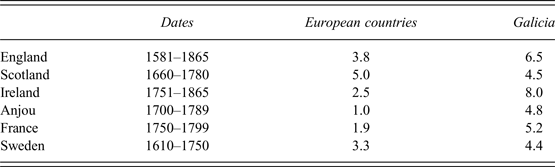
A quick, prima facie idea of the level of illegitimacy reached in Galicia can be gained from a simple comparison with the situation in other European countries, shown in Table 1.Footnote 2 Ratios for Galicia have been adjusted to match the specific time periods for which data are available for other countries. At certain moments of the Ancien Régime the ratio for Galicia was double or even triple that of Sweden, England and France, and up to 4.1 times higher than the ratio for Ireland.
Illegitimacy ratios in Europe

Sources: For England (74 parishes): Peter Laslett, Family life and illicit love in earlier generations (Cambridge, 1977) and Peter Laslett, Karla Oosterveen and Richard M. Smith eds., Bastardy and its comparative history (London, 1980); for Scotland (16 parishes): Leah Leneman and Rosalind Mitchinson, ‘Scottish illegitimacy ratios in the early modern period’, Economic History Review 40, 1 (1987); for Ireland (7 parishes): Sean J. Connolly, ‘Illegitimacy and pre-nuptial pregnancy in Ireland before 1864: the evidence of some Catholic Parish Registers’, Irish Economic and Social History 6 (1979); for Anjou: François Lebrun, ‘Naissances illégitimes et abandons d'enfants en Anjou au XVIIIe siècle’, Annales ESC 4 (1972); for France as a whole: Yves Blayo, ‘La proportion de naissances illégitimes en France de 1740 à 1829’, Population 30 (1975); for Sweden: Richard F. Tomasson, ‘Premarital sexual permissiveness and illegitimacy in the Nordic countries’, Comparative Studies in Society and History 18, 2 (1976); for Galicia as a whole: see endnotes 2 and 9.
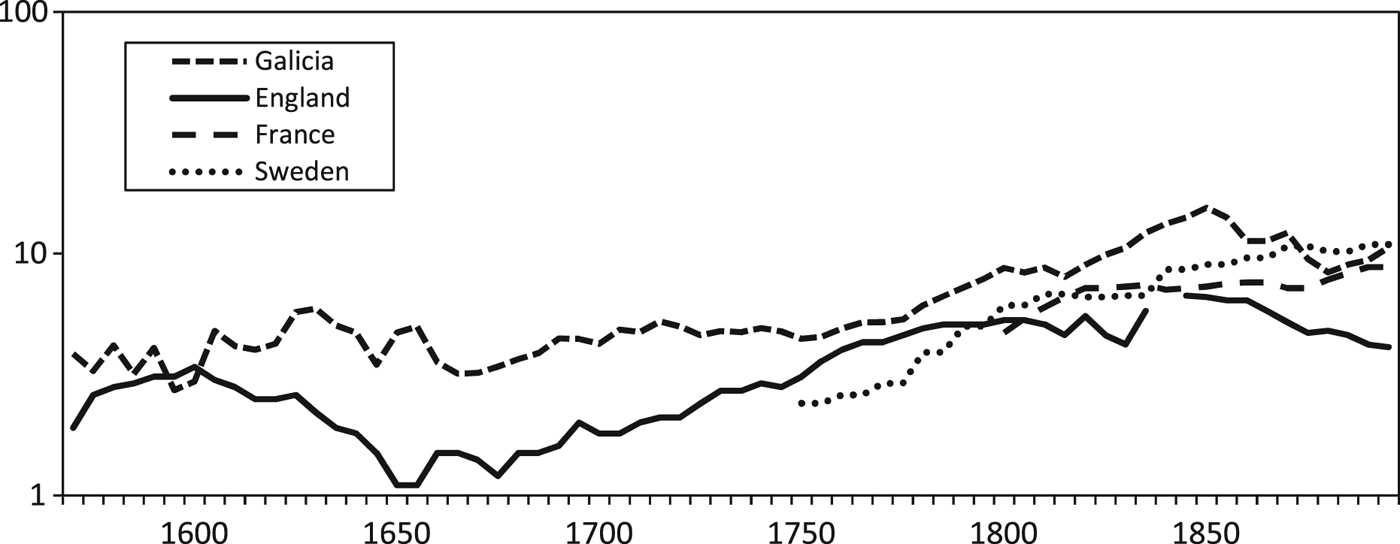
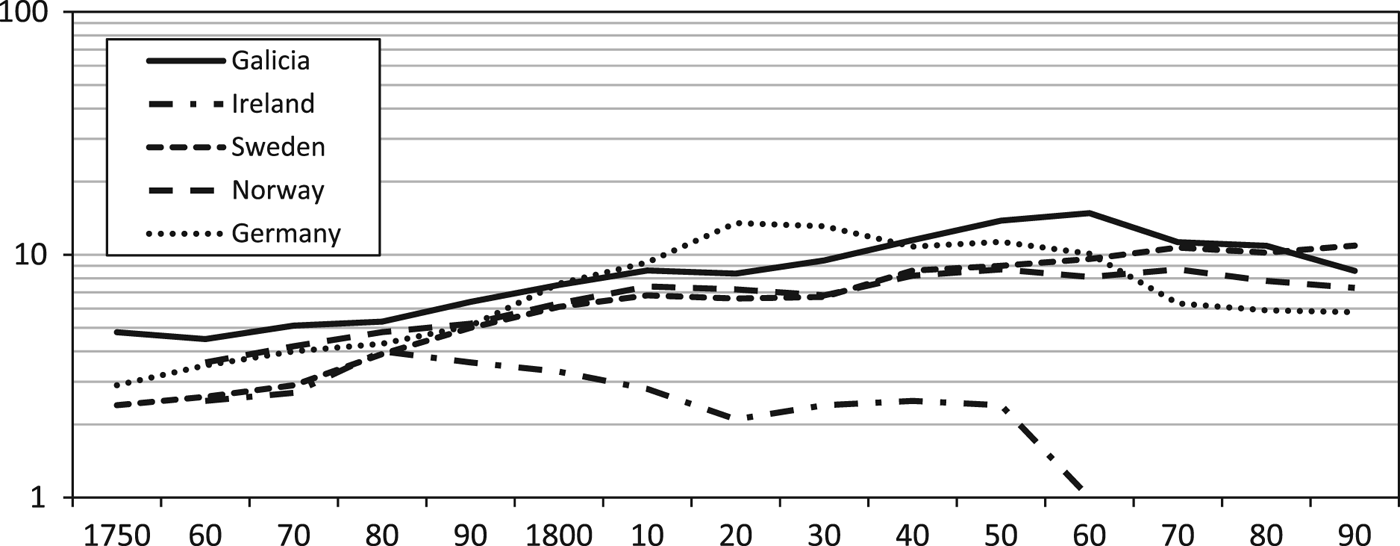
Strikingly, despite differences in the levels of illegitimacy, the long-term trends show remarkable similarities (Figure 1). If we compare Galicia and England, for which data are available back to the sixteenth century, the trends over the sixteenth and seventeenth centuries diverged somewhat, with Galicia witnessing a slight decline in illegitimacy at the end of the sixteenth century, a rise up until 1640 and then another dip until the 1670s. The trend thereafter, however, was very similar to England's: a first rise until 1720 followed by relative stability until 1770–1780 and then a second rise until 1860 (see Figure 1). A turning point around 1860, after an almost continuous rise since 1770, is a pattern repeated in countries as different as Scotland, Denmark, France, Sweden and Norway (Figure 2).Footnote 3
Illegitimacy trends in Galicia (1570–1899). Sources: Galicia: see endnotes 2 and 9, drawn up by the author; for England: Laslett, Family life and illicit love in earlier generations; for France: Etienne Van de Walle, ‘Illegitimacy in France during the nineteenth century’, in Laslett, Oosterveen and Smith eds., Bastardy and its comparative history, and Yves Blayo, ‘La proportion de naissances illégitimes en France de 1740 à 1829’, Population 30 (1975).

Illegitimacy trends in Europe (1750–189). Sources: For Galicia: drawn up by the author from the sources indicated in Figure 1; for Ireland: Connolly, ‘Illegitimacy and pre-nuptial pregnancy in Ireland before 1864’; for Sweden and Norway: Tomasson, ‘Premarital sexual permissiveness and illegitimacy in the Nordic countries’; for Germany: John E. Knodel, Demographic behaviour in the past: a study of fourteen German village populations in the eighteenth and nineteenth centuries (Cambridge, 1988).

The evidence of a widespread rise in illegitimacy around 1770–1780 led Edward Shorter to propose an explanation in the form of a putative ‘Sexual Revolution’ that he linked to the wave of industrialisation and urbanisation then beginning in Europe.Footnote 4 Nevertheless, this interpretation does not account for the fact that the post 1770–1780 illegitimacy boom occurred in countries with very different degrees of economic and social development, such as England, France or Norway. There were also European regions where the trends in illegitimacy did not tally with this timeframe. In northern Portugal and Ireland illegitimacy dropped steeply during the period 1770 to 1810–1820; while in Germany, the peak came in 1820–1829, thirty years earlier than the other countries (see Figure 2).Footnote 5 In France, the illegitimacy ratio plateaued after 1820, attributed to the slow but steady spread of the ‘dismal secret’ of contraception among the bulk of its inhabitants (see Figure 1).Footnote 6 These criticisms of Shorter's thesis highlight the danger and drawbacks of trying to come up with any catch-all explanation of the problem in Europe.
Peter Laslett had provided a more compelling explanation for the secular fluctuations in English illegitimacy levels some years earlier. He called scholars’ attention to the close parallels between the trend in legitimate and illegitimate births (as represented by baptisms) and the marriage trend. When the age at marriage rose as real wages fell and posed greater difficulties to marriage, both legitimate and illegitimate births fell. By contrast, when the age at marriage fell, as marriage became easier in a time of relative economic prosperity, both the legitimate and illegitimate ratios tended to rise.Footnote 7 The explanation proposed by Laslett was that courtship often involved pre-marital sex: the greater willingness to promise marriage in times of rising real wages made pre-marital sex more likely, but then if the marriage did not take place, an illegitimate birth was a frequent outcome. Laslett also proposed the notion of ‘repeaters’, that is, mothers who bore more than one illegitimate child, suggesting that small numbers of women were often thus responsible for the bulk of illegitimate births in particular parishes.
Although this study makes use of the idea of ‘repeaters’, as discussed in section 6 below, it would be a mistake to see real wages as having an effect on illegitimacy in the north-west of the Iberian Peninsula. It should be borne firmly in mind here that Galicia was not England; it was a highly rural area with very little urban development. In the eighteenth to nineteenth centuries, as noted above, smallholdings and subsistence farming remained the basis of the economy, and wage labour played little part.Footnote 8 Under these circumstances it would seem illogical to expect the trend in legitimate and illegitimate fertility to bear any medium- or long-term relationship to the real wage trend.
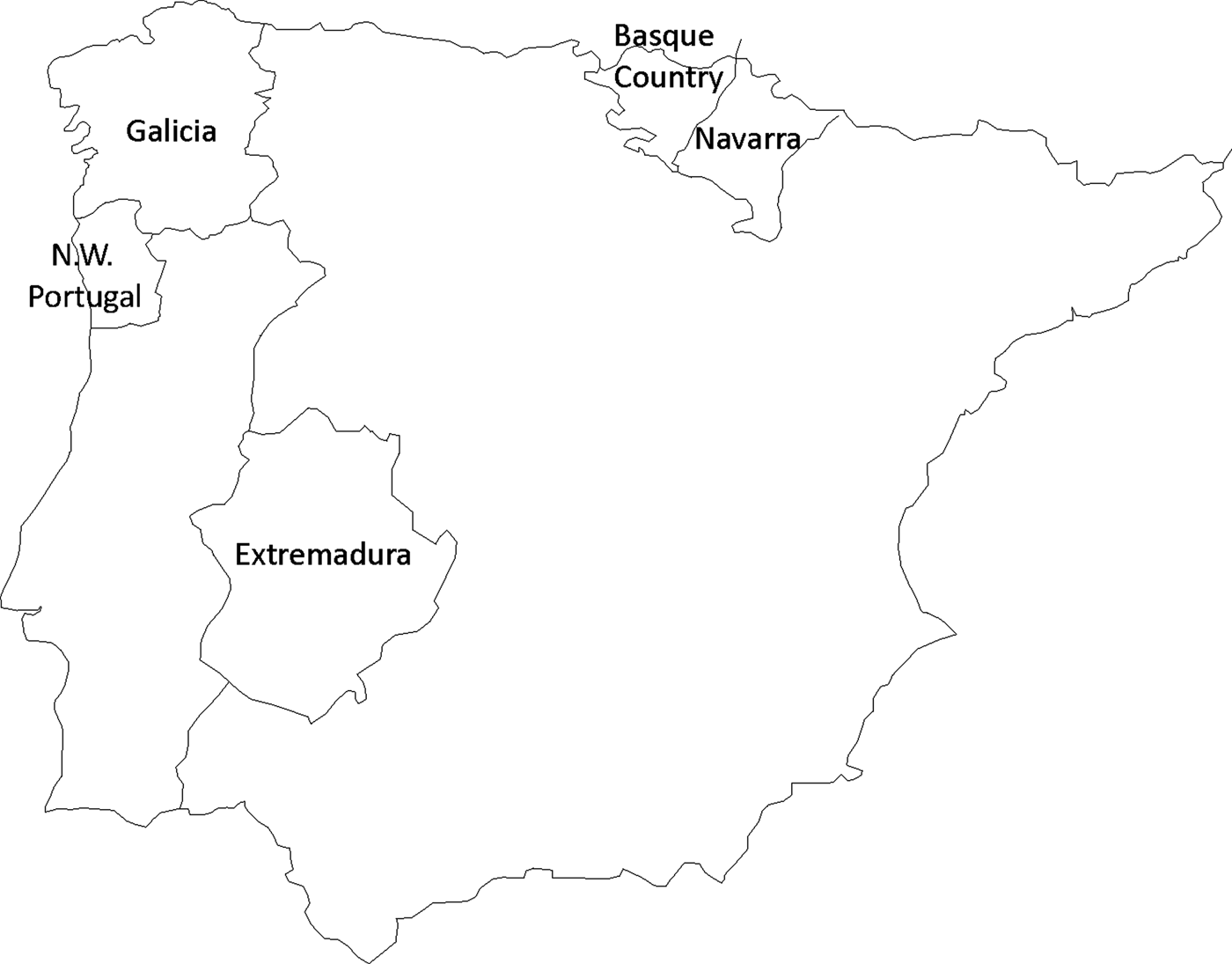
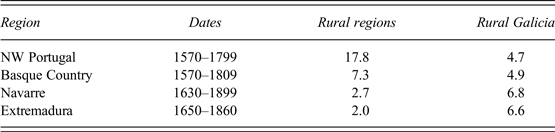
Illegitimacy ratios also varied markedly within the Iberian Peninsula. The few regional studies tend to focus on the rural world (Table 2). Here we see that rural Galicia's illegitimacy ratio was 3.2 times lower than north-west Portugal's and 1.2 times lower than that of Guipuzkoa, in the Basque Country. Conversely, it was more than four times higher than the ratio in regions as diverse as Extremadura and Navarre (Figure 3).Footnote 9 Although few in number, the figures for the Iberian Peninsula have the particular virtue of raising questions about illegitimacy that Spanish research has hardly tackled hitherto. A key question would be why geographical areas relatively close to each other, and with similar patterns of economic, social and demographic development should show such different illegitimacy patterns. All of the areas of northern Iberia that have been studied, that is, Galicia, the Basque Country, Navarre and north-west Portugal, were characterised throughout the early modern era by low rates of urbanisation, a late age at marriage pattern, seasonal or temporary migration to other areas of the peninsula, the predominance of smallholdings, subsistence farming and the relative importance of stem families. Despite these overall similarities, these areas were characterised by quite different illegitimacy patterns, as shown in Table 2.
Locations of various rural regions in the Iberian Peninsula. Source: Drawn up by author.

Illegitimacy ratios in the Iberian Peninsula

Sources: For north-west Portugal (11 parishes): Antonio A. Neves, Filhos das ervas: a ilegitimidade no norte de Guimaraes, séculos XVI–XVIII (Guimaraes, 2001); for Basque Country (5 parishes): Lola Valverde, ‘Algunos aspectos de la ilegitimidad en Guipúzcoa durante la Edad Moderna’, in II Congreso Mundial Vasco, Volume IV: La crisis del Antiguo Régimen (San Sebastián, 1988); for Navarre (14 parishes): Fernando Mikelarena, ‘Ilegitimidad y exposición en Navarra, siglos XVI–XX’, in Vicente Pérez Moreda coord., Espostos e Ilegítimos na realidade ibérica, do século XVI ao presente (Porto, 1996); for Extremadura: Pablo Blanco Carrasco, Demografía, familia y sociedad en la Extremadura moderna, 1500–1860 (Cáceres, 1999); for rural Galicia: see endnote 9.
The differences over time in the illegitimacy ratios in these regions of the northern Iberian Peninsula have traditionally been explained by invoking the efforts at moral and social reform driven by the Council of Trent in 1563.Footnote 10 It was the continual pressure exerted by the Catholic Church on the inhabitants of these regions, it is argued, that fostered among them a bedrock of sexual morality, whether at the level of the individual, the family or the community. The long-term effects of this were a steady fall in bastardy. The ‘religious variable’, so to speak, in fact clearly accounts for very little in this case. It cannot come up, for example, with any coherent explanation for why the illegitimacy ratio continued to rise in north-west Portugal during the 60-year period following on from the Council of Trent – rising to levels of about 26 per cent of total baptised children in the 1630s – despite the reforms undertaken by the Portuguese church in the area after 1563.Footnote 11 Neither does it explain why bastardy also rose across Galicia from 1670–1680, despite the fact that the reforms brought in by the religious authorities from the end of the sixteenth century to improve the moral life of the lower clergy and their congregations, had taken hold by then in three of the five dioceses, that is, in over 47 per cent of this territory.Footnote 12 Another factor religious reform does not account for is why the illegitimacy ratio rose again from 1770–1780, by which time these reforms had taken firm hold throughout Galician society, and continued to rise until the 1850s–1860s (see Figure 1).
Our hypothesis is that social and demographic dynamics at the regional level offer a better explanation of the development of illegitimacy over the mid and long term. Focusing on local variables and contexts allows a better chance of providing a cogent explanation of how illegitimacy reached much the same level in two geographical areas otherwise so dissimilar (in demographic, economic, social and family-structure terms) as Extremadura and the Basque Country or, conversely, how it is possible that two areas so relatively close geographically and similar like north-west Portugal and south-west Galicia, for one, or the Basque Country and Navarre, to take another example, had such different illegitimacy ratios (see Table 2 and Figure 3).Footnote 13
3. RURAL GALICIA AS A CASE STUDY FOR ILLEGITIMACY: SOURCES AND METHODS
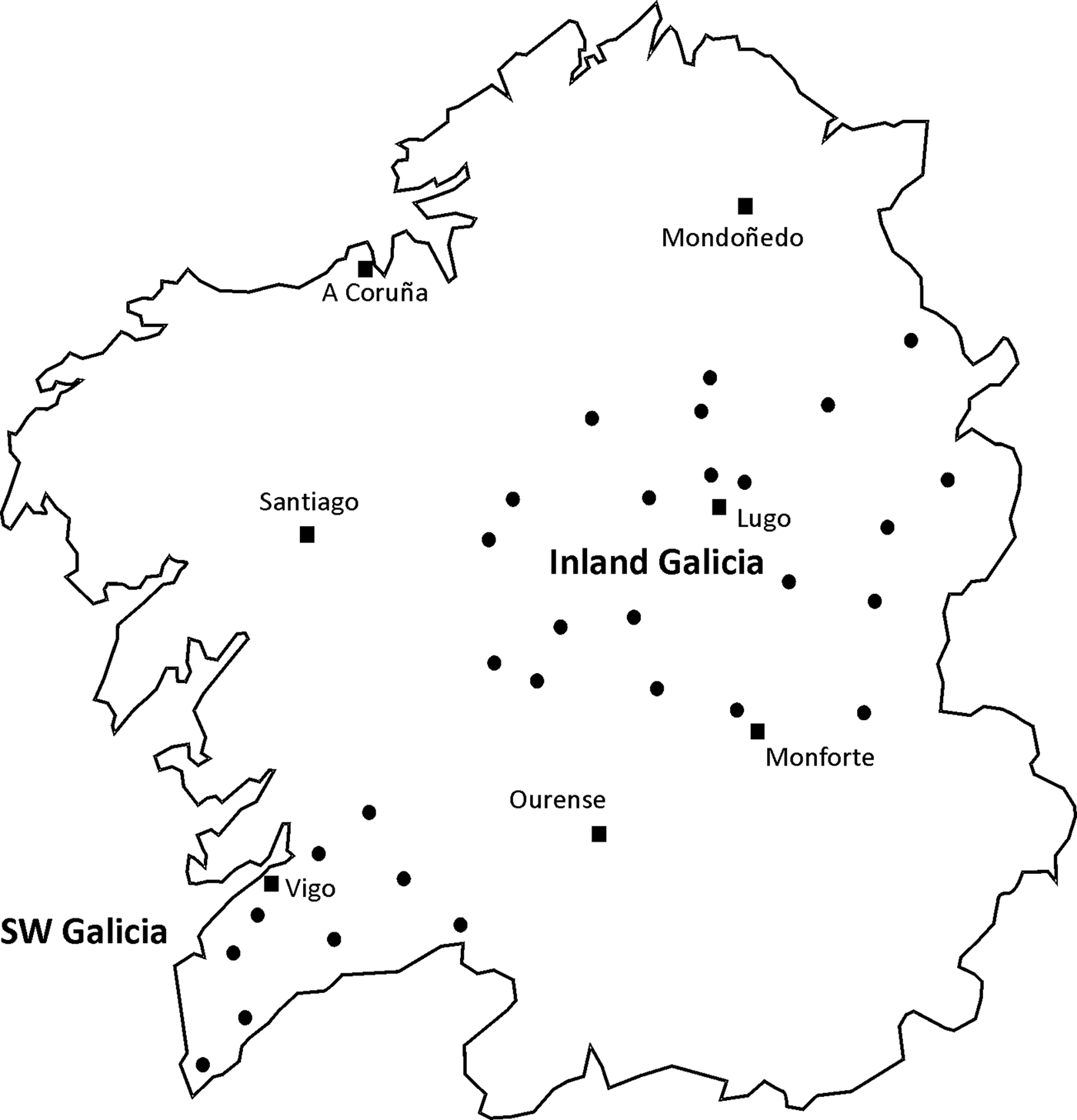
The best idea would seem to be to seek the whys and wherefores of the various illegitimacy trends in Spain and elsewhere in the local historical contexts.Footnote 14 In an attempt in this direction, this study will cover two different rural areas of north-west Spain – inland Galicia and south-west Galicia – from 1570 to 1899. These two dates have been chosen because the former marks the beginning of reliable recording of illegitimacy in parish registers, while the second date relates to a new phase in illegitimacy, driven by the economic and social transformations underway in rural Galicia in the first third of the twentieth century. To carry out this research, this article draws on the information contained in baptism records in parish registers, namely, cases in which the mother was described as unmarried, or where a note in the margin made clear the infant was illegitimate. This information improved greatly in quality from the last quarter of the sixteenth century to the end of the nineteenth, as registers were inspected with greater regularity by bishops’ representatives. This research enabled us to draw up a nominative database containing 10,300 illegitimate baptisms recorded among 141,100 baptisms pertaining to 29 rural parishes of inland and south-west Galicia (Figure 4). This database has allowed us to establish both the trends in illegitimacy ratios over time and the number of mothers bearing more than one illegitimate child.
Location of parishes in rural Galicia (circles = location of rural parishes; squares = main cities and small towns in Galicia at that time). Source: Drawn up by author.

In this study, we also use information contained in the Catastro de Ensenada. This source is essentially a household listing resulting from a project by the Crown to impose a new tax on the territory of the Crown of Castile, a tax that would be proportional to the level of wealth of each individual and household. Between 1750–1756, all individual members of households, including children and servants, were registered in each locality, along with the property and income owned by each household, and the rents and taxes already paid on this property and income. In Galicia, registration was carried out at parish level by royal officials, aided by parish priests.Footnote 15 Using this source, I have drawn up a database of 20,721 households belonging to 311 rural parishes chosen from a systematic and random sampling of the almost 3,700 parishes of rural Galicia in 1752. We compare this with another database of 1,267 households belonging to 26 rural parishes located in the current municipal districts of Lugo, in inland Galicia, and Trazo, in north-west Galicia, in the 1860s, based on household listings (padrones) drawn up at municipal level. In this second case the limited size of the sample in terms of the number of parishes included is more than made up for by the considerable improvement in the quality of the information the sources contain, giving a greater depth to our analysis. In 1752, for example, the sources offered information only on the size and structure of households that were headed by bastard-bearing mothers. By 1860 this pool of information included average age, social status, size and structure of the households they headed or to which they belonged, and, last but not least, the age at which they first gave birth to an illegitimate child can be calculated from the ages of their children.Footnote 16
We can therefore combine these three datasets to establish illegitimacy ratios for our study areas, the basic social profiles of the mothers who bore illegitimate children, and make an educated guess at their degree of acceptance within their respective parishes and work out how many of these mothers had given birth to two or more bastards. The long-term constancies and changes within each of these factors also give us a rough idea of the transformations that might have taken place within the internal structure of illegitimate fertility over the more than three-hundred-year period from 1570 to 1899.
It should be borne in mind here that both the calculation of the illegitimacy ratios and the study of their trend over time include foundlings abandoned in house doorways or rural church porches. These children may or may not have been illegitimate, though illegitimacy was a compelling reason for abandonment. Such children would have been baptised in the parishes in which they were found before being sent to Galicia's only foundling home until the end of the eighteenth century, in the city of Santiago de Compostela. Their number was very small, however; they feature in only 0.43 per cent of the 141,100 baptisms; moreover they account for only 5.9 per cent of the 10,300 bastards making up the nominative database. This means that from 1570 to 1899, 99.6 per cent of all baptised children and 94.1 per cent of the total of illegitimate children were cared for in the first instance by their respective mothers, relatives or kin. These figures, together with other evidence in previous works, show the low ratio of abandoned foundlings in rural Spain during the Ancien Régime.Footnote 17
Neither does it seem to be the case that the calculation of illegitimacy ratios in the two rural Galician districts has been skewed significantly by a massive increase of expectant mothers into nearby towns to give birth. Had this been so, urban illegitimacy ratios would have been much higher than those recorded in rural areas. In the city of Lugo, for example, only 7 per cent of the total baptised children between 1650 and 1849 were illegitimate. The same figure was 10 per cent in the small town of Monforte de Lemos from 1600 to 1895.Footnote 18 By contrast, the combined ratio for the rural parishes making up inland Galicia in which these two built-up areas were set, was 9.1 per cent of the total from 1600 to 1899. Much the same goes for Atlantic Galicia: in 1635–1860, 6.7 per cent of the total of baptised children in Santiago de Compostela, the largest city in north-west Spain until well into the nineteenth century, were illegitimate while in the rural district of Ulla, lying only 25 kilometres south of Santiago, this figure was 4.2 per cent from 1600–1849.Footnote 19 Some of the young women giving birth to a bastard in Galicia's built-up areas had moved there from the outlying country areas with this sole purpose in mind. In the above-mentioned town of Monforte de Lemos, about 37 per cent of unmarried mothers between 1600 and 1895 came from nearly rural parishes. Despite this fact, as already pointed out, not only was Monforte's illegitimacy ratio very similar to that recorded in the rest of inland Galicia, but 10 per cent of the mothers of illegitimate children in these inland parishes gave birth to these children in a different parish from the one where they themselves had been born, including a few who had moved from Monforte or Lugo to the countryside.
Working from the information derived from the parish registers and household listings, the remainder of this article begins with a brief historical account of the two study areas in order to understand the economic and social context, before moving on to describe the evolution of illegitimacy within the two areas. A further section focuses on the internal dynamics of this illegitimacy, paying particular attention to mothers who bore more than one illegitimate child (the ‘repeater’ ratio).Footnote 20 As this article will show later, the results obtained cast doubt on some of the received ideas as to why illegitimacy became so widespread in Europe's rural societies.
4. TWO WORLDS, TWO ILLEGITIMACIES?
Twenty of the twenty-nine rural parishes I have looked at lie in inland Galicia (see Figure 4). This territory makes up about one fifth of today's Galicia; in the eighteenth and nineteenth centuries it accounted for 23–4 per cent of the total population of the north-west Iberian Peninsula. Lying at a height of over 500 m on the high ground called ‘tierras altas’, it was a very sparsely developed area, with only two large built-up areas. The city of Lugo was the provincial capital, episcopal see and privileged residence of lay and ecclesiastical rentier groups. Its 4,019 inhabitants in 1787 had more than doubled by 1860. The smaller town of Monforte de Lemos increased its population from 1,650 inhabitants to nearly 4,000 between the same dates.Footnote 21
The countryside surrounding these towns was characterised by low population densities (27 inhabitants per km2 in 1752; 40 in 1860), and a scattered settlement pattern made up of small hamlets. These were organised around a parish that in 1752 had an average of 200 inhabitants. The inhabitants practised a type of agriculture based on the cultivation of rye interspersed with fallow periods on farms with an average size of 2.5–2.7 hectares. This agriculture produced only a single harvest each year. To eke out a living on this basis it was necessary to exploit scrubland and to raise a large number of livestock. Many household members also participated in seasonal or short-term labour migration to neighbouring Castille, while also carrying out all sorts of other complementary trades like rope-making, carpentry, shoemaking, pottery, etc. This technically backward agriculture, partly a result of tiny patchwork farms, made up by an average of 40 plots, was traditionally associated with a high proportion of stem families. Between 1752 and 1860–1869, 40–5 per cent of families in the heartland of inland Galicia took this form, although in inland Galicia as a whole this figure fell to about 30–3 per cent.Footnote 22
This agricultural, social and family system was sustained over time thanks to a patrilocal, non-egalitarian inheritance system that, after gestation in the sixteenth and seventeenth centuries, came to full fruition in the first half of the eighteenth century.Footnote 23 Under these conditions it was normal for the head of the household upon his death to leave the bulk of the farm to the firstborn son living at home. The workings of this inheritance system had significant demographic and social implications. The combination of a post-mortem inheritance system and the heir's obligation to facilitate the marriages of his younger siblings, marriages that usually had to be phased in over time, explains inland Galicia's late-marriage pattern (26 years for women over the period 1787–1887) and the high proportion of women who never married. In 1787, 18.3 per cent of women aged fifty and over had never married; in 1887, it was 22.4 per cent. In addition, the aforementioned succession of marriages tended to eat into the family's dowry budget. This meant that the second, third or fourth child to be married after the elder son often had to choose between running the risks of downward social mobility associated with a smaller dowry or remaining as a bachelor or spinster in the paternal household under the new head of the family. The other alternative was for younger children to look for their own livelihood outside the family. For women this would mean the possibility of ending up as a maid in a house of kin or a neighbour. For men it meant eking out a living in the lowest levels of the peasantry or also going into farm service.Footnote 24
The workings of this inheritance system also reinforced the patriarchalism that imbued each and every aspect of social life in inland Galicia. One example would be the low number of female heads of household in the zone (10–12 per cent) until the very start of the nineteenth century. The proportion of female heads of households, however, varied inversely with the scale of farming property within the different classes, increasing therefore as we move down the social scale. In the mid-eighteenth century, women headed only 5 per cent of farming households; among the poor, however, with no landed property, they headed 52 per cent of households. A century later, after a relative relaxation of the inheritance system from 1769 onwards, 25 per cent of households in the 1860s in rural parishes close to the city of Lugo were led by women. Among the richer farmers, however, this percentage was only 18–19 per cent, but was 36 per cent for day labourers and as high as 66 per cent among the poor.
The relaxation of the inheritance system stemmed from the spread of potato farming in the zone after the great famine of 1769. The ensuing agricultural transformations greatly boosted yields. This led to a reorganisation of arable farming, freeing up land for further cultivation, which in turn favoured a relaxation of the inheritance system and provided a stimulus for marriage, since the young no longer needed to wait for the death of their father to be able to get married and start their own family. The combined effect of these changes was an increase in the number of farms between 1752 and 1830 and a sharp reduction in complex family structures.Footnote 25 This picture changed again, however, from the early 1850s after the introduction of a new taxation system in 1845. The agrarian crises of 1852–1858 and 1878–1880 also made living conditions much harsher, thus reducing the marriage prospects of young people from the lower peasant classes.Footnote 26
The other nine parishes used in this part of the study come from south-west Galicia, making up 6 per cent of Galicia's territory today and formed by those rural districts that roughly comprised the ancient province of Tui. Clustered here were six of the twenty-two cities and small towns of the north-western Iberian Peninsula. Since the end of the eighteenth century some of them, particularly the town of Vigo, had expanded briskly in both commercial and industrial terms, multiplying their population fourfold by 1887.Footnote 27 In this regard, most of the towns, villages and the rural regions of the ancient province of Tui benefited from their strategic geographical position. This area served as the natural outlet for Vigo's overland trade with inland Galicia and neighbouring Castile through the city of Ourense.Footnote 28 On the strength of this trading activity half the rural parishes of south-west Galicia had an average of 700 inhabitants by the mid-eighteenth century. Hamlets were relatively densely populated too and population densities in general exceeded 100 persons per km2 (110 persons in the 1787 census), that is, four times higher than those chalked up by inland Galicia at the same date.
Another reason for these high population densities was the introduction of maize as a local farming crop in the early seventeenth century. This crop's high yield spawned a vigorous population growth in the following century. Ensuing land pressure produced a patchwork landscape of minifundista farming, with an average farm size of 1.3 hectares. Even these tiny farms managed to turn out up to three harvests a year, thanks to a complicated system of crop rotations. Nonetheless, from 1690 to 1730, the high yields of this multi-crop subsistence farming system were no longer sufficient to feed the swelling population of the south-west. As the eighteenth century progressed, therefore, the local residents were forced to fall back on an increasingly varied clutch of complementary peasant activities while also emigrating to Castile, Andalusia, or Portugal on a temporary or seasonal basis. A complex labour market thus developed over the eighteenth century, which helps to explain how 65 per cent of the peasants of south-west Galicia were able to survive on even smaller holdings with an average size of just 0.65 hectares, totalling only 20 per cent of the total arable area.Footnote 29
For much the same reason, the marriage pattern at this time was characterised by a high age at first marriage for women (25.3 years in 1787; 25.6 years in 1887) and a high proportion of never-married women (15.3 per cent in 1787; 29.5 per cent in 1887). Similarly, the combined effect of increasing male emigration from 1730 and the relative complexity of the labour market explains why 27–8 per cent of eighteenth-century households were headed by a woman. It should be borne in mind here that the inheritance system of south-west Galicia was more egalitarian and less patriarchal than that of inland Galicia. Indeed, it proved in practice to be much more flexible and even-handed to all household members, whatever their gender.Footnote 30 Accordingly, by the end of the Ancien Régime, 65 per cent of south-west families were nuclear in form, 12 per cent consisted of individuals living alone and 21 per cent were complex, albeit much less so than the stem families of inland Galicia. The formation of complex households in south-west Galicia stemmed more from welfare objectives, that is, the desire to ensure care in old age, than from the desire to pass on the farm (la casa) whole to the firstborn male.Footnote 31
This productive, labour and family system remained more or less intact throughout the first two thirds of the nineteenth century. This longevity was helped by changes introduced into the agricultural system in the 1790s. The net result of all these factors was population growth: by 1860 the population density had increased to about 140 inhabitants per km2. From here on, with the agricultural system on its last legs, the imbalance between the population and agricultural output of south-west Galicia was solved by a combination of late marriage and mass emigration to the Americas.Footnote 32
In short, we are dealing here with two markedly different historical contexts in terms of population, agrarian and family structures and labour markets. In what follows, we compare illegitimacy in the two areas and whether trends over time were responding to the same factors.
5. ILLEGITIMACY IN INLAND AND SOUTH-WEST GALICIA (1570–1899)
From 1570 to 1899 south-west Galicia's illegitimacy ratio was 5.7 per cent of total baptised children. During the same period, the ratio for inland Galicia stood at 9.1 per cent of the total, a difference of 37 per cent. This is a striking difference given some of the claims in the literature discussed at the start of the article, since bastardy was much lower in Galicia's most highly populated and demographically, economically and socially dynamic districts. Moreover, these same districts over the eighteenth and nineteenth centuries witnessed a growing glut of single women on the local marriage market due to the strong temporary and seasonal emigration of young males to the cities of Castile, Andalusia, Portugal and, from the end of the eighteenth century, to the Americas.Footnote 33 In addition, as outlined in the previous section, patriarchalism had a much weaker hold here than in inland Galicia, as evidenced by the fact that, by the end of the eighteenth century, 27–8 per cent of households in the area were headed by women. One in three of these women lived alone, with nobody at their side to dissuade them from any licentious sexual behaviour. Despite assumptions to the contrary, therefore, it is clear that in southwest Galicia, the dearth of marriageable males and a high degree of individual and social autonomy for women did not result in a higher bastardy ratio.Footnote 34
It is equally difficult to come up with reasons for inland Galicia's high illegitimacy ratio. Again, this area does not fit with the standard assumptions. It was a lightly populated area, and emigration by young men, until well into the nineteenth century, was limited to annual harvest migration to Castile.Footnote 35 High illegitimacy might be attributed to late marriage for women, except that the same pattern held sway both in inland Galicia (mean age at first marriage of 26.3 years in 1787; 26.1 in 1887) and in south-west Galicia (25.3 years in 1787; 25.6 in 1887). The difference is certainly not enough to explain the differences in illegitimacy, which suggests that demography is not the key to understanding high illegitimacy in this case. Elsewhere, I have suggested, contrary to what others have argued, that inland Galicia's bastardy boom from 1570 to 1899 was closely bound up with women's low status within the family, and with their low degree of personal and social autonomy, alongside the continual reinforcement of a non-egalitarian hereditary system.Footnote 36 Research is as yet insufficiently advanced to enable us to draw similar conclusions about the late eighteenth-century picture in south-west Galicia. Nonetheless, it seems clear that the best way of tackling the study of illegitimacy in rural Galicia is by giving prominence to social rather than purely demographic factors.
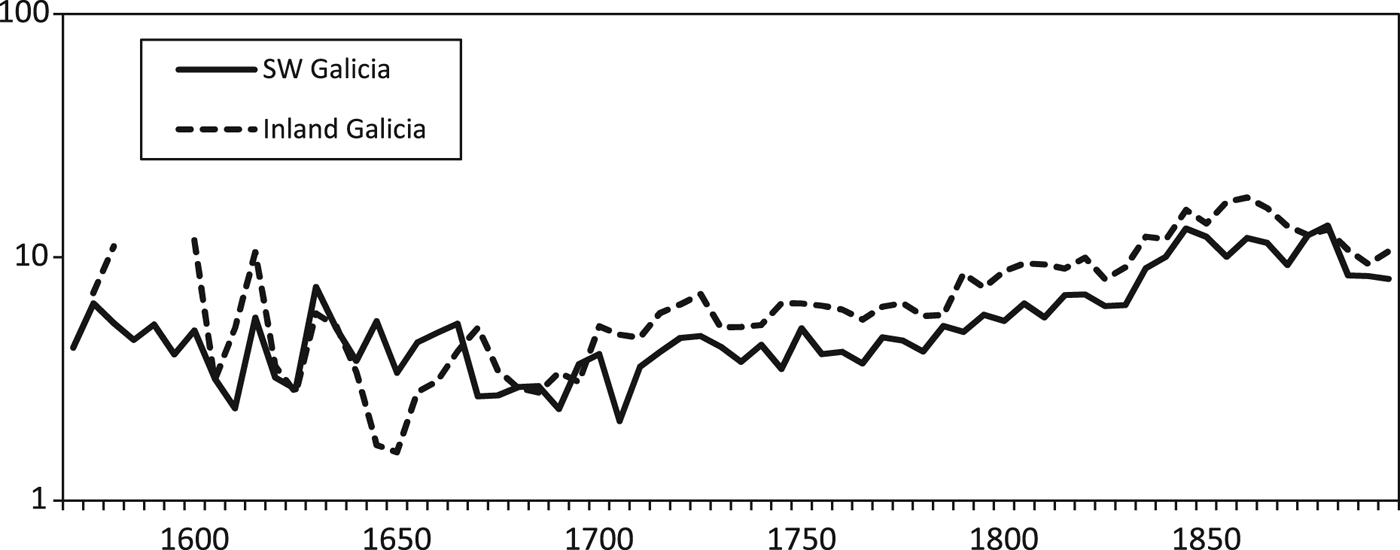
A further difficulty is that, although the two regions had different levels of illegitimacy, the trends over time were very similar, as shown in Figure 5. Thus after initial levels that were dropping sharply at the end of the sixteenth century both in south-west Galicia and in inland Galicia, accounting for about 4.3 and 6.5 per cent respectively of the total of baptised children, the illegitimacy ratio continued to fall, more sharply in the interior, from about 1620 or 1630 to 1680, dropping from 5.5 and 5.8 per cent of the total to 2.8 and 2.9 per cent of the total. After this fall it climbed back up to about 4.8 and 6.7 per cent by 1720. Over the next fifty years, these figures plateaued around 4 and 6 per cent, rising rapidly again after about 1770. By 1860–1864, the figures were three times higher than in 1770, up to 12 and 17 per cent of all baptisms. This peak was followed by a further dip to 8 and 10 per cent by the start of the twentieth century.
Illegitimacy trends in rural Galicia (1570–1899). Source: Inland Galicia and south-west Galicia: Parish Baptism Registers kept in Archivo Histórico Diocesano de Lugo (hereafter AHDL) and Archivo Histórico Diocesano de Tui (hereafter AHDT). Drawn up by the author.

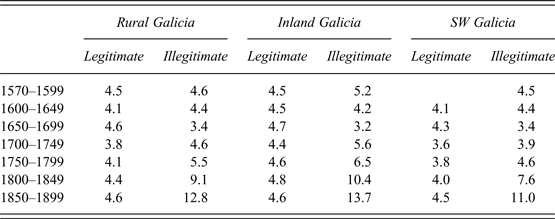
It is very hard to explain trends in illegitimacy in terms of background changes in settlement patterns, the degree of urban development, the type of farming carried out, emigration or other factors, since these varied across the two areas. Similarly, legitimate fertility trends were the same in inland and southwest Galicia. Table 3 shows both fertility trends in each territory to illustrate this point. As an indirect indicator of marital fertility, the Table uses the ratio of legitimate children baptised to the number of marriages celebrated, while illegitimate fertility has been estimated by calculating the percentage of illegitimate children in relation to the baptism total.
Relation between legitimate and illegitimate fertility, rural Galicia (1570–1899)

Sources: AHDL and AHDT. Drawn up by author.
We thus see a rise in legitimate fertility in both regions, in inland Galicia from 1700 to 1849, in south-west Galicia from 1700 to 1899, which coincided with an unbroken rise in illegitimacy from 1650 to 1899. In inland Galicia, this rise took place against a backdrop both of agricultural stagnation before 1769 and also during the expansion triggered off by the rapid take-up of potato cultivation described in the previous section. The upward illegitimacy trend did not stop even after the 1840s, when expansion ceased and when living conditions were worsened by a new taxation system in 1845 and the agrarian crises of 1852–1858 and 1878–1880.
In south-west Galicia, rising fertility occurred against the background of three successive phases: first, a profound demographic and economic crisis, sparked off by the exhaustion of the maize-fuelled agricultural expansion cycle of the early seventeenth century; second, the agricultural recovery from 1800 to 1840; and, third, the agricultural downturn after 1840 and the crises of 1852–1858 and 1878–1880.
That long-term trends in illegitimacy should be as similar in two such different contexts as described here suggests that, unlike Laslett's suggestion for England, no simple explanations are to be found in agrarian changes or demographic factors such as late age at marriage. Instead, an alternative explanation for this steady and unbroken upward illegitimacy trend for Galicia is to be found in the changes occurring in the internal structure of illegitimate sexuality. This is suggested by the Ih index, which tells us the propensity of unmarried women aged 15 to 45 to have natural children. In Galicia, this has been calculated at 12.2 per thousand unmarried women in 1787 and 12.7 per thousand for Galicia in 1887. That the Ih index should have hardly changed, at a time when the ratio of illegitimate births saw nearly a threefold increase, suggests that, increasingly, the number of illegitimate children borne by the same mothers was rising, rather than a greater proportion of women bearing only one illegitimate child.
6. THE INTERNAL DYNAMICS OF ILLEGITIMACY
Apart from parish registers, there are very few systematic mentions at all in sixteenth- and seventeenth-century sources about single mothers, let alone those who had two or more illegitimate children. Later on, some insights can be gleaned from the household listings of 1752 and the 1860s, as described above. These insights support the idea that single mothers giving birth to more than one child loomed ever larger in the picture of Galician illegitimacy.
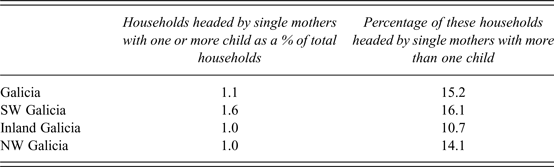
Although the information in the 1752 Catastro de Ensenada, described in section 3, is by no means as complete as we might wish, it does provide information about the household circumstances of single mothers, and allows us to identify those who had more than one illegitimate child. At this point, based on a sample of 311 parishes from across the whole of Galicia, illegitimate baptisms were 4.5 per cent of the total. The information in the Catastro suggests that most mothers of illegitimate children lived with their birth families or other close relatives, considering that barely 1.1 per cent of all Galician households were headed by an unmarried mother. Moreover, in only 15.2 per cent of these were two or more children involved (Table 4). Table 4 shows that the proportion of households headed by unmarried mothers was higher in south-west Galicia, at 1.6 per cent, than in the rural districts of north-west or inland Galicia. While the percentages of households with more than one illegitimate child varied across the region, the proportion of single women with two or more children was the same in all three districts as for Galicia as a whole, namely 10 per cent.
Households headed by single mothers with one or more child in rural Galicia, 1752

Sources: Catastro de Ensenada. Inland Galicia: Archivo Historico Provincial de Lugo (hereafter AHPL); south-west Galicia: Archivo Histórico Provincial de Pontevedra; north-west Galicia, Arquivo Histórico do Reino de Galicia. Drawn up by author.
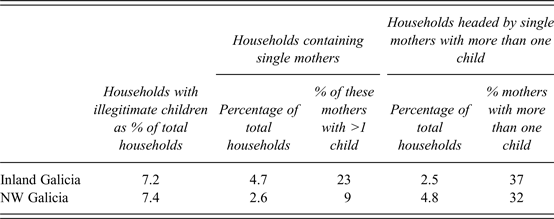
A little over a century later, when illegitimacy had risen to account for about 14–15 per cent of total baptisms, the lists of inhabitants drawn up at local level in the 1860s show that illegitimacy was now present in at least 7 per cent of households (Table 5). For this decade, we are working with 26 rural parishes from the old municipality of Lugo, in inland Galicia, and the current municipality of Trazo, lying 20 kilometres north of the city of Santiago de Compostela, in north-west Galicia. In the parishes near Lugo, 7.2 per cent of households contained an illegitimate child, while in those near Trazo, 7.4 per cent did.
Percentage of households with illegitimate children, rural Galicia, 1860

Sources: Inland Galica, Padrones municipales, AHPL, and north-west Galica, Archivo Histórico Municipal de Trazo. Drawn up by author.
The 1860 figures show clearly the important role played by families in inland Galicia in taking in unmarried mothers. These families represented 4.7 per cent of total households, while those headed by unmarried mothers accounted for only 2.5 per cent of the total. These figures contrast with those found in the rural districts of north-west Galicia, where 4.8 per cent of households were headed by single mothers, outnumbering those living with their families, who were only 2.6 per cent of the total. This higher household headship rate for single mothers is closely bound up with the greater relative autonomy of women outside the territories of inland Galicia.
Leaving these differences aside, unmarried women living with their respective families shared various characteristics across the areas studied. One was their age. All of them reported an average age between 32–3 years. Based on the ages of their children, the average age at which they had first given birth was 26 to 27 years, though the lack of information on children who had died prior to the census date means these ages might be biased upwards for some women. These women hence became mothers at the same age or one year older than the mean age at first marriage for Galicia at that point, which was 26 years. Their situation may have been due to the breaking of a marriage promise.Footnote 37 Interestingly, over 60–70 per cent of these women belonged to the medium and lower layers of the peasantry and only slightly fewer than 30 per cent to the most humble class, that is, day labourers, rural artisans or the poor. Elsewhere in Europe, illegitimacy was often correlated with poverty and low social status, but here this relationship is less evident.Footnote 38 Finally, it is striking how often families in inland Galicia took in or continued to shelter mothers with more than one illegitimate child. Table 5 shows that this was the case for almost one in every four families with single mothers in the rural parishes close to the city of Lugo.
By contrast, single mothers heading their own households in 1860 had a mean age of 45–6. Unlike the situation in 1752, 37 per cent of them in inland Galicia and 32 per cent in north-west Galicia were looking after two or more children, the first born when they were 29–30 years old. Between 60–75 per cent of these women eked out some sort of a living in the very lowest echelons of peasant society, working as day labourers, weavers, spinners or seamstresses, when they were not openly begging with their offspring from door to door or fair to fair. This poverty was caused or worsened by the agrarian crisis of 1852–1858, the ravages of which these mothers were much more exposed to than those sheltered by their families, particularly in north-west and south-west Galicia, where households headed by unmarried mothers were more numerous.
It is possible that some of these women were living with a man out of wedlock, but proving this from the sources to hand is tricky. Since living out of wedlock was a punishable offence at that time, those who were doing so were very unlikely to declare it to the recording officials. Only on rare occasions do we glimpse the possibility of this state from very ambiguous or obscure declarations. A good example is the declaration made in 1752 by Inés Pérez, a young single mother living in Rubillón, in the province of Ourense, that she had ‘in her company’ one Fernando Nogueira, a thirty-year-old stone carver.Footnote 39 Much the same occurs with the lists of inhabitants drawn up during the 1860s by the municipal authorities. Ecclesiastical sources tend to be somewhat clearer on this score, with some of them on occasion even estimating the approximate number of couples living out of wedlock in this or that parish.Footnote 40 In general, however, such references are vague, generic and merely qualitative in type, making it very difficult for historians to come up with any realistic figures for this practice.
The figures for Galicia therefore point to a growing number of mothers with more than one illegitimate child throughout the eighteenth and nineteenth centuries. The importance of such ‘repeaters’ within overall illegitimacy was recognised in the 1970s by Laslett, as mentioned in section 2. Though researchers thereafter have overlooked this tendency, it may prove to be one of the key factors for understanding the internal dynamics of illegitimacy.Footnote 41 This, at least, seems to be the conclusion that can be drawn from events in rural Galicia, where, from 1570 to 1899, 20 per cent of the mothers of illegitimate children recorded in the parish registers had two or more natural offspring, and were therefore responsible for bringing into the world 40 per cent of the bastards baptised within this three-hundred-year period. These percentages were higher in south-west Galicia than in inland Galicia: with 23 per cent of unmarried mothers ‘repeating’, and accounting for 44 per cent of all bastards in the former, compared with 20 per cent and 38 per cent, respectively, in the latter. In other ways, the mothers of ‘repeaters’ appear similar across the two regions. Sixty-eight to seventy per cent of them had two children and 30–2 per cent had three or more. They also come across as deeply rooted in their home communities, living in the places where they had been born on 93–5 per cent of occasions.
Galicia's repeater ratio, derived from parish registers, correlates broadly with those found in various rural districts of neighbouring north Portugal from the seventeenth to nineteenth centuries, where repeaters were 22–3 per cent of the total of mothers of illegitimate children.Footnote 42 This resemblance does not, however, mean there was anything distinctive about the north-west Iberian Peninsula in this regard. Between 1751 and 1899, the percentages of repeaters in the Scottish countryside were almost identical to those of rural Galicia and north Portugal, 24 per cent of the total.Footnote 43 Similarly, in some industrial districts of western England during the first half of the nineteenth century, ‘repeaters’ made up 22 per cent of unmarried mothers.Footnote 44
Despite these similarities and the claims made in the past by Edward Shorter, there is no single explanation for these ‘repeater’ ratios. As this article has argued for other aspects of illegitimacy, explanation calls for a case-by-case analysis of each local historical context. The repeater ratio in rural Scotland, for example, stemmed largely from the late eighteenth-century slackening of the cast-iron moral surveillance previously exerted by the church over the sexual conduct of its congregations.Footnote 45 More important in rural Galicia was the breaking at the local level of mechanisms of family and social control of the behaviour of young people of both sexes after the passing of royal legislation between 1776 and 1803. This legislation reinforced parental control of the marriages of their children. At the same time, however, it limited the power of the Catholic Church to punish young men who seduced women of lower social status with false promises of marriage by forcing them to honour their promises even against their parents’ wishes.Footnote 46 The salient factor in north Portugal was the harshening of living conditions from the second half of the eighteenth century onwards and systematic male emigration to Brazil; these two factors had disruptive effects on the delicate social fabric governing the marriages of young men and women in rural communities.Footnote 47 At the beginning of the nineteenth century the figures corresponding to the industrial areas of the west of England are explained by a concatenation of causes, including the consequences for many woman of their poverty-enforced migration from the countryside to the city, the difficulties for women of humble origin to get themselves married in times of crisis and the tolerance shown in the urban world towards bastardy and unmarried unions.Footnote 48
This overall mean figure of 20 per cent repeaters for rural Galicia was not invariable over the 1570–1899 period. Studies are thin on the ground from elsewhere in Europe but the few that do exist show that the ‘repeater’ ratio tended to vary over time, sometimes quite sharply. In England the mid- and long-term repeater ratio varied in line with the general marriage trend, but also at the local level according to specific demographic and social factors.Footnote 49 In rural Galicia, by contrast, the percentage of repeaters picked up slowly but steadily in both areas under study here.
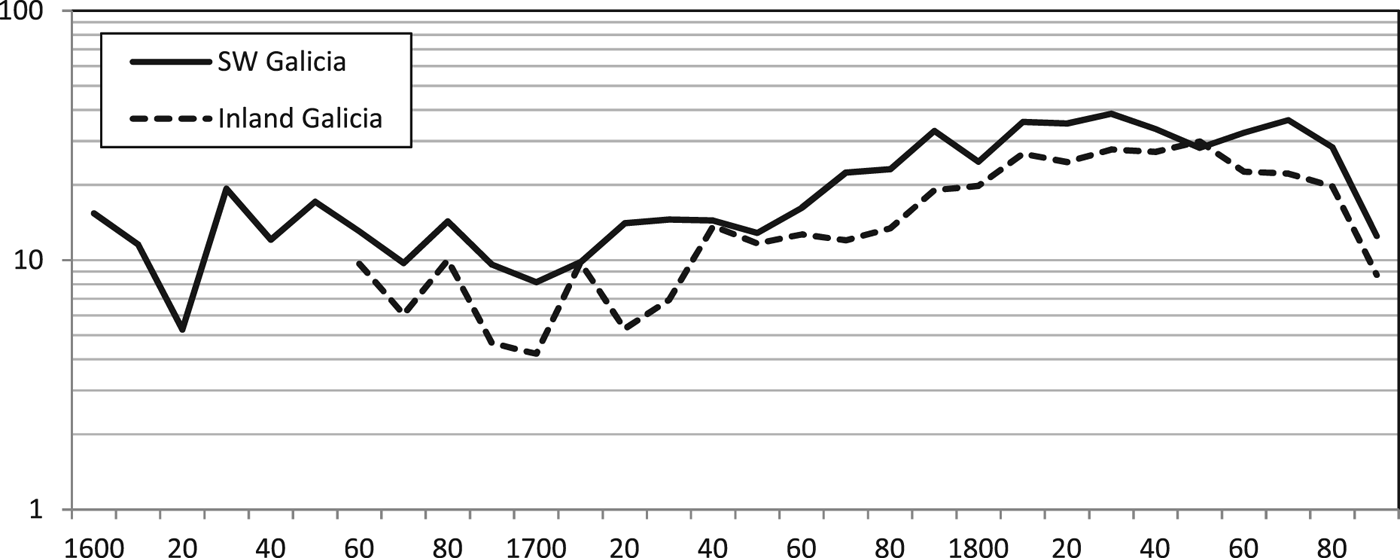
Up to 1750 the number of repeaters in the illegitimacy ratios of south-west Galicia did bear a close relationship to the ups and downs of marriage patterns, as in England. When marriage rates increased the number of repeaters tended to fall and when it plateaued repeaters did likewise. Figure 6 shows that from 1630–1639 to 1700–1709, the proportion of repeaters fell from 19 per cent to 8 per cent of unmarried mothers. This fall coincided with the ‘nuptial euphoria’ unleashed by the introduction of maize into local farming practices.Footnote 50 As described above, this new crop triggered a wave of prosperity, encouraging the setting-up of new households that then helped to boost population growth in south-west Galicia from 1630–1690. The petering out of the maize boom from 1690–1730 led to a gradual harshening of living conditions and stymied the marriage trend.Footnote 51 In keeping with this, the ‘repeater’ ratio dipped between 1700 and 1720, as marriage possibilities improved briefly at the end of the agrarian crisis of 1709–1710, but then hovered for the next forty years after 1720 at about 12–14 per cent of the total.
Trends of the repeater ratio (1600–1899). Source: Inland and SW Galicia: Parish Baptism Books kept in AHDL and AHDT. Drawn up by the author.

Everything changed after 1760, when the trend in ‘repeater’ ratios in south-west Galicia fell completely out of step with the marriage trend. The growing share of ‘repeaters’ in illegitimacy after this date occurred against the backdrop of an economic slump that severely curtailed the marrying chances of the lowest classes of peasant farmers. Under these circumstances, ‘repeaters’ seem to have followed an alternative path as their marriage chances dwindled.Footnote 52 However, the upward trend in ‘repeater’ ratios did not plateau after 1800, despite the rise in farming activity, which effected another rise in the marriage rate. The reason for this continued trend may be the negative effect on marriage prospects of the new royal legislation of 1776–1803 on family marriage arrangements. This would explain why, in south-west Galicia, the repeater ratio almost doubled from 1770–1779 to 1830, rising from 22 per cent to 39 per cent of the total. Another contributing factor was certainly growing tolerance of ‘repeaters’ among most of the peasant farmer class.Footnote 53 This tolerance was largely due to the church's decreasing moral control at local level, as disentailments of church property by the various liberal governments began to take effect.
The persistence of many of these factors during the nineteenth century explains why, despite ups and downs in the economic and marriage cycles, repeaters increased to such an extent as to become a structural part of illegitimacy within south-west Galicia. From 1800–1889 they accounted for 33 per cent of all mothers with illegitimate children. This figure in itself speaks volumes about the changes that had occurred since the 1750s in the internal structure of illegitimate sexuality in the area. There is nothing a priori to suggest that behind this development lurked a bastardy-prone sub-society, as claimed for England by Laslett. While Galicia was similar to England and Scotland in that illegitimacy was bound up with the breaking of marriage promises, the ways and the periods in which these broken prospects influenced illegitimacy varied between different contexts.Footnote 54
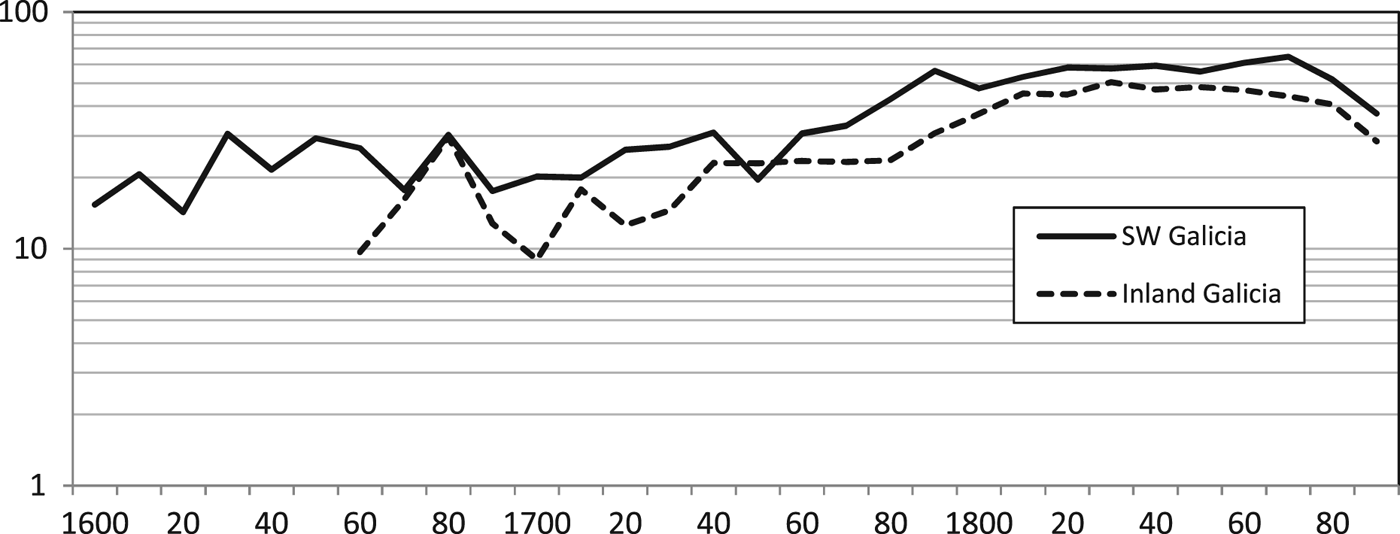
The fertility of ‘repeaters’ was a key contribution to overall trends in Galician illegitimacy. This is evident in the similar long-term trends in ‘repeaters’ and overall illegitimacy, as can be seen from a comparison of Figures 5 and 6, which show a fall in both ratios over the 70 years from 1630 to 1700, and a similar rise from the mid-eighteenth century. The strength of the relationship between them is even more evident in south-west Galicia, where ‘repeaters’ were responsible for bringing into the world 31 per cent of all illegitimate children in 1760–1769, 48 per cent in 1800–1809 and 61 per cent in 1860–1869 (Figure 7). Everything therefore seems to suggest that ‘repeaters’ were the main factors in the internal dynamics of illegitimacy. Indeed, the soaring rise in illegitimacy ratios after 1770 seems to be due not to an increasing proportion of women becoming unmarried mothers but to an increasing tendency for these women to have more than one illegitimate child.
Children born to ‘repeaters’ as a percentage of total illegitimate children (1600–1899). Source: Inland and south-west Galicia, Parish Baptism Books kept in AHDL and AHDT. Drawn up by the author.

Comparing Figures 6 and 7 shows that the long-term trend of ‘repeaters’ in inland Galicia differed somewhat from the trend in south-west Galicia. In inland Galicia, the number of ‘repeaters’ over time much more clearly tracked the ups and downs in the marriage rate, albeit with a time lag of about 30 years. For example, the fall in the ‘repeaters’ after the 1680s coincided with the negative impact on the marriage rates of a succession of agrarian crises from 1694–1695, 1698–1699 and 1709–1710.Footnote 55 The same goes for the stagnation in matrimonial prospects after 1720, when the trend in the ‘repeater’ ratio stalled from 1740 to 1780. It would therefore seem plausible that fluctuations in the numbers of ‘repeaters’ were bound up with the marriage opportunities of the lower strata of the peasantry. These illegitimate children were not necessarily the fruit of freely and casually arranged unions; marriage was still the keystone of sexual relations at that time.
The soaring number of repeaters from the 1780s, building up to 30 per cent of total illegitimate baptisms in 1850–1859 (Figure 6), coincided with the wave of prosperity fuelled by the introduction of potatoes as a local farming crop in inland Galicia, with a concomitant rise in the marriage rate. Paradoxically, this overall rise in the marriage rate was offset by a series of circumstances that worked against the marriage chances of the most humble women. The coming into force of the royal legislation of 1776–1803, described above, which removed the obligation for men to marry women they had impregnated, triggered a rise in illegitimacy and the ‘repeater’ ratio, aided by the subsequent spread of a certain familial and social tolerance for the repeaters. We can characterise the situation as one in which couples kept putting off their marriages while the immediate future remained uncertain, yet women's continued hopes that these marriages would take place one day led them to consent to pre-marital sex. After 1850, however, when living conditions worsened for the poorer peasantry, female day labourers, weavers and seamstresses were less willing to believe the promises of marriage made to them, and less likely to submit to sexual advances, whether they had already had an illegitimate child or not. In inland Galicia, therefore, unmarried mothers with only one illegitimate child did contribute more to illegitimacy trends after 1850, compared with south-west Galicia, though repeaters were still central to the soaring illegitimacy ratios between 1780 and 1859.
Changing our focus slightly, the percentages of repeaters recorded in places as diverse as Galicia, Portugal or Scotland suggest that societies in rural Europe during the Ancien Régime and in the north-west Iberian Peninsula in particular were governed by more than one pattern of social and sexual behaviour where illegitimacy was concerned. The prominence of ‘repeaters’ contradicts the stereotype of an extramarital sexual relationship struck up by a man with a woman of lower social status, often from the lowest echelons of society, with whom he had only one child and whom he never married or did so only after a long delay.
The evidence presented in this article shows that between 1570 and 1899 in rural Galicia this behavioural pattern was only one strand of the story. ‘Repeaters’ exhibited very different behaviour. About one third of them were by contemporary standards promiscuous, having children with more than one man (in south-west Galicia this was the case for 31 per cent of repeaters and in inland Galicia 27 per cent). One possible explanation for this, that these women were occasional prostitutes, does not seem to tally with the facts. The normal state of affairs was for them to keep up relationships with different males for long periods of time, long enough, in any case, to be clear afterwards who were the fathers of their children. A good example of this is Juliana Barrio, living in the parish of San Martiño de Barcia de Mera, in south-west Galicia. She gave birth to three natural children between 1738 and 1744: one in 1738 with Francisco Pino, a bachelor from the same parish; another in 1741 with Francisco Gil, a married resident of the town of Pontevedra; and the last in 1744 with Francisco Sánchez, a young single resident of Santa María de Savaxáns.Footnote 56 A similar pattern seems to emerge from the recorded behaviour of Luisa de Quintela, living in the parish of San Xoan de Visantoña, in inland Galicia. In 1795 she declared herself to be the mother of the child of Pedro García; in 1797 of the child of José Frade; in 1802 of the child of an individual whose name she did not wish to reveal; and in 1804 of the child of Juan Rodríguez, a married man.Footnote 57
By contrast, the behaviour of the bulk of repeaters – the remaining two thirds – was quite different. In general, they were in long-term relationships with the same men, with whom they can often be seen living ‘in sin’, in the sources from the late nineteenth century.Footnote 58 Such was the case of María Gómez, resident of San Salvador de Asma, who had all her four children with José Fernández, a young single neighbour, in 1835, 1837, 1838 and 1840.Footnote 59 Similarly, cases of men maintaining relations with several repeaters at the same time were few and far between, identified for only 2.1 per cent of the total baptism certificates of illegitimate children in inland Galicia and 4 per cent in south-west Galicia. Cases like that of Juan Núñez, resident of Santa María de Tomiño, who, in 1744, fathered the child of Dominga Pérez from Nigrán, in 1746, 1747 and 1750, those of Liberata Núñez and in 1745 and 1750 those of María Núñez, the latter two women from his home town of Tomiño, were thus exceptional.Footnote 60
7. CONCLUSION
From 1570 to 1899 the illegitimacy ratios of the various zones of rural Galicia were among the highest in Europe. Despite the differences in demographic and family structures, local economies and the status of women, the different regions of Galicia studied here showed remarkable similarities in the trends, if not the levels, of illegitimacy over time. Although illegitimacy rose rapidly from 1770–1780, in line with other European regions, most of this rise fuelled by rising numbers of ‘repeaters’, the mechanisms behind the growing numbers were often different from those at work in England, Scotland or France. Here, the rise in illegitimacy after 1770–1780 is best explained in terms of how particular material and legal circumstances impinged on the marrying chances of women from the lowest peasant classes. These circumstances varied from one part of Galicia to another and at different times of the period under study. This article has stressed that, from the last quarter of the eighteenth century, repeaters were the real driving force behind rising illegitimacy, the internal dynamics of which reveal a highly complex picture, in both inland and south-west Galicia. Trends in the ‘repeater’ ratio and thus in overall illegitimacy were influenced by factors as varied as the impact on population and households of the introduction of new crops, the coming into force of specific matrimonial legislation or the relative tolerance shown to a situation suffered largely by the lowest peasant farmer classes.
Above all, what this article has hoped to show is that future studies of illegitimacy, both of its underlying dynamics and what it reveals about past societies, families and cultures, should look not to general explanations, but rather to specific local and regional historical contexts.
ACKNOWLEDGEMENTS
I would like to thank the editors for their assistance with this article and also the anonymous reviewers for their comments and contributions.