Introduction
Major depressive disorder (MDD) affects as much as 16% of the U.S. population and has been estimated by the World Health Organization (WHO) to be one of the leading causes of years lived with disability.1 Many patients with MDD do not respond to currently available treatments and suffer through recurring depressive episodes.Reference Bulloch, Williams, Lavorato and Patten2 The monoamine hypothesis of depression, which posits that depression results from a deficiency in serotonin (5HT), norepinephrine (NE), and dopamine (DA), has been the mainstay of antidepressant treatments including selective serotonin reuptake inhibitors (SSRIs) and serotonin norepinephrine reuptake inhibitors (SNRIs).Reference Marazziti3 Here we provide a review of the serotonergic system and our understanding of its role in major depressive disorder. We also discuss how modulation of 5HT neurotransmission via pharmacological agents that act at various 5HT receptors and reuptake transporters may provide novel antidepressant treatments.
Serotonin Circuits
Serotonin circuits arise from discrete brainstem nuclei, including the dorsal and medial raphe nuclei. These circuits project to a wide range of cortical and subcortical brain areas: prefrontal cortex (PFC), hippocampus, amygdala, thalamus, hypothalamus, striatum, nucleus accumbens, basal forebrain, cerebellum, and spinal cord (Figure 1).Reference Stahl4 Serotonergic neurons directly and indirectly influence virtually all other neurotransmitter systems—DA, NE, glutamate (Glu), acetylcholine (ACh), histamine (HA), and gamma-aminobutyric acid (GABA)—as well as self-modulation of the 5HT system. Thus, it is not surprising that the 5HT system is thought to regulate a variety of behaviors including mood, sleep, and appetite, and that dysregulation of the 5HT system has been implicated in many psychiatric disorders, including major depressive disorder (MDD).Reference Stahl4, Reference Mann5
Serotonin circuits throughout the brain. Serotonin has both ascending and descending projections. Ascending serotonergic projections originate in the brainstem neurotransmitter centers (NT) and extend to various brain regions, including the prefrontal cortex (PFC), basal forebrain (BF), nucleus accumbens (NA), striatum (S), thalamus (T), hypothalamus (HY), amygdala (A), hippocampus (H), and cerebellum (C), where they regulate mood, sleep, anxiety, appetite, and many other behaviors. Descending serotonergic projections extend down the brainstem and through the spinal cord (SC) where they regulate pain.

Serotonin Receptors
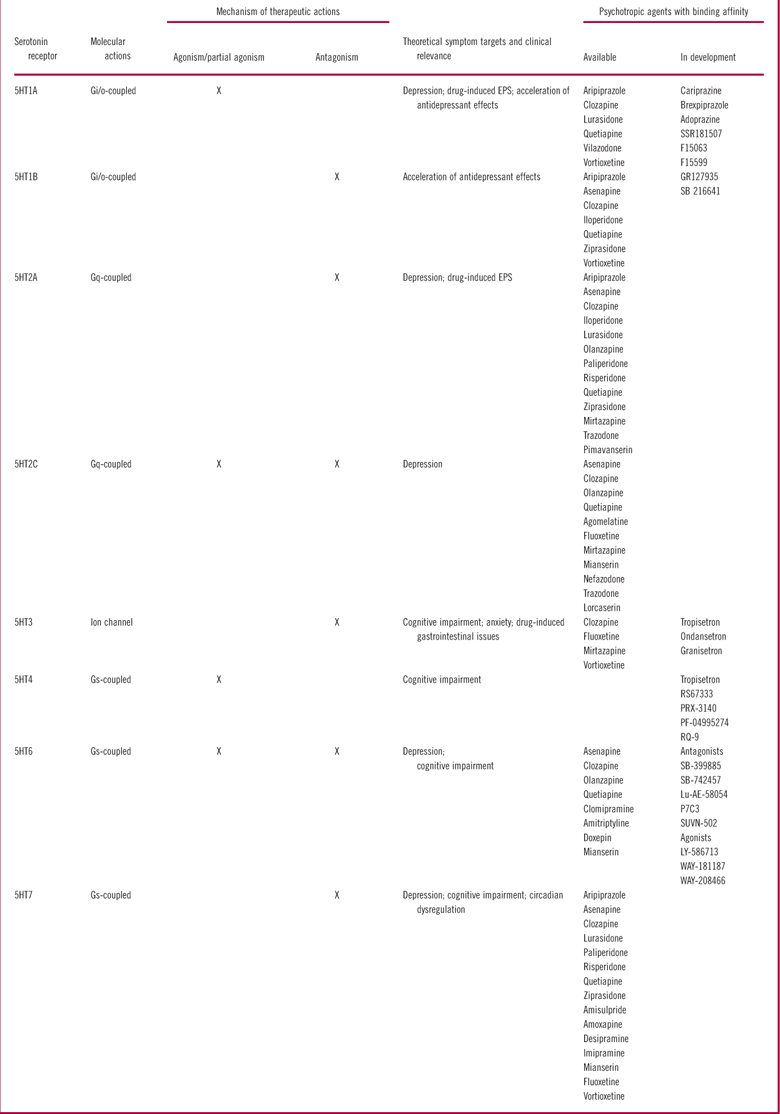
There are 7 families of 5HT receptors, with at least 14 subtypes (Table 1). Activation of each of the 5HT receptors leads to G-protein–coupled cascades, with the exception of the 5HT3 receptor, which is a ligand-gated ion channel.Reference Shimizu, Mizuguchi and Ohno6 Our discussion will focus on the potential roles of 5HT1A, 5HT1B, 5HT1D, 5HT2A, 5HT2C, 5HT3, 5HT4, 5HT6, and 5HT7 receptors in depression, as less is currently known about how 5HT1E, 5HT1F, 5HT2B, and 5HT5 may be involved in the neurobiology and treatment of MDD.
Serotonin receptors
5HT1A
Serotonin 5HT1A receptors are located postsynaptically in the hippocampus, septum, amygdala, and corticolimbic areas, where they regulate release of other neurotransmitters. Serotonin 5HT1A postsynaptic heteroreceptors control release of ACh in the septum, Glu neurotransmission in the PFC, and DA signaling in the ventral tegmental area (VTA).Reference Artigas7–Reference Ohno, Shimizu and Tokudome9 Additionally, 5HT1A receptors exist as presynaptic somatodendritic autoreceptors on 5HT neurons in the raphe nuclei, where they inhibit 5HT neurotransmission (Figure 2).Reference Artigas7 Not only are 5HT1A receptors associated with depression, but modulation of signaling through both pre- and postsynaptic 5HT1A receptors may also ameliorate antipsychotic-induced extrapyramidal symptoms (EPS) by increasing nigrostriatal DA neurotransmission.Reference Stahl4, Reference Ohno, Shimizu and Tokudome9 Numerous psychotropic agents possess 5HT1A binding affinity, including the antidepressants vilazodone and vortioxetine, the atypical antipsychotics aripiprazole and lurasidone, the anxiolytic buspirone, and several novel agents such as cariprazine and brexpiprazole.Reference Artigas7, Reference Carr and Lucki8, Reference Ramirez, Lai, Tordera and Francis10
Serotonin 5HT1A somatodendritic autoreceptors. (A) Presynaptic 5HT1A autoreceptors are located on the soma and dendrites of serotonergic neurons. (B) Serotonin (5HT) binding to 5HT1A autoreceptors causes inhibition of neuronal impulses and a reduction in 5HT output.
5HT1B and 5HT1D
Serotonin 5HT1B receptors exist both as postsynaptic autoreceptors on the axons of nonserotonergic cells and as presynaptic autoreceptors on the axons of serotonergic neurons. Serotonin 5HT1B heteroreceptors control release of ACh from neurons in the basal forebrain, HA from neurons in the tuberomamillary nucleus, DA from neurons in the ventral tegmental area, and NE from neurons in the locus coeruleus.Reference Stahl4, Reference Sari11 Blockade of 5HT1B postsynaptic heteroreceptors may also have antidepressant effects due to resultant increases in Glu, DA, ACh, NE, and HA in the cortex.Reference Stahl4, Reference Carr and Lucki8 Serotonin 5HT1B autoreceptors function much the same as 5HT1A autoreceptors (discussed in the previous section); stimulation of 5HT1B autoreceptors reduces 5HT output.Reference Artigas7, Reference Sari11 Serotonin 5HT1D receptors also function as autoreceptors on serotonergic axons and have historically been difficult to distinguish from 5HT1B receptors due to a lack of selective agonists and antagonists, species differences, and confusion in nomenclature.Reference Bonaventure, Kelly and Aluisio12 Although 5HT1B receptors may be more prominent in median raphe nuclei, whereas 5HT1D receptors are more abundant in dorsal raphe nuclei, they are often lumped together as 5HT1B/1D when discussing the function of serotonergic autoreceptors (Figure 3).Reference Hopwood and Stamford13
Serotonin 5HT1B/D axon terminal autoreceptors. (A) Presynaptic 5HT1B/D autoreceptors are located on presynaptic axon terminals of serotonergic neurons. (B) Binding of 5HT to 5HT1B/D autoreceptors causes inhibition of 5HT release.
5HT2A
Serotonin 5HT2A receptors are located throughout the brain, including the cerebral, piriform, and entorhinal cortices; claustrum; olfactory bulb; anterior olfactory nucleus; brainstem nuclei; and limbic regions.Reference Shimizu, Mizuguchi and Ohno6 Within the cortex, 5HT2A receptors are located on Glu and GABA neurons.Reference Artigas7 Serotonin 5HT2A receptors may be increased in patients with MDD, and it has been shown that chronic treatment with 5HT2A antagonists results in down-regulation of the 5HT2A receptor in conjunction with antidepressant effects.Reference Carr and Lucki8 The antidepressant effects, as well as amelioration of antipsychotic-induced EPS, from 5HT2A antagonism are thought to stem, at least partially, from disinhibition of dopaminergic neurons and the resultant increase in cortical DA neurotransmission (Figure 4).Reference Stahl4, Reference Shimizu, Mizuguchi and Ohno6
Serotonin 5HT2A receptors in the nigrostriatal pathway. (A, B) Binding of 5HT to 5HT2A receptors located on nigrostriatal dopaminergic neurons leads to inhibition of DA neurotransmission. (C) Atypical antipsychotics, which are essentially serotonin-dopamine antagonists (SDAs), block the actions of dopamine at post-synaptic DA receptors; this can lead to the development of extrapyramidal symptoms (EPS). (D) However, simultaneous blockade of 5HT2A receptors leads to an increase in DA output. This excessive DA in the nigrostriatal pathway is able to compete with binding of atypical antipsychotics to DA receptors, thus ameliorating EPS.
5HT2C
Serotonin 5HT2C receptors are found in numerous brain regions including the hippocampus, amygdala, anterior olfactory and endopiriform nuclei, cingulate and piriform cortices, thalamic nuclei, and substantia nigra.Reference Shimizu, Mizuguchi and Ohno6–Reference Ohno, Shimizu and Tokudome9 Although preferentially located on GABAergic interneurons, 5HT2C receptors can also be found on DA neurons in the mesolimbic pathway.Reference Artigas7 Interestingly, both 5HT2C agonists and antagonists have been shown to have antidepressant effects.Reference Carr and Lucki8 This seemingly conflicting information may be due to the fact that antagonists block the actions of 5HT2C receptors, whereas chronic agonism of 5HT2C receptors leads to receptor downregulation; in both scenarios, there may a resultant increase in DA and NE in terminal regions.Reference Stahl4
5HT3
Serotonin 5HT3 receptors are found in the spinal cord, brainstem, hippocampus, and amygdala, and the entorhinal, frontal, and cingulate cortices where they regulate DA, NE, 5HT, ACh, GABA, and HA release (Figure 5).Reference Artigas7, Reference Carr and Lucki8 Serotonin 5HT3 receptors also modulate pyramidal cell activity in the cortex by reducing Glu neurotransmission (Figure 6).Reference Stahl4 Data have shown that antagonism of the 5HT3 receptor may have several therapeutic effects, including enhanced cognition and reduced anxiety, as well as reducing D2-antagonism–induced EPS.Reference Shimizu, Mizuguchi and Ohno6–Reference Ohno, Shimizu and Tokudome9 Additionally, antagonism of 5HT3 receptors in the chemoreceptor trigger zone of the brainstem and in the gastrointestinal tract, which mediate nausea/vomiting and bowel motility, may protect against the gastrointestinal side effects that often accompany antidepressant agents such as SSRIs and SNRIs.Reference Stahl4, Reference Shimizu, Mizuguchi and Ohno6
Effects of serotonin 5HT3 receptors on ACh and NE neurotransmission. (A, B) When 5HT binds to 5HT3 receptors on GABAergic neurons, GABA is released onto cholinergic and noradrenergic neurons preventing the release of acetylcholine (ACh) and norepinephrine (NE), respectively. Additionally, the binding of 5HT to postsynaptic 5HT3 receptors located on directly on cholinergic and noradrenergic neurons also prevents release of ACh and NE. (C) Administration of a 5HT3 antagonist leads to disinhibition of cholinergic and noradrenergic neurons, thus increased ACh and NE output.
Effects of serotonin 5HT3 receptors on Glu neurotransmission. (A) Serotonin 5HT3 receptors are found on GABAergic neurons in the prefrontal cortex (PFC). (B) When 5HT binds to these 5HT3 receptors, GABAergic neurons are stimulated and release GABA onto glutamatergic neurons, thus inhibiting Glu output. (C) Addition of a 5HT3 antagonist inhibits GABA from being released, thus increasing Glu neurotransmission.
5HT4
Serotonin 5HT4 receptors, which are located in the putamen, caudate nucleus, hippocampus, nucleus accumbens, globus pallidus, substantia nigra, neocortex, raphe and pontine nuclei, and thalamus, are thought to mediate the expression of various genes involved in synaptic plasticity.Reference Shimizu, Mizuguchi and Ohno6–Reference Carr and Lucki8 In line with this hypothesis, 5HT4 agonists have been shown to enhance cognition, whereas 5HT4 antagonists may cause impairments in learning and memory.Reference Shimizu, Mizuguchi and Ohno6 Not only does stimulation of 5HT4 receptors increase release of ACh, it also may reduce the levels of amyloid beta.Reference Ramirez, Lai, Tordera and Francis10 Amyloid beta is the protein that accumulates in Alzheimer's disease, a neurodegenerative condition that is often heralded by depression in its earlier stages.Reference Khundakar and Thomas14
5HT6
Serotonin 5HT6 receptors are located in the striatum, nucleus accumbens, olfactory tubercles, cortex, hippocampus, amygdala, hypothalamus, thalamus, and cerebellum, where they regulate the release of ACh, NE, DA, and GABA.Reference Artigas7–Reference Ramirez, Lai, Tordera and Francis10 These receptors have been implicated in many psychiatric illnesses, including schizophrenia, eating disorders, cognitive impairment, and depression.Reference Stahl4, Reference Shimizu, Mizuguchi and Ohno6 Interestingly, both agonism and antagonism of 5HT6 receptors may have both pro-cognitive and antidepressant effects.Reference Artigas7, Reference Carr and Lucki8, Reference Ramirez, Lai, Tordera and Francis10
5HT7
Serotonin 5HT7 receptors, located in the thalamus, hypothalamus, hippocampus, and cortex, have been implicated in thermoregulation, circadian rhythms, sleep, and mood disorders.Reference Stahl4, Reference Shimizu, Mizuguchi and Ohno6, Reference Carr and Lucki8 Intriguingly, dysregulation of circadian rhythms and sleep–wake disorders are highly prevalent in patients with MDD.Reference Baron and Reid15, Reference Karatsoreos16 Therefore, the antidepressant effects of 5HT7 antagonism may be due not only to increases in 5HT levels and activation of glutamatergic neurons in the PFC, but also to normalization of circadian rhythms (Figure 7).Reference Tokarski, Kusek, Sowa and Bobula17 Additionally, the 5HT7 receptor has been implicated as an important mediator of hippocampus-dependent learning and memory; thus modulation of the 5HT7 receptor may also affect the impaired cognition that is often present in patients with MDD.Reference Roberts and Hedlund18
Serotonin 5HT7 receptors. (A) Serotonin 5HT7 receptors are located on GABAergic neurons in the raphe nuclei. (B) When stimulated by 5HT, these 5HT7 receptors activate GABAeric neurons, leading to inhibition of 5HT output in the prefrontal cortex (PFC). (C) Addition of a 5HT7 antagonist blocks activation of GABAergic neurons in the raphe nuclei, leading to disinhibition of serotonergic neurons and increased 5HT output. (D) Similarly, 5HT7 receptors are also located on GABAergic neurons in the PFC where they regulate activation of glutamatergic neurons. (E) When these 5HT7 receptors are activated by 5HT, GABA is released onto glutamatergic neurons, inhibiting release of Glu. (E) When a 5HT7 antagonist is added, GABAergic neurons are not activated, glutamatergic neurons are disinhibited, and Glu output is increased.
Reuptake Inhibitors
The most commonly prescribed antidepressant treatments, SSRIs and SNRIs, work by blocking the reuptake of 5HT and NE from the synapse, leaving more of these neurotransmitters available to bind to their respective receptors and mediate downstream effects on mood, cognition, anxiety, and many other functions (Figure 8).Reference Stahl4 However, although reuptake inhibitors rapidly increase monoamine levels upon treatment initiation, the therapeutic effects can take weeks to manifest.Reference Stahl4, Reference Stahl, Lee-Zimmerman, Cartwright and Morrissette19 The reason for this may be due to the inhibitory effects of 5HT autoreceptor stimulation.Reference Stahl4, Reference Mann5 The initial increase in a monoamine (eg, 5HT) following treatment with an antidepressant (eg, an SSRI) results in activation of 5HT1A, 5HT1B, and 5HT1D autoreceptors, which in turn causes a decrease in 5HT output (Figure 9).Reference Stahl4, Reference Artigas7, Reference Ohno, Shimizu and Tokudome9 With time, 5HT1A, 5HT1B, and 5HT1D receptors may be down-regulated and/or desensitized, leading to increased 5HT output, stimulation of postsynaptic 5HT receptors, and therapeutic effects.Reference Stahl4 One strategy with the potential for decreasing the delay between SERT inhibition and therapeutic effects is to simultaneously block 5HT1A, 5HT1B, and/or 5HT1D autoreceptors; this can be achieved either by combining multiple pharmacological agents or by using a single agent with actions at both reuptake pumps and multiple 5HT receptors.
Serotonin reuptake transporter inhibition. (A) The serotonin reuptake transporter (SERT) removes 5HT from the synapse leaving less 5HT to act on serotonergic receptors. (B) Many antidepressants and some atypical antipsychotics have binding affinity for SERT. (C) Administration of a pharmacological agent with SERT binding affinity, such as a selective serotonin reuptake inhibitor (SSRI), prevents SERT from pumping 5HT out of the synapse, leaving more 5HT available to bind 5HT receptors and exert downstream effects on neurotransmission and behavior.
Delayed therapeutic actions of SERT inhibitors. (A) In the depressed state, 5HT levels are hypothetically low, 5HT receptors are upregulated, and stimulation of the serotonergic neuron to increase 5HT output are low. Upon administration of a SERT inhibitor (eg, an SSRI), reuptake of 5HT is prevented at both the dendrites (left) and at the axon (right). (B) Although 5HT levels may be immediately increased, 5HT binds to somatodendritic 5HT1A autoreceptors (as well as 5HT1B/D axonal autoreceptors—not shown), inhibiting further release of 5HT. (C) Eventually, 5HT1A (and 5HT1B/D) autoreceptors are downregulated and/or desensitized leading to increased 5HT output. This necessity for downregulation/desensitization of autoreceptors is thought to underlie the delay in therapeutic actions of SSRIs.
Polypharmacy and Multimodal Agents
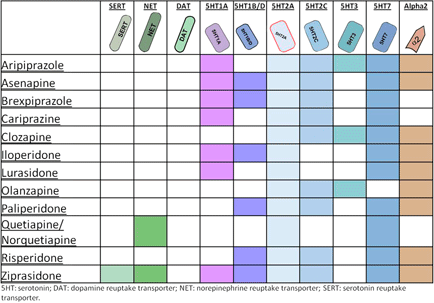
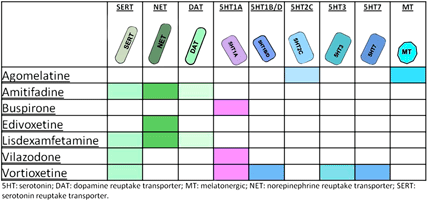
As discussed above, the most commonly employed treatments for MDD (SSRIs and SNRIs) often take weeks to reach full therapeutic effectiveness, leaving patients suffering with unresolved symptoms of depression in the meantime. Simultaneous blockade of 5HT autoreceptors and SERT may accelerate the therapeutic benefit of antidepressant treatment by preventing the inhibition of 5HT neurons that follows the initial burst of serotonin (Figure 10).Reference Stahl4, Reference Artigas7, Reference Carr and Lucki8 Indeed, this is the rationale for adding an agent such as pindolol, a partial agonist at 5HT1A and 5HT1B receptors, as an adjunct to antidepressant treatment.Reference Carr and Lucki8 Binding affinity for 5HT1A and 5HT1B/D is also a property of many atypical antipsychotics and, along with binding at various other 5HT receptors, may contribute to the efficacy of some of these agents in treating depression (Table 2).Reference Stahl4 The newly approved antidepressants vilazodone and vortioxetine, as well as several other agents in development, are multimodal agents that also take advantage of the potential for simultaneously inhibiting SERT while stimulating or blocking specific 5HT receptors (Table 3).Reference Stahl, Lee-Zimmerman, Cartwright and Morrissette19 Although the theory that novel multimodal agents acting on various 5HT receptors and SERT may accelerate the antidepressant effects compared to traditional treatments (eg, SSRIs) has been supported in animal models, it remains to be seen whether this theory will play out in clinical situations.
Simultaneous inhibition of SERT and 5HT autoreceptors may reduce therapeutic delay of antidepressant treatment. (A) Some novel multimodal agents, such as serotonin partial agonist/reuptake inhibitors (SPARIs), combine SERT inhibition with antagonism or partial agonism of 5HT autoreceptors. (B) The inhibitory actions at SERT cause an increase in somatodendritic 5HT levels, which would bind 5HT1A autoreceptors. (C) Downregulation of 5HT1A autoreceptor levels from the increased somatodendritic 5HT would normally be delayed if SERT inhibition was the sole pharmacological intervention. However, the presence of a 5HT1A partial agonist blocks 5HT from binding to 5HT1A autoreceptors and theoretically leads to more a more rapid downregulation and/or desensitization of 5HT1A autoreceptors. (D) The dual actions at SERT and 5HT autoreceptors therefore lead to a more rapid increase in axonal 5HT output and subsequent therapeutic effects.
Potential antidepressant mechanisms of novel agentsFootnote *
Potential antidepressant mechanisms of novel agentsFootnote *
Conclusion
Inhibition of reuptake transporters, especially of SERT, has been the mainstay of antidepressant treatment for several decades. The antidepressant actions of SSRIs and SNRIs are thought to stem from their ability to compensate for an underlying monoamine deficiency inherent to MDD. However, as our knowledge of the serotonergic system has increased, we are beginning to fully recognize that it is not enough simply to raise 5HT levels; we must also consider the various 5HT receptor targets and their downstream actions when designing optimal therapeutics. By simultaneous blocking or stimulating specific 5HT receptors, we can fine-tune pharmacologic treatment and potentially provide more effective and faster treatments with reduced propensity for intolerable side effects (Table 1). For example, if a patient with MDD is experiencing impairments in memory, a rationale strategy might include choosing a pharmacological agent with strong affinity for 1 or more 5HT receptors implicated in cognition, such as 5HT3, 5HT4, 5HT6, and 5HT7.
As our understanding of the 5HT system continues to expand and our repertoire of pharmacological agents with targeted binding affinity for specific 5HT receptors is increased, it is likely that the future will bring more effective, more tolerable, and faster-acting treatments for patients suffering with depression.
Disclosures
Debbie Morrisette does not have anything to disclose. Stephen M. Stahl, MD, PhD: Over the past 12 months (March 2013–April 2014), Dr. Stahl has served as a consultant for Astra Zeneca, Avanir, Biomarin, Envivo, Forest, Jazz, Lundbeck, Neuronetics, Noveida, Orexigen, Otsuka, PamLabs, Servier, Shire, Sunovion, Taisho, Takeda and Trius; he is a board member of RCT Logic and GenoMind; he is on the speakers bureau for Astra Zeneca, Janssen, Otsuka, Sunovion, and Takeda; and he has received research and/or grant support from AssureX, Eli Lilly, EnVivo, Janssen, JayMac, Jazz, Lundbeck, Mylan, Neuronetics, Novartis, Otsuka, Pamlabs, Pfizer, Roche, Shire, Sunovion, Takeda, Teva, and Valeant.