INTRODUCTION
Cryptosporidiosis is a frequent diarrhoeal disease of humans and other animals, including cattle. In immunocompetent hosts, the infection is self-limiting, whereas in immunocompromised people and neonatal animals, it has the potential to cause deaths. Since the treatment of cryptosporidiosis is usually limited to supportive therapy, a thorough understanding of the epidemiology and transmission dynamics of Cryptosporidium is required in order to allow the control of disease outbreaks (Xiao and Ryan, Reference Xiao and Ryan2004; Xiao et al. Reference Xiao, Fayer, Ryan and Upton2004).
Thus far, 9 Cryptosporidium species/genotypes, including C. hominis, C. parvum, C. meleagridis, C. felis, C. canis, C. muris, C. suis and the Cryptosporidium cervine and monkey genotypes, are known to be responsible for human cases of cryptosporidiosis, with the former two being the most common species (Pieniazek et al. Reference Pieniazek, Bornay-Llinares, Slemenda, da Silva, Moura, Arrowood, Ditrich and Addiss1999; Katsumata et al. Reference Katsumata, Hosea, Ranuh, Uga, Yanagi and Kohno2000; Morgan et al. Reference Morgan, Weber, Xiao, Sulaiman, Thompson, Ndiritu, Lal, Moore and Deplazes2000; Pedraza-Diaz et al. Reference Pedraza-Diaz, Amar and McLauchlin2000; Ong et al. Reference Ong, Eisler, Alikhani, Fung, Tomblin, Bowie and Isaac-Renton2002; Xiao et al. Reference Xiao, Bern, Arrowood, Sulaiman, Zhou, Kawai, Vivar, Lal and Gilman2002, Reference Xiao, Fayer, Ryan and Upton2004; Mallon et al. Reference Mallon, MacLeod, Wastling, Smith and Tait2003). Cryptosporidium hominis is transmitted anthroponotically, whereas C. parvum can be transmitted zoonotically, particularly from cattle, and anthroponotically to humans (Xiao and Ryan, Reference Xiao and Ryan2004). Cattle can become infected with at least 4 Cryptosporidium species/genotypes, including C. parvum, C. bovis, C. andersoni and the Cryptosporidium deer-like genotype (Santín et al. Reference Santín, Trout, Xiao, Zhou, Greiner and Fayer2004; Xiao et al. Reference Xiao, Fayer, Ryan and Upton2004; Fayer et al. Reference Fayer, Santín, Trout and Greiner2006). However, C. parvum is the only known zoonotic species in cattle (Xiao and Ryan, Reference Xiao and Ryan2004).
A number of molecular methods have been developed for the genetic classification of C. hominis and C. parvum to the subgenotypic level (=‘subtyping’). These methods provide useful tools for the ‘tracking’ of infection sources and, consequently, for the surveillance of cryptosporidiosis. One of the most commonly used tools is the sequencing of a 60 kDa glycoprotein (gp60) gene, which allows the definition of C. hominis Ia, Ib, Id-If and C. parvum IIa-IIk (Strong et al. Reference Strong, Gut and Nelson2000; Peng et al. Reference Peng, Matos, Gatei, Das, Stantic-Pavlinic, Bern, Sulaiman, Glaberman, Lal and Xiao2001, Reference Peng, Meshnick, Cunliffe, Thindwa, Hart, Broadhead and Xiao2003a, Reference Peng, Wilson, Holland, Meshnick, Lal and Xiaob; Sulaiman et al. Reference Sulaiman, Lal and Xiao2001, Reference Sulaiman, Hira, Zhou, Al-Ali, Al-Shelahi, Shweiki, Iqbal, Khalid and Xiao2005; Glaberman et al. Reference Glaberman, Moore, Lowery, Chalmers, Sulaiman, Elwin, Rooney, Millar, Dooley, Lal and Xiao2002; Leav et al. Reference Leav, Mackay, Anyanwu, O'Connor, Cevallos, Kindra, Rollins, Bennish, Nelson and Ward2002; Alves et al. Reference Alves, Xiao, Sulaiman, Lal, Matos and Antunes2003, Reference Alves, Xiao, Antunes and Matos2006; Sturbaum et al. Reference Sturbaum, Jost and Sterling2003; Wu et al. Reference Wu, Nagano, Boonmars, Nakada and Takahashi2003; Zhou et al. Reference Zhou, Singh, Jiang and Xiao2003; Chalmers et al. Reference Chalmers, Ferguson, Cacciò, Gasser, Abs EL-Osta, Heijnen, Xiao, Elwin, Hadfield, Sinclair and Stevens2005; Abe et al. Reference Abe, Matsubayashi, Kimata and Iseki2006; Akiyoshi et al. Reference Akiyoshi, Tumwine, Bakeera-Kitaka and Tzipori2006; Trotz-Williams et al. Reference Trotz-Williams, Martin, Gatei, Cama, Peregrine, Martin, Nydam, Jamieson and Xiao2006; Misic and Abe, Reference Misic and Abe2007; Thompson et al. Reference Thompson, Dooley, Kenny, McCoy, Lowery, Moore and Xiao2007). Except for IIj and IIk, all of the above mentioned ‘subtype families’ have been detected in humans, whereas exclusively IIa, IId and IIj have been found in cattle.
Currently, information regarding the importance of cattle as a source of human cryptosporidial infections in Slovenia is lacking, since only a small number of human and bovine isolates has been characterized (Stantic-Pavlinic et al. Reference Stantic-Pavlinic, Xiao, Glaberman, Lal, Orazen, Rataj-Verglez, Logar and Berce2003). In the present study, we classified more than 70 Cryptosporidium isolates from human and bovine cases of cryptosporidiosis from Slovenia by direct DNA sequencing, targeting a variable region of gp60. The findings suggest that zoonotic transmission may be responsible for most of the human cases of cryptosporidiosis in this country.
MATERIALS AND METHODS
Faecal samples
Thirty-four faecal samples from sporadic human cases of cryptosporidiosis in rural and urban areas of Slovenia, collected at the Institute of Microbiology and Immunology between 2000 and 2006, were used in this study. Twenty-nine of these samples were described in a previous study (Soba et al. Reference Soba, Petrovec, Mioc and Logar2006). Of the remaining 5 faecal samples, 1 was from a human immunodeficiency virus (HIV)-infected patient and 4 were from patients not known to have been immunosuppressed. Four of these 5 patients were hospitalized because of cryptosporidiosis. Also, a total of 51 Cryptosporidium oocyst-positive faecal samples from diarrhoeic calves (<8 weeks of age) were included in the study. Bovine faecal samples were collected between 2002 and 2007 on 31 dairy farms throughout Slovenia. These farms were chosen because of problems with diarrhoea in calves. Faecal samples from all diarrhoeic cattle from these farms were examined, but only those positive for Cryptosporidium oocysts were included herein. Oocysts were identified microscopically in faecal smears using a direct immunofluorescence test (MeriFluor, Meridian Bioscience, USA). Oocyst-containing faecal samples were stored at +4°C in 2·5% potassium dichromate until required for molecular analysis.
DNA extraction and genotyping
Faecal samples were washed 3 times in phosphate-buffered saline (PBS, pH 7·2) by centrifugation to remove traces of potassium dichromate prior to DNA extraction. Genomic DNA was extracted from faecal samples using a QIAamp DNA Stool Mini Kit (Qiagen, Germany), according to manufacturer's instructions. The DNA extracts were stored at −20°C until analysis.
The identification of Cryptosporidium in the DNA samples to species was inferred using nested PCR amplification of a region of the nuclear small subunit (SSU; ~830 bp) ribosomal RNA gene, followed by restriction fragment length polymorphism (RFLP) analysis of the secondary PCR product. A primer pair (forward: 5′-TTCTAGAGCTAATACATGCG-3′ and reverse: 5′-CCCTAATCCTTCGAAACAGGA-3′) was used in primary PCR, and another pair (forward: 5′-GGAAGGGTTGTATTTATTAGATAAAG-3′ and reverse: 5′-AAGGAGTAAGGAACAACCTCCA-3′) in secondary PCR (cf. Xiao et al. Reference Xiao, Escalante, Yang, Sulaiman, Escalante, Montali, Fayer and Lal1999). The restriction endonucleases SspI and VspI were employed, prior to the use of MboII for the differentiation among C. parvum, C. bovis and the Cryptosporidium deer-like genotype (Xiao et al. Reference Xiao, Bern, Limor, Sulaiman, Roberts, Checkley, Cabrera, Gilman and Lal2001; Feng et al. Reference Feng, Ortega, He, Das, Xu, Zhang, Fayer, Gatei, Cama and Xiao2007). All secondary PCR products not representing C. parvum were sequenced to establish the species. Genomic DNA from the Iowa strain of C. parvum (ATCC PRA-67D) was used as a positive control and H2O as a negative control in each batch of samples tested. The species of 29 human isolates (SI1-29) had been identified in a previous analysis (Soba et al. Reference Soba, Petrovec, Mioc and Logar2006).
Sequence analysis of the 60 kDa glycoprotein (gp60) gene for the classification of ‘subtypes’ (according to Sulaiman et al. Reference Sulaiman, Hira, Zhou, Al-Ali, Al-Shelahi, Shweiki, Iqbal, Khalid and Xiao2005)
The gp60 gene of C. hominis and C. parvum parasites was amplified by nested PCR (Alves et al. Reference Alves, Xiao, Sulaiman, Lal, Matos and Antunes2003). The secondary PCR products were sequenced from both strands using the forward and reverse primer pair used in the secondary PCR as well as an additional, internal sequencing primer AL3533 (5′-GAGATATATCTTGGTGCG-3′) in an automated sequencer (ABI Prism 310 Genetic Analyzer, Applied Biosystems, USA). The sequences were assembled using Vector NTI Advance® sequence analysis software (Invitrogen, USA) and subjected to a similarity/identity searches using BLAST (http://www.ncbi.nlm.nih.gov/blast/Blast.cgi) against sequences in GenBank. Sequences were aligned using the ClustalX program (http://bips.u-strasbg.fr/fr/Documentation/ClustalX/) and adjusted manually. A neighbour-joining tree was constructed using the Mega program (http://www.megasoftware.net/), the evolutionary distances being calculated by the Kimura 2-parameter model. A C. meleagridis sequence (Accession number AF401499) was used as an outgroup. The reliability of groupings was assessed by bootstrapping analysis, using 1000 replicates. The sequences determined in this study were deposited in the European Molecular Biology Laboratory (EMBL) database under the Accession numbers AM937006–AM937018, AM947935 and AM988862–AM988865.
At present, C. hominis Ia, Ib, Id-If and C. parvum IIa-IIk are classified based on gp60 sequence data (Strong et al. Reference Strong, Gut and Nelson2000; Peng et al. Reference Peng, Matos, Gatei, Das, Stantic-Pavlinic, Bern, Sulaiman, Glaberman, Lal and Xiao2001, Reference Peng, Meshnick, Cunliffe, Thindwa, Hart, Broadhead and Xiao2003a, Reference Peng, Meshnick, Cunliffe, Thindwa, Hart, Broadhead and Xiaob; Sulaiman et al. Reference Sulaiman, Lal and Xiao2001, Reference Sulaiman, Hira, Zhou, Al-Ali, Al-Shelahi, Shweiki, Iqbal, Khalid and Xiao2005; Glaberman et al. Reference Glaberman, Moore, Lowery, Chalmers, Sulaiman, Elwin, Rooney, Millar, Dooley, Lal and Xiao2002; Leav et al. Reference Leav, Mackay, Anyanwu, O'Connor, Cevallos, Kindra, Rollins, Bennish, Nelson and Ward2002; Alves et al. Reference Alves, Xiao, Sulaiman, Lal, Matos and Antunes2003, Reference Alves, Xiao, Antunes and Matos2006; Sturbaum et al. Reference Sturbaum, Jost and Sterling2003; Wu et al. Reference Wu, Nagano, Boonmars, Nakada and Takahashi2003; Zhou et al. Reference Zhou, Singh, Jiang and Xiao2003; Chalmers et al. Reference Chalmers, Ferguson, Cacciò, Gasser, Abs EL-Osta, Heijnen, Xiao, Elwin, Hadfield, Sinclair and Stevens2005; Abe et al. Reference Abe, Matsubayashi, Kimata and Iseki2006; Akiyoshi et al. Reference Akiyoshi, Tumwine, Bakeera-Kitaka and Tzipori2006; Trotz-Williams et al. Reference Trotz-Williams, Martin, Gatei, Cama, Peregrine, Martin, Nydam, Jamieson and Xiao2006; Misic and Abe, Reference Misic and Abe2007; Thompson et al. Reference Thompson, Dooley, Kenny, McCoy, Lowery, Moore and Xiao2007). However, C. parvum IIj has been used erroneously by a number of workers (Misic and Abe, Reference Misic and Abe2007; Wielinga et al. Reference Wielinga, de Vries, van der Goot, Mank, Mars, Kortbeek and van der Giessen2008), as this ‘subtype family’ had already been designated by Thompson et al. (Reference Thompson, Dooley, Kenny, McCoy, Lowery, Moore and Xiao2007) (see GenBank Accession number DQ648547). Thus, we propose the use of C. parvum IIl instead of IIj for the ‘subtype family’ identified by Misic and Abe (Reference Misic and Abe2007) and Wielinga et al. (Reference Wielinga, de Vries, van der Goot, Mank, Mars, Kortbeek and van der Giessen2008).
RESULTS
Cryptosporidium species
SSU PCR products of the expected size (~830 bp) were amplified from genomic DNA samples (n=85) using the nested PCR. In total, 29 of 34 faecal samples collected from humans had been genotyped previously (Soba et al. Reference Soba, Petrovec, Mioc and Logar2006): Cryptosporidium hominis had been identified in 2 of them, C. parvum in 26, and Cryptosporidium cervine genotype in 1. RFLP analysis of the secondary amplicons from the remaining samples using the endonucleases SspI, VspI and separately MboII showed that all 5 humans and 45 of 51 calves were infected with C. parvum, 3 calves with C. bovis and 3 calves with Cryptosporidium deer-like genotype. Cryptosporidium bovis and Cryptosporidium deer-like genotype in 6 samples from cattle were established by DNA sequencing of the secondary SSU PCR product. The SSU sequences determined for C. bovis and Cryptosporidium deer-like genotype were identical to those reported previously for these taxa (see GenBank Accession numbers AY741305 and AY587166; Santín et al. Reference Santín, Trout, Xiao, Zhou, Greiner and Fayer2004; Fayer et al. Reference Fayer, Santín, Trout and Greiner2006).
Cryptosporidium hominis and Cryptosporidium parvum subtypes
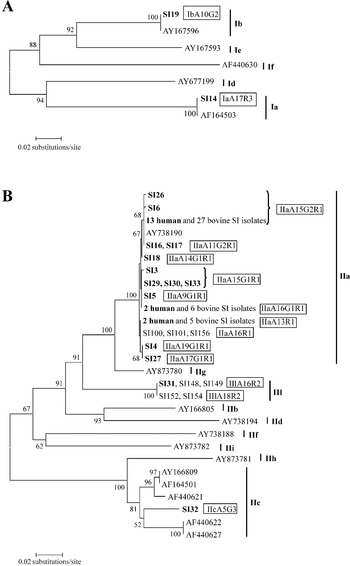
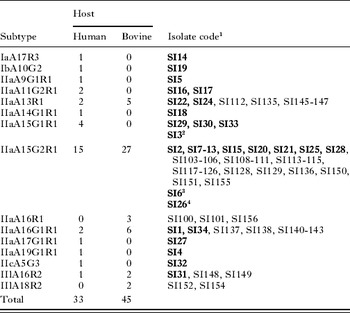
The secondary gp60 amplicons from all 78 genomic DNA samples shown to contain C. hominis or C. parvum were sequenced. The sequence data for C. hominis and C. parvum were subjected to phylogenetic analysis separately because of the sequence variation in gp60 between these two species. For C. hominis, 2 subtypes defined could be linked to clusters Ia and Ib (Fig. 1A); for C. parvum, the 13 subtypes were linked to 3 clusters (IIa, IIc and IIl) (Fig. 1B). Eleven of the 13 C. parvum subtypes were from humans, whereas 6 subtypes were from calves. Four subtypes were from both humans and calves. Details on the numbers of samples representing each subtype are presented in Table 1.
Phylogenetic relationship of Cryptosporidium hominis (A) and C. parvum (B) isolates from humans and calves examined in the present study and sequences previously deposited in GeneBank as inferred from neighbour-joining analysis of the partial gp60 gene. Human isolates examined in the present study appear in boldface. Codes in boxes following isolates examined in the present study are the names of subtypes. Values on branches are percentage bootstrap values using 1000 replicates. Bootstrap values greater than 50% are shown.

Distribution of Cryptosporidium hominis and C. parvum subtypes in humans and calves in Slovenia as inferred from gp60 sequence data

1 Human isolates appear in boldface.
2 With a change of A to G downstream of the trinucleotide repeats.
3 With a change of C to T downstream of the trinucleotide repeats.
4 With a change of C to T shortly after the trinucleotide repeats.
The phylogenetic analysis of the gp60 sequence data representing 33 human isolates (using published data for comparison) allowed C. hominis samples to be classified as Ia (1/2) and Ib (1/2), and those from C. parvum as IIa (29/31), IIc (1/31) and IIl (1/31) (Fig. 1). Nine different subtypes were identified within IIa (Fig. 1B), which differed from one another mostly in the numbers of TCA and TCG repeats (coding for the amino acid serine) and in a single nucleotide polymorphism in a region following the trinucleotide repeats (a change from G to A, resulting in an amino acid substitution – from glycine to aspartic acid). The most common subtype was IIaA15G2R1, detected in 15 of 31 C. parvum-infected humans. Of the remaining 8 C. parvum IIa subtypes, IIaA15G1R1 was detected in 4 humans, whereas IIaA9G1R1, IIaA11G2R1, IIaA13R1, IIaA14G1R1, IIaA16G1R1, IIaA17G1R1 and IIaA19G1R1 were represented in 1 or 2 humans (Table 1). The sequence of isolate SI32, which had 5 TCA repeats and 3 TCG repeats, had identities of 93–95% with sequences of C. parvum IIc (Accession numbers AY166809, AF440621, AF440622, AF440627 and AF164501; Strong et al. Reference Strong, Gut and Nelson2000; Leav et al. Reference Leav, Mackay, Anyanwu, O'Connor, Cevallos, Kindra, Rollins, Bennish, Nelson and Ward2002; Alves et al. Reference Alves, Xiao, Sulaiman, Lal, Matos and Antunes2003). However, phylogenetic analysis placed it in the cluster of C. parvum IIc sequences (Fig. 1B).
Phylogenetic analysis classified C. parvum samples (n=45) from cattle as IIa (41/45) or IIl (4/45) (Fig. 1B). Four and 2 subtypes were identified within IIa and IIl, respectively (Fig. 1B). As was found in humans, the most common subtype in calves was IIaA15G2R1, detected in 27 of 45 C. parvum-infected calves. This subtype was also the most widely distributed, being present on 19 of the 31 farms studied herein. Subtype IIaA13R1 was detected on 3 farms, whereas subtypes IIaA16R1, IIaA16G1R1, IIlA16R2 and IIlA18R2 were each detected on 1 farm (data not shown). More than 1 diarrhoeic, C. parvum-infected calf was detected on 10 of the 31 farms. No sequence variation in gp60 was detected among samples from cattle on individual farms (data not shown).
DISCUSSION
In Slovenia, there is a paucity of information on the genetic make-up of Cryptosporidium from humans and calves (Stantic-Pavlinic et al. Reference Stantic-Pavlinic, Xiao, Glaberman, Lal, Orazen, Rataj-Verglez, Logar and Berce2003). In the present study, we studied 2 C. hominis and 76 C. parvum isolates from 33 humans and 45 calves at the gp60 gene locus. A total of 15 gp60 subtypes were identified, and most of the infections in both humans and calves were caused by C. parvum IIa which has been reported to be the commonest in cattle (Alves et al. Reference Alves, Xiao, Sulaiman, Lal, Matos and Antunes2003, Reference Alves, Xiao, Antunes and Matos2006; Peng et al. Reference Peng, Meshnick, Cunliffe, Thindwa, Hart, Broadhead and Xiao2003b; Brook et al. Reference Brook, Hart, French and Christley2007; Geurden et al. Reference Geurden, Berkvens, Martens, Casaert, Vercruysse and Claerebout2007; Plutzer and Karanis, Reference Plutzer and Karanis2007; Thompson et al. Reference Thompson, Dooley, Kenny, McCoy, Lowery, Moore and Xiao2007; Xiao et al. Reference Xiao, Zhou, Santin, Yang and Fayer2007). Therefore, it is not surprising that human infections with C. parvum IIa are detected in areas with intensive animal husbandry (e.g. Glaberman et al. Reference Glaberman, Moore, Lowery, Chalmers, Sulaiman, Elwin, Rooney, Millar, Dooley, Lal and Xiao2002; Alves et al. Reference Alves, Xiao, Sulaiman, Lal, Matos and Antunes2003, Reference Alves, Xiao, Antunes and Matos2006; Peng et al. Reference Peng, Meshnick, Cunliffe, Thindwa, Hart, Broadhead and Xiao2003b; Chalmers et al. Reference Chalmers, Ferguson, Cacciò, Gasser, Abs EL-Osta, Heijnen, Xiao, Elwin, Hadfield, Sinclair and Stevens2005; Feltus et al. Reference Feltus, Giddings, Schneck, Monson, Warshauer and McEvoy2006; Trotz-Williams et al. Reference Trotz-Williams, Martin, Gatei, Cama, Peregrine, Martin, Nydam, Jamieson and Xiao2006), as is the case in Slovenia. Ten subtypes within C. parvum IIa were identified in the present study, with IIaA15G2R1 being the commonest (60% of C. parvum infections in calves and 48% of C. parvum infections in humans). Previously, this subtype was shown to be the most prevalent C. parvum subtype in calves and humans in the United Kingdom, United States, Portugal, Australia, Japan, Kuwait and Canada, and appears to be frequently linked to zoonotic cryptosporidiosis (Glaberman et al. Reference Glaberman, Moore, Lowery, Chalmers, Sulaiman, Elwin, Rooney, Millar, Dooley, Lal and Xiao2002; Peng et al. Reference Peng, Meshnick, Cunliffe, Thindwa, Hart, Broadhead and Xiao2003b; Wu et al. Reference Wu, Nagano, Boonmars, Nakada and Takahashi2003; Chalmers et al. Reference Chalmers, Ferguson, Cacciò, Gasser, Abs EL-Osta, Heijnen, Xiao, Elwin, Hadfield, Sinclair and Stevens2005; Sulaiman et al. Reference Sulaiman, Hira, Zhou, Al-Ali, Al-Shelahi, Shweiki, Iqbal, Khalid and Xiao2005; Abe et al. Reference Abe, Matsubayashi, Kimata and Iseki2006; Alves et al. Reference Alves, Xiao, Antunes and Matos2006; Trotz-Williams et al. Reference Trotz-Williams, Martin, Gatei, Cama, Peregrine, Martin, Nydam, Jamieson and Xiao2006; Xiao et al. Reference Xiao, Zhou, Santin, Yang and Fayer2007). In the present investigation, 2 other C. parvum IIa subtypes, IIaA16G1R1 and IIaA13R1, were identified in both human and bovine isolates and, therefore, may also be zoonotic. Subtype IIaA13R1 (identified herein in 2 human and 5 bovine isolates) was novel, whereas subtype IIaA16G1R1 (identified herein in 2 human and 6 bovine isolates) has been reported previously from calves in the United States, Canada, Serbia and Montenegro, Hungary and The Netherlands (Peng et al. Reference Peng, Meshnick, Cunliffe, Thindwa, Hart, Broadhead and Xiao2003b; Trotz-Williams et al. Reference Trotz-Williams, Martin, Gatei, Cama, Peregrine, Martin, Nydam, Jamieson and Xiao2006; Plutzer and Karanis, Reference Plutzer and Karanis2007; Misic and Abe, Reference Misic and Abe2007; Wielinga et al. Reference Wielinga, de Vries, van der Goot, Mank, Mars, Kortbeek and van der Giessen2008). There are no previous reports of IIaA16G1R1 infecting humans. Subtypes IIaA11G2R1, IIaA17G1R1 and IIaA19G1R1, identified in 2, 1 and 1 Cryptosporidium isolates from humans, respectively, have been identified previously in calves in the United Kingdom, Hungary and also Slovenia (Stantic-Pavlinic et al. Reference Stantic-Pavlinic, Xiao, Glaberman, Lal, Orazen, Rataj-Verglez, Logar and Berce2003; Brook et al. Reference Brook, Hart, French and Christley2007; Plutzer and Karanis, Reference Plutzer and Karanis2007; Thompson et al. Reference Thompson, Dooley, Kenny, McCoy, Lowery, Moore and Xiao2007), indicating that these 3 subtypes may also be exchanged between humans and farm animals. Herein, 2 additional new subtypes (IIaA9G1R1 and IIaA14G1R1) were each identified in 1 isolate from a human, and another (IIaA16R1) was identified in 3 isolates from infected calves. The zoonotic potential of these 3 subtypes, as well as that of IIaA15G1R1 (identified in 4 human isolates and, previously, in 2 isolates from children in Kuwait (Sulaiman et al. Reference Sulaiman, Hira, Zhou, Al-Ali, Al-Shelahi, Shweiki, Iqbal, Khalid and Xiao2005)), remains to be determined.
Cryptosporidium parvum IIl was identified in 1 human (subtype IIlA16R2) and 4 bovine isolates (subtype IIlA16R2 and a new subtype IIlA18R2); it has been identified previously in cattle from Serbia and Montenegro and The Netherlands (Accession numbers AB242225, AB242227 and EF576957; Misic and Abe, Reference Misic and Abe2007; Wielinga et al. Reference Wielinga, de Vries, van der Goot, Mank, Mars, Kortbeek and van der Giessen2008) but erroneously named as IIj. This designation had already been used by Thompson et al. (Reference Thompson, Dooley, Kenny, McCoy, Lowery, Moore and Xiao2007) for a genetic variant of C. parvum from a calf in Northern Ireland (see GenBank Accession number DQ648547). This study is the first published report of C. parvum IIl in humans. The finding of the subtype IIlA16R2 in human and bovine hosts suggests that at least 1 subtype of C. parvum IIl is zoonotic, representing a potential human health threat.
Cryptosporidium parvum IIc, which has not yet been found in animals, is commonly detected in infected humans in many countries (Leav et al. Reference Leav, Mackay, Anyanwu, O'Connor, Cevallos, Kindra, Rollins, Bennish, Nelson and Ward2002; Alves et al. Reference Alves, Xiao, Sulaiman, Lal, Matos and Antunes2003, Reference Alves, Xiao, Antunes and Matos2006; Xiao et al. Reference Xiao, Bern, Sulaiman, Lal, Thompson, Armson and Ryan2003; Xiao and Ryan, Reference Xiao and Ryan2004; Sulaiman et al. Reference Sulaiman, Hira, Zhou, Al-Ali, Al-Shelahi, Shweiki, Iqbal, Khalid and Xiao2005), indicating that it is probably anthroponotic. Cryptosporidium parvum IIc was identified in 1 human isolate herein and was, as expected, not detected in infected calves, suggesting that, although rare, anthroponotic transmission of C. parvum can occur in Slovenia. Cryptosporidium parvum IIc determined in the present study was genetically distinct from all of the C. parvum IIc subtypes reported previously. This information is consistent with findings from previous studies, which have shown that sequence divergence among gp60 subtypes within C. parvum IIc is greater than within other genotypes, although no variation in the number or type of trinucleotide repeats had been detected for IIc (they all have 5 TCA repeats and 3 TCG repeats) (Strong et al. Reference Strong, Gut and Nelson2000; Sulaiman et al. Reference Sulaiman, Hira, Zhou, Al-Ali, Al-Shelahi, Shweiki, Iqbal, Khalid and Xiao2005).
In this study, C. hominis Ia (subtype IaA17R3) and Ib (subtype IbA10G2) were each identified in 1 human isolate. Cryptosporidium hominis Ib and subtype IbA10G2 have been recorded in Europe both in sporadic cases and outbreaks (Glaberman et al. Reference Glaberman, Moore, Lowery, Chalmers, Sulaiman, Elwin, Rooney, Millar, Dooley, Lal and Xiao2002; Chalmers et al. Reference Chalmers, Ferguson, Cacciò, Gasser, Abs EL-Osta, Heijnen, Xiao, Elwin, Hadfield, Sinclair and Stevens2005, Reference Chalmers, Hadfield, Jackson, Elwin, Xiao and Hunter2008; Alves et al. Reference Alves, Xiao, Antunes and Matos2006; Cohen et al. Reference Cohen, Dalle, Gallay, Di Palma, Bonnin and Ward2006; O'Brien et al. Reference O'Brien, McInnes and Ryan2008). Moreover, infections with C. hominis subtypes other than IbA10G2 are usually linked to travel outside of Europe (e.g. Alves et al. Reference Alves, Xiao, Antunes and Matos2006; Chalmers et al. Reference Chalmers, Hadfield, Jackson, Elwin, Xiao and Hunter2008). As no information was available on foreign travel for the patient infected with the novel C. hominis subtype IaA17R3, it is not possible to infer whether this subtype is endemic in humans in Slovenia or whether it was acquired in a foreign country.
The lack of sequence variation in gp60 among samples from diarrhoeic, C. parvum-positive calves from individual farms suggests that a single subtype is endemic on each farm. This finding is similar to a study on farms around Belgrade in Serbia and Montenegro (see Misic and Abe, Reference Misic and Abe2007) but contrasts with the situation on several farms in Michigan, Ontario and other parts of the USA, where multiple subtypes have been detected on individual farms (Peng et al. Reference Peng, Meshnick, Cunliffe, Thindwa, Hart, Broadhead and Xiao2003b; Trotz-Williams et al. Reference Trotz-Williams, Martin, Gatei, Cama, Peregrine, Martin, Nydam, Jamieson and Xiao2006; Xiao et al. Reference Xiao, Zhou, Santin, Yang and Fayer2007). This difference probably reflects management practices on farms, including the purchase of calves and the mixing of groups of different origins and/or ages. While the exchange of calves between farmers and/or the introduction of new animals is common in the USA (Peng et al. Reference Peng, Meshnick, Cunliffe, Thindwa, Hart, Broadhead and Xiao2003b), dairy farms in Slovenia usually represent ‘closed systems’, and calves are almost never purchased from other farmers or traders, explaining the presence of a single C. parvum subtype per farm. Similarly, in the UK, Brook et al. (Reference Brook, Hart, French and Christley2007) demonstrated multiple C. parvum subtypes on a commercial beef farm onto which calves were introduced and on which calves were also raised, while on ‘closed’ dairy farms only one subtype was present. Besides genetic diversity of Cryptosporidium within a single farm, management issues are also likely to contribute to genetic diversity among farms. Indeed, much greater genetic diversity of C. parvum was recorded among farms in Slovenia than in the United States, Canada and Portugal (Alves et al. Reference Alves, Xiao, Sulaiman, Lal, Matos and Antunes2003, Reference Alves, Xiao, Antunes and Matos2006; Peng et al. Reference Peng, Meshnick, Cunliffe, Thindwa, Hart, Broadhead and Xiao2003b; Trotz-Williams et al. Reference Trotz-Williams, Martin, Gatei, Cama, Peregrine, Martin, Nydam, Jamieson and Xiao2006; Xiao et al. Reference Xiao, Zhou, Santin, Yang and Fayer2007). Substantial genetic diversity within C. parvum has also been detected among farms in Northern Ireland (Thompson et al. Reference Thompson, Dooley, Kenny, McCoy, Lowery, Moore and Xiao2007), where management practices on farms are similar to those in Slovenia.
In conclusion, the results of this study provide useful insights into the epidemiology of Cryptosporidium infecting humans and cattle in Slovenia. The low percentage of human infections attributable to C. hominis and C. parvum IIc indicates that anthroponotic transmission may not contribute as significantly to sporadic human cryptosporidiosis in Slovenia, as has been inferred in other areas of the world (Peng et al. Reference Peng, Matos, Gatei, Das, Stantic-Pavlinic, Bern, Sulaiman, Glaberman, Lal and Xiao2001, Reference Peng, Meshnick, Cunliffe, Thindwa, Hart, Broadhead and Xiao2003a; Leav et al. Reference Leav, Mackay, Anyanwu, O'Connor, Cevallos, Kindra, Rollins, Bennish, Nelson and Ward2002; Alves et al. Reference Alves, Xiao, Sulaiman, Lal, Matos and Antunes2003, Reference Alves, Xiao, Antunes and Matos2006; Xiao and Ryan, Reference Xiao and Ryan2004; Xiao et al. Reference Xiao, Fayer, Ryan and Upton2004; Wielinga et al. Reference Wielinga, de Vries, van der Goot, Mank, Mars, Kortbeek and van der Giessen2008; Chalmers et al. Reference Chalmers, Hadfield, Jackson, Elwin, Xiao and Hunter2008; O'Brien et al. Reference O'Brien, McInnes and Ryan2008). Most cases of human cryptosporidiosis examined in the present study were caused by ‘zoonotic’ C. parvum subtypes, suggesting that zoonotic transmission plays an important role in human cryptosporidiosis in this country. Although these conclusions need to be confirmed through further studies, they seem to reflect the agricultural context in Slovenia. Measures to reduce the risk for human infections from cattle will be important. However, the origin of some novel C. parvum subtypes found exclusively in humans remains to be determined. Further molecular epidemiological studies are required to clarify the zoonotic potential and host affiliation of such C. parvum subtypes.
This work was supported by Grant No. 0381-029, P3-0083/3.01 from the Ministry of Education, Science and Sports of the Republic of Slovenia.