Anna held the audience, Anna held its gaze, Anna held it breathless with her Frenchy way, Anna held her train up in manner unexcelled. Countless eyes did Anna hold with those of Anna Held.
Washington Times, December 8, 1902.To turn-of-the-twentieth-century Americans, Anna Held was an agent provocateur of eroticism. As one critic sighed, Miss Held “confined to chansonettes and stunning skin-tight costumes . . . has no superior . . . when she wheezed and wiggled and rolled her eyes in an enticing way, [she] had every one sitting up and taking notice.” Through songs like “I Want to Be Naughty Too,” “Why Can't My Eyes Behave?” and “Won't You Come and Play With Me?” Held electrified and pleasantly discomfited audiences across the nation. Announcements like the one made in 1902 that she was wearing a dress so tight she had to oil herself in order to slide into it and that “any artificial building up [read: undergarments] would destroy the whole effect” drew audiences by the thousands. She was “serpentine and undulant . . . the garment slips until it clings as closely to the skin as to a serpent,” raved a newsman. However, Anna Held was no burlesque queen or tenderloin quarter celebrity; she appeared on the best popular stages before audiences that were, according to a Detroit report, “as good . . . in appearance as usually gathers in the opera house.”Footnote 2 Although working people undoubtedly filled seats in the balconies, Held's audience was largely middle class. How was the coquettish Anna Held perceived by audiences in Progressive Era America? What was the process by which she made performances that Victorian Americans would have considered sordid and morally corrupting into entertainments acceptable to audiences whom modernists would later characterize as prudish and sentimental? What effect did the enjoyment of the erotic have on the way middle-class people perceived sexuality?
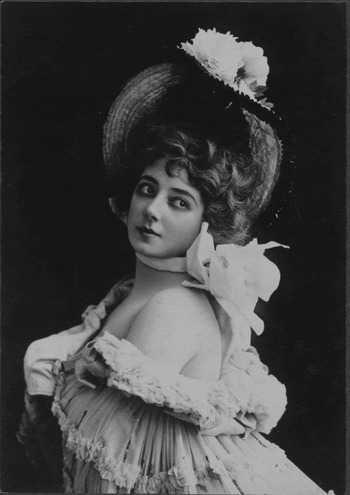
The famous Held shoulders emerge from the opulent frills. Box 3, Anna Held Museum Papers, courtesy of the New York Public Library.

Early-twentieth-century modernism was everywhere a revolt against Victorianism, but in America it was also a response to the earnest, moral reform impulse within progressivism and the “Victorian assumptions about sexuality which dominated Progressive rhetoric.”Footnote 3 Historians have commonly accepted the opinion of progressivism's modernist critics and have depicted bourgeois sexuality as repressed before World War I. Although progressive reformers engaged in a more candid discussion of sexual issues, they also struggled to control erotic impulses and bind them to a standard of normalcy. Consequently, sex emerges in the historical treatment of the Progressive Era as a subject of reflection, obscenity regulation, and social hygiene rather than as a topic whose discussion and display seemed increasingly pleasing to ordinary people.Footnote 4 Female sexuality is depicted as particularly disruptive in the eyes of progressives. “In the view of reformers,” writes cultural analyst Michael Trask, “simply going on a date turned a woman into a prostitute, whether she wanted to be one or not.” To one historian, the early twentieth century “witnessed not the defeat of once hegemonic principles of sexual restraint but the brilliant success of an increasingly radical social purity,” while another affirms that the “national spirit” of the time was one of “almost frenzied social rectitude.”Footnote 5
Historians who study the modernist critique that emerged in the years surrounding World War I see countercultural Americans turning to the very carnality that American progressives—by suppressing red light districts, saloons, and delinquency—had tried to stamp out. When fashionable or bohemian moderns went slumming in Harlem or the South Side, danced through the night in clubs or speakeasies, listened to what they took to be the primitive sounds of jazz, or celebrated artists who depicted prostitution and other seamy sides of city life, they forged the kinds of cross-class, transracial linkages that the progressive generation had worried were degenerative. Sexual modernism's touchstone was the very rough culture that progressivism had struggled to civilize, and sexual modernism was the instrument that legitimized disruptive working-class and African American cultures by commercializing and reworking them in ways that middle-class white males could dominate.Footnote 6
This historical interpretation of modern and Progressive Era sexuality is certainly powerful, but it rests on a series of assumptions and disconnections. It posits the clear separation of popular and bourgeois culture and presumes the pervasive sexual conservatism of the one while romanticizing the raw honesty of the other.Footnote 7 Ironically, it then privileges those middle-class moderns who “discovered” plebian sexuality in post-WWI period, shifting the development of mass culture chronologically forward while at the same time reintegrating working-class mores and behavior patterns back into a framework based on bourgeois cultural hegemony. The working-class sexual freedom that historians of the Progressive Era see as disruptively liberating suddenly becomes disempowering once “everybody was doing it” in the 1920s.
This study of Anna Held questions the prevailing interpretation in two ways. First, it suggests that although the attention that has been devoted to leisure and entertainments in the modernization of sexual attitudes is well placed, too much emphasis has been given to the high culture/low culture division and to the role of post-war, middle-class modernists in changing bourgeois sensibilities. The percolating eroticism of the Progressive Era dripped down even while it bubbled up. As Alison Kibler demonstrates, vaudeville acts—the most important entertainments of the Progressive Era—blended together middle-class and working-class forms of mass entertainment by the 1890s. Peter Gay, David Scobey, and Joseph Horowitz have similarly revealed how middle-class audiences drew on highbrow traditions of art to justify shocking displays of sexuality. In fact, middle-class audiences were often exposed to levels of theatrical eroticism beyond those available in respectable working-class entertainments. Even though she employs the highbrow/lowbrow dichotomy, Katie Johnson rightly asserts, “Bourgeois and upper-class audiences were, in fact, seduced by the practice of slumming via the theater” well before World War I. In this context, the post-war modernists were swept along by currents already surging through middle-class culture; modernism synthesized existing tastes and preferences as much as it engaged in cultural revolt against others. For as Malcolm Cowley, reflecting back, noted of the artists of the pre-war period, “They too had been in revolt and . . . were a lost generation.” In the end, Cowley remarked, the Progressive Era's innovators have been “more tragically lost than their successors.”Footnote 8
Second, this essay argues that in defining modernization using a highbrow/lowbrow paradigm, historians of sexual modernism have neglected an underlying psychological and philosophical element of modernist thought: acceptance of the relativistic character of perception and even reality itself. Focusing on modernism's sociostructural and gender manifestations in the post-World War I decades is certainly informative, but it obscures the deeper transformation in perception and understanding on which the new attitudes to the erotic were based. This essay argues that by the mid-1890s, the ninteenth century's morally anchored pattern of visual perception—its “scopic regime,” to use a phrase borrowed from media theory—was breaking down, and people began to accept the pleasure of the transient and indefinite impression.Footnote 9 This was the necessary transformation that underpinned the modernization of sexual attitudes. The change can be detected in Progressive Era art, in revisions to vice laws, and in new attitudes toward erotic displays in everyday life. It was also readily observable in the theaters of the Progressive Era, where performers, writers, and impresarios pushed the boundaries of taste by manipulating their audiences' erotic sensibilities. Although the Progressive Era's bohemians may have been the most visible proponents of sexuality's modernization, recognition of the broader changes taking place in perception allows us to see them as the vanguard rather than the cause of a cultural shift.
Anna Held was one of those actors who in the 1890s and first decade of the twentieth century contributed to and profited from the cracks that were opening in middle-class perceptions. Held was among the brightest stars in the American musical-theater firmament at the turn of the century, but she was also a sex symbol famous for her flirtatious manner and skin-tight clothing. As Linda Mizejewski has demonstrated, Held's career provides a good starting point for the discussion of sexual modernization and changing attitudes to female eroticism. According to her friend, actor Lillian Russell, Held introduced the “vogue for thinness.” Moreover, as Lois Banner explains, “Held was a direct precursor of the short, boyish female with a doll-like face who would come to dominate standards of physical appearance in the 1920s.”Footnote 10 In short, Held illustrates the link between the sensuality of Progressive Era culture and modernism's free-living, off-the-rack flapper. Held was, however, also a star who performed in expensive theaters before overwhelmingly middle-class audiences. Her career offers another example of the need to reconsider the stark highbrow/lowbrow dichotomy that dominates much of the literature on Progressive Era sexuality.
Accounts of Held's performances offer insight into the moving boundaries surrounding the public display of sex and the ways in which sexual modernism was a product of, and a contributor to, a new way of seeing. Perception has, not surprisingly, strongly interested students of female sexuality. In recent years, scholars exploring women's agency have recognized the hegemonic masculine gaze underpinning modern eroticism while simultaneously arguing that women's actual performances of their own sexual attractiveness, “though circumscribed” by male perception, “were nonetheless potentially empowering.” Privileging the way modern sexuality was performed rather than perceived has the effect of polarizing the putative (and male) manufacturers of sexual modernism from its (female) performers. Indeed, this topic is often studied through the prism of the stage because the theater seems the perfect forum in which to conceptualize the separation of male spectatorship from female performance. Performance subverted the male gaze in unexpected ways, which expanded the space available for female erotic expression.
The privileged position accorded heterosexual males in the modern erotic is indisputable, but the very ambiguity that entered their sight was sufficiently blurred to provide women with considerable interpretive freedom. As Held's performances revealed, the far-reaching changes that affected perception in the Progressive Era encouraged female sensuality to be revealed in challenging ways even as its male-directedness was affirmed. What historians generally interpret as resistance, Richard Allen observed of female burlesque artists, was “deflected and redirected into a discourse of subordination.” This is why female sexual agency could not be seen as oppositional or insubordinate. At work in the modern erotic was not a conflict between female performers and male directors and spectators; rather, a woman's freedom to be sensual was written into the script. Held's public fame as a sexual provocateur was inseparable from her roles as a wife, mother, social conservative, decadent and pampered woman, and trend-setting foreigner. Her independence of spirit was not ultimately derived from the dissent implicit in what she performed so much as from the gray zone created by the very act of seeing her. The pleasure audiences derived came from the multiplicity of messages she communicated (wife, mother, social conservative, decadent aristocrat, sexual provocateur, actor, fashion plate), all of which allowed her to be at once shocking and containable. In modernist terms, she was freer to be whom she wanted to be because people were never certain how they should categorize her to begin with. This uncertainty about what one was seeing lay at the center of sexual modernism, and it created space for experimentation and complaint, but it did not provide a stable perspective from which to engage sexual privilege.Footnote 11
Watching Anna Held
Anna Held was a short, buxom woman with a long nose, almond eyes, and high cheekbones. Commentators considered her striking rather than beautiful. By all accounts she was an undistinguished singer, possessed of a thin “little door-hinge warble that hasn't much carrying quality.” She put on a cartoon-like French accent—“Sometimes I zink eet ees not so deseerable to be zee elegant woman who knows zee life”—that made it hard for the public to evaluate her dramatic ability. Few, however, considered acting her strong suit. As one critic noted, when she wanted to emote, she “mewed and meowed and yowled until her agony was more painful to the audience than it could possibly be to her.” Still, for all the deficiencies of her art, Held was a box-office sensation who broke attendance records throughout her career. Her first cross-country American tour in 1903 reportedly produced a net profit for its promoters of $142,000. As one journalist concluded, “There are a dozen, a hundred, perhaps a thousand women on the stage more beautiful, more talented, more graceful . . . [but] I know of no one who can make so much out of so little.”Footnote 12
What made Held a star at the turn of the century was her eroticism. “She so far exceeds what the word risqué implies,” an Atlanta columnist wrote, “that to apply it to her stage performance scarcely does the little lady credit.” To Held's critics, the eroticism she displayed on stage was proof of her degeneracy. Uncomfortable with the idea of separating the stage from everyday morality, these thinkers argued that sex on stage and on the street were of a kind. When the great French actor Sarah Bernhardt visited America in the 1870s, one disapproving theatergoer informed her that it would be “dangerous to public morals to separate the public life of the artist from her professional qualities.” Similarly, some moralists regarded Held as “the essence of filth. It can not be said that Anna Held is vulgar. She is gross.” A Boston journalist concurred: “She breaks through the thin crust that covers the vices of humanity . . . the subject matter of many of her songs is avowedly immoral. And the manner in which she sings them increases their lubricity a hundred fold.” These comments, however, represent a minority opinion. Almost all reviewers and, one assumes from sold-out theaters, a majority of audiences found her wonderful. As a reporter noted of her first appearance at the Manhattan Theater in 1899, “Pretty much everything she did evoked applause, which at times arose to the point of positive ecstasy.” Many believed that Held was “a particular women's favorite,” despite her sexiness. At a typical performance, “there were nearly as many women as men and they were well dressed women, and many of the men wore dress suits.” Indeed, “women adore Miss Held . . . they envy her her clothes and her ability to wear them.”Footnote 13
That Anna Held's extravagant eroticism was not generally repudiated as corrupting is extraordinary and shows that theatergoers and critics were finding ways of separating themselves from the commerce of her sexuality. In order to do this they needed mechanisms for containing and neutralizing the effects of her erotic assault on their morals. People rationalized Held's appeal throughout her career in ways that provide clues to American attitudes to sexual display. At the same time, however, such pronouncements remained rationalizations. The unavoidable truth is that in watching Held, Americans were learning to enjoy the public display of sex, and in so doing they were unconsciously advancing the great inversion of perception that was at the center of the triumph of sexual modernism.
Few Americans had heard of Anna Held when she arrived in New York in 1896, though her manager, Florenz Ziegfeld, promoted her as a great celebrity in Europe. Ziegfeld first heard of Held when he was in London earlier that same year. The French actor had an engagement at the Palace Varieties theater, and according to Ziegfeld, the London public was “wild over her.” He approached her about appearing in the United States and joked, “I knew little or no French and she only speaks a few words of English—she can only say $1500 a week . . . big money to give a woman for less than a half-hour's work on the stage nightly.” However, when the American promoter watched her perform, he became “the worst [fan] of the lot, sitting in the front row and applauding as though I wanted her to ask me $2000.” Undoubtedly, Ziegfeld had fallen under the spell of Anna Held's sex appeal. The producer decided to launch Held's career in America as an entre acte to a well-known farce, A Parlor Maid. It was a sensible decision: If Held succeeded, she would generate sales for the rather tired comedy and, if she proved a bust, the play would cushion the cost of her enormous salary.Footnote 14
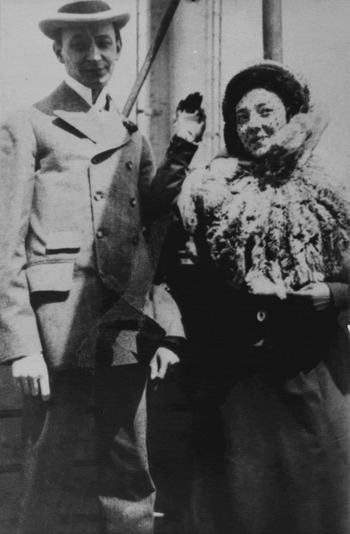
Florenz Ziegfeld Jr. and Anna Held at the time of her arrival in America, October 1896. Box 3, Anna Held Museum Papers, courtesy of the New York Public Library.

Fortunately for her promoters, Held was the sensation of the New York season in 1896–97, and she was an equal hit in Boston and other cities of the Northeast. “Anna's photographs do not do her justice,” a Boston Globe reporter exalted on first eyeing her. “She is a striking figure from any point of view. No one but a French woman could ever present such a picture. Her bodice is cut very low and her skirt pretty high, and the physical charms revealed are well worth being displayed.” She appeared when the long-winded A Parlor Maid had already gone on for two hours, with the audience by then waiting “in impatient expectancy.” Held swayed onto the stage in a “blaze of diamonds,” wearing a décolleté dress “as never could be seen anywhere but on a Parisian.” Not surprisingly, given the long wait, the welcoming applause for the unknown star had an “uncertain ring.” She sang two songs, which produced “something verging on mild disappointment, for both were of a character unusual on the American stage and being sung in French were apparently understood and appreciated by few.” Then she sang a French ballad directly to one of the cellists in the orchestra “of such originalities of expression that they began to stir the audience genuinely.” Finally, she unleashed the song in English that had so excited New Yorkers; “I would like you to play with me,” she cooed, “play with me all the day long.” Her English “is charming,” exclaimed the Globe's reporter, and she decorated it “with such a wealth of pretty nods and winks and grimaces, and such a queer little wiggling of the shoulders and bosom, suggesting a refined version of a danse du ventre, that the audience—that is the male part of it—pretty near reached that stage commonly expressed as going wild.” At subsequent performances, Held closed with a shockingly vulgar song in which she assumed the part of a young man:
She then presented an encore in English: “I want you, my honey, yes I do” in a “delectable mixture of French, English, and negro dialect.” This, wrote the Globe's critic, “completed her conquest . . . the white gloves were worn out with clapping.”Footnote 16
The sex in a Held performance was thinly disguised, and her manner was provocative. But she was not in any discernable way a product of American low culture. When, on occasion, she took her act to a more popularly priced theater, the novelty was no less apparent: “Never have I seen the West Side playhouse so packed with people,” a New Yorker reported in 1899, “the Eighth Avenue-ites jumped at the chance of cheaply seeing the heroine of the milk baths . . . her peerless shoulder blades were in full evidence, conspicuously displayed by the nonchalance of her costume, and the dazzling manipulations of her skirts and draperies . . . it is impossible to get seats.”Footnote 17
Why did late-nineteenth-century audiences—with brows low, middle, and high—who had been raised in a culture in which such titillation was seen as soul destroying, enthusiastically applaud Anna Held? Rev. Madison C. Peters, pastor of New York's Bloomingdale Reformed Church, offered the obvious explanation: Americans were rushing headlong towards damnation. American “society” only “outwardly wears the white cloak of virtue . . . underneath that spotless garment are the soiled underclothes of depravity and sin. Its appetite is carnal, and can only be appeased by a menu of the flesh served up à la Française,” Peters wrote in despair. “Go to Held!” erupted Archie Bell of the Cleveland News, echoing Peters's diatribe. Her show
is Frenchy. It's bizarre, It's risque. Yes it's naughty, real Parisian naughty . . . I believe it's the raciest show that has ever played . . . I can remember moments at the theater when you would have heard a pin drop. Last night, the crowd would have blasted if anyone had been guilty of breathing. It was a moment of awful, excruciating suspense. But nobody fainted. Everyone enjoyed it thoroughly. People got just what they expected and what they wanted. They even applauded the unspeakable matchische for which you must pay extra in the Parisian cabaret . . . the Egyptian danse de ventre is tame by comparison.Footnote 18
The fact that Held was French was undoubtedly crucial in overcoming discomfort with her eroticism. If there was another half in a Held show, that half was Europe. Her French origins, at least initially, allowed her to preserve something of the transformative protection of the mask. In her first seasons in America, Held sang most of her songs in French and would speak to the audience only briefly and in fractured English. “Her French accent is confusing to the ear and helps her piquancy,” a reporter shrewdly commented. Held reinforced the image of her Frenchness at every turn, not just through speech, but also in diet, dress, and identification. She returned to Paris every summer of her twenty-year American career, sailing back to New York most every fall. This allowed a crucial separation from her American audience, and it gave her the opportunity to purchase the latest Parisian gowns and maintain her appeal to women as a living fashion plate. In 1911, for example, she returned with twelve gowns and promptly displayed them to the press. They each cost $400, she told the impressed newsmen, even though they looked like lace handkerchiefs. “Don't you know,” she joked, undoubtedly playing to audiences she hoped would attend her shows, “that the latest style is a millinery imitation of what Eve wore . . . they should really be called ‘French undresses.’” France was so important to Held's identification that when in 1907 the story broke that she was actually Polish, she emphatically denied it: “I was born in Paris. Voila! That is settled.”Footnote 19
As the critic in the San Francisco Call remarked in 1897, Held could get away with risqué songs because nine-tenths of the audience couldn't understand her. She had lived some years in London after the death of her father, and she understood considerably more English than she made out; Ziegfeld in 1896 reported her English to be “surprisingly good.” On stage, however, her foreignness was essential, because it allowed her to push American conventions in a way no native actor could do. Frenchness gave Held a license to transgress; it tied her to a society popularly regarded as decadent while preserving the American audience's sense of security about their own cultural standards. As a saucy French import, Held was exotic and licentious—she was “like some luscious tropical fruit,” according to one admirer—but attendance at her shows did not presume any deterioration in the morals of Americans. A Washington Post reporter understood this when he wrote, “What would the press and public say if an American girl were to appear on the stage of the National Theater and attempt such a performance as that given by Anna Held?” The answer: “I do not believe she would meet with such a hearty reception . . . the conservators of public morals would raise a rumpus and the managers would request some modification.” The difference was that “Mlle. Held is French,” and what from an American would seem “broadly vulgar” was carried “with such grace and chic that it made the [potentially obscene] appear the most natural thing in the world. . . . We are accustomed to allow great latitude to anything French.” After all, an Atlanta minister insisted, wasn't “France the direful source of unnumbered social mischiefs?”Footnote 20
The theatrical setting of Held's display also helped audiences contain the shock they may otherwise have experienced over her sexiness. It is doubtful if many of them would have responded so enthusiastically to a similar advance on the street. Those attending shows are predisposed to find them enjoyable and to disconnect what they see on stage from their everyday lives. Even if Held may be “a little unsavory and despicable,” a newsman wrote, “something that our American feelings protest against inwardly, we laugh and applaud.”Footnote 21 Held's foreign ways and French accent aided audiences in disassociating the actor's behavior (her head tilts and winks, jiggling breasts, and verbal appeals) from the impressions of her they derived. In the theater at least, they were willing to decide for themselves what was indecent and corrupting and to reassure themselves concerning their own moral rectitude even though they enjoyed watching Held perform.
However, social commentators were not really deluded by these rationalizations. As Nat Goodwin, a San Francisco Call writer, reasoned in 1900, “All of us, more or less, like a shock. We get in a rut of emotions once in a while and anything which takes us out of it seems to give a certain amount of pleasure. If the shock comes to our morals all the worse for the morals.” Moreover, drawing from this a lesson for the country's guardians of morality, Goodwin added, “why . . . we blame the shock I can't quite make out. It's not necessary for us to take [obscenity] if we don't want it . . . why blame the actor for it?” Then, quoting Justice Edgar L. Fursman in a recent New York indecency case, Goodwin noted that an act “is not to be condemned because it may shock the sensitiveness of [some] or approved because it may gratify [interests prurient] . . . all men do not hold the same idea of any one play or book or painting or anything of an artistic nature, even though certain set rules are put for their guidance. Everything in the world must depend on the point of view.”Footnote 22
As Goodwin implied, Held's eroticism appealed because she was on stage. She needed the stage in order to subvert the moral order; the audience needed the theater in order to enjoy what on the street they would likely have still considered a moral affront. Both actor and spectator depended on theater to transform what was generally regarded as vice into play. What this means, however, is that in the theater at least, American audience members were separating the sensory stimulus Held provided from their moral judgment of it. They were implicitly reasoning that because she was French and on stage, her eroticism was not corrupting and could be enjoyed. This implied what Charles Peirce called a more “indefinite determinability” between the predicate (Held) and the people who were watching her than a traditional Victorian perspective might suggest. For the thousands attending Held's show, a subtle but important shift was taking place in their perception of the connection between external realities and the sensations they took from them. Watching an erotic performance did not necessarily imply the moral contamination of the spectator. Held might behave on stage like a tart without being one, at least, not an American one. She made the public display of sex chic rather than sinful. Underlying this simple fact was an inversion of the Victorians' belief structure: Moral truth was not absolute or inherent in the thing itself; it had to be assigned by those perceiving it.
The Cultural Construction of Perception
Historians often attribute the emergence of a more erotically charged popular theater in the early twentieth century to a crisis of masculinity. Women's rights, progressivism, and the bureaucratization of middle-class work, they suggest, raised men's anxieties concerning their virility. In the film and theater of the time, Lewis Erenberg affirms, men “made women stand for the vitality they wanted in their own lives without having to create emotional vibrancy out of the depths of their own beings.” Through the chorus girl and her real-life facsimile, the flapper, modern males—in this interpretation—constructed for women an ideal of youth and energy onto which they imputed a sexuality unencumbered by Victorian sentiment. However, the eroticization of the performer represented, as Susan Glenn writes, no more than “a psychological wish—a symbolic attempt to assert male prerogatives and to master the perceived threat of dangerous feminine ambitions.”Footnote 23 The historians' gendering of audience desire is important, but in defining the eroticism of an actor like Held largely as a projection of anxiety, historians have tended to ignore both the immediate repercussions of that projection as well as its far-reaching consequences. In accepting the staged erotic, audience members had to adopt a new way of seeing. The transformation of perceptions that the process advanced contributed in crucial ways to the discrediting of the nineteenth-century worldview and the birth of modernism.
Although its primacy was never undisputed, it is fair to say that empiricism guided Victorian Americans in their perception of the sexual.Footnote 24 This may sound like an odd assertion. Perception is, after all, popularly considered a biological rather than a historical fact. To an extent, this is correct. Few nineteenth-century Americans would have wanted or been able to explain the process by which they apprehended what they found sexual or, more generally, the concepts underlying what they took to be external realities. These things, however, were the product of belief structures, and they assumed popular and institutional forms. As many scholars point out, smells can serve to divide people along class and ethnic lines; the feel of different fabrics can arouse divergent associations; the look of a certain place can make one worried or comfortable. In this sense, the sensual meanings people derive from the things they apprehend with their sense organs can be historicized.Footnote 25 But what about perceiving itself?
Our understanding of sensory experience is ordered by thought and memory, expressed by language, encoded in laws, and manifested in social practices. We may assure ourselves that a process is physiological, but our understanding of physiology is a result of knowledge. When we observe objects in the world, we make assumptions about the truth of what we are looking at and about the relationship of the thing seen to the image we have of it in our minds. The assumptions we make about how our sense organs work and how we process the information they deliver are culturally defined and change over time.
Nineteenth-century Americans believed that they found other people sexually attractive because that person communicated sexual interest to their senses, which in turn conveyed it to their mind. This conception of the interaction of the individual and reality was a product of the Enlightenment and can be termed empiricist. The empiricist view held that the senses gathered data impartially from a world of things whose existence anticipated their communication. As John Stuart Mill explained in his popular study of logic: “The existence . . . of a phenomenon . . . is but another word for its perceived existence, or for the inferred possibility of perceiving it. When the phenomenon is within range of present observation, by present observation we assure ourselves of its existence; when it is beyond that range, and is therefore said to be absent, we infer its existence from marks or evidence.”Footnote 26 Victorian Americans extrapolated from empiricism the idea that because the possibility of sensation lay in the thing perceived, then the thing had to have its own independent existence and, in a values-laden world, its own intrinsic meaning.
The Victorian understanding of sexuality rested on four assumptions: first, that a person's inner soul and physical shell were unified (corruption of the body corrupted the soul); second, that each individual was both spiritually and physically separate from the outer world; third, that the senses were neutral receptors that opened the individual to the world; and fourth, that everything had intrinsic qualities, which the perceiver's senses detected and communicated. Although realities might be disguised—and given their understanding of perception, Victorians were understandably fascinated by masks—the inherent messages that a person or thing communicated could be cloaked but not eliminated. Windows always opened the inner soul or truth to the sense perceptions of others, if people were only acute enough to look through them.
Empiricism permeated American law, letters, and education through the middle years of the nineteenth century. In these forms its regime was encoded and naturalized. Empiricists did come in various guises. Romantic empiricists believed emotions let people feel the qualities in nature that the senses communicated. Commonsense empiricists saw reason as the innate sense that allowed minds to process sensory perceptions and distinguish the world's truths. Sensationalists, in contrast, argued that all First Principles were falsehoods and that humans did not have a preordained ability to reason or feel accurately; rather, they argued, people learned from experience how to make judgments and recognize truths. Still, all nineteenth-century empiricists accepted that an essence or value was somehow detectable in nature, that the physical process of perceiving was neutral and that the observer's mind or spirit had the job of detecting and storing the meanings that the impressions intuited. The mind and the world were autonomous things that were connected only by the senses, however, individual values and spirits could not function separately from the material, sensory world. “I accept Reality and dare not question it,” wrote the romantic empiricist, Walt Whitman, “Materialism first and last imbuing.” What materialism imbued for the poet, as for all Victorian empiricists, was the individual soul, for the world of things existed so that one could “enter by them to an area of my dwelling.” As Emerson explained, “The true doctrine of omnipresence is that God reappears in all his parts in every moss and cobweb . . . the universe is alive. All things are moral.”Footnote 27
Empiricist thinking profoundly influenced the mid-nineteenth-century approach to vice law and the public display of the sexual. From the middle years of the century, vice laws were grounded on the belief that the erotic was a projection that had unambiguous visual indicators and, because the senses merely delivered information, largely unmediated consequences. As the lawyer Theodore Schroeder wrote in a text widely disseminated by the Free Speech League he founded, laws that penalized the “lewd, indecent and obscene . . . proceed upon the assumption . . . that such words as ‘obscene’ stand for real qualities . . . that are sense perceived, and, therefore, permit of exact general definition or tests, such as are capable of universal application, producing absolute uniformity of result.” In New York in the mid-nineteenth century, for example, the presence of “lewd women” on the streets was deemed an “annoyance” to “men of high ideals and a fairly clean heart” because their erotic projections tempted them to sin. So great was the concern over the contaminating influence of prostitutes, and so central was the reliance on visual indicators of it, that police in New York's Fifth Ward even went so far, in one 1855 evening crackdown, as to “arrest every girl they saw speak to a man.”Footnote 28
The idea that vice communicated its own meaning and that souls were liable to be corrupted by exposure to it explains why many municipalities after 1850 confined brothels and saloons to segregated districts where commercialized sex would be kept “from being easy to access to strangers or to casual or unpromiscuous citizens.” A philosophically similar approach was for the police to turn a blind eye when the vice did not affront the senses of ordinary citizens; if a brothel “is disorderly, so that respectable citizens are offended or scandalized by the manner in which their purpose is advertised, or by the behavior of the inmates, they should be raided without mercy—so long as nothing is visible or audible to indicate that they differ from a decent house, they might perhaps be ignored.” It was not the job of the police to “ferret out secret vice”; they need only concern themselves with suppressing “vice which is open and unconcealed.” In other words, the preservation of moral security depended on reducing optical exposure to sexual temptation. Witnessing the public erotic was inviting corruption; the sight of commercial sex produced a sensual response that was destructive of morality and the soul. “It is not too much,” wrote one newspaper editor “to demand . . . that vice shall be made to hide itself and depravity to seek concealment”Footnote 29
The challenge to empiricist perception actually began with romanticism and the individualization of the emotional response to sensations. Although romantics did not question the existence of a transcendent reality, they privileged individual sensibilities by arguing that only the truly sensitive spirit could perceive it. Impressionism and photography, which together revolutionized late-nineteenth-century art and letters in America, continued this process. The impressionists of the 1870s never doubted the existence of a reality with intrinsic meanings. Indeed, Hamlin Garland, the American writer, declared on first seeing their work: “These men are veritists in the best sense of the word.” Impressionism, like photography did, however, affirm that the real as seen is ever-changing because light, not form, is what the visual senses perceive. This realization led to a new idea: By conveying the “lighted, visual surface of the world,” the photographer or visual artist could produce a truer impression of reality, a reality as it was seen and not as it was imagined and idealized by the processing mind. Pierre-Auguste Renoir, the French impressionist painter, explained it this way to the American press: Impressionism, he said, was no more than “a system of colored stenography.”Footnote 30
Impressionism and photography had a profound impact in America and in some ways reinforced the Enlightenment passion for realism. “Impressionism,” claimed one critic, “is transcendently close to fact.” William Dean Howells and the realists who came to dominate late-nineteenth-century serious prose, for example, would try to capture in literature the evanescence of social relations, just as photographers and impressionists were reproducing their visual manifestations. “Let fiction cease to lie about life. Let it portray men and women as they are, activated by the motives and passions in the measure we all know. Let it speak the dialect, the language that most Americans know,” wrote Howells.Footnote 31
Translating impressionism's instructions to the page was reasonably unproblematic for realists like Howells and Garland.Footnote 32 They believed that although they could not hope to “present anything like a kinetoscopic impression” of reality, they could still provide “a glimpse of it” in its continual “state of transition.” A few artists, however, did find assertions like this disconcerting. If reality was fleeting and had to be apprehended before it vanished into shadows, then the eyes of the viewer could not be separated from the work itself. Not only might the senses play a more independent and conditioning role in perception, but the very intangibility of light, as opposed to the presumed fixity of form, meant that individuals could be actually seeing different realities. In the frustrating and fruitless search that informs Henry James's novel, The Figure in the Carpet, the writer characterizes reality as a form sensed in the tangled colors of a Persian rug. Everyone knew it was there, but it remained indecipherable, and it was ultimately impossible to make someone else see what one saw oneself.Footnote 33 This led to the obvious question: Was the totality of perceived reality truly the real?
The questions that were emerging in artistic circles in America in the 1880s and 1890s reflected the doubts growing among thinking people concerning the ability of the senses to assimilate impressions objectively and, by extension, about the existence of a morally centered externalized reality.Footnote 34 One can see the new skepticism in William James's separation of the object of thought from the object itself, or, as he put it, of the idea we derive from a thing (“knowledge about”) from the sensory perception of it (“knowledge by acquaintance”). Dreams, illusions, remembrances, visions, and misperceptions were forms of “knowledge about” that could be equally “real” as conventional sense acquaintance; indeed, “any object which remains uncontradicted is ipso facto believed and posited to be absolutely real.”Footnote 35 By the turn of the century perception was beginning to be commonly reconstructed in intellectual circles as an individual projection rather than a universal fact. Scientists would start to focus on the ways individuals made sense out of ink blots, abstractions, and colorful swirls. The senses would be denigrated to the extent that their truthfulness fell into question and minds would be seen as the instrument through which we “make sense” of incoherent realities. As the historian Nicholas Wade remarks, “In the context of the perceptual process, the twentieth century was the age of illusion.”Footnote 36
The sympathetic identification of individuals with their surroundings continued to be widely believed in the Progressive Era, as is evident, for example, in the social work impulse. Still, doubt about the validity and universality of sense perceptions was growing by the 1890s, and these doubts were not only emerging in William James's Cambridge or John Dewey's Chicago. New ideas were brewing across America, and they found expression in everyday places and diverse ways. In a little column in June 1904 in The Pacudah [Kentucky] Evening Sun, the editor asked: “Did you ever realize how much of our vision is mental? We see nothing properly and definitely until the mind lends its perception. We may gaze steadfastly at a picture, yet be unable to see anything but a confused mass of color, because the mind is seeing faces and scenes a thousand miles away.” That the mind might control and manipulate the senses was a radical thought, which reversed the flow of suggestion that empiricism posited between the real and the mind's impression of it. By the 1890s, illusionists, spiritualists, and Christian Scientists were all questioning the logic of the Enlightenment and were arguing that the mind directed the senses and that it might actually determine the ability of people to apprehend things. As one Christian Scientist explained in the New York Sun, using words that might have easily come from William James, “Mental states, conceptions and convictions are themselves the essentials of truth or reality.” Many quack scientists of the period took advantage of the popular interest in perception to market secret insights that might free people from the confines of their own senses. A 1909 advertisement for a popular-market book, Suggestion, announced, “Unlock the door into the real,” release the power of the “subconscious mind which governs and controls all the vital functions of the body.” Newspapers reviewed books on philosophy, such as A System of Metaphysics by George Fullerton, and in so doing communicated something of the growing academic debate about perception. The basic conflict, the New York Daily Tribune reported, summarizing Fullerton's work, “is not between sensations and a reality which causes them; [it] is between a subjective and an objective order. The former is external, and, although a construct, is independent of my [objectifying] perception.”Footnote 37
Even as William James and C.S. Peirce were formulating new epistemological approaches, the nature of the senses and the connection between the mind and the real was in general, if unsystematic, discussion. James and a few decades later the culture critic Walter Benjamin were not alone in turning to narcotics as a way of perceiving a reality deeper than what the senses provided, “a world of peculiar affinities,” in Benjamin's words, and “contrary communications.” In order to understand the realities of the city, Benjamin wrote, one had to “sink them into the deepest stratum of the dream.”Footnote 38 The popularity on America's vaudeville stages, from the early 1890s, of mind readers, magicians, and illusionists was a sign that the public was intrigued by the possibility that some people's sensory experience transcended what everyday perception suggested was real.Footnote 39 Like Benjamin, audiences for these acts wanted to have their own sense perceptions subverted, confused, and thickened. Metaphorically, these theater performers were doing in public what hallucinogens might achieve in private: severing the presumed connection between sight, sound, and the overt reality that had been so unquestioningly accepted through much of the nineteenth century.
Growing belief in the indeterminacy of knowledge as perceived naturally manifested itself in the understanding of sexual relations. People quickly discovered that insecurity about the sexual messages that others communicated might be more fun than a priori judgments. As late as the 1870s, in the early hours of empiricism's decay, the socially conservative Chicago Daily Tribune ran a series of articles condemning the flirtations of women. For Victorian empiricists, flirting was universally regarded as an unfortunate behavior that denoted a “laxity of morals which men will take advantage of.” As a song popular in the Bowery theaters in the 1860s put it:
For empiricist thinkers, flirting was not a prelude to romance and marriage; it was its negation. Flirtation, wrote one, is “a spoon with nothing in it; courtship, though it may be a spoon too, is a spoon with something in it—that is to say, the intention to marry. Flirting means attention without intention.” In Victorian America, where the projection implied the essence, the flirt was either dim-witted or morally rancid. In either case, corruption was almost sure to follow, and upstanding individuals had to avoid the flirt to dodge temptation. Perceptions were changing by the 1890s, however, and the indeterminacy of flirtation was beginning to recommend itself to more modern thinkers. In the Tribune's first full defence of flirting in 1903, its writer declared sex play to be a delightful mental stimulant: “What is the difference between a great flirt and a great coquette [prostitute]? The great flirt makes [a man] think she is inspired by him—and she is. The great coquette makes him think that he is the lord of her hour when he is not. She is really only thinking of herself. The coquette stirs the pulse; the flirt stimulates the brain.” Flirting—because of its very sensory indeterminability—was here being described as a positive force, unlike sexual enticement, which remained morally corrupting. Because the mind projected the sexual implications onto the flirtation, it could be appreciated as a variety of mental exercise. By 1907, the Tribune went even further and carried advice to girls on how to flirt: “We must learn to use our eyes, so that they will express the slightest shades of meaning and, in fact, we must be ten times more interesting and vivacious than the girls in the days of our grandmothers . . . the finest art of flirtation is adaptability.”Footnote 40
New attitudes to perception were also revealing themselves in the courts. Mid-nineteenth-century vice law rested on the idea of containment; good souls had to be protected from the external nuisance of sexual suggestion. This made sense in a world where vice and indecency were believed to have clear and universal meanings. Vice could be contained because it was recognized by the senses; it had to be contained because exposure to it was corrupting. Although a New York ordinance in 1905 could still prohibit the posting of posters “which shall be of a lewd, indecent, immoral, immodest, vulgar or suggestive character, calculated to debauch the public or shock the sense of decency or propriety,” the very premise on which such laws rested was crumbling. The first major test of the law came in 1906 when Anthony Comstock, the famous secretary of the Society for the Suppression of Vice, charged the producer of a poster announcing a “beauty show” at Madison Square Garden with obscene advertising. The men and women in the poster, one reporter smirked, were “attired seemingly for a Turkish bath.” The New York Court of Special Sessions split over the case and then dismissed the charges. As Justice Lorenz Zeller explained to Comstock, “I think my standards of decency are fully as high as yours . . . and I don't see anything immoral in these pictures.” Indeed, if “you think [the posters] are immoral, it is your business to produce evidence to that effect.” Comstock left the court “in some confusion,” a casualty of the modernization of perception. As lawyer Theodore Schroeder observed one year later, “Obscenity and indecency are not sense-perceived qualities . . . [obscenity] is not a quality inherent in a book or picture, but wholly and exclusively a contribution of the contemplating mind.”Footnote 41 In short, whereas Victorian obscenity and vice laws depended on the notion that the person, image, or thing under investigation communicated an erotic meaning, the emergent modernist perspective held that every mind might perceive indecency differently because thought preceded perception and perception shaped reality.
Through Anna Held's Eyes
Belief in the independence of the mind from the phenomenon the senses perceived was growing in the 1890s. This belief validated middle-class audiences in their enjoyment of entertainments that they would previously have condemned as immoral and corrupting. Historians who have studied changing attitudes to sexuality have generally focused on class and have seen bourgeois audiences experiencing sexuality vicariously, by looking across a class divide. However, the sexual revolution for the middle class became possible because American attitudes toward the immoral were changing. Eroticism, people were coming to believe, was more a result of how things were seen than how they looked. Anna Held appears to have understood this on some level, certainly enough to target the very perceptual uncertainty that the withering of empiricist certitude produced. Held toyed with her audiences' perceptions and in so doing pushed against the boundary of what people were willing to bear. She subverted her audiences' values by making them enjoy what they weren't supposed to applaud. She did this by making spectators doubt if she was serious about what she was pretending to be on stage.
As with flirts and other illusionists, the core of Held's performance was uncertainty. Her control over situations, her power as an artist, came from her ability to upset audience expectations and call into doubt their ability to understand her through her actions. This took several forms onstage and off. In the theater, she behaved as though she was a famous foreign actor performing erotic parts, but at the same time, she made the public believe that her own sexual desires (those of the real Anna Held) were intruding into the act. Off stage, her desire to remain an ambivalent symbol led her to become a facsimile of the sensual innocent in a François Boucher painting: all perfumed softness, pink skin, opulent wealth, and childlike vulnerability. In looking back to an Ancien Regime imagery, she pointed American sensibilities forward toward modernity.
Held said her goal was to “charm” her audience “with the eyes” and with a “general attitude of confidential interest . . . toward the orchestra chairs. I always pick out the susceptible spots in my audience, and they spread their impressions broadcast. It is a gift that no art can teach; it is an objective power over passive influence.” The duality of sight—looking and being looked at—was at the center of Held's appeal. “With her soul windows does she cast destruction and chagrin,” wrote one critic in the empiricist tradition. Men “didn't want to miss a glance,” reported another, “they preferred to be sure of every twinkle. They liked the shy ones and the bold ones, the dilating stares and the subtle winks, the languid beams. Appearances may be deceiving but looks always tell the truth.” Here emergent was the new sensibility. Although Held may have looked like a fashionable performer who appeared in fashionable houses, her gaze revealed the volatility of her true passions. Her looking told audiences more about her than how she appeared; being and seeing were, in a Held performance, disconnected. It was this tension between the passive experience of being looked at and the activity of looking that created the frisson people felt when watching her.
Held would single out certain men in the audience and focus attention on them, singing as though to them and eyeing them seductively as they watched her. “She has the most dazzling habit of ogling the front rows—sheer impudence—but the front rows like it,” noted one reporter after a performance in Los Angeles. “She implored some man in the parquet floor front . . . to ‘coom and play weez me,’” observed another in Salt Lake City. “Miss Held beseeched with most dulcet tones an embarrassed stage box victim to be her teddy bear,” reported a third, this time in Washington. Held's disruptive trick of individualizing her sexual appeal transformed her more fully into a personal provider of sex and broke down the artificiality that separated audience and entertainer. As one commentator sighed, “When Anna Held sings, it seems as if she is singing right at you.”Footnote 42
By ogling the audience, Held was pretending to let the mask slip from her own performance. Suddenly catching the eye of someone in the audience, she would behave as though she was fighting to resist her own amorous impulses. In other words, she acted as though the real Anna Held was bubbling up from inside the stage one. “Miss Held wants to be good,” a Variety reporter remarked, “but her eyes make it oh, so difficult. She shows the audience how her regard for womanly rectitude is jeopardized by their misbehavior.” Inverting the male gaze was traditionally considered the behavior of the prostitute, the woman who instead of averting her eyes looked at men impertinently with a saucy tilt of the head. “Vell, I think ze eyes flirt mos', don't you?” an interviewer quoted Held as saying, “There are many ways to use them. Women . . . use their eyes different. Ze society girl, she use her eyes discreetly; the young girl, demur, so? Ze vicked woman vill wink and look sly, so!” Her expression “showed unusual knowledge for a young lady,” the reporter noted. In case anyone missed what she was doing with her looks, in most of her shows, Held would sing an “eye” song:
Still, what made Held's ocular promiscuity fun was the audience's uncertainty. Although her attraction to someone in the audience was surely part of the show, how could one be absolutely sure? Her exotic foreignness was to this extent only a way of justifying her more sensual attractions. Her eyes, wrote one, “cast their radiance up to the gallery and shone into the boxes . . . [but] she made her hands look too and her shoulders also, and it was at such moments that she added little shrugs to the eye shafts and threw in delightful little gestures for good measure . . . With hands on her heart, she told you that she loved you.”Footnote 44 What male did not take up a seat in the front rows secretly hoping he would be the one the actor picked out? It was a magnificent tease, spectacularly naughty but never really threatening or, at least, so people still wanted to believe.
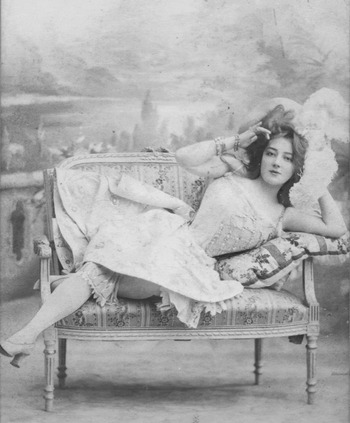
Anna Held's curves excited turn-of-the-century Americans, but it was the eyes that seduced. Box 3, Anna Held Museum Papers, courtesy of the New York Public Library.

Held crossed the Atlantic as a profound cultural shift was occurring in the way Americans imagined the relationship between external realities and the perceiving mind. As Flo Ziegfeld joked, the audience reaction to Held was so surprisingly hot, “it's like discovering a land of Tabasco.”Footnote 45 Held did not cause that shift, but she profited from its beginnings and consciously contributed to its advancement. Audiences were more willing to see Held in a modernist way where their senses gave meaning to the visual impression. American audience members were thus able to regard the actor's sexual allure as an enticing form of entertainment. Audiences could define Held as a foreigner and an actor and, defying the common sense opinions of the pulpit and police, separate the sensory messages they gained from the meanings they derived. She was known to be a performer of great wealth, fame, and exoticism who was performing before middle-class audiences and acting like a prostitute. To accept this display, audience members had to draw on their knowledge of Held's fame and background while remaining conscious of their presence in a theater; but Held did not allow them to so easily contain her provocations. By eyeing a member of the audience, Held suggested that her erotic performance might well be authentic. Was she pretending to have uncontrollable passions or revealing herself? The senses told one story, the mind rationalized another, and then Held's mischievous eyes cast doubt on the rationalizations. At a Held show, middle-class theatergoers discovered the fun of mistrusting their reading of Held's body, and in this she embodied the delights of the tease.
There was nothing random about the ambivalence she presented on stage. In this era, audiences were increasingly drawn to acts that subverted their understanding of the real and the relationship that conventionally existed between the actor and the audience. Masks were disappearing, replaced by a theater of actors like Held: cross-dressers who removed their costumes in mid-performance and octoroons who played on the confusion about their race. Moreover, Held was not alone in drawing audience members into her act. Mind readers and magicians regularly involved spectators in their tricks, and Harry Houdini invited the public to design traps from which they hoped he could not escape. Actors like these made the confusion of the senses fun. They made audience members work to understand what was theater and what was real. The moral certainty that a tangible truth was thought to communicate to the senses was giving way to feelings of uncertainty and a pleasure in illusion. The separation of sexual openness from availability (the essence of the flirtation) in Held's performance became the active element in the twentieth century's acceptance of the public parade of the erotic. It unmasked the presentation and discussion of sex because it detached the erotic from moral degeneracy. What the eyes communicated did not necessarily reveal the soul of the thing seen because play and pleasure intruded.
Underlying Held's strategy for making her sexuality palatable to people who were starting to accept the idea of the “social play of eroticism” was a widened gap between her own off-stage morals and those conventionally assigned the prostitute.Footnote 46 Held and her manager/husband, Florenz Ziegfeld, were masters of press manipulation, and they were honest about their dependence on journalists. “I figure to myself these dear newspapers are quite responsible for much of my success,” she explained, “they are a good thing . . . I read them every day just to discover if one mentions Anna Held. And if I do not find it I am no longer interested. The papers seem very dull if I do not see my name in them. Flo, too—Mr. Ziegfeld—likes to see me in print: He is at present engaged in reading all the papers just to see what he can learn about me. If he sees a man is ‘held up’ even that pleases him, because he seems to read my name.”Footnote 47 Held used the press to cultivate her public image, and through it, she created herself into a symbol of pampered sensuality not corrupting sexuality, elegant eroticism not peep-show obscenity.
Ziegfeld understood the need to keep his wife's image untarnished by scandal. His invention of the milk bath proved the perfect vehicle for the new star. Linking together purity, beauty, and Cleopatran elegance, Ziegfeld in 1897 released a story to the press that in order to keep her complexion perfect, Held bathed twice a week in hot milk. A milkman was even paid to attest to the large volume of milk that he delivered to her apartments, and reporters were invited to glimpse the actor relaxing in a vat of the opaque liquid. The lie was quickly exposed, but it moved like a wave across the country and kept reappearing in press reports throughout her career. The milk bath began Held's association with decadent pleasures that were sensual but not necessarily promiscuous. She was famously fond of pousse café, champagne, lobster, and cream, and in her early years she decried exercise as unhealthy: “I do not think exercise is good,” she exclaimed in 1907, “though that is what they always say, because it makes you hungry and you eat too much and that keeps you fat.”Footnote 48
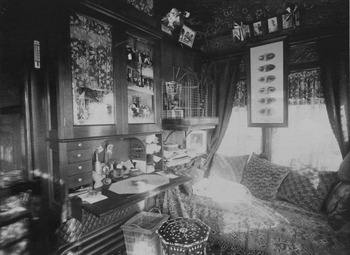
Even Held's Pullman car was watched by her eyes. Box 3, Anna Held Museum Papers, courtesy of the New York Public Library.

News of her private indulgences created an aura of decadence around Held that she linked to feminine softness and aristocratic pleasure rather than vice. More conventional critics, relying on the empirical tradition, tended to characterize these manipulations as pure humbug.Footnote 49 Just as an earlier generation of empiricists found reasons to disbelieve Barnum's mermaids and missing links, so too did empiricists in the Progressive Era imagine conspiracies that made Held's performances comprehensible. Her mischievous eyes were not misbehaving, they told themselves, they were weapons wielded by a cold intelligence. The sex thing was all a sham, “an art, a trick of stage mannerism and stage effect entirely, apart from any intimate relation . . . gayety, frivolity and brilliancy of a smile, the sensational elements of a dance, are all stage tricks.” Held might insist that “her eyes express everything that she feels,” wrote one reporter, “but I doubt that. Some one has said that speech is merely a device of concealing thought, and there are unquestionably discreet reserves back of the apparent candor of Miss Held's level look.” The eyes are “too well trained and controlled either to melt into friendliness or to dim with a too disdainful distance, without conscious intent,” wrote another. There was no “profound or tragic mystery” in her eyes, “no riddle behind them.” Many of the skeptics in this patriarchal era naturally concluded that Held was merely the “pretty feminine reflection of [Ziegfeld's] seething brain.” To these empiricists, whatever uncertainty Held communicated was merely a confidence game, a classic case of masked intentions. She was a trickster, playing on the vulnerable morals of Americans.Footnote 50 Anyone wanting to see the truth only had to look.
But Held's sexual invitation was confusing and contradictory, and even the skeptics found themselves seduced. In 1897, for example, Held participated in a kissing experiment designed to determine how many times a man and woman might kiss before collapsing from exhaustion. The experiment was presided over by a doctor, thereby shrouding it in pseudo science. More importantly, it was a product of a friendly wager and therefore embedded in manly play. Ziegfeld was present and was responsible for the wager, and the press was certain that the thing was an elaborate publicity stunt. Even so, the reporters could not resist the eroticism of Held's performance. Despite the contrived, staged setting, reporters were simply carried away by the connection between kissing and intercourse. After expressing their initial doubts about what they were watching, the journalists produced rapturously detailed reports concerning Held's increasing dishevelment as the experiment continued. Initially, they wrote, Held “moved slightly forward and met her kisser half way, her smile dying out of sight in the tangle of his moustache,” but as the kissing continued, the rhythm slowed, and she grew more and more exhausted. After 150 kisses, “she panted ‘c'est impossible.’” She “lay back in her chair—panting, exhausted—white as the flower that had fallen from her hair—limp as the roses that were dying in the gaslight. Her golden hair was tumbled, her eyes were closed, her mouth drooped pathetically.” The supervising doctor inspected her and announced: “The woman has given out.”Footnote 51
Performances like these established Held's sexual availability and appetite even as the triumphant masculinity, the wager, the publicity, and pseudo-scientific trappings of the event confused the issue. The kissing experiment, like the ocular flirtation, allowed spectators to participate in sex acts without really doing so. The kissing experiment was a tease, and no matter how much one might question the master manipulators behind it, there was no resisting the stunning sensuality of the event itself.
The kissing experiment was characteristic of Held's approach to the media and the public. Reporters interviewing her were always treated to a richly choreographed performance that stressed her softness, vulnerability, and barely controlled sexuality. Held seduced the media in the same way that she enticed spectators in the front row of the theater. As late as 1912, long after she and Ziegfeld had split, when an interviewer for the Los Angeles Examiner met her in her dressing room, he found her “in the loose folds of a filmy something. She held out a plump little hand with the grandness of a sixteenth century marquise, smiled a somewhat soporific smile, and bade me sit down on a trunk. Anna was tired. She said so in copyrighted accents, languidly raising a tiny brush to her eyelashes and breathing a bird-like sigh that heaved her opalescent shoulders amid the fragrant mists of the filmy something.”Footnote 52
A central element in making Held's erotic appeal tolerable lay in her way of decoupling sensuality from immorality by breaking the empiricist construction of the body and soul as a unified entity. Her body, she insisted, exerted pressures independent of those of her soul or thought. Her wandering eyes, which she could not “make behave” and which revealed her inner desires, were only one element in this. Held portrayed her entire body as a commodity, something comprised of semi-independent working parts, which added up to the corporeality on which her career depended. Eroticism and consumption were united in the independent demands of her body to look good. “See my skin, is it not clear and healthy?” she asked clinically, “no raincoat, no wrinkles, nothing to mar its surface.” In order to prove this to a reporter, “she let the thin dressing gown slip from her shoulders, revealing her form encased in silken tights. “See,” she began, as she slapped her chest, her shoulders, arms and her hips. “I am still of good figure. Besides, my body is trim, yet free of muscle.”Footnote 53 This extraordinary display on the part of a woman in 1913 was in keeping with her career-long habit of describing her physical self as somehow alienated from her mind. It was her way of justifying the pampering she gave it. She was not self-indulgent in taking milk baths or consuming lobster bisque; she was catering to the insistent demands of her body for indulgence.
Not surprisingly, Held's preoccupation with her body grew stronger as she grew older. Increasingly, she spoke of her obsession with satisfying the physical needs of her body with an almost scientific precision. “It is not all play to be beautiful. It is very much like work,” she announced. This was in 1914, and she was now taking “exercises, if you must know, all the way from 15 to 25 minutes every morning. Shadow boxing, shadow fencing, and the usual one, two, three, four courses are included.” “I am getting too rolly-polly,” Anna sighed between dabs of make-up. “I had not taken good care of myself. Too many pousse cafes.” By 1910 she was battling against aging, fat, ugliness, and anonymity. “I must not get fat,” she insisted, “no, no, no. I must never get fat. The too fat woman cannot by any possibility be called beautiful. Even in Turkey, where the fat woman once reigned as the queen of beauty, the slender, svelte woman has now taken her place.”Footnote 54
Clothes played a crucial role in the struggle to remain attractive, and she deployed them, as she did flirtations, to both disclose and conceal. They were part of the act. “The public expects to see me wear handsome clothes, and I try to give them what they want. They would not come to see Anna Held looking drab.” Held was here affirming the uncertainty of visual perception even as she proclaimed its primacy through the clothes she wore. She dressed not to achieve “plain hansomness [sic]. You know what I mean?” but to become “elusive or, well, alluring.”Footnote 55 Held suggested that with clothes she could design herself to reflect the demands of her physique and the expectations of her public. This required an element of duplicity made possible, ironically, by the apparent honesty of her confessions regarding her body's needs. It was a carefully studied obfuscation: skin-tight clothes that revealed nothing, misbehaving eyes that were precisely controlled, a sexual availability that disguised untouchability. “Each woman must be a law unto herself.” You cannot trust your dressmaker, she went on. “They have, in their head, another woman [an ideal image] that will forever obliterate your picture from his eyes. He dresses you, grand Dieu, as he would dress her. If you happen to be her type, good; if not, bad . . . So I say do not rely upon your couturiere [sic], but know yourself. Study yourself in one of those three leaved mirrors that reflect things as they are. You will suffer, as I have, but you will grow wise. You will learn that such and such a line is bad and needs to be corrected, that another is good and may be brought out, revealed, as it were.”Footnote 56 Here was utter mastery of form, singularity of presentation, and projection of spontaneity. In Held's hands, the key elements of modernism had moved into place.
An Electric Sign Goes Dark
No one understood better than Anna Held the cruelty of time for the sex symbol. Not only did she have to fight her own aging body, but the very morals she loosened were daily refashioning her into a prude. In the end, she could no more freeze cultural change than could the vice reformer, Anthony Comstock. Held electrified American audiences at a moment when nineteenth-century culture, which stood upon empiricist thinking, was losing its balance. People were tiring of moral absolutes, were intrigued by uncertainty, and were starting to believe that impermanence and instability underlay perception. Where masks had embodied the imagination of Victorian civilization—a culture of whites and blacks—modernists were intrigued by spirals, signs, and layers. For modernists, knowing was never precise and always speculative. Truth had to be dug out of uncertainty; it did not make itself manifest in appearances. Held toured America as these values were gaining currency among the urban middle-class audiences before whom she performed. She participated in their creation by giving an erotic twist to Americans' developing perceptual uncertainty. The pleasure of the verbal flirtation, of the dress that revealed something but not enough, of the ogling eye that conveyed a secret desire, of sensual pleasure for the body's sake: This is how she advanced the cause of sexual modernization in Progressive Era America.
However, tastes have a tendency to outpace people. Held's décolleté dresses, bare shoulders, and tightly corseted waist were deeply erotic in 1896, but by 1910 they were looking pretty old fashioned. At the turn of the century, Held's corset squeezed her waist down to nineteen and a half inches, thereby exaggerating the swell of her thirty-six-inch bust and hips. Her sexual appeal lay in those curves. By bending over and wiggling her shoulders, she could draw attention to the voluptuousness of her breasts. With a lift of her skirt or a sway of her hips, she could emphasize the round swell of her hips and the daintiness of her feet. The rapid demise of the swan-bill corset as a fashion feature after 1909 left the middle-aged Held vulnerable to sag. Anxious to remain fashionable, she announced her support for the new style: “I believe in the corsetless dress,” she told the Nashville Banner in 1913, “Women, like men, should learn to hold themselves upright without artificial aid.” However, she insisted, it was harder for her than for others, as her body was everywhere available for public consumption: “Possibly because my face peers out from so many shop windows—it is exceedingly difficult for me to pass along your streets unobserved,” she noted. People had to give her time to adjust. “Life is so funny and how everything is changing around me,” she wrote her daughter in 1915. “It is no longer the same, it is a new world and my ‘habitudes’ are failing me, and you know what they say, one's habitudes are a second nature.”Footnote 57
Perhaps empiricism's weakening had allowed for too much theatrical uncertainty. By 1910, when it came to erotic displays, audiences seemed willing to accept a rather more generous helping of reality. Held had been a major contributor to the sexualizing of American popular stage performances, but once the taboos had been broken, how could the resulting flood be stemmed? Two years after Held's first appearance in America, a German actor, Nina Diva, removed her clothes in a play. Tossing off her dress and then removing her corset, Diva was “reduced to one garment [her chemise. Then the actor playing her stage lover] pulled off her socks and the two of them started for another room.” In 1904, Charmion, the trapeze artist, disrobed to her flesh-colored tights on the high wire, to the delight of her neck-straining audiences. Lalla Selbini did “corsetless stunts” in tights “utterly unhampered by conventional clothing.” There was, said Selbini, nothing immodest in the “strip tights of the beautiful formed actress.” In 1908, La Sylphe, who became famous in America for her erotic “Salome dance” concealed by “not enough of a costume to worry over,” explained: “I've been among artists and studied art so much, that I see no harm in the nude figure.” At the same time, Gertrude Hoffman, Anna Held's young friend, began dancing with a group of girls in nothing more than loose and blowing “Grecian” robes. Annette Kellerman, the Australian diver, went one further. Speaking to a New York audience in November 1909, she announced, “The only bones about me, girls, are the ones nature gave me.” In order to prove this she removed her “tight-fitting black velvet gown . . . and revealed herself in her black swimming suit.” Making the point even clearer, as if such a thing was necessary, she then announced, “I'll just rip this thing (the suit) down the side and show you that there is nothing underneath but—but me,” and she did that too. By this time, tastes had changed sufficiently for displays of this kind to be considered “a little tart, but on the whole unoffensive” even in the most exclusive theaters.Footnote 58
It was not easy for an actor of Held's age and standing to engage in this kind of display, and her producers responded by shifting attention away from her and towards the girls in her chorus. Her chorines' nakedness recontextualized Held's naughtiness. Ever the star, she found her relative de-sexing galling. Things came to a head with her 1911 show, Miss Innocence. Although Held remained the risqué center of a story in which she left the Island of Innocence seeking knowledge in Paris as a “student of erotics,” most of the flesh revealed in the show was visible among the girls backing her up. “America has doubtless never beheld a more gorgeous array of Ruedelapaixian femininity,” the critic for the Atlanta Constitution bubbled. Audiences would be boggled by the girls in the show another advised: “They are sure to please the most ardent chicken fancier. Everywhere the fatted calf was on display for prodigal son and puritan father.” The “costumes of a dozen or more [girls] are ripped off in view of the audience!” a Denver reviewer exclaimed. In Denver, Held herself was visibly discomforted by this upstaging, “and oh! How the audience does sympathize with Mlle Held during this particular episode.” The chorus offered “the limit in spiciness” with “bare necks and nether limbs . . . shaking their bodies then lying on their backs with legs—yes, legs, not limbs—in the air and shaking them and twisting them while the bells rang out in the orchestra.” In Los Angeles, one of the chorines began attracting particular attention to her “nether limbs” when, in a dance number where all the dancers were in white dresses and pink fleshings, “she omitted the fleshings.”Footnote 59
This was too much for Held. She finally lashed out against the chorus girls who were distracting so much attention away from her. In France, she told the papers, the girls “don't have to go on stage to advertise their beauty,” and the men are “gallant . . . they marry these pretty girls to keep them off the stage.” Turning “the big white light on the world behind the scenes” and thinking, perhaps, of Flo Ziegfeld's extramarital affairs, she denounced the rapaciousness of the producers and managers “who exploited these girls for their own pleasure.” Held attacked “the vast sums of money spent on musical extravagance and the suggestiveness of performances. . . . Thousands and thousands of dollars are spent on garments and scenery for the allurement of eyes that have lost their innocence.” There was no hope for the theater, she declared, “so long as vanity prevails, mendacity exists and evil men go unpunished.”Footnote 60
The failure, she thought, must lie with America's men. “With American men it is business, business all the time. Oh, how this disgusts me. Then too, the American man has no mustache. I love the big curving mustache.” Why were the men allowing their women to be paraded about on stage in semi-nude and demeaning ways? American men are “deteriorating into softer mold, are more yielding and are forgetting their manhood,” she declared. “I am afraid both sexes are deteriorating.”Footnote 61 Continuing to rail against the empirical perspectivism that had been the foil for her career, she maintained that when female sexuality became too unambiguous, it ended up a tool of male depravity. Allure—which confused the senses, created uncertainty, and forced the imagination to shape perception—was the real instrument of female power. “Husbands are what their wives make them. I would know what I wanted from him and what I expect of him and I would get it. I would never forget that I would have to be his mistress and that I must keep him wanting me. . . . A man is held by woman's lips and arms and will not be held unless his wife has the consummate art of keeping herself his mistress.”Footnote 62
Held became an outspoken antifeminist, denouncing the suffragettes for their insufficient femininity. “I would much rather see a woman with a baby than with a vote.” Indeed, to Held, “a chiffon gown is much more interesting than an election. I can't think of going to vote with curls and laces and a string of pearls. One always must dress for what one does. If you ride horseback you wear a riding habit, whether it becomes you or not; if you play golf, you wear short skirts; if you vote, I suppose you wear—oh well, I'd rather have the chiffon gown.” Her sensibilities led her to oppose feminism on the grounds of femininity and to oppose more overt sexual display on the basis of a more ambivalent eroticism. “The inability of American men to pamper women is the real cause of the spread of women's suffrage . . . instead of organizing anti-suffrage clubs, men who oppose equal suffrage should take a course in petting and pampering their wives.”Footnote 63
Unfortunately, by the time of her death in 1918, the sexual adventure Anna Held inspired had become a memory. Florenz Ziegfeld had already gone on to a new wife, and her own daughter was old enough to impersonate her mother's younger self. Only briefly had World War I provided a new role for Held, as mother of the French people. “I have grown a hundred years younger,” she declared. “The sufferings of France have purged my heart and soul.” Before the war was over, however, she was herself cut down, collapsing in mid-performance.Footnote 64 For almost a decade, Held had seemed out of place in the world she helped to create. There had been a transformation in values between 1896 and 1918, but she accompanied it only part way. At the height of her popularity, Anna Held presented a complex of impressions and layers of beguiling falsehoods. Soon enough, however, she was outpaced by American tastes. Somewhere between twenty-five and thirty years old when Ziegfeld brought her across the Atlantic, Held was fifteen years older when she discarded her corset. This was late in life for a sex symbol, and she found it difficult to compete with the younger, slimmer, and more healthy stars who emerged in the years immediately preceding the war.
When she first toured the cities of the Northeast in the late 1890s, the empiricist perceptual heritage was coming unstuck. The modernist approach to seeing, which privileged the imagination over the apparent and preferences over moral certitudes, was taking shape. Held profited from the modernization of Victorian sensibilities in the 1890s, and she helped advance the modernist revolution by playing games with the senses of her audience. Sight, in an Anna Held show, did not neutrally communicate certain truth; she was an erotic illusionist who detached the image from its hitherto-anticipated associations. Held's mischievous eyes told Americans that they needed to enjoy their sensual selves and express the indeterminate pleasure that flirtation and self-indulgence aroused. In so doing, Held helped license women in the more sexual display of their bodies. She validated shopping as a healthy exercise and as something linked to what she saw as the satisfaction of every woman's physical need to attract attention. Buying became a way of increasing the intangibility of one's sexual allure by hinting at the appeal of the various bodily parts: scent, rustle, hair, face, and limbs. Each element might communicate a message, sometimes together and sometimes discordantly; she represented a process of fracturing, deepening, and confusing the real. So it seems only fitting that in the end it was the parts of her that people remembered: eyes, shoulders, bust, and waist. As Carl Sandburg wrote on hearing of her death: “She belonged to many thousand men, lovers of the/white chiseling of arms and shoulders, the ivory/of a laugh, the bells of song.”Footnote 65
So long as moral meaning was believed to be intrinsic to the thing observed, external to the viewer, and apprehended by the neutral senses, obscenity would continue to be treated as an absolute. Things in life were or were not indecent. The senses conveyed the messages truthfully and directly. Whatever ambiguity existed lay in the thing perceived, and it took the form of a mask, a humbug, or a disguise. By burying truth and subordinating the senses to the perceiving mind, the modernization of perception inverted this formula and facilitated a sexual revolution. What one considered sexual was perhaps less a reflection of the thing seen than of the perceiving eye; and the misbehaving eye itself might influence this process in the same way that semi-independent bodies cried out for exercise and skin for softeners. Illusion and the fragmentation of perception had entered into the equation, and with these came the full pleasure of the erotic. Uncertainty is what made the flirt fun, and the 1890s naughty. As processed sensory messages were separated from the impressions they appeared to make, the possibilities for public eroticism increased. One might wear sexy clothes without being morally corrupt. One might make an alluring remark without inciting public condemnation. One might take off one's clothes in order to reveal the perfection of one's physique and invite admiration rather than lust. It was no longer certain what was being communicated; bodies themselves seemed to be exerting their own independent demands. Faces needed make-up to appear beautiful, not to mask corruption; dancers needed to foxtrot erotically because their legs and arms insisted on interweaving. Morals appeared to play a less certain role as meanings shifted away from real things and identities fractured. Anna Held helped make this transformation possible and popular, and this earned her a leading part in the theater of Progressive Era sexiness. The fact that pleasure in the commercial erotic soon outstripped and marginalized her was perhaps unavoidable. Those misbehaving eyes had worked their magic too well.