Introduction
The city of Kyoto reached 100 percent residential electrification in 1915, at a time when in Berlin only 5.5 percent of households was electrified. Footnote 1 Two decades later, residential electrification rate approached 89 percent in Japan, higher than in Germany (85 percent) and in the United States (68 percent). Footnote 2 Kyoto electrified rapidly, as did Japan. Thus, to study Japanese electrification, Kyoto provides an important case study. Footnote 3
These statistics do not reveal the role of governments, which varied tremendously across nations. The case study of Kyoto again represents a Japanese experience; for example, the Kyoto Municipal Electric Works was the only government-owned electric utility in Japan before 1906. In comparison, by the end of the nineteenth century, in German cities with populations of over 100,000, 62 percent of electric utilities were government-owned. Footnote 4 Additionally, starting in the 1880s, electric utilities in most German and U.S. cities were regulated by municipal franchises; meanwhile, in Kyoto, the franchise, as a regulation model, appeared late and was short-lived. Furthermore, in the 1910s, fierce competition took place between the government-owned Kyoto Municipal Electric Works and the privately owned Kyoto Electric Light Company, while in Western countries electricity is normally considered a natural monopoly. Footnote 5 The different business–government relations gives rise to two key questions. The first is: What explains the ownership structures of electricity? The second is: What explains the regulation model of electricity?
This article explores the history of Japanese electrification through the case study of Kyoto from 1887 to 1915, and focuses analytically on business–government relations. Footnote 6 The period covers when residential electrification in Kyoto rose from zero to 100 percent. Research included reviewing published government records, company histories, and statistical yearbooks.
The structure of the article is organized as follows. First, the origination stories of the two main players, Kyoto Electric Light Company and Kyoto Municipal Electric Works, are introduced. The article then discusses their collusion, competition, and demarcation from 1887 to 1915. Kyoto is put in context through comparisons between it and other Japanese cities; and the article ends with conclusions.
Between Business and Politics
Kyoto Electric Light Company (KEL), the third-oldest Japanese electric utility, was founded in November 1887. Footnote 7 Its cofounders, Takagi Bunpei (1843–1910), Tanaka Gentaro (1853–1922), Nakamura Eisuke (1849–1938), and Ozawa Zensuke (1853–1934), were capitalists with strong personal networks with the local government. Takagi was chairman of the Kyoto Chamber of Commerce and a member of the Kyoto Municipal Council. Tanaka was chairman of Kyoto Prefectural Assembly and cofounder of local financial infrastructures, including the Kyoto Stock Exchange and the Bank of Kyoto. Nakamura was senator in the prefectural assembly and later was the chairmen of the municipal council. Ozawa was a senator in the prefectural assembly. All of them were businessmen and politicians, and their profiles represent the business–government connections behind the start of Kyoto’s electrification. Footnote 8
Kyoto’s local government promoted the formation of KEL. The local governments of Kamigyo and Shimogyo bought KEL’s stock when the company could not find enough investors confident in the future of electricity; these governments owned 6 percent of KEL. Footnote 9 In Japan, local governments actively promoted the start of electrification. For example, the Tokyo prefecture coordinated two groups of capitalists that competed with each other for concessions Footnote 10 ; and the Nagoya prefecture provided credit to local capitalists to enable them to create the Nagoya Electric Light Company. Footnote 11 However, local governments usually went no further than providing credit or acting as coordinators. The private–government mix of ownership of KEL was exceptional, but the municipal government was not involved in its management.
Japanese electric utilities had a centralized regulation structure, which is why local governments’ role was small. The 1880s was the final period when prefectural governments could grant concessions, because in 1896 the Ministry of Communications centralized this authority. Footnote 12 Investors and governments seeking to set up new electric utilities had to apply for concessions from the Ministry of Communications, which could, according to policy, veto or allow the applications. Additionally, the Meiji government forbade foreign ownership of Japanese equities and land until 1898, thus making foreign direct investment in Japan’s electric utility industry nonexistent. Footnote 13
Although capital did not flow across international borders, people, ideas, and machines did. The quality of electric engineering education in Japan was perhaps among the highest in the world at that time, thanks to William E. Ayrton (1847–1908), a British engineer who taught at the Division of Electricity at the Tokyo Imperial College from 1873 to 1878. Footnote 14 By 1890 the chief engineers of Japanese utilities were, without exception, graduates of the Tokyo Imperial College, and many were former students of Ayrton. Electrical engineers were usually members of the Institute of Electric Engineers of Japan, which was founded in 1888 and played important roles in translating and spreading academic knowledge of electrical engineering through meetings and journals. Footnote 15 However, because of Japan’s weak manufacture of electric equipment, it had to rely on imported machines and equipment. Footnote 16
By 1895, about a decade after the start of Japan’s electrification, there were thirty-three privately owned utilities. Their assets ranged from 15,000 yen (e.g., in the small city of Toyohashi) to 1 million yen (e.g., Tokyo Electric Light). Footnote 17 With capital assets of 200,000 yen, KEL was ranked sixth among electric utilities and was among the 100 largest Japanese firms ranked by asset. Footnote 18 Most of the capital-intensive electric utilities relied primarily on issuing stocks, and the bourgeoning stock exchanges in Tokyo, Osaka, and other big cities catered to the financial needs of electricity firms. Footnote 19 During the period under investigation, large shareholders, who were mostly local capitalists, managed Japanese utilities such as KEL; and the industry has been dominated by privately owned and managed enterprises ever since. The worldwide business model in which electric manufactures built, operated, and financed electric utilities with German and U.S. FDI did not occur in Japan. Footnote 20
Government as Entrepreneur
In the 1890s, the Kyoto Municipal Electric Works (KMEW) was the only government-owned utility in Japan, and its founding represents local government entrepreneurship. In 1888 Tanabe Sakuro (1861–1944), the chief engineer of Kyoto’s civil project Lake Biwa Canal, learned of the world’s earliest hydroelectric stations in Switzerland and the United States. He successfully persuaded the city government to send him to the United States to study hydroelectric technology. Returning from the United States, Tanabe, a former student of Ayrton, convinced the municipal council that Kyoto should and could build a hydroelectric power station on the Lake Biwa Canal. This is how Japan’s first government-owned electric utility and hydroelectric power station for general supply was founded in 1889. Footnote 21
The technological achievements of KMEW were recognized by academic communities in Japan and overseas. In 1892 the Institute of Electric Engineers of Japan invited Tanabe to give a keynote speech. Footnote 22 In 1894 Tanabe reported on the municipal electric works in a pamphlet, The Lake Biwa Kioto Canal, which was published by the London-based Institute of Civil Engineers. Footnote 23 In 1907 the Deutsches Museum exhibited miniatures of Japan’s Lake Biwa Canal and Sweden’s Trollhättan Canal, introducing each of them to the German public as a “masterpiece of natural science and technology.” Footnote 24
KMEW occupied a significant place not only in the history of Japanese electrification but also in the history of Kyoto’s municipal finance, as the city’s first municipal bonds were electricity bonds. In 1889 it issued a short-term municipal bond in the amount of 204,500 yen to cover the budget for new electric works; meanwhile, the total municipal income in that year was 331,971 yen. Footnote 25 A year later, Kyoto raised a long-term municipal bond in the amount of 531,300 yen to cover additional construction costs for electric works. Until 1913 all of Kyoto’s municipal bonds were electricity bonds.
In the Japanese context, Kyoto was an exception when it opened a government-owned electric utility. In the 1890s, electricity was still a very uncertain technology. In Germany, for example, local governments usually had private entrepreneurs bear the initial risk, and did not make electricity a municipal utility until after it became profitable. Footnote 26 In Kyoto, however, the municipal government considered electricity as a symbol of modernization, and so it bore the risk to set up, operate, and finance an electric utility. The municipal council expected a financial return, but KMEW kept losing money until 1897. Footnote 27 Other Japanese cities found Kyoto’s example hard to follow. The second-oldest government-owned utility was launched in the northeastern town of Sakata in 1907, nearly twenty years after Kyoto’s. It was not until the 1910s that electricity became a public infrastructure providing stable income, which provided the incentive for government ownership. However, compared with Germany and the United States, government ownership in Japan remained weak even after the 1910s. Footnote 28
Collusion
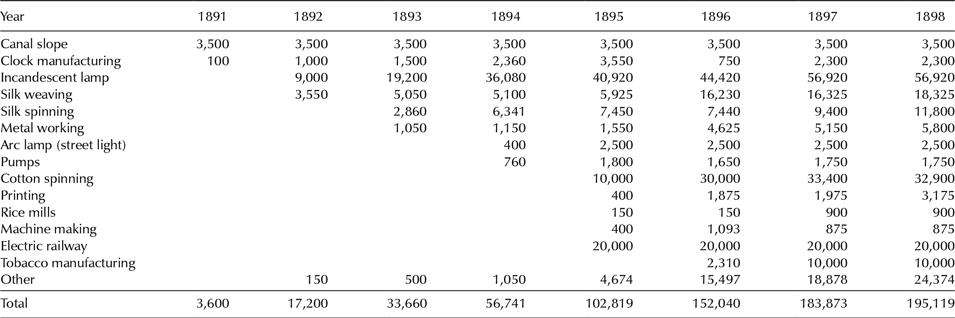
The early 1890s were hard years for both KMEW and KEL. For example, KMEW in the beginning sold electric power, but it had no customers except for a canal slope on the Lake Biwa Canal and a private clock workshop, which happened to be owned by Ozawa Zensuke, head of KEL (Table 1). Meanwhile, the electric light producer KEL also fell into financial difficulty. After a fire at the Imperial Diet in Tokyo, new applicants for KEL’s electric lighting slumped nationwide. Gas lamp, oil lamp, and candle producers jumped at the chance to expand their market share. Footnote 29
Contracted load of Kyoto Municipal Electric Works, from 1891 to 1898 (in horsepower)

Source: Kyotoshi denkikyoku, Kyoto shiei denkijigyo enkakushi (History of Kyoto Municipal Electric Works), 589–593.
In 1892 KEL signed a ten-year contract with the Kyoto Municipal Council, which also oversaw KMEW. The contract, proposed by Ozawa Zensuke, was to relieve the difficulties for both utilities. Footnote 30 According to the contract, KMEW would wholesale electricity to KEL at a favorable price. Footnote 31 KMEW charged KEL 2.46 yen per horsepower, while the price was normally 3.55 yen per horsepower. KMEW’s pioneering, and cheap, hydroelectricity enabled KEL to reduce greatly the lighting tariffs in the 1890s. Hydroelectricity costs remained unaffected by the Sino-Japanese War (1894–1895), which drove up coal prices by about 200 percent. Footnote 32 By the turn of the century, electricity in Kyoto was the cheapest form of lighting in Japan. For a sixteen-candle light lamp, a resident paid 3 yen per month in Tokyo, 1.7 in Osaka, 2.5 in Yokohama, and 2.1 in Kobe, but only 1 in Kyoto. Footnote 33 One drawback, however, was that the contract created a temporary dependence of KMEW on KEL. It was not until 1895 that the shares of KEL in KMEW’s total contracted load dropped below 50 percent, largely due to the opening of the Kyoto Electric Railway Company. The honeymoon between KEL and KMEW was extended when the city approved KEL to build the city’s first electric streetlights, Footnote 34 which were not yet common. Tokyo, for example, still had a budget for gas lighting in 1893.
The relationship between KMEW and KEL became a provocative topic for debates in the municipal council. Political opponents of Ozawa submitted a series of bills aimed at either taking over KEL or allowing KMEW to retail electric lighting, thus initiating competition with KEL. Footnote 35 These bills were all voted down, some by small margins; some were first approved but then rejected several days later after pro-KEL parties submitted counter-bills. The relationship between the two utilities became an instrument of political dispute. Eventually, the municipal council reached a gentlemen’s agreement with KEL in 1893; via self-regulation, each would henceforth be confined to one market field: the KEL in lighting, and the KMEW in power. Footnote 36
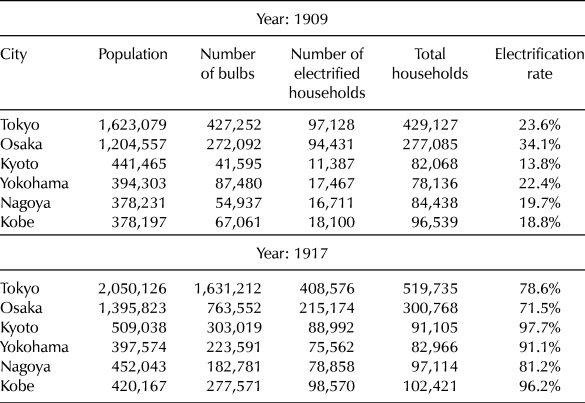
However, this market division was both unusual and shortsighted, because in the 1890s electric light companies were transforming to combined light and power companies, which was more efficient. This usually required changing to alternating current (AC) systems from direct current (DC) systems. Footnote 37 The former reaches economies of scale and scope by enabling a unit of generators to supply electricity for light and power at the same time through a centralized distribution network. The latter requires different generators and networks for different kinds of consumption and therefore has higher costs. Tokyo Electric Light (TEL) installed 50-cycle AC generators manufactured by AEG in 1895. Two years later, Osaka Electric Light (OEL) installed 60-cycle AC generators manufactured by General Electric. The influence of TEL and OEL, the two biggest utilities, thus settled the battle between AC and DC systems in Japan. Both TEL and OEL became electric light and power companies with a centralized production and distribution system. However, the gentlemen’s agreement between KEL and KMEW hindered their transformation to a more efficient system. For example, in 1903 KMEW still had nineteen small-scale generators for different purposes, for example, from spinning, to tramway, to ice making, to weaving, and to cigarette making. Its power production and distribution was decentralized because the cycle of these machines ranged from 133, 125, 60, and 50 Hz, and they required separate distribution networks. Footnote 38 KEL and KMEW confined each other to one market field, when electric utilities in other cities were learning that it was more efficient to sell light and power at the same time. Ironically, although Kyoto was a first-mover in many fields of electrification, in the 1900s it was the least electrified of the six biggest Japanese cities (Table 2).
Residential electrification statistics in the six largest Japanese cities, 1909 and 1917
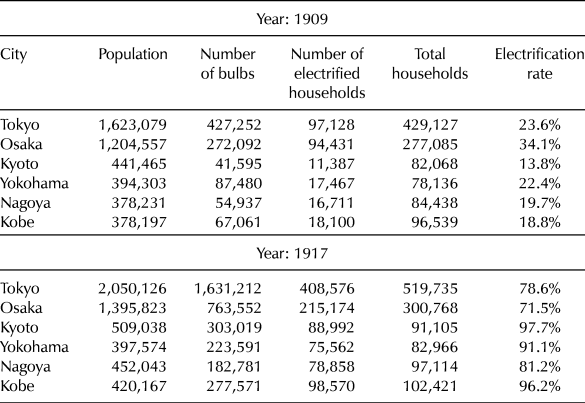
Sources: For 1909, see Kyoto denki, Kyoto denki kabushikikaisha shimatsu (History of the Kyoto Electric Company), 108. For 1917, see Teishinsho denkikyoku, Denkijigyoyoran (Statistical yearbook of Japanese electric utility industry) .
Franchise
In a comparison to Germany and the United States, Japan’s electric utilities were born in a municipal regulatory vacuum. In Germany and the United States, municipal governments normally regulated electric utilities from the beginning; and these governments also owned and managed public roads, which were necessary for the electric utilities to lay distribution systems. The governments’ rights of way gave rise to the regulation model of municipal franchise. Footnote 39
A franchise could include agreements on utility’ usage of public passageways, governments’ tariff regulation, governments’ claim of a part of the utility’s profit, and conditions of government takeover. Footnote 40 In Japan, on the other hand, ownership of public roadways was ambiguous when electrification started. Japan’s utilities received concessions from the national government, but the legal basis was not in rights of way but in political structures, and these concessions did not involve legal obligation to the municipal governments. The municipal governments were content with not being regulators yet receiving compensation though the electric pole tax, which began in 1895. Footnote 41
Kyoto, however, could have become a regulator. In 1889, KEL submitted a proposal to the Kyoto Municipal Council that requested that the municipal hydroelectric station be leased to KEL. In return, the municipal government would hold the right to regulate tariffs, claim some income, and municipalize KEL under certain conditions. Had Kyoto accepted the proposal, there might have been a Japanese version of municipal franchise in the 1890s; however, the Kyoto Municipal Council voted against it. Footnote 42
Japan became aware of municipal franchises after the turn of the century. In 1900 Kyoto dispatched the first Japanese municipal government delegation to Europe to study public administration. After returning home, the delegation, drawing evidence from Berlin, highlighted that ownership of public passageways was ambiguous in Japan, and recommended municipal regulation through franchise-based on rights of way. Footnote 43 The Kyoto Municipal Council voted for the municipal takeover of KEL in 1902. Footnote 44 However, this was on the eve of the Russo-Japanese War, so the plan failed because the city was unable to raise municipal bonds.
It was not only the war that made adoption of municipal franchise difficult. In 1903 Osaka’s municipal government initiated negotiations with Osaka Electric Light (OEL) with the hope of reaching a franchise. The Osaka municipal government demanded 5 percent of OEL’s gross profit; the right to approve OEL’s tariff, capital increase, bond issuance; and the right to municipalize OEL after the franchise’s expiration. In exchange, OEL would be given monopolistic right to use public passageways in the city. Footnote 45 However, the demands provoked fierce debates among businessmen, senators, lawyers, and scholars. The Japan Electric Association and OEL declared themselves against the franchise. Footnote 46 Some jurisprudence professors held that the demands were illegal. Footnote 47 After protracted negotiations, Osaka and the OEL finally agreed to a franchise in 1906. Footnote 48 Other big cities signed franchises with urban utilities: Nagoya in 1908, Kyoto in 1911, Tokyo in 1912, and Kobe in 1914.
However, the franchise in Kyoto was short-lived. The city reached a franchise with the newly established utility Kyoto Electric Company (KEC) in 1911. A year later, KEL acquired KEC. Footnote 49 Surprisingly, the municipal government did not continue the franchise, partly because, by that time, KMEW had decided not to regulate tariffs but instead to initiate a tariff war with KEL.
Despite its short duration, the contents of Kyoto’s franchise were typical in Japan. Footnote 50 Although it did not include a monopoly on the use of roads, it detailed compensation and purchase conditions. Road monopoly was undesirable because, as with the case of Kyoto, some cities were already operating, or were planning to open, municipal utilities. While most Japanese municipal governments claimed a percentage of gross profit from the private utilities so as to increase public revenue, not all municipal franchises mentioned price regulation. In general, Japanese municipal franchises were more interested in compensation rather than in regulation. The literal translation for hoshokeiyaku, the Japanese term for franchise, is compensation contract.
The Japanese municipal franchise was born out of a centralized regulation structure. After the 1910s, contradictions in centralized concessions and decentralized franchises usually led to conflicts between the Ministry of Communication and municipal governments, especially in matters of municipal takeovers. Footnote 51 The national government had even more control if a municipal franchise conflicted with policies of the Ministry of Communication. Overall, the municipal franchise was a weak regulation model.
Competition
In 1906, about a decade after the gentlemen’s agreement, KMEW created a new strategy: sell light and power to all citizens. Footnote 52 KMEW’s system expansion began in 1908, and by the completion of the new power stations and substations in 1914, its capacity had increased from 1,800 kilowatts to 6,400 kilowatts. Footnote 53 KMEW began retailing electric lighting in 1912, and with that KEL’s monopoly in electric light was broken.
The new strategy was not only a response to the backward state of Kyoto’s electrification and a farewell to the gentlemen’s agreement but was also in accordance to the Ministry of Communication’s policy. At that time, the Ministry was granting concessions of the same areas to multiple utilities so as to encourage competition and to promote electrification. Footnote 54 The ministry divided concessions into the light market and the power market. In the case of Kyoto, the ministry granted an electric light concession to KMEW in 1906, and another electric light concession of the same supply area to the aforementioned Kyoto Electric Company (KEC). In 1910, three utilities (KEL, KMEW, and KEC) in Kyoto held electric light concessions and two (KEL and KMEW) held electric power concessions. Kyoto represents a typical case of competition under the central government’s policy.
Retained earnings and municipal debts financed KMEW’s expansion. Mitsui Bank offered a short-term debt, with a limit of 100,000 yen per month. Twice, once in 1909 and again in 1911, a French consortium, via Mitsui Bank’s foreign branch, underwrote Kyoto’s municipal bond. The total foreign debt of 50,000,000 yen was to be redeemed in 1919. Kyoto chose Paris so as to avoid competition with Tokyo’s and Osaka’s municipal bonds, which were issued in London. Footnote 55 With entrance into the electric light market, costs for KMEW’s distribution systems rose tremendously. The distribution costs in 1912 totaled 155,000 yen, three times the original 50,000 yen estimate. Footnote 56 In 1914 Kyoto issued a 1.2 million yen domestic bond, which included 450,000 yen for the distribution system.
The surging distribution costs were largely caused by KMEW’s policies on low tariffs and nondiscriminatory expansion. Many of KMEW’s new electric light applicants came from thinly populated city areas. The former electric light monopoly, KEL, had refused to build distribution systems in these areas for cost reasons; after all, it took 1,000 yen to extend distribution to a remote part of the city for what would amount to only one or two bulbs. These areas thus had remained without electrification. This scenario played out frequently and put the social responsibility of private utilities in question. Footnote 57 However, KMEW, wanting to provide electricity to all citizens, did not take into account the location of consumers, and thus bore huge costs to build distribution systems to remote areas. Additionally, KMEW’s prices were cheaper than KEL’s. For example, KMEW charged a 20-watt bulb for only 0.45 yen, while KEL charged it at 1.2 yen. KMEW’s prices were akin to subsidies for citizens who lived in thinly populated areas. Footnote 58
To reduce distribution costs, the municipal council wanted KMEW and KEL to make common use of electric poles. If KEL and KMEW could share the existing poles, then the municipal government would not have the expenditure of building new poles that ran parallel to KEL’s old ones. However, KEL, having no incentive to cooperate with a competitor, rejected the suggestion. Footnote 59
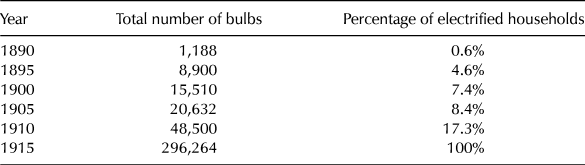
The expansion of KMEW’s distribution system and its extremely low tariff significantly improved the rate of residential electrification. KMEW user numbers exploded, from 1,335 households in 1912, to 14,547 households in 1913, and to 38,887 households in 1915. Conversely, KEL users increased from 61,494 households in 1912, to 78,797 households in 1913, but then stagnation followed: from 1914 to 1915, there was a meager increase of only 65 households. In 1914, 80 percent of KMEW’s new customers were KEL’s former customers. Footnote 60 Thanks to KMEW’s expansion, residents in every corner of Kyoto were connected to electricity by 1915 (Table 3). It was the first Japanese city that reached 100 percent residential electrification, and it remained the most electrified Japanese city in terms of residential households in the late 1910s (see Table 2).
Residential electrification statistics of Kyoto, from 1890 to 1915

Source: Kyoto furitsu sogo shiryokan, Kyotofu tokei shiryo shu (Historical statistics of Kyoto Prefecture), 297.
Demarcation
In the Japanese context, residential electrification rates increased rapidly in the 1910s, largely due to the competition between electric utilities. However, in electricity, competition in the same territory meant rate wars, which usually drove prices to a level that covered only operating costs, not also fixed capital costs. Footnote 61 Kyoto’s experience was no exception. Starting in 1914, KMEW began losing money; and between 1911 and 1915, KEL’s stock price fell from about 100 yen to only about 50 yen. Both would have been close to bankruptcy if their competition had continued and if the national government had not intervened. The Ministry of Communication eventually switched policy in response to improved residential electrification: overlapping concessions in lighting were frozen.
In 1914, the ministry sent Kyoto an administrative order demanding a demarcation, which KEL welcomed but divided the Kyoto Municipal Council. The council worried that a forced demarcation violated the municipal government’s self-governance, and that some citizens would be deprived of their rights to use the inexpensive service provided by the municipal electric works. The municipal council voted for demarcation only after it became clear that if the competition continued, Kyoto would be unable to pay its foreign and domestic debts. Footnote 62 Nevertheless, thousands of citizens demonstrated against the decision. In April 1915 KMEW and KEL signed a demarcation agreement. Footnote 63 The overlapping distribution systems constructed by KMEW were dismantled before 1918. Footnote 64
Conclusion
Through the case study of Kyoto, this article discussed aspects of business–government relations in Japan’s electrification. It also compared the experience of Kyoto with that of other large Japanese cities.
From the point of ownership, Kyoto became an entrepreneur because it interpreted electric power as a symbol of modernization. Income incentives and the check on private monopoly seemed subsidiary concerns. However, at the turn of the twentieth century, Japanese cities discovered the financial advantage of municipal ownership and began operating government-owned utilities.
From the point of regulation, Kyoto’s experience shows that regulation was a historical process and that regulation models were not universal. Municipal franchises were imported from Western countries but had to be adapted to Japan’s legal and political contexts. Additionally, because the national government centralized regulation in the early stages of electrification, the municipal franchise was a weak regulation model.
Kyoto’s experience also indicates that electricity becoming a monopoly depended on the regulator and the utility, with both understanding the cost structure of the industry. This shows that one must pay attention to the historical context of natural monopoly.