Introduction
[i]f archaeology is not an inevitable result of accumulating truth, but is largely ideologically constituted, the expansion of archaeology must be seen as an aspect of cultural colonialism in which one system of knowledge erodes and ultimately supplants the structure of alternative systems. In this view, the chronological replacement by archaeology of other means of approaching the past is not progressive but imperialistic.
Joan Gero (Reference Gero, Pinsky and Wylie1989, 97)Joan Gero penned the quote above, with subsequent studies citing her work in discussing post-colonial alternatives for archaeological practice (e.g. McGuire Reference McGuire2008; McNiven & Russell Reference McNiven and Russell2005). Similar statements occur within the more recent literature (e.g. González-Ruibal Reference González-Ruibal2018; Haber Reference Haber2012). For example, McNiven and Russell (Reference McNiven, Russell, Bentley, Maschner and Chippindale2008) propose, as a solution for Australian post-colonial archaeology, a partnership between archaeologists and indigenous people at the community level. Wylie has also adopted this position, emphasizing the need for indigenous and academic groups to define and continually reassess research agendas (Wylie Reference Wylie, Meskell and Pells2005; Reference Wylie, Padovani, Richardson and Tsou2015; see also La Salle & Hutchings Reference La Salle, Hutchings, Labrador and Silberman2018; Nicholas & Wylie Reference Nicholas, Wylie, Young and Brunk2009; Reference Nicholas, Wylie, Scarre and Coningham2013). What is common to these studies is a critique of the notions of a universal value, that aspects of human cultural heritage hold value for all peoples, justifying the existence of institutions like encyclopaedic museums. Critiques point out that the universalism is often based on a series of Eurocentric and state-centric ideas that diminish the importance of local, often indigenous communities (Labadi Reference Labadi2013).
The challenge for archaeologists seeking alternatives to such universalist claims is to recognize that the shifts in understanding needed are ontological (as Wylie and others indicate). However, studies to date are not very specific about what a post-colonial analysis of the archaeological record including material culture might look like. Part of the reason reflects that while many archaeologists have learnt from anthropology and abandoned concepts involving rigid boundaries defining cultural or social entities, they have not by and large used this knowledge to question material culture categories (Van Oyen Reference Van Oyen2013; Reference Van Oyen2016). In many cases, what appear as fundamental artefact classes remain and so continue to appeal to a form of universal value. Material culture categories in turn provide the bases for defining site types, leading to settlement pattern reconstructions and associated forms of archaeological interpretation (Holdaway & Davies Reference Holdaway and Davies2019). Challenging concepts like artefact categories therefore strikes at the very foundations of archaeological interpretation. Here we seek to employ a novel application of the ontological turn, specifically Holbraad's (Alberti et al. Reference Alberti, Fowles, Holbraad, Marshall and Witmore2011; Holbraad & Pedersen Reference Holbraad and Pedersen2017) method of ontography (described below) to help us break away from conventional approaches to stone artefact categorization and interpretation. We apply the method to suggest an alternative from the current models for material culture interpretation using material from two sites in Aotearoa (New Zealand).
Lucas (Reference Lucas2012, 115) suggests that instead of archaeologists focusing on identifying artefacts that functioned together, it is better to focus on historical processes of inscription and erasure. These terms derive from the original definition of a palimpsest, where a document preserves earlier traces of writing partially erased (Bailey Reference Bailey2007; Holdaway & Wandsnider Reference Holdaway, Wandsnider, Holdaway and Wandsnider2008). Lucas suggests application of the terms to both assemblages and artefacts, paying attention to the order in which instances of both inscription and erasure occur as indicated by changes in artefact form as the result of artefact use-lives. Artefacts, both individually and as groups, need not derive interpretation as forms solely manufactured for a particular purpose. Rather, materialization is emphasized with relations among objects and people continually made and unmade and therefore contextually and historically contingent (Lucas Reference Lucas2012, 166). This leads to a different form of historical narrative, one based on artefact use-life histories, linking to studies of human material relations (González-Ruibal Reference González-Ruibal2018; Van Oyen Reference Van Oyen2016). The approach therefore aligns with relational ontological approaches where organisms and things are seen as continuously changing and artefact identity comes from relationships among entities rather than the entities themselves (Herva Reference Herva2009; Ingold Reference Ingold2004).
We use Lucas’ discussion of materialization as the basis for developing an alternative approach to the artefact categories Van Oyen criticizes. To help undertake the ontological shift in understanding, we apply Holbraad's (Alberti et al. Reference Alberti, Fowles, Holbraad, Marshall and Witmore2011; Holbraad & Pedersen Reference Holbraad and Pedersen2017) method of ontography. This method offers the opportunity to question ontological assumptions, where apparent disjunctures in artefact associations become foci for analysis and suggestive of alternatives to universalist assessments. The results provide an opportunity to explore Māori concepts that might align with alternative readings of the significance of objects derived from archaeological sites. The approach we use therefore draws from the literature on the ontological turn in anthropology, particularly its proposed application to archaeology (Alberti Reference Alberti2016; Marshall & Alberti Reference Marshall and Alberti2014). While accepting the philosophical issues with the use of ontology noted by Graeber (Reference Graeber2015) in response to Viveiros de Castro (Reference Viveiros de Castro2015), as Holbraad and Pedersen (Reference Holbraad and Pedersen2017) stress, the value of the ontological turn is methodological, not ontological or philosophical in the strictest sense, and this is how we employ it. Furthermore, it uses to advantage the toolkit of anthropology ‘intensifying the anthropological project’, and in turn provides the potential to do likewise for archaeology. Alberti and colleagues (Reference Alberti, Fowles, Holbraad, Marshall and Witmore2011, 129) suggest archaeology has the ability to contribute to this conversation, ‘uncovering the complicity of anthropology and other disciplines in modernity's project of determining what counts as reality (Latour Reference Latour1993) and in the defense of indigenous peoples’ right to “ontological self-determination”’. The approach serves our purposes because it asks anthropological archaeologists to question observations that clash with established explanatory models.
Background
Several early sites in Aotearoa have large numbers of artefacts associated with faunal middens and features such as post-holes and fire scoops. Current assessments of these artefacts focus on their form and function as well as manufacture, with both the diversity of artefact types and their spatial concentrations thought to reflect activities that enable the identification of site types, notably central occupation sites (villages) and peripheral resource extraction camps (Anderson & Smith Reference Anderson and Smith1996; Walter et al. Reference Walter, Smith and Jacomb2006). Analyses emphasize the production of end products. For example, stone working reflects adze manufacture, or the production of drill points for bone fishhook production. Analysis of completed artefacts, the adzes and fishhooks, but also items such as bone and stone ornaments, involves stylistic comparisons of final artefact forms used as the basis for establishing cultural links with other archaeological sites in Aotearoa and further afield in tropical Polynesia (e.g. papers in Anderson & Smith Reference Anderson and Smith1996; Furey Reference Furey2002; Furey et al. Reference Furey, Phillipps, Emmitt and Holdaway2020). In contrast, most discussions of flaked stone material see these as debitage, the residue from the production of intended end products. While these approaches are typical of those undertaken worldwide, the Aotearoa examples face the same criticisms levelled at examples from elsewhere that durable materials like stone often saw re-use (e.g. Coco et al. Reference Coco, Holdaway and Iovita2020; Dibble et al. Reference Dibble, Holdaway and Lin2017; Holdaway & Douglass Reference Holdaway and Douglass2012; Rezek et al. Reference Rezek, Holdaway and Olszewski2020; Turq et al. Reference Turq, Roebroeks, Bourguignon and Faivre2013). Therefore, rather than seeing stone artefact manufacture as an end in itself, stone artefact re-use suggests that analyses based around the materialization concept discussed above would provide a better understanding of artefact form and assemblage accumulation. Here we use insights gained from these critiques to reassess artefact assemblages from Aotearoa archaeological sites.
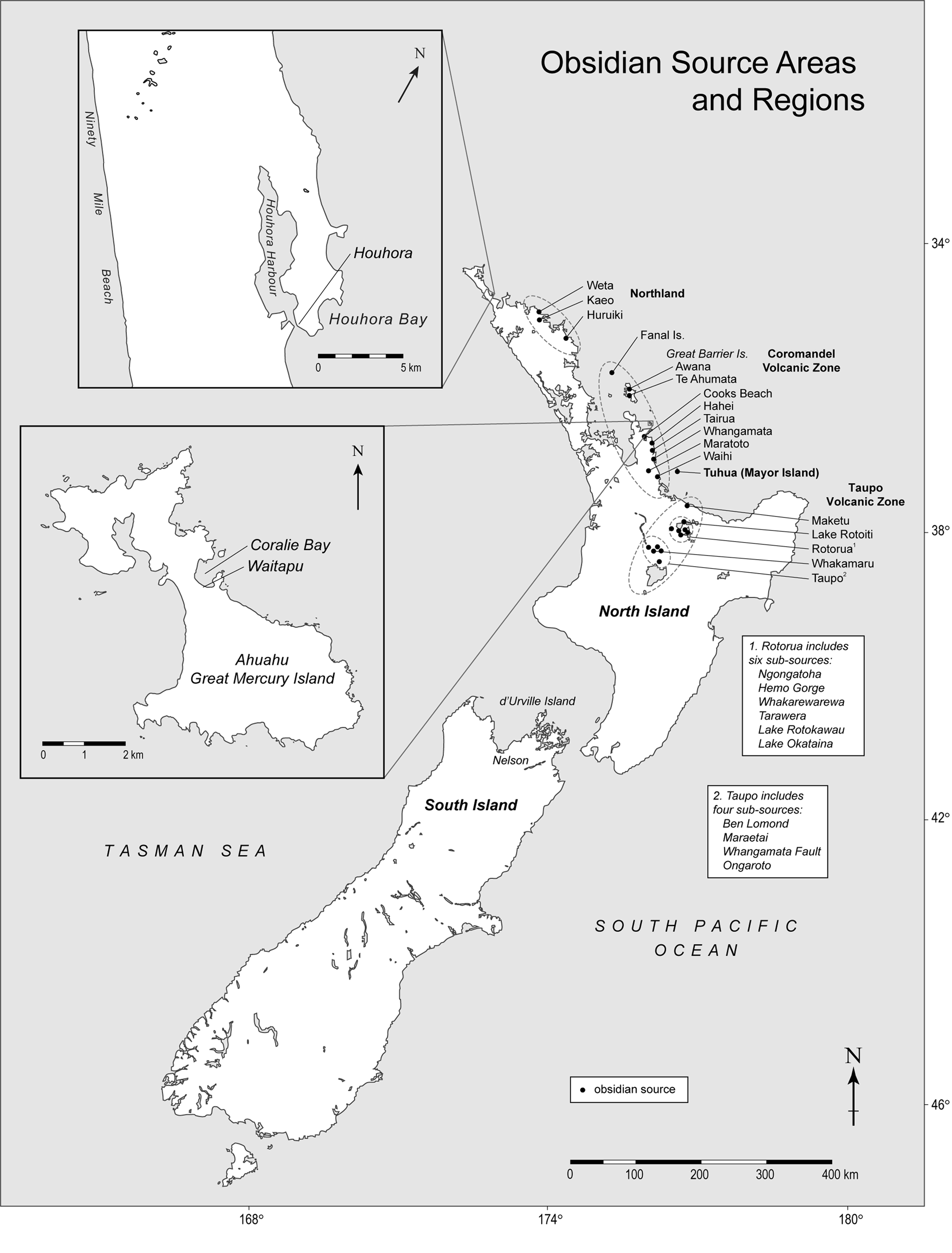
We consider two examples from the North Island of Aotearoa, both of which contain large numbers of flaked stone artefacts. The first is known as Waitapu, located on the edge of Coralie Bay, Ahuahu, Aotearoa (Fig. 1). At this site, a large assemblage of obsidian artefacts (more than 18,000 artefacts >20 mm in length), including complete and broken flakes, cores and tools, is associated with flaked stone artefacts manufactured from chert, petrified wood and basalt. As well as the obsidian artefacts, the Waitapu site produced other stone objects, including a serpentine trolling lure, interpretable as an ornament, two complete stone adzes, a broken pendant and hammer stones. The bone objects included a sperm whale tooth, two elephant seal tusks and numerous shark's teeth. As well, there were blocks of prepared kokowai (red ochre). Bones thought of as faunal material included numerous dog bones and fragments of whale bone (Furey et al. Reference Furey, Phillipps, Emmitt and Holdaway2020). Two concentrations of artefacts are identifiable stratigraphically, with most of the artefacts associated with lower layers and dated by radiocarbon to the fourteenth century. Artefacts in both layers come from sand deposits and the site is located on a partially eroded sand dune immediately above the Coralie Bay beach.
Location of Waitapu, Houhora and Aotearoa obsidian sources. (Map: Seline McNamee.)

Excavations at the second site, Houhora, occurred during the 1960s and early 1970s; however, analysis of the material recovered occurred much later by Furey, who published a monograph in 2002. Like Waitapu, the excavations produced many portable artefacts, including bone fishhooks and evidence of their manufacture in the form of stone drill points, together with drilled bone ornaments including reels and imitation whale teeth, tattooing chisels and other bone artefact forms. Like Waitapu, Houhora also contained large numbers of obsidian artefacts. Furey (Reference Furey2002, 107) records 23 kg of obsidian artefacts recovered from eroded surface contexts across the site, with a further 16 kg recovered from excavations. Furey (Reference Furey2002, 109) also reports the presence of numerous chert flakes as well as a number of stone adzes and basalt flakes. In summarizing occupation at the site, Furey (Reference Furey2002, 121) notes the presence of later occupation, but suggests association of the abundant artefacts with earlier sand layers 3 through 2b stratified below a build-up of layer 2a soil. This occupation, dated by radiocarbon to the fourteenth century, contains evidence for artefact manufacture, cooking areas and middens distributed across an area that was originally estimated to be 1.5 ha, although the excavated areas were much smaller, with the major excavation in Area A measuring 156 sq. m (although not all of this area was fully excavated).
At both sites, obsidian artefacts together with those made from other materials, occur together with well-designed and manufactured artefacts, and some forms that represented high, yet unrealized, raw material potential. Some artefacts are truly exceptional, interpreted as ornaments with high symbolic significance (Furey Reference Furey2002; Furey et al. Reference Furey, Phillipps, Emmitt and Holdaway2020). In both sites, artefacts occur in sand deposits subject to erosion and redeposition without definitive evidence for structures that might explain the association of the mundane with the exceptional (grave goods, for example). Complete and broken artefacts occur mixed together. Some had their potential utility reduced or removed (i.e. through breakage) while others have as yet unrealized utility (the raw materials). Still others are complete and unbroken, their utility still largely intact but with evidence of past use. Flaked stone artefacts occur with ground stone artefacts and all are associated with bone material.
Following the approach to analysis of the type Holbraad (Alberti et al. Reference Alberti, Fowles, Holbraad, Marshall and Witmore2011) describes in his ‘path to ontography’, the challenges to interpretation arose at Waitapu and Houhora following ordinary description of the materials (Holbraad's Step 1, detailed below). The juxtaposition of different artefact forms thought of in terms of materialization (Step 2) provided the potential for alternative explanations. The obsidian from both sites is significant here in providing the means to talk about levels of historical use, since the material is identifiable to geological source, analysable technologically and retains traces of use. This led us to consider Step 3 in Holbraad's scheme and to investigate the concepts on which archaeologists have based assessments of the relationships among material culture items. The subsequent discussion below is an implementation of Step 4, ‘experiment with redefining in different ways the concepts that generate contradictions’. In the following, we therefore use Holbraad's four steps to organize an alternative approach to material culture analysis using the Waitapu and Houhora artefacts as examples.
Descriptions and contradictions
Step 1: Descriptions
i. Obsidian
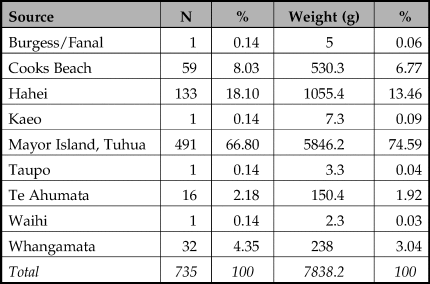
Investigations at Waitapu yielded approximately 20,000 artefacts. The numbers from Houhora are smaller but still number in the thousands. As noted above, many of these objects derive from different raw material ‘classes’, the most numerous of which at both sites is flaked obsidian. This obsidian comes from a variety of sources, primarily Tuhua (Mayor Island) in the Bay of Plenty and several sources on the Coromandel Peninsula as well as those in Northland (Furey et al. Reference Furey, Emmitt, Phillipps, Ladefoged, Jorgensen and Holdaway2017; Ladefoged et al. Reference Ladefoged, Gemmell, McCoy, Jorgensen, Glover, Stevenson and O'Neale2019; McBride Reference McBride2019) (Fig. 1). Across the New Zealand archipelago, obsidian manifests in 27 geological occurrences that are geochemically discernible using portable X-ray fluorescence, the technique used to separate the Waitapu and Houhora obsidian assemblage by geological origin (Table 1). Numerous geologists and archaeologists alike comment on the variability in the appearance of obsidian at the different sources, including attributes like the total volume of source, raw material form (outcrop, nodule etc.), and ‘quality’ (taken to relate to the ‘quality’ of conchoidal fracture). Moore (Reference Moore2012) provides a useful summary of these attributes. Considered the most significant obsidian source for Māori, Tuhua also stands out as the most abundant source, having a greater variety of raw material forms, and being of better quality (‘very good’ according to Moore Reference Moore2012), than any other source. Its position on the eastern coast of Aotearoa in the Bay of Plenty probably made it easily accessible, given the seafaring capabilities of Māori. Procurement from this location occurred in a variety of forms: cortical nodules, flakes struck from large boulders and flakes or nodules struck from seams. Moore (Reference Moore2012) describes the contexts as in situ, colluvial, and detrital. It is not surprising, therefore, that Tuhua obsidian is overwhelmingly present in archaeological obsidian assemblages from the North and South Islands (Ladefoged et al. Reference Ladefoged, Gemmell, McCoy, Jorgensen, Glover, Stevenson and O'Neale2019; McCoy & Carpenter Reference McCoy and Carpenter2014; McCoy & Robles Reference McCoy and Robles2016; Moore Reference Moore2012; Moore & Coster Reference Moore and Coster2015; Phillipps et al. Reference Phillipps, McAlister and Allen2016; Sheppard Reference Sheppard, Furey and Holdaway2004; Sheppard et al. Reference Sheppard, Irwin, Lin and McCaffrey2011; Walter et al. Reference Walter, Jacomb and Bowron-Muth2010). In comparison, the Coromandel and Northland sources also represented at Waitapu and Houhora respectively are smaller and more limited in both raw material form and abundance, with only colluvial and detrital materials present, and of a quality Moore (Reference Moore2012) categorizes as ‘good’. In one sense it is therefore not surprising that artefacts made from Coromandel and Northland obsidian are less abundant in archaeological assemblages (e.g. Ladefoged et al. Reference Ladefoged, Gemmell, McCoy, Jorgensen, Glover, Stevenson and O'Neale2019), if for no other reason than that the cobbles at these sources are smaller and hence capable of yielding fewer flakes (we discuss this further below). Ethnohistoric records suggest some Māori distinguished between four types of obsidian based on colour with certain colours used for particular tasks (White Reference White1875). However, colour classes do not necessarily align with the geochemical designations for source or even with source zone (e.g. Taupo Volcanic Zone), although Tuhua obsidian was distinguishable by colour. This raises the question of relevance when source definition relates to geochemistry using portable X-ray fluorescence. We also address this further below.
Waitapu obsidian artefact numbers and weight by geochemical source.

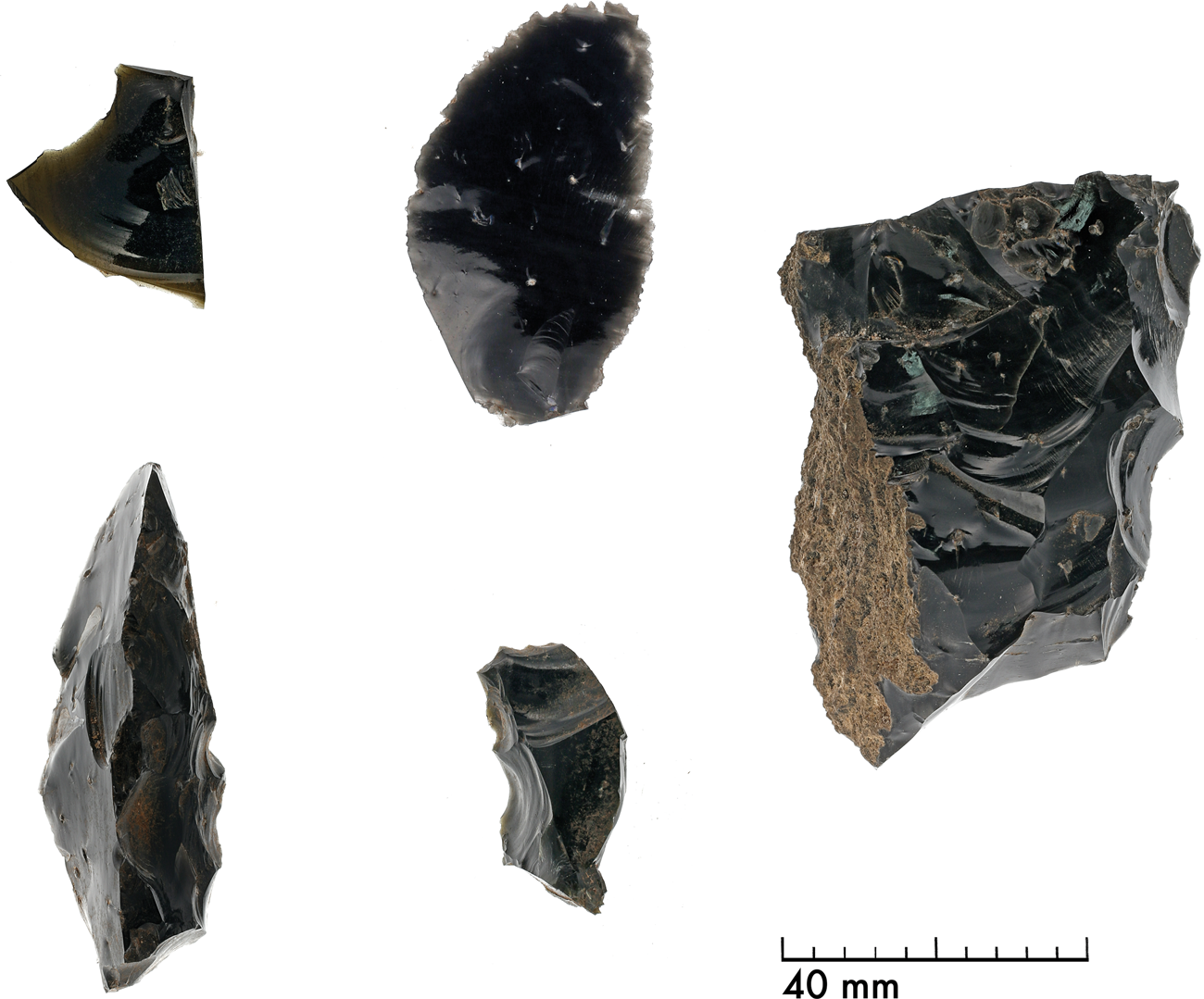
Grouping the Waitapu and Houhora obsidian assemblage into flake classes indicates a high level of fragmentation (Fig. 2). Longitudinal and transverse/latitudinal splits are common, as are angular fragments (definitions from Holdaway & Stern Reference Holdaway and Stern2004). Broken flakes represent many of the less abundant sources. Additionally, tens of thousands of obsidian chips and shatter are present at Waitapu and to a lesser degree at Houhora, although if they are collected, stone artefact analysis typically excludes these objects beyond count and weight. The high levels of fragmentation are not surprising, given the properties of obsidian. Obsidian is a rhyolitic volcanic glass that is very brittle and prone to shattering when hard hammer percussion detaches flakes from a core. Obsidian assemblages in Aotearoa commonly have flakes split along the axis of percussion with platforms crushed (e.g. Holdaway Reference Holdaway and Irwin2004). Despite being prone to fragmentation during flaking, explaining the abundance of chips and shatter, obsidian produces a very sharp edge when flaked. The ethnohistoric literature attests to the versatility of sharp obsidian flakes (e.g. Manning Reference Manning1875). So-called ‘formal’ tools are, however, rare in obsidian assemblages, although ‘informal’ macroscopic retouch does occur along with microscopic usewear.
Waitapu obsidian artefacts. Technological categories from upper left moving right: longitudinal split flake, complete flake (ventral surface showing edge damage), core with cortex; lower left: tool with retouch; lower right: broken flake. As discussed in the text, technological categories changed as artefacts were re-used. (Photograph: Tim Mackrell.)

The obsidian objects from Waitapu overall are large (McBride Reference McBride2019; Young Reference Young2019) when compared to other obsidian assemblages (e.g. Holdaway Reference Holdaway and Irwin2004; Phillipps et al. Reference Phillipps, McAlister and Allen2016). Furey (Reference Furey2002, 107) comments that the majority of Houhora obsidian artefacts fall within the size class 30 × 20 mm with none larger than 100 × 100 mm. Economizing principles would suggest that the discard of large objects with re-use potential is somewhat ‘wasteful’. The assemblages are both numerous compared to others recorded in Aotearoa, seemingly supporting the wasteful inference (but see discussion below).
ii. Fine-grained volcanic and metamorphic stone
Furey (Reference Furey2002, 100) reports retouch on small numbers of basalt flakes and broken fragments with and without grinding and polish from Houhora. Reworked adze fragments are also mentioned. Chert drill points are numerous, with several hundred in collections from the site with these linked to bone fishhook manufacture. Technologically, drill points originated as both cores and flakes with many broken. Furey (Reference Furey2002, 109) reports that most chert flakes are small, <40 × 40 mm with only a very small proportion >80 × 80 mm. Adzes numbered 97 from excavated contexts but only seven of these were intact with the rest broken. Broken adze fragments in the excavated collection are small, with the largest piece 110 mm in length (Furey Reference Furey2002, 81, 84). Several raw materials are represented including Tahanga basalt from the Coromandel which predominates.
Unlike the obsidian objects, fine-grained volcanic (including basalt) and metamorphic stone (including argillite) objects at Waitapu are largely limited to flakes and chips, some of which are polished, and are therefore likely to be the product of use (accidental damage) or resharpening of adzes. Although some preforms and complete adze forms are present at Waitapu, these are limited in number, and in contrast to the obsidian assemblage the utility of these objects is largely expended based on traditional criteria.
iii. Bone
Dog bone occurs in Aotearoa archaeological sites, present due to the consumption of dog as a food resource, but also as a raw material for the production of a range of tool types. Ash (Reference Ash2018) discusses the complexities of dog preservation at Waitapu, where a poor preservation context for bone has probably biased the assemblage toward the presence of more robust elements. It is unclear therefore whether this bone relates to butchering of dogs, consumption and subsequent bone discard, the use of bone for manufacture of objects with bone derived locally or transported from other locations, or some combination of the above. What can be said is that the bone discarded at Waitapu, like the obsidian, had the potential for further use, its utility largely unrealized. Waitapu also yielded unmodified teeth of sperm whale and elephant seal, both potential materials for artefact manufacture.
Bone artefacts are abundant at Houhora. In addition to the ornaments described below, there are 37 complete and broken bone chisels manufactured from moa bone (extinct ratite), bone points and awls, ivory and bone points interpreted as dart heads, eight bone tattooing chisels, and bird bone needles. The most abundant bone artefacts are fishhooks, with more than 1000 complete and fragmentary one-piece fishhooks together with bone tabs and partially finished fishhook fragments. Trolling fishhooks are represented by 26 points and artefacts assumed to represent fishhook shanks (with some manufactured from stone and shell in addition to bone). One bone point is thought to represent a broken harpoon.
iv. Exceptional items
Furey and colleagues (Reference Furey, Phillipps, Emmitt and Holdaway2020) provide details of a trolling lure shank made from serpentinite found at Waitapu. It is unusual in its large size and completeness, the largest example retrieved from an archaeological site in Aotearoa. The exact source of the material from which it is manufactured is not yet determined but is probably derived from the d'Urville Island and Nelson areas of the northern South Island where serpentinite is associated with the metasomatized argillites used for making adzes. A notched pendant made from petrified wood, perforated shark teeth, an imitation whale tooth pendant and shaped cylinders of ochre (kokowai) were also recovered. The importance placed on these objects comes partly from aesthetics, but also from ethnohistoric accounts and contemporary heritage values (Furey et al. Reference Furey, Phillipps, Emmitt and Holdaway2020). For the most part, however, their archaeological value derives from assumptions about curation. These include a direct link between the amount of time or skill involved in the manufacture of objects and their likely value. Because materials used to produce these items were difficult to procure and/or the objects were difficult to make, they were likely to have circulated for long periods before discard. Furthermore, their very discard is unusual since they are rare or otherwise absent from other archaeological sites in Aotearoa. While some of these objects were possibly abandoned because they were broken, many show no sign of breakage that might explain their presence resulting from discard.
At Houhora, personal ornaments exist in a variety of styles. Among these are a number of imitation whale tooth pendants, both complete examples and those in the process of manufacture. There are also 15 ivory reel units and drilled teeth from seal, dog and dolphin, as well as beads made from bird bone.
Step 2 Contradictions
How archaeologists conceive of artefacts as objects of study has often limited understanding of their utility, curation and abandonment (Holdaway & Douglass Reference Holdaway and Douglass2012). Limited numbers of complete objects (in both the senses of not broken and finished) contrast with the presence of numerous fragments derived from manufacture. Stone flakes, for example, become manufacturing debris. An expectation of finding ‘finished’ objects, often described as formal tools, tends to direct description and analysis. At Waitapu and Houhora, the ornaments and some of the bone artefacts represent such ‘formal tools’, but apart from the fine-grained volcanic and metamorphic stone flakes derived from adze reworking, and drill point flaking and the bone fragments related to fishhook manufacture, the large numbers of obsidian and chert artefacts that might form the ‘manufacturing debris’ category did not result in the manufacture of formal tools. The assemblages at Waitapu and Houhora therefore suggest the need to view utility, manufacture, curation and abandonment for some artefact classes in a different way.
Most often, in archaeological studies of stone artefacts, utility links specific material properties of objects with curation, interpreted as an outcome of economic behaviour (Shott Reference Shott1989). Objects discarded with their ‘utility’ intact indicate something about the nature of access to raw materials (i.e. unrestricted access, lack of territoriality, etc.) or settlement pattern and mobility, the creation and maintenance of social networks, or trade related to other more important (i.e. useful) resources. Where the economic rationale does not seem to apply, but where objects continue to suggest unrealized potential utility, interpretations focus on caches, votive or ritual deposits and burial goods. Studies conceived of in this way rely on universalist notions, often manifest as ideas involving economic optimization.
For example, in Aotearoa, drawing on analogues with Melanesian colonization and trade, Walter and colleagues (Reference Walter, Jacomb and Bowron-Muth2010) suggest that a failure to ‘maximize value’ in the use of obsidian from one source, Tuhua, in the period prior to ce 1500 indicates that people had access to a common obsidian distribution system. Post-ce 1500, this system broke down, so economizing behaviour replaced wastefulness, providing the basis for inferences about the reduction in social complexity and associated social networks. The size of obsidian flakes and cores as well as use wear on tool edges reflects use intensity, and therefore utility. ‘Value’ equates with intensity of use, such that something more intensively used is more valued, and this value increases with distance from material source. Following such a mode of inference, the measurements taken on artefacts reflect value and therefore material properties of the archaeological objects, in this case obsidian flakes and cores. As size reduces and distance from source increases, utility and therefore value is economized or not (as is the case for the earlier period).
This form of value relationship appears self-evident (as do all universalist positions); however, for stone artefacts such relationships are not as straightforward as they first appear. Whether or not things have utility may change throughout the object's use-life. For example, if we classified a broken projectile point or a flake broken by trampling according to conventional artefact classification schemes, both might appear as ‘broken’ artefacts and therefore less valuable than complete examples. However, using another classification scheme, measuring edge length for example, and ignoring completeness, a broken flake may still have utility and value considered via the criterion of edge length. Alternatively, while value might relate to the length of the edge, it might also relate to the mere presence of a cutting edge, beyond some length threshold depending on the nature of use. So, what is brokenness? How does length relate to utility? When is an artefact expended or no longer useful, and more fundamentally, what is ‘discard’ and how does it relate to usefulness and therefore concepts like utility and value? How do we know when people are ‘economizing’ based on the classification of objects found archaeologically? As Lucas (Reference Lucas2012, 211) comments, the archaeological record is best thought of as collections of objects that retain residues of the previous ways in which artefacts were organized. Objects in the archaeological record preserve these residues to a greater or lesser extent because of their incorporation into this record (the inscription and erasure discussed above). Utility and value therefore depend on historical aspects of residue preservation.
A great deal of archaeological analysis of stone artefacts reflects the reconstruction of the process of manufacture, the systematic removal of artefacts from original raw material to construct a desired product. Despite the ubiquity of such analyses, Holdaway and Douglass (Reference Holdaway and Douglass2012) as well as others (e.g. Coco et al. Reference Coco, Holdaway and Iovita2020; Dibble et al. Reference Dibble, Holdaway and Lin2017; Rezek et al. Reference Rezek, Holdaway and Olszewski2020; Turq et al. Reference Turq, Roebroeks, Bourguignon and Faivre2013) criticize single reduction sequences, suggesting instead that multiple episodes of flaking and re-use are common, thereby resulting in the transport of many products of stone knapping, not simply the supposed endpoints of a reduction sequence. Ethnohistoric accounts indicate repeated instances where people used artefacts manufactured by others and/or produced new artefacts from previously worked artefacts (Amick Reference Amick2015; Holdaway & Douglass Reference Holdaway and Douglass2012). In other words, stone artefacts were often not the result of a single episode of manufacture but subjected to re-use on many occasions. Artefact re-use confounds the notion of fixed raw material sources (Douglass et al. Reference Douglass, Holdaway and Fanning2017; Holdaway et al. Reference Holdaway, Douglass, Phillipps and Shott2014; Holdaway & Davies Reference Holdaway and Davies2019; Jorgensen Reference Jorgensen2019). People transported material to different places, making use of that material for whatever purposes and then abandoning it for a variety of reasons. However, in the act of transporting and abandoning material they effectively created new raw material sources available for different people, or the same groups, to exploit at different moments in the future through the re-use of previously worked stone artefacts. This is significant when assessing ‘value’, or as Shott (Reference Shott1989) terms it, the potential and realized utility of artefacts. If different people exploited previously abandoned materials, then notions of return on investment and therefore measures of (supposedly universal) economic efficiency need reassessment. Picking up previously used material might involve instead the realization of what might be termed residual potential, which is of course a relative measure depending on the context of use.
Where re-use of artefacts is involved in new artefact production, questions of intentionality also become contextually dependent. It is no longer possible to assign such intentionality merely based on ordered flake removals or the intensity of manufacture or use. A complete flake with a long edge may have value in one situation but be less suitable in another, where indeed a broken flake with an edge length suitable for use becomes the one selected, even if the edge length is less than that in a complete artefact. Technological attributions to categories like cores, flakes, or retouched tools may have little relationship to object use. Arriving in the past at what we now call an archaeological site, and confronted by an array of artefacts derived from geologically different sources previously used, selection and treatment of raw materials and indeed technological categories may be equal since they now effectively represent a single new source of stone material, even though their geological attribution was originally different.
If, for the moment, we leave the implications of artefact re-use aside, it is possible to derive a series of expectations imagining that uniform blocks of materials arrived for flaking at Waitapu and Houhora and comparing these against the actual assemblage composition. For example, at Waitapu we might expect Cooks Beach and Hahei (Coromandel) obsidian to be more abundant, because these sources are closer (~20 km) to Ahuahu than some other sources (Fig. 1). Similarly, an expectation of a greater abundance of Northland sources at Houhora would correlate with linear distances from site to source. Therefore, the size of artefacts (and frequency) from other sources should be smaller in comparison to those from the closest Coromandel or Northland sources. Indeed, we might expect some form of uniform correlation between artefact size, the proportion of artefacts from different sources and distance to those sources. We might also expect relationships among cores, flakes and tools reflecting the reduction sequence for flake manufacture orientated at the creation of particular products. There should, for example, be differences between such flake products and ‘debitage’. Flakes should be smaller than the cores from which they were struck, unless the reduction sequence involved reducing cores by removing as many flakes as possible (e.g. Douglass et al. Reference Douglass, Holdaway, Shiner and Fanning2015). In such cases, cores with multiple platforms should be smaller in comparison to those with single or double platforms. We might expect broken flakes to be smaller than complete flakes, reflecting the damaged state of artefacts when broken. Depending on the activities at the site, we might also expect the products of core reduction to be either used (thereby exhibiting usewear or retouch) and/or removed for use elsewhere, leaving behind a class of debitage. We might expect evidence for resharpening, as an example of maintenance, to be more evident on artefacts from distant sources.
When tested against the Waitapu and Houhora assemblages, results run contrary to some of these expectations. Beginning with Waitapu, the closest sources (Cooks Beach and Hahei) are not the most common, based on artefact frequency or weight. These Coromandel sources make up approximately 26 per cent of the assemblage by frequency and approximately 20 per cent by weight. In comparison, Tuhua (80 km from Ahuahu) makes up 67 per cent by frequency and 75 per cent by weight. The Cooks Beach and Hahei flakes are smaller than those from Tuhua and Great Barrier Island when weight is considered, but larger when flake length is considered. Overall, there is no direct correlation between frequency and size of artefacts from different sources, with distance to source relating to frequency only in some cases.
At Houhora, based on preliminary work by McBride (Reference McBride2019), a similar pattern is evident, with results (n=525) running contrary to expectations, although fewer sources overall are identified. The closest source is Kaeo, but it accounts for only approximately 12 per cent by weight and count. In comparison, Tuhua makes up approximately 85 per cent by weight and count. Two Coromandel sources are represented: Hahei (less than 1 per cent by count and weight) and Whangamata (approximately 2 per cent by count and weight). Flakes from Kaeo and Tuhua are similarly sized, although flakes made on Tuhua obsidian are slightly larger when flake length is considered.
At Waitapu, the average size of cores is larger than flakes, but so is the average tool size. Comparison of broken and complete artefact sizes shows there is no difference in mass and only a slight difference in maximum length. Comparisons among artefact technological class show 56 per cent of artefacts as complete and 44 per cent as broken, contrary to the expectation that debitage and broken flakes should be the most frequent following a complete reduction scenario orientated at flake production and subsequent use, including onward transport. Resharpening of flakes to produce tools is extremely limited, with only five artefacts (from 5500 analysed) with macroscopic ‘scraper’ retouch and six with regular unifacial retouch, and only two artefacts have all four quadrants (edges) retouched. However, in a preliminary study of microscopic usewear, approximately one-third of the Waitapu assemblage exhibited use wear visible under magnification on one or more edges, but with only one artefact with both use wear and retouch (Young Reference Young2019). In sum, the assemblage is not heavily utilized in the traditional sense of the production of numbers of formal tools, although use wear indicates obsidian was used to work a variety of materials. More intensive ‘use’ in either the retouch or use wear sense of artefacts from distant sources might also be expected, but this is not the case. Nor is there evidence for preferential use of the Tuhua source, argued by Moore (Reference Moore2012) to be of superior quality, for tools defined by either retouch or use wear. Finally, despite the presence of large nodular cores with residual ‘utility’, 35 per cent of these cores occur on re-used broken or complete flakes. Both nodular and flake cores are represented by artefacts from across the geological sources, with core form unrelated to core size or geological source.
The results from the Houhora obsidian assemblage are more limited; however, these are again similar to Waitapu. On average cores are larger than flakes at Houhora, and tools are smaller than both flakes and cores. Assuming flaking is a reductive process, this is surprising and may suggest the removal of the largest flakes from this assemblage. In contrast to Waitapu, approximately 30 per cent of the flake assemblage was classified as complete, the rest broken. This may reflect post-depositional fragmentation given the context of the site, since it was discovered as a result of gravel mining (Furey Reference Furey2002). Only 11 tools are represented featuring scraper and unifacial retouch; however, use-wear analysis of the Houhora obsidian remains to be completed.
In sum, the Waitapu and Houhora examples fail to show the types of simple universal economic relationships expected when considering technology and distance to geological source. This suggests that the properties related to raw material origin and technological form are not inherent to either the materials from which artefacts were made or the forms into which they were manufactured but instead likely varied depending on context. If raw material source varied depending not on geological origin but the places of artefact acquisition, then artefact classes like brokenness and completeness, flakes, cores and tools are not truly technological if such classes rely on the notion of a single reduction sequence from raw material to finished product, with all the issues that assuming the existence of such sequences entail (Holdaway & Douglass Reference Holdaway and Douglass2012). In the Waitapu and Houhora examples, an object's position within a reduction sequence is not readable from the object alone, as for example the cores formed by removing flakes from previously struck flakes indicate. Obsidian is likely to have changed its shape and size as people worked and transported the materials from their original locations; therefore the potential utility of the new-made sources changed. Tuhua obsidian found at the initiation place was not the same ‘source’ as Tuhua obsidian found at a transported location, if by the term source we include the location from which the material was retrieved and the potential of the material for manufacture and use. The lack of consistency in the way Waitapu Tuhua obsidian was flaked, indeed in the way obsidian from all of the sources was flaked at both sites, probably reflects the complex history of material acquisition and use: in other words, the acts of materialization, following Lucas’ (Reference Lucas2012) notion where objects result from the varied histories of interactions among people and materials. Given this, the lack of a direct relationship between artefact size and distance to source, as illustrated by the Hahei and Cooks Beach obsidian at Waitapu and the Northland sources at Houhora, is not surprising.
Reflecting on the contradictions that the Waitapu and Houhora results pose for models based on linear core reduction sequences, it is apparent that the history of artefact use may structure archaeological assemblages in several additional ways. For example, at first settlement of Aotearoa there were only the geological sources of obsidian available, since no transported obsidian assemblages yet existed. Therefore, abundance of obsidian in the earliest assemblages related to the size and form of material at the source (see Moore Reference Moore2012, table 1, for detail). Through time, deposition of transported materials occurred in what we today identify as archaeological sites. These created new constructed sources and when these provided a source of material for Māori the form and abundance of this material was different to that found at the original geological locations. However, the original transportation of obsidian reflected the form and abundance of material at the original sources. Because obsidian was much more abundant at Tuhua than at any other geological sources it was relatively more abundant at the transported sources. This may explain the abundance of Tuhua material in early sites. Archaeological obsidian assemblages subsequently changed their composition, with the later assemblages inevitably looking different to those earlier in age through material use, movement and re-use. Ignoring the process of materialization, and assuming atemporal economic efficiency, the historical patterns might look like the outcome of a simple model reflecting distance to source. However, this imposes a particular world, in this case a western economic one, on to archaeological interpretation. Questioning the assumed basis for this world leads us to question not only previous interpretations of obsidian artefact assemblages, but also the status of the other items and the raw materials that form part of the Waitapu and Houhora assemblages discussed above.
Step 3 Underlying assumptions
Archaeological deposits are the abandoned remains that people no longer considered serviceable. Middens encompass this view most dramatically, since faunal and less frequently floral materials become refuse, the remains of the food quest after consumption. However, the same types of assumptions provide interpretations for material culture, the ‘waste flakes’ and ‘broken tools’ for example, manufactured from stone. Discard or sometimes loss is the assumption in such interpretations. From these assumptions come other forms of inference. Discard implies an action; an item was useful and now it is not; its utility, whether reflecting material quantity or otherwise, becomes expended. Foodstuffs, caught or collected, move through a sequence of processing, consumption, with the remains thrown away as refuse. Therefore, items found together become interpretable following a series of domestic actions, leading to interpretations of settlement consisting of activity types and areas. Through discard, the behavioural state of things becomes fixed. Natural processes may alter their disposition, but because they are no longer wanted, there is no expectation that they will change their behavioural significance once discarded. Interpretive models represent this cycle of use, discard, post-depositional process and archaeological discovery.
However, such simple sequences do not characterize all instances of discard. Bone remains for example, might be food remains at one time and raw materials at another (as with the dog bone remains at Waitapu: Ash Reference Ash2018, and most clearly the bone remains from fishhook manufacture at Houhora: Furey Reference Furey2002). Studies of stone artefact refit sets often indicate flake removals that occurred at earlier times (e.g. Bleed Reference Bleed2002; Turq et al. Reference Turq, Roebroeks, Bourguignon and Faivre2013). Obsidian at Waitapu, interpreted following a complete reduction sequence and notions of economic efficiency, requires a set order of actions: transportation of material from a source occurs before flaking according to a reduction strategy, and abandonment following the manufacture and use of intended products. Interpretation rests on the notion of discard, involving the removal of material from the active world into a new, almost suspended or inert state, waiting for archaeological discovery. However, is interpretation as discard the only way to assess abandonment? Following Holbraad's Step 3, and building on the results of the Step 2 consideration of contradictions, particularly the results of the obsidian analysis, we experiment with inferences concerning why materials are present in archaeological sites.
At Waitapu, some broken obsidian objects show use wear. Broken flakes were once complete, but there is no indication that the use-wear accumulated only before breakage occurred. Other objects struck as flakes saw subsequent use as cores with the same pattern apparent at Houhora. The lack of simple reduction sequences suggests that individual objects often had complex life histories that probably involved multiple episodes of use and re-use. However, this said, among the obsidian objects left at Waitapu and Houhora, a number had the potential to have additional flakes removed at some point in the future. Therefore, the obsidian assemblages do not fall easily into the category of discard where no further use is possible. In this sense, at least some of the obsidian appears to be available raw material, and therefore is similar in this respect to bone material also retrieved from Waitapu and at Houhora that had the potential for reworking into other artefacts.
The ornaments and other complete artefacts, most notably the lure shank from Waitapu and the bone ornaments at Houhora, might not be discard because of their form and rarity. Loss as an explanation is possible, but at both sites the number of items makes such an inference less likely. Based on an analysis of the lure shank (Furey et al. Reference Furey, Phillipps, Emmitt and Holdaway2020), deposition at Waitapu occurred after a history of manufacture and use including acquisition of raw materials from a distant source. In this sense, there are aspects of the use history of these items that parallel the history of obsidian use. If the potential for material re-use is emphasized, the obsidian becomes a potential raw material, like the bone and tooth materials.
If obsidian and the other materials are not necessarily objects of discard, but instead materials with the potential for re-use, what significance does this have for interpretation? Through the act of discard, materials accumulate in a transformed state marking the location of their removal from the active world. Following the complete reduction sequence approach, the accumulation of discard marks the location where particular types of activities occurred. Functionally defined locations relate to functional site types and from this regional settlement patterns follow. A structured, bounded, organizational use of space results from which inferences of bounded social groups follow (Ladefoged et al. Reference Ladefoged, Gemmell, McCoy, Jorgensen, Glover, Stevenson and O'Neale2019).
However, with the discard as a discrete process questioned, it follows that the assumption that social organization should translate into spatially patterned distributions of material objects should also be examined. If we can conceive of object state as fluid (Van Oyen Reference Van Oyen2013; Reference Van Oyen2016), sometimes ‘useful’, sometimes not, sometimes forming new raw material sources from what were once functioning artefacts and as described above not fixed, not tied to material attributes, then this has implications for inferences about settlement patterns and associated social organization.
Harry Allen explored some of these issues in his 1996 paper ‘Horde and hāpu’, which touches on observations in ethnohistoric and contemporary discussions of Māori social organization. Allen considered the issues around equating social organization and (archaeological) settlement pattern, noting that given the difficulties in social anthropological analyses of social organization, even more caution should be employed when dealing with archaeological evidence, including the re-evaluation of assumptions. For Māori, the coalescence of groups may vary through seasons, times of warfare, and other important events (e.g. tangihanga burial rituals). The ownership and use of resources fluctuate, allowing the differential leveraging of kinship networks. Described as a ‘mosaic of groups scattered across the landscape’, which could at any time ‘split up or coalesce into higher order social entities’ (Allen Reference Allen, Davidson, Irwin, Leach, Pawley and Brown1996, 670), social organization becomes spatially and temporally variable. At any moment in the past, one might see a manifestation of social organization; however, at another moment, an observer might see something altogether different (see also Anderson Reference Anderson1998; Irwin Reference Irwin2020). Thought of in this way, social systems only emerge over time (Holdaway & Davies Reference Holdaway and Davies2019) and the patterns archaeologists study based on material evidence are also the outcome of time-transcendent processes.
Step 4: Redefining relationships with things
Step 4 in Holdbraad's method involves an ‘experiment with redefining in different ways the concepts that generate contradictions’. In considering Step 4—application—the intention is not to describe an alternative way of thinking about indigenous pasts, one that inevitably will involve appropriating concepts, and therefore opening the possibility for the use of these concepts in inappropriate ways. Rather, we intend to provide the intellectual space for alternative ways of knowing and/or alternative worlds, and from this the development of alternative narratives about the past. To address Gero's (Reference Gero, Pinsky and Wylie1989) comment quoted at the start of the paper, in the context of the ‘anthropological turn’, we envision the potential for a multitude of approaches, even among indigenous groups. For example, there is not necessarily one ‘Māori’ way of connecting with the past, since this may vary among individual iwi and hapū. The authors acknowledge our position as academics, so we present our redefining of relationships with things in the context of the contemporary literature and finish by commenting on how we see this potentially aligning with ideas drawn from the work of Māori scholars and others on relationships with taonga and tupuna [material objects and the ancestors].
In the descriptions above, stone artefacts may be classed as tools, that is, flaked objects with continuous regular retouch. Alternatively, classification may relate to fracture. For example, a flake is broken if a platform is absent, or complete if the platform and a termination are intact. Yet another classification scheme may reflect the presence and/or nature of use wear visible under magnification allowing categories of used or not, or the classification of the object as a taonga tūturu [national treasures] based on a separate set of criteria. How do we reconcile these different classification systems? Is it the historically most recent form that becomes the target for analysis, with attributes describing this form entered into archaeological databases? Or is it the initial form, the result of the manufacture of the flake struck from the core? And what role do these classifications play in assigning value? Does value derive from the application of a classification scheme by the archaeologist or the aesthetic sense of a museum curator? As illustrated in the Step 3 analysis of obsidian, the answers to any of these questions become, like the obsidian raw material itself, somewhat malleable.
Fracture state, technological forms, and potential for use are not absolutes with fixed categorical definitions. As Van Oyen (Reference Van Oyen2013, 89) states, ‘In order to question the impermeability of boundaries and the rigidity of categories effectively, we need to bypass the distinction between a single, stable, external world of things “out there” and its multiple, fluid, ambiguous, but disconnected meanings’. There is no such thing as a ‘neutral’ description, where artefact categories are devoid of bias. Differences between objects are not essential to the object: rather they are specific to, and therefore an effect of, the process of analysis (Marshall & Alberti Reference Marshall and Alberti2014, following Barad Reference Barad2007). Things never pre-exist with the identification of difference. The outcome of analysis is not the discovery of some essential category. The analysis of stone artefacts produces categories of artefacts, beginning for example by assessment of technological form: flake, core and tool. Flake classification may include fragmentation: complete flake, proximal flake, distal flake, etc. with these classes defined according to landmarks noted above. Landmarks allow measurements taken by callipers, sometimes measurement of the landmarks themselves or the use of landmarks to orient the measurements. The more landmarks identified, the more ‘stable’ the classification, and therefore the more certain the differences among classification states. However, following Barad (Reference Barad2007) this is an illusion, as are the technological and fragmentation categories for stone artefacts, since the analysis produces outcomes that are phenomena, intra-action, not something infused into the object themselves. Matter is in a constant state of becoming, with things not fixed, but rather available for future potential intra-actions.
With obsidian, initial manufacture state as a flake may change to a core or a tool and back to a flake at some later time. Even the geological origin as raw material may change as the object transported to a new location becomes a potential new raw material source for future use. Thinking through intra-action therefore seems a useful way to create the intellectual space needed for alternative perspectives, but there are also implications for definitions of artefact categories, or at least the way in which we treat these categories to store and disseminate information about objects.
The imposition of categories on material culture has in the past led to value assigned in ways that have lasting consequences for indigenous communities. Archaeologists create categories that determine objects as discard, for example. However, if an object can be a flake, core, tool, and broken all at once, discard at one time and a raw material source or a tool at another, then following Van Oyen (Reference Van Oyen2013, 98), rather than take objects as a ‘base line’ to explain or highlight processes, ‘we need to ask which kinds of process a specific kind of material culture enabled’. At Waitapu and Houhora this is useful for thinking about the concept of re-use and revisiting of sources, whether they be geological sources or those created by the past actions of communities leading to different ways for thinking about assemblages.
If objects are fluid and indeterminate, the same holds true for assemblages. As Marshall and Alberti (Reference Marshall and Alberti2014, 32) note, ‘An assemblage is always a material discursive becoming so cannot slip from the discursive to the material no matter how often it is reproduced’. Perhaps defining obsidian artefact types based on their technological state related to their manufacture and completeness is less important than obsidian objects as part of an assemblage, and therefore a source that can be utilized, forming a context on the landscape, providing an ability to relocate and revisit multiple times. Rather than seeking to assess the function of assemblages by assessing the completeness, utility and therefore value of each object, analysis considers what visibility on the landscape implies about spatial knowledge and recurrent use, with assemblage presence on the landscape the topic of study in its own right. Is the role of archaeology, then, also to understand the history of these time-averaged deposits, what was removed or re-used over time, to tell us about place use history and then compare such places across landscapes? If so, then this is a different form of settlement pattern archaeology to the established method with interests in functional site type categorization (Holdaway & Davies Reference Holdaway and Davies2019).
Many archaeological interpretations of discard suggest the material outcomes from social interaction involved objects entering an inert state, separate from the world of action. At Waitapu and Houhora, however, analysis of the obsidian assemblage shows that even the seemingly most mundane flaked stone obsidian objects reflect a history of use and re-use, one that leaves materials with their utility still intact available for future use, just as these objects were used and re-used in the past. In this sense, the assemblage is not about discard, but rather about continued availability; objects with a potential to be re-found or reworked from what was available. ‘Discard’ does not place objects out of circulation, but rather places them in a condition where their relationships might be rekindled. Using this perspective, the act of interpretation from archaeological remains shifts from one of reconstructing lifeways (that is, the use of things by people at points in the past) to one of the accumulation of materials in the present that provide links with the past. Objects do not represent social relations directly but rather come to represent social interaction as they accumulate the residue of repeated actions.
Discussion
Like all universalist assumptions, the notion of a direct link between the amount of time or skill involved in the manufacture of objects and their likely value appears self-evident; however, as the analyses of the Waitapu and Houhora obsidian assemblages show, the evaluation of utility and value depends on historical aspects of residue preservation. Artefact categories, even the seemingly obvious stone artefact technological divisions, break down when analysed through the lens of historical materialization. Flakes, cores and tools are fluid, not fixed. The discarded, seemingly mundane stone flakes share a history like the histories of manufacture and transport inferred for exceptional ornaments at both sites. Questioning the assumptions around an economic efficiency leads to other questions concerning discard as a discrete process, and from this, assumptions about spatially patterned distributions of material objects. The application of Holbraad's scheme provides the means to ‘unthink’ universalist archaeological assumptions, thereby providing the opportunity to explore Māori concepts that might align with alternative readings of the significance of objects derived from archaeological sites. If, following Van Oyen (Reference Van Oyen2013; Reference Van Oyen2016), we think of object states as fluid, and from Barad (Reference Barad2007) the result of intra-action rather than the discovery of pre-existing categories, then we may consider how the results of these ideas applied to archaeological collections, like those from Waitapu and Houhora, align with ideas drawn from the work of Māori scholars and others on relationships with taonga and tupuna, material objects and the ancestors.
In thinking about such an alignment, we begin by considering the concept of taonga within a Māori world. Here the intent is not to appropriate concepts of taonga for our own analysis, but rather to acknowledge alternative ways of knowing from discussion of taonga, using this as a way of presenting an entry point for experimenting in understanding objects from the past and thinking reflexively about our practice as archaeologists.
Henare explains the taonga in the following way:
A taonga might equally be a historic whalebone weapon, the Maori language, a native plant or a body of knowledge; distinctions between the material and the ephemeral are not relevant here. Nor are ideas about animate versus inanimate entities; women and children may be exchanged as taonga, and taonga such as woven cloaks are often held as ancestors or instantiations of ancestral effect. (Henare Reference Henare, Henare, Holbraad and Wastell2007, 47)
As Henare (Reference Henare, Henare, Holbraad and Wastell2007, 56) goes on to stress, taonga ‘more than simply “representing”, “signifying” or “embodying” ancestral efficacy and power, are it in specific form’. Within the anthropological literature, discussion involving taonga originally developed around the work of Mauss (Reference Mauss and Halls1990) on exchange, particularly his appropriation of the Māori concept of hau (for discussion, see Henare Reference Henare2018; Nicholson Reference Nicholson2019; Stewart Reference Stewart2017). However, contemporary Māori scholarship has criticized the appropriation of such terms. Tapsell (Reference Tapsell1997, 334), for example, provides ethnographic accounts of both the appearance and disappearance of taonga as they ‘descend through particular kin group's rangatira-lines’ [chiefly lines] emphasizing the links between taonga and whakapapa [genealogy]. Although items might become lost for a time, their re-appearance established their ancestral connections. Tapsell describes how such connections link to the past:
Taonga are threads from the past, acting as here, or guides. These guides link a myriad of interconnecting relationships within the genealogically patterned universe of Maori society. (Tapsell Reference Tapsell1997, 334–5)
Tapsell describes an account given by a kaumatua [elder] stating that taonga cannot be owned: they are like people, you can belong to them, but you cannot own them (see also Craig et al. Reference Craig, Taonui and Wild2012). Following Tapsell's (Reference Tapsell1997) discussion, taonga are not so much exchanged as Mauss (Reference Mauss and Halls1990) described, but are rather circulated, acting as a mechanism to bind people to the community through strengthening relationships with the tupuna [ancestors]. These accounts emphasize how objects reflect histories of relationships. If archaeologists were seeking to align inferences about archaeological materials with Māori scholarly discussions, then there are potential parallels with objects taken to exist in a state of becoming, not embodying and the circulation of taonga. Such an alignment builds on the suggestion of Marshall and Alberti (Reference Marshall and Alberti2014, 32) who note, in discussing another ornament type found in Aotearoa, chevron amulets, ‘They come into determinacy, are produced as artefacts or taonga, under specific conditions—not in any general or universal way’. What makes an object taonga relates to the stories, knowledge and sometimes associated named individual ancestors that rekindle relationships in the present. As Tapsell (Reference Tapsell1997) illustrates through contemporary examples, taonga in this way embody the ‘present past’.
Archaeologists, in discussing artefacts, have shown only limited concern with aspects of the present past (although Turner's work with the craftsman Dante Bonica is an exception: Turner Reference Turner2000; Turner & Bonica Reference Turner and Bonica1994). There is a notable dichotomy, for example, between studies of Māori material culture taught in universities as part of Māori Studies and those taught in university archaeology programmes. In Māori Studies, the approach taken is closer to chaîne opératoire studies conducted elsewhere (Hussain Reference Hussain2019 provides a detailed review of chaîne opératoire). Interest expands beyond the form of the finished product to include all stages of manufacture and use, from raw material acquisition through manufacture to use and, indeed, re-use (Turner & Bonica Reference Turner and Bonica1994). Ellis (Reference Ellis2016) also discusses the role of taonga tuku iho for Māori and ways of approaching the study of material culture. She challenges us to acknowledge the persistent colonial power imbalances in anthropology and other disciplines related to heritage and archaeology. Aside from encouraging indigenous scholarship, as part of the process of considering the form a post-colonial archaeology could take, archaeologists might consider analyses that pay more attention to describing material culture in ways closer to those that Tapsell (Reference Tapsell1997) describes, with an emphasis on historical materialization rather than universalist assessments of utility and value.
Conclusion
Obsidian artefacts used and re-used like other forms of material culture found at Waitapu and Houhora have forms that reflect complex use histories. In this sense, they are no different to the ornaments found at both sites. Using Holbraad's method of ontology provides the means to rethink the ontology of artefact categories. Rather than places for reconstructing lifeways through functional site designations, archaeological sites provide materials with which to describe historical relationships among objects. This may allow the development of alternative historical narratives, ones that have potential to align with Māori scholarship in Aotearoa emphasizing connections between whenua [land], tangata [people], and taonga [things], connections that underpin a Māori world. Following such an approach opens the possibility of writing a truly post-colonial archaeology the implications of which we have yet to explore.
Acknowledgements
Harry Allen, Matthew Douglass, Joshua Emmitt, Tim Murray, Gerard O'Regan and Nicola Stern provided comments on earlier drafts of this paper. We thank two anonymous referees for their constructive criticisms that led to significant revisions. Inspiration to develop the ideas in the paper came from published comments by Marama Muru-Lanning. Louise Furey, Thegn Ladefoged and the authors direct fieldwork on Ahuahu. The Fay and Richwhite families through Sir Michael Fay and a grant from the University of Auckland Foundation, and Sir Roderick and Lady Gillian Deane through the Natalie Blair Scholarship, support our work. The Permission to undertake archaeological research on the island was provided by Ngāti Hei, who provide manawhenua cultural support, and Heritage New Zealand. Seline McNamee drew Figure 1 and Tim Mackrell photographed Figure 2.