In the name of humanity, the Empire of Good will bomb Belgrade, Baghdad or Tripoli, foment colour revolutions in former Soviet states, set the Maghreb and the Near East ablaze, and seek to universally impose its fundamentalist conception of democracy. Squads of businessmen dispatched by corporations will follow the ideological bulldozers driven by the evangelists. How many times have popular revolutions been hijacked by social benefactors chiefly interested in serving the interests of the people behind them?
Eric Maulin, 2011The critique of humanitarianism above was not written by an anti-imperial writer on the left, nor by a scholar of US empire. Rather, it was penned by a French academic in his introduction to a book by Alain de Benoist, a founder of the French “New Right” and an intellectual godfather of the transatlantic far right in the twenty-first century. Benoist's book, entitled Beyond Human Rights: Defending Human Freedoms (2004), crystalized an argument that its author had furthered for decades on the fringes of West European politics, one which has now become much more widespread within the political right on both sides of the Atlantic. That is, “human rights,” and the liberal universalism they embody, have become the new “white man's burden,” performing the same ideological function of older colonial discourses (such as civilization and progress) in the service of Western imperialism.Footnote 1 On its face, the argument shares much with critiques of human rights from the left.
But what makes Benoist so appealing to the transatlantic political right is the idea of cultural belonging that grounds his critique of the world order. That is to say, human rights, in his view, are a destructive basis for international relations because they rest on a notion of human equality that ultimately homogenizes and flattens human particularity and cultural identity. Such rights are grounded in Enlightenment liberalism, which reduces a concrete, diverse humanity into a set of universally equivalent abstractions. “If all men are equal, if they are all fundamentally the same, if they are all ‘men like others,’” he writes, then “far from the unique personality of each of them being able to be recognized, they will appear, not as irreplaceable, but on the contrary as interchangeable.” In this sense, human rights are driven by an egalitarian, leveling impulse that fails to recognize the human need for groups to differentiate themselves in order for their members to maintain a coherent selfhood. Thus, he concludes, “The imposition of human rights represents … the dislocation or eradication of collective identities.”Footnote 2 The solution, to Benoist and to the explicitly antiliberal “Identitarian movement” that his work inspires, is “ethno-pluralism,” a world order based around ethnically homogeneous peoples, each able to define the terms of the human within their own autonomous spaces, free from interference from other powers. Derived in part from Carl Schmitt's notions of Großraum (“big space”) and nomos, ethno-pluralism is an attempt to couch arguments for a white ethno-state within a multicultural grammar of diversity and postmodern ideas of difference. As Benoist wrote elsewhere, in what became a central manifesto of white nationalists on both sides of the Atlantic, “The French New Right is profoundly opposed to the suppression of differences.”Footnote 3
In the United States, such ideas have not only fueled the small but culturally significant alt-right movement; they have also surfaced at the highest levels of public rhetoric during the Trump administration, including the Stephen Miller-authored speeches delivered by the President in international forums. President Trump's speeches to the United Nations General Assembly, for example, were mislabeled “conventional” by the US press, largely because he stuck closely to the coherent scripts written by his policy adviser, Stephen Miller.Footnote 4 Yet, as I will later illustrate, the journalistic coverage failed to notice the distinctly Schmittian, ethno-pluralist, even antiliberal undertones in these addresses – repeated two years in a row – which were actually quite novel. Identitarianism, though beginning on the fringes of European politics, dimly emerged as a face of American power and as an exportable theory of international relations. Though the Trump administration is now past, the antiliberal politics he brought together show no signs of dissipating. In fact, they may take on even more frightening dimensions if they reclaim state power under a more disciplined administration.
I begin with these discussions of ethno-pluralism and the explicit rejection of human rights in right-wing circles because we as American studies scholars have yet to fully apprehend this emergent turn in US imperial logics, one that may become more significant as the so-called “white nationalism” becomes a long-term fixture of US politics. Scholars of US empire have produced excellent work on the ways in which human rights and even multiculturalism are deployed toward highly destructive, world-ordering ambitions by the United States.Footnote 5 This work overlaps with scholarship in critical ethnic studies that has closely examined what might be termed “aversive” modes of racialization; that is, white racial projects that viscerally disavow racism, at home and abroad, such as “colorblindness,” “neoliberal multiculturalism,” and “the postracial.”Footnote 6 American studies and other interdisciplines have also developed excellent critiques of Enlightenment liberalism, particularly the way it has facilitated colonialism and other racial formations.Footnote 7 This important work continues to be critical, since the total eclipse of liberalism is arguably not on the immediate horizon, and since imperial logics have always been flexible in nature, simultaneously putting in motion a multiplicity of rhetorics, affects, and formal ideologies toward the same historical project.
But to fully gauge the contours of American-made violence in the twenty-first century, both “foreign” and “domestic,” we also need to take more seriously contemporary imperial modes grounded in antiliberal cultural logics, ones that make no pretense of “uplifting” racial others and that unapologetically place white power at their center. Over the last twenty years, the ways in which Americans have been conscripted into the project of empire has arguably undergone a shift away from Cold War and early neoliberal modes of global engagement, a shift that far-right discourses from Europe are well positioned to shape into a new synthesis. Developmental narratives of Third World uplift under the auspices of an American-led global market arguably no longer hold purchase with a US public beset by stagnant real wages and declining living standards, a public also weary from failed yet costly interventions in Iraq and Afghanistan. Moreover, elements within the Trump administration no longer felt the need to distinguish the United States from Europe in order to win the allegiances of a decolonizing world, as during the Cold War. Rather, they wished to cultivate transatlantic alliances with insurgent, neo-fascist parties in Europe against the global South and “multiculturalists” at home. So what shape does a twenty-first-century discourse of militarization take in an age of white nationalism? What cultural forms might be taken by a post-multicultural, imperial mode that does not ground itself in universal human rights or even a substantive engagement with universal liberation?
While it is beyond the scope of this essay to fully answer these questions, it will point to sites of emergence of this imperial logic, one I refer to here as Identitarian war, which has quite literal connections to fascism and that has been taking shape over the two most recent neoliberal decades. As this essay will show, Identitarian war consists of a “positive,” formally articulated side shaped by the contemporary discourse of ethno-pluralism and rooted in Schmittian notions of Großraum. This side necessarily passes itself off as a form of tolerance within an ostensibly multicultural world order. Yet because ideologies never successfully interpellate through formal articulations alone, but through “structures of feeling,” Identitarian war also relies upon a necessarily “negative” component: long-standing yet updated fantasies of male violence that concretize in distinct narrative and imagistic patterns visible in contemporary cultural production, particularly film, graphic novels, and console video games. This essay traces this violent structure of feeling through an unlikely source: Frank Miller's graphic novel 300 (1998), adapted to a popular film in 2006. Miller's 300 and its cinematic adaptation are significant because they are key source texts for Identitarians in Europe and North America.
When considering its openly violent side alongside its putatively tolerant one, we see that this white nationalist mode of empire is not about liberating the Other, but about encoding desire in a brotherhood of men that “comes alive” by forging its own ethno-culturally homogeneous space and actively reinvigorating the (white) citizen subject through blood spilled in conflicts with a globalized humanity, perceived as a “flood” that must be dammed. The battle ground, moreover, is an imaginative space in which the foreign and the domestic are collapsed and hopelessly blurred. In so doing, Identitarian war does not generate white supremacist modes of being out of the ether; rather it makes explicit what was before an implicit US cultural logic and places it at the center of political life, and under more authoritarian auspices (I describe this imperial mode as largely a phenomenon of the political right precisely because it is not yet hegemonic). Schmittian ethno-pluralism and Miller's 300, taken together – one as a formally expressed ideology and the other an affective structure – model the emergent cultural logic of Identitarian war.
To see these darker expressions of violence and war making, we must also take seriously the ways in which the US right has been informed, over the past decade in particular, not only by an Anglo-American history of white supremacy and settler colonialism, but also by a long-standing yet recently intensified dialogue with its counterparts in continental Europe. The American right not only is driven by a US settler colonial history, but, since the 1920s, has also continually incorporated into this history a transnational flow of ideas, which notably includes fascism. Indeed, a US history of white supremacy is precisely what has made Americans open to fascist appeals.
As an important note on terminology, I use “white nationalism” as a term of convenience to describe a twenty-first-century phase of transatlantic neo-fascism. Fascism is a particular strand of right-wing politics, separate from classical conservatism or even other strands of right-wing authoritarianism (e.g. Pinochet's Chile, Hungary before World War II), in that it is not primarily driven by traditional elites wishing to preserve their economic interests. Rather, it is a largely middle-class, insurgent movement animated by a highly symbolic, populist, and mythic drive for national renewal grounded in militarism or male violence, anti-Marxism, racism, and antiliberal authoritarianism. It deemphasizes economics while actively enlisting the population in a culture war against ethno-racial outsiders, gender nonconformists, and the left.Footnote 8 While a fully fascist state has yet to emerge anywhere in the world since the end of World War II, fascist politics and fascist movements have perennially resurfaced across the world. Trump, in this analysis, rediscovered a neo-fascist rhetoric and mobilized fascist affects, but he neither directed a fascist party nor commanded a fascist state. Yet he did prove the electoral viability of a fundamentally fascist grammar, a fact which bodes real danger. Finally, what white nationalism of the twenty-first century adds to its fascist foundations, particularly in the United States, is a characteristically postmodern sense of irony, a much sharper antifeminism, and a necessity of operating within a multicultural political terrain, even using some its terms. Identitarianism performs much of the ideological heavy lifting for this newer incarnation of fascism.
IDENTITARIANISM, THE TRUMP ADMINISTRATION, AND THE TRANSATLANTIC EUROPEAN RIGHT
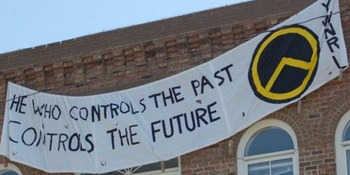
On 20 May 2017, Staff Sergeant Joseph Manning and Sergeant Michael Chesney, both on active duty in the US Marine Corps, were arrested for trespassing after climbing atop a building and dropping a white supremacist banner during a Confederate Memorial Day Rally. The banner featured a famous line from George Orwell's 1984: “He Who Controls the Past Controls the Future” (Figure 1) and, off to the side, the letters “YWNRU,” or “You Will Not Replace Us,” the maxim of the Identitarian group Identity Evropa, founded by Marine Corps veteran Nathan Damingo a year earlier. The banner also featured the signature icon of the Identitarian movement in Europe and North America: a black-and-yellow shield emblazoned with the lambda symbol, referencing the Thermopylaen shield of ancient Greece, most immediately inspired by the film and graphic novel 300. After the violence in Charlottesville, Virginia later that summer, Manning was court-martialed as part of a crackdown of “extremism” in the military, driven by public concerns that neo-fascists of various stripes had become rampant within the armed forces.Footnote 9
Identitarian banner drop, Graham, North Carolina, May 2017.

To be sure, fascist movements within the US armed forces are not new. As Katheryn Belew has recently illustrated, their presence in the enlisted ranks has been an acute phenomenon since the end of the US war in Vietnam.Footnote 10 What's new, however, is the degree of mainstreaming of these movements, fueled in the United States by the electoral viability of Donald Trump and also the global mainstreaming of far-right nationalism. Also, whereas elements of the radical right from the late 1970s into the 1990s took inspiration from Europe, the degree and depth of the transatlantic dialogue on the right are a relatively recent (re)turn. White power activists in the late twentieth century tended to originate tactics and symbols within US-based organizations like the Ku Klux Klan and Aryan Nations. By contrast, Identity Evropa, in a move parallel to other organizations of the so-called alt-right, lifted its language and strategy directly from the European Identitarian movement, becoming almost an American affiliate. Even the tactic of the “banner drop” – the unveiling of a large, provocative banner in a highly visible, public place by a handful of activists as a publicity stunt – was borrowed from their European counterparts. The founding act of the self-identified Identitäre Bewegung (“Identitarian movement”) in Germany, for instance, was the unfurling of a giant banner on the Brandenburg Gate in Berlin reading “Secure Borders, Secure Future” in 2016, a banner that used the group's signature black-and-yellow color scheme.Footnote 11
While there are multiple ideological currents within the contemporary far right, Identitarianism is arguably the closest thing to a coherent ideology that is widely found amongst white nationalists on both sides of the Atlantic, particularly those that are younger and more middle-class. In recent years, its activism has focussed largely on border, immigration, and refugee issues. As a set of ideas, it originated in France in the late 1960s amongst the so-called French nouvelle droite (New Right), with Alain de Benoist and Guillaume Faye as its intellectual leaders. It was first used as an explicit label by a political movement in 2003, with the founding of the Bloc Identitaire, also in France. Its youth wing, Génération Identitaire, founded a decade later in 2012, has enjoyed far more success, spreading across Western Europe and into the United States with the mainstreaming of white nationalism. It became much more visible in Austria and Germany in 2016, with the result that its most recognizable figure in Europe is now the Austrian former neo-Nazi Martin Sellner.Footnote 12 Recently, in March 2019, Identity Evropa rebranded itself as the American Identity Movement to avoid liability for its participation in the Unite the Right march in Charlottesville, and to regroup after antifascist media organization Unicorn Riot released a trove of its internal chatroom messages to the public. Yet its personnel and tactics remain largely the same, and its new leader, Patrick Casey, is a regular presence on the Sweden-based alt-right YouTube channel Red Ice with its nearly 330,000 subscribers.
The formal membership in Identitarian groups like American Identity Movement is rather small, and, thanks to antifascist organizing, they have few physical, institutional spaces like think tanks or offices, nor can they hold public meetings or rallies without serious physical risk. Yet as the sizable subscriber list of Red Ice illustrates, they are more important as a central part of a neo-fascist public sphere, one that impacts the language and even policies of the mainstream right in Europe and North America. As Casey's presence on the Swedish-based Red Ice indicates, this largely Internet-based public sphere is also seamlessly transnational. In the United States, Breitbart regularly touts Identitarian activities, especially in Europe, and the movement's black-and-yellow icon frequently appears as an avatar in the website's viscerally racist comment section. Spencer, who also claims to be an Identitarian, flagged Benoist and Faye as “central influences” on his thinking; he founded the website Alternative Right – the original basis of the term ‘alt-right’ – as an attempt to inject European radicalism into a “quaint Anglo-American conservatism” that he found lacking (Benoist also spoke at a conference of Spencer's National Policy Institute in 2013).Footnote 13 To be sure, international Identitarianism exists off-line as well, with a well-established, English-language press based in the United Kingdom, Artkos, that translates Continental rightist intellectuals. Bannon, with limited success, tried to give it multiple, off-line institutional forms through his Brussels-based organization the Movement, and through a political training center (Gladiator School) that he almost opened at a monastery outside Rome before it was blocked by Italian authorities. Antifascist organizations that track the US far right have also noted its recent Europeanization in terms of tactics, symbols, and ideology.Footnote 14
As a movement, Identitarianism is formally independent of political parties – though its members are certainly aligned and sometimes work closely with far-right parties like Alternative for Germany (AfD), the Austrian Freedom Party (FPÖ), or the Trump wing of the Republican Party. Its activists and writers expressly operate at the cultural level in ways that inform formal politics, using a strategy borrowed from Antonio Gramsci, by way of the French New Right, that they call “metapolitics.” Benoist and Faye consciously adapted Gramsci's notion of hegemony for use by the right, and the term persistently appears in alt-right writings in the United States. They wanted a new, more spiritualized name for a long-term ideological struggle that could be waged in the everyday, putatively pre-political realm of culture. This quotidian struggle could take place outside traditional institutions, but, if successful, could eventually inform party politics and the law.Footnote 15 For example, if a meme endlessly circulates on social media and its message then begins to come out of the mouths of Republican politicians, this is effective metapolitics in action. As Andrew Breitbart stated, in a comment often repeated in alt-right circles, “politics is downstream from culture.” Key to contemporary right-wing metapolitics, notably amongst the US alt-right, is to insert concepts, terminology, and narratives from the social media margins (i.e. “cultural Marxism,” “white genocide,” “globalists”) and gleefully watch as these terms and narratives are picked up and recirculated by national politicians, including Donald Trump.Footnote 16
As a formal ideology, Identitarianism begins with a premise that runs something like this: multiculturalism has allowed people of color and ethnic minorities to embrace their own cultures, but white Christian majorities have not been allowed to express pride in their own European heritage. And since culture (invariably social) is the basis for individual identity, this state of affairs has left people of European descent confused and alienated, prone to self-hatred and destructive behavior, most pathologically embodied by the “antifa” movements of the left. As Identity Evropa stated, “We embrace the idea that our identities are central to who we are, and take pride in our history and rich cultural heritage. At a time when every other group is free to stand behind its identity, we choose to assert ours as well.”Footnote 17
Identitarianism's ostensible nod to multiculturalism comes in how it situates this European identity in relation to other ethnic and racial groups, which is through the notion of ethno-pluralism. Ethnopluralism is a central ideological pillar of the Identitarian movement; its most visible intellectual origins are the writings of Carl Schmitt, a point to which I will return below. Simply put, ethno-pluralism reframes “diversity” as the sovereign right of each “people” to exist, separate from others, with their own cultures, identities, and political forms intact. According to this view, the dominant, universalist regimes of the West practice diversity through the multiethnic state (a spatial amalgamation of distinct peoples), with the result that all peoples of the world have begun to fuse, and global, cultural diversity is fading. In more sinister, less polite versions, whites and Europeans are simply being substituted with other peoples on “their own” territory, hence the phrase “You Will Not Replace Us” and the appeal to indigeneity in some European variants. As the German IB asserts,
The concept of ethnopluralism is repeatedly mischaracterized as worldwide apartheid. This is about as correct as accusing American indigenous peoples as “racist” because they defended themselves against the land seizures of the Europeans. Ethno-pluralism simply means preservation, not destruction: cherishing differences, not leveling them.Footnote 18
Muslims have a right to be Muslims in their own lands without imperial interference from Europeans, so the argument continues. Just let Europeans be Europeans without interference in their own spaces as well.
To be sure, there is a bad-faith color blindness at work here that these activists have imported from the dominant multiculturalism that they attack. That is to say, the black power, yellow power, and Chicano movements of the late 1960s and early 1970s often sought racial justice through an anticolonial understanding of race, one that sought to reclaim a usable past rendered invisible through histories of diaspora and super-exploitation, and in a society in which resources were materially distributed along racial lines at the expense of their constituents. Neoliberal variants of multiculturalism institutionalized these movements’ affirmative drive to reclaim a viable cultural past, “celebrating difference” while jettisoning their radical, material analyses of racial capitalism.Footnote 19 Much like neoliberal multiculturalism, ethno-pluralism ignores histories of racial hierarchy and exploitation that materially undergird different claims for cultural identity and political power. But unlike palliative visions of multiculturalism, there can be no sharing of space in the Identitarian imaginary: implicitly, for them, cultural and demographic mixture ultimately brings (white) extinction.
This is because, despite their egalitarian trappings, the ethnopluralists’ fear of “leveling” (nivellieren) betrays a hierarchical view of human value. Much like the historical fascists before World War II, they implicitly see life as struggle, and particularly as a zero-sum struggle between races in which the ultimate stake is elimination.Footnote 20 Hence their characterization of non-European migrants, refugees, and asylum seekers as inherently aggressive and dangerous: stories of whites victimized by refugees and of the latest immigrant criminal outrage are front and center in the websites of the Identitarians as they are in Breitbart, Fox News, Junge Freiheit (the newspaper of Alternative for Germany), and the speeches of Donald Trump. Furthermore, the relativistic rhetoric of Identitarianism is clearly in bad faith for the Americans in particular, whose writings are especially vicious. Unlike their German counterparts, Identity Evropa openly advocated biological racism. Their website linked to books and essays from Richard Spencer's neo-Nazi National Policy Institute, one of which, to take a representative example, decried a “cultural Marxist” society that rejects “any discussion of the biological basis of human racial differences, nowhere more so than in issues relating to IQ.”Footnote 21 That biological racism accompanies their multicultural language should come as no surprise: after all, one could only desire to live in a white ethno-state if one sees people of color as contaminants. As we will see, a parallel bad faith guided Carl Schmitt, who made pluralistic gestures in his writing while supporting Adolf Hitler.
Yet the bad-faith, ambiguous color blindness among the New Right has nonetheless provided an opening for some multiracial spaces – for instance, the presence (even leadership) of people of color in the Proud Boys and in Patriot Prayer, black hosts Sonnie Johnson and David Webb on Breitbart Radio, and the widely touted alt-lite speaker Candace Owens. In this strand of the far right, an American or “Western” supremacy is touted over a white racial one, yet they adhere to much the same violent, ethno-nationalist structure. The Proud Boys, for example, with its slogan “the West is the Best,” still racializes human value by trading in theories of white genocide, yet, organizationally, it is formally open to nonwhites and can claim a few minoritized individuals in its ranks who identify with the hierarchical construct of “Western culture.” It is important to remember that even without white supremacy, fascist politics can offer quite a lot to its constituents, such as nationalism, anticommunism, patriarchy, militarism, and the visceral power of violence. As Daniel Martinez HoSang and Joseph Lowndes have noted, categories of value derived from white supremacy – viewing some groups as virtuous producers and others as social parasites, for example – are flexible and can be “transposed” into other ideological mixes that can interpellate people of color as well.Footnote 22 Moreover, as a number of political scientists have noted, the defining feature of right-wing politics across its various strands – what “unites the right,” as it were – is not a set of beliefs about the size or role of government, but more fundamentally a rejection of social equality and a belief in the inevitability, even desirability, of social hierarchy.Footnote 23 Thus no right-wing formation can truly espouse egalitarianism, cultural or otherwise, without contradiction.
Identitarianism is also important as an ideological current because it is adaptable as a principle of international relations, as evidenced by its appearance in Trump's Stephen Miller-authored speeches to the United Nations. In his address in September 2017, for instance, Trump stated, “We do not expect diverse countries to share the same cultures, traditions or even systems of government. But we do expect all nations to uphold these two core sovereign duties: to respect the interest of their own people and the rights of every other sovereign nation.”Footnote 24 Later, in the same speech, he stressed that strong borders, erected to keep out migrants and refugees, were a central pillar of “sovereignty.” In his UN speech a year later, delivered three months after he withdrew the United States from the UN Human Rights Council, he stated,
Each of us here today is the emissary of a distinct culture, a rich history, and a people bound together by ties of memory, tradition, and the values that make our homelands like nowhere else on Earth … We reject the ideology of globalism, and we embrace the doctrine of patriotism. Around the world, responsible nations must defend against threats to sovereignty … I honor the right of every nation in this room to pursue its own customs, beliefs, and traditions. The United States will not tell you how to live or work or worship. We only ask that you honor our sovereignty in return.
Defining diversity in terms of “culture” and “tradition” is certainly conventional, but to extend it to “systems of government” – and within a discourse in which borders serve to keep each people's “memory, tradition, and values” distinct from the heterogeneity represented by migrant flows – is a rejection of liberal universalism in favor of an ethno-nationalist sovereignty. Viewed from within a policy context marked by increased military budgets and a withdrawal from international human rights treaties, such words, far from auguring a genuine anti-imperialism or even a withdrawal of US politico-economic power from the world, represent the “friendly face” of an emergent racial project that will not ground itself in liberal, humanist engagements with others, but in more Identitarian modes.
Those familiar with the rhetoric of ethno-pluralism instantly recognize its echoes in words such as these, delivered by Trump to the UN General Assembly in 2017: “Strong sovereign nations let diverse countries with different values and different dreams not just coexist, but work side by side on the basis of mutual respect.”Footnote 25 This is consistent with a view that sees human rights universalism as means of imperial domination and, furthermore, an intrusion into polities that desire a different ordering principle than that afforded by contemporary interpretations of liberalism. Necessarily unspoken here, this new ordering principle is one of internal, ethnic homogeneity and authoritarian states of exception. It should be remembered that when Trump pulled the United States out of the UN Human Rights Council in the summer of 2018 – the first time a member has voluntarily left that body – human rights experts saw in the move a calculated strategy to discredit an organization more and more critical of the administration's own, largely internal, practices: from restricting press freedoms, to rolling back protections for women and girls at home and abroad, to the separation of families in migrant detention camps.Footnote 26 Whereas previous administrations in recent memory would at least try to situate their policies within a human rights framework, the Trump administration returned to the fully autonomous nation-state – untethered from any liberal universalism – as an ordering principle of world affairs. As the former President stated in the same speech, “All responsible leaders have an obligation to serve their own citizens, and the nation-state remains the best vehicle for elevating the human condition.” This is the putative basis for the national sovereignty perceived as “America First,” one that also restages, on new cultural ground, an established thread of racist anti-imperialism within US politics.Footnote 27 Benoist, it should be noted, revised Hannah Arendt's arguments about the limitations of human rights – that they are far too abstract and cannot possibly offer what the nation-state delivers in practice – as an argument for a new principle of world order.Footnote 28
A key difference between the French ethno-pluralists and Trump, however, is that the former generally saw the region, not the nation-state, as the basis of the organic community. France, in other words, is too large a basis for a sovereign ethno-state: Lombardy, Brittany, or Normandy are more suitable for this project. Many neo-fascist intellectuals in Europe see nationalism as a bankrupt product of the Enlightenment and the French Revolution, one grounded in republican ideas of universal citizenship. Likewise, US white power groups like Aryan Nations have often been less interested in the borders of the existing United States and more wedded to a new racial utopia with its own boundaries (for example, an Aryan state that unites Canadian and US territory in the Pacific Northwest).Footnote 29 Thus while these right-wing movements tend to be much more radical than the Trump administration when defining the proper homeland of the sovereign white subject, what they all share is the notion that universalist, Marxist-derived notions of “globalism” and human rights represent an unwanted interference in a (white) people's attempt to determine a hierarchical foundation of humanity on its own organic terms.
THE LONG SHADOW OF CARL SCHMITT
This notion of global order does have a distinct, intellectual formation in the writings of German legal philosopher Carl Schmitt (1888–1985). Schmitt joined the Nazi Party in May 1933 not long after Hitler took power and refused to renounce the party after the war, yet his writings have enjoyed a renaissance, across the political spectrum, in recent decades. It should be noted here that there is no evidence to date that Trump or anyone in his administration was directly reading Schmitt, though there is an indirect route from the White House to his philosophy via Michael Anton, who for a time was a senior national security official.Footnote 30 None of the senior officials surrounding Trump who were explicitly tasked with foreign policy or border security – John Bolton, Mike Pompeo, John F. Kelly, even Stephen Miller – were avid readers of European political theory. Yet the congruence between the worldviews expressed by Trump, Miller, and Schmitt led more than one scholar to publicly note that Trump was “channeling” the German philosopher.Footnote 31
The “channeling” at work here is not so metaphysical. “Channeling” began as a spiritualist term for a mystical process in which the dead inhabit a living body and speak through it. Yet we can also use it with a more secular foundation to think through how ideology circulates. That is to say, if we take seriously Raymond Williams's now venerable concept of the “structure of feeling,” we would see Schmittian concepts of national sovereignty not necessarily as a directly articulated, conscious positions, but rather as a foundational part of a transatlantic, discursive stream informing white nationalism, one that later political actors merged with other discourses and mediated through their own generational experiences.Footnote 32 For example, while the Trump administration does not openly access Carl Schmitt, the philosopher is a conscious and quite active influence on the contemporary European right. This very right shares a common, white nationalist public sphere with its US counterparts and thus “metapolitically” informs the political circles and social media worlds that Stephen Miller, Steve Bannon, and the President himself inhabit. In Germany, for example, one of the markers of its so-called New Right is its intellectualization, partly a tactical move designed to distance its members from “mere” skinheads. Junge Freiheit, which has become the newspaper of the major far-right party, Alternative for Germany, is much like the American Breitbart in its obsessive focus on borders and migrant crime, yet regularly gives its editorial positions intellectual authority by couching them in the philosophies of Martin Heidegger, Friedrich Nietzsche, Ernst Jünger, and Carl Schmitt, including Schmitt's notion of Großraum. Schmitt's work is also touted and sold within the German and Austrian Identitarian movements. Phalanx Europa, a brand founded Austrian GI leader Martin Sellner that peddles Identitarian swag, even sells stickers featuring the Carl Schmitt quote “Whoever speaks of humanity wants to swindle” (Figure 2)
Identitarian stickers: “Whoever says humanity wants to swindle.”

.
In Russia, Schmitt's work has informed central state power more directly. His theory of Großraum was reformulated into a new vision of Russian empire called “Eurasianism” by the intellectual Alexandre Dugin, who was nicknamed “Putin's Rasputin” by critics. Though Dugin was eventually forced out of Vladimir Putin's inner circle, his ideas deeply impacted the Prime Minister and were required reading for the country's military leadership.Footnote 33 The Russian intellectual and his reformulation of Schmitt are celebrated in far-right circles across Europe and North America. Richard Spencer's Russian-born (now) ex-wife devoted herself to translating his work into English, and American fascist Preston Wiginton brought in Dugin for a Skype lecture at Texas A&M in 2016.
Schmitt's notion of Großraum arguably serves as the foundation for contemporary, ethno-pluralist visions of international order. Significantly, he developed it in his Nazi years, articulating it most fully in an essay first delivered at an academic conference and then published as a stand-alone book in 1941: The Großraum Order of International Law with a Ban on Intervention for Spatially Foreign Powers: A Contribution to the Concept of Reich in International Law. It began with the premise that the world is dominated by a West European liberalism with a confused, even hypocritical, principle of global order, one that uses a “universalist” rubric of individual rights to mask a particular set of imperial interests. Its imperial universalism arises mainly from its attempt to manage the entire globe as a single space, and it lends itself to a cold, formalistic, and ultimately empty notion of states and borders. Liberalism's borders are mere geographic and political conveniences – marked by rivers, mountains, and railways – and dictated by the needs of trade. “The British world empire,” he writes, “is no coherent space but rather a political union of littered property scattered across the most distant continents – Europe, America, Asia, Africa, and Australia – a collection that is not spatially coherent.”Footnote 34
A proper Großraum, by contrast, is a political space in which a coherent, unitary idea radiates throughout its entire territory, one that is shared by a people awake to their national identity, and that excludes all foreign intrusions from “spatially alien” (raumfremde) powers. For Schmitt, “A genuine principle of Großraum” connects “a politically awakened nation, political idea, and a Großraum ruled by this idea, a Großraum excluding foreign interventions.”Footnote 35 He named this genuine Großraum a Reich (he insisted on the untranslatability of this German word), and saw a Reich as a leading power whose political idea permeated throughout its entire Großraum; in other words, a Großraum is a “big space” which includes both the territory of the Reich proper and its protectorates. His historical model was the Monroe Doctrine, though he saw this policy as having since degenerated into a pretext for US imperialism. He envisioned an international order in which various Großräume (with their Reiche at the center) peacefully coexisted, each with their own ideas, customs, and traditions insulated from interference.
Though he was rather vague about the specific content of the ideal Reich's spatial order, it was clear that he most valued the current Nazi one, based on its völkisch (folk-ish) idea of ethnic nationalism, insulated from “unvölkisch ideas of assimilation and the melting pot” foisted on it by the liberal powers.Footnote 36 That the proper Reich was to be a cluster of homogeneous ethnic spaces was confirmed by his praise of the Romanian–Bulgarian Treaty of 7 September 1940, which resolved a dispute in the region of Dobruja by mandatorily resettling ethnic minorities on each side of the Romanian–Bulgarian border into the nations where their ethnicity was dominant. For Schmitt, Adolf Hitler was in the process of actualizing this principle of international relations in the current German Reich with “its great political idea, the respect of every nation as a reality of life determined through species and origin, blood and soil, with its radiation into the Middle and East European space.” He continued: “The action of the Führer has lent the concept of our Reich political reality, historical truth, and a great future in international law.”Footnote 37
Schmitt's notion of Großraum serves as an intellectual foundation for later notions of ethno-pluralism because it imagines a world order wherein the supposed ethno-cultural homogeneity of each nation is respected and preserved in relation to others, and which holds as its opposite a dominant liberal order hell-bent on multiethnic nationhood. As geographers Claudio Minca and Rory Rowan have noted, the political for Schmitt was grounded upon difference, but it was a spatialized difference that should exist between states, not within them, as in multiculturalism.Footnote 38
To be sure, Schmitt's proto-ethnopluralism was somewhat out of step with the practice of the Third Reich, a practice better reflected by the discourse of Lebensraum than Großraum. Indeed, the idea of Lebensraum, or the creation of “living space” for the German race through the conquest of new territory, was more often evoked in National Socialist rhetoric than any of Schmitt's ideas. Far from honoring the blood-and-soil nationalism of right-wing actors in Eastern Europe, the Nazi occupation in Poland and the Soviet Union was designed to clear space for German settlers by reducing local populations and converting those who remained to brute laborers at best, a process that claimed approximately 27 million lives in the Soviet Union alone, by more recent estimates.Footnote 39 This Nazi version of settler colonialism better comported with Hitler's idea of struggle – in which races perpetually contend for space and mastery – than with the notion of a peaceful coexistence of different folk, implied in Schmitt's loftier moments. As in most wars, however, no single idea consistently guided the violence of the German advance, and Schmitt's idea of Großraum did have a short-term impact on Nazi diplomacy, and even on Hitler's speeches.Footnote 40
One can easily see, however, that Großraum presents a more usable foundation for a white nationalist, global order than any direct advocacy of settler colonial conquest, especially in a twenty-first century where the notion of diversity is hegemonic. Yet implicit in Schmitt's assertions, elsewhere in his writings, that a Volk must be homogeneous and that certain peoples are not subject to international law is an overall cosmology of profound violence.Footnote 41 Indeed, the ethno-pluralist, racial project of parsing out “the domestic” from “the foreign,” combined with its characteristically fascist elevation of male violence, implies brutality on a massive scale. In this context, a consideration of the film and graphic novel 300 becomes particularly useful. It provides a foundation to trace the affective and openly violent logic of Identitarian war that must go unspoken in its formal, ethno-pluralist assertions, yet that would be necessary to bring an ethno-pluralist world order into being.
300 AND THE CULTURAL LOGIC OF WHITE NATIONALIST WAR
It is most productive to consider contemporary US white nationalist violence as part of a transatlantic continuum, and not defined strictly by US racial history. Nikhil Pal Singh's recent Race and America's Long War (2018) shows the ways in which racial violence has been constitutive of US culture. The book identifies a nexus between war and policing in US history, one that blurred the boundaries of domestic and foreign in ways constitutive of “race making” in the United States. Frontier aggressions against indigenous people and the antiblack legislation of slave patrols and Jim Crow not only rendered the internal/external enemy in homologous, racial terms, but also authorized white violence in everyday life, granting each white man a miniature monopoly of violence vis-à-vis nonwhites, whether inside or across the frontier. Both black and indigenous peoples, he argues, “featured in the development of a racialized narrative of security, one that invested every white person with the sovereign right to kill and blurred the lines between military and police action.”Footnote 42
Singh sees Jacksonian populism as a more productive lens than fascism through which to view the rise of Trumpian politics. He makes an excellent case that Andrew Jackson helped establish a settler colonial, racial politics that authorized a galaxy of decentralized, white monopolies of violence, setting in motion a kind of libertarian racial aggression that eschewed central authority.Footnote 43 Be that as it may, it is my own view that we need not see the influence of Jacksonian populism and neo-fascism on contemporary US white nationalist politics as an “either–or,” but as a “both–and.” Fascist violence, even in prewar Europe, has generally been more decentralized than we often think. Indeed, as histories of the Nazi brownshirts have shown, the movement's street violence against Jews and the left in the Weimar period was a permissive form of “doing what one likes,” and, in one assessment, marked a deliberate attempt to discredit the Weimar state by showing that it did not hold a monopoly of violence.Footnote 44 Moreover, as I indicated above, fascist regimes domestically touted their expansionist wars, whether in Eastern Europe or Ethiopia, as a form of settler colonialism that would give individuals license to practice violence in their own interests.
In this regard, what histories of fascism have consistently shown is a process increasingly familiar to Americans in the current moment. That is, fascism marks a desire to elevate militarized, male, racial violence – always already implicit in Western culture – as a central principle of political life, at home and abroad, and in ways that destroy any democratic space that oppositional movements have carved out. Claudio Pavone, a historian of Italian fascism and former participant in the Italian antifascist underground, echoed so many other accounts when he wrote, “Fascism's supreme ambition had indeed been to fuse politics with war – that is, the citizen with the soldier, or better still the warrior.”Footnote 45 A history of settler colonialism and a specific US history of white supremacist violence have, in the twentieth century, helped to make white Americans amenable to fascist appeals, and have persistently worked to generate the functional equivalent of vast fascist movements in the United States. These range from the Ku Klux Klan of the 1920s, to the Coughlinite mobilizations of the 1930s, to George Wallace's American Independence Party, and the “reconstructionist” wing of the Christian right.Footnote 46 As Aimé Césaire and Hannah Arendt both persuasively argued, moreover, the racialism of European fascism was forged in the crucible of colonial rule and reimported back into Europe.Footnote 47
Nothing better illustrates the quintessentially fascist fusion of citizen and warrior – endemic to the negative expression of Identitarian war – than Frank Miller's graphic novel 300 and its film adaption by Zack Snyder. As a pair of visual narratives, they vividly perform the male, racial violence of the emergent mode of white nationalist empire. They extend the formally articulated and seemingly pluralistic theories of ethnopluralism and Großraum by modeling the political violence that must necessarily go unsaid in these diplomatic iterations; yet this violence lies much closer to the mobilizing passions of white nationalism than to the formal assertions of Schmitt or Identitarian writers. If we return to Williams's notion of the structure of feeling, we see that political currents do not move individuals through formal ideologies alone, but, more importantly, through cultural productions that mediate – and transform – formal ideologies into affects, images, and narratives capable of speaking to everyday cultural experience.Footnote 48 As a structure of feeling, 300 hits its mark quite well among white nationalism's political base, partly because it revives an old Greek legend already known to the European right.
Its plot is a retelling of the legendary defense of the narrow Thermopylaen pass – at the border of Persia and Greece, East and West – by three hundred elite Spartan warriors under King Leonidas in 480 BC. Their sacrifices helped to block the armies of the Persian king Xerxes from invading Europe. It is easy to see how this plotline – of desperate warfare in defense of the borders of the West – would inspire anti-migrant and refugee politics in the twenty-first century. As stated above, Identitarians were directly inspired to use the black-and-yellow lambda shield icon from both the graphic novel and the 2006 film, and the narratives’ images and symbols appear frequently in white nationalist milieu. In 2013, when Austrian Identitarians tried to block refugees seeking asylum in a church in Vienna, they used the slogan “Thermopylae in Vienna.” German neo-fascists and soccer hooligans took the Spartan battle cry “Ahu!” directly from the film, printing the word on T-shirts and yelling it as they went into fights with immigrants and antifascists. Yet the appeal is certainly not limited to the German-speaking world: every year, the Greek neo-Nazi party Golden Dawn holds a memorial rally at the site of the former battle.Footnote 49 And, to be sure, both Frank Miller and Zack Snyder are Americans.
That this is a legend of ancient Greece – and Sparta, to be more precise – is no doubt the heart of its appeal to the transatlantic right. From Mussolini's National Fascist Party to Identity Evropa, fascist movements have always been obsessed with ancient Greece and Rome, using them as a foundation for their palingenetic temporality of national rebirth (one can only desire to be “reborn” if one had a noble birth to begin with).Footnote 50 They also serve as useful origin stories of a European civilization born of strict social hierarchies, clear symbols of male authority, and a pervasive warrior ethos. Strikingly, Snyder and Miller appear to have been attracted to the Spartans for the same basic reasons as Adolf Hitler; that is, their eugenic biopolitics. Snyder in particular emphasizes this element of Spartan society by announcing it in the first lines of narration. Dilios tells us of Leonidas’ birth as a perfectly formed baby, and that “as a boy, like all Spartans, he was inspected. If he would have been small, or puny, sickly, or misshapen he would have been discarded” (Miller at least waits until Chapter 3 of his graphic novel to introduce the Spartan practice of infanticide). Leonidas is then rigorously trained for combat from “the time he could walk,” graduating to the perfect visual specimen of Spartan masculinity that almost every film reviewer commented on: the scantily clad, statuesque, white body, its “uniform” highlighting the muscular, six-pack (even eight-pack) abdomen by leaving it exposed. The clear, visual contrast between the disciplined, white physique and the body of its enemies is central to the politics of 300, but also to white nationalism more broadly. The display of the warrior body – honed from within the most intimate realms of family life – establishes a clear principle of militarization and icon of authority that blurs the boundaries of public and private.
The particular rendering of the threats to this body is what completes the neo-fascist circuit. Both the film and graphic novel return to the necessity of eugenics through the character of Ephialtes, who was born with serious physical disabilities. Ephialtes was spared from infanticide by loving parents who spirited him out of Sparta before he was killed. In the film, the scene in which Ephialtes converts to the Persian cause is crucial, as it brings together all the various forms of otherness and desire that the audience is directed to destroy. Earlier, the narrator described King Xerxes’ forces as “all the world's warriors,” a statement that is visually underscored by multiracial casting of Middle Eastern, Asian, black, and white actors to play the roles of his soldiers. Moreover, Xerxes crudely appears as the antithesis of the normative masculinity of Leonidas: played by Brazilian actor Rodrigo Santoro, he is brown-skinned, ethnically ambiguous, slight of build, heavily pierced, and feminized through thick makeup. None of this went unnoticed by the film's right-wing fans. In its glowing review of Snyder's adaptation, Junge Freiheit happily wrote that the Persians were all represented as nonwhites and “mulattoes” (Mulatten) and that “in contrast to the virile Leonidas, [Xerxes], with his makeup, jewelry, and lascivious gestures, looks like a colossal, sadistic drag queen.”Footnote 51
Into this multiracial and ambiguously gendered world, Ephialtes enters a tent behind the Persian lines where Xerxes appears to be holding an orgy. Within a film marked by almost nonstop violence, the scene marks a kind of tranquil yet sinister pause. Ephialtes moves through a room of rhythmic, fluid bodies that seem to melt into one another under warm torchlight: a lesbian couple kissing, one partner with a half-burned face; naked, brown and black limbs and torsos; a male transvestite with amputated arms; and the gender-fluid Xerxes presiding over it all. Xerxes tells Ephialtes that if he joins his armies and betrays the Spartans, he can essentially enter this space and finally be accepted, having “everything you could ever desire.” Not surprisingly, he blissfully consents. Ephialtes becomes an arch-traitor to Sparta, leading the Persians down a little-known pathway to the Greeks’ rear and ultimately destroying them. As the “misshapen” baby that got away, his physiognomy reflects his virtue and thus validates the eugenic practices of Sparta. It should be noted that Ephialtes’ deformity was not a recurring part of earlier iterations of the legend: Miller, then Snyder, chose to add this element.
Xerxes’ word “desire” is critical here, because the entire narrative is arguably a road map of white nationalist libido, one that follows, yet updates, a now venerable fascist pattern. It is useful to consider here Klaus Theweleit's insights in his two-volume Male Fantasies (1977, 1978), which remains the landmark theorization of fascist masculinity. Concentrating on men in the proto-Nazi Freikorps militias, he noted that women figured largely as an absence in their narratives: the men (“soldier males”) sought most of all a homosocial male brotherhood realized most perfectly in military life. More pertinent here, the narratives persistently rendered threats using metaphors of floods, torrents, mires, swamps, and morass: liquid elements that flow, blend, and intermingle. The soldier male's horror was a borderless equality represented by these fluid bodies; he dreaded that “if that stream reaches me, touches me, spills over me, then I will dissolve, sink, explode with nausea … I'll be in a state where everything is the same, inextricably mixed together.” In response, the soldier males figured themselves as standing aloft and tightening into dams to keep this blending at bay, and not as one man, but “in formation; on command as a line, a column, a block; as a wedge, a tight unit.” As Theweleit wrote, “They want to stand with both feet and every root firmly anchored in the soil. They want whatever floods may come to rebound against them; they want to stop, and dam up, those floods.” The resolution, for the soldier males, was not to suppress desire altogether, but to rechannel or “encode” it in other directions: transforming feminized streams into masculine columns, reds floods into mass rituals, and democratic co-mingling into enemy blood that flows.Footnote 52
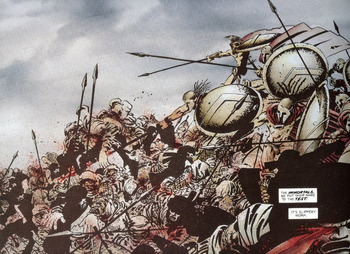
There is a tendency in empire studies to concentrate on the political narrative in cultural texts and to avoid scenes of violence and killing as if these were beneath analysis. But what approaches such as Singh's and Theweleit's require us to do is to see these scenes of violence as the story, and as the densest analytical knots to unravel. For this is the central interpellative terrain of the Identitarian war narrative, the place where desire and even pleasure are produced. In the film and the graphic novel of 300, for instance, the Spartans generally appear in the shots and frames of the battle scenes as a series of symmetrical circles and lines: their faces are covered, but their musculature is exposed in a series of gestures that also serve to individuate them. This is strikingly illustrated in one page of Miller's graphic novel, where they are visually contrasted with the elite forces of the Persian “Immortals,” who appear blended and merged together as single, fluid morass of bodies, their skin completely covered so as to make them further indistinguishable. The Spartans, as in most of the shots, are positioned above them, the liquid Persian mass breaking and rebounding against their shields (Figure 3).
From Frank Miller, The 300 (1998).

In other frames of Miller's 300, the Persians appear as mere silhouettes, as mere algebraic indices of the human. In the film adaptation, a similar effect is achieved in persistent shots which deny color to the Persians, figuring them as a grey mass against the vivid red tunics, gold shields, and white torsos of the dynamic Spartans (the grey mass tends to appear at their feet as crumpled bodies after a battle). Following Theweleit, 300 urges viewers to identify the Spartans as human precisely because they are able to hold themselves aloft as clearly white, male-gendered subjects against a flood of global and ambiguously gendered humanity that threatens to carry them away. To enter the flood of a common humanity is to lose the “color” – one's identity as a subject with clear boundaries within a hierarchy of difference – that makes life worthy of the name.
Finally, it should be noted that right-wing groups have persistently used this narrative of border war with a foreign enemy as a frame story for anti-immigrant, anti-refugee, and anti-left violence in the streets of their own countries. Since multiculturalism has brought the enemy “here,” there is no need to distinguish between violence within the national borders and without. Their use of the narrative serves as a reminder that the military metaphor of “damming” is a libidinal gesture of militarized masculinity that white nationalists can perform anywhere: on the streets of Portland, Oregon against “antifa” or the hills of Afghanistan against “Islamists.”
CONCLUSION
Identitarianism and ethno-pluralist sovereignty, whether actualized in a Lombard ethno-state or border wall in the Arizona desert, can never be fully asserted without profound violence and coercion, whether in the form of internal “police action” or external war. At that moment in the United States, the Trump administration was directing his constituents’ energies toward internal violence, but if the history of fascist currents is any guide, such energies have a tendency to escalate outwards. But so long as it lacks hegemony or the backing of an authoritarian state to give it force, Identitarian war will likely remain a domestically focussed grammar of violence rather than a logic of world order as envisioned by Carl Schmitt.
At the end of the day, the reliance of white nationalists on the multicultural grammar of ethno-pluralism and Identitarianism reveals their weakness, since they still must articulate themselves partly through the language of their enemies. A full-throated white nationalism would be able to rely on a discourse closer to the symbolic violence of the film 300, which could bypass multicultural trappings in order to mock the very idea of a multiethnic democracy. Or it could be more in line with Miller's graphic novel, which figures Leonidas’ treasured wife as dark-skinned, thus exalting “the West,” not whiteness, per se, as that which is to be defended through restorative violence, much like the nominally multiracial Proud Boys.
US antifascist coalitions will need to be on the lookout for a potentially more dangerous and effective white nationalist imperialism after Trump, guided by a figure, perhaps, read as a “man of honor” with a military background who does not make persistent strategic blunders. We would do well to remember the words of leading historian of fascism Roger Griffin, who wrote in 1993, “as a political ideology capable of spawning new movements [fascism] should be treated as a permanent feature of modern political culture.”Footnote 53 As scholars, we should thus also be flexible in our methods, always attentive to new modes of violence and empire – Identitarian or not – far darker than those that use liberal universalism and human rights as their shields.