Introduction
H2A histone family, member Z (H2A.Z) is an evolutionarily diverged but highly conserved basal histone H2A isoprotein species (Hatch and Bonner, Reference Hatch and Bonner1988). H2AFZ gene has been characterized in the human (Hatch and Bonner, Reference Hatch and Bonner1988, Reference Hatch and Bonner1990 and Reference Hatch and Bonner1995), mouse (Faast et al., Reference Faast, Thonglairoam, Schulz, Beall, Wells, Taylor, Matthaei, Rathjen, Tremethick and Lyons2001), cow (Ball et al., Reference Ball, Slaughter, Hensley and Garrard1983), rat (NM_022674) and other species. Mice deficient in H2AFZ died early in development, i.e., around the time of implantation (Faast et al., Reference Faast, Thonglairoam, Schulz, Beall, Wells, Taylor, Matthaei, Rathjen, Tremethick and Lyons2001). H2AFZ is localized to the transcription start sites of genes, and has both positive and negative regulatory functions in the gene expression process (Bruce et al., Reference Bruce, Myers, Mantouvalou, Lefevre, Greaves, Bonifer, Tremethick, Thorne and Crane-Robinson2005; Guillemette et al., Reference Guillemette, Bataille, Gévry, Adam, Blanchette, Robert and Gaudreau2005; Kamakaka and Biggins, Reference Kamakaka and Biggins2005; Raisner et al., Reference Raisner, Hartley, Meneghini, Bao, Liu, Schreiber, Rando and Madhani2005).
The porcine H2AFZ (pH2AFZ) gene was mapped to the end of SSC8q, close to a confirmed candidate gene for litter size-secreted phosphoprotein 1 (SPP1) gene (Jiang et al., Reference Jiang, He, Hamasima, Suzuki and Gibbins2002). There were many quantitative trait loci (QTLs) for reproduction traits on the SSC8q listed in the released Pig QTL Database (http://www.animalgenome.org/cgi-bin/QTLdb/browse, December 28, 2007), including QTLs for litter size at 127 cM and number born alive at 125 cM (King et al., Reference King, Jiang, Gibson, Haley and Archibald2003), uterus capacity at 71 cM and ovary weight at 122 cM (Rohrer et al., Reference Rohrer, Ford, Wise, Vallet and Christenson1999), age for puberty at 101 to 102 cM (Cassady et al., Reference Cassady, Johnson, Pomp, Rohrer, Van Vleck, Spiegel and Gilson2001) and ovulation rate at 107.5 cM (Rathje et al., Reference Rathje, Rohrer and Johnson1997). Here, pH2AFZ gene was selected as a candidate gene for litter size due to its important role in the early embryo development, and its position on the reproduction QTL interval. In this study, we cloned and characterized the pH2AFZ gene, investigated its polymorphisms, and then performed association analyses to evaluate the importance of mutation(s) in the litter-size selection.
Material and methods
A total of 714 animals from 11 different populations were used to investigate the allele frequency, including 48 Chinese Meishan pigs, 37 Tongcheng pigs, 7 Hezuo pigs, 21 Huainan pigs, 37 Bamei pigs, 132 DIV (4th Dam line of Chinese lean-type new lines) pigs, 106 Large White × Meishan (LW × MS) F2 pigs, Large White I-III pigs (n = 69, 111 and 130) and 16 Landrace pigs from several farms in China. Our experimental protocols and animal care met the requirements of the Institutional Animal Care and Use Committee (IACUC). The association analyses were conducted in DIV pigs. Synthetic DIV line was a result of cross of Landrace, Large White, Tongcheng or Meishan pigs, and was raised in the pig farm owned by Huazhong Agricultural University. During the consecutive years (2005–07), both total number of piglets born (TNB) and number of piglets born alive (NBA) were recorded in 412 litters of 132 DIV sows.
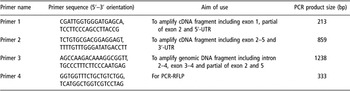
Primers 1 and 2 (Table 1), designed from a human cDNA sequence (NM_002106) and aligned with that of the mouse (NM_016750), were used to amplify the pH2AFZ cDNA fragment. A volume of 1 μl of ovary cDNA was amplified in a final volume of 25 μl containing 0.2 mM dNTPs, 1.5 mM MgCl2, 0.5 μM of each primer and 1 U Taq DNA polymerase. After denaturation at 94°C for 4 min, 34 amplification cycles were performed, comprising denaturation at 94°C for 35 s, annealing at 57–60°C for 35 s and extension at 72°C for 2 min, followed by a further 10-min extension at 72°C. The purified PCR products were cloned into the pMD18–T vector (TaKaRa, Tokyo, Japan) and sequenced commercially (Augct, Beijing, China).
Primers used in this study

The two cDNA sequences of the pH2AFZ gene, listed above, were overlapped, and then Primer 3 (Table 1) was designed from the cDNA sequence for amplification of genomic DNA. The pH2AFZ nucleotide and predicted amino-acid sequence were then compared with those of the human and mouse by online BLAST. Spidey program (http://www.ncbi.nlm.nih.gov/IEB/Research/Ostell/Spidey/) was used to predict the genomic organization of the pH2AFZ gene by aligning the cDNA and genomic sequence. The molecular mass and isoelectric point (pI) of H2AFZ, were calculated by ProtParam program (http://expasy.org/tools/protparam.html).
Mutations were detected by comparative sequencing of the pH2AFZ gene in three Large White and three Chinese Meishan pigs. Then, Primer 4 (Table 1) was designed to identify a 4 bp deletion/insertion in intron 2. Following PCR, 8.5 μl of PCR products were digested with 5 U Bsu15I (TaKaRa) in 1 × digestion buffer added in a total volume of 15 μl. The products were then separated by electrophoresis on a 2% agarose gel in 1 × Tris-acetate-EDTA (TAE) buffer and stained with 0.5 μg/ml ethidium bromide.
The relationship between pH2AFZ genotypes and litter-size traits was evaluated with the general linear model (GLM) procedure of SAS version 8.0 (SAS Institute Inc., Gary, NC, USA). Both additive and dominance effects were also estimated using the general regression (REG) procedure, where the additive effect was estimated as −1, 0 and 1 for AA, AB and BB, respectively, and the dominance effect represented as 1, −1 and 1 for AA, AB and BB, respectively (Liu, Reference Liu1998). The model used to analyze the data was assumed to be: Yijkl = μ + Pi + Sj + Fk + Gl + eijkl, where Yijkl is the observation of the trait, μ is the least square mean, Pi is the effect of ith parity (i = 1, 2, 3, 4 (parity ⩾ 4 )), Sj is the effect of jth season (k = 1, 2), Fk is the effect of kth farm (k = 1, 2), Gl is the effect of lth genotype (l = 1−3) and eijkl is the random residual.
Results and discussion
The Primers 1 and 2 produced a 213 bp and a 859 bp fragment, respectively, which were cloned and sequenced. By overlapping the sequences of the above two fragments, the 932 bp full length of pH2AFZ cDNA was identified (GenBank accession number: EU408324). Sequence analysis showed that pH2AFZ cDNA contained an open-reading frame of 387 nucleotides flanked by 185 bp of 5′-UTR and 360 bp of 3′-UTR. Primer 3 produced a 1238 bp fragment including sequence of intron 2 to 4 (286 bp, 338 bp, 278 bp). The pH2AFZ gene was predicted to be organized in five exons and four introns by the Spidey program. The 387 bp coding sequence encodes a protein of 128 amino acids with a calculated molecular mass of 13.55 kDa and a pI of 10.58. The cDNA sequence of pH2AFZ, as determined by aligning with human and mouse cDNAs, shared 94% and 84% similarity, while the deduced protein showed 100% sequence similarity to that of human and mouse.
A ‘CGAT’ deletion/insertion polymorphism in intron 2 was revealed by comparative sequencing, and then a PCR-Bsu15I-RFLP method was developed to detect this deletion/insertion (Figure 1a). The digested PCR products were separated on a 2% agarose gel, such that a 333 bp fragment was observed for the BB genotype, and 158 bp + 175 bp fragments for the AA genotype (Figure 1b).
(a) Detection of a four-nucleotide deletion/insertion by sequencing. Arrow indicates the Bsu15I site. (b) Four-nucleotide deletion/insertion detection by PCR-RFLP. Three different PCR-Bsu15I-RFLP genotypes of porcine H2AFZ, genotypes (AA, AB, BB), are shown at the top. M is the DNA molecular marker DL 2000.

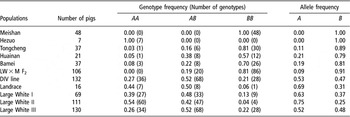
The genotype and allele frequencies of the polymorphism obtained from 11 pig populations are shown in Table 2. Allele B was fixed in two Chinese breeds, Meishan and Hezuo pig, and the frequency of this allele was obviously higher in all five tested Chinese breeds than in two Western breeds. In contrast, the A allele was predominant in the Western breeds. This suggested that allele B might probably be the favourable allele for litter size, which was confirmed by the following results of association analysis.
Allele frequencies of H2AFZ gene polymorphisms in 11 pig populations

LW = Large White; M = Meishan; DIV = 4th Dam line of Chinese lean-type new lines.
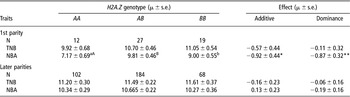
Association studies of pH2AFZ gene with litter-size traits involved 412 litters of 132 DIV sows, the results of which are listed in Table 3. For first parity litters, the difference between AA and AB, BB were −2.64 (P < 0.01), −1.83 (P < 0.05) piglets per litter for NBA, respectively. The additive allelic effect was estimated to be 0.92 piglets per litter per B allele for NBA (P < 0.05), and the dominance effect (−0.87 piglets per litter) was observed for parity 1 data for NBA (P < 0.01). For all parities, no significant difference has been observed among the three genotypes (P > 0.05). Our present study showed that there were some differences in NBA, but not in the TNB among genotypes, suggesting that pH2AFZ gene is related to fetal survival but not ovulation rate. Faast et al. (Reference Faast, Thonglairoam, Schulz, Beall, Wells, Taylor, Matthaei, Rathjen, Tremethick and Lyons2001) observed that heterozygous H2A.Z+/− mice appeared normal and were fertile, but none were homozygous for the H2A.Z mutation. This indicated that a lack of functional H2AFZ led to embryonic lethality. Moreover, the distance between SW2410 and SPP1 is 134 cM on PiGMaP version 2.0; 1 cM on the genetic map could be equivalent to 5.2 cR on a radiation hybrid (RH) map, and the pH2AFZ gene was mapped to 648 cR on a RH map (Jiang et al., Reference Jiang, He, Hamasima, Suzuki and Gibbins2002). Here pH2AFZ gene was predicted to be located to 124.6 cM on the PiGMaP genetic map. Therefore, the pH2AFZ gene remains a reasonable positional candidate gene of the QTL for NBA at 125 cM (King et al., Reference King, Jiang, Gibson, Haley and Archibald2003), a linked marker gene of the QTL for uterine capacity at 71 cM (Rohrer et al., Reference Rohrer, Ford, Wise, Vallet and Christenson1999), but probably is not a candidate gene of the QTL for ovulation rate and ovary weight at the distal end of the long arm of SSC8.
Association between H2AFZ PCR-Bsu15I-RFLP genotypes and litter-size traits in DIV (4th Dam line of Chinese lean-type new lines) line pigs

N = number of investigated litters; TNB = total number of piglets born; NBA = number of piglets born alive.
a,bMeans within a column without common subscripts differ (P < 0.05).
A,BMeans within a column without common subscripts differ (P < 0.01).
*P < 0.05 and **P < 0.01.
Although this polymorphism is located in a non-coding region (intron 2) and does not directly alter any amino-acid residue, it might play a role in regulating gene expression. For example, the regulatory mutation in IGF2 gene, which causes a major QTL effect on muscle growth in the pig, is a single nucleotide polymorphism (G3072A) in intron 3 (Van Laere et al., Reference Van Laere, Nguyen, Braunschweig, Nezer, Collette, Moreau, Archibald, Haley, Buys, Tally, Andersson, Georges and Andersson2003). However, before the polymorphism can be used for marker-assisted selection in genetic improvement of pigs, further evaluation and confirmation studies in more pig populations, with large sample sizes, are necessary.
Acknowledgments
This work was financially supported by the National High Technology Development Project (2007AA10Z162), National Key Technology R&D Program during the 11th Five Year Plan (2008BADB2B01), National Natural Science Foundation of China (30700571) and the National ‘973’ Projects of P. R. China (2006CB102102).