Introduction
The lifetime prevalence of psychotic experiences (PEs) in the non-help-seeking general population ranged from 2.5% to 15.5% with a median of 7.2% (Linscott & Van Os, Reference Linscott and Van Os2013; van Os, Linscott, Myin-Germeys, Delespaul, & Krabbendam, Reference van Os, Linscott, Myin-Germeys, Delespaul and Krabbendam2009). The wide prevalence range may be explained by the use of different PE assessment tools (Lee et al., Reference Lee, Chan, Chang, Lee, Hui and Chen2016). However, two cross-national studies by the World Health Organization (WHO) using the same PE assessment tool found that PEs prevalence varied considerably across locations and ethnicities: life-time prevalence ranged from 1% to 14.9% (McGrath et al., Reference McGrath, Saha, Al-Hamzawi, Alonso, Bromet, Bruffaerts and Florescu2015); 12-month prevalence ranged from 0.7% to 45.8% (Nuevo et al., Reference Nuevo, Chatterji, Verdes, Naidoo, Arango and Ayuso-Mateos2012). These results suggested that the variations in PEs prevalence might be related to ethnicity and socioeconomic development. Although PEs prevalence in Asia was evaluated in the WHO studies, only one city in China was assessed. Studies of PEs in the general population in Asia were indeed limited and the few studies on Chinese population were restricted to the subgroup of populations such as University students (Wang et al., Reference Wang, Wang, Li, Zhang, Wei, Deng and Li2019), male gender (Coid et al., Reference Coid, Hu, Kallis, Ping, Zhang, Hu and Kirkbride2018) or specific area of a city (McGrath et al., Reference McGrath, Saha, Al-Hamzawi, Alonso, Bromet, Bruffaerts and Florescu2015). Therefore, an epidemiological study of PEs in the non-help-seeking Chinese general population is warranted to fill the knowledge gaps.
Earlier studies on PEs have mainly focused on exploring the concept of psychosis continuum, which posit that positive psychotic symptoms, such as hallucinations and psychosis, in clinical samples may continue from PEs in the general population (van Os, Hanssen, Bijl, & Ravelli, Reference van Os, Hanssen, Bijl and Ravelli2000). This hypothesis is supported by several systematic reviews reporting that about 20% of individuals with PEs developed persistent PEs and 7% transited to psychotic disorders, which was 3.5 times higher than individuals without PEs (Kaymaz et al., Reference Kaymaz, Drukker, Lieb, Wittchen, Werbeloff, Weiser and Van Os2012; van Os & Linscott, Reference van Os and Linscott2012; Zammit et al., Reference Zammit, Kounali, Cannon, David, Gunnell, Heron and Lewis2013). Meanwhile, the postulated psychosis proneness-persistence-impairment model of psychotic disorders suggests that clinical outcomes of PEs are affected by the degree of environmental risk exposure (van Os et al., Reference van Os, Linscott, Myin-Germeys, Delespaul and Krabbendam2009), for which supporting evidence has been reported (Wigman et al., Reference Wigman, van Winkel, Raaijmakers, Ormel, Verhulst, Reijneveld and Vollebergh2011).
Recent studies have suggested that PEs are not only specific phenotypic expression of attenuated psychotic phenomena but also represent a transdiagnostic expression (van Os & Reininghaus, Reference van Os and Reininghaus2016). Many cross-sectional studies have demonstrated the association of PEs with common mental health symptoms and disorders including anxiety, depression, post-traumatic stress disorder, suicidal ideation (DeVylder, Burnette, & Yang, Reference DeVylder, Burnette and Yang2014; Kelleher et al., Reference Kelleher, Keeley, Corcoran, Lynch, Fitzpatrick, Devlin and Arseneault2012a, Reference Kelleher, Lynch, Harley, Molloy, Roddy, Fitzpatrick and Cannon2012b; Saha, Scott, Varghese, & McGrath, Reference Saha, Scott, Varghese and McGrath2012), general functional disabilities (Navarro-Mateu et al., Reference Navarro-Mateu, Alonso, Lim, Saha, Aguilar-Gaxiola, Al-Hamzawi and Degenhardt2017; Oh, Koyanagi, Kelleher, & DeVylder, Reference Oh, Koyanagi, Kelleher and DeVylder2018) and quality of life (Alonso et al., Reference Alonso, Saha, Lim, Aguilar-Gaxiola, Al-Hamzawi, Benjet and Florescu2018). Results of longitudinal studies, however, have been inconsistent. A systematic review and meta-analysis did not find a significant effect of PEs on future non-psychotic clinical outcomes (Kaymaz et al., Reference Kaymaz, Drukker, Lieb, Wittchen, Werbeloff, Weiser and Van Os2012). On the other hand, a subsequent 3-year follow-up study suggested that PEs were longitudinally associated with personal functioning (Collip et al., Reference Collip, Wigman, Lin, Nelson, Oorschot, Vollebergh and Myin-Germeys2013). Another study involving two birth cohorts demonstrated that PEs and depressive and anxiety symptoms were manifestations of a single and latent continuum of common mental disorders, with PEs carrying information about a severe end of common mental disorders (Stochl et al., Reference Stochl, Khandaker, Lewis, Perez, Goodyer, Zammit and Jones2015). The mixed findings call for further research on the longitudinal impact of PEs on common mental health outcomes to unveil the role of PEs.
Furthermore, understanding the relationships between the severity and types of PEs with clinical outcomes may facilitate exploring the nature of PEs in the general population. Dose-dependent relationships between PEs and psychotic disorders and other non-psychotic clinical outcomes have been reported in many studies (Gale, Wells, McGee, & Oakley Browne, Reference Gale, Wells, McGee and Oakley Browne2011; Kaymaz et al., Reference Kaymaz, Drukker, Lieb, Wittchen, Werbeloff, Weiser and Van Os2012; Navarro-Mateu et al., Reference Navarro-Mateu, Alonso, Lim, Saha, Aguilar-Gaxiola, Al-Hamzawi and Degenhardt2017), but the relationships between types of PEs and clinical outcomes have remained rather obscure. Among the three studies that used latent class analysis (LCA) to establish PEs subtypes, two identified a two-class model (Gale et al., Reference Gale, Wells, McGee and Oakley Browne2011; Mamah et al., Reference Mamah, Owoso, Mbwayo, Mutiso, Muriungi, Khasakhala and Ndetei2013) while one reported a three-class model (Shevlin, Murphy, Dorahy, & Adamson, Reference Shevlin, Murphy, Dorahy and Adamson2007). Using a cross-sectional study design without longitudinal follow-ups, two of the three studies explored the link between PEs subtypes and non-psychotic clinical outcomes and found a differential relationship between them (Gale et al., Reference Gale, Wells, McGee and Oakley Browne2011; Shevlin et al., Reference Shevlin, Murphy, Dorahy and Adamson2007). Longitudinal studies are thus important to elucidate the differential significance of severity (dose effect) and PEs subtypes in predicting clinical outcomes.
The current study aimed to estimate the 12-month prevalence of PEs in a general Chinese population and to investigate the link between PEs and common mental health symptoms. Specifically, the cross-sectional relationship between PEs and common mental health symptoms were explored. In addition, subjects with PEs were followed-up for 2 years to investigate the association between baseline PEs and common mental health outcomes. Finally, the effects of PEs dose and subtypes on such association were further examined. The results of this study will enrich the understanding of relationships between PEs and common mental health symptoms in the general population and delineate the nature of PEs.
Methods
Epidemiological study and identification of subjects with PEs
Hong Kong has a population of over 7.2 million over a 1104 km2 territory, and 92% of the population is Han Chinese. Participants with PEs were identified through the Hong Kong Mental Morbidity Survey (HKMMS) (Chang et al., Reference Chang, Wong, Chen, Lam, Chan, Ng and Lam2017; Lam et al., Reference Lam, Chan, Wong, Chen, Ng, Lee and Chiu2014, Reference Lam, Wong, Wang, Chan, Chen, Ng and Lam2015), an epidemiological study was conducted during November 2010 to May 2013, which employed a 2-phase design (Jenkins et al., Reference Jenkins, Bebbington, Brugha, Farrell, Gill, Lewis and Petticrew2003). The HKMMS utilized a multistage sampling design stratified by the nature of premises and geographical districts, with a random selection of addresses from the Census and Statistics Department of the Hong Kong Special Administrative Region Government. Only one consented adult aged 16–75 years who are ethnically Chinese was interviewed in each eligible community household. The Psychosis Screening Questionnaire (PSQ) (Bebbington & Nayani, Reference Bebbington and Nayani1995) was used to investigate the presence of five psychotic symptoms in the past 12 months including hypomania, paranoia, thought insertion, strange experiences and hallucinations. All five PE types were assessed using a single-item probe. Upon endorsement of each probe question, the respondents were interviewed with secondary questions to clarify the endorsement of the item. All PSQ positive items were further confirmed in a consensus meeting with the research team. Individuals who endorsed any one of the PSQ items were considered screened positive for psychosis in phase 1 and were selected for phase 2 assessment to ascertain the presence of psychotic disorders based on clinician-administered diagnostic interviews (Chinese-bilingual Structured Clinical Interview for DSM-IV) (CB-SCID-I/P) (So, Kam, & Lam, Reference So, Kam and Lam2004) and medical record review. Those who were screened positive on PSQ without psychotic disorders were considered as PE-positive. The study was approved by research ethics committees of the Chinese University of Hong Kong, the University of Hong Kong and the Hospital Authority. All participants provided written informed consent in each phase of the survey.
Two-year follow up of PE
All PE positive participants were followed up 2 years later. Face-to-face interviews were conducted with consented participants. Participants who endorsed any item of PSQ in the follow-up study were further interviewed using CB-SCID-I/P and Comprehensive Assessment of At-Risk Mental State (Yung et al., Reference Yung, Yuen, McGorry, Phillips, Kelly, Dell'Olio and Godfrey2005) to ascertain the presence of psychotic disorders or at-risk-mental-state and to confirm the presence of PEs. Those who endorsed any item of PSQ without a psychotic disorder at 2-year follow-up assessment were considered as having persistent PEs. Approval for the follow-up study was obtained from the research ethics committees of the University of Hong Kong and the Hospital Authority. All participants provided written informed consent for the follow-up study.
Sociodemographic and clinical assessments
Demographics information on gender, age, marital status, household size, education level and employment status were collected through self-report forms completed by participants. The revised Clinical Interview Schedule (CIS-R) (Lam et al., Reference Lam, Chan, Wong, Chen, Ng, Lee and Chiu2014; Lewis, Pelosi, Araya, & Dunn, Reference Lewis, Pelosi, Araya and Dunn1992) was conducted in HKMMS phase 1 and the 2-year follow-up study to assess non-psychotic psychiatric symptoms. Suicidal thinking and intent were assessed with the Chinese version of the Beck Scale for Suicidal Ideation (BSS) (Beck, Brown, & Steer, Reference Beck, Brown and Steer1997). Data on family history of mental illness were also collected. The Alcohol Use Disorders Identification Test (Saunders, Aasland, Babor, De la Fuente, & Grant, Reference Saunders, Aasland, Babor, De la Fuente and Grant1993), in which a cut-off score of 8 indicates harmful alcohol use, was performed to assess alcohol use. Data on the dependence of illicit substances including opiates, cannabis, ketamine, ecstasy, amphetamines, cocaine, tranquilizers, volatile substances and hallucinogens in the past year were also obtained. A translated Chinese version of the Life Event Checklists (Gray, Litz, Hsu, & Lombardo, Reference Gray, Litz, Hsu and Lombardo2004) was used to evaluate the experiences of stressful life events of participants.
Data analysis
The 12-month prevalence of PEs was computed by applying weightings in two steps. First, post-stratification weights were assigned based on age, sex and types of housing using data from the 2011 Hong Kong Population Census (Census & Statistics Department, 2016) to ensure an accurate representation of the survey sample. Second, weights were calculated as the inverse of the probability of response for non-response adjustment. The bootstrap resampling method was used to calculate the weighted prevalence, which was represented as percentages with 95% confidence interval (CI), stratified by sex and age groups.
The participants were divided into PE-positive and non-PE-positive groups after excluding those diagnosed with a psychotic disorder. To compare univariate differences in demographics between the PE-positive and non-PE-positive groups, chi-square and Mann–Whitney U tests were performed for categorical and continuous variables, respectively. Propensity score analysis controlling for age, years of education and sex was performed to compare the differences in mental health outcomes between the PE-positive and non-PE-positive groups.
LCA was used to identify subclasses among PE-positive participants based on the five PSQ items at baseline. To determine the best model with optimal number of latent classes based on responses to the PSQ, a 2-class model was first evaluated, followed by systematic increase of latent classes up to 6 in consideration of the relatively small sample size. The selection was based on the Bayesian information criterion (BIC), entropy measures and likelihood ratio tests. Among the several available statistical information criteria including Akaike Information Criterion (AIC), the Bayesian information criterion (BIC) and the Adjusted Bayesian Information Criterion (ABIC), BIC was used as it performs the best in assessing the goodness-of-fit and optimal number of latent classes, especially for models with unequal class sizes (Nylund, Asparouhov, & Muthén, Reference Nylund, Asparouhov and Muthén2007). Lower BIC and entropy that is closer to one imply a better goodness-of-fit and a clearer delineation of latent classes. The Lo-Mendell-Rubin adjusted likelihood ratio test (LMR-LRT) and the bootstrapped likelihood ratio test (BLRT) were used to compare whether a K-class model is a better fit than a K-1-class model, in which K-1-class model should be chosen when the tests statistics were insignificant (p > 0.05). Participants were assigned to their most probable class. The PE-positive subjects were also classified into ‘single’ and ‘multiple’ groups based on the number of PSQ items endorsed. Repeated-measures ANOVA was performed to investigate the effects of class or group on clinical outcomes, controlled for sex, age and years of education. Post-hoc tests were performed on significant main and interaction effects; with Mann–Whitney U tests for comparisons between single and multiple groups; Kruskal–Wallis tests for comparisons between latent classes and Wilcoxon signed-rank tests for within-subject comparisons. Statistical analyses were conducted with IBM SPSS version 25.0 and the LCA analysis was performed in Mplus version 8.3 (Muthén, Muthén, & Asparouhov, Reference Muthén, Muthén and Asparouhov2017).
Results
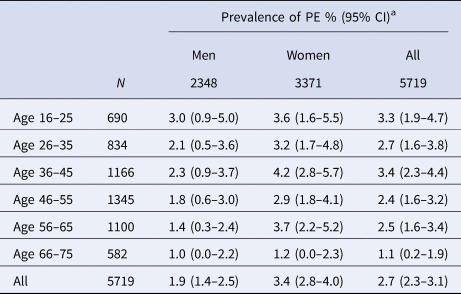
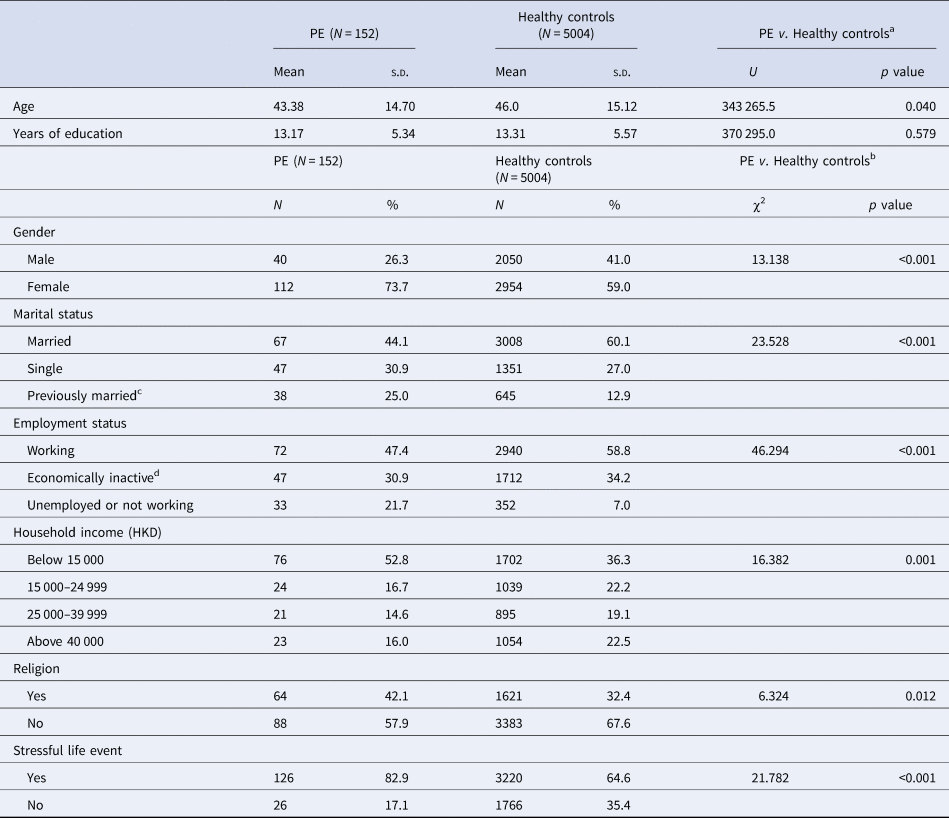
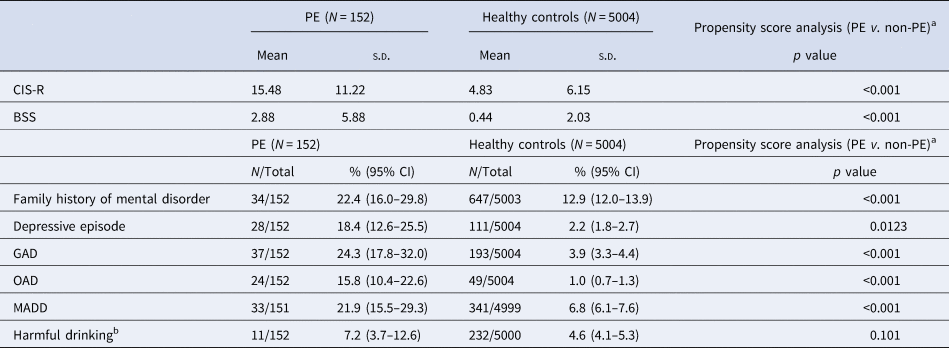
A total of 5719 individuals completed phase 1 survey and 5.5% (n = 312) were screened positive on PSQ and entered phase 2 screening. A total of 152 participants were considered PE-positive without the psychotic disorder. The weighted 12-month prevalence of PEs was 2.7% (95% CI 2.3–3.1) with that being highest in women aged 36–45 (Table 1). The PE-positive group had a higher proportion of women with lower mean age, and a significantly higher divorce and unemployment rate (Table 2). Propensity score analysis revealed that the PE-positive group had significantly poorer mental health and a higher proportion of individuals with a family history of mental disorders (Table 3). Illicit drug dependence rate was very low in both the PE-positive (n = 4, 2.6%) and non-PE-positive (n = 89, 1.8%) groups, thus was excluded in the subsequent statistical analysis.
Weighted 12-month prevalence of PE in Hong Kong general population (N = 5719)

PE, psychotic-like experience; CI, confidence interval; N, number of subjects.
a Weighted prevalence adjusted for post-stratification weights.
Basic demographics of PE and healthy controls at baseline

PE, psychotic-like experience; HKD, Hong Kong Dollar (HKD = USD 7.8).
a Mann–Whitney U test.
b χ2 test.
c Included separated, divorced and widowed.
d Included student, housewife and retiree.
Health- and functioning-related factors of PE and matched controls at baseline

PE, psychotic-like experience; CIRS, Cumulative Illness Rating; CIS-R, Revised Clinical Interview Schedule; BSS; Beck Scale for Suicide Ideation; SOFAS, Social and Occupational Functioning; GAD, generalized anxiety disorder; OAD, other anxiety disorders; MADD, mixed anxiety and depressive disorder.
a Propensity score weighted regression.
b Alcohol Use Disorders Identification Test ≥8.
Types and latent classes of PE
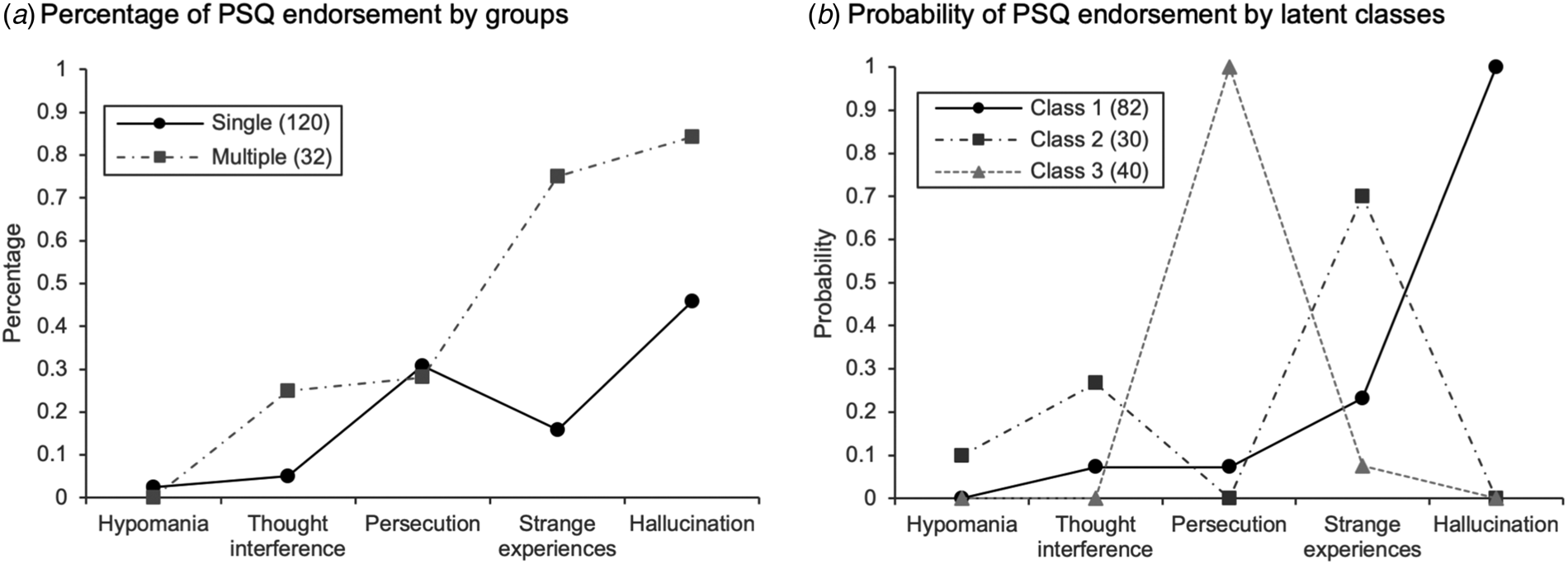
Among the 152 PE-positive participants, 120 endorsed one PSQ item (single group, N = 120, 78.9%) and 32 endorsed more than one (multiple groups, N = 32, 21.1%). Figure 1a shows the percentage of participants in each group endorsing each PSQ item. Based on the LCA fit statistics (online Supplementary Table S4), the three-class model was considered to be the best solution: class 1 (‘hallucination’ class: N = 82, 53.9%), class 2 (‘mixed’ class: N = 30, 19.7%) and class 3 (‘paranoia’ class: N = 40, 26.3%). Figure 1b shows the probability of endorsing each PSQ item for the three latent classes. Most of the subjects in the mixed (N = 28, 93.3%) and paranoia (N = 37, 92.5%) latent classes reported single PE, while a considerable number of subjects in the hallucination class (N = 27, 32.9%) reported multiple PEs.
Differences in responses to PSQ in (a) groups and (b) LCA classes. (a) Visualizes percentage of endorsing particular PSQ items in single PE and multiple PE groups. (b) Shows probability of endorsing particular PSQ items in the three latent classes. Naming of classes per probabilities was as follows: class 1 as ‘hallucination’, had a 100% probability of reporting ‘hallucination’; class 2 as ‘mixed’ had a 70% probability of reporting ‘strange experiences’ and 26.7% probability of reporting ‘thought interference’, and class 3 as ‘paranoia’, had a 100% probability of reporting ‘persecution’.

Two-year follow-up clinical outcomes
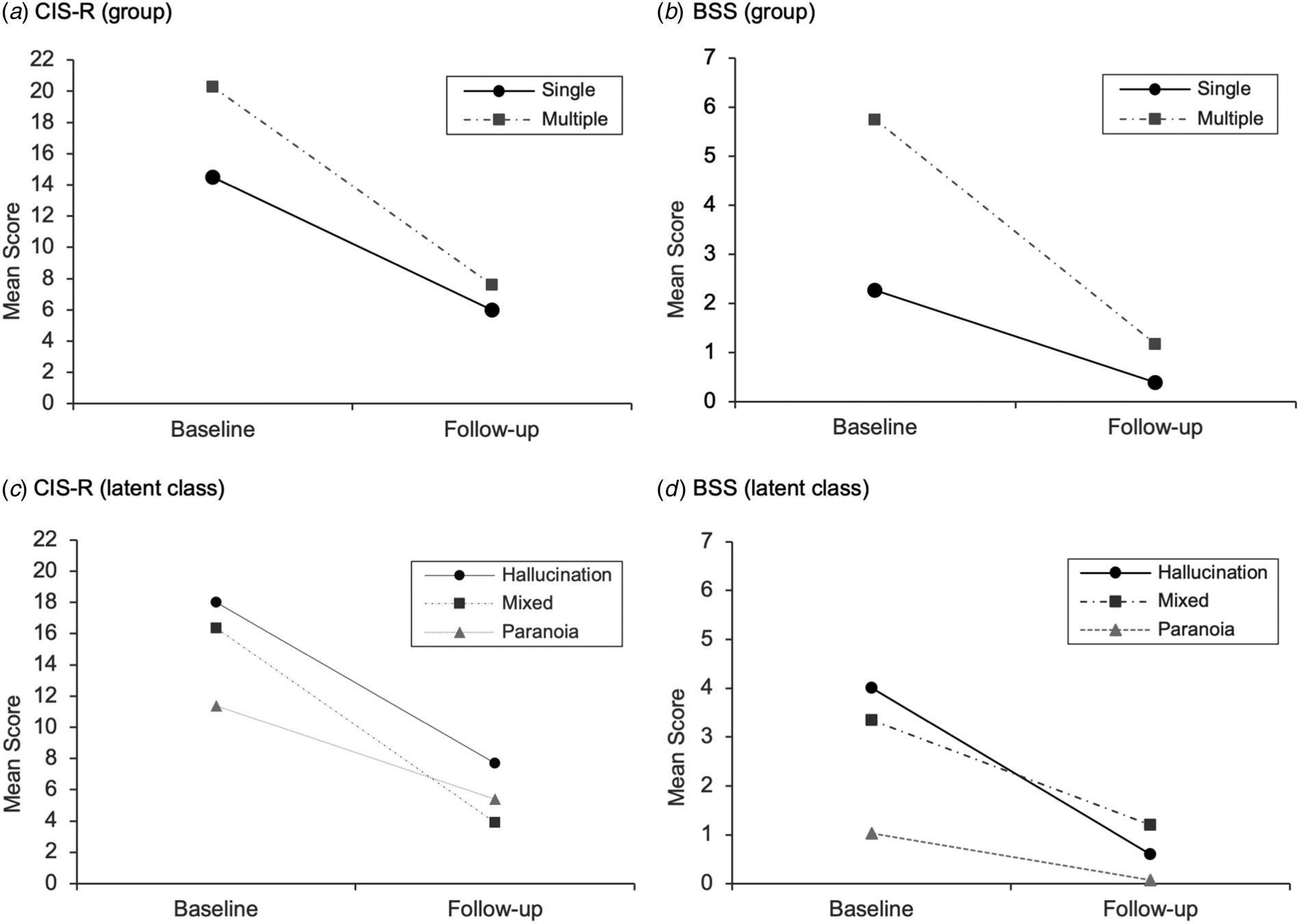
At the 2-year follow-up, 107 PE-positive respondents (70.4%) completed the interview. Two participants (1.87%) were excluded from subsequent analysis because they were diagnosed with a psychotic disorder or at-risk-mental-state. No significant difference was found in the demographic and clinical variables at baseline between individuals who attended follow-up assessment and those who did not (online Supplementary Table S2 and S3). Among the 105 successfully followed-up participants, 16 (15.2%) had persistent PEs and no significant difference was found in the distribution of persistent PEs across groups (χ2 = 2.295, p = 0.130) and latent classes (χ2 = 2.511, p = 0.285). The repeated-measures ANOVA showed a significant main effect of groups (single v. multiple) on CIS-R (p = 0.033) and BSS (p = 0.009) and a significant ‘group × time’ interaction effect on BSS (p = 0.040) (Fig. 2a and b; online Supplementary Table S5). A significant main effect of latent classes (hallucination v. mixed v. paranoia) on CIS-R (p = 0.045) was also found (Fig. 2c and 2d; online supplementary Table S5). Post-hoc comparisons revealed that the multiple groups had significantly higher CIS-R score at both baseline (U = 675, p = 0.028) and follow-up (U = 704, p = 0.040). Difference in the CIS-R score between the three latent classes was significant at baseline (H = 6.34, p = 0.042), with hallucination latent class having the highest level of common mental health symptoms. A similar pattern was not observed at follow-up (H = 3.71, p = 0.157).
Repeated-measure ANOVA controlled for age, gender and years of education over time on CIS-R (Revised Clinical Interview Schedule) and BSS (Beck Scale for Suicide Ideation) for groups (single v. multiple) and classes (hallucination v. mixed v. paranoia) of psychotic experiences. (a) Shows significant group effect (F (1,99) = 4.649, p = 0.033); (b) shows significant group (F (1,99) = 7.126, p = 0.009) and group × time interaction effects (F (1,99) = 4.332, p = 0.040); (c) shows significant class effect (F (2,98) = 3.2, p = 0.045); (d) has no significant effect found.

Discussion
The 12-month prevalence of PEs in the Chinese population of Hong Kong, with a low substance misuse rate, was 2.7%. Compared with the non-PE-positive group, higher proportions of participants in the PE-positive group were women, of younger age, unemployed and divorced. The PE-positive group had a higher level of common mental health symptoms and suicidal ideations. Among the PE-positive group, 21.1% endorsed multiple PEs. They had a significantly higher level of common mental health symptoms and suicidal ideations compared with the single PE group. The difference was significant both at baseline and 2-year follow-up. Three distinct latent classes of PEs were identified using LCA: hallucination, mixed and paranoia, with the majority being in the hallucination latent class (53.9%). Participants in the hallucination latent class had the highest level of common mental health symptoms and the difference was significant only at baseline. The PE persistence rate at the 2-year follow-up was 15.2%.
Hong Kong is a high-income territory according to the World Bank (World Bank Country & Lending Groups, 2019). The 12-month prevalence of PEs in Hong Kong found in this epidemiological study was similar to those reported in the high-income countries (2.2%) (McGrath et al., Reference McGrath, Saha, Al-Hamzawi, Alonso, Bromet, Bruffaerts and Florescu2015) and higher than that in the Shenzhen metropolitan area of China (1.4%), which was classified as a low-income city. Consistent with the findings of other studies (McGrath et al., Reference McGrath, Saha, Al-Hamzawi, Alonso, Bromet, Bruffaerts and Florescu2015; Nuevo et al., Reference Nuevo, Chatterji, Verdes, Naidoo, Arango and Ayuso-Mateos2012), a higher proportion of participants with PEs in the present study were unemployed, divorced and had lower household income. These results suggest that participants with PEs are likely to be among the more socioeconomically disadvantaged groups within a high-income region. It is likely that people with disadvantaged socioeconomic status may have higher stress levels. Given that PEs are most likely to be transient, as suggested by previous (Linscott & Van Os, Reference Linscott and Van Os2013) and the current studies, PEs could be a presentation of stress state in some subjects. Furthermore, subjects with PEs were found to be more likely to have life stresses, suggesting that previous life-stress might increase the vulnerability to developing PEs. Participants with PEs were found to have poorer mental health, corroborating results of many other cross-sectional studies (DeVylder et al., Reference DeVylder, Burnette and Yang2014; Kelleher et al., Reference Kelleher, Keeley, Corcoran, Lynch, Fitzpatrick, Devlin and Arseneault2012a, Reference Kelleher, Lynch, Harley, Molloy, Roddy, Fitzpatrick and Cannon2012b; Saha et al., Reference Saha, Scott, Varghese and McGrath2012). These findings highlight that PEs might be an index for general mental wellbeing.
The dose-effect of PEs on common mental health symptoms, including suicidal ideation identified in the current study is consistent with that reported in the previous literature (Kaymaz et al., Reference Kaymaz, Drukker, Lieb, Wittchen, Werbeloff, Weiser and Van Os2012). The results of the present study further suggested that people with multiple PEs were more likely to have poorer mental health after 2 years. Having multiple PEs does not only indicate a higher level of symptom severity but based on the postulated symptom network theory (Borsboom, Reference Borsboom2017), the possible interconnection between the concurrent multiple symptoms may also sustain the symptom network and lead to a poorer mental health condition longitudinally. Furthermore, the LCA provided another approach to understand the PEs subtypes in this sample population. Two previous studies (Gale et al., Reference Gale, Wells, McGee and Oakley Browne2011; Shevlin et al., Reference Shevlin, Murphy, Dorahy and Adamson2007) evaluated PEs subtypes using LCA approach on the CIDI psychosis measurement of a representative population sample. However, neither studies excluded patients with the clinical psychotic diagnosis. Therefore, in addition to the distinct hallucination latent class, both studies reported a psychosis latent class in which participants reported positively to all items of psychosis and exhibited higher odds of having poorer mental health conditions, which likely resembled the condition of a clinical population. The current study is the first to evaluate PEs subtypes in a population without a clinical diagnosis of psychotic disorders. Three PEs subtypes were identified, of which the hallucination latent class was found to have the highest level of common mental health symptoms. The difference was distinct at baseline but not at 2-year follow-up. Results remained similar when participants with multiple PEs were excluded. Altogether, this study corroborates the previous findings that PEs might reflect a transdiagnostic phenomenon and represent the severe end of the common mental health disorders (Perez & Jones, Reference Perez and Jones2019; Stochl et al., Reference Stochl, Khandaker, Lewis, Perez, Goodyer, Zammit and Jones2015), and further suggests that multiple PEs and hallucination latent class are potential specific indications for poorer common mental health, with multiple PEs being associated with poorer mental condition longitudinally.
The PE persistence rate at 2-year follow-up was slightly lower than the average reported in previous studies (Kaymaz et al., Reference Kaymaz, Drukker, Lieb, Wittchen, Werbeloff, Weiser and Van Os2012). A possible reason for the discrepancy may be the relatively older mean age of this study compared to the previous one (Linscott & Van Os, Reference Linscott and Van Os2013). Another possible explanation is the low substance misuse rate in this population. In addition, it is possible that the PE-positive group represented the more severe end of the sample population and hence reassessment of PEs in this group at follow-up might have a significant drop of PE endorsement due to the effect of regression to mean. The number and subtypes of PEs were not found to have a significant relationship with PE persistence. The low persistence rate might have limited the power of the study.
The main limitation of the current study is the small sample size of PE-positive participants, which have restricted the power in identifying the LCA model and its replicability; nonetheless, a sample size of 150 could achieve 90% power to accurately determine the optimal 3-class model from five dichotomous questions using BLRT (Dziak, Lanza, & Tan, Reference Dziak, Lanza and Tan2014). The small sample size might also have compromised the understanding of the role of PEs subtypes in predicting general mental health symptoms and the rate of PE persistence rate. Secondly, the considerable attrition of PE-positive participants at 2-year follow-up could have contributed to selection bias, however, no difference was noted in the demographic measures between participants who were followed up and those who were not. Clinical diagnoses at the 2-year follow-up could not be explored because of the small sample size and significant symptoms improvement in participants. Finally, to reduce the number of comparisons, only total symptom level, but not individual symptoms, was explored at the follow-up.
Conclusions
The 12-month prevalence of PEs among the Chinese population in Hong Kong was 2.7%. Participants with multiple PEs and hallucinatory PEs were associated with higher levels of common mental health symptoms. Multiple PEs was further associated with poorer mental health at 2-year follow-up. The PE persistence rate at 2-year follow-up was 15.2%. To conclude, the findings highlighted the transient and heterogeneous nature of PEs, and that multiple PEs and hallucination latent class of PEs are potential indices for a poorer mental health condition.
Supplementary material
The supplementary material for this article can be found at https://doi.org/10.1017/S0033291720001452
Acknowledgements
We would like to thank all research staff supporting the research logistic and psychiatrists supporting the diagnostic assessment process. The current work is funded by the Health and Health Service Research Fund Hong Kong (grant number: 09101601); Health and health services research fund of Hong Kong (grant number: 11121531).
Conflict of interest
All authors have no specific financial interest relating to the subject nor other conflicts of interest.