Now the fate of the Beatles lies in the hands of those who someday will prepare the poetry textbooks of the future in which the songs of unrequited love and psychedelic philosophy will appear stripped of their music, raw material for doctoral dissertations, just as the songs of John Donne, William Shakespeare, and John Milton, once a special kind of 17th-century Top 40, are now locked inside the groves of the academy, armored in footnotes and frozen out flat on the dry, cold paper of expensive variorum editions.
—Jules SiegelFootnote 1The epigraph comes from an article by Jules Siegel that appeared in the Village Voice in September 1966. Siegel contends that the music of the Beatles will soon be “resting in peace” due to a new seriousness in the reception of the music. This music is fated to be analyzed by academics while being divested of the element—music—that gives it life. Acceptance in the academy thus sounds a death knell for the music.
Siegel did not have a crystal ball, and he may well have imagined that readers would perceive his proposition that academics might be interested in popular music as outrageous. He could not have known that popular music would eventually achieve a foothold in the university, albeit with its music intact. The appearance of Siegel's article in 1966 is significant, as that year did indeed witness a significant shift in terms of the aesthetic and critical values shared by musicians, listeners, and journalists.Footnote 2 By January 1967, participants in the field of popular music could find music of greater formal complexity, with a large range of improvisatory techniques, more experimentation with electronics and new techniques of sound recording (especially musique concrète), the increasing use of modes and drones, pitch ornamentation associated with Indian music and music of the “East” more generally, and greater diversity of instrumentation.Footnote 3 Changes in song lyrics also displayed a more self-conscious poetic quality focused on philosophical concerns, spiritual quests, and forms of altered consciousness, be they allusions to intense transformative experiences associated with romantic love, or to altered states of mind associated with psychedelic drugs.
Of the stylistic elements listed above, improvisation played a particularly important role. Contributing to the increased amount of improvisation in popular music was the cross-fertilization of many genres of music that were, up until this time, outside of popular music, but which, by the end of 1966, had become a part of it. Many of these non-popular genres of music featured types of improvisation that had been heretofore quite rare in post-1955 popular music. Such improvisatory practices, associated with Indian classical music, jazz, blues, and contemporary art music, would become a constitutive aspect of one branch of popular music, rock.Footnote 4
In parallel with these musical developments, changes occurred in the audience, media, and performance setting for certain forms of popular music. One of the most significant of these changes involved a group of young intellectuals in the United States who attempted to create a new mode of music criticism that responded to (and, in turn, influenced) these musical-social developments. According to one of their cohort, these critics were responding to the “patterns rock has learned to speak without words … in ways that words never could.”Footnote 5 The development of a mode of criticism specific to popular music, as well as self-conscious musical dialogues between popular musicians and references to popular music among avant-garde artists working in other media, created a mechanism for legitimizing certain forms of popular music.Footnote 6 The shift in critical value responded to the growth in formal variety and instrumental competence that formed a part of the expansion of improvisation in rock. Rock music became the dominant musical genre for white, middle-class youth in the United States during this period, in part because of its economic success, but also in part due to its growth in cultural prestige.
The reference to a connection between a type of music and a demographic group leads to the following proposition: music genres circulate more than a mere stylistic combination of sounds; they also connote categories of people, a property that is strikingly clear in the case of popular music genres.Footnote 7 As will become clear from the following discussion, the consolidation of rock as a type of popular music also came with an increasingly clear association of rock with a white, male, middle-class demographic. Such an association marked a dramatic shift with the previous genres to which rock owed the clearest allegiance: rock ’n’ roll and the urban folk revival.Footnote 8 The relative cultural prestige of rock music and, hence, its cultural dominance relied on and reinforced the implied dominance of its associated audience, as well as on the simultaneous obviousness and invisibility of this connection. At the same time, the importance of improvisation and instrumental prowess was established via a chain of associations that linked rock with types of music outside the popular music field. These non-rock genres thus also brought with them associations with people outside of the dominant rock demographic, an element that I will argue was crucial to the critical value they acquired in 1966 and the period thereafter. The consolidation of rock's association with white identity relied on evocations of exoticized otherness even as it reduced the diversity of actual physical participants.
This article explores the interrelationship of musical practices, journalistic discourse, and racial politics. A presentation of a framework for analyzing politics, race, and genre will be followed by a survey of recordings emphasizing new modes of improvisation, after which I will turn to a discussion of Pierre Bourdieu's formulation of “symbolic capital” and how this concept illuminates the formation of rock criticism.
Rock and Race: Towards a Politics of Improvisation?
The separation of rock from the rest of popular music relied on an aura of greater cultural prestige or “symbolic capital” (i.e., the value of an art work independent of its economic value), on its citation of a range of previous musics, on a negative relation to other types of popular music (such as R&B, country, mainstream pop, easy listening, etc.), and on a critical apparatus, developed in part as a response to a perceived increase in formal and technical complexity. Yet another element formed a crucial part of what differentiated rock from other popular genres at this time: the adoption of particular musical techniques from sources outside of folk, pop, and early rock ’n’ roll. Musicians, critics, and fans derived expressive authenticity in rock music from realms beyond mass taste: in jazz, in high art, and in the classical music of the East. The attitude adopted by rock musicians did not insist merely on autonomy from mass taste and commerce, as in the urban folk revival, but also, on occasion, on autonomy from the demands of pleasing an audience as well. That is, unlike folk, part of the value of rock derived from the challenge, or difficulty, of this music.Footnote 9 The challenge of this music to audiences demanded an increased focus on the music's aesthetic qualities, which ranged in style from the experimental yet still extremely popular music of the Beatles to the occasionally confrontational manipulation of noise by the Velvet Underground.
The “art-for-art's-sake” ideology of rock underscores and complements the important distinction between urban folk and rock in the role of politics. These two genres were fairly similar in terms of the makeup of audiences and performers, consisting as they did largely of a white, middle-class, college-educated or college-age demographic, although rock limited the age range with its emphasis on “youth.” Despite demographic similarities between musicians and audience members, the two genres generated very different processes of identification. A strong strain of urban folk was explicitly political, with important performers playing active roles in the civil rights movement in the United States. The Newport Folk Festivals of the early 1960s presented themselves as models of harmony and integration in terms of both race and gender. The urban folk revival also included many significant participants who were either women, African American, or both.
In contrast with this, rock circa 1966 eschewed an explicit political agenda, its social rebellion marked primarily by liberal attitudes towards drugs and sex and by anti-materialism, in which politics were linked with a more generalized social rebellion. While the range of engagements with music outside the popular music mainstream expanded in rock, the demographic diversity of the physical participants declined, marking the emergence of identifications that could be understood as imaginary or exoticist.Footnote 10 Yet diversity returned in a variety of ways, primarily in the form of an eclecticism that located aesthetic and spiritual value in musical practices coming from elsewhere (in terms of geography or cultural hierarchy).
The shift from urban folk to rock thus occurred across several registers: musical, aesthetic, and social. The changes in how these categories of music related to (and evoked) categories of people was anything but straightforward. We can view the relationships between genres and their racialized associations as taking place along a spectrum of possibilities, as Georgina Born has argued, from those that are either homologous (i.e., a genre of music evokes an extant demographic group and is presumed to have a direct, one-to-one relationship with it) or primarily fantasized, such as those involved in exoticism. In-between these two poles lie two other ways of conceptualizing music-identity relations: a nostalgic or retroactive relation, in which an identification is mapped onto the past, as in what occurs with many nationalist uses of folk music; and imaginary identifications that prefigure an emergent, and potentially homologous, social grouping.Footnote 11
Another factor in Western music that relies on an encounter with a real or imagined other is how a musical event models the social relations that produce it, and how this event is inflected by the power relations between the actors involved with it. Thus, it follows that not all encounters between Western and non-Western musicians are equally appropriative or exploitative.Footnote 12
The specter of exoticism, especially in relation to largely fantasized notions of the “East,” evokes the concept of Orientalism as theorized famously by Edward Said.Footnote 13 Said analyzed several centuries worth of colonial discourse for how it reified ideas about the “East” and the “Orient.” This discourse was produced across an array of institutional sites, including military journals, literature, and academic writing. Subsequent discussion and criticism of Said has not challenged the description of the stereotypes that Said detailed; rather, it has shifted the discussion to the process through which such stereotypes are produced; or, in the words of Homi Bhabha, to “an understanding of the processes of subjectification made possible (and plausible) through stereotypical discourse,”Footnote 14 and how the idea of the Orient as Other results from an ambivalent, conflictual economy within European discourse itself. Other approaches have analyzed colonial discourse as a mixture of desire and disavowal, as resulting from the interactions of the colonized with the colonizer, and as a technique for solidifying concepts of the West.Footnote 15
Several of these tropes were clearly in play during the period in which the predominantly white, male musicians from the United States and the United Kingdom produced the identity-genre category of rock music. Most prominent among them is the use of the “other” to solidify a sense of the “self.” At the same time, as indicated above in the discussion of music-identity possibilities, the “othered” music—in this case, Indian classical music, jazz, blues, and avant-garde art music—is not necessarily only an empty result of a “negative” relation. Varying degrees of engagement with music imbued with difference demonstrate how these types of music exhibit their own positivity, and do not merely exist as the negative other of white-identified music.Footnote 16 The events discussed in this article cannot help but allude to Orientalism as a persistent historical construct. The emphasis here, however, will not be on the truth or falsity of a given stereotypical representation but rather on the specific ways in which these case studies facilitate an “an understanding of the processes of subjectification made possible (and plausible) through stereotypical discourse.”Footnote 17
One further point can be illustrated by referring to some of the larger historical currents of the period. The post–World War II period in general, and the 1960s in particular, could be viewed as a period of decolonization and neo-colonialism.Footnote 18 As such, awareness of formerly colonized people took on a higher profile among those who may have identified with former colonizers. Another material factor was the greater flow of people from former colonies to European and North American metropoles, a development that facilitated encounters between people who were previously separated, and one that played a role in several of the stories to follow.
Raga Rock, Jazz Rock, Psychedelic Rock: A History of Sound Recordings
The Raga Rock Connection
Beginning in 1966 a group of rock sub-genres expanded the role of improvisation, attracting attention from and becoming held in the highest esteem by critics. These sub-genres now go by the name of blues rock, psychedelic rock, jazz rock, progressive rock, and raga rock. Of these, by far the most recognized by name at the time was raga rock.
Raga rock was a diverse genre. Prominent among these recordings were the Beatles’ take on North Indian “light classical” music in tunes written by George Harrison, such as “Love You Too” (1966), “Within You, Without You,” “Blue Jay Way” (both 1967), and “The Inner Light” (1968). While partaking of the distinctive rhythmic and melodic practices of Indian music, these tunes featured little improvisation, except for melodic ornamentation of a pre-composed melody. The Beatles presented another approach in “Norwegian Wood” (1965), their first recording to use a sitar. In this song, the band substituted a sitar playing a part that could have easily been played by a guitar in a song whose only other connection to South Asian music might be its modal quality in the verse sections of the tune. In this respect, songs such as “Norwegian Wood” represent the strain of raga-rock that uses instruments such as the sitar to provide a novel instrumental timbre to what is otherwise a fairly standard pop-rock song of the period.Footnote 19 Another device would be the use of modally derived ornamentation, such as that found in the fadeout to the Beatles’ “I Want to Tell You” (1966). Yet another strain of raga-rock blends with the beginnings of another rock sub-genre, psychedelic rock: in a song like “Tomorrow Never Knows” (1966) drones and tamburas combine with an overtly experimental, electronic texture featuring musique concrète and other forms of sound processing to create a kind of pop avant-garde.
The Kinks’ “See My Friends” (released July 1965) also features in discussions of the beginnings of raga rock. This song, like many of the others discussed here, relies on drones, the mixolydian mode, and vocal slides evoking a generalized “Eastern” musical trope. Another mode of otherness, queer sexuality, is also evoked by “See My Friends,” a topic that would have been absolutely verboten within the discourse of popular music in 1965. This use of stylistic features with exotic connotations illustrates how exoticism could act as a conduit for sexual, as well as racial, otherness.Footnote 20 For our purposes here, however, the most interesting forms of raga rock, in terms of its contribution to the growth of improvisation in rock, were found in the work of other popular musicians of the time, including the Byrds and the Paul Butterfield Blues Band.
For example, the sources of the Byrds’ “Eight Miles High” (released March 1966) exemplify the multiple paths through which extended improvisation entered the world of rock in early 1966. The Byrds recorded “Eight Miles High” following a tour during which the group listened repeatedly to the virtuosi Ravi Shankar and John Coltrane.Footnote 21 One of the tracks in heavy rotation in the bands’ van was Coltrane's “India,” which Coltrane recorded after a period of study of North Indian music and religion.Footnote 22
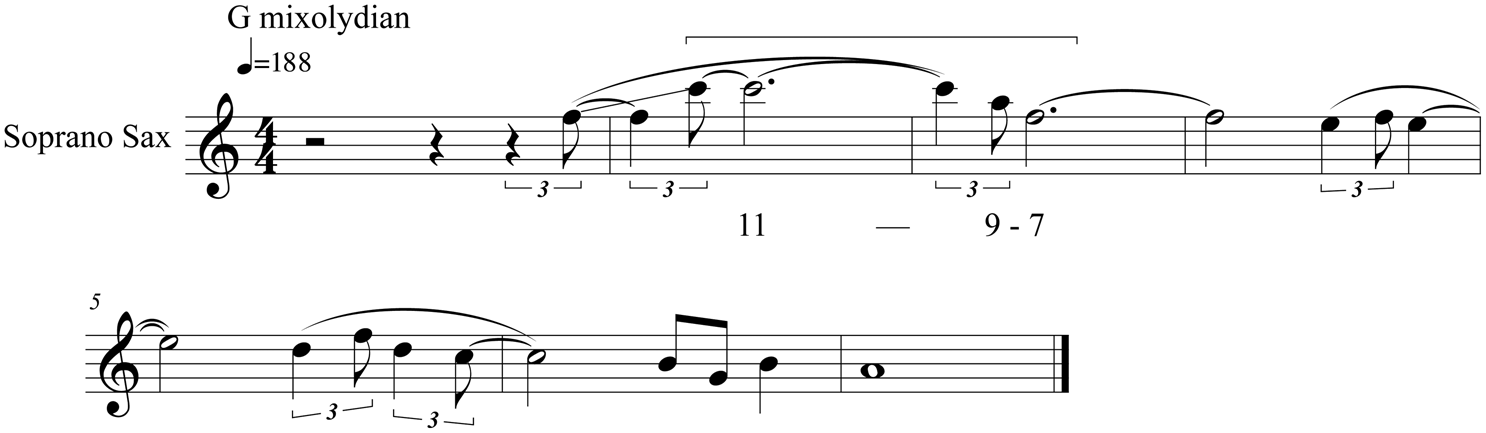
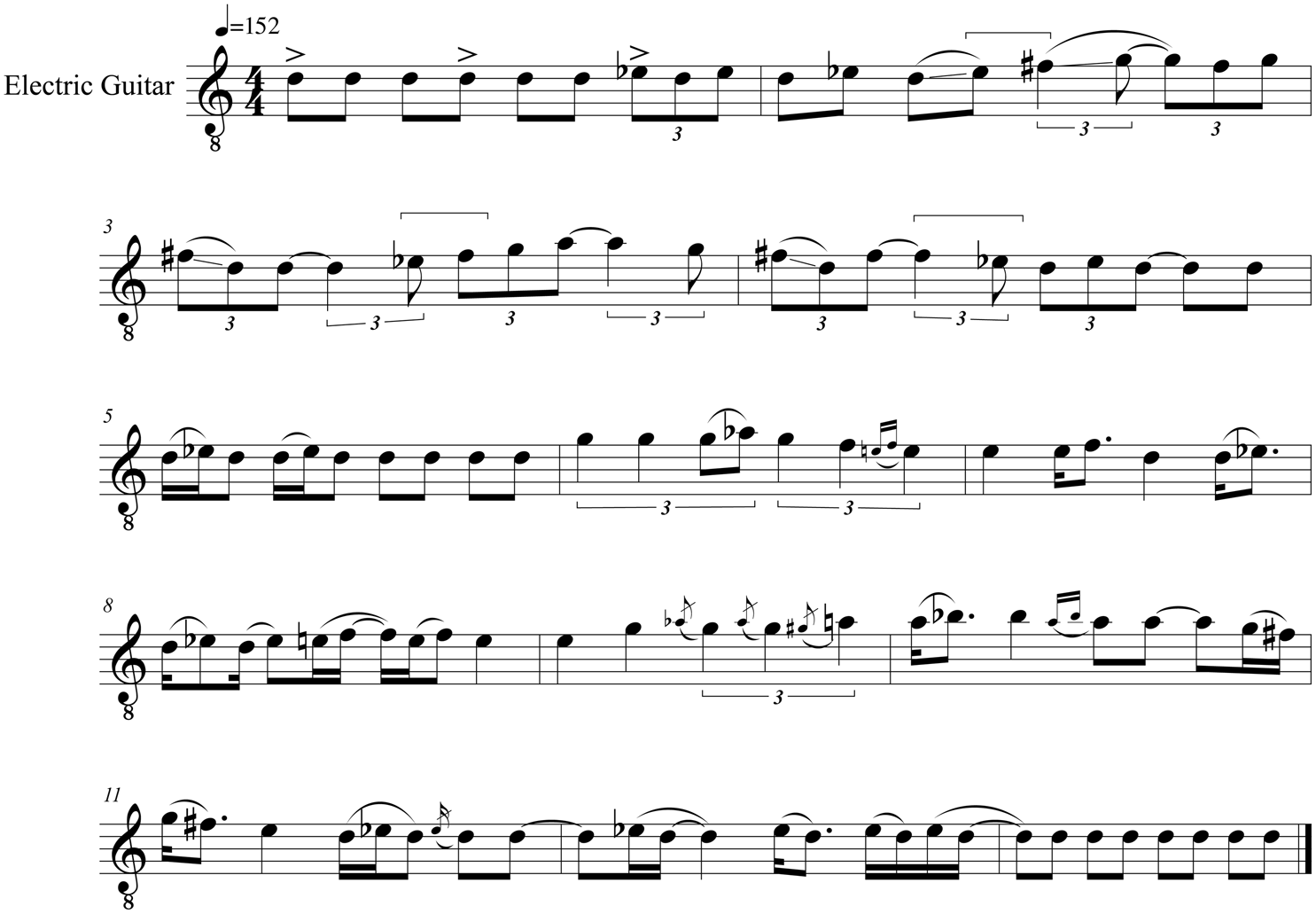
The improvisational sections of “Eight Miles High” borrow from the opening motive of Coltrane's “India,” and the Byrds’ bass player, Chris Hillman, plausibly derived his part from the alternating perfect fifths played by Coltrane's bass player, Jimmy Garrison. However, the Byrds’ recording simplifies the harmonic relationship between melody and drone: Coltrane's initial melodic motive, C–A–F unfolds over a drone on G, making these pitches the implied eleventh, ninth, and seventh of an imaginary chord built in thirds above the bass (see Example 1—the brackets outline the motive); the Byrds retain the intervallic relationship but transpose it to D–B–G, and play this over a drone on E, creating relationships of a seventh, fifth, and third (see Example 2). In terms of rhythm, “Eight Miles High” replaces the ambling, polyrhythmic swing of Coltrane's recording with a faster tempo and a somewhat simpler groove, albeit one that was unusual for the rock music of the era. Coltrane's rhythmically elusive phrases are replaced by rhythms that fall more squarely on the beat, although the Byrds’ guitarist, Roger (then Jim) McGuinn comes closer in the second phrase to some of Coltrane's rhythmic complexity (and the melodic motive is now transposed to emphasize the eleventh, ninth, and seventh as in Coltrane's opening), including flurries that suggest Coltrane's famed “sheets of sound” approach to rhythm.Footnote 23
John Coltrane, “India,” opening, 0:12–0:19.

The Byrds, “Eight Miles High,” opening, 0:10–0:16.

These efforts at musical expansion resulted in novel approaches to rock performance practice of the time. McGuinn's solos, and the rest of the band's playing during these sections, suggest a profound reorientation of the group compared to what they had recorded previously. These open-ended solo sections, which are based on two alternating chords that project the Dorian mode in E, reveal the influence of Coltrane's approach to songs such as “My Favorite Things” or “Afro Blue” and are a far cry from the previous instrumental interludes played by the group. The Byrds’ earlier guitar solos had more or less followed the rock ’n’ roll convention of improvising over the harmonic progression of the verse and/or chorus of the song, while the other instrumentalists in the band closely mimicked the parts played as accompaniment to the vocals.
“Eight Miles High,” labeled “raga-rock” and “jazz-rock” at the time, also provides an excellent example of the iterative process in the production of genre.Footnote 24 For instance, the use of modal improvisation over unchanging harmony and a drone can be traced to both South Asian classical music and to modal jazz (through both aural evidence and the accounts of participants in the recording), as well as to earlier folk and rock artists such as Sandy Bull (heard in his Fantasias from 1963) and the Yardbirds. The harmony vocals draw on the Byrds’ own previous work, as well as that of the Beatles and traditions of shape-note vocal harmonizing from the US South. The lyrics draw on the surrealism of Bob Dylan's work, which in turn draws upon Beat poetry. The instrumentation cites the makeup of a rock ’n’ roll band that had become standard since the early 1960s with surf groups and the Beach Boys, followed by the Beatles, which in turn drew upon the ensembles led by electric guitars found in R&B and honky-tonk/Western swing ensembles of the 1940s.
The Byrds’ “Eight Miles High” figures prominently in histories of psychedelic rock and acid rock as a foundational moment, yet only a few months following its release, the Butterfield Blues Band released a recording with similar influences that has received much less attention.Footnote 25 This recording, East-West (released August 1966), represented a significant departure from the Butterfield Blues Band's only previous album, The Paul Butterfield Blues Band, released in October 1965, which featured tight, swinging electric blues numbers. The instrumental solo sections of the earlier album contained no more than three choruses, and none of the recordings lasted longer than four-and-a-half minutes. East-West continued the previous album's focus on the blues while expanding into adjacent genres, including Indian classical music, proto-soul and proto-funk, soul jazz, and rock. The title track of East-West lasts over thirteen minutes (live versions could last up to one-half hour) and presents its own ambitious synthesis of disparate musics.
In addition to Indian musical influences, the recording blends bossa nova–derived rhythms with group interactions adapted from small jazz groups and long textural buildups reminiscent of the rave-ups (discussed below) of British bands such as the Yardbirds. A section from the end of guitarist Michael Bloomfield's first solo in “East-West,” beginning at about 5:00, displays faux-raga inspired guitar lines, tambura-like drones by the second guitar (played by Elvin Bishop), and a frenzied crescendo abetted by the harp (harmonica) work of Paul Butterfield. Scalar passages influenced by a conglomeration of Middle Eastern, Arabic, and South Asian musics serve as the basis for several sections of improvisation. In addition to the modal/scalar quality (in what sounds like the Phrygian mode on D with a raised third scale degree), the prominent use of the augmented second, slides and microtonal ornaments convey a sense of “Eastern-ness” (see Example 3; augmented seconds are outlined by brackets). Other passages are derived from minor-based modes, such as the Dorian mode; and the emphasis on pitches implying extended chord tones, such as the ninth and eleventh, recall the pitch selection of artists such as Miles Davis on a track like “So What” from the Davis Sextet's epochal 1959 album, Kind of Blue. As reminiscences of participants make clear, the Butterfield band's tour of the West Coast in early 1966 and their relatively advanced abilities as improvisers played a major role in the spread of improvisational practices, and in the blending of blues, jazz, and classical Indian music, especially in the San Francisco Bay area.Footnote 26
Butterfield Blues Band, “East-West,” 5:47–6:07.
The different examples of music indebted to South Asian music and using extended improvisation display a range of identifications. John Coltrane's “India” and George Harrison's Beatle recordings clearly exhibited an emergent form of identification with Indian music through these musicians' long-term investment in the music and its attendant spiritual practices to the point where what may have initially sounded exotic became absorbed into the music associated with these artists. In regards to Harrison, Ravi Shankar himself noted that “I have accepted George as my disciple. He is not at all like other pop musicians.”Footnote 27 A significant difference between Harrison and Coltrane is that Coltrane could not benefit from his “discovery” of this raw material from the East to nearly the same degree as Harrison, due to the far more limited circulation of the genre (“jazz,” or “modal jazz,” or “avant-garde jazz”) in which he participated. Harrison, on the other hand, was a member of the most successful group of pop musicians in the world up to that point. Having said that, Harrison used his resources to try to raise awareness of Indian classical music, promoting Shankar in concerts and recordings and displaying a lifelong commitment to the music and to Indian spiritual practices.
However sincere the enthusiasm of the Byrds, the Yardbirds, or Bloomfield might have been, the history of their encounter seems superficial and opportunistic by comparison. Quotes from the musicians involved reveal attitudes that could be read as exoticist. For example, the experience of Butterfield guitarist Michael Bloomfield with Indian music, contrasted mightily with the approaches of Coltrane and Harrison. The Butterfield Band's keyboard player, Mark Naftalin presents the following description of the genesis of the song, “East-West”: “Mike sequestered himself for a few hours. … Around daybreak he joined me. … This was when he told me that he had had a revelation and that he now understood how Indian music worked. On our next gigs, while we were still in Boston, we began performing the improvisation we called ‘The Raga’ for a while, until it was given the name: ‘East-West’.”Footnote 28 The study of Indian classical music, frequently assumed to require at least twenty years of intense practice to acquire proficiency, is condensed into a single evening (although, to be fair, Bloomfield, in his own statements, was extremely modest when comparing his abilities to great blues, jazz, and Indian musicians). Along similar lines, guitarist Jeff Beck described “mass hysteria in the studio” when he recorded the solo to the Yardbirds’ “Shapes of Things”: “They weren't expecting it and it was just some weird mist coming from the East out of an amp. Giorgio [Gomelsky, the producer] was freaking out and dancing about like some tribal witch doctor.”Footnote 29
The Rave-Up, Blues Rock, and the Blues Raga Connection
The Butterfield Blues Band's background in electrified Chicago blues and their connection to the rave-ups associated with the Yardbirds suggest two other important strands in this genealogy, one connected specifically to the Yardbirds, and the other encompassing a broad range of artists who shared an approach to improvisation. The first of these is the engagement of white musicians with various forms of electrified blues and rhythm and blues (R&B) on both sides of the Atlantic. Blues recordings by white musicians in the United Kingdom, many of whom would figure prominently in discussions of rock music a few years later, predated by several years their white counterparts in the United States, such as the Butterfield Blues Band.
Unlike the members of the Butterfield Blues Band, who were either African American participants in the Chicago electric blues scene (e.g., Sam Lay, Jerome Arnold, and Billy Davenport), or younger white musicians whose initial musical affiliations were guided by an attraction to that scene (e.g., Paul Butterfield, Mark Naftalin, Nick Gravenites, Elvin Bishop, and Michael Bloomfield), many of the British musicians who began performing electric blues in the early 1960s arrived at the genre via “trad jazz,” a British category akin to “New Orleans” or “Dixieland” jazz in the United States. Within this scene, both the folk/country blues and then urban/electric blues were accepted as part of a complex of African American–associated genres.Footnote 30 The initial attitude toward electric blues shared much with the folkloristic purism associated with white aficionados of folk blues in the United States. A group of younger musicians, many of whom gained their initial public performance experiences through participation in this scene, however, did not share this conservationist sensibility. Alexis Korner's Blues Incorporated featured a veritable “Who's Who” of British blues rock musicians who would later achieve global notoriety, including members of what would become the Rolling Stones, the Yardbirds, Fleetwood Mac, Cream, and many others.Footnote 31
The Yardbirds form one of the earliest and strongest links between the different threads discussed thus far. Deriving their name from their admiration for bebop virtuoso, Charlie “Yardbird” Parker, their earliest recordings show them strongly rooted in the British R&B scene. Five Live Yardbirds (recorded in March 1964) consists almost entirely of 12-bar blues or blues-based songs based on a repeating riff and unchanging harmony. A remarkable recording for the era, several of the tracks exceed the then-almost-unassailable 3:30-time barrier for popular music by featuring extended improvisations, usually led by either Eric Clapton on electric guitar or by vocalist/harmonica player Keith Relf. Although some of these songs, such as the slow blues “Five Long Years,” follow the practice of African American blues musicians established (both in live performances and recordings dating back several years) by artists like B. B. King, one of the most innovative features of these extended tracks was what came to be called the rave-up. Often occurring over an unchanging single chord, or a rapid alternation of two chords, the rave-up featured rhythmic intensification in all the instruments, often moving to a double-time effect, resulting in a build-up that was then resolved by returning to the original tempo.
One of the main sources of this practice can be found in the work of Bo Diddley, whose songs “I'm a Man” and “Here ’Tis” were given the rave-up treatment on Five Live Yardbirds, along with “Respectable,” an Isley Brothers song that was played by the Yardbirds with the “Bo Diddley” rhythm derived from the R&B master's famous eponymous 1955 hit.Footnote 32 In addition to the Bo Diddley–influenced numbers, songs based on a one-chord blues-riff, such as Howlin’ Wolf's “Smokestack Lightning,” which was also recorded on Five Live Yardbirds, were to play a role in the extended improvisations of other rock bands during the 1965–66 period.
The Yardbirds, beginning with the replacement of Eric Clapton by Jeff Beck, began to merge their interest in extended improvisation over unchanging harmony with an interest in “Eastern” musical sounds featuring modal harmony and drones. One of the first and most widely circulated examples of musical elements that were heard as “Indian” in a popular music recording was the Yardbirds’ “Heart Full of Soul” (released June 1965). Beck used a “tone-bender” distortion device to produce something that may have recalled the sound of a sitar for some. In fact, the band first attempted to use a sitar to play the part eventually played by Beck, only to abandon it when they encountered difficulty achieving a decent recorded sound. The track begins with Beck's “tone-bender” guitar accompanied by a percussion instrument that sounds like a tabla but could also be bongos, and the melody has a modal quality. The band's interest in Eastern-associated sounds continued with “Shapes of Things” (released February 1966), and “Over, Under, Sideways, Down” (released May 1966), both of which used fuzz tone on the guitar, modes created by the alternation of two chords or unchanging harmony, and lyrics that refer to some sort of psychic transformation.
The point here is not to posit an origin for raga-rock, but rather to observe that many musicians were interested in similar musical elements associated with South Asia and the Middle East, and that these in turn acquired (or brought with them) connotations of exoticism, spirituality, experimentalism, psychic interiority, and alternative sexualities. These interests overlapped with musical practices derived from African American musics, such as the blues and one-chord rhythmic patterns associated with Bo Diddley.
Droning On: Western Art Music—Avant-Garde or Otherwise
In addition to Indian classical music, jazz, and blues, Western art music—in the form of both historical idioms and the post-war avant-garde—also played a role in the newfound focus on improvisation in rock music. The Yardbirds again took the lead: their “Still I'm Sad” (released October 1965) references medieval music.Footnote 33 As with South Asian music (or “Eastern” music more broadly), the Beatles attracted the most attention for their incorporation of Western art music. “In My Life” (from Rubber Soul, released December 1965), for example, cites a kind of figuration associated with Baroque keyboard music in the middle instrumental section. “Eleanor Rigby” (from Revolver, released August 1966) employs a modernist-influenced arrangement for string octet derived from Bernard Hermann's score for the film Psycho.Footnote 34 The Byrds also participated in this trend: in “She Don't Care About Time” (released October 1965), Roger McGuinn bases his guitar solo on a quotation of the melody from the last movement of the Bach cantata, Herz und Mund und Tat und Leben, BMV 147 (popularly known as “Jesu, Joy of Man's Desiring”).
The influences of Western art music thus far described made themselves felt in ways that were not necessarily related to the growth of improvisation. These influences could extend beyond the individual song: artists such as Brian Wilson and the Beach Boys absorbed musical values associated with Western art music, such as cyclic unity, harmonic complexity, formal irregularity, timbral experimentation and textural variety. This development can be traced from the Beach Boys’ Pet Sounds (released in May 1966), sometimes called the first “concept album” due to how the songs on the album seem related to one another and to trace a coherent narrative.
This use of pre-twentieth-century art music sources resembles the use of Indian classical music in that it is an attempt to create or locate musical value in the use of non-rock genres that are outside the ambit of early rock ’n’ roll or blues. In some of these cases, as in the references to medieval music, the Western art music in question predates “functional” harmony, thus sharing much with the drones of South Asian music, and the one-chord blues-based songs with unchanging harmony that served as a basis for rave-ups and modal jazz.
In addition to the Beatles’ “Tomorrow Never Knows,” musique concrète had already appeared in other recordings released in 1966, including (most prominently) Frank Zappa's Freak Out! The use of musique concrète points to another important element in the citations of Western art music in the popular music of the time: the flirtation with elements of the avant-garde. A brief discussion of two groups—the Grateful Dead and the Velvet Underground—will help tease out the sometimes-subliminal effect of the avant-garde on the associations then forming between Western art music and types of music associated with improvisation, including South Asian music, jazz, blues, bluegrass, and country music.Footnote 35
A comparison between a Velvet Underground recording such as “European Son” and a Grateful Dead tune from the same time, such as “Viola Lee Blues” (both released in March 1967 but performed and recorded in 1966) reveals a good number of similarities, particularly in the near-atonal, improvised climaxes of both songs. The difference lies more in the way of arriving at these sounds: for the Velvet Underground, the path runs through avant-garde minimalism and the rejection of conventional virtuosity; a group like the Dead arrives at noise through the evolution of dissonance within a trajectory of increasing musical complexity during a performance. The connection with the Dead is highlighted here because statements from those associated with the Velvet Underground about their total rejection of West Coast psychedelia are so often taken at face value. While there may have indeed been an ideological rejection, often musicians operating during the same period share practices that only become obvious retroactively.
As much as one can point to differences in context—the nascent “peace and love” ethos of the San Francisco counterculture versus the ironic cool of Andy Warhol's Factory with which the Velvet Underground were associated—one can also find striking resemblances in connection with avant-garde composition and performance art. John Cale of the Velvet Underground collaborated with John Cage and LaMonte Young and was associated with Fluxus. Phil Lesh of the Grateful Dead studied composition with Luciano Berio at Mills College. The Velvet Underground performed in multimedia presentations with Warhol's “Exploding Plastic Inevitable”; and the Dead were featured in productions such as Ken Kesey's Acid Tests and the Human Be-In. Free jazz also represented an important influence for both bands, as it did for avant-garde art music's incorporation of improvisation.Footnote 36 The problematic nature of a generalized “coastal” separation of improvisational practice is highlighted by bands such as the Blues Project from New York, whose approach to extended improvisation in recordings such as their eleven-and-a-half-minute-version of Muddy Waters’ “Two Trains Running” resembles the Dead's approach on “Viola Lee” much more closely than anything recorded by the Velvet Underground.
Given the associations with South Asian music, jazz, and blues, the appropriation of stylistic features from Western art music presents as an outlier of sorts. Western art music would likely be understood as the other in this context on the basis of its association with high culture, and not due to racialized differences.
Symbolic Capital and Rock Criticism
Within the emerging rock music aesthetic of the mid– to late–1960s, improvisation was one of the qualities perceived to create distinction between artistically autonomous, newly christened rock, and old-style, commercially dependent pop. Rock critics agreed that improvisation differentiated rock from pop even as they disagreed about whether this was a positive development or not. It is clear, however, that the growth of improvisation within rock was part of a larger shift in the internal differentiation of the popular music field, aided and abetted by a range of other material and discursive practices such as the formation of accrediting institutions specific to rock (i.e., rock criticism and “serious” rock-oriented publications); the appearance of new media able to disseminate extended improvisations in the guise of free-form, underground FM radio; and a shift in old media, including the ascendance of the LP (album) over the single, 45 rpm recording, and changes in concert rituals.Footnote 37
Of these changes in the popular music field, many of the most significant can be associated with an increase in cultural prestige or “symbolic capital.” The idea of symbolic capital—along with other forms of capital, such as “cultural capital” and “economic capital”—is most closely associated with the work of Pierre Bourdieu.Footnote 38 Much of the analysis of how cultural prestige functioned in the criticism of rock music during this period relies on the opposition of symbolic capital vs. economic capital. The value of the opposition, symbolic capital/economic capital, is not that it describes an unvarying truth of the social world; rather, it is useful if it aids in the analysis of empirical data. It helps clarify not just that events and statements exist in a local, momentary context, but also that such data are part of longer-range historical discourses and that they can be viewed as specific instantiations of historically recurrent power relations. The relation within the popular field between music that was valued for its autonomy from economic forces and music that was applauded for its popularity was not unique. Such a spectrum of possibilities also existed in the mid-1960s in jazz between avant-garde (or “free”) jazz, mainstream-bop-derived jazz, and R&B-friendly “soul” jazz; as well as in Western art music between contemporary art music, on the one hand, and mainstream concert performances and music tarnished by its associations with commercialism and popularity, on the other. The employment of Bourdieu's theoretical framework does not come without its own set of contradictions, as Bourdieu himself did not entertain the possibility that an artwork could accrue symbolic and economic capital simultaneously. As we will see, such contradictions informed the criticism of the period, as critics lauded the artistic autonomy of recordings that sold millions of copies.Footnote 39
If the use of elements from South Asian music, jazz, and blues transferred cultural prestige to rock due, in part, to the associations of these musics with demographic categories outside of the white, middle-class, then the use of Western art music transferred cultural prestige in a more direct manner. In other words, Western art music's effect on rock conforms more to Bourdieu's model than does the accumulation of cultural prestige via exoticism. If exotic stereotypes function as a kind of fetish, and thus evoke both desire and disavowal, then “desire” (i.e., the positive valence of the other) is figured in the interactions of white US/UK musicians with music from the “East” as a distinct kind of capital.Footnote 40 The same could be said of the form of symbolic capital, what could be called “subcultural capital” or “hipness,” accumulated by white musicians via their emulation of musical styles associated with African Americans, such as blues or jazz.Footnote 41
To put it briefly, the shift in popular music during 1966 marked the entrance of an art/non-art distinction into the popular music field, whereas before this distinction divided popular music from jazz and classical music. The new stratification within popular music made it possible for one genre within the popular music field, rock, to acquire critical prestige relative to other pop music genres.Footnote 42
One of the arenas in which the symbolic/economic divide appeared, that of musical style, has already been explored in some detail earlier in this article. Musical developments associated with the formation of rock music featured a newfound intellectual approach to making music, the exploration of music that already possessed greater symbolic capital (such as jazz, classical music, and to a lesser extent, Indian music), and an interest in greater formal complexity and technical virtuosity. The area of activity in which changing attitudes can be most clearly tracked, however, is in the discourse of the new field of rock criticism.
Early Rock Criticism and Its Antecedents
Connoisseurship of popular music had its precedents: a critical apparatus for the assessment of jazz arose in the 1930s during the swing era when the popularity of jazz-associated music was at its peak. As jazz slowly detached from the mainstream during the 1940s, critical writing about popular music went with it. With the move of R&B- and country-associated musics into the popular mainstream during the mid-1950s, and the subsequent articulation of the label “rock ’n’ roll” with a synthesis of these genres combined with mainstream pop, media appraisal became limited to sociological explanations that depicted the various moral panics accompanying the early days of rock ’n’ roll. If the value of popular music was discussed at all in the mass media, it tended to be in terms of its economic value, not its artistic merit.
In the period 1955–65, some critics—such as Robert Shelton with the New York Times, Nat Hentoff with the New Yorker (among others), Ralph J. Gleason with the San Francisco Chronicle, and William Mann of the London Times—did stray from assessing popular music strictly in economic terms, especially in discussions of Bob Dylan and the urban folk revival of the early 1960s (or, in the case of Mann, the Beatles).Footnote 43 Even when writing sympathetically, however, the work of these writers often conveyed a sense of distance from the objects of their criticism. The new development in 1966 was the emergence of criticism written by participants in the popular music field about which they were writing. Given that one of the strongest markers of post-rock ’n’ roll-popular music was its association with the demographic category of youth, the appearance in print of critics who were the same age as the musicians and audience was a key moment in the formation of a critical discourse specific to the music. The founding of the magazine Crawdaddy!, the work of Richard Goldstein at the Village Voice, the music criticism at ’zines focused on local music scenes such as Mojo Navigator in the San Francisco Bay Area, and the work of writers such as Chris Welch at Melody Maker in the United Kingdom all contributed to a nascent form of criticism that attempted to assess value in popular music that was autonomous from its economic impact.Footnote 44
These contributions to the emergence of rock criticism were far from homogeneous. During the course of 1966, Crawdaddy! devoted itself entirely to the criticism of popular music (mainly rock) and featured several critics in dialogue with one another. Goldstein, along with a few colleagues at the Village Voice, operated in a milieu in which rock music was presented as marginal, although this began to shift by the end of the year. Mojo Navigator did not begin publishing until September 1966, only published consistently for three months, and was largely the work of two writers, although during that period it did function as a kind of Crawdaddy! West.
Paul Williams, a first-year student at Swarthmore College, produced the first issue of Crawdaddy! in February 1966. It was clear from the opening editorial of its first issue that the raison d’être of Crawdaddy! was the projection of “autonomous value.” In the words of Williams, “We fully expect and intend to be of great use to the trade: by pushing new 45s that might have otherwise been overlooked, by aiding radio stations in deciding on their playlists, by giving manufacturers some indication of response to a record other than sales.”Footnote 45 At this stage, the emphasis on symbolic capital was still allied to its utility as an aid to institutions organized around economic capital, that is, the music industry and, in particular, Top 40 radio and the singles’ market. Similarly, the range of recordings discussed in Crawdaddy! was quite broad, from the work of easy listening artists like Tom Jones to underground groups such as the Blues Project. Such eclecticism indicates that the Top 40 radio format and popular 45s (i.e., single recordings targeted for a mass audience) were as much the basis for the field of criticism as were recordings that were potentially rich in symbolic capital but weak in economic capital. The same is true of terminology, in which the term “rock ’n’ roll” was used as a synonym for popular music.
Such critical broad-mindedness would change toward the end of the year. For example, here is the opening of Williams's review of albums by the Mamas & the Papas, the Blues Project, and Love, in the August 1966 issue of Crawdaddy!:
Sometimes the only way to feel better, after looking at the top 100 charts, is to remember that they have practically nothing to do with rock ’n’ roll. Rock ’n’ roll, or the big beat, whatever clumsy term we want to use, is a musical idiom quite apart from what is selling at the moment, i.e., quite apart from pop music. Money and popularity serve as important influences on the field, inevitably; but they aren't in control. Barry Sadler is about as significant an influence on r ’n’ r as Harold Robbins is on American literature.Footnote 46
The article continues in this vein: the way value is conferred is not by sales but “influences” from “the really vital musicians … those who never stop introducing new sounds, new ideas: The Beatles, the Stones, Dylan, the Spoonful, the Byrds: Nancy Sinatra will never make an impact on the history of music. … With this in mind, we can … look down and even off the charts for the songs that really are new.”Footnote 47
I cite this article at length because it encapsulates the opposition between symbolic and economic capital in contrast to earlier in the year, when Williams did not oppose so clearly the two types of capital. He does not, of course, explain how the Beatles, the Stones, and Dylan have all managed to succeed on the pop charts while other innovators have not.
By the March 1967 issue of Crawdaddy!, Williams had become more explicit about the stakes involved in carving out an anti-commercial form of popular music. In his “What Goes On” column, a regular feature that provided news about artists deemed significant by the Crawdaddy! staff, Williams asserts that a chasm divides “quality” popular music from commercially-driven pap:
Something good is happening. Never mind Aaron Neville, Micky Dolenz, the bl**dy red baron or whatever else is on the radio. Go down to your friendly (maybe) record man and pick up the Doors album, the Youngbloods album, the new Stones, the new Donovan, the John Mayall Bluesbreakers lp … all of which came out in the last week as I write this. Never have there been so many different good things going on all at once—never have there been so many more good things promised for the immediate future. And this album activity comes at a time when we are just entering the millennia of performing rock, with college concerts replacing the teeny-bop hits, with the San Francisco scene beginning to spread across the country, with groups like the Airplane, the Springfield, Moby Grape, the Doors, who interact with an audience and present live rock in a manner that cuts absolutely everything that had gone before.Footnote 48
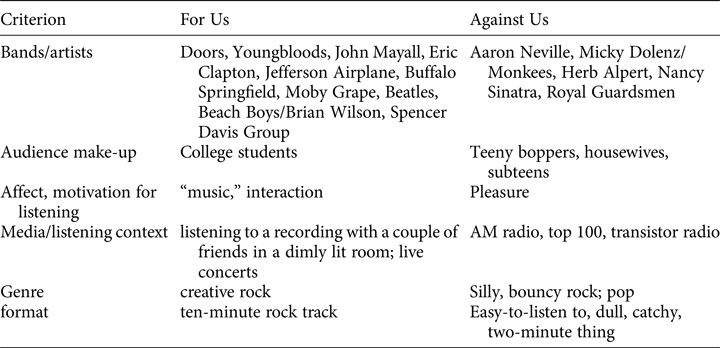
Table 1 summarizes the oppositions used by Williams in this article to outline the symbolic/economic divide in popular music at this time:
Oppositions derived from the March 1967 “What Goes On” column, Crawdaddy!
A couple of things are notable here: the villains are named more clearly than the heroes in terms of the audience and the media through which the music is disseminated. The consecrated demographic becomes, by default, white (by virtue of the preferred artists), male (due to the denigration of housewives), and focused on young adults (note the disparagement of teeny-boppers and easy listening, a genre associated with the middle-aged). Other pieces written around the same time, such as those by Richard Goldstein, make the antidote to the malaise associated with commercialism explicit by mentioning the rise of “underground” FM radio and a shift towards LPs instead of 45s as complementary developments.Footnote 49 Although improvisation is not listed explicitly in the “For Us” column, it arises via association with many of the artists (The Doors, Eric Clapton, Jefferson Airplane, etc.) and through the invocation of “creative rock” and formats such the “10-minute rock track.”
For another view on these developments, it can be instructive to examine the music industry press. Contrary to a publication such as Crawdaddy!, a publication like Billboard was (and is) devoted to the bottom line and how the potential profit of artists and recordings might benefit record companies, record store owners, radio stations, and concert promoters, among others. Thus, we would not expect symbolic capital to interest this conglomeration of interests (which I will call the “music industry”) unless it could be converted into economic capital. Yet, as has already been argued here, one of the more fascinating developments in popular music during this time, and one of the most confusing for music industry agents, was how symbolic and economic capital were often conflated with the critical and commercial success of artists like Bob Dylan and the Beatles. Thus, enthusiasm existed for “underground” artists to the extent that a way could be found to monetize their bohemian qualities. These underground groups had an intellectual appeal, and, as one Billboard columnist wrote, were “getting nearly all their exposure in coffee houses.”Footnote 50
The process of consecration encountered a significant obstacle with underground music, however, due to its lacking both commercial success and approval from the institutional arbiter of symbolic capital, the university. (For the purposes of the music industry, rock criticism was not yet firmly enough established to confer prestige outside of a small group of connoisseurs.)Footnote 51 Such consecration came from other sources: as Jerry Schoenbaum, head of Verve-Folkways Records (the label most active in signing underground acts as the Mothers of Invention and the Velvet Underground) put it, “their records sell through word-of-mouth among the customers of these coffee houses as well as the artists themselves.”Footnote 52
This statement as well as others in the same article recognize the principles of consecration in the autonomous field adumbrated by Bourdieu: appeal to timeless value, higher prestige of material forms (like the LP as opposed to the single record), longevity vs. transient appeal (typified by the “aim for a single record hit”), the appeal to cognoscenti (coffee house denizens), and, perhaps most importantly, the “specific principle” of the approval of other artists working in the “sub-field of restricted production” (i.e., the approval of other artists working in genres that were rich in symbolic capital but with little commercial appeal).Footnote 53 An article from slightly earlier in the year uses the term “Greenwich Village Establishment” to talk about the process of consecration of these underground artists. The Establishment is “a jet set of the college crowd” and “has an influence that extends for [sic] beyond the narrow geographical confines of the Village.” These jet setters, in turn, participate in a network that spreads their values: “Collegians who make their homes in the New York area attend virtually every major college in the country, and what is happening in the Village is of importance in college towns like Madison, Ann Arbor and Berkeley.”Footnote 54 The contradictions in such usages of the idea of an “underground” almost leap off the page and were not lost on a critic such as Richard Goldstein, who noted that such undergrounds tended to vanish as soon as they were discovered by the culture industry and subsequently recuperated as a novelty.Footnote 55
The Criticism of Rock Virtuosity/Improvisation
If cultural legitimation were all that was at stake, however, one would expect the unqualified valorization of notions of musical technique and virtuosity associated with more prestigious forms of music such as jazz and Indian classical music. As may already be apparent, that was patently not the case. Many passages in early rock criticism indicate a critical attitude toward the idea of virtuosity, formal complexity, or technique for its own sake. In these discussions, improvisation sometimes acquires negative value due to its associations with virtuosity in general, while at other times it is viewed positively because of its sources in jazz, blues, and Indian music, but some of its specific applications in rock are disparaged because of a failure to execute up to the standards of the other types of music.
Anti-elitist and anti-high-art attitudes can be found in numerous statements from the period. For example, Williams praised the Troggs’ album Wild Thing as the anti-Revolver and for its lack of virtuosity due to its “down home rock ’n’ roll, tough vocals and hard, [and] clear accompaniments that ring like cold steel. … It is clear that the Troggs’ guitarist, Chris Britton, prefers accurate harmony over flashy runs and the like. This might be because he can't really do fantastic Kalb-like runs; if that's the case, however, I hope he never learns how.”Footnote 56
Inversely echoing Williams's praise of the Troggs, Jon Landau's comments in Crawdaddy! about the Butterfield Band's East-West and the Blues Project's Projections conveyed his criticisms of recordings in which lengthy improvisations were not properly “integrated” into the song, and the band (the Butterfield Band in this case) sounded more “like a collection of soloists than a group.”Footnote 57 Landau's most explicit criticisms of long instrumental soloing in rock appear in the review of the Blues Project's album, in which he compares the role of the solo in rock to the work of two of the premier jazz guitarists of the time, George Benson and Johnny Smith. Landau considers these two guitarists “good because they can use their incredible technique to say something meaningful.” This demonstration of meaningful soloing contrasts with “the absurdity of the approach to rock and roll that judges instrumentalists on the basis of their technical capabilities.”Footnote 58 In this case, Landau denigrates improvisation in rock as pretentious—a failed attempt to emulate a more prestigious music, jazz.
Not too surprisingly, a counter-movement arose to those, like Williams and Landau, who were seeking an anti-elitist approach to establishing an aesthetic for elite popular music. In contrast to exhortations to limit solos to the minimum that might be judged essential to the overall expression of a recording, other writers argued that some instrumental solos should be longer and dominate the listening experience more.Footnote 59 Still others, like Ralph J. Gleason and Richard Goldstein, emphasized the importance of live performance and spontaneity, even if they were reluctant to give rock musicians carte blanche for endless soloing.Footnote 60
The restrained embrace of virtuosity, improvisation, and self-conscious approaches influenced by jazz, non-Western music, blues, and avant-garde Western art music tempers the process of legitimation instigated by rejecting commodification (albeit in a limited way) and the development of criticism designed to evaluate popular music as an autonomous art. In the words of Ellen Willis, writing retrospectively about the Velvet Underground in 1978, the aesthetic innovations prized the most by many critics, fans, and musicians were projected as “antiart art made by antielite elitists.”Footnote 61
Race and New Rock Criticism
It comes as a great shock to discover that the country which is your birthplace, and to which you owe your life and your identity, has not in its whole system of reality evolved any place for you.
—James BaldwinFootnote 62A parallel development to the positive aesthetic value given to music saturated with difference by rock musicians and critics was the disavowal of influence that surfaced repeatedly in early rock criticism, usually in the form of an uneasy assertion of the value of bands that did not rely on blues or R&B influences. Critics often shared aesthetic values and social beliefs with the musicians they were writing about, so it is not surprising that the most “underground” of bands were the strongest proponents of this denial; as late as 1995, Sterling Morrison of the Velvet Underground was still proclaiming that “Lou and I never saw blues as a religion, something where you had to learn every riff and play it just that. There was no danger that either Lou or I would become the next Mike Bloomfield. We didn't care enough about the blues as a form.”Footnote 63
Similar attitudes found their way into the work of rock critics: a writer like Paul Williams could implicitly express pride that now African American musicians were being influenced by white rock musicians:
One of the curious things about the year 1966 is that for the first time in the history of America, the best contemporary music is not being made by the American Negro. In fact, much of what is now called “rhythm & blues” by the music trade … is watered-down formula stuff, from which all the “soul” which is so highly valued has been taken in order to make it more saleable. This is particularly true of the r&b that comes out of Detroit.Footnote 64
Elsewhere in the pages of Crawdaddy! or Mojo Navigator one could find disparaging comments on how soul music is “rather boring” because of its “unvarying beat” or on the “showbiz” routines of “Negro acts,” which were compared unfavorably to groups like the Rolling Stones, who, while clearly indebted to black R&B, did not apparently aim to please their audience.Footnote 65
Given the ease with which annualism (i.e., limiting an historical study to a single year) facilitates a study of the “immediacy of events”Footnote 66—the synchronic occurrence of concepts transpiring in realms that would otherwise be kept apart—the focus on 1966 makes such belittling discourse towards black music all the more striking, coming as it did from young, white, liberal countercultural writers who one might have presumed were sympathetic to the civil rights movement. The civil rights movement figured prominently in mass media discourse: 1966 was the year, after all, when the idea of “Black Power” entered into the mass media lexicon, and the year when the Black Panther party was founded; the year when “soul music” began to be used with some frequency as the genre label for black popular music; the year when Richard Nixon conceived of his “Southern Strategy” in the United States for consolidating support for the Republican Party based on appealing to white, working-class resentment towards African Americans; and the year that Ronald Reagan was first elected to public office (governor of California) on a platform “to send the welfare bums back to work.”Footnote 67 In other words, the year witnessed the advance of “dog whistle” politics, in which politicians used code to exploit racism in support of regressive economic policies.Footnote 68
This debate about the value of rejecting African American influence would continue for several years, and was never quite resolved, as new rock bands heavily and overtly indebted to the blues, such as Led Zeppelin, continued to appear well into the 1970s and up to the present day while often downplaying the degree of their indebtedness.Footnote 69 The legacy of such an attitude reared up prominently with punk in the mid-1970s by proclaiming its difference from mainstream rock, which punk musicians had come to perceive as ossified, via the strenuous rejection of any relationship to blues-derived music. The blindness to the debt owed to black music (even as its contemporary manifestations were denigrated by critics), its simultaneous invisibility even as it was omnipresent, forms part of what I think James Baldwin was referring to when he said (late in 1965): “that the country which is your birthplace … has not in its whole system of reality evolved any place for you.”Footnote 70
Echoes of Raga Rock, New Forms of Symbolic Capital: A Canon Emerges
Like the issue of the indebtedness of rock to African American music, the legacy of intra-musical and discursive dialogues around genre, race, colonialism, and cultural prestige reached well beyond the 1970s. In 1997, the Punjabi-British band, Cornershop, released their critically applauded album, When I Was Born for the Seventh Time. On the fifteenth and final track the band recorded a cover version of the Beatles’ “Norwegian Wood.” The band's name already referenced a racist name for the convenience stores strongly identified with South Asian owners in British metropolitan areas; the appropriation of this name performs the kind of ironic, humorous reversal that has long functioned as a linguistic resource for marginalized communities. Now, with Cornershop's remake of “Norwegian Wood,” featuring lyrics rewritten in Punjabi, the ambivalence of colonial musical discourse could come home to roost in the unsettling reversal of the sonic “gaze.” Such an act of mimicry confirmed both the power asymmetry that made possible the initial appropriation of a South Asian sonic trope and the unsettling power of recognition that remains a latent potential of colonial encounters. In the words of Homi Bhabha, “the look of surveillance returns as the displacing gaze of the disciplined, where the observer becomes the observed and ‘partial’ representation rearticulates the whole notion of identity and alienates it from essence.”Footnote 71 The Beatles’ most exoticist use of an element of Indian music relied on the “strange” (the sound of the sitar) made familiar by being incorporated into a setting reminiscent of both British Isles traditional music (the gentle waltz and Mixolydian mode of the first section) and current popular music (the shift to the parallel minor and the use of the ii–V harmonic progression in the second section). Now Cornershop's reappropriation of the song—an otherwise faithful cover version except for the translation of the lyrics—makes the familiar strange once again, exposing the routinized practices of the colonial relation that may have gone unnoticed.
Music journalists and audiences categorized Cornershop as an indie-rock band when they emerged during the 1990s, and aspects of this articulation of genre and identity were undoubtedly new: the ability of children of Punjabi immigrants to participate in a London-based rock scene would have been very unlikely to occur in the mid-1960s. Several aspects of indie rock, however, did harken back to that earlier time: the indie genre was merely one of the latest manifestations of a hyphenated rock sub-genre that used its aura of anti-commercialism, of being outside of the “mainstream,” as a way of accruing cultural prestige. As such, Cornershop, and by extension, indie rock, drew on associations of genre with symbolic capital (and with allusions to music of the East) that reached back to the advent of the rock sub-genres underground rock, blues rock, jazz rock, raga rock, and psychedelic rock. These genres, which made the musical gestures and practices of extended improvisation commonplace, ushered in a new set of musical values and a new form of subjectivity associated with popular music. The significance of the identity of this new subject becomes clear when we consider that improvisation participated in the cultural legitimation of rock by relying on the prior connotations of the social identity of other genres, and the corresponding position of these identities in the field of economic and political power. To find examples of how musical practice and cultural prestige were mediated by race, one need only ponder the many examples of blues and rhythm and blues that featured improvisation prior to 1966. These recordings were arguably part of the popular music field, but a part that seemingly existed on a different plane from rock in terms of audience and critical approval. Particularly abundant examples may be found in live albums, such as James Brown's extensive vocal extemporizations in Live at the Apollo from 1963, or B. B. King's apparently limitless flow of ideas in Live at the Regal from 1964.
The consistent efforts of many critics through the latter part of the 1960s and into the 1970s to valorize certain genres of popular music eventually resulted in a canon of rock music, the prestige of which did not necessarily correspond to its popularity. This achievement made little initial impact in the institutions that confer legitimacy—the universities, the apparatus of public granting institutions, long-established highbrow periodicals, and even public television. The current situation differs considerably: academic journals specialize in popular music, specialists are hired in musicology programs, the BBC and National Public Television in the United States jointly sponsored the ten-part series Rock & Roll (US title) in 1995, and high-middlebrow publications, such as the New Yorker, have long featured their own popular music critic. As rock increasingly appears as one genre among others, as less relevant than ever to contemporary popular music, we may wonder if the prophecy of Jules Siegel in the epigraph for this essay will eventually come true. Will the canon of rock music one day “be locked inside the groves of the academy, armored in footnotes and frozen out flat on the dry, cold paper of expensive variorum editions”?Footnote 72
The context of popular music criticism has also shifted: in contrast to the debates over value that filled the pages of Crawdaddy! and the Village Voice in 1966, now we have Pitchfork and Allmusic: assessments of value minus the discussion of the aesthetic framework, meaning that the critical framework can now be assumed. Such sites for criticism give the strong impression that the struggle to acquire symbolic value for popular music is over. A shared framework for aesthetic judgment implies a shared notion of a canon of important artists and recordings/performances. The creation and stabilization of a canon help facilitate the institutionalization of an art form, a process which in turn further reinforces the canon. What began to take tenuous hold among the critics, musicians, audiences, and other mediators in the mid-to-late 1960s now finds further consolidation in the narratives that fill popular music history textbooks, survey courses in universities, as well as the latest Top 500 list from Rolling Stone. Canonic narratives fill an important function, and they are not so much inaccurate as oversimple; and the lineages of how different important artists influenced one another can, in turn, seem too neat. By going back to 1966, attempting to suspend retroactive views of great artistry, and surveying the growth of improvisation in rock in counterpoint with the emergence of rock criticism, perhaps some of the messiness of this history—with all its exclusions and struggles between competing actors, aesthetic positions, and identities—can be restored.