Obstructed total anomalous pulmonary venous connection in a neonate usually presents with severe respiratory distress and metabolic acidosis, often requiring cardio-respiratory support and warrants immediate relief of the obstruction. Surgical intervention is the definite treatment of this condition; however, obstruction leading to severe pulmonary venous congestion, poor pre-operative clinical status, and low weight is associated with increased surgical mortality. Reference Husain, Maldonado and Rasch2,Reference Yong, d’Udekem and Robertson3 Relief of pulmonary venous obstruction via emergent vertical vein stenting to stabilise a critical neonate prior to surgery can decrease morbidity and mortality. Reference Al-Muhaya, Najjar and Jelly4,Reference Bratincsák, Van Alstine and Koren5 We report the successful relief of severe pulmonary venous obstruction in a neonate with infradiaphragmatic total anomalous pulmonary venous connection, whom we felt was unfit for emergent surgery.
Case report
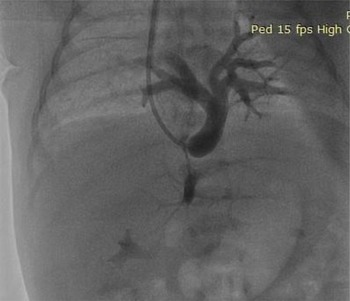
A full-term, one-day-old infant was transferred to our institution from a peripheral health centre in view of cyanosis and suspicion of CHD. The baby weighed 2.3 kg on arrival, had severe respiratory distress, and was deeply cyanosed with an oxygen saturation of ∼55–60%. Given the critical condition on arrival, she was intubated and placed on mechanical ventilation. Arterial blood gas analysis showed severe metabolic acidosis (pH 7.2) and hypoxia (paO2 27 mmHg). Echocardiogram revealed situs solitus, levocardia, and atrioventricular-ventriculoarterial concordance. All four pulmonary veins formed a common chamber behind the left atrium and drained below the diaphragm into the inferior vena cava, via a descending vertical vein with obstruction at the level of the vertical vein-inferior vena cava junction. The vertical vein had a short intrahepatic course and opened almost directly in the inferior vena cava at an acute bend. There was a large patent ductus arteriosus shunting predominantly right to left and a patent foramen ovale with an obligatory right to left shunt. The infant had severe pulmonary hypertension with systolic dysfunction of the right ventricle. She was diagnosed as having obstructed infradiaphragmatic total anomalous pulmonary venous connection and further testing done for a pre-operative evaluation revealed low white blood cell counts with neutrophilia. She continued to remain critical and in severe metabolic acidosis and hypoxia with a saturation of ∼65–70% despite optimal mechanical ventilation, antibiotics, and other support measures. Repeat blood counts showed that the infant had started developing thrombocytopenia (80,000/cumm). Since the infant was unstable and unsuitable for cardiopulmonary bypass, we decided to take her to the catheterisation laboratory to relieve the vertical vein-inferior vena cava obstruction. Vascular access was obtained in the right femoral artery for continuous blood pressure monitoring, and in the right internal jugular vein through which a 5 Fr sheath was placed, and a 5 Fr multipurpose catheter was passed into the right atrium-right ventricle-inferior vena cava-hepatic vein. The opening of the vertical vein was probed with three to four sighting angiograms using dilute radiopaque contrast Visipaque®. The catheter was placed near the opening of a hepatic vein in the inferior vena cava over a 0.014 coronary wire guidewire across the constriction into the vertical vein. The position was confirmed with an angiogram which showed all four pulmonary veins forming a confluence and forming an inverted Christmas tree like pattern to drain through a slender vertical vein (Figs 1 and 2).
All four pulmonary veins forming a confluence and an inverted Christmas tree like pattern to drain through a slender vertical vein. The flow through the vertical vein could not be demonstrated well as the 4 Fr catheter was completely obstructing it.

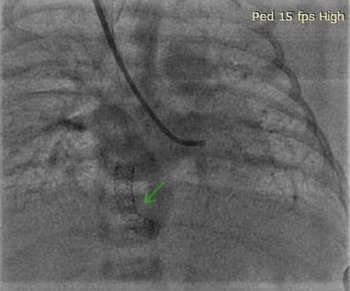
Final stent position.

A premounted, balloon expandable Rebel Platinum Chromium Coronary Stent (4 mm × 20 mm) was passed over the wire and stationed at the vertical vein-inferior vena cava constriction and dilated resulting in almost immediate improvement in oxygen saturation to 80–85%. She continued to remain in same oxygen saturations and the stent remained in place for the rest of her hospital stay. However, due to multiple organ failure and severe sepsis despite optimisation of antibiotics, she ultimately succumbed before undergoing surgical repair.
Discussion
Infradiaphragmatic total anomalous pulmonary venous connection is the most common type of total anomalous pulmonary venous connection that is associated with obstruction, Reference Burroughs and Edwards6 which gives rise to severe pulmonary oedema and pulmonary hypertension and is often refractory to medical management. Surgical correction is the definitive intervention in these cases; however, in preoperatively critical neonates, surgery is associated with high mortality. Reference Yong, d’Udekem and Robertson3 Other factors like sepsis and lower patient weight can further worsen the surgical outcome. All the above factors can lead to a delay in surgery and can prove to be detrimental for the patient. Our patient was critically ill and unfit to undergo an emergent surgery. Sepsis and pulmonary venous congestion were both contributing to her critical state and despite optimal medical measures, she continued to deteriorate. Palliative stenting of the vertical vein improved her lungs and lead to increased oxygen saturations and improved blood gas, but she could not survive fulminant sepsis. It cannot be overemphasised that palliative stent placement can be considered in low weight, critically sick neonates with obstructed total anomalous pulmonary venous connection until they are in a more stable pre-operative condition or have gained weight. It can give time to a neonate to tide over an acute crisis and lead to better surgical outcomes.
Acknowledgements
None.
Financial support
This research received no specific grant from any funding agency, commercial, or not-for-profit sectors.
Conflicts of interest
The authors have no conflict of interest.