




No CrossRef data available.
Article contents
- Extract
- Acknowledgements
- Socialist Transformation and Mnemonic Politics
- Speaking Bitterness: The Violence of Statist Remembering
- Oppositional Practices of Time
- The Said and the Unsaid: Displacing Tibetan Agency
- Constructing Spaces of Memory
- Living Oppositional Testimony
- Contending with Father State
- Negotiating Local Dilemmas and Class Hatred
- Conclusion: Reconstituting Trulku Space-Time and Karmic Justice
- References
“Speaking Bitterness”: Autobiography, History, and Mnemonic Politics on the Sino-Tibetan Frontier
Published online by Cambridge University Press: 07 April 2005
Article contents
- Extract
- Acknowledgements
- Socialist Transformation and Mnemonic Politics
- Speaking Bitterness: The Violence of Statist Remembering
- Oppositional Practices of Time
- The Said and the Unsaid: Displacing Tibetan Agency
- Constructing Spaces of Memory
- Living Oppositional Testimony
- Contending with Father State
- Negotiating Local Dilemmas and Class Hatred
- Conclusion: Reconstituting Trulku Space-Time and Karmic Justice
- References
Extract
In the Tibetan Buddhist monastery town of Labrang, located in southwest Gansu Province, China, the past is a heavy, and very often hidden, burden for residents and visitors alike (figure 1). This is not readily apparent amidst the bustling ‘nowness’ of commercial activities in this tourist site and model town for the profitable coexistence of Tibetan Buddhist monasticism and Chinese state-sponsored development goals. But as I discovered over the course of my fieldwork there in the mid-1990s, and again in the summer of 2002, for a population living with unsanctioned memories of the traumatic ruptures of the Chinese Communist-led revolution beginning in 1949, the ‘unsaid’ of history spoke loudly in implication—in implied dialogue with multimedia official histories, in the gaps in written and oral chronologies of events, in the revived performance of the lay and monastic ritual calendars, and in the dodges and silences of my Tibetan interlocutors during our many conversations about their pasts: “I don't know anything! I'm too young, you know!” (Tibetan [Tib.] ngas shes ni ma red, nga lo chung gi mo). Ama Drolma, a village matriarch in her late fifties, repeated this adamantly to me after I and my Tibetan woman assistant had asked her for a taped interview about local “history” (Tib. lo rgyus). She would hear none of our explanations about my interest in people's personal histories and insisted that I seek out old men, they would know about “early, early, early times” (Tib. sngan na sngan na sngan na).
Information
- Type
- Research Article
- Information
- Copyright
- © 2005 Society for Comparative Study of Society and History
Acknowledgements
I conducted research during three trips to Labrang over a four-year period between 1992 and 1996, with a return trip in 2002. The research was sponsored by the Committee on Scholarly Communication with China, the Wenner-Gren Foundation, a Foreign Language and Area Studies fellowship, a National Science Foundation pre-dissertation grant, the Institute for Research on Women and Gender at the University of Michigan, and the University of Michigan Rackham Graduate School fellowships. Research in 2002 was supported by a Reed College summer research grant. Paid Leave at Reed College was generously supported by the Levine Fund.
Every effort has been made to secure necessary permissions to reproduce copyright material in this work, though in some cases it has proved impossible to trace copyright holders. If any omissions are brought to our notice, we will be happy to include appropriate acknowledgments on reprinting in any subsequent edition.
In the Tibetan Buddhist monastery town of Labrang, located in southwest Gansu Province, China, the past is a heavy, and very often hidden, burden for residents and visitors alike (figure 1). This is not readily apparent amidst the bustling ‘nowness’ of commercial activities in this tourist site and model town for the profitable coexistence of Tibetan Buddhist monasticism and Chinese state-sponsored development goals. But as I discovered over the course of my fieldwork there in the mid-1990s, and again in the summer of 2002, for a population living with unsanctioned memories of the traumatic ruptures of the Chinese Communist-led revolution beginning in 1949, the ‘unsaid’ of history spoke loudly in implication—in implied dialogue with multimedia official histories, in the gaps in written and oral chronologies of events, in the revived performance of the lay and monastic ritual calendars, and in the dodges and silences of my Tibetan interlocutors during our many conversations about their pasts: “I don't know anything! I'm too young, you know!” (Tibetan [Tib.] ngas shes ni ma red, nga lo chung gi mo). Ama Drolma, a village matriarch in her late fifties, repeated this adamantly to me after I and my Tibetan woman assistant had asked her for a taped interview about local “history” (Tib. lo rgyus).1
All names used in this article are pseudonyms. Due to the sensitive nature of this material, I do not give much identifying information about my interlocutors.

Location of Labrang in the People's Republic of China (by the author).
That awkward encounter occurred in 1995, only a few months into my stay in Labrang, and during an early attempt at “collecting” villagers' “oral histories” based on a brief interview schedule. At the time, I thought I had understood Ama Drolma's metamessage to me: as an uneducated lay village woman, she did not consider herself a legitimate narrator of “history.” It was not until much later, when I tried to write about the life-stories I eventually heard from some sixty elderly Tibetans in Labrang, that I realized Ama Drolma was also telling me something crucial about the category of “history” itself.
Socialist Transformation and Mnemonic Politics
In this article, I address the problematic relationship between memory and historiography by exploring the cultural politics of history among Tibetans in the People's Republic of China. The analysis will demonstrate that amidst the persistent efforts of post-Mao Chinese state officials to shape and delimit memory and forgetting among Tibetans, a vigorous alternative historiography flourished in Labrang. I argue that this alternative “practice of time” (Mueggler 2001:7) elucidates local Tibetans' active relationship to a state that many experienced as fearsome and repressive. The Labrang region, considered by Tibetans to be part of a broader cultural region called Amdo, is a particularly important place to consider these issues. Since the great Tibetan lama Jamyang Shepa founded the famous monastery of Labrang Tashikhyil in the Sang river (Chinese [Ch.] Daxia) valley in 1709, Labrang has been both an edge of empires and a powerful center of religious and political economic life.2
This was a time of the culmination of over a century of Tibetan Buddhist Geluk sect administration and cultural hegemony in Tibet proper, thirty years after the death of the great 5th Dalai Lama. In China, the Qing emperor Kangxi was increasing his interventions in Tibetan regions on the peripheries of his empire. Jamyang Shepa founded the monastery at the behest of the Qoshot Mongol prince who ruled the nomadic tribes in that region.
The Sang river valley region was largely Tibetan, but in its heyday the monastery also exercised jurisdiction over populations of Mongols, Salar muslims, Chinese muslims, and Mongours. The monastery was also home to a small number of Mongol, Mongour, and even Han Chinese monks. See Makley 1998; 2002; 2003.
In this context, the radical changes and unprecedented reach of the Chinese Communist Party (CCP)-state during the Maoist years (1949–1980) both highlighted and rendered extremely dangerous any expression of local memory vis-à-vis the ascendant official history of the new nation under Mao. In the post-Mao rush to delimit and purge the suffering of that period amidst the reform-era push to economic development, it was particularly dangerous for Tibetans to publicly remember the Maoist years. Unlike Han Chinese individuals and groups participating in a range of public memorializing activities,4
This is not to say that Han do not experience any limitations and potential political ramifications in memorializing the Maoist years (see, for example, Schwarcz 1994; Watson 1994b; Judd 1994). Yet since the early 1980s Han citizens could participate in conferences and publish fiction and autobiographical memoirs (i.e., the “wounded literature” and “seeking roots literature” movements). For important overviews see Schwarcz 1992, and Dai 1996. For paradigmatic examples of Han literature memorializing the Maoist years see Feng Jicai 1991. For ordinary Han villagers' memorialization practices that protest atrocities committed during the Cultural Revolution see Jun Jing 1999.

View of Sang river valley looking east. Labrang monastery is at lower right, Labrang town and Xiahe County seat upper left. Summer 1993 (photo by the author).
It is perhaps not surprising then that in decades of international contests over the national status of Tibet, Chinese state agents and dissidents abroad have all presented memories elicited from Tibetans, most often in the form of first-person narratives, as authentic historical evidence in opposition to what are considered to be the politically motivated silences of opponents' histories of the Maoist years in Tibetan regions.5
This is a vast literature. Tibetans in exile typically worked closely with Americans or Europeans to produce autobiographical accounts of CCP intervention in Tibetan regions. As Hugh Richardson pointed out, the Dalai Lama himself spearheaded the move to oppositional personal accounts in exile (1960), and his older brother quickly followed suit (Norbu 1960). See also International Commission of Jurists 1960 for a compilation of refugee accounts; Taring 1970; Gompo Tashi 1973; Trungpa and Cramer 1977; Dhondup Choedon 1978; Norbu 1986 [1979]; Tashi Khedup 1998 [1986]; Dawa Norbu 1987; Sakya and Emery 1990; Tenzin Palbar 1994; Kunga Samten 1997; Tashi Tsering; Goldstein and Siebenschu 1997; Ama Adhe 1997; Palden Gyatso 1997. Accounts produced under Chinese government auspices have been equally numerous in both Chinese and English. They can be found as core components of most literature produced for foreign audiences, but see, for examples, Anna-Louise Strong 1959; Israel 1983; and Liu Qizhong and Chen Gengtao 1991.
As Jacquelyn Hall points out, this move was particularly important among feminist historians and literary theorists (1998:462).
But as many theorists have pointed out, the opposition between “memory” (or subjective accounts of the past) and “history” (or objective accounts of the past)7
Note in this regard academic historians' traditional abhorrence of the first person in constructing their accounts. As Hayden White put it, in this way, the objectivity of the narrative is defined by the absence of a narrator; no one speaks, and events tell themselves (1981:3).
I address these issues by considering the elderly Tibetans' stories I heard in 1995 and 2002 not as reified individual memories revealing a repressed “history” of Labrang, but as interactions in which we all participated in the on-going construction of a collective local memory of the painful years of socialist transformation in Labrang. I draw on the work of linguistic anthropologists and literary theorists who treat narrative as a fundamental speech genre in which people work together to order relationships between selves and others in space and time by placing them in the unfolding plot of a story (Volosinov 1986 (1929); Bakhtin 1981 [1937–1938]; Ricoeur 1981; White 1981; Hanks 1989; Tedlock 1995; Ochs and Capps 1996).8
Elinor Ochs and Lisa Capps argue that narrative is a fundamental speech genre because it is culturally universal and emerges early in childhood speech development. Provided only that they present sequences of events, Ochs and Capps assert that the term “narrative” covers verbalized, visualized, or performed versions (1996:19).
Ama Drolma was not the only Tibetan villager in Labrang who rejected my early requests for interviews on local history. When like others she adamantly declined, she was not refusing just to narrate a fixed but hidden “history.” She was denying some of the crucial historiographic assumptions embedded in the terms of our discourse and in the interview genre of interaction that I had proposed. Even though in other long conversations she had readily talked with me about being born and raised in Labrang, about her family and village affairs, here Ama Drolma refused the requirements of being the subject of testimony. As Charles Briggs has argued, the ubiquitous and unexamined nature of interview practices in contemporary societies both contributes to and masks the crucial role of this discourse genre in recruiting people to produce objective, and therefore authoritative knowledge. In his view, interviews attempt to control the type of narrative elicited from interviewees by asking for metalinguistic statements in which selves must stand apart from experience and report, describe, and evaluate (1986:2). Further, in the case of eliciting historical knowledge, interviews most often ask for first-person narratives providing valued “real history” (White 1981:5), that is, a subject's experiences only as they pertain to historical events in a particular chronology of calendrical time (cf. Gyatso 1998:109).
Acting as a foreign social science researcher seeking an “objective” story of the recent past in Labrang, I had not fully realized the particular historicizing power of the interview in that milieu. In the context of the overwhelming might of the Chinese Communist state since 1949 in those regions, and the state's foundational narrative of a traumatic, revolutionary rupture between past and present, interviews have been associated for Tibetans with both the obligation and the felt need to provide testimony. Testimony could be seen as a now transnational type of first-person narrative that takes on powerful legal and moral weight in the context of a perceived crisis of truth related to past, often traumatic events and the legal agencies of nation-states.9
Shoshanna Felman and others have argued that testimony as a discourse genre became a pervasive and powerful political tool internationally after World War II especially, when survivors of Nazi atrocities were asked to testify as witnesses to war crimes. Elie Weisel, cited in Felman, even stated that “our generation invented a new literature, that of testimony” (Felman and Laub 1992:6).
In these narratives, speakers are required to take a particularly marked stance toward their stories—they must (implicitly or explicitly) evaluate the past events and agencies they describe and they must promise to authorities that their speech is material evidence for the truth (Felman and Laub 1992:5). Ama Drolma's expectation that this was the type of speech genre in which she was being asked to participate perhaps explains why she immediately assumed, when I tried to explain that I was interested in what had changed in Labrang, that I wanted her opinion on which was better, life “before” or life “nowadays.” In effect, narrators of testimony must present as self-conscious, individual selves and then publicly attest to the “autobiographical pact”: that the narrating self and narrated sel(ves) are one and the same (Gyatso 1998:107; Crapanzano 1996:109), all the while anticipating potentially serious consequences for their speech acts.
As I mentioned above, collecting testimonies from Tibetans about Chinese state repression has been a widely assumed role among Westerners, and the appeal of such a stance was perhaps not lost on me. In the transnational participation framework of the genre, one can style oneself a seeker of the truth, and assume that this will produce an alliance with Tibetans. But the danger is that any provisional cooperation achieved within the genre can obscure crucial differences in participants' subject positions, notions of personhood, and worldviews, and turn foreigners' attention from the importance for locals of other (multimedia) forms of metacommunication about the past (Briggs 1986:2; Hall 1998:440; cf. Germano 1998). Ama Drolma's refusal (and those of many others) made it clear to me that Tibetans in the PRC do not necessarily share Westerners' faith in the moralizing historiography of testimonials.10
As Hayden White put it, Western historical self-consciousness is only possible with moral reference to social or legal centers as the true subjects of “proper histories.” In this way, he argues, “every historical narrative has as its purpose the desire to moralize” (1981:14).
Speaking Bitterness: The Violence of Statist Remembering
Indeed, the state-sponsored violence Tibetans in the valley experienced during successive social reform and anti-rebellion campaigns beginning in 1958 was largely narrativized by Chinese state cadres as a battle for their self-consciousness as participants in the nation's linear historical trajectory now under the proper guidance of the Communist Party (cf. Duara 1995; Dreyer 1976; Wen Ho Chang 1989; Chang 1997; Cheek 1997).11
To list only the main campaigns that directly affected ordinary Tibetans in Labrang: “Democratic Reforms,” including class labeling and land reform (1957–1961); the Great Leap Forward (1958); anti-feudalism campaigns (1958–1962); Socialist education campaigns (1962–1966); and the Cultural Revolution (1966–1968).
In interviews with state agents, and at compulsory group meetings, Tibetans were required to produce and listen to testimonials of their participation in the Communist-led revolution, that is, life-stories attesting to their consciousness of past class-based oppression in the “Old Society” (Ch. jiu shehui, Tib. ءjig rten rnying pa) and their present “liberation” (Ch. jiefang) in the “New Society” (Ch. xin shehui, Tib. ءjig rten gsar pa).12
These included life stories produced in a wide variety of mandatory speech events such as statements made at small group (Ch. xiaozu) discussions, in interviews, self-criticisms and most dramatically, in public “struggle sessions” (see figure 4).
Mao first elaborated his theories of revolutionary self-consciousness, the proper didactic relationship between the party and the emergent category of the “masses” (Ch. qunzhong, Tib. mi dmangs), and the most effective means or media through which to implement these in 1942–1943, during the Yan'an years (Wen Ho Chang 1989:28). Uses of revolutionary testimonials were already being developed and modified during Communist work-team-lead land reform and socialist education campaigns among Han villagers in the “liberated areas” prior to 1949 (e.g., Hinton 1966; David and Isabel Crook 1979; Chan et al. 1984; Friedman et al. 1991). In the Labrang region, neighboring Han Chinese counties underwent the land reform process in 1952–1953, five years before Labrang (Gainan Gaikuang 1987). Early speaking bitterness narrative practice was arguably the grounding structure for the highly stylized violence of struggle sessions during the Cultural Revolution.
These narratives were visualized and exhibited in emerging forms of socialist realist mass media, including ubiquitous propaganda posters (see Evans and Donald, eds. 1999), but also in traveling exhibits by the early 1960s of life-sized clay models of various scenes of horrific bodily exploitation of peasants by feudal landlords, such as the exhibits “Rent Collection Courtyard” and “Wrath of the Serfs” (China Reconstructs 1967; China Reconstructs 1976; cf. Harris 1999:130).
Yet unlike for many Chinese villagers elsewhere, or for the few local Tibetans who sought training as cadres in the new regime,15
These included the handful of young Tibetans who had joined the CCP early, local Tibetan leaders, and young people who had to attend short-term training classes at the Northwest Nationalities Institute in Lanzhou (Huang Zhengqing 1989; Xiahe Dangshi 1991). According to the school's statistics, before 1966 the Cadre Training Class graduated forty-one classes and several thousand “minority cadres” from all over Gansu and some from Qinghai. (Xibei Minzu 1984).
CCP-organized propaganda and work-team efforts were underway in the Labrang region from at least 1949 on, and Apa Alo, the head of Labrang's militia and older brother to the late Jamyang Shepa, had accompanied a troupe of 100 performers from Beijing on the Northwest Solicitation Delegation on a tour of Tibetan regions in spring 1950 (Huang Zhengqing 1989:76). Presumably, some locals were exposed to dramatized forms of “speaking bitterness” narratives then. But the 1958 campaign was the first time they were widely experienced as testimony in earnest.
A glimpse at the content of such narratives can be found in a 1958 diatribe from Qinghai printed in the state-run magazine Nationalities Unite. In it, the author says he was a monk for ten years, and asserts that at that time monks and lamas were shameless: there was “not one who has not violated a woman, not one who has not violated the young monks. They are all like beasts” (International Commission of Jurists 1960:61; also see Strong 1959). See Ama Adhe 1997 and Palden Gyatso 1997 for similar accounts of the rapid move in Khams (spring 1956) and Tibet (summer 1959) from the meetings introducing “Democratic Reforms” to abusive uses of “speaking bitterness” narratives in struggle sessions. The Panchen Lama, in his courageous 1962 petition criticizing errors made by local cadres in Tibetan regions in the 1950s, argues that one of the main “mistakes” in the introduction of “Democratic Reforms” was the rapid move from a few perfunctory meetings to mass struggle sessions and arrests (1997:12).
These numbers were reported by Alak Tsayi tshang in an interview with Warren Smith. The Alak, also known as Tenzin Palbar, is a well-known incarnate lama and former monk at Labrang who was arrested and imprisoned at this time. He states that of the total monks, 2,000 were arrested. Of those, 800, mainly elite monks and high lamas, were imprisoned and the other 1,200 were placed in “reform through labor” (Ch. laogai) camps. According to him, only 200 of the original 2,000 survived hard labor, torture, and imprisonment. He himself survived and fled to India in 1987 (Smith 1996:482; cf. Tenzin Palbar 1994). Note that many younger lamas, at least those who had not openly defied state agents, were placed at this time in “cadre training classes” at the Northwest Nationalities Institute in Lanzhou.

Detail from life-size clay sculpture exhibit “Wrath of the Serfs,” Lhasa Museum of Revolution, 1976. Depicts a monk pushing a boy into a box, to bury him under a new monastery as a “sacrificial offering” (photo courtesy Clare Harris).
Oppositional Practices of Time
Of course, traumatic rupture notwithstanding, this was not a case, as some more romantic notions of popular “memory” versus rational “history” would have it, of an unself-conscious people finally becoming aware of history and thus entering (voluntarily or not) the “modern” world (i.e., Nora 1989; cf. Kansteiner 2001:183). Tibetologists have noted the centuries-old avid interest of Tibetan scholars in a wide variety of historiographic genres, a preoccupation that distinguished them from their models in Indian literary traditions (Van der Kuijp 1996:40; cf. Gyatso 1996; Robinson 1996).19
Leonard Van der Kuijp notes that fragments exist of the earliest Tibetan historiographic works from the seventh through ninth centuries. Evidence uncovered in the Dunhuang caves suggests that historiographic texts survived throughout the so-called “dark age” with the persecution of Buddhism in central Tibet. These early texts reveal an intense interest in record-keeping including royal and family genealogies and archives. By the eleventh and twelfth centuries, historiographic genres had coalesced in several main forms: records (Tib. lo rgyus), royal chronology (rgyal rabs), and religious chronicle (chos 'byung) (1996:42). In addition, an alternative literary tradition developed around this time of “treasure literature” (Tib. gter ma), in which “treasure finders” (Tib. gter ston) make the crucial historical claim that they have discovered objects or texts written or left by lamas in the past, and that they themselves have the authority to transmit them (Gyatso 1996). This mode of historiography, as David Germano argues, has taken on new importance in some Tibetan regions in the PRC (1998).
Gyatso argues that this was probably the case since the advent of Tibetan writing, but an interest in forms of autobiography exploded after the Great 5th Dalai Lama published his three-volume account in the seventeenth century.

“Speaking bitterness” meetings on grasslands west of Labrang, c. 1958. American writer Anna Louise Strong took these from an exhibit in Beijing. Captions are from her pro-CCP book, Tibetan Interviews (1959).
In fact, Tibetans' reverence for life-writing exemplifies a fundamental orientation of selves and agencies to time and space that was operative among Tibetans in Labrang, and which I argue crucially structured their alternative “mnemonic communities” (Kansteiner 2002:189) under Chinese rule. Tibetan accounts described the lives of individuals presented almost exclusively as acting according to Mahayana Buddhist principles of altruism, and, as fully enlightened persons, their lives were meant as models for others (Gyatso 1998: 103).21
Hence the Tibetan names for the genres: rnam thar, meaning fully liberated from the transmigration of samsara, and rang rnam, the self-account of such a person. Gyatso also points out that in practice these two forms of life-writing were closely linked, since biographies were often dictated to disciples by lamas, and autobiographies were often edited by disciples.
In Labrang, the central role of the famous Geluk sect monastery meant that the most exemplary of individuals were incarnate lamas or trulkus (Tib. sprul sku)—men considered to be incarnations of deities or previously enlightened lamas. As such, they were quintessential Tibetan historical agents. As enlightened beings, trulkus' life stories construct the biographical person as grounded in the absolute time of the pure Buddha Dharma (Tib. chos) while he, in order to aid sentient beings trapped there, intentionally inhabits successive mortal bodies within the relative time of karmically conditioned history. Importantly, this altruistic positioning between absolute and relative time and space is what leant incarnate lamas awesome and ultimately unintentioned power over the mundane world of karmic causation (Tib. ءjig rten), and hence it was the basis of their charisma for locals and of their authority to guide and to teach (cf. Keane 1997:11). For Tibetans in the Labrang region, selves were fundamentally constructed in a Buddhist cosmology through their worship of lamas.
The last of Labrang's ruling trulkus who reached adulthood before CCP intervention was the fifth Jamyang Shepa. The main Tibetan biography for him, written by the lama scholar Shabdrong tshang (1896–1960) in the early 1950s,22
I obtained this text from the woodblocks in the library at Labrang monastery. Neitupski (1999) refers to a condensed biography of Jamyang Shepa by the same author, printed in 1948 in Nanjing, but this text includes the account of the enthronement of the 6th Jamyang Shepa in 1952. This text was not carved on woodblocks until the 1980s after Labrang monastery was re-opened. Shabdrong Tshang was arrested in Lhasa after the uprising there, and died while being transported back to Amdo in 1960. I am grateful to Amdo Lekshay Gyamtso for his excellent index of the text and for his invaluable help in translating portions of it.
Shabdrong's erasure of such a pivotal event for Chinese state historiography in his life story of Labrang's main lama exemplifies a Tibetan “oppositional practice of time” (Mueggler 2001:7) that had arguably emerged since the monastery was founded in symbiosis with the ascendant Qing dynasty in this frontier zone. Crucially, such life stories were not presented as “myth.” Instead, they often leant the narrative force of eyewitness to strong claims to historical truth; their practical efficacy for local Tibetan readers or listeners depended on this historicity (Gyatso 1998:9).23
Shabdrong frequently uses the first person pronoun (Tib. kho bo) to record his presence at key events in Jamyang Shepa's life. Further, as Gyatso points out, most Tibetan life-writings were intensely concerned with dating events, often to the day and time of day, in a chronological sequence of the life (albeit according to lunar calendars keyed to crucial ritual events) (ibid.:108).

Images of local trulkus and deities for sale in Labrang street market. Largest photos: left: Gongtang; right: current Jamyang Shepa, a layman, Summer 1993 (photo by the author).
The Said and the Unsaid: Displacing Tibetan Agency
In mid-1990s Labrang, these interpretive politics and the violence that constituted them just a few decades earlier heavily structured both the said and the unsaid—in everyday interactions, as well as in dealings with foreign researchers like myself. Under the Chinese Communist party regimes of the post-Mao “reform and opening up” period (Ch. gaige kaifang), the official media of memory in Tibetan regions still insisted, under pain of arrest and interrogation, on the basic historiographic parameters laid out in Maoist “speaking bitterness” narratives.24
Official history was presented in Tibetan regions in such multimedia forums as National Day celebrations and various anniversary ceremonies commemorating the glory of the early CCP and its state-building efforts (cf. Schwarcz 1992). Television shows, by 2002 widely viewed by villagers in Labrang, focused on heroic underground CCP workers and the victories of the PLA over corrupt KMT officials and rapacious feudal landlords. Official written histories of the Labrang region and Gannan Tibetan Autonomous Prefecture have been rife since the late 1980s. These accounts, usually in the context of encyclopedic “local gazeteers” (Ch. difang zhi or gaikuang), emphatically make the PRC the subject of a national history (cf. Duara 1995), posing 1949 as the pivotal point in the narrative, and erasing almost anything about the suffering of ordinary Tibetans in the 1950s especially. Unlike in some accounts of Han regions, the events of the Cultural Revolution are most often skipped in official chronologies for Tibetan regions (Ch. dashi ji). When the Cultural Revolution is mentioned, as elsewhere, it is strictly limited to an agentless “ten years of chaos” (Ch. shinian dongluan) between 1966 and 1976, when “leftist errors” were made (see Luo Faxi et al. 1987; Li Shangcheng, ed. 1987, Ma Jiang, ed., 1993; Xiahe Xian Zhi 1997; Gannan Zhou Zhi 1999).
Du Pengcheng was a Han Chinese Xinhua reporter and member of the all-Han first temporary party committee established in Labrang in August 1949. As he put it in his first-person account of the “peaceful liberation” of Labrang, from the day the party committee was founded, “Xiahe's history began a new chapter” (1991:28).
In this light, the full import of Ama Drolma's temporal opposition to my request for an “oral history” interview in 1995 becomes clearer. She insisted that she was too young to “know history,” yet she was born in the early 1940s, several years before the People's Liberation Army (PLA) marched in and “liberated” Labrang. She lived her adult life under Chinese rule. Thus against our use of the Tibetan term for “history,” “lo rgyus,” which recalled its recent redefinition as a gloss for the Chinese “lishi,” Ama Drolma insisted on referring lo rgyus to a time, emphasized in her repetition of the time-word “early, early, early,” well before Chinese Communist intervention in Labrang, when the region was under the authority of what elders commonly referred to as bla ma dpon po, (Tibetan) lamas and lay male leaders. In this way, she erased the Maoist years as narratable “history,” referring narrative agency to old men, those traditionally charged with transmitting local lore, and thereby avoiding the danger of testifying to her personal experiences therein.
Ama Drolma and other elders who refused in similar ways to be interviewed about recent history no doubt had a range of personal motives for doing so.26
Another striking example of this denial was my struggle to interview the only woman trulku in the region, Alak Gungru tshang (b. 1936), now a cadre in the county government in Labrang, She was almost the same age as Ama Drolma, and had been a teenager in 1949. She carefully listened to my proposal to interview her, questioning my motives, and refused to be interviewed in person. Instead, she took my list of questions, and returned to me several weeks later a carefully written account in Tibetan of the lineage of Gungru lamas. Her written account made no mention at all of the CCP takeover or her activities as a lay cadre in the new regime, and she explicitly explained to me that that was impossible (Tib. mi nyan gi).
Van der Kuijp states that the first known instance of the term lo rgyus occurs in the eleventh century in an emerging historiographic genre that presented events, largely in verse, in the course of a narrative and only in rough chronological sequence. This is very different from how the term has been used by Tibetans in post-Mao China (1996, cf. Gyatso 1996).
I have talked with hundreds of laypeople throughout the main villages surrounding the monastery, as well to monks and nuns in Labrang, over the course of my fieldwork there. But I refer here only to those Tibetans born before 1949 (people in their mid-forties and older) who told detailed stories of their lives. Of those, there were twenty-six men (three monks and seven former monks, including one incarnate lama), and twenty-eight women (three nuns). The majority, over thirty of them, were sixty and older.
When I finally gave up my attempt to explicitly control the type of historical narrative locals produced, I was able to appreciate not an objective flow of events to which Tibetans were mere witnesses, but the particular ways in which differently positioned locals actively imagined, and thereby helped to constitute, the structuring power of the state in their lives past and present, even as some explicitly resisted it (cf. Mueggler 2001:4). Importantly, the main elements of these processes were pervasive among Tibetans, regardless of their positioning vis-à-vis the new regime in the transition years. As I myself, in order to participate, began to partake of the categories structuring the life stories Tibetans offered, I shared in an on-going process by which Tibetans appropriated the narrative forms and historiographic premises of the “speaking bitterness” discourse genre to construct alternative arrangements of selves, agencies, and moralities in space and time, often doing this even if their accounts were not posed in conscious opposition to official histories.
As we have seen, the socialist transformation of Labrang was not a simple process of cadres giving locals a self-consciousness where none existed. Instead it amounted to an imposition, simultaneous with many rural Tibetans' experiences of radical disenfranchisement, of new socialist realist metalinguistic practices through new media of memory that were deployed to usurp existing ones. Marxist historiography in Maoist practice required people to express themselves as radically social; that is they were to see themselves as constituted exclusively by historical forces immanent to socioeconomic structure (Dirlik 1978:9; Unger 1993:2). Their representations of self-process were thus expected to strictly imitate observable, “material” changes in social relations, that is, class conflict, that inevitably moved forward towards socialism.
Perhaps the crudest forms of usurping media of memory beginning in 1958 in Labrang simply involved replacing one central chronotope for another in local practice, such as replacing tantric representations of lamas and deities with realist depictions of Mao in the honored high places on household and meeting hall walls (cf. Harris 1999:120) (see figure 4).29
CCP recognition of the dangerous power of Buddhist chronotopes for Tibetans is perhaps indexed in the 1950s in Tibetan translations designated for Western/Marxist philosophy adapted by Maoists. For such concepts as objectivity and subjectivity, about which Indo-Tibetan Buddhist philosophy arguably spoke reams, Maoist translations instead drew their neologisms from colloquial Tibetan (Tsering Shakya 163:1994).
Importantly, “speaking bitterness” narratives have been state officials' response of choice in the face of Tibetans' oppositional practices in public spaces up to the present.30
“Speaking” and “remember bitterness” campaigns were central throughout the Maoist years in Tibetan regions. Dhondup Choedon's account of life on a commune describes ritualized drinking of thin, “remember bitterness soup,” and states that clay models of abject victimization by Tibetan feudal lords and monks were displayed to them even before the official exhibit was set up in Lhasa (1978; cf. Dreyer 1976; Harris 1999) (see figure 3). Recently, standard speaking bitterness narratives have been the backbone of Chinese State White Papers on Tibet (party-line policy papers for foreign audiences) between 1992 and 2001.
In several of the first-person accounts of the Cultural Revolution by Han workers in Feng Jicai's collection, the speakers laugh embarrassedly to their interviewer about the silliness of their devotion to Mao at that time. Anagnost, citing Chan et al 1984, refers to Han youth joking and smirking at old people's speaking bitterness narratives as early as the mid-1970s (1994:273).
But the stark polarities of subjects and motivations generated by the use of such stories and resistance to them can obscure the painfully subtle mutual constitution of state and local subjectivities that actually shaped socialist transformation in Labrang, as well as Tibetans' memories of it decades later. For one thing, by the 1990s Tibetans widely assumed the (limited) validity of a social-scientific time-space posited in Marxist historiography. The almost exclusive focus among Tibetans on life-stories of enlightened individuals had given ground to widespread acceptance of the idea that ordinary people's lives revealed important information about the nature of society,32
Harris (1999) documents this process visually, noting that before 1959 realist paintings and self-portraits of lamas, not to mention depictions of ordinary Tibetans' lives, were almost unheard of. In Amdo, especially, the 1980s saw an explosion of vernacular literature depicting ordinary lives, including first-person accounts (Tshering Shakya 2000; Upton 2000).
Yet I also found that through the subtle processes of language choice in everyday talk, locals also persistently set themselves apart from the socialist realist time-space introduced by the Chinese communists. In my conversations about their pasts with elders variously positioned vis-à-vis the state, all would regularly insert Chinese loanwords in otherwise Tibetan language talk for events and concepts indexing major spatiotemporal changes during the socialist transformation of Labrang. The type and frequency of loanwords varied with a narrators' status in relation to the state. Rural Tibetans most often inserted words for the spatial organization of the commune system and its leadership, such as dui (team), dadui (brigade) and she (commune). Cadres and former cadres used more, inserting Chinese terms for major events especially, such as jiefang (liberation 1949) and panluan (Tibetan rebellion 1958). In the case of one elderly Tibetan man, a retired highly placed county party official, in the midst of a long Tibetan language conversation about local custom, he switched to Chinese completely to describe his career as a state cadre during the transition years.
On the Sino-Tibetan frontier, such unconscious language shifts are themselves historical markers; they are echoes of encounters with a state discourse that was imposed in Chinese by Han officials in opposition to local Tibetan discourses. In the words of Ochs and Capps, “as narrators shift between [linguistic] codes they iconically represent the radical displacements that define their life history” (1996:27; cf. Hill 1995). Indeed many of the local Tibetans who went on to play important roles in the new regime in Labrang, including the party official just mentioned, were those who had secular, Chinese language education prior to the Communist victory,33
Secular schools were first established in Labrang in the late 1920s when KMT officials established the new county of Xiahe seated there. Many of the Tibetan graduates went on to study in Nanjing and then to become cadres in the KMT and later CCP regimes (see Gu and Lu 1935; Ma Haotian 1942; Huang Zhengqing 1989; Upton 1999).
Note that my interlocutors were not necessarily doing this on purpose. One old village woman, whose account of her experiences of socialist transformation in Labrang was one of the most directly oppositional, was surprised to hear in conversation with me that the term “duizhang” (team leader) was not Tibetan, but Chinese.
Constructing Spaces of Memory
Traces of the alternative histories embedded in unconscious language choice could be encountered throughout public spaces in post-Mao Labrang. But conscious alternative historiography was relegated to private (Tib. sger) frameworks, refigured in contradistinction to state-mediated public spaces first imposed in the 1950s. This largely meant conversations kept within a network of trusted familiars in the informal gathering places of households and monks' quarters. This was strikingly apparent in my conversations with Apa Dondrup (age fifty) and his wife Ama Deji (age fifty-four), farmers in one of the main villages. They did not tell me detailed stories of their experiences of the Maoist years until many months into our friendship. Then, as we sat comfortably next to their stove and ate one day, they emphasized how the first mandatory meetings under CCP auspices were held in 1958 in their village manikhang, the small temple and communal space devoted to the invocation of village protector deities originally tamed to the service of Buddhism by Jamyang Shepa. In their subsequent description of the meetings, both Apa Dondrup and Ama Deji used only the new label given to those spaces at that time—zhungkhang, or state/public meeting halls.
Before they were all destroyed during the Cultural Revolution, the zhungkhang were focal points for state-local encounters during “Democratic Reforms” in the 1950s, centers for the rapid re-spatialization of the valley's population into militarily loyal collectives (i.e, “production teams,” shengchan dui, and “production brigades,” shengchan dadui) working state-arbitrated public property (Tib. gzhung, Ch. gongjia) for the public good.35
Most likely due to the ongoing clout of the monastery, the Labrang region was spared widespread collectivization efforts until after military intervention to put down Tibetan resistance. Then, in September 1958, Gannan was the first region to implement full communes in Gansu (Li Shangcheng 1987).
Importantly, many elders across the community narrated this period as a time when state and local agents suddenly acted according to motives inexplicable at the time, a time when all villagers knew that survival in the face of public pressure to reconstitute themselves on narrative premises they did not understand required a drastic split between narrating and narrated selves, between the heart (Tib. khog, sems) and the mouth (Tib. kha).36
The Panchen Lama, in his 1962 petition to the central government about treatment of Tibetans during the campaigns of the 1950s, argues that one of the biggest mistakes of the time was the pressure on Tibetans to produce disingenuous speech, which was taken as literal truth by Han leaders. See Dondup Choedon (1978) and Palden Gyatso (1997) for compelling accounts of local Tibetans' initial bewilderment at the premises of “speaking bitterness” stories, and the subsequent process of learning to produce valued forms of conventional speech against personal convictions.
In the 1990s then, the shift from Maoist attacks on inter-household ties and the consequent extreme dependence on the state to inter-household competition in the reform era market economy had heightened the insularity of household and village groupings in Labrang.37
In this Tibetans are not unique. This legacy of the Maoist years and the transition to market reforms has been documented in communities throughout China (cf. Chan et al. 1984; Friedman et al. 1991).
In this context, I could not help but enter Tibetans' private conversations about the past at the highly charged juncture of two historiographic genres—elders' traditional oral transmission of local lore (cf. Briggs 1986:83) and the more recently emergent genre of oppositional testimony to “foreigners” (Tib. phyi rgyal pa), a racialized category of favored alien others that Tibetans used to refer to white people they assumed to be both highly educated and sympathetic to Tibetans. For many elders, a foreigner who spoke Tibetan was a powerfully therapeutic opportunity—in the midst of a sense of local distrust and ignorance to speak to such a high status outsider about their pasts. Amnye Gompo, a well-respected village patriarch and former monk in his seventies, agreed to tape an interview with me (one of only two elders, both men, who did) largely due to his great pride in being asked to talk about local lo rgyus, associated for him, as it was for Ama Drolma, with a time safely prior to Chinese intervention.38
To be sure, I was also a foreigner vouched for by his close familiar, my research assistant. That interview was punctuated by ongoing conversational awkwardness as Amnye Gompo's desire to hold forth on the past in his own terms clashed with the controlling interview questions of my research assistant as she read from the schedule I had prepared.
Living Oppositional Testimony
The most intense (and dangerous) conversations were those in which certain elders took the opportunity of an apparently well-meaning foreign listener to offer bitter stories of the suffering they experienced and witnessed during the Maoist years. The powerful expectations of and almost compulsive need for oppositional testimony hit home for me when many elders launched with great emotion, even tears, into such stories upon learning I spoke Tibetan, and with little introduction to me, sometimes before I had even expressed an interest in local history at all.39
Of the twenty-five oppositional testimonials I heard, seventeen were offered almost immediately after we met. My experience was perhaps a pale echo of those of The Panchen Lama and Apa Alo, who both described similar reactions when the two separately traveled to Amdo regions to talk with Tibetans in 1961. Such repressed emotion also exploded when the Dalai Lama was allowed to send delegations to Tibetan regions in the late 1970s. In Labrang, crying locals swamped the first delegation that arrived in 1979, embarrassing the state cadres handling them (cf. Avedon 1984:333).
In this, locals were participating in a countermove that had been conventional abroad since Tibetan exiles began writing counter-versions of speaking bitterness narratives in exile (see note 5). By the 1990s in Labrang, Tibetans across the community were arguably well aware of the existence of this counter-genre. Perhaps the perceived direct threat to core premises of the Communist Party's legitimacy expressed in speaking bitterness narratives explains Mao's eventual angry response to the Panchen Lama's 1962 report, titled “A Report on the Bitter Sufferings of the Masses (Ch. qunzhong de jiku) in Tibetan Regions.”
These encounters, as I discovered, were not at all a matter of a simple “liberation” of a repressed, monolithic “Tibetan” voice. Instead, as narrators recruited me to participate in their narratives, knowing that I moved through the community talking with a variety of people, I found myself awkwardly caught up in a bitter class politics among Tibetans. This I would argue was the most profound of the hidden legacies of the Maoist years in Labrang, differentiating Tibetans in the 1990s in ways not accounted for in “speaking bitterness” depictions of class struggle. As Ann Anagnost and others have pointed out, those narratives sought to constitute villagers as first and foremost class subjects; they were part and parcel of the class-labeling process that simultaneously marked locals' most important social status in the new regime and posited it as the locus of deepest inherent conflict (1994:263; cf. Hershatter 2001). For Tibetans in Labrang, this was as alien a concept as it was for most Han villagers, expressed by an awkward neologism that directly follows the Chinese, gral rim 'thab rtsol for jieji douzheng, itself a neologism directly glossing the English, “class struggle” (Shakya 1994:160).41
Jaschke's etymology of the Tibetan term gral rim asserts that it originally meant “rank.” Gral meant “class, row, series, especially of a row of seated persons.” Gral rim was used to mean “claim” or “title,” and speakers would not have characterized it as “high” or “low” (Tib. mtho/dma') in the manner of Marxist usage. Thus this new usage indexes the very different space-time of a Communist worldview.
Mao of course radically reworked Marx's notion of class in his efforts to apply it to rural China (cf. Dirlik 1978; Anagnost 1994). When the rote forms of class struggle were angrily implemented in the Labrang region, this meant not delineating the owners of the means of production, but subsuming the intricacies of ethnic difference under a schema of economic difference by associating all forms of lay and monastic wealth with the feudal exploitation of “serfs” (Tib. mi ser). In this framework, all types of high social status, such as that of lamas, or anti-state resistance, such as that of local Tibetan men who took to the hills in 1958, could be assimilated to an economic model of exploitation regardless of actual personal wealth, and locals found themselves interacting as members of “classes,” from serf-owning landlords and their agents, to rich and middle class traders, farmers, and nomads to the small percentage identified as poor serfs (cf. Dhondup Choedon 1978:32). These last, including women and former monks, were among the first Tibetans that Han work-teams cultivated, and throughout Tibetan regions they were among the first Tibetans, voluntarily or not, to “speak bitterness” against local Tibetans identified as “class enemies” (ibid.).
Those elders who risked the political dangers and chose to narrate to me dissenting testimonials of that time—twenty-five of a total sixty—were those who felt themselves to have been grievously victimized in this process, either targeted and attacked as class enemies, or as farmers and nomads at the time they found themselves at the bottom of a practical chain of command that left them powerless to resist change.42
Of those twenty-five, only three were cadres at the time (one woman studied in Lanzhou but did not become a cadre). During the Maoist years, ten were labeled class enemies (struggled for being a monk, landlord, rich trader, or rebel) and the rest were farmers. There were fourteen men and eleven women, their ages about evenly distributed between fifty and seventy years old.
Thus, in the very regular forms such narratives took, in the patterns discernible in both the said and the unsaid, I could glimpse the emotional toll such unresolved violence had taken on the entire Tibetan community. The burden of the Maoist years in Labrang was fundamentally an ongoing contest over the nature of human agency and morality. I came to realize that the unspeakable among Tibetans was not just the product of state repression; it was also a marker of locals' grapplings with the nature of their own and other Tibetans' agency in (and responsibility for) the unprecedented shape and scope of violence beginning in 1958. Bolstered by public evidence of their contemporary Buddhist piety,43
I originally met many of these people while walking the circumambulation path around the monastery. Most of them undertook three to four circuits of the monastery each day, taking several hours to do it.
In this light, perhaps the loudest silences within these oppositional testimonies make more sense. Of all these accounts, only a very few came close to describing the actual content of public “struggle” sessions or “speaking bitterness” accusations, and no narrator mentioned the Chinese names or goals of campaigns nor explicitly reiterated any fragment of Marxist ideology. On one hand, given the massive quantities of Marxist media (in Chinese and in Tibetan translation) imposed on the valley beginning in the 1950s,44
Tsering Shakya notes that monks at Labrang were recruited as early as 1950 to translate Chinese policy documents and speeches for the first Tibetan language newspaper in Amdo (1994:158).
Note that three of these narrators had themselves been low-level state cadres during the Maoist years, and therefore presumably used Maoist/Marxist state discourse in their daily duties even before the Cultural Revolution.
Instead, elders' dissenting accounts dialogued by implication with those of “speaking bitterness” class struggle sessions. They did this by asserting a very different chronology of pivotal events that reversed the moral consequences of revolution, ignoring 1949 and making 1958, the very year “speaking bitterness” sessions were introduced, the point of historical rupture leading to unprecedented fear and suffering.46
In this, such oppositional testimonials starkly contrasted with the easy narratives of some Tibetan lishaypa I spoke with, whose accounts of their careers as cadres portrayed 1949 as a threshold moment.
This made for some interesting difficulties for the children of these elders, many of whom were schooled in Chinese institutions. I witnessed on two separate occasions young Tibetan college graduates, listening to elders' stories of the Maoist years, mistakenly assume that the events of 1958 had taken place during the state-sanctioned historical period of the Cultural Revolution.
Contending with Father State
In striking contrast to official historiography, the discursive power of 1958 in elders' oppositional accounts was such that events prior to that time under Communist rule were obscured, barely mentioned at all. Thus, their accounts repudiated the retrospective posited in “speaking bitterness” stories they heard that year which claimed the benevolent, didactic nature of the state's intervention in the valley since 1949. Instead, these elders tended to associate the arrival of the Chinese state with the overthrow of the monastery and forced reorganization of their lives in 1958. Indeed, throughout these conversations, and in many other contexts, Tibetans widely depicted the Chinese state as a unitary, radically alien and uncannily powerful paternal agent—Apa Gongjia, Father State. As Eric Mueggler has recently argued, understanding the process by which locals imagine their relationships to state agents, especially in the case of ethnic others within the PRC, is essential for grasping the practical efficacy of state projects locally, despite the actually fragmentary and variable nature of state institutions and their capacities to control subjects over space and time (2001:4; cf. Anagnost 1994; 1998).
The arrival of Apa Gongjia as a fearsome colonizing agent thus is the threshold to which all uses in these stories of the contrasting time words “before” (Tib. sngan na, sngon chad) or “in the past” (Tib. nyin dus) versus “now” (Tib. da) or “nowadays” (Tib. dengseng) referred. The dignified Apa Denzin, seventy-seven-years old and a former monk servant of a high status trulku, had traveled widely as a trader then and after he left monkhood in 1945 upon his lama's death. Despite all the change this cosmopolitan man had seen during his adult years before CCP intervention, his stories over several conversations were always punctuated with the stark temporal contrasts of “before” versus “now.” He would eventually tell me about being labeled a wealthy trader and “struggled” as a class enemy in his village, but he framed our first conversation by asserting that nothing changed until Apa Gongjia came (Tib. Apa Gongjia thon dang), and he insisted on explicitly teaching me this phrase for the Chinese Communist state: “we say ’Apa Gongjia.'” By then though, I had been routinely and unconsciously referring to Father State in casual conversation for months.
Apa Gongjia was a particularly important protagonist in elders' oppositional testimony. In those narratives, he actively “arrives” (from elsewhere) in exactly the same way Chinese Communist campaigns do; narrators used the same active verb and past tense complement for an action consciously undertaken, thon dang, to describe both Apa Gongjia and events glossed in speech as “'58” (Tib. lnga brgyad lo) or with Chinese loanwords: “Wenhua Da Geming” (Cultural Revolution). “When Apa Gongjia arrived,” said Ama Deji, describing events that did not occur until 1958, “we had to cut off our headdresses or else we were accused of clinging to old ways of thinking (Tib. bsam pa rnying pa).”48
June Dreyer describes an article by Wang Guoxuan, “Fraternal Nationalities of Hunan Province and Elsewhere Vigorously Abolish Decadent Customs” (Minzu Tuanjie 7, 1958), that states that Tibetan women in Gansu had realized that the weight of their elaborate headdresses slowed work in the fields and had agreed to discard them.
Tibetan dialects belong to the minority of world languages known as ergative languages. In these languages, a grammatical marker usually distinguishes agents of transitive verbs from both subjects of intransitive verbs and objects of transitive verbs (Ahearn 2001:22). In these oppositional narratives of the past I found what is perhaps a similar though less marked pattern, as Duranti (1994) finds in his study of grammar and agency in Samoa. In everyday speech Tibetans tended to elide ergative agents, leaving the precise nature of agents implied, but in interviews and conversations with me about the Maoist years, Tibetans consistently marked Apa Gongjia as an ergative agent, thus performatively emphasizing his overpoweringly active force.
Akhu Jamyang, a seventy-year-old monk scholar in the monastery who told me his life story only under conditions of great secrecy, recalled how in 1958 Buddhist texts and images were destroyed. When I asked who did the destroying, he replied, “The Chinese,” and his young lay male student clarified, “Apa Gongjia destroyed them” (Tib. Apa Gongjia gis bshigs dang). Similarly, Ama Gazang, a sixty-eight-year-old village woman and wife of a retired Tibetan party cadre, and her friend Ama Dukar began their account of the collectives established in 1958 with the common observation that there was no food at that time. When I asked why, Ama Gazang replied matter-of-factly, “because Apa Gongjia confiscated all the produce” (Tib. hanebo Apa Gongjia gis moshui byas dang). The two women then went on to describe the hard work required in their “production team” (in Chinese, shengchan dui), mentioning no other active agent and depicting themselves as having been passive participants. Ama Dukar described how they were forbidden to worship at the monastery and had to do farm work all day long, opening up “wastelands” (she used the Chinese kaihuang) by plowing new fields on high grassland plateaus. Finally, the sense of a sudden loss of vital agency among local Tibetans in 1958, which is still felt today, was perhaps most poignantly emphasized in the narrative of a forty-eight-year-old professional. He ended his anguished account in Chinese of the waves of “movements” (Ch. yundong) that came through Labrang, not with the seeming resolution offered by Deng Xiaoping's post-Mao reforms in the 1980s, but by recounting a friend's 1958 suicide at the age of twenty, just after the monastery was closed and the first communes were established.
Thus, the hybrid form of the phrase “Apa Gongjia” for the Chinese Communist State encapsulates well local Tibetans' struggles to account for the radically altered time-space introduced in the 1958 campaigns, as well as for the new premises for human agency that transformation entailed. By attaching “Apa,” the local Tibetan term of respectful address for lay male familiars of one's father's generation, to the Chinese loanword for public property and hence the state (gongjia), elders effectively condensed into one agent powerful, yet abstract and dispersed disciplinary forces, anthropomorphizing them so as to recognize both their Chinese origins and their appropriation by Tibetans.50
Note that the Tibetan gloss for gongjia in the Labrang region is gzhung, the term given to public meeting halls, and often used grammatically as a substitute for Apa Gongjia, that is as an agent of transitive verbs.
In the context of oppositional accounts told in private spaces, the term “Apa Gongjia” refers, through safer forms of implication, to a scathing critique of the Chinese state. Contrary to claims made in “speaking bitterness” narratives that the ordinary “masses” were the primary subjects of the revolution and owners of communal property, elders' use of the name Apa Gongjia recognized the otherness and the primary subjectivity of the Chinese state in the transition. The use of the Chinese loanword does this, but the choice of that word—“public property”—also sarcastically reduces the state's main goals to its will to confiscate Tibetans' private possessions, and by extension the markers of their ethnic difference. Further, by referring to this usurping ethnic other as a familiar father figure and head of a lay household,51
Note that alternative uses of the name often added the word tshang—meaning “house” or “household”—to the name, Apa Gongjia tshang, or just Gongjia tshang, which is a locally prevalent way of addressing a lay or monastic person in respectfully recognizing their headship of a lay household or monastic estate.
Perhaps most importantly, the name Apa Gongjia allowed elders to construct a certain type of powerful agent in relation to themselves in the past and the present. By persistently referring to Father State as a conscious, active agent in the virtual absence of any other named protagonists, elders asserted that the ultimate responsibility for the trauma they experienced lay far away from the Labrang locality, with the central Party leaders sending policies down to local cadres. Indeed “Gongjia” also operated in everyday Tibetan speech as a gloss for the Communist Party. And crucially, as Apa Denzin's remark above makes clear, for elder narrators of oppositional stories of the Maoist years, Father State as an actively dominating agent was a continuing presence. Against contemporary official historiography that relegated “mistakes” of the past to the actions of a few named party leaders during the circumscribed period of the Cultural Revolution, the name Apa Gongjia indexes a refusal to name specific leaders,52
No one even mentioned the name of Mao Zedong in their oppositional narratives of the Maoist years during my fieldwork in the mid-1990s. But when I returned in the summer of 2002, perhaps due to the recent Patriotic Education campaign which attempted yet again to “educate” Tibetans to state loyalty, several elders mentioned Mao in their accounts. Interestingly though, all of them lowered their voices, and looked carefully around when they did so.
Note that villagers' angry commentaries about this development in the valley were widely expressed in these same terms, using the same word for “destroy, raze” (Tib. bshig) that locals commonly used to describe what happened to monasteries and temples during the Maoist years.
In elders' narratives of Maoist violence, Apa Gongjia reveals their awareness of the awesome might of the state in the public imaginary past and present, and their resolve that the violence was thus fundamentally state violence. Apa Gongjia's incomprehensible motives reduce to arbitrary and amoral social domination and impart impunity to his agents for outrageous violence. Ama Dorje, seventy-one, and the wife of Apa Denzin, told me that she was arrested with her husband in Lhasa in 1959 and spent four months in prison before being trucked back to Labrang to work in the communes. She said that before she returned, one of her younger brothers was among the many Tibetan men executed by firing squad (in Chinese, qiangbi) for resisting land reforms. I asked why they executed him, and she ventured only, “I don't know, it was Apa Gongjia, you know” (Tib. mi shes gi, Apa Gongjia red mo).
In the telling, the might of Apa Gongjia as an agent also empties local Tibetans of agency. Thus as against the gross embodiment of class victims described in “speaking bitterness” narratives, the vast majority of elder's dissenting accounts focused on violations of their embodied selves under Father State. People tended to enumerate such events, emphasizing numbers of times their property was confiscated, or they or relatives were arrested or struggled against. Finally, most narrators who had been villagers at the time highlighted the pervasive physical victimization of the majority of Tibetan locals in the unprecedented famine that accompanied confiscations and collectivization in the early 1960s. One of the most widespread narrative elements in these stories was the weed broth (Tib. ldum bu) that Tibetans had to eat in communal kitchens. Ama Gazang, demonstrating how the soup was made from scraps of vegetable leaves and barely edible wild weeds, and looking to her friend Ama Dukar for confirmation, insisted that then “everyone was hungry,” and she repeated again and again that many many people died. Ama Dukar emphasized that many children died as well, and described how everyone's face swelled with malnutrition. All of this, and they still had to work incessantly in the fields.
Negotiating Local Dilemmas and Class Hatred
But their focus on such physical suffering of “everyone” at that time and the narrative clarity afforded by the figure of Apa Gongjia as the conscious agent responsible for it, was not enough to remedy elders' deep ambivalence in accounting for new divisions among Tibetans then and the consequent moral dilemmas that period still raised. As Bakhtin put it, narrators of histories observe the past from their “own unresolved and still evolving contemporaneity” (1981:255). Ama Gazang's situation illustrates this particularly well. Her embittered stories of the famine were framed by other remarks about her fear and anger about being old, isolated by her relatives, and uncertain in what she considered to be the social chaos and moral flux of newly market-oriented Labrang. She was always lamenting that she and her husband had no children and survived only on the small pension he received as a retired party cadre. But she never admitted that her present anxieties were fundamentally shaped by the moral predicament produced by her husband's participation as a lishaypa in the Maoist regime and by his ongoing impunity.
How to account for local Tibetans' own involvement in Maoist violence was a quandary that faced all elders. In many stories, the figure of Apa Gongjia allowed for a therapeutic polarization of state versus local subjectivities in the violence. Apa Sangye, a retired trader of seventy-one who proudly told me of his close relationship to the family of Labrang's ruling lama before he was imprisoned in 1958, described with great disgust the day he and his wife were secretly circumambulating the monastery in the late 1960s and watched as Tibetan villagers “happily” tore down monastic buildings. He sardonically imitated them by raising his open hands in the air and dancing around as he sat (figure 6). But he was also careful to say that such ordinary people, the wesang (Tib. besang), were not responsible for those actions (Tib. khag med gi)—they had to do what Apa Gongjia and the lishaypa said. In his case, he emphasized that one of the main Tibetan lishaypa and “activists” (in Chinese, jijifenzi) responsible for confiscating all of his household's possessions in 1958 was none other than a granddaughter of Labrang's revered ruling family, his erstwhile intimates.54
Apa Alo's daughter, Tshering dpal skyid (b. late 1920s), was in her twenties in 1949. She most likely was sent to study in the first cadre training classes established in Lanzhou when her father and lama uncle's joint rule of Labrang was broken up by the arrival of the PLA in 1949.

Ruins of a hermitage destroyed during the Cultural Revolution. Labrang, Spring 1995 (photo by the author).
Thus despite rhetorical recourse to Apa Gongjia, narrators of such oppositional accounts were acutely aware of the role of Tibetan cadres as agents of Chinese state-constituted violence during the Maoist years. Their depictions of them posited a deep, binary social division that amounted to an oppositional class politics in contemporary Labrang. Contrary to the expedient class labels given to a wide variety of Tibetans as “exploiters” of the “serfs” and deployed in accusatory speaking bitterness narratives, elders reclassified subjects of the narratives, inverting the moral roles of accuser and accused and asserting a fundamentally hierarchical relationship between exploiting lishaypa (state cadres) and exploited wesang (local “ordinary” lay people, across farming and nomad regions and regardless of previous economic status).55
Note that is not the term that was used during the Maoist years to translate “the masses” (Ch. qunzhong), or “mi dmangs.” This is a local idiom that may well be an old transliteration of the pre-Communist Chinese term for the common folk, “bai xing,” or “hundred names.”
This choice was the benchmark for elders' judgments about the extent of locals' participation in the state, past and present. When they referred to Apa Gongjia as an object in their sentences, it was for this purpose, as a measure of conscious, contemporary loyalties. As Ama Luji put it when angrily describing the Tibetan party secretary of their district, a man she said who had joined the PLA in the early 1950s and had helped to guide Chinese troops to Tibetan guerrillas in the mountains around Labrang, “He really likes Apa Gongjia” (Tib. apa gongjia a hon da dga' gi). Importantly, these elders interpreted this division in state versus local loyalties as fundamentally manifest not in ethnicity, but in ongoing class exploitation. In effect, in our conversations, elders appropriated the terms of the Marxist socioeconomic analysis first introduced in “speaking bitterness” narratives and, in both explicit and implicit ways, asserted perhaps the most damning of their criticisms: that the impunity provided by the brute might of Apa Gongjia allowed Tibetan lishaypa to continue to profit from the violent expropriation of the wesang that had begun in 1958.
Many of these elders depicted Tibetan lishaypa in 1958 gleefully dividing amongst themselves confiscated clothing, money, and jewelry, avoiding manual labor and eating well during the famine by beating starving villagers and confiscating their produce for the “commune.” For them, these accounts resonated strongly with their perception that those who had served the state well then continued to live well in the present, while they themselves struggled to afford butter. In urbanizing Labrang of the mid-1990s, where high inflation and the market economy required cash income for the purchase of everyday necessities, not to mention newly available luxury commodities, elders like Ama Luji consistently framed their stories of the Maoist years with angry assertions about how rich lishaypa were now, while the wesang had no recourse at all (Tib. bkod pa med). Indeed, at that time some of the nicest homes I had ever been in were those built by Tibetan party cadres after the reforms. But by 2002, village elders' estimates of the huge cash salaries and pensions given to local Tibetan lishaypa did not reflect the diminishing economic power of Tibetan state cadres relative to private businessmen. By then, elderly villagers' angry stories of binary class exploitation worked to simplify and to make sense of an increasingly complex situation in which, once again, they felt the nature of human agents and their moral responsibilities to be greatly in flux.
Ama Gazang, then, was in a particularly difficult position vis-à-vis the past and the present. Since she was married to a retired lishaypa who many insisted had been one of those who confiscated produce and beat villagers during the famine, her own angry and very detailed stories about witnessing “bad” Tibetan cadres doing this could have been indirectly condemning her own husband.56
I do not think that Ama Gazang and he were married at that time.
Conclusion: Reconstituting Trulku Space-Time and Karmic Justice
Tibetans in Labrang in the mid-1990s were variously positioned vis-à-vis the revitalized monastic community and state institutions amidst the rapid flux and intensifying inequity of a market economy. As they gradually recruited me to participate in the structures of their everyday lives, I came to realize how certain elders' dissenting narratives of the Maoist years were an important part of a much larger Tibetan “oppositional practice of time” in which Tibetans across the community and across generations were engaged. I was not the only one hearing oppositional testimonials in the Labrang region. Such stories circulated widely among Tibetans as second- and third-hand accounts from children and grandchildren, or as un-sourced legend. But elders' choice to narrate versions to me in the midst of our broad-ranging conversations about their lives highlighted the persistently antagonistic dialogue between discourses premised on clashing, moralizing logics of space and time, despite the threatening dominance of official historiography.
In the context of great political danger associated with speaking to a foreigner, elders' alternative “speaking bitterness” testimony powerfully worked to disclaim the “autobiographical pact” to which they had all presumably testified during Maoist class struggle, replacing it with the conviction of their contemporary narrating selves. As we have seen, this was not a process of mere substitutions of narrative elements. Instead, the shared terms of their oppositional testimony circumscribed the efficacy of the state and effectively distanced their contemporary selves from its narrative premises. Unlike the vast majority of my interactions with local Tibetans, elders' dissenting first-person testimonials were limited, like Maoist “speaking bitterness” narratives, to social and thus radically secular spatiotemporal terms. In this, these stories were distinguished from and subordinated, often in the same conversation, to other, more predominant discourse genres in which space and time expanded to include other possibilities for efficacious power that overwhelmed state-sponsored socialist realism with its own realness and encompassing morality.
In fact, the truth claims of elders' oppositional testimony about the Maoist years were fundamentally linked to theirs and others' faith (Tib. dad pa) in the opposing historicity of the Buddha Dharma, as manifest especially in the power of local trulkus. Indexing the failure of cadres' attempts in the 1950s and 1960s to substitute the charisma of Mao Zedong for that of Tibetan lamas, as far as I know there are no stories among Tibetans about the supernatural (or better, supersocial) powers of Apa Gongjia. As against the highly intentioned and thus arbitrary coercive force of Apa Gongjia, elders were much more interested in registering their awed amazement (Tib. ya mtshar) in recounting local lore about the fundamentally unintentioned and thus objectively transcendant power of Tibetan lamas over time and space.57
For monk and lama narrators especially, I found that in their accounts of the Maoist years they often refused to describe their own experiences, focusing instead with painful indignation on the arrests and humiliations of lamas and monks as representatives of revered monastic communities.
When trulkus reinhabited Labrang monastery in the early 1980s, most villagers and nomads quickly reoriented themselves to them as their supporting patron communities (Tib. lha sde), even before the collectives were completely disbanded. I would argue that the massive appeal of this move for local Tibetans was the opportunity to publicly relocate moral agencies in the knowable space and time of a Buddhist cosmology. As enlightened beings and community leaders centered in the monastery, lamas animated and arbitrated the karmic historical world of moral justice. Elders like Apa Dondrup most often referred to this concept with the compound jundray (Tib. rgyu 'bras), which constructed individuals' actions as causes (rgyu) that inevitably produced just effects ('bras) within and across lifetimes. For him, the split between the “old society” and the new under Chinese rule was characterized by a fundamental loss of jundray in the legal arbitrations of authorities. As people nearing the ends of their lives, I found that Tibetan elders' stories of Maoist violence were framed in their ongoing karmic preparations for death and transmigration. As Ama Luji explained, proudly showing me her elaborate altar lined with offerings placed in front of images of local trulkus and deities, “in Buddhism you must do good things like this, or else after you die your soul (Tib. rnam shes) has no place to go” (figure 5).
For those who lived with the impunity of Apa Gongjia and Tibetan lishaypa for the violence of socialist transformation in Labrang, the inevitability of death was associated with the inevitability of karmic justice. Crucially, trulkus were not necessarily direct and conscious arbiters of this justice, but in their capacity as embodiments of the Dharma, they could see, and thus witness to, the inerasable karmic fruits of any individuals' good or bad deeds in the past, and provide guidance for future moral action before one died. In a way then, trulkus' very presence in the Tibetan community laid bare hidden histories of unspoken conscience, representing always the potential to distinguish those whose choices remained “honest” (Tib. drang mo, lit. “straight,” indexing a straight line between heart and mouth/speech) during the Maoist years from those whose choices did not. Thus, like several others who told oppositional stories about that time, Ama Luji's smile was both satisfied and sarcastic when she noted that many old Tibetan party members, like Ama Gazang's husband, now quietly sought the karmic guidance of trulkus and worked hard to accumulate good merit.
But such ironic observations of cadres' public piety were not enough to assuage community rage about Maoist state violence that circulated in stories about trulkus. “Most of the Tibetan activists have died,” insisted Apa Gyalo, retired trader of seventy-five who told me that he had been horribly struggled throughout the Maoist years, and, he continued, switching to the first person plural, “we say that was jundray (karmic justice). We say that for doing such things you will die (Tib. shi ‘gro dgos).” I had heard, in other conversations, stories passionately told about the circumstances of their deaths. According to my lay male friend Kazang and his young monk nephew, neither of whom had personally experienced Maoist violence, when the great trulku Gongtang was finally released from prison in 1979 and returned to Labrang, locals responsible for violence against the monastery, its monks, and lamas, began to die horrible deaths, deaths which they described in gory detail as the slow torture of unexplained illnesses. This they interpreted as due to the wrath of Gongtang.
Such stories of karmic retribution in the presence of trulkus most vividly pitted the locally grounded empowerment of Tibetan trulkus against the alien force of the Chinese state. The graphic terms of unmerited bodily violence introduced in Maoist “speaking bitterness” stories are here reworked to describe the inevitable, karmically wrought sufferings of a Buddhist hell. In the tense political environment of reform-era Labrang, where state officials hopefully constructed Tibetan Buddhism as a benign aspect of ethnic custom and a profitable tourist spectacle, “history” was anything but a static collective story, for locals and state officials alike. Instead, as my narrative participation both triggered and foreclosed Tibetans' representations of the traumas of socialist transformation, I came to see that alternative historiography among Tibetans was an ongoing interpretive battle—with themselves as well as with the state. In the face of increasing socioeconomic inequality among Tibetans and a generation gap they feared would erase their memories among the young, elders' private counter-narratives of the past vigorously posited a radically different social and moral world from that of Maoist historiography, a world in which the Chinese Communist revolution united honest and pious lay Tibetans as exploited wesang, while the transcendent witness of trulkus both revealed and adjudicated the truly unspeakable—the un-redressed state violence of local lishaypa.
References
Agha Asif
1993
Structural Form and Utterance Context in Lhasa Tibetan: Grammar and Indexicality in a Non-Configurational Language
New York
Peter LangGoogle Scholar
Ahearn Laura M.
2001
Language and Agency
Annual Review of Anthropology
30
109–37CrossRefGoogle Scholar
Adhe Ama
Blakeslee Joy
1997
Ama Adhe, the Voice that Remembers: The Heroic Story of a Woman's Fight to Free Tibet
Somerville, Mass.
Wisdom PublicationsGoogle Scholar
Anagnost Ann
1989
The Transformation of Gender in Modern China
Gender and Anthropology: Critical Reviews for Research and Teaching
Amherst
Project on Gender and the CurriculumCrossRefGoogle Scholar
Anagnost Ann
1994
John Hay
Who is Speaking Here? Discursive Boundaries and Representation in post-Mao China,”
Boundaries in China
London
Reaktion BooksGoogle Scholar
Anagnost Ann
1997
National Pastimes: Narrative, Representation and Power in Modern China
Durham
Duke University PressCrossRefGoogle Scholar
Bakhtin Mikhail
1981 [1937–1938]
Forms of Time and of the Chronotope in the Novel: Notes toward a Historical Poetics
The Dialogic Imagination
Austin
University of Texas PressGoogle Scholar
Briggs Charles
1986
Learning How to Ask: a Sociolinguistic Appraisal of the Role of the Interview in Social Science Research
Cambridge
Cambridge University PressCrossRefGoogle Scholar
Chan Anita
Richard Madsen, and Jonathan Unger
1984
Chen Village: The Recent History of a Peasant Community in Mao's China
Berkeley
University of California PressGoogle Scholar
Chang Julian
1997
Timothy Cheek and Tony Saich
The Mechanics of State Propaganda: The People's Republic of China and The Soviet Union in the 1950s
New Perspectives on State Socialism in China
Armonk, N.Y.
M. E. Sharpe, IncGoogle Scholar
Chang Wen ho
1989
Mass Media in China: The History and the Future
Ames
Iowa State University PressGoogle Scholar
Cheek Timothy
1997
Timothy Cheek and Tony Saic
Introduction: The Making and Breaking of the Party-State in China
New Perspectives on State Socialism in China
Armonk, N.Y.
M. E. Sharpe, IncGoogle Scholar
Cohn Bernard and Nicholas Dirks
1988
Beyond the Fringe: The Nation State, Colonialism, and the Technologies of Power
Journal of Historical Sociology
1
2
224–29CrossRefGoogle Scholar
Corrigan Philip and Derek Sayer
1985
The Great Arch: English State Formation as Cultural Revolution
Oxford
Basil BlackwellGoogle Scholar
Crapanzano Vincent
1996
Michael Silverstein and Greg Urban
Self-Centering Narratives
Natural Histories of Discourse
Chicago
University of Chicago PressGoogle Scholar
Crook David and Isabel Crook
1979
Ten Mile Inn: Mass Movement in a Chinese Village
New York
Pantheon BooksGoogle Scholar
Dai Jinhua.
1996
Redemption and Consumption: Depicting Culture in the 1990s
Positions: East Asia Culture Critique
4
1
127–41CrossRefGoogle Scholar
Dirks Nicholas
1992
Nicholas Dirks
Introduction: Colonialism and Culture
Colonialism and Culture
Ann Arbor
University of Michigan PressCrossRefGoogle Scholar
Dirlik Arif
1978
Revolution and History: The Origins of Marxist Historiography in China 1919–1937
Berkeley
University of California PressCrossRefGoogle Scholar
Dhondup Choedon
1978
Life in the Red Flag People's Commune
Dharamsala
Information Office of H. H. the Dalai LamaGoogle Scholar
Duara Prasenjit
1995
Rescuing History from the Nation: Questioning Narratives of Modern China
Chicago
University of Chicago PressCrossRefGoogle Scholar
Duranti Alessandro
1994
From Grammar to Politics: Linguistic Anthropology in a Western Samoan Village
Berkeley
University of California PressCrossRefGoogle Scholar
Evans, Harriet and Stephanie Donald, eds.
1999
Picturing Power in the People's Republic of China: Posters of the Cultural Revolution
Oxford
Rowan and LittlefieldGoogle Scholar
Felman Shoshanna and Dori Laub
1992
Testimony: Crises of Witnessing
New York
RoutledgeGoogle Scholar
Feng Jicai.
1991
Voices from the Whirlwind: An Oral History of the Chinese Cultural Revolution
New York
Pantheon BooksGoogle Scholar
Friedman Edward
Pickowicz Mark
Selden Mark
1991
Chinese Village, Socialist State
New Haven
Yale University PressGoogle Scholar
Gao Zhanfu
1992
1949 Yilai de Gansu Minzu Yanjiu (Research in Gansu minority studies since 1949)
Xizang Yanjiu Huixun (Newsletter of Tibetan studies)
14
20–24Google Scholar
Germano David
1998
Melvyn Goldstein and Matthew Kapstein
Re-membering the Dismembered Body of Tibet
Buddhism in Contemporary Tibet: Religious Revival and Cultural Identity
Berkeley
University of California PressCrossRefGoogle Scholar
Goldstein Melvyn
1997
The Snow Lion and the Dragon: China, Tibet, and the Dalai Lama
Berkeley
University of California PressCrossRefGoogle Scholar
Goldstein Melvyn
William Siebenschuh, and Tashing Tsering
1997
The Struggle for Modern Tibet: The Autobiography of Tashi Tsering
New York
M. E. SharpeGoogle Scholar
Gompo Tashi Angdrugtsang
1973
Four Rivers, Six Ranges: Reminiscences of the Resistance Movement in Tibet
Dharamsala
Information and Publicity OfficeGoogle Scholar
Gu Zhizhong and Lu Zhi
1935
Dao Qinghai Qu (Enroute to Qinghai)
Shanghai
Shangwu Yinshu GuanGoogle Scholar
Gyatso Janet
1996
Jose Ignacio Cabezon and Roger R. Jackson
Drawn from the Tibetan Treasury: The gTer ma Literature
Tibetan Literature: Studies in Genre
New York
Snow LionGoogle Scholar
Gyatso Janet
1998
Apparitions of the Self: The Secret Autobiographies of a Tibetan Visionary
Princeton
Princeton University PressCrossRefGoogle Scholar
Hall Jacquelyn Dowd
1998
You Must Remember This: Autobiography as Social Critique
The Journal of American History
85
2 (Sept.)
439–65CrossRefGoogle Scholar
Hanks William
1989
Text and Textuality
Annual Review of Anthropology
18
95
128CrossRefGoogle Scholar
Harris Clare
1999
In the Image of Tibet: Painters of Tibet Post-1959
London
Reaktion BooksGoogle Scholar
Hershatter Gail
2001
“The Remembered Self: Gender and Early Socialism in the Life Stories of Rural Shaanxi Women.”
Paper for the conference Gender in Motion: Division of Labor and Cultural Change in Late Imperial and Modern China
5–7 Oct.
University of California, BerkeleyGoogle Scholar
H. H.
1997 [1962]
The Panchen Lama. A Poisoned Arrow: The Secret Report of the 10th Panchen Lama
London
Tibet Information NetworkGoogle Scholar
Hill Jane
1995
Dennis Tedlock and Bruce Mannheim
The Voices of Don Gabriel: Responsibility and Self in a Modern Mexicano Narrative
The Dialogic Emergence of Culture
Chicago
University of Illinois PressGoogle Scholar
Hinton William
1966
Fanshen: A Documentary of Revolution in a Chinese Village
New York
Vintage BooksGoogle Scholar
Huang Zhengqing
1989
Huang Zhengqing yu Wushi Jiamuyang (Huang Zhengqing and the Fifth ’Jam-dByangs bZhad-pa)
Lanzhou
Gansu Minzu ChubansheGoogle Scholar
International Commission of Jurists
1960
Tibet and The Chinese People's Republic: A Report to the International Commission of Jurists
Geneva
International Commission of JuristsGoogle Scholar
Jacka Tamara and Josko Petkovic
1998
Ethnography and Video: Researching Women in China's Floating Population
Intersections
1 (Sept.) n.pGoogle Scholar
Jaschke H. A.
1992 [1881]
Tibetan-English Dictionary
Delhi
Motilal Banarsidass PublishersGoogle Scholar
Jun Jing
1999
Villages Dammed, Villages Repossessed: a Memorial Movement in Northwest China
American Ethnologist
26
2
324–43CrossRefGoogle Scholar
Kansteiner Wulf
2002
Finding Meaning in Memory: a Methodological Critique of Collective Memory Studies
History and Theory
41
2
179–97CrossRefGoogle Scholar
Keane Webb
1997
Signs of Recognition: Powers and Hazards of Representation in an Indonesian Society
Berkeley
University of California PressCrossRefGoogle Scholar
Kunga Samten Dewatshang
1997
Flight at the Cuckoo's Behest: The Life and Times of a Tibetan Freedom Fighter
New Dehli
Paljor PublicationsGoogle Scholar
Krech Shepard
1991
The State of Ethnohistory
Annual Review of Anthropology
20
345–75CrossRefGoogle Scholar
Laub Dori
1992
Shoshanna Felman and Dori Laub
Bearing Witness or the Vicissitudes of Listening
Testimony: Crises of Witnessing
New York
RoutledgeGoogle Scholar
Li Shangcheng, ed.
1987
Gannan Zangzu Zizhi Zhou Gaikuang (An introduction to Gannan Tibetan Autonomous Prefecture)
Lanzhou
Gansu Minzu ChubansheGoogle Scholar
Liu Qizhong and Chen Gengtao, eds.
1991
Profiles of 50 Tibetans (Jinri Xizang ren)
Beijing
Xinhua Publishing HouseGoogle Scholar
Luo Faxi ed
1987
Labuleng Si Gaikuang (An introduction to Labrang Monastery)
Lanzhou
Gansu Minzu ChubansheGoogle Scholar
Ma Haotian
1942–1947 [1936]
Gan Qing Zang Bianqu Kaocha Ji (Travel record of investigations in the border regions of Gansu, Qinghai, and Tibet)
3 vols.
Shanghai
Commercial PressGoogle Scholar
Ma Jiang ed
1993
Gannan Zangzu Zizhizhou Shoumu Zhi (Gazeteer of pastoralism in Gannan Tibetan Autonomous Prefecture)
Lanzhou
Gansu Minzu ChubansheGoogle Scholar
Makley Charlene
1998
Jennifer Dickinson et al, eds.
Ann Arbor, Michigan Discussions in Anthropology
The Power of the Drunk: Humor and Resistance in China's Tibet
Linguistic Form and Social Action
13
39–79Google Scholar
Makley Charlene
2002
On the Edge of Respectability: Sexual Politics on the Sino-Tibetan Frontier
Positions: East Asia Cultures Critique
10
3
575
630CrossRefGoogle Scholar
Makley Charlene
2003
Gendered Boundaries in Motion: Space and Identity on the Sino-Tibetan Frontier
American Ethnologist
30
2
597
619CrossRefGoogle Scholar
Marcus Julie
1992
Judith Okeley and Helen Callaway
Racism, Terror and the Production of Australian Auto/biographies
Anthropology and Autobiography
New York
RoutledgeGoogle Scholar
Mueggler Erik
2001
The Age of Wild Ghosts: Memory, Violence, and Place in Southwest China
Berkeley
University of California PressCrossRefGoogle Scholar
Neitupski Paul
1999
Labrang: A Tibetan Buddhist Monastery at the Crossroads of Four Civilizations
New York
Snow LionGoogle Scholar
Nora Pierre
1989
Between History and Memory: Les Lieux de Memoire
Representations
26 (Spring)
7–24CrossRefGoogle Scholar
Norbu Jamyang
1992
Atrocity and Amnesia: Another Assault on Goldstein's Attempt at Revising Tibetan History
Tibetan Review
27
5
22
24Google Scholar
Norbu Jamyang
1986 [1979]
trans., 1986
Warriors of Tibet: The Story of Aten and the Khampas' Fight for the Freedom of their Country
London
Wisdom PublicationsGoogle Scholar
Norbu Thubten Jigme and Heinrich Harrer
1960
Tibet is My Country
London
Rupert Hart-DavisGoogle Scholar
Ochs Elinor and Lisa Capps
1996
Narrating the Self
Annual Review of Anthropology
25
19
43CrossRefGoogle Scholar
Palden Gyatso
1997
The Autobiography of a Tibetan Monk
Tsering shakya, trans.
New York
Grove PressGoogle Scholar
Rent Collection Courtyard: A Revolution in Sculpture
1967
Special supplement in
China ReconstructsGoogle Scholar
Richardson Hugh
1998 [1986]
Adventures of a Tibetan Fighting Monk
Foreword, Tashi Khedrup
Montreal
Orchid PressGoogle Scholar
Ricoeur Paul
1981
W.J.T. Mitchell
Narrative Time
On Narrative
Chicago
University of Chicago PressGoogle Scholar
Robinson James Burnell
1996
Jose Ignacio Cabezon and Roger R. Jackson
The Lives of Indian Buddhist Saints: Biography, Hagiography and Myth
Tibetan Literature: Studies in Genre
New York
Snow LionGoogle Scholar
Rofel Lisa
1994
Yearnings: Televisual Love and Melodramatic Politics in Contemporary China
American Ethnologist
21
4
700–22CrossRefGoogle Scholar
Sakya Jamyang and Julie Emery
1990
Princess in the Land of the Snows
Boston
Shambhala PublicationsGoogle Scholar
Schwarcz Vera
1992
Memory and Commemoration: The Chinese Search for a Livable Past
Popular Protest and Political Culture in Modern China
Boulder
Westview PressGoogle Scholar
Schwarcz Vera
1996
Gail Hershatter et al
How to Make Time Real: From Intellectual History to Embodied Memory
Remapping China: Fissures in Historical Terrain
Stanford
Stanford University PressGoogle Scholar
Scott Joan
1991
Judith Butler and Joan Scott
Experience
Feminists Theorize the Political
New York
RoutledgeGoogle Scholar
Smith Warren
1996
Tibetan Nation: A History of Tibetan Nationalism and Sino-Tibetan Relations
Boulder
Westview PressGoogle Scholar
Tedlock Dennis
1995
Bruce Mannheim and Dennis Tedlock
Interpretation, Participation, and the Role of Narrative in Dialogical Anthropology
The Dialogic Emergence of Culture
Chicago
University of Illinois PressGoogle Scholar
Tenzin Palbar
1994
(Alags Tsa yus tshang) nga'i pha yul gyi ya nga ba'i lo rgyus (The tragic history of my fatherland)
Dharamsala
Narthang PublicationsGoogle Scholar
Tshering Shakya
1999
The Dragon in the Land of the Snows
New York
Columbia University PressGoogle Scholar
Tshering Shakya
2000
Tsering Shakya and Herbert Batt
The Waterfall and Fragrant Flowers: The Development of Tibetan Literature Since 1950. In, “Song of the Snow Lion: New Writing from Tibet.”
Manoa
12
2CrossRefGoogle Scholar
Unger Jonathan
1993
Introduction
Using the Past to Serve the Present: Historiography and Politics in Contemporary China Armonk
M. E. SharpeGoogle Scholar
Upton Janet
2000
“Rivers of Change and Oceans of Tears: Three Contemporary Poems from the Amdo Region.”
MSGoogle Scholar
Van der kuijp Leonard
1996
Jose Ignacio Cabezon and Roger R. Jackson
Tibetan Historiography
Tibetan Literature: Studies in Genre
New York
Snow LionGoogle Scholar
Volosinov V. N.
1986 [1929]
Marxism and the Philosophy of Language
Ladislav Matejka and I. R. Titunik, trans.
Cambridge
Harvard University PressGoogle Scholar
Xibei Minzu Xueyuan Yuanshi 1950–1984
1984
(The history of the Northwest Nationalities Institute 1950–1984)
Xining
Qinghai Renmin ChubansheGoogle Scholar
White Hayden
1981
W.J.T. Mitchell
The Value of Narrativity in the Representation of Reality
On Narrative
Chicago
University of Chicago PressGoogle Scholar
Whyte Martin
1979
Small Groups and Communication in China: Ideal Forms and Imperfect Realities
Moving a Mountain: Cultural Change in China
Honolulu
University of Hawai'i PressGoogle Scholar
Young James
1997
Between History and Memory: The Uncanny Voices of Historian and Survivor.
History and Memory
9
1–2
47–58CrossRefGoogle Scholar
Zhabs drung tshang (skal bzang dkon mchog rgya mtsho). c.
1952
Kun mkhyen po rje brtsun blo bzang 'jam dbyangs ye shes bstan pa'i rgyal mtshan dpal bzang po'i rnam par thar ba dpag bsam ljon pa zhes bya ba (The wish-fulfilling tree: The biography of the 5th <'Jam dByangs bZhad pa) Google Scholar
Zhang Qingyou ed
1991
Zhonggong Xiahe Xian Wei Dangshi Ziliao Zhengji Bangongshi (Materials on the history of the Communist Party in Xiahe)
Lanzhou
Xiahe Dangshi Ziliao 1Google Scholar

Location of Labrang in the People's Republic of China (by the author).
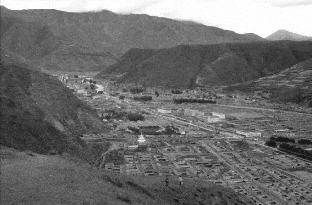
View of Sang river valley looking east. Labrang monastery is at lower right, Labrang town and Xiahe County seat upper left. Summer 1993 (photo by the author).
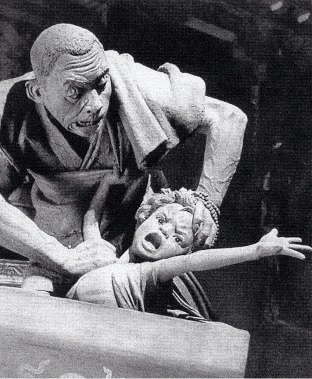
Detail from life-size clay sculpture exhibit “Wrath of the Serfs,” Lhasa Museum of Revolution, 1976. Depicts a monk pushing a boy into a box, to bury him under a new monastery as a “sacrificial offering” (photo courtesy Clare Harris).

“Speaking bitterness” meetings on grasslands west of Labrang, c. 1958. American writer Anna Louise Strong took these from an exhibit in Beijing. Captions are from her pro-CCP book, Tibetan Interviews (1959).
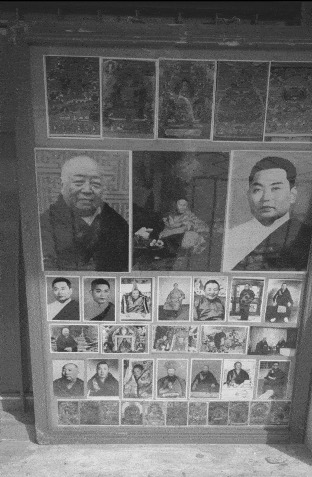
Images of local trulkus and deities for sale in Labrang street market. Largest photos: left: Gongtang; right: current Jamyang Shepa, a layman, Summer 1993 (photo by the author).
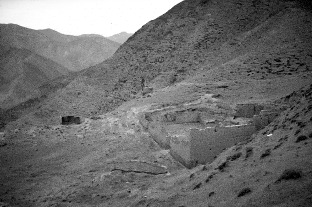
Ruins of a hermitage destroyed during the Cultural Revolution. Labrang, Spring 1995 (photo by the author).
 You have
Access
- 35
- Cited by