

Introduction
The rising food demand brought on by growing world population and competition for natural resources between economic sectors compels future agricultural systems to increase production per unit area and reduce losses of production capacity due to land and water degradationReference Beddington, Asaduzzaman, Clark, Fernandez, Guillou, Jahn, Erda, Mamo, Van Bo, Nobre, Scholes, Sharma and Wakhungu1. The link between sustainable water use in agriculture and food security was reaffirmed recently during the 2012 World Water Week in Stockholm (http://www.worldwaterweek.org/). A resource-efficient approach is particularly crucial in areas that already experience overexploitation of scarce freshwater resources and where population growth rates are high. In the Middle East and North Africa (MENA) region, 85% of water use is for irrigation, and the dependency on groundwater aquifers is the highest in the world. The availability of environmentally sound technologies to cope with volatile food prices, high dependence on imports, rural poverty and unemployment is of strategic importance to regional food security and sustainable development2.
Irrigation in the MENA region and elsewhere increasingly relies on marginal quality sources, such as saline water from brackish aquifers. Although international statistics on the diffusion of brackish water irrigation are lacking, brackish water with EC of 2 dS m−1 or higher is used for irrigation to various extents in more than 40 countriesReference Tanwar3. In India, it is estimated that 24% of the annual net groundwater draft consists of saline and/or sodic water, most of which is used for irrigationReference Qadir, Sharma, Bruggeman, Choukr-Allah and Karajeh4. Crops cultivated with brackish water worldwide include alfalfa (Medicago sativa), sorghum (Sorghum bicolor), sugar beet (Beta vulgaris), wheat (Triticum aestivum), cotton (Gossypium hirsutum), date palms (Phoenix dactylifera), artichoke (Cynara cardunculus), barley (Hordeum vulgare) and rye grass (Lolium spp.)Reference Hamdy, Hamdy, Katerji, Van Horn and Mastrorilli5. Brackish water irrigation is often a consequence of progressively deteriorating water qualities in aquifers due to shrinking natural freshwater recharge by precipitation, modifications in the subsurface hydrochemical processes related to overexploitation, and build up of residue of dissolved substances in the soil after the irrigation water is lost by the crops through evapotranspiration. Some of the world's major food-producing regions are threatened by accelerating rates of saltwater intrusion in coastal aquifersReference Beddington, Asaduzzaman, Clark, Fernandez, Guillou, Jahn, Erda, Mamo, Van Bo, Nobre, Scholes, Sharma and Wakhungu1.
Brackish water irrigation can be sustained over prolonged periods of time when appropriate soil, crop and irrigation management strategies are implemented. These may involve salt leaching, water drainage, addition of chemical amendments or biological managementReference Ayars, Wallender and Tanji6. However, the lack of proper know-how determines the development of salinity, sodicity, ion-specific toxicity and nutrient imbalances in the soilsReference Sharma and Minhas7. Statistics from FAO's Information System on Water and Agriculture (Aquastat, http://www.fao.org/nr/water/aquastat/main/index.stm) indicate that the area equipped for irrigation that has become salinized due to mineral buildup caused by inadequate drainage is higher than 25% of the total area in 14 countries in the MENA region, sub-Saharan Africa, South America and Asia. The area salinized by irrigation in the 51 countries for which such information is available in Aquastat amounts to 363,000 km2.
Even in the presence of adequate management, brackish water irrigation promotes an inefficient and potentially highly unsustainable use of the available water resourcesReference Ben-Gal, Ityel, Dudley, Cohen, Yermiyahu, Presnov, Zigmond and Shani8. First, high salinity levels cause osmotic imbalances and reduce water uptake and transpiration, which results in lower yields than obtainable with freshwater irrigationReference Sadeh and Ravina9. Second, the choice of crops is limited by the specific salinity tolerance. Third, large volumes of water in excess of plant requirements are necessary to leach salts and limit the potential for damage to plants and soil structure due to salt accumulationReference Ben-Gal, Ityel, Dudley, Cohen, Yermiyahu, Presnov, Zigmond and Shani8. Advancements in agriculture technology aimed at the production of desalinated water for irrigation offer a potentially more resource-efficient and sustainable alternative, particularly in hot, arid regions where renewable solar energy can be exploited to reduce the energy costs and carbon footprint of desalinationReference Ghermandi and Messalem10.
This paper presents a first-of-its-kind application of solar-powered membrane desalination to arid agriculture. The main objective of the study is to provide a proof of concept of the technical feasibility of solar membrane desalination at the farm-scale level. To this purpose, we describe and test viable solutions for the minimization of the system's energy requirements, achievement of an ionic composition in the membrane permeate that is suitable for irrigation of four widely grown staple crops (i.e., potato, maize, millet and sorghum), and disposal of the desalination brine by growing a salt-tolerant crop (i.e., red beet). Moreover, we test the hypothesis that irrigation with desalinated water promotes a more efficient use of resources than brackish water irrigation, where use efficiency is measured by the productivity of water, i.e., the ratio between the marketable yield and the irrigation volume. An increased productivity of fertilizers is expected as well, since less water is washed away from the root zone. We present the results of the first year of operation of a pilot unit constructed in Hatzeva, Israel, and the outcome of agricultural experiments performed during two growing cycles in 2010/11.
Material and Methods
Location
The experimental system was constructed at Hatzeva (Lat. 30°28′N, Long. 35°10′E, Alt. −125 m m.s.l.) in the Arava Valley of Israel, south of the Dead Sea. The Arava basin is extremely arid, with average annual precipitation of about 50 mm. Only ephemeral streams run into the valley. Rainstorms are infrequent and limited to a short period in the winter. Economic activities in the region rely heavily on the exploitation of local, brackish aquifers for highly intensive agriculture, and export of off-season horticultural crops to the European markets. Brackish water irrigation with salinities of 2–3.5 dS m−1 is practiced as a rule. Hatzeva hosts the Yair Experimental Agricultural Research Station of the Central and Northern Arava Research and Development, which is responsible for developing new agricultural technologies and disseminating them among local farmers. The site has high solar irradiation levels, with average daily global radiation ranges between 3000 and 8000 W m−2 in December and June, respectively.
Solar-powered nanofiltration (NF) desalination unit
A pilot membrane desalination unit was installed at the Yair station in Hatzeva in the autumn of 2009. The unit was designed to desalinate the local brackish water and produce 5 m3 d−1 of permeate freshwater. A diagram of the proposed design scheme is shown in Fig. 1.
Design scheme of the pilot solar desalination unit at Hatzeva, Israel.

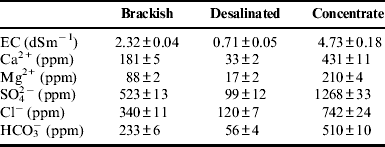
The chemical water quality at the selected well was monitored periodically over a period of 3 years and showed little seasonal variation (see Table 1). The water is characterized by low turbidity (0.15 NTU) and concentration of total suspended solids (2 ppm), total dissolved solids (1577 ppm), and boron (0.34 ppm). The unit is equipped with two Dow Filmtec NF90-4040 NF membranes in one pressure vessel. The advantages of the proposed design with NF membranes vis-à-vis reverse osmosis membranes in terms of lower energy consumption and ionic composition of the permeate for the local conditions at Hatzeva are discussed in detail elsewhereReference Ghermandi and Messalem10. A positive displacement pump with a helical rotor (Grundfos SQFlex 1.2–2) pressurizes the water to the extent required for membrane filtration. The design operation pressure of the membranes and permeate flux of the NF membranes are 5 bar and 16.3 liters m−2 h−1 (lmh), respectively. The design recovery rates for each membrane are 17 and 16%, respectively. Conventional pre-treatment was installed consisting of sand filtration, micro-filtration with pore size 5 μm, and active carbon cartridge filtration. A recirculation flow was installed, which recycles nearly 90% of the concentrate from the NF membranes back through the membranes (0.5 m3 h−1). Although it was designed to achieve a recovery rate of 80%, during the period of operation described here the system was run at a conservative recovery rate of 60% to guarantee smooth operation and minimal maintenance during the agricultural experiments. Antiscalant chemicals and hydrochloric acid were added to inhibit scale formation and for pH control. A blending flow was initially set at 25 liters h−1 and subsequently raised to 50 liters h−1 to increase the concentrations of Ca2+ and Mg2+ in the permeate flow to meet irrigation water quality guidelinesReference Yermiyahu, Tal, Ben-Gal, Bar-Tal, Tarchitzky and Lahav11. Standard instrumentation for offline monitoring of electroconductivity (EC), pH, pressure and flow rate at key points was installed. Composite daily samples of feed water, permeate and concentrate were collected on a regular basis and analyzed for pH, EC and concentration of the ions of principal interest to this study (Ca2+, Mg2+, SO42−, Cl−, and HCO3−).
Measured electrical conductivity and concentration of selected ions in the brackish feed water, desalinated permeate water after blending, and concentrate during the experimental period (means±SE, n=11–13).
An array of solar photovoltaic (PV) modules with a total capacity of 4.2 kWp was installed in May 2011 adjacent to the desalination plant. It consists of 15 polycrystalline modules (Suntech STP 280 W) organized along three rows for a total surface area of 31.6 m2 (10.0 m ×3.2 m). The modules are inclined at a 45° angle toward the south to maximize the electricity output in the winter season. The system includes three solar controllers with maximum power point tracking (TriStar MPPT, 60 Amp). Twelve battery units (2 V, 750 Ah) and a sine-wave DC/AC inverter (AJ 500-12) connect the solar and desalination sub-units. Since the solar unit was installed near the end of the 2010/11 growing season, which in the Arava is from September to June, the desalination plant was powered with electricity from the local grid during the agricultural experiments described below. During the summer, autumn and winter of 2011, the pilot desalination plant was operated exclusively on solar energy continuously and without interruption over prolonged periods without differences in performance.
Plant materials and management
A 1056 m2 agricultural plot (22 m ×48 m) was prepared in September–October 2010 for crop cultivation in open-field conditions. Owing to the high salinity of the local soil and in line with the common local practice, 30 m3 of soil were transported from the Arava River and distributed at the site. The soil has the texture of loamy sand with EC of 4.7±0.3 dS m−1. The contents of N, P and K before the distribution of compost and fertilizer were, respectively, equal to 21.7±1.8, 2.6±0.8 and 80.1±28.2 ppm. The terrain was prepared by distributing compost (50 kg, C=17%, N=1.68%, P=1.36%, K=2.12%, and C/N ratio=10) and granular fertilizers mixed into the soil with a rotovator. The irrigation water was supplemented with a liquid nutrient solution (NPK 7–3–7) at a constant concentration of 1 liter m−3 for all treatments. Pesticides were used according to standard agricultural practices.
Four different staple crops were grown at the experimental site during two growing cycles. During the winter cycle (from November to March), potato (Solanum tuberosum L.) cultivars Bellini and Mondial were grown. Diagrams of the subdivisions and irrigation schemes during the winter and spring cycles are given in Figs. 2 and 3, respectively. Seed potatoes were planted on November 1 in 44 parallel rows spaced 90 cm apart. Each row consisted of a 20 cm high, hand dug hummock, and a minimum thickness of 15 cm from the original soil was maintained everywhere. Potatoes were planted in 17 cm deep holes dug on the top of the hummocks. Planting distance in a row was about 30 cm. After sowing, the holes were filled up to 5 cm from the surface, where drip irrigation pipes were installed. The terrain was subdivided into eight equal, 11 m long plots. Half were irrigated with desalinated water, the rest were control plots irrigated with brackish water, with two replicates for each treatment and variety. Sprinkler irrigation distributed 3 cm of the intended final water quality (i.e., brackish, desalinated or concentrate) before sowing and 3 cm after sowing. In both cases, the water was applied in a single irrigation event with 4 h duration. After this initial period, routine irrigation with the drip system was implemented. The irrigation volumes for the control plots were determined based on the guidelines of the Israeli Ministry of Agriculture (http://www.shaham.moag.gov.il/) and set equal to 80% of the pan evaporation rate, which was measured daily on-site. The pan evaporation rate varied between 3 and 6 mm d−1 over the winter cycle. The plots irrigated with desalinated water consistently received 25% less water than the control plots. Samples of potato tubers and plants were collected, respectively, on February 18 and 24 from 90 cm wide and 2 m long strips that had been previously cleared. The final harvest was on March 23. The tubers were divided into six categories based on the average diameter and whether they were cracked or otherwise defected.
Cultivation and irrigation scheme for potato during the winter cycle.
Cultivation and irrigation scheme for maize, sorghum and millet during the spring cycle.
During the spring cycle (from March to June), the plots were split between three cereal crops: maize (Zea mays L., variety 72-10), sorghum (S. bicolor L. Moench, variety STT12) and pearl millet (Pennisetum glaucum L.). Sowing was on March 2. The terrain was subdivided into 15 plots, each with a length of 9.5 m and a width of 6 m. Three parallel lines of crops were grown in each plot, each with a net width of 1.5 m. Experiments with brackish water had two replicates, whereas control plots were replicated three times. The routine irrigation strategy was identical to that of the winter cycle, with the experimental plots receiving 25% less water than control plots through drip irrigation. On May 22, a sample of five maize plants and ten millet and sorghum plants were collected from each of the agricultural plots and analyzed for plant height and number of leaves per plant. At final harvest, on June 16, the crops were analyzed for wet and dry matter weight, weight and number of cobs, and marketable yield.
During both cycles, a fraction of the terrain was set aside for the cultivation of red beet (B. vulgaris L.), which was irrigated with the concentrated stream from the desalination plant. The red beets were initially grown in a nursery for a period of 2 weeks and subsequently manually planted in the field. Plants were placed into 16 parallel lines arranged into four groups of four parallel lines. A distance of 35 cm was kept between each line, and the emitters were spaced at intervals of 20 cm. The plants were put in the ground at a distance of 5 cm from the drip irrigation pipe. The surface cultivated with red beet was 100 m2 in the winter cycle and 160 m2 in the spring cycle. All the concentrate solution produced by the pilot desalination plant was used to irrigate the red beet plants. The final harvests were on February 28 and May 11.
Results
Desalination plant
Pilot NF desalination unit performance matched expectations in terms of reliability of operation, permeate production and energy consumption during both growing cycles. The pilot unit was operated for 24 h d−1 over the entire growing periods, with the exception of a 3-week period at the end of the spring cycle, during which a pump malfunction prevented pilot plant operation until the pump could be replaced. Following the contingency plan, the crops were irrigated during this period with desalinated water from the nearby brackish water reverse osmosis desalination plant, which produces drinking water with a similar composition for the field school in Hatzeva.
The NF pilot consistently produced an average permeate flow of 271 liters h−1 during the period of observation, corresponding to a daily production of 6.5 m3. This flow is 30% higher than specified by system design, an outcome that was due mainly to a larger-than-expected feed flow rate. The chemical composition of the feed water showed little variation during the period of observation with the exception of Ca2+, which ranged between 215 ppm on January 16 and 151 ppm on March 6. The operating pressure of the NF membranes was stable in the range of 4.2−4.4 bar, and it did not show any increase over the period of operation. The specific energy consumption of the pilot plant was 1.37 kWh m−3.
The desalination unit performed according to expectations regarding abatement of monitored ion concentrations (Table 1). Retention of Cl− ranged between 54% (February 27) and 75% (January 16), with an average permeate Cl− concentration of 120 ppm. At the initial blending flow of 25 liters h−1, the concentrations of Ca2+ and Mg2+ in the permeate were, respectively, 23 and 12 ppm, values that are lower than the recommended minimum concentration of these nutrients for agricultural use (32 ppm for Ca2+ and 12 ppm for Mg2+)Reference Yermiyahu, Tal, Ben-Gal, Bar-Tal, Tarchitzky and Lahav11. The blending flow was increased on January 19 to 50 liters h−1, raising the average concentrations of Ca2+ and Mg2+ in permeate to 45 and 23 ppm, respectively. Such values are well within or above the recommended concentrations. The concentration of SO42− was above the minimum recommended value of 30 ppm during the whole period.
The EC of the feed water showed little variation over the observed period, averaging 2.32 dS m−1 and with no trend toward increase or decrease over time. EC values of permeate and concentrate were relatively constant at 0.71 and 4.73 dS m−1, respectively. Before the increase in blending flow, the average EC of permeate was 0.58 dS m−1; after January 19, the average EC increased to 0.86 dS m−1. Evaluation of the sodium adsorption ratio (SAR) and sodium/calcium ratio, as indicators of the suitability of the water for agriculture, indicates that irrigation with either the brackish feed water (SAR=3.7; Na/Ca ratio=1.17) or the blended permeate water (SAR=2.9; Na/Ca ratio=1.78) does not entail a significant risk for reduction of the water infiltration rate in the sandy soil of the AravaReference Ayers and Westcot12.
The actualized cost of water was estimated at 2.0 US$ m−3 for solar-powered operation, a relatively low value compared with the range of costs of experimental solar membrane desalination unitsReference Ghermandi and Messalem13. The cost could be reduced further to 1.1 US$ m−3 if the pilot unit was powered by grid electricity, assuming an average electricity price of 0.115 US$ kWh−1. These estimates include the investment costs for both the NF desalination unit and the solar modules (including batteries, charge controller and AC/DC inverter). Operation and maintenance costs were estimated with a yearly replacement rate of 20% for membranes and batteries and a cost of 0.03 US$ m−3 for anti-scalants. A project lifetime of 20 years, a discount rate of 2%, 24 h d−1 operation, and a plant availability of 95% were assumed.
Crop growth and yield
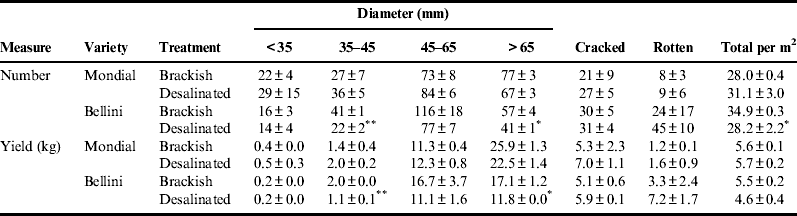
The number of potato tubers and yield in the final harvest of the winter cycle are shown in Table 2. Healthy tubers are categorized into four diameter ranges, while the cracked and rotted potatoes are reported in two separate columns. The figures for total number and weight per square meter of agricultural plot include the cracked and rotten tubers.
Number of tubers and yield (in kg) observed at final harvest for two varieties of potatoes grown at different irrigation water qualities and quantities (means±SE, n=2).
Note: A two-tailed t-test with equal sample size and variance was used to identify statistically significant differences between the experimental and control plots for each variety. Statistical significance is indicated with ** and * for 5 and 10% levels, respectively.
The average yield in the eight plots was 53.5 tons ha−1, a value that is in line with the initial expectations. The yield was higher for the Mondial variety (56.4 tons ha−1) than for Bellini (50.6 tons ha−1). Results for the Bellini variety were affected by a particularly low yield in one of the plots irrigated with desalinated water, which produced 41.8 tons ha−1, i.e., 18% less than the replicate plot. Overall, there are no statistically significant differences in the yields of potatoes irrigated with desalinated and brackish water. The number and yield of potatoes with diameters >65 mm were lower in plots irrigated with desalinated water than in control plots, but the difference was statistically significant only for the number of Bellini potatoes. The total number of Bellini potatoes per unit area was lower in crops irrigated with desalinated water.
An infestation of Erwinia carotovora that affected the plots irrigated with desalinated water more severely is a confounding factor in the interpretation of the results of the winter cycle. Erwinia is a common potato pathogen that causes tuber soft rot and blackleg and against which no chemical treatment is known to provide full protection in field conditions. Samples of plants were collected on February 24 (Fig. 4) and were investigated at the Southern and Central Arava R&D facilities, for the presence of infected plants. The results of this analysis indicate that the number of infested plants was 1.7 and 2.7 times higher in desalinated plots for Mondial and Bellini, respectively (Fig. 2). This is consistent with the higher number and weight of rotten tubers collected from plots irrigated with desalinated water for both varieties in comparison with control plots (see Table 2). A higher incidence of the infestation in experimental plots is also suggested by the analysis of the sample of tubers collected on February 18. This sample of healthy plants revealed an increase of 25% in the yield of Bellini plots irrigated with desalinated water compared with control plots. Whether there are mechanisms that link desalinated water irrigation with the Erwinia infestation is unknown.
Number of potato plants infected by E. carotovora in a sample collected on February 24, 2011.
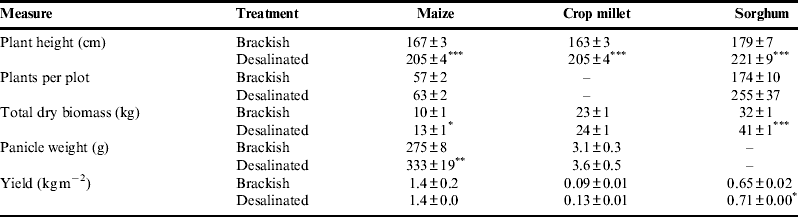
The results of the analyses at final harvest of the spring cycle for maize, millet and sorghum are shown in Table 3. Both growth measurements and yield are reported.
Observed growth measurements and grain yield made at final harvest for maize, millet and sorghum grown at different irrigation water qualities and quantities (means±SE).
Note: A two-tailed t-test with equal variance was used to identify statistically significant differences between experimental and control plots for each crop. Statistical significance is indicated with ***, ** and * for 1, 5 and 10% levels, respectively.
Irrigation with desalinated water positively affected plant growth in all three crops. Plants in experimental plots were between 23 and 26% taller than in control plots. Similarly, the total dry biomass was 27 and 32% larger in experimental plots for sorghum and maize, respectively. The total wet biomass of maize in experimental plots was larger than in control plots by 45%. We found no significant difference in the number of leaves per plant in maize (data not presented).
A difference in yield was observed only for sorghum (Table 3). Arithmetic mean yield of millet was 34% higher in desalinated than brackish plots, but the difference was not statistically significant probably because of the limited number of replicates. In spite of a larger weight of individual panicles in experimental plots, the yield of maize was not larger than in control plots as determined by a lower number of cobs in experimental plots.
The cultivation of red beet irrigated with concentrate from the desalination unit was successful during both growing cycles. Plants failed to show any detrimental effect from irrigation water salinity or pests. Table 4 shows the results of the analysis at final harvest for two classes of diameter and for cracked or otherwise defective beets. A higher yield was observed during the spring cycle, when beets were typically larger than during the winter cycle.
Observed yield of red beet irrigated with concentrate during winter and spring cycles (means±SE, n=4).
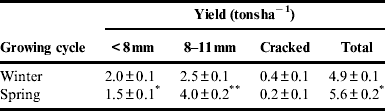
Note: A two-tailed t-test with equal sample sizes and variance was used to identify statistically significant differences between the growing cycles. Statistical significance is indicated with ** and * for 1 and 5% levels, respectively.
Discussion and Conclusions
To date, research on the combination of renewable energy and desalination in agriculture has focused principally on distillation technologies and greenhouse farming. Among the proposed solutions are solar stills, solar greenhouses, enhanced solar greenhouses and hybrid pressure-driven/distillation systemsReference Ghermandi and Messalem10, Reference Chaibi14. None of these technologies has achieved widespread adoption, at least in part due to high investment costsReference Papapetrou, Wieghaus and Biercamp15. The growth of the membrane segment in the desalination market and the plunging prices of PV modules suggest that there may be an unexplored potential for membrane solar desalination. In this study, we investigated the combination of NF membranes and PV power for the desalination of brackish groundwater for application in arid land agriculture at the farm-scale level.
The design of the investigated system reflects the state-of-the-art of membrane solar desalination. The combination of PV modules and pressure-driven membrane desalination is the most thoroughly tested and currently the only commercial technology available for solar-powered membrane desalination in small-scale systemsReference Ghermandi and Messalem13. Particular care is devoted to address some issues that commonly affect the viability of inland desalination in application to the agricultural sector. First, the operation of NF membranes is less energy intensive than reverse osmosis, since the membranes operate at a lower pressure, albeit at a lower salt retention. Modeling of the membrane filtration process with the boundary conditions observed at Hatzeva suggests that NF membranes can operate at a 45% lower pressure than reverse osmosis and with a 40% reduction in energy consumptionReference Ghermandi and Messalem10. That lower energy consumption translates into a lower investment cost for the PV modules, which, thus far, has been the main limiting factor for a wider market penetration of PV-powered membrane desalinationReference Ghermandi and Messalem13.
Second, NF membranes allow for a higher permeate concentration of basic nutrients such as Ca2+, Mg2+ and SO42−, which are essential to plant growth. The operation of the pilot plant during the period described in this paper shows that the implementation of an appropriate blending flow rate between feed water and NF permeate is sufficient to meet the requirements for the application of desalinated water in agriculture. The resulting salinity of the irrigation water is compatible with the tolerance of most salt-sensitive crops (EC=0.86 dS m−1).
Third, the proposed design explores the opportunity for beneficial reuse of desalination concentrate for the cultivation of salt-tolerant crops (i.e., halophytes). The fate of the concentrate is an important issue in inland desalination due to the high cost for its disposal, which has been estimated at about 15% of the total costsReference Glueckstern and Priel16. Commonly used methodologies for dealing with concentrate include discharge to surface waters and wastewater treatment plants, deep well injection, land disposal, and near-zero liquid dischargeReference Ahmed, Arakel, Hoey, Thumarukudy, Goosen, Al-Haddabi and Al-Belushi17, Reference Oren, Korngold, Daltrophe, Messalem, Volkman, Aronov, Weismann, Bouriakov, Glueckstern and Gilron18. Halophyte irrigation has been proposed as a suitable paradigm to convert the management of desalination concentrate from a disposal problem to a water management opportunityReference Riley, Fitzsimmons and Glenn19. Halophyte irrigation with desalination brine presents soil and water management constraints that are analogous to those of brackish water irrigation. Only a limited number of halophytes have been investigated in the literature, including forage, biofuel and oilseed crops, such as Salicornia spp.Reference Ladewig and Asquith20, Reference Ventura, Wuddineh, Shpigel, Samocha, Klim, Cohen, Shemer, Santos and Sagi21. The present research contributes to this growing literature by testing the use of desalination concentrate to irrigate red beet, a moderately salt-tolerant crop with good nutritional properties and commercial value. Red beet was successfully managed to consume the effluent of the pilot plant over two growing seasons, suggesting that this can be a suitable option for moderately saline concentrate from brackish water desalination.
The principle objective of this study was to provide a proof of concept of the technical feasibility of solar membrane desalination in the context of arid, inland agriculture at the farm level. The four investigated staple crops were accordingly selected based on their widespread adoption and range of salt tolerance (from moderately tolerant to moderately sensitive) rather than their expected economic return on initial investment. We hypothesized that irrigation with desalinated water would result in an appreciable improvement in resource use efficiency both for water and fertilizers per unit of marketable yield compared with the current practices involving brackish water irrigation. Table 5 summarizes the water productivity for the four investigated crops. It is calculated as the ratio between the marketable yield (in kg) and the total volume of water used for irrigation (in m3). The percent increase in productivity for desalinated water irrigation is also presented in the table. Since the liquid fertilizer was added to the irrigation water at constant concentrations for all treatments, the results for fertilizer productivity are analogous to those for water.
Water productivity of four staple crops irrigated with brackish or desalinated water.

Table 5 shows that once the actual irrigation volumes are taken into account, the water productivity of crops irrigated with desalinated water was consistently higher, including for the Bellini potato variety, i.e., the only crop for which a (non-statistically significant) yield decrease was observed when irrigated with desalinated water. The highest increase in water productivity (+93%) was found for millet.
The two important factors in the observed change in water productivity are the salinity and the application rate of the irrigation water. In similar climatic conditions, a previous study observed a progressive yield decrease in maize for continuous irrigation with brackish water at different EC levelsReference Pasternak, De Malach and Borovic22. If applied to the salinities measured in this study, their best-fit regression would predict a 13% reduction in the yield for brackish water irrigation compared with the optimal freshwater salinity (EC=0.84 dS m−1). A considerable variation in salt tolerance exists among cultivarsReference Pasternak, Sagih, DeMalach, Keren and Shaffer23. Experiments with potatoes in southern Israel led to the conclusion that the yield under brackish water irrigation is substantially affected by external stress factors such as heat waves, time of application of the brackish water and soil salinityReference Bustan, Sagi, Malach and Pasternak24, Reference Levy25. Under favorable conditions, no significant effect on the yield of the potato variety Desiree was observed up to 2.42 dS m−1.Reference Bustan, Sagi, Malach and Pasternak24 Under stress conditions due to heat waves, however, the yield closely approaches the response curve proposed by Maas and HoffmanReference Maas and Hoffman26 with a 12% linear decrease in yield for each additional dS m−1 above a threshold of 1.7 dS m−1. In the conditions under study in the present investigation, such a relationship would predict a yield increase of 7% for irrigation with desalinated water. Similar estimates of yield variability have been measured with equal application rates of irrigation water and cannot be directly compared with the results of this study. Research on the effect of the amount of applied irrigation water on transpiration, yields and leaching fractions of bell pepper, showed that yield response is highly dependent on both the water salinity and its application rate, the impact of salinity being highly reduced in the presence of high rates of leachingReference Ben-Gal, Ityel, Dudley, Cohen, Yermiyahu, Presnov, Zigmond and Shani8.
In conclusion, the results of this study support the hypothesis that solar-powered membrane desalination is a technically viable and more resource efficient alternative to brackish water irrigation, at least in the context of arid agriculture at Hatzeva in the Arava Valley of Israel. Further research should investigate whether higher water savings can be achieved without adversely affecting water productivity and marketable yield. Moreover, the costs and benefits of the system should be evaluated in a wider range of contexts. In particular, the benefits of desalination are expected to be highest for elevated brackish water salinities—since the energy consumption, and thus the costs for desalination, do not increase linearly with the salinity of the feed water—and in combination with the cultivation of salt-sensitive cash crops that cannot be grown with brackish water (e.g., strawberries and asparagus). The performance of the proposed scheme should be tested under nutrient limitation such as that induced by low soil fertility, a condition that is observed, for instance, in many regions in Africa, and in longer-term studies, to ensure that soil integrity is maintained when irrigated over prolonged periods. Although the system operated with relatively little maintenance during the reported period, operational tests with solar power for longer durations are required to evaluate the risks associated with pump malfunctions or battery replacement requirements as they apply to remote areas. Overall, we suggest that solar desalination has the potential to become an additional resource within a portfolio of strategies to improve the sustainability of agriculture and adapt to climate change in arid and remote areas that are freshwater-poor but have extensive brackish water resources, as is the case for many areas in the MENA region.
Acknowledgments
This research was supported by donations from Samuel Josefowitz, Lausanne, Switzerland, and the Alliance for Global Good, Greensboro, NC. We appreciate the cooperation of Aylon Gadiel, Avraham Kudish, Asher Brenner, Avi Oshrovitz, Oshrat Koren, Lior Singer, Dorit Hashmonai, Patrick Martin, and all the staff involved in various phases of the project at the Zuckerberg Institute for Water Research and the Central and Northern Arava R&D Yair station in Hatzeva.