

1. Introduction
Why did the eurozone not lead to institutional reform? The consensus prediction before the euro’s introduction on 1 January 1999 was that the monetary union would lead to economic modernization in its least productive members – Greece, Ireland, Italy, Portugal and Spain. These countries used currency devaluations to recover from adverse business cycle shocks before the euro, leaving them with persistent underlying economic imbalances. The euro – with its promise of sound fiscal policy and controlled inflation – was expected to end such policy short-termism. Lucas Papademos argued in 2001, when he was the Governor of Greece’s central bank, that
…it will certainly be impossible to improve the [Greek] economy’s international competitiveness by changing the exchange rate of our new currency, the euro … higher employment and output growth will therefore have to be pursued through structural reforms and fiscal measures aimed at enhancing international competitiveness by increasing productivity, improving the quality of Greek goods and services and securing price stability.Reference Fernandez-Villaverde, Garicano and Santos 1
Policymakers such as Papademos had the backing of academics. Charlie Bean, who later became the Bank of England’s Deputy Governor for Monetary Policy in 2008, argued that, by taking monetary and fiscal policy out of governments’ hands, the euro would give them no alternative but to reform.Reference Bean 2 Saint-Paul and Bentolila’sReference Saint-Paul and Bentolila 3 first main policy conclusion was that ‘EMU [European Monetary Union] creates incentives to alter the economy’s structure in order to improve in response to shocks.’ They went on, ‘[i]ndeed, the conventional wisdom prevailing today is that EMU will eventually remove some barriers to labor reform’ (Ref. Reference Saint-Paul and Bentolila3, p. Reference Rothstein7). In fact, something quite different happened: institutional decline.
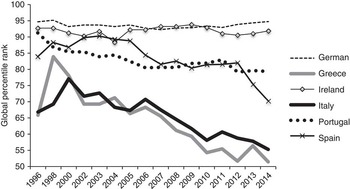
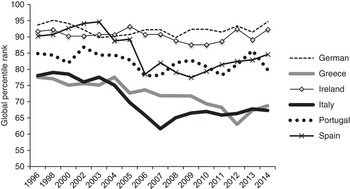
From 1998 to 2014, Greece experienced deterioration in each of the World Bank’s governance indicators – control of corruption, rule of law, regulatory quality, government effectiveness, voice and accountability, and political stability.Reference Kaufmann, Kraay and Mastruzzi 4 The deterioration was considerable. Its Control of Corruption index, which measures the extent of control over public power being exercised for private gain, went from a percentile rank (0 lowest to 100 highest rank among all countries in the world) of 84 in 1998 to 51 in 2014. Its Government Effectiveness index, which measures perceptions of quality in public services, the civil service, policy formulation and implementation, and the credibility of the government’s commitment to such policies, dropped from 77 to 69. Greece is the worst case, but the same deterioration occurred in the rest of the periphery. Italy’s Control of Corruption index dropped from 69 to 55; its Government Effectiveness index from 79 to 67. For Portugal, the corresponding numbers go from 87 to 79 and 84 to 80. In Spain, the results were 88 to 70 and 91 to 85. Ireland is the best case, the numbers going from 93 to 92 while Government Effectiveness remained at 92. What went wrong? Why did the eurozone’s least productive members experience institutional decline rather than the modernization that most policymakers and academics predicted?
An important answer comes from Fernandez-Villaverde et al.Reference Fernandez-Villaverde, Garicano and Santos 1 The authors start from the point that the euro eliminated exchange rate risk, made for accommodative monetary policy, and contributed to the global loosening of financial conditions. This facilitated large flows of capital from the European core to its periphery, as peripheral interest rates converged to the lower core rates. Greek 10-year yields went from around 25% in 1993 to around 5% by 2000 – the same level as German yields (Ref. Reference Fernandez-Villaverde, Garicano and Santos1, p. 147). These large capital flows, as the argument goes, led to the abandonment of economic reforms through two channels. First, capital inflows relaxed the economic constraints, and hence also the pressure for reform. Second, capital inflows made it harder for actors to see who was performing well and who was performing poorly. For example, the flood of capital allowed banks to deliver profits and made all bank managers look good. As a result, bad managers and ineffective governments remained in place. As Warren Buffet put it, ʻyou only find out who’s swimming naked when the tide goes outʼ. 5 While not belittling the importance of this line of argument, it leaves two questions open. Why has institutional quality not improved at the same rate as capital outflows, and why do we see the sharpest drop in the Control of Corruption indices?
In this study, I suggest an explanation that links the reluctance of peripheral countries to reform with the deterioration in their corruption levels. I build on the literature that argues that corruption is a collective action problem.Reference Rothstein 6 I argue that peripheral European countries were in an equilibrium where corrupt behaviour was the expected behaviour; a setting where the short-term costs of being honest were comparatively high since honesty would not change the environment. Unwilling and incapable of paying the costs, or being a ʻsuckerʼ,Reference Rothstein 7 people will instead choose corruption over non-corrupt behaviour. In an environment in which corruption is the expected norm, monitoring and enforcement devices are ineffective since there is no one with an incentive to hold corrupt officials to account. This is what Ostrom calls a second-order collective action problem: everyone understands they would collectively gain from stamping out corruption, but, as they cannot trust each other to refrain from corrupt practices, they stand to lose individually from not paying or demanding bribes.Reference Ostrom 8 As corruption is antithetical to government quality,Reference Rothstein 9 this situation can explain the reluctance to reform. But why did the deterioration after Eurozone membership happen?
Ostrom (Ref. Reference Ostrom8) – referring generally to collective action problems – argues that when an external authority imposes rules in an attempt to solve the problem, but is only able to achieve weak monitoring and sanctioning, it actually exacerbates the problem in two ways. First, weak monitoring discourages forming social norms while making it attractive for some actors to engage in corruption, given the low risk of being caught. Second, increased transparency risks increasing corruption by making people even more aware of the problem, encouraging formerly non-corrupt actors to engage in corruption.Reference Persson, Rothstein and Teorell 10 The Maastricht Treaty and Stability and Growth Pact criteria and rules, which set the stage for EMU in the 1990s, were concerned exclusively with outcomes – inflation, fiscal targets – rather than focusing on improving member states’ institutional environments: the means through which member states were supposed to meet those criteria. European Union institutions also failed to implement other policies to improve dysfunctional institutions in member states. For example, peripheral member states were unable to fully absorb EU structural funds due to corrupt domestic bureaucracies, which the EU failed to act on.Reference Papaioannou 11 In short, my argument is that rules set, but weakly monitored and enforced, by the EU exacerbated already-weak institutions in the periphery. Thus, while I use a mixture of survey evidence to support my argument, this paper in no way offers a conclusive analysis. It is mainly an attempt to draw attention to a neglected potential explanation of institutional weakness in the eurozone. The hope is that this paper will spur some relevant debate on the topic.
2. Conventional Wisdom before EMU
As Fernandez-Villaverde et al.Reference Fernandez-Villaverde, Garicano and Santos 1 outline, EMU had four goals: (1) to build a unified European identity; (2) to eliminate nominal exchange rate fluctuations and their associated imbalances; (3) to create a monetary authority that is protected from political pressure; and (4) to widen the support for structural supply-side reforms that would improve Europe’s growth rate. It is the fourth goal in which I am interested here. EMU was expected to affect the political economy of reform by imposing stricter constraints on member states’ monetary and fiscal policymaking. As BeanReference Bean 2 argued, the expectation was that EMU would take monetary and fiscal policy out of member states’ hands, leaving no alternative but to reform.
The pre-1999 literature on the euro focused on trade and macroeconomic performance. Little attention was paid to political economy forces. Two forces in particular were highlighted. First, governments would no longer be able to use demand-side policies to lower unemployment and so they would have to resort to structural reforms. Second, the euro was expected to increase market discipline on government borrowing as the euro would allow investors to compare investments across countries without fear of exchange rate risk. This second channel was emphasized by the 1989 Delors Report, which informed the EMU’s creation. The Report expected market discipline to be more effective than the Maastricht Treaty’s formal constraints.
Others worried that, as part of the EMU, peripheral countries would have to undertake structural reform ‘without anesthesia’ (Ref. Reference Fernandez-Villaverde, Garicano and Santos1, p. 148). This would increase the costs of reform, making it less likely for the reforms to be undertaken in the first place. Similar arguments have emerged during the eurozone crisis, with calls for and against painful ʻinternalʼ devaluations on the grounds that currency devaluations are no longer possible.Reference Felipe and Kumar 12 Some worried about the potential for ʻfree-ridingʼ in EMU.Reference Chari and Kehoe 13 As the effects of labour market policies, bank supervision, and fiscal policy of any one member state could negatively affect the welfare of the entire union, the monetary authority can be forced – due to the actions of one member – to generate inflation for all its members.
What the EMU did, in fact, was to allow a steep drop in peripheral interest rates, loosening rather than tightening peripheral members’ budget constraints. Fernandez-Villaverde et al.Reference Fernandez-Villaverde, Garicano and Santos 1 argue that this weakened the will of governments to structurally reform. But this weakening would only occur if institutions were weak to begin with.
3. Capital Inflows and Institutional Decline
The argument that euro-facilitated capital flows into the European periphery weakened peripheral institutions is compelling. If large enough, net capital inflows can relax the economic pressures that drive structural reform. At the start of millennium, Greece, Ireland, Italy, Portugal and Spain all had sustainable external debt positions. Their net external debt (value of domestic assets owned by foreigners less the value of assets nationals owned abroad) ranged from around –40% of GDP in Greece to less than –10% in Ireland and Italy (Ref. Reference Fernandez-Villaverde, Garicano and Santos1, p. 149). By 2010, however, all these countries, with the exception of Italy, reached net external debt close to –100% of GDP. Italy’s position more than doubled, reaching around –20% of GDP. Thanks to this boom, the peripheral countries were able to expand their public budgets either through cheap debt issuance (Greece, Portugal) or through tax revenue earned off the related real estate boom (Ireland, Spain).
Is, however, institutional weakness and policy stasis a necessary outcome of large net capital inflows? The conceptual thrust comes from the foreign aid literature. Alesina and Drazen argue that the decision process for economic reform is a ʻwar of attritionʼ where all groups delay the reform (with a shared cost) until one group runs out of funds and gives up, bearing the highest cost.Reference Alesina and Drazen 14 Casella and Eichengreen use this line of argument to show how foreign aid can delay concessions and reforms.Reference Casella and Eichengreen 15 The main empirical case for it comes from Vamvakidis,Reference Vamvakidis 16 who extends the argument to financial booms across a panel of 81 developing countries. He finds that increases in external debt are correlated with slowdowns in economic reforms. Yet Vamvakidis’ sample,Reference Vamvakidis 16 being composed exclusively of developing economies, including the world’s poorest, makes the correlation a foregone finding. In countries with robust institutions, with initially low corruption and a strong rule of law, large net capital inflows are unlikely to be correlated with reform slowdown and institutional weakening.
Many of the countries in Vamvakidis’ sampleReference Vamvakidis 16 earned their capital inflows through natural resource exports; for example, Nigeria and oil. A more helpful guide than the foreign aid literature here is the ʻresource curseʼ literature. The ʻcurseʼ can work through three causal channels.Reference Isham, Pritchett, Woolcock and Busby 17 First, regarding the export channel, strong demand for a natural resource export drives currency appreciation, weakening the export competitiveness of other sectors and diverting resources away from other more productive sectors. In the long run, this causes institutional and economic decline. Second, as for the volatility channel, natural resource production exposes countries to volatility, especially in commodity prices, which can adversely affect growth. Finally, for the institutional channel: natural resources generate rents that lead to rent-seeking, leading to increased corruption, which has a negative effect on growth and institutional quality. Which of the three channels dominates is an empirical question.
A rigorous empirical analysis comes from Sala-i-Martin and Subramanian.Reference Sala-i-Martin and Subramanian 18 They find that, in aggregate, natural resources only affect growth through impairing institutional quality, specifically a Rule-of-Law index. Once institutional quality is controlled, there is either no effect of natural resources on growth or even a positive effect. More prosaically, oil wealth was a curse in Nigeria, where oil revenues funded rent seeking, but it was a blessing in Norway, where oil revenues went into a sovereign wealth fund that invested in various sectors domestically and internationally. Why was the fund in Norway? As Sala-i-Martin and Subramanian argue,Reference Sala-i-Martin and Subramanian 18 a fund requires stringent mechanisms to ensure accountability and to prevent the misuse of resources. These mechanisms did not exist in Nigeria before the discovery of oil and were unlikely to emerge after its discovery. In contrast, Norway’s oil discovery was made when its institutional capacity was already highly developed.
It is the interaction between capital inflows and weak institutions that impair the capacity and will for structural reform. The large net capital inflows Australia received from 2003 until the onset of the eurozone crisis, largely driven by China’s demand for Australian resources, was not correlated with a decline in its Control of Corruption or Government Effectiveness index. Like Norway, Australia’s institutional capacity allowed it to manage large capital inflows without adverse effects. The decline in institutional quality and the prospects for structural reform in peripheral eurozone members was not a necessary outcome of capital inflows. The capital inflows were an exacerbating factor.
4. Peripheral Institutions Before and After the Euro
Institutions in Europe’s core tend to be well-functioning. Property rights are defined clearly and enforced, public bureaucracies are professional and public goods provision is efficient, and corruption is not a major issue. In contrast, in Europe’s periphery, shareholders and creditors are afforded weak protection by the state because laws are ill-designed and conflicting and because courts are slow and inefficient. Public administrations are also inefficient and riddled with corruption, political interference and graft.Reference Alesina and Drazen 14
Figure 1 illustrates this contrast by plotting the World Bank’s Control of Corruption indices for Germany, representative of the core, and those of Greece, Ireland, Italy, Portugal and Spain from 1996 to 2014. Ireland’s trend is closest to that of Germany. Its percentile rank is high throughout the period, with only modest deterioration of the control of corruption between 1998 and 2005. Portugal and Spain start out in with lower ranks, and experience deterioration all throughout the period. Greece and Italy start out with even lower ranks, and experience even faster deterioration throughout the period. Apart from Ireland, there is a clear divergence between the core and periphery in terms of corruption. It is important to emphasize that from 1996 to 1998, the ranks of Greece, Italy and Spain actually improved – dramatically so for Greece. The divergence occurred after 1998. Additionally, deterioration in the control of corruption was fastest where it was initially low.
Control of Corruption, 1996–2014. Notes: Control of Corruption index measures the extent to which public power is exercised for private gain. Source: See Ref. Reference Kaufmann, Kraay and Mastruzzi4.

The same trends can be observed with the World Bank’s other governance indicators. Figure 2 plots the same countries’ Government Effectiveness indices. Ireland is again closest to the core and experiences only slight deterioration in government effectiveness during the boom. Spain starts out at more or less the same rank as Ireland and Germany, but after 2003 drops rapidly and remains at a lower rank until 2014. The same trend occurs in Portugal, Greece and Italy, only these countries started out at much lower ranks.
Government effectiveness, 1996–2014. Notes: Government Effectiveness index measures perceptions of quality in public services and their independence from political pressure, the civil service, policy formulation and implementation, and the credibility of the government’s commitment to such policies. Percentile rank (0 lowest to 100 highest) among all countries. Source: See Ref. Reference Kaufmann, Kraay and Mastruzzi4.

The fact that institutional quality was lower in the European periphery than the core before the euro was well known. Indeed, EMU was in part seen as a means through which peripheral countries would be stimulated to reform their institutions and economic structures (Ref. Reference Saint-Paul and Bentolila3, p. Reference Bean2). The substantial declines in institutional quality in Figures 1 and 2, however, beg the question as to why no one noticed – or made noise about – the institutional deterioration. The fast income convergence that peripheral countries experienced after the euro’s introduction likely obscured these deeper institutional trends or at least made them seem secondary. It was only after the crisis that the periphery’s institutional deficiencies were laid bare, and drew the attention of academics.Reference Alesina and Drazen 14 , Reference Corsetti 19 – Reference Arkolakis, Doxiades and Galenianos 21
5. Corruption and the Reluctance to Reform
Europe’s periphery, particularly Greece and Italy, less so Ireland, struggled to control corruption before the euro. This can be seen in Figure 1 and also in Transparency International’s Corruption Perceptions Index (CPI). 22 The CPI is a measure of how widely perceived corruption – the exercise of public power for private gain – is in a country, and ranges from 0 (perceptions of total corruption) to 10 (no corruption perceived). In 1995, Greece, Italy and Spain all had scores below 5: 4, 3, and 4.4 respectively. Portugal’s score was 5.6 while Ireland again proved to be the exception with a score of 8.6, putting it even above Germany’s 8.1. These high perceptions of corruption – that corruption was seen to be the rule rather than the exception – are central to the argument here.
The rewards of corruption – and so the existence of actors willing to enforce reform – depend on how many other actors in the same country are expected to be corrupt. When corruption is the expected behaviour, the short-term benefits of corruption outweigh the costs of honesty and reform. In such an environment, the usual instruments used to curb corruption and enable reform – monitoring devices and punishment regimes – will be ineffective as no one will have an incentive to enforce them. This situation holds even if everyone knows corruption is widespread (ʻperfect informationʼ) and even if everyone thinks curbing corruption will be beneficial to society at large – it is consistent to acknowledge that collectively a society will be better off, but that individually one will be worse off, with reform. Reform turns into a collective action problem of the second order:Reference Ostrom 8 ʻprincipled principalsʼ are also corrupt and pursue their narrow self-interest rather than that of society. Incentives to collectively find a solution to this problem are undermined by the shared expectations of each other actor’s behaviour. Persson et al.Reference Persson, Rothstein and Teorell 10 successfully apply this framework to Kenya and Uganda, whose 1996 CPI scores, at 2.2 and 2.7 respectively, are not much lower than Italy’s at 3.4. The framework fits peripheral Europe.
5.1. The Costs of Acting Fairly
Why do individuals living in the European periphery, where they perceive corruption to be widespread, choose not to report and punish corrupt behaviour? Why do they not report and punish this behaviour, even though they believe corruption should be curbed and even though the available institutional and legal frameworks allow them to act on their beliefs? In line with the collective action argument, survey data from the periphery suggest an environment in which reporting corruption seems pointless as it will not make any difference.
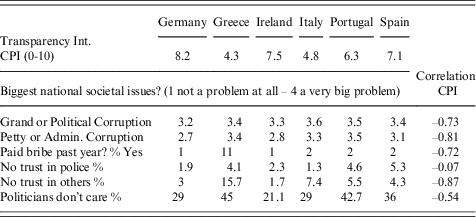
Table 1 summarizes some of this survey evidence for the earliest period in which we have meaningful coverage, 2002–2004. The first row gives each country’s CPI score, showing how widely perceived corruption is. Here, the same hierarchy can be seen as in Figure 1: Ireland closest to Germany, with higher perceptions in Spain, and much higher in Portugal, Italy and Greece. The third and fourth rows show, using data from Transparency International’s Global Corruption Barometer report, how much of a national societal issue corruption is. So, the CPI asks how widely perceived corruption is, and these two rows ask how much of a problem corruption is. The final column contains the Pearson correlation coefficients between the CPI and each row – the coefficients are based on too limited a number of observations to be conclusive, but they may ease the interpretation of the table. The first coefficient shows that lower perceptions of corruption are associated with a lower proportion of respondents thinking that grand or petty corruption is an issue. In other words, people both perceive corruption and recognize it as a national societal issue.
Societal issues and corruption perceptions, 2002–2004.

Notes and sources: ʻTransparency Int. CPIʼ is Transparency International’s Corruption Perceptions Index, ranging from 0 to 10 (lowest perceptions of corruption), for 2004. Third and fourth rows are answers to the question ʻNational societal issues – which pose the biggest problems?ʼ where respondents rated their answers from 1 ʻnot a problem at allʼ to 4 ʻa very big problemʼ. From Transparency International’s 2004 Global Corruption Barometer. Other categories included ʻPovertyʼ, ʻHuman Rights Violationsʼ, ʻUnemploymentʼ, ʻEnvironmental Problemsʼ and ʻPolitical Instabilityʼ. The fifth row is from the same source, and is the percentage of yes answers to ʻPaid a bribe within last 12 monthsʼ. Final three rows are from the 2002 European Social Survey. The sixth row records the percentage of ʻNo trust at allʼ responses to ʻhow much you personally trust each of the institutions I read out [police] ʼ, with answers ranging from 0 ʻNo trust at allʼ to 10. The seventh row records the percentage responses of ʻpeople mostly look out for themselvesʼ to the question, ʻWould you say that most of the time people try to be helpful or that they are mostly looking out for themselves?ʼ, with answers ranging from 0 to 10. The final row records the percentage responses of ʻHardly any politicians careʼ to the question ʻDo you think that politicians in general care what people think?ʼ, answers ranging from 1 to 5.
The fifth row shows that there is not much variation in the proportion of respondents who paid bribes in the past year being interviewed, but the hierarchy matches the CPI hierarchy. Bribe payments were most common (11%) in Greece and least common in Germany and Ireland (1%), with all other countries registering 2%. People are more likely to participate in bribery where they perceive more corruption. That is, people are more likely to participate in corruption rather than report it the more corrupt they perceive their environment to be.
The last three rows show why this might be the case. While the correlation is weak, high perceptions of corruption go hand-in-hand with lower trust in the police. In Germany, only 1.9% of respondents said they have ʻno trust at allʼ in the police compared with 4.1% in Greece or 5.3% in Spain. This suggests that people might not feel comfortable reporting bribery or corruption to the police, even if they wanted to. The penultimate row measures respondents’ ʻcollectiveʼ sentiment. It records the percentage of people who responded with ʻpeople mostly look out for themselvesʼ to the question ʻWould you say that most of the time people try to be helpful or that they are mostly looking out for themselves?ʼ The higher the percentage, the less likely people are to overcome the collective action problem: why not engage in corrupt behaviour if most other people are doing so; why go out on a limb for others? The correlation between this measure and CPI is stronger. It implies that people put less confidence in each other the more corrupt they perceive their environment to be. The final row is an attempt to measure how pointless reporting corruption might seem – it runs parallel to the trust in the police measure. It shows that the higher the proportion of respondents who feel that ʻhardly any politiciansʼ care in general what people think, the more widespread they perceive corruption to be.
What Table 1 suggests is that reporting corruption where corruption is widespread brings little return. As long as people perceive each other to be corrupt, the costs of playing fairly and reporting are high. The tendency to trust others, the police, and to think that politicians care about what people think is lower where perceptions of corruption are higher. This happens in spite of people recognizing that corruption is a ʻnational societal issueʼ. Further, the prospects of higher corruption in the future – which is what the 2004 Global Corruption Barometer report shows for all countries – gives people the ‘feeling of being part of a vicious cycle of corruption that nobody alone can afford to break out of’ (Ref. Reference Persson, Rothstein and Teorell10, p. 460). This is what RothsteinReference Rothstein 7 calls a ʻsocial trapʼ.
In the light of the collective action argument, Table 1 provides support for the reluctance to reform in the early days of EMU. The arguments that some external authority (EMU) was needed to promote structural reform in the periphery were implicitly saying that such reform would not emerge domestically.Reference Bean 2 So far, it has been shown why this may be the case: peripheral countries were stuck in a collective action problem – a ʻsocial trapʼ. In retrospect, we know that the reforms did not happen even with an external authority. Rather, the periphery went into structural and institutional decline after the formal and market discipline expected to come with EMU failed to materialize.
5.2. The Costs of Acting Fairly under EMU
Table 1 does not tell us why institutional quality went into decline. It is a static explanation as to why reform was not forthcoming in the first place. There are, however, two ways in which a ʻsocial trapʼ can get worse and they are both the outcome of an external authority imposing rules with weak monitoring and sanctioning. First, weak monitoring, and so the low risk of being caught, makes it more attractive to engage in corruption. Second, higher levels of transparency can, perversely, make people even more aware of corruption, encouraging formerly non-corrupt actors to enter the corruption game.
Figure 2 provides evidence for the first channel. The ability of peripheral countries, save Ireland, to control corruption went into decline after 1998, after having actually improved between 1996 and 1998. As the ability to control corruption waned, people’s perception of corruption grew, providing support for the second channel. From 1998 to 2015, the CPI scores of Greece, Portugal and Spain changed by –8.2%, –4.6% and –9.8% respectively. The Italian score improved slightly, by 2.2%, and Ireland’s improved by a more meaningful 8.5%. However, if we take 2013 instead of 2015 as the terminal year, the CPI scores for all peripheral countries may be seen as declining: Greece –18.4%, Ireland –12.2%, Italy –6.5%, Portugal –4.6% and Spain –3.3%.
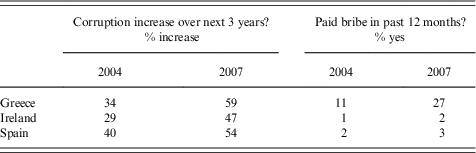
Table 2 provides some more evidence that the European periphery was stuck in a downward spiral of corruption. For the three peripheral countries where we have consistent data from Transparency International’s Global Corruption Barometer reports, we see that in 2004 a large share of respondents expected corruption to increase over the next three years. By 2007, those shares increased: by 25 percentage points in Greece; 18 in Ireland; and 14 in Spain. Meanwhile, the second panel in Table 2 shows that the proportion of respondents who engaged in bribery in the previous 12 months grew over the same period: by 16 percentage points in Greece and a much lower single point (that is, doubling) in both Ireland and Spain. As expectations of increased corruption grew, along with a decline in the control of corruption, more people engaged in bribery.
Expectations of corruption and bribe paying, 2004–2007.

Notes and sources: From Transparency International’s 2004 and 2007 Global Corruption Barometer reports. Left panel shows the percentage of ʻIncreaseʼ [ʻIncrease a lotʼ + ʻIncrease a littleʼ for 2004] responses to the question ʻDo you expect the level of corruption in the next three years to change?ʼ The Right Panel shows affirmative responses to, the question ʻIn the past 12 months, have you or anyone living in your household paid a bribe in any form?ʼ
The rules set by both the Maastricht Treaty and the Stability and Growth Pact in preparation for EMU, regulated outcomes such as inflation and fiscal balances, but made no attempt to improve member states’ institutional quality. The ʻexternal authorityʼ these rules provided was, from the beginning, not concerned with the potential corruption that may come by trying to meet those rules and criteria, nor was it concerned with the corruption peripheral countries needed to overcome to meet those rules and criteria.
For example, the EU’s Structural Funds, designed to even out income inequalities across Europe, were rarely ever fully absorbed by peripheral countries due to corrupt domestic bureaucracies.Reference Papaioannou 11 One empirical study found that the effectiveness of Structural Funds in generating economic growth was significantly reduced by corruption and poor institutional quality.Reference Ederveen, de Groot and Nahuis 23 PapaioannouReference Papaioannou 11 writes that this was one example of the EU failing to properly monitor and sanction. This failure contributed to making corruption more likely with the distribution of the Structural Funds.
6. Conclusion
Around the time of the euro’s introduction, it was commonplace to argue that monetary union was impossible without political union. These arguments have resurfaced in the wake of the eurozone crisis. Proponents for the euro argued that the latter will follow the former: that monetary union would, as George Osborne, Britain’s Chancellor of the Exchequer under David Cameron, put it, spur the ‘remorseless logic’ towards greater European integration.Reference Osborne 24 Yet, as I have shown in this study, monetary union was associated with institutional divergence. Europe’s periphery converged on the core in economic terms, but the large and increasingly wide institutional gaps make it hard to imagine an ʻever-closer union’.
The eurozone crisis has heightened the pressure for structural reform. It has laid bare the weak monitoring and sanctioning ability of EU and eurozone institutions in the run-up to the crisis. There is now a sharp focus on the frictions associated with translating European policy into domestic policy. At the 2015 Economic Council Meeting of the German Christian Democratic Union party, Finance Minister Wolfgang Schäuble said of the periphery’s slow-pace of reform, ʻIt’s the implementation, stupid!ʼ But as PapaioannouReference Papaioannou 11 points out, EU and eurozone policy implementation depends on sound national institutions. While there is heated debate on the reform of supranational institutions, the Banking Union, for example, there is much less debate on the need to improve national institutional quality. Papaioannou lays the blame for this inaction with the EU, and lists a number of potential reforms whereby the EU incentivizes improvements in national institutional quality. Is this the right approach?
In this article, I have argued that most of Europe’s periphery was stuck in a ʻsocial trapʼ. Corruption levels were high before the euro’s introduction, which hindered the reforms needed for the currency’s success. People in the periphery perceived corruption to be widespread, but felt unable to reform the situation because of their shared expectations about each other’s behaviour. The survey evidence presented here shows that people understood that corruption was a national societal issue, that they would gain collectively from curbing corruption, but as they were unable to trust each other to refrain from corruption, they stood to lose individually from not being corrupt themselves. Thus, corruption is antithetical to institutional quality, and so this collective action problem can explain why reform was not forthcoming. If this argument holds, then ʻfixing the incentivesʼ, as suggested by Papaioannou,Reference Papaioannou 11 might not be the right approach.
Solving a collective action problem requires changing actors’ beliefs about what all other actors are likely to do. Individuals must be convinced that corruption is not the only ʻgame in townʼ.Reference Linz and Stepan 25 This requires moving from an equilibrium characterized by ʻparticularismʼ to one characterized by ʻuniversalismʼ.Reference Mungiu-Pippidi 26 That is to say, an open society where rules apply equally to all at all times – a tall order. We have case studies of countries making this transition – most recently, Hong Kong and Singapore – where ʻbig pushʼ-type policies were used to change the country’s political, economic, and social institutions.Reference Root 27 It was only after these reforms that individuals saw that there was a new game in town. These new games involve both formal and informal mechanisms of control – not just the monitoring and sanctioning that an external authority like the EU can provide, but also reciprocity and trust among individuals.Reference Ostrom 8 Formal rules, as the European periphery shows, have little effect without complementary policies that change the way people trust each other, or not.
Taking the right approach is important. Numerous authors have shown that a ʻfix the incentivesʼ approach might even be harmful. Mungiu-Pippidi,Reference Mungiu-Pippidi 26 for example, argued that failed corruption reform efforts risk creating a sense of cynicism among individuals, which further strengthens their feeling of being stuck in a ʻsocial trapʼ. In short, attempting to reform institutions and corruption with the wrong approach, risks – according to collective action theory and the case of Europe’s periphery from 1998 to the present, as shown in this paper – creating an even worse outcome than was initially the case.
Paul Caruana-Galizia is Marie Curie Fellow in the Institute of Economic History at the Humboldt-University of Berlin, a Fellow of the Royal Geographical Society, and an Associate of the Mediterranean Seminar at the University of California, Santa Cruz. He has authored 13 peer-reviewed journal articles covering economic history, public policy, the digital humanities, and bird conservation, and a book chapter on Maltese politics. He has published a monograph on Mediterranean economic history, and has another forthcoming on Maltese economic history, both with Palgrave Macmillan. Caruana-Galizia holds an MSc and PhD in economic history from the London School of Economics. At the LSE, he taught an undergraduate course on global economic history, and was funded by an EU-Malta Government Scholarship and an Economic and Social Research Council Studentship. At Humboldt, he gave a seminar on housing markets and financial crises.