Highlights
-
Female sex, advanced PD, diabetes mellitus, daily levodopa dosage per kilogram body weight and BMI were associated with the severity of levodopa induced dyskinesia (LID).
-
Hyperlipidemia and constipation were associated with the severity of end-dose dystonia.
-
Further studies based on these results may help to individualize levodopa regime by risk factors.
Introduction
Parkinson’s disease (PD) is known as the second most common degenerative disease. Patients with PD suffer from many symptoms, mostly motor disorders such as slowing of movements (bradykinesia), tremors (which could be the cardinal disabling symptom in some patients) and rigidity. They also suffer from non-motor symptoms like depression, REM behavior disorder (RBD), anosmia, constipation, etc. Reference Tolosa, Garrido, Scholz and Poewe1,Reference Choudhury, Pradhan and Paul2 Sometimes these non-motor symptoms cause more morbidity in patients than motor symptoms themselves.
Levodopa-induced dyskinesia (LID) is one of the most disabling complications of PD. According to the literature, about 90% of PD patients develop dyskinesia throughout disease progression. Reference Ahlskog and Muenter3 The exact mechanism and risk factors for LID remain elusive despite the challenges it causes for PD management. For instance, although the advancement of PD necessitates an increase in the dosage of levodopa, higher doses of levodopa exacerbate LID. Reference Kwon, Kwatra, Wang and Ko4 Studies showed some predisposing clinical and genetic factors that make some patients prone to dyskinesia. Reference Santos-Lobato, Schumacher-Schuh and Rieder5 High total daily levodopa dosage, Reference Aradi and Hauser6 a younger age of disease onset, Reference Santos-Lobato, Schumacher-Schuh and Rieder5,Reference Hashim, Norlinah, Nafisah, Tan, Raymond and Tamil7 advanced PD, Reference Hashim, Norlinah, Nafisah, Tan, Raymond and Tamil7 female gender Reference Hong, Sunwoo and Yoon8 and lower BMI Reference Zhou, Guo and Sun9 are some known factors that affect LID occurrence.
While many studies have assessed risk factors for developing LID, few have examined the factors that correlate with its severity. Reference Choudhury, Pradhan and Paul2,Reference Grigoriou, Espa and Odin10 In this study, we aimed to assess the severity of LID in the Iranian population using the Unified Dyskinesia Rating Scale (UDysRS) Reference Goetz, Nutt and Stebbins11 and reveal clinical and demographic factors that are associated with the severity of LID.
Methods
This cross-sectional study was done on PD patients who were referred to Rasoul Akram Hospital, a tertiary movement disorder center in Tehran, Iran, between September 2023 and March 2024. The study was approved by the institutional review board committee (IR.IUMS.FMD.REC.1403.164) and adhered to the tenets of the Helsinki Declaration. We included patients with idiopathic PD, diagnosed according to the Movement Disorder Society PD criteria Reference Postuma, Berg and Stern12 whose LID was confirmed by our movement disorder specialists (AH.H and M.R). Patients with atypical Parkinsonism were excluded from the study. Patients with a history of drug abuse and anti-psychotic consumption, head trauma, neurosurgery intervention, stroke, seizure, deep brain stimulation surgeries and apomorphine pump use were also excluded.
We gathered the information by taking history, performing examinations and studying patient records. A neurologist evaluated LID in the “on” state of PD using the UDysRS. Unified Dyskinesia Rating Scale (UDysRS) includes four parts: Part I is based on the impact of on-dyskinesia on patients’ daily routine activities (subjective data); Part II is based on the impact of off-dystonia on patients’ daily routine activities (subjective data); Part III evaluates the severity and distribution of dyskinesia (objective data by examination) and Part IV measures the disability rate of dyskinesia (objective data by examination). Reference Goetz, Nutt and Stebbins11 We consider Part II as off-dystonia severity. We also evaluated disease severity using the Hoehn and Yahr (H&Y) scale. Reference Hoehn and Yahr13 Patient cognitive status was assessed by the MoCA (Montreal Cognitive Assessment). Reference Nasreddine, Phillips and Bédirian14 REM behavior disorder (RBD) was assessed using the RBD1Q questionnaire Reference Postuma, Arnulf and Hogl15 and constipation was evaluated by the ROM IV criteria. Reference Aziz, Whitehead, Palsson, Törnblom and Simrén16
We evaluated demographic features, disease and treatment varieties and past medical histories. The extracted variables include age, sex, BMI, weight loss, PD duration, first symptom, initial levodopa dosage, current levodopa dosage, PD symptoms to initial levodopa consumption interval, the severity of PD, MoCA, non-motor symptoms (constipation, hyposmia, RBD), PD diagnosis to dyskinesia onset interval, smoking, history of hypertension (HTN), hyperlipidemia and diabetes mellitus (DM).
Statistical analysis
Statistical analyses were performed using SPSS version 27. Continuous variables were described by means and standard deviations, or medians (interquartile ranges [IQRs]). Categorical variables were reported as percentages. Univariate linear regression analysis was utilized to reveal significant predictors of LID. Multivariate linear regression using the backward elimination method was applied to variables with a P-value less than 0.05 in the univariate analysis. A p-value of less than 0.05 was considered significant for all analyses.
Results
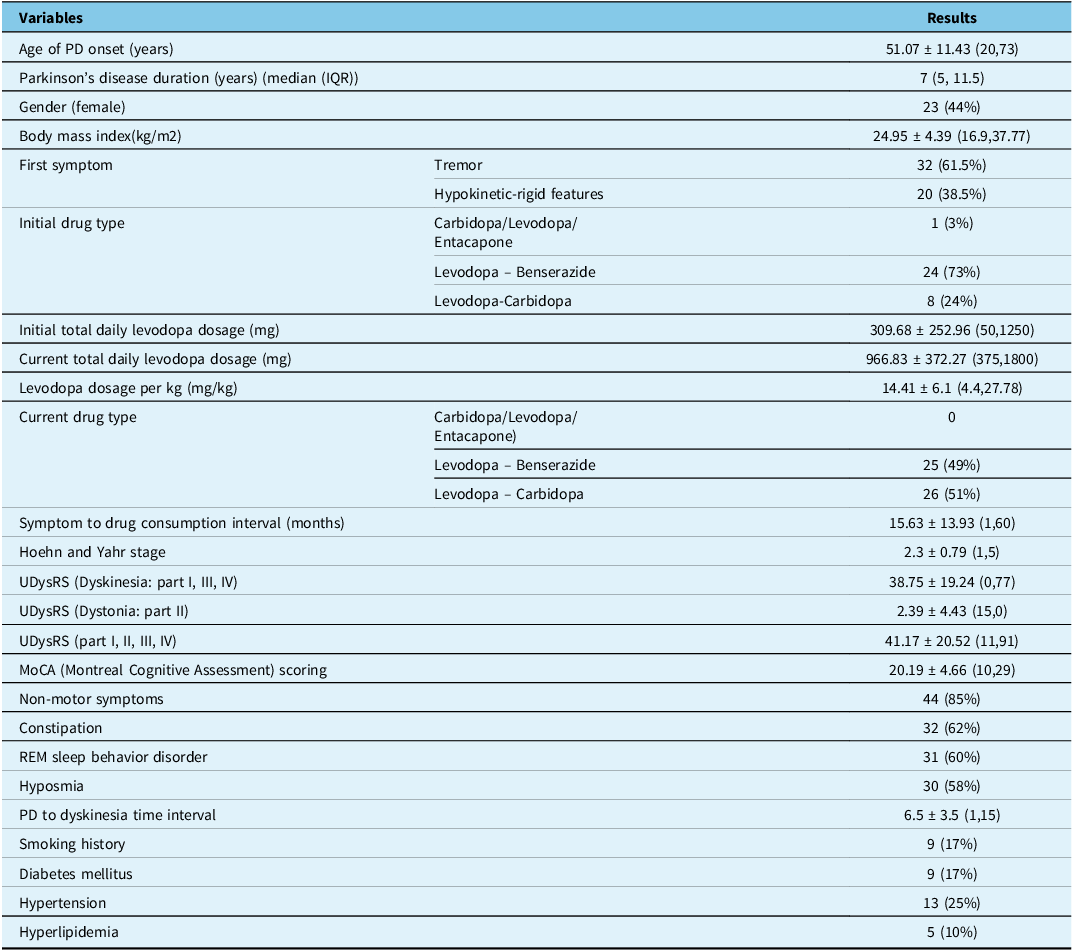
Fifty-two PD patients with LID were studied. The mean age of the included subjects was 59.9 ± 11.4 years. In total, 44.2 percent were female, with a mean BMI of 24.9± 4.4. The median disease duration in our population was 7 years (interquartile range [5, 11.5]). The mean interval between the diagnosis of PD and to development of dyskinesia was 6.5 ±3.5 years. Among our population, the mean initial levodopa dosage was 309.7 ± 252.9 mg per day. In addition, all participants were assessed using the MoCA, with a mean score of 20.19 ± 4.66. The mean severity of the disease calculated by the H&Y stage was 2.3 ± 0.8. The details of demographic and clinical features are shown in Table 1.
Demographic characteristics of included patients (n = 52)

Notes: Normally distributed data are presented as mean ± standard deviation (min, max). Non-normal data are shown as median (inter-quantile range) or the number of patients (percentage).
PD = Parkinson’s disease; UDysRS = Unified Dyskinesia Rating Scale; REM = rapid eye movement.
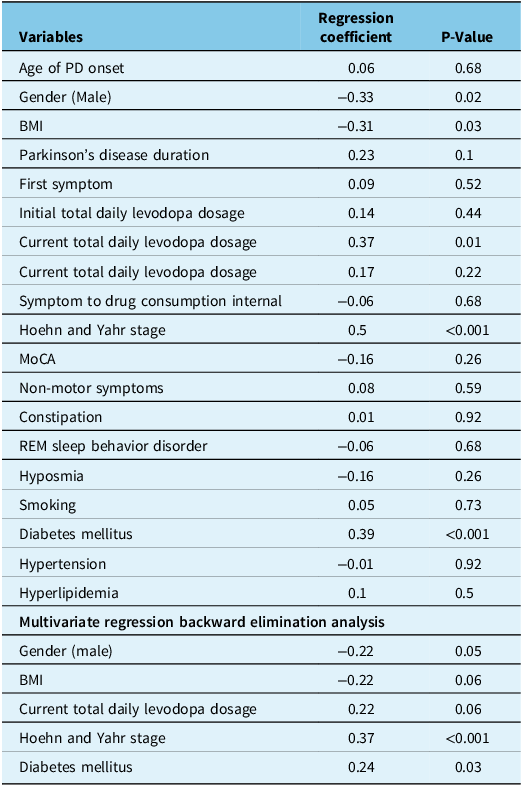
Results of the univariate regression analysis for evaluation of risk factors for the severity of LID based on UDysRS are presented in Table 2. We found that H&Y stage (β = 0.5, p-value < 0.001), BMI (β = −0.3, p-value = 0.03), male sex (β = −0.3, p-value = 0.02), history of DM (β = 0.4, p-value = 0.001) and current daily levodopa intake per kg (β = 0.4, P = 0.01) were significantly associated with the severity of dyskinesia. However, the correlation of age of onset, PD duration, the first symptom of PD, initial levodopa dosage, current levodopa dosage, the time between onset of PD and initial levodopa exposure, MoCA, non-motor symptoms (constipation, RBD and hyposmia), the time between onset of PD and onset of dyskinesia, smoking, history of hyperlipidemia and HTN and the severity of dyskinesia were not significant (all p-value were > 0.05, Table 2). Results of multivariate regression analysis indicated that gender (β = −0.2, p-value = 0.05), H&Y stage (β = 0.4, p-value < 0.001) and history of DM (β = 0.2, p-value = 0.03) were significant factors associated with the severity of dyskinesia.
Factors associated with dyskinesia severity based on the total UDysRS scoring system

Note: This table shows the results of univariate regression and multivariate regression backward elimination analysis to evaluate factors involved in dyskinesia severity.
PD = Parkinson’s disease; BMI = Body Mass Index; MoCA = Montreal Cognitive Assessment scoring; REM = rapid eye movement.
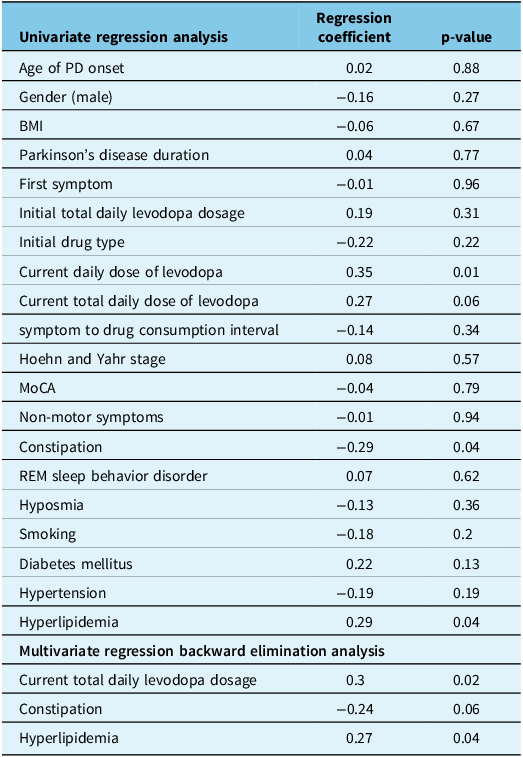
Results of regression analysis for end-dose dystonia are presented in Table 3. The linear univariate regression analysis showed constipation (β = −0.3, P = 0.04), hyperlipidemia (β = 0.2, P = 0.04) and current daily levodopa intake per kg (β = 0.35, P = 0.01) correlate with end-dose dystonia severity. However, age of onset, sex, BMI, PD duration, weight loss, the first symptom of PD, initial levodopa dosage, the time between the onset of PD and levodopa consumption, Hoehn and Yahr Stage, MoCA, other non-motor symptoms (RBD and hyposmia), the time between the onset of PD and onset of dyskinesia, smoking, history of DM and HTN don't significantly associated with end dose dystonia (all p-value was >0.05). Results of the multivariate regression model showed that HLP (p = 0.04) and daily levodopa intake per kg (β = 0.3, P = 0.02) showed a significant correlation with the severity of end-dose dystonia.
Factors associated with dystonia severity based on the UDysRS scoring system

Note: This table shows the results of univariate regression and multivariate regression backward elimination analysis to evaluate factors involved in dyskinesia severity.
PD = Parkinson’s disease; BMI = Body Mass Index; MoCA = Montreal Cognitive Assessment scoring; REM = rapid eye movement.
Discussion
Levodopa-induced dyskinesia (LID) is one of the most disabling symptoms in advanced PD. Reference Ahlskog and Muenter17 It is a common problem for both patients (who alternate between episodes of bradykinesia and dyskinesia) and physicians (who face challenges in finding the right balance between managing the “off” symptoms of PD and controlling dyskinesia as an “on” phase phenomenon). Levodopa-induced dyskinesia (LID) occurrence rates are different among patients. Reference Ahlskog and Muenter17 Although some are more predisposed to develop LID, others may never experience it. Among those who suffer from LID, some experience a more severe form of LID, and it occurs earlier than in others. Reference Ahlskog and Muenter3 Despite most previous studies that focused on risk factors of developing LID, we attempted to assess the association between probable predisposing factors contributing to the severity of LID in idiopathic PD. To enhance the precision of the evaluation, one of our key objectives was to quantify LID through the use of established LID severity scale systems. A few previous attempts to evaluate factors associated with the severity of LID used the Unified Parkinson’s Disease Rating Scale Part IV (UPDRS IV) Reference Choudhury, Pradhan and Paul2 and Abnormal Involuntary Movement Scale. Reference Nicoletti, Mostile and Nicoletti18 In the current study, we employed a subjective and objective scale (UDysRS) to study factors that are correlated with LID severity. It contains both dystonia and dyskinesia parts for evaluating motor fluctuation. Reference Goetz, Nutt and Stebbins11 Based on evidence, UDysRS is superior to other measures evaluating treatment effectiveness. Reference Goetz, Stebbins and Chung19 To the best of our knowledge, this is the first study to use the UDysRS for this purpose. Also, we evaluated the off-dystonia as the other form of motor fluctuation Reference Choudhury, Pradhan and Paul2 using this scale.
In addition, the association of various factors with LID severity has not been precisely studied in the Iranian population. Given that our center is a tertiary referral center, our patients were from various regions across the country. Therefore, the results can be generalized to the broader national population.
According to our findings, female gender, low BMI, more severe PD disease (higher H&Y stage), diabetes and higher levodopa dosage to weight ratio have direct correlation with severity of dyskinesias of LID. We also find a relationship between hyperlipidemia, lack of constipation and daily levodopa intake per kg with end-dose dystonia based on UDysRS part II.
Previous studies showed that LID occurrence is more probable in advanced stages of PD. Reference Choudhury, Pradhan and Paul2,Reference Zhou, Guo and Sun9,Reference Nicoletti, Mostile and Nicoletti18 Additionally, some of these studies have shown that greater PD severity is associated with more severe LID, as measured by UPDRS Part IV. Reference Choudhury, Pradhan and Paul2,Reference Nicoletti, Mostile and Nicoletti18 In consensus with these studies, our analysis confirms that as PD gets more advanced (higher H&Y stage), the severity of LID increases.
The relationship between gender and LID was confirmed in previous studies. Reference Hong, Sunwoo and Yoon8,Reference Zhou, Guo and Sun9,Reference Eusebi, Romoli, Paoletti, Tambasco, Calabresi and Parnetti20 We showed that females develop more severe LID than males as well. We also found that there is no relationship between sex and end-dose dystonia. Also, we noticed that Lower BMI is associated with more severe LID. Other articles confirm the association of low BMI with LID occurrence. Reference Aradi and Hauser6,Reference Zhou, Guo and Sun9 In contrast, Choudhury et al. compared the severity of LID based on UPDRS IV between patients with a BMI below and above 25. They found no significant statistical relationship between them. Reference Choudhury, Pradhan and Paul2 Younger age of PD onset is a risk factor for LID incidence according to evidence, Reference Hashim, Norlinah, Nafisah, Tan, Raymond and Tamil7,Reference Nicoletti, Mostile and Nicoletti18 but Choudhury et al. did not find a significant relationship between age of onset and LID severity calculated by UPDRS part IV. Reference Choudhury, Pradhan and Paul2 Our findings align with those presented by Choudhury. The age of onset may influence the incidence of LID, but it does not appear to correlate with its severity. The disparity may be explained by genetic differences in PD patients across various regions of the world, which could affect both the age of onset and the occurrence of dyskinesia. Reference Latourelle, Pankratz and Dumitriu21,Reference Comi, Ferrari and Marino22 Further investigations are required to explore this relationship.
Although diabetes was shown as a factor associated with LID in a few studies, Reference Sandyk23,Reference Mirzae, Abbasi, Shahidi, Hosseinifakhr, Sina and Habibi24 its correlation with LID severity has not been studied before. This study revealed direct correlation between diabetes mellitus (DM) and LID severity. It has been shown that chronic exposure to hyperglycemia decreases striatal dopaminergic transmission, which leads to increased sensitivity of postsynaptic dopamine receptors. It can be the reason why patients with diabetes are more prone to develop LID. Reference Sandyk23 Furthermore, some evidence showed the role of anti-diabetic drugs like metformin in developing dyskinesia. Reference Postuma, Berg and Stern12 Also, we observed that DM was not associated with off-dystonia. Future studies are required to consider DM in the dose adjustment of PD treatment.
Some articles showed that baseline levodopa total dosage plays a significant role in dyskinesia occurrence. Reference Santos-Lobato, Schumacher-Schuh and Rieder5,Reference Luca, Monastero and Baschi25 In this study, we examined the relationship between the initial dosage and the severity of LID. Our results did not reveal initial dosage as a significant association factor in LID severity. Some studies found a direct correlation between daily total levodopa dosage and the incidence of LID. Reference Hashim, Norlinah, Nafisah, Tan, Raymond and Tamil7,Reference Zhou, Guo and Sun9 In line with previous publications, we found that the levodopa dosage (mg) to weight (kg) ratio was significantly associated with LID severity. This may help physicians to individualize levodopa dosage by the patient’s weight.
For years, the timing of when clinicians should initiate levodopa treatment to avoid LID has been a subject of debate. Cilia et al. conducted a study in 2014 that demonstrated that the time between symptoms to drug consumption does not affect dyskinesia. Reference Cilia, Akpalu and Sarfo26 We can conclude from this finding that delaying levodopa prescription has no benefits in preventing LID. Our study showed this timing was not related to the severity of dyskinesia, either.
Some articles showed that tremors as the initial symptom of PD decrease the possibility of LID incidence. Reference Nicoletti, Mostile and Nicoletti18,Reference Zhang, Tang and Song27 According to our findings, there is no association between initial symptoms and LID severity. Although the initial symptom maybe associated with developing LID, our study showed that it is not correlated with dyskinesia severity. Also, studies showed that genetic polymorphisms can lead to different rates of first symptoms and LID occurrence. Reference Nicoletti, Mostile and Nicoletti18 Hence, the importance of genetic polymorphism in the severity of LID should be studied in the future.
Some articles confirmed the association of non-motor features such as RBD, Reference Kim, Jeon and Yang28 constipation and hyposmia Reference Zhou, Guo and Sun9 with LID incidence. Our data demonstrated that these three do not significantly correlate with LID severity. On the other hand, lack of constipation is related to off-dystonia in our population. Some studies support the role of anorectal focal dystonia as one of the possible causes of constipation in PD patients. Reference Jost29 Then further evaluation is needed to clarify the relation between constipation and end-dose dystonia.
Longer disease duration has been identified as a factor associated with developing dyskinesia in some studies. Reference Zhou, Guo and Sun9,Reference Nicoletti, Mostile and Nicoletti18 However, we indicated that PD duration does not correlate with the severity of LID. Therefore, longer disease duration might be associated with the onset of dyskinesia, but it does not seem to correlate with its severity.
Although several studies have shown identified longer disease duration as a predictive factor for the development of LIDs, our findings indicate that disease duration does not significantly correlate with the severity of dyskinesia. This highlights the multifactorial nature of LID pathophysiology. While prolonged exposure to dopaminergic treatment and disease progression may increase the likelihood of dyskinesia onset, Reference Warren Olanow, Kieburtz and Rascol30,Reference Cilia, Akpalu and Sarfo31 the intensity or severity of these motor complications appears to be influenced by other factors – such as cumulative levodopa dose, dosing frequency, individual susceptibility, younger age at onset and possibly genetic modifiers. Reference Fabbrini, Brotchie, Grandas, Nomoto and Goetz32,Reference Espay, Morgante and Merola33 Moreover, in advanced PD, the prominence of bradykinesia and rigidity may mask dyskinetic symptoms, leading to a non-linear relationship between disease duration and dyskinesia severity. This interpretation is in accordance with observations from the LEAP study Reference Verschuur, Suwijn and Boel34 and other longitudinal research, which emphasize that LID severity is not exclusively a function of disease length, but rather the result of a complex interplay of therapeutic and patient-specific factors.
Cognitive decline has been identified as an associated factor for LID in some articles. Reference Yoo, Chung and Lee35 However, other studies have not found a significant relationship between cognitive decline and LID. Reference Eusebi, Romoli, Paoletti, Tambasco, Calabresi and Parnetti20,Reference Kelly, Lawton and Baig36 We also could not find any relationships between cognitive status based on MoCA and LID severity. The discrepancy in previous studies may be because of different ways of cognitive status assessment in articles or genetic variations among populations.
According to previous studies, smoking is not associated with LID. Reference Zhou, Guo and Sun9,Reference Nicoletti, Mostile and Nicoletti18 Our findings are in line with this. We couldn't find any association between a history of smoking and LID severity. We found out that the history of hypertension and hyperlipidemia does not correlate with the LID severity. On the other hand, our data suggests a relationship between the history of hyperlipidemia and off-dystonia.
Our study has several limitations. First, it was a cross-sectional study, and recall bias was unavoidable. Furthermore, according to recent articles, genetic polymorphism plays a role in the development of dyskinesia. Reference Nicoletti, Mostile and Nicoletti18 We didn't have access to the genetic data of our patients, so further studies in this matter are required. Due to limited available data, the interval time between levodopa doses, or the frequency of levodopa consumption in a day, was not evaluated in our study. These points can be considered in future studies.
Another limitation that should be acknowledged is that UDysRS Part II is not a precise measure for assessing dystonia. While we considered it useful to analyze this section as a proxy score of dystonia, further research is required to validate its accuracy and applicability in this context.
Conclusion
We assessed the association of different factors with LID severity based on UDysRS. We found that the female gender, higher H&Y stage, diabetes mellitus, current daily total levodopa dosage per kilogram body weight, and BMI are associated with severity of dyskinesia. Also, our study suggests that lack of constipation and hyperlipidemia are correlated with end-dose dystonia.
Author contributions
Shamim Kazemi: Conceptualization, Methodology, Investigation, Writing – Original Draft, Writing – Review & Editing, Visualization, Supervision, Project administration. Narges Yazdi: Conceptualization, Methodology, Writing – Review & Editing, Visualization, Supervision. Seyed Amir Hassan Habibi: Writing – Review & Editing, Data Curation. Elahe Amini: Formal analysis, Writing – Review & Editing. Farhad Salari: Writing – Review & Editing, Formal analysis. Mohammad Rohani: Conceptualization, Methodology, Writing – Review & Editing, Visualization, Supervision, Data Curation.
Funding statement
The authors declare that there are no additional disclosures to report.
Competing interests
The authors declare that there are no conflicts of interest relevant to this work.
Ethical compliance statement
We confirm that we have read the Journal’s position on issues involved in ethical publication and affirm that this work is consistent with those guidelines. The study was approved by the institutional review board committee (IR.IUMS.FMD.REC.1403.164) and adhered to the tenets of the Helsinki Declaration. Informed written patient consent was obtained from patients.
Declarations of interest
None.