Introduction
It is widely accepted that risks for non-communicable diseases in adulthood are determined not only by concurrent lifestyle factors, such as diet and levels of physical activity, but also by exposures encountered in early life, either pre- or postnatally [an area of research called Developmental Origins of Health and Disease (DOHaD)].
The most widely researched associations within the DOHaD paradigm have been between birth weight and indicators of cardiovascular and metabolic health in later life.Reference Barker, Martyn, Osmond, Hales and Fall1–Reference Lawlor, Ronalds, Clark, Smith and Leon9 Birth weight is an easily accessible proxy for ‘the overall maternal, environmental and placental factors that influence the efficiency of nutrient transfer to the fetus, and thus overall fetal growth’.Reference Low, Gluckman and Hanson10 Nevertheless, birth weight is unable to provide insight into growth patterns during different stages in utero and offers little information about critical periods of development in the prenatal period.
Early postnatal life is also a period of substantial developmental plasticity in which the infant seeks to regain, through catch-up growth, its position in its programmed growth canal. Canalisation is the phenomenon in which an individual, when in an environment that does not constrain growth, displays a growth pattern that tracks along a given centile position.Reference Cameron11 Using birth weight as a proxy for the entire prenatal period, however, means that any discussion regarding the beginnings of canalisation is limited to the postnatal period only. Identification of where or when the fetus was potentially canalised is impossible and thus one is also unable to determine whether the amount of catch-up growth exhibited in infancy is appropriate or whether it represents rapid growth leading to an elevation of risk. If the canalised growth curve can be identified in utero a more accurate distinction between healthy catch-up growth and deleterious rapid growth can be made.
Routine ultrasound examination during pregnancy is now a standard part of antenatal provision across much of the developed world. Gravidas typically present for two to three scans over the course of pregnancy, in which repeated measurements of various fetal biometric dimensions [abdominal circumference (AC), head circumference (HC), femur length (FL), bi-parietal diameter (BPD), estimated fetal weight (EFW)] are obtained. With this longitudinal assessment of fetal biometry, an assessment of fetal growth rate is possible and the potential identification of not only critical periods of growth, but also the presence of growth canalisation.
The objective of this review is to identify studies that have assessed growth longitudinally in both the pre- and postnatal periods – during childhood and beyond – to identify any relationships between prenatal growth and postnatal outcomes. If a relationship is observed between pre- and early postnatal growth and tracking is seen to occur during this period, it would not only provide insight into the short-term adaptive responses (of any prenatal insult) that have the potential to programme future health, but may also lead to a change in opinion of when the timing of canalisation occurs.
Methods
Selection of studies
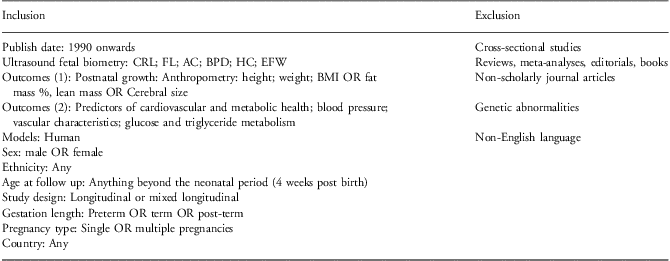
The inclusion and exclusion criteria for this review are presented in Table 1.
Inclusion and exclusion criteria

CRL, crown-rump length; FL, femur length; AC, abdominal circumference; BPD, bi-parietal diameter; HC, head circumference; EFW, estimated fetal weight; BMI, body mass index.
Literature search
The literature search was conducted in five databases [Medline (accessed via EBSCO), Aids and Cancer Research Abstracts, Biological Sciences, Physical Education Index (all accessed via ProQuest) and Scopus] between 1 January 1990 and 1 January 2012. The full details of the search strategy can be found in supplementary document S1. The searches in the three major databases yielded 21,944 journal articles; Medline, 3100; ProQuest, 3391; Scopus, 15,453. The article titles were then assessed against the inclusion criteria, which resulted in the inclusion of 77 papers. Following this, the articles were firstly assessed on their abstracts, with analysis of the whole text as the final elimination step (supplementary figure S2). Reference lists of all included papers were reviewed in order to identify any relevant papers not included in the databases used.
Quality assessment
Publication quality was evaluated according to the method developed by Downs and Black.Reference Downs and Black12 This checklist consists of 27 questions that evaluate the reporting, internal and external validity and statistical power of each of the included studies. Questions 8, 13, 14, 19, 23 and 24 were not applicable to studies included in this review and were therefore excluded. Questions were scored with 0 if the criteria was inadequately met or not mentioned, and 1 if the criteria had been adequately met, thus the maximum possible score was 21.
Results
Included studies
After the evaluation of abstract and full text 29 papers were available for analysis (supplementary figure S2).
The 29 studies came from 10 different cohorts, with five cohorts contributing 24 of the studies. Within these 24 the Generation R cohortReference Jaddoe, Mackenbach and Moll13 contributed 14 studies.
The average sample size used in the 29 studies was 819 (3 significant figures) (range: 37–6276). Twenty of the studies had follow-up in infancy (⩽3 years), five in childhood (>3 to ⩽7 years), three in adolescence (⩾12 to ⩽18 years) and one in adulthood (>18 years).
Study quality
Supplementary tables S3 and S4 provide scores of quality based on the Downs and Black checklist.Reference Downs and Black12 The mean (s.d.) score was 13.59 (2.61) with a range of 7–18. None of the studies reported whether the cohort asked to be in the study was representative of the population from which they were recruited and a limited number of studies reported on whether those that were included in the study were representative of the population. Other methodological issues were not reporting the blinding status of the measurers of the outcome and not reporting the statistical power of the analysis.
Main results
Body composition: fat mass and distribution, lean mass and bone
Fat and muscle mass
Section summary: The majority of the studies used EFW in the final trimester and related this to a measure of body composition (typically adipose tissue) at some point during infancy. A trend for an inverse relationship between EFW and adiposity was observed,Reference Vielwerth, Jensen and Larsen14–Reference Durmuş, Mook-Kanamori and Holzhauer17 though a contrasting association was observed in one studyReference Ay, Van Houten and Steegers18 and in a twin study, third trimester fetal growth velocity was unrelated to lean mass and total or abdominal adiposity, though follow up was in adolescence.Reference Pilgaard, Hammershaimb and Grunnet19
Bone mass
Section summary: From the limited number of studies conducted, a positive association was observed between the growth of certain fetal dimensions (AC,Reference Harvey, Mahon and Robinson20 FL,Reference Harvey, Mahon and Robinson20 EFWReference Jensen, Vielwerth and Frystyk21, Reference Ay, Jaddoe and Hofman22) and bone status in infancy and childhood. In particular, fetal FL showed positive associations with three indices of postnatal bone size (bone area, bone mineral content and areal bone mineral density), an association that strengthened with advancing gestational age.Reference Harvey, Mahon and Robinson20
Height, weight, HC and body mass index (BMI)
Height and weight
Section summary: Consistent positive associations were observed between FL and length/height in infancy and childhood.Reference Harvey, Mahon and Robinson20, Reference Cacciari, Salardi and David23, Reference Mook-Kanamori, Durmuş and Sovio24 This association of fetal length [FL or crown-rump length (CRL)] and postnatal length was apparent as early as the first trimester.Reference Mook-Kanamori, Steegers and Eilers25 With advancing gestational age, FL may be as good a marker for postnatal weight as AC.Reference Harvey, Mahon and Robinson20 Results for the programming of weight are more inconclusive but suggest it may be later than the first trimester.Reference Mook-Kanamori, Durmuş and Sovio24 Reduced weight velocity in the final trimester was inversely associated with weight velocity in infancy.Reference Mook-Kanamori, Durmuş and Sovio24, Reference Larsen, Greisen and Petersen26 Results indicate that the effects of maternal constraint are resolved by 18 months of age.Reference Cosmi, Visentin, Fanelli, Mautone and Zanardo27
BMI
Section summary: Mean abdominal diameter (MAD) in the final trimester may be an important predictor of childhood BMI. MAD in the final trimester was positively associated with childhood BMI, even among smoking mothers.Reference Rückinger, Beyerlein, Jacobsen, von Kries and Vik28 This is contrary to the hypothesised effects of smoking during pregnancy; fetal growth restriction followed by greater increases in postnatal weight, typically as fat. More studies are needed to replicate such findings, especially as another study did observe more rapid increases in BMI in infancy in those fetuses that experienced growth restriction.Reference Beltrand, Nicolescu and Kaguelidou16 The discrepancy between these two studies could be related to the differences in follow up occasion in postnatal life [one in early infancy (0–1 year) and one in childhood (5 years)].
Cardiovascular and metabolic health
Blood pressure
Section summary: Consistent inverse associations have been observed between fetal growth and systolic blood pressure (SBP) in infancy, childhood and adolescence,Reference Vielwerth, Jensen and Larsen14, Reference Thame, Osmond and Wilks29–Reference van Houten, Steegers and Witteman32 with one study observing this relationship as early as 20-week gestation.Reference Thame, Osmond and Wilks29 AC may be the dimension most closely associated with the programming of blood pressure.Reference Thame, Osmond and Wilks29
Arterial, ventricular and atrial thickness
Section summary: Reduced growth (EFW) in the third trimester has been associated with thickening of the vessel wall in the abdominal aorta, occurring as early as 18 months.Reference Cosmi, Visentin, Fanelli, Mautone and Zanardo27, Reference Zanardo, Fanelli and Weiner33 No statistically significant association was observed with the diameter of this vessel however.Reference Cosmi, Visentin, Fanelli, Mautone and Zanardo27, Reference Geelhoed, Steegers and van Osch-Gevers34
Renal development and function
Section summary: The results are inconclusive as to the elucidation of both the most sensitive fetal period and fetal dimension related to kidney development, in terms of kidney size.Reference Geelhoed, Verburg and Nauta35 One study reported negative effects of reduced final trimester growth on renal function, occurring as early as 18 months.Reference Zanardo, Fanelli and Weiner33
Serum glucose, insulin and lipids
Section summary: Reduced fetal growth (using EFW) in the final trimester was associated with a less efficient triglyceride (in singletons)Reference Vielwerth, Jensen and Larsen14 and insulin metabolism (in twins)Reference Pilgaard, Hammershaimb and Grunnet19 in adolescence and young adulthood. For both twins and singletons, third trimester fetal growth velocity was unrelated to insulin disposition index (measure of insulin secretion corrected for the ambient degree of insulin resistance) and first phase insulin response (change in insulin above basal/change in glucose above basal in first 10 min of intravenous glucose tolerance test),Reference Vielwerth, Jensen and Larsen14, Reference Pilgaard, Hammershaimb and Grunnet19 though more studies with earlier follow up are necessary.
Smoking
Section summary: Children whose mothers smoked during pregnancy demonstrated catch-up growth in the first few years of life to reduce the observed deficits in weight and length seen at birth.Reference Vik, Jacobsen, Vatten and Bakketeig36 This may not be the case for growth of the head; indeed, exposure to the 700 chemicals within smoke that have been observed to cross the placental barrier,Reference Hackshaw, Rodeck and Boniface37 may permanently reduce the size of the head.Reference Vik, Jacobsen, Vatten and Bakketeig36
Genotype studies
Section summary: The insulin gene variable number of tandem repeats mini-satellite (III/III genotype) was implicated in a deleterious growth profile of the head.Reference Mook-Kanamori, Geelhoed and Steegers38 Differences in the IGF1Reference Geelhoed, Mook-Kanamori and Witteman39 and proliferator-activated receptor γ2 (PPAγ2)Reference Mook-Kanamori, Steegers and Uitterlinden40 genotypes may also lead to divergent growth trajectories in the second half of pregnancy and infancy, with (PPAγ2) sharing a possible interaction with breastfeeding duration. Variants of the glucocorticoid receptor haplotype appear not to be involved in the growth profiles for total weight, length and head during gestation and infancy.Reference Geelhoed, Steegers and Koper41
Other associations
Section summary: Fetal dimensions (HC, AC, FL, EFW) showed no association between skeletalReference Mook-Kanamori, Durmuş and Sovio24 or reproductive development,Reference Hart, Sloboda and Doherty42 whereas HC and BPD in later trimester may well be predictive of cerebral ventricular volume in infancy.Reference Roza, Govaert and Vrooman43
Discussion
The relative paucity of data in any of the topics under discussion (approximately four studies per topic), as well as the heterogeneity of the included studies (in terms of age at follow up, statistics used, definition of impaired/rapid growth) makes it difficult to form definite conclusions about the relationship between prenatal growth and postnatal outcomes, in terms of either postnatal growth patterns or predictors of cardiovascular and metabolic health.
Programming, growth patterns and canalisation
It may be posited that programming of fat occurs as early as 20-week gestation, with several of the studies showing a relationship between fetal growth at this time and adiposity in infancy. The component stores comprising total fat, may be programmed at different periods of gestation; the more metabolically active peritoneal fat may be subject to programming in the second trimester, with programming of less active subcutaneous fat occurring in the third trimester. The fact that EFW, the sum of the whole body, was the measure of fetal growth used in the analyses that revealed possible associations with particular periods of gestation and adiposity, means that we are unable to elucidate whether specific body dimensions are linked to programming of fat in infancy. One study did, however, investigate whether growth of the abdomen in the second half of pregnancy was related to per cent body fat at 4 years and found no association.Reference Harvey, Mahon and Robinson20 If this observed time dependent programming effect is indeed true, it has important implications for fetuses experiencing poor growth at particular times in pregnancy. For example, a fetus experiencing growth restriction in the second trimester may be predisposed to a postnatal ‘catch-up’ of peritoneal fat, which has more adverse metabolic risks associated with it than a fetus who experienced growth faltering in the third trimester and experiences postnatal ‘catch-up’ of the less metabolically active subcutaneous fat. It is important to consider the biological significance of these statistically significant associations, as the effect sizes for the observed associations were relatively small.
It is apparent that programming of length/height does occur during prenatal life, but the exact timing of this is unclear. One study reported that a reduction in CRL as early as the first trimester (10–13 weeks) was associated with a compensatory increased growth rate in the first 2 years, thus suggesting that the infant is attempting to catch-up to a centile position that must have been determined before 10–13 weeks. Furthermore, a study in the same cohort reported that minimal growth of the FL (a proxy for total length) between the second and third trimester and third trimester – birth was associated with a greater peak height velocity (PHV) in infancy and the effect was greater for third trimester faltering. This could be interpreted as showing that the longer the insult persists and thus the further the fetus deviates from the centile position programmed in the first trimester, a more rapid postnatal growth is needed to return the infant to its centile position. Others, however, reported only significant associations between FL in the third trimester (not second) and height in childhood, suggesting that the centile location is not determined until later. Despite not providing clear evidence on the timing of canalisation, the fact that rapid postnatal growth rates have been observed, independent of birth weight, means that fetal growth in length is associated with metabolic and cardiovascular diseases in adult life, mediated by the deleterious rapid growth rate in infancy.Reference Ekelund, Ong and Linne44, Reference Leunissen, Kerkhof, Stijnen and Hokken-Koelega45
Fetal weight is traditionally thought to have a peak velocity in the third trimester, at around 34–36 weeks.Reference Tanner46, Reference Guihard-Costa, Droulle and Larroche47 This velocity is said to be a consequence of an increased deposition of fat in the third trimester, with Southgate and HayReference Southgate and Hay48 observing that between 30 and 40 postmenstrual weeks, fat content increases from 30 to 430 g. This theory of a sequential timing of growth velocities, the second trimester for length and the third for weight, is known as the ‘Timing Hypothesis’Reference Villar and Belizan49 and today is still considered by many as the pattern of fetal growth. Despite showing the greatest increases in the final trimester, the determination of the fetus’ weight centile could, as may also be the case for length, occur before the time of this substantial increase. The physiologic constraint of growth that occurs in the third trimester (maternal size) could provide insight into whether there is a degree of weight tracking in utero. Infancy is a period of great increases in weight and many speculate that this is to readdress the effects of maternal constraint in the final trimester. However, studies investigating catch-up growth during infancy have used birth weight as the proxy for maternal constraint, that is lower birth weight equals more constraint. Studies included here show that fetal growth velocity as early as 30 weeks is inversely associated with gains in weight in infancy, providing a more direct assessment of the effects of maternal constraint. Furthermore, it appears that the effects of this constraint are resolved by ∼18 months, with two studies reporting that there was no difference in weight at this time between those infants classified as intrauterine growth restriction (IUGR) (more severe maternal constraint) in the third trimester and those classified AGA. However, these studies defined IUGR using both EFW and umbilical artery pulsatility index (measure of resistance in the fetoplacental circulation) and thus an aetiology not originating solely from maternal constraint.
Others speculate that the determination of the infant's centile location occurs in the period of gestation soon after organogenesis, when cell numbers are increasing rapidly (circa 10 weeks). ColeReference Cole50 speculates that if an insult occurs during this sensitive period of prenatal life, the result will be a reduced total number of cells (hypoplasia), with no opportunity once the period has passed for compensatory growth. If the insult occurs later in gestation when increases in size are due to hypertrophy, the infant is able to catch-up in postnatal life. This discussion, however, was concerning organ development and whether the same can be applied to growth assessed at the whole body level is unknown. Also, this theory focuses on how insults may affect the hyperplastic rate and makes no reference to physiologically normal low or high hyperplasic rates that may occur between individuals, thus culminating in the naturally occurring heterogeneity in achieved size. Whether determination of the weight centile occurs as early as the first trimester is uncertain, as two studies in the same cohort report contrasting findings regarding CRL and weight velocity in infancy.Reference Cacciari, Salardi and David23, Reference Mook-Kanamori, Durmuş and Sovio24
A potential method to identify fetuses tracking along a particular centile or within a centile band is that used by BjØnerem et al.Reference BjØnerem, Johnsen, Nguyen, Kiserud and Seeman51 who calculated FL Z scores at four separate time points, for each fetus. The range of Z scores was split into quartiles and tracking was inferred if the fetus remained in the same quartile at each time point. However, as one would expect 95% of the sample to fall within ±1.96 Z scores of the mean, splitting the range into quartiles will result in each quartile being ∼1 Z score, which may not be sensitive enough to elucidate deviation. It may be more intuitive to split the range into groups of width 0.67 Z scores, thus each group would represent a centile band.
Predictors of cardiovascular health-link to DOHaD paradigm
One of the more consistent findings in the studies was the inverse relationship between fetal growth and SBP, with some studies finding this association as early as 20-week gestation. Of particular concern is that the deleterious effects of poor fetal growth on blood pressure were apparent in infants and children. The dimension that was used most often as the proxy for total fetal growth in these studies was AC which is also considered a proxy for the growth of central organs,Reference Cole50 with a reduced size reflecting reduced organ size.Reference Barker, Martyn, Osmond and Wield52 The association of a reduced AC and thus reduced size of the central organs, and an increase in SBP may be in line with the ‘Brenner Hypothesis’. This states that the reduced kidney size and thus nephron number leads to a hyper-filtration in the remaining nephrons, causing subsequent renal damage and reduced renal function,Reference Brenner, Meyer and Hostetter53 potentially leading to increased SBP. However, as most of the evidence cited by these authors was based on animal models and adult patients with pre-existing renal disease, caution is warranted when generalising to normal populations. Nonetheless recent studies have observed hyper-filtration leading to increased SBP occurring as early as infancy.Reference van Houten, Steegers and Witteman32, Reference Frankfurt, Duncan, Heyne and Rosenfield54 Thame et al.Reference Rückinger, Beyerlein, Jacobsen, von Kries and Vik28 speculate that the AC may be the most sensitive fetal dimension for indicating any potential programming of blood pressure and as this measurement is routinely taken in the UK, it provides clinicians with an available surveillance tool for identifying fetuses that may be on the pathway to increased blood pressure and hypertension. When, as is commonly the case, a whole body measure such as EFW is used as the measure of fetal growth, it is less apparent as to which aspects of the fetal anatomy are implicated in the programming of disease risk. For example, some of the studies showed associations between EFW and various aspects of the cardiovascular profile such as aortic intima-media thickness and diameter, with those fetuses experiencing IUGR in the third trimester having poorer profiles than those who did not. However with EFW, unlike AC that has been associated with growth of the central organs, we are unaware of the reductions in size at the organ or tissue level and how these may increase risk factors for cardiovascular disease in infancy.
Limitations of included studies
Owing to the originality of the studies included and the burgeoning nature of the field of fetal biometry, it is difficult to compare the effect sizes of the particular factors affecting the pattern of pre- and postnatal growth to other studies in the literature. The majority of the studies provide no reference as to the least significant difference sought, though again this may be understandable because of the lack of comparable studies. However, failing to mention the statistical power for the associations under investigation limits the understanding of ‘non-significant’ results. Furthermore a finding that is statistically significant does not necessarily mean it is biologically significant, and vice versa. For example, Ay et al.Reference Ay, Hokken-Koelega and Mook-Kanamori15 report that for each kilogram increase in third trimester (30 weeks) EFW, there was a significant 4.11 mm reduction in sum of skinfolds at 2 years. With the mean fetal weight in this cohort only being ∼1.6 kg (s.d. = 260 g) at this time, a 1 kg increase (62.5% increase) translates to a Z score of 3.84 and therefore at the extremity of the population distribution. It may not only be concluded that this will only affect an extremely small proportion of the population, but furthermore, there is no evidence that an increase in sum of skinfolds of 4.11 mm may have a deleterious effect on the health of the individual. Similarly small effect sizes were observed in other studies.Reference Jensen, Vielwerth and Frystyk21, Reference Mook-Kanamori, Durmuş and Sovio24, Reference Blake, Gurrin and Beilin31, Reference Geelhoed, Mook-Kanamori and Witteman39 A recurring problem in the papers was the definition of ‘catch-up’ growth. This phenomenon relates to the compensatory increased growth rates observed in individuals who have experienced some sort of insult. However, many of the studies included, although identifying the value of clinically significant ‘catch-up’ growth (0.67 SDS), fail to provide evidence of prior insult. Without prior insult, this increased growth rate cannot be deemed ‘catch-up’ growth; rather this is simply rapid growth and the results of these studies should be interpreted accordingly. Furthermore, only one of the studies referred to the statistical phenomenon of ‘regression to the mean’, in which a second measurement taken on an individual is closer to the population mean than the initial measurement was. According to Cameron et al.,Reference Cameron, Preece and Cole55 catch-up growth and regression to the mean both operate on the Z score scale and catch-up growth is ‘present only when the increase in Z score over time exceeds that predicted by regression to the mean’. With the deleterious effects of rapid growth in infancy reported, it is imperative to identify whether the observed pattern is indeed because of a true biological compensatory effect or merely a statistical artefact. Understanding the loss to follow up is vital in cohort studies. Although a lot of studies did include figures for rates of attrition, it was not universal for a subsequent comparison (in terms of fetal, maternal or socioeconomic variables) of those who did and did not attend for follow up. Failure to explore and account for reasons for drop-out puts studies at risk of reporting biased results. Although rare, a small number of studies failed to make reference to the particular growth standard or reference on which their sample was compared. Without this information, it is impossible to understand the true profile of the sample. For example, the reference could have been based on a significantly different population to that in the study or could have been produced a substantial time ago and thus masking possible secular trends. In the study by Vik et al.,Reference Vik, Jacobsen, Vatten and Bakketeig36Z scores were calculated using the mean of the sample (both smokers and non-smokers) and not on an independent sample of normal pregnancies. This will underestimate the true deviation in the fetuses of smoking mothers as the sample mean used to calculate the Z scores will be reduced with the inclusion of the smoker's scores into the overall mean. The formula to determine EFW was not the same across the studies. Although the use of a different equation to estimate fetal weight may not affect the relationships observed between pre- and postnatal growth (i.e. all fetuses will have been subject to the same formula within a study), whether or not the investigators were aware of the population on which the formula was derived and thus the appropriateness of its use in their population, is unknown. The lack of adjustment, or lack of acknowledgement as to which covariates were adjusted for, limits the conclusions one can make regarding the association between dependent and independent variables.
Limitations of review methods
The ultimate goal of a systematic review is to include all available relevant studies. Ideally studies written in any language would be included in order to avoid language bias. Egger et al.Reference Egger, Zellweger-Zähner and Schneider56 report that studies with statistically significant results that have been conducted in non-English speaking countries are more likely to be published in English language journals than those reporting non-significant results, thus introducing language bias into the review. Furthermore, limiting to only English language studies results in an analysis of fewer relevant papers. Whether a study is published or not may depend on the results reported and thus limiting included articles to only those published as articles in scholarly journals may introduce publication bias into the review. It was decided, however, to limit the studies to only those published in scholarly journals because these are easier to source and obtain than unpublished studies. Also, the fact that they are published in scholarly journals means that a peer review has deemed the study to be satisfactory both in terms of methods and ethics. Study selection by a single reviewer (T.N.) could potentially have introduced selection bias into the analysis, a risk that may have been reduced had two reviewers been used. However, discussions with the second reviewer (N.C.) regarding the selected studies were frequent in an attempt to reduce this possible bias. As almost 50% of the included studies came from a single cohort in the Netherlands (Generation R), caution is warranted when extrapolating results to other populations.
Conclusions
The use of repeated ultrasound assessments of fetal growth is valuable for the assessment of tracking and the identification of periods of reduced or rapid growth. The current findings suggest that centile tracking may occur early in pregnancy though whether this is as early as the first trimester is uncertain. Variation in the definitions of ‘catch-up growth’ and the inability to account for ‘regression to the mean’ may mask actual associations. The second trimester may be a critical period for the programming of blood pressure and AC may be the most sensitive fetal dimension to indicate programming. However, the timing and fetal dimensions involved in the programming of other aspects of cardiovascular health are less clear. The heterogeneity of the studies included makes it difficult to provide definite conclusions as to the relationship between prenatal growth and postnatal outcomes. More studies utilising 3D imagery and Doppler velocimetry while benefitting from more sensitive statistical techniques may provide greater insight into prenatal growth and the programming of cardiovascular health. Furthermore, there is an urgent need for studies to be conducted in less developed countries, as these fetuses are likely to be exposed to insults which may result in more transparent programming of later health and disease.
Acknowledgements
The authors would like to thank Frank Parry, an academic librarian at Loughborough University, for his help in the literature search and Dr E. Rousham (Loughborough University) for advice on formatting and correcting parts of the results section.
Financial Support
This research received no specific grant from any funding agency, commercial or not-for-profit sectors.
Conflicts of Interest
None.
Ethical standards
Our analysis of published data, using non-identifiable information, did not require ethical approval.