Asthma is a serious and chronic respiratory condition that is characterised by shortness of breath, coughing and breathlessness. Asthma poses a substantial physical health burden upon children. For example, asthma is the third leading cause of hospitalisation in the United States for children under 15 years of age (Kelley & Kearney, Reference Kelley and Kearney2018). It is the leading cause of total disease burden for children aged 5–14 in Australia (Australian Institute of Health and Welfare, 2016). Consequently, support for the physical health of children with asthma is a high priority for health promoting schools (Centers for Disease Control and Prevention, 2019).
However, children with asthma face not only direct physical health risks but also increased risk for mental health problems; in particular, for internalising problems, with moderate–large effect sizes (dmn = .73; McQuaid, Kopel, & Nassau, Reference McQuaid, Kopel and Nassau2001). Disruptive behaviour problems (dmn = .40) are also elevated among children with asthma (McQuaid et al., Reference McQuaid, Kopel and Nassau2001). It is not clear how the fact of having asthma may translate into psychosocial problems. How schools can support children with asthma against psychosocial risks is similarly unclear.
One possible pathway may be via toxic social experiences such as bullying. In healthy populations, bullying victimisation is a well-established risk factor for a range of psychosocial outcomes, with meta-analyses indicating a likely role in suicidal behaviour (Holt et al., Reference Holt, Vivolo-Kantor, Polanin, Holland, DeGue, Matjasko and Reid2015), internalising (Reijntjes, Kamphuis, Prinzie, & Telch, Reference Reijntjes, Kamphuis, Prinzie and Telch2010; Zwierzynska, Wolke, & Lereya, Reference Zwierzynska, Wolke and Lereya2013) and externalising problems (Reijntjes et al., Reference Reijntjes, Kamphuis, Prinzie, Boelen, van der Schoot and Telch2011).
Bullying may play a role in the elevated rates of adjustment problems faced by children and adolescents with asthma. In general, children with chronic conditions have increased risk of being the target of bullying (Pittet, Berchtold, Akré, Michaud, & Surís, Reference Pittet, Berchtold, Akré, Michaud and Surís2009; Sentenac et al., Reference Sentenac, Arnaud, Gavin, Molcho, Gabhainn and Godeau2012; Sentenac et al., Reference Sentenac, Gavin, Arnaud, Molcho, Godeau and Gabhainn2011). But, to date, only a handful of studies have examined bullying among young people with asthma, all of which have important methodological limitations. This leaves little known about asthma, bullying and adjustment among younger children who have a clear diagnosis of asthma. There has also been very little work on the co-occurrence of bullying victimisation and perpetration (‘bully/victim’ status). Children who experience bullying as both victims and as perpetrators (bully/victims) have the greatest psychosocial risk (Haynie et al., Reference Haynie, Nansel, Eitel, Crump, Saylor, Yu and Simons-Morton2001).
Most of the studies have relied on data from the National Survey of Children’s Health, a recurring telephone-based survey addressing adolescent health. Using data from the 2003 wave, the earliest study on bullying and asthma reported parent data on over 100,000 American children with and without asthma (Blackman & Gurka, Reference Blackman and Gurka2007). Parents who reported that their child had asthma also reported higher rates of victimisation, as well as elevated rates of behavioural disorder, attention-deficit/hyperactivity disorder, and depression. But this study had several important limitations: the link of bullying to adjustment was not examined, bullying perpetration was not assessed, parents were the source for all data, and asthma was not ascertained. Moreover, rates of bullying were low overall (13.8% for non-asthma group; 14.5% for the asthma group) compared to meta-analytic estimates of self-reported victimisation (~33%; Modecki, Minchin, Harbaugh, Guerra, & Runions, Reference Modecki, Minchin, Harbaugh, Guerra and Runions2014), raising concerns about the validity of parent report.
Subsequent studies using these data shared these limitations. For example, parent-report of children bullying other children or being ‘cruel’ or ‘mean to others’ were associated with asthma severity (Blackman & Conaway, Reference Blackman and Conaway2012). Another study found bullying perpetration to be associated with low wellbeing among those with more severe asthma (Nabors et al., Reference Nabors, Odar-Stough, Peugh, Merianos, Cunningham and Yockey2018). Unfortunately, these studies did not report on bullying victimisation, and thus provide an incomplete picture of bullying involvement and its role in psychosocial adjustment for children with asthma.
Another U.S. study examined bullying among adolescents with and without self-reported asthma (Gibson-Young, Martinasek, Clutter, & Forrest, Reference Gibson-Young, Martinasek, Clutter and Forrest2014); 19.7% of adolescents with asthma reported face-to-face bullying victimisation compared to 13.4% of non-asthmatics, r = −.06, p < .01. Adolescents with both asthma and depression with more likely to be victims of bullying. This aligns with a study that found that bullying victims with chronic health conditions may experience greater consequences than victims who do not have such physical health problems (Pittet et al., Reference Pittet, Berchtold, Akré, Michaud and Surís2009). But their study also bears several important limitations. First, all items used were single-item self-reports, including asthma (‘Has a doctor or nurse ever told you that you have asthma?’) and depression (‘During the past 12 months, did you ever feel so sad or hopeless almost every day for two weeks or more in a row that you stopped doing some usual activities?’). This latter item was nominated ‘yes’ by 18.7% of males and 32.9% of females, raising serious questions as to its validity and reliability as an indicator. To compare, an Australian national study using a validated assessment of major depressive disorder found prevalence rates of 4.3% and 5.8% for 12- to 17-year-old boys and girls respectively (Lawrence et al., Reference Lawrence, Johnson, Hafekost, de Haan, Sawyer, Ainley and Zubrick2015).
In the only study outside the United States to study bullying and asthma, only one in ten young people reported having been made fun of or bullied because of their asthma (Wildhaber, Carroll, & Brand, Reference Wildhaber, Carroll and Brand2012). This figure is substantially lower than meta-analytically derived prevalence estimates (Modecki et al., Reference Modecki, Minchin, Harbaugh, Guerra and Runions2014), likely because it conflates the behaviour (being bullied) with the attribution of the cause of the bullying (the asthma). Furthermore, this question was not psychometrically sound, with no validity or reliability evaluation provided in the article.
Only one study to date has examined the co-occurrence of asthma with both bullying perpetration and victimisation, with a sample of American students (Grades 6–12; Waasdorp, Mehari, Milam, & Bradshaw, Reference Waasdorp, Mehari, Milam and Bradshaw2019). This study found that youth with asthma were more likely to be victimised online and offline, and to be cyber bully/victims. However, this study may have occluded important patterns due to how it parsed the offline and online bullying involvement data (e.g., cyber bully/victim was treated as a distinct group from face-to-face bully/victims). Given that online and offline bullying involvement are strongly correlated (Modecki et al., Reference Modecki, Minchin, Harbaugh, Guerra and Runions2014), this likely created an overly complex picture. This study did not examine psychosocial outcomes, leaving an unclear picture of the relationship of bullying and psychosocial functioning among students with asthma.
The current study
The extant research addressing the association of asthma and bullying has provided a sense that bullying may be more common for young people with asthma, and may also be more noxious to the psychosocial functioning of children with asthma (Gibson-Young et al., Reference Gibson-Young, Martinasek, Clutter and Forrest2014). However, the current body of research shares several serious limitations that the current study aimed to overcome. The current study was conducted to examine bullying among a clinical sample of children with asthma using psychometrically sound self-reports of bullying involvement. Extant research on the topic almost exclusively focused on adolescents: the current study aimed to examine the role of asthma in bullying in primary-school-aged children. Finally, all but one of the previous studies were conducted in the United States, leaving unclear the generalisability of the findings of elevated bullying involvement in asthma. The current study presents data from an Australian sample.
The current study aimed to determine: (a) whether children with asthma are more likely to be bullying perpetrators, victims, or both; and (b) whether having asthma amplifies the association of bullying and psychosocial adjustment. The hypotheses were: (a) children with asthma would report greater bullying victimisation and more bully/victim co-occurrence than a comparison group of children without asthma; children with asthma were hypothesised not to differ with regard to ‘pure’ bully perpetration status; (b) that involvement in either of these roles would amplify the risk of adjustment problems for children with asthma, compared to children without asthma.
Methods
Participants
Children with confirmed asthma (n = 24; 18 boys and 6 girls) were recruited, as well as a comparison sample (n = 39; 22 boys and 17 girls). The mean age was 9.8 years (SD = 2.51).
Instruments
Psychosocial adjustment
The 25-item Strengths and Difficulties Questionnaire (SDQ) Parent Report Measure (Goodman, Ford, Simmons, Gatward, & Meltzer, Reference Goodman, Ford, Simmons, Gatward and Meltzer2000) was deployed to assess emotional symptoms, conduct problems, hyperactivity/inattention, and peer relationship problems (five items per subscale). The SDQ has been widely validated and shows excellent validity and reliability (Goodman et al., Reference Goodman, Ford, Simmons, Gatward and Meltzer2000).
Bullying victimisation and perpetration
The Forms of Bullying Scale (FBQ; Shaw, Dooley, Cross, Zubrick, & Waters, Reference Shaw, Dooley, Cross, Zubrick and Waters2013) measures child self-report of bullying victimisation and perpetration (10 items per subscale). The FBQ provides a definition of bullying, and items address physical, verbal, relational and cyber bullying in the previous school term (Response options were not at all, once or twice, every few weeks, about once a week, several times a week). The FBQ has excellent readability (Flesch-Kincaid grade level = 2.74). For the current sample, the scale had adequate internal consistency, α = 0.78; 0.74 (victim; perpetrator).
Descriptive data were also collected to characterise the child’s asthma. For parents who indicated their child was involved in bullying at school, a question addressed (a) to what extent these bullying experiences may have been due to their child’s asthma, and (b) whether they believed this bullying had contributed to their child not taking their asthma medication (y/n). Other questions were used to characterise the child’s asthma, including current asthma medication use and adherence to medication.
Procedure
The study was approved by the human research ethics committee of Perth Children’s Hospital. Starting in 2016 and extending into 2017, children with a confirmed asthma diagnosis and their parents were recruited while awaiting respiratory clinic appointments at an Australian children’s hospital. Staff within the respiratory clinic advised regarding times at which potential participants would be waiting. A trained research assistant introduced the study of asthma and children’s school social experiences to parent(s) and the child and provided an information booklet. Inclusion criteria for the asthma group included evidence of ongoing symptoms and exacerbation requiring oral steroid in the previous year. The non-asthma sample was recruited from a plastic and reconstructive surgery and an orthopaedic clinic and were excluded from the comparison group if they had any diagnosed chronic health conditions, other than hayfever or eczema (per parent report). Those who consented completed surveys while in the waiting area. The research assistant supported the child in completing the survey and explained unclear items.
Data analysis
Bullying role was calculated based on cut-offs derived from inspection of the distributions. The FBQ is a multi-item scale with no a priori cut-off. Students who selected once or twice for more than one of the 11 bullying items are de facto reporting repeated experience of bullying. For example, a mean score 1.18 could reflect two distinct forms of bullying once or twice, or alternately, a single form of bullying every few weeks). A mean score of 1.27 would be attained with three items rated as once or twice. For the distribution of victimisation scores, an inflection point was observed at 1.27, suggesting a threshold for bullying victimisation. For perpetration, an inflection point was observed at 1.18. These inflection points were used as cut-offs to classify the Victim-only, Bully-only, Bully/victim, and Uninvolved groups. To determine the robustness of findings, two alternative cut-offs were used and analyses rerun; the results were substantively unchanged.
Considering the small sample size, both parametric and nonparametric tests were conducted where possible to determine convergence of results. Simple group differences were tested via t test and by Mann-Whitney U-test. Likelihood ratio tests were run to examine the dependence of bullying role on asthma group. To determine the effects of the asthma group and bullying role (and their interaction) on socio-emotional adjustment, analyses of variance (ANOVAs) were conducted, with attention to heteroscedasticity due to the risk of the small sample size not meeting best linear unbiased estimates. A series of generalised linear models were tested with emotion problems, conduct problems, peer problems, hyperactivity and proactive behaviours as the dependent variables and age as a covariate. Where there was evidence of heteroscedasticity, Huber-White robust standard errors were calculated and maximum likelihood estimation applied in IBM SPSS 26.0; no substantive differences were found. Cohen’s d was reported for group difference effect sizes, using established rules of thumb for interpretation of effect size (Bosco, Aguinis, Singh, Field, & Pierce, Reference Bosco, Aguinis, Singh, Field and Pierce2015).
Results
Asthma characterisation
The consent rate for the asthma sample was 76.4%, and the non-asthma sample consent was 46.9%. All but two parents reported their child missed days of school in the previous year due to asthma, ranging from 1 to 68 days (M = 14.4, SD = 14.2). Three-quarters of parents of the asthma sample reported daytime symptoms or nights awoken due to asthma and 62.5% reported days with wheeze.
Bullying role and asthma
Children with asthma reported more victimisation on average, M = 1.68, SD = .59, than the comparison group, M = 1.39; SD = .52, but this was not statistically significant, t(61) = 3.29, p = .04. The two groups did not differ in overall bullying perpetration, t = 2.20, p = .15; M asthma = 1.15, SD = .25; M control = 1.06, SD = .24. However, age was significantly associated with bullying perpetration, r = −.33, p = .01, such that older children reported less bullying perpetration; age was not significantly associated with victimisation, r = −.20, p = .11. As well, children in the asthma group were, on average, significantly younger than the comparison group (8.5 years vs. 10.6 years), t = 3.71, p < .001; hence age was controlled for in all subsequent analyses. With age as a covariate, no significant asthma-group difference in victimisation, F = 2.36, p = .13, or perpetration, F = 0.26, p = .61, was observed. Thus, examination of bullying victimisation and perpetration as discrete continuous variables indicated no differences between children with and without asthma.
However, examining the coincidence of perpetration and victimisation, group differences were observed. Of the whole sample, using the cut-offs described above, 30 children were classified as Uninvolved (47.6%); 20 were Victim-only (31.7%); and 13 children were Bully/Victims (20.6%). No Bully-only cases were observed. A significant association was found between the asthma group and bullying role, based on a significant likelihood ratio test (LR = 6.99). Of children with asthma, 33.3% were Uninvolved, compared with 56.4% of comparison children. The key difference in bullying roles was in Bully/victim status: 37.5% of children with asthma were involved as Bully/victim, compared only 10.3% of the comparison children. No difference in rates of Victim-only status was observed (children with asthma, 29.2%; children without 33.3%) between the asthma and non-asthma groups.
Asthma, bullying roles and psychosocial adjustment
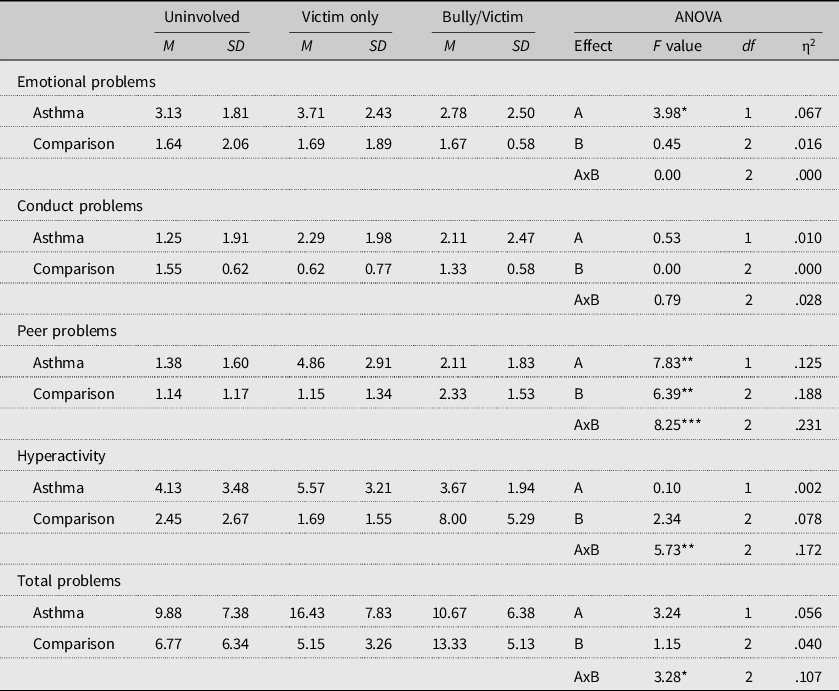
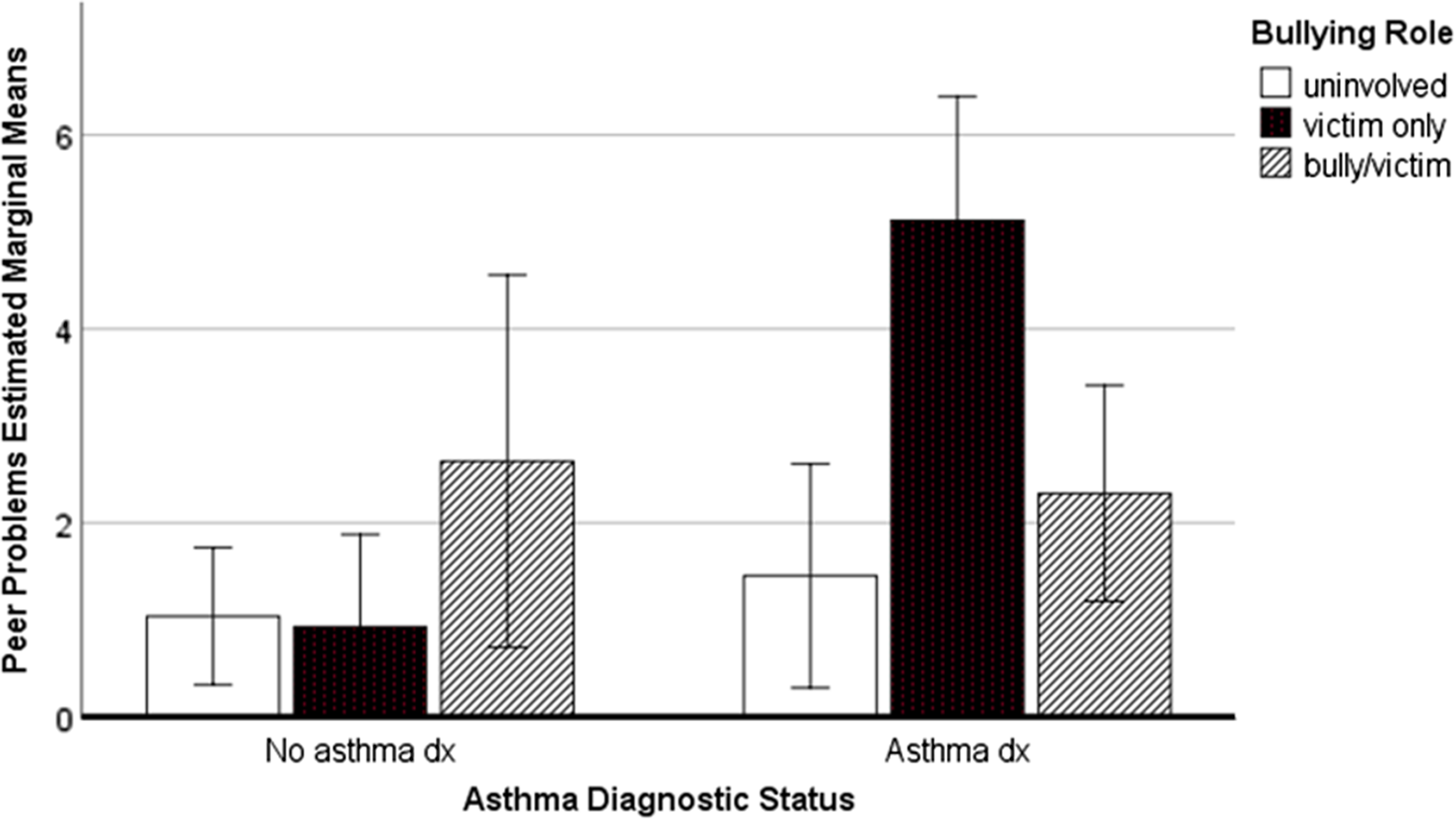
The asthma group showed significantly more emotional problems and hyperactivity/inattention than the comparison group (see Table 1 for ANOVA details; analyses with robust standard errors were substantively identical). A significant interaction of bullying group by asthma was found for peer problems (see Figure 1): Victims of bullying who also had asthma were more likely to be rated by their parents as having significant peer problems, (estimated marginal M = 5.12, 95% CI [3.84, 6.40]), compared to children who were victimised but did not have asthma (M = 0.93, 95% CI [−0.02, 1.88]). Peer problems were roughly equivalent for bully/victims with and without asthma (Asthma M = 2.64; 95% CI [0.71, 4.56]; Non-asthma M = 2.31, 95% CI [1.18, 3.42]), as were peer problems for uninvolved students (Asthma M = 1.04; 95% CI [0.33, 1.74]; Non-asthma M = 1.45, 95% CI [0.30, 2.61]).
Means, standard deviations, and two-way analysis of variance (ANOVA) statistics for study variables

Note: N = 62. A = Asthma group; B = Bullying role.
*p < .05, **p < .01, ***p < .001.
Parent-rated peer problems by asthma diagnosis and bullying role.

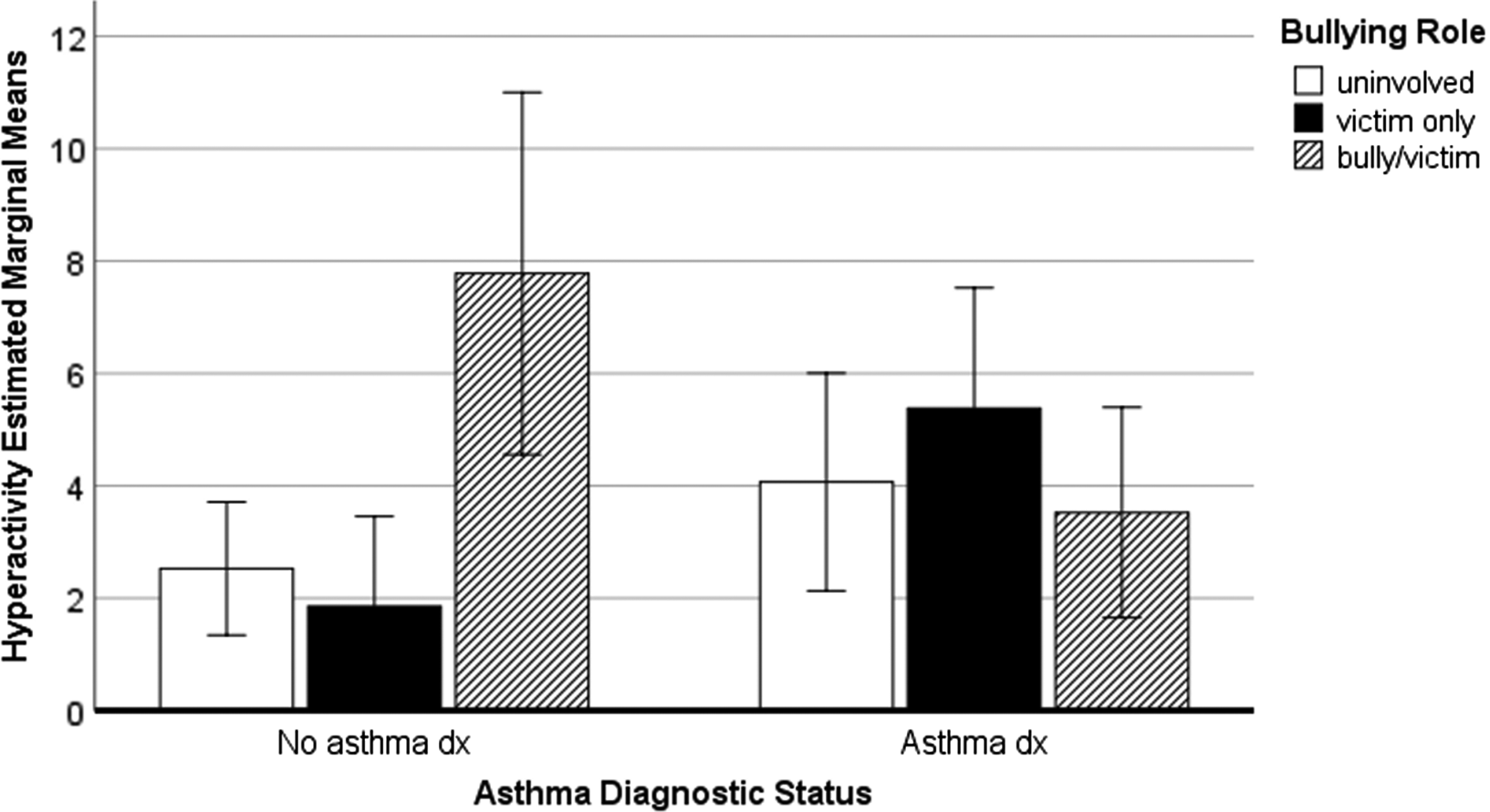
A similar pattern for hyperactivity was observed for children with asthma who were victimised, compared to victims without asthma (see Figure 2). However, in this analysis, children without asthma who were engaged in bully/victim behaviour showed much higher rates of parent-rated hyperactivity (M = 7.78, 95% CI [4.56, 11.00]) than did children with asthma who fit the bully/victim profile (M = 3.53, 95% CI [1.65, 5.40].)
Parent-rated hyperactivity/inattention by asthma diagnosis and bullying role.

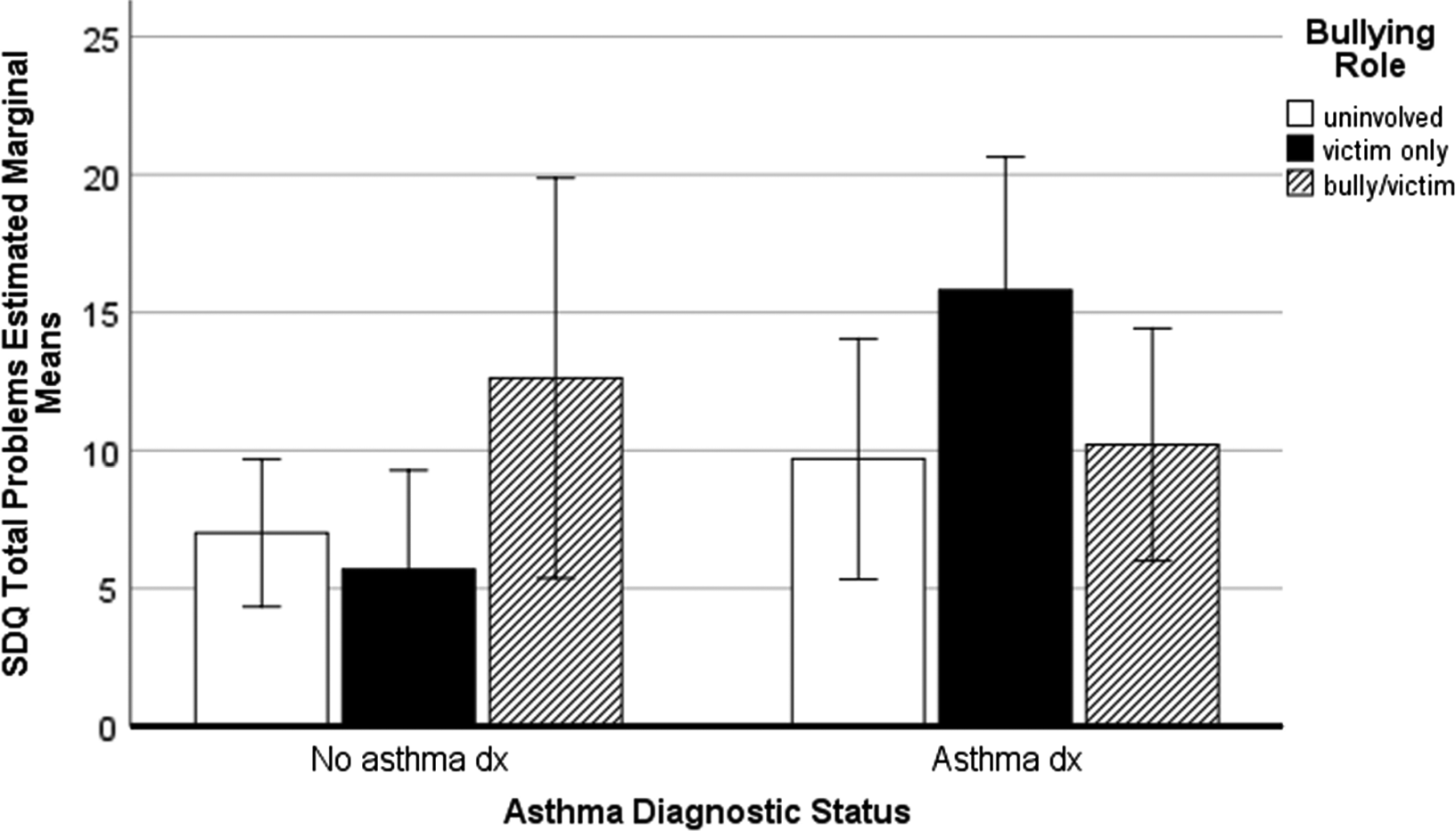
Finally, a significant interaction effect was found for total psychosocial problems (see Figure 3). As with peer problems, victims of bullying who had asthma were at greater risk of total problems (M = 15.81, 95% CI [10.98, 20.64]) than were victims without asthma (M = 5.69; 95% CI [2.09, 9.28]). Bully/victim students with asthma, by contrast, had slightly lower total problem scores (M = 10.21; (95% CI [6.00, 14.42]) than did bully/victims without asthma, M = 12.62; 95% CI [5.36, 19.88]). Uninvolved students with asthma had slightly higher total problem scores (M = 9.69; 95% CI [5.33, 14.05]), than Uninvolved students without asthma (M = 7.01; 95% CI [4.34, 9.67]).
Parent-rated total psychosocial problems by asthma diagnosis and bullying role.

Discussion
The current study aimed to examine bullying perpetration, victimisation and their co-occurrence (bully/victim status) among primary-school-aged students with and without asthma, and the relationship of bullying to psychosocial adjustment. The current study examined whether asthma amplified the risk of psychosocial problems.
The chief new finding is that children with asthma were more likely to be involved in bullying as bully/victims compared to children without asthma. Previous studies on this topic had largely failed to examine co-occurrence of perpetration and victimisation. Only one previous study had examined bully perpetration and victimisation in conjunction (Waasdorp et al., Reference Waasdorp, Mehari, Milam and Bradshaw2019), finding that asthma predicted cyberbully/victim status. The current study extends this finding: asthma is associated with bully/victim status in general. This finding confirms the finding of previous studies that used parent report of tendencies to be cruel or mean to other students (e.g., (Blackman & Conaway, Reference Blackman and Conaway2012). However, asthma was not associated with elevated conduct problems or hyperactivity.
The findings from this study noted that the bully/victim had elevated peer problems for children with and without asthma. But it was noteworthy that children with asthma who were victims-only were at increased risk of peer problems compared to victims without asthma. Absence from school, stigmatisation, weak friendship groups and exclusion are key potential mechanisms that may contribute to the risk faced by children with chronic conditions such as asthma in the school setting (Runions et al., Reference Runions, Vithiatharan, Hancock, Lin, Brennan-Jones, Gray and Payne2020). Further study is needed to examine the unfolding over time of bullying for the adjustment of children with asthma.
This study adds to the body of research indicating not only the risk of bullying among children with asthma, but the potential for an amplification of the psychosocial impact of bullying for children with asthma, with both peer problems and total parent-rated problems elevated for students with asthma who were victims of bullying. This amplification effect had been shown for chronic conditions in general (Pittet et al., Reference Pittet, Berchtold, Akré, Michaud and Surís2009); this study indicates the effect holds for asthma specifically. The mechanisms whereby asthma confers increased risk for bullying and poor psychosocial outcomes are less clear. The social relationships children enjoy in school may play protective functions in their lives, or may exacerbate risk, with a range of potential pathways including absence from school, stigmatisation and exclusion from activities among key potential mechanisms (Runions et al., Reference Runions, Vithiatharan, Hancock, Lin, Brennan-Jones, Gray and Payne2020).
The strengths of the current study include: (a) recruitment of children from asthma clinics, rather than reliance on secondary analyses of general health surveys in the community; (b) multi-item bullying assessment, rather than single-item measures that lack psychometric rigor; (c) use of a validated parent-rated measure of childhood psychological problems that eliminates shared-source variance common to studies where parents or students provide both bullying and psychosocial adjustment data. These strengths thus overcome major limitations in the extant body of research.
The study, however, had several limitations. The study had a relatively small clinical sample. Recruitment faced challenges due to the efficiency of the hospital in question — in particular for the respiratory clinic: families overall appeared to have very short wait times, which created a barrier to recruitment and to completion of the survey during the time allocated; mechanisms to follow up families who cannot complete the survey while waiting are recommended in future studies. Replication with a larger clinical sample is essential. The sample size limited our capacity to understand heterogeneity among children with asthma. The cross-sectional nature also limits all capacities to draw causal conclusions; longitudinal research is needed. Finally, children completed their questionnaire while sitting with their parent, which may have affected their willingness to disclose bullying involvement, and thus potentially introducing bias into the findings.
Conclusions
This is the first study to examine bullying with a clinical sample of children with asthma. Previous studies had found that children with asthma are risk of victimisation and poor psychosocial outcomes (e.g., Gibson-Young et al., Reference Gibson-Young, Martinasek, Clutter and Forrest2014). But, in only examining the variables as distinct independent predictors, and not considering the synergistic effect of being both a victim and a perpetrator of bullying, previous studies provide an occluded view of the risks associated with asthma for bullying and psychosocial problems.
Bullying appears to offer a pathway from asthma to psychosocial adjustment problems. This study provides evidence for the risk that asthma can pose to children’s social and emotional wellbeing, and in particular that bullying may be especially problematic for students with asthma. This study provides reason to believe that school counsellors and psychologists should attend not only to student physical health problems such as asthma but also mental health and peer relationships in the school. Exposure to noxious social experiences in school by students with chronic health conditions may play a primary role in the risk for mental health problems seen among such students (Runions et al., Reference Runions, Vithiatharan, Hancock, Lin, Brennan-Jones, Gray and Payne2020). School counsellors and psychologists, as well as any whole-school health promotion policy or practice, should be mindful not only of physical health or mental health, but of the complex interactions that may occur, and the special risks that may attend students with asthma. School counsellors and psychologists must be mindful of bullying in schools and/or support children who may be or are victimised by their peers, even if that bullying takes the form of teasing and jokes or purposeful and malicious exclusion from activities. Recognition by school counsellors and psychologists that students with asthma may be at elevated risk of both bullying victimisation and bullying perpetration is a first step toward effective prevention and intervention. Effective bullying prevention programs exist and are particularly likely to be effective with primary school settings (Yeager, Fong, Lee, & Espelage, Reference Yeager, Fong, Lee and Espelage2015). But such programs rarely provide a focus onto students with chronic health conditions like asthma. Attending to these social processes may help protect students with asthma from negative psychosocial outcomes.
Funding
This research was funded by a New Investigator Grant from Asthma Foundation WA to Dr Kevin C. Runions. Prof Donna Cross’ contribution to this paper was supported by an NHMRC Research Fellowship GNT 1119339.
Human subjects approval statement
This research was conducted in compliance with the Australian National Statement on Ethical Conduct in Human Research (National Health and Medical Research Council, 2007) guidelines, and with full approval from the University of Western Australia Human Research Ethics board, and by Perth Children’s Hospital.
Conflict of interest
All authors of this article declare they have no conflicts of interest.