Introduction
Nowadays, in the wake of the recession in the past decade and the concurrence of continuous marketplace changes, organizations, and employees have to strive in a challenging environment and in a workplace atmosphere of uncertainty. In this turbulent business context, building resilience within organizations seems to be of vital importance for understanding and responding to crisis situations (Lengnick-Hall & Beck, Reference Lengnick-Hall and Beck2005; Kantur & İşeri-Say, Reference Kantur and İşeri-Say2012). The word ‘Resilience’ derives from the Latin word ‘Resilere’, meaning ‘to spring back’. Thus, resilience is understood to be the capacity to rebound, ‘to come back’ from adversity, uncertainty, conflict, failure, or even positive change (Luthans, Reference Luthans2002). Therefore, by definition, this capability enables companies to react to stressful events and emerge from challenging conditions and unexpected changes (Lengnick-Hall, Beck, & Lengnick-Hall, Reference Lengnick-Hall, Beck and Lengnick-Hall2011). In fact, the organizational literature indicates that resilience is an essential organizational competence for modern organizations and is one of the most important characteristics inherent to their success in the world today (Näswall, Kuntz, Hodliffe, & Malinen, Reference Näswall, Kuntz, Hodliffe and Malinen2013; Britt, Shen, Sinclair, Grossman, & Klieger, Reference Britt, Shen, Sinclair, Grossman and Klieger2016). Nonetheless, organizational resilience is still an underexplored variable in the organizational literature. In fact, a recent systematic review on the organizational resilience term demonstrates that ‘the literature is still far from reaching consensus about organizational and operational implementation of static and dynamic resilience (How can an organization become resilient? How to design, create and maintain resilient processes? Which are dynamic capabilities for resilience?). This will probably be one of the main directions of research’ (Annarelli & Nonino, Reference Annarelli and Nonino2016: 10). For this reason, in the literature, there has been an urge to study and find out which Human Resource Management (HRM) systems or practices are necessary for organizations to respond to downturns, and are more resilient, as well as the outcomes of resilience (e.g., Lai, Saridakis, Blackburn, & Johnstone, Reference Lai, Saridakis, Blackburn and Johnstone2016).
As some academics recently noted (e.g., King, Newman, and Luthans, Reference King, Newman and Luthans2015; Malik & Garg, Reference Malik and Garg2017), to date, little empirical research has examined the factors that foster organizational resilience. In some of the literature it is suggested that HRM practices and policies build-up organizational resilience (Lengnick-Hall, Beck, & Lengnick-Hall, Reference Lengnick-Hall, Beck and Lengnick-Hall2011). For example, specific organizational practices such as promoting career development or a work–family balance have proved to enhance employee resilience (Vera, Rodríguez-Sánchez, & Salanova, Reference Vera, Rodríguez-Sánchez and Salanova2017). In this respect, it seems that the perception employees have that their employer provides resources to them and gives them opportunities to develop, helps them build a sense of resourcefulness and resilience (Rodríguez-Sánchez & Vera, Reference Rodríguez-Sánchez and Vera Perea2015). Accordingly, in this study our intention is to extend research in this field by proposing that a supportive employee work environment, based on responsible, ethical, and protective HRM practices – namely corporate social responsibility for employees (CSRE) – may enhance organizational resilience. Therefore, human resource corporate practices in terms of providing support to employees in organizations (e.g., employee safety, job security, profit-sharing, employee participation, treating employees fairly and equitably, etc.) could be an effective way of increasing employee resources and capabilities, and thus developing organizational resilience. In fact, this reasoning is in line with previous research that supports the idea that those organizations that collapse where trust, honesty, and self-respect are developed are more prone to foster new options (e.g., mutual adaptation, blind imitation of creative solutions) to emerge from chaos (Weick, Reference Weick1993; Taleb, Reference Taleb2012) and therefore to become more resilient.
As we mentioned above, organizational resilience is an important characteristic that positively influences the organization in the long run, since resilient ones are those that are able to survive and thrive in an increasingly volatile, complex, and uncertain business world (Näswall et al., Reference Näswall, Kuntz, Hodliffe and Malinen2013). This is true to the extent that such capacity has been suggested as being a core capability to explain why some firms outperform others (Kantur & İşeri-Say, Reference Kantur and İşeri-Say2012). Surprisingly, despite how important this is in theory, there has been little research into the link between organizational resilience and what impact this has had on outcomes within organizations. Therefore, our aim is to make headway in this field by also unveiling the influence workplace resilience has on other variables that are essential for organizational success and adaptation, such as organizational learning capability (OLC) and firm performance. In this regard, the proposal put forward in this study is that organizational resilience may be linked to firm performance by means of OLC. Thus, in this paper, OLC and hence firm performance are examined as being the results of organizational resilience.
In a nutshell, we aim to make a link between CSRE and organizational resilience and in turn link this with OLC and firm performance. Therefore, the purpose of this paper is to contribute to recent debates on organizational resilience by revealing what antecedents and consequences this resilience has, and, in this regard, shed some light on this underexplored and prominent phenomenon. To do so, this paper is organized in four sections. The first section offers a theoretical overview and the hypotheses of our proposed model. In the second section, we present the empirical research carried out and the methodology. The third section provides an overview of the main results, and the fourth section summarizes the conclusions, implications, and future lines of research stemming from this study.
Theoretical background: Organizational resilience
Resilience has been defined as ‘the process by which an actor (i.e., individual, organization, or community) builds and uses its capability endowments to interact with the environment in a way that positively adjusts and maintains functioning prior to, during, and following adversity’ (Williams et al., Reference Akaike2017: 742). In other words, resilience is not just an individual characteristic, but also a quality that can be studied from a collective point of view (e.g., group, community, and organization) (Horne & Orr, Reference Horne and Orr1997). Hence, it is a term that has recently been applied to organizational and management science. In fact, in these uncertain economic times the notion of ‘resilient organizations’ has gained in popularity as a concept that might help them survive and thrive in difficult or volatile environments (Riolli & Savicki, Reference Riolli and Savicki2003). Actually, organizational resilience is required in our daily lives as well to shape and mitigate the consequences of adversity when it strikes (Van Der Vegt, Essens, Wahlström, & George, Reference Van Der Vegt, Essens, Wahlström and George2015).
There are two different approaches to ‘operationalize’ organizational resilience. On the one hand we can find literature that is focused mainly on resilience as an economic outcome or financial performance (Pal, Torstensson, & Mattila, Reference Pal, Torstensson and Mattila2014). This view conceptualizes organizational resilience as an organizational output measured with economic indicators coming from the organization. And on the other hand, a more holistic view, that considers an organization's capacity for resilience is embedded in a set of individual level knowledge, skills, and abilities and organizational routines and processes by which a firm conceptually orients itself, acts decisively to move forward, and establishes a setting of diversity and adjustable integration that enables it to overcome the potentially debilitating consequences of a disruptive shock (Lengnick-Hall, Beck, & Lengnick-Hall, Reference Lengnick-Hall, Beck and Lengnick-Hall2011). Therefore strategic HRM systems are instrumental in developing the requisite knowledge, skills, abilities, and other attributes and in invoking the appropriate collective routines and processes to generate resilience outcomes (Lengnick-Hall, Beck, & Lengnick-Hall, Reference Lengnick-Hall, Beck and Lengnick-Hall2011). We, take into account this second approach to conceptualize and measure organizational resilience.
In other words, the capacity for resilience is developed through strategically managing human resources to create competencies among core employees, that when aggregated at the organizational level, make it possible for organizations to achieve the ability to respond in a resilient manner when they experience severe shocks (Lengnick-Hall, Beck, & Lengnick-Hall, Reference Lengnick-Hall, Beck and Lengnick-Hall2011: 243). For instance, in Common Welfare HRM systems democracy, participation, and unconditional trust are inherent parts of their culture (Chiva, Reference Chiva2014), and for developing resilience it is necessary to create a climate of open communication, collaboration, and to nurture a climate of reciprocal trust (Lengnick-Hall, Beck, & Lengnick-Hall, Reference Lengnick-Hall, Beck and Lengnick-Hall2011). In this sense, resilience can be enhanced through ‘the practice of caring relationships’ (Wilson & Ferch, Reference Wilson and Ferch2005: 45), that is, a way of interpersonal relating through which people empower and help each other to grow towards their potential.
Organizational resilience has been defined as the capacity employees have (which is promoted and supported by the organization) to use resources to positively cope, adapt, and thrive in response to changing work circumstances (Näswall et al., Reference Näswall, Kuntz, Hodliffe and Malinen2013). We can extract two main ideas from this definition. First, resilience is seen as a capacity employees that are part of the organization have. Therefore, the human factor is stressed as being the main actor in organizational resilience, as one that creates a climate of resilience that is enhanced by practices within the organization. This concept is based on the stream of literature related to psychological capital (e.g., Luthans et al., Reference Luthans, Avolio, Walumbwa and Li2005) and the fact that resilience capability can be developed and is amenable to managerial intervention. In fact, Bardoel, Pettit, De Cieri, & McMillan (Reference Bardoel, Pettit, De Cieri and McMillan2014) highlights the emerging challenge of HRM to enhance resilience, as HRM practices might positively contribute towards employees’ attitudes and behaviours.
The second concept taken from the definition of resilience is the fact that it is seen as a dynamic capacity that can be developed within the organization, rather than as a relatively static trait (Bonanno, Reference Bonanno2004). In fact, most researchers agree that organizational resilience is dynamic in nature and thus, on the need to research which factors facilitate this and what the desirable consequences of organizational resilience are (Linnenluecke, Reference Linnenluecke2017; Williams et al., Reference Akaike2017). In short, in our view, organizational resilience comes not just from the dynamic capacity employees have to absorb stress but also from their ability to learn and grow from adversity to emerge even stronger than before (Stephens, Heaphy, Carmeli, Spreitzer, & Dutton, Reference Stephens, Heaphy, Carmeli, Spreitzer and Dutton2013).
Antecedents of resilience at work: Corporate social responsibility for employees
Existing empirical insights might not have yet revealed all the contributing factors to organizational resilience. However, in theory, it seems that specific organizational practices and a HR management system may be conducive to the development of organizational resilience (Lengnick-Hall, Beck, & Lengnick-Hall, Reference Lengnick-Hall, Beck and Lengnick-Hall2011; Vera, Rodríguez-Sánchez, & Salanova, Reference Vera, Rodríguez-Sánchez and Salanova2017). For instance, HR principles that reinforce organizational citizenship, personal accountability, and power based on expertise rather than hierarchical position would serve as a starting point for building organizational resilience (Lengnick-Hall, Beck, & Lengnick-Hall, Reference Lengnick-Hall, Beck and Lengnick-Hall2011). This concept is in keeping with the philosophy found in teal organizations, which are new structural models based on a higher consciousness level (Laloux, Reference Laloux2014). Teal organizations care about employee wellbeing, as well as stakeholders and the impact they have on the community. Moreover, in these organizations, relationships are based on trust (and not control), there are no hierarchies (i.e., they have a decentralized structure), and these organizations are actually innovative and perform much better.
In this respect, due to business ethics debates, the concepts of corporate social responsibility (CSR) and the ethical aspects of HRM have received increasing attention among scholars (Waldman & Siegel, Reference Waldman and Siegel2008; Cooke & He, Reference Cooke and He2010; Gond, Igalens, Swaen, & El Akremi, Reference Gond, Igalens, Swaen and El Akremi2011; De Gama, McKenna, & Peticca-Harris, Reference De Gama, McKenna and Peticca-Harris2012; Greenwood, Reference Greenwood2013; Morgeson, Aguinis, Waldman, & Siegel, Reference Morgeson, Aguinis, Waldman and Siegel2013). Traditionally, CSR and HRM have been considered as independent fields. However, these two areas are connected due to the positive organizational outcomes for internal and external stakeholders. The study of HRM focuses primarily on internal aspects of the company and CSR has traditionally focused on external elements (the environment, the local community etc.). Nevertheless these two functions overlap, as Diaz-Carrion, López-Fernández and Romero-Fernandez (Reference Diaz-Carrion, López-Fernández and Romero-Fernandez2018) recognize.
CSR and ethical behaviour is associated with an ethical professional conduct towards employees and other stakeholders. It is becoming more and more important for companies to become socially responsible businesses and the effort they make is partly reflected in their sustainable outlook and CSR reports. For some time now, we have recognized that employees are the most important resource at any company, yet they are often overlooked when sustainability is addressed. Thus, the social or human dimension has not been taken into account in sustainability, which includes a commitment to ethical HRM. In this regard, ethical business is encouraged and promoted as an internal system response (Moore & Wen, Reference Moore and Wen2008).
As organizational resilience has been defined as the capacity employees have, which is promoted and supported by the organization (Näswall et al., Reference Näswall, Kuntz, Hodliffe and Malinen2013), it is reasonable to think that CSR activities can positively affect resilience, with a Social Identity Theory approach (Turker, Reference Turker2009). Employee-orientated CSRE includes a bundle of ‘good’ HRM practices designed to demonstrate that the company recognizes the needs and concerns its employees have. In this line of research, Voegtlin and Greenwood (Reference Voegtlin and Greenwood2016) conducted a meta-analysis on the link between CSR and HRM that reviewed 150 papers relating to both topics. Therefore, authors try to delimit the content of sustainable HRM systems in terms of CSR-oriented practices they include (e.g., Bučiūnienė & Kazlauskaitė, Reference Bučiūnienė and Kazlauskaitė2012; Celma, Martínez-Garcia, & Coenders, Reference Celma, Martínez-Garcia and Coenders2014; Newman, Miao, Hofman, & Zhu, Reference Newman, Miao, Hofman and Zhu2016; Barrena-Martínez, López-Fernández, & Romero-Fernández, Reference Barrena-Martínez, López-Fernández and Romero-Fernández2017; Diaz-Carrion, López-Fernández, & Romero-Fernandez, Reference Diaz-Carrion, López-Fernández and Romero-Fernandez2018). Therefore we can expect that CSRE as a form of Perceived Organizational Support (Eisenberger, Huntington, & Sowa, Reference Eisenberger, Huntington and Sowa1986; Karavardar, Reference Karavardar2014) has a positive impact on employee behaviour as a consequence of their perception about the extent to which the firm considers the contributions its employees have made and pays attention to issues related to their wellbeing. From a practical point of view, the most widespread worldwide standard, the Global Reporting Initiative, includes information related to HRM and CSR as, for example, firm commitments to labour practices, decent work and respect for human rights (Diaz-Carrion, López-Fernández, & Romero-Fernandez, Reference Diaz-Carrion, López-Fernández and Romero-Fernandez2018).
HRM practices included in CSRE may enhance the image, attitudes, and intended behaviours of employees (Riordan, Gatewood, & Bill, Reference Riordan, Gatewood and Bill1997). HRM practices included in CSRE such as flexible work arrangements, work teams, or information-sharing mechanisms are supposed to increase intrinsic motivation in employees (Deci & Ryan, Reference Deci and Ryan1985). According to social exchange theory and the norm of reciprocity (Gouldner, Reference Gouldner1960; Blau, Reference Blau1964), employees who experience such investments as being beneficial may feel obliged to reciprocate and be more motivated, flexible, or eager to make a comeback after adversity. In other words, such CSRE practices will have a positive impact on employee behaviour, as they may feel proud of belonging to a socially responsible company (Turker, Reference Turker2009) and, at the same time, they are also conducive to a climate of resourcefulness in the organization (Rodríguez-Sánchez & Vera, Reference Rodríguez-Sánchez and Vera Perea2015), which leads to increasing organizational resilience.
Additionally, another characteristic of organizational resilience is linked to training mechanisms. Through CSRE practices, company employees may have incentives to share their knowledge and learn from others, thereby increasing the positive outcomes for the organization (such as improved performance and innovation) and positive behaviour (such as cooperation with the colleagues, increased resources for the team) is fostered in the workplace. Since these opportunities are mechanisms that encourage employees to take action and engage them in trouble-shooting or involvement mechanisms (Boxall & Purcell, Reference Boxall and Purcell2008; Bos-Nehles, Van Riemsdijk, & Looise, Reference Bos-nehles, Van Riemsdijk and Looise2013), this will help them anticipate future challenges and thus will lead to increased organizational resilience.
Therefore, with the arguments set out above, we expect that CSRE activities, which are directly related to the physical and psychological working environment employees are in, influence organizational resilience. The following hypothesis has been drawn up on this basis:
Hypothesis 1
Corporate social responsibility to employees has a positive relationship with organizational resilience.
Consequences of resilience at work: The mediating role of OLC between resilience and firm performance
Theoretically, organizational resilience is considered to have a number of positive outcomes in the workplace, such as on organizational commitment or job performance (Coutu, Reference Coutu2002; Worline, Dutton, Frost, Kanov, Lilius, & Maitlis, Reference Worline, Dutton, Frost, Kanov, Lilius and Maitlis2002; Lengnick-Hall, Beck, & Lengnick-Hall, Reference Lengnick-Hall, Beck and Lengnick-Hall2011). However, empirically some data have questioned the impact resilience has on work outcomes, especially on firm performance. For example, at an individual level, some studies show there to be a direct positive relationship between resilience and job performance or productivity (Luthans, Avolio, Walumbwa, & Li, Reference Luthans, Avolio, Walumbwa and Li2005; Shatté, Perlman, Smith, & Lynch, Reference Shatté, Perlman, Smith and Lynch2017), whereas others find null or weak relationships between both variables (Youssef & Luthans, Reference Youssef and Luthans2007). Actually, recent research has shown that there is an indirect connection between resilience and performance via job satisfaction (Meneghel, Borgogni, Miraglia, Salanova, & Martínez, Reference Meneghel, Borgogni, Miraglia, Salanova and Martínez2016). Note, these studies have considered variables at an individual level. Therefore, it is plausible that the relationship between organizational resilience and firm performance may be influenced by other factors.
By definition, resilience capacity enables a company to take appropriate actions and undergo transformation in response to unanticipated events that potentially threaten its continued existence (Lengnick-Hall, Beck, & Lengnick-Hall, Reference Lengnick-Hall, Beck and Lengnick-Hall2011). Hence, organizational resilience enables a company to prosper in an ever-changing and threatening environment. Resilient organizations adopt effective strategic postures, diagnose their environmental conditions with greater accuracy, transform themselves in order to survive, develop new capabilities and create new opportunities to adapt to changes (Lengnick-Hall, Beck, & Lengnick-Hall, Reference Lengnick-Hall, Beck and Lengnick-Hall2011). Therefore, resilience helps companies become more flexible, adaptable, and remain competitive, and learn from the past. In keeping with this point of view, it has been suggested in some literature that a resilient organization will maintain high performance levels even in complex and competitive environments (Boin & Van Eeten, Reference Boin and Van Eeten2013). Nevertheless, empirical evidence on the consequences organizational resilience has is actually scant, and the direct versus indirect impact resilience has on organizational performance is still not clear.
Likewise, organizational resilience has been theoretically linked to learning processes (e.g., Lengnick-Hall, Beck, & Lengnick-Hall, Reference Lengnick-Hall, Beck and Lengnick-Hall2011; Rodríguez-Sánchez & Vera, Reference Rodríguez-Sánchez and Vera Perea2015) since the capacity to learn from past mistakes and emerge stronger is part of the essence of resilience (Boin & Van Eeten, 2013). In this respect, Salanova et al. (2012) indicated that in critical and turbulent scenarios, resilient organizations develop a kind of strength that enables them to learn from adversity and emerge stronger. Thus, in the literature it is suggested that OLC may be enhanced by organizational resilience.
OLC is defined as the organizational and managerial characteristics or factors that promote the organizational learning process or enable an organization to learn (Chiva, Alegre, & Lapiedra, Reference Chiva, Alegre and Lapiedra2007). It is a multidimensional construct made up of five aspects. One of these is experimentation which involves trying out new ideas, being curious at work, carrying out changes in work processes or searching for innovative solutions (Chiva, Alegre, & Lapiedra, Reference Chiva, Alegre and Lapiedra2007). In turbulent and critical times, experimenting with new conditions is essential as is innovation capability and adaptation in order to embrace complex risks and uncertainties (Tschakert & Dietrich, 2010). Therefore, since organizational resilience is required to survive unstable situations, this implies experimenting with new processes and circumstances. In other words, as Mallak (Reference Mallak1998) stated, ‘practising bricolage’ that is, experimenting with the resources we have at hand.
Another factor which promotes OLC is risk taking for tolerating ambiguity, uncertainty, and errors (Chiva, Alegre, & Lapiedra, Reference Chiva, Alegre and Lapiedra2007). In the literature the importance of designing environments in which risks are taken and mistakes accepted has been stressed for a long time because such environments encourage organizational learning (e.g., Hedberg, Reference Hedberg1981). Organizational resilience depends on an ability to provide novel and improvised solutions (Coutu, Reference Coutu2002) to exploit changes under challenging conditions. Developing organizational resilience entails taking risks such as attempting to exploit new opportunities and finding ways to face unexpected challenges (Lengnick-Hall, Beck, & Lengnick-Hall, Reference Lengnick-Hall, Beck and Lengnick-Hall2011). Therefore, resilience in organizations may stimulate the concurrence of risk-taking behaviours.
The third factor that promotes OLC is interaction with the external environment, which is the extent to which a company maintains relationships and is connected to its immediate environment (Chiva, Alegre, & Lapiedra, Reference Chiva, Alegre and Lapiedra2007). Being in harmony with its surroundings is very important since the organization attempts to evolve at the same time as its changing environment (Hedberg, Reference Hedberg1981). Organizational resilience entails continuous innovation and adaptation to changing conditions and unexpected events in today's unpredictable business environments. Hence, resilience within organizations implies they have a strong capability to respond successfully to the continuous disturbances in these (Kantur & İşeri-Say, Reference Kantur and İşeri-Say2012). Accordingly, resilient organizations should have constant interaction with the world around them in order to respond rapidly and adapt to changes in the corporate environment. Hence, resilience within an organization entails more frequent connections and relations with its immediate surroundings.
The fourth component that encourages organizational learning is dialogue (Chiva, Alegre, & Lapiedra, Reference Chiva, Alegre and Lapiedra2007). Dialogue is defined as a sustained collective inquiry into the processes, assumptions, and certainties that everyday experience is made up of (Isaacs, Reference Isaacs1993). Authors, who have looked at the social perspective in particular (Brown & Duguid, Reference Brown and Duguid1991; Weick & Westley, Reference Weick, Westley, Clegg, Hardy and Nord1996), stress how important dialogue and communication are in organizational learning. According to Lengnick-Hall, Beck, & Lengnick-Hall (Reference Lengnick-Hall, Beck and Lengnick-Hall2011: 250) organizational resilience requires a climate of open communication in which ‘employees feel confident in their ability to explore new options while exploiting what they know, and to share information and observations in ways that lead to quick and situation-specific responses when novel conditions emerge’. Therefore, communication and dialogue among employees proliferate as organizations become more resilient.
The last dimension which favours OLC is participative decision-making which refers to the level of influence that employees have in the decision-making process (Cotton, Vollrath, Froggatt, Lengnick-Hall, & Jennings, Reference Cotton, Vollrath, Froggatt, Lengnick-Hall and Jennings1988). In the literature, the importance of involving people in company decisions about promoting organizational learning has been emphasized (Scott-Ladd & Chan, Reference Scott-Ladd and Chan2004; Chiva, Alegre, & Lapiedra, Reference Chiva, Alegre and Lapiedra2007). In the literature it is suggested that empowerment can be considered as an outcome of resilience (e.g., Cakir & Yerin Guneri, Reference Cakir and Yerin Guneri2011). The notion of empowerment implies giving power or delegating authority to someone (Burke, Reference Burke1986). Hence, empowerment entails decentralizing decision-making and participative management techniques as a means to sharing power or delegating authority (Conger & Kanungo, Reference Conger and Kanungo1988). Accordingly, organizational resilience seems to lead to more power delegation and employee participation in decision-taking.
In short, organizational resilience seems to promote each factor that makes up OLC: experimentation, risk-taking, interaction with the external environment, dialogue, and participative decision-making. In turn, organizational learning and the factors that promote this have been shown to have various effects, including a beneficial one on firm performance (e.g., Tippins & Sohi, Reference Tippins and Sohi2003; Camps & Luna-Arocas, Reference Camps and Luna-Arocas2012; Guinot, Chiva & Mallen, Reference Guinot, Chiva and Mallén2013). Jerez-Gomez, Céspedes-Lorente, & Valle-Cabrera (Reference Jerez-Gomez, Céspedes-Lorente and Valle-Cabrera2005) consider OLC to be a key element in improving efficiency and for organizational capacity to innovate and grow, while other authors state that OLC is one of the strategic means of achieving long-term organizational success (Liao & Wu, Reference Liao and Wu2010).
Organizations capable of learning from competitors and customers are better placed to identify and act upon market developments and trends (Camps & Luna-Arocas, Reference Camps and Luna-Arocas2012), thus these organizations are usually more flexible and respond faster to new challenges than their competitors (Jiménez-Jiménez & Sanz-Valle, Reference Jiménez-Jiménez and Sanz-Valle2011). Moreover, organizations which learn may provide more suitable and sharply targeted products, thereby increasing customer satisfaction and responding more successfully to changes in the environment by providing added-value (Camps & Luna-Arocas, Reference Camps and Luna-Arocas2012), and hence improving sales/profit margins (Tippins & Sohi, Reference Tippins and Sohi2003). Thus, OLC is conducive to having a dynamic and proactive organizational vision, which generates unique and valuable resources and capacities in the firm, is hard to replace and difficult to imitate, and may lead to higher levels of firm performance (García-Morales, Jiménez-Barrionuevo, & Gutiérrez-Gutiérrez, Reference García-Morales, Jiménez-Barrionuevo and Gutiérrez-Gutiérrez2012). On the basis of the above arguments, organizational learning literature has usually established a positive direct association between OLC and several measures of firm performance – both objective and subjective – including financial and nonfinancial aspects (e.g., Camps & Luna-Arocas, Reference Camps and Luna-Arocas2012; Guinot, Chiva & Mallen, Reference Guinot, Chiva and Mallén2013; Akgün, Ince, Imamoglu, Keskin, & Kocoglu, Reference Akgün, Ince, Imamoglu, Keskin and Kocoglu2014; Zhou, Hu & Shi, Reference Zhou, Hu and Shi2015).
In keeping with the reasons stated above, we propose that organizational resilience promotes OLC factors, which in turn enhances firm performance. Therefore, we have put forward the following hypothesis:
Hypothesis 2
The relationship between organizational resilience and firm performance will be mediated by OLC.
Method
Data collection
The study focuses on a sample of 11,594 Spanish firms, which was based on a list of companies provided by the Spanish Ministry of Economy and Competitiveness. This covers heterogeneous small-medium size companies that meet at least one of these requisites for innovation: (1) The organization has received public funding for R&D in the last 3 years; (2) the organization has demonstrated it is innovative by means of developing its own innovative products/services; and (3) the organization has demonstrated its innovative capacity by any official certification recognized by the Ministry of Economy and Competitiveness. Therefore, these are not necessarily highly innovative organizations, but they are concerned about nurturing innovation and productivity within the company.
In order to make our model robust and avoid common method variance, different questions were addressed to different people in the same organization. In this respect, while questions related to resilience and OLC targeted human resource managers (because these questions concerned the perception of people and the atmosphere within the organization); the general manager at the organization answered questions about CSRE and firm performance (because these questions were about company policy and results on this matter). We believed that human resource managers as well as general managers have gained an overall perspective and in-depth knowledge of their organizations as a result of their position and their experience within it. By being in close contact with different departments, they can provide an accurate picture of what happens in their organizations, and are therefore a reliable source of information for evaluating their companies as a whole. Moreover, to encourage participation, respondent anonymity was guaranteed, which encouraged them to provide more honest answers, thereby increasing the reliability of the results.
The questionnaire addressed to human resource managers consisted of 19 items (five related to resilience at work and 14 to OLC), while the questionnaire for general managers had nine (five related to CSRE and four to firm performance). All items were measured on a 7-point Likert scale. All Likert-scaled indicators were expressed positively and respondents had to state whether they agreed or disagreed with each statement included in the questionnaire. The survey was completed by means of telephone interviews since this technique is useful when asking questions to different people in the same company or when people are hard to reach, as was the case with the managers at major companies in this study. Finally, a sample of 296 companies was obtained. The size of the companies ranged from 10 to 260 employees with the mean value being 47 employees (SD = 39.8) and a mean firm age of 26 years.
Measures
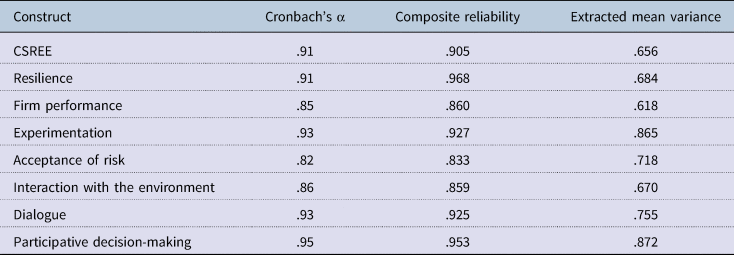
We used scales that have been validated and which are well-known in the literature, the reliability information (Cronbach's α) for the scales is presented in the Results section, Table 2.
Corporate social responsibility to employees
We assessed ‘corporate social responsibility to employees’ with five items adopted from the Turker scale (Reference Turker2009) on CSR. Turker measured four forms of CSRE on four scales: CSRE to social and nonsocial stakeholders; CSRE to employees; CSRE to customers; and CSRE to government. We used the scale for CSRE to employees and the questions were answered by the general manager of each organization, an example of which is: ‘Our company policies encourage employees to develop their skills and careers’.
Organizational resilience
We assessed ‘organizational resilience’ with five items from the original Caza, Bagozzi, Woolley, Levy, & Barker (Reference Caza, Bagozzi, Woolley, Levy and Barker2010) adapted by Stephens et al. (Reference Stephens, Heaphy, Carmeli, Spreitzer and Dutton2013). The scale questions were answered by the Human Resource manager at each organization, an example of which is: ‘Employees at this company bounce back when they confront setbacks at work’.
Organizational learning capability
We assessed ‘Organizational learning capability’ with 14 items which comprised five dimensions of the construct. These dimensions were: experimentation, risk-taking, interaction with the external environment, dialogue, and participation (Chiva & Alegre, Reference Chiva and Alegre2009). The Human Resource manager at each organization answered the questions on the scale, an example of which for each dimension was: ‘People here receive support and encouragement when presenting new ideas’ (experimentation); ‘People are encouraged to take risks at this organization’ (risk-taking); ‘There are systems and procedures for receiving, collating and sharing information from outside the company’ (interaction with the external environment); ‘There is free and open communication within my work group’ (dialogue); ‘Managers at this organization frequently involve employees in important decisions’ (Participative decision-making).
Firm performance
We assessed firm performance by means of four items validated by Tippins and Sohi (Reference Tippins and Sohi2003). General managers were asked to report how well their company had performed during the previous 2 years. The items which made up this scale were (1) customer loyalty, (2) sales growth, (3) profitability, and (4) return on investment. A 1- to 7-point Likert scale was used; where a 1 gave the participating company the lowest score in relation to how well the company was performing and 7 the highest.
Control variables
Bearing in mind the external sources that can alter firm performance, we have included both company size and company age as control variables. Empirical studies examining company performance as a dependent variable have commonly used company size as a control variable (e.g., Chiva & Alegre, Reference Chiva and Alegre2009; Guinot, Chiva & Mallen, Reference Guinot, Chiva and Mallén2013) since this has been shown to influence organizational performance (e.g., Tippins & Sohi, Reference Tippins and Sohi2003). On the other hand, the experience and organizational competencies that comes with age helps companies become more efficient and, therefore, perform better than younger companies (Jiménez-Jiménez & Sanz-Valle, Reference Jiménez-Jiménez and Sanz-Valle2011). Accordingly, company age has also been included as a control variable of firm performance.
Reliability of the measurement scales and data analyses
First, we calculated descriptive analyses (i.e., means, standard deviations), inter-correlations and reliability analyses (Cronbach's α) using SPSS.
To check how reliable the scale was, as well as Cronbach's α coefficient (Cronbach, Reference Cronbach1951), we have used two indicators: composite reliability (Fornell & Larcker, Reference Fornell and Larcker1981) and average variance extracted (Alegre & Chiva, 2008).
Given our use of subjective evaluation measures, we conducted Harman's single-factor test (Podsakoff & Organ, Reference Podsakoff and Organ1986; Podsakoff, MacKenzie, Lee, & Podsakoff, Reference Podsakoff, MacKenzie, Lee and Podsakoff2003) to assess whether common method variance existed and to tackle potential social desirability bias in the responses. The results of the confirmatory factor analysis with the 22 indicators loading into a single factor (χ2(230) = 4,547.249; CFI = .0; RMSEA = .259; BBNFI = .0; χ2/df = 19.77) showed a poor fit, thereby indicating that the single factor does not account for all the variance in the data. Consequently, and in accordance with this procedure, we do not consider common method variance to be a problem in our research.
Second, we implemented structural equation modelling (SEM) by AMOS to test the hypothesized model following the recommendations for mediating analyses for latent constructs and multiple mediators (Holmbeck, Reference Holmbeck1997; James, Mulaik, & Brett, Reference James, Mulaik and Brett2006). Three models were tested in order to verify the hypotheses: ‘M1.Proposed’ which assumed that CSRE was positively related to resilience at work that in turn was linked to OLC that was conducive to firm performance (see Figure 1); ‘M2.Partially Mediated’ in which there was a direct relationship between resilience and performance; and, as recommended by Kline (Reference Kline1998), we also tested an alternative model to show that the order of the mediating variables in our model was not arbitrary. Consequently, ‘M3.Alternative’, in which resilience mediates the relationship between OLC and performance, was tested.
Hypothetical research model
Note: CSREE = corporate social responsibility for employees; RESIL = resilience at work; OLC = organizational learning capability; FFERF = firm performance.

For the SEM analyses, methods of maximum likelihood were used by testing absolute and relative indices for goodness of fit (Marsh, Balla, & Hau, Reference Marsh, Balla and Hau1996): the χ2 index, Goodness of Fit Index (GFI), the Root Mean Square Error of Approximation (RMSEA), the Comparative Fit Index (CFI), the Incremental Fit Index (IFI), and the Tucker–Lewis Index (TLI). Values smaller than .08 for RMSEA (Browne & Cudeck, Reference Browne, Cudeck, Bollen and Long1993) and SRMR (Hu & Bentler, Reference Hu and Bentler1998) and greater than .90 for the remaining indices (Hoyle, Reference Hoyle1995) indicated an acceptable fit. Finally, the Akaike Information Criterion (AIC; Akaike, Reference Akaike1987) was computed to compare competing nonnested models; the lower the AIC index, the better the fit was.
Moreover, we also performed the bootstrapping method by AMOS (MacKinnon, Lockwood, Hoffman, West, Sheets, Reference MacKinnon, Lockwood, Hoffman, West and Sheets2002; Preacher & Hayes, Reference Preacher and Hayes2004) using the Monte Carlo estimation method. This method enabled us to determine more accurately what the direct and indirect effect of a variable was when the samples were not large, as well as the confidence intervals of the indirect effects (Efron & Tibshirani, Reference Efron and Tibshirani1993; Shrout & Bolger, Reference Shrout and Bolger2002). The null hypothesis, which proposed that x had no indirect effect on y via m, was ruled out when the confidence interval was above or below zero.
Results
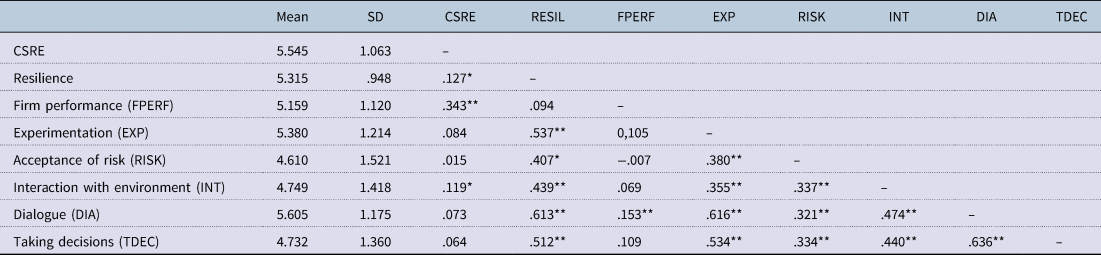
First, results (see Tables 1 and 2) show that all Cronbach's α coefficient values, as well as those for composite reliability, were above the minimum acceptable value of .7 (Nunnally & Bernstein, Reference Nunnally and Bernstein1994). Meanwhile, in all situations, the average variance extracted showed values greater than the recommended minimum of .5 (Nunnally & Bernstein, Reference Nunnally and Bernstein1994; Hair, Anderson, Tatham, & Black, Reference Hair, Anderson, Tatham and William1998). Furthermore, the pattern of correlations indicated that, as expected, there was a positive and significant interrelationship between CSRE, resilience and OLC. Note the correlation between resilience and performance was not significant.
Correlation factors, means, and standard deviation (N = 296)a

a For the standard deviations and correlations between factors, we have worked with the mean of the items for which each dimension is made up of.
*Significant correlation (p < .05).
**Significant correlation (p < .01).
Reliability of the measurement scales

Model fit: Structural equation modelling
Table 3 displays the results of the structural equation analyses. We fit our proposed model (M1) to the data. CSRE and resilience were made up of five indicators each one (items). OLC was made up of three indicators related to the subscales (experimentation, risk-taking, interaction with the external environment, dialogue, and participation). Finally, firm performance was composed of four indicators.
Fit indices of the structural equation models (n = 296)

Note: χ2 = Chi-square; χ2dif. = difference of Chi-square; AIC = Akaike information criterion; CFI = comparative fit index; df = degrees of freedom; GFI = goodness of fit index; IFI = incremental fit index; RMSEA = root mean square error approximation; SRMR = standardized root mean square residual; TLI = Tucker–Lewis index.
***p < .001, *p < .05.
Results indicated that M1.Proposed (in which CSRE had a positive relationship with resilience which was in turn related to OLC and firm performance) fits the data well. The partial mediation model, M2.Partially mediated (in which we also directly related resilience to performance), also showed good fit indexes although the AIC was higher in this second model (M2 AIC = 719.55) than that in M1 which implies there is a better fit for M1 according to Akaike (Reference Akaike1987). Moreover, in M2, the direct relationship between resilience and performance was not significant (β = −.01, n.s.). Finally, we tested an alternative model as proposed by Kline (Reference Kline1998), in order to prove that the order of the mediating variables in the model was in a theoretical and not arbitrary sense. As a consequence, M3.alternative, in which resilience mediates the relationship between OLC and performance, was tested. As expected, again the results yielded were favourable to M1, since M3 showed a higher χ2 value, and worse AIC when compared with M1. Hence, the results displayed in Figure 2 provide evidence favourable to M1: (1) there is a positive and significant relationship between CSRE and resilience; (2) there is a direct significant relationship between resilience and OLC, β = .77, p < .001; and (3) there is a direct significant relationship between OLC and performance, β = .15, p < .01. These findings also demonstrated that resilience and performance were fully mediated by OLC.
Empirical results of the research model. *Significant correlation (p < 0.05).
Note: CSREE = corporate social responsibility for employees; RESIL = resilience at work; OLC = organizational learning capability; FFERF = firm performance.

Moreover, the results from bootstrapping analyses showed that OLC fully mediated the relationship between resilience and firm performance, since the direct relationship between resilience and firm performance was nonsignificant (β = −.01, n.s.). The estimated indirect effect resilience had on firm performance was .066. The 95% bias corrected confidence intervals for the indirect effect were between .011 and .145, and there was a p-value of .001 for the two-tailed significance test. Hence, the standardized indirect effect resilience had on firm performance was significantly different to zero at a level of .001 and we can discard the null hypothesis of no mediation effect. Consequently, we may conclude that, as expected, OLC mediates the relationship between resilience and firm performance.
Discussion
Results from SEM analyses showed how CSRE for employees had a positive impact on organizational resilience. In other words, CSR acted as a key antecedent that enabled employees to feel more resourceful and capable of recovering from any disturbance. At the same time, organizational resilience, through OLC, had a positive relationship on firm performance. Therefore, the results confirmed our hypotheses regarding the role CSRE played as a promoter of organizational resilience (Hypothesis 1), and also concerning the impact organizational resilience had on firm performance through OLC (Hypothesis 2). Hence, our study has made headway as regards testing antecedents and the consequences organizational resilience has. Moreover, this model has been tested with two key sources of information (CEOs and HR managers) and for this reason our results have been supported and are robust.
Theoretical and practical implications
This study has shed light on the antecedents and consequences of organizational resilience, and has thus, responded to calls to research this topic (Linnenluecke, Reference Linnenluecke2017; Williams et al., Reference Akaike2017). On one hand it has contributed, both in theory and in practice to prominent and innovative research on workplace resilience. The specific link between CSRE and employees with organizational resilience is an important and innovative finding in terms of practices that can be implemented at the workplace. In fact, theoretically, CSRE for employees encourages sharing knowledge, problem solving, and social support, among other behaviours, that are necessary for building resilience (Boxall & Purcell, Reference Boxall and Purcell2008; Mallak, Reference Mallak1998). Therefore, in our study, we empirically showed how important the activities aimed at taking care of employees are, and how CSRE for employees, helps build stronger organizations.
On the other hand, our study has extended empirical clarification concerning the underexplored relationship between resilience and the outcomes of organizational performance (Youssef & Luthans, Reference Youssef and Luthans2007; Shatté et al., Reference Shatté, Perlman, Smith and Lynch2017) by unveiling the mediating role OLC has in this relationship. Our results support the logical premise that resilience enhances capability to learn by promoting experimentation, risk-taking, interaction with the environment, dialogue, and open communication, as well as participative decision-making, thereby enhancing firm performance. This pattern of results provides empirical evidence on how organizational resilience may benefit organizations by boosting some organizational processes which are essential today, such as learning capability.
Moreover, in the literature there has clearly been a request to provide empirical evidence of the mediating role OLC has on performance (García-Morales, Jiménez-Barrionuevo, & Gutiérrez-Gutiérrez, Reference García-Morales, Jiménez-Barrionuevo and Gutiérrez-Gutiérrez2012). Therefore, our study has bridged this gap in the literature. In this paper, the positive influence OLC has on perceived business performance has been confirmed, thus reinforcing the general consensus there is about this relationship. These findings have contributed to the growing body of literature on organizational learning by providing further empirical support on its positive relationship with OLC and firm performance on the basis of a large sample of Spanish firms of different sizes and from various industries.
Since resilience can be enhanced (Lengnick-Hall, Beck, & Lengnick-Hall, Reference Lengnick-Hall, Beck and Lengnick-Hall2011), our study has also provided powerful insights for managers and practitioners. First, managers should clearly implement policies and practices for boosting CRS for employees. For instance, by supporting those employees that want to have additional training or go on courses. Additionally, they could give support to those that want to keep on developing their careers, or, for instance, promote a work–life balance. For example, they could provide opportunities for telework or introduce more flexible schedules. In reality, career development and work–life balance policies have been linked to resilience (Vera, Rodríguez-Sánchez, & Salanova, Reference Vera, Rodríguez-Sánchez and Salanova2017). However, not only is support needed, but also an atmosphere of open communication must be created in which the wishes and expectations of employees are taken into account. These findings could help organizations develop policies and practices that are not only fair and helpful to their employees but also have organizational benefits.
Limitations and future research
This research is not without limitations. First, it is cross-sectional. In future, it would be interesting to carry out longitudinal studies by collecting two or three measurements over time to establish cause-and-effect relationships. It would be of interest to analyse how increasing CSRE would lead to higher levels of organizational resilience and OLC that would give rise to enhanced firm performance in the future. The second limitation refers to the fact that data were collected through self-report questionnaires, which could generate common variance bias. However, the Harman's test revealed there to be no common method bias variance in the database. Furthermore, we also attempted to prevent this by having two key informants (the CEO and the HR manager at the organization) for the study variables. One related suggestion for future research might be to also include the point of view of the employees and to measure the level of resilience they have, since our study has only considered this at an organizational level. On the other hand, we only analysed one type of antecedent (CSRE), thus, taking into account our ethical approach to the study of resilience, it would be convenient in future research to consider the role of ethical leadership style (such as servant or compassionate leadership). Besides it would be of interest to include as an outcome measure from resilience the role of wellbeing of employees, maybe considering happiness. Nowadays, short measures that measure happiness at work (i.e., Salas-Vallina & Alegre, Reference Salas-Vallina and Alegre2018) may be feasible to apply in order to gather information about the link between resilience and happiness.
Final note
Although there is still much research to be conducted on the antecedents of organizational resilience and its consequences, our study marks a step forward in showing the human-side of building organizational resilience, beyond financial and technologic resources. We really believe that practices linked to employee welfare make a difference in building a resilient atmosphere in the organization that in turn may lead to better firm performance by means of improving OLC.
Author ORCIDs
Alma Rodríguez-Sánchez, 0000-0002-3131-7612.
Alma Mª Rodríguez-Sánchez is an Associate Professor of Management and Organizations in the Department of Business Administration at the University Jaume I of Castellon, Spain. She has been a visiting scholar at Utrecht University (The Netherlands); Finnish Institute of Occupational Health (Finland) and Helsinki University (Finland). Her research is focused on wellbeing at work, flow, engagement, creativity, and resilience. She has published her research in international journals such as Work & Stress; Journal of Organizational Behaviour; Group & Organization Management; Stress & Health; Journal of Occupational and Organizational Psychology among others.
Jacob Guinot is an Assistant Professor of Management and Organizations in the Department of Business Administration at the University Jaume I of Castellon, Spain. His research is focused on organizational trust, organizational learning and altruism in organizations. He has published his research in international journals such as Journal of Management & Organization, Journal of Business Ethics, Personnel Review and International Journal of Conflict Management.
Ricardo Chiva is a Professor of Management and Organizations at Universitat Jaume I in Castellón, Spain. He has published his research in journals such as International Journal of Management Reviews, Management Learning, and Journal of Product Innovation Management. His current research interests are in Organizational Learning and Human Resource Management and Development, drawing on interdisciplinary theories and methods.
Álvaro López-Cabrales is an Associate Professor of Human Resource Management in the Business Administration Department, Pablo de Olavide University (Seville), where he obtained his doctorate in 2003. He has been a visiting scholar at Texas A&M University and Tilburg University. His current work focuses on research in human capital, employment relationships, organizational capabilities, and innovation. He has published his research in international journals such as Human Resource Management, R&D Management, Personnel Review, British Journal of Management and The International Journal of Human Resource Management.