Introduction
Sexuality is a multidimensional construct that encompasses a myriad of factors, such as gender, attitudes, feelings, cultural background, self-image, values, and behaviors, as well as mental and physical health (Whitehouse, Reference Whitehouse2009). Sexuality is a central aspect of being human throughout the life cycle and is influenced by a multiplicity of factors including biological, psychological, social, economic, political, and cultural. Sexuality is an integral part of the quality of life, well-being, and health at all ages. Yet, the sexual behavior of people in old age is an understudied topic and is often ignored (Gott and Hinchliff, Reference Gott and Hinchliff2003; Bouman et al., Reference Bouman, Arcelus and Benbow2006).
Although the study of sexuality in older adults is becoming more relevant as societies age (Lindau et al., Reference Lindau, Schumm, Laumann, Levinson, O'Muircheartaigh and Waite2007), the body of knowledge of sexuality in older adults is limited (Kleinplatz, Reference Kleinplatz2008). Studies have shown that older people, men and women alike, remain sexually active (e.g. Laumann et al., Reference Laumann2005; Papaharitou et al., Reference Papaharitou, Nakopoulou, Kirana, Giaglis, Moraitou and Hatzichristou2008), although sexual activity was found to decline with age and that women were less sexually active than men (Lindau et al., Reference Lindau, Schumm, Laumann, Levinson, O'Muircheartaigh and Waite2007). Furthermore, most studies focused on populations that had undergone extreme physical or pathological changes due to severe illnesses, such as women who underwent mastectomy or men who underwent prostatectomy (e.g. Carpentier and Fortenberry, Reference Carpentier and Fortenberry2010), which may have a paramount adverse effect on their body image. Only a paucity of studies examined the link between body image and sexual activity and satisfaction in older age, and they have shown inconsistent results (Pujols et al., Reference Pujols, Meston and Seal2010).
In terms of Jewish settlement, there are two main groups in Israeli society: people who were born in Israel or immigrated a long time ago, and relatively new immigrants (mostly from the Former Soviet Union, FSU) who immigrated to Israel during the 1990s. In the FSU, the external social control was very strong, especially in comparison to Israel, which limited to a great extent the maneuvering ground of the individual. In the FSU, the power centers were based on social–political ideology, which translated into a strong influence on the private and sexual life of the individual. This influence manifested itself in a very “moralistic” and “puritan” way of sexual life. To the best of our knowledge, no previous study examined the connection between migration status and perceived physical and mental health (henceforth perceived health), body image, and sexual behavior.
This study aimed to assess the perceived health and body image of older persons and their link to sexuality in later life, and to assess the extent to which gender and migration status play a role in this regard. Specifically, the goals of this study were twofold: first, to examine the extent to which gender and migration status are associated with perceived health and body image. The study aimed to examine if there are significant differences in sexual activity and sexual satisfaction between long-standing older residents in Israel and new immigrants from FSU countries and between men and women; second, to assess the extent to which perceived health and body image predict sexual activity and sexual satisfaction of older persons. The study will enable a better understanding of the relationship between health, body image, and sexuality among various groups of older adults and indicate where professional intervention may be needed.
Health and sexuality
Although sexuality persists into old age, its physical, social, and psychological qualities are changing and deteriorating. This is because aging entails various changes in the hormonal and neurologic systems as well as psychological changes, resulting in reduced sexual potency; therefore, sexuality in later life may be challenged (Gott and Hinchliff, Reference Gott and Hinchliff2003; Sharpe, Reference Sharpe2004; NIA, 2008). It was found that sexual problems are more strongly associated with impaired health in old age rather than age per se (Nusbaum et al., Reference Nusbaum, Lenahan and Sadovsky2005; Lindau et al., Reference Lindau, Schumm, Laumann, Levinson, O'Muircheartaigh and Waite2007). For example, Lindau et al. (Reference Lindau, Schumm, Laumann, Levinson, O'Muircheartaigh and Waite2007) found that older men and women with poorer health were less likely to be sexually active. Older people are more susceptible to chronic and terminal diseases (Gott and Hinchliff, Reference Gott and Hinchliff2003; Nusbaum et al., Reference Nusbaum, Lenahan and Sadovsky2005) that can cause them to reassess the role and importance of sexuality in this stage of their lives, particularly when they suffer from severe diseases such as cancer, cardiovascular diseases, diabetes, or depression (Nusbaum et al., Reference Nusbaum, Lenahan and Sadovsky2005; Whitehouse, Reference Whitehouse2009). Studies (e.g. Leiblum et al., Reference Leiblum, Koochaki, Rodenberg, Barton and Rosen2006) showed that sexual desire was more strongly connected with mental health than with physical health. For example, incontinence can cause a psychological barrier to sexual activity (Salonia et al., Reference Salonia2004).
Sexuality is an important factor influencing quality of life at older adulthood, more so for men than for women (Ginsberg et al., Reference Ginsberg, Pomerantz and Kramer-Feeley2005; TNS NFO Atlanta and AARP, 2005; Lindau et al., Reference Lindau, Schumm, Laumann, Levinson, O'Muircheartaigh and Waite2007; Beckman et al., Reference Beckman, Waern, Gustafson and Skoog2008; Laumann et al., Reference Laumann, Das and Waite2008; Papaharitou et al., Reference Papaharitou, Nakopoulou, Kirana, Giaglis, Moraitou and Hatzichristou2008; Lindau and Gavrilova, Reference Lindau and Gavrilova2010). McCall-Hosenfeld et al. (Reference McCall-Hosenfeld2008) found that women who reported greater sexual satisfaction had a better mental health compared with women with lower sexual satisfaction. Robinson and Molzahn (Reference Robinson and Molzahn2007) found that sexual activity was significantly associated with quality of life. Yet, other studies showed that health was relatively insignificant in explaining sexual activity in old age (Fooken, Reference Fooken1994).
Body image and sexuality
Body image is the sum of thoughts, conceptions, emotions, and behaviors that people have about themselves. Body image is strongly influenced by societal norms about physical beauty and desirable attributes for women and men. Body image and sexuality are interrelated because they reflect various aspects of the self and both are influenced by changes of the body that are linked to old age and illness. Previous studies (e.g. Pujols et al., Reference Pujols, Meston and Seal2010) found that among young and middle-age women, sexual satisfaction was predicted by high body esteem. Aging is characterized by deterioration of the senses and visible age-related changes in physical appearance that include wrinkles, gray hair, skin patches, decrease in muscle mass. These can cause feelings of shame, alienation, anger, and inferiority, and hinder self-image and body image (Shabat, Reference Shabat2006). For example, Lowenstein et al. (Reference Lowenstein2009) found that sexual function was related to a woman's self-perceived body image among older women with pelvic organ prolapse.
In western societies, there are significant differences between men and women with regard to body image. Women's body image is substantially affected by physical beauty, which changes over time and is connected to physical attractiveness (e.g. weight) and general physical state, whereas men's body image is more connected with autonomy, power, and self-control (Shabat, Reference Shabat2006). Mental health plays a major role in older women's sexuality and is connected to women's self-worth (Ratner et al., Reference Ratner, Erekson, Minkin and Foran-Tuller2011). It is therefore assumed that gender differences may affect the association between body image and sexuality. Thus, if a woman perceives that she is not attractive in the eyes of her partner it can make sexual relations less enjoyable for her (NIA, 2008), and this can consequently cause a sense of failure and loss of self-esteem. These negative feelings can be further strengthened by the spouse's reactions such as anger or disappointment (Nusbaum et al., Reference Nusbaum, Lenahan and Sadovsky2005).
Existing literature grants little attention to the negative impact of migration on the mental health of older people and its link to their sexual life. Studies have shown that migration can adversely impact the mental health of new immigrants. Bradley and van Willigen (Reference Bradley and van Willigen2010), for example, found that migration for older people, in particular for older women, can be very stressful and hinder mental health. A study conducted in Israel (Ritsner et al., Reference Ritsner, Ponizovsky, Kurs and Modai2000) examined somatization and psychological distress among older immigrants and found that more than half of the respondents experienced psychological distress, and about a fifth complained of heart or chest pain, feelings of weakness in different parts of the body, and nausea. Women and older unmarried persons reported significantly more somatic and other distress symptoms than men, and younger and married new immigrants. Other studies conducted in Israel (Mirsky, Reference Mirsky2009) found greater psychological distress and psychiatric morbidity among immigrants from FSU countries compared with the Israel-born, and these varied by gender and age as well as by the differing cultural backgrounds of the immigrants. This suggests that cultural change and migration can negatively affect self-esteem and sense of control and also generate sexual problems (Laumann et al., Reference Laumann, Das and Waite2008). However, there is a lack of knowledge about the associations between health and body image and sexuality among older new immigrants compared with local born or immigrants who are long-term residents.
Older people in Israel
Israel is a rapidly aging society with adults aged 65 and older currently composing 10% of its population, with the age group of 75+ representing 47.4% of the total older population (Brodsky et al., Reference Brodsky, Shnoor and Be'er2012). The older population is expected to increase to 14% by the year 2025, an increase of about 41% compared with the projected increase of 32% in the general population, and to 19.4% by 2050 (United Nations, 2011). Life expectancy in Israel is one of the highest in the world and is currently about 79 for men and 83 for women.
Eighty-five percent of the older population in Israel is composed of immigrants who immigrated to Israel in various waves of mass migration since the establishment of the state of Israel in 1948. The first wave was during the 1950s, immediately after the establishment of the state, and included many holocaust survivors who left Europe and immigrants from Asian–African countries. The second wave was at the end of the 1980s after the collapse of the Soviet Union and continued during the 1990s when about a million new immigrants arrived in Israel, of whom about 16% were older people who currently represent 21% of the total older population of Israel. Only about 10% of the new immigrants who arrived in Israel during the 1990s reported good mental health compared with about 35% among those who immigrated in the first wave of migration and 75% among those who were born in Israel (Brodsky et al., Reference Brodsky, Shnoor and Be'er2012). Furthermore, unlike previous waves of immigration, the assimilation of the recent wave of immigrants from the FSU was slower (Horowitz, Reference Horowitz1996); thus, even after 15 years the status of a “new” immigrant is still relevant to their mental health. Immigration and cultural transition in old age can negatively influence older immigrants; meeting with the new reality can cause confusion and a sense of disorientation, decrease their self-esteem and hinder their sense of control.
Based on the literature review, two hypotheses were posed. First, better perceived health and positive body image are related with greater sexual activity and satisfaction; second, men and those who are long-standing older residents in Israel will report better health, a more positive body image, more frequent sexual activity, and greater satisfaction compared with women and new immigrants.
Methods
Sample
The sample was obtained using two distinct methods. The first method was to distribute questionnaires to senior citizens clubs and sheltered housing in the Jerusalem metropolitan area. Twenty-nine community-based services were approached in order to conduct the study; only 14 of the above institutions consented to participate. In those institutions 214 applications were made to older people, but only 100 volunteered to participate in the study, yielding a response rate of about 47%. The main reason for refusals was embarrassment and shame in relating to their sexual life. The second sampling method was snowballing through the researchers’ social network country-wide. With this method, 193 questionnaires were distributed and 100 were completed, which gives a 52% response rate. Overall, 407 questionnaires were distributed, and of those 200 were completed, which gives us an overall response rate of 49%. Inclusion criteria were: age over 60, living in their homes in the community, functionally independent, were in a relationship with a spouse (married or living with a partner) for at least one year, heterosexual, holding Israeli citizenship, and were proficient either in Hebrew or Russian.
The study underwent an institutional board review and was approved by the ethics committee of Ben-Gurion University of the Negev. Informed consent was obtained from all participants.
Pilot study
Before the start of the main data collection, a small pilot study was conducted. In this pilot study, a questionnaire was distributed to ten people of the relevant demographic group in order to get sample results and comments on the questionnaire.
Data collection
One of the researchers visited 11 senior citizen clubs and three sheltered housing centers in Jerusalem and explained the purpose of the study to the residents. Those who volunteered to participate in the study were given structured questionnaires in Hebrew and Russian. They were asked to complete the questionnaire and mail it to the researchers, thus assuring confidentiality. It should be noted that they were not asked to provide any identifying data (e.g. name, address, or telephone number). The respondents who were recruited through snowballing were contacted via telephone, and after explaining the research goals they were asked if they would like to participate in the study. Those who gave their consent were sent via mail an envelope with a questionnaire and a stamped envelope to return the completed questionnaire. All the new immigrants from FSU countries completed the Russian version, whereas the others used the Hebrew version of the questionnaire. Based on the back-translation method to evaluate adaptability and validity of the measures, the Hebrew version was translated into Russian by two bilingual translators and then from Russian into Hebrew, until there was agreement between the two translators that the Russian version fits the Hebrew version.
Twenty-five respondents who had difficulties with completing the questionnaire preferred to be interviewed face-to-face by one of the researchers at their homes. Data collection took place between July and November 2009.
Outcome variables
Sexual activity
A new sexual activity index was created for this study. This index was based on that of Ginsberg et al. (Reference Ginsberg, Pomerantz and Kramer-Feeley2005), which originally included five types of sexual activity: hugs and kisses, holding hands, sexual caressing, sexual intercourse, and masturbation. The measure that was used in this study included only four types of sexual activity. As a result of the pilot study and the results of TNS NFO Atlanta and AARP (2005) and Ginsberg et al. (Reference Ginsberg, Pomerantz and Kramer-Feeley2005), it was found that masturbation was rare. Taking into consideration that people might be ashamed to report this kind of activity and ignore this question it was excluded. Respondents were asked the frequency of each type of activity with scores ranging from 0 (not at all) to 4 (every day). A mean score was calculated that composed the sexual activity index, with higher scores indicating high frequency of sexual activity. Cronbach's α in this study was 0.84.
Sexual satisfaction
The Hudson (Reference Hudson, Corcoran and Fischer1982) index of sexual satisfaction was used. The index consists of 25 items that examine various aspects of sexual satisfaction and the participants assess how often this can be applied to them. This measure was translated into Hebrew and reliability was 0.89 (Guy, Reference Guy1995). Scores for each item ranged from 1 (never/very rarely) to 5 (always/very often) and mean scores were calculated with higher scores indicating higher sexual satisfaction. Yet, after a pilot study nine items that were mostly negative statements were excluded (items 4, 6, 7, 11, 13, 15, 16, 20, 21) and 16 items were used because respondents complained that several questions were too intrusive and embarrassing. Example items that were removed included: “When I've sex it is too rushed and hurriedly completed,” “Sex with my partner has become a chore for me,” and “My partner is too rough or brutal when we have sex.” Cronbach's α for the 16 items used in this study was 0.94.
Independent variables
Health status
The SF-36, which measures perceived health-related quality of life, was used. The health-related quality of life is widely used and is a validated measure for collecting older individuals’ perceived health status information. It has been used in various studies of older adults and has good reliability that ranged from 0.75 to 0.82 (Fry, Reference Fry2001). The measure was originally established to quantify overall perceived health by combining observations of various domains of health into one summary index. The measure includes two dimensions: physical and mental health and provides eight multi-item subscales. Physical health includes: physical functioning, role physical, body pain, and general health. The mental health dimension includes four components: vitality, social functioning, role emotion, and mental health. Scores range from one to six for each item with higher scores indicating better health-related quality of life. A total score is calculated for each of the dimensions and for the whole measure, with scores ranging from 36 to 148. This measure was translated into Hebrew and was validated by Lewin-Epstein et al. (Reference Lewin-Epstein, Sagiv-Schifter, Shbtai and Shmueli1998), and reliability ranged from 0.76 to 0.93. In this study, Cronbach's α was 0.90 for each of the two dimensions and 0.94 for the whole measure.
Body image
A modified Gray's questionnaire (Gray, Reference Gray1977) that includes 12 items and relates to body image was used. After a pilot study, three items (items 7–9, example item: “I feel embarrassed when people tell me that I look good”) were excluded because most of the respondents did not answer these questions. Scores ranged on a Likert-type scale from 1 (definitely true) to 5 (definitely not true). A mean score was calculated with higher scores indicating a more positive body image. The measure translated to Hebrew (Palgi, Reference Palgi1995) was found to be reliable (α = 0.86) and was used in different Israeli studies (e.g. Moin et al., Reference Moin, Duvdevany and Mazor2009). Cronbach's α in this study was 0.70.
Demographics
These included age, gender, ethnicity, migration status (new immigrants for those who immigrated to Israel after 1989 or standing residents in Israel for those who immigrated to Israel prior to 1989 or were born in Israel), education (included five categories of formal education: 0–4, 5–8, 9–12, 13–15, and 16+ years), and duration of relationship with current spouse/partner.
Statistical analysis
A range of descriptive analyses (percentages, means, and standard deviations) were initially performed to examine their distributions and present the characteristics of the respondents and the dependent and independent variables. In order to facilitate a meaningful statistical analysis, items with missing data were completed using mean scores in the case of body image and sexual satisfaction. Multivariate analyses of variance (MANOVA) were performed to compare differences between groups of respondents and bivariate correlation analyses were performed to examine the associations between the dependent and independent variables. Thus, to examine differences between men and women and between those who lived longer in Israel compared to new immigrants from FSU countries MANOVAs were used. To examine correlations between dimensions of perceived health and body image, sexual activity, and sexual satisfaction, Pearson correlation coefficients were examined. To identify significant predictors of sexual activity and satisfaction, linear regression analyses were performed. The multivariate analyses included respondents’ sociodemographics, duration of relationship with current spouse, body image, and physical as well as mental health-related quality of life. The statistical package for social sciences (SPSS) version 17 was used to perform the statistical analyses.
Results
Participants’ characteristics
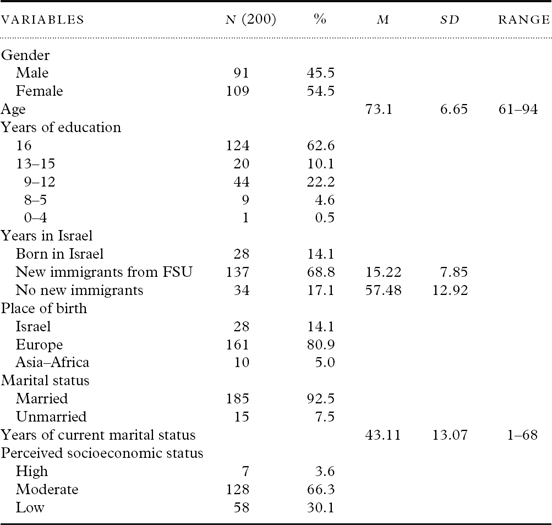
The sociodemographic characteristics of the respondents are presented in Table 1. The findings show that about 55% were women and the average age of respondents was 73 years (SD = 6.65) with a range of 61–94 years. About 73% had high education, about 81% were born in European countries, and about 69% were new immigrants from FSU countries. About 93% were married and the others had a partner; the average duration of relationship was 43 years (SD = 13.07).
Sociodemographic characteristics of respondents (percentages, means, standard deviations, and ranges)

Sexual activity and sexual satisfaction
The findings show that 54.5% of the respondents reported they had no full sexual intercourse, whereas 28.2% reported they had full sexual intercourse once or twice a month, and the remainder reported more frequent sexual intercourse. Yet, other sexual expressions were more common. For example, 74.7% reported they hold hands, 78.3% used to hug and kiss, and 62.6% reported some kinds of sexual caresses. About 15% reported they did not have any kind of sexual activity, suggesting that 85% of the respondents reported at least one kind of sexual activity. Between 17% and 19% of the respondents did not answer the questions that related to types and frequency of sexual activity. Scores for sexual activity ranged from 0 to 15 with a mean of 7.77 (SD = 5.14); scores for sexual satisfaction ranged from 1 to 6 with a mean of 4.25 (SD = 1.26), suggesting moderate levels of sexual activity and satisfaction. Sexual activity and satisfaction were significantly positively correlated (r = 0.41, p < 0.001).
Health-related quality of life
Scores for overall health-related quality of life ranged from 40 to 141 with a mean of 99.89 (SD = 20.94), physical health scores ranged from 24 to 75 with a mean of 45.81 (SD = 11.37), and mental health scores ranged from 14 to 70 with a mean of 54.09 (SD = 11.20). Sexual activity was significantly correlated with overall physical and mental health (r = 0.32, p < 0.001; r = 0.27, p < 0.001; r = 0.40, p < 0.001, respectively). Significant negative correlations were found between sexual satisfaction and overall health-related quality of life (r = −0.30, p < 0.001) and between sexual satisfaction and physical health (r = −0.26, p < 0.001), and mental health (r = −0.34, p < 0.001).
Body image
Mean scores for body image ranged from 1 to 4.80 with a mean of 3.29 (SD = 0.78), suggesting a moderate level of body image. Body image was significantly positively correlated with overall health-related quality of life (r = 0.47, p < 0.001), physical health (r = 0.48, p < 0.001), mental health (r = 0.50, p < 0.001), sexual activity (r = 0.20, p < 0.01), and sexual satisfaction (r = 0.20, p < 0.01), suggesting that those with better physical and mental health-related quality of life reported a more positive body image and those with a positive body image were more sexually active and satisfied.
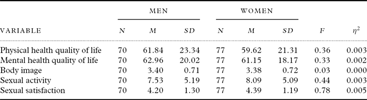
Table 2 presents the MANOVA of physical and mental health-related quality of life, body image, sexual activity, and satisfaction by gender. The findings show no statistically significant difference between men and women with regard to any of these variables with F (1, 145) = 0.53, p > 0.05; Wilk's λ = 0.98, partial ε2 = 0.02.
MANOVA of independent and dependent variables (means, standard deviations) by gender of respondents (N = 147)
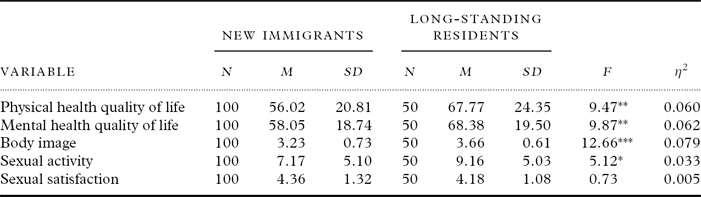
Table 3 presents the MANOVA of physical and mental health-related quality of life, body image, sexual activity, and satisfaction by migration status. The findings show that new immigrants reported poorer physical and mental health-related quality of life, poorer body image, and lower levels of sexual activity and satisfaction compared with their peers who were long-standing residents in Israel. There was a statistically significant difference between new and long-standing residents in Israel with F (1, 148) = 3.58, p < 0.01; Wilk's λ = 0.890, partial ε2 = 0.11.
MANOVA of independent and dependent variables (means and standard deviations) by migration status of respondents (N = 150)
*p < 0.05; **p < 0.01; ***p < 0.001.
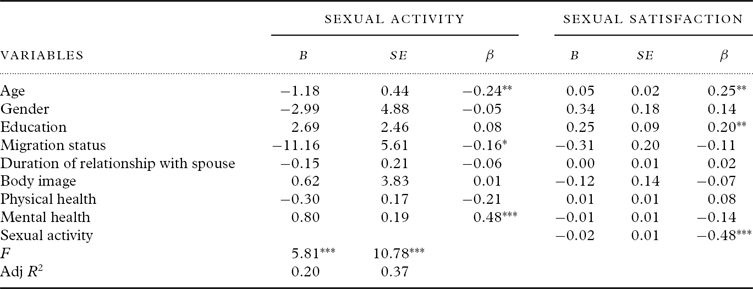
Table 4 presents the regression analyses of the independent variables explaining sexual activity and satisfaction. The findings show that age, migration status, and mental health-related quality of life were significant in explaining sexual activity, suggesting that older age, being a new immigrant, and poorer mental health were associated with less sexual activity. The variables that were included in the equation explained 20% of the variance in the outcome variable. With regard to sexual satisfaction, the findings show that age, education, and sexual activity were significant in explaining sexual satisfaction, suggesting that increased older age, higher education, and more sexual activity were associated with increased sexual satisfaction. All the variables that entered the equation explained 37% of the variance in the outcome variable.
Linear regression analyses of variables explaining sexual activity and satisfaction (N = 150)
*p < 0.05; **p < 0.01; ***p < 0.001.
Discussion
In brief, the goals of the study were to examine physical and mental health, body image, gender, and migration status among older adults and their relationship to sexual activity and satisfaction. It was hypothesized that men and those who are long-standing residents in Israel will report better health and a more positive body image than women and new immigrants and that good perceived health and positive body image are related with greater sexual activity and satisfaction. However, the findings showed that no significant differences were found between men and women, whereas significant differences were found between new immigrants and long-standing residents in Israel, with the latter reporting lower levels of perceived physical and mental health, poorer body image, lesser sexual activity and satisfaction. The multivariate analyses revealed that age, migration status, and perceived mental health were significant in explaining sexual activity, while age, education, and sexual activity were significant in explaining sexual satisfaction. The findings also indicate that although the majority did not have full sexual intercourse, they had other sexual expressions such as hugs, kisses, or mutual stroking. Respondents who were more sexually active reported more sexual satisfaction.
Consistent with previous studies (Ginsberg et al., Reference Ginsberg, Pomerantz and Kramer-Feeley2005; Laumann et al., Reference Laumann2005), the findings of this study do not support the stereotype of an “asexual” old age, but rather indicate that older men and women alike pursue various modes of sexuality and that the drive for sexual activity persists into late life, although most of them do not have full sexual intercourse. Full sexual intercourse is replaced by other modes of sexuality (Gott and Hinchliff, Reference Gott and Hinchliff2003) and may offer older persons sexual satisfaction. These findings are very similar to those found by Ginsberg et al. (Reference Ginsberg, Pomerantz and Kramer-Feeley2005), who examined sexuality among older adults in the United States and found that the majority reported having some physical and sexual experiences that included touching, holding hands, embracing, hugging, and kissing. However, mutual stroking and intercourse were not experienced by the majority of the respondents.
Advanced age was found to be significantly correlated with decreased sexual activity. This is because the aging process includes not only various physiological changes that can negatively affect sexual potency and activity (Nusbaum et al., Reference Nusbaum, Lenahan and Sadovsky2005; Ahn et al., Reference Ahn2007; DeLamater and Moorman, Reference DeLamater and Moorman2007; Laumann et al., Reference Laumann, Das and Waite2008; Papaharitou et al., Reference Papaharitou, Nakopoulou, Kirana, Giaglis, Moraitou and Hatzichristou2008; Lindau and Gavrilova, Reference Lindau and Gavrilova2010), but also various losses that older people experience as they age that can hinder their mental health. Yet, poor mental health was negatively connected with sexual activity. This finding emphasizes the paramount effect that mental health rather than physical health has on sexual activity in old age. Poor mental health in old age, in particular depression, is more common than in younger age and can be affected by a variety of losses, including visible body changes that can negatively affect the self-esteem and self-confidence of an individual and cause uneasiness in intimate relationships including sexual activity (DeLamater and Moorman, Reference DeLamater and Moorman2007; Laumann et al., Reference Laumann, Das and Waite2008). However, body image and mental health-related quality of life were found to be strongly correlated, although in the multivariate regression analysis, body image was not found to be a significant factor in explaining sexual activity. Therefore, it might be that mental health moderates the relationship between body image and sexual activity, suggesting that poor body image can impair mental health (Figueiredo et al., Reference Figueiredo, Cullen, Hwang, Rowland and Mandelblatt2004; Baker and Gringart, Reference Baker and Gringart2009) and the latter can adversely affect sexual activity. This issue, however, merits further investigation.
No significant differences by gender were found with regard to body image and sexuality, which is inconsistent with previous studies (NIA, 2008; Baker and Gringart, Reference Baker and Gringart2009) that showed significant differences between men and women with regard to body image and sexuality. It might be that the results of this study were biased and that those who had a better body image and were more sexually active completed the questionnaires, while those who had a poorer body image refused to participate in the study. This is an assumption that could not be validated in this study because no information on those who refused to participate in the study was available because respondents were not asked to provide identifying personal details.
One of the striking findings of this study is that migration status is a significant factor in explaining sexual activity in old age; new immigrants from FSU countries reported poorer health-related quality of life, lower body image, and lesser sexual activity and satisfaction compared with their counterparts who were long-standing older residents. Several explanations can be provided for this: first, new immigrants undergo many adjustment difficulties that hinder their mental health (e.g. Mirsky, Reference Mirsky2009) and consequently negatively affect their sexual life.
Second, cultural background can affect sexual behavior (Whitehouse, Reference Whitehouse2009). It might be that new immigrants from FSU countries still hold social taboos and attitudes toward dealing with sex. Taking into account their communist cultural background, where talking about sexual issues was considered a social deviation and where self-control and sexual restraints were desirable ideals (Kon, Reference Kon, Stulhofer and Sandfort2005), they may feel less at ease disclosing their attitudes and behaviors in this regard. Thus, cultural transformation that includes migration can negatively affect self-esteem and sense of control. The mental health problems caused by these situations can consequently generate sexual problems (Laumann et al., Reference Laumann, Das and Waite2008). In other words, taking into account that the new immigrants came from a society and a culture that suppressed sexuality might have caused them not to disclose their real personal attitudes and behaviors with regard to sexuality.
Third, although living arrangements were not examined in this study, many old new immigrants from FSU countries in Israel live in multigenerational families due to economic difficulties, where privacy and intimacy are lacking, tensions are prevalent, and sexual needs are ignored. A comparative study (Burr et al., Reference Burr2012) conducted in Israel and the United States showed that the less time older immigrants from FSU lived in the host country, the more likely they lived in extended households. Therefore, they lack the conditions that can enable them to have privacy and intimacy and sexual activity.
Yet, taking into account that the majority of long-standing residents in Israel refused to participate in the study may bias the results in a direction that those who had more active and satisfactory sexual relationships volunteered to participate in the study. This is only an assumption that cannot be validated. However, these issues merit further investigation with larger random representative samples that may provide better insights into the reasons for poorer body image and sexual activity among older immigrants from the FSU compared with their peers who were long-standing residents in Israel. However, previous studies (e.g. Amit and Litwin, Reference Amit and Litwin2010) found similar findings about the association between migration status and mental health of older immigrants and found that older immigrant in the United States and Israel who emigrated from FSU reported higher levels of depression and lower levels of subjective well-being. Yet, there is a lack of research on the effect of migration on the sexuality of older people. Therefore, more cross-cultural and cross-national studies are necessary to provide better insights into this important aspect of aging well.
Sexual satisfaction was found to be significantly connected with increased sexual activity and, surprisingly, with advanced age and higher education. It might be that older and more educated persons feel less embarrassment and unease in talking about their sexual life as opposed to those who are younger and have lower education. However, this issue merits further investigation.
To conclude, more mental health services may need to be offered to older people, in particular to those who are new immigrants, in order to help them cope with the difficulties they encounter that may have a devastating impact on their mental health and sexual life. In addition, providing sexual education and interventions is needed to enable older people to overtly talk about their sexuality, to change attitudes, and to legitimize the importance of sexual life in old age for promoting their quality of life. It is also very important to provide training to health professionals to become more aware of the sexual needs of older people, in particular when they are new immigrants who came from cultures where talking and dealing with sex, in particular in old age, have negative connotations. Professionals must be more attentive to the difficulties older people have talking about these issues, in particular when they are new immigrants, and the implications on their mental health. It might be that because of lack of awareness and openness of physicians, older persons rarely apply to them with their sexual problems (Lindau et al., Reference Lindau, Schumm, Laumann, Levinson, O'Muircheartaigh and Waite2007; Hirayama and Walker, Reference Hirayama and Walker2011). However, this is a great challenge for health professionals, taking into account that life expectancy is increasing and older people are more healthy and better educated than previous cohorts; as Sharpe (Reference Sharpe2004, p. 204) says: “Sexuality at all ages is an issue for mental and medical health providers, but in late life, it poses particular challenges.”
Limitations
There are several limitations to this study. First, the study is a cross-sectional study, thus causal relationships between mental health, body image, and sexuality are unwarranted. Further investigation and longitudinal studies that will examine changes in sexual activity and satisfaction over time, as well as changes in body image and mental health and its implications for variations in sexuality in old age may contribute to the extant knowledge on the role that sexuality plays in later life. Second, generalization of the findings is limited because the sample and the sampling procedure do not guarantee representativeness of all older people. Indeed, previous studies (Gott and Hinchliff, Reference Gott and Hinchliff2003; Whitehouse, Reference Whitehouse2009) have pointed out that studying sexuality in older age is difficult because of the sensitivity of the topic. A bias in the findings is likely because less than half of the initial sample contacted actually participated in the study, in particular when taking into account the high number of refusals among the group of long-standing residents in Israel.
In addition, the sample included only functionally independent older adults and therefore does not provide any information on how disability and cognitive impairments affect body image and sexuality in old age. Third, since several measures underwent some changes, further investigation is needed to study the validity and reliability of the measure on larger samples. Finally, more variables should be included in such studies that might moderate or mediate the relationships between perceived physical and mental health and sexuality. These can include quality of spousal relations and communication, affection, as well as self-attitudes toward sexuality in old age. Nevertheless, the study throws some light on this understudied issue and opens new avenues for further research.
Conflict of interest
None.
Description of authors’ roles
Both the authors designed the study. The first author wrote the methods section and conducted the data collection. The second author wrote the literature review and conducted the data analyses. Both the authors wrote the discussion.