This paper focuses on the topic of evaluation of clinical ethics consultation. The concept of evaluation seems to contain an internal tension: On the one hand, evaluation is seen (by some authors) as distorting the conceptual and normative content of the case(s) under scrutinyFootnote 1 and, on the other, the evaluative act is the most important use of judgment and an inescapable part of everyday life (e.g., the decision to buy a certain car or eat certain food is based on our own evaluations). As such, we maintain that evaluation is essential. Commonly, “evaluation is the systematic investigation of the merit or worth of an object (program) for the purpose of reducing uncertainty in decision making.”Footnote 2
Acknowledging the challenges of the evaluative task, this paper presents an evaluation strategy for clinical ethics consultation. The evaluation structure is discussed on the basis of our own experience in clinical ethics over some 15 years in various institutions and a systematic literature search. Specifically, we will address the following four questions:
1) How should a clinical ethics consultation service be structured to meet the needs of those seeking support in ethically challenging situations?
2) Which criteria should guide an evaluation of clinical ethics consultation?
3) What can we learn from empirical results published so far?
4) What conclusions can be drawn?
Background
Clinical ethics consultation (CEC) has gained increasing importance in EuropeFootnote 3 during the past decade, about 20 years later than in the United States,Footnote 4 and research on or evaluation of ethics consultation has started to appear in the European literatureFootnote 5 only recently. Drawing a complete and authentic picture of the situation in Europe is difficult across the multitude of languages, yet a review of publications in English, German, and French reveals that, at the institutional level, European hospital ethics committees (HEC) are growing in number and in the diversity of their tasks and duties.
One important and much debated aspect of HEC activity concerns whether and how ethics support services such as consultation are provided to clinicians, other caregivers, families, and sometimes patients as well. Clinical ethics consultation, where it exists, is called “on request” for ethically challenging situations and difficult treatment decisions,Footnote 6 that is, the service is voluntary and relies strongly on the ethical awareness and motivation of those providing it. The various forms of clinical ethics consultation are predominantly oriented toward assisting the healthcare providers in patient care and related decisionmaking, thus, ultimately striving to improve the patient's welfare.
In Europe, ethics consultation has developed at various rates depending on the country and societal context. Great Britain, for example, focused on a national strategy to establish hospital ethics committees on a large scale, with a primary emphasis on educational issues or policy development, rather than on case consultation.Footnote 7 The Netherlands developed both hospital ethics committees and consultation services, propagating synergies between the two.Footnote 8 In Spain, the situation is now shifting from implementation and accreditation procedures to increased demands on HECs and new questions about evaluation.Footnote 9 Starting in church-run hospitals, Germany also has shown a strong commitment to establishing hospital ethics committees, increasingly connected with efforts to offer ethics consultation.Footnote 10 In France, medical centers normally do not have committees or other structures offering consultation services, except l'Hôpital Cochin at Paris,Footnote 11 but the “Espace éthique” approach is gathering clinicians from various regions who are interested in developing different models of consultation and support.Footnote 12 Switzerland benefits from the Swiss Academy of Medical Sciences and its support for HECs and clinical ethics consultation. An International Conference on Clinical Ethics Consultation, held in Basel in 2005, also stimulated both the development of ethics consultation and related research in that country.Footnote 13 As regards countries in Eastern Europe, ethics committees are gaining importance. Although little is known about the structure of their ethics consultation services, both the need for such services and the lack of trained staff for ethics consultation are documented.Footnote 14
The Clinical Ethics Consultation Service
Definition
Fletcher and Siegler provided an early consensus statement: “Ethics consultation is defined as a service provided by an individual consultant, team, or committee to address the ethical issues involved in a specific clinical case. Its central purpose is to improve the process and outcomes of patients’ care by helping to identify, analyze, and resolve ethical problems.”Footnote 15 For example, Boesch-Willi and colleagues report on two different kinds, one being classified as ad hoc discussion, the other as systematic ethics consultation on request with an expert from outside.Footnote 16 White distinguishes three levels of consultation services: Level 1 consultation involves answering uncomplicated questions by a single member of the services, whereas, on Level 3, full multidisciplinary reviews are provided to address difficult ethical dilemmas. Level 2 involves “facilitating a decision-making process with the health care team, patient and/or family, and is performed by the ethics consultation service member on-call.”Footnote 17
Despite this broad range of meaning, we will use the terms clinical ethics consultation and consultation service as synonyms denoting a short, structured, multiprofessional meeting centered on an ethical problem or dilemma and facilitated by specialized members of the ethics consultation team, with the goal of identifying and solving the problems addressed. Phone calls, quick clarifications in corridors, as well as deliberations without involvement of the clinicians-in-chargeFootnote 18 are not included in this definition. They are part of healthcare ethics or hospital ethics committees' work, but not specifically an ethics consultation, at least as we conceive it.
Organization, Request, and Utilization
In European countries where ethics consultation services are growing, the task force report of the American Society of Bioethics and Humanities (ASBH) is often used as a reference for the organization of consultation services.Footnote 19 This is also true for the ethics consultation service at our institution. The implementation of this ethics consultation service in 2005 responded to the need for structured and professional ethics support for hospital staff. The service consists of staff members with long-standing professional experience and a variety of ethics qualifications who provide ethics consultation services on request. Consultations can be requested by whoever is in need: patients, surrogates, legal guardians, and families or members of the healthcare team (physicians, nurses, other allied health professionals). The question or conflict should be clearly expressed at the time of the request, and background information (e.g., history of the patient) has to be available at the time of the consultation. As a rule, two members of the service respond to the request: A consultant and a supporting co-consultant (writing the report) serve as facilitators and chair the consultation meeting. Neither is a member of the requesting department.
The consultants seek to create a respectful atmosphere of trust and privacy. The patient him- or herself should be involved if possible. If he or she is not able to articulate his or her own values and preferences, a surrogate or legal guardian is invited to participate. In any case, the patient or his or her surrogate is informed about the meeting in advance. Family members' contributions often are helpful for the interpretation of advance directives or presumed patient wishes and preferences. For this reason, we support the participation of relatives, even though we are aware of the burden that may result from the meeting for them. To minimize distress, we clarify roles and responsibilities of the participants: According to German law, treatment decisions remain with the patient or his legal surrogate and the physician-in-charge. The patient or legal surrogate has the right to refuse treatment.
Procedure and Documentation
The consultation is oriented at helping to make ethical decisions.Footnote 20 Our evaluation strategy combines three different European models of ethics consultation: The Nijmegen approach suggests a four-step procedure with an emphasis on the moral question to be solved,Footnote 21 the Basel method integrates reflection on principles and a systematic change of perspectives,Footnote 22 and the framework from Leuven involves the “ethos” of personalism.Footnote 23
As a first step, medical, nursing, religious, and social aspects are assessed. Communication problems and misunderstandings are identified and distinguished from the ethical issues. Within a time frame of about 60 minutes, various options and their pros and cons are discussed until the majority of participants agree to the results. Minority views with specific arguments are recorded. A recommendation is based on the information gathered, different options for action are identified, a variety of perspectives is considered, and a consensus is reached, as far as possible. Results and main arguments are documented in the medical file and signed by the physician-in-charge and the ethics consultants. Details for the patient's care plan or instructions for the nursing team or other healthcare providers are articulated and signed by the attending physician, the nurse, and the ethicist. However, decisions can be canceled at any time by repeating the procedure. As a rule, the physician-in-charge also informs involved parties who would not or could not join the consultation, for example, other clinical staff members or the patient and/or his or her relatives. A consensus-based decision functions as a recommendation for the physician-in-charge and the patient or his or her legal representative.
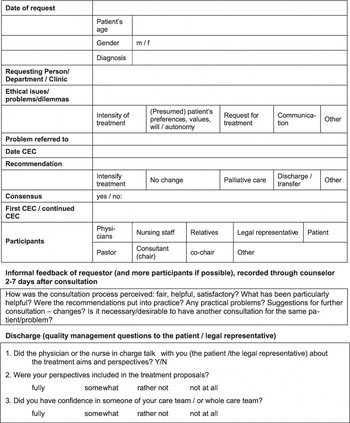
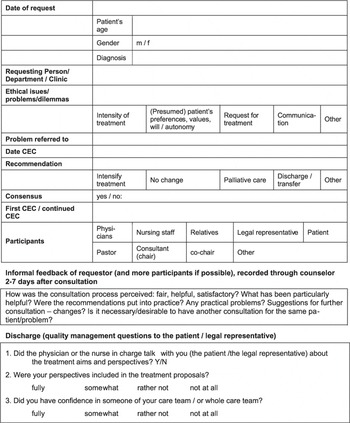
The process and result of ethics consultation need to follow ethical values and principles. (We document the consultations with respect to the items outlined in Table 1.) At the same time, the decision ought to reflect patient-specific values and preferences in accordance with the values and treatment options of the healthcare team.
Evaluation Record of Clinical Ethics Consultation (in Addition to Minutes of the Consultation)
Criteria for Evaluation of CEC—Conceptual Frameworks
Initial Frameworks, Impulses, and Obstacles
Evaluation of clinical ethics consultation has been a topic of concern in the field since the Conference on Evaluation of Case Consultation in Clinical Ethics in Chicago in 1996.Footnote 24 Fox, Tulsky, and others reported with enthusiasm about the early conceptual frameworks for future research and provided detailed methodological approaches clearly addressing obstacles and pitfalls and offering proposals for managing them.Footnote 25 The ethics community itself served as the stakeholder in establishing the effectiveness or quality of ethics consultation. Main topics for evaluation, such as structure, process, and outcome, were formulated especially with respect to effectiveness.Footnote 26 Furthermore, it seemed feasible to develop common research questions, methods, evaluation strategies, standards, and instruments.Footnote 27 Measurable outcome criteria were categorized into four broad content domains: (1) ethicality, (2) satisfaction, (3) resolution of conflict, and (4) education.Footnote 28
The first three of these content domains are of special interest for us. The domains are defined as follows: Ethicality refers to the “primary goal of ethics consultation … to promote practices consistent with ethical norms and standards. Outcomes in the domain of ethicality, then, reflect the degree to which clinical practices conform to established ethical standards.”Footnote 29Satisfaction is defined as a “subjective construct—a function of someone's personal attitudes and impressions.”Footnote 30 Finally, the major outcome variable in the resolution of conflict is “the degree to which involved parties construe that conflicts have been resolved.”Footnote 31
In Europe, perhaps due to the stage of development, evaluation of CEC has developed along a more casuistic path. Case-based reflections and single case interviews are prominent and can be seen as preliminary steps for the creation of research hypotheses.Footnote 32 Services are documenting their cases and may carry out some follow-up inquiries,Footnote 33 often unpublished. More Ph.D. and M.D. theses are searching outcome variables of clinical ethics consultations retrospectively or on the basis of case series.Footnote 34 In general, major effort is necessary if European CEC is to join the community of CEC evaluation.Footnote 35
Looking back at the pioneering work carried out in the United States, it is surprising to find that only a few outcome studies from North America on clinical ethics consultation have been published since 1996.Footnote 36 What might be the reasons for this gap, considering the enthusiasm of the initial implementation of CEC services? The following problems point to some of the reasons:
1) Clinical ethics consultation had been developed and established before evaluation was considered or even planned, and the means for realizing studies were lacking. Without a stable structure and a certain number of comparable consultations, sound evaluation was difficult to perform.Footnote 37 Still, in the early stages, “pilot” evaluation was used to detect pitfalls and benefits of ethics consultation.Footnote 38
2) The objectives of CEC evaluation are too complex to evaluate easily. The content domains set up by the Conference on Evaluation of Case Consultation in Clinical Ethics pursue several different goals. Appropriate instruments for evaluating these domains are difficult to develop. In addition to the domains mentioned above, other criteria emerged, for example, the reduction or prevention of staff burnout or moral distress in daily work,Footnote 39 supporting medical staff in making difficult decisions, rather than providing solutions,Footnote 40 as well as issues of cost effectiveness.Footnote 41
3) The requirements for sound evaluation create problems affecting the quality of the studies. Several of the empirical studies published thus far show methodological shortcomings: The sample size often tends to be (too) small, control groups are missing, and responder versus nonresponder analysis is lacking. Response rates in retrospective investigations vary between 17% and 66%. A number of studies focus only on a single aspect without considering the general importance of the result or its relation to other studies.
Despite these problems, evaluation has made progress, although the early goal of standardizing evaluation of consultation has not (yet) been reached.
Levels of Evaluative Criteria
The goals of ethics consultation supply the framework and the criteria for the evaluation of the outcome of the consultation. In practice, though, the goals vary and depend on the participating persons and the specific problems addressed in the consultation. This leads to the methodological difficulty of evaluating outcome criteria that cannot be defined in advance because the appropriate outcome (“which goal is to be reached”) is only identified within the consultation process itself. In addition, the participants vary with every consultation; for these reasons, standardization is only possible on a rather abstract level. Although Molewijk and colleagues claim a significant difference between “moral case deliberation” and ethics consultation service, their proposal of a “responsive evaluation method” is on the right track for ethics consultation as a field.Footnote 42 Such an approach can do without predetermining the evaluative criteria in advance and, instead, identify the actual consultations.
Taking these complex and contingent outcome processes into account, we thus identify the following as preliminary criteria that are feasible and could allow for some comparability and standardization:
a) Content criteria: Are the ethical dilemmas or problems and the treatment options clearly identified? For example, should treatment be intensified, is palliative treatment indicated, and which of the possible options is most likely in accordance with the preferences of the patient? Are the values and preferences of the patients clarified, understood, and respected by the care team, or are there reservations about some preferences of the patient and the family? Possibly, the care team is not the right one for the patient's problem, and the patient should be referred to another clinic or even discharged.
b) Structural criteria: Who should participate in the consultation, and in what role? For example, is everyone who is necessary for the consultation invited and participating in the session (also patients and representatives)? Does the consultant (and co-consultant) chair the session? What is the time frame of the consultation?
c) Process-oriented criteria: Does every participant have the chance to speak and be heard? For example, do participants have the chance to change perspectives or express emotions without intimidation and improve their ethical skills through active participation in the discussion?
d) Outcome-oriented criteria: Did the consultation have an appropriate result, for example, were preferences and values clarified? Was a recommendation or decision reached? Was the consultation fair and satisfying for the participants?
The investigation of the expectations and values of the patient on the one hand and the concepts and values of the healthcare providers on the other addresses both process and outcome at the same time. In cases of conflict, we seek to bridge the different positions in a participatory process including a change of perspectives.Footnote 43 Identifying conflicting values of the involved parties also points to the mutual dependency of patients and providers. This “dual contingency” is one decisive reason for the difficulty of developing standardized evaluation measurements for outcome, because the “content of the specific criteria used to measure the success of ‘ensuring respect for individuals’ values’ will be contingent on the specific values of the patient and/or other parties involved.”Footnote 44
Empirical Studies of Ethics Consultation
Structure and Process as Outcome Criteria
The PEECE study (project examining effectiveness in clinical ethics) in Canada is a large-scale study that assesses the effectiveness of clinical ethics services by comparing and contrasting variations in structure, activities, and resources. Phase 2 of the project was designed especially to examine the consultation process, but publication of results is still pending. The outcome of Phase 1 of this study points to high variability in structures and processes, without clear conclusions about their advantages and disadvantages.Footnote 45 Earlier studies demonstrated that consultation had a high impact on the ethical sensitivity of the participating physicians.Footnote 46 One third of the participants identified ethical issues that requestors had not recognized and more than 75% changed patient management considerably (41%) or slightly (36%) after consultation.Footnote 47
Satisfaction as an Outcome Criterion
A number of studies have assessed satisfaction as an outcome criterionFootnote 48 by encompassing various target groups such as patients, families, and different healthcare providers. Methods and evaluation differed in details, with Likert scales being used frequently to express satisfaction with respect to the process and outcome of the consultation. The majority of responders reported being satisfied and rated the consultation as helpful—two categories that do not necessarily correlate, as Orr and colleagues have demonstrated.Footnote 49 Physicians or other healthcare providers repeatedly reported more satisfaction than did family members.Footnote 50 Of those who expressed some dissatisfaction, still one third thought the ethics consultation had been very helpful. Satisfaction and degree of change in treatment showed a positive correlation: Responders were more satisfied when they believed that the ethics consultation had resulted in more of a change in treatment.Footnote 51 Dissatisfaction was related to a variety of reasons; single causes could not be clearly identified.Footnote 52 In one study, miscommunication or communication gaps primarily seemed to be the reason for dissatisfaction among families, independent of the result of the consultation as such.Footnote 53
Cost as an Outcome Criterion
Schneiderman and colleaguesFootnote 54 investigated the effectiveness of ethics consultation in a prospective, randomized controlled study, seeking evidence-based outcomes. They showed that ethics consultation was associated with a significant reduction of hospital days and of life-sustaining treatments in patients who did not survive to discharge. The authors conclude: “Ethics consultations also reduce hospital costs without diminishing the quality of care. Hence, ethics consultations seem to be useful in resolving conflicts that may be inappropriately prolonging non-beneficial or unwanted treatment at the end of life.”Footnote 55 This result combines an assumed advantage for the patient with cost-saving results.
Critical Appraisal
The wide range of methods, goals, and purposes makes the question of selecting the appropriate criteria for evaluating ethics consultation a very difficult one. Each of the goals mentioned above may be ethically justifiable in specific cases and under certain circumstances.
Ethics consultation seems to enhance ethicality and sensitivity toward ethical issues in teams. Nevertheless, it remains unclear whether or how this may also be reached by other means. Patient, surrogate, or family satisfaction with the consultation may be a good criterion, especially when respect for their values has been an issue in the CEC process. The Conference on Evaluation of Case Consultation in Clinical Ethics deliberately addressed satisfaction as an outcome criterion, but it seems that satisfaction is not sufficient as a criterion measure or an overall measure for the effectiveness of an ethics consultation. Satisfaction is one possible subjective reflection of the consultation, but it is not the goal of consultation. Ethicality could be infringed and participants still might be satisfied with the process and the result of the consultation. To rely on an analogy, we prefer to assess a kind of Rawlsian “procedural justice,” that is, whether the participants experienced the process of consultation as fair.Footnote 56 The ethical dimension of “justice as fairness” includes all affected persons, even those who are absent. Satisfaction—as a subjective category—is immanently related to a person or a group. Furthermore, it has to be asked whose satisfaction should be addressed, the patient's, the administration's, or the physician's? Justice as fairness opens the horizon because it appeals to the need to follow a fair process and include all interested persons in the consultation.
In a recent study by Cohn et al.,Footnote 57 healthcare professionals and family members were asked whether the consultation was respectful of their values and whether it was fair. Responses were obtained on a 5-point Likert scale. Similar to the results on satisfaction, the healthcare professionals tended to value consultation more than did family members, but with regard to the criterion of being “respectful to values,” no statistically significant difference was found between the groups. It may be asked whether the study participants had fully understood the question, because no psychometric information about the questionnaire was given. Nevertheless, this study suggests a possible shift toward the domain of ethicality—with this linkage, even the criterion of satisfaction appears in a more favorable light.
The criterion of cost effectiveness may also be a legitimate criterion if the resources being saved were used for goals of higher (ethical) priority, so that saving money would not count as a value in itself, but as a means toward achieving good consequences. Presently, issues of appropriate micro-allocation are not regularly addressed in ethics consultation, but given the pressure resulting from scarce resources and the evidence of implicit rationing at the bedside,Footnote 58 this might become necessary.Footnote 59 If ethics consultation proves to be an effective instrument for reducing costs in hospitals under some circumstances, the risk of using CEC to limit quality of care under economic pressure might grow.Footnote 60
The next questions to ask, then, regards who is supposed to benefit from ethics consultation (the patient, the healthcare professionals, or the organization that operates the hospital) and whether the identified benefits are consistent with the ethical framework of CEC. Cost reduction without diminishing the quality of care may be a goal within a framework of quality standards and needs to be discussed as an ethical issue.Footnote 61 What is defined as appropriate or good care is already part of the ethical conflicts being addressed in consultations. Therefore, studies examining the issue of cost reduction should also consider consequences of consultation on quality of care.
Application
To develop a more systematic assessment of ethics consultations, we developed an evaluation record (Table 1). Our strategy shows that evaluation can be started, even on a small scale, with a systematic approach incorporating the points discussed above. Our records demonstrate that even though only limited resources of time and staff are available for clinical ethics, which is a very common experience in the majority of European healthcare institutions, the evaluation requirement need not thwart the provision of consultations out of fear regarding extra paperwork for the clinicians themselves.
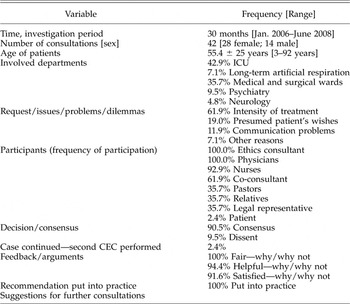
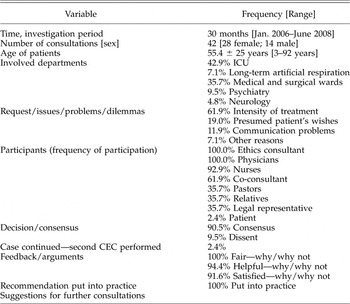
If documentation of CEC is mandatory in an institution, the statistical basis is laid: The issue, question, or problem of the requestor is recorded as well as basic data about the index patient and the treatment setting (Tables 1 and 2). Consultation notes and minutes address participants, ethical dilemmas, or conflicting values, patient history and current status according to all involved in the treatment process (including the physician-in-charge, nursing staff, other therapeutic staff, and family members), main arguments, recommendations, next steps, and minority views (if any).
Statistical Outcome of Consultation (Amounts)
In addition, after 2 to 7 days following the consultation, the consultant contacts the requestor for feedback. Including all participants of the consultation into feedback is still pending. During this short interview (phone call) or personal communication, the consultation asks the requestor whether he or she found the consultation helpful and fair and whether he or she is altogether satisfied. Suggestions and additional comments can be made. This method of follow-up has been criticized on the grounds that the evaluative interview is performed by the person who chairs the consultation, thus creating a bias. We cannot completely rule out a certain distortion, yet without resources for a full research project at this time, our options for data gathering are limited.
One of our major problems is insufficient resources for interviewing patients and representatives after discharge. We focus on staff participating in a consultation and on those who did not request the CEC (the latter forming a sort of control group). Often, patients or relatives spontaneously contact us for feedback about the consultation. This feedback is welcomed, but its suitability for outcome evaluation is limited. Following White and colleagues,Footnote 62 we currently make use of the general feedback gathered by quality management after discharge. The feedback at discharge is anonymous and cannot be related to concrete consultations or interventions unless patients disclose consultations voluntarily. Nevertheless, the feedback may offer sectional impression about what we see as being crucial for the criterion of “ethicality.” We have therefore added three questions to our evaluation form (Table 1) asking about aims, perspectives, and confidence. We included the question about confidence because this is a prerequisite for expressing one's own wishes or perspectives.
We would rate it as a positive outcome
a) if the number of consultations (structured in the way described above) increased,
b) if more relatives and patients attend or request consultations,
c) if more CECs were requested and by a larger range of hospital units, and
d) if the recommendations were endorsed by many participants and put into practice.
Finally, we would want to see that consultation is appreciated as a process of bridging different values and that the discussions in CEC are experienced as expressing justice as fairness.
The problems of evaluation of ethics consultation service have stimulated intense discussion; efforts are being made to find ways of including quality criteria such as respect for the patient's values in combination with the perspectives of healthcare providers. Although the challenges of getting ethics consultation established continue,Footnote 63 the necessity of evaluation is clearly recognized: “As the field of clinical ethics continues to grow and gain prominence, the need to attain knowledge about benchmarks, best practices, and measurement of effectiveness is becoming increasingly significant.”Footnote 64 In the meantime, even in Europe ethics consultation has gained a positive reputation, and healthcare providers are interested in active participation.Footnote 65 The empirical preconditions for systematic evaluation have improved tremendously over the past few years, given the growing number of countries and institutions establishing CEC services. Presently, our aim is to get evaluation started with a pragmatic data collection strategy taking into account the uncertain state of the art and the limited resources. Even with these preliminary measures, we hope that the instruments can prove useful and stimulate further activities, not only for large-scale research projects on CEC evaluation, but also for a decent minimal standard requirement that should pave the way for networking projects in the near future.