Adolescence is a stage of human development in which the biopsychosocial maturation process occurs. Thus, it is a period of intense physical changes, emotional and social, in the sense that, in the face of these changes, the adolescent may be more vulnerable to developing emotional and behavioral problems (Jacobs, Reinecke, Gollan, & Kane, Reference Jacobs, Reinecke, Gollan and Kane2008). A consensus is non-existent in the scientific literature, on the definition of emotional and behavioral problems in childhood and adolescence. Some authors treat the subject focusing on the symptoms according to a biological or medical model (Kaplan, Sadock, & Grebb, Reference Kaplan, Sadock and Grebb1997), while others examine the deficits and behavioral excesses more (Patterson, DeBaryshe, & Ramsey, Reference Patterson, DeBaryshe and Ramsey1989).
According to Achenbach (Reference Achenbach1991), emotional and behavioral problems are characterized by symptomatic patterns, which can be divided into two types: externalizing and internalizing. Externalizing disorders are those that express themselves in relation to others. They refer to behaviors such as difficulty controlling impulses, hyperactivity, aggressiveness and presence of anger and delinquency. Commonly linked to the conduct disorder and oppositional defiant disorder. The internalizing disorders are those that are expressed in relation to oneself. Characterized by sadness, withdrawn, somatic difficulties and fear. Generally are related to mood disorders (depression) and anxiety (Achenbach & Howell, Reference Achenbach and Howell1993).
Recent studies have pointed to the importance of the family in the development of behavioral and emotional problems in children and adolescents (Silvares & Souza, Reference Silvares and Souza2008; Teodoro, Cardoso, & Freitas, Reference Teodoro, Cardoso and Freitas2010). However, in our context, longitudinal investigations are still scarce that empirically demonstrate what are the factors involved in this relationship and how they interact.
The emotional and behavioral problems are influenced by biopsychosocial variables. In addition to the individual characteristics of adolescents, family structure, relational aspects and characteristics of the parents may be linked to the emergence of emotional and behavioral problems (Avanci, Assisi, & Oliveira, Reference Avanci, Assis and Oliveira2008; Cruvinel & Boruchovitch, Reference Cruvinel and Boruchovitch2009; Sheeber, Hops, Alpert, Davis, & Andrews, Reference Sheeber, Hops, Alpert, Davis and Andrews1997; Stark, Humphrey, Crook, & Lewis, Reference Stark, Humphrey, Crook and Lewis1990; Teodoro et al., Reference Teodoro, Cardoso and Freitas2010).
Research has shown that levels of support, attachment and approval of behavior of adolescents in the family have negative correlations with depression (Garrison, Jackson, Marsteller, McKeown, & Addy, Reference Garrison, Jackson, Marsteller, Mckeown and Addy1990; Sheeber et al., Reference Sheeber, Hops, Alpert, Davis and Andrews1997). Additionally, the satisfactory relationship between parents has been considered important to the quality of life and well-being of children (McFarlane, Bellissimo, & Norman, Reference McFarlane, Bellissimo and Norman1995). Thus, families with healthy relationships can be considered as being protective in relation to the appearance of pathologies children and adolescents (Costello, Rose, Swendsen, & Dierker, Reference Costello, Rose, Swendsen and Dierker2008).
Moreover, the low quality of family interactions may contribute to the development of emotional and behavioral problems, being considered a risk factor for the onset of these disorders (Silvares & Souza, Reference Silvares and Souza2008). There is evidence, for example, that family conflict is associated with a higher intensity of depression in children and adolescents (Stark et al., Reference Stark, Humphrey, Crook and Lewis1990).
In a study that investigated affection and family conflict and its relations with the symptoms of depression, from the perspective of 234 children and adolescents, in the metropolitan area of Porto Alegre (RS), Teodoro et al. (Reference Teodoro, Cardoso and Freitas2010) found positive correlations between depression and the level of conflict and negative correlations for affection. This study also showed negative correlations between affectionate family relationships and depressive symptoms. However, the cross-sectional nature of the study did not allow the establishment of relations between these predictive variables.
Rohenkohl (Reference Rohenkohl2009), investigated the level of affection and conflict and its relationship to behavioral problems in 59 children of preschool age. She found that in families with high conflict in the mother-father dyad, children have more emotional and behavioral problems than in families with low conflict. This study showed also that in families with high conflict in the mother-father dyad and low affection in mother-child dyad, children had higher scores on internalizing problems. These findings reveal the importance of the degree of affection and conflict between spouses and their relation to emotional and behavioral problems in young children.
The experience of stressful events, such as death of a family member, separation from parents, or suffer some kind of violence, can also be considered a risk factor for the development of emotional and behavioral problems. Masten and Garmezy (Reference Masten, Garmezy, Lahey and Kazdin1985), define the stressors as occurrences of life that alter the environment and cause tension which interferes with the responses emitted by individuals. Moreover, the impact caused by stressful events is determined not only by how they occur, but also by the way they are perceived.
Aiming to investigate the occurrence and impact (low, medium, or high) of stressful life events, Kristensen, Leon, D’Incao, and Dell’Aglio (Reference Kristensen, Leon, D’Incao and Dell’Aglio2004) conducted a study with 330 adolescent school students in elementary school. The results showed a high incidence of problems in relationships with peers and family, as well as in the school context. Furthermore, this study demonstrated that events such as violence, although less frequent, was regarded by adolescents as an event of great impact. Confirming these findings, Sternberg, Lamb, Guterman, and Abbott (Reference Sternberg, Lamb, Guterman and Abbott2006) conducted a longitudinal study with 110 children of Israel and their parents, who pointed out that the children who have gone through some kind of domestic violence had higher levels of behavioral problems or depression symptoms in adolescence, than in children who had not experienced violence.
The present study investigated the predictive power of emotional and behavioral problems of parents and children, the characteristics of family relationships and stressful life events in terms of the internalizing symptoms manifested by children after one year. Furthermore, we evaluated the temporal stability of behavioral and emotional problems and the perception of family relations from the perspective of a adolescent.
Method
Participants
In this longitudinal study, 139 adolescents and their parents participated, 79 girls (56.80%) and 60 boys (43.20%), aged between 12 and 16 years (M = 13.59 years, SD = 0.89) from two public schools. The group of parents included 110 mothers with a mean age of 39.28 years (SD = 6.78) and with 70 fathers with a mean age of 42.41 years (SD = 9.36). The sample was chosen for convenience, and all the adolescents attending from the 6th to 8th grades, and 8.3% of the adolescents were also working besides studying. All adolescents who had participated in the first sample (n = 187) were invited to participate in the longitudinal study. However, after the interval of a year, 48 adolescents (25.67%) were not located.
Instruments
Socio-Demographic Data Sheet
In order to obtain information on the parents (occupation, education and marital status) and family structure (number of children, people living in the house). This sheet was answered by adolescents.
Youth Self-Report 11-18 years (YSR)
The YSR is part of the System of Empirically Based Assessment (Achenbach System of empirically based Assessment -ASEBA, Achenbach, Reference Achenbach1991; Achenbach & Rescorla, Reference Achenbach and Rescorla2001; Rocha Araújo, & Silvares, Reference Rocha, Araújo and Silvares2008) and consists of eight scales of behavioral problems (anxiety/depression, isolation/depression, somatic difficulties, social problems, thought problems, attention problems, rule-breaking behavior, and aggressive behavior) and by the topic “other problems”. The internalizing problems include the first three scales. The questions of the YSR are answered through a three-point Likert scale (not true, sometimes true, or very true/often true). The YSR was completed by adolescents in the first and second collection, made a year later. The instrument has been used in multicultural studies demonstrating the validity of the identification of emotional and behavioral problems and obtained average alphas among the 24 countries of .94 for the total problems and .86 for internalizing and externalizing problems (Ivanova & Israel, Reference Ivanova and Israel2006). The Portuguese version was tested and obtained a coefficient of .92 for total problems, .84 for internalizing problems and .85 for externalizing (Rocha, Reference Rocha2012), considering the sample of adolescents in the general population. In this study, we obtained a Cronbach’s alpha of .93 for the total scale, .86 for the dimension of internalizing symptoms, .80 for the subscales that comprise anxiety/depression, .57 for isolation/depression and .66 for somatic difficulties. These scores are similar to those described by Achenbach (Reference Achenbach1991), who reported values ranging from .59 to .86, indicating that the Portuguese version used has internal consistency indices in proximity with to the original instrument.
Adult Self-Report 18-59 years (ASR)
The ASR is part of ASEBA (Achenbach & Rescorla, Reference Achenbach and Rescorla2001, Reference Achenbach and Rescorla2003; Rocha et al., Reference Rocha, Araújo and Silvares2008) and has 168 items divided into scales on total, externalizing and internalizing behavioral problems. The ASR questions are answered through a three-point Likert scale (false/never, sometimes or true/often). This instrument was completed by the parents during the first collection of the study. The alphas obtained in this study were .92 for the total score, .88 for internalizing symptoms, and .87 for externalizing symptoms.
Familiogram (FG)
The Familiogram (Teodoro, Reference Teodoro2006; Teodoro, Cardoso, & Freitas, Reference Teodoro, Cardoso and Freitas2010) is an instrument that assesses the perception of family affection and conflict in family dyads. The affection is understood as a set of existing positive emotions in interpersonal relationships, while the conflict is defined as a range of negative feelings that can be both a source of stress and aggression within the family system. The participant is asked to enter through a list of 22 adjectives and a five-point Likert scale as is the relationship in each of the dyads that we are evaluating. Psychometric studies confirmed the bifactorial structure of the Familiogram for dimensions of affection and conflict and had Cronbach’s alphas ranging from .87 to .91 (Baptista, Teodoro, Cunha, Santana, & Carneiro, Reference Baptista, Teodoro, Cunha, Santana and Carneiro2009; Teodoro et al., Reference Teodoro, Cardoso and Freitas2010). This study investigated the child-parent dyads, mother-son and father-mother from the perspective of the child. The FG was answered by adolescents in the first and second collection. The alphas varied in this study from .88 for the parent-child conflict factor, from the perspective of the father and .97 for the father-mother affection from the perspective of the mother, similar to the scores of other studies.
Family Climate Inventory (FCI)
The FCI (Teodoro, Land, & Allgayer, Reference Teodoro, Land and Allgayer2009) investigates, through 22 items on a five-point Likert scale (from disagree to strongly agree), cohesion, support, hierarchy and family conflict. Family cohesion is defined as the emotional bonding between family members (e.g. “The people feel happy when the whole family is gathered together”; “People like to walk around and do things together”). The support contains items that describe the material and emotional support of members, (eg. “We seek to help people in our family when we realize that they are in trouble”; “When someone is sick, the others take care of them”). The hierarchy is related to a rigid differentiation of power within the family, in which older people have an authoritative influence in family decisions. (eg. “It is common for some people prohibit other from doing certain things without explaining why”, “Some demand that others obey”). The family conflict evaluates the aggressive relationship, criticism and confrontation among family members (eg. “The conflicts are common,” “People criticize each other often”) Teodoro et al., Reference Teodoro, Land and Allgayer2009) found four factors elaborated theoretically and Cronbach scores ranging from .71 to .84. The results of psychometric FCI showed Cronbach’s alphas above .80. This instrument was completed by the adolescents in the two collections.
Inventory of Stressful Events in Adolescence (ISEA)
The ISEA (Kristensen et al., Reference Kristensen, Leon, D’Incao and Dell’Aglio2004) assesses the occurrence and impact (low, medium, or high) of stressful events during adolescence. This instrument consists of 64 items in the form of stressful life events, so that, for each item the participant must indicate an alternative yes or no, as per whether the event occurred. From this, on a five-point Likert scale (ranging from “low impact” to “high impact”), the participant must inform the impact attributed to each event experienced. The ISEA showed high internal consistency (α = .92) in a previous study (Kristensen et al., Reference Kristensen, Leon, D’Incao and Dell’Aglio2004), showing to be reliable in assessing stressful life events in adolescents. In this study, a Cronbach’s alpha of .82 was obtained. This instrument was answered by adolescents only in the second collection of the study.
Procedure
The project was approved by the Ethics Committee and initiated after contact with the administration of the schools. The students were visited by the researcher in the classroom, an occasion in which they were informed about the general characteristics of the project. Students interested in participating in the study received a letter, to be delivered to the parents, containing general information about the study and signed a Written Informed Consent, which must be signed by a parent or guardian authorizing the child’s participation. The application was done in small groups and lasted approximately 60 minutes. When finishing this step, adolescents received two envelopes containing the instruments to be answered individually by parents in their homes and the individual Written Informed Consent. After answering the questionnaires, sealed the envelope and returned to the school by the children. The adolescents were re-evaluated one year after the first collection; parents did not participate in this second phase of the research study.
Data Analysis
The associations between variables were analyzed using Pearson’s correlation and paired t Test, and the comparisons between groups by way of t Test for independent samples. The predictive analyses were performed using multiple linear regression, placing the adolescent internalizing symptoms of the second collection as the dependent variable. All were considered significant results with p < .05.
Results
Temporal Stability of Emotional and Behavioral Problems and Family Relations
The temporal stability of scores of internalizing and externalizing symptoms was assessed using Pearson’s correlation and paired t Test. Internalizing symptoms investigated in the first test correlated positively with the second (r = .66, p < .001). With respect to externalizing symptoms, there was also a correlation (r = .70, p < .001) between the two collections. There was not a significant difference between the two longitudinal scores for both internalizing symptoms (t = 1.30, GL = 120, ns) nor for externalizing (t = 1.80, GL = 120, ns).
The correlation scores for perceptions of family relationships by adolescents between the two collections in the affection dimension were .54 (p < .001) for the mother-child relationship, .51 (p < .001) for father-son and .62 (p < .001) for father-mother. In terms of conflict, .58 (p < .001) was found for mother-son, .53 (p < .001) for father-son and .66 (p < .001) for father-mother. There was no significant difference between the beginning and end times for the measures of affection and conflict investigated by the paired t Test. For measures that relate to the entire family system, evaluated by the FCI, .54 (p < .001) for support was found, .43 (p < .001) for hierarchy, .45 (p < .001) for cohesion and 0.62 (p < .001) for conflict. Analyses using the paired t Test showed a significant decrease in the conflict factor at time 2 (t = 3.05, GL = 119, p < .01).
Associations between Family Relations, Stressful Events and Emotional and Behavioral Problems and Internalizing Symptoms of Children after a Year
All scores of family relationships obtained in the first test were correlated with adolescents’ internalizing symptoms one year later. Among the variables measured by the Familiogram, the conflict dimension was positively correlated with adolescents’ internalizing symptoms at Time 2 in the mother-child(r = .22, p < .05), parent-child (r = . 21, p < 0.05) and mother-father dyads (r = .22, p < .05). As for affection, there was a significant negative association in the mother-child dyad (r = − .19, p < .05) with the child showing internalizing symptoms a year later. Among the variables measured by the FCI, only conflict was positively correlated with the adolescents’ internalizing symptoms (r = .24, p < .01).
Associations between family relationships and adolescent internalizing symptoms measured in the second collection showed positive correlations between conflict in the parent-child (r = .21, p < .05) and mother-father dyads (r = .26, p < .05). As for the concepts investigated by the FCI, there was a significant positive correlation between the hierarchy (r = .38, p < .01) and conflict (r = .36, p < .01) with the internalizing symptoms.
The number of stressful events reported by adolescents was correlated with internalizing symptoms of the second collection. The data indicated a positive and significant score of .44 (p < .001) between these two measures.
The transgenerational association of internalizing symptoms was evaluated from the correlation between emotional problems and parental behavior and adolescent internalizing symptoms a year later. The internalizing symptoms of the child at Time 2 correlated positively with internalizing symptoms of the mother (r = .31, p < .01) and father (r = .27, p < .01). Moreover, only the mother’s externalizing symptoms correlated positively with the those of the children (r = .32, p < .01).
Prediction of Internalizing Symptoms
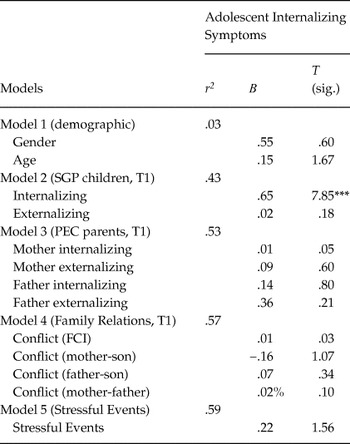
The hierarchical regression analyses are shown in Table 1. All the variables with a correlation coefficient greater than .20 were added to the association analyses.
Hierarchical Linear Regression with Enter Method for Adolescent Internalizing Symptoms at Time 2

***p < .005; Note: PEC (Emotional and Behavioral Problems), FCI (Family Climate Inventory)
As can be seen in Table 1 five regression models were calculated, the first one including gender and age of participants. The first model was not significant and explained .03 of the total variance.
The only independent variable that contributes significantly to internalizing symptoms at Time 2 is the intensity of the symptoms of internalizing adolescents at Time 1 (β = .65), included in the model 2. The third model, despite adding 10% of the explained variance to the model 2, shows no significant variable. In model 4, there was an increase of 4% in the variance, and family conflict was significant. In the final model, we included the number of stressful events as a predictor of internalizing problems. This variable added a 2% variance, but was not significant.
Discussion
The main objective of this research was to examine how the emotional and behavioral problems of parents and children and the characteristics of family relationships can be predictors of internalizing symptoms manifested by children after one year. Given this general objective, the results indicated that family relationships did not have a significant explanatory power in relation to symptoms of adolescent internalizing at time 2. This result differs from that found in other studies with children where family relations explained, in large part, the children’s symptoms (Fleitlich-Bilyk & Goodman, Reference Fleitlich-Bilyk and Goodman2001; Herrenkohl, Kosterman, Hawkins, & Mason, Reference Herrenkohl, Kosterman, Hawkins and Mason2009). On the other hand, approximates the findings of a study of 100 Spanish adolescents who identified a low predictive power of family relationships in relation to symptoms of internalizing adolescents (Oliva, Jiménez, & Parra, Reference Oliva, Jiménez and Parra2009).
Based on these previous studies, one might think that the developmental stages of life may be a relevant factor in demonstrating that the family can have a more direct influence in childhood than in adolescence. During adolescence, there is a departure from the family home and an approximation towards the peer group (Wagner, Falcke, Silveira, & Mosmann, Reference Wagner, Falcke, Silveira and Mosmann2002), there may be an increase in the influence of the peer group and social environment, which leads consequently to a decrease in the impact of the family.
The stability of internalizing symptoms and characteristics of the home environment, during the period of a year, can also be a demonstration that the relationship between these variables has already been established from childhood and remains stable throughout adolescence. In the same direction, the correlation between the symptoms of parents and children also indicates a process that seems to have been constituted within family relationships since its origin, by the way the children have been modeled by the parents.
The parental modeling (Bandura, 1969/1997) is one of the ways in which parents can contribute to the development of internalizing symptoms in children particularly when one parent has an anxiety disorder and verbalizes his or her fears, modeling anxious reactions in children. In addition, to modeling the internalizing behavior of the children, parents can reinforce this behavior, thus contributing to the maintenance of symptoms in children (Shortt, Barrett, Dadds, & Fox, Reference Shortt, Barrett, Dadds and Fox2001). From a systemic perspective, this fact could be understood as a possibility of transgenerational transmission, through which the children fall into a familiar story and receive existing mandates and legacy of former generations. According to Falcke (Reference Falcke2003), the transgenerational transmission is the process through which family identity is being perpetuated through their myths, beliefs and legacies.
The possibility of transgenerational association of internalizing symptoms was evaluated from the correlation between the parent’s emotional and behavioral problems and adolescent internalizing symptoms. Significant and positive correlations were verified between the maternal symptoms (both internalizing and externalizing) and the internalizing symptoms among the adolescents as well as with the paternal internalizing symptoms with the manifestation of the adolescent. These data bring to light the possibility of transgenerational transmission of emotional and behavioral problems, as it is perceived that when the parents’ symptoms increase their children’s symptoms also increase.
By correlating the perception of adolescents and their parents about family relationships at time 1 and adolescent internalizing symptoms after one year, we found positive correlations between the adolescent perception of conflict at time 1 and the manifestation of internalizing symptoms after one year. This data reveals that the greater the perception of family conflict at time 1 from the adolescents perspective, the higher the level of internalizing symptoms at time 2. This corroborates the findings of a longitudinal study conducted by Sheeber et al. (Reference Sheeber, Hops, Alpert, Davis and Andrews1997), whose data showed that family environments with more conflict were associated with greater depressive symptoms after a period of one year, suggesting that the quality of family interactions is important for understanding the evolution of depressive symptoms in adolescents. More than affection, in this study the dimension of conflict is correlated with internalizing symptoms of adolescents. According Silvares and Souza (Reference Silvares and Souza2008), the low quality family interactions may contribute to the development of emotional and behavioral problems and is considered a risk factor for the onset of these disorders.
Correlating the dimensions of conflict and affection from the perspective of an adolescent, the mother and father, at time 1, with adolescent internalizing symptoms at time 2, the results showed that only the adolescents’ perceptions about the relationships between Family members in T1 and the manifestation of internalizing symptoms at T2 showed significant correlations. These data confirm the findings of Teodoro et al. (Reference Teodoro, Cardoso and Freitas2010) which, when investigating the relationships of affection and family conflict with its relationship to symptoms of depression from the perspective of children and adolescents, found positive correlations between depression and the level of conflict and negative affection, strengthening the relation between the family system and depressive symptoms.
It is observed, by correlating the perception of adolescents on family relationships and internalizing symptoms themselves at time 2, that the main correlations existed between the dimensions of conflict and internalizing symptoms, especially in the conflicts observed by adolescents in the father-mother and father-son dyads. These data shows how the dimension of the parent’s conjugality reflected in symptoms of adolescents, while also revealing the importance of the relationship with the father. These results can be understood from what is described by El-Sheikh and Harger (Reference El-Sheikh and Harger2001) and by Mosmann and Wagner (Reference Mosmann and Wagner2008) who postulated that there is an interference of the marital conflict on the adolescents’ symptoms.
Overall, this study shows a stability of the internalizing symptoms in adolescence, measured one year later, and the minor influence of family relations in the perception of emotional and behavioral problems. It is noted, however, the necessity for a larger number of empirical studies involving the Brazilian context which involve the variables examined in this study.