Introduction
Worldwide, populations are aging. Older adults, particularly the oldest old (85 years and over) are the most rapidly growing segment of society (Louria, Reference Louria2005). Dementia and cognitive impairment are very closely linked to aging and the overall prevalence of dementia at death is now 30% (Brayne et al., Reference Brayne, Gao, Dewey and Matthews2006).
Despite these changes in demography and morbidity, research on laypersons’ knowledge and beliefs about dementia is limited (Werner, Reference Werner2005). Recent surveys provide evidence of increased public familiarization with dementia: 46% of Canadians (Alzheimer's Society of Canada, 2003) and 34% of those in the U.K. (Crisp et al., Reference Crisp, Gelder, Goddard and Meltzer2005) knew someone with Alzheimer's disease or dementia. Yet misinformation, fear and stigmatization are still common. In a survey of 1737 respondents, the majority believed that people with dementia “feel differently than we would feel” (61%), were unpredictable (53%) and hard to talk to (60%) (Crisp et al., Reference Crisp, Gelder, Rix, Meltzer and Rowlands2000). Qualitative studies show profound misconceptions about the causes of Alzheimer's dementia (Hinton and Levkoff, Reference Hinton and Levkoff1999) and the belief that severe memory problems are an inevitable part of normal aging seems to be commonly held (Werner, Reference Werner2004; Connell et al., Reference Connell, Scott and McLaughlin2007). The majority of those surveyed across six European countries believed no treatments for dementia were available (Bond et al., Reference Bond, Stave, Sganga, O'Connell and Stanley2005) and older adults themselves reported no sense of urgency about finding a cure for a disease that primarily affects older people (Corner and Bond, Reference Corner and Bond2004).
Attitudes to aging itself also tend to be negative. In 2005, one-third of 2000 adults aged over 16 years viewed those aged over 70 as incompetent and incapable, and thought that the demographic shift towards an older society would make life worse in terms of standards of living, security, health, jobs and education (Age Concern, 2006). Since dementia usually traverses two negatively-viewed constructs (mental health problems and aging), it has been described as a victim of “double jeopardy” (Werner, Reference Werner2005).
We aimed to investigate attitudes to aging and dementia using obituary notices in local and national newspapers. Newspaper obituaries fulfill a cohesive function for society, affirming values and legitimizing the cultural practices of the time (Phillips, Reference Phillips2007). Previous analyses have used obituaries to understand social processes, and have illuminated issues such as racism, sexism and homophobia (Spilka et al., Reference Spilka, Lacey and Gelb1980; Williams, Reference Williams1997). More recently, a longitudinal analysis of obituaries from the New York Times was utilized to explore changing conceptions of death over the last 100 years, a period in which the locus of social control shifted from nature and God to the individual (Phillips, Reference Phillips2007).
We hypothesized that obituaries would reflect societal attitudes to aging and dementia in Canada and in the U.K.
Methods
The Times and the Globe and Mail were studied as representative national newspapers from the U.K. and Canada respectively. Local newspapers were chosen from the capital cities of a principality (Cardiff, Wales: the Western Mail) and a province (Halifax, Nova Scotia: the Chronicle Herald). We assumed that acknowledgment of dementia would occur in 10% of obituaries in Canada and 2.5% in the U.K. and set α at 0.05 and β at 0.9, giving a required sample size for statistical significance of 243 obituaries from each country. A preliminary survey during June 2008 established that at least 12 obituaries were published in each paper per day. Data were therefore collected over a 12-day period toward the end of 2008. Obituaries written by journalists, announcements regarding memorial services and extended obituaries (e.g. “Lives remembered” in the Globe and Mail) were excluded. Repeated obituaries were counted once.
When chronological age was not included, those stated to be grandparents were assumed to be between 70 and 79 years old and “great-grandparents” to be over 80 years. Obituaries published in the Welsh language were translated by one of the authors (REH).
Critical discourse analysis focused on macrolevel features of the written texts (Hodges et al., Reference Hodges, Kuper and Reeves2008). Repeated analysis of the obituaries by two authors working concurrently (REH and EMPE) reinforced knowledge of their contents (Pope et al., Reference Pope, Ziebland, Mays, Pope and Mays2000). Data were collected on an evolving proforma: identification of any new theme was followed by further searches through all obituaries to expand upon it. This iterative coding process was based on grounded theory (Kennedy and Lingard, Reference Kennedy and Lingard2006). Quantitative estimates were made using SPSS software.
Ethics Committee approval was not sought. All data were available in the public realm and no patient identifiers were included.
Results
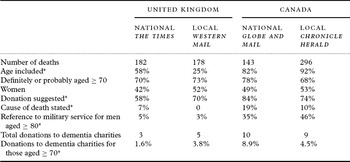
In all, 799 obituaries were included in this analysis: 360 from the U.K. and 439 from Canada. Half were men. In the Western Mail, 15 obituaries (8%) were published in the Welsh language only and 13 (7%) in both English and Welsh. The deceased ranged in age from infants to centenarians (oldest 106 years). Some 572 obituaries (72%) were for subjects stated to be aged 70 or over or referred to as grandparents or great-grandparents. No age identifying information was recorded for 27 obituaries. Demographic data by country and by newspaper are shown in Table 1.
Demographic characteristics and donations

*p < 0.05 for difference between U.K. and Canada.
Chronological age, suggested donations in memory of the deceased and a stated cause of death were each included in significantly more obituaries in Canada than in the U.K. In the sample as a whole, cancer was most frequently specified as a cause of death (U.K. = 8; Canada = 43), followed by accidental death (U.K. = 3, Canada = 4) and heart disease and stroke (U.K. = 1, Canada = 4). Dementia was stated as a cause of death in three obituaries, all published in the Canadian national newspaper. Other causes of death were liver disease (U.K. = 1; Canada = 1), multiple sclerosis (Canada = 1) and a fall with increasing frailty (Canada = 1). Military service was explicit for significantly more men aged ≥ 80 years in Canada compared to the U.K. (41% versus 4%; p < 0.05).
Suggestions for donations in memory of the deceased were made in 569 obituaries (71%), most frequently to medical charities (260, 46% of donations). Local hospitals or hospices were proposed in 107 obituaries (19%), church 49 (9%), children's or animal charities 46 (8%), “charity of your choice” 37 (7%), military charities 18 (3%), local heritage or community projects 12 (2%), humanitarian causes 10 (2%), the Royal National Lifeboat Institute 10 (2%: all in U.K.), residential or nursing homes 7 (1%), personal trust funds 5 (1%), schools or universities 4 (0.5%), the fire department 3 (0.5%: all in Canada) and 1 donation to a ballet company (0.1%).
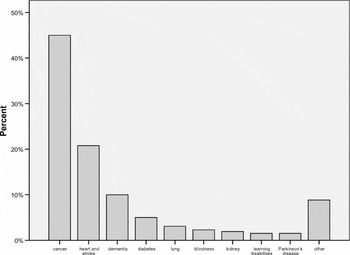
Of the donations to medical charities, nearly half (n = 117) were to cancer charities and one-fifth (54) to heart and stroke foundations (Figure 1). Dementia charities (26) attracted more donations than diabetes (13), lung disease including cystic fibrosis (8), charities for the blind (6), kidney disease (5), learning disabilities (4) and Parkinson's disease (4). Less frequently suggested medical charities included arthritis (3), multiple sclerosis (3), Huntington's disease (3), international medical aid (2), amyotrophic lateral sclerosis (2), colitis (2), a hospital-based nursing home/aging research institute (2) and hyperbaric medicine (1). Charities conducting research or offering support to those with liver disease, muscular dystrophy, scleroderma, AIDS or schizophrenia were each mentioned once.
Total donations to medical charities.

In the U.K., there were 258 obituaries for subjects aged 70 or over, with 170 suggesting donations in memory of the deceased. These obituaries were more likely to recommend donations to children's charities (n = 12) or the Royal National Lifeboat Institution (8) than dementia charities (7), and donations to animal charities (4) were more frequent than those to help research into arthritis (2) or Parkinson's disease (1).
Discussion
In this study, significant differences were found between obituaries in the U.K. and Canada. Inclusion of chronological age, a stated cause of death and donations to dementia charities were more frequent in Canada. We suggest that this reflects less reticence about aging and a greater acceptance of age-related disease.
We also found that military service was referenced in significantly more obituaries for men aged ≥ 80 years in Canada, though similar proportions of the Canadian and U.K. populations were in the armed forces during World War Two (Harrison, Reference Harrison1998; Hicks and Allen, Reference Hicks and Allen1999). The association of old age with vulnerability and dependency underpins many negative stereotypical views (Brocklehurst and Laurenson, Reference Brocklehurst and Laurenson2008). Highlighting an attribute that makes older people unique (here, military service at a time of international threat) challenges aging stereotypes (Whitbourne and Sneed, Reference Whitbourne, Sneed and Nelson2002) and is perhaps an additional marker of the value placed on the contributions of older people to society.
Canada and the U.K. have similar demographic profiles: those over 65 years comprise 14% and 13% of the respective populations (Statistics Canada, 2006; Office for National Statistics, 2003). Attitudes to geriatric medicine in the national medical press, however, seem to differ. While U.K. journals debate whether geriatric medicine should continue to exist (Denaro and Mudge, Reference Denaro and Mudge2008), their Canadian counterparts discuss the challenges of meeting the complex needs of frail older patients (Rockwood, Reference Rockwood2005). Aging research in the U.K. is “largely fragmented, underrepresented, poorly coordinated and lacks adequate funding” (Franco et al., Reference Franco2007) prompting an inquiry by a House of Lords Select Committee. In contrast, the Canadian Institutes of Health Research established an Institute of Aging in 2000, with a mandate to fund research on “the aging person in an aging society, and the effects of different diseases and conditions on aging,” with an aim of building research capacity and facilitating partnerships among public and private sector organizations to minimize overlap and encourage collaboration (Canadian Institutes of Health Research, 2000).
Donations to medical charities do not reflect their prevalence or impact on the individual. The lifetime prevalence of mental health problems, for example, is 20% (Patten et al., Reference Patten2006; King et al., Reference King2008) but research and support to help those affected attracted just one donation. Cancer charities were the major recipient. Fifty years ago, the diagnosis of cancer was associated with considerable stigma. Cancer is now seen from an objectivist perspective as a “disease to be beaten.” Clear descriptions of clinical features, insights into pathogenesis and development of modifying interventions have been essential components in this transformation. Comparable investigative steps are underway for dementia. Fifty years ago, “senile dementia” was viewed as an inevitable consequence of aging but “Alzheimerization” may change public perceptions.
Our data should be interpreted with caution. Previous analyses of obituaries (Phillips, Reference Phillips2007) and the newspaper coverage of disease (Adelman and Verbrugge, Reference Adelman and Verbrugge2000) have made inferences from changes over time whereas our conclusions are drawn from a comparative design. Furthermore, we acknowledge that obituaries are “forged in the fires of cultural convention” (Nord, Reference Nord1990); as cultural products, they are affected by multiple social structures and considerations (Peterson, Reference Peterson and Crane1994). However, the obituaries from these two developed countries were contemporaneous and, though obituaries in Canada tend to be longer and written in narrative style, similar cultural constraints are likely to apply. Information was collected over a short period from only four newspapers, which may limit the generalizability of results. Nevertheless, the emergence of trends in national and local newspapers affords some construct validation of our results.
Though donations to dementia charities were significantly lower than those to cancer or heart and stroke disease charities, they were significantly more common than donations for other age-related diseases or to help biological aging research. Modern concepts of frailty provide a scientific framework for geriatric medicine (Bergman et al., Reference Bergman2007; Rockwood and Mitnitski, Reference Rockwood and Mitnitski2007), helping us understand and explain why our interventions work, and for whom. The “frailterization” of decrepitude and decline therefore has the potential to improve the health care of older people. Tantalizing questions remain as to whether this will also translate into changes in societal attitudes to aging and increased funding into age-related research.
Conclusion
In this study of obituaries in local and national newspapers, donations to dementia charities were significantly more common in Canada than in the U.K. In both countries, donations to medical charities did not reflect disease prevalence or impact to the individual. Societal attitudes in the U.K. may be impacted by the fragmentation of aging research and antipathy to geriatric medicine in the national medical press.
Conflict of interest
None.
Description of authors’ roles
Ruth Hubbard designed the study. Ruth Hubbard and Eamonn Eeles collected and analyzed the data. All authors co-wrote the paper and approved the final version.
Acknowledgments
Professor Rockwood is supported by the Kathryn Allen Weldon Chair in Alzheimer Research at Dalhousie University. Dr. Hubbard is supported by an award from the Fountain Innovation Fund of the Queen Elizabeth II Health Sciences Foundation.