Introduction
The distributions of animal and plant species are extremely variable in time and space (e.g., Hewitt, Reference Hewitt1996, Reference Hewitt2000; Taberlet et al., Reference Taberlet, Fumagalli, Wust-Saucy and Cosson1998). Studies of geographic differentiation have revealed genetic patterns resulting from historical and contemporary demographic and evolutionary processes (Avise, Reference Avise1994, Reference Avise2000). The present-day distribution of genotypes is partly the result of climate-influenced changes in species distributions (Nichols & Hewitt, Reference Nichols and Hewitt1994; Schmitt & Müller, Reference Schmitt and Müller2007; Saitoh et al., Reference Saitoh, Miyai and Katakura2008; Dvořáková et al., Reference Dvořáková, Fér and Marhold2010; Šmídová et al., Reference Šmídová, Münzbergová and Plačková2011; Hucka et al., Reference Hucka, Büdelb and Schmitta2012). Information on genotype distribution will be much more effective for the conservation of endangered species than that on only physical distribution, especially in terms of identifying units for conservation and designing management plans (Moritz, Reference Moritz1994; Meffe & Carroll, Reference Meffe and Carroll1997; Primack, Reference Primack2004).
The lycaenid butterfly Zizina emelina (de l'Orza) (previously Zizina otis emelina) (Lepidoptera, Lycaenidae) is distributed in Honshu, Shikoku, and Kyushu in mainland Japan and inhabits sunny grasslands of early successional stages, such as those of seashores, riverbanks, and farmland levees (Fukuda et al., Reference Fukuda, Hama, Kuzuya, Takahashi, Takahashi, Tanaka, Tanaka, Wakabayashi and Watanabe1984; Yago et al., Reference Yago, Hirai, Kondo, Tanikawa, Ishii, Wang, Williams and Ueshima2008). This species uses the bird's-foot trefoil, Lotus japonicus (Fabaceae), as a larval food plant (Fukuda et al., Reference Fukuda, Hama, Kuzuya, Takahashi, Takahashi, Tanaka, Tanaka, Wakabayashi and Watanabe1984). The abundance of this plant, and thus the habitat of Z. emelina, is decreasing because of lack of mowing due to cessation of traditional rural land uses and because of the covering of river embankments with concrete (Nakamura, Reference Nakamura, Sunose and Eda2003; Sunose & Eda, Reference Sunose, Eda, Sunose and Eda2003; Ishii, Reference Ishii, Mano and Fujii2009; Mano & Fujii, Reference Mano, Fujii, Mano and Fujii2009). Zizina emelina is listed on the Red Data List of Japan (Ministry of Environment, Japan, 2006, 2012) as Threatened IB. Recently, more than 40 small habitats of this species were found in and around Osaka International Airport in northern Osaka Prefecture, central Japan (Minohara et al., Reference Minohara, Morichi, Hirai and Ishii2007; Ishii et al., Reference Ishii, Hirai and Hirowatari2008). At these sites there were few primary host plants (L. japonicus), and Z. emelina was using white clover, Trifolium repens (Fabaceae), or Japanese clover, Kummerowia striata (Fabaceae) (Minohara et al., Reference Minohara, Morichi, Hirai and Ishii2007). Although Yago et al. (Reference Yago, Hirai, Kondo, Tanikawa, Ishii, Wang, Williams and Ueshima2008) have investigated the molecular systematics and biogeography of the genus Zizina globally, to our knowledge the genetic structure of populations of Z. emelina has not been examined.
Recently, Sakamoto et al. (Reference Sakamoto, Hirai, Hirowatari, Yago and Ishii2010, Reference Sakamoto, Hirai, Tanikawa, Yago and Ishii2011) found that the Toyonaka population near Osaka International Airport was infected with two strains of Wolbachia, wEmeTn1 and wEmeTn2. Wolbachia is a maternally inherited bacterium that is widely distributed among various groups of arthropods (Werren et al., Reference Werren, Zhang and Guo1995; Werren, Reference Werren1997). It causes a variety of reproductive alterations, including cytoplasmic incompatibility (Hoffmann et al., Reference Hoffmann, Turelli and Harshman1990; Turelli & Hoffmann, Reference Turelli and Hoffmann1995; Poinsot et al., Reference Poinsot, Charlat and Mercot2003), parthenogenesis induction (Stouthamer et al., Reference Stouthamer, Luck and Hamilton1990; Weeks & Breeuwer, Reference Weeks and Breeuwer2001), feminization of genetic males (Rigaud et al., Reference Rigaud, Soutygrosset, Raimond, Mocquard and Juchault1991; Hiroki et al., Reference Hiroki, Kato, Kamito and Miura2002; Negri et al., Reference Negri, Pellecchia, Mazzoglio, Patetta and Alma2006), and male killing (Hurst et al., Reference Hurst, Jiggins, von der Schulenburg, Bertrand, West, Goriacheva, Zakharov, Werren, Stouthamer and Majerus1999; Fialho & Stevens, Reference Fialho and Stevens2000). Maternal transmission means that these bacteria are genetically linked to the mitochondrial genome; Wolbachia affects the mitochondrial genetic structures of lepidopteran host species (Jiggins, Reference Jiggins2003; Narita et al., Reference Narita, Nomura, Kato and Fukatsu2006). In Z. emelina, one of the Wolbachia strains, wEmeTn2, induces male killing, and infection with both the wEmeTn1 and the wEmeTn2 strains of Wolbachia may have some effect on genetic structure (Sakamoto et al., Reference Sakamoto, Hirai, Tanikawa, Yago and Ishii2011).
We collected male and female adults from Z. emelina populations, in which the main larval food plants differed. To accurately delineate units of conservation for Z. emelina and augment our geological and biogeographic knowledge of the historical differentiation of its populations, we examined the effects of Wolbachia infection on host genetic structure and evaluated the mitochondrial and nuclear DNA of the host populations.
Sampling sites
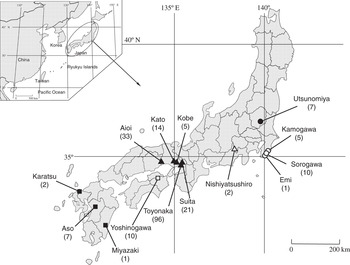
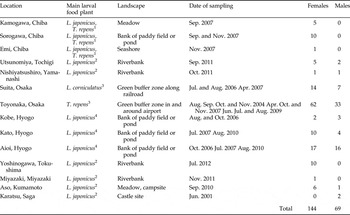
From 2001 to 2012, adults of Z. emelina were collected from 14 populations over a large area of Japan (fig. 1, table 1). Populations were considered to come from the same region when they were less than 150 km apart and were not separated by sea. There were six main regions (fig. 1). The land use at 14 sites is shown in table 1. Although Z. emelina usually uses L. japonicus, some populations do not. The Kamogawa, Sorogawa, and Emi populations use mainly Trifolium repens and L. japonicus (Suzuki, Reference Suzuki2007). Zizina emelina in the Suita population uses mainly Lotus corniculatus, and those in the Toyonaka population use mainly T. repens (Minohara et al., Reference Minohara, Morichi, Hirai and Ishii2007; Ishii et al., Reference Ishii, Hirai and Hirowatari2008). The others use L. japonicus (Takei, Reference Takei2005; this study); in these remaining populations there have been no reports of the use of T. repens, even though T. repens is commonly seen in their habitats.
Sites in Japan where Z. emelina was collected. Numbers of individuals collected are given in parentheses. Six regions, defined to separate the distributions by distance, are indicated by open circles (region 1), a closed circle (region 2), an open triangle (region 3), closed triangles (region 4), an open rectangle (region 5), and closed rectangles (region 6).

Individuals of Z. emelina collected at 14 geographic locations in Japan.

1 Suzuki (Reference Suzuki2007).
2 This study.
3 Minohara et al. (Reference Minohara, Morichi, Hirai and Ishii2007).
4 Takei (Reference Takei2005).
L.: Lotus, T.: Trifolium.
Materials and methods
DNA extraction
Total DNA was extracted from the legs and thoracic muscles of field-collected adults. The tissues from one adult were placed in a 1.5-ml plastic tube with 180 μl lysis buffer and proteinase K, incubated at 56°C for 2 h or longer, and subjected to DNA purification with a DNeasy Tissue kit (Qiagen, Valencia, CA, USA). Total DNA was eluted with 50 μl of elution buffer.
PCR and sequencing
Detection and identification of Wolbachia were performed with the primers 81F (5′-TGGTCCAATAAGTGATGAAGAAAC-3′) and 691R (5′-AAAAATTAAACGCTACTCCA-3′) for wsp (Braig et al., Reference Braig, Zhou, Dobson and O'Neill1998) and the primers ftsZBf (5′-CCGATGCTCAAGCGTTAGAG-3′) and ftsZBr (5′-CCACTTAACTCTTTCGTTTG-3′) (Werren et al., Reference Werren, Zhang and Guo1995) or FtsZFT2 (5′-GAAGGTGTGCGACGTATGCG-3′) and FtsZRTB2 (5′-ACTCTTTCGTTTGTTTGCTCAGTTG-3′ (Wenseleers et al., Reference Wenseleers, Ito, Van Borm, Huybrechts, Volckaert and Billen1998) for ftsZ. The cycles for wsp were as follows: an initial 30-s exposure at 94°C, followed by 40 cycles each at 94°C for 30s, 55°C for 30s, and 75°C for 120s, with a final extension at 72°C for 120s. The cycles for ftsZ were as follows: an initial 300-s exposure at 94°C, followed by 45 cycles each at 94°C for 30s, 60°C for 60s, and 72°C for 120s, with a final extension at 72°C for 120s. The positive PCR products were purified and sequenced with an ABI Prism 3100 Genetic Analyzer (Applied Biosystems, USA).
The mitochondrial ND5 gene, which encodes NADH dehydrogenase subunit 5, was amplified using the primers V1 (5′-CCTGTTTCTGCTTTAGTTCA-3′) (Yagi et al., Reference Yagi, Sasaki and Takebe1999) and KA1L (5′-GTTCTAATATAAGGTATAAATCATAT-3′) (Saigusa et al., Reference Saigusa, Nakanishi, Yata, Odagiri, Yago, Masunaga, Tanikawa, Nishiyama, Hasebe and Mohri2001; Yago et al., Reference Yago, Hirai, Kondo, Tanikawa, Ishii, Wang, Williams and Ueshima2008; Ohshima et al., Reference Ohshima, Tanikawa-Dodo, Saigusa, Nishiyama, Kitani, Hasebe and Mohri2010). The PCR temperature profile for ND5 was an initial 60-s exposure at 94°C, followed by 30 cycles each at 94°C for 60s, 45°C for 60s, and 72°C for 120s. The mitochondrial COI gene, which encodes cytochrome oxidase subunit I, was amplified using the primers LCO1490 (5′-GGTCAACAAATCATAAAGATATTGG-3′) and HCO2198 (5′-TAAACTTCAGGGTGACCAAAAAATCA-3′) (Folmer et al., Reference Folmer, Black, Hoeh, Lutz and Vrijenhoek1994). The PCR temperature profile for COI was an initial 120-s exposure at 94°C, followed by 40 cycles each at 94°C for 15 s, 52°C for 30s, and 72°C for 60s, with a final extension at 72°C for 300s. The PCR products were purified and then sequenced with an ABI PRISM 3100 Genetic Analyzer.
In lepidopteran species the nuclear Tpi gene, which encodes triose phosphate isomerase, is located on the Z chromosome (Logsden et al., Reference Logsden, Tyshenko, Dixon, Jafari, Walker and Palmer1995). A segment of the gene containing a highly variable intron was amplified using the primers (5′-GGTCACTCTGAAAGGAGAACCATCTT-3′) and (5′-CACAACATTTGCCCAGTTGTTGCCAA-3′) (Jiggins et al., Reference Jiggins, Linares, Naisbit, Salazar, Yang and Mallet2001) and sequenced. Primers TpiZif (5′-AGAAAGACGAATTGGTTGCTGA-3′) and TpiZir (5′-TGGTAATAGGGCTTTAGTCTG-3′) for precise amplification in Z. emelina were designed from the Tpi nucleotide sequences obtained using the method described above. The cycles were as follows: an initial 60-s exposure at 95°C, followed by 35 cycles each at 95°C for 60s, 54°C for 60s, and 72°C for 30s, with a final extension at 72°C for 300s. All samples were screened using the new primers and sequenced. The nucleotide sequences of ND5, COI, and Tpi from Z. emelina were deposited in the DDBJ/EMBL/GenBank databases.
Phylogenetic and statistical analyses
Phylogenetic trees were constructed using the maximum-likelihood method and the programme package PAUP* 4.0b10 (Swofford, Reference Swofford2002). For maximum-likelihood analyses, we applied best-fit models (ND5+COI: TrN+I;Tpi: HKY) selected using the Akaike information criterion (Akaike, Reference Akaike1974) in Modeltest 3.7 (Posada & Crandall, Reference Posada and Crandall1998). The robustness of the branches was tested by bootstrap analyses with 1000 replications as part of the maximum-likelihood method. To visualize genealogical relationships and potential population substructures, networks were constructed on the basis of the sequence data using the statistical parsimony algorithm (Templeton et al., Reference Templeton, Crandall and Sing1992) implemented in the software package TCS version 1.21 (Clement et al., Reference Clement, Posada and Crandall2000). The TCS program calculates the minimum number of mutational steps by which sequences can be joined with >95% confidence.
To estimate the variation attributable to differences among populations, analysis of molecular variance (AMOVA; Excoffier et al., Reference Excoffier, Smouse and Quattro1992) was performed with Arlequin 3.5 (Excoffier & Lischer, Reference Excoffier and Lischer2010). Potential isolation among populations and regions was tested by estimating the pairwise fixation index F ST by haplotype permutations among populations and regions (10,000 replicates), as implemented in Arlequin 3.5. F ST was calculated only for populations and regions in which the sample size was at least 10 individuals. To test for isolation by distance, the correlation between genetic and geographical distances was assessed by the regression of F ST on the geographic distance (km).
In an attempt to statistically detect reduced mitochondrial genetic diversity compared with nuclear genetic diversity in populations of Z. emelina, the Hudson–Kreitman–Aguadé (HKA) test (Hudson et al., Reference Hudson, Kreitman and Aguade1987) was performed with the software packages DnaSP version 5.10 (Rozas et al., Reference Rozas, Sanchez-DelBarrio, Messeguer and Rozas2003) and HKA (written by JodyHey; http://genfaculty.rutgers.edu/hey/software#HKA) on the basis of the sequence data of mitochondrial (ND5 and COI) and nuclear (Tpi) genes. The mitochondrial ND5 and COI data were combined because of their genetic linkage. In the analysis, the effective population sizes of the mitochondrial gene (ND5+COI) and the Z chromosomal gene (Tpi) were corrected using a ratio of 1:3. To calculate interspecific divergence values, Z. otis was used as an outgroup. Because six haplotypes, including two haplotypes with deletions (or insertions), were found in Tpi, gaps in the sequence alignment were removed and the remaining sequences were used for the molecular analyses.
Rearing experiment
Eggs were obtained from field-collected females of Z. emelina in six populations. Hatching larvae were enumerated to determine hatchability and then reared to the adult stage to examine sex ratio. The rearing experiment was performed as described previously (Sakamoto et al., Reference Sakamoto, Hirai, Tanikawa, Yago and Ishii2011).
Results
Rates of infection by three strains of Wolbachia
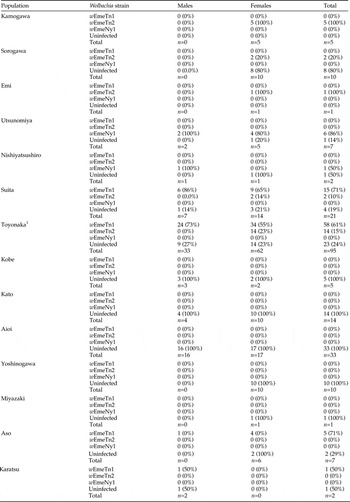
Examination of 99 adults by PCR assay using the wsp and ftsZ primers revealed that nine populations – Kamogawa, Sorogawa, Emi, Utsnomiya, Nishiyatsushiro, Suita, Toyonaka, Aso, and Karatsu – were infected with Wolbachia (table 2). The infection rates of the populations varied from 20 to 100%. The Kobe, Kato, Aioi, Yoshinogawa, and Miyazaki populations were uninfected. Although because of recombination the wsp sequences did not necessarily accurately reflect the genetic relationships, phylogenetic analysis of the wsp and ftsZ sequences revealed that there were three strains of Wolbachia. Two of the three strains had sequences identical to those of wEmeTn1 and wEmeTn2 found previously in Z. emelina (Sakamoto et al., Reference Sakamoto, Hirai, Tanikawa, Yago and Ishii2011). The other was a new strain of Wolbachia, wEmeNy1. It had both wsp and ftsZ gene sequences identical to those found in Acraea encedon (AJ271199), Hypolimnas bolina (AB167399), Phyllonorycter quinnata (AJ005887), Parornix devoniella (AJ005888) and Cnaphalocrocis medinalis (HQ336508).
Rates of Wolbachia infection in populations of Z. emelina.

1 Includes the data from Sakamoto et al. (Reference Sakamoto, Hirai, Tanikawa, Yago and Ishii2011).
In the Suita population (n=21), 71% of individuals were infected with strain wEmeTn1 and 10% were infected with wEmeTn2; no individuals were infected with the two strains simultaneously. In the other populations, all infected individuals were infected with either of the two strain of Wolbachia; rates of infection with each strain differed among populations (table 2).
Offspring sex ratio
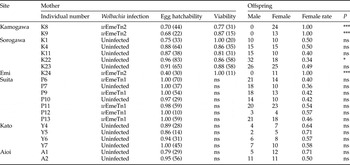
Broods including more than five offspring that reached adulthood were used for analyses of sex ratio and hatchability. All three wEmeTn2-infected females (K8, K9, and K24) produced only female offspring (P<0.001 by binomial test), whereas no uninfected or wEmeTn1-infected females produced female-biased broods (P>0.05 by binomial test; table 3).
Wolbachia infection of female adults of Z. emelina collected from Kamogawa, Sorogawa, Emi, Suita, Kato, and Aioi in 2007, and egg hatchability and sex ratio of their offspring. Number of individuals are in parentheses.

*P<0.05; *** P<0.001; ns P>0.05.
Mitochondrial and nuclear DNA
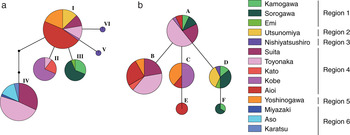
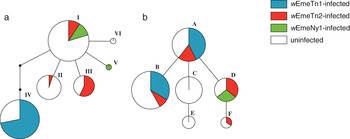
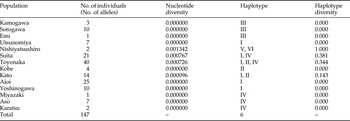
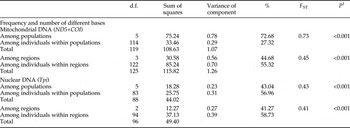
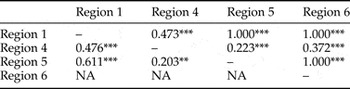
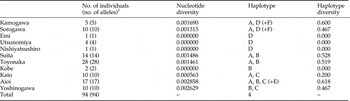
In the mitochondrial DNA analysis, the 147 individuals sequenced for the 832-bp ND5 gene were polymorphic at four nucleotide sites, constituting four haplotypes (GenBank: AB714583–AB714594). The individuals sequenced for the 658-bp COI gene were polymorphic at three positions, constituting four haplotypes (GenBank: AB714595–AB714606). The combined ND5 and COI sequences constituted six haplotypes (arbitrarily named I–VI; fig. 2). Haplotype networks were produced according to population (fig. 3a). The Toyonaka population had the most haplotypes (I, II, and IV), and all of the other eight populations from Suita westward (Suita, Kobe, Kato, Aioi, Yoshinogawa, Miyazaki, Aso, and Karatsu) had one or two haplotypes in common with those of the Toyonaka population. Haplotype III was found only in the three eastern most populations (Kamogawa, Sorogawa, and Emi), and haplotypes V and VI were found only in Nishiyatsushiro, which was relatively isolated from the other populations. Nucleotide diversities were less than 0.002 (table 4). AMOVA revealed a significant genetic structure among the populations and regions tested (i.e., those in which the sample size was at least 10 individuals; P<0.001; table 5). Genetic differentiation, as determined by F ST, was also significant among all pairs of populations (P<0.05) except for two, namely Suita–Toyonaka and Aioi–Yoshinogawa (table 6). Genetic differentiation among all pairs of regions was also significant (P<0.001; table 7). Comparison of the haplotype results with those for infection status (fig. 4a) revealed that individuals infected with wEmeTn1 had haplotype IV, wEmeTn2-infected individuals had haplotype I, II, or III, and wEmeNy1-infected individuals had haplotype I or V.
Maximum-likelihood phylogeny based on the mitochondrial ND5+COI gene sequences (1490 aligned nucleotide sites) of Z. emelina. Bootstrap values of <50% are not shown. Roman numerals (I–VI) indicate the different haplotypes. Zizina otis was used as an outgroup. Wolbachia strains are indicated after the population names. Tn1, wEmeTn1; Tn2, wEmeTn2; Ny1, wEmeNy1.

Haplotype networks for populations, based on the (a) mitochondrial and (b) nuclear gene sequences of Z. emelina. A network with 95% connection limit is shown; the size of each circle reflects the number of individuals with each of the haplotypes. Each haplotype is coloured according to the proportion of individuals in each population (shown in the colour key at right).

Haplotype networks and Wolbachia infection, based on the (a) mitochondrial and (b) nuclear gene sequences of Z. emelina. A network with 95% connection limit is shown; the size of each circle reflects the number of individuals with each of the haplotypes. Each haplotype is coloured according to the proportion of individuals classified by Wolbachia infection status (shown in the colour key at right).

Genetic diversity of mitochondrial haplotypes within populations of Z. emelina.

Analysis of molecular variance of mitochondrial and nuclear haplotypes in Z. emelina.

1 After 10,000 random permutations.
Population pairwise F ST values based on the frequency and number of different bases in Z. emelina.

*P<0.05, **P<0.01, ***P< 0.001, after 100,000 random permutations.
Upper right: mitochondrial DNA.
Lower left: nuclear DNA.
gional pairwise F ST values based on the frequency and number of different bases in Z. emelina.

*P< 0.05, **P<0.01, ***P<0.001, after 100,000 random permutations.
Upper right: mitochondrial DNA.
Lower left: nuclear DNA.
NA: not applicable.
In the nuclear DNA analysis a total of 103 female adult samples were subjected to sequencing of Tpi; 355–360 bp were obtained and aligned, representing six haplotypes (arbitrarily named A–F; GenBank: AB714607–AB714624; table 8).The 355-bp alignment, from which aligned nucleotide sites containing gaps had been excluded, was polymorphic at three sites, representing four haplotypes (arbitrarily named A to D; fig. 5). The six haplotypes in the haplotype network were analysed (fig. 3b); two gaps (of four nucleotides and one nucleotide) were considered to represent a fifth character state. The Aioi population had the most haplotypes (A, B, C, and E), and haplotype E was found only in the Aioi population. Haplotype A was found throughout the study area, although not in all populations. Haplotypes B and C occurred in some of the populations from Suita westward, and haplotypes D and F occurred in some of the populations from Nishiyatsushiro eastward. AMOVA revealed a significant nuclear genetic structure among the six populations and three regions tested (P <0.001; table 5). Genetic differentiation (F ST) was also significant among all pairs of populations (P<0.05), with the exception of four, namely Suita–Toyonaka, Suita–Aioi, Kato-Yoshinogawa, and Aioi–Yoshinogawa (table 6). Genetic differentiation was also significant among all pairs of regions tested (P<0.01; table 7). Nuclear haplotypes tended to be shared between regions, whereas mitochondrial haplotypes were not (fig. 3). Nuclear DNA haplotype was not associated with Wolbachia infection (fig. 4b).
Maximum-likelihood phylogeny based on the nuclear Tpi gene sequences (355 aligned nucleotide sites) of Z. emelina. Bootstrap values of <50% are not shown. Letters (A–F) indicate the different haplotypes (see text). Zizina otis was used as an outgroup. Wolbachia strains are indicated after the population names. Tn1, wEmeTn1; Tn2, wEmeTn2; Ny1, wEmeNy1.

Genetic diversity of nuclear haplotypes within populations of Z. emelina.

1 Number of individuals with each haplotype.
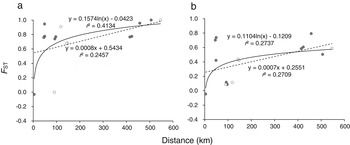
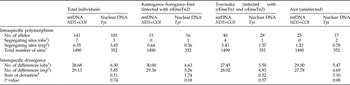
The relationship that we obtained between F ST value and geographic distance as a result of the mitochondrial and nuclear DNA analyses showed that the degree of genetic differentiation was positively correlated with geographic distance: the farther apart the sets of populations were, the lower their decrease in gene flow (fig. 6). Each coefficient of determination in the logarithmic regression was higher than that in the linear regression in the case of both mitochondrial and nuclear DNA. No significant difference was found between mitochondrial genetic diversity and nuclear genetic diversity in Wolbachia-infected or -uninfected populations by HKA test (P>0.05; table 9).
Relationships between genetic differentiation (F ST) and geographic distance among populations of Z. emelina in Honshu and Shikoku, Japan. Geographic distance was measured as the straight-line distance between sites. Each point represents a pair of populations. Solid line, logarithmic regression between F ST and distance; dashed line, linear regression between F ST and distance. Closed circles, separated by sea; open circles, not separated by sea (a) mitochondrial genetic differentiation; (b) nuclear genetic differentiation

Results of HKA testing for mitochondrial and Z-chromosome polymorphism within Z. emelina, and divergence between Z. emelina and Zizina otis.

1 Observed value.
2 Expected value.
3 Nucleotide sites containing alignment gaps were excluded.
4 The effective mitochondrial gene (ND5+COI) and Z-chromosomal gene (Tpi) population sizes were corrected.
DISCUSSION
Wolbachia and sex ratio distortion
An understanding of reproductive manipulation by Wolbachia is important to any discussion of the genetic diversity of Z. emelina. Sakamoto et al. (Reference Sakamoto, Hirai, Tanikawa, Yago and Ishii2011) revealed that the presence of wEmeTn2 is associated with the death of male Z. emelina in the Toyonaka population. We also found wEmeTn2-infected females in three populations, Kamogawa, Sorogawa, and Emi, and they produced only female offspring. This strain was therefore also likely responsible for killing males in these populations. Sakamoto et al. (Reference Sakamoto, Hirai, Tanikawa, Yago and Ishii2011) found that a high rate of infection with wEmeTn1 did not induce sex ratio distortion in the Toyonaka population. We found individuals infected with wEmeTn1 in the Suita population; similarly, there was no sex ratio distortion. Individuals in the Utsunomiya and Nishiyatsushiro populations were infected with a new strain of Wolbachia, wEmeNy1. Although this Wolbachia is identical, in terms of both wsp and ftsZ, to those known to cause male killing in A. encedon and H. bolina, we found wEmeNy1-infected males of Z. emelina in the field. Therefore, wEmeNy1 is not likely to kill or feminize its male hosts.
Genetic diversity of Z. emelina in Japan and effects of Wolbachia on diversity
We expected the extent of among population differentiation to be associated with species movement, dispersal ability, and degree of isolation, depending on the amount of gene flow; previous observations support these predictions (Hastings & Harrison, Reference Hastings and Harrison1994; Hamrick & Godt, Reference Hamrick, Godt, Avice and Hamrick1996). Mitochondrial and nuclear markers revealed different patterns of genetic structure in Z. emelina. In our data, mitochondrial haplotypes – unlike nuclear haplotypes – tended not to be shared among regions. This finding can be explained first in terms of population size. Because of genetic drift, small and bottlenecked populations have low levels of genetic diversity (Bonnell & Selander, Reference Bonnell and Selander1974; O'Brien et al., Reference O'Brien, Wildt, Goldman, Merril and Bush1983; Ellegren et al., Reference Ellegren, Mikko, Wallin and Andersson1996; Groombridge et al., Reference Groombridge, Jones, Bruford and Nichols2000). Because the mitochondrial genome has a smaller effective population size than that of an average nuclear locus, the rate of genetic drift is increased in mtDNA (Fay & Wu, Reference Fay and Wu1999). Therefore, especially in the mtDNA of Z. emelina, single haplotypes were observed in populations and regions.
Second, the relative lack of sharing of mitochondrial haplotypes among regions can be explained in terms of the lower dispersal probabilities of females: males of Z. emelina, unlike females, patrol to find a mating partner (Sakamoto et al., unpublished observations). Moreover, a highly biased sex ratio may lead to higher dispersal rates and trigger the evolution of sex-specific dispersal (Leturque & Rousset, Reference Leturque and Rousset2003; Bonte et al., Reference Bonte, Hovestadt and Poethke2009): the female-biased sex ratio induced by male killers can thus induce higher rates of male dispersal in Z. emelina.
Third, selective sweep by Wolbachia could reduce mtDNA diversity. Theoretical studies have shown that the presence of male killers should markedly reduce mitochondrial diversity, because the original mitochondrial DNA lineages in the uninfected hosts will ultimately be lost and replaced by haplotypes associated with the symbiont (Johnstone & Hurst, Reference Johnstone and Hurst1996). There has been a recent selective sweep of the mitochondrial DNA within populations of A. encedon, in which the benefit of infection of females with male killers was increased by fitness compensation via resource reallocation in the larval period (Jiggins, Reference Jiggins2003). Our examination of the distribution of the Wolbachia genotypes identified among the mitochondrial haplotypes (fig. 4a) revealed linkages between some haplotypes and Wolbachia strains. Haplotype I was associated with wEmeTn2 and wEmeNy1, and each strain was found in different populations. Additionally, wEmeTn2 was associated with three different haplotypes, which were not sympatric, indicating that horizontal transmission has occurred infrequently in the past and that wEmeTn2 infection is old, probably predating the emergence of several mitochondrial haplotypes. In contrast, particular nuclear DNA haplotypes were not associated with infection with particular Wolbachia strains (fig. 4b). The HKA test detected no significant difference in mitochondrial genetic diversity compared with nuclear genetic diversity in infected or uninfected populations (table 9). Although the results of the HKA test did not make it clear whether mtDNA diversity was decreased, our results reveal that the dynamics of Wolbachia affect the mitochondrial haplotype structure of Z. emelina.
Those populations with relatively high genetic variation were the Toyonaka one (for mtDNA) and the Aioi one (for nuclear DNA), both of which belonged to region 4; genetic diversity was relatively well maintained in these habitats. Furthermore, the TCS networks revealed central haplotypes (haplotype I in the case of mitochondrial DNA and haplotype A in the case of nuclear DNA) that were shared by most populations. These are possible common ancestors. The above-mentioned results suggested that region 4 was the centre of genetic diversity for this butterfly. However, our maximum-likelihood phylogenetic trees based on mitochondrial and nuclear DNAs did not entirely support the ancestry inferred from the TCS results. Further analyses – of outgroups, sibling species and subspecies – are needed to reveal the historical patterns of distribution of Z. emelina in Japan.
Yago et al. (Reference Yago, Hirai, Kondo, Tanikawa, Ishii, Wang, Williams and Ueshima2008) examined the molecular systematics and biogeography of the genus Zizina worldwide. They found five haplotypes of ND5 in Z. emelina in Japan, and the combination of haplotypes in each population was the same as that in our study. A large and highly significant number of endangered populations and species have low levels of genetic variation compared with those of related, non-endangered species (Frankham, Reference Frankham1995). The number of haplotypes of ND5 or Tpi in Z. emelina is lower than that in other butterflies (e.g., Yoshio, Reference Yoshio2005; Nakatani et al., Reference Nakatani, Tashita, Maruyama, Usami and Itou2006; Narita et al., Reference Narita, Nomura, Kato and Fukatsu2006). This lower number could be indicative of extinction risk, although it is difficult to compare genetic diversities because of differences in ecological and historical conditions.
We used F ST analysis to reveal the genetic differentiation among populations and among regions. F ST and species migration, or dispersal ability, are strongly correlated (Frankham et al., Reference Frankham, Briscoe and Ballou2002). Given that we defined population differentiation as occurring when two populations or regions did not share haplotypes, or as supported by F ST value if they shared haplotypes, we considered that there were eight groups in our Japanese study area, namely Kamogawa–Sorogawa–Emi, Utsunomiya, Nishiyatsushiro, Suita–Toyonaka, Kato–Kobe, Aioi, Yoshinogawa, and Miyazaki–Aso–Karatsu (1 and 3). Therefore, gene flow among Z. emelina populations has been highly limited: the butterfly has low levels of migratory activity and lives in small, fragmented populations.
The degree of genetic differentiation is correlated with geographic distance among populations in many animal species (e.g., Forbes & Hogg, Reference Forbes and Hogg1999; Haig et al., Reference Haig, Wagner, Forsman and Mullins2001). In Z. emelina, there was a correlation between F ST and geographic distance, with a relatively high coefficient of determination in the logarithmic regression. Ibrahim et al. (Reference Ibrahim, Nichols and Hewitt1996) demonstrated spatial patterns using three different forms of dispersal. A stepping-stone model (Ibrahim et al., Reference Ibrahim, Nichols and Hewitt1996), in which only migration to adjacent populations is allowed, can explain the migratory pattern of Z. emelina. We conclude that Z. emelina has little migratory activity and its populations are not continuous, because very little gene flow occurs beyond a certain distance. From these results, together with geological and biogeographic knowledge of climatic change and processes of formation of the Japanese Archipelago, we can propose an evolutionary hypothesis for Z. emelina. In several refugia, populations of some species might have been pushed towards lower latitudes or altitudes with more suitable habitats during the cool glacial periods (Saitoh et al., Reference Saitoh, Miyai and Katakura2008; Ikeda et al., Reference Ikeda, Kubota, Cho, Liang and Sota2009; Jeratthitikul et al., Reference Jeratthitikul, Hara, Yago, Itoh, Wang, Usami and Hikida2013). The most likely scenario is a split of Z. emelina populations into mainly genetic lineages, resulting in the formation of each specific genotype frequency through the glacial period. Later, Z. emelina would have expanded its range of habitats northward and fragmented during the postglacial warming period.
These results give valuable information about the conservation of this endangered butterfly. Populations that have significant divergence of allele frequencies at mitochondrial and nuclear loci are regarded as management units (Moritz, Reference Moritz1994). The eight groups should be treated as conservation units in Z. emelina, because each group has accumulated mutations leading to evolutionary distinctiveness, as supported by the F ST values. Our results also have another implication for conservation management: they suggest that the presence of the male killer wEmeTn2 has complex effects on this butterfly. The presence of the male killer could lead to the avoidance of inbreeding depression, but it could also lead to host extinction because of a shortage of males or reduce host genetic diversity, especially in small populations (Johnstone & Hurst, Reference Johnstone and Hurst1996; Hurst & Jiggins, Reference Hurst and Jiggins2000; Jiggins et al., Reference Jiggins, Hurst and Majerus2000). Additionally, it cannot be denied that wEmeTn1 and wEmeNy1 had some effects on the host.
The presence of Wolbachia may place the conservation of Z. emelina populations at risk. For this reason, we think that diagnosing the presence or absence of Wolbachia infection is important in conserving Z. emelina, as is the case in other endangered butterflies (Nice et al., Reference Nice, Gompert, Forister and Fordyce2009; Ritter et al., Reference Ritter, Michalski, Settele, Wiemers, Fric, Sielezniew, Sasic, Rozier and Durka2013). In conservation management we should avoid introducing infected individuals into uninfected populations. Our results show that the presence or absence of infection is clearly distinguishable between very close populations of Z. emelina that are, say, tens of kilometres apart and have limited gene flow. Therefore, for endangered butterflies such as Z. emelina, whose populations are fragmented and isolated (Tscharntke et al., Reference Tscharntke, Steffan-Dewenter, Kruess and Thies2002; Nakamura, Reference Nakamura2010), we recommend that the conservation units be chosen particularly carefully.
Acknowledgements
We are grateful to Dr T. Hirowatari of the Entomological Laboratory of Kyushu University, Japan, and to Dr J. Y. Uchida of the University of Hawaii for their kind advice and help. We also thank Mr S. Morichi and Mr S. Minohara of the Lepidopterological Society of Japan, Dr T. Kobayashi of the Yamanashi Institute of Environmental Sciences, and Mr Y. Yoshida of the Yokohama Plant Protection Station for collecting samples. Our thanks are also due to our colleagues in our laboratory for their helpful cooperation and comments. This study was supported in part by the Japan Society for the Promotion of Science (Grant-in-Aid for JSPS Fellows 11J10420, Grants-in-Aid for Scientific Research 23510297 and 24510331).