Introduction
Sensory integration refers to the neurocognitive processes that underlie the integration of information from different sensory modalities into a complete representation (De Gelder & Bertelson, Reference De Gelder and Bertelson2003; de Jong, Hodiamont, Van den Stock, & de Gelder, Reference de Jong, Hodiamont, Van den Stock and de Gelder2009; Meredith & Stein, Reference Meredith and Stein1986). Accumulating evidence suggest that schizophrenia patients have deficits in sensory integration (de Gelder, Vroomen, Annen, Masthof, & Hodiamont, Reference de Gelder, Vroomen, Annen, Masthof and Hodiamont2003; Ross et al., Reference Ross, Saint-Amour, Leavitt, Molholm, Javitt and Foxe2007; Tseng et al., Reference Tseng, Bossong, Modinos, Chen, McGuire and Allen2015; Zhou et al., Reference Zhou, Cai, Weigl, Bang, Cheung and Chan2018; Zvyagintsev, Parisi, & Mathiak, Reference Zvyagintsev, Parisi and Mathiak2017) and such deficits are associated with clinical symptoms and social functioning (Stevenson et al., Reference Stevenson, Park, Cochran, McIntosh, Noel, Barense and Wallace2017; Tseng et al., Reference Tseng, Bossong, Modinos, Chen, McGuire and Allen2015). However, the underlying neurobiological mechanisms for the dysfunction of sensory integration are largely unknown.
Among several hypotheses of schizophrenia, glutamate dysfunction is implicated in the pathophysiology of schizophrenia (Balu, Reference Balu2016; Javitt, Zukin, Heresco-Levy, & Umbricht, Reference Javitt, Zukin, Heresco-Levy and Umbricht2012; Lin, Lane, & Tsai, Reference Lin, Lane and Tsai2012). The glutamate hypothesis posits that N-methyl-D-aspartate glutamate receptor (NMDAR) hypofunction could lead to decreased activity of gamma aminobutyric acid (GABA) interneurons and increased activation of downstream pyramidal glutamatergic neurons, resulting in excessive release of glutamate in the brain (Merritt, Egerton, Kempton, Taylor, & McGuire, Reference Merritt, Egerton, Kempton, Taylor and McGuire2016). Importantly, rodents treated with ketamine, the antagonist of NMDAR, were found to have impaired sensory integration (Cloke et al., Reference Cloke, Nguyen, Chung, Wasserman, De Lisio, Kim and Winters2016; Jacklin et al., Reference Jacklin, Goel, Clementino, Hall, Talpos and Winters2012), implicating the key role of glutamate in sensory integration deficits. However, no study to-date has specifically examined the associations between glutamatergic functions and sensory integration deficits in schizophrenia patients.
Functional magnetic resonance imaging (fMRI) studies found abnormal Blood Oxygenation Level Dependent (BOLD) activation and dysconnectivity in schizophrenia patients during multimodal integration (Straube, Green, Sass, & Kircher, Reference Straube, Green, Sass and Kircher2014; Szycik et al., Reference Szycik, Munte, Dillo, Mohammadi, Samii, Emrich and Dietrich2009, Szycik et al., Reference Szycik, Ye, Mohammadi, Dillo, Te Wildt, Samii and Munte2013; Wroblewski, He, & Straube, Reference Wroblewski, He and Straube2020). Sensory integration is a complex neural function, supported by a large-scale network involving different brain regions, including the frontal cortex (Binder, Reference Binder2015; Gau, Bazin, Trampel, Turner, & Noppeney, Reference Gau, Bazin, Trampel, Turner and Noppeney2020; Mayer, Ryman, Hanlon, Dodd, & Ling, Reference Mayer, Ryman, Hanlon, Dodd and Ling2017; Mihalik & Noppeney, Reference Mihalik and Noppeney2020), the superior temporal cortex (Chandrasekaran & Ghazanfar, Reference Chandrasekaran and Ghazanfar2009; Erickson, Heeg, Rauschecker, & Turkeltaub, Reference Erickson, Heeg, Rauschecker and Turkeltaub2014; Gao, Weber, & Shinkareva, Reference Gao, Weber and Shinkareva2019; Leminen et al., Reference Leminen, Verwoert, Moisala, Salmela, Wikman and Alho2020), the inferior parietal lobule (Baumann et al., Reference Baumann, Vromen, Cheung, McFadyen, Ren and Guo2018; Binder, Reference Binder2015), and the thalamus (Cappe, Morel, Barone, & Rouiller, Reference Cappe, Morel, Barone and Rouiller2009; Gao et al., Reference Gao, Weber and Shinkareva2019; Komura, Tamura, Uwano, Nishijo, & Ono, Reference Komura, Tamura, Uwano, Nishijo and Ono2005). In particular, the anterior cingulate cortex (ACC) has been found playing a pivotal role in resolving the conflicting multimodal stimuli from other brain regions and then send conflict-solving signals to other regions (Mayer et al., Reference Mayer, Ryman, Hanlon, Dodd and Ling2017; Shenhav, Botvinick, & Cohen, Reference Shenhav, Botvinick and Cohen2013; Zhou, Cheung, & Chan, Reference Zhou, Cheung and Chan2020), suggesting that the ACC might be a key region functionally connected with other brain regions during sensory integration. However, how glutamatergic function contributes to BOLD activation and functional connectivity (FC) during sensory integration in schizophrenia remains largely unclear. Previous neuropharmacological studies showed that healthy people displayed altered brain activation during basic perceptual tasks such as auditory task (van Wageningen, Jorgensen, Specht, Eichele, & Hugdahl, Reference van Wageningen, Jorgensen, Specht, Eichele and Hugdahl2009) and visual task (Steffens et al., Reference Steffens, Neumann, Kasparbauer, Becker, Weber, Mehta and Ettinger2018) after administration with NMDAR antagonists. Previous studies combing magnetic resonance spectroscopy (MRS) and fMRI to investigate this important issue have yielded interesting findings, but were limited to unisensory processing (Falkenberg et al., Reference Falkenberg, Westerhausen, Craven, Johnsen, Kroken, Em and Hugdahl2014; Overbeek et al., Reference Overbeek, Gawne, Reid, Salibi, Kraguljac, White and Lahti2019). For instance, schizophrenia patients exhibited a positive correlation between the ACC glutamate levels and the BOLD response in the inferior parietal lobe during an auditory cognitive control task, whilst a negative correlation was found in healthy controls (Falkenberg et al., Reference Falkenberg, Westerhausen, Craven, Johnsen, Kroken, Em and Hugdahl2014). Thus, investigating the associations between glutamate levels and fMRI measurements (BOLD response and task-dependent FC) would provide a unique opportunity to gain deeper insights in the biochemical mechanisms of sensory integration in schizophrenia.
The overarching aim of this study was to explore the underlying neurobiological basis of sensory integration in schizophrenia patients. Behavioural manifestations of sensory integration could be reliably measured using the sensory integration subscale of the Cambridge Neurological Inventory, a valid instrument applicable to schizophrenia patients (Chan et al., Reference Chan, Xie, Geng, Wang, Lui, Wang and Rosenthal2016; Chan & Gottesman, Reference Chan and Gottesman2008; Chen et al., Reference Chen, Shapleske, Luque, McKenna, Hodges, Calloway and Berrios1995; Gottesman & Gould, Reference Gottesman and Gould2003; Xu et al., Reference Xu, Wang, Li, Huang, Lui, Tan and Chan2016). Neural activities of sensory integration could be measured using a well-validated audiovisual sensory integration fMRI task (Huang et al., Reference Huang, Reinders, Wang, Xu, Zeng, Li and Dazzan2018), manifested as BOLD activation and task-dependent FC. Considering the key role of the ACC (Mayer et al., Reference Mayer, Ryman, Hanlon, Dodd and Ling2017; Shenhav et al., Reference Shenhav, Botvinick and Cohen2013; Zhou et al., Reference Zhou, Cheung and Chan2020), this brain region is the volume of interest (VOI) for constructing task-dependent FC and MRS scanning. Specifically, this study adopted the hierarchical approach to examine (1) whether ACC glutamate levels would be correlated with the severity of sensory integration behavioural deficits in schizophrenia patients; (2) whether ACC glutamate levels would be associated with the brain BOLD activation and ACC-based FC differently in schizophrenia patients and healthy individuals under the sensory integration fMRI task. First, we hypothesised that higher levels of the ACC glutamate in schizophrenia patients would be correlated with more severe impairments in sensory integration (Bojesen et al., Reference Bojesen, Broberg, Fagerlund, Jessen, Thomas, Sigvard and Glenthøj2021), but healthy individuals would lack such patterns. Second, based on the previous findings on unisensory processing (Falkenberg et al., Reference Falkenberg, Westerhausen, Craven, Johnsen, Kroken, Em and Hugdahl2014; Overbeek et al., Reference Overbeek, Gawne, Reid, Salibi, Kraguljac, White and Lahti2019), we hypothesised that schizophrenia patients would show a positive correlation between the ACC glutamate levels with the BOLD activation and FC in the network of sensory integration, whereas healthy individuals would show a negative correlational pattern.
Methods
Participants and neuropsychological characterisation
Fifty-four schizophrenia patients were recruited from the Peking University Sixth Hospital in Beijing, China. Forty-three healthy individuals were recruited from the neighbouring communities via advertisements as controls. The Sensory Integration subscale of the abridged version of the Cambridge Neurological Inventory (CNI) (Chan et al., Reference Chan, Wang, Wang, Chen, Manschreck, Li and Gong2009; Chen et al., Reference Chen, Shapleske, Luque, McKenna, Hodges, Calloway and Berrios1995) was administered to all participants to assess the sensory integration deficits at the behavioural level. Further details of the exclusion criteria, clinical characterisation, and neuropsychological measures are shown in Supplementary Information. All participants provided written informed consent. This study was approved by the Ethics Committee of the Peking University Sixth Hospital (Protocol Number: 2014-30).
The data of four schizophrenia patients were excluded from the MRS analyses because of insufficient data quality. This study comprised two main parts. In the first part, we explored the correlation between the ACC glutamate levels and behavioural impairments of sensory integration. Therefore, we obtained MRS data and the score of behavioural assessment for sensory integration in the final sample of 50 schizophrenia patients and 43 controls. In the second part, we explored the associations between the ACC glutamate levels and fMRI measurements using a subsample of 20 pairs of schizophrenia patients and controls, who further attended an audiovisual sensory integration fMRI task. This subsample had the full set of MRS, fMRI and behavioural data for multimodal analyses. The experimental procedure is shown in Supplementary Methods.
The fMRI task
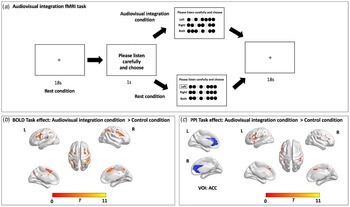
The audiovisual sensory integration fMRI task was a block-designed and alternated between rest and task period (Fig. 2). The task period contains audiovisual integration and control conditions. During the rest periods, participants were asked to fixate on a cross at the centre of the screen for 18 s. In the audiovisual integration condition, participants were instructed to choose a dotted line which was congruent with the tone sequence in a dot matrix. In the control condition, participants were asked to choose a dotted line with a square in front irrespective of the tone sequence. The task consisted of 5 blocks of audiovisual integration condition, 5 blocks of control condition, and 10 blocks of rest period. Each task condition contained 5 trials. In each trial, the duration of each tone or silent tone was 350 ms and the tone interval was 200 ms.
MR data acquisition
All participants were scanned by a 3 T GE Discovery MR 750 scanner at the Centre for Neuroimaging of Peking University Sixth Hospital, Beijing, China. T1-weighted structural image data were collected using a 3D spoiled gradient recalled sequence (TR = 2000 ms, TE = 30 ms, voxel size = 1 × 1 × 1 mm3, matrix size = 256 × 256, FOV = 256 mm, flip angle = 12°, slice thickness = 1 mm) for anatomical reference.
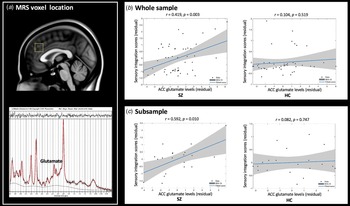
Following a previous protocol (Modinos et al., Reference Modinos, McLaughlin, Egerton, McMullen, Kumari, Barker and Williams2017), the 1H-MRS voxels (20 mm × 20 mm × 20 mm) for the VOI in the ACC were prescribed using the structural T1-weighted scan as anatomical reference (Fig. 1). 1H-MRS data were collected using a standard PROBE sequence with a standardised chemically selective suppression (CHESS) water suppression process (TR = 3000 ms, TE = 30 ms, 128 water-suppressed averages, 16 unsuppressed-water averages, VOI size = 20 mm × 20 mm × 20 mm, Fig. 1). Auto-prescan was performed to optimise shimming and water suppression before each scan.
(a) The placement of voxel in the bilateral ACC visualised on a mid-sagital plane and a representative spectrum from LC Model analysis. (b) Scatterplots of the correlations between two unstandardized residuals for reflecting relationships between ACC glutamate levels and sensory integration scores controlling for covariates (age and gender) in patients with schizophrenia and healthy controls in the whole sample. (c) Scatterplots of the correlations between two unstandardized residuals for reflecting relationships between ACC glutamate levels and sensory integration scores controlling for covariates (age and gender) in patients with schizophrenia and healthy controls in the subsample. MRS, magnetic resonance spectroscopy; ACC, anterior cingulate cortex; SZ, patients with schizophrenia; HC, healthy controls.

An echo planner imaging sequence (TR = 2000 ms, TE = 30 ms, voxel size = 3.59 × 3.59 × 4 mm3, matrix size = 64 × 64, FOV = 230 mm, flip angle = 90°, number of slices = 37) was used to obtain fMRI data.
1H-MRS data analysis
Water-suppressed spectra were analysed using LCModel version 6.3-1 N. Water-scaled glutamate levels were corrected for voxel tissue composition (Modinos et al., Reference Modinos, McLaughlin, Egerton, McMullen, Kumari, Barker and Williams2017) (see online Supplementary Methods). The spectra quality measures and voxel tissue composition are shown in online Supplementary Table S1.
Because previous studies found that age and gender affecting glutamatergic function (Brandt et al., Reference Brandt, Unschuld, Pradhan, Lim, Churchill, Harris and Margolis2016; Marsman et al., Reference Marsman, van den Heuvel, Klomp, Kahn, Luijten and Hulshoff Pol2013; Merritt et al., Reference Merritt, McGuire, Egerton, Investigators, Aleman, Block and Yamasue2021; Tayoshi et al., Reference Tayoshi, Sumitani, Taniguchi, Shibuya-Tayoshi, Numata, Iga and Ohmori2009), we included age and gender as covariates to examine the group differences in glutamate levels using analysis of covariance (ANCOVA). To explore the relationship between the ACC glutamate levels and sensory integration scores, partial correlations were performed in each group, with age and gender as covariates. Furthermore, the relationship between the ACC glutamate levels and clinical variables (i.e. illness duration and the PANSSS scores) were explored. Given the fractions of grey matter (GM) and cerebrospinal fluid (CSF) in the MRS VOI were significantly different between two groups (online Supplementary Table S1), the fractions of GM and CSF were further included as covariates to perform the above analyses.
The fMRI data analysis
The whole-brain activation and the ACC-based FC were analysed by the Statistical Parameter Mapping 12 (SPM12) Software (http://www.fil.ion.ucl.ac.uk/spm). The general linear modal (GLM) analysis was performed to assess the BOLD activation. The BOLD response was estimated with regressors for the three task conditions (audiovisual integration condition, control condition, rest condition) and the nuisance regressors in the individual-level GLM analysis. An audiovisual integration condition > control condition contrast was calculated and used in the group-level GLM analysis based on summary statistics (the detailed preprocessing steps are shown in online Supplementary Methods).
A psychophysiological interaction (PPI) approach was performed to assess the task-dependent FC (Friston et al., Reference Friston, Buechel, Fink, Morris, Rolls and Dolan1997), aiming to identify brain regions which functionally interact with a VOI during the experimental context and clarify the psychological impact of such functional interaction. In our study, a VOI representing the bilateral ACC was created from the WFU Pick Atlas (https://www.nitrc.org/projects/wfu_pickatlas/) to extract the BOLD time course. The individual level PPI GLM analysed a physiological variable (BOLD time course of the VOI) and a psychological variable (the contrast of audiovisual integration condition > control condition), entered as covariates of no interest, and their interaction term entered as a regressor of interest. The interaction contrasts were used in the second-level analysis.
One-sample t tests were performed to test the task effect of whole-brain BOLD activation and FC under the contrast of audiovisual integration condition > control condition for all participants. The significance threshold was set at p < 0.05 family-wise error (FWE) correction. Two-sample t tests were used to examine the between-group differences in BOLD activation and FC, with a voxel-wise cluster defining threshold of p < 0.001 (uncorrected) and cluster-level p < 0.05 (FWE corrected). Age, gender and mean frame-wise displacement (FD) were included as covariates of no interest.
Multimodal (1H-MRS and fMRI) analysis
To examine the associations between the ACC glutamate levels and fMRI measurements (with either BOLD activation or FC), we included the individual glutamate values as covariates of interest in an analysis of variance design with the fMRI contrast images (audiovisual integration condition > control condition) from BOLD activation analysis or PPI analysis (Cohen, Cohen, West, & Aiken, Reference Cohen, West and Aiken2014). In the SPM design matric, the Group-by-Glutamate Level interaction effects on fMRI measurements were assessed to examine the group differences in the association slope between the glutamate levels and the fMRI measurements. Age, gender and mean FD were entered as covariates of no interest. Meanwhile, the correlation between the glutamate levels and fMRI measurements in each group was assessed separately in the same design matrix. To elucidate possible interaction effects, the beta parameter estimates from the significant clusters were extracted in MarsBar to examine the association direction with the ACC glutamate levels in each group. The fractions of GM and CSF were further included as covariates to avoid potential confounding effects (see online Supplementary Information). The cluster-defining threshold was set at an uncorrected p < 0.001 at the voxel level and FWE corrected p < 0.05 at the cluster level.
Results
Characteristics of participants
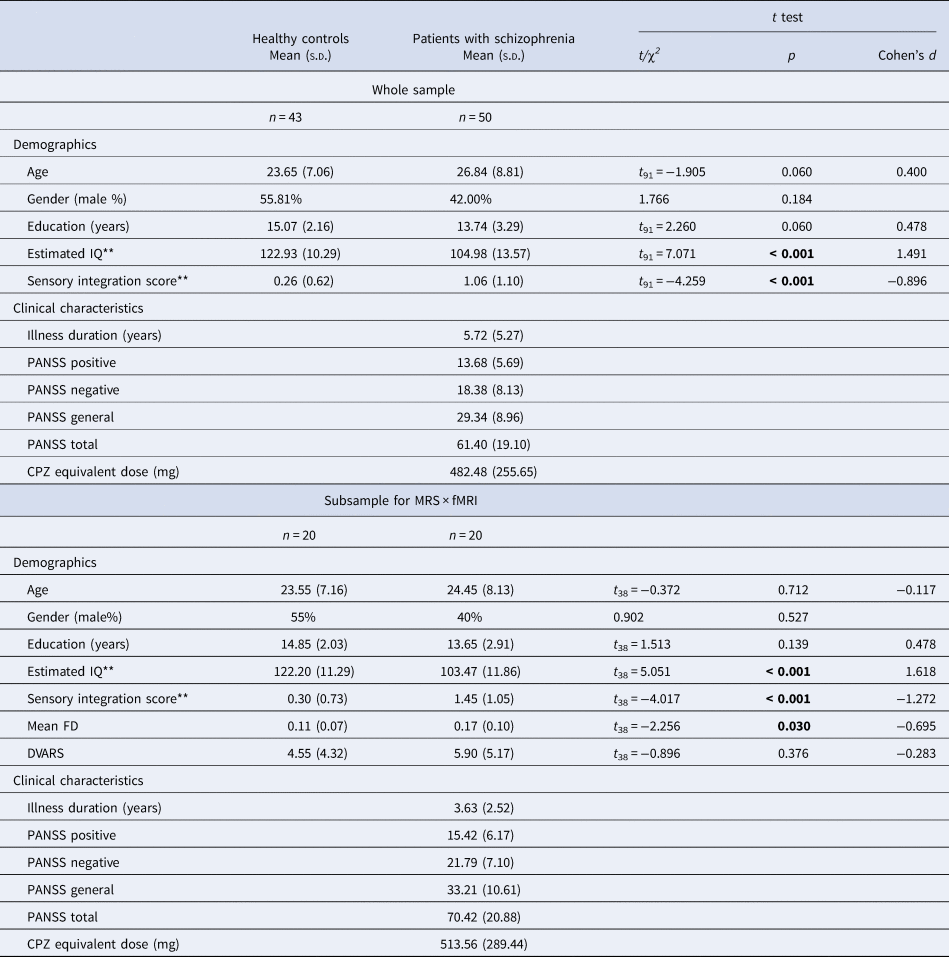
Table 1 shows the characteristics of the entire sample (N = 93) and the subsample (n = 40). In both samples, the schizophrenia group and the control group were matched in age, gender and education level (all ps > 0.05). Meanwhile, schizophrenia patients showed significantly lower estimated IQ and more severe sensory integration deficits relative to controls.
Demographic and clinical information for healthy controls and schizophrenia patients

Notes: PANSS, the Positive and Negative Syndrome Scale; CPZ, chlorpromazine. The sensory integration score was derived from the Sensory Integration subscale of the abridged version of the Cambridge Neurological Inventory.
**p < 0.001.
The 1H-MRS results
As shown in online Supplementary Table S1, schizophrenia patients and controls showed comparable spectrum quality indices. After controlling for age and gender, the ANCOVA model did not find any significant group difference in the ACC glutamate levels in both samples (entire sample: F (1, 89) = 0.840, p = 0.362, η2p = 0.009; subsample: F (1, 36) = 1.924, p = 0.174, η2p = 0.051). The results remained unchanged after including the GM fraction and the CSF fraction as covariates (entire sample: F (1, 87) < 0.001, p = 0.994, η2p < 0.001; subsample: F (1, 34) = 0.232, p = 0.633, η2p = 0.007).
The correlation of glutamate levels with sensory integration and clinical variables
For schizophrenia patients, significantly positive correlations between the sensory integration scores and glutamate levels were observed in both the entire sample (r = 0.419, p = 0.003) and the subsample (r = 0.592, p = 0.010) (see Fig. 1). However, we did not find any significant correlation between the glutamate levels and sensory integration scores in controls (entire sample: r = 0.104, p = 0.519; subsample: r = 0.082, p = 0.747) (see Fig. 1). The correlational patterns remained unchanged after including the GM fraction and the CSF fraction as covariates or using Spearman's correlation analysis (see online Supplementary Results).
The fMRI results
The main effects of the task showed significant activation in the frontal lobe, the thalamus, the caudate, and the occipital-parietal junction in the whole brain activation analysis (see online Supplementary Table S2 and Fig. 2). The PPI analysis with the ACC as VOI showed that the FC of the ACC with the inferior frontal gyrus, the inferior parietal lobule, and the insula were modulated by audiovisual sensory integration (see online Supplementary Table S3 and Fig. 2). We did not find any significant difference in BOLD activation or FC between the schizophrenia patients and control groups.
(a) Workflow of the audiovisual integration fMRI task. (b) Task effect of significant BOLD activation in all participants (FWE corrected p < 0.05). (c) Task effect of significant functional connectivity in all participants (FWE corrected p < 0.05). The blue brain region in the ACC indicates the seed region for the PPI analyses. The red clusters indicate the brain regions having significantly functional connectivity with the ACC. L, left; R, right.

Multimodal (1H-MRS and fMRI) analysis results
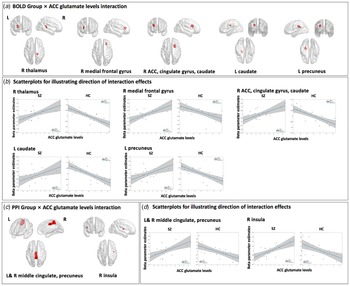
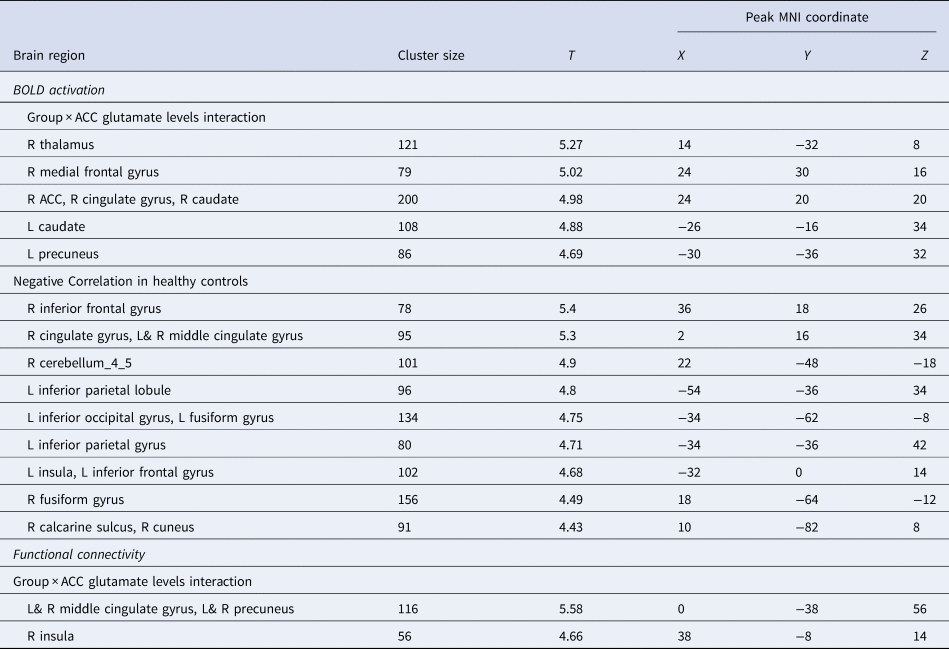
Regarding the Group-by-Glutamate Level interaction effect on BOLD activation during audiovisual sensory integration, we found significant interactions in the right ACC, the right medial frontal gyrus, the left precuneus, the right thalamus, the right cingulate gyrus, and the bilateral caudate (see Table 2 and Fig. 3). To clarify the directionality of the interaction effects, the beta parameter estimates from the significant clusters in the interaction analysis were extracted for further analysis. The results showed that the significant interactions were driven by the positive associations in schizophrenia patients and negative associations in healthy controls (see Fig. 3 and online Supplementary Results), indicating higher levels of ACC glutamate with stronger BOLD activation in schizophrenia patients. Regarding the within-group association effect, healthy controls showed significant negative correlations between ACC glutamate levels with the magnitude of BOLD activation in the bilateral inferior frontal gyrus, bilateral middle cingulate, left inferior parietal lobule, bilateral fusiform gyrus, and occipital regions (Table 2). No significant clusters were found in patients in the within-group correlation analysis. Most results remained significant after including the GM fraction and the CSF fraction as covariates (see online Supplementary Tables).
(a) Associations of ACC glutamate with BOLD activation in patients with schizophrenia and healthy controls (clusters defined as p < 0.001 and cluster-level FWE corrected p < 0.05). (b) Scatterplots of the significant correlation between two unstandardized residuals for reflecting relationship between the ACC glutamate levels and the beta parameter estimates of significant clusters (age, gender and FD as covariates). (c) Associations of ACC glutamates with functional connectivity in patients with schizophrenia and healthy controls (clusters defined as p < 0.001 and cluster-level FWE corrected p < 0.05). (d) Scatterplots of the significant correlation between two unstandardized residuals for reflecting relationship between the ACC glutamate levels and the beta parameter estimates of significant clusters (age, gender and FD as covariates).

ACC glutamate effects on fMRI BOLD activation and functional connectivity during audiovisual sensory integration (audiovisual integration condition > control condition contrast)

Notes: ACC, anterior cingulate cortex; fMRI, functional magnetic resonance imaging; R, right; L, left. The threshold was voxel-level p < 0.001 and cluster-level FWE correction p < 0.05. MNI, Montreal Neurological Institute space.
Regarding the Group-by-Glutamate Level interaction effect on PPI FC during audiovisual sensory integration, we found significant Group-by-Glutamate Level interactions in the right insula and a region from bilateral precuneus extending to bilateral middle cingulate gyrus. The further analysis showed that such interactions were driven by the positive associations in schizophrenia patients and negative associations in healthy controls (see Table 2, Fig. 3, and online Supplementary Results). We did not find any significant within-group association in schizophrenia patients or control. Most results remained unchanged after controlling for the GM fraction and the CSF fraction (see online Supplementary Tables).
Discussion
To our knowledge, this is the first study using both 1H-MRS and fMRI together to investigate the neurobiological basis of sensory integration processing in schizophrenia patients. The results showed that more severe sensory integration impairments were associated with higher ACC glutamate levels in schizophrenia patients. Importantly, multimodal analyses results showed that the significant Group-by-Glutamate Level interactions suggest different associations between the ACC glutamate level and the magnitude of BOLD activation as well as FC during sensory integration in schizophrenia patients and healthy control.
Our finding of schizophrenia patients exhibiting behavioural sensory integration deficits is consistent with previous evidence (Bombin, Arango, & Buchanan, Reference Bombin, Arango and Buchanan2005; Chan, Xu, Heinrichs, Yu, & Wang, Reference Chan, Xu, Heinrichs, Yu and Wang2010; Heinrichs & Buchanan, Reference Heinrichs and Buchanan1988). Our findings further suggested that such sensory integration deficits in schizophrenia patients are related to excessive ACC glutamate levels. This novel finding concurs with prior studies that rats treated with NMDAR antagonists had increased glutamatergic activity (Javitt et al., Reference Javitt, Carter, Krystal, Kantrowitz, Girgis, Kegeles and Lieberman2018; Moghaddam, Adams, Verma, & Daly, Reference Moghaddam, Adams, Verma and Daly1997; Stone et al., Reference Stone, Dietrich, Edden, Mehta, De Simoni, Reed and Barker2012) and exhibited sensory impairments (Cloke et al., Reference Cloke, Nguyen, Chung, Wasserman, De Lisio, Kim and Winters2016; Cloke & Winters, Reference Cloke and Winters2015; Jacklin et al., Reference Jacklin, Goel, Clementino, Hall, Talpos and Winters2012). Our findings also concur with another study which showed that healthy people exhibited abnormal sensory processing after administration of NMDAR antagonists (Strube et al., Reference Strube, Marshall, Quattrocchi, Little, Cimpianu, Ulbrich and Bestmann2020).
Importantly, we found significant Group-by-Glutamate level interaction effects on BOLD activation during sensory integration task, and the directionality differed markedly between the two groups. Consistent with our findings, previous studies reported the opposite patterns between the ACC glutamatergic levels with BOLD activation in schizophrenia patients and healthy people, using auditory (Falkenberg et al., Reference Falkenberg, Westerhausen, Craven, Johnsen, Kroken, Em and Hugdahl2014) and visual (Cadena et al., Reference Cadena, White, Kraguljac, Reid, Maximo, Nelson and Lahti2018) fMRI tasks. Moreover, van Wageningen et al., found that healthy people who received glutamate antagonists showed increased brain activation in the temporal-frontal cortex during auditory perception (23). Taken together, these evidence implicates that the disease status of schizophrenia would alter the directionality of glutamatergic function for sensory processing, especially sensory integration.
Notably, such significant interaction effects on BOLD activation were found at the prefrontal cortex, the cingulate gyrus, the precuneus, the thalamus and the caudate. The prefrontal cortex has been implicated in processing and resolving conflicting multimodal stimuli, and has extensive connections with other regions (Erickson et al., Reference Erickson, Heeg, Rauschecker and Turkeltaub2014; Zhou et al., Reference Zhou, Cheung and Chan2020). The thalamus is a sensory relay centre, and a hub for early sensory integration (Kreifelts, Ethofer, Grodd, Erb, & Wildgruber, Reference Kreifelts, Ethofer, Grodd, Erb and Wildgruber2007; Sherman, Reference Sherman2007). The caudate (Li et al., Reference Li, Huang, Xu, Wang, Li, Zeng and Chan2018; Nagy, Eordegh, Paroczy, Markus, & Benedek, Reference Nagy, Eordegh, Paroczy, Markus and Benedek2006; Reig & Silberberg, Reference Reig and Silberberg2014) and the precuneus (Cavanna & Trimble, Reference Cavanna and Trimble2006; Huang et al., Reference Huang, Reinders, Wang, Xu, Zeng, Li and Dazzan2018) have been implicated in integrating information across different modalities. Notably, the ACC, the thalamus, and the caudate form part of the salience network which is a functional loop for cognitive control by integrating sensory information to guide attention and finally modulate behaviour (Menon, Reference Menon2011; Peters, Dunlop, & Downar, Reference Peters, Dunlop and Downar2016). Our findings further suggest that the ACC glutamate levels are involved in the ‘cortico-subcortical-cortical’ circuit, contributing to the sensory integration processing. Regarding the negative associations between ACC glutamate levels and BOLD response in healthy people in the within-group analysis, and in the light of the fact that glutamatergic system is thought to contribute energy metabolism and signal processing (Rothman, Behar, Hyder, & Shulman, Reference Rothman, Behar, Hyder and Shulman2003), it is plausible that additional efforts to recruit the glutamate system for higher energy-consuming brain activities are not required in healthy people, because of their intact sensory integration.
Our findings suggested that higher ACC glutamate levels were associated with increased FC between the ACC and the insula, the middle cingulate gyrus as well as the precuneus in schizophrenia patients, while healthy people exhibited an inversed relationship of such. Previous evidence supports that schizophrenia patients have abnormal glutamate-dependent circuitry at the ACC (Benes, Sorensen, Vincent, Bird, & Sathi, Reference Benes, Sorensen, Vincent, Bird and Sathi1992; Woo, Shrestha, Lamb, Minns, & Benes, Reference Woo, Shrestha, Lamb, Minns and Benes2008), which may directly influence other local brain circuits through its FC with the middle cingulate gyrus. Since the majority of the corticocortical connections are glutamatergic (Falkenberg et al., Reference Falkenberg, Westerhausen, Craven, Johnsen, Kroken, Em and Hugdahl2014), our findings related to the precuneus and the insula suggest that the glutamate levels at the ACC apparently affects distant brain regions, through its long-ranged FC, during sensory integration. As an excitatory neurotransmitter, the positive patterns found between ACC glutamate and FC as well as BOLD activation in schizophrenia indicates that ACC glutamate might boost the consumption of glucose oxidation in the brain and might cause hyperactivities in schizophrenia. Taken together, this study provides evidence to support the important role of ACC glutamate levels in modulating neural activity as well as FC across the large-scale sensory brain network.
However, it is noteworthy that group differences in fMRI measurements were not found in the present study as well as previous studies (Mayer et al., Reference Mayer, Hanlon, Teshiba, Klimaj, Ling, Dodd and Toulouse2015; Straube, Green, Sass, Kirner-Veselinovic, & Kircher, Reference Straube, Green, Sass, Kirner-Veselinovic and Kircher2013; Szycik et al., Reference Szycik, Munte, Dillo, Mohammadi, Samii, Emrich and Dietrich2009). The possible reasons might be due to the small sample size or the low levels symptoms for patients with schizophrenia. Moreover, it is noteworthy that our participants with schizophrenia and controls showed comparable ACC glutamate levels. This negative finding was consistent with a few meta-analyses comparing the glutamatergic metabolite levels in similar brain regions in schizophrenia patients with that in controls (Iwata et al., Reference Iwata, Nakajima, Plitman, Mihashi, Caravaggio, Chung and Graff-Guerrero2018; Merritt et al., Reference Merritt, Egerton, Kempton, Taylor and McGuire2016; Nakahara et al., Reference Nakahara, Tsugawa, Noda, Ueno, Honda, Kinjo and Nakajima2022), but divergent from another recent mega-analysis showing lower glutamate levels in the medial frontal cortex in schizophrenia patients than controls (Merritt et al., Reference Merritt, McGuire, Egerton, Investigators, Aleman, Block and Yamasue2021). It is plausible that the exposure to antipsychotic medications and illness chronicity of our clinical sample might have affected the glutamate levels (de la Fuente-Sandoval et al., Reference de la Fuente-Sandoval, Leon-Ortiz, Azcarraga, Stephano, Favila, Diaz-Galvis and Graff-Guerrero2013; Merritt et al., Reference Merritt, McGuire, Egerton, Investigators, Aleman, Block and Yamasue2021), and contributed as confounds to our negative results.
This study has several limitations. First, antipsychotic medications affect neural activities (Fusar-Poli et al., Reference Fusar-Poli, Broome, Matthiasson, Williams, Brammer and McGuire2007; Radua et al., Reference Radua, Borgwardt, Crescini, Mataix-Cols, Meyer-Lindenberg, McGuire and Fusar-Poli2012) and glutamatergic function (Carli, Calcagno, Mainolfi, Mainini, & Invernizzi, Reference Carli, Calcagno, Mainolfi, Mainini and Invernizzi2011; Kegeles et al., Reference Kegeles, Mao, Stanford, Girgis, Ojeil, Xu and Shungu2012) in schizophrenia patients, which might have contributed to the lack of group difference in this study. In fact, elevated glutamate levels have been reported in medication-naïve schizophrenia patients but not medicated schizophrenia patients (Kaminski et al., Reference Kaminski, Mascarell-Maricic, Fukuda, Katthagen, Heinz and Schlagenhauf2021; Merritt et al., Reference Merritt, Egerton, Kempton, Taylor and McGuire2016). Future research should recruit medication-naïve schizophrenia patients. Second, the behavioural task and the fMRI task in this study revealed different multisensory processes. Specifically, our fMRI task was designed to measure the ability to integrate spatial and temporal information simultaneously, as signalled in the auditory and visual modalities (Huang et al., Reference Huang, Reinders, Wang, Xu, Zeng, Li and Dazzan2018). This fMRI has been reported to activate the frontal gyrus, and such BOLD response was associated with the CNI sensory integration scores in healthy people (Huang et al., Reference Huang, Reinders, Wang, Xu, Zeng, Li and Dazzan2018). Future research should employ fMRI tasks which directly measure sensory integration in ways almost identical to the CNI. Third, sensory integration is a process recruiting a large-scale brain network (Zhou et al., Reference Zhou, Cheung and Chan2020), but this study only chose the ACC as VOI. Future research should measure glutamate levels in other nodes of the sensory integration network. Moreover, previous meta-analysis studies reported significantly elevated glutamate levels in the basal ganglia, the hippocampus and the dorsolateral prefrontal cortex in patients with schizophrenia than healthy controls (Merritt et al., Reference Merritt, Egerton, Kempton, Taylor and McGuire2016; Nakahara et al., Reference Nakahara, Tsugawa, Noda, Ueno, Honda, Kinjo and Nakajima2022). These brain regions and their glutamine levels should also be measured using MRS in future research. Fourth, altered GABAergic functions in schizophrenia patients may lead to impairments in multisensory integration (Cloke et al., Reference Cloke, Nguyen, Chung, Wasserman, De Lisio, Kim and Winters2016). Therefore, future MRS studies should simultaneously investigate the role of glutamate and GABA in sensory integration. Lastly, multimodal analysis was only applied to a subsample, and our sample size remained small. Larger samples and inclusion of cohorts with different psychotic disorders are warranted to clarify the generalisability of our findings.
To conclude, schizophrenia patients exhibit sensory integration deficits at behavioural level, and the higher glutamate levels at the ACC appear to play the key role in contributing to such deficits. The ACC glutamate levels could modulate BOLD activation and FC within a network of sensory integration in both schizophrenia patients and healthy people but with markedly different directionality. This difference in directionality of effects may be putative neurobiological origin of sensory integration deficits in schizophrenia, as well as the psychopathology of the disease.
Supplementary material
The supplementary material for this article can be found at https://doi.org/10.1017/S0033291722001817
Acknowledgements
This study was supported by a grant from the National Key Research and Development Programme (2016YFC0906402), Beijing Municipal Science & Technology Commission Grant (Z161100000216138), CAS Key Laboratory of Mental Health, Institute of Psychology, and the Philip K. H. Wong Foundation to Raymond Chan.
Conflict of interest
None.