Introduction
The shaping of Sylhet as a region from the 1870s onwards has been remarkable and, to some extent, ‘dramatic’. The emergence of tea as a global product was the underlying factor behind Sylhet's shifting borders. Its separation from Bengal in 1874 gave its Hindu—and later Muslim—elites a dominant position in Assam in the spheres of politics, administration, and education within the colonial polity. The questions that will be asked are: What was the reaction of the Sylhetis to this new political and administrative set-up? What were the consequences? Looking at aspects of political mobilization since 1874, this paper examines the construction of nation/s and observes how religious communities in South Asia were interwoven with the parallel emergence of ‘identities’. The shifting position of Hindu elites is interesting: in the 1920s and 1930s they insistently supported a ‘Back to Bengal’ movement, but later the same leaders reversed their position and mobilized political forces against Sylhet's reunion with Bengal. These ‘self-confessed’ Bengali nationalists had become aware of the possible effects of losing power in the new state, as well as a shrinking social space as a result of the emerging power of lower-middle class Muslims and Muslim peasants. With some misgivings, these fears ultimately compelled them to demand that Sylhet should be retained by non-Bengali Assam in 1947. Focusing on the Sylhet referendum, this paper looks at how multiple ‘identities’, based on class, caste, and religion, worked at the grassroots level. Even the Sylheti seamen of London's East End—though at a distance of 5,000 miles—were involved in the struggle. This paper will argue that the annexation of Sylhet by Assam and its return to East Bengal in 1947 set challenges for the elites—irrespective of whether they were Hindus, Muslims or Assamese. As a result, an element of contradiction was always present in their responses. The underdogs such as the dalits and maulvis were not silent and showed remarkable awareness during the referendum; nonetheless, their responses to this issue were not only varied but also complex.
Revisiting existing studies and the scope of the investigation
Abundant secondary material is available on eastern India, especially on Assam. However, very few of these studies have attracted the attention of scholars. Amalendu Guha presented a Marxist perspective highlighting class formation and class struggle in Assam.Footnote 1 The question of identity has rarely been treated in this kind of historiography. More recently, in her study of Assam, Jayeeta Sharma focused on Assamese identity, but devoted hardly any space to Sylheti identity. In addition, her study ends in 1935 and the perspective of Assamese leaders on the Sylhet referendum was not included.Footnote 2 David Ludden's major works focus on agrarian capitalism in South Asia, mostly drawn from his empirical study on South India. His recent work on Sylhet and Assam sheds important light on ethnicity such as Khasias, on the one hand, and space or modernity, on the other.Footnote 3 Anindiata Dasgupta points out that the ‘refuge-hood’ of the Sylheti-Bengali Hindu was a more pluralistic experience than has been assumed by both popular writers and academia. However, she rightly argues that this plurality should be explored further.Footnote 4 Although it is surprising that (except for Dasgupta) no one has included the Sylhet referendum in their studies, the reason is understandable. Sylhet was an integral part of Bengal for a thousand years; it only became a key district of Assam in the 1870s. Researchers depend on archival data and government reports, and so when they find Sylhet in a different administrative set-up and its official data kept separately, it is easily excluded. Thus the reshaping of Sylhet's boundaries, first in 1874 and later in 1947, place it outside the parameters of the abovementioned studies. Dasgupta has tried to unearth Hindu and Muslim voices from the forgotten stories of partition, but she has mainly confined herself to Sylheti Hindu bhadralok, ‘displaced without experience of direct violence’.Footnote 5
This paper departs from both the ‘old’ and the ‘new’ historiography of partition. It takes a holistic approach designed to treat real issues and experiences rather than existing piecemeal approaches based on ‘imagined’ historiography, particularly in the context of the Sylhet frontier. It may be pointed out here that identity politics was crucial in Assam from the 1870s to the 1940s. On one side, this was a matter of Bengali versus Assamese, and on the other, Hindu versus Muslim. In Sylhet, the local elites were in the forefront of any mobilization; nonetheless, underdogs such as peasants, labourers, dalits, and maulvis also made significant contributions. In this process, a number of divisions and contradictions emerged, particularly among the elites, which brought about irreversible changes. There was, for example, the demise of the already mentioned ‘Back to Bengal’ movement—the brainchild of the Hindu elites. These issues can be linked to a broader socio-political and ideological framework to highlight their effects on the people of Sylhet and beyond. This paper therefore intends to move from existing studies of partition and explore intertwined, multifaceted cross-borders’ histories, where proceedings were dictated not only by mighty colonizers but also by locals, irrespective of their class, caste or religion. It will be argued here that the Sylhet referendum was a watershed not only for the elites but also for peasants, maulvis, seamen, tea labourers, and dalits.
Many historians of modern South Asia tend to analyse partition in the context of a greater Bengal or Hindu-Muslim binary. Only a few historians have researched the question of how Britain sought to fashion the borders during the transfer of power. Some innovative studies have been carried out on cross-borders’ history, particularly in the context of Bengal. For example, Willem van Schendel argues that partition created a ‘borderland society’.Footnote 6 Joya Chatterji's study on British Bengal draws attention to the complex relationship between nationalistic politics and religion in South Asia. She presents important information on how the bhadralok in Congress and Hindu Mahasabha formed the Bengal Partition League. She focuses on the twin processes of Hindu revivalism and the rise of the Muslim peasantry in Bengal politics.Footnote 7 In contrast, Bidyut Chakrabarty argues that the partition of Bengal and Assam was ‘probably inevitable’.Footnote 8 He also suggests that the results of the referendum were skewed in favour of the division of Sylhet on the basis of its demographic composition. However, having used selective archival sources, he presents a partial picture of the Sylhet referendum and partition. Chakrabarty suggests that the role of the maulvis was extremely significant in popularizing League demands, because they participated actively in mobilizing support for the amalgamation.Footnote 9 This argument is not tenable since the maulvis mainly supported the cause of Pakistan. Such a narrow approach does not help us to understand the complexity of the situation on the ground. For example, in most cases local communists sided with the ‘Hindu elites’, though Muslim religious groups, such as Jamait-Ulema-e-Hind (the Indian Association of Muslim Theologians, henceforth Ulema-e-Hind), particularly in Sylhet, supported the concept of ‘one state’. It is for this reason that this paper will re-examine both traditional and non-traditional sources on political mobilization and attempt to discover the ‘experienced’ history as distinct from the ‘imagined’ one. Many important facts and issues are not included in official records and thus cannot be located in the colonial archives. Some key sources can, however, be traced in autobiographies and vernacular materials.
Methodology and sources
Publicly available archive documents such as government and non-government papers, legislative proceedings, Sylhet referendum papers held in the British Library, population censuses, and gazettes have been extensively used in writing this paper. It also uses a wide range of non-archival sources, particularly oral histories and autobiographies. For instance, the interviews with Abul Mal Abdul Muhith and Haji Mohammed Younus were held in London and Essex. The latter made available a collection of family papers which revealed that only those peasants who paid nine annas tax were able to cast their vote in the Sylhet referendum.Footnote 10 The interview with the late Dewan Mohammed Azrof took place in 1996 and it helped with the analysis of the Sylhet referendum. Azrof was a representative at the Boundary Commission, from the Muslim League.Footnote 11 The interview with Major General C. R. Dutta was held in 1997. General Dutta is a war hero who led the Bangladesh Liberation Force in the Sylhet sector in 1971.Footnote 12 Interviews with Nurul IslamFootnote 13 were also undertaken in London. Although most of the research on the Sylhetis in the United Kingdom is primarily based on interviews carried out between 2006 and 2008, use has been made of some earlier interviews conducted by the late Caroline Adams. She assembled a unique collection of papers and tapes that are now held in the Tower Hamlets Local History Library. Oral evidence has also been used to understand the political mobilization of Sylhetis at home and abroad.Footnote 14
Textual narratives from autobiographies sometimes substantiate oral versions of events, but on occasion they do not. Nevertheless, there is much to be learned from individual histories that exist beyond archival sources. Hindu, Muslim, and European elites provide different accounts of events from the late nineteenth century to the early 1970s. Such sources are almost unexplored and tend to be overshadowed by the historians who use more conventional sources and archives. It is important to analyse what nationalist leaders or social elites think about their own times, and there is much to be learned from their narratives. However, care needs to be taken where autobiographical sources are concerned. Colin Heywood argues that ‘ego documents’ need careful scrutiny, like any other primary source, taking into account such considerations as the genre in question, the literary conventions of the period, and the personal agenda of the author.Footnote 15 Keeping this in mind, the autobiographies of locals who articulated their ideas regarding the engagement of political and social elites were chosen: the memoirs of three Congress leaders of different generations: Bipin Chandra Pal,Footnote 16 Borjendra Narayan Chaudhury,Footnote 17 and Suhasini Das.Footnote 18 All three narratives are interesting sources for conceptualizing the discourse of nationalism within the Congress Party and the approach to the separate discourse of the Muslim League. Chanchal Kumar Sharma, one of the founders of the Sylhet Communist Party and the commander of the ‘Volunteer Core’ during the Sylhet referendum, has provided an eyewitness account.Footnote 19 Dewan Mohammad Azrof,Footnote 20 the representative to the Boundary Commission from the Muslim League who later became known as ‘principal’, and C. M. Abdul Wahed,Footnote 21 a student activist from the Muslim League during the referendum, represent examples of Muslim thinking and polity of that time. In brief, these texts demonstrate attempts to influence contemporary politics and the intellectual dilemmas of the age.
As well as these local narratives, some autobiographies written by European officers are also available. Sir Henry Cotton and G. P. Stewart produced their version of what they experienced as administrators.Footnote 22 Henry Cotton, the chief commissioner of Assam in the late nineteenth century, noted the influences of planters on the British administration in India. G. P. Stewart was appointed assistant commissioner in Sylhet in 1930 and in 1936 he was promoted to deputy commissioner of Sylhet, the main officer of the district. His autobiography, still unexplored, is of interest for many reasons. The life and work of a district officer in Assam is graphically described with some historical details. His dispassionate account of the hybrid culture created by the new plantation economy is useful for historical research. He has sketched the importance of Sylhet in the 1930s in Assamese history.Footnote 23
The Assam ‘Planter Raj’ and Sylhet: the inclusion of a ‘rebellious partner’
Sylhet was a frontier of Bengal, particularly before the emergence of Assam as a northeastern province of British India in 1874.Footnote 24 Bipin Chandra Pal had the privilege of witnessing, indeed personally sharing, the toils and turmoils which transformed Sylhet in the second half of the nineteenth century. He tried to use the thread of his personal life to weave together the history of his times. In his autobiography, published just five days before his sudden death in 1932, he depicted the reshaping of Sylhet in the following language:
I was born in a village, Poil, in the District of Sylhet, on Kartik 22, Shakabda 1779, (1265 Bengali year) corresponding to November 7, 1858. Sylhet is now a part of the administrative province of Assam; but at the time of my birth, and for many years afterwards during the whole of my boyhood, it was a Bengal district in the Commissionership of Dacca. Assam too was then a part of the Lieutenant-Governorship of Bengal under a Commissioner. When the Commissionership of Assam was made into a separate Province under a Chief Commissioner in 1874, Sylhet and Cachar were transferred to the new Administration very much against the wishes of the people of these Districts, who were all Bengalees (sic) and were still crying out for re-union with Bengal.Footnote 25
Bipin Pal revealed that historically and culturally Sylhet was a Bengal District under the commissionership of Dhaka. He pointed out that the British ruled Assam as part of Bengal before it emerged as a northeastern frontier province of the Raj in the 1870s. Thus the inclusion of Sylhet in Assam created one kind of identity crisis. Identity gradually emerged as a burning issue for Sylhetis living in the Bengal-Assam borderlands. One of my interviewees, Nurul Islam, who witnessed the events of the Sylhet referendum at the age of 17, explained how identity was constructed and reconstructed. Putting the situation in its wider context, he said:
Well, it changes with the creation of new states and regions. For example, I was born in 1930, and till 1947 it was the British period, we were British subjects of His/Her Majesty. Our identity was then Indians. Our second identity was that of Bengalis. At that time we used to live in greater Bengal or Assam. Although we were in Assam, we never called ourselves Assamese. The Assamese people used to call the Sylheti people Bengali. The Bengali used to call us as Assamese. So we were Bengalis, we were Indians, we were Assamese; then we became Pakistanis. Then with the creation of Bangladesh we became Bengalis or Bangladeshis.Footnote 26
So the notion of a Sylheti identity is more or less distinct from a Bengali one. Similarly, a linguistic perspective shows that Sylheti Nagri is the linguistic expression of Sylheti identity.Footnote 27 The advent of Shah Jalal, the mystic Sufi of the subcontinent in the fourteenth century, ushered a new era for Sylhet and northeastern India. Shah Jalal and his 360 disciples left a unique legacy. Scholars argue that Sylheti Nagri emerged during the time of Shah Jalal as the language for writing on religious and social matters. This is an alternative script used to write Bangla and provides a new source of information about the region, documenting a complex period of local history when Islam was emerging as a social force. Thus, Sylheti Nagri was one of the key elements of acculturation, as a result of the encounter of the indigenous culture with Perso-Arabic traditions.Footnote 28 It acted as a vehicle for the formation of Muslim identity and created a tradition of high Islam as expressed in regional popular culture. From the eighteenth century, texts were directed towards women, who were the primary consumers of these predominantly religious verses. B. C. Allen wrote that Sylheti Nagri was used among the ‘low caste’ Muslims of Sylhet.Footnote 29 Discarding this opinion, Nagandra Nath Basu argued that converted Nagar Brahmins (Hindu priests) wrote Muslim religious books in Sylheti Nagri characters.Footnote 30 These contending views reveal that it was a popular script for a considerable cross-section of people. Even today, many people as well as academics refer to it as Jalalabadi Nagri to commemorate Shah Jalal.Footnote 31 Furthermore, linking family history to Shah Jalal and his followers is quite common in Sylhet. It appears that this particular notion has captured the imagination of almost all the Muslim masses of Sylhet and these beliefs have been reflected through devotional songs celebrating Shah Jalal, which are still in circulation in Sylhet and in Brick Lane in London. Thus, Sylheti identity is also transnational. Later in this paper there will be evidence to show how ‘British Sylhetis’ were emotionally and physically involved in the events surrounding the referendum. Although 1971 issues will not be discussed in this paper, one can also find evidence of British Sylhetis’ participation in the Bangladesh War. Many studies indicate that Sylhetis have had a long diasporic experience, particularly in Britain.Footnote 32 In his autobiography, Robert Lindsay, a late eighteenth century resident of Sylhet, mentioned that in 1809 Syed Ullah was the first Sylheti to migrate to Britain. Lindsay also wrote that he was able to carry out business regularly with help of Sylhetis from Sylhet to Calcutta and, on a few occasions, also from southeast Asia.Footnote 33 At the close of the nineteenth century, however, the traditional river-trade on boats or ships had declined as a result of the introduction of river steamships and the railway into the interior of Sylhet and Assam. Moving goods from Assam via Sylhet to Calcutta by steamships and rail was quicker and easy. Thus hundreds of Sylheti boatmen found themselves out of jobs, but they were soon recruited on seagoing ships in Calcutta. In this way, they moved from ‘river to sea'—trading ships, after all, required experienced crews to run them. The Calcutta-based writer Shankar argues that the people of Sylhet were the pioneers among Bengalis in the ‘conquest of the sea’. By nature, he asserts, they were ‘brave’ and they showed that characteristic in sailing around the world. Leaving Kiderpore dock, they created history and participated in global trade.Footnote 34 Later, particularly from the 1940s, they began to settle in Britain. Today up to 90 per cent of Bangladeshis living in the United Kingdom either originate or come from Sylhet. Interestingly, one diaspora poet and performer Shamim Azad asserts, ‘I firmly believe that these Sylheti seafarers probably had a special migratory gene that drove them across rivers and seas.’Footnote 35
Colonial officials and the local Bengali gentry in Assam considered it to be an extension of Bengal. In contrast, the tea planters had long demanded the creation of an exclusive province to secure their own interests and the efficient use of state tools. Due to the increased work brought about by the growth of tea plantations and immigrant labourers, very soon every branch of the administration was overhauled and special regulations were drafted to provide for local needs. Accordingly, on 6 February 1874, a new province was created comprising the area of Assam proper, Cachar, Goalpara, Garo Hills, and the other hill districts. Although vast in area, this new province, with its population of 2.4 million, had a low revenue potential. Initially Sylhet was not included in this province but within six months, the colonial administration realized the need to redraw the map of Assam. To make it financially viable, and to accede to demands from professional groups, they decided in September 1874 to annex the Bengali-speaking and populous district of Sylhet. With its population of 1.7 million, Sylhet had been historically and ethnically an integral part of Bengal. In effect, the creation of the new province merely merged the four uneven areas. These were as follows: the five Assamese-speaking districts of the Brahmaputra Valley, known as Assam proper, which was congruent; the Goalapara district of the same valley where Assamese and Bengali cultures overlapped; the ‘pre-literate’ hill districts where different dialects were spoken; and, finally, the two populous and Bengali-speaking districts of Sylhet and Cachar. This is how this new province was created. It remained without a legislature from 1874 to 1905. From the 1920s to the mid 1940s there was a provincial legislature in which the planters and local elites maintained significant influence until the end of British rule in 1947.Footnote 36
The integration of Sylhet with Assam separated Bengali-speaking people on either side of the Meghna. It was threatened by the antagonism between the people of Assam and the Surma valleys, which was characterized by occasional outbreaks until 1947.Footnote 37 The administrative reorganization and subsequent public protests on the eastern frontier of the Raj need to be analysed in the context of the political economy of the region, spearheaded by the tea business. Publicly, there was always a demand for reunion with Bengal. This sentiment found emphatic expression when the new province was first formed in 1874. Sylhetis felt that their district was deliberately torn from Bengal in order to incorporate it into Assam province, which could not pay its own way financially. The elites, mostly Hindus, were against the transfer of Sylhet as they regarded it as disadvantageous to be yoked to a ‘backward region’. Newspapers published in Calcutta and Sylhet by Hindu elites tried to mobilize public opinion against this government move. The influential Hindu Patriot published a series of articles and editorials echoing the sentiment of the Bengali elites. K. Das Pal, its editor, wrote that Sylhet was the golden calf, being sacrificed for the new idol, the province of Assam.Footnote 38
A memorandum of protest against the transfer of Sylhet was submitted to the viceroy on 10 August 1874 by leaders of both the Hindu and Muslim communities.Footnote 39 Although the government immediately rejected this demand, Governor General Lord Northbrook came to Sylhet to assure the people that their culture and tradition would not be affected because of the new administrative arrangements. It was also decided that education and justice would be administered from Calcutta University and the Calcutta High Court respectively.Footnote 40 The administration of this new province adopted two major policies: first, it would ensure the smooth recruitment of tea labourers from outside and, secondly, it would oversee a policy of sponsored migration of Bengali peasants from East Bengal districts to the countryside of Sylhet and Assam to facilitate the expansion of agriculture. This was done under the slogan ‘Grow more food’. Evidently, colonial officialdom did not consider historical or cultural contiguity when it declared Assam to be a new administrative province.
Although the Hindu gentry of Sylhet and Calcutta initially resisted the creation of the new provinces, they soon shifted their position for two reasons. They accepted assurances from Lord Northbrook that Sylhet's education and justice system would be administered from Bengal. They could also see that the benefits conferred by the tea industry on the province would also prove profitable for them. For example, those who were literate were able to obtain numerous clerical and medical appointments in tea estates, and the demand for rice to feed the tea labourers noticeably augmented its price in Sylhet and Assam enabling the Zaminders (mostly Hindu) to dispose of their produce at a better price than would have been possible had they been obliged to export it to Bengal. It appears from the data that there was an overwhelming dominance of Bengalis from Sylhet in the colonial bureaucracy in Assam as well as in different offices in the tea estates. Sanjib Baruah, writing in 1999, suggests that by the early twentieth century, Bengali Hindus in Assam dominated the medical, legal, and teaching professions and held many of the mid-ranking and clerical jobs in the railways and post offices.Footnote 41 Having been part of Bengal, British India's most dynamic province, Sylhet had more experience of colonial rule and an English-educated professional class that could immediately take advantage of the opportunities opened up in the new frontier. Baruah points out, ‘As they came to occupy the bulk of the positions in Assam's colonial bureaucracy, their dominance was resented, especially after an Assamese western-educated class began to emerge.’Footnote 42 Sylhet was thus cut off from the larger life of Bengal and continued to be so for 30 years until it was reintegrated in 1905. In that year a short-lived province was created (through a partition of Bengal) under the name ‘Eastern Bengal and Assam’ with its capital at Dhaka. So when the partition of Bengal was annulled in 1912, Assam was reconstituted into a separate province into which Sylhet was again integrated. The district was consequently convulsed by agitation in towns, marketplaces, and important villages. There were public meetings of protest and a petition that was signed by members of the Provincial Legislative Council. The titleholders, the Zaminders (with two exceptions), and lawyers submitted their protest memorial to Lord Hardinge in 1912, but without any success.Footnote 43
In 1920 the Sylhet-Reunion League was formed under the auspices of Brojendra Narayan Chaudhury. It was decided that a deputation should wait upon the viceroy, but with the advent of the Non-cooperation Movement the matter was temporarily dropped.Footnote 44 In the 1920s, as evidenced by the proceedings of the Assam Legislature, the Hindu gentry and a significant number of Muslims fought for the issue of Bengali identity—a goal that was jointly shared by the Hindus and Muslims of Sylhet. There was a possibility that Sylhet would lose its special status regarding education and justice. There was also a question of establishing a university in Assam. These issues were clearly of concern to both the Hindu and Muslim elites. In the 1920s and 1930s, Brojendra Narayan Chaudhury acted as a spokesman for Sylhet's reunion with Bengal. He captured the contemporary imagination regarding the Bengali ethnicity of Sylhetis. In an upbeat moment in the Assam Legislative Council, in August 1924, he argued:
In moving the resolution I need to point out that the transfer of Sylhet from this Administration to Bengal is the chief concern of the representatives of Sylhet. Indeed this is our only politics. . . I have supplied hon. members with copies of a booklet called ‘Back to Bengal’ by Rai Bahadur Girish Chandra Nag, a very experienced and retired member of the Assam Civil Service and a representative of Sylhet in the first Assembly. . . I will not read it fully, but merely give extracts.
Barring the small imported labour in tea plantations, nearly cent percent (100 per cent) of the indigenous population speaks Bengali, belong ethnologically to the Bengali race, have the same manners, customs and traditions and thoughts as their brethren in Bengali and are indissolubly bound up with them by ties of blood and social relationship [emphasis added].Footnote 45
In the same speech, Chaudhury declared:
It is stated that fears were entertained about our connection with the Calcutta High Court and University. . . We of Sylhet will stand to a man against any thought of transferring us from the protection of the Calcutta High Court, whose traditions are bound up with our Bengali traditions. . . can I or any other member from Sylhet consent to an expenditure from which Sylhet will deprive no benefit? Let the naked truth be told that Sylhet, so long as it is here will stand in the way of Assam. . . This will be Assam's legacy of being bound to an unwilling and rebellious partner [emphasis added].Footnote 46
The Assamese also dreamed of their own homeland, and saw Bengali-speaking Sylhet as a major obstacle to that goal. So the Jorahat Sarbajanik Saha (an Assamese social organization) passed a resolution to exclude Sylhet from Assam, which received support from the Assamese newspapers.Footnote 47 In 1933 the president of the Assam Association publicly argued that Assam could not have its own university or high court, nor could it develop its language and literature for as long as Sylhet remained in Assam.Footnote 48
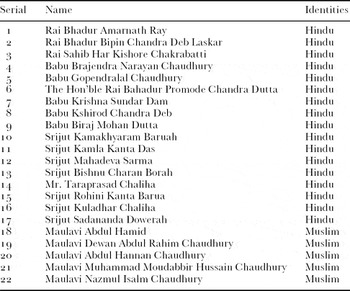
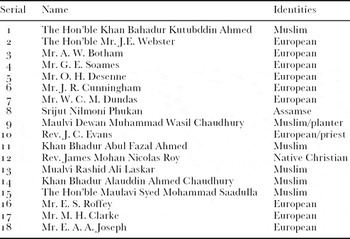
As the upper class Muslims of Assam and Sylhet became increasingly powerful in provincial politics, a considerable number of their leaders such as Khan Bahadur Aluddin Chaudhury and Maulvi Dewan Wasil Chaudhury spoke out against reunion and questioned whether the Muslims of the districts supported it.Footnote 49 Abdul Matin Chaudhury, a former congressman who had become a member of the Muslim League and an influential Muslim leader of Sylhet, wrote a letter to members of the Assam Legislature in 1924 declaring that the Muslims of Sylhet did not want to be part of Bengal, and argued that the only ones who wanted this were the Sylheti Hindus.Footnote 50 Khan Bahadur Aluddin Chaudhury explained his decision to shift his position thus, ‘I have already confessed in my speech that I was one of those who advocated the re-union of Sylhet with Bengal in 1918 but I changed my views in 1920. . . A wise man changes but a fool does not.’Footnote 51Tables 1 and 2 demonstrate the interesting pattern of votes in the Assam legislature.
‘Aye’ votes in the Assam Legislative Council on the transfer of Sylhet back to Bengal, August 1924.

Source: Proceedings of the Assam Legislative Council, August 1924, Assam Gazette, Part IV, Shillong, 1924, pp. 619–20.
These tables show that ten European officials and planters, one native Christian, six Muslims, and an Assamese leader voted against the proposal to transfer Sylhet back to Bengal, while all the Hindu leaders voted in favour. However, the Muslim leaders of Sylhet were divided on the issue, with five Muslim members voting in favour of joining Bengal and six voting against. The five Muslim votes meant that Chaudhury's resolution was adopted.
‘No’ votes in the Assam Legislative Council on the transfer of Sylhet back to Bengal, August 1924.

Source: Proceedings of the Assam Legislative Council, August 1924, Assam Gazette, Part IV, Shillong, 1924, pp. 619–20.
A similar resolution was passed in the Assam Legislature in January 1926 with the help of four Muslim members from Sylhet.Footnote 52 However, soon Sylhet's Muslim politicians lost interest in the Back to Bengal movement led by Hindu politicians. The reason was twofold: first, the emergence of Muhammad Saadulla, an aristocratic Muslim from Assam who dominated legislature politics with the help of European planters and British officials. He openly argued that Sylhet should remain in Assam. He pointed out, ‘If we allow Sylhet to go, on what basis or principle could we stop Cachar and Goalpara also from going?’Footnote 53 After visiting Sylhet in July 1925 Saadulla saw that ‘opinion in the country is divided’. He opposed ‘the disturbance of the status quo’. Later that month he wrote, ‘Speaking from the communal point of view, the transfer of Sylhet will spell disaster for both the Valley Moslems.’Footnote 54 So Saadulla's underlying interest was in safeguarding his political career. In the following years he played the ‘religious card’ quite cleverly. Also, many Muslims believed that Sylhet's integration into Assam would lead it to become a Muslim-dominated province in the future. For example, in opposing the proposal of Sylhet's separation from the Assam Legislature in 1926, Maulvi Dewan Wasil Chaudhury, himself a planter, suggested that Sylhetis would benefit from this new province. He argued that the bench and bar and subordinate services had been full of Bengalis, but now, ‘Sylhet not only elbowed out her Bengali friends from bench and bar. . . but managed to send her gifted children to take part in the administration of the province and elsewhere.’Footnote 55 The notion of Sylhetis as distinct from Bengalis never disappeared and overlapped with the growing Hindu–Muslim division. Wasil Chaudhury continued to argue that all along Sylhet had been politically connected with Assam.Footnote 56 At that time the term ‘Sylheti’ was coined by Muslim politicians to mean the Muslims of Sylhet. Later Mohammed Ali Jinnah included Assam in his plan: to Mahmud Ali, the secretary of the Assam Muslim League, he said, ‘I tell you young man; nothing short of Assam shall satisfy me.’Footnote 57 So, without the backing of Muslim politicians, the resolution regarding the Back to Bengal campaign in the Assam legislature lost ground. Muslim politicians of Sylhet such as Wasil Chaudhury, Mahmud Ali, and Abdul Matin Chaudhury had been dreaming of Assam province as their ‘future free homeland’. In the 1930s and the early 1940s, they served as ministers in the province under the British governors. However, in the early 1940s, the main concern of the Muslim League was the inclusion of Assam in the Pakistan scheme.Footnote 58
To complicate matters further, in the 1930s many Assamese politicians who wanted to ‘get rid of Sylhet’ took their case to the highest level. The newly emerged Assamese middle class attempted to fix their ‘homeland'—to make ‘Assam for Assamese'—free from the competition of the Bengali middle class. In his note submitted to the Indian Round Table Conference in 1931, Chandradhar Barooah, a member from Assam, made a strong argument for the territorial redistribution of Assam on a linguistic basis, with the separation of Sylhet.Footnote 59 The government of Assam also sent a letter to the Reform Office on 5 September 1934, relating to the transfer of Sylhet from Assam to Bengal. It stated:
His Excellency the Governor in Council considers that in view of the continued agitation over this question of the transfer of Sylhet from Assam to Bengal—a question which is bound to be an important political issue before the future Government of this province—he should bring the point raised by the deputation of Assam Valley Associations to the notice of the Government of India. The point is, in the opinion of this Government, one of considerable importance to this province and they trust that some provision on the lines of section 60 of the present Government of India Act will be included in the new Constitution Act.Footnote 60
At that time, Richard Austen Butler was the under-secretary of state for India.Footnote 61 He was aware of the different views on Sylhet's reunion with Bengal, including, of course, those held by the bureaucracy in London. On 12 December 1934, Butler interviewed Barooah along with an MP, Sir Walter Smiles. The interview and discussion focused on the question of the amalgamation of Sylhet with Bengal and relevant issues, including the demands of the Assamese elites to exclude Sylhet from Assam. Butler noted:
He (Barooah) said. . . that there was a great deal of feeling in Assam that Sylhet held back the wish of the Province for a High Court and a University, since the Sylhetis wanted none of these things, as they found them quite sufficiently in the neighbouring province of Bengal. . . I could hold out no hope to him that the amalgamation of Sylhet to Bengal would be included in the provisions of the Bill.Footnote 62
Both Butler and Smiles then explained to Barooah why the British administration preferred to keep Sylhet in Assam instead of transferring it into Bengal. Butler explained:
I was able to refer him to the reference in the Report of the Statutory Commission to the representations of the Assam Government to that Commission which seemed to show that there was no unanimity of opinion, and in fact the Muslims, who formed the majority of the population in Sylhet, were opposed to the transfer [emphasis added].Footnote 63
It appeared that Assam's boundary, particularly the incorporation of Sylhet into Assam, was based on the considerations of administrative convenience and the interest of the planters. On behalf of government of Assam, Arthur William Botham, articulated the official position in a confidential letter, as follows:
Even a partial dismemberment of Assam as at present constituted would give rise to many serious difficulties, both administrative and political, and if its area and population were materially curtailed, it is doubtful whether it could retain the status of a Governor's province.Footnote 64
Although British authorities in Assam, Calcutta, Delhi, and London listened to diverse views from different quarters on the transfer of Sylhet to Bengal, the official position remained unchanged. The British administrators often belonged to the same families as the planters and in a few cases they even had their own hidden investments in tea gardens as well.Footnote 65 By the late nineteenth century the planters had emerged as the strongest lobby group in British India. In the closing years of the century, Sir Henry Cotton, the governor of Assam, seeing the misery of the labourers, proposed a mild reform plan. However, this gentlemanly initiative was rejected by the planters’ guild. The power and influence of the planters can be grasped from Cotton's autobiography:
The tea industry and the planters as a body had become so intolerant of Government control and interference that they had come to regard a derogatory word as an insult, and the official who uttered it as an enemy. A section of the community had set itself up the attitude of defiance of the administration.Footnote 66
Sir Henry said he was treated with ‘malignity’ and even ‘dishonesty’ by the planters, although he belonged to a distinguished family which had served in India for five generations. The words of Viceroy Lord Curzon on the Assam labour issue were even stronger than those of Sir Henry, and this came out in their official communications. Nevertheless, Curzon retreated in the face of a rising storm of opposition from the planters. According to Sir Henry, ‘he (Curzon) saved his own skin but deliberately flung me to the wolves’.Footnote 67 Sir Henry thus was forced into early retirement instead of being promoted to be lieutenant governor of the Bengal Presidency.
The authority also conducted its own surveys to get an idea of public opinion on this burning issue. Directed by the government, in June 1925, Christopher Gimson, the deputy commissioner of Sylhet, consulted a wide range of people on the ground. He noted that it was beyond his power to say what the real wishes of the people of Sylhet were; he wrote, ‘more than 75 per cent of the people are ordinary agriculturists, whose views it is almost impossible to obtain’.Footnote 68 He pointed out that only ten per cent showed any interest in the issue and that the larger portion of the Muslims wanted to remain in Assam. He further noted that, not surprisingly, those who worked in the tea gardens as managers also ‘prefer to remain in Assam’.Footnote 69 Thus, on the basis of the official survey, the British carefully designed the Assam colonial boundaries so that Sylhet became a key component. In 1928, the Assam Review reported that the planters always voted with the government on this issue.Footnote 70 Relentless lobbying, protests, and many resolutions made by the Bengalis of Sylhet, led mostly by Hindus, were in vain as Sylhet did not return to Bengal until 1947.
Paradox of communalism and the Sylhet referendum
Evidently, intercommunal relations were cordial in Sylhet until the 1920s. The legacy of Shah Jalal and Sri ChaitanyaFootnote 71 had a long-lasting impact on the collective psyche of the people, promoting a liberal attitude and outlook. This could be observed in the mystic songs of the region, which were products of the interactions of cultures in this borderland. This harmony began to fade as the Sylhet elites adopted more contentious positions in the late 1920s, 1930s, and early 1940s. At this critical juncture, communal feelings were influenced by the attitudes of Hindu and some Muslim businessmen who began to name their companies along communal lines. For example, in 1919 some entrepreneurs named their company the ‘Hindu-Muslim Tea Company’ while later, in the late 1920s, both the Hindu and Muslim elites registered their companies with ‘religious’ names such as ‘Binapani’, ‘Joy-Tara’ or ‘Daru-Salam’.Footnote 72
Drawing a new map on the borders of East Bengal and Assam as a result of the Sylhet referendum was a defining moment in the history of the region. As the majority of the population of Sylhet was Muslim, the Muslim League actively campaigned for the inclusion of Sylhet into Pakistan. At the same time the Sylhet branch of the Congress actively campaigned on behalf of the Hindu minority who chose to stay in Assam. Furthermore, every stakeholder was involved, whether it was Congress, the Muslim League, the communists, the ‘pro-Indian’ maulvis, the ‘pro-Pakistani’ dalits, and, finally, the British. In the 1940s, the population of Sylhet was distributed as follows: Muslims 60.7 per cent, Scheduled Castes (dalits) 11.6 per cent, Caste Hindus 25.1 per cent, and Tribal 2.2 per cent.Footnote 73 However, the voters in the Assam Assembly (1946) for Sylhet district were divided as follows: Muslims 311,707 and General 235,808. Although the Muslims formed 60.7 per cent of the population of Sylhet, they represented only 54.27 per cent of total electoral roll of the district. So on 11 June 1947, in his letter to Mountbatten, Liaquat Ali Khan argued that the Muslim votes did not reflect their real strength. To remedy this, he suggested multiplying Muslim votes by a factor that would equate with their voting strength. On the question of tea labourers he argued, ‘I presume that the electorates of special constituencies (sic), such as labour, tea planters, commerce, etc. would not participate in the referendum.’Footnote 74 On 25 June 1947, Mountbatten wrote back that he could not accept the first suggestion and that the referendum in Sylhet would be held ‘on the basis of existing electoral rolls’. Mountbatten accepted Ali's second suggestion, so that electorates of special constituencies such as labour and the tea planters could not participate in the referendum.Footnote 75
This suddenly brought the issue of tea labour to the table. Interestingly, these were not local labourers; almost all came from the Chota Nagpore (Chotanagpur) plateau and Santal Parganas to the newly created plantation enclaves. This inland labour migration was a major phenomenon in the second half of the nineteenth century and it continued until the 1940s. In 1876, J. G. Grant, the superintendent of emigration, wrote that the supply of labour for the tea districts was obtained from western Bengal and Chota Nagpore.Footnote 76 In the second half of the nineteenth century, droughts had caused the failure of food production and several famines occurred in the tea-labour recruiting areas. Recruitment through contractors and their sub-agents such as the arkatti (native recruiter) was actively pursued in the 1870s, 1880s, and 1890s. Also, the garden sardars (labour leaders) were freely deployed when large numbers of labourers were required in a hurry. In the peak years of the tea plantations, particularly in the 1890s, big firms like James Finlay, Andrew Yale, Octavius Steel, and Duncan Brothers opened their own recruiting agencies. They were given licences as the principal employers on whose behalf licensed sub-contractors, such as arkatti and sardar, were active in the area of recruitment. A report of the emigration department of Bengal shows that James Finlay, the biggest tea company operating in Sylhet, held the largest number of licences for recruitment in 1890. Finlay had 16 licences that permitted the recruitment of labour in the following areas: Singbhoom, Manbhoom, Dumka, Hazaribagh, Giridih, Gya, Patna, Rajmehal, Sahebgnge, Govindpore, Arrah, Buxar, Raneegunge, Mehhijam, Burdwan, Beerbhom, Loharduga, Bankora, Nuddea, Pachamba, 24-Pergunahs, Monghyr, Bhagulpore, and Mozufferpore.Footnote 77 At the Twelfth Indian National Congress meeting held at Calcutta in December 1896, Bipin Chandra Pal pointed out that for some years the Santal Parganas district had been the hunting ground of ‘coolie-catchers’.Footnote 78 For the most part the labour migration into the plantations was a permanent move. In the early decades of the twentieth century, railways gradually began to play a major role in transporting these labouring families into the tea plantations.
This historical trajectory misled many postcolonial ‘Hindus’, who later distorted what had actually happened. On the fiftieth anniversary of Indian Independence—21 August 1998—the Southern Assam Bharatiya Itihasa Sankalana Samiti (Indian History Collection Association) organized a seminar at Silchar to explore interpretations of the referendum. It appears that one of the participants, Janmjit Roy, was not aware of the situation of the tea labourers. Roy argued:
On the pretext of not being sons of the soil, more than one and half a lakh of the Hindu tea garden labourers were disfranchised in the electoral roll of 1946 Assembly election. Had they been allowed to vote and had only 40 per cent of them turned up for polling, they could have turned the scale. The so-called Sylhet Referendum was an eye-wash.Footnote 79
However, all the tea labourers were not ‘Hindus’. Many were animists and followers of religions that had few links with ‘Caste-Hindus’. Contemporary documents suggest that in Sylhet there was one labour constituency and there were 11,449 voters on the electoral roll in 1946. In this year, Sardar Jibon Santal was elected from the Srimongal Labour Constituency as a member of the Legislative Assembly in Assam.Footnote 80 Clearly the tea labourers were the privileged among their peer group. A government record reveals the contemporary situation:
The position in regard to the Srimongal Tea Gardens Labour Constituency is somehow different. There are 11,449 voters on the electoral roll for this constituency, the requisite qualification being that the voter should have been working as a permanent employee in one or more qualifying tea gardens on not less than 180 days. They thus represent a floating population with little or no stake in the district as such. There is no strong reason why plantation labour should be given a special voice in the referendum which other labour, agricultural or industrial, do not get. We have accordingly adopted the general principle that voters in Special Constituencies need not be permitted to participate in the referendum [emphasis added].Footnote 81
On the one hand, according to law in the 1940s, only those people who had paid 9 annas rent to the government were eligible to vote.Footnote 82 The poor agriculturists and agricultural labourers such as nankars Footnote 83 or industrial labourers at the Assam-Bengal Cement factory at Chatak did not fulfil this criterion and did not have voting rights. On the other hand, tea labourers had their own constituency and the requisite qualification for a voter was to prove that they were permanent employees in a tea garden. Accordingly, all permanent tea labourers cast their vote in 1946 election. So the polemics around the tea labourers’ votes is mostly a product of post-partition imagination. Even a communist partly repeated this story of injustice in his autobiography.Footnote 84
As part of the partition plan, the British authority called for a referendum in Sylhet to decide whether the district should be amalgamated with Pakistan or remain in Assam. A statement by the government made on 3 June 1947 stated:
There has been a demand that, in the event of the partition of Bengal, Sylhet should be amalgamated with the Muslim part of Bengal. . . a referendum will be held in Sylhet. . . If the referendum results in favour of the amalgamation with Eastern Bengal, a Boundary Commission with terms of reference similar to those for the Punjab and Bengal will be set up to demarcate the Muslim majority areas of Sylhet district and contiguous Muslim majority areas of adjoining districts, which will then be transferred to Eastern Bengal.Footnote 85
Under the leadership of Assamese leaders the Assam Provincial Congress had little interest in Bengali-speaking Sylhet. Amalendu Guha argues that the reason for the referendum was to enable the Assamese leadership ‘to get rid of Sylhet’ and carve out a more linguistically homogenous province. When the result of the referendum was declared, there was a feeling of relief in the Brahmaputra Valley.Footnote 86 Conversely, the Sylhet District Congress fought hard to keep the Sylhet district in Assam. After losing in the referendum, they tried to salvage a portion of the district through effective representations to the Boundary Commission. It appears that the Muslim League was also divided due to a spilt between the Assam Provincial League president Maulana Bhasani and ex-premier Sir Saadulla. Two Sylheti politicians, Mahmud Ali and Matin Chaudhury, supported Bhasani and they appeared to have been most effective in mobilizing Muslim support. The role of the Muslim National Guard of trained League volunteers was also crucial.
At the same time, the ‘pro-Hindu’ firebrand politician, Syama Prasad Mookerjee, sent workers from Hindu Mahasabha to mobilize Hindus in support of Sylhet's union with Assam. The ‘Frontier Gandhi’, Gaffar Khan, sturdily opposed the idea of Pakistan and he sent many ‘Red Shirts’ in Sylhet to work with the Congress.Footnote 87 Thus, all the contending forces made the referendum a hotly contested issue. A picture of the Hindu–Muslim spilt can be seen in the remarkable autobiography of the communist leader, Chanchal Sharma. Hardly any of the upper castes or middle class Hindus campaigned for the union of Sylhet with East Bengal/Pakistan, and even a considerable number of articulate communists mobilized people, including Muslim nankars, against Sylhet's inclusion in Pakistan. Azrof wrote that the local communists had developed friendly relations with the Muslim League but that the bond was broken during the referendum.Footnote 88 One might suspect this contention, since nearly all communists were from the Hindu gentry and came from Bejura, Hobigonj, a predominately Brahmin village.Footnote 89 As soon as the Communist Party took the decision to form a ‘Joint Volunteers Core’ with the Congress, its leader, Chanchal Sharma, was chosen as ‘commander in chief’. Sharma explained their strategy and action:
Our ‘Joint Volunteers Core’ organized a procession in Sylhet, which paraded through out city streets. Hindu people joined the procession in great numbers, but almost none from Muslims. We chanted slogan [such] as, ‘don't break golden Sylhet and don't go broken Bengal’. Our strategy was to get some Muslim votes for India, but we failed so far. . . Hindus voted for India and Muslims voted for Pakistan.Footnote 90
While the communists rallied behind the Congress, a number of dalits were in favour of the Muslim League. In particular, Jogendranath Mondal, a dalit leader from East Bengal, had considerable influence over the dalits of Sylhet. In his speech in 1944, Jinnah promised that the League would protect the rights of the dalits.Footnote 91 Jogendranath Mondal, visiting Sylhet as law minister on 2 July 1947, sent a telegram to Mountbatten regarding the activities of the communists and tea labourers that reads as follows:
Reached Sylhet yesterday, excited by Communist and Congress tea garden labourers. . . Muslim National Guards, while travelling the train between Kulaura and Sylhet, were attacked at Dakshinbhag and a number of them wounded with Lathis and arrows by the tea garden labourers. Train was stopped by them twenty one times within a distance of thirty eight miles between Kulaura and Sylhet. Violence by them (tea labourers) and Congress is apprehended (feared) by Muslims. They are requesting a deputing (sic) European military or equal number of Hindu and Muslim military. I think the matter deserves your immediate attention.Footnote 92
Like Jogendranath Mondal, one might question the role of the communists during the Sylhet referendum. However, in their view it was not a communal issue since they felt class politics would be more favourable if Sylhet remained in Assam, and Sharma clarified that this was the party line.Footnote 93 During the referendum, Hemango and Nirmalendu, two leading Communist Party singers joined the folksong tradition and composed songs with messages such as ‘Hindu Muslim are brothers, let's us go to India’ and ‘Oh darling, why are you breaking golden Sylhet into pieces?’Footnote 94 Nevertheless, the Muslim League and the National Guards replied, ‘Hindu Muslim are brothers, let us eat cows.’ Some dalits’ leaders favoured Congress. For instance, Birat Mondal, a member of the Bengal Legislature, visited Sylhet and addressed a number of meetings during which he appealed to the dalits in particular to vote for Sylhet's amalgamation with India. His visit had little impact on them. The sources of support for separation were rooted in the local social structure. As the Gandhian activist, Suhasini Das, pointed out:
We worked among the Scheduled (dalits) caste people to get their support, but we did not get much response. . . The high caste Hindus had kept out the lower caste people for centuries; so these people did not respond to the calls of high caste leaders in the days of referendum in Sylhet.Footnote 95
At the same time, in a desperate move to gain support, upper caste Hindus in Sunamgaj arranged a festival for all Hindus, including Untouchables, which necessitated the unheard-of prospect of mass eating of cooked food, irrespective of caste. The vote was a mighty social leveller and Caste Hindus were compelled to eat with Untouchables off the same plates. At a critical moment, a Scheduled Caste leader, Dwarikanath Barori arrived and called to an Untouchable, ‘This is not food, this is poison, please do not eat.’Footnote 96
At 60 per cent, Muslims constituted the majority of Sylhet's population, while Hindus and Scheduled Castes jointly constituted 38 per cent, so the Congress was looking for some crucial votes from Muslims. At that defining moment, Maulana Hussein Ahmed Madani and his party Ulama-e-Hind stood behind the Congress. His followers were mostly lower middle class maulvis who had considerable influence over the Muslims of Assam. Since he was against the partition of India, he ordered his disciples to build up opposition to Sylhet's amalgamation with East Bengal.Footnote 97 Maulana Madani articulated the thesis ‘that modern nationhood is determined by territory and not by religious faith’. He wrote the much-discussed Muttahida Qaumyyat aur Islam (Composite Nationalism and Islam) in reply to his ideological opponents, in particular Dr Muhammad Iqbal. Madani argued that as a religion, Islam was not opposed to a united nationalism based on a common motherland, ethnicity or language which brought together Muslims and non-Muslims sharing one or more of these attributes. Abdul Majid Qureshi recalled that Madani urged supporters to ‘support India and join with us’.Footnote 98 In the 1946 election (held on the basis of a separate electorate) of the Assam Assembly, Ulama-e-Hind obtained two seats in Sylhet and secured 46 per cent of the Muslim votes. Depending on Ulama-e-Hind, the Congress had looked forward to a favourable verdict for themselves in the referendum. Madani addressed a number of well-attended meetings of his followers in Sylhet and urged them to vote for the inclusion of Sylhet in India.Footnote 99 However, Maulana Sahul Osmany stood against Ulama-e-Hind by issuing ‘An Open Letter to Maulana Madani’ in which he argued that if the people of Sylhet wanted a Muslim country, they should vote for Pakistan.Footnote 100
The Muslim League put forward the case for a separate homeland and formed a strong organizing committee. They worked hard, spending days in Sylhet's villages, towns, bazaars, and streets. Meeting after meeting was held to organize the Muslim polity and support Pakistan on the referendum. On 24 April 1947, the police opened fire on a Muslim League demonstration and a man named Alkas Miah died on the spot. This added strength to the slogan, ‘Assam-e-ar thakbona, goli kheye morbona’ (‘We would not stay in Assam and won't die of police firing’). This slogan, according to Mahmud Ali, secretary of the Assam Muslim League, ‘turned the tide of the entire Muslim masses in support of Sylhet joining the Province of East Bengal’.Footnote 101 Even some of the people who had been working as seamen or living as expatriates in the United Kingdom came back to Sylhet to take part in political activities during the referendum. Some were so involved that they undermined their own health by working too hard, as Syed Abdul Majid Quersihi describes:
I left this country (England) in September 1946, and Jinnah came later, just before partition. During the partition time I was at home and was undertaking propaganda work there, working day and night during the Sylhet referendum, I used to have no time even for eating. I had to make speeches here and there, and convince people, why we want Pakistan, and since Pakistan was already established, the question was only for Sylhet, whether we join in India or whether we join Pakistan, that was the point on which I had to speak. After Sylhet declared for Pakistan, I was unwell for sometime because of all this activity. Voting took place in every village, every town, every bazaar; we used our mikes and everything.Footnote 102
The referendum was therefore a defining moment for Sylhetis across the globe—they were both physically and emotionally connected. In Sylhet, the president of the Referendum Committee was Abdul Matin Chaudhury, who had been minister of Assam for several terms. He invited leaders such as Prime Minister Suhrawardy of Bengal; the former prime minister of Bengal, Fazlul Haque; Moulana Akram Khan; and the industrialist, Abol Hasan Ispahani to campaign in favour of Pakistan. The role of Maulana Bhasani, president of the Assam Muslim League, was noteworthy. His leadership was rooted in his relentless struggle to safeguard the rights of the peasantry and the labouring classes. Owing to his Maoist inclinations, he was nicknamed the ‘Red Maulana’. A young political figure, Sheikh Mujibur Rahman—later the founding father of Bangladesh—came to Sylhet to campaign. Thousands of local activists worked at the grassroots level.Footnote 103 In the mid 1940s, the League, under the leadership of Muslim ashrafs (aristocrats), was well entrenched in Sylhet as in many other districts of East Bengal. Muslim students of the colleges and schools of Bengal and Assam were mobilized to work for the referendum cause, distributing leaflets in every nook and cranny of Sylhet. They worked jointly with the dalits and argued that Pakistan would be a state for the ‘have-nots’.Footnote 104
Although the media was also divided along communal lines, it played a leading role in exposing the machinations of both the government and the opposing camp. For instance, the Dawn, a widely circulated paper published in Delhi, was engaged in countering Hindu ‘propaganda’ against Muslims. Its editor was Altaf Hussain, a Sylheti and a famous journalist, who brought the paper to India-wide attention. Under his editorship, the Dawn relentlessly advocated the cause of the Muslims and the policy and programme of the Muslim League. An article appeared on 28 June 1947 under the title ‘Sylhet Referendum’ in which it was asserted that the whole affair had been left in the hands of a Congress Ministry in Assam and to ‘a Governor notorious for his anti Muslim League views and also for his anxiety to placate the Congress’. It noted:
They have appointed a European I.C.S. officer of Assam as Referendum Commissioner. This officer is unsuitable for this post because: (1) He is directly subordinate to a Hindu Minster from Sylhet and (2) he was a prisoner of war in Turkey during World War I, as a result of which he is understood to have developed an aversion to the ‘Turkish Cap’ and whoever wears this headgear. . . the Muslims of Assam regard him with distrust.Footnote 105
The Dawn asserted that symbols for ballot boxes had been fixed arbitrarily and without consulting the Muslim League. It argued that the ‘Hut’ had been chosen as the symbol for the ballot boxes for votes against Sylhet joining eastern Pakistan while an ‘Axe’ had been chosen as the symbol for votes in favour of joining Pakistan. These symbols had a popular background, as the Dawn pointed out:
Congress canvassers are already going about playing on popular superstitions and telling them that if they would want to live happily in their own homes, they should put their votes into the boxes bearing the symbol ‘Hut’ and ‘if they want to put the axe to their limbs, i.e. commit an injury to themselves, they will do that by putting their votes into the boxes bearing the symbol of the axe.Footnote 106
In another article, the Dawn alleged that the date fixed for the referendum was too early and ‘while no British military officer has been sent by the Governor General either to maintain peace or supervise proceedings, Sardar Baldev Singh's Sikh Officers are touring the district extensively’.Footnote 107 The Dawn also alleged that the Assam government was delaying giving authentic voter lists to the Muslim League while Congress workers could easily obtain copies clandestinely. It pointed out that:
. . . the Muslim Press are being heavily censored and even telegrams to more distant League members and to League workers in various parts of Sylhet and the Province of Assam are being withheld. . . League workers are being indiscriminately arrested.Footnote 108
Government intelligence in Delhi collected this article and brought it to Mountbatten's attention. He immediately telegraphed the governor of Assam, asking for an urgent reply. In his telegram in reply to the viceroy on 1 July 1947, the governor said:
Your para. 2 (b) Matin Chaudhuri's idea was to have crescent for joining East Bengal which would have been resented by nationalist Muslims in Sylhet and would have nourished communal feeling. Am not aware of any local superstitions to Axe nor Stewart ICS.Footnote 109
While watching the voting in Sylhet, Scheduled Caste leader Jogendranath Mondal collected evidence of incidents of bias towards Hindus by the local administration in rural areas, a matter on which he sent telegrams to Mountbatten. In one, he put the evidence as follows:
Secretary, Muslim League Hobigonj, Sylhet by written statement stated to me that seizure of Boats by government. Put the schedule caste and Muslim voters who mostly belong to rural areas in difficulty. This will deprive them of exercising their franchise. Authority was moved in the matter but the prayer was rejected. In my opinion seizure of Boats by government at this time will surely create great resentment and dissatisfaction – matter should (receive) your attention.Footnote 110
The Sylhet referendum was held on 6 and 7 July 1947 and the result went in favour of a merger with Pakistan. It appears that the referendum was completed fairly and peacefully but there were incidents of violence. For example, police opened fire on a riotous Muslim crowd at Amtal in South Sylhet on 7 July, causing one death and wounding three people. Leaguers attacked Congress workers near Sylhet and 12 people were injured, of whom eight were taken to hospital.Footnote 111 The Sylhet referendum result was as follows: valid votes for joining East Bengal were 239,619 and for remaining in Assam were 184,041. The overall majority for joining East Bengal was 55,578. The percentage of the valid votes to total electorate entitled to vote was 77:33.Footnote 112
Sylhet ‘cut into pieces’
Dewan Azraf wrote in his autobiography—and stated it again in his interview—that after such a referendum, there was absolutely no justification to cut Sylhet into pieces. He also argued that the district of Cachar, especially Hailaknadhi, would almost certainly have joined Pakistan, but he felt that ‘at the last moment we were betrayed’. Cachar had two Muslim seats in the Assam Legislature and the Ulama-e-Hind, which was opposed to the creation of Pakistan, won one.Footnote 113 It appears that there was some high profile lobbying to keep the Sylhet tea belt in Assam and some systematic pressure had influenced Radcliffe's decision. Just after the publication of the referendum result, Nehru lodged a complaint with Mountbatten on the referendum:
Today I had a visit from a deputation from Sylhet consisting of Hindus and Moslems. They placed before me a number of allegations supported by various statements and data which together were formidable. . . I feel I must draw your attention to these allegations as they are gravely disturbing and if they are at all based on facts then the validity of the referendum is doubtful. May I suggest that some kind of brief enquiry be made and a report from the Governor be waited (upon) before the figures of the Sylhet referendum that you have sent me are published?Footnote 114
In his reply to Nehru, sent on the same day, Mountbatten mentioned that Jinnah had made detailed complaints about interference by the Assam Ministry in the referendum and asked for an enquiry. Mountbatten's suggestion to Nehru was:
I have no doubt that if an enquiry was held there would be a long and embarrassing contest which at this stage would, in my opinion, do no good. . . In any case I have already telegraphed the results to London and authorised their release tomorrow, which means that they are probably already in the offices of newspapers, and to withdraw that would cause a sensation. . . I imagine there are always complaints about the conduct of any election or referendum and in this case the Governor, who is directly responsible under me, has asked for immediate announcement, which clearly means that he is satisfied.Footnote 115
Mountbatten simultaneously instructed the governor of Assam, Sir Akbar Hyderi (a friend of Nehru's), to explain the events of the referendum in detail. Accordingly, Governor Hyderi sent a telegraphic reply to Mountbatten and Nehru in which he argued that the great majority of the specific complaints were not based on evidence according to the testimony of military or police officers who were in the localities, and complaints of false impersonation were also unfounded. Hyderi also wrote that Mukherji, one of the two Assam ministers from Sylhet who had previously supported allegations of widespread intimidation ‘now agrees that in light of these figures they could not have been well-founded’.Footnote 116 Consequently, Nehru accepted the verdict and recognized the result as fair. It appears that Nehru's next step was to bargain on territorial issues in the hope of acquiring some area of Sylhet. So on 15 July he argued for the division of Sylhet thus:
There is one important matter to which our attention has been drawn by Mr. Gopinath Bardoloi, Prime Minister of Assam. . . it is highly probable that certain parts of Sylhet district will have to go back to Assam after the report of the boundary commission. . . The process of transfer must be a single one after final determination of the area to be transferred. The easiest way to arrange this is to get the report of the Boundary Commission before 15th August.Footnote 117
In this process Nehru was not alone. The planters, lobby, communists, and labour unions were also involved. Baidyanath Mookherjee was the Surma Valley representative of the Indian planters and a minister in the Assam cabinet. He was one of those accused by Jinnah of ‘naked bias’ during the referendum. Mookherjee lobbied for retaining as many of the tea gardens as possible in Assam. The same was true of the communist leaders (Barrister M. Sen, Briesh Misra, and Achintya Bhattacherjee), who submitted a memorandum on behalf of the Srihatta Cachar Cha Mojdoor Union demanding the incorporation of the whole tea belt into Assam.Footnote 118 Thus Haideri was forced to bend to pressure and officially suggested that a slice of Sylhet be included in Assam:
My personal view is that this road (the road to Cahar and Lushai Hills from Khasi Hills), so vital to Assam communications if the Government's request is granted by the Chairman of Boundary Commission, I would be able to persuade my Ministers to abate their claims to some other parts of Sylhet District. Such concession would also I think assist growth of good feeling between Assam and East Bengal which it is in the economic interest of both Provinces to foster.Footnote 119
This idea was accepted by Mountbatten. On 11 August 1947 he wrote to Hyderi, ‘Radcliffe's secretary has seen your telegram and it has been verified that the Commission is fully seized of the point made by you on behalf of your Government’.Footnote 120 The result was that the whole district was transferred to East Bengal except for the four thanas of Patharkandi, Ratabari, Karimgunj, and Badarpur. These four thanas were vital for access to the road to Cachar and Lushai Hills from Khasi Hills to Assam and for communications with Tripura. The division of Sylhet resulted in a large portion of tea gardens, 55 in total, going to India. Even one British officer did not like the idea of ‘cutting Sylhet’. He expressed clear doubts and argued for a joint survey of borderlands to avoid quarrels in the future.Footnote 121
‘Calcutta also gone’
The partition of the subcontinent thus brought some significant changes to Sylhet, which were to bring some drastic consequences for the Sylheti seamen in Calcutta: a link that had been important to many people since the late nineteenth century was now permanently dislocated. At that time, more than 100,000 Sylhetis were located in Calcutta, 50,000 at sea and 50,000 waiting for ships. The whole of Kidderpore was a little Sylhet, as Brick Lane in London is today. A witness to the events around the referendum said:
So the partition of India had its impact on Sylheti people. It was huge and immense. Sylheti businessmen had lost an attractive business due to partition. Well, there were riots in Calcutta. People started to think that, ‘it is no longer our country we can not live here’. Bariwallahs (House owners) also started to pack up, then passports were introduced and it was not easy just to get into a train and to go to Calcutta, wait for ships.Footnote 122
For the seamen, it was a suddenly a different world. A whole network had been shattered and the Sylheti seafarers were left stranded. In addition, the tea labourers who came from more than 1,000 kilometres away were permanently cut off from their village homes by the partition of the subcontinent.
The Hindu elites: doubly punished?
The situation in Sylhet itself did not change quickly after the referendum, although there was much unease. For the Muslims there was the recent memory of the sporadic incidents of violence during the voting, in which two Muslims had been killed by police fire, one on 24 April and the other on 7 July 1947. There was also a feeling of insecurity among the Hindu community. So the Congress and communist and Muslim League leaders met immediately and a joint procession of workers from all parties paraded in Sylhet town. After the procession, they greeted each other with tea and sweets.Footnote 123 Despite this, the situation in Sylhet deteriorated, especially in 1950 after Chief District Administrator Nomani from West Pakistan caused bitterness between Hindu and Muslims. As a result a considerable number of educated Hindus left Sylhet for good, while Muslim elites from Karimgonj left Assam for Sylhet. The slow but steady exodus of upper caste Hindus from Sylhet continued as they were faced with the spectre of ‘communalism’. For the first time, some neighbours suddenly became hostile to each other and there was a constant stream of people fleeing across the border.Footnote 124 Veteran Mahmud Ali formed a volunteer corps of 500 college students and a riot was stopped in Sylhet. Ali was arrested and put behind bars. Liaquat Ali Khan came to Sylhet to stop the tide and Nomani was transferred elsewhere. Consequently, the situation improved.Footnote 125 Brojendra Chaudhury became a member of the Minority Commission in the early 1950s but in 1962 he left Calcutta forever. Subas Bose had once called Chaudhury the ‘uncrowned king of the Surma Valley’ but losing his power in a hostile environment, the ‘marginalized king’ gave vent to his sad feelings in the following verse: ‘Then a deathlike numbness/Creeps over the soul/It cares not for others’ sorrows/It dares not feel its own.’Footnote 126 Yet not all of Hindu elites felt uncomfortable in the new setting.Footnote 127
Conclusion
The investment in tea in northeastern India ultimately led to the creation of Assam province in 1874, which became known as the ‘Planters’ realm’. This event impacted upon all sectors of society. Sylhet, the frontier Bengali district, was annexed to Assam since it appeared vital to maintaining effective economic and intellectual links between the delta and mountains. However, the Bengali elites of Sylhet, particularly the Hindu gentry, strongly protested at this reshaping of their border. Their early protests were halted by the assurance of Sylhet's special status. With its education and courts run from Bengal, they were able to see some material benefits. By the 1920s, however, when professional jobs became contested, and in most cases were taken up by educated Muslims and the Assamese middle class, the Bengali Hindu gentry again raised their voices in protest. The British government in London and its colonial officialdom in India, the European planters, and many Muslim aristocrats in Assam were unwilling to redraw the map of the tea province. Noticeably, from the 1870s to 1940s Sylheti identity in Assam was very strong and also overlapped with the Hindu–Muslim division.
This micro-level study has shown that there was a deep-rooted division between Hindu and Muslim elites. At the same time, there was discord between upper caste and lower caste, and between educated ‘pro-Pakistani’ Muslims and madrasa educated ‘pro-Indian’ maulvis. A considerable number of maulvis not only supported the ideology of a ‘single nation’ but fought for it in the contested referendum. Therefore, it was not a mere binary, rather, a complex phenomenon when seen at the field level. The Hindu elites who had originally fought for Sylhet's incorporation into Bengal had changed their minds by 1947, when they fiercely tried to opt for integration with Assam. In 1947, the Congress and even the Communist Party formed a union, which organized a vigorous campaign for the retention of Sylhet by Assam. Except for some lower castes, hardly any Caste-Hindus voted for Pakistan. Conversely, many ‘nationalist’ Muslims at first voted for their vision of ‘united’ India.
In 1947, the fate of Sylhet was decided through a referendum. The sequence of events indicates that, when deciding the boundary of Sylhet, the people's verdict was not wholly respected. A slice of Sylhet, even though it was predominantly Muslim, was annexed to Assam for the convenience of the Indian state. The Hindu elites remained unsatisfied as well. For example, Rabindranath Chaudhury wrote to Mountbatten urging him to hold ‘another referendum’;Footnote 128 later, some of them claimed that they were ‘doubly punished’. It was an entirely different matter for the marginal peasants and the labourers who were not enfranchised: at least two groups were directly disadvantaged—the Sylheti seamen who lost their livelihood base in Calcutta and the tea labourers who were cut off from their home villages.