Introduction
A large overlap between attention deficit hyperactivity disorder (ADHD) and oppositional defiant disorder (ODD) has been found in culturally and regionally diverse epidemiological (Anderson et al. Reference Anderson, Williams, McGee and Silva1987; Bird et al. Reference Bird, Canino, Rubio-Stipec, Gould, Ribera, Sesman, Woodbury, Huertas-Goldman, Pagan, Sanchez-Lacay and Moscoso1988) and clinical samples (Kadesjo et al. Reference Kadesjo, Hagglof, Kadesjo and Gillberg2003; Biederman et al. Reference Biederman, Monuteaux, Mick, Spencer, Wilens, Silva, Snyder and Faraone2006). Despite its high prevalence in samples of ADHD, there is a paucity of information on the course of ODD in ADHD youth outside the context of conduct disorder (CD).
In the largest evaluation of ODD in the extant literature, Greene et al. (Reference Greene, Biederman, Zerwas, Monuteaux, Goring and Faraone2002) used data from a clinical sample of more than 1000 subjects and found that ODD significantly predicted compromised psychiatric, family and social functioning relative to other psychiatric comparison subjects independently of the presence of CD. Similar findings were identified in our longitudinal investigation of the course of ODD in a large longitudinal sample of referred boys with and without ADHD followed up for 4 years (Biederman et al. Reference Biederman, Faraone, Milberger, Garcia Jetton, Chen, Mick, Greene and Russell1996b). This study found that the majority of ADHD youth with ODD did not have CD and were not at increased risk to develop it by adolescent years. However, because the sample was followed only into adolescent years, uncertainties remain as to whether these findings would extend over the long term.
A better understanding of the long-term scope and impact of the co-morbidity with ODD in ADHD youth would be useful in forecasting prognosis. Such knowledge would alert clinicians to the importance of recognizing ODD in children with ADHD for treatment planning as well as help design improved preventive and early intervention programs. From a public health perspective, the ability to predict the course of ODD in youth with ADHD over the long term could help to focus limited societal resources on those at higher risk for persistent illness with complicated outcomes (Loney et al. Reference Loney, Kramer, Milich, Gadow and Loney1981; Farrington et al. Reference Farrington, Loeber, Van Kammen, Robins and Rutter1989).
Co-morbid externalizing disorders have been shown to increase the risk for substance use in longitudinal studies of subjects with ADHD (Molina & Pelham, Reference Molina and Pelham2003; August et al. Reference August, Winters, Realmuto, Fahnhorst, Botzet and Lee2006). However, these studies combined ODD and CD into a single category. The long-term independent effects of ODD and CD have yet to be explored. Additionally, Loeber et al. (Reference Loeber, Green, Lahey, Frick and McBurnett2000b) identified ODD as a development precursor of CD, whereas August et al. (Reference August, Realmuto, Joyce and Hektner1999) found little evidence for this hypothesis. Our study seeks to answer these unresolved and discrepant findings.
The main aim of this study was to evaluate the long-term longitudinal course of ODD and CD among ADHD children grown up. To this end we used longitudinal data from a large, well-characterized sample of pediatrically and psychiatrically referred ADHD boys followed prospectively for 10 years. In the present analysis we sought to answer the following research questions: (1) How persistent is ODD over the long term? (2) What aspects of the compromised course and outcome of children with ADHD are attributable to co-morbid ODD or CD? (3) Can the development of CD be predicted by ODD or Child Behavior Checklist (CBCL) scores? To the best of our knowledge, this represents the first comprehensive evaluation of the longitudinal course of the co-morbidity of ODD in boys with ADHD.
Method
Subjects
Subjects were derived from a longitudinal case–control family study of ADHD (Biederman et al. Reference Biederman, Faraone, Milberger, Guite, Mick, Chen, Mennin, Marrs, Ouellette, Moore, Spencer, Norman, Wilens, Kraus and Perrin1996a, Reference Biederman, Monuteaux, Mick, Spencer, Wilens, Silva, Snyder and Faraone2006). At baseline, we ascertained male Caucasian subjects aged 6–17 years with (n=140) and without (n=120) DSM-III-R ADHD from pediatric and psychiatric clinics. ADHD subjects met full DSM-III-R diagnostic criteria for ADHD at the time of the clinical referral; at the time of recruitment they all had active symptoms of the disorder. Previously, this sample was followed up 1 year and 4 years after the baseline assessment. At baseline, 1-year follow-up and 4-year follow-up, psychiatric assessments relied on the Schedule for Affective Disorders and Schizophrenia for School-Age Children for DSM-III-R, Epidemiologic Version (K-SADS-E; Orvaschel & Puig-Antich, Reference Orvaschel and Puig-Antich1987). Diagnoses were based on independent interviews with the mothers and direct interviews with subjects, except that children younger than 12 years of age were not interviewed directly. The present study reports on the 10-year follow-up of this sample, where 112 ADHD and 105 control probands were successfully reascertained. Parents and adult offspring provided written informed consent to participate, and parents also provided consent for offspring under the age of 18. Children and adolescents provided written assent to participate. The human research committee at Massachusetts General Hospital approved this study.
Two independent sources provided the index children. The ‘psychiatric referral source’ was a major academic medical center, where we selected ADHD subjects from consecutive referrals to its pediatric psychopharmacology clinic. We selected normal controls from out-patients referred for routine physical examinations to its pediatric medical clinics. The ‘pediatric referral source’ was a major Health Maintenance Organization, where we selected ADHD subjects from consecutively ascertained pediatric clinic out-patients, identified from their computerized records as having ADHD. Again, we selected normal controls from out-patients referred for routine physical examinations to its pediatric medical clinics, identified from their computerized records as not having ADHD.
We used a three-stage ascertainment procedure to select subjects because screening can decrease false positives and improve the accuracy of psychiatric diagnoses (Faraone & Tsuang, Reference Faraone and Tsuang1994; Faraone et al. Reference Faraone, Tsuang and Tsuang1999). For ADHD subjects, the first stage was their referral, resulting in a clinical diagnosis of ADHD by a child psychiatrist or pediatrician. Because many clinicians using different clinical standards made these diagnoses, we included a second, systematic stage that confirmed the diagnosis of ADHD by screening all children positive at the first stage using a telephone questionnaire of DSM-III-R ADHD criteria with their mother. Eligible case children meeting study entry criteria were recruited for the study and received the third stage, a diagnostic assessment with a structured interview. Only patients who received a positive diagnosis at all three stages were included in the final analysis.
We also screened potential non-ADHD controls in three stages. First, as described above, we ascertained them from referrals. In stage 2, the control mothers responded to the ADHD telephone questionnaire. Eligible controls meeting study entry criteria were recruited for the study and received the third stage, a diagnostic assessment with a structured interview. Only subjects classified as not having ADHD at all three stages were included in the control group. Controls were screened only for ADHD, and therefore could have met criteria for any other disorders in their structured interview.
Follow-up assessment procedures
Psychiatric assessment at the 10-year follow-up captured information on diagnoses present since the previous 4-year follow-up (hence interval diagnosis). Psychiatric assessments relied on the K-SADS-E, 5th edn (Orvaschel, Reference Orvaschel1994) for subjects younger than 18 years of age and the Structured Clinical Interview for DSM-IV (SCID; First et al. Reference First, Spitzer, Gibbon and Williams1997) (supplemented with modules from the K-SADS-E to assess childhood diagnoses) for subjects 18 years of age and older. We conducted direct interviews with subjects older than 12 years and indirect interviews about all subjects with their mothers (i.e. mothers completed the interview about their offspring). Of the 217 subjects interviewed, the proportion that provided direct only, indirect only and both types of reports were 22, 17 and 62% respectively. We combined data from direct and indirect interviews by considering a diagnostic criterion positive if it was endorsed in either interview.
We considered a disorder present if DSM-IV diagnostic criteria were unequivocally met during the interval between the 4- and the 10-year follow-ups. A committee of board-certified child and adult psychiatrists who were blind to the subject's ADHD status, referral source and all other data resolved diagnostic uncertainties. Uncertainties arose in a minority of co-morbid disorders and never for ADHD. Diagnoses presented for review were considered positive only when the committee determined that diagnostic criteria were met to a clinically meaningful degree. We estimated the reliability of the diagnostic review process by computing κ coefficients of agreement for clinician reviewers. For these diagnoses, the median reliability between individual clinicians and the review committee assigned diagnoses was 0.87. κ coefficients for individual diagnoses included: ADHD (1.0), CD (1.0), major depression (1.0), bipolar (0.78), separation anxiety (0.89), agoraphobia (0.80), panic (0.77), substance use disorder (1.0), and tics/Tourette's (0.68).
The interviewers were blind to the subject's baseline ascertainment group, the ascertainment site, and all prior assessments. The interviewers had undergraduate degrees in psychology and were extensively trained. Initially, they underwent several weeks of classroom-style training, learning interview mechanics, diagnostic criteria and coding algorithms. Then, they observed interviews by experienced raters and clinicians. They subsequently conducted at least six practice (non-study) interviews and at least three study interviews while being observed by senior interviewers. Trainees were not permitted to conduct interviews independently until they had executed at least three interviews that achieved perfect diagnostic agreement with an observing senior interviewer. The principal investigator (J.B.) supervised the interviewers throughout the study. We computed κ coefficients of agreement by having experienced, board-certified child and adult psychiatrists and licensed clinical psychologists diagnose subjects from audiotaped interviews. Based on 500 assessments from interviews of children and adults, the median κ coefficient was 0.98. κ coefficients for individual diagnoses included: ADHD (0.88), CD (1.0), major depression (1.0), mania (0.95), separation anxiety (1.0), agoraphobia (1.0), panic (0.95), substance use disorder (1.0), and tics/Tourette's (0.89).
Interviewees assessed the degree of impairment to daily functioning associated with each disorder that subjects endorsed on a three-level ordinal scale: minimal (e.g. little to no impairment), moderate (e.g. difficulties in daily life tasks), or severe (e.g. unable to perform essential daily tasks). Mothers also completed the CBCL (Achenbach, Reference Achenbach1991). Socio-economic status (SES) was measured using the five-point Hollingshead scale (Hollingshead, Reference Hollingshead1975). Information about academic functioning, legal problems, sexual history, treatment history, and driving history was also collected at the 10-year follow-up assessment.
Statistical analysis
The subjects' lifetime diagnostic status of ADHD, ODD and CD by the 4-year follow-up (i.e. full lifetime criteria met at baseline, at the 1-year follow-up or the 4-year follow-up) defined the groups. Diagnostic outcomes at the 10-year follow-up were considered positive if full criteria were met any time after the 4-year assessment (interval diagnosis). Onsets of ODD and CD were analyzed using Wilcoxon rank-sum tests. Persistence of ODD was examined using a Kaplan–Meier survival function. All other outcomes were examined using logistic regression (for binary outcomes), linear regression (for continuous outcomes), and negative binomial regression (for count outcomes) controlling for age. All tests were two-tailed with α set at 0.05.
Results
Groups by diagnostic status and demographics
Detailed information on our sample has been presented previously (Biederman et al. Reference Biederman, Faraone, Milberger, Guite, Mick, Chen, Mennin, Marrs, Ouellette, Moore, Spencer, Norman, Wilens, Kraus and Perrin1996a, Reference Biederman, Monuteaux, Mick, Spencer, Wilens, Silva, Snyder and Faraone2006). In brief, of the 140 ADHD and 120 control subjects recruited at baseline, 112 (80%) and 105 (88%) respectively were reassessed at the 10-year follow-up. The rate of successful follow-up did not differ between the groups (p=0.11). There were no significant differences between those successfully followed up and those lost to follow-up on age, Global Assessment of Functioning (GAF) score, familial intactness, ascertainment source, or psychiatric outcomes. A significant difference was found in SES, with ADHD and Control subjects lost to follow-up having a lower mean SES compared to subjects successfully reassessed.
Cumulative lifetime rates of ODD in ADHD probands increased over time, and at each assessment these rates were significantly higher than those in controls (baseline 64% v. 9%, 1-year follow-up 70% v. 10%, 4-year follow-up 73% v. 14%, 10-year follow-up 79% v. 17%, all p<0.001). The average age at onset of ODD in ADHD subjects was significantly younger compared to controls (5.3±4.0 v. 9.9±6.0 years, p=0.003). The onset of CD was also significantly younger in ADHD subjects compared to controls (8.9±4.9 v. 13.8±2.1 years, p<0.001). Because almost all of the cases with ODD developed the disorder by the 4-year follow-up, we grouped our sample by the presence or absence of a lifetime diagnosis of ODD by the 4-year follow-up. Thus, comparisons in the following analyses were made between the following groups of subjects defined by their diagnostic status at the 4-year follow-up: (1) subjects without ADHD, ODD or CD (Controls, n=89); (2) subjects with ADHD without ODD (ADHD, n=28); (3) subjects with ADHD plus non-CD ODD (ODD, n=52), and (4) subjects with ADHD plus ODD plus CD (ODD+CD, n=30). Six subjects returned for the 10-year follow-up but not the 4-year follow-up and their diagnostic statuses were defined by their 1-year follow-up assessments (three Controls, one ADHD, one ODD, and one ODD+CD). Two subjects with ADHD who had CD without ODD were excluded.
Ages did not differ significantly between groups at the 4-year follow-up assessment [mean ± s.d. in years, Controls=11.1±3.7, ADHD=14.2±2.9, ODD=14.1±2.7, ODD+CD=15.0±3.4, F(3, 195)=1.22, p=0.30] or the 10-year follow-up [Controls=22.4±4.0, ADHD=21.6±3.2, ODD=21.2±3.2, ODD+CD=22.0±3.5, F(3, 195)=1.35, p=0.26]. Because controls had a higher SES than ADHD subjects [Controls=1.3±0.6, ADHD=1.8±0.7, ODD=1.6±0.8, ODD+CD=2.0±1.2, χ(3)=14.3, p=0.003], all analyses using Controls corrected statistically for SES. A large majority of subjects with ADHD had a lifetime history of pharmacotherapy for ADHD by the 4-year follow-up and did not differ by group [ADHD=93%, ODD=88%, ODD+CD=90%, χ(2)=0.4, p=0.82]. At the 10-year follow-up, a smaller majority of subjects with ADHD had pharmacotherapy, which also did not differ by group [ADHD=57%, ODD=77%, ODD+CD=60%, χ(2)=4.2, p=0.12]. The severity of ADHD did not increase the risk of developing ODD or CD at follow-up (both p>0.10).
Course of ODD in youth
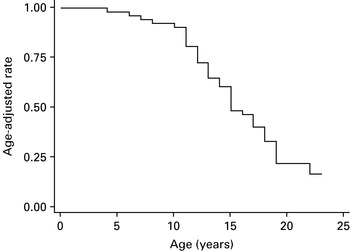
As depicted in Fig. 1, by 25 years of age, ODD was estimated to persist in 16.6% of the ODD group at a full (10.8%) or subthreshold (5.8%, at least half of the symptoms required for a full diagnosis) level, compared to 36.1% (32.5% full and 3.6% subthreshold) of the ODD+CD group [hazard ratio (HR) 2.2, 95% confidence interval (CI) 1.2–3.9, p=0.01] (Fig. 1).
Persistence of oppositional defiant disorder (ODD) (full or subthreshold) by diagnostic status defined at the 4-year follow-up in subjects with attention deficit hyperactivity disorder (ADHD). —–, ODD (n=52); · · · · ·, ODD+CD (n=30) (p=0.01).

Symptoms of ODD at the adolescent assessment and young adult follow-up
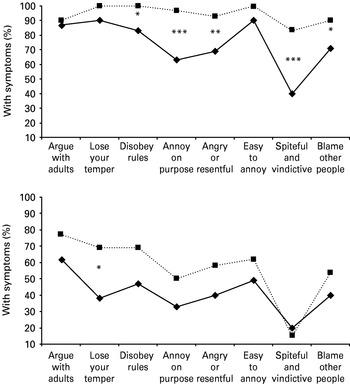
As shown in Fig. 2a, at the 4-year follow-up assessment the ODD+CD group had significantly higher rates of ODD symptoms ‘Disobeys Rules’, ‘Annoys On Purpose’, ‘Often Angry/Resentful’, ‘Often Spiteful/Vindictive’ and ‘Blames Other People’ compared to the ODD group. At the 10-year follow-up, the ODD+CD group had a significantly higher rate of the ODD symptom ‘Often Loses Temper’ (Fig. 2b).
Symptomatic picture of oppositional defiant disorder (ODD) by conduct disorder (CD) status in subjects with attention deficit hyperactivity disorder (ADHD) at (a) the 4-year follow-up and (b) the 10-year follow-up. —◆—, ODD (n=52); · · · ·■· · · ·, ODD+CD (n=30) (* p⩽0.05, ** p⩽0.01, *** p⩽0.001).

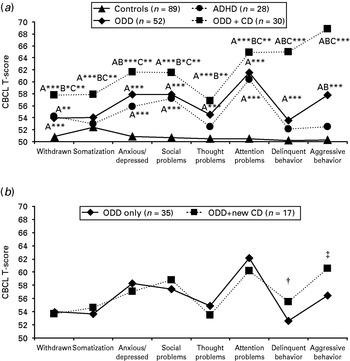
Meaningful differences between the groups were also observed in the CBCL profiles at the 4-year follow-up assessment. With the exception of the CBCL clinical scale ‘Thought Problems’, the ODD+CD group had significantly higher t scores on all CBCL scales when compared with the three other groups (Fig. 3a, all scales p<0.05). By contrast, ODD was associated selectively with a significantly higher t score in the CBCL ‘Aggressive Behavior’ scale when compared with ADHD subjects (p<0.001). Further examination of CBCL findings at the 4-year follow-up assessment revealed that CBCL scores differed significantly between ODD subjects who subsequently developed CD at the 10-year follow-up (n=17) and those who did not (n=35), with higher t scores in the CBCL ‘Delinquent Behavior’ and ‘Aggressive Behavior’ scales significantly predicting subsequent CD (55.5±6.3 v. 52.6±3.9, Cohen's d=0.62, p=0.04 and 60.6±6.9 v. 56.5±5.5, Cohen's d=0.68, p=0.03, respectively, Fig. 3b).
Child Behavior Checklist (CBCL) profiles at 4-year follow-up in attention deficit hyperactivity disorder (ADHD) subjects with and without oppositional defiant disorder (ODD) and conduct disorder (CD) and Controls: (a) by diagnostic status at 4-year follow-up. A=v. Controls, B=v. ADHD, C=v. ODD (* p⩽0.05, ** p⩽0.01, *** p⩽0.001). (b) Subjects with ODD at 4-year follow-up who did (ODD+CD) and did not (ODD only) develop CD at 10-year follow-up († p=0.045, ‡ p=0.03).

Psychiatric outcomes in ODD youth at the 10-year follow-up assessment
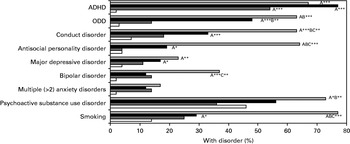
As mentioned above in the Method, psychiatric outcomes at the 10-year follow-up were defined as satisfying full DSM-IV diagnostic criteria on the structured diagnostic interviews during the time from the 4-year follow-up assessment until the 10-year follow-up assessment (interval diagnosis) (Fig. 4). The presence of CD at the 4-year follow-up assessment was selectively and significantly associated with an increased risk for psychoactive substance use disorders (any alcohol abuse, alcohol dependence, drug abuse, or drug dependence) (v. ADHD and Controls) and bipolar disorder (v. ODD and Controls) at the 10-year follow-up. By contrast, ODD by the 4-year follow-up assessment significantly increased the risk for ODD (v. ADHD and Controls) and major depressive disorder (v. Controls) by the 10-year follow-up assessment. Although both ODD and CD were associated with an increased risk for CD [odds ratio (OR) 6.2, 95% CI 2.2–17.5 for ODD; OR 28.4, 95% CI 8.0–100.5 for CD], antisocial personality disorder (OR 4.5, 95% CI 1.1–18.2 for ODD; OR 30.9, 95% CI 6.9–139.2 for CD) and smoking (OR 2.6, 95% CI 1.1–6.4 for ODD; OR 17.5, 95% CI 5.7–54.3 for CD), CD conferred a significantly larger risk for these outcomes than ODD.
Diagnoses during the interval between 4-year and 10-year follow-ups in attention deficit hyperactivity disorder (ADHD) subjects with and without oppositional defiant disorder (ODD) and conduct disorder (CD) and Controls. A=v. Controls, B=v. ADHD, C=v. ODD (* p⩽0.05, ** p⩽0.01, *** p⩽0.001). □, Controls (n=89); , ADHD (n=28); ■, ODD (n=52);
 , ODD+CD (n=30).

Functional outcomes in ODD subjects at the 10-year follow-up assessment
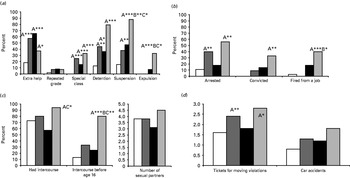
Although both ODD and CD were associated with higher rates of school suspensions, the risk was much higher in subjects with CD (Fig. 5). In addition, CD was selectively associated with having been expelled from school, convicted of a crime, and fired from a job at the 10-year follow-up. Subjects with CD were also more likely to have had sexual intercourse and also to have had sex before the age of 16 years. However, both the ADHD and ODD+CD groups were at increased risk for receiving traffic tickets for moving violations compared to controls. There were no significant differences between the ADHD and ADHD+ODD groups.
Functional outcomes in controls and attention deficit hyperactivity disorder (ADHD) subjects with and without oppositional defiant disorder (ODD) and conduct disorder (CD): (a) school outcomes; (b) legal and employment problems; (c) sexual history; (d) driving history. A=v. Controls, B=v. ADHD, C=v. ODD (* p⩽0.05, ** p⩽0.01, *** p⩽0.001). □, Controls (n=89);, ADHD (n=28); ■, ODD (n=52);, ODD+CD (n=30).

Discussion
In a systematic investigation of the long-term longitudinal course of ODD in the context of ADHD from a 4-year follow-up assessment to a 10-year follow-up assessment, we found that, compared to youth without ADHD, ODD (in the absence of CD) increased the risks over the long term for major depression and ODD. By contrast, CD was selectively associated with significantly increased risks for psychoactive substance use disorders, smoking, and bipolar disorder. These findings suggest that the greatest burden of adverse outcomes among ADHD youth with ODD occurs among those that have CD.
The rate of persistence of ODD into young adult years was much lower than that reported in our work and others into adolescent years (see Fig. 1) (Biederman et al. Reference Biederman, Faraone, Milberger, Garcia Jetton, Chen, Mick, Greene and Russell1996b; Whittinger et al. Reference Whittinger, Langley, Fowler, Thomas and Thapar2007). These results suggest that ODD will continue to wane in a sizeable number of youth with ADHD over the long term. Our results showing that ODD was more persistent in the context of CD confirm previous reports that the severity of ODD symptoms influences the stability of this disorder (Cohen et al. Reference Cohen, Cohen, Kasen, Velez, Hartmark, Johnson, Rojas, Brook and Streuning1993).
The current findings that ODD in ADHD subjects at the 4-year assessment modestly increased the risk for CD and antisocial personality disorder at the 10-year follow-up assessment are consistent with other studies showing that some children with ODD will later progress to CD (Rowe et al. Reference Rowe, Maughan, Pickles, Costello and Angold2002; Whittinger et al. Reference Whittinger, Langley, Fowler, Thomas and Thapar2007). Although some theoretical conceptualizations of disruptive behavior disorders have proposed that ODD is a developmental precursor to CD (Loeber et al. Reference Loeber, Burke, Lahey, Winters and Zera2000a), the present results, as well as our previous work (Biederman et al. Reference Biederman, Faraone, Milberger, Garcia Jetton, Chen, Mick, Greene and Russell1996b), show that the majority of subjects with ADHD and co-morbid ODD will not progress to CD.
Although our results suggest that ADHD in the absence of ODD or CD does not predict antisocial outcomes, those results must be viewed with caution, given the small number of ADHD subjects without co-morbid disruptive behavior disorders (n=28). The literature on this topic has been mixed. Some longitudinal prospective studies of clinic-referred children have suggested that childhood ADHD predicts later antisocial behavior (Taylor et al. Reference Taylor, Chadwick, Heptinstall and Danckaert1996; Mannuzza et al. Reference Mannuzza, Klein, Abikoff and Moulton2004) whereas others have suggested that childhood ADHD only appears to be a risk factor for adolescent CD when childhood conduct problems are also present (Loeber et al. Reference Loeber, Green, Keenan and Lahey1995; Lahey et al. Reference Lahey, Loeber, Burke and Applegate2005). Taken together, these findings are consistent with the developmental model for antisocial disorders proposed by Loeber & Keenan (Reference Loeber and Keenan1994) that suggests that only those children with ADHD who also exhibited co-morbid childhood-onset disruptive behaviors disorder would subsequently develop CD.
Notably, only CD was selectively associated with bipolar and psychoactive substance use disorders (PSUD), smoking, having been expelled from school, having been convicted of a crime, having had sexual intercourse before the age of 16, and having been fired from a job. Considering the well-established association between childhood CD and later substance use (Schubiner et al. Reference Schubiner, Tzelepis, Milberger, Lockhart, Kruger, Kelley and Schoener2000; Burke et al. Reference Burke, Loeber and Lahey2001), the emergent literature linking CD with bipolar disorder in youth (Biederman et al. Reference Biederman, Mick, Wozniak, Monuteaux, Galdo and Faraone2003), and the well-documented association between CD and subsequent antisocial personality disorder (APA, 1994), the selectivity of these associations indicates that these severe adverse outcomes in youth with ADHD and co-morbid ODD are driven by CD and not ODD. Questions remain as to the developmental course of CD and these co-morbid disorders. For example, CD may simply be a risk factor for an independent co-morbid substance use disorder, or the remittance of overt CD symptoms and the onset of substance use into adult years may indicate the heterotypic continuity of these disorders. We note that the high rate of PSUD found across all four groups was driven mainly by elevated rates of alcohol abuse, which may reflect the high risk for binge drinking in young adults in this age range (Wechsler et al. Reference Wechsler, Lee, Kuo and Lee2000; Biederman et al. Reference Biederman, Petty, Wilens, Fraire, Purcell, Mick, Monuteaux and Faraonein press). The finding that ODD symptoms were more frequent in subjects with CD than in subjects with ODD extends previous reports documenting similar results (Biederman et al. Reference Biederman, Faraone, Milberger, Garcia Jetton, Chen, Mick, Greene and Russell1996b). Also consistent with earlier findings are the CBCL results showing that ODD subjects with CD could be distinguished from ODD subjects without CD by their markedly more severe CBCL profile. Equally important is the result showing that ODD subjects without CD selectively differed from ADHD subjects without ODD on the CBCL Aggressive Behavior scale. This finding is consistent with previously reported findings documenting the selectivity of the Aggressive Behavior scale of the CBCL for the identification of ODD cases (Biederman et al. Reference Biederman, Ball, Monuteaux, Kaiser and Faraone2007). It is also noteworthy that CBCL scores differed significantly between ODD subjects who subsequently developed CD at the 10-year follow-up and those who did not by the higher scores of Delinquent and Aggressive Behavior at the 4-year assessment. Considering the severe prognosis of CD, the ability to distinguish ODD subjects with and without CD by the magnitude and severity of their ODD symptoms and their CBCL profile is of high clinical significance.
Although the rate of major depressive disorder (MDD) was numerically much higher in ODD than in ADHD subjects, and statistically higher than in Controls, statistical significance could not be established in comparisons between subjects with ODD and those with ADHD, perhaps due to limited statistical power. However, the higher rate of MDD in ODD subjects relative to Controls by the 10-year follow-up extends previously reported findings by Greene et al. (Reference Greene, Biederman, Zerwas, Monuteaux, Goring and Faraone2002) in a cross-sectional pediatric sample that also found a strong association between ODD and MDD. These findings are also consistent with those recently reported by Brotman et al. (Reference Brotman, Schmajuk, Rich, Dickstein, Guyer, Costello, Egger, Angold, Pine and Leibenluft2006) on the longitudinal course of children with ‘chronic irritability and hyperarousal’ (also termed severe mood dysregulation or ‘SMD’) using data from the Great Smoky Mountains Study, a longitudinal epidemiological study. Because items used to generate SMD criteria were largely derived from the modules on ADHD and ODD from the Child and Adolescent Psychiatric Assessment used in that study, what is termed by these investigators as SMD appears to be largely consistent with ADHD plus co-morbid ODD using more standard DSM-IV-based nosology. In fact, the most common DSM-IV diagnoses among SMD children were ADHD (26.9%), CD (25.9%) and ODD (24.5%). In young adulthood, youth who met criteria for SMD in the first wave (mean age 10.6 years) were significantly more likely to be diagnosed with a depressive disorder (OR 7.2) than youth who never met criteria for SMD. Future research should disambiguate the temporal relationship between ODD and MDD in children.
The compromised course associated with ODD in later years is consistent with findings from a recent study by Harpold et al. (Reference Harpold, Biederman, Gignac, Hammerness, Surman, Potter and Mick2007). This study found that 30% of referred adults with ADHD and co-morbid ODD in childhood continued to have ODD in adulthood regardless of co-morbid CD, and adults with ODD were also at risk for more compromised outcomes.
Our findings need to be considered in the light of some methodological limitations. Because our sample was referred, results may not generalize to ADHD children in the general population. Referred cases have been described as having potentially differing clinical characteristics (e.g. chronic course, high co-morbidity) from cases in the population (Berkson, Reference Berkson1946). However, our results are likely to generalize to ADHD children seen in pediatric and psychiatric settings. Similarly, because our sample was male and Caucasian, the results may not generalize to females and other minority groups. Our sample was ascertained using DSM-III-R criteria, so the results may have differed had we used DSM-IV. However, considering the very high overlap between the two definitions (93% of DSM-III-R cases received a DSM-IV diagnosis; Biederman et al. Reference Biederman, Faraone, Weber, Russell, Rater and Park1997), any effect should be minimal. Our ascertainment criteria precluded the ability to test the effect of ADHD subtype on the outcome of subjects with ODD or CD. For example, subjects with ODD and only inattentive ADHD may have a different outcome than those with ODD and hyperactive/impulsive or combined type. Because of the small number of subjects in the ADHD and ODD groups, we had low power for statistical comparisons. The use of over 50 statistical tests in our analysis increases the likelihood of Type I errors, so marginally significant findings should be interpreted with caution.
Despite these limitations, this systematic investigation of the 10-year longitudinal course of ODD found that the greatest burden of psychiatric co-morbidity and psychosocial dysfunction seen in ODD in ADHD youth grown up was accounted for by those cases that progress to CD. However, in the absence of CD, ODD appeared to increase the risk for major depression over the long term. Because these numerical differences did not separate statistically from other cases of ADHD, definitive conclusions await subsequent research with larger samples of ADHD and ODD in the absence of CD.
Acknowledgments
This work was supported in part by grant RO1 MH41314-07 from the National Institute of Mental Health, Bethesda, MD (Dr Biederman) and by grant support from Shire LPC (Dr Mick).
Declaration of Interest
Dr J. Biederman receives/d research support from, is on the speaker's bureau for, and/or has an advisory/consulting relationship with the following sources: Shire, Eli Lilly, Pfizer, McNeil, Abbott, Bristol-Myers-Squibb, New River Pharmaceuticals, Cephalon, Janssen, Neurosearch, Stanley Medical Institute, Novartis, Lilly Foundation, Prechter Foundation, Astra-Zeneca, Forest Laboratories, Glaxo-SmithKline, UCB Pharma, Inc, NIMH, NICHD, and NIDA. Dr S. V. Faraone receives/d research support from, is on the speaker's bureau for, and/or has an advisory/consulting relationship with the following sources: Eli Lilly & Company, McNeil Pediatrics, Novartis, Shire Laboratories, NIMH, NICHD, and NINDS. Dr E. Mick receives/d grant support from the following pharmaceutical companies: McNeil Pediatrics, Shire LPC, Pfizer, and NIMH.