Introduction
One of the most striking changes in the study of colonial India's social history over the last two decades lies in the intensified scrutiny directed at the position of women in colonial society and its significance for social reform and nationalist movements.Footnote 1 Discussion here has extended well beyond conventional ‘women's history’ approaches to take in gender relations in wider settings: social reform and nationalism; new class, caste, and religious community identities; cultures of the body and martial masculinity; and gender identities within the new print cultures of colonial India.Footnote 2 Nonetheless, we still have relatively little understanding of how colonial social change affected men's experience as men and their gendered responses to challenges posed to older forms of domestic, community, and political authority. This is in part because, as a number of scholars have observed, the study of ‘masculinity’ presents particular conceptual and evidential difficulties. Conceptual difficulties often accompany the study of social and political arenas where men's activities are not apparently ‘gendered’ and men appear to be the natural ‘ungendered’ subjects of history. Difficulties of evidence arise because men rarely explain their own experiences with direct reference to their own or others’ identities as men.Footnote 3
One way past these problems may lie in the development of small-scale and fine-grained studies of a kind that will enable us to look closely at men as historical subjects and agents in their own communities. The present article sets out to do this in the case of the Muslim communities of a small North Indian town during the early decades of the twentieth century. Bijnor was home to a long-running community newspaper, Madinah, whose pages offer us a series of unique insights into how its male editors and contributors thought about themselves as fathers, husbands, heads of households, lovers, workers, and political agents. Readings of male contributions to Madinah reveal curiosity and pleasure, pride in the educational attainments of some Muslim women, anxiety about some of their new public roles, and above all a deep ambivalence about the challenge to older norms and structures of family authority implied in these new relations. Perhaps most interestingly, male contributors to the newspaper sometimes assumed the voices of women in order to represent what they took to be a ‘female’ perspective on contemporary social change. These contributors drew on the older literary and poetic forms of rekhti in the construction of their ‘female’ voices, thus evoking an older cultural world of Islamicate urban sociability in which playfulness and hybridity remained essential aspects.Footnote 4 Scholarship has not yet analysed the significance of men mediating the female perspective in Urdu newspaper print, beyond describing it as a practical response to the dearth of female authors, a way to encourage female participation, or as a tactic to trick housewives into obeying reformist advice.Footnote 5
As much scholarship has observed, the spread of printing technology aided the emergence of a new middle class from among the ashraf Footnote 6 in post-Mutiny British India.Footnote 7 A concomitant shift of Islam from state sponsorship to the private realmFootnote 8 inspired an emphasis on manners over nobility of birth; this concern with comportment and the domestic sphere fostered a new genre of reformist literature for women.Footnote 9 While previously Islam had been associated with state power, after India came under the direct rule of the British empire 1857, Islam's state dimensions rapidly diminished. Muslims therefore needed to relate religion to public identity in different ways; while Islam of course retained public dimensions, the heart of reform remained internally focused. This inward turn inspired increased attention to the domestic sphere.Footnote 10 It was in this setting that vernacular newspapers such as Madinah assumed a vital new role in dispensing moral and social advice to their Urdu-speaking readership, male as well as female. Close study of this advice, and the voices in which it was delivered, opens up new insights into the range of emotions that these small-town and middle-class readers felt as they viewed the challenges of colonial social change. Social reformist advice directed towards women turns out to be, in this context, an important source of insight into the world of its male authors. As Pernau has argued in the context of the transformations of Delhi's middle classes post-1857, looking more closely at the emotional responses cultivated by language, convention, and social practices can contribute to a history of emotions.Footnote 11
Four principal themes emerge from the close reading of Madinah presented here for the period 1912 to 1922, a period when Muslim social and political identity underwent dramatic transformations in light of internal conflicts within the Muslim League and the rise of the Khilafat Movement. First, Madinah showed that hybridity and playfulness remained present in reformist writings by men about women, complicating authors’ relationships with those writings. Second, Madinah fostered a sense of shame among men unable to control uneducated women. While unreformed language remained a source of artistic expression and even entertainment, ultimately women's unpolished language threatened men with a diminished class and spiritual status. Third, the newspaper framed reports of women warriors fighting in the Italo-Turkish War of 1910–1911 and later the Balkan Wars to shame men into acts of courage. Finally, curiosity and pleasure regarding women's habits and bodies emerged. Threaded through each of these expressed and cultivated emotions was the presence of the newspaper as a new confessional space, offering anonymous intimacy among its readers. Ultimately the paper captured an ambivalence between curiosity about the world of women and men's duty to regulate the reputation of Islam.
Madinah and the women's page
The Madinah newspaper, published by Majid Hasan, became one of the most influential newspapers in North India within a decade of its inception in 1912. Hasan was educated in a Lahore madrasa and worked as a journalist there. In 1910 he returned to his hometown, Bijnor, in the United Provinces to assist in maintaining the family paper, Sahifa. By 1912 he had sold his newly wed bride's jewellery and started his own publication, which he dreamed would eclipse the old family paper, just as a full moon outshines a thin crescent moon.Footnote 12 His dream became a reality. By 1922 Madinah circulated more copies on a bi-weekly basis than any other nationalist, Indian, or English-language paper of the period.Footnote 13
Madinah published a women's section, entitled Akhbar-i Nisvan, in the 1910s and 1920s. The women's section included editorials, short stories, poems, advertisements, and news items targeted at sharif – noble – women.Footnote 14 Men always edited and often authored columns.Footnote 15 Creative pieces and editorials in Madinah appeared under takhalluses (pen-names), where the gender was unclear, or under the names of male relatives, a common practice in a period of low female literacy and persistent taboos against women publishing written work. Madinah presented its women's page as a literary haven, offering sharif ladies access to the lives of Muslim women beyond the walls of their own courtyards. Similar to a physical zenana (the women's quarters of a house), the paper identified itself as a space ostensibly for women, with one significant contrast to its literal counterpart: in Madinah, as with many reformist publications of its day, many of the ‘female’ contributors were men. In many cases overtly, in some cases covertly, men wrote in the voices of women.
Editorials and creative pieces featured in this ‘women's newspaper’, while political news items and advertisements related to women appeared in the general section. Akhbar-i Nisvan was usually placed at the end of each issue just before the advertisements; its title varied, or was omitted. The column stated its intention to entertain and instruct honourable Muslim women by publishing stories, editorials, and poems.Footnote 16 Although the newspaper officially targeted all Indian women, it focused on the community, rituals, and history of Islam. Whenever an issue was pressed for space, the women's section was omitted. Sometimes articles on women's issues appeared in Akhbar-i Nisvan, but increasingly discussions of women appeared in the main section of the paper. Madinah also published explicit discussions about men's lives in the form of fatwas, editorials, and guest columns in the main section of the paper. Some editorials spoke directly about the adab (courtesy) and akhlaq (virtue) of men.Footnote 17 These focused on observance of Islam and practical manifestations of proper behaviour that avoided undue Westernization. While some writings in Madinah commented directly on how men should act, ultimately conversations about women's behaviour occurred more frequently and took greater prominence.Footnote 18 Furthermore, writings on women, unlike fatwas, were oriented on a gender matrix, where gender became the primary identity signifier. Men's mediation of women's issues in all sections of the newspaper offers a new tool to understand masculinity.
The women's section in context
While scholarship on Urdu ladies’ home journals has focused on their female audience, men often edited, contributed to, and commented on reformist writings for women.Footnote 19 Madinah's women section also would have been read and contributed to by men.Footnote 20 In the decade preceding and following the founding of Madinah, at least seven prominent women's periodicals began publication, demonstrating a greater penetration of publishing technology as well as an interest in reforming gender as a crucial piece of the new moral order. The ‘big three’ women's periodicals, all founded and controlled by men, inspired other women's publications. Mumtaz ‘Ali, who worked with his wife, Muhammadi Begum, started Tahzib un-Nisvan in 1898 in Lahore. Shaikh Abdullah and his wife, Wahid Jahan Begum, of Aligarh founded Khatun in 1904 (it ceased publication in 1914). Rashidul Khairi's Delhi literary journal ‘Ismat first appeared in 1908, five years before Madinah's first issue. Khairi wrote in women's voices, sometimes signing his entries with his own name, and at other times signing his entries with women's names.Footnote 21 Like the ‘big three’ papers, Madinah included a masala, or mix, of creative and instructive material, including news, creative works, and practical instruction on domestic matters.Footnote 22 As with Khatun and ‘Ismat, Madinah's all-male editorial team wrote some contributions and signed their work using women's names.
Majid Hasan, by including a women's section in his paper, tapped into the popular trend of publishing articles for the benefit and improvement of women. He also sought to encourage female participation in the newspaper. Even the name Akhbar-i Nisvan mimicked the names of periodicals such as Tahzib un-Nisvan and Akhbar un-Nisa.Footnote 23 Urdu ladies’ journals sought to counter the isolation of the zenana by creating publications that transcended the boundaries of pardah.Footnote 24 At the same time, women's sections exposed male participants to conversations about women's domestic lives.
Reformist novels by Nazir Ahmed, Rashidul Khairi, and even the Majalis of Khwaja Altaf Hussain Hali emphasized the role of men as leaders and regulators. Rashidul Khairi, a novelist who took up the mantle of Nazir Ahmed in the early twentieth century, emphasized the role of each woman as a safeguard for the soul of the Muslim community. Khairi affirmed the role of men as the protectors of women's rights in popular works such as Tafsir-i ‘Ismat and Hashmat while remaining critical of women's efforts to request those rights.Footnote 25 Hali's Chup ki Dad and Majalis un-Nisa both exhorted women to reform their traditional domestic roles for the sake of the community.Footnote 26 Ashraf ‘Ali Thanawi's Bahishti Zeivar also influenced Madinah's approach to reform.Footnote 27 Like Hindi papers of the period, Madinah published conversations on pardah, widow remarriage, education, and child marriage intended to promote female ‘uplift’.Footnote 28 It also included inspiring historical accounts of famous female figures, including Hazrat Fatimah, the daughter of the Prophet, the Delhi Sultanate-period ruler Raziya Sultan, and Hazrat ‘Aisha, one of the Prophet's wives.Footnote 29
We know from contemporary conversations regarding authorship that men masqueraded as women in reformist writings, as this practice was the subject of some controversy. A contributor to Tahzib un-Nisvan accused ‘Ismat and Khatun of publishing ‘women’s’ contributions that were written by men. A response to this article, written by a woman named Rabi’a Begum, beseeched readers not to dismiss women's abilities to write excellent prose simply because the gender of a purportedly female author was uncertain.Footnote 30 Syed Ahmed Khan chastised an editor of an unnamed newspaper for knowingly publishing letters by a ‘woman’ when he suspected a man had written them instead; his unnamed friend evaded the issue in his response.Footnote 31 We should not use this practice as a means to undermine women's substantial contributions to reformist literature. At the same time we must consider the implications of men writing in women's voices, even though it is sometimes difficult to prove authorship in individual cases.
While Majid Hasan's own wife contributed only to the administration of the newspaper,Footnote 32 there is no evidence that she contributed to Akhbar-i Nisvan as Muhammadi Begum contributed to Tahzib un-Nisvan. Women who wrote articles could sign them with the name of a near male relative; at the same time ‘Mr’ could become ‘Mrs’ in the editing process.Footnote 33 While women certainly wrote for Madinah, articles signed with a female takhallus or simply the word khatun (lady) could also point to male authorship (see Figure 1).
Title page for the women's paper, including a reference to a poem by a ‘lady’. Source: Madinah, 22 January 1913.Footnote 35

It is sometimes difficult to be certain of authorial gender in reformist newspapers like Madinah, and this complicates our reading of them. Nevertheless, the tendency for major publications to adopt the practice of gender obfuscation calls for further consideration of men's involvement in reformist papers. What remains more important than proving the gender of authors in individual cases is the newspaper's cultivation of emotional responses among men.
Playing with women's language
The world of elite Urdu speakers before 1857 was populated by courtesans, elaborate mushairah (poetry recitations), and the grandeur of the courts of Awadh. Urban centres such as Lucknow, Lahore, and Delhi, as well as qasbahs Footnote 34 cultivated the patronage of poets; in this context a constellation of poetic genres emerged. One prominent genre in this solar system, rekhti, was characterized by hybridity and a playful approach to women's language, with men often writing in women's voices. Rekhti was the feminized form of rekhta, a form of verse belonging to the ghazal Footnote 36 genre which became popular in the seventeenth and eighteenth centuries.Footnote 37 The genre focused on women's lives and used exaggerated ‘female’ language, or ‘auraton ki zaban. In subject matter, Madinah demonstrated the influence of rekhti. Pleasure and playfulness also characterized reformist writings on women, although ultimately this was supressed in favour of reformist goals.
Initially, rekhti dealt with distinctly female subjects, and used idiomatic language associated with women isolated from broader society. While early forms of rekhti typically featured a female speaker uninterested in marriage or children,Footnote 38 later uses of begumati zaban (women's speech) indicated a focus on noble, married women.Footnote 39 This was reflected in the work of the poet Jan Sahib, who merged the genres of rekhti and rekhta, applying the female voice to issues unrelated to women.Footnote 40 I suggest that Sahib's use of rekhti to speak about general topics, rather than only women's issues, expanded the literary range of women's language. This in turn established a literary precedent for using women's voices in service of reformism. While rekhti was initially used to describe homosexual love, or gender-ambiguous passion,Footnote 41 Sahib's rekhti came to be more concerned with the domestic environment and complaints about marital life.Footnote 42 The rekhti genre disappeared after Sahib.Footnote 43 However auraton ki zaban or begumati zaban, an idiom central to the rekhti genre, continued to feature in reformist writings. In reformist literature, however, women's language indicated a lack of self-control and the need for reform.Footnote 44 The legacy of rekhti suggests that even during the reformist turn uses of women's language retained some aspects of playfulness and hybridity.Footnote 45 Just as Indo-Persian ethical constructs appeared reworked in the service of early twentieth-century condemnation of courtesans, rekhti's influence survived in some reformist literature.Footnote 46
Contributors’ tendency to use begumati zaban to access the female experience revealed the influence of rekhti.Footnote 47 In scholarship, a gap remains between the world of the mid nineteenth-century mushairah and conversations about women in the mid twentieth century. The assumption remains that there is no connection between male poets writing as women and reformists’ use of women's language, which sometimes employed the same playful tone found in rekhti. Madinah's use of begumati zaban demonstrated how reformist-influenced literature in some cases preserved its entertaining aspect, even in a reformist context.
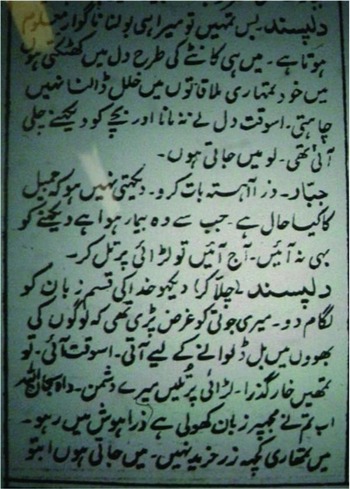
In one story, ‘Oh Just of the Most Just!’ (see Figure 2), a man named Jabbar took a second wife, whose name was Dilpasand or ‘Heart's Desire’.Footnote 48 She used colourful begumati zaban to manipulate her husband into neglecting his first wife, Halima. In this story begumati zaban highlighted Dilpasand's lack of education and showed playfulness. Dilpasand's tendency to indulge in rude bursts of idiomatic language marked her out to readers as unworthy of her husband's protection and love. In contrast, the first wife spoke formally in the language associated with educated men. For instance, she usually addressed her husband formally with ‘āp’, while Dilpasand was more casual, addressing him as ‘tum’. The interaction between the two wives below highlights Dilpasand's use of idiomatic women's language:
Dilpasand's tirade. Source: Madinah, 15 June 1912.

Halima [to Dilpasand]: Sister, why are you standing? Take that chair, sit down.
Dilpasand [who was irritated by Halima's invitation]: So it's on your invitation that I sit or stand. You aren't standing, and you have deceived everyone.
[Jabbar, understanding her sarcasm, became unsettled and looked at her.]
Dilpasand [to Jabbar]: You only get annoyed at what I say, that's it. I stick in your heart like a thorn. I don't want to disturb your meeting. I couldn't help myself, I came to see the boy. Look, I’m going.
Jabbar: Talk a little less hastily. You haven't seen the state of Jamal. Since he has been sick, you haven't been once to see him. Today you come, and start a fight.
Dilpasand [while leaving]: Look, check your hoity-toity language. Of course I just had to start a fight, I only came here to scrunch everyone's eyebrows up. I came only a moment ago, and I’m a thorn in your side. Full of a fight for my enemies. Wow, Glory to God, now you’ve really let me have it, just shut up for a second. I’m not your property. I’m going now, so you can all calm down.Footnote 49
Although Dilpasand was rude and erratic, she was a woman readers would have loved to hate. By the end of the story, Jabbar has divorced Dilpasand and she has disappeared. Her bawdy last words marked her fall from grace and the entertaining climax of the story.
Both men and women engaged in dramatic language. Madinah reprinted a dialogue between genders first published in a journal entitled Khatib. The feature, spaced out over a period of weeks, began with a contribution entitled ‘To Woman’, addressing women in a dramatic, accusatory tone:
Oh, Lord knows you encompass all the temptation to evil, and what limitless upheavals you have caused in the veil of providing tranquillity. I still remember your first ‘act of kindness’, when you took my left rib from my side.Footnote 50 And I didn't even know you were there at my side, occupying my peace and calm and privacy. Oh fraudulent prosperity! The first rivalry of Cain and Abel was the outcome of your display of glowing cheeks.Footnote 51
The male author accused women of violating the chastity of prophets, deceiving ascetics, and distracting devoted spiritual mendicants with a single twitch of the eyebrow.Footnote 52 The argument for women's moral depravity and deception was consolidated with Qur’anic anecdotes, and the exaggerated misogyny hooked readers with extreme views and pugnacious language. The response, ‘From a Woman’, written in similar colloquial language, was dictated to a male transcriber by an anonymous woman. The article written from the female perspective did not disappoint. It also used idiomatic and irreverent language, turning the male author's characterization of women's Qur’anic role on its head:
Hey, ungrateful one! Who was never embarrassed to deny realities, who never lost tolerance for his own audacity to cast away the truth from the world; look, don't remind me of those ‘achievements’ that are a source of pride and distinction for your false being, but for me are painful tales of the destruction of my gender . . . You will remember that even in the condition of being the master of an extensive atmosphere, the spring of paradise, you were sad and lonely. You were fed up with paradise. . . . when the angels conveyed this sadness and grief to God, then your lost comfort (that you were anxious for), your real contentment and peace (which no heavenly object could replace) was given to you as a reward, in the shape of me [emphasis added].Footnote 53
The language used to berate men was idiomatic, unpolished, and angry. As it was reportedly dictated to a man, the suggestion may have been that the female author could not write. She shamed men for their ignorance of women's pivotal role. Both articles addressed the opposite gender using the intimate pronoun ‘tu’, underscoring the passion of their positions. The hybridity of the language is striking, since it employs idiomatic phrases and marshals Qur’anic examples in the same breath:
You said I was the source of your operation on your left side, but you are not saying where your comfort in your original state came from. If biting the hand that feeds you wasn't your main purpose in life, if you were smart, if you had understood the value of it, you would have kept me by your side.Footnote 54
Playfulness remained embedded in reformist literature for women, preserving possibilities for pleasure in reformist writings among male readers. This playfulness also suggests a link between the genre of rekhti, its use of begumati zaban, and reformist writings. The alternately playful and pedantic tone of reformist writings in Madinah helps preserve ambivalence towards the reformist project.Footnote 55 In Madinah examples of playfulness were outweighed by more serious uses of language; curiosity about women and enjoyment of their distinctive idioms were ultimately supressed by shame at the lack of control begumati zaban could signify. More typically, reformist articles emphasized women's primary responsibility to teach their daughters to be good wives.Footnote 56 While Madinah demonstrated the potential for pleasure in inhabiting uneducated women's voices, ultimately the risk of shame that uneducated women posed was more compelling.
Shame: the harvest of ignorance
Madinah fostered pride among men for Muslim women educated in religious sciences, warning men of the risk of public shame if they did not support women's education, defined in various ways. This shame had two layers: the exterior layer was that of class shame, caused by individual behaviour that posed a risk to social respectability; the interior aspect was teleological, indicating behaviour contrary to the will of God for man. Madinah cautioned male readers against tolerating or enforcing feminine ignorance on threat of public judgement by other Muslims, by the English, and by God.
One article threatened men with public embarrassment if they did not acknowledge the significance of the role of women's education. The title of the article read ‘The perspectives [khayalat] of a “woman” in the garb of a fiery poem’.Footnote 57 The subtitle, joshaili nazm, or ‘fiery poem’, referred to its radical tone. In this example, the title ‘clothed’ the author in a female form of expression through the use of the word libas (clothes); the author may or may not have been a woman.Footnote 58 The signature ‘B. L. Hijab’ appends the end of the poem. The poem adopted the voice of women speaking directly to men:
The first half of the poem focused on what men and women stood to gain from women's education. Education enabled women to more effectively devote themselves to their husbands and God, and it offered an increase in civilization over generations, as women raised more enlightened children. The latter half of the poem adopted a more ominous tone, threatening embarrassment and even destruction to men who failed to see the import of women's education. The poem inspired pride among men who embraced women's education, and threatened men with shame if they failed to see its significance. Even though this poem appeared in the women's section of Madinah, it targeted male readers. Just as here the meaning of education remained vague, Madinah's contributors generally disagreed about the exact parameters of acceptable female education. Some editorials argued that women's education referred to basic religious principles and domestic duties, and discouraged education in reading and writing Urdu.Footnote 62 By publishing articles under women's names, however, Madinah seemed to encourage female participation in Urdu literary spaces. Education, even when vaguely defined, referred to women's knowledge of behaviours and practices that protected class status and spiritual health.
In the serial story ‘Oh, Just of the Most Just!’, women were sources of temptation to men, and uneducated women caused public disgrace to men who failed to control their desires.Footnote 63 In the story, Jabbar married a second wife without requesting the consent of his first wife, Halima.Footnote 64 Although Halima was a model wife, she had one ‘fault’—her education, which had fostered an enlightened mind and progressive ideals. In contrast, Dilpasand's lack of education caused her to be ignorant, rude, and cruel to Halima and Jabbar. The British repeatedly warned Jabbar to control Dilpasand. After Jabbar separated Halima from her son, at Dilpasand's request, the boy almost died, and only when an English doctor scolded Jabbar did he reunite mother and child. His son's health immediately improved. Later, an English nurse passed by the family house and heard Dilpasand haranguing her husband. The nurse suggested that Jabbar take his wife to a mental hospital and used Jabbar's home situation to discredit Muslims’ ability to participate equally in public life with Europeans. Finally, Dilpasand spent all of Jabbar's money on trinkets, bringing him to the brink of financial ruin. When Dilpasand had reduced Jabbar's social standing, he finally understood ‘the true difference between knowledge and ignorance’.Footnote 65 Without order in the domestic sphere, achieved through regulating women's language and behaviour, men could not achieve respectability in the British-dominated public.Footnote 66 Men, by failing to remain vigilant against the temptations of the uneducated woman, invited social shame. In the end Jabbar divorced Dilpasand and crawled back to Halima on her sick-bed. Conveniently, Halima immediately received news of a windfall inheritance, which she generously gave to her husband. Thus, Jabbar's social status was saved, and shame averted, by an educated woman.
In one article a self-appointed referee tried to broker a peace treaty between the sexes. The author posed as an angelFootnote 67 and discouraged men and women from attacking each other. Instead, the author claimed that men should cultivate awareness of their rights and obligations. They were guilty of forgetting their duty to protect women's rights of inheritance. On the other hand, women were encouraged by zan murid (wife-worshippers) to treat men like slaves. Balance was required, with the angel-author translating the surah: Footnote 68 ‘They [women] are clothing for you and you are clothing for them.’ This explication of the verse emphasized women and men's responsibility to shield each other from public shame at their nang, or nakedness. The fault of failure lay with men; they failed to respect Qur’anic injunctions to protect women's property but also encouraged women to disrespect them.
Just as it remained a man's duty to educate women, it was also his duty to protect women from public exposure. In one article, recounting a court case, a man summoned his wife and her mother to court after his wife's parents had refused to let her live with him. The husband showed the court that the wife had even written a letter to her husband, begging to be rescued or she would commit suicide. However, when the woman and her mother arrived in court the wife refused to go home with her husband. She accused her husband of bringing the entire family into disrepute by summoning her into a public court. The husband fainted in response; he had lost his wife forever. In his attempt to save her from an oppressive domestic situation, he had compromised her respectability. He no longer had a right to his wife's companionship because he had exposed her and her family to public scrutiny.Footnote 69
In some poems in Madinah's women's section, wives and mothers chastised men for imbuing them with too much value, which could lead to an improper indulgence. In one issue of Akhbar-i Nisvan, two male-authored poemsFootnote 70 appeared entitled ‘Little girl’ and ‘Mother’.Footnote 71 In the first poem the child sang a song of praise to her mother, followed by her mother's response. The child compared her mother to a flower, creating a season of spring in which her offspring grow:
The little girl in the poem was wrapped in the cocoon of the zenana and idealized the mother as a source of comfort. In response the mother warned her child not to put faith in the fleeting beauty of the flower, which fades quickly. The implied importance of the eternal beauty of spiritual paradise stood in contrast to the ‘treacherous’ flower:
The poem affirmed pride in the modest Muslim woman's high status through her humility.
The male author, writing as a mother, guided the child's love away from the mother and towards God's eternal comfort. The first poem invoked the peace of the zenana and hazy memories of childhood contentment. The second poem disabused not only the child, but also the reader, of the mother's sancitity. The verses both indulged in and questioned dependence on maternal love. Veneration of the world of women by men, either in the form of a doting son or a zan murid, posed as much of a risk as women's superstition and lack of education. In addition to reform, vigilance against the temptation of indulgence, passion, and sentimentalism were necessary to keep such risks in check.
Women as warriors, shaming men
The trope of the female warrior throwing off the veil of pardah in order to fight the enemies of Islam demonstrated the ambivalence inherent in male portrayals of women in Madinah. While accounts of women warriors emphasized their empowerment, the framing of their experiences served ultimately to affirm the traditional boundaries between genders. The female warrior first emerged in Madinah during the Balkan Wars of 1912 and 1913 and continued well into the First World War. While it is difficult to determine the provenance of the several ‘eye-witness’ accounts of women on the field of battle in the 1910s and early 1920s, what remained significant was the content and reception of the stories. Women warriors had become an obvious symbol of the courage and valour of the Muslim community, whose exact meaning depended on the responses of men. These women, by going so far beyond the constraints of what qualified as appropriate female behaviour, achieved mythical status. They had sacrificed traditional femininity for the glory of Islam and the Ottoman empire. If men responded to the example of women warriors with their own acts of bravery, the women were sources of inspiration; if men failed to rise to the occasion, women warriors became a source of shame. Even though female bodyguards or warriors had appeared in the Mughal context, they were lower-status women appointed to protect zenanas;Footnote 72 sharif women crossing those boundaries would have been more remarkable.
In one 1912 example, an anonymous male author described two Arab women—a young woman and her mother—fighting on the side of the Ottomans with their menfolk.Footnote 73 The two women had taken guns and gone out into the field of war to fight, and ‘with daring and bravery’ they fired on the enemy. Their feat was equated to the service of armoured cavalry soldiers. This equivalency may have inspired men to battle or instilled in them a sense of shame for their failure to contribute to the war effort. The women entered into the battle with little regard for their own safety. The young woman, unnamed, spoke to readers: as long as ‘enemies’ threatened to take away her country, there could be no fear of death. She said, ‘It is better if we die and our country live, than for us to live and our country fall into the hands of the enemy.’ Their risk ended in tragedy. The old woman was hit by a bullet, telling her daughter, ‘I have already given three sons to this war. And now I too happily go to God.’ The old woman encouraged her daughter to sacrifice herself for her country; only when she had given all her children to the country's cause would she feel at peace. The old woman's sacrifice inspired nationalist fervour in the author. The women had transcended boundaries of ‘proper’ female behaviour to encourage male valour in service of Islam.
The old woman also pushed her son to fight, forbidding him to retreat, ‘because you are the son of those ancestors who quickened the history of our country with brave deeds’. Hearing these words the son became brave again and ‘his steps grew faster’. He joined his sister, who had put on men's clothes, in battle against the Italians. Seeing piles of Italian corpses, she said, ‘I could not explain how happy it made me. I embraced my brother and began to cry tears of joy.’ The woman found a visceral energy from the sight of Italian bodies. I suggest the ecstasy she experienced at the sight of death provided an emotive link between readers and the soul of the qaum,Footnote 74 both shocking and inspiring men to action.
In a 1912 Eid commemoration issue, a prose piece purportedly penned by a woman in Tripoli appeared.Footnote 75 The title read: ‘Dear crescent! Doubtless, the key to the heart's delight of believers.’ The woman had remained on the field of battle after her husband fell victim to Italian soldiers. The holy sign of Eid—the moon—was her only companion. She mourned the loss of her husband:
My husband—the oppressed—has already fallen victim to Italian soldiers—I have been smeared with his blood, stacked his corpse on my shoulder [to carry it] from the field of battle, I have already buried it. Oh, his moonlike face drifts before my eyes and his black locks, turning into snakes, are returning to my heart.
Even in her suffering, the moon remained consistent. The corpse of her husband, in its pale, clammy state, became the sign of a sacred spiritual moment. The style of prose mimicked a marsiyah,Footnote 76 in which the speakers’ mourning facilitates spiritual access to the divine.
Not all women who participated in war emerged victorious in Madinah, or were allowed to fight. These failures reaffirmed female physical weakness and shamed men into support for the qaum. According to a male-authored account from the Italo-Turkish War, a noble woman entered the field of battle on August 1912.Footnote 77 As a result, the Italians set her hair and hat on fire. The article deplored the killing of the woman by the Italians as a sign of moral corruption, since ‘such a powerful Sultanate as Italy did not shrink away from attacking a woman’. In another article, a group of women attempted to bring water to soldiers. The women tried to fight—in this instance they were not permitted to do so by male soldiers. The women were no less mujahidin, or warriors, in their actions, according to the article, since they faced great risk in bringing water to the thirsty soldiers.Footnote 78 Accounts of female warriors shamed men into enthusiastic support for the Ottoman cause, offering an implicit comparison between women warriors and emasculated men unwilling to make the ultimate sacrifice.
Accounts of women warriors in Madinah emphasized the physical pleasure a woman took in the death of her enemies, as well as her pain at the death of Muslim soldiers, inciting male soldiers to action. In one instance, a correspondent recounted the engagement story of a Turkish woman, who would only assent to marriage if her young man stole 50 Italian cannons and brought them to her. As meher,Footnote 79 the judge demanded the corpses of 50 Italian soldiers. The woman's husband admired her commitment to the national cause, fulfilling her requirements by stealing the requisite number of cannons. At the time of his wedding he had already killed 20 Italian soldiers, and when he was interviewed ‘there [were] only thirty Italian soldiers left to kill’. His wife pushed him to fulfil his role as warrior.
Madinah also explicitly used praise of women warriors to shame male readers. The article recounting the sacrifice of an old woman and her daughter wondered ‘what level the condition of men has come to when women have taken on half the role of men’.Footnote 80 A woman was permitted to step out of the home in order to be used to spur men onwards to brave deeds, but the exceptional nature of her sacrifice ultimately affirmed the unnatural nature of the role reversal. The warrior women portrayed in Madinah stepped beyond the curtain separating the genders, allowing male readers the rare vicarious experience of female passion and power. The female warrior vibrated with conviction. But at the same time, her transgressive, nearly limitless power remained contained by its purpose—to demonstrate to men their own failings.
Even the ‘women’ who defended pardah from its detractors in Madinah presented their defence as a battle against the enemies of Islam. These accounts formed a bridge between stories of literal battles and accounts of more abstract battles to protect Muslim identity; men were honour-bound to protect both. One poem appeared entitled ‘Women's Pardah’.Footnote 81 The male-authored poem was written in a female voice, and spoke against those who wished her to abandon pardah.
They kept telling me, the devil's place is rest and repose
But I never took a step outside my house
I was born in pardah
And I am in pardah still.
Living in pardah I gained consciousness
In pardah rest and comfort comes easily
. . .
Can there be any worry in pardah, why would you leave it.
. . .
If there were no pardah a storm would hit
The speaker clung to pardah's protection from the storms of life. The language idealized the convention of maintaining pardah and valorized its defenders as heroes in the battle to preserve Islam.Footnote 82
Looking at women who had gone beyond what was expected of them in the face of a foreign threat clarified the boundaries of community. These examples had as much to do with men's experiences, and the norms they generated, as they did with the actions of women. The imagery of the warrior woman capitalized on the radical shoring up of the domestic sphere. By implication, the threat inspiring such a rebellion against propriety must be great indeed. This Muslim woman, who stepped outside of the zenana only by necessity, stood in contrast to European culture in Madinah, where according to this perspective the proper order of genders had been dramatically reversed.
Bahar ki ‘aurat: European women and Muslim pride
In contrast to the ghar ki ‘aurat,Footnote 83 who embodied homeliness, domestic contentment, and motherhood, bahar ki ‘aurat Footnote 84 was an outsider who indirectly demonstrated the superiority of the Muslim domestic ideal. European women provided a negative contrast to the appropriate social roles laid out for Muslim women.
In Madinah, it was abnormal for a woman to fight for her country. When a woman stepped outside of the domestic sphere, she should have done so only in response to immediate danger. This model stood in contrast to that of Britain, where women joined the police force as a matter of course. Madinah reported women's entry into the British police force with concern.Footnote 85 While fictional women warriors were effective metaphors for resistance, making female participation the norm would unbalance gender norms. This account demonstrated ambivalence between an emphasis on women's rights in the context of Islam and the risks inherent in unchecked female empowerment.
Descriptions of European women also gestured toward voyeurism when shocking reports touched on potentially sexual subjects. In a report from a hospital in Glasgow, Scotland, where women increasingly worked alongside men, a male patient reported being examined by women.Footnote 86 He described arriving in a room where several female nurses asked him to strip nude before examining him, touching his back and other parts of his body. Other male patients in the same room experienced the same shocking treatment. Madinah tells the story as a nightmare scenario, in which authoritative women initiated the violation of physical boundaries usually policed by men. The inclusion of such a story in the newspaper was already sensational; the horrified tone of the author would have made the details of the nude examination even more exciting.
Sensational articles regarding foreign women cultivated pride among Muslim readers by characterizing Western woman as independent, strong-willed creatures with loose morals in comparison to Muslim women. Significantly, sensationalist stories featuring Indian women never appeared in Madinah. One article divulged details of the elopement of a high-status European woman and her actor lover.Footnote 87 Another reported the suicide of a prominent American socialite, and still another story reported a German man's suicide on the funeral pyre of his captivating sweetheart.Footnote 88 These stories offered entertainment while inspiring a sense of moral superiority among Muslims. A report emerged in Madinah of a foreign woman who married an Indian man in Britain. The court case arbitrated between the wife's accusation of neglect and abuse and the husband's accusation of infidelity. The judge found the accusation of infidelity sound, but awarded the wife the cost of the legal fees since she had been beaten at risk of her life. According to the judge's ruling, the man had a right to hit his wife, but not in such an extreme way. Madinah mocked the overly equitable method of the judge, asking sarcastically, ‘But we ask, does the woman also have the right to sometimes hit her husband in the same way?’Footnote 89 The Indian man had been emasculated by European courts, which not only prohibited him from beating his wife, but might even allow her to beat him instead. Madinah's male readers would have been able to enjoy the sensationalist reports of the moral depravity of European women as a method of cultivating pride in Muslim values; it may also have offered a way to sate curiosity regarding European immorality in the safe space of a Muslim forum. Lurking behind the sense of outrage at Europeans’ exaggerated equity was fear at the unchecked rise of women's legal rights.
Another article described demographic transformations in Europe, asserting that the decrease in the ratio of men to women in Europe reflected men's diminished value. In this view polygamy was the correct response to a surplus of women. In Europe, however, the demographic imbalance had translated into an exaggerated emphasis on the welfare of women over men. Prioritizing women over men was short-sighted in this analysis, since the role of men—specifically their power and organization—remained more pivotal to activities in the national sphere. The cause of the increase in male deaths in Europe, the article claimed, was ignorance and backwardness; it affirmed that education must increase to convince Europe of men's value over that of women. This article also sought to cultivate a pride among Muslims for their ability to preserve the ‘natural’ order of the genders and maintain an emphasis on male welfare.Footnote 90
Confessing curiosity and pleasure in Madinah
Many other articles in Akhbar-i Nisvan emphasized attention to female hygiene, a space that had previously been off limits. Reformist commentary in Madinah sought to impose standards on the mundane activities of women, including eating, drinking, sitting, and chewing paan;Footnote 91 these standards stood for both men and women. The women's newspapers instructed readers on general housekeeping, describing the health risks posed by flies and the necessity of keeping paan containers clean and organized.Footnote 92 The etiquette of eating also featured prominently. Women should sit with their feet covered, chew their food thoroughly, and only upon finishing drink a sip of water.Footnote 93 It was healthier to consume salty dishes before sweet things. After eating one should not sit or sleep in extreme heat or cold, although resting was recommended.Footnote 94 While these suggestions were gender neutral, Madinah also defended the right of reformists to comment on specifically female hygiene, women's sexual habits, and other private issues. We can see this in Zahin Karatpuri's editorials, which defended Thanawi's Bahishti Zeivar against accusations of obscenity, thus facilitating the removal of the discursive taboo on the intimate female space.Footnote 95 In practice, however, as the accusation of obscenity revealed, aspects of the woman's world remained as separate as ever. Newspapers, in their anonymous format, remained a method of learning more about the female experience, as well as regulating it.
Knowledge about sex was a source of concern for Madinah's male readers. In advertisements, science book publishers capitalized on this concern. Although ostensibly a guide to curing disease, one book, complete with colour illustrations printed in Paris, offered information about the distinction between male and female anatomy, sanitized with Western scientific terminology.Footnote 96 Other businesses claimed in advertisements to have cures for ailments ranging from kaji, or perversity, to namard, a lack of manliness or impotence.Footnote 97 Another advertisement offered a panacea for ‘weakness of lust, kidney disease, weak bladder, the inability to father sons, chronic constipation, backache, flatulence, problems with sperm intensity, the need for aphrodisiacs, perversity, weakness, seminal discharge, and other kinds of defects’. The advertisement, entitled ‘Lives of Men’, sung a litany of the serious medical difficulties that could affect masculinity.Footnote 98 Illustrated advertisements for aphrodisiacs (for use on wives only) also appeared, offering husbands the key to their wives’ affections.Footnote 99
Advertisements would appear on the page facing the women's newspaper and be repeated for weeks or months at a time. Curiosity about women's intimate spaces was visually juxtaposed with advertisements for impotence cures; the duty to regulate women's behaviour stood in tension with the risk of emasculation posed to men entering into women's private spaces.
Madinah's support of widow marriage also offered male readers a glimpse into the world of female desire. A poem entitled targhib-i nikah-i sani, ‘Incitement to re-marry’, encouraging widows to remarry, gestured toward the anatomy of female desire.Footnote 100 The poem was signed nasah, or ‘counsellor’, a pen-name indicating male authorship. A note on the genre of the poem, sho‘lah, or ‘flame’, referred to the passionate nature of the poem's content.
The analogy of hunger acted as a veiled reference for female sexual desire. The male counsellor reminded female listeners of their natural desires, and gave them permission to ‘eat’ according to those desires, by getting re-married when widowed. The vitriolic attitude toward the prohibition of widow remarriage affirmed the reformist position, seeking to eliminate external, Hindu influence.Footnote 102 More importantly in this context, the male author referred to widowed women's desires, opening a door to imagining female sexuality.
Other articles in Akhbar-i Nisvan focused on the clothing and daily experiences of women. An anonymously authored article ostensibly lauding women's charitable work in Makkah described the burqa's place in daily life in Makkah. The author described a scene in which burqas flooded the streets of Makkah during his visit, demonstrating the prevalence of Islamic modesty. He reported that burqa-clad women travelled easily throughout the city, avoiding harassment by curious men. Expressing wonder at the variety of burqa styles available, he expressed a desire to research further and to curate a museum display focusing on the burqa. With regret, he could not delve deeper into his research on burqas without the assistance of a woman.Footnote 103 The article emphasized pride in the cultural practice of the burqa, but also expressed an unfulfilled curiosity regarding the details of women's clothing.
Fatwa sections allowed men to request advice anonymously from notable Deobandi scholars; many of these questions related to women, and were confessional in nature.Footnote 104 In one letter, a man wrote to an ‘alim (scholar) asking about the adulterous wife of a ‘friend’. His wife had committed adultery and had become pregnant as a result. The man had divorced his wife, and wanted to know if his ex-wife should observe ‘iddat (the typical waiting period incumbent upon both widows and divorced women wanting to remarry); ‘iddat ensured the legitimacy of children in marriage. The scholar replied that ‘iddat should be observed, even though the woman was already pregnant with her lover's child.Footnote 105 Although the question focused on a technical aspect of personal law, the letter of enquiry dealt with a sensitive topic men may have felt uncomfortable broaching with their local ‘alim. Newspapers offered men an anonymous opportunity to ask scholars about delicate matters, augmenting the confessional character of the medium.
Conclusion
This article has considered how a fine-grained study of an early twentieth-century Urdu reformist newspaper illuminates male experiences of women's reform. Here, close study of this small-town Urdu readership turns out to offer valuable insights into the complex emotions evoked by colonial social change. The new confessional space of Madinah, at once intimate and anonymous, offered the newspaper's male readership a means to share their ambitions, fears, and anxieties, and to learn from each other's experiences. Within this space, advice ostensibly offered to, and sometimes ‘by’ women, provides us with important clues to the concerns of male readers and writers. How far were these developments shared across Urdu-speaking communities in other North Indian settings during the early decades of the twentieth century?
Madinah’s wide distribution across North India and Punjab, despite its small-town origins, indicates that its approaches were attractive to a broader Urdu-speaking public. Through its structure, content, and tone it remained in conversation with prominent reformist publications of the period, regularly republishing columns and responding to entries from newspapers published in Lahore, Lucknow, Delhi, and Bombay. As for men speaking in women's voices, the popularity of the work of Nazir Ahmed, Raishidul Khairi, and Mirza Farhatullah Beg, who used women's colloquial language to not only instruct but to express playfulness in the reformist context, indicates the meaningful role women's language served in reformist writing by men beyond this small-town paper.Footnote 106
Ambivalence also emerged as a trend in male reformist writing on women's education more broadly. For instance, while prominent Sufi and scholar Ashraf ‘Ali Thanawi had no objection to women reading and writing generally, he advised men to keep knowledge of writing from women who might abuse it.Footnote 107 Reformist concerns to educate women only enough to fulfil specifically circumscribed roles and to prevent the abuse of education in a way that would destabilize women's appointed social role were widespread. These concerns appear in the biography of Bibi Ashraf, a woman from a noble family who was forced to beg, borrow, and steal her writing lessons.Footnote 108 Conversations in the women's magazines Tahzib un-Nisvan, ‘Ismat, and Saheli revolve around the appropriate uses for education and are concerned to define the point of diminishing returns for men and women. Evidence in individual accounts and other publications orbiting in Madinah's galaxy indicate that the conversation occurring in Madinah was not idiosyncratic, but indicative of broad concerns among male reformists.
Madinah and its women's newspaper offered a confessional space in which men could express conflicting responses to the risks and benefits of reformism. Madinah cultivated shame among men unable to control uneducated women, or those who allowed women to act for them on behalf of the Muslim qaum. Pride in Islam and shame regarding weakness of the community were printed on two sides of the same coin of pride in Islam, while curiosity about the world of women was ultimately supressed by a sense of duty to regulate clear boundaries between genders. Women's idiomatic speech appeared in reformist writings as begumati zaban, no longer as an accessory to bawdy accounts, but instead as a way to demonstrate the necessity for reform. Elements of the playfulness of rekhti remained in Madinah, however, complicating its otherwise didactic tone. Ultimately, men stood on the edges of the women's quarters, struggling with contradictory impulses to patrol its boundaries and to listen in on women's lively conversations.