1. German liberalisation or dualisation? Contribution of the paper to the debate
There is general agreement among policy analysts that reform of the German social model since the 1990s has been extensive, but debates about the significance of these changes continue. For some commentators, such as Wolfgang Streeck, Germany has undergone a clear-cut liberalisation, judged by the reduction in the scale and scope of state provision, the greater role of non-state actors in welfare delivery and the increased emphasis on voluntarism (2009; also Howell, Reference Howell2006). Others, more sympathetic to the varieties of the capitalism framework (e.g., Carlin and Soskice, Reference Carlin and Soskice2008; Palier and Thelen, Reference Palier and Thelen2010; Emmenegger et al., Reference Emmenegger, Häusermann, Palier and Seeleib-Kaiser2012), have highlighted the varying extent and impact of the reforms for workers in different parts of the labour market. They argue that by largely preserving the privileged position of core workers in the German political economy, the reforms reinforce rather than liberalise the dualist features of welfare provision. Thus, while all workers have been affected by the changes, the low paid and insecurely employed have suffered the most; the gap in terms of status and protection between them and core workers has become wider. Theoretically, this debate is important because it reflects the ongoing disagreement between neo-institutionalists and their critics about the future of welfare capitalism in a globalising world. Do advanced capitalist systems remain on different distinct paths, which global pressures are likely to reinforce (Hall and Soskice, Reference Hall, Soskice, Hall and Soskice2001: 57), or is ever-increasing liberalisation the likely common future, especially for countries like Germany where market coordination has traditionally taken second place to corporatist forms?
In relation to Germany, this debate has focused on industrial relations, labour market change and the reforms to unemployment provision (Hartz IV). Thus, in industrial relations the position of core workers has largely been maintained, proponents of the dualism thesis suggest, because the decline in national-level bargaining has been at least partly predicated on company-level pacts in the core sector, which local labour representatives used to increase job security in return for productivity improvements (Palier and Thelen, Reference Palier and Thelen2010: 124). Likewise, labour market flexibilisation has not been a ‘unified’ process involving all workers; rather ‘those in “normal” employment relationships continue to enjoy multiple protections’ often on the basis of legal stipulations (2010: 127). Finally, despite the Hartz IV reforms, which reduced benefits for the long-term unemployed, core workers are less likely to become unemployed, both because of their skills and the employment protection agreements negotiated at firm level (2010: 120, 138, 139; Carlin and Soskice, Reference Carlin and Soskice2008: 26; Emmenegger et al., Reference Emmenegger, Häusermann, Palier and Seeleib-Kaiser2012; for a different view Clasen and Goerne, Reference Clasen and Goerne2011) making them less likely to require unemployment benefit. Thus, while in all three spheres of reform marginal workers have become significantly less protected and more insecure, the position of core workers has either not changed or worsened less than that of workers at the periphery of the labour market; the reforms thus pose no threat to the institutional complementarities on which the German system is based.
This paper makes two main contributions to this debate. First, it argues that consideration of pensions and of pension reform is essential for a proper assessment of the evolution of the German social model given the central role the pension system has played in the coordinated/conservative welfare state since 1957. Secondly, the paper estimates for the first time in a fully integrated way how the change in public, company and personal pensions, including taxation, has affected retirement income and whether the outcome is more characteristic of a dualised or liberal system. It does this by projecting future pension benefits for hypothetical individuals with employment biographies that represent core and marginal workers. Our core workers have a long-term career in manufacturing or finance, where wages are higher than in other sectors (Appendix 1), employment careers are normally longer and the coverage and generosity of occupational pension provision is better than elsewhere (Carlin and Soskice, Reference Carlin and Soskice2008: 4; also Rueda, Reference Rueda2005). We compare these core workers with a marginal employee in the retail sector where wages are lower and conditions less secure. To this end, we simulate the public and private pension core and marginal workers would accrue if they spent their entire employment career under the new and under the old system, in 2000, before the reform. We first assess their individual situation and distance from each other before the reform, and then do the same for the situation after the reform. Does the reform affect core and marginal workers differently? Most particularly, has the privileged position of core workers before the reform been maintained after the reform while that of less privileged workers deteriorated, as the dualisation theorists assume? Alternatively, has the status and protection of all workers become more precarious as the liberalisation thesis would expect?
The paper argues that the new German pension system is much more characteristic of the type found in a liberal rather than a dualised political economy. It makes this argument on the basis of two main findings. First, we show that after the reform even core workers in manufacturing and finance are far less likely than previously to receive a public pension on retirement above the relative poverty line. The status and protection of core workers has declined so much that it now fails an essential requirement of the German model's skills regime, namely that their income when outside the labour force is maintained. Instead, core workers are now expected to insure themselves voluntarily, using either an occupational system that is in decline or a regulated personal pensions market whose success still remains in considerable doubt (Willert, Reference Willert and Clasen2011; Hagen and Kleinlein, Reference Hagen and Kleinlein2012). Thus, core workers have experienced a more significant drop in security and status with regard to pensions than with reference to their labour market status, their unemployment provision or industrial relations. Secondly, in addition to the fall of the absolute level of protection, the gap between the pension levels of core and non-core workers has also generally diminished. Again, this contrasts with developments in industrial relations, labour market flexibilisation and the reforms to unemployment provision. Thus, our findings suggest that the combined reforms of public and private sector pensions have hit core workers at least as hard as marginal workers, indeed some are more affected because their projected total pension has declined the most over recent years. At the same time, some core workers, mainly in engineering, maintain their advantage, due primarily to continuing access to superior occupational provision: there is thus some evidence of the development of a much smaller core group (Carlin and Soskice, Reference Carlin and Soskice2008: 4). However, even here the level of protection has declined and continuing pressures for retrenchment in occupational provision threaten these workers’ position. Given the long time scales over which pensions operate it will be some time before the full implications of these reforms for the rest of the German system are clear. However, if institutional complementarities do indeed underpin the German social model, as the neo-institutionalists suggest, substantial reforms of one of the system's core components are likely to undermine the model as a whole as workers get closer to pension age (Hancké et al., Reference Hancké, Rhodes, Thatcher, Hancké, Rhodes and Thatcher2007; Vitols, Reference Vitols2004; Höpner, Reference Höpner2001).
In the following, we first justify our claim that the pre-reform German pension system has been an intrinsic component of the country's social model, and that its reform is thus crucial to analysis of the model's evolution. We then provide an overview of the various aspects of public–private pension reform since 2000, before discussing our methods and analytical framework. In the final section, we report the results of our simulations of the net public and private pension benefits of workers under the old and the new system and highlight their implications for the dualisation and liberalisation debate.
2. Pensions and the German social model since the 1950s
Debate about the nature of change to the German social model has, as shown, focussed empirically on the security and productivity of core workers while in employment. This focus has been justified by the assumption that German production is a system based on high skills, high wages and high productivity, and that therefore institutional complementarities in labour market policy are essential for its success. However, there are strong reasons for including the pension system as a core institution in this regime; as some commentators have suggested skills’ regimes in coordinated market economies rest not only on protection during employees’ working life but also on social security beyond their economically active time. High pay differentials in retirement encourage workers to follow long-range career paths and to invest in additional skills (Manow, Reference Manow and Pierson2001a: 157–8; Mares, Reference Mares, Hall and Soskice2001: 196).
Between 1957 and 2001, the German pension system was very well suited to these tasks. The 1957 reform was based on the principle of status‐maintenance, with contributions calculated as a percentage of gross income and the value of pension benefits closely linked to contributions paid during the individual's whole employment (Riedmüller and Willert, Reference Riedmüller, Willert, Meyer, Bridgen and Riedmuller2007: 141). No guaranteed minimum pension was provided. Thus, a life-long, full-time productivist worker could expect from public pensions a generous replacement rate of previous net earnings.
Yet, the public pension was not sufficient by itself to preserve status distinctions. Public pension contributions had an upper income limit of double the average wage, which generated a benefit cap for higher earners (Berner, Reference Berner2009: 117–19). It was left to occupational provision to maintain replacement rates for this group. The scope of occupational benefits had increased during the 1950s; because of low public pensions, coverage rates in manufacturing, finance and the public sector had been almost complete, financed by employers through current resources or the popular tax-free ‘book reserve’ schemes (BetrAV, 1957). The 1957 reform ushered in an era in which the new function of occupational pensions was to protect employees’ standard of living instead of ensuring subsistence (Bischoff, Reference Bischoff1965: 86). This remained true during the 1980s and 1990s, especially for higher wage earners in the private sector where businesses helped to achieve the high social wage so essential for the German political economy (e.g., Infratest Sozialforschung, 1990: 14, 17, 79; 1992: 47; Maydell, Reference Maydell1983: 276; Bischoff, Reference Bischoff1965: 88). Thus, despite strong economic pressures in the latter part of the twentieth century (Flecken, Reference Flecken1990: 108; Ruppert, Reference Ruppert1985: 13–14; 1997: 11) occupational pension coverage in manufacturing never dipped below 61 per centFootnote 1 up to the end of the 1990s.
However, while the public pension system was consistent in important respects with the model of social provision expected in coordinated market economies, its scale and scope meant that its protection encompassed most citizens not just those in the core sectors of the economy. Thus, earnings-related benefits rose significantly as a consequence of the 1957 reform, and because they were indexed to wages this growth was maintained – widespread pensioner poverty was ended (Hockerts, Reference Hockerts1980: 320–425). Moreover, even in the occupational sector, coverage was greater than would be expected purely on the basis of skilled labour requirements. This was at least in part because book reserve capital was tax free (Manow, Reference Manow2001b), but also because employers used occupational benefits to weaken trade union bargaining power in some regions (Trampusch, Reference Trampusch2004: 233–7).
3. Public and private reforms 2001 and 2004
Until the millennium the German pension regime kept its main features, despite some retrenchment in the occupational sphere and some modernisation (Meyer and Bridgen, Reference Meyer, Bridgen and Clasen2011), but since then change has been rapid and extensive. This has included significant change to public pensions, company pensions and pension taxation, as detailed below.
The 2001 and 2004 reforms
From 2000, the Red–Green coalition not only brought in the Hartz IV reforms to unemployment provision, but it also transformed pensions. To reduce costs, the reforms of 2001 and 2004 aimed to effect fundamental change, resulting in the introduction of a multi-tier system to be achieved through a freeze on contributions below 20 per cent of wages until 2020 and 22 per cent until 2030 (DRV, 2009: 239, 93), and a cut in public pensions from 70 per cent to not below 64 per cent of previous net wages (Altersvermögensgesetz, 2000). To instigate the growth of non-state pensions, the government provided incentives for employees to join subsidised and licensed occupational and private funded schemes (BetrAV, 2007: 561). First, employees received the right to require their employer to transfer up to 4 per cent of their wage into such schemes. Secondly, where an individual's employment is covered by a collective agreement, salary sacrifice can only take place on the basis of this or delegated company agreements (Altersvermögensgesetz, 2000). Thirdly, for licensed schemes, subsidies and tax rebates were introduced. Under the Eichel subsidy, most commonly used for occupational schemes, salary sacrifice payments from gross wages to a fully funded occupational scheme up to the 4 per cent contribution receive tax and social insurance rebates. As part of the Riester Rente, employees can contribute net wages to a fully funded occupational scheme up to 4 per cent and receive tax-financed allowances from the state and rebates against tax (Berner, Reference Berner2009: 136–46; TNS Infratest, 2008: 69, 81). Finally, pension schemes savings are better protected: employees in salary sacrifice schemes now have their rights vested from first payment and after five years in employer-financed schemes (Riedmüller and Willert, Reference Riedmüller, Willert, Meyer, Bridgen and Riedmuller2007).
Company pensions
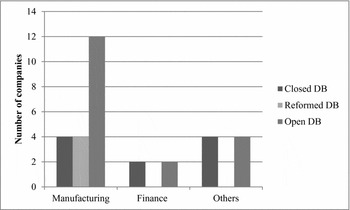
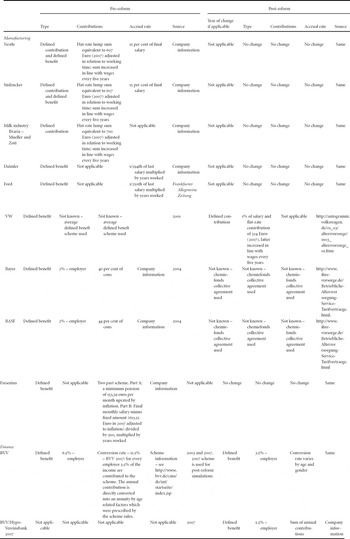
Important changes have also occurred in the last decade in the ‘traditional’ occupational sector. In particular, book reserve schemes have shifted towards a more funded approach to the coverage of liabilities, involving contractual trust arrangements. This is, in part, a consequence of the introduction of ‘fair’ value accounting as standard for the presentation of pension assets and liabilities on companies’ balance sheets (Kortleve et al., Reference Kortleve, Nijman, Ponds, Kortleve, Nijman and Ponds2006; Yermo, Reference Yermo2003). An increasing number of German companies have made this change since 1998 when the Capital Raising Act allowed German listed companies to prepare their consolidated accounts in accordance with International Accounting Board standards (Clark, Reference Clark2003; Löbe and Stadler, Reference Löbe and Stadler2008). This development has been accompanied by a move away from defined benefit provision, mirroring developments in occupational schemes in Britain, the USA and the Netherlands (Bridgen and Meyer, Reference Bridgen and Meyer2009). Thus, our research suggests, that of thirty-two German companies which appeared on the DAX30 between 2003 and 2009 (Appendix 3), ten have closed their original defined benefit scheme to new members, and a further four implemented significant reforms, all after they adopted the new international accounting standard (Figure 1) (Löbe and Stadle, Reference Löbe and Stadler2008). Where defined benefit schemes have been closed they have generally been replaced by defined contribution schemes, although these are not of the ‘pure’ form common in the UK because in Germany schemes are not allowed to deliver a negative rate of return (Ebbinghaus et al., Reference Ebbinghaus, Gronwald, Wiβ and Ebbinghaus2011: 134).
Changes to ‘traditional’ occupational pensions in a selection of publicly listed German companies between 2003 and 2009

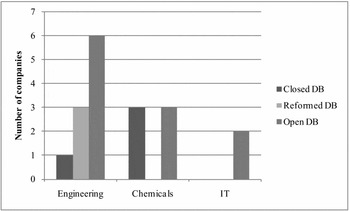
Some DAX30 companies have so far resisted the trend away from defined benefit pensions. Core employers in the manufacturing sector, particularly those with a strong engineering component, such as Thyssen Krupp, have kept their defined benefit schemes open, notwithstanding the fact that many of these have moved towards a more funded approach (Figure 2) (www.life.pensions.com).
Changes to ‘traditional’ occupational pensions in selection of publicly listed German manufacturing companies between 2003 and 2009

Nevertheless, financial pressures on those companies that have retained defined benefit occupational pensions remain intense, exacerbated by the 2009–12 financial crisis, which has been blamed for a rise in pension liabilities to ‘historic highs’ by the end of 2010 (Kalia, Reference Kalia2010). The voices calling for a more general shift to defined contribution provision are growing (Gnaedinger, Reference Gnaedinger2010), with the employers’ association and the Liberal Party backing the abolition of controls on defined contribution schemes (Riedmüller and Willert, Reference Riedmüller, Willert, Meyer, Bridgen and Riedmuller2007: 157). This move, if agreed, would significantly increase the financial benefits for companies of a shift out of defined benefit provision and thus make more likely an acceleration of this trend. Even if this does not occur, however, changes in the accountancy rules for unlisted German companies from the end of 2010, as a result of new legislation, are expected to raise awareness of the cost of pensions and herald a shift out of defined benefit pensions in the minority of small- and medium-sized enterprises, which operate ‘traditional’ pensions (Gnaedinger, Reference Gnaedinger2010).
Pension taxation
A shift in taxation from contributions to benefits will further reduce pensions in payment. Until 2005, employees’ pensions were only taxed above a threshold and most pensioners paid no income tax (Keenay and Whitehouse, Reference Keenay and Whitehouse2003: 30–1). In 2002, the Constitutional Court upheld a complaint about higher tax levels for retired civil servants in comparison with retired employees (BVerfG, 2002). The court ruled that taxation be equalised by 2005. Consequently, between 2005 and 2040 tax from public pension contributions during employment will be phased out, with retirement income gradually becoming fully taxed: net wages will gradually increase and net pension levels gradually decline (DRV, 2010). Post-reform net pension levels are further depressed by an increase in the contribution rate for sickness and long-term care insurance that all pensioners have to pay (GBE, 2011; MISSOC, 2000, 2007, appendix for details).
4. A dualisation or a liberalisation of the German pension system?
Scholars focussing mainly on the reforms of 2001 and 2004 regard these changes as a ‘paradigm shift’ away from the conservative model (e.g., Berner, Reference Berner2009: 134; Schmähl, Reference Schmähl2007: 334–5; Reference Schmähl, Rein and Schmähl2004; Schulze and Jochem, Reference Schulze, Jochem, Immergut Anderson and Schulze2007; Hinrichs, Reference Hinrichs, Petersen and Petersen2009) because they replace the dominant public pension with multiple tiers, increase the role of private retirement income and change the public defined benefits system to defined contributions. Analysts have concluded that the reforms will lead to pensions below the social assistance line for many (Schmähl, Reference Schmähl2007: 330; Riedmüller and Willert, Reference Riedmüller, Willert, Meyer, Bridgen and Riedmuller2007). Such conclusions mirror the more broadly based judgements of Streeck about the German social model. For him, recent reforms amount to a liberalisation because they have created an ‘institutional substructure of economic action that is decentralised, fragmented, diversified, and privatised, and shaped by individual choice and local conditions instead of public–private design representing collective values and objectives’ (2009: 157; also Hassel and Schiller, Reference Hassel and Schiller2009: 13).
However, while the German pension system has undoubtedly become less generous and more private, this does not necessarily mean that it has also become more dualistic. Proponents of the dualist argument accept that significant change has occurred but they would expect pension reform, like change in other spheres, to lead to less protection for marginal workers with the living standards in retirement of core workers maintained. Two features of the reform would be consistent with such an outcome. First, a retrenched, but still strong contributory and earnings-related public system means that working time and wages remain the main determinant of pension rights, favouring core workers. Secondly, because a decline in public provision makes non-state provision more important, this would advantage core workers who have always had better access to occupational pensions (Seeleib Kaiser et al., Reference Seeleib-Kaiser, Saunders and Naczyk2009). Moreover, among employers who did not provide occupational provision in the pre-reform period, the expectation would be that interest in introducing pensions would be greatest after the reform among core sector employers because of their interests in encouraging skill acquisition and the retention of skilled staff (Mares, Reference Mares, Hall and Soskice2001).
To test the relative merits of the liberalisation and dualisation thesis in the sphere of pensions, we thus focus on the extent to which the reforms have preserved the pension position of core workers in relation to the relative poverty line and last wages and in relation to marginal workers. We focus first on the absolute projected pension of core workers. If pension reform has taken the same direction as change in other parts of the German social model, we would expect the core workers’ projected pension to remain at, or only slightly below, the pre-reform level. We would not expect core workers to be at risk of relative poverty in retirement, or to receive a pension much below the previous replacement rate; such decline would end the privileged status accorded heretofore to core workers. Secondly, we look at the gap between the projected pension of core workers and non-core workers: if recent reforms in pensions have reinforced the dualist aspects of the system in the same way as they are said to have done in other parts of the German system, we would expect this gap to have widened, or at the very least remained constant.
5. Methods
We use policy simulation to project the net outcomes of the pre- and post-reform systems in the public and non-state sectors for a range of constructed, illustrative biographies (Appendix 1). Policy simulation allows an assessment of the future impact of today's pension policies and thus evaluates existing system design. It isolates the pension system at a particular point and makes more transparent the long-term impact of reforms whose effects in the short-term might appear negligible (Hinrichs and Kangas, Reference Hinrichs and Kangas2003). This method does not assess the actual pensions of German citizens before 2001, or those likely to be received by employees retiring over the subsequent decades under a mix of old and new systems, but this is not its purpose. Instead, the strength of the method is that it provides a meaningful quantitative comparison of one set of institutional arrangements with another.
Policy simulation has been subject to two main criticisms. First, concern has been expressed about its focus on too narrow a range of work histories (Bridgen and Meyer, Reference Bridgen, Meyer, Meyer, Bridgen and Riedmuller2007) particularly its emphasis on standard ‘male’ biographies with a full working life (OECD, 2005; Social Protection Committee, 2006). However, in our analysis we need to focus on precisely these workers. Secondly, simulation outcomes are dependent on notoriously unreliable predictions about price and wage growth: would the results be significantly altered by changes in our assumptions about these variables? Our robustness checks suggest they would not be for logical reasons: changes in wage growth affect not just the size of the projected pension but also the relative poverty threshold against which it is measured and therefore the relative distance between them remains the same. As it is, we assume the same rate of wage growth as EU policymakers.
Our comparison of the public system before and after the reforms includes three individuals (Table 1): our core manufacturing and finance workers receive a public pension based on the average wages paid in those sectors for full-time employment across their working life; the marginal worker is a retail employee who has average wages for this sector when in work but a much more broken employment trajectory.
Working life details of the illustrative biographies used in the pension simulations

Note: 1 See Appendix 1 for further details.
We calculate the net projected public pension entitlements of these workers before and after the 2001 and 2004 reforms under the assumptions set out in Appendix 1. This allows comparisons on two dimensions. First, we measure how the core workers’ positions change in relation to the poverty line and last wages. This shows whether the core worker is still protected from poverty and whether he continues to enjoy a high replacement rate. On the second dimension, we set the core workers in relation to the peripheral workers and test whether the gap between them widens after the reform. A growing gap would be an indicator of reinforced dualisation. We report the pensions of married and single biographies; with the gradual full taxation of pensions, married pensioners’ tax rates will be lower than singles’.
After calculating the public pensions for our three biographies we add for all workers the projected median level of occupational provision available in their sector before 2001 and in 2010, using information we collected on pension schemes from manufacturing, finance and retail sector. The pension entitlements in all calculations are reported in relation to a relative poverty threshold set at 50 per cent of average net full-time wages (Appendix 1).
6. The core worker in the new German public pension system
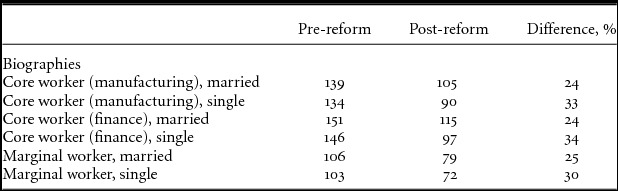
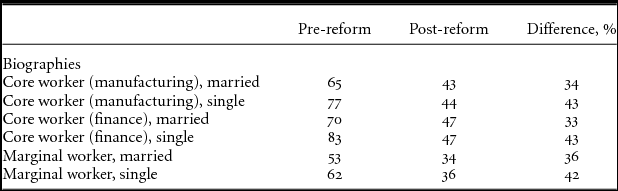
Tables 2 and 3 detail the net projected public pensions on retirement for our biographies before and after the reforms of 2001 and 2004. Our main focus is on core workers – in manufacturing and finance, with full working lives and on average earnings. According to the dualisation thesis, they should have retained their privileged position in the German social economy. To what extent is this evident under the reformed public pension system?
Projected net pre-reform1 and post-reform2 public pension as a percentage of the relative poverty line3
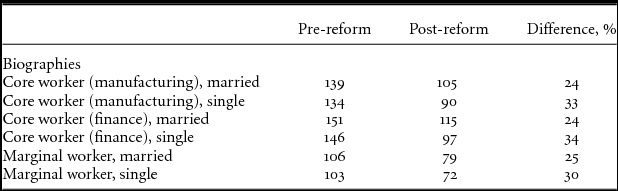
Notes: 1Rules and stipulations as in operation immediately before 2001 reform.
2Rules and stipulations as in operation in 2007.
350% of average net wages (see appendix 1).
Source: Own calculations.
Projected pre-reform1 and post-reform2 public pension net replacement rates on retirement
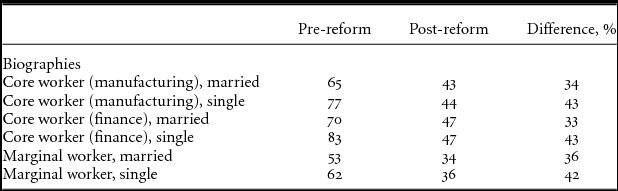
Notes: 1Rules and stipulations as in operation immediately before 2001 reform.
2Rules and stipulations as in operation in 2007.
Source: Own calculations.
Beginning with our first dimension, the core worker's position in relation to the relative poverty and net replacement rate thresholds, the simulations raise doubts about the dualisation case. The projected public pension of core workers in manufacturing and finance has declined markedly. The married man moves from a pension comfortably above the relative poverty line under the old system to a position on retirement which is only 5 percentage points above it (Table 2) for the manufacturing employee and 15 percentage points above for the finance worker. The net replacement rate of both falls to under half of their pre-retirement net wage (Table 3). Should the new public system be changed further, perhaps due to concerns similar to those in 2004 about rising employer contributions, the projected pension for the married core worker on retirement is likely to fall below relative poverty, a situation which would in any case be probable in later years of retirement, particularly for the manufacturing worker, given that pension levels rise more slowly than earnings. This fate would immediately befall the single core worker in both industries whose tax bill is higher; their projected pensions are both below the relative poverty line after the reforms (Table 2), by 10 percentage points in the case of the manufacturing worker and 3 percentage points for the finance worker.
Our second dimension, the position of the core worker in relation to marginal workers, is captured by Table 4 which shows the gap between the average core worker pension and that received by the marginal worker before and after the reforms. After the reforms this gap has shrunk, not grown, as the dualisation thesis expects. Thus, for example, while the average pension of the married core worker used to be 39 percentage points above the marginal worker's position in relation to the poverty line before the reforms, the distance has shrunk to 31 percentage points afterwards, and from 37 to 22 percentage points for the single core worker.
Difference in projected public pensions of core and marginal workers before1 and after2 reform in relation to relative poverty line3 and net replacement rate on retirement

Notes: 1Rules and stipulations as in operation immediately before 2001 reform.
2Rules and stipulations as in operation in 2007.
350% of average net wages (see appendix 1).
Source: Own calculations.
Certainly, under an earnings-related social insurance model, the core worker continues to receive a higher pension than the marginal worker in relation to the poverty line and wage replacement due to the stability of the former's employment and higher lifetime earnings (Table 2): retrenchment has substantially weakened the protection of marginal workers as Palier and Thelen suggest (2010: 139), with their projected pension moving from just above the relative poverty threshold under the old system to 21 (married) and 28 (single) percentage points below it under the new one (Table 2). However, notwithstanding this continued relative advantage for the core worker, they have seen an equally large proportionate reduction in their public pension (Tables 2 and 3), and as a result the gap between them and the marginal worker has declined. This evidence is not consistent with the view that recent reforms in the German social model have reinforced its dualistic features: in public pensions the secure position of the core worker in relation to the poverty line and last wages has been eroded and their relative distance to marginal workers has diminished. However, to establish whether this is the case for the German pension system as a whole we need to incorporate into our analysis changes to the non-state sphere.
7. The core worker in the ‘traditional’ occupational sector
The decline in the generosity of the public pension system means that non-state pensions have become more important. If all other things remained equal, this situation would favour core workers who have had better access to occupational pensions, making them less vulnerable to the poverty risks created by the decline in the public scheme. However, as was seen above, since 2000, the ‘traditional’ occupational provision has also come under retrenchment pressure. How do these twin developments affect the position of core workers and their position relative to non-core workers?
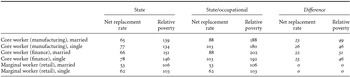
Let us first consider the situation before and after the recent changes for those covered by ‘traditional’ occupational provision, which includes most core workers. Table 5 shows how this provision supplemented the public pension of core workers before the reforms. Thus, in addition to the public pension the table includes a median occupational pension for workers in the manufacturing and finance sectors on the basis of the sample of schemes outlined in Appendix 2. The retail worker in contrast, like most marginal workers, receives no such supplement. As can be seen, occupational provision was not important with respect to relative poverty prevention because the public pension succeeded in lifting all core workers significantly above this threshold. Instead, its main purpose was to increase net replacement rates. Thus, the married core manufacturing worker saw their rate on retirement rise by 23 per cent in relation to the relative poverty line on the basis of occupational provision, while that for the single worker rose 26 per cent. This situation was not confined to core workers in the manufacturing sector. As was suggested above, coverage of ‘traditional’ occupational pensions also remained buoyant in the financial sector after 1957. ‘Traditional’ occupational provision in the pre-reform system thus significantly extended the gap between the pension received by core workers and marginal workers.
Projected net pensions on retirement of pre-reform1 German pension system by sector with and without ‘traditional’ occupational provision,2 as a percentge of relative poverty line3 and net replacement rates on retirement

Notes: 1Rules and stipulations as in operation immediately before 2001 reform.
2Median state/occupational outcomes are based on schemes detailed in appendix 2.
350% of average net wages (see appendix 1.)
Source: Own calculations.
However, on the basis of the recent changes in the occupational sphere outlined above our simulations suggest that the ‘traditional’ occupational system no longer protects core workers in this way: the median level of this provision has fallen and therefore increasing numbers in the previously secure sectors can no longer rely on their occupational pension to significantly lift their net replacement rates. As Table 6 shows, these only rise to 50 per cent or so for all our illustrative core biographies even with the inclusion of the median occupational pension for each sector. Indeed, for many core workers relative poverty during retirement remains a risk.
Projected net median total pension on retirement of pre-reform1 and post-reform2 German pension system for core workers by sector, as a percentge of relative poverty line3 and net replacement rates on retirement

Notes: 1Rules and stipulations as in operation immediately before 2001 reform.
2Rules and stipulations as in operation after 2004.
350% of average net wages (see appendix 1).
Source: Own calculations.
Thus, Table 6 shows that the pension of the married manufacturing core worker has dropped to only 24 percentage points above the relative poverty line with the addition of a post-reform median occupational pension for this sector, with the finance worker 5 points better off. The single worker in each sector receives less than that, with the manufacturing employee only 5 percentage points above the threshold, and the finance employee 10 points above. Considering the changes in the public and private sector together, this means that from a secure pre-reform position 88 percentage points above the relative poverty threshold, the projected net total pension of the married core manufacturing worker has fallen post-reform by 64 percentage points in relation to the relative poverty line, with the single worker's pension falling by 75 percentage points. The financial workers’ projected net total pensions, on the other hand, have fallen by 82 percentage points for the single person and 73 percentage points for the married one.
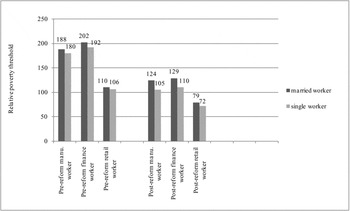
Comparing the post-reform situation for core workers with that of marginal retail workers (Figure 3), we see a marked flattening of the sectoral variation in projected public/private pension outcomes. The core workers’ position is now much closer to that of the retail worker, a situation which runs directly counter to the dualist thesis. Thus, the distance between the highest and lowest pension has declined after the reform from 92 percentage points to 50 for the married worker and from 86 percentage points to 38 for the single worker.
Projected net median total pensions of the pre-reform1 and post-reform2 German pension system for core and marginal workers as a per cent of the relative poverty line3Notes: 1Rules and stipulations as in operation immediately before 2001 reform. 2Rules and stipulations as in operation in 2007. 350 per cent of average net wages (see appendix 1) Source: Own calculations

The substantial falls in pension levels for core workers outlined above would not of course be experienced by the workers in the six engineering companies detailed earlier in Figure 2, where traditional provision remains unchanged. However, such workers are becoming a much smaller group: we are seeing the development of a more tightly drawn set of core workers, with many in manufacturing and finance excluded.
8. Dualisation and the new occupational and personal pensions
The incentives established by the 2001 reforms led to new occupational provision and Riester pensions. Do they fill the gaps left by the decline of public provision, especially for workers without traditional occupational provision?
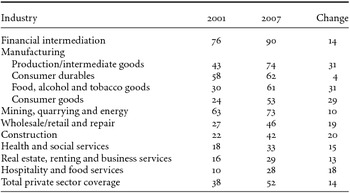
Among this group, there is some evidence that core workers have increased their coverage most (Table 7). Thus, reforms have widened occupationally based coverage across the board (Bundesministerium für Wirtschaft und Arbeit, 2004: 57), but this growth has been greatest in manufacturing, with consumer durables an exception. Moreover, the highest employer contributions have been negotiated as part of collective agreements in the metal and chemical sectors; in the chemical industry, employers contributed 614 Euros per annum in the mid-2000s, and metal employers 319.08 Euros annually in 2006 (www.metallrente.de/; Ebbinghaus et al., Reference Ebbinghaus, Gronwald, Wiβ and Ebbinghaus2011: 142–3). Change in the financial sector is much less marked due mainly to the fact that the coverage of ‘traditional’ occupational provision was already very high.

Thus, among workers without occupational pensions before the reforms the newer forms of private pension appear to have protected core manufacturing workers better than marginal workers. However, this finding must be contextualised. First, a large proportion of employees in the core manufacturing sector are still either without occupational provision (between 47 per cent in the consumer goods’ industry and 26 per cent in production/intermediate goods) or are reliant on ‘traditional’ occupational provision, which is likely to have been retrenched. Secondly, even though core manufacturing workers generally have better access to new occupational provision, this protection does not eradicate the risk of relative poverty in retirement. This is because of low employer contributions and because in some schemes, such as the chemical industry scheme, employee contributions remain voluntary, so there is no guarantee that more than the minimum employer contribution will be paid into the funds (Ebbinghaus et al., 2010: 142). Our calculations suggest that in combination, the new public system and a new occupational pension based on the median available through collective agreements in the core manufacturing sector push the pension of the single core worker only 11 percentage points above the relative poverty threshold on retirement (Table 8). The married worker escapes this threshold by more, 29 percentage points, but this still represents a decline of 10 percentage points in their pension in relation to what they would have received before the reform from the public scheme alone.
Projected post-reform net median pension for core worker with occupational pension from manufacturing collective agreement,1 or a Riester pension, as a percentage of the relative poverty line2

Notes: 1for details of the scheme see http://www.metallrente.de/ and Ebbinghaus et al. (Reference Ebbinghaus, Gronwald, Wiβ and Ebbinghaus2011): 142.
250% of average net wages (see appendix 1).
Source: Own calculations.
Those core workers without salary sacrifice schemes are reliant on Riester pensions, to which there are no employer contributions but which rely on voluntary individual contributions. Most recent figures suggest that after a slow start, take-up of these schemes has picked up, but still only 40 per cent of the eligible population contribute anything to these plans, and a good proportion of these are higher-paid workers (Hagen and Kleinlein, Reference Hagen and Kleinlein2012). Moreover, there is strong evidence that the contracts for Riester schemes include high and uncertain costs (Willert, Reference Willert and Clasen2011; Hagen and Kleinlein, Reference Hagen and Kleinlein2012); our simulations reflect this (Appendix 1). They show that a married core worker who paid the maximum tax-subsidised contribution of 4 per cent of earnings would secure a pension on retirement 22 percentage points above the relative poverty threshold, with the single worker only 6 points above this threshold (Table 8).
9. Liberalisation or dualisation?
We have shown that recent German pension reforms in the public and private sectors have generally resulted in a marked decline in the security and status of core workers, absolutely and in relation to marginal workers; the gap between the two groups has narrowed rather than widened. In contrast to changes to other parts of the German model, therefore, pension reform has not reinforced the dualistic features of the system. Instead, many core workers building up benefit entitlement under the new public/private mix will be at greater risk of poverty in retirement than under the old system. The projected public pension of the married manufacturing and finance worker is not much above the relative poverty threshold after the reform; it would drop below it if his career was only a little shorter than the standard working life; for a single man the additional tax would lead to a pension below the poverty line in any case. In these circumstances, occupational pensions become essential, protecting core workers against poverty rather than boosting their replacement rates as previously. However, these too are under pressure. Already many of the bigger German companies have adapted to the demands of global finance by shifting occupational provision away from the ‘book reserve’ model towards a funded approach. A sizeable minority have gone further, dismantling defined benefit provision, especially for new workers, in favour of the defined contribution model. As a consequence, the occupational sphere, in manufacturing, in particular, seems far from secure. For core workers without traditional provision before the reform, the situation afterwards looks more promising: coverage of new Eichel-based occupational provision has grown most for them and employer commitment, while still limited, is greater among core firms. However, even this minority is affected by poverty risks, particularly because the future performance of the new defined contribution pensions is uncertain. Doubts are even greater for those with Riester pensions given employer contributions to these are voluntary.
Moreover, there are good reasons to believe that further retrenchment will happen. In public pensions, the linking of benefits to fixed contribution levels makes further cuts likely; this would push the projected pension of core workers below the relative poverty line. In the non-state sector, evidence from other countries suggests that further retrenchment of ‘traditional’ occupational provision could occur quickly (Bridgen and Meyer, Reference Bridgen and Meyer2005, Reference Bridgen and Meyer2009). However, even without more cuts our results suggest that the dualistic aspects of German pension institutions have already been significantly reduced rather than reinforced.
Theoretically, our findings are consistent with the shift in recent years away from rigid formulations of the varieties of capitalism framework that only expect narrow path dependent change in coordinated market economies (Hall and Soskice, Reference Hall, Soskice, Hall and Soskice2001; Hall, Reference Hall2005; Aoki, Reference Aoki1994). A more dynamic model of institutional development is now generally accepted, with the debate focussing on the extent to which core complementarities are maintained in the face of dynamism (e.g., Hancké et al., Reference Hancké, Rhodes, Thatcher, Hancké, Rhodes and Thatcher2007). In this debate, the dualist thesis emphasises continuity within change: because the core worker continues to be protected, institutional complementarities remain. The new public/private pension mix could be similarly understood as a functional equivalent to the previous public system. Certainly, reformers had promised that the new private pensions would fill the gaps left by public retrenchment, maintaining existing replacement rates (Schmähl, Reference Schmähl2007).
Our findings cast doubt on these claims of functional equivalence, particularly for those who have started their first employment in the last ten years and who face inadequate new private pensions and retrenchment in the traditional occupational sphere. These young workers cannot rely on the new system for adequate wage-related pensions. While this might not worry them a lot now, it is likely that they will become increasingly concerned about these shortcomings as they age, unless the system is reformed (Anderson and Lynch, Reference Anderson and Lynch2007). Already German workers’ confidence in the pension system is declining. In 1994, 66 per cent of German adult men not yet retired thought their old age protection was sufficient, while 22 per cent did not feel adequately protected. By 2004 these figures had dropped to 56 per cent and risen to 35 per cent respectively. While these results are not differentiated by age or employment status, they show that men are much more concerned about their future in retirement than before the reforms (ALLBUS Studien-Nr. 4574: 150).
The pension system has been a building block of the German model because over decades it has made worthwhile long-term investment in skills for qualified workers. Today it has lost this function, exposing the core worker to long-term insecurity, no matter whether he is still unionised and protected against unemployment in the shorter term. By exclusively examining the factors relevant for an individual during their employment career – industrial relations, labour market change and reforms to unemployment provision – the dualisation argument has missed the part of the German model with the potential to undermine it in the longer term. Insufficient pension entitlements are likely to diminish the readiness of the core worker as he ages to invest in employer specific skills; they thus undermine institutional complementarities. In other words, if the core workforce no longer trusts the future of their pensions, their loyalty to one employer might well be weakened, leaving fewer reasons to preserve high replacement rates for unemployed core workers: liberalisation would then spread to the rest of the model.
Acknowledgements
For their constructive advice and support the authors wish to thank Bernhard Ebbinghaus, Markus Sailer, Tobias Wiß, Frank Berner, Lynne Chester, two anonymous referees and the editors of the Journal of Social Policy.
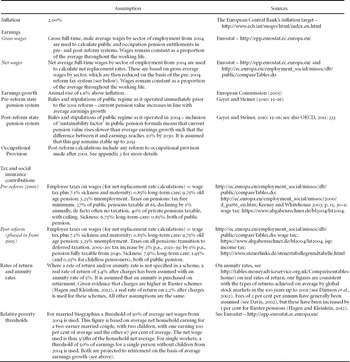
Details of the assumptions made in simulations

German cccupational schemes used in the simulations

German companies appearing in DAX 2003–2008 for which occupational pension information was available