Introduction
The verse above, set to a melody of rippling semiquavers and followed by a choral repeat of the last line and six subsequent comic verses, greeted the young readers of a temperance magazine in 1872. Its levity may appear more suited to performance in a music hall than in a temperance meeting, but an investigation of hundreds of such songs reveals not only humour and wordplay, but mock drinking songs, comments on government policy, and stirring calls to action alongside the predictable praise of water and tales of drunkards. Such songs were sung by thousands, and heard by millions: the importance of temperance as a social and cultural influence is increasingly recognised, and while Brian Harrison's magisterial study Drink and the Victorians showed the impressive scale of the movement until the 1870s, more recent studies have traced the vast subsequent influence of organised temperance groups and campaigns (Harrison Reference Harrison1994; Nicholls Reference Nicholls2009; McAllister Reference McAllister2014; Yeomans Reference Yeomans2014). It is no longer surprising for a social historian to remark that ‘the Temperance movement was an immense catalyst for reform in the nineteenth century … all classes, Protestant denominations, ages, and genders were involved at some point throughout the century’ (Clapp-Itnyre Reference Clapp-Itnyre, Clapp-Itnyre and Melnyk2015, p. 90). Making music was a vital aspect of the temperance movement, and brass bands, for example, in popular memory, are associated with traditions of temperance and the rational recreation movement. The famous Wingates Temperance Band only dropped the middle word from its name in 1980, after over a hundred years of existence, and some smaller bands, such as Rothwell or Tongwynlais, still retain the term.Footnote 2 According to the brass band historian Arthur Taylor, the first such band to convert to temperance was the Bramley Old Reed band, who in 1836 ‘took the pledge en bloc and converted to all-brass instrumentation at the same time’, and the records of brass band contests show many temperance band winners (Taylor Reference Taylor1979, p. 21).
But the songs of the movement, now sadly often reduced in the popular mind to watery warblings or maudlin tales of dying children, were arguably even more influential than the brass bands. David Russell commented in Popular Music in England that the sheer volume of temperance songs that appeared … suggests that they must have enjoyed some appeal and their evolution in terms of content and musical language may well repay the attention of scholars’ (Russell Reference Russell1997, p. 37). There remains much to discover, not only about the way in which these songs were ‘imbricated in people's social networks’, but also interrogating their popularity and why they got ‘particular attention at particular moments’ (Frith Reference Frith, Clayton, Herbert and Middleton2003, p. 101). Such songs have been studied in relation to Chartism and other social movements, but a similar study of the temperance movement's deployment of song is only now beginning (Bowan and Pickering Reference Bowan and Pickering2009; McGuire Reference McGuire2009; Clapp-Itnyre Reference Clapp-Itnyre, Clapp-Itnyre and Melnyk2015). Such an endeavour needs to illuminate the history of music, and more specifically song; however, bear in mind that Trevor Herbert has noted that historians ‘have typically used music as the fodder of footnotes, merely illustrating social and cultural patterns’, and asks whether social history can ‘offer anything new to music history’ (Herbert Reference Herbert, Clayton, Herbert and Middleton2003, p. 146). This study will explore not only the diversity and interconnectedness of popular songs in the 19th century, but how they were distributed and the uses made of them, personally, socially and politically.
What did ‘temperance’ mean?
Some background information on the temperance movement may be helpful, bearing in mind Charles McGuire's warning that:
Temperance … is largely a historical artefact, little understood in today's world. As a political movement, temperance was most often propounded by the disenfranchised, members of either the middle classes or the working classes, whose histories are much less permanent than those of the elite. Further, history does not favour the defeated, and the politics of temperance ultimately failed in the United Kingdom. (McGuire Reference McGuire2009, p. 110)
Widespread public concern about drinking first arose in Britain in the mid-1700s, with the widespread availability of cheap gin to lower class drinkers (some readers may have seen Hogarth's Gin Lane print of 1751). High consumption of wines, brandy and other alcoholic drinks among the upper classes was not viewed as particularly problematic, but when drunkenness was publicly visible, and indeed led to public disorder, it became seen as a social problem. Beer was recommended as a healthy alternative and, of course, with unreliable public water supplies this may have been sound sense. ‘Temperance’ societies were formed to encourage moderation in drinking from the late 1700s, coming to England from the USA and Scotland, and were usually middle-class organisations directed towards reforming the habits of working people, most of them in the manufacturing districts of the north. In these locations people were clustered in huge numbers, often having moved from their home districts to find work, and as drink provided an obvious escape, there was very heavy drinking in industrial areas. With the 1830 Beerhouse Act the government made it much easier for anyone to sell beer from their premises, in the hope that this would encourage ‘healthy’ beer consumption. However, this move backfired and merely led to a huge increase in public drunkenness, and concern among all classes. As James Nicholls argues,
The [teetotal] movement struck a chord with large numbers of working people, not least because it suggested that both personal salvation and social transformation were in their hands rather than the hands of priests or politicians. Teetotalism … held out the promise of more than mere emancipation or even respectability. It told them they could spearhead the dawn of a new age: the sober millennium. (Nicholls Reference Nicholls2009, p. 103)
This was the key aspect of the ‘teetotal’ temperance movement: rather than a being a mission for social order, seeing working people as subjects whose behaviour needed to be controlled and improved, it was initiated by working men to liberate themselves and their fellows from the ‘demon drink’ which could ruin their lives. Seven men from Preston jointly signed a pledge, or promise, to abstain from all alcoholic drinks as beverages in 1832, and the leader of the seven, Joseph Livesey, a weaver turned local merchant and entrepreneur who retained his political and social radicalism, had a genius for publicity and organisation. Total abstinence offered a welcome to the reformed drunkard, and clearer guidelines to follow than the nebulous goal of moderation; it spread rapidly throughout the country. By the 1840s, the word ‘temperance’ had come to mean, for many, not moderation but ‘teetotalism’, and this gave the character to what was to become a huge social and cultural movement.
Using John Bunyan's image from Pilgrim's Progress, Livesey recommended that temperance campaigners make use of the two gates to people's minds: ‘Eye-gate’ and ‘Ear-gate’. Public demonstrations were soon supplemented by developing visual technology of the magic lantern, but in addition the ear was appealed to by a wide range of musical versions of the teetotal message, as well as the predictable lectures and public debates. The movement went through several phases in its history of over a hundred years, and the initial focus on persuasion of the individual is often said to have been succeeded by reliance on legislation as social policy making in the latter quarter of the 19th century (Harrison Reference Harrison1994; Berridge Reference Berridge2013). Certainly organisations became more powerful and diverse, and more mention of policy and the state occurs in songs after 1870, perhaps beginning with the American import ‘Shut the Drink Saloon’, published for young singers in 1869.Footnote 3 But ‘moral suasion’ remained a central part of the temperance armoury and, indeed, a study of its music can act as a corrective to a history of the movement drawn mainly from public speeches and parliamentary sources.
Many individual groups existed with specific missions: one factor in the popularity of ‘signing the pledge’ was the material prosperity and social harmony it brought, enabling many families to make provision for the future, and the Independent Order of Rechabites was founded in 1835 as a teetotal friendly society providing sickness and death benefits. It grew spectacularly to become an influential national and international organisation, numbering a UK membership of 600,000 by its centenary in 1935, with many thousands more internationally, and managing funds of £6.5m. Other influential temperance groups included the UK Alliance for the Suppression of the Traffic in all Intoxicating Liquors, founded in 1853 to lobby Parliament for prohibition of all intoxicating drink throughout the UK. After its first three years it had 30,000 members and has, in some form, survived for over 150 years. Similarly, the Band of Hope still exists; founded in 1847 to deter children from drinking and to encourage them to challenge alcohol use in others, it grew rapidly to a claimed membership of over three million in its first 50 years and retained at least this number of members until the mid-1920s. It can be considered the most significant of all temperance organisations in terms of membership, duration and influence, and it had a prime role in commissioning, printing and distributing songs, as will be shown below. The temperance movement, although far from monolithic, can be considered a relatively united force whose significance can be inferred from its membership, estimated as at least six million out of a UK population estimated at just over 38 million by 1900 (Rowntree and Sherwell Reference Rowntree and Sherwell1900, p.5; Hicks and Allen Reference Hicks and Allen1999, p. 6).
‘A good melody will linger on the ear …’
Brian Harrison suggested that the temperance movement, in common with similar popular pressure groups, had three main functions, which he sums up as to inspire, to inform and to integrate (Harrison Reference Harrison, Shattock and Wolff1982, p. 282). Its music played a large part in this, particularly songs which, through their lyrics and music, fulfilled all three of these functions. The temperance community provided many opportunities for members to sing in public, both on the move in processions and in more static surroundings in the many festivals, competitions and concerts – and indeed, most meetings would begin with a hymn or temperance song so that music was woven into the fabric of the membership. Possibly the most visible, in terms of spreading the message, were the many occasions on which the musicians took their message out onto the streets, often with brass bands but always with plentiful singing. There are many accounts of public activities such as marches, processions and parades which not only established the size and fervour of the temperance movement, but staked their claim to ‘a particular space, a landscape that could be exploited effectively through the collective performance of particular rituals to communicate, legitimate, and politicize values’ (Goheen Reference Goheen1993, p. 128). As with Chartist demonstrations, in the early years of the temperance movement the use of popular tunes with invented words ensured that every event could make an impact on the public soundscape by hearty singing (Bowan and Pickering Reference Bowan and Pickering2009, pp. 53–6). Early teetotal campaigners in Preston soon made use of a local printer, John Harkness, to produce songs such as ‘A Warning to Drunkards’, alongside his production of radical pamphlets such as those for striking textile workers in 1853–54 (Palmer Reference Palmer1988, pp. 18, 172). Hymns featured more heavily according to the religious nature of the particular group, but it appears to have been equally common to set new words to popular melodies, as in Tredegar in 1857: ‘large processions … formed every evening, parading the streets, singing temperance verses adapted to some well-known tunes’ (cited in O'Leary Reference O'Leary2012, p. 116). Later, however, although re-use of tunes still occurred, many completely original compositions were written by UK temperance activists, and many were also borrowed from the US, where a tradition of such songs had developed a little earlier (Ewing Reference Ewing1977; Sanders Reference Sanders.2006).
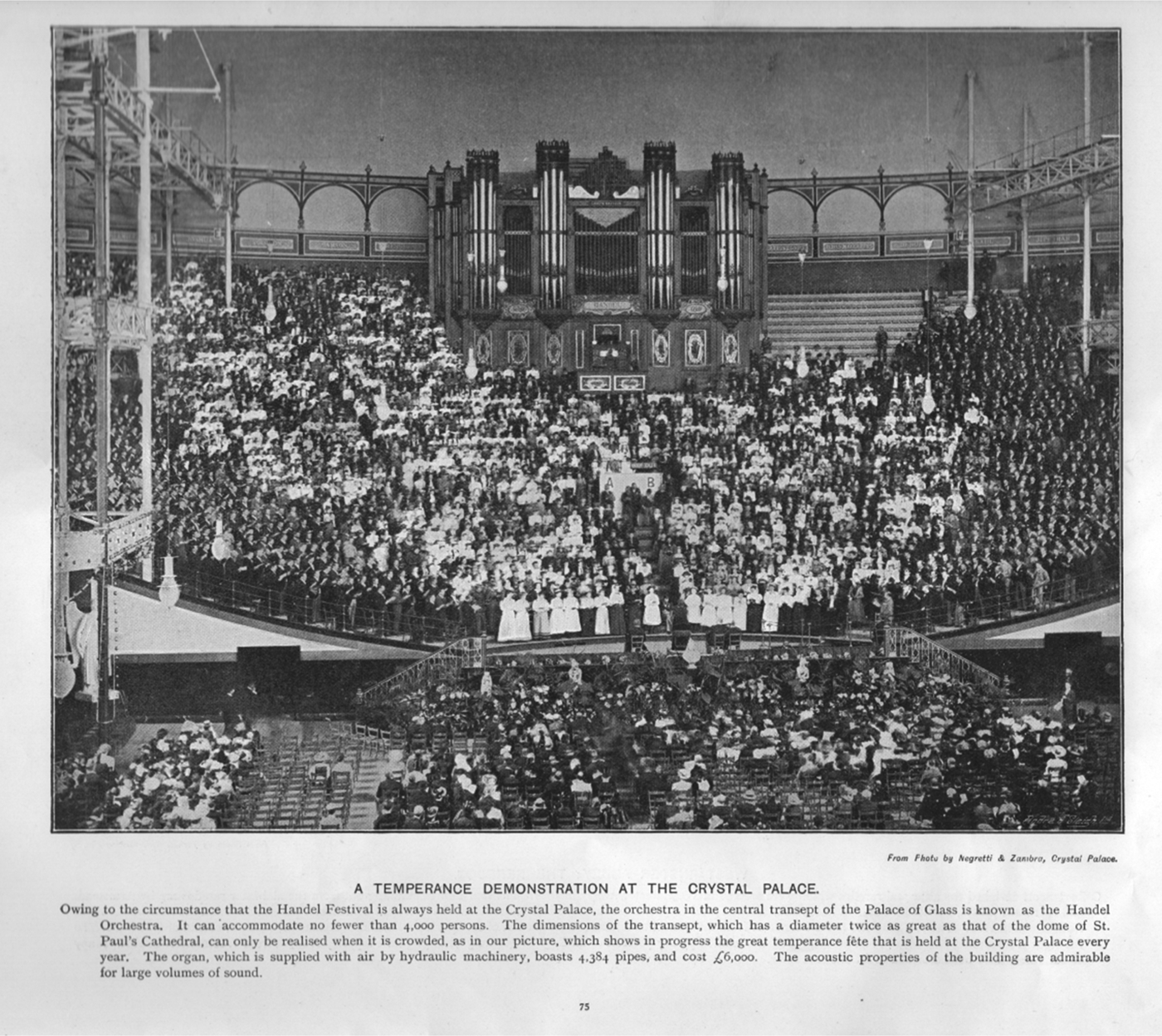
The concerts, however, may be considered the apex of public singing in the temperance movement, stemming from the growth of public concerts from the 1840s, discussed by Russell (Reference Russell1997, pp. 32–7). Those at the Crystal Palace were the most impressive, held inside in the huge hall with its transept twice the size of the Dome of St Paul's or outside in the grounds, as part of fetes or festivals (Figure 1). The National Temperance League had held such events from the 1860s, with participation by children's choirs from the Band of Hope, but the latter movement's temperance concerts soon assumed much greater proportions, From 1862 the Band of Hope held annual fetes, or concerts, in the Crystal Palace or the Exeter Hall, which featured choral performances by large groups of children. The choir in 1862 was 1,000; four years later it numbered 3,000; the following year, 1867, there was a 5,000-strong choir and in 1871 9,000 young voices entertained the many thousands of visitors. It might be thought that this had reached the maximum size possible, but in 1872 10,000 children sang, in two choirs of 5,000. Finally, from 1883, three separate choirs of 5,000, one from London and two composed of representatives from Bands throughout the country, performed, making a total of 15,000 trained young voices and this continued for over 20 years. In 1886, for example:
The chief feature of the Fete was the holding of three Great Choral Concerts, each sustained by 5,000 singers, comprised in 310 contingents, and trained at nearly 2,500 rehearsals. … The singers came from widely distant places, and, by cheerfully undertaking long and toilsome journeys, gave proof of devotion to the cause. Contests were arranged between Temperance Choirs from various parts of the country, and a great Processional March of Societies and Orders presented an impressive spectacle.Footnote 4
1986. ‘A Temperance Demonstration at the Crystal Palace’, from The Queen's London: A Pictorial and Descriptive Record of the Streets, Buildings, Parks and Scenery of the Great Metropolis (London: Cassell & Co.), p. 75.

Preparation for such events was carried out in local settings throughout the country for months, with choristers arriving for final rehearsals on the day and often expected to sing from memory so that they could pay ‘considerable attention to the bâton’.Footnote 5
Surviving evidence indicates that many, less spectacular, concerts were frequently held in large public buildings in London, Manchester, Birmingham and many other cities, towns and even villages.Footnote 6 Their popularity is not merely indicated by large attendances; subsequent publication of programme material was common, such as The Temperance Minstrel consisting of original songs, duets, choruses, etc. as sung by the choir at the Temperance Hall, Townhead Street, Sheffield, music composed by John Fawcett (Sheffield Temperance Association, 1857). And singing formed part of many hybrid entertainments, such as a lecture on ‘The Noble Army Of Martyrs’, in 1867 which was accompanied by a new series of dissolving views (lantern slides). ‘Six hundred children, trained by Mr. Frederick Smith, sang before and after the lecture. The execution of the piece, “Father, come home”, will, it is believed, be remembered for years by those who were present. It was sung in so pathetic and beautiful a style as to move many to tears.’Footnote 7
Adult group singing was also encouraged, in less formal situations, with social singing meetings as a lively alternative to the sociability of the public house, and also through the influence of evangelical religion, where hymns were public expression of belief. The pleasure found in singing with other like-minded people was a very common part of 19th-century cultural and social life, with glee clubs and free and easies two of the frequent occasions for working-class singing. It also acted for many as an expression of commitment and an assertion of identity, whether national, regional, or in opposition to prevailing systems or mores (Hoegaerts Reference Hoegaerts, Geisler and Johansson2014 ; Randjärv Reference Randjärv, Geisler and Johansson2014). But, above all, music could transmit propaganda with supreme effectiveness; as an 1867 article in the Band of Hope magazine Onward remarked:
An address may be forgotten, a recitation may be remembered only by the reciter, but a good melody will linger on the ear, and find its way into a thousand homes, and months after the meeting, as we pass along the street, we may hear from the lips of some young aspirant the strain which so delighted the audience. (Onward, November 1867, p. 69)
Singing and the Band of Hope
Indeed, it was in the work of the Band of Hope with young people that music was most inextricably entwined with temperance, as singing ran throughout the organisation, locally, regionally and nationally.Footnote 8 As well as the almost constant preparation for concerts and musical competitions, every weekly meeting usually featured singing, often through the medium of tonic sol-fa instruction. Instilling temperance principles into children, often in large groups, required entertaining and interactive approaches and music was ideal, but the volunteer workers could not all boast conventional musical literacy, and this easily learnt system provided a welcome solution. The close links between the tonic sol-fa and temperance movements, developing in the same period, using similar techniques and supporting each other, have been ably explored by Charles McGuire (Reference McGuire and Ahlquist2006, Reference McGuire2009) and it is probably sufficient here to point out that each organisation promoted the other. However, the Band of Hope was the dominant partner, claiming over half a million members in 1877, well over a million by 1887, over two million by 1891, and on the way to over three million by its Jubilee year of 1897. Although the Tonic Sol-fa Reporter (founded in 1851, changing its name to the Musical Herald in 1889) published many temperance songs and promoted teetotal events, and tonic sol-fa was recognised as a music teaching method for English schools in 1860, the use of it as the main system for learning songs by the millions of Band of Hope young people, in addition to adult temperance society users, was critical to its success. The national organisation, the United Kingdom Band of Hope Union (founded in 1856) had an extremely successful trading department dating from its second year of operation, and commissioned, produced and distributed media for a period of over a hundred years. Due to the scale of the membership and the organisation's entrepreneurial approach, the trading department became a major supplier of temperance-related material ‘throughout the Colonies and other parts of the world’ as well as at home, and by 1913 had stock and annual turnover worth £8,000.Footnote 9 As well as pledge cards, certificates and material for teaching temperance through scientific experiments, it became the largest commissioner and distributor of magic lantern slides and a nationally significant publisher of books, magazines and music. Many temperance songbooks, cantatas and even a dedicated singing course were published by John and Spencer Curwen, leading the tonic sol-fa movement, but the sheer scale of the Band of Hope organisation meant that from the 1870s it took the lead in producing and distributing new singing material for the continuing demands of its members.
Songbooks
Performances of songs are relatively well documented, as is the importance of the tonic sol-fa method of learning, but equally of interest is how these thousands of songs got into the hands of singers. All Band of Hope members were advised to purchase a singing book; millions of hymnbooks and songbooks poured from the presses, these differing titles drawing on the temperance movement's influences from both religious and popular uses of song, although as Alisa Clapp-Itnyre (Reference Clapp-Itnyre, Clapp-Itnyre and Melnyk2015, pp. 95–6) points out, the term ‘hymn’ was used as a general category at times, and often titles or subtitles referred to ‘songs’ or ‘melodies’. She has carried out a study of 12 examples of British temperance hymn- and songbooks between 1860 and 1899, identifying examples which appear most frequently across volumes, and going on to discuss categories of content. Unsurprisingly, the benefits of water loom large, with ‘Give me a draught from the crystal spring’ found in five out of 12 publications and two more songs about water in the ‘top 19’. But she also identifies several other song types or tropes, such as warnings or advice to young people ‘hovering on the brink of adulthood who face critical decisions about drink’ (Clapp-Itnyre Reference Clapp-Itnyre, Clapp-Itnyre and Melnyk2015, p. 97). She comments on the great stress on the agency of children, as they are encouraged to influence the behaviour of adults who drink – a key feature of the Band of Hope's address to children which has been explored by Olsen (Reference Olsen2014) and McAllister (Reference McAllister2015), for example. And, linked to this concept of child agency, she remarks on the lively and stirring nature of many of the tunes, and indeed the lyrics, in the ‘large handful of “marching” songs in the temperance repertoire’ and the increasingly martial and militant nature of songs (Clapp-Itnyre Reference Clapp-Itnyre, Clapp-Itnyre and Melnyk2015, pp. 99, 102). In the list of the most frequently anthologised songs in her sample, however, three are well-known hymns (‘Sun of my soul, Thou Saviour dear’, ‘Sweet Saviour, bless us ere we go’, and ‘There is a happy land’) and so her presentation of this list does confirm, to some extent, the predominance of water and religion which might be expected as topics in Band of Hope hymn- and songbooks. As Ewing did in the case of American temperance songs, and Bowan and Pickering in Chartist songs, she discovers that many British temperance songs used existing well-known tunes, largely hymns, patriotic anthems or borrowed tunes from the USA. As well as obviating the need to learn new music, this ‘enabled songbook editors to produce their books as small, inexpensive, pocket-size chapbooks’. This leads her to draw the conclusion that ‘Band of Hope hymn- and songbook writers were just that: writers of texts, not composers, and almost all songbooks of my study give words only‘(Clapp-Itnyre Reference Clapp-Itnyre, Clapp-Itnyre and Melnyk2015, p. 100).
However, there was a much wider variety of songbooks – and Band of Hope composers, as well as writers. One of the books which Clapp-Itnyre uses is by William Hoyle (his 1863 Temperance Offering: One Hundred and Twenty Melodies for Bands of Hope) and, as this title suggests, Hoyle not only collected and wrote lyrics but wrote and arranged music – in addition to training and conducting choirs. He published many collections, such as the Band of Hope Choir Book (tonic sol-fa edition) of 1868, but the one for which he became best known was Hymns and Songs for Bands of Hope, first published in 1869 and reprinted in many large editions until at least 1910. There was a choice of format; the penny-halfpenny, regular, version came without music, but a separate Hoyle's Music Book was advertised, containing four-part music to complement the cheaper lyrics-only songbooks – in tonic sol-fa or ‘old notation’.Footnote 10 There were several editions with words and music; the author possesses one featuring 275 songs (undated but printed after January 1887) which gives full traditional notation, but Hoyle more usually preferred to give both notations (see below). Where the music is not by Hoyle himself, he is usually credited with the harmony, or arrangement. He was a much-lauded choral director, and the songbook quotes a tribute from the national Union:
For the past quarter of a century Mr. Hoyle has been conspicuous for his unremitting labours, and his musical and literary abilities have been of immense value to the spread of the movement. The Lancashire and Cheshire Union has held thirty-two great Festivals in the Free Trade Hall, Manchester, and on each occasion Mr. Hoyle has not only trained the choir, but has also written the words and composed the music of many of the brightest and best of the pieces. In like manner … we have ourselves been greatly indebted to Mr. Hoyle, in making up the programmes for the great Temperance Concerts at the Crystal Palance, for some of the most popular and taking pieces have come from his pen.Footnote 11
As well as such dedicated songbooks, more ephemeral or smaller publications were successful in getting songs into the hands of thousands of potential singers. Curwen issued a series of monthly Temperance Music leaflets, both as conductor's specimen copies and for general use at one shilling per hundred, eightpence for 50, or a halfpenny for a single copy (these are undated, but were advertised in Curwen's Tonic Sol-Fa Reporter in the 1870s) (McGuire Reference McGuire and Ahlquist2006, p. 123). These contained music in both notations, and as they were issued monthly may illustrate a more direct response to the market imperative and public taste, in that more topicality was possible, and unpopular types of song would not be repeated. An analysis of the surviving leaflets bound in a series in the British Library reveals over three times as many songs with martial lyrics and tunes as those devoted to the benefits of water, with these two largest categories confirming the findings of Clapp-Itnyre's study. However, there are significant differences. Topicality is seen in a category of song which might be called ‘Policy’, with very specific references to current legislative battles about licensing in number 14 ‘Vote It Out! (Permissive Bill Song)’, and number 94 ‘Give your votes for Local Options’. And number 180 ‘Oh! A song for the flag of Prohibition’, and number 186 ‘Launched on the wave’ refer to the debate about the introduction of prohibition in the 1880s (Anon. 1882–9; Yeomans Reference Yeomans2014, pp. 70–1).
Music in periodicals
Another important forum for the publication of topical songs, and indeed songs more generally, was temperance periodicals. Initially songs were rare, appearing perhaps only once or twice a year, and usually lyrics only were printed, with a suggested tune or ‘Air’. An examination of some of the earliest publications shows that many did not feature songs, but some, such as Livesey's Moral Reformer (January 1838 – February 1839), and The Star of Temperance (1835–7) did do so occasionally. In early temperance magazines for children, songs and hymns feature more regularly in such examples as The Temperance Intelligencer and Sabbath School Journal (Vol. 1, 1836–7) although again, without music. But the growth of singing in the movement, and the Band of Hope in particular, gave rise to several magazines which printed songs with music in almost every issue. Songs were printed increasingly in some magazines for adults – usually occasionally, but sometimes regularly, for example in The Methodist Temperance Magazine (1868–89) until 1880, or The National Temperance Mirror (1881–1904) until 1892. But it was in magazines for children, or adults working with them, that much of the distribution of songs took place – and such publications were largely produced by the Band of Hope, just as it was in their weekly meetings that the groundwork was laid for the magnificent spectacles of public concerts referred to above.
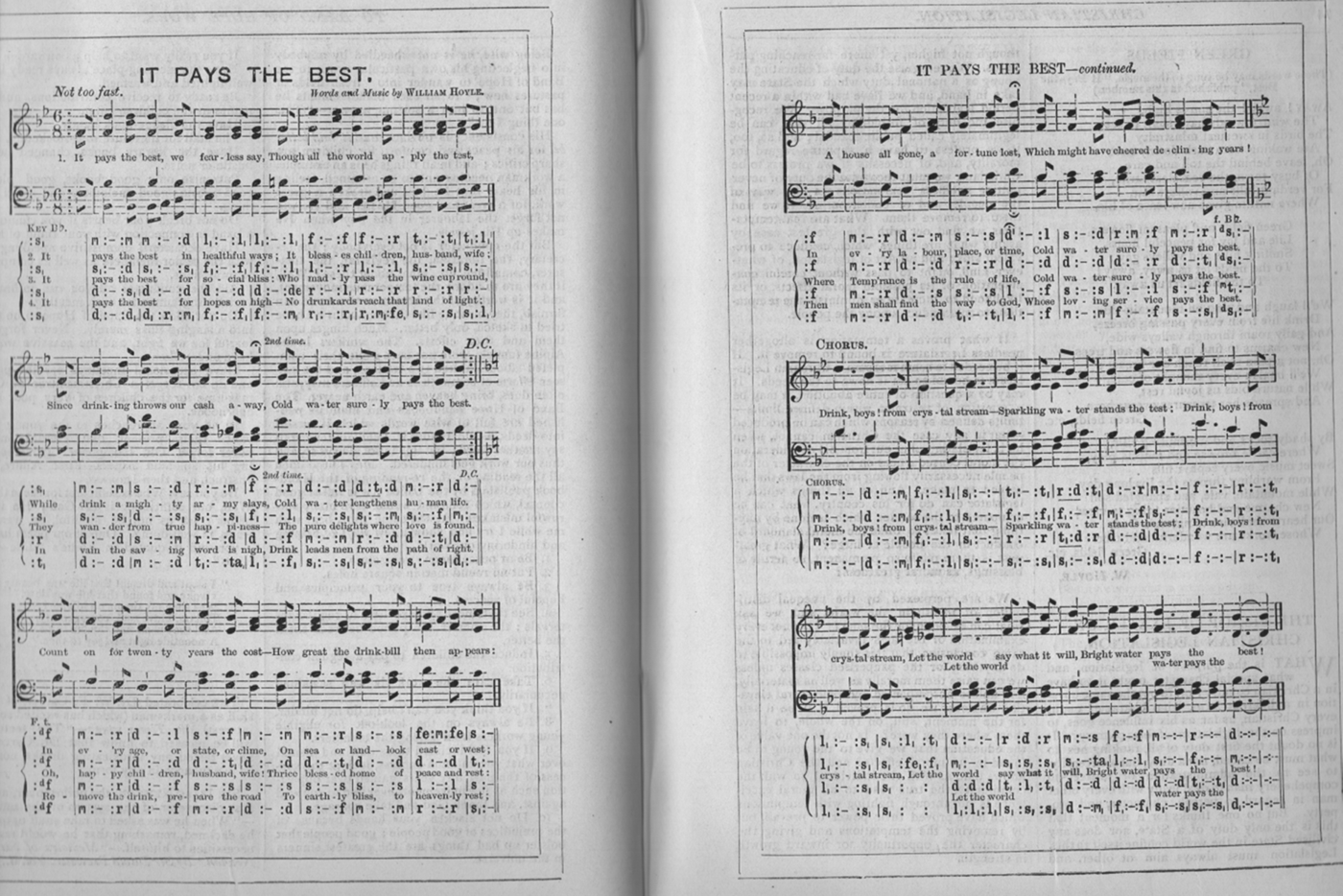
William Hoyle, referred to above, played a huge part in the history of music in children's temperance periodicals. Many of the songs he composed or collected were reprinted, but he was also the means of collecting, curating, and of course producing many more, as well as establishing music as a the regular menu item for readers. In his position as Secretary of the Lancashire and Cheshire Band of Hope Union, he took on the editorship of their monthly magazine Onward at its inception, aiming, as he said in the Introduction to the first issue in July 1865, to make it a lively read ‘by providing for our children interesting tales, anecdotes, and facts, with original and select songs, music, and recitations’ (p. 1). In the third issue, as well as contributing an original Lancashire dialect recitation for the children (a deliberately populist inclusion which mirrored the magazine's mission), he wrote an article on ‘Music in Bands of Hope’, the first of many such, and printed two songs, ‘The Better Land’ and ‘The Fatal Glass’. From the fourth issue at least one song was printed with conventional musical notation in each issue, but increasingly tonic sol-fa was also given, sometimes in the next issue, citing reader request; from 1867 songs appear with both systems arranged for four-part singing (Figure 2), as well as accompaniment in some cases, in every issue until August 1906.
William Hoyle. 1882. ‘It Pays the Best’, Onward, May, pp. 72–3, showing both notations.
After handing on the editorial chair in 1867, Hoyle continued to write articles and compose or arrange songs for Onward regularly for over 20 years.Footnote 12 He also founded The Band of Hope Treasury (1869–1917), a smaller magazine, in which there was at least one song with music notation in both forms each month, often with other song lyrics. Other children's temperance magazines, such as The Adviser (1849–1900), printed songs regularly with tonic sol-fa music from 1870. The considerable and continual demand for new songs for children was also met in the pages of magazines for volunteers who worked with Band of Hope children, such as the Band of Hope Chronicle (1878–1983, with breaks) and the Temperance Worker and Reciter (1882–1901) in which songs with both forms of notation appeared regularly, and in every issue at certain periods. Many songs presented for children's use were, of course, also suitable for adult performance, and Clapp-McItnyre (Reference Clapp-Itnyre, Clapp-Itnyre and Melnyk2015) talks of songs passing between age groups in this way.
Onward: a case study
However, Onward offers perhaps the best case study to gain more detailed information about the publication of songs for young readers, as a stablemate of Hoyle's many musical works in the publishing powerhouse which was the Lancashire and Cheshire Band of Hope Union.Footnote 13 What can be considered Onward's main song was always printed in the centre pages of the magazine from 1866, for easy detaching and use in other contexts, and other Band of Hope material shows that these songs were used in meetings, in children's competitions, in public events such as processions and entertainments, and in large and small choral concerts. A study of the entire 44-year run throws much light on the distribution and circulation of songs in the temperance movement. For example, songs are sometimes, although rarely, repeated, for what one might consider a later children's generation, such as ‘Keep the Temperance Banner Waving’ in January 1885 and October 1898, or ‘No Surrender!’, first printed in May 1881, which resurfaces in November 1896 and November 1903. Songs can carry on a dialogic relationship, as with ‘Come Home, Father’ in April 1867 and an answering song set as a continuation of the story, ‘The Father's Resolve’ in February 1868. By the early years of the 20th century the temperance movement was still at its zenith, but the fading out of song from the pages of Onward in 1906 suggests that singing seems to have become less of a feature of activities, and indeed there are fewer reports of concerts. Many of the songs have not been found by the present author in any other printed format, and therefore appear original, possibly written or adapted for the magazine, and many appear to be composed by William Hoyle. But the situation is, inevitably, more complex, and many apparent repetitions are adaptations, and many actual repetitions may be concealed.
An examination of, arguably, the most famous temperance song of all shows the multiple incarnations and changes of title, viewpoint and plot which can bedevil the tracing of a popular song. The song which has become popularly referred to as ‘Father, Dear Father Come Home’ was originally composed by Henry Clay Work and apparently first printed in New York in 1864 (Work Reference Work and Work1884). However, it had been performed under the title of ‘Little Mary's Song’, as part of the temperance melodrama Ten Nights in a Bar Room by W.W. Pratt from 1858 onwards, which was itself an adaptation of the story of the same name by Timothy Shay Arthur, published in 1854 (Frick Reference Frick2003, p. 69). It was printed in Onward in April 1867 as ‘Come Home, Father!’ and features a child pleading with her father to return home, where ‘our fire has gone out, the house is all dark/And mother's been watching since tea, /With poor brother Benny so sick in her arms, /And no one to help her but me.’ Each verse is marked by the striking of the clock, from one to three, both in the lyrics and accompaniment, which lends a sense of the playing out of an inevitable ending and what J.S. Bratton calls ‘progressively heart-rending urgency’ (Bratton Reference Bratton1975, p. 146). By the stroke of three Benny has died, but the child still fruitlessly begs her father to come home. It is a very sentimental song in both its lyrics and music, but did not represent an unknown situation to many poor families in the 19th century urban districts from which Onward's readers came, and if the song is not performed cynically it still has the power to move listeners.Footnote 14 Bratton traces many songs which were clearly offshoots with differing titles, such as ‘I Want to Kiss Papa Goodnight’ or taking up the story at differing points or with different endings, such as ‘Oh papa don't go out tonight’ or ‘Father has come home’, and further songs in which the causes of distress are more general rather than solely drink related (Bratton Reference Bratton1975, pp. 146–7). Such appropriations provide ‘interesting examples of the way in which the specifically Temperance writing and inspiration was sometimes, when it used genuine popular themes, reabsorbed into the mainstream of popular poetry’ (Bratton Reference Bratton1975, p. 146). Indeed, this song lives on in popular memory as a metonym for Victorian parlour ballads, even when only a version of the title is recalled.
Although there are of course many religious references or allusions in songs in Onward, as well as hymns, there is not an overwhelming proportion of solely religious compositions. This may surprise modern readers, but as early as the 1850s Joseph Livesey had separated temperance songs to be sung in meetings and at social events from hymns, as such: ‘As much as possible the singing should be considered a medium for instruction, excitement, and amusement, and not as worship, for I consider this too sacred to introduce into an ordinary temperance meeting’ (Livesey, Reference Livesey1852, p. 49). In fact, hymns and songs were later often mixed in temperance music and were not seen as exclusive areas, as Clapp-Itnyre notes, but Onward's mission to provide a lively, readable and useful publication was undoubtedly a factor in the lack of religious dominance. Studies of temperance songs in the USA have found a predominance of religion, but also many compositions seeking to expose the perils of drink, often with lurid or heart-rending examples, and this was also the case in the pages of Onward (Ewing Reference Ewing1977; Sanders Reference Sanders.2006). Advice to avoid drink was plentiful in songs, and the example given at the beginning of this article illustrates that drinkers were to be avoided as well as pitied. Water was of course the recommended alternative, and featured frequently in the magazine's songs, as we might expect. Ewing (Reference Ewing1977, p. 166) dryly remarks, ‘Water in the temperance verse differs little from the water of romantic poetry in general except that there is more of it’. But an analysis of song topic categories over the 41 years in which Onward printed songs every month reveals the predominance of another topic also noted in US songs – the martial aspect which seeks to inspire listeners or singers to social action – and children to act as agents for change, in particular. Alcohol was seen as a gigantic foe, responsible for most of society's problems, resulting in many songs from ‘Wake Up John Bull!’ of July 1868 to ‘Freedom's Land’ of May 1902, showing concern for national improvement as well as compassion for others in a category that can be termed ‘social amelioration’. More downright opposition to drink, and warnings against it, feature strongly, ranging from exhortations, ‘Touch Not the Drink!’ in August 1895, to tragic case studies, such as ‘Father's A Drunkard!’ of June 1887. But many of the songs were rousing calls to action and confirmation of the importance of the battle in which the children were seen as engaged. As well as celebration of the forces of the temperance movement, and the power of children, the very title of the magazine often featured as an inspiring command in songs such as ‘Onward! Onward!’ in June 1868, ‘Onward! Still Onward!’ in June 1875, or ‘March Onward, Temperance Men!’ in March, 1899. Action was for the national good as well as at the personal level, and the focus on policy seen in some songs in Curwin's Temperance Music leaflets is illustrated by Hoyle's ‘Stop the Drinking Trade’ which Onward printed in March 1885. Given the prevailing cultural climate and the links of many Bands of Hope to Sunday schools, it is not, of course, surprising to see many songs which are primarily religious in nature, or hymns, and the rest of the magazine reveals a similar tenor. Figure 3 shows the results by proportion of all songs, and although ‘religious’ is the highest category, it is greatly outnumbered in the total reading experience by the songs warning of the problems associated with drink, stressing children's agency, calling for social amelioration, and of course inspiring singers and hearers to the martial fight.Footnote 15
Content of songs printed in Onward, 1865–1906.
‘Onward! Still onward!’
This study has explored the ways in which song formed a key part of the UK temperance movement, but also, more widely, the importance of temperance songs to social and cultural history. As interest in and study of this movement grows, a recuperation of its songs should receive corresponding attention. Songs offer not only an interesting and accessible pathway to past attitudes to drinking and not-drinking, but also illustrate nuances and collocations of concepts, and even persist as powerful objects to which strong beliefs adhere. This affective dimension, while not discussed here, is a particularly rich field for exploration. Their sheer number, moreover, demands attention, if only on the principle advanced by Sigmund Spaeth that ‘At their worst, however, our popular songs represent beliefs and emotions that are shared by the great majority of people’ (Spaeth Reference Spaeth1948, p. 8). However, the huge corpus of temperance songs has further, and stronger, claims to importance. Rather than viewing temperance songs as hackneyed re-uses of popular tunes, or raiding their lyrics for neat phrases, we surely need to see them as a valid field of study in their own right. Such a study has much to teach us about music's place in the social and political cultures of the 19th and 20th centuries, the interrelationship of music, ideas and beliefs, and its interrelationship with other forms of social activity. This has potential to contribute to our understanding of music history, as well as social history. Alcohol, as the present volume shows, is closely intertwined with musical expression in diverse and complex ways, as well as being a continuing focus for public debate. If we seek to understand past – and present – attitudes to alcohol, music and society, we could certainly benefit from examining temperance songs.
Acknowledgements
Much of the research for this article made use of the temperance material in the Livesey Collection, University of Central Lancashire. The author greatly appreciates the support given over a number of years by Helen Cooper, University Archivist. The work of Dr Oliver Wilkinson, History Research Assistant 2014–15, was also invaluable.