Antibiotics are one of the most frequently prescribed medications in nursing homes.Reference Benoit, Nsa and Richards1 Of the 1.4 million individuals who reside in a nursing home on daily basis,Reference Harris-Kojetin, Sengupta, Park-Lee and Valverde2 8%–11% are actively being treated with an antibiotic.Reference Thompson, LaPlace and Epstein3,Reference Pakyz, Xa, Dwyer and Xa4 More than half of the residents who reside in a nursing home for ≥6 months are prescribed 1 or more antibiotic courses, with a mean of 4.6–4.8 courses per 1,000 resident days.Reference Benoit, Nsa and Richards1,Reference Crnich, Jump, Trautner, Sloane and Mody5 Antibiotic therapy is associated with a number of potential harms, including adverse drug reactions and Clostridioides difficile infection (CDI) as well as increased resident risk of colonization with and spread of multidrug-resistant bacteria.Reference Crnich, Jump, Trautner, Sloane and Mody5-Reference McElligott, Welham, Pop-Vicas, Taylor and Crnich7 Many of these harmful events are avoidable; 25%–75% of antibiotic use in nursing homes is inappropriate.Reference Eure, LaPlace and Melchreit8-Reference Lim, Kwong and Stuart11 As such, there is an urgent need to improve the quality of antibiotic prescribing in nursing homes.Reference Palms, Kabbani, Bell, Anttila, Hicks and Stone12-Reference Hanson, Pacilli, Xydis, Walblay and Black14
Although most nursing-home stewardship interventions have focused on reducing unnecessary antibiotic use,Reference Crnich, Jump, Trautner, Sloane and Mody5 significant improvements in antibiotic use may be achieved by modifying active antibiotic orders through a process commonly referred to as an “antibiotic time-out (ATO).”Reference Srinivasan15 As a stewardship strategy, the ATO prompts reassessment of an antibiotic prescription once more clinical information becomes available. An ATO is often conducted by the primary provider 48–72 hours after therapy initiation to determine whether the antibiotic is still needed or whether the prescription should be modified.Reference Olans, Olans and DeMaria16,Reference Tamma, Miller and Cosgrove17 Studies performed in hospitals have shown that ATO interventions can increase the frequency of discontinuing unnecessary antibiotics and de-escalation of broad-spectrum antibiotics.Reference Senn, Burnand, Francioli and Zanetti18-Reference Lee, Frenette, Jayaraman, Green and Pilote23 However, these interventions do not appear to be as effective as other stewardship approaches such as prior authorization and prospective audit and feedback.Reference Lesprit, Landelle, Girou and Brun-Buisson19,Reference Thom, Tamma and Harris22,Reference Lee, Frenette, Jayaraman, Green and Pilote23 ATO interventions are lower in cost than prior authorization and prospective audit and feedback, and they may be particularly well suited to low-resource health settings like nursing homes. However, the effects of ATO interventions in nursing homes remains poorly studied.
The objective of this study was to evaluate the impact of an antibiotic stewardship intervention that promotes the use of an ATO on antibiotic changes in nursing homes. We applied the data analysis (1) to evaluate the effect of intervention on the frequency and types of antibiotic change events (ACEs) and (2) to assess the extent to which initial antibiotic choice (broad or narrow spectrum) modified observed ACE patterns.
Methods
This controlled before-and-after intervention study took place in nursing homes in Madison, Wisconsin, and Pittsburgh, Pennsylvania. We conducted the Optimizing Antibiotic Stewardship in Skilled Nursing Facilities (OASIS) Clinical Trial, a complex system-level stewardship intervention, from 2016 to 2018 (https://clinicaltrials.gov/ct2/show/NCT02874872). The OASIS clinical trial focused on (1) standardizing the assessment of residents experiencing a change-in-condition potentially caused by an infection; (2) substituting active monitoring in place of empiric testing and treatment in situations where the probability of an infection is low; (3) consistently reviewing active antibiotic orders to identify opportunities to de-escalate therapy; and (4) improving interdisciplinary communication focused on antibiotic-related activities. The OASIS intervention significantly reduced total antibiotic and fluoroquinolone days of treatment but had a limited impact on overall antibiotic starts.Reference Crnich, Ford and Ramly24
We randomly assigned 11 nursing homes to 1 of 2 cohorts: (1) OASIS intervention or (2) usual care. Nursing homes in the intervention cohort received online training to introduce OASIS and one-on-one clinical coaching to support implementation. For facilities in Wisconsin, the 13-month OASIS intervention started on October 1, 2016, and on January 1, 2017, for facilities in Pittsburgh. Data from the 12 months before the intervention and 13 months after the intervention were used to evaluate the effect of OASIS intervention. The study was approved by the University of Wisconsin Health Sciences Institutional Review Board (no. 2016-0274) and the University of Pittsburgh Institutional Review Board (no. PROJ5020140).
Data collection
Resident change in condition logs were reviewed to identify residents who received antibiotics during their stay in the nursing home. Data related to antibiotic starts in participating nursing homes (n = 11) were abstracted from resident charts and pharmacy records onto standardized case report forms by members of the research team (see Appendix 1 online).
Study data were collected and managed using REDCap electronic data capture tools hosted at University of Wisconsin–Madison Department of Medicine.Reference Harris, Taylor, Thielke, Payne, Gonzalez and Conde25 Residents and their providers were assigned unique codes, linked to an identifier (ie, resident or provider name) and maintained by the participating nursing home to allow tracking across multiple antibiotic prescribing events. No private identifiers (eg, name, social security, date of birth, etc) were recorded. We considered the bacterial coverage of the initial prescription to be broad-spectrum if an anti-MRSA agent, broad-spectrum, non-fluroquinolone or fluroquinolone antibiotic was prescribed and to be narrow spectrum if a narrow non-fluoroquinolone antibiotic was prescribed (see Appendix 2 online for further details).
Definition of antibiotic change event
In this study we primarily aimed to evaluate the proportion of initial antibiotic prescriptions associated with an antibiotic change event (ACE). ACEs were assigned to 1 of 3 mutually exclusive categories based on observed provider order patterns (Fig. 1):
Early discontinuation: discontinuation of an antibiotic order within 2 days of initiation without additional antibiotic orders or whenever early discontinuation of the antibiotic was clearly documented in text recorded in the medical record
Class modification: a new order for an antibiotic of a different chemical structure (eg, switch from ciprofloxacin to ampicillin), administered within 4 days after conclusion of the previous antibiotic order, or initiation of additional antibiotics 1 or more days after the start of the initial antibiotic order
Administration modification: a new order for the same antibiotic agent, administered within 4 days after the previous antibiotic order was concluded, that differs by dose, frequency, and/or route
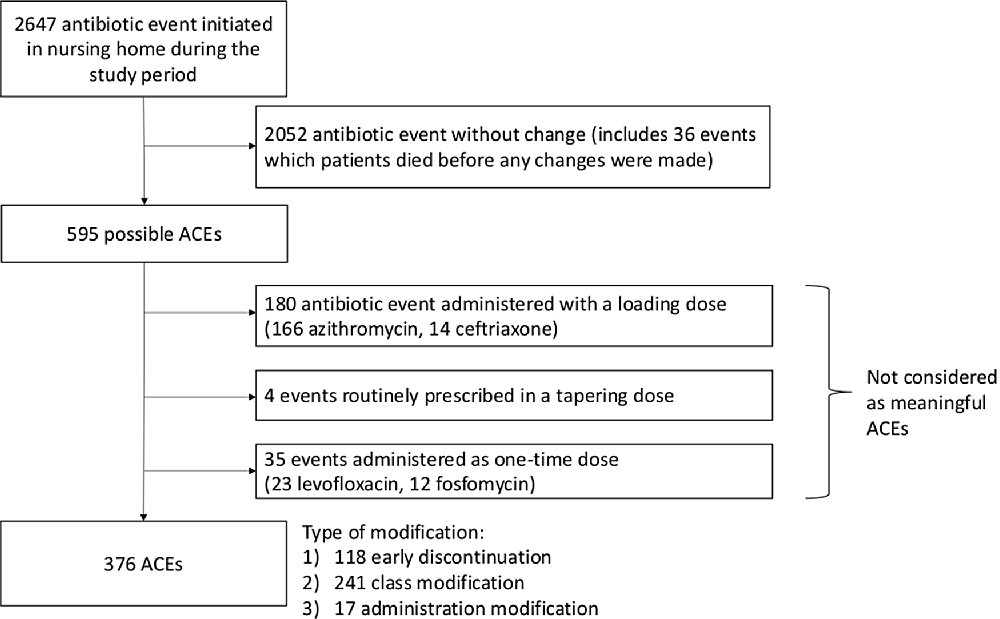
Type of antibiotic change event: (A) early discontinuation, (B) class modification, and (C) administration modification.

Class modification ACEs were further classified based on the effects the change had on bacterial spectrum coverage relative to the initial antibiotic (Fig. 1). No spectrum change ACEs were identified when the new antibiotic provided the same bacterial spectrum coverage as the initial antibiotic. For example, a switch in treatment from ciprofloxacin to levofloxacin (broad spectrum to broad spectrum) or from cephalexin to sulfamethoxazole trimethoprim (narrow spectrum to narrow spectrum) would both be defined as no spectrum change ACEs according to this approach. Spectrum-narrowing ACEs were identified when an initial broad-spectrum antibiotic was switched to a narrow-spectrum antibiotic. Conversely, a spectrum-broadening ACE was identified when an initial narrow-spectrum antibiotic was replaced with a broad-spectrum antibiotic.
Changes to antibiotics that were administered with a loading dose (eg, azithromycin), routinely prescribed in a tapering dose (eg, oral vancomycin) or administered as a single dose (eg, fosfomycin) were not considered a meaningful ACE for the purposes of this study.
Statistical analysis
Descriptive statistics describing the number of total antibiotic events per month per facility, number of resident days per month per facility, indication and the bacterial coverage range of the initial antibiotic for both control and intervention facilities were performed. A difference-in-difference (DiD) approach with simple linear regression model was used to evaluate the impact of the intervention by isolating changes in number of ACEs associated with the intervention. A similar analysis, stratified by the bacterial spectrum coverage of the initial antibiotic prescription, was also performed. The results were reported for both intervention and control facilities. All reported P values are 2-sided with a significance level at .05. All analyses were conducted using Stata version 15.01 statistical software (Stata Corp, College Station, TX).
Results
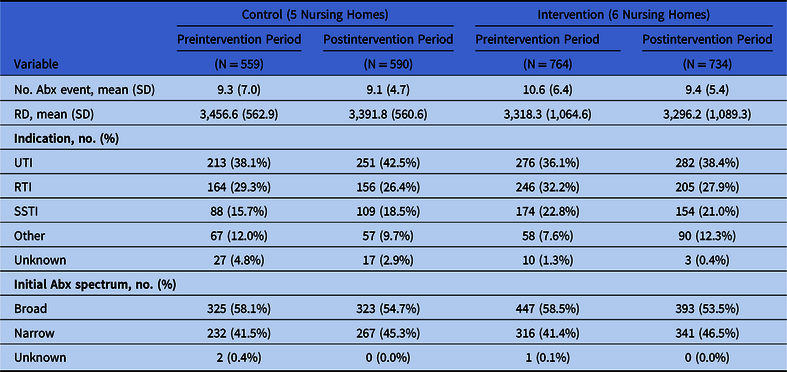
In total, 2,647 antibiotic events were identified during the study (1,149 in control facilities, 559 preintervention and 590 postintervention) and 1,498 of those were in intervention facilities (764 preintervention and 734 postintervention). Table 1 shows the descriptive statistics for the control and intervention nursing home before and after the intervention. Urinary tract infection (UTI) and respiratory tract infection (RTI) were the 2 most common indications for antibiotic treatment for both intervention and control groups; they accounted for ~40% and ~30% of antibiotic prescriptions, respectively. Approximately 60% of initial antibiotics prescribed in nursing homes were broad-spectrum agents, and no significant differences were observed between the intervention facilities (54.7%) and control facilities (58.1%) at baseline.
Characteristics of Antibiotic Use Among Control and Intervention Nursing Homes, Preintervention Period and Postintervention Period

Note. Abx, antibiotic; SD, standard deviation; RD, mean resident days per month per nursing home; No. Abx event, mean antibiotic event per month per nursing home; UTI, urinary tract infection; RTI, respiratory tract infection; SSTI, soft-tissue infection.
Of the 2,647 antibiotic events, 376 (14.2%) were associated with an ACE (14.2%) using specified criteria (Fig. 2). Within the identified ACEs, we found that 241 ACEs (64.1%) were due to class modifications and 118 ACEs (31.4%) were due to early discontinuations, respectively. Administration modifications were uncommon (n = 17).
Flow chart for identification of antibiotic change event (ACE).

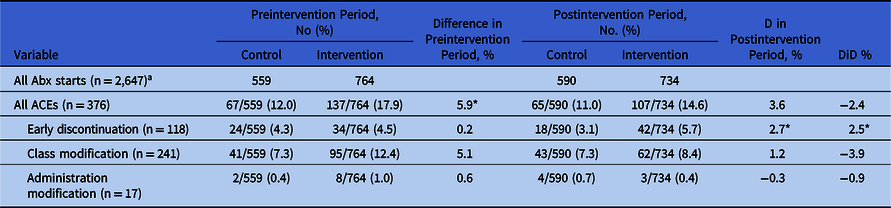
Table 2 shows the results of the DiD analysis. Overall, the frequency of ACEs decreased in both control and intervention group over the study period. The overall differences in difference in ACEs were not statistically significant. Early-discontinuation ACEs increased in interventions nursing homes following the introduction of the intervention (4.5% to 5.7%) but decreased in control nursing homes (4.3% to 3.1%) resulted in a significant DiD (2.5 %; P = .01). Class modification ACEs were higher in intervention nursing homes during the baseline period and decreased significantly following introduction of the intervention (12.4% to 8.4%), but they remained unchanged in control nursing homes (7.3% to 7.3%). The DiD in class-modification ACEs was not statistically significant (−3.9%; P = .15).
Results for the Difference-in-Difference Analysis

Note. Abx, antibiotic; ACEs, antibiotic change events; DiD, difference in difference.
a Intervention and control group: preintervention period, n = 1,323; postintervention period, n = 1,324).
* P < .05.
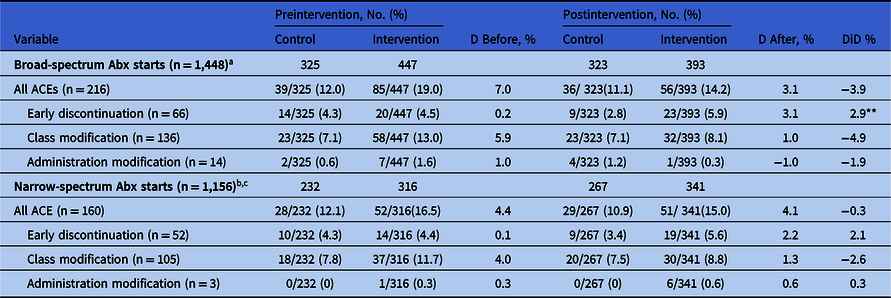
Analyses stratified by whether the initial antibiotic was a broad- or narrow-spectrum antibiotic were conducted (Table 3). The results of these analyses showed that the increase in early discontinuation ACEs in intervention nursing homes occurred among both groups but only achieved statistical significance in the broad-spectrum antibiotic group (DiD, 2.9 %; P < .01). The DiDs for class modification ACEs did not achieve statistical significance in either antibiotic spectrum group.
Results for the Difference-in-Difference Analysis by Antibiotic Spectrum

Note. Abx, antibiotic; ACEs, antibiotic change events; D, difference; DiD, difference in difference.
a Intervention and control group: preintervention period, n = 772; postintervention period, n = 716.
b Intervention and control group: preintervention period, n = 548; postintervention period, n = 608.
c The number of broad-spectrum and narrow-spectrum Abx starts do not sum up to all antibiotic starts because spectra of 3 antibiotic starts were not known.
** P < .01.
When examining the reduction in class-modification ACEs among subjects initiated on broad-spectrum antibiotics (see Appendix 3 online), most of this was driven by a reduction in changes to another broad-spectrum agent (8.9% to 5.1%). More modest reductions in spectrum-narrowing ACEs were identified (4.0% to 3.1%). Spectrum-broadening ACEs decreased among subjects initiated on narrow-spectrum antibiotics in intervention nursing homes (6.0% to 4.1%) but increased slightly in control nursing homes (4.3% to 4.9%). No spectrum-change ACEs decreased modestly among subjects initiated on narrow-spectrum antibiotics in both intervention nursing homes (5.7% to 4.7%) and control nursing homes (3.4% to 2.6%). However, none of the DiDs for the 3 class modification ACEs achieved statistical significance.
The frequency of the combination of early discontinuation and spectrum-narrowing ACEs among subjects initiated on broad-spectrum antibiotics increased in intervention nursing homes (8.5% to 9.0% but decreased in control nursing homes (6.8% to 5.6) (Appendix 4 online). The DiD was not statistically significant. No differences in this combination was identified among subjects initiated on narrow-spectrum antibiotics (data not shown).
Discussion
Strategies to improve antibiotic use in nursing home are needed. Most studies have focused on nursing home interventions targeting antibiotics start decisions, and few have focused on the postprescriptive phase.Reference Crnich, Jump, Trautner, Sloane and Mody5,Reference Feldstein, Sloane and Feltner26 Recent studies show that opportunities exist for a postprescriptive intervention in the nursing home setting.Reference Palms, Kabbani, Bell, Anttila, Hicks and Stone12,Reference Hossin, Bahranian, Taylor, Nace and Crnich27
Effects of ATO interventions in hospitals have been mixed.Reference Senn, Burnand, Francioli and Zanetti18-Reference Lee, Frenette, Jayaraman, Green and Pilote23 Senn et alReference Senn, Burnand, Francioli and Zanetti18 showed that prompting inpatient teams to provide a justification for continuing intravenous antibiotic therapy after 72 hours of use led to modest increases in the frequency of modifications of existing intravenous antibiotic therapy and a 14% overall reduction in total days of antibiotic therapy.Reference Senn, Burnand, Francioli and Zanetti18 In contrast, Thom et alReference Thom, Tamma and Harris22 showed that an ATO intervention had no effect on overall antibiotic utilization. Based on these studies, the Centers for Disease Control and Prevention (CDC) has de-emphasized the use of ATO interventions giving greater priority to facility-specific treatment guidelines, prior authorization, as well as prospective audit and feedback.28
Most nursing homes do not have the resources to implement the antibiotic stewardship interventions the Centers for Disease Control and Prevention (CDC) recommends for hospitals. Therefore, it is important to understand whether ATO interventions have utility outside the hospital setting. Other than the current study, we are aware of only 1 study that has examined the effects of an ATO intervention in the nursing home setting.Reference Fleet, Gopal Rao and Patel29 In this study, 30 London nursing homes were randomized to a checklist-based stewardship intervention that included an ATO as part of the recommended care of residents started on an antibiotic. Although the intervention decreased antibiotic consumption by 5%, adherence to the time-out process was low.
Our study adds to the literature of ATO interventions in nursing homes. Despite no apparent effects on the overall frequency of ACEs in intervention nursing homes, the OASIS intervention did result in a significant increase in early-discontinuation ACEs that were offset by a reduction in class-modification ACEs. The stewardship intervention implemented in intervention nursing homes, while promoting ATOs, also focused on withholding antibiotics in residents experiencing a low-risk change-in-condition and emphasized using nonfluoroquinolone alternatives. Consequently, one possible explanation for the paradoxical findings of this study is that subjects in intervention nursing homes were more likely to receive appropriate antibiotic therapy initially, resulting in fewer class-modification opportunities.
This study has several limitations. First, we did not collect data that allowed us to quantify ACE opportunities. Consequently, a potential explanation for the limited impact of the intervention on the overall frequency of ACEs is the underuse of ATOs in participating nursing homes. Additionally, we identified ACEs indirectly through a retrospective examination of provider orders and medication administration records, which typically do not include an anticipated duration of therapy. As a result, we were unable to ascertain whether time-out–related practices resulted in shortening the treatment duration and may have led to an underestimation of the frequency of ACEs in participating nursing homes. Moreover, we did not link antibiotic orders to culture results, and it is possible that secular changes in bacterial susceptibilities drove observed patterns in ACEs, particularly those related to class-modification ACEs. However, the lack of change in class-modification ACEs in control nursing homes reduces concern that secular changes in antibiotic resistance played a major role in observed prescribing patterns in this study. The OASIS intervention was designed to standardize nursing staff behaviors focused on resident assessment and communication with providers. Consequently, effects on ACEs relied on nursing staff to prompt providers to consider modifying existing antibiotic orders. It is likely that more proactive interventions based on prospective audit and feedback, perhaps delivered by the facility pharmacist or an external stewardship expert, would have a greater impact on ACEs, and this warrants further study. Finally, the findings of the study may have limited generalizability because the sample comprised only 11 nursing homes in 2 states. However, the nursing homes included in this study are typical of most nursing homes in the United States, and we have no reason to believe that the antibiotic prescribing practices in these facilities are qualitatively different from other nursing homes.
Despite these limitations, our study is one of the first to explore the impact of a nursing home–specific ATO intervention. Although we did not observe the increase in ACEs in intervention nursing homes that we expected, we did find evidence that the ATO intervention did increase the frequency of early discontinuation ACEs. Consequently, we believe that our results justify further studies designed to isolate the effects of ATO interventions on the postprescriptive decision making by nursing home providers. These future studies will be strengthened by methods that directly measure opportunities for ACE and the use of ATOs and methods that allow modifications in existing antibiotic therapy to be captured prospectively, particularly those that that result in changes to the duration of treatment courses.
In conclusion, the implementation of an ATO intervention in the nursing home setting appears to have increased the frequency of early discontinuation of broad-spectrum antibiotics. The effects of an ATO intervention on other types of postprescriptive modification remains unclear.
Supplementary material
To view supplementary material for this article, please visit https://doi.org/10.1017/ice.2020.75
Acknowledgments
We acknowledge the staff and prescribers who provide care to the residents of the following nursing homes: Capitol Lakes, Oakwood, St. Mary, UPMC Cranberry, UPMC Canterbury, and Asbury Heights for their time and participation in this study.
Financial support
The development and publishing of this manuscript was supported by a grant from the US Department of Health and Human Services, Agency for Healthcare Research and Quality (grant no. R18 HS022465-01A1).
Conflicts of interest
All authors report no conflicts of interest relevant to this article.