INTRODUCTION
Spinner dolphins (Stenella longirostris) are commonly found during daylight hours associated with shallow, sandy bays and reefs near islands and coral atolls (e.g. Norris et al., Reference Norris, Würsig, Wells and Würsig1994; Karczmarski et al., Reference Karczmarski, Würsig, Gailey, Larson and Vanderlip2005; Notobartolo-di-Sciara et al., Reference Notobartolo-di-Sciara, Hanafy, Fouda, Afifi and Costa2009). Spinner dolphins typically utilize these protected inshore areas for resting and social interaction, after having spent the night offshore foraging in the mesopelagic zone (Norris & Dohl, Reference Norris and Dohl1980; Benoit-Bird, Reference Benoit-Bird2004).
In mammals, a lack of rest and sleep deprivation leads to vision and memory impairments, and to a lack of co-ordination (Sternemann et al., Reference Sternemann, Schneider, Leweke, Bevilacqua, Dietrich and Emrich1997; Smith et al., Reference Smith, Conway and Rose1998; De Gennaro et al., Reference De Gennaro, Ferrara, Urbani and Bertini2000). More specifically, in spinner dolphins resting behaviour is considered to be important to their survival; hence any disturbances affecting either their resting behaviour or resting location is likely to have detrimental impacts on other facets of their ecology such as their ability to feed and reproduce successfully (Courbis, Reference Courbis2004; Courbis & Timmel, Reference Courbis and Timmel2009). Resting locations of spinner dolphins have often been reported in the close vicinity to popular, tropical tourist destinations (e.g. Notobartolo-di-Sciara et al., Reference Notobartolo-di-Sciara, Hanafy, Fouda, Afifi and Costa2009). While the possibility of getting up close and personal with a spinner dolphin in its natural environment represents a strong asset for the tourism industry, it also becomes a direct concern for the health of animals involved. This issue has recently received a considerable amount of attention, for example in the Hawaiian Islands, where it has led to the proposal of regulations aimed at protecting them from human disturbances (see US Department of Commerce, 2005).
Off the north-east coast of Viti Levu, the main island of Fiji, a small population of spinner dolphins has been regularly observed by local fisherman from the Dawasamu district and surrounding ecotourism ventures. On a daily basis they occur within the inside lagoon of a small tropical reef complex. This predictable presence has made these spinner dolphins a major draw for tourists to this destination. Boat trips from the local ecotourism lodges occur nearly daily and tourists are taken out to the reef to observe the dolphins and snorkel. With the potential for tourism growth and development in this area, the establishment of this reef as an important resting habitat is considered a crucial issue for their conservation. In this context, the objective of the present study was to quantitatively and objectively assess the use of Moon Reef by spinner dolphins, based on their site fidelity and behaviour. More specifically, because resting behaviour is considered important to the fitness, hence survival of spinner dolphins (Courbis & Timmel, Reference Courbis and Timmel2009), a specific care was given to assess whether this population were primarily utilizing Moon Reef as a resting habitat and additionally identify whether the same individuals were frequenting the reef over time.
MATERIALS AND METHODS
Study site
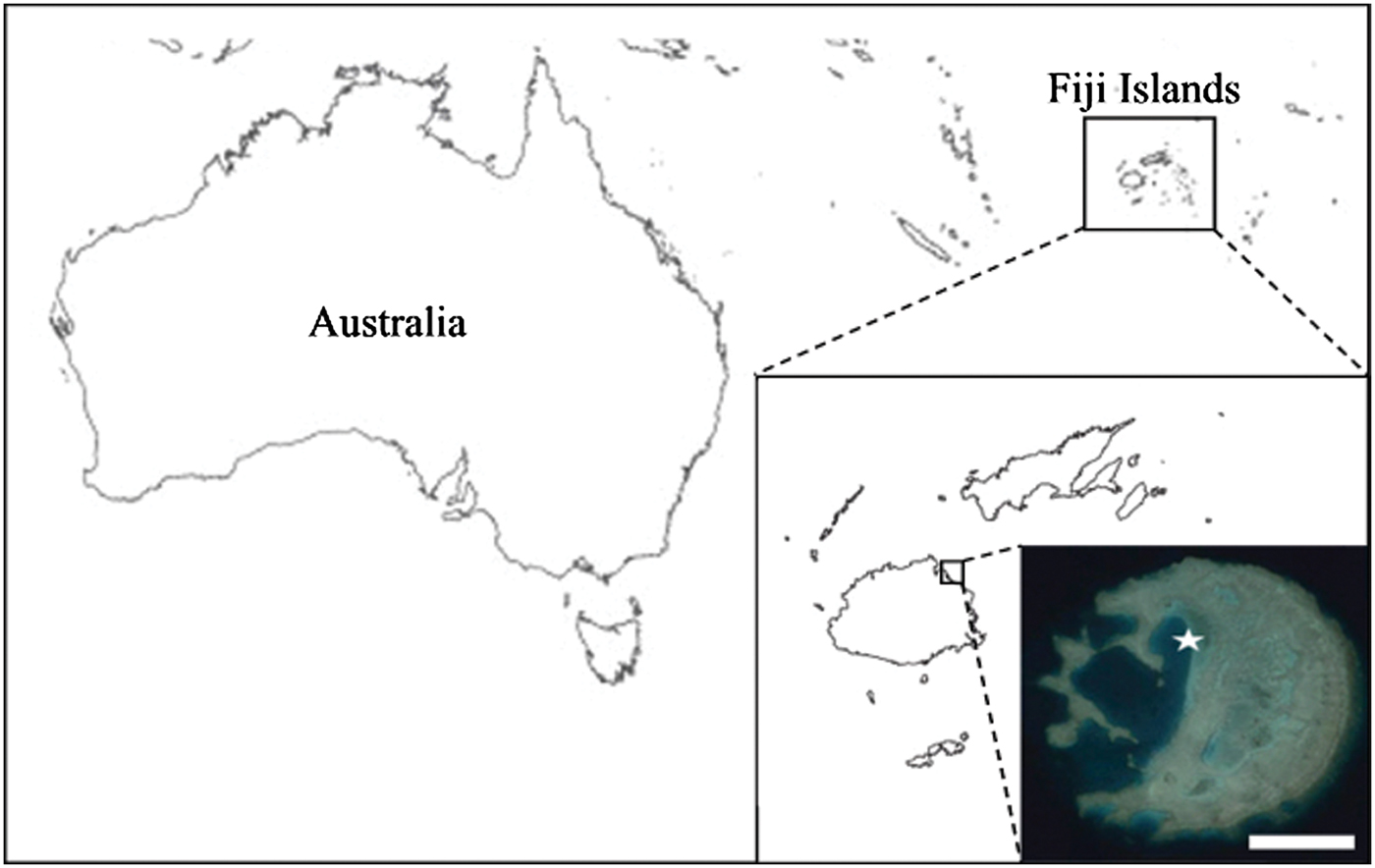
Moon Reef is a tropical reef complex located in the South Pacific Ocean (17°31.7′S 178°30.7′E; Figure 1), belonging to the southernmost end of a group of patch reefs bordering the Vatu-I-Ra channel. This circular shaped reef is located 9 km from the coastline of the main island of Fiji, Viti Levu. We measured the reef as being 1500 m in diameter, and covering an area of approximately 1.7 km2. The waters in the inner lagoon utilized by dolphins are approximately 15 m deep at maximum depth and consist of a sandy bottom substrate (covering an area of approximately 0.38 km2) with scattered patchy coral structures. This reef has 2 distinct natural entrances. First, there is a 66 m wide and 12 m deep channel, oriented on the south-western side of the reef. Second, there is an opening into the surrounding waters on the north-west of the reef that has a 15 m wide and 5 m deep channel. This smaller entrance is separated in its centre by a solid reef structure, which splits the entrance into two distinct smaller openings.
Location of the study site, Moon Reef, with regards to Australia and the Fiji Islands. The mooring location of the vessel during observations is indicated as a white star, and the scale bar represents 500 m.
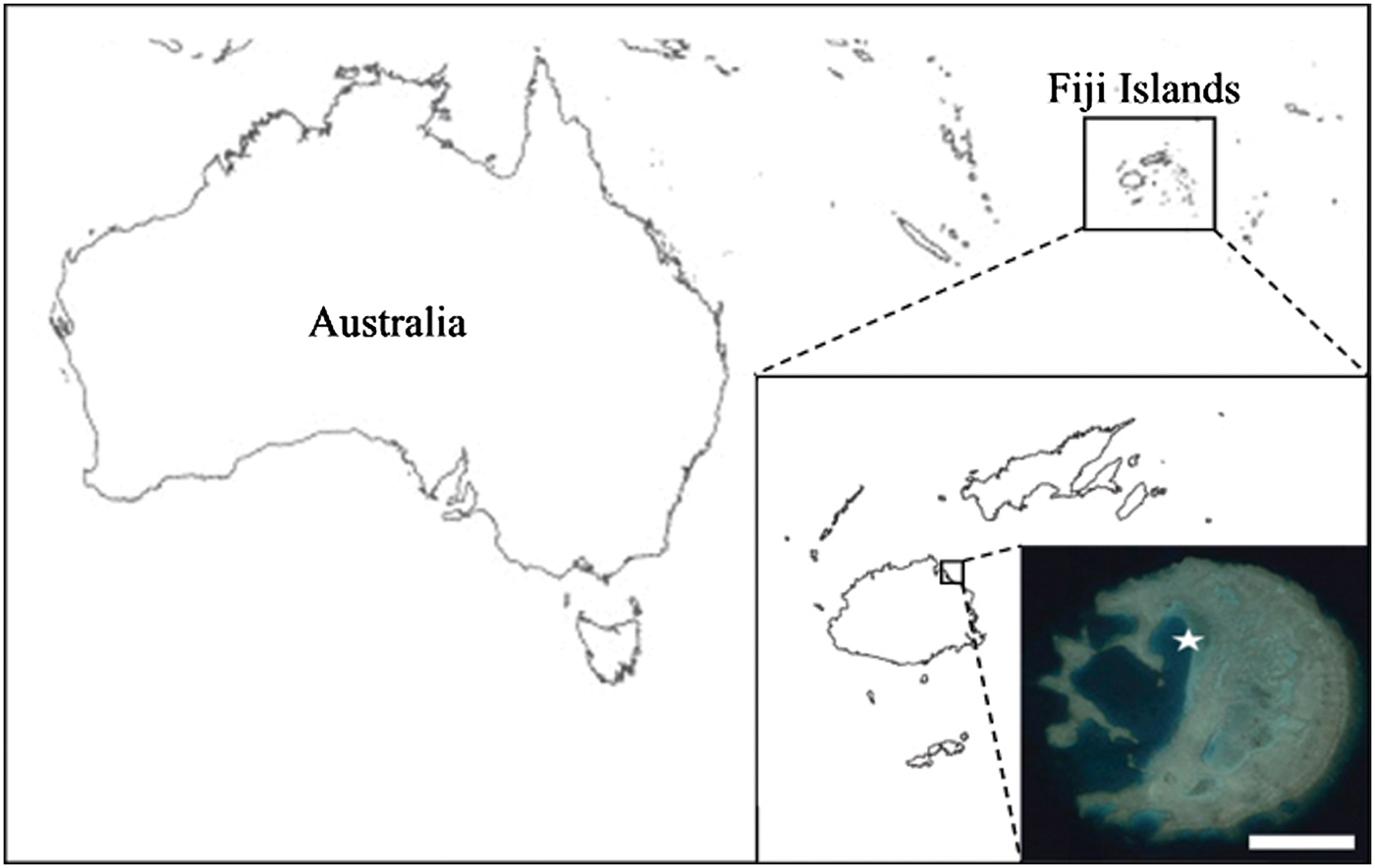
Photo-identification and observational data
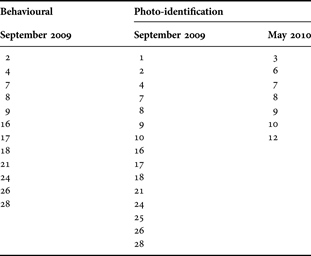
Photo-identification surveys and behavioural observations were conducted within the Moon Reef complex between the 1 and 28 September 2009 and 3 and 12 May 2010. All surveys were conducted aboard a 7 m fibreglass vessel powered by an 85 HP outboard engine. Surveys were carried out at a Beaufort sea state of less than 3, under daylight conditions, with all observations conducted before midday due to weather conditions. In addition, because sampling occurred non-ambiguously within the same time period, this has ensured that the study was not influenced by the animal's diurnal patterns (Sini et al., Reference Sini, Canning, Stockin and Pierce2005; Silva & da Silva, Reference Silva and da Silva2009). Access to the reef over the two study periods was relatively limited due to poor sea state and weather conditions. This resulted in a total effort of 12 days of behavioural observations and 22 photo-identification surveys. This totalled 1130 minutes spent conducting behavioural observations of spinner dolphins and 635 minutes dedicated solely to conducting photo-identification surveys.
Upon entering the Moon Reef complex, a binocular scan was used to locate a dolphin group and to record its initial behaviour before the vessel entered the inside lagoon. Once the initial behavioural activity was noted, the vessel approached the group. Dolphins were approached slowly at a speed of approximately 5 knots at an angle parallel to the group's direction of travel and the vessel was kept at a distance of approximately 20 to 50 m. Photo-identification surveys were conducted for a maximum period of 20 minutes, in order to minimize disturbance to the animals. Standard photo-identification techniques were applied, and as many as possible of the individuals present in the group were photographed (Würsig & Würsig, Reference Würsig and Würsig1977; Würsig & Jefferson, Reference Würsig, Jefferson, Hammond, Mizroch and Donovan1990). A Canon EOS 50D with a Tamron VC telephoto lens (18–275 mm), UV filter, and high-speed shutter was used to take all photographs.
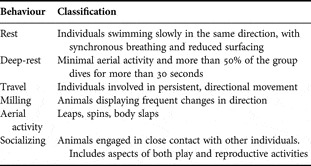
Additional behavioural observations were conducted whilst the boat was anchored at a fixed mooring position with the motor off over a section of reef structure (Figure 1). This enabled a continuous clear view of the group and was an attempt to minimize disturbance by the vessel. As part of the dolphin group was always visible at the surface when inside the reef's lagoon, observations were made with the naked eye. However, binoculars were used to observe the group when sea state inside the reef's lagoon became greater than 2, which limited the visibility of the group when they moved more than approximately 200 m away from the vessel. The group was scanned at regular 5 minute intervals back and forth from the left side of the lagoon to the right side. The predominant behavioural activity of only those animals visible at the surface of the water at the time of observation was then recorded. An ethogram was adapted from Norris & Dohl (Reference Norris and Dohl1980) and Danil et al. (Reference Danil, Maldini and Marten2005), and behavioural states were defined as resting, travelling, milling, deep-rest, engaging in aerial activities and socializing (Table 2). This resulted in 201 behavioural observations. Additional opportunistic observations of disturbances related to either the presence of additional boats and snorkellers in Moon Reef were also noted during each observational survey.
Data analysis
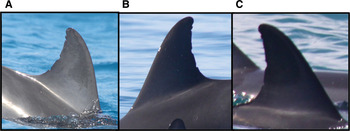
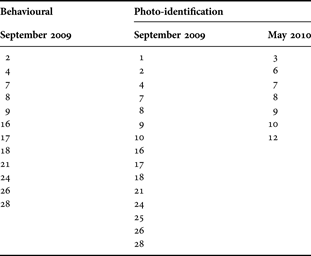
Analysis to identify individuals was based on distinctive fin features, such as nicks and notches present on both the trailing and leading edges of the fin and tip nicks (Würsig & Würsig, Reference Würsig and Würsig1977; Würsig & Jefferson, Reference Würsig, Jefferson, Hammond, Mizroch and Donovan1990). Each photograph was assessed for its photographic quality according to its focus, clarity, contrast, angle, portion of the fin visible and the percentage of picture filled by the fin. Photographs were then graded by their quality (excellent, average or poor: Baird et al., Reference Baird, Webster, Mahaffy, McSweeney, Schorr and Ligon2008, Reference Baird, Gorgone, McSweeney, Ligon, Deakos, Webster, Schorr, Martien, Salden and Mahaffy2009; Figure 2). Only photographs deemed excellent (e.g. fin angled parallel, sharp focus, no water droplets present, minimal glare, fin occupying large proportion of the frame) were used in the analysis (Baird et al., Reference Baird, Webster, Mahaffy, McSweeney, Schorr and Ligon2008). However, photographs considered average (i.e. those photographs of slightly lower resolution that still provided a clear identification and therefore a non-ambiguous match of the individual) were occasionally deemed sufficient in order to make a match and were included. Those considered poor (e.g. out of focus, poor contrast, high glare, fin only filled small proportion of frame, water droplets, features not distinguishable) were discarded from the analysis. Photographs were checked systematically against each other to develop a master catalogue of recognizable individuals and determine whether these individuals had been sighted using the reef complex on more than one occasion and between the two study periods. In order to establish whether recognizable individuals were revisiting and frequenting Moon Reef over time their degree of site fidelity was determined by their frequency of re-identification. Site fidelity has previously been defined as ‘the tendency of an individual to return to an area previously occupied or remain in an area for an extended period’ (Baird et al., Reference Baird, Webster, Mahaffy, McSweeney, Schorr and Ligon2008). Therefore, for the purpose of this study we considered those individuals sighted on 2 or more occasions during each of the 2 study periods and resighted in both years to be regular users of Moon Reef (Table 1).
Examples of excellent (A), average (B) and poor (C) quality photographs of individual spinner dolphins used in the photo-identification analysis.

Behavioural observation and photo-identification survey days for each of the two study periods conducted in Moon Reef, Fiji.
Classification of spinner dolphin behavioural activities observed in Moon Reef (adapted from Norris & Dohl, Reference Norris and Dohl1980; Danil et al., Reference Danil, Maldini and Marten2005).

Frequencies of occurrence of each behavioural category were determined for each survey from the number of 5 minute observation bins over which a given behaviour was observed, and subsequently averaged for each survey day. When more than one behavioural category was observed on a survey day, behavioural frequencies were compared within each day; the frequency of each behavioural category was also inferred between days. In both cases, potential differences among frequencies of occurrence of each behavioural category were inferred using the Kruskal–Wallis test and specified using a subsequent multiple comparison procedure based on the Tukey test to identify distinct groups of measurements (Zar, Reference Zar2010). Computations were run using a Fortran code, programmed following the methods described in Zar (Reference Zar2010). Non-parametric statistics were used throughout this work as our observations did not satisfy the normality assumption (Kolmgorov–Smirnov test, P < 0.05); hence medians and inter-quartile range were used to describe their variability. The confidence level was always set at 5%.
RESULTS
Behavioural observations
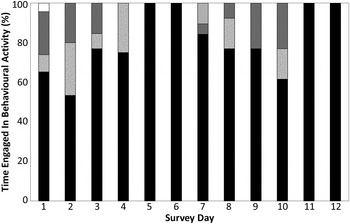
Over the two study periods spinner dolphins were present within the Moon Reef complex on all surveys except one, 22 September 2009. Over the duration of the study, spinner dolphins were observed resting, travelling, milling, engaging in aerial activities and socializing. Deep-rest was never observed during behavioural observations. Resting was the only behaviour observed on 4 of the 12 survey days (Figure 3). When resting was not the only behavioural activity, it was consistently the most frequently observed behaviour (Kruskal–Wallis test, P < 0.05; Figure 3), ranging between 53 and 100% depending on the day of observations. This behaviour (76.9%) was 20 times more frequent than travelling (3.8%) and nearly 12 times more frequent than milling (6.5%).
Percentage of time group spent engaged in each specific behavioural activity whilst congregating in Moon Reef across the 12 survey days. Black, resting; grey texture, travel; light grey, socializing; dark grey, milling; white, aerial activity.

Note that no specific behaviours such as rest and travel were ever observed in the presence of vessels and snorkellers. Strong and direct disturbances were, however, observed on 2 occasions during our behavioural surveys when a tourist vessel was directly engaged in approaching and following the dolphins at a close distance which led the dolphin group to cease resting and flee directly over the side of the reef structure.
Site fidelity and photo-identification
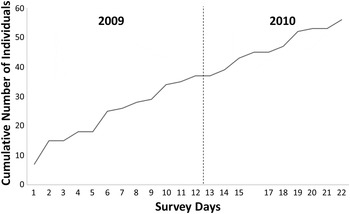
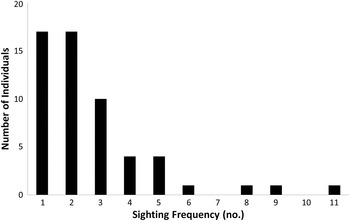
Two thousand two hundred and ninety-three photographs were obtained over the study period. From these 457 were used in the photo-identification analysis. A total of 56 recognizable individuals were identified and catalogued. Examples of dorsal fin markings of recognizable individuals included in the catalogue ranged from tip nicks to trailing and leading edge notches. The rate at which new animals were identified linearly increased over the two study periods (Figure 4), with new animals identified on 17 of the 22 surveys. Forty-five individuals were identified in September 2009, 11 individuals in May 2010, and 11 animals (20%) were resighted in both years. Resightings of identified animals within the reef ranged from 1 to 11 sightings (Figure 5). Of the 56 animals identified, 70% (N = 39) were resighted within Moon Reef on 2 or more separate surveys and between years. These individuals were therefore considered to be regular users of Moon Reef.
Rate of discovery of newly identified spinner dolphins in Moon Reef. The dashed line separates the two study periods (September 2009 and May 2010).

Re-identification frequency of individual spinner dolphins identified in Moon Reef.

DISCUSSION
Spinner dolphins were found to consistently occur in groups inside Moon Reef with 70% of the 56 animals identified being resighted on various occasions over the two survey years. This is consistent with previous work conducted in Hawaii, Tahiti and the south-western Atlantic showing spinner dolphins regularly congregating in large groups (Karczmarski et al., Reference Karczmarski, Würsig, Gailey, Larson and Vanderlip2005; Martens Silva-Jr et al., Reference Martens Silva-Jr, Silva and Sazima2005; Gannier & Petiau, Reference Gannier and Petiau2006) with specific individuals being resighted over time (Marten & Psarakos, Reference Marten and Psarakos1999; Martens Silva-Jr et al., Reference Martens Silva-Jr, Silva and Sazima2005). However, both the linear increase in the cumulative number of new individuals observed (Figure 4) and the relatively low resighting rates observed in Moon Reef (Figure 5) suggest that this reef may be supporting a larger population than first thought and that not all individuals present within the group on any given survey day were photographed. However, to date, there is no current estimation of abundance available for this population, and our sample size is too small to draw reliable conclusions about population structure and size. The observed low resighting rates may be consistent with individuals having extended home ranges and choosing other locations in which to rest during daylight hours. This low resighting rate might also be related to technical issues such as poor photograph quality or limited encounters resulting from our restricted and relatively limited field effort over the 2 survey periods.
The regular presence of the same individuals in particular and spinner dolphins in general, potentially makes them a source of attraction and interest for tourists, as previously stressed in Hawaiian waters (Courbis, Reference Courbis2007). Hence, this may induce additional threats to the fitness of individuals and ultimately the survival of the population. As such, this makes Moon Reef susceptible to anthropogenic threats, especially as, to our knowledge, it is the only site where spinner dolphins have been reported to congregate in Fijian waters (see Global Vision International, 2008). This is consistent with resting being by far the most frequent behaviour observed in Moon Reef (Figure 3), and with the behaviour of other spinner dolphin populations occurring in various tropical locations around the globe (e.g. Danil et al., Reference Danil, Maldini and Marten2005; Notobartolo-di-Sciara et al., Reference Notobartolo-di-Sciara, Hanafy, Fouda, Afifi and Costa2009). More specifically, spinner dolphins congregating in sheltered environments are generally using them to rest (Norris & Dohl, Reference Norris and Dohl1980). This regular behavioural pattern and more specifically their unique life history strategy of resting during daylight hours when tourism-related activities occur potentially makes them more susceptible to disturbances in their environment (Samuels et al., Reference Samuels, Bejder, Constantine, Heinrich, Gales, Hindell and Kirkwood2003; Danil et al., Reference Danil, Maldini and Marten2005; Delfour, Reference Delfour2007).
Anthropogenic impacts, such as tourism activities and vessel presence, are known to alter both the short and long-term behaviour of dolphins and, in some cases even their distribution (Lusseau, Reference Lusseau2003; Constantine et al., Reference Constantine, Brunton and Dennis2004; Bedjer et al., Reference Bedjer, Samuels, Whitehead, Gales, Mann, Connor, Heithaus, Watson-Capps, Flaherty and Krützen2006; Seuront & Cribb, Reference Seuront and Cribb2011). More specifically, the increase in tourism activities occurring in places such as Hawaii and Egypt (e.g. Delfour, Reference Delfour2007; Shawky & Afifi, Reference Shawky and Afifi2008) where resting spinners are subjected to anthropogenic activities such as swim-with dolphin programmes, snorkelling and vessel presence, has previously raised concerns for their welfare (Notobartolo-di-Sciara et al., Reference Notobartolo-di-Sciara, Hanafy, Fouda, Afifi and Costa2009). Disturbances to spinner dolphins whilst in the resting phase ultimately have the potential for detrimental effects to their overall fitness (Lammers, Reference Lammers2004; Courbis & Timmel, Reference Courbis and Timmel2009). Specifically, spinner dolphin resting behaviour has also been characterized by a ‘deep-rest phase’, when there is minimal aerial activity and dolphins are predominantly observed engaged in longer dives and spending less time at the surface (Norris & Dohl, Reference Norris and Dohl1980; Danil et al., Reference Danil, Maldini and Marten2005). This behaviour was, however, never observed during our surveys (Figure 3). This might suggest that the presence of our vessel, despite our care to minimize its potential disturbance, was still a relatively weak and indirect disturbance sufficient to prevent the dolphins from reaching this deep-rest phase. This is consistent with: (i) the observed decrease in spinner dolphins (Danil et al., Reference Danil, Maldini and Marten2005) and common dolphins (Kyngdom et al., Reference Kyngdom, Minot and Stafford2003) resting behaviour during presence of swimmers and the occurrence of deep-rest behaviour once the swimmers are gone (Danil et al., Reference Danil, Maldini and Marten2005); and (ii) the stress identified in bottlenose dolphins' surfacing rhythms in response to even a priori negligible disturbances (Seuront & Cribb, Reference Seuront and Cribb2011). This is even more important in cases in which vessels and swimmers are in direct pursuit of the animals (Danil et al., Reference Danil, Maldini and Marten2005; Gannier & Petiau, Reference Gannier and Petiau2006). This is in agreement with our observations of the dolphin group ceasing to rest and fleeing directly over the side of the reef structure with the presence of the tourist boat. Additionally, Moon Reef is regularly used as a fishing ground by locals from the surrounding villages; both fishing boats and spear fisherman frequent this reef and in the near vicinity, potentially leading to an additional source of disturbance that is still difficult to assess. Disturbances such as those observed at Moon Reef may then have the potential to keep these dolphins in a constant state of alertness that prevents them from reaching a deep-rest phase (Danil et al., Reference Danil, Maldini and Marten2005). To date, however, these disturbances and their potential impacts upon dolphin behaviour in Moon Reef have not been investigated and, as such, are not considered to be detrimental. Concerns about the impacts of human activities on spinner dolphins such as those observed in Moon Reef have previously led other locations such as Hawaii to begin initiating regulations in which to help minimize disturbance to the animals whilst in their resting habitats (Courbis, Reference Courbis2007). Given the example of the proposed regulations for spinner dolphin management in Hawaii (see US Department of Commerce 2005), regulations such as these could similarly be included in the preliminary management initiatives establishing Moon Reef as a Marine Protected Area (Convention on Migratory Species, 2011). However, the potential impacts of tourism-related activities occurring within Moon Reef should still be monitored and considered in future studies. Alternatively, the population of spinner dolphins investigated in Moon Reef might potentially not reach the above mentioned deep-rest phase. While the resolution of this specific issue is far beyond the scope of the present study, it should nevertheless be taken into consideration in future studies to ensure the efficiency of future management and conservation strategies.
CONCLUSION
The regular presence of individuals and the consistent resting behaviour displayed by spinner dolphins in Moon Reef clearly indicate the importance of this reef complex as a resting habitat to this population. However, the discovery rate of identified individuals suggests that this population is much larger than the animals identified during this study, hence stressing the need for further investigation to determine the abundance of this population. The potential subsequent application of a social network approach (e.g. Baird et al., Reference Baird, Gorgone, McSweeney, Ligon, Deakos, Webster, Schorr, Martien, Salden and Mahaffy2009; Stanton et al., Reference Stanton, Gibson and Mann2011), would also be beneficial in helping to understand the relationships and associations of those individuals resighted on more than one occasion. With the potential of tourism growth in this area, the needs for management and conservation initiatives are indeed crucial. These preliminary findings provide information that may be used as a baseline for their development and implementation. Additionally, the establishment of Moon Reef as a spinner dolphin resting environment may provide a stepping stone for future studies to investigate the specific biological and physical environmental features required by spinner dolphins.
ACKNOWLEDGEMENTS
Appreciation is extended to staff from Takalana Bay Retreat, Coraline Chapperon and Trish Cribb for their contribution to support in the field. We acknowledge the comments and suggestions of two anonymous referees. This research was supported under the Australian Research Council's Discovery Projects funding scheme (project numbers DP0664681 and DP0988554). Professor Seuront is the recipient of an Australian Professional Fellowship (project number DP0988554). This research project was also funded by the South Australian Government (through the Marine Innovation South Australia initiative). Field work was conducted under research permit number 1960/09 from the Government of Fiji Islands and ethics approval from Flinders University (project number E269).