Family, school and community (peers, leisure, and neighborhood) are primary developmental contexts for adolescents. Research and intervention in these contexts are very important to prevent externalized and internalized problems as well as to promote health and well-being in these contexts (Stattin & Kerr, Reference Stattin and Kerr2009). For example, positive parent-child relationships result in lower substance use (Johnson, McBride, Hopkins, & Pepper, Reference Johnson, McBride, Hopkins and Pepper2014), such as alcohol and tobacco use (Piko & Balázs, Reference Piko and Balázs2012). In a qualitative study by Navarro et al. (Reference Navarro, Montserrat, Malo, González, Casas and Crous2017), relationships with family and friends were considered to be the most important for well-being, confirmed by other studies indicating that family and peer relationships have a positive influence on adolescent well-being (Tomé, Matos, Camacho, Simões, & Diniz, Reference Tomé, Matos, Camacho, Simões and Diniz2012; Williams & Anthony, Reference Williams and Anthony2015). Additionally, a positive school climate promotes healthy development, with lower drug use and higher mental health (LaRusso, Romer, & Selman, Reference LaRusso, Romer and Selman2008).
Social support from developmental contexts
This study examines family, school and peer contexts. Specifically, it analyses the perceived social support from these developmental contexts and the contribution of the family, teachers, classmates and friends support in adolescent substance use and well-being.
Social support is a relevant aspect of each context, which in general refers to the help and emotional support that adolescents may have from different sources, such as family, friends, teachers or classmates. Perceptions of social support from different contexts vary according to age and gender. Girls perceive higher friend support, teacher support (Bokhorst, Sumter, & Westenberg, Reference Bokhorst, Sumter and Westenberg2010) and classmate support than boys (Bokhorst et al., Reference Bokhorst, Sumter and Westenberg2010; Hombrados-Mendieta, Gomez-Jacinto, Dominguez-Fuentes, Garcia-Leiva, & Castro-Travé, Reference Hombrados-Mendieta, Gomez-Jacinto, Dominguez-Fuentes, Garcia-Leiva and Castro-Travé2012). In addition, younger adolescents perceive similarly important parental and friend support and classmate and teacher support (Bokhorst et al., Reference Bokhorst, Sumter and Westenberg2010), and according to other research maternal support is the main source of support followed by paternal, classmate and teacher support (Hombrados-Mendieta et al., Reference Hombrados-Mendieta, Gomez-Jacinto, Dominguez-Fuentes, Garcia-Leiva and Castro-Travé2012). In contrast, older adolescents perceive friend support as more important than parental support (Bokhorst et al., Reference Bokhorst, Sumter and Westenberg2010) and classmate support as similarly important to parental support (Bokhorst et al., Reference Bokhorst, Sumter and Westenberg2010; Hombrados-Mendieta et al., Reference Hombrados-Mendieta, Gomez-Jacinto, Dominguez-Fuentes, Garcia-Leiva and Castro-Travé2012), whereas they perceive lower teacher support. This decrease of teacher support is probably due to the transition from primary to secondary school (Bokhorst et al., Reference Bokhorst, Sumter and Westenberg2010). Regarding the differences between parental and friend support, during adolescence parental support decreases and friend support increases, finally reaching similar levels (Helsen, Vollebergh, & Meeus, Reference Helsen, Vollebergh and Meeus2000). This could be related to the decrease of parental influence and the increase of friend influence during adolescence, although both are similarly relevant towards late adolescence (De Goede, Branje, Delsing, & Meeus, Reference De Goede, Branje, Delsing and Meeus2009).
In addition, substance use increases during adolescence (Sánchez-Queija, Oliva, Parra, & Camacho, Reference Sánchez-Queija, Oliva, Parra and Camacho2015), it is higher in older than in younger adolescents (Jiménez-Iglesias, Moreno, Rivera, & García-Moya, Reference Jiménez-Iglesias, Moreno, Rivera and García-Moya2013), and boys’ substance use increases more than girls’ substance use along adolescence (Sánchez-Queija et al., Reference Sánchez-Queija, Oliva, Parra and Camacho2015). Regarding well-being, girls and older adolescents show lower levels of well-being (Erhart et al., Reference Erhart, Ottova, Gaspar, Jericek, Schnohr, Alikasifoglu and Ravens-Sieberer2009; Ramos, Moreno, Rivera, Matos, & Morgan, Reference Ramos, Moreno, Rivera, Matos and Morgan2012). Perceived social support is associated with child and adolescent well-being and it seems that the association between social support and well-being increases with age, being greater in girls than in boys (Chu, Saucier, & Hafner, Reference Chu, Saucier and Hafner2010). In contrast, poor social support is a risk factor for adolescent mental health problems (Ravens-Sieberer, Erhart, Gosch, Wille, & The European KIDSCREEN Group, Reference Ramos, Moreno, Rivera, Matos and Morgan2008).
Family support, adolescent substance use and well-being
Parental support is the source of support most strongly associated with mental health, particularly with positive life satisfaction (Stewart & Suldo, Reference Stewart and Suldo2011), it is considered the best indicator of lower emotional problems throughout adolescence and it seems to influence the effect of friend support. Specifically, in adolescents with higher parental support, friend support had a slightly positive effect, whereas in adolescents with lower parental support, friend support had a negative effect (Helsen et al., Reference Helsen, Vollebergh and Meeus2000).
Family support positively influences adolescents’ subjective well-being (Leme, Del Prette, & Coimbra, Reference Leme, Del Prette and Coimbra2015; Williams & Anthony, Reference Williams and Anthony2015), such as life satisfaction (Gutiérrez & Gonçalves, Reference Gutiérrez and Gonçalves2013; Rodríguez-Fernández, Droguett, & Revuelta, Reference Rodríguez-Fernández, Droguett and Revuelta2012). Similarly, perceived support from adult family members is associated with fewer depressive symptoms (Tummala-Narra & Sathasivam-Rueckert, Reference Tummala-Narra and Sathasivam-Rueckert2013) and parental support is associated with fewer emotional symptoms (Demaray & Malecki, Reference Demaray and Malecki2002). Moreover, parental support is negatively related to substance use (Wills, Resko, Ainette, & Mendoza, Reference Wills, Resko, Ainette and Mendoza2004) and maternal support is associated with lower substance use (Branstetter, Low, & Furman, Reference Branstetter, Low and Furman2011). In fact, substance use is lower in boys and girls who had caring and supportive relationships in their families during childhood, and cohesive family context throughout adolescence and emerging adulthood (Sánchez-Queija et al., Reference Sánchez-Queija, Oliva, Parra and Camacho2015).
Friend support, adolescent substance use and well-being
Friend support positively influences adolescents’ subjective well-being (Leme et al., Reference Leme, Del Prette and Coimbra2015; Williams & Anthony, Reference Williams and Anthony2015), such as life satisfaction (Rodríguez-Fernández et al., Reference Rodríguez-Fernández, Droguett and Revuelta2012). However, others studies have found the contrary, showing that friend support did not influence on life satisfaction (Gutiérrez & Gonçalves, Reference Gutiérrez and Gonçalves2013). In the case of substance use, it has been found that friend support is not associated with substance use (Branstetter et al., Reference Branstetter, Low and Furman2011), and in contrast that peer support is positively related to substance use since peer group may favor risk behavior and have more positive substance use attitudes (Wills et al., Reference Wills, Resko, Ainette and Mendoza2004).
School support, adolescent substance use and well-being
Concerning school, classmate support has been associated with fewer emotional symptoms (Demaray & Malecki, Reference Demaray and Malecki2002), lower internalizing behavior and positive life satisfaction, and although teacher support did not associate with these variables, it did however with lower externalizing behavior (Stewart & Suldo, Reference Stewart and Suldo2011) and it indirectly influenced life satisfaction mediated by satisfaction with school (Gutiérrez & Gonçalves, Reference Gutiérrez and Gonçalves2013). In addition, other studies have found that perceived support from adults in the school context (among them teachers) is not associated with depressive symptoms, probably because adolescents perceive adults at school as sources of support for academic issues and not for emotional issues (Tummala-Narra & Sathasivam-Rueckert, Reference Tummala-Narra and Sathasivam-Rueckert2013). Possibly for similar reasons, in a study by Leme et al. (Reference Leme, Del Prette and Coimbra2015), teacher support did not influence adolescents’ subjective well-being. However, other studies have found that teacher support is positively associated with subjective well-being (García-Moya, Brooks, Morgan, & Moreno, Reference García-Moya, Brooks, Morgan and Moreno2015; Suldo et al., Reference Suldo, Friedrich, White, Farmer, Minch and Michalowski2009) and low teacher support, among others school-related aspects, implies low subjective and social well-being (Pilkauskaite-Valickiene & Gabrialaviciute, Reference Pilkauskaite-Valickiene and Gabrialaviciute2015).
In fact, a meta-analysis found that support from teachers and school personnel had the highest association with well-being, followed by family support, while friend support and other support had the lowest association (Chu et al., Reference Chu, Saucier and Hafner2010). In addition, it has been found that adolescents with higher teacher support perceive their schools as having a more respectful and healthy climate and this promotes lower substance use as well as higher social belonging and fewer depressive symptoms (LaRusso et al., Reference LaRusso, Romer and Selman2008).
Social support in Spain and Portugal
Social support seems to be an important factor for adolescent development and it is therefore of great interest to know how perceived support in different contexts, such as family, school and peers, contributes to their development in two similar countries, like Spain and Portugal.
In general, Portugal and Spain share many cultural and political similarities, which make it relevant to carry out this study in both countries. For example, Spain and Portugal are two of the European countries that assign less money to family-related policies (Instituto de Política Familiar, 2014); the education system is similar in both countries, Portuguese and Spanish adolescents’ perception about school generates concern (Inchley et al., Reference Inchley, Currie, Young, Samdal, Torsheim, Augustson and Barkenow2016) and the model for the provision of school health services is community-based (children and adolescents are supervised by health professionals working in health centers separated from the schools) in both Spain and Portugal (Pommier et al., Reference Pommier, Jourdan, Berger, Vandoorne, Piorecka and de Carvalho2010). Additionally, adolescents from Spain and Portugal show a positive perception of their families, parental support and good relationships, are generally involved in unproblematic peer group, as well as being satisfied with aspects of their school context (Serrano, El-Astal, & Faro, Reference Serrano, El-Astal and Faro2004).
Aims and hypotheses
The aim of this study was to analyze the role of social support from the main developmental contexts (family, school-teacher and classmate- and friend) in adolescent substance use (tobacco and alcohol use) and well-being (life satisfaction and health-related quality of life) in Portugal and Spain. Analyses were performed after deleting the effects of gender and age since, as has been indicated above, these demographic variables are related to social support, substance use and well-being and could affect the relationships between them. It was expected that all the sources of social support would be relevant for adolescent substance use and well-being, especially family support, and the social support from the main developmental contexts would be particularly important for adolescent well-being. Additionally, similar results were expected between Spain and Portugal due to similarities in both countries.
Method
Participants
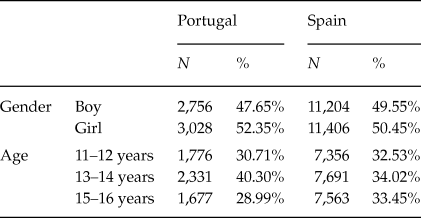
The participants were boys and girls aged 11 to16 years from Portugal and Spain who took part in the 2014 edition of the Health Behavior in School-aged Children (HBSC) study, a WHO collaborative cross-national study, in both countries. Specifically, the sample consisted of 5,784 Portuguese adolescents and 22,610 Spanish adolescents (see table 1).
Study sample

In Portugal, participants were randomly chosen from 36 national vertical clusters of schools, in a total of 473 classes, in a national sample geographically stratified by Education Regional Divisions (Matos, Simões, Camacho, Reis, & Equipa Aventura Social, Reference Matos, Simões, Camacho and Reis2015). In Spain, participants were selected through a random multistage sampling procedure stratified by conglomerates taking into account age, habitat (rural or urban) and type of educational centre (public or private) (Moreno et al., Reference Moreno, Ramos, Rivera, Jiménez-Iglesias, García-Moya, Sánchez-Queija and Morgan2016). Both samples were nationally representative regarding those ages.
Measures
The measures used in this study come from the 2014 edition of the HBSC questionnaire. In order to ensure that the same variables are measured in all countries, the HBSC study recommends carrying out a specific and critical translation process of the questionnaire: first, the measures are translated from English to national languages (Portuguese and Spanish in the case of this study); second, they are back-translated into English by a different translator; thirdly, the back-translations are reviewed by the national teams; and finally, the back translated measures are reviewed by the Translation Group Reviewer of the HBSC study (Aleman-Diaz et al., Reference Aleman-Diaz, Currie, Nic Gabhain, Godeau, Smith and Schnohr2013). For this study, the selected variables were as follows:
-
Demographic variables:
-
- Country: Portugal and Spain.
-
- Gender: boys and girls.
-
- Age: 11–12, 13–14 and 15–16 years.
-
-
Adolescents’ perceptions about social support variables:
-
- Family support: this variable was the family subscale of the Multidimensional Scale of Perceived Social Support (MSPSS): ’my family really tries to help me/ I get the emotional help and support I need from my family/ I can talk about my problems with my family/ my family is willing to help me make decisions’. Cronbach’s coefficient alpha of this subscale was .87, indicating good internal consistency (Zimet, Dahlem, Zimet, & Farley, Reference Zimet, Dahlem, Zimet and Farley1988). In this study, the values of Cronbach’s alpha were .95 in Portugal and .93 in Spain. The scale ranges from 1 (very strongly disagree) to 7 (very strongly agree).
-
- Teacher support: this variable was developed by the HBSC study and measures the support from teachers through a scale with three items ’I feel that my teachers accept me as I am/ I feel that my teachers care about me as a person/ I feel a lot of trust in my teachers’. The scale has a high internal reliability with a Cronbach’s alpha of .82 (Rasmussen et al., Reference Rasmussen, Dür, Freeman, Currie, Klinger, Ramelow and Samdal2013), similar to the values obtained in this study of .84 in Portugal and Spain. The scale ranges from 1 (strongly agree) to 5 (strongly disagree).
-
- Classmate support: this variable was developed by the HBSC study and assesses the support from classmate through a scale with three items ’the students in my class(es) enjoy being together/ most of the students in my class(es) are kind and helpful/ other students accept me as I am’. The scale has a high internal reliability with a Cronbach’s alpha of .74 (Rasmussen et al., Reference Rasmussen, Dür, Freeman, Currie, Klinger, Ramelow and Samdal2013), and in this study the values were similar with .76 in Portugal and .80 in Spain. The scale ranges from 1 (strongly agree) to 5 (strongly disagree).
-
- Friend support: this variable was the friends subscale of the Multidimensional Scale of Perceived Social Support (MSPSS): ’my friends really try to help me/ I can count on my friends when things go wrong/ I have friends with whom I can share my joys and sorrows/ I can talk about my problems with my friends’. Cronbach’s coefficient alpha of this subscale was .85, showing good internal consistency (Zimet et al., Reference Zimet, Dahlem, Zimet and Farley1988). In this study, the values of Cronbach’s alpha were .96 in Portugal and .93 in Spain. The scale ranges from 1 (very strongly disagree) to 7 (very strongly agree).
-
-
Adolescent substance use variables:
-
- Tobacco use: this variable was adapted from Monitoring the Future-study and the European School Survey Project on Alcohol and Other Drugs (ESPAD), it analyses the prevalence over the last 30 days of tobacco use: ’On how many days (if any) have you smoked cigarettes? In the last 30 days’, and it is a good measure of smoking prevalence (Hublet & Fotiou, Reference Hublet and Fotiou2013). The values range from 0 (never) to 30 (30 days or more).
-
- Alcohol use: this variable was adapted from Monitoring the Future-study and the European School Survey Project on Alcohol and Other Drugs (ESPAD), it examines the prevalence over the last 30 days of alcohol use: ’On how many days (if any) have you drunk alcohol? In the last 30 days’, and it is a good measure of frequency of usual drinking (Kuntsche et al., Reference Kuntsche, Simons-Morton, De Looze, Ter Bogt, Godeau, Hublet and Dankulincová2013). The values range from 0 (never) to 30 (30 days or more).
-
-
Adolescent well-being variables:
-
- Life satisfaction: this variable was measured through the Cantril Ladder (Cantril, Reference Cantril1965), which it is good measure of general life satisfaction: ’Here is a picture of a ladder. The top of the ladder “10” is the best possible life for you and the bottom “0” is the worst possible life for you. In general, where on the ladder do you feel you stand at the moment?’. This item ranges from 0 (worst possible life) to 10 (best possible life).
-
- Health-related quality of life: this variable was taken from the KIDSCREEN-10 index questionnaire, which has a good reliability (α = .82) (Ravens-Sieberer & The KIDSCREEN group Europe Reference Ravens-Sieberer2006). The KIDSCREEN-10 index is composed of 10 items about physical, psychological and social aspects of subjective health and well-being: ’Thinking about the last week… have you felt fit and well?/ have you felt full of energy?/ have you felt sad?/ have you felt lonely?/ have you had enough time for yourself?/ have you been able to do the things that you want to do in your free time?/ have your parent(s) treated you fairly?/ have you had fun with your friends?/ have you got on well at school?/ have you been able to pay attention?’. The scale ranges from 10 (never) to 50 (always). The values of Cronbach’s alpha in this study were .82 in Portugal and Spain.
-
Procedure
Data collection
The study was approved by the Ethical Research Committee of the University of Seville and the Ethical Commission of the Hospital S. João do Porto and was authorized by the Portuguese Ministry of Education and the Spanish Ministry of Health, Social Services and Equality (Matos et al., Reference Matos, Simões, Camacho and Reis2015; Moreno et al., Reference Moreno, Ramos, Rivera, Jiménez-Iglesias, García-Moya, Sánchez-Queija and Morgan2016).
The data collection in both Portugal and Spain was done through an online questionnaire that fulfilled the requirements of the HBSC study (Matos et al., Reference Matos, Simões, Camacho and Reis2015; Moreno et al., Reference Moreno, Ramos, Rivera, Jiménez-Iglesias, García-Moya, Sánchez-Queija and Morgan2016): the adolescents must answer the questionnaire themselves; the anonymity and confidentiality of their answers must be guaranteed; and the questionnaires must be administered within the school context (Inchley et al., Reference Inchley, Currie, Young, Samdal, Torsheim, Augustson and Barkenow2016).
Statistical analysis
The statistical analyses were performed using the IBM SPSS Statistics 23 program and were carried out separately for Portugal and Spain to analyze differences between both countries.
General Linear Models were used in order to control the effect of gender and age on the substance use and well-being variables and to save the unstandardized residual dependent variable. Following this, General Linear Models were performed to examine the role of social support in unstandardized residual variables of substance use and well-being after the effect of gender and age had been eliminated. R 2 (explained variance) values were used to inform about the relevance of the models, specifically using Cohen’s criteria (1988), the relevance was considered negligible from 0 to .019, small from .02 to .129, medium from .13 to .259, and large from .26 or greater. Partial eta squared (partial η2) values were utilized to analyze the effect size of each variable, taking into account that values were considered negligible from 0 to .009, small from .01 to .059, medium from .06 to .149, and large from .15 or greater (Cohen, Reference Cohen1988).
Results
General Linear Models of gender and age on the substance use variables were significant and with small relevance in Portugal and Spain for tobacco use (Portugal: F(3, 5623) = 61.620, p < .001, R 2 = .032; Spain: F(3, 19199) = 212.521, p < .001, R 2 = .032) and for alcohol use (Portugal: F(3, 5634) = 64.083, p < .001, R 2 = .033; Spain: F(3, 19121) = 242.938, p < .001, R 2 = .037). Similarly, General Linear Models of gender and age on the well-being variables were also significant with small relevance in Portugal and Spain for life satisfaction (Portugal: F(3, 5524) = 87.999, p < .001, R 2 = .046; Spain (F(3, 18488) = 484.230, p < .001, R 2 = .073) and for health-related quality of life (Portugal: F(3, 5523) = 230.582, p < .001, R 2 = .111; Spain: F(3, 16630) = 770.190, p < .001, R 2 = .122).
On the other hand, General Linear Models used to analyze the role of social support in unstandardized residual variables of substance use and well-being after the effect of gender and age had been eliminated showed similar results in Spain and Portugal.
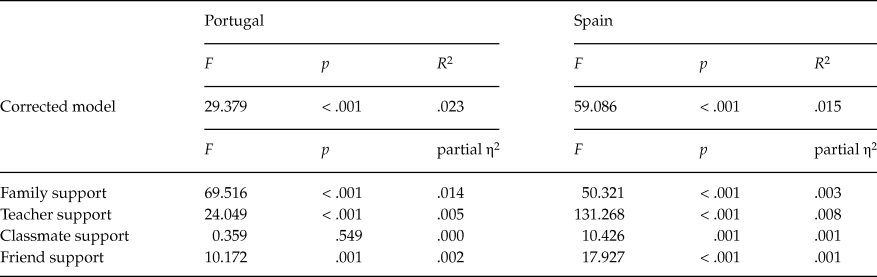
The model of social support from developmental contexts on tobacco use was significant and with small relevance in Portugal (F(4, 4913) = 29.379, p < .001, R 2 = .023). All social support variables, except classmate support, were significant, but the effect size was only noticeable for family support (p < .001, partial η2 = .014) with higher values favoring less tobacco use. On the contrary, in Spain the model was significant but the effect size did not reach a noticeable value (F(4, 15547) = 59.086, p < .001, R 2 = .015). These results are shown in table 2.
General Lineal Model of the social support from developmental contexts on tobacco use

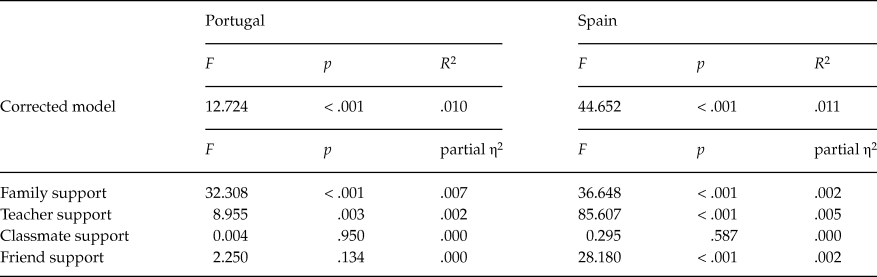
Regarding alcohol use (see table 3), the models were significant, but the effect sizes were negligible in Portugal (F(4, 4925) = 12.724, p < .001, R 2 = .010) and in Spain (F(4, 15502) = 44.652, p < .001, R 2 = .011).
General Lineal Model of the social support from developmental contexts on alcohol use

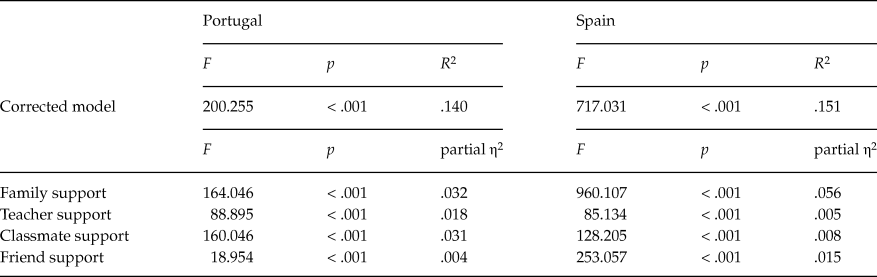
Concerning the model of social support from developmental contexts on life satisfaction (higher values of social support involved higher life satisfaction), as is shown in table 4, in Portugal it was significant with medium relevance (F(4, 4925) = 200.255, p < .001, R 2 = .140). All the social support variables were significant and the effect sizes were small for family support (p < .001, partial η2 = .032), teacher support (p < .001, partial η2 = .018) and classmate support (p < .001, partial η2 = .031), and the effect size was negligible for friend support (p < .001, partial η2 = .004). In Spain, this model was significant with medium relevance (F(4, 16126) = 717.031, p < .001, R 2 = .151). Again, all the social support variables were significant, but the effect sizes were small only for family support (p < .001, partial η2 = .056) and friend support (p < .001, partial η2 = .015), whereas for teacher support (p < .001, partial η2 = .005) and classmate support (p < .001, partial η2 = .008) they were negligible.
General Lineal Model of the social support from developmental contexts on life satisfaction

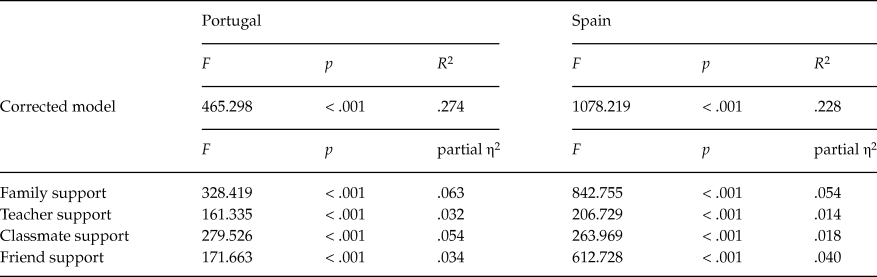
With respect to health-related quality of life, higher values of social support implied higher health-related quality of life. In Portugal, the model was significant with large effect size (F(4, 4925) = 465.298, p < .001, R 2 = .274). The social support variables were also significant and the effect sizes were medium for family support (p < .001, partial η2 = .063) and small for teacher support (p < .001, partial η2 = .032), classmate support (p < .001, partial η2 = .054) and friend support (p < .001, partial η2 = .034). Similarly, in Spain the model was significant with medium relevance (F(4, 14644) = 1078.219, p < .001, R 2 = .228) and all the social support variables were significant with small effect size: family support (p < .001, partial η2 = .054), teacher support (p < .001, partial η2 = .014), classmate support (p < .001, partial η2 = .018) and friend support (p < .001, partial η2 = .040). The results are shown in table 5.
General Lineal Model of the social support from developmental contexts on health-related quality of life

Discussion
The purpose of this study was to know what sources of social support from the main developmental contexts (family, school-teacher and classmate- and friend) were relevant for substance use (tobacco and alcohol use) and well-being (life satisfaction and health-related quality of life) in Portuguese and Spanish adolescents. Analyses were performed after deleting the effect of gender and age. The results of this study partially agreed with its hypotheses.
Social support variables were not relevant for substance use, with the exception of family support for tobacco use in Portugal, showing that higher values of parental support imply less substance use, as confirmed by previous studies (Wills et al., Reference Wills, Resko, Ainette and Mendoza2004). These results could be due to the fact that although different developmental contexts are analyzed, the social support variable is only one aspect of each context and is probably not as relevant to substance use as it is for well-being. As was found by Branstetter et al. (Reference Branstetter, Low and Furman2011), it would have been important to analyze different aspects of each context and not only one aspect, such as social support in the case of our study. Regarding friends, it is very likely that friends’ substance use and the peer pressure to use substances have a clearer role in predicting adolescent substance use than friend support. Therefore, the results of this study do not prove that the developmental contexts analyzed are unimportant for substance use, but only that the social support from these contexts is not a good predictor of adolescent substance use. Future research could go in depth analyzing different variables of these contexts, not only social support, to know the contextual variables involved in Spanish and Portuguese adolescents’ substance use.
In contrast, social support was relevant for well-being, with higher values of social support implying higher adolescent well-being in both countries. Specifically, family support, teacher support and classmate support were especially relevant for higher life satisfaction in Portugal, whereas in Spain, family support and friend support were more important for life satisfaction. All the social support variables (family, teacher, classmate and friend support) were relevant for health-related quality of life in Portugal and in Spain.
Therefore, family support is a key factor for well-being in Portuguese and Spanish adolescents. In fact, parental support is the dimension most related to mental health, mainly life satisfaction (Stewart & Suldo, Reference Stewart and Suldo2011), as well as to lower emotional problems during adolescence (Helsen et al., Reference Helsen, Vollebergh and Meeus2000). It has been also found that family support is positively associated with adolescents’ subjective well-being in general (Leme et al., Reference Leme, Del Prette and Coimbra2015; Williams & Anthony, Reference Williams and Anthony2015), and specifically with adolescent life satisfaction (Gutiérrez & Gonçalves, Reference Gutiérrez and Gonçalves2013; Rodríguez-Fernández et al., Reference Rodríguez-Fernández, Droguett and Revuelta2012).
In addition, teacher support is relevant for life satisfaction in Portugal and for health-related quality of life in both countries, whereas friend support is relevant for life satisfaction in Spain and for health-related quality of life in both countries. Previous studies have found contradictory results regarding support from teachers and friends, with some studies finding that friend support (Leme et al., Reference Leme, Del Prette and Coimbra2015; Rodríguez-Fernández et al., Reference Rodríguez-Fernández, Droguett and Revuelta2012; Williams & Anthony, Reference Williams and Anthony2015) and teacher support (García-Moya et al., Reference García-Moya, Brooks, Morgan and Moreno2015; Pilkauskaite-Valickiene & Gabrialaviciute, Reference Pilkauskaite-Valickiene and Gabrialaviciute2015; Suldo et al., Reference Suldo, Friedrich, White, Farmer, Minch and Michalowski2009) are positively associated with well-being, whereas others have not shown this association neither with friend support (Gutiérrez & Gonçalves, Reference Gutiérrez and Gonçalves2013) nor with teacher support (Leme et al., Reference Leme, Del Prette and Coimbra2015; Tummala-Narra & Sathasivam-Rueckert, Reference Tummala-Narra and Sathasivam-Rueckert2013). These results could explain that teacher and friend support are more relevant in Spain or Portugal depending on the well-being variable. When the relationship between social support and health-related quality of life is analyzed in this study, both teacher and friend support are relevant in both countries. This may be because health-related quality life is a more global measure of well-being than life satisfaction.
The same can happen with classmate support, because this variable, as teacher support, is more important for life satisfaction in Portugal and for health-related quality of life in both countries. Therefore support from classmates, as previous studies have found, is relevant for positive well-being (Demaray & Malecki, Reference Demaray and Malecki2002; Stewart & Suldo, Reference Stewart and Suldo2011), especially in Portugal.
These results also suggest that school-related social support is more relevant for adolescent well-being in Portugal than in Spain. Additionally, the support of classmates (not necessarily friends) in Portugal behaves similarly to the support of friends in Spain. A possible explanation is that in Spain the classmate group habitually changes every two years, whereas in Portugal the classmate group often stays together through almost all the compulsory education making it more likely that classmates are also friends and more important for adolescents in Portugal than in Spain. Nevertheless, it would be interesting to do an in-depth analysis in future research of the role of classmates and friends in Spanish and Portuguese adolescents. Furthermore, these results contribute to reflections on concerns about the education system in Spain and Portugal, as well as the data of the last HBSC international report regarding Portuguese and Spanish adolescents’ perception about school compared with adolescents from other countries. In this report for example, Spanish adolescents were among those who reported feeling more pressured by schoolwork and Portuguese adolescents were among those who indicated liking school less (Inchley et al., Reference Inchley, Currie, Young, Samdal, Torsheim, Augustson and Barkenow2016).
In general, as was expected taking into account cultural and political similarities, the results of this study are very similar in Portugal and Spain, probably because Spanish and Portuguese adolescents perceive their family context, peer groups and school context similarly (Serrano et al., Reference Serrano, El-Astal and Faro2004).
On the other hand, it is indispensable to indicate some limitations of this study when considering the results, such as that the HBSC study is a cross-sectional study that does not allow for establishing causal relationships. Others limitations include the fact that only one aspect, and not more dimensions, about the relationships in each context is studied and that it is examined as it is perceived by adolescents and not by other members of each context.
In conclusion, this study shows that social support is more relevant for adolescent well-being than for adolescent substance use, as well as that social support in each context, mainly family context, is important for adolescent health and well-being, which must be taken into account in interventions to promote adolescent health in Portugal and in Spain. Specifically, interventions in schools must be directed towards improving the education system considering the concerns based on adolescents’ perception of school (Inchley et al., Reference Inchley, Currie, Young, Samdal, Torsheim, Augustson and Barkenow2016). Additionally, these interventions must consider that school health promotion is one of the priorities for the school context, however the community-based model, existing in Portuguese and Spanish schools, does not always have as a main priority the school health promotion and the integration and acceptance of the health system in schools could be difficult with this model (Pommier et al., Reference Pommier, Jourdan, Berger, Vandoorne, Piorecka and de Carvalho2010), and therefore it would be necessary to overcome these limitations. Regarding interventions with families, since the economic benefits for family-related policies in Spain and Portugal are scarce (Instituto de Política Familiar, 2014) and family context was found to be the most important for adolescents in this study, it is necessary to provide more resources for Spanish and Portuguese families and, in general, to promote public policies with a family perspective across Europe (Instituto de Política Familiar, 2014), which ensure quality contexts for all families and adolescents.