1. Introduction
As the carrier of detection equipment and communication system, amphibious robots have gradually become a research hotspot in the field of robotics in recent years [Reference Xing, Guo, Shi, He, Su, Chen and Hou1–Reference Picardi, Chellapurath, Iacoponi, Stefanni, Laschi and Calisti3], and bionic amphibious robots of different structures have also come out one after another. Compared with amphibious motion modes such as the propeller-wheel, leg-paddle, crawler, and ball rolling type [Reference Xing, Liwei, Xihuan, Liu, Hu, Xia, Li and Guo4–Reference Yi, Shugen, Fujita, Yang and Pu9], the combination of swimming and jumping can better adapt to the complex operating environment and has stronger performance advantages such as obstacle crossing and risk avoidance.
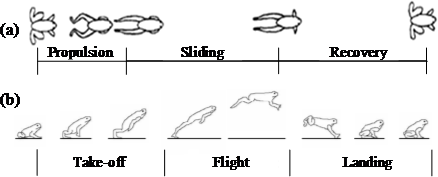
As a typical amphibian, frogs have excellent amphibious locomotion abilities. The synergy of different movement modes enables them to achieve efficient and flexible movement in various complex natural environments [Reference Meng, Xizhe, Jizhuang and Zhao10]. It is worth noting that the tree frogs can also perform climbing movements with the help of boundary friction created by their adhesive toe pads [Reference Hanna, Jon and Barnes W.P.11, Reference Smith, Barnes, Downie and Ruxton12]. The adhesive toe pads of tree frogs have been widely studied in the field of adhesive materials [Reference Barnes, Goodwyn P.J., Nokhbatolfoghahai and Gorb13–Reference Shi, Tan, Liu, Meng, Zhu and Xue15], while the research field of frog-inspired robots mainly focuses on two modes of movement of frogs: swimming and land jumping. In addition, the crawling movement of frogs does not have obvious locomotion advantages. Since climbing and crawling are not the research focus of frog-inspired robots, so we only describe the two situations of swimming and jumping here. The amphibious movements of frogs are all achieved by explosive movements of the hind limbs, as shown in Fig. 1, which are unified in movement and control. This highly integrated movement pattern is an effective means to expand the robot’s movement space [Reference Gillis16, Reference Richards17]. Meanwhile, the intermittent amphibious movement mode helps to improve the mobility and stability of the robot movement. Therefore, many scholars take frogs as bionic objects and apply the biological characteristics and motion mechanism to the research of frog-inspired robots, which have basically realized the function of detecting the surrounding environment [Reference Jizhuang, Shuqi, Qingguo and Zhu18].
The sketch of the frog amphibious locomotion, including (a) swimming and (b) jumping, and each locomotion process is divided into three stages.

Although researchers have made a lot of achievements in frog-inspired robots, it is found that research on frog-inspired amphibious robots is still in its infancy by reviewing and analyzing the existing literature. The existing frog-inspired robots are only limited to a single movement of swimming or jumping, resulting in a relatively narrow application field. Correspondingly, the frog-inspired amphibious robot with both swimming and jumping capabilities has the dual advantages of high integration and intelligence and can adapt to complex water and land environments. It has a broad application space, especially in the field of interstellar exploration with microgravity and has greater advantages and practical value. Therefore, the frog-inspired amphibious robots also have a large space for development. How to develop frog-inspired amphibious robots that can adapt to a variety of complex environments on the basis of existing research has gradually become the focus of researchers. It is also one of our research purposes to summarize and analyze the research status of frog-inspired robots to provide reference for subsequent research.
The biological motion mechanism is the basis for the research of bionic robots. Therefore, we first summarize the existing research methods on the single movement mechanism of frogs and proposes a solution based on the analysis of the advantages and disadvantages of each research method, so as to provide a reference for the study of the amphibian movement mechanism of frogs. The developed frog-inspired swimming or jumping robot has laid the foundation for the research of the frog-inspired amphibious robot. Its design concept, structural characteristics, actuation method, and locomotion performance will have great practical value for subsequent research. So, on the basis of analyzing its characteristics in detail, we then discuss the main technical challenges and key technical problems that need to be solved for the frog-inspired amphibious robot, which provides a certain reference value for its future research.
This paper is organized as follows: Section 2 will summarize the existing research methods on the movement mechanism of frogs and proposes a potential solution to provide a reference for the study of the amphibious movement mechanism of frogs. The research status of the existing frog-inspired robots is classified and analyzed according to the locomotion mode in Section 3. Section 4 will analyze the main technical challenges faced by the frog-inspired amphibious robot, the key technical problems that need to be solved, and its future research directions. Finally, Section 5 will conclude the proposed work.
2. Research methods of frog locomotion mechanism
The analysis of the locomotion mechanism of the frog is the first step in the research of the frog-inspired robot. This paper divides the current research methods on frog locomotion mechanism into anatomical method, experimental analysis method, digital particle imaging velocimeter (DPIV) method, and simulation method according to the technical means adopted.
2.1. Anatomical method
As the most basic means to study the musculoskeletal properties of frogs, anatomy was first used to study the mechanism of locomotion. The most primitive biological information data and musculoskeletal characteristics can be obtained by anatomy, which provides a data for the design and optimization of the frog-inspired robot body structure.
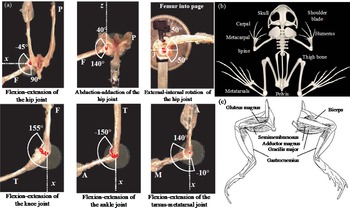
Kargo et al. [Reference Kargo, Nelson and Rome19] assessed the skeletal system of frogs by anatomically realistic modeling and forward dynamic simulations and finally obtained the range of motion of each joint. The movement relationship of the joints of the hind limbs is shown in Fig. 2a, in which the joint motion form and its motion angle are based on the established coordinate axes. Rotation around the Z-axis is the main form of movement of the hind limbs of frogs, which is regarded as flexion and extension movement here, and all joints of the hind limbs have flexion and extension movements. Rotation about the Y-axis and X-axis exists only at the hip joint, which are regarded as abduction-adduction and external-internal rotation, respectively. It should be noted that since the joint angle is marked with the coordinate axis as the starting line, the motion range of the joint is will be divided into two parts, so the angles in the figure include positive and negative values.
Anatomical analysis of frogs. (a) Range of motion of each joint [Reference Kargo, Nelson and Rome19]. The white arcs overlying the joint images represent the range of motion about each joint axis; red dots represent the locations of the instantaneous centers of rotation measured over this range of motion; The dotted lines show the X-, Y-, and Z-axis; Hip joint: left panel, flexion-extension of the femur F relative to the pelvis P around the Z-axis; middle panel, abduction-adduction of the F around the Y-axis; right panel, external-internal rotation of the F around the Z-axis; knee joint: the tibiofibula T relative to the F; ankle joint: the astragalus segment A relative to T, and tarsometatarsal joint: the metatarsals M relative to the tarsals. The musculoskeletal system of the frog, including (b) the skeletal system of the frog and (c) the muscular system of the hind limbs.

As can be seen from the musculoskeletal structure (Fig. 2b), the frog’s body is long and narrow in size, with a flat and slightly pointed head, and its mass is mainly concentrated in the torso, which ensures the smoothness of its amphibious movement. The hindlimb bones constitute the hip joint with three degrees of freedom (DOF), which corresponded most closely to a ball-and-socket joint including rotation, pitch, and torsion movements. The knee joint, ankle joint, and tarsus-metatarsal joint with one DOF. The forelimb consists of a shoulder joint with three DOFs formed between the scapula and the humerus, and the elbow and wrist joints with one DOF. The foot is a chain-like flexible structure formed by the tarsus and five phalanges. From the mechanical point of view, the torso will press the gravity to the tarsal and then distribute the force to the foot, so that the frog is in a relatively stable state. In addition, the tarsal also has certain elasticity, which can convert part of the gravitational potential energy into elastic potential energy, thus increasing the frog’s jumping ability and also playing a certain role in landing buffer. The flipper helps to generate propulsion during swimming, and its flexibility also reduces recovery resistance. The long and flexible characteristics provide a guarantee for jumping and swimming. Therefore, the design of the flipper structure has a certain influence on improving the locomotion efficiency of the frog-inspired robot. The basic biological information provides the data basis for the structural design of the robot.
In addition, strong muscular system is the main reason for frogs to achieve explosive movement, and the main feature of the hindlimb muscles (Fig. 2c) is the anti-pull type. Nauwelaerts et al. [Reference Azizi and Roberts20, Reference Nauwelaerts21] conducted experiments on the muscle movement of frogs during jumping and swimming. The structural and movement characteristics of the hind leg muscles of frogs were analyzed, and it was found that the antagonistic muscles generally had a pre-tension phenomenon in the process of locomotion, which was beneficial to the elastic structure connected to the muscles to store energy. When the muscles are stimulated by bioelectrical signals, they contract and transmit energy to the bones. The skeletal system is pulled by the corresponding muscles to realize the movement of the joints, and then the corresponding locomotion and propulsion force are generated. The semimembranosus, gluteus, biceps, and gastrocnemius play an important role in hindlimb movement. The semimembranosus is a double-joint muscle interlaced in the hip and knee joints, mainly acting on the hip joint. The gluteal and the biceps have similar effects, both of which mainly act on the knee joint. The gastrocnemius is a pinnate bi-articular muscle that mainly acts on the ankle joint. This discovery gave researchers a preliminary understanding of the musculoskeletal properties of frogs [Reference Aerts and Nauwelaerts22–Reference Jizhuang, Pengcheng and Wei24] and also provided inspiration for subsequent research on frog-inspired robots based on pneumatic muscles.
From the research and analysis of the musculoskeletal system of frogs, it can be seen that the hind limbs can generate large joint torque instantaneously and play an indispensable role in amphibious movement. Compared with the strong hind limbs, the frog’s forelimbs are relatively short. The forelimbs are used to support the body to adjust the take-off angle and to cushion the landing when jumping. The forelimbs mainly play the role of balancing the body and assisting turning when swimming. Therefore, we can focus on the hindlimb structure when designing the frog-inspired amphibious robot. Although its structural characteristics and the generation mechanism of propulsion can be analyzed from the perspective of biological ontology with anatomical method, this method has the disadvantages of high cost and low universality and is not suitable as a routine method for the study of amphibious motion mechanism.
2.2. Experimental observation method
Building a motion experiment observation platform is the most direct and effective way to obtain frog’s motion information. Based on the collected locomotion data, the position information of each joint and torso of the frog is analyzed, and its motion trajectory is extracted to calculate the corresponding speed and acceleration, and then its motion mechanism can be analyzed.
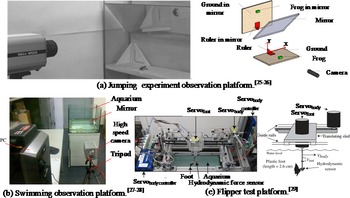
To extract the three-dimensional (3D) motion information during frog jumping, Wang et al. [Reference Shanyuanye25, Reference Meng, Xizhe and Jie26] built a spatial motion trajectory extraction platform as shown in Fig. 3a. The platform is simple, effective, and requires less equipment. It can be seen from the schematic diagram of the experimental platform that the mirror is placed at an angle of 45° to the ground, and the image formed in the mirror is the top view of the frog. With the help of mirror reflection, the top and front views of the frog’s movement can be captured simultaneously with only one high-speed camera. Among them, the 3D Cartesian coordinates are on the ruler, the y-coordinate axis is vertically upward, the x-coordinate axis is horizontally to the right, and then the z-coordinate axis is determined by the right-handed coordinate system. This simple operating principle also provides a reference for building an experimental platform for frog swimming observation (Fig. 3b) to analyzing its swimming mechanism [Reference Wei, Jizhuang, Yanhe, Qiu and Zhao27, Reference Yulong28].
The experiment observation platform of frog locomotion. (a) Jumping experiment observation platform [Reference Shanyuanye25, Reference Meng, Xizhe and Jie26]. (b) Swimming observation platform [Reference Wei, Jizhuang, Yanhe, Qiu and Zhao27, Reference Yulong28]. (c) Flipper test platform [Reference Richards and Clemente29].

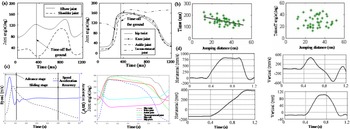
In the follow-up, it only needs to establish a camera pinhole model for coordinate transformation to obtain the 3D coordinates of each joint changing with time and then extract the 3D information of the movement trajectory of the joints at each moment. The joint and centroid data of the frog while jumping and swimming are shown in Fig. 4. In addition, we can also see from Fig. 4b that the take-off time is approximately inversely proportional to the jump distance, and the take-off angle is mostly concentrated between 20° and 40°. These data lay the foundation for the study of frog locomotion mechanisms and subsequent robotics research.
The frog movement data obtained from the experimental observation platform. (a) The angle of each joint changes when the frog jumps. (b) The relationship between frog jumping distance and take-off time and take-off angle. (c) The angle of each joint changes when the frog swimming. (d) The change in the center of gravity of a frog when it jumps.

To study the effect of flipper structure on frog swimming, Richards and Clemente [Reference Richards and Clemente29] further enriched the experimental equipment and built a test platform as shown in Fig. 3c. The experimental platform is easy to assemble and has low cost. As can be seen from the schematic diagram, the movement of multiple DOFs can be realized with the help of guide rails, and the comparison experiments of flippers with different aspect ratios are carried out here. If the control variable method is used to analyze the influence of a key biological structure on the movement performance, the design and assembly method of this platform can be used for reference.
2.3. DPIV analysis method
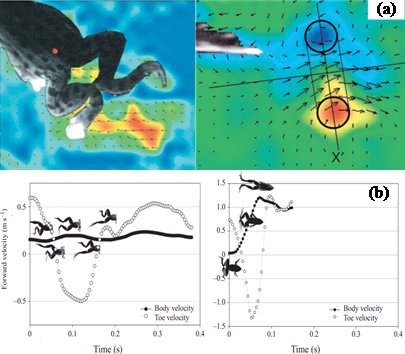
The flow field information in the process of frog movement, especially when they are swimming, has an important influence on the research on the mechanism of its propulsion. As an advanced imaging technology, the DPIV analysis method can make up for the insufficiency of the flow field information that cannot be obtained by the experimental observation method and has been applied to the observation of frog swimming. Aerts et al. [Reference Nauwelaerts30, Reference Stamhuis31] used the DPIV analysis method to observe the swimming process of frogs, as shown in Fig. 5a. The velocity information of the flow field during swimming is obtained, and the vorticity data near the flippers are calculated. The momentum impulse method is used to solve the reaction force of the fluid mass on the flippers to solve the propulsion during the swimming process. At the same time, a method using the vortex ring model of the flow field is also proposed to calculate the fluid force on the flippers.
The swimming information of frogs observed by DPIV. (a) The structural characteristics of the flow field when frogs swim [Reference Nauwelaerts30, Reference Stamhuis31]. (b) Locomotion velocity curves in different gaits [Reference Johansson and Lauder32].

Johansson and Lauder [Reference Johansson and Lauder32] also used the DPIV analysis method to study the asynchronous and synchronous movements of the hind limbs of frogs and obtained the speed change curves of the torso and toes under the two gaits, as shown in Fig. 5b. The effects of two gaits on changes in torso and toe velocity were analyzed. The speed of synchronous motion is significantly higher than that of asynchronous motion, about 3.5 times. The existence of this phenomenon is reasonable, because only one leg plays a propulsive role in the asynchronous movement process, while the other leg is in the recovery state, which will inevitably reduce the propulsive force of the frog. Therefore, most scholars focus their research on the synchronous movement of frog hindlimbs, and the asynchronous movement of hindlimbs is often considered to exist only with the turning motion of frogs during swimming.
The DPIV analysis method has the advantages of efficient and accurate capture and will play a more important role in analyzing the flow field information of biological motion.
2.4. Simulation analysis
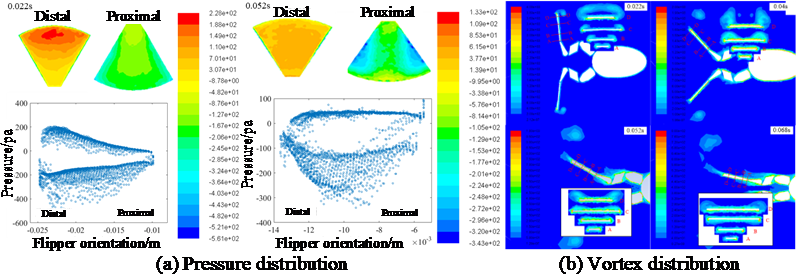
Motion simulation based on biological structure size and experimental data is the most convenient and fast method to analyze frog motion mechanism, but there are relatively few studies on frog motion mechanism using this method. Fan et al. [Reference Fan, Wei, Yanhe and Zhao33] used the software Fluent to realize the simulation of autonomous swimming of frogs based on Computational Fluid Dynamics (CFD). They first analyzed the pressure distribution at both ends of the flippers at different times (Fig. 6a). The distribution characteristics show that the propulsion force gradually transitions from drag to lift during the propulsion phase. To further study the connection between the flipper motion and the generated propulsion force, the vorticity distribution of the flow field during swimming was extracted. As the flipper rotates, the outer edge has a larger velocity component, which causes the attachment vortex to develop faster on the outer edge, so it is also the first to detach, forming the vorticity diagram as shown in Fig. 6b. The vorticity diagram reflects the generation mechanism of the propulsion force more intuitively. In addition, they also studied the effect of flipper shape and motion pattern on the swimming propulsion efficiency by the control variable method [Reference Fan, Wei, Bowen and Gangfeng34]. This provides an important reference value for applying the simulation method to the study of motion mechanism.
The pressure distribution and flow field vorticity diagram of frog flippers [Reference Fan, Wei, Yanhe and Zhao33]. (a) Pressure distribution and (b) vortex distribution.

From the above summary and analysis of the research methods of frog movement mechanism, it can be seen that from the most primitive anatomical analysis to the advanced DPIV method, the research on biological musculoskeletal characteristics [Reference Chum, Felt, Garner and Green35–Reference Moo, Peterson, Leonard, Kaya and Herzog37], single swimming, and jumping mechanism has been relatively mature [Reference Saboohi, Jamshidi and Poursina38–Reference Marsh and John-Alder41]. However, the research on the mechanism of frog amphibian movement needs to be further enriched, and the conversion mechanism between swimming and jumping is still unclear, which is also the fundamental reason for restricting the structural design of frog-inspired amphibious robots.
Based on the existing research methods, this paper proposes a solution from the perspective of co-simulation for reference. That is, the parametric model of the creature is established firstly according to the musculoskeletal characteristics and motion information and then combined with software MATLAB or Adams to simulate the system, and the influence of the parameters and forms of the key structures such as the hip joint and the flippers on the motion performance is specifically analyzed by the control variable method. Finally, Fluent is used to perform motion simulation to obtain the flow field information when converting motion and then analyze its amphibious motion mechanism, which provides theoretical basis for the design and optimization of the body structure of the frog-inspired amphibious robot. It is worth noting that the co-simulation method has the advantages of low cost, fast timeliness, strong operability, and good predictability. Therefore, the co-simulation-based method can be used as an alternative for analyzing the transition mechanism of frog amphibian movement.
3. Classification and research status of frog-inspired robot
According to the literature review, different kinds of frog-inspired robots have been successfully developed. They are many different classification methods according to different basis. Depending on the materials used, it can be divided into frog-inspired rigid or soft robot; and it also can be divided into frog-inspired swimming or jumping robot according to the locomotion mode. Since the characteristics and performance of motion are relatively more important than the material properties, we make an inductive analysis from the perspective of movement mode. The design concept, structural characteristics, and the driving method used will ultimately affect the motion performance of the robot. Therefore, we summarize the research status of frog-inspired robots from these aspects and analyze their characteristics, to inspire subsequent research on frog-inspired amphibious robots.
3.1. Frog-inspired swimming robot
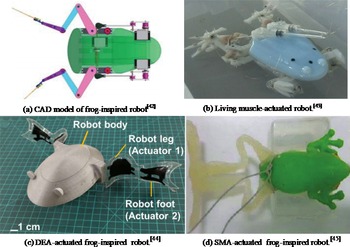
The frog-inspired swimming robot is a kind of robot developed based on the frog’s swimming mechanism, which can realize intermittent bionic swimming. In 2013, Pandey et al. [Reference Pandey, Reddy, Ray and Shome42] established the CAD model of the frog-inspired swimming robot by adopting the method of motor drive, rope, and pulley transmission, as shown in Fig. 7a. Afterward, to better study the swimming characteristics of the robot, the propulsion force was calculated by co-simulation and dynamic analysis of the 3D model. Although this scheme is only a simple 3D theoretical model, it still provides a reference for the structural design of the small frog-inspired swimming robot. Further, Sakai et al. [Reference Sakai, Shimizu, Aonuma and Hosoda43] developed a frog-inspired swimming robot with a shape and size very similar to a frog in 2014, as shown in Fig. 7b. The hind limbs of the robot have four DOF, and the propulsive force is generated by stimulating the muscles of the living body to realize swimming motion. It can reach the maximum swimming speed of 55.1 mm/s under the excitation voltage of 1 V. However, the living muscle preparation process used in this scheme is complex and has low repeatability and is not suitable for use as a driving unit of a robot.
The frog-inspired swimming robot with different actuation methods. (a) CAD model of frog-inspired robot [Reference Pandey, Reddy, Ray and Shome42]. (b) Living muscle-actuated robot [Reference Sakai, Shimizu, Aonuma and Hosoda43]. (c) DEA-actuated frog-inspired robot [Reference Yucheng, Lei, Xiaoning, Chew and Zhu44]. (d) SMA-actuated frog-inspired robot [Reference Gul, Kim, Lim, Doh and Choi45].

The development of new material technology provides new methods and ideas for the research of the robots. Researchers have begun to study the structure of frog-inspired swimming robots based on new materials. Tang et al. [Reference Yucheng, Lei, Xiaoning, Chew and Zhu44] designed a robot based on a dielectric elastomer actuator (DEA) in 2017 as shown in Fig. 7c. The robot contains only two DEAs per hind leg, with a total mass of 108 g. While realizing the simplification of the structure, the movement efficiency is also improved. The forward projected area of the fins is increased by 66%, and the average swimming speed is as high as 19 mm/s. As a driving unit with high energy density, DEA is more suitable for the explosive movement of frogs. However, the actuator has the disadvantages of complicated preparation process, and high-risk factor of driving voltage. In the same year, Gul et al. [Reference Gul, Kim, Lim, Doh and Choi45] developed a frog-inspired soft swimming robot based on shape memory alloy (SMA) combined with multi-layer 3D printing technology, as shown in Fig. 6d. Relying on the flexible sensor encapsulated on the robot limb to read the real-time angle of the joint, the synchronous movement of the torso can be realized by defining the mode of muscle activation, and then the basic movement of imitating swimming is completed. The two-way memory effect of SMA is used to realize joint extension movement, which expands the research idea of robot joint structure design.
It can be seen that the new actuation methods such as DEA and SMA can realize the miniaturization and light weight of the frog-inspired swimming robot, and the body structure is simple. However, the preparation process of such actuator is relatively complicated, and the motion efficiency is low, and there is still room for further optimization and improvement.
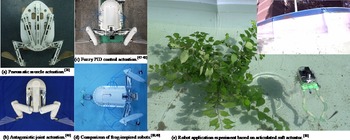
As we all known, pneumatic muscles have the advantages of high-power density, high output force, and fast response speed. Fan et al. took advantage of this feature and have successively developed the first generation [Reference Yulong28], the second generation [Reference Jizhunag, Pengcheng, Bowen, Zhang, Liu and Liu46], the third generation [Reference Jizhuang, Wei, Pengcheng, Cai and Liu47, Reference Jizhuang, Gangfeng, Huan, Zhang and Zhu48], and the fourth generation of frog-inspired swimming robots [Reference Jizhuang, Bowen, Du and He49], as shown in Fig. 8a–8d, respectively. Among them, the fourth-generation robot cannot only complete long-distance autonomous swimming without cables but also add a hip joint attitude adjustment mechanism, achieving a propulsion speed of 0.75 m/s, a steering speed of 30°/s, and a turning radius of 0.6 m. Its sustainable locomotion time reaches 1.2 h. In addition, the flipper of the robot adopts a four-bar linkage mechanism, and four pressure films are installed in the middle of the toes, which can accurately measure the propulsion force during swimming. However, we can also see that these robots developed based on pneumatic muscles are generally large in size and heavy in weight. The total mass of the fourth-generation prototype is as high as 10 kg and the body length is 0.740 m, which is inconsistent with the development direction of miniaturization and light weight. At the same time, the poor contractility and flexibility of pneumatic muscles also limit their further application in the structural design of frog-inspired amphibious robots.
The frog-inspired swimming robot based on pneumatic muscles and articulated pneumatic soft actuators. (a−c) Different forms of robotics based on pneumatic muscle actuation [Reference Yulong28, Reference Jizhunag, Pengcheng, Bowen, Zhang, Liu and Liu46–Reference Jizhuang, Gangfeng, Huan, Zhang and Zhu48]. (d) The comparison of the two frog-inspired robots shows that the articulated soft actuator greatly reduces the structure and mass of the robot [Reference Jizhuang, Shuqi, Qingguo and Zhu18, Reference Jizhuang, Bowen, Du and He49]. (e) The robot application experiment based on the articulated soft actuator has realized the observation function of the surrounding environment [Reference Jizhuang, Shuqi, Qingguo and Zhu18].

It is worth noting that, with different pneumatic muscles, the small pneumatic drive unit has the advantage of high speed, low cost, and good flexibility and is suitable for robots with medium and small loads. Fan et al. [Reference Jizhuang, Qingguo, Bowen and Zhu50] integrated 3D printing and molding methods to prepare an articulated pneumatic soft actuator, which has been successfully applied to in frog-inspired swimming robot, as shown in Fig. 8d. The mass of the robot is 1.29 kg, and the torso size is 0.175 × 0.1 × 0.06 m. Compared with pneumatic muscles, articulated pneumatic soft actuators realize the miniaturization and weight reduction of robots. With the cooperation of eight soft actuators, the robot’s fast and flexible motion is completed. The propulsion distance of a single motion cycle exceeds three times its own body length, and the turning radius is only 0.20 m while achieving a single 90° turning angle. In addition, the upper part of the robot’s torso can also be equipped with a small high-definition camera, which successfully realizes real-time observation of the surrounding environment [Reference Jizhuang, Shuqi, Qingguo and Zhu18].
Due to the flexibility and compliance of the base material, the articulated soft actuator not only realizes the flexibility of the body structure but also enhances the adaptability of the robot to the environment. Therefore, it is foreseeable that soft materials will be more widely used in the structural design of frog-inspired robots.
3.2. Frog-inspired jumping robot
The frog-inspired jumping robot can realize intermittent frog-inspired jumping motion. In view of its advantages of higher flexibility and better adaptation to unstructured terrain, and a larger application space, many scholars focus on the research of frog-inspired jumping robots compared with swimming robots, and the number of research literatures can also show this.
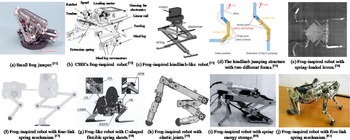
Jumping motion is more explosive than swimming and requires a higher energy density driving method. The frog-inspired jumping robots that have been developed mostly use mechanical elastic energy as driving energy, and the most common driving unit is the motor. Burdick and Fiorini [Reference Burdick and Fiorini51] first developed a frog jumping machine in 2003, which only relies on a small motor to complete all the actions of intermittent jumping. As shown in Fig. 9a, the size of the robot in the compressed state is only 0.3 × 0.3 × 0.3 m, and the weight is 1.3 kg. Not only it is light in weight and small in size, but also it shows high jumping ability and energy conversion efficiency and can complete a single jump with a height of 0.8 m and a distance of 1.8 m. However, the adjustment time between two jumps is about 1 min, and the movement frequency is relatively low. Reddy et al. [Reference Reddy, Ray and Shome52] designed a simple and efficient frog-inspired jumping robot using servo servos (Fig. 9b). The robot uses a four-link spring combined with spool winding and ratchet release for jumping. A telescopic spring is used on the two-link forelimb for landing buffering, and a jumping motion of 0.39 m in height and 0.63 m in distance is realized. Ahn et al. [Reference Ahn, Park, Kim and Kim53] designed a small frog-inspired hindlimb-like jumping robot weighing only 22.5 g based on the principle that the motor torsion stores elastic energy on the elastic body (Fig. 9c). The robot also uses a four-bar linkage structure to imitate the musculoskeletal structure and movements of the frog’s hind limbs and achieves a maximum jump height of 2.5 m by instantly releasing elastic elements, which is 58 times the height of its energy storage posture and 13.8 times its energy release posture. Igarashi and Mikami [Reference Igarashi and Mikami54] designed a frog-inspired limb structure that can use two different types of actuators (Fig. 9d). One is to use the stretching force generated by the compressed cam spring when it is released to realize the jumping motion and the other is to use the servo motor to drive the wire transmission to realize the precise control of the joint.
Different types of frog-inspired jumping robots that are driven by motors. (a) Small frog jumper [Reference Burdick and Fiorini51]. (b) CSIR’s frog-inspired robot [Reference Reddy, Ray and Shome52]. (c) Frog-inspired hindlimb-like robot [Reference Ahn, Park, Kim and Kim53]. (d) The hindlimb jumping structure with two different forms [Reference Igarashi and Mikami54]. (e) Frog-inspired robot with spring-loaded levers [Reference Tao56]. (f) Frog-inspired robot with four-link spring mechanism [Reference Xiguang and Zuquan57]. (g) Frog-like robot with C-shaped flexible spring sheets [Reference Di, Zhang, Zhao, Zhao and Liu58]. (h) Frog-inspired robot with elastic joints [Reference Xiangquan59]. (i) Frog-inspired robot with spring energy storage [Reference Chenjun60]. (j) Frog-inspired robot with five-link spring mechanism [Reference Meng, Xizhe, Jie and Hegao61].

The motor drive mode is simple in structure, flexible in control, and reliable in operation and has many types of motors to choose from. And elastic mechanisms such as springs and elastic rods are more common, so the combination of motors and elastic mechanisms has become a simple and commonly used method for constructing a frog-inspired jumping robot drive system [Reference Astley and Roberts55]. Li et al. [Reference Tao56, Reference Xiguang and Zuquan57] successively proposed three frog-inspired jumping robot schemes using elastic mechanisms such as spring levers and four-link springs (Fig. 9e–9g). The third-generation robot is an overall M-shaped structure based on linear bearings. The leg structure adopts C-shaped flexible leaf spring, and the cam is used to control the legs to realize the continuous jumping motion [Reference Di, Zhang, Zhao, Zhao and Liu58]. It is a pity that the motion performance of the robot has not been further verified by the prototype experiment, but it still provides a theoretical analysis for the pose adjustment, dynamics research, trajectory planning, and real-time control of the frog-inspired jumping robot.
In addition to the simulation analysis, Tan [Reference Xiangquan59] designed and developed a frog-inspired jumping robot (Fig. 8h) driven by a motor, transmitted by a synchronous belt and having five elastic joints in terms of shape and principle. The robot adjusts the jump height and distance by changing the number of springs, which verifies the feasibility of the elastic joint form. Lu [Reference Chenjun60] carried out structural optimization on this basis (Fig. 9i) and verified the correctness of trajectory planning for obstacle crossing based on improved particle swarm algorithm, which has certain reference value in trajectory planning of frog-inspired robots. Wang et al. [Reference Meng, Xizhe, Jie and Hegao61] developed a frog-inspired jumping robot that is driven by a motor, stored with springs, and uses five-bar mechanism legs to jump (Fig. 9j). The robot has a maximum horizontal distance of 0.865 m and a maximum height of 0.345 m for a single jump and can adjust the take-off attitude to meet different jumping requirements [Reference Xiangyu, Jizhuang and Hegao62].
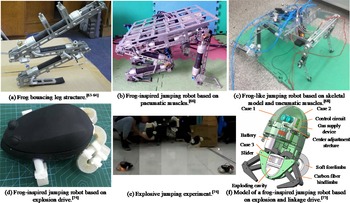
Compared with the traditional motor drive method, the pneumatic muscle mentioned above is more explosive, and its output torque is larger than that of the motor by adjusting the appropriate joint radius. Meanwhile, it can also achieve low speed or reverse motion, which can well adapt to the stagnation and reversal during the joint rotation process. Therefore, pneumatic muscles are more suitable for joint drive than motors and elastic mechanisms and have been successfully used in the research of frog-inspired jumping robots. Zhang et al. [Reference Wei, Jizhuang, Jun and Hegao63, Reference Wei and Jizhuang64] took the lead in developing a frog-inspired jumping leg based on pneumatic muscle drive (Fig. 10a) and successfully achieved a jumping motion of 0.5 m away and 0.3 m high. On this basis, the team successively developed the second generation as shown in Fig. 10b [Reference Leitao, Wei, Zhong, Jizhuang and Meng65, Reference Zhong, Fan, Zhu, Zhao and Zhai66] and the third generation of frog-inspired jumping robots as shown in Fig. 10c [Reference Wenbo, Jizhuang and Jie67, Reference Zhihai68]. Each joint of the robot uses pneumatic muscles as the driving unit, which realizes the jumping motion of 0.33 m high and 0.41 m far. The use of pneumatic muscles also has the same problem. While improving the motion efficiency of the robot, it also causes the robot to have the defects of large size and heavy weight, which does not conform to the development trend of miniaturization and light weight of robots.
The frog-inspired jumping robot powered by pneumatic muscles and explosions. (a) Frog bouncing leg structure [Reference Wei, Jizhuang, Jun and Hegao63, Reference Wei and Jizhuang64]. (b) Frog-inspired jumping robot based on pneumatic muscles [Reference Zhihai68]. (c) Frog-like jumping robot based on skeletal model and pneumatic muscles [Reference Zhihai68]. (d) Frog-inspired jumping robot based on explosion drive [Reference Xu74]. (e) Explosive jumping experiment [Reference Xu74]. (f) Model of a Frog-inspired jumping robot based on explosion and linkage drive [Reference Jiaming75].

In recent years, with the development of chemical fuel explosion driving technology, it has become feasible to develop small, even close to biological size soft bionic robots [Reference Keithly, Whitehead, Voinea, Horna, Hollenberg, Peck, Pikul and Shepherd69–Reference Ho and Lee73]. Yan [Reference Xu74] developed a hydrogen-oxygen explosive drive unit combined with rapid prototyping technology, which has been used in the prototype of a frog-inspired jumping soft robot. The total mass of the robot (Fig. 10d) is only 450 g, and the hopping motion of 0.4 m high and 0.75 m far is realized by means of explosion drive. The use of the soft drive unit promotes the development of the frog-inspired robot in the direction of miniaturization, light weight, and flexibility. To realize stable and controllable explosion drive, Qi [Reference Jiaming75] proposed a high-precision gas flow control method based on air pressure sensor, which integrates solenoid valve and air pump to realize quantitative generation and high-precision delivery of gas fuel. Meanwhile, a structural design scheme combining the soft explosive drive unit and the rigid hindlimb drive is also proposed (Fig. 10f), and the feasibility of the scheme is verified by jumping simulation.
From the perspective of energy utilization, the energy used by the driving unit of the frog-inspired jumping robot gradually changes from mechanical elastic energy to chemical explosive energy, and the body mechanism is also reduced and gradually integrated with soft materials to develop in the direction of soft robots. In addition, the research of frog-inspired jumping robot mainly focuses on the improvement of jumping performance, and it lacks in jumping direction control, landing buffer, and attitude adjustment [Reference Yihao and Liang76–Reference Yang78]. Excellent control strategy is also an important topic in the research of bionic robots.
3.3. Frog-inspired amphibious robot
Summarizing the current development process of the frog-inspired robot, its research mainly follows the following steps: firstly, based on the study of musculoskeletal characteristics and motion mechanism, the complex skeletal structure and joints of frogs are simplified, and then a mechanism model for actual motion is proposed. Then kinematics [Reference Meng, Xizhe, Fan and Jie79], dynamic analysis [Reference Jizhuang, Yulong, Zhang and Huan80], and motion simulation [Reference Song, Minghai, Huang, Donghai and Yigang81] are carried out to optimization and verify the rationality of key structural designs. Finally, following the principles of reasonable mass distribution, improving motion efficiency and realizing attitude adjustment, the overall structure [Reference Jizhuang, Yulong, Zhang and Huan82, Reference Yicong83] and the control system [Reference Jizhuang, Qingguo, Xu and Qilong84] of the frog-inspired robot were designed, and further verification and analysis were carried out by prototype experiments.
In view of the current research on frog-inspired amphibious robots is mainly in the theoretical research stage, the above basic theoretical achievements have laid the foundation for the research of frog-inspired amphibious robots. Yan [Reference Jia85] proposed a structural design scheme of a frog-inspired robot that can realize amphibious motion. The scheme adopts the driving method of motor and elastic mechanism, and the rationality of the design of key components such as the robot’s jumping mechanism, reset mechanism, and conversion mechanism is verified by finite element simulation, which provides a reference for the structural design of the frog-inspired amphibious robot. There is still a lot of work to be done on amphibious robotics research. It is worth noting that Yi et al. [Reference Yi, Geng, Jianqing, Siyuan and Mengyin86] inspired by frog scooter and breaststroke developed a novel amphibious robot, which adopts a dual-swing-legs propulsion mechanism. Based on its swing leg mechanism, an unusual universal wheel structure is used to generate propulsion on land, while a pair of flexible caudal fins functions like the foot flippers of a frog to generate similar propulsion underwater. Although this robot is not developed based on the mechanism of frog movement, its new locomotion mode also broadens our research ideas. The jumping motion can avoid obstacles, and the wheeled motion can improve the locomotion efficiency of the robot on flat terrain. In addition, the combination of the flippers of tree frogs and novel materials is used to further improve the flipper structure of the robot so that it can achieve climbing motion, which will further expand the movement space of the robot. Therefore, there is still a lot of research space for the research on frog-inspired amphibious robots.
4. Discussion
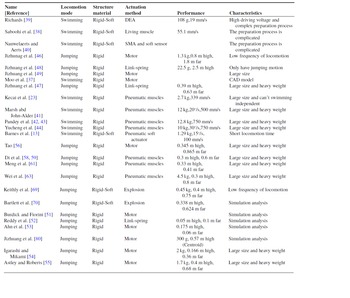
The research on frog-inspired robots has made great progress. Here, the types, driving principles, performance, and characteristics of the frog-inspired robot are summarized and listed in Table I. It can be seen from Table I that each protype has its advantages and disadvantages. However, despite the large number of frog-inspired robots, none of them can achieve amphibious locomotion, especially in the aspects of integration, intelligence and practicability of the prototype are still unsatisfactory. It is hard to say at this point what the best approach to further design an amphibious structure is. In terms of driving methods, motors and pneumatic muscles are still the main driving schemes used in the current research on frog-inspired robots. However, these two driving methods also lead to the shortcomings of the robot body structure, such as large size (body length exceeds 20 cm), heavy weight (over 1.5 kg), and poor environmental adaptability, which also cannot effectively simulate biological appearance.
Summary of the characteristics of the frog-inspired robot.

In addition, although the new driving unit that has been applied can realize the miniaturization and light weight of the frog-inspired robot, the disadvantages of complex preparation process, difficult modeling, and short service life also limit its application in the frog-inspired amphibious robot. It is worth noting that the chemical explosion driving unit has been successfully used in the driving system of the frog-inspired jumping robot, which does not require high size of the robot. Therefore, combining novel materials and new technologies to develop a chemical explosion actuation system with good explosiveness and high energy density will further promote the development of frog-inspired robots.
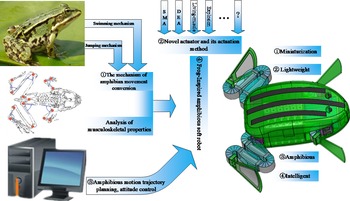
The research on frog-inspired amphibious robots is still in its infancy, and there are still many problems that have not been solved. The frog-inspired amphibious soft robot prototype with both jumping and swimming capabilities has not been reported yet, and further exploration and research are still needed. According to the research status of the frog-inspired robot, we will discuss and analyze the technical challenges and development trend of the robot from four aspects: motion principle, actuation technology, structural design, and control strategy, as shown in Fig. 11.
The technical challenges and development trends of frog-inspired robots.

4.1. Research on the mechanism of amphibian locomotion
Frog has attracted the attention of bionics because of its excellent amphibious movement ability. The frog-inspired amphibious robot can adapt to complex environments and has greater advantages and practical value. However, the frog-inspired amphibious robot based on the frog movement mechanism is still in the theoretical research stage. The study of amphibious structure is the first step in robot design. The principle of motion conversion between frog amphibious motions is still unclear, and it is difficult to provide a theoretical basis for subsequent research on robot structure design and motion control strategies, which is also an important factor restricting the successful development of frog-inspired amphibious robots. Therefore, clarifying the mechanism of amphibian motion is the primary challenge for frog-inspired amphibious robot research, and exploring suitable amphibious motion observation platforms and research methods for motion mechanism is also an important content of future research.
4.2. Novel explosive actuation technology
The structure and actuation method of the actuator have a direct impact on the body structure of the frog-inspired robot, while the traditional actuation methods such as servo motor, hydraulic drive, and pneumatic muscle cannot meet the high energy density requirements of the robot during motion. In addition, the choice of actuator is also affected by multiple factors such as the speed of the robot’s movement, the maximum workload, and the requirements for its own stability and sustainability during locomotion. Therefore, choosing the appropriate actuation technology is also the difficulty and focus currently faced.
As a novel type of actuation technology, chemical explosion actuation has the characteristics of high energy density and high explosive force, and the characteristics of generating huge energy at the moment of explosion meet the explosive needs of frog limb movement. Meanwhile, the explosion actuation has lower requirements on the structure size. Miniaturization and even close to biological size are more helpful for robots to improve locomotion efficiency and reduce unnecessary damage caused by collisions with the external environment. Therefore, it will be one of the future development trends to apply the novel explosive actuation technology to the drive system of the frog-inspired amphibious robot to realize the miniaturization and light weight of the overall structure.
4.3. Flexible structural design with amphibious locomotion capabilities
The ontology structure of the frog-inspired robot is a key issue that needs to be considered when conducting bionic research. With the development of novel material technology, the structure of the robot has gradually developed from the original pure rigid structure to the direction of integrating soft materials, and its adaptability to the environment has gradually increased. It can be seen that the structure of the frog-inspired robot will gradually develop in the direction of integrating the characteristics of rigid, flexible, and soft materials. In addition, novel materials are combined to improve the flipper structure of frog-inspired robot so that it can achieve climbing motion, which will further expand the movement space of the robot. The integration of amphibious motion modes will enable a leap forward in robotic flexibility and applicability. Therefore, on the premise of ensuring the reasonable size and quality of the robot, the realization of amphibious locomotion mode will be an important research and development direction in the future.
4.4. Intelligent control strategy
Attitude control technology based on environmental awareness is the main technical challenge in the intelligent design for frog-inspired amphibious robots. With the development of artificial intelligence and sensing technology, teleoperation and flexible sensors have been used in the development of new robots. It has become possible to continuously plan the motion trajectory according to its own position and external environment information, reasonably adjust the motion attitude and avoid obstacles, and finally achieve the purpose of closed-loop control. Intelligent control strategy is a key step for robots to move from laboratory to practical application. Therefore, improving the autonomy of frog-inspired robots and realizing intelligence is also one of the future development trends.
5. Conclusion and prospects
The amphibious movement mechanism of frogs is the basis for the research on frog-inspired robots. We summarize the existing research methods on the single movement mechanism into four types: anatomical method, experimental analysis method, DPIV, and simulation method. In the case of obtaining structural parameters, it is a better choice to study the mechanism of amphibious motion by using simulation analysis. In addition, the current research on frog-inspired robots mainly focuses on the frog-inspired swimming and jumping robots, but neither of them belong to the real frog-inspired amphibious robot, and there is still a lot of room for development. It is worth noting that the researchers‘ design concept has also begun to expand in the direction of amphibious robots. The feasibility of the amphibious structure has been preliminarily verified from the design schematic. The development of new materials and rapid prototyping has also accelerated the iteration of actuators. The driving energy used is gradually transformed from traditional mechanical elastic energy to chemical energy, which also provides positive feedback to the structural design of the robot, making it feasible to develop robots close to biological size.
The frog-inspired amphibious robots have great practical value in the fields of resource exploration and environmental exploration. It is a topic worthy of in-depth exploration to apply the structure characteristics of frogs and the mechanism of amphibious motion in the structural design of robots and then combine trajectory planning and motion control to complete the development of the robot. In the future, the frog-inspired robot will achieve a high degree of bionic and intelligent in appearance and function, with an amphibious motion mode, integrating flexible materials, and novel actuation technologies to achieve rigid-flexible integration, miniaturization, and light weight and have the ability to perceive the environment and complete tasks such as exploration and obstacle avoidance by autonomous trajectory planning. The research prospect of frog-inspired amphibious soft robots is very broad, and its unknown field is full of hope and challenges and needs to be continuously explored and studied.
Author contributions
All the authors have made contributions in literature analysis and paper revision. S W helped in the writing of the manuscript. J F and G L participated in the collection of literature and analyzed it together with S W. G L supervised and guided the manuscript.
Financial support
This work is supported by the National Key R&D Program of China (2019YFB1309601) and National Natural Science Foundation of China (Grant No. 51675124).
Competing interests
The authors declare none.