INTRODUCTION
Community conservation, namely the notion that conservation cannot and should not be pursued against the interests and wishes of local people, has received increasing attention from researchers, authorities, development and conservation agencies and local community organizations (Hulme & Murphree Reference Hulme and Murphree1999; Adams & Hulme Reference Adams and Hulme2001). Bruner et al. (Reference Bruner, Gullison, Rice and da Fonseca2001) and Vanclay (Reference Vanclay2001) showed the importance of the number of protected area (PA) guards and their awareness-building activities in local communities for the effectiveness of protected areas. PA personnel, including wardens and guards, have seldom been involved in the development of community conservation, however, in spite of its substantial international funding (El-Ashry Reference El-Ashry, Fishpool and Evans2001).
Training needs assessments for Eastern and Southern Africa (ULG Consultants Ltd 1998) and the African continent (Pitkin Reference Pitkin1995) have highlighted the need to train PA managers in human-related subjects (see also Western Reference Western2003). In India and the USA, the need to include a human dimension in conservation education has also been stressed (Saberwal & Kothari Reference Saberwal and Kothari1996; Jacobson & McDuff Reference Jacobson and McDuff1998). Unfortunately, the African training needs assessments have remained without further specification; for example stressing a need for all aspects of Community Based Natural Resource Management training (ULG Consultants Ltd 1998). Some publications have emphasized that changes in attitudes of PA personnel are required (for example IIED [International Institute for Environment and Development] 1994).
Existing training courses in participatory natural resource management (Borrini-Feyerabend et al. Reference Borrini-Feyerabend, Taghi Farvar, Nguinguiri and Ndangang2000; Nguinguiri Reference Nguinguiri2001) are based on insights from participatory rural development (Pretty et al. Reference Pretty, Guijt, Thompson and Scoones1995), which do not take frictions between conservation and short-term development objectives into account (Oates Reference Oates1999; Scholte Reference Scholte2003a). For example, PA personnel also have a policing role, rendering their position towards local communities sometimes ambiguous, which requires special skills and attitudes. Another difference with participatory rural development is that PA personnel are evaluated on overall conservation results. From their perspective therefore, community conservation tends to be seen as a means rather than a goal.
Garoua Wildlife College (‘Garoua’) is one of the three regional African wildlife colleges that train most of the continent's mid-career PA managers (Scholte Reference Scholte2003b). Founded in 1970, Garoua draws its students from 20 francophone, mainly West and Central African countries. Garoua provides two-year courses at both Certificate and Diploma level, with entry requirements of BEPC (similar to English GCSE) and BAC (similar to English A-levels), respectively. On average, Garoua students will possess more than 10 years professional experience (Scholte Reference Scholte2003b). Such professional experience has been argued to be the most important variable influencing learning results (Dochy et al. Reference Dochy, Segers, Moerkerke, Charrier and van Haarlem1997), although this is conditioned by active student participation in the courses. Garoua's curriculum has been dominated by courses on species identification and the functioning of ecosystems, while some attention has been paid to tourism and sport hunting. Regional colleges in India (Saberwal & Kothari Reference Saberwal and Kothari1996) and Tanzania (Snelson Reference Snelson1993) shared this focus on bio-ecological PA management until recently.
An external curriculum review carried out in 1996, stressed the need to introduce a community conservation course and updated courses on PA management planning and environmental education (Scholte Reference Scholte2003b). With the subsequent curriculum reform, about 10% of Garoua's curriculum has become people-oriented. In addition, the review identified the need to provide courses to upgrade the skills of former Garoua students, working as PA managers.
But what is the relevance of people-oriented training if PA personnel are ‘attitude-limited’ towards community conservation as widely assumed (IIED 1994; Scholte et al. Reference Scholte, Adam, Kari and Mbouche1999)? In other words, do they reject learning and change? Our hypothesis was that it is difficult to have a positive attitude towards something that you are insecure about and cannot implement. We therefore evaluated the students' assessments of the first long and refresher courses in community conservation for West and Central African PA personnel given by the basic training college at Garoua (Cameroon). We compared our findings with courses at the other two regional African Wildlife Colleges receiving students from Eastern and Southern Africa (Scholte Reference Scholte2003b).
METHODS
Course design
The goal for both the short and long courses has been to raise awareness and increase capacities for transparency and mutual trust between PA managers, local communities and integrated conservation-development project (ICDP) personnel. Both long and short courses began with a discussion about the objectives of community conservation, addressing knowledge and attitudes. These objectives were specified by the fine-tuning of PA objectives (IUCN [World Conservation Union] 1994) with possible participation levels (Pretty et al. Reference Pretty, Guijt, Thompson and Scoones1995; Barrow & Murphree Reference Barrow, Murphree, Hulme and Murphree2001), essentially addressing analytical skills. For the remainder, especially of the long courses, a ‘community conservation cycle’ was emphasized, in an analogous fashion to the project cycle (Cracknell Reference Cracknell2000), to stress the interrelationships between activities undertaken. The diagnostic stages of participatory rural appraisal (PRA) and problem and stakeholder analysis (De Groot Reference De Groot, Nath, Hens, Compton and Devuyst1998) were followed by the facilitation of stakeholder representation. Confidence building, addressing attitude and communication skills, was included in the course because of the potential for tense relations between authorities and local communities in PAs. Problem analysis and categorization allowed trainees to grasp development problems with conservation requirements and their inclusion into the community conservation cycle.
Long courses were designed with a focus on analytical and communication skills, addressed by lectures, fieldwork and examples taken from PAs visited during the coursework or the students' home areas. A one-day village PRA exercise was included in the College's regular 1–2 week fieldtrips to one of the national parks in northern Cameroon. Fieldwork planning did not allow for overnight stays in a village, which might have stimulated more informal contacts.
Both short courses aimed at initiating collaboration between PA guards and their local communities, and the development of dialogue between ICDP personnel and PA guards. The courses were structured around the main phases of the community conservation cycle, with examples from the local PA and its ICDP, and based on the concept that involvement of local communities should not imply loss of authority over the PA.
The park warden refresher course was limited to 10 days because of financial and absence-from-post constraints, motivating a specific course theme: ‘The role of management planning in the involvement of local people in PA management’. This choice was based on the interest that Cameroonian park wardens had shown in the management planning of Waza National Park and the frequent discussions on community conservation (Scholte Reference Scholte2005). These refresher courses focused participants from several West and Central Africa countries on a selected PA where management planning was ongoing. In preparation for the courses, wardens prepared 10-minute presentations on management planning in relation to local community involvement in their own PA, enabling introductory lectures to focus on management planning and community conservation for both trainers and trainees. In the session with Central African wardens, the host warden presented the ongoing park planning process, which was then the subject of subsequent fieldwork. In the training session with West African PA wardens, the host warden was unable to carry out his presentations and the emphasis of the course was shifted to an exchange of experiences amongst participants, with fieldwork limited to a one-day visit to development interventions in park villages. Both sessions included lectures and discussions on PRA and communication skills, but PRA field exercises were only undertaken during the session attended by Central African wardens.
With the Garoua courses as starting point, we compared the 2001 syllabi of the one-year certificate and two-year diploma courses at the College of African Wildlife Management (Mweka, Tanzania) and the 1998 one-year course at the Southern African Wildlife College (SAWC, South Africa).
Course evaluation
The three training dimensions of individual knowledge, skills and attitude development (Rothwell & Sredl Reference Rothwell and Sredl1992; Stone Reference Stone1997) were investigated using Kirkpatrick's hierarchy (Rothwell & Sredl Reference Rothwell and Sredl1992; Kirkpatrick Reference Kirkpatrick1994), based on trainees' (1) reaction, (2) learning and (3) behaviour change during job performance. No course evaluations from Mweka and SAWC were available for comparison (Scholte Reference Scholte2003b).
Trainees' reactions
At the start of the 1999–2001 long course, students were invited to write a statement on people's involvement in conservation, the justification for conservation and their earlier experiences. These statements were categorized into four classes, ranging in focus from development to conservation. As part of the curriculum evaluation, long-course students judged the ‘relevance’ of section of the curriculum to their future profession. Students also judged the ‘presentation’ of each course, in which they addressed whether they ‘liked’ the course and its training methods. Both long- and short-course participants were asked to judge the relevance of course themes and training methods on a scale of 1 (non-relevant) to 5 (highly relevant) and explain their choice in a few words.
Trainees' learning
At the end of all but the 1996 short course, trainees' reactions to their perceived learning experiences were anonymously assessed with two multiple-choice questions. Halfway through and at the end of each long course, Garoua organized a written assessment, mainly addressing acquired knowledge, which constituted half the students' marks. An oral assessment at the end of the semester constituted the remainder of their marks, together with, in 1999–2001, an appreciation of the reports on the PRA field exercise written by groups of four diploma students. Oral assessments generally emphasized students' analytical skills and attitudes, and often referred to work placement experiences. These assessments fulfilled regular educational requirements and were a check on learning progress.
Behaviour change during job performance
Experience with tracer studies of Garoua has shown that post-course assessments based only on questionnaires that were sent out, did not yield valid results and needed more cost-intensive interviews conducted in the respective countries of former students. For the present courses, post-training observations could be made only for PA guards based in North Cameroon.
Statistical analysis
Formal assessment data (‘trainees learning’) were analysed with Pearson correlation, the means being compared with t-tests (SPSS [Statistical Package for the Social Sciences] 1999). Ratings of the curriculum and course contents and methods evaluation were compared with Mann-Whitney tests (SPSS 1999).
RESULTS
General reactions to relevance and presentation of the courses
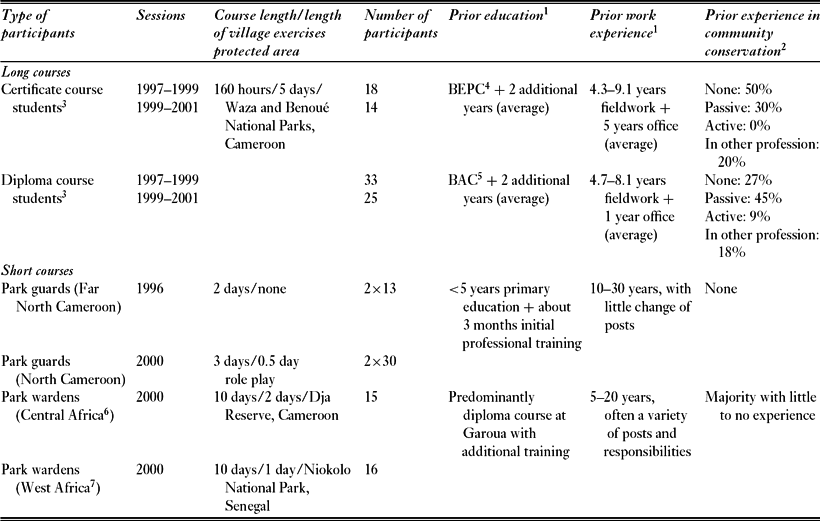
Three-quarters of the diploma students and half of the certificate students indicated they had some experience in community approaches prior to the course, especially where they had a background in agriculture or forestry (Table 1). Asked to justify community conservation at the start of the course, certificate students emphasized conservation objectives, whereas diploma students tended to emphasize development objectives.
Background of trainees and community conservation courses at the Garoua Wildlife College (1996–2000). 1Information on long courses 1997–1999; 2information on long courses 1999–2001; 3from 17 francophone West-Central African countries; 4roughly equivalent to English GCSE; 5roughly equivalent to English A-levels; 6Central African Republic, Cameroon, Chad, Congo-Brazzaville and Gabon; 7Burkina Faso, Guinée Conakry., Mali, Mauritania and Senegal.

In the diploma curriculum evaluation covering 47 courses, the relevance of both sessions of the community conservation course was rated as above average amongst the well-established courses in wildlife and vegetation inventories (p < 0.01). Diploma students judged the presentation of the 1997–1999 session as average, improving to above average in 1999–2001 (p < 0.0001), without correlation with perceived course relevance. Certificate course students perceived the relevance as well as the presentation of both sessions of the community conservation course as average amongst the 46 evaluated courses, outperformed by courses on mammals and legislation. Both diploma and certificate students judged the community conservation course still too theoretical, as all other courses, with the exception of courses on mechanics, computer science and vegetation inventories.
PA guards judged the course as useful (mean score 4.3 and 3.7 for the 1996 and 2000 sessions, respectively). The PA warden refresher course was considered ‘very useful’ by half and two-thirds of the trainees of the West and Central African sessions, respectively. The remaining wardens considered the course merely ‘useful’.
Specific reactions to course contents and training methods
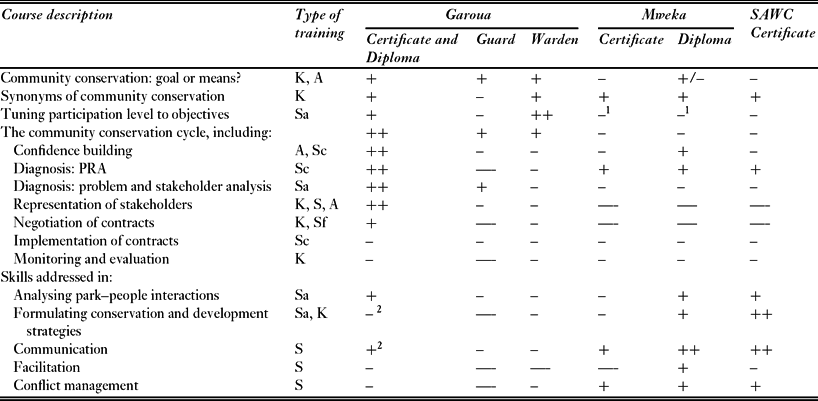
Courses were held in a stimulating atmosphere, with trainees eager to know what the community conservation approach was about. Especially at certificate level, discussions on fieldwork sessions were sometimes considered overwhelming. Frequent structuring and summarizing allowed students to take notes and ask questions in the next session. The introduction of both long and short courses emphasized the responsibility of PA personnel towards conservation objectives, stressing that community conservation is a means, not a goal (Table 2). This was a response to some trainees, who felt threatened by the mere idea of community conservation, which they initially perceived as loss of authority.
Contents of community conservation courses of different duration (long, short) and different level (guard, warden, certificate and diploma) at the three regional African Wildlife Colleges. + + dominant, + much attention, – fair attention, — no attention, K = knowledge, A = attitude, Sa = analytical skills, Sc = communication skills, Sf = facilitation skills, PRA = participatory rural appraisal. 1Mostly limited to participation typology (Pretty et al. Reference Pretty, Guijt, Thompson and Scoones1995). 2Also subject of follow-up long courses in protected area planning and extension.

Certificate students considered problem analysis, problem categorization and community representation as very relevant (p < 0.05) compared to the introductory subjects (Table 2). Problem analysis, problem categorization and community representation had been the focus of a great deal of attention during the course, stimulated by the large number of questions, exercises and discussions with examples from the visited PA, whereas the introductory topics had remained more abstract. Diploma students singled out the topic of ‘Who is local?’ as more relevant than the introduction (p = 0.04). Diploma and certificate students expressed a strong preference for cases that were familiar through their own fieldwork. The discussion of the Waza National Park committee and especially the visit of a local community member who had signed a contract with the Waza National Park authorities were thus considered to be of above average relevance (p < 0.05). Certificate students considered cases presented by fellow students on protected area committees ‘very relevant’ (p < 0.05), contrasting with a merely average appreciation by diploma students. Less relevant than these direct experiences were discussions on an article on Campfire in Zimbabwe (Feron Reference Feron1997) and a video on buffer zone management in Uganda (Brown & Singer Reference Brown and Singer1991) (p < 0.05).
During the PA guards' short course, stimulating question and answer sessions developed after each introductory lecture, often centred on the ambiguous legislation with regard to community involvement. Attention was paid to development problems of the region and the role PA guards could play in gaining the confidence of local communities. The participation of wardens, the guards' supervisors, in the course limited the frankness of the discussions, but was aimed at assuring a consistent future approach towards local communities.
In the refresher course for Central African wardens, PA management planning received a lot of attention, with high levels of appreciation for the course theme (4.8 on a scale of 1 to 5) and perceived relevance (4.4). In the West African PA wardens course, without a local practical case, the exchanges of experience with fellow wardens (4.4) were considered above average (p = 0.014), whereas the community conservation approach was ranked second (4.2). Contrary to the long-course students, park wardens expressed a lot of interest in the somewhat abstract subject of finer-tuning participation level to PA objectives (Table 2).
Trainees' learning
Student assessments were (partly) based on fieldwork and associated classroom discussions, and the presentations of fellow students. Assessments showed generally large differences amongst students that Garoua trainers generally attribute to the students' educational background, which varies according to their countries of origin. Repeated assessments yielded little individual variation. With the exception of the 1999 certificate long course, oral assessments targeting skills and attitudes obtained better results than written tests (p < 0.05). Diploma students' reports on PRA fieldwork, on which they worked until night, received higher marks.
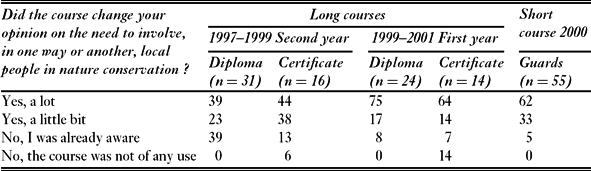
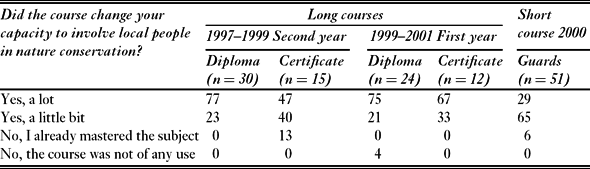
Half to three-quarters of the diploma and certificate students declared that the course had changed their attitude towards the need to involve local people (Table 3). All diploma students and a majority of the certificate students declared that the course had changed their analytical skills in involving local people in conservation (Table 4).
Community conservation course evaluation, attitude dimension, and self-assessment of change of opinion by course participants on the need to involve local people in nature conservation (% of respondents).

Community conservation course evaluation, skills dimension. Assessment by course participants on the change of their capacity to involve local people in nature conservation (% of respondents).

Virtually all PA guards declared having changed their attitude towards the need for involvement of local people (Table 3), which was the primary objective of the guard course. This contrasted with the limited perceived changes in skills (Table 4), which were not specifically addressed by this introductory course (Table 2).
Post-course behaviour change during job performance
In the months following the 1996 training, at least five (out of 26) guards, stimulated by follow-up instructions of their wardens, undertook initiatives such as the organization of village discussion sessions, assistance of villagers in dealing with problem animals and a bushfire campaign. In addition, the warden and guards of one of the Far north province national parks initiated a public awareness campaign in all the park villages for the first time. These initiatives much improved, at least temporarily, their hitherto negative relations with local communities. The fact that half of the northern province guards retired between 1996 and 2004 limited the long-term impact of the course.
Community conservation courses at the other African Regional Wildlife Colleges
In the 2001 curricula, Mweka developed a two-week certificate course entitled ‘People and conservation’ and, at diploma level, a two-week communication skills and a three-week ‘community conservation’ course. Mweka provides a three-week course on participatory planning and community conservation at post-graduate level for senior PA managers without prior training in participatory approaches, similar to the Garoua warden refresher course. Long course training methods at Mweka and Garoua were comparable, based predominantly on lectures (50%) and case studies by students (15%), with only 15% of the course time devoted to field exercises. Although course objectives differed amongst the wildlife colleges, the contents were largely similar (Table 2). SAWC paid more attention to community-based natural resource management (conservation outside protected areas), whereas Mweka and Garoua focused their courses on protected areas.
DISCUSSION AND CONCLUSIONS
Reaction to training is considered as one of several relevant variables in studying the impact of training (Rothwell & Sredl Reference Rothwell and Sredl1992; Kirkpatrick Reference Kirkpatrick1994; Stone Reference Stone1997). Long- and short-course participants had an average of over 10 years of professional experience, and we are therefore inclined to consider their views on the relevance of the courses and their perceived learning experience as an indication of the impact of training for their future job performance.
Thibault and Blaney's (Reference Thibault and Blaney2001) study from Gabon suggested training of governmental PA personnel had low long-term impact because they are often based in cities. Participants of the Garoua courses worked in field-based posts, and may therefore be expected either to use the training results themselves or to encourage their application by others.
In the introduction, we asked the question if PA personnel are ‘attitude-limited’ towards community conservation and reject learning and change. Our hypothesis was that it is difficult to have a positive attitude towards something that you are insecure about and cannot implement. The trainees' reactions showed that once roles and needs were clarified and basic skills acquired, attitudes changed quickly (Tables 3 and 4). The evaluation suggested that even the three-day introductory courses were already successful in changing attitudes on the importance of involving local people in conservation. The high appreciation of the relevance of the course by diploma students was consistent with the number that declared that the course had increased their analytical skills (Table 4). Prior to the course, these diploma students associated community conservation mainly with economic development objectives; they discovered that communities could also be involved in conservation. The lower level of perception of certificate students and the lower numbers who had acquired the necessary skills, suggested that the long course was more attuned to the diploma students' level or interest, probably because of its largely analytical character.
The ICDPs that financed the PA guard short courses were happily surprised at the enthusiastic reaction of the trainees, as they had expected a somewhat hostile attitude towards them. Reporting back, Garoua proposed to train a selection of guards in communication skills, once the policy described in the management plan was clarified and clear instructions could be given. This would prepare them as community liaison agents, reducing some of the difficulties of combining policing and extension tasks (Van den Ban & Hawkins Reference Van de Ban and Hawkins1988).
The course evaluations indicated the need for continuous reference to work practice. Effective training of PA guards needs to be carried out in their working area, requiring trainers who are familiar with the working situation, close to a mentoring process. For PA wardens, the experiences of colleagues played an important role, especially when focused on the course theme. Working with long-course students also revealed the need to assist trainees in presenting their experiences. For long-course students, personal experience gained from fieldwork locations played an essential role in training. Cases presented on paper or video were found to be less valuable and should be limited to only the truly necessary, for example for broader comparison of the trainees' experiences.
Training in community conservation, preferably early in their careers, allows PA managers to participate in public outreach (Barrow & Murphree Reference Barrow, Murphree, Hulme and Murphree2001; Gilbert Reference Gilbert1971) and play an active role in community involvement. This, in turn, may stimulate PA personnel to influence authorities and projects towards a balanced integration of conservation and development objectives (Scholte Reference Scholte2003a) and the integration of community conservation into PA institutions (Bergin Reference Bergin, Hulme and Murphree2001).
ACKNOWLEDGEMENTS
We would like to thank Freddy Manongi (CAWM) who provided the Mweka course syllabi and Nancy Gelman (ABCG), Gerard Barendse and Hans Bauer (Leiden University), Rob van Haarlem (Wageningen University), Stephany Kersten and Piet Wit who commented on earlier drafts.