The story related in this paper involves the British Museum in London, a French nobleman – Charles Maurice Camille, marquis de Talleyrand and fourth duc de Dino – and three Fellows of the Society of Antiquaries of London: Sir Charles Hercules Read, Mr Ormonde Maddock Dalton and Charles Alexander, baron de Cosson, another French nobleman. These are the chief actors amongst a numerous and motley cast, which includes Cypriot tradesmen and merchants, British Colonial officials and the inevitable French diplomat. The events to be described took place more than one hundred years ago in Cyprus, France and Britain, and have not before been recounted in detail. The reasons for this situation – and the reticence – will become apparent as the story unfolds.
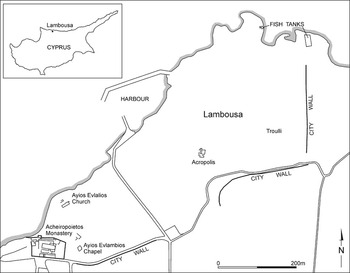
The importance of this study lies in authenticating the provenance and composition of a collection of Byzantine silverware, which was reputedly found or retrieved from the ancient site of Lambousa, on the north coast of the island of Cyprus. Though sometimes referred to as the ‘first Cyprus treasure’, it is better known as the ‘first Lambousa treasure’. Lambousa, which means ‘shining’, was the popular Byzantine name of the ancient city of Lapethos, which flourished for about one thousand years. This Greek colony became one of the nine kingdoms of Cyprus, and, during Christian times, the seat of one of its fourteen bishops. The Byzantine settlement was almost completely destroyed by the Arab raids of ad 653/4, and out of the ruins emerged the twin townships of Karavas and Lapithos. The remains of Lambousa were subsequently used as quarries for building materials for the new settlements. As a result the only surviving monuments of substance on the site of ancient Lapethos/Lambousa are the Greek Orthodox monastery of Acheiropoietos, the small church of Ayios Evlalios and the rock-cut chapel of Ayios Evlambios (fig 1).Footnote 1
Site map of ancient Lambousa, Cyprus. Drawing: after Nicolaou Reference Nicolaou1976, 134, fig 1

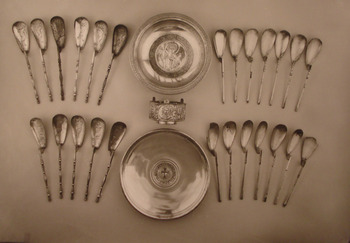
A significant part of the first Lambousa treasure was acquired by the British Museum’s Department of British and Mediaeval Antiquities and Ethnography (now Department of Prehistory and Europe) in 1899, and comprised the following twenty-eight items (fig 2):
The first Lambousa treasure, the British Museum. Photograph: courtesy of the Trustees of the British Museum

1. Silver dish: 1899, 4–25, 1 (Dalton Reference Dalton1901, 86–7, no. 397)
2. Silver bowl with saint: 1899, 4–25, 2 (Ibid, 87, no. 398)
3. Silver censer: 1899, 4–25, 3 (Ibid, 87–9, no. 399)
4. Silver spoon: 1899, 4–25, 4 (Ibid, 89, no. 400)
5. Silver spoon: 1899, 4–25, 5 (Ibid, 89, no. 401)
6. Silver spoon: 1899, 4–25, 6 (Ibid, 89, no. 402)
7. Silver spoon: 1899, 4–25, 7 (Ibid, 89, no. 403)
8. Silver spoon: 1899, 4–25, 8 (Ibid, 89, no. 405)
9. Silver spoon: 1899, 4–25, 9 (Ibid, 89, no. 406)
10. Silver spoon: 1899, 4–25, 10 (Ibid, 89, no. 407)
11. Silver spoon: 1899, 4–25, 11 (Ibid, 89, no. 408)
12. Five identical silver spoons: 1899, 4–25, 12–15 and 17 (Ibid, 89, nos 409–13)
13. Silver spoon: 1899, 4–25, 16 (Ibid, 89, no. 404)
14. Eleven silver spoons with animals: 1899, 4–25, 18–28 (Ibid, nos 414–24)
The circumstances surrounding the discovery of the first Lambousa treasure, its removal from Cyprus and acquisition by the British Museum have, until recently, remained obscure and mysterious.Footnote 2 Overshadowed in terms of its content, quality and notoriety by the second Lambousa treasure, the first has had to wait until now for a thorough investigation of its modern history.Footnote 3 Even then the full story cannot be told and may never be known, for very few records exist in the British Museum concerning the purchase, and the private papers of nearly all the principal players have disappeared or cannot be traced.
The existence of the first Lambousa treasure was made known to the scholarly world by means of a paper read to the Society of Antiquaries of London on 15 March 1900 by O M Dalton, then Assistant in the Department of British and Mediaeval Antiquities and Ethnography at the British Museum. Entitled ‘A Byzantine silver treasure from the district of Kerynia, Cyprus, now preserved in the British Museum’, it was published that same year in volume 57 of Archaeologia.Footnote 4 The second Lambousa treasure was subsequently discovered in two separate lots in 1902 by two quarrymen from the village of Karavas. The local police confiscated a small part of this hoard, which is now in the Cyprus Museum in Nicosia, but the rest was split up. The group with the largest number of items was smuggled out of Cyprus by an unscrupulous antiquities dealer from Cairo, bought in Paris in 1906 by the American industrialist and collector, J Pierpont Morgan, and donated in 1917 to the Metropolitan Museum of Art in New York, where it is currently on show in the Mary and Michael Jaharis Galleries for Byzantine Art.Footnote 5 Its modern history is relatively well known, unlike that of the first treasure, and Dalton also published a paper on it, entitled ‘A second treasure from Cyprus’, in volume 60 of Archaeologia, in 1906.Footnote 6 No trace of any remaining parts of the first or second treasure has so far been identified in private hands in Cyprus itself, despite one promising lead, which turned out to be a modern copy.
Confusion and circumspection reign in published references to the provenance of the first Lambousa treasure and its emergence in London, and nothing is recorded of the way it left Cyprus. Dalton, in his initial report on the hoard, by then in the British Museum, merely stated that it ‘was discovered a few years ago in a mound near the monastery of Acheripoetos (Αχειροποιητός), which is situated about six miles west of Kerynia, on the north coast of the island’.Footnote 7 He added: ‘It is unfortunate that an accurate account of the actual excavation of the mound is not available; for had a careful record been kept, it might have been possible to form at least some idea of the date when the hoard was buried.’Footnote 8 Lukach and Jardine, in their handbook of Cyprus, described it as ‘a silver treasure, found near the monastery of Acheiropoietos (Kyrenia) in 1897, and now in the British Museum’,Footnote 9 while Gunnis allowed it to be inferred that both the first and the second treasures were found in the chapel of Ayios Evlambios, between the monastery and the church of Ayios Evlalios.Footnote 10 Myres conflated both treasures when he wrote that ‘about 1900, in the foundations of a ruined church near the sea, nearly north of the highest mound, a very rich collection of silver vessels was found by people from Karavás. Four pieces from this were seized by the police, and are in the Cyprus Museum; some of the silver spoons were acquired by the British Museum; but the best pieces were bought in Paris by Pierpont Morgan, and are in the Metropolitan Museum of Art in New York’.Footnote 11 Nicolaou similarly mixed up the two hoards when he stated in 1976 that: ‘The site is better known as Lampousa, which is the well known place where the remarkable “treasure of Lampousa” was found at the beginning of this century. It may be recalled that this treasure consisted of numerous silver trays and spoons and gold jewellery, often with precious stones, distributed today between the Metropolitan Museum of Art in New York, the British Museum and the Cyprus Museum.’Footnote 12
Since Dalton’s original publication, the British Museum has released a small amount of additional information about the circumstances of the treasure’s acquisition. In his comprehensive Catalogue of Early Christian Antiquities and Objects from the Christian East in the Department of British and Mediaeval Antiquities and Ethnography of the British Museum, published in 1901, Dalton reiterated that the ‘Cyprus Treasure’ had been ‘found within the last few years of the nineteenth century in a mound near the Monastery of Acheripoetos, six miles west of Kerynia on the north coast of the Island’.Footnote 13 In A Guide to the Early Christian and Byzantine Antiquities in the Department of British and Mediaeval Antiquities, written by Dalton and published in 1903, the hoard is simply said to have been ‘found at the close of the nineteenth century near Kerynia, on the North Coast of Cyprus’.Footnote 14 However, in an internal report on a visit he made to Cyprus in the autumn of 1904, which was never published, Dalton disingenuously noted that ‘the place [where the second Lambousa treasure was accidentally found] appears to be on land belonging to the Monastery of Acheiropoietos, where a few years earlier another treasure was discovered, part of which was bought by a French collector, and by a lucky chance ultimately acquired by the British Museum’.Footnote 15 Considering his role in the acquisition of the treasure by the British Museum, it is curious that there is no mention of it in the anonymous publication, Charles Hercules Read: a tribute on his retirement from the British Museum and a record of the chief additions to the Department of British and Mediaeval Antiquities and Ethnography during his Keepership 1896–1921 (London, 1921), or in Read’s obituaries.Footnote 16 Hill devoted a paragraph to it in his obituary for Dalton, though the Society of Antiquaries omitted any reference in their Dalton obituary.Footnote 17
In the first of the handbooks on Cypriote Art in the British Museum edited by B F Cook and published in 1979, House claimed that ‘towards the end of the nineteenth century a hoard of silver objects was found by local villagers in the ruins at the ancient site known as Lambousa, on the north coast a few miles to the west of Kyrenia’ and further that ‘ “The First Cyprus Treasure” … was purchased by the British Museum in 1899 after passing through various hands’.Footnote 18 More recently Entwistle has written that ‘in the late 1890s, in the same location of Lambousa, an earlier silver treasure – the so-called first Cyprus Treasure – had been unearthed in unknown circumstances … The treasure was acquired by a French aristocrat, the duc de Dino, who subsequently offered it to the British Museum. The purchase was formally submitted to the Trustees on the 23rd July 1898; a decision was deferred until the following financial year, when it was duly acquired for £500. A few miles from the find-spot was the large sixth- to seventh-century monastery of Achieropoietos.’Footnote 19 Finally Loverance, in the third and latest edition of the British Museum’s handbook on Byzantium, refers somewhat cryptically to ‘a cache of silver which emerged from Cyprus at the turn of the nineteenth century’ and describes it as ‘the “First Cyprus Treasure”, also known as the Lambousa Treasure’.Footnote 20 There is no mention of this hoard in the second edition of Ancient Cyprus published by Veronica Tatton-Brown, FSA, for the Trustees of the British Museum in 1997.
To Judith and Andreas Stylianou, who once lived close to the site of Lambousa, we owe the most exhaustive and authentic survey of the anecdotal evidence from Cyprus for the discovery of both hoards of silver. Notwithstanding their claim that ‘it was during the quarrying of building material from the ruins of Lambousa, that two important treasures of the early Byzantine period were discovered by the villagers of Karavas’,Footnote 21 they were unequivocal in stating that ‘no contemporary local information survives today concerning “the first treasure of Lambousa”, which is kept in the British Museum’.Footnote 22 This, however, comes from the English version, which was only a shortened and misleading summary of the modern Greek text of their account, in which they set out in greater detail the evidence they had assembled on the first treasure’s discovery. According to this, ‘Local information taken down by Costas Kyrkos from Theonitsa and Stavrini Constantinou relates that their father, Constantis Thoma Pisiali, while exercising the occupation of stone-cutter in Lambousa, found 36 spoons, 36 forks and 36 knives, all of silver. As the date was reported to be 1902, the information on this point is, however, confused and dubious. Constantis exchanged these items from time to time for food at the grocers in Karavas and Yerolakkos. The grocers subsequently sold them to a well-known jeweller in Nicosia who sold them by weight at the price of silver.’Footnote 23
This account was subsequently reproduced, with some additions and variations, by Andreas Stylianou in a German exhibition catalogue some years later: ‘When I occupied myself for the first time with this question in 1968, there was no trustworthy information about the “First Treasure”. Two elderly ladies had a vague recollection that their father, Konstantis Thoma Pishiali, had found during quarrying in Lambousa 36 silver spoons, forks and knives. Only the first part of this can be correct, just like the report that he later sold the finds piecemeal to a dealer who sold them on to a silversmith. In any case most of the objects were smuggled out of the country and resurfaced in 1899 in the British Museum.’Footnote 24
The Stylianous had grave doubts about the veracity of this story, as it seemed to be mixed up with details about the second Lambousa treasure, and they gave it no credence in their discussion of the history of the hoard. It now emerges that the recollections of the two local informants were essentially correct. In the State Archives in Lefkosia is a letter dated 28 December 1898 from Major Tankerville James Chamberlayne, District Commissioner of Kyrenia from May 1898, to the Chief Secretary of the Island Administration.Footnote 25 The letter reads as follows:
Last year a number of articles of silver plate were discovered at or near Acheropities by a peasant named Constanti Thoma working in a field. He sold them privately at Nicosia; some were, it is alleged, melted down and others resold, at, I believe, greatly enhanced prices.
Mr Giovanni tells me that this peasant stated to Mr [Frank G] Glossop [District Commissioner, Kyrenia, 1894–8] that he had sold 17 pieces of plate to a jeweller or goldsmith at Ayios Dometios for £25. The jeweller was one Nikolaki of Nicosia.
I believe that he subsequently brought an action against the purchaser for having cheated him but failed to establish his plea.
Some years ago, after the discovery of the bronze horn at Vasilia,Footnote 26 he brought me an ancient urn or vessel like a font for which he wanted 15s. He said he had discovered it in a field near Acheropities. The article is too bulky to be carried about, I did not admire it, and the price 15/- seemed excessive. However, not wishing to entirely discourage the man, who may be in the way of discovering himself, or through others, antiquities of value and importance in so rich a field as Lapithos, I thanked him and gave him a shilling for his trouble.
Upon this he offered me the urn for 10/-. I think it worth that sum but I do not want it.
Now he wants to know if the Government will buy it.
I am inclined to recommend the acceptance of the offer. The urn could be placed in the Castle.
I should wish to encourage the people to always inform the Government of any similar discoveries and to give the Government the first offer of purchase of antiquities.
Thanks to this contemporary report, we may now safely conclude that the first Lambousa treasure was accidentally discovered in 1897 during quarrying operations in the vicinity of Acheiropoietos monastery, retained by the workman, Constanti Thoma Pishiali, without notifying the local authorities, and subsequently traded or exchanged through commercial channels, ending up with a jeweller cum silversmith in Nicosia. It would also be fair to assume that what the British Museum acquired in 1899 was far from being the complete hoard unearthed by the quarryman in 1897.
Indeed, according to Dalton, the first Lambousa treasure ‘originally consisted of three larger objects and about thirty-six spoons, and the whole, with the exception of eleven or twelve spoons, has been acquired by the British Museum’.Footnote 27 We now know that it evidently contained an additional seventeen pieces of silver, some of which were probably plates. It is noteworthy that three silver plates not in the British Museum but comparable to the silver dish with the cross in its possession have been provisionally assigned to the first Lambousa treasure. The largest, with a diameter of 255mm, is now in the Walters Art Gallery, Baltimore (no. 57.652),Footnote 28 while another was purchased by the Metropolitan Museum of Art from Kouchakji in 1952, with no indication of a find site (no. 52.25.2).Footnote 29 The third, with a diameter of 135mm, was originally owned by Sir William Haynes-Smith, KCMG, who acquired it in Cyprus while High Commissioner from 1898 to 1904. It was exhibited at the Society of Antiquaries on 10 May 1906,Footnote 30 and published separately by Dalton.Footnote 31 It ended up in the personal collection of Mrs Paul Fagan of San Francisco, who donated it to Dumbarton Oaks, Washington, DC, in 1960.Footnote 32
Furthermore, by Dalton’s own account, there were eleven or twelve spoons which did not enter the British Museum with the rest of the hoard. In fact Hauser has attributed eleven spoons without recorded provenance to the first Lambousa treasure.Footnote 33 Amongst them are four bought by the Metropolitan Museum of Art from the art market in 1913.Footnote 34 They might well have been the four spoons which Ressman acquired from the duc de Dino at Montmorency in 1898 and which subsequently came into the possession of the baron de Cosson (see below), as well as some of the so-called ‘duplicates’, which had been extracted from the hoard before its purchase by the British Museum (see above). Of the remaining spoons attributed by Hauser to the hoard, two of the three that once belonged to the Jackson collection in England ended up in the National Museum of Wales in Cardiff,Footnote 35 while the other found its way to the St Louis Art Museum.Footnote 36 Another, acquired from the art market in Rome in 1910, has been traced to the Staatliche Museen in Berlin,Footnote 37 and two were sold at auction in Monaco in 1987 from the ‘Collection de Martine, Comtesse de Béhague provenant de la Succession du Marquis de Ganay’.Footnote 38
The earliest and, until Entwistle’s recent observation (see above), the only published reference to the way in which that part of the first Lambousa treasure now in the British Museum was obtained from the duc de Dino, is contained in I K Peristianes, Γενική ίστορια της νήσου Κύπρου (A General History of the Island of Cyprus), which appeared in Nicosia in 1910. The author reproduced a note he requested from his ‘esteemed friend’, Claude Delaval Cobham, CMG, formerly Larnaca District Commissioner, about the treasures discovered at Lambousa. The relevant extract reads:
The Silver Byzantine Treasure from Kyrenia District, Cyprus, acquired … in March 1897 by M Le Duc de Dino from the private collection of Mr G A Mozeras from Larnaca. 1 church patera. 1 basin and 36 spoons, all belonging to the second half of the 6th or the beginning of the 7th century before the Arab raids and the outbreak of the dispute over the holy icons.Footnote 39
From the British Museum’s records we can infer that the treasure was brought to London by the duc de Dino himself and inspected by Read in early July 1898. Charles Alexander, baron de Cosson, acted as go-between and Read asked him to find out the price. Read remarked in an annotation on the report, no doubt indignantly, that ‘the Duc de Dino bought them in Cyprus for £150 and asks £1,000’ but, as Read’s initial report to the Trustees reveals, an independent valuation put its worth at £400. After what Read describes as ‘the withdrawal of some duplicate spoons’, the price agreed on was £500.
Mozeras and the duc de dino
George Athanasios Mozeras (1868–1917), from whom the duc de Dino bought these items, was a prosperous businessman, who belonged to a well-known commercial firm,Footnote 40 as well as being the largest landowner in Larnaca.Footnote 41 When the Mozeras family fell on hard times after George Athanasios’ death, their family home in Larnaca was bought by Mrs Evanthia Pieridou,Footnote 42 who left it to the Municipality of Larnaca for use as a town hall.Footnote 43 It stood opposite the statue of Cimon on the waterfront and presumably housed the Mozeras family’s collection of antiquities, which was registered with the Committee of Management of the Cyprus Museum in 1906 (no. 135). At that time it comprised a relatively small number of objects, including coins, seal stones and jewellery, much of it gold. The collection was still in the family’s possession in 1911 when Mozeras sought permission from the Cyprus Museum to have it sold or taken out of the island. After his death in 1917, his widow, Eliza (née Fatala), from a Roman Catholic family in Larnaca, offered in 1927 ‘1) one pair of gold earrings, 2) one Byzantine cross and 3) one gold Byzantine ring, gratis to the Museum, provided she would get permission to export the rest of the collection’.Footnote 44 It therefore seems entirely plausible that George Athanasios Mozeras had the first Lambousa treasure in his possession and sold it to the duc de Dino.Footnote 45
Charles Maurice Camille, marquis de Talleyrand and fourth duc de Dino, was born on 25 January 1843 and died on 5 January 1917 at the Villa Périgord in Monte Carlo. Second child of Alexandre Edmond, marquis de Talleyrand and third duc de Dino (1813–94), who was himself the great-nephew of Charles Maurice, prince de Talleyrand-Périgord, prince-duc de Bénévent and first duc de Dino (1754–1838), he had a mouvementé military and political career and expensive tastes that required the periodic infusion of money to cover his accumulated debts. He emerges from the scattered biographical sketches published about him as a larger-than-life character. Though described as ‘a Frenchman of no particular attractions, being short and rather stout and decidedly ordinary looking’,Footnote 46 he was nothing if not aristocratic in his behaviour and full of Gallic charm, with a connoisseur’s taste for antique armour and rich American ladies.Footnote 47 Tomkins has nicely summed him up as ‘a dedicated bon vivant, a womanizer, and a collector of armour – three rather costly hobbies whose demands often exceeded his means’.Footnote 48
His main collecting priority was medieval and Renaissance arms and armour, of which he assembled a substantial number of items between 1885 and 1900. While it must be assumed that the bulk of his possessions were kept, initially at least, in the château at Montmorency, north of Paris, where he lived from 1887 to 1901, there is a published reference to a display in the first Jean-Jacques Rousseau Museum in Montmorency, open from 1899 to 1906, of ‘collections d’armes et d’objets d’art de M le duc de Dino … membre actif de l’ancienne société de la bibliothèque populaire et président d’honneur du nouveau conseil d’administration du musée’.Footnote 49 The arms and armour belonging to him were purchased in their entirety by the Metropolitan Museum of Art in New York in 1904.Footnote 50 The duc’s interests also ran to travelling and writing, but he seems to have committed nothing to paper about his collecting, and nothing has come down to us about the way he became involved in Cyprus.
Indeed, the duc de Dino’s visit to the island in early 1897 is completely unknown to students of Cypriot history and archaeology. His name nowhere occurs in Masson’s accounts of French explorers and travellers to Cyprus in the nineteenth century,Footnote 51 and the reasons for his visit can only be guessed at. However this was not the duc’s first trip to the Levant nor was it the last time he visited Cyprus. In early 1894 he joined Pierre Loti, the well-known French author and travel writer, on the latter’s expedition to Egypt and the Holy Land, though it had not been part of his original itinerary, and a few days after their arrival in Jerusalem he left Loti to return to France.Footnote 52 Then, in a letter of 11 February 1898 from Constantino Ressman (d 1899), Italian Ambassador to France, to William H Riggs (1837–1924), an American collector living in Paris, the duc de Dino is described as being in Cairo and planning to make a side-trip to Cyprus, which he did, according to another letter of 15 April 1898 from Ressman to Riggs, ‘pour y chercher des armes et n’y trouver qu’un morion rouillé’.Footnote 53 This was, according to Pyhrr,Footnote 54 undoubtedly the same as the ‘Petit heaume (bassinet) pointu du XIIe [crossed out] ou XIIIe s. trouvé à l’île de Chypre Famagusta (Dino)’, which, according to a manuscript inventory which Ressman made of his collection and maintained up to the time of his death in 1899, was added in Paris on 17 April 1898.
This was evidently not the only acquisition made by the duc de Dino in Cyprus (presumably in 1898), for reference is also made in Ressman’s inventory to the addition on 28 April of a ‘Boucle d’une ceinture d’épée en cuivre doré garni de granats VIe ou VIIe siècle, de Chypre (Dino)’, and, on 30 July at Montmorency, of ‘Quatre cuillières du trésor trouvé à Chypre et vendu au British Museum pour 12,500 fr[ancs], Ve siècle (Dino)’. This last entry had been completely crossed out and followed by the annotation ‘(à Cosson)’, indicating that these four spoons, which once belonged to the first Lambousa treasure, had passed into the hands of the baron de Cosson (see above).
There can be little doubt, as A and J Stylianou have surmised, that the first Lambousa treasure was removed from Cyprus surreptitiously and illegally, without the formal permission of the British authorities.Footnote 55 The law ‘To Regulate and Place Upon a Better Footing the Cyprus Museum’, which was enacted by the High Commissioner, Sir Walter Sendall, on 30 June 1896 and gazetted by the Island Administration on 3 July 1896, though subsequently disallowed, stipulated in Article 11(2) that ‘no object of antiquity shall be exported unless a similar object is already in the possession of the Museum’. At that time there was certainly nothing in the Cyprus Museum remotely comparable to the hoard of silverware which constituted the first of the Lambousa treasures.Footnote 56 Furthermore volume 26 of the ‘Correspondance Commerciale Larnaca’, in the archives of the Quai d’Orsay, Paris, contains an extended exchange of letters between the French Consul, Auguste-Emile Boysset, and the Ministry of Foreign Affairs concerning the offer by Marius Tano of a certain number of Cypriot antiquities to the Louvre.Footnote 57 On 6 May 1896 Boysset informed Paris that ‘il [Marius Tano] est disposé à les expédier aussitôt que l’administration des Beaux-Arts aura obtenu du gouvernement anglais l’autorisation de les exporter, les règlements locaux ne permettant la sortie d’objets d’antiquité trouvés sur le territoire de l’île qu’avec une permission spéciale qui n’est jamais accordée à des particuliers’. From the foregoing it may be safely inferred that if the duc de Dino, or someone acting on his behalf, had sought the British Government’s approval to take the first Lambousa treasure out of Cyprus, it would have been refused outright. There is, however, no record that any request was ever made to the Island Administration for an export permit, and a search of the index to the Chief Secretary’s files for 1897 and 1898 in the State Archives in Lefkosia has failed to turn up any mention of the hoard at all.
How then did the first Lambousa treasure leave the island? It could have been smuggled out by the duc de Dino himself or by someone acting on his behalf. If the duc took it out in his luggage, it seems unlikely in those class-conscious days that he would have been challenged by the Customs authorities. Using an agent for this purpose was successfully tried in the case of the second Lambousa treasure, which was evidently removed in a wine cask.Footnote 58 Alternatively it could have been taken out in the French Consulate’s official bag, which was not liable to Customs inspection, or Boysset himself could have put it in his personal luggage when he left Cyprus on leave in June 1897. The notorious Luigi Palma di Cesnola, who served as American Consul in Larnaca from 1865 to 1872, had no hesitation in taking advantage of his official status to take antiquities from the island.Footnote 59 There is, however, no shred of evidence to implicate Boysset in the illegal removal of the first Lambousa treasure from Cyprus, or indeed to connect him in any way with the duc de Dino and his visits to the island.
None of these scenarios excludes the possibility of official collusion (or at least acquiescence in) the hoard’s smuggling from Cyprus, as there were suspicions around this time that locally engaged Cypriot staff, especially in the Customs service, were involved in unauthorized antiquities trafficking.Footnote 60 The very fact that the duc de Dino was able to return to the island in search of more loot a year after he purchased the first Lambousa treasure in Larnaca, without so much as an arrière-pensée or hint of suspicion, suggests indifference, inefficiency or connivance on the part of the local authorities, and the duc’s own sense of immunity. By July 1898 the British Museum had already been offered the hoard, and knowledge of its existence was sufficiently widespread for the Hermitage in St Petersburg to have enquired about its availability (see below).
In the absence of any extant files in the British Museum about the acquisition of the first Lambousa treasure, we are reduced to supposition about the chain of events which led the duc de Dino to give it the option to buy. There are nevertheless sufficient clues to indicate the most likely scenario, and the key lies with Charles Alexander, baron de Cosson (1846–1929), whose name occurs in the letter dated 26 July 1898 from Sir Charles Hercules Read to the duc de Dino, informing him that the trustees had agreed to the purchase of the ‘hoard of silver objects of Byzantine work of about the sixth century found in Cyprus’, as soon as funds became available. Most significantly the letter noted that Read had already told his old friend, the baron de Cosson, of the Museum’s decision.
According to his obituary in the Antiquaries Journal for 1929 the baron de Cosson ‘was elected a[n Honorary] Fellow [of the Society of Antiquaries of London] in 1886, and read occasional papers to the Society on the subject of arms and armour. On these he was the leading authority, his catalogue of helmets and mail, published by the Royal Archaeological Institute, being the one on which all modern research is based. He was of French parentage, his father being an émigré, and for many years he lived at Chertsey, whence he moved to Brittany and subsequently to Florence, where he died. It is impossible in a short notice to recall his manifold activities, his travels in search of armour, and the work he did in securing fine examples for museums and collections the world over, but it may be recalled that it was mainly through him that the famous Jacobe manuscript, now in the Victoria and Albert Museum, was secured for the nation. As a writer in The Times remarked “his death leaves a gap that cannot be filled, for his great knowledge and experience were gained under conditions and opportunities which will never be repeated.” ’Footnote 61 Needless to say, as an Honorary Fellow of the Society of Antiquaries, the baron de Cosson associated with all the leading British scholars of the nineteenth century, including Read himself, Secretary of the Society from 1892 to 1908, as well as Keeper of the Department of British and Mediaeval Antiquities and Ethnography in the British Museum.Footnote 62
In 1897, the year the duc de Dino acquired the first Lambousa treasure, the baron de Cosson was invited by the duc to write a catalogue of his collection of medieval and Renaissance arms and armour. The duc’s purpose was probably more mercenary than academic, as he evidently had the intention of displaying his collection at the Exposition Universelle in 1900 and ultimately of selling it, while the baron de Cosson’s interest was both mercenary and academic, as he needed to supplement a private income with earnings from his connoisseurship. The results of the baron’s research were embodied in a sumptuous catalogue, published in 210 copies by Paul Dujardin in 1901 in Paris under the title Le Cabinet d’armes de Maurice de Talleyrand-Périgord duc de Dino. étude descriptive par le baron de Cosson, membre de la société des Antiquaires de Londres et des sociétés de Géographie de Paris et de Londres. As their correspondence begins in 1893, two years after the baron and his family established themselves in Dinant in France, the duc and the baron had already struck up a working relationship at least by 1897, and no one would have been better placed than the baron to advise the duc on how to dispose of his Byzantine silver from Cyprus.
Amongst the baron de Cosson’s correspondence in the library of the Royal Armouries, Leeds, is a letter of 25 July 1898 from the duc, who wrote to Monsieur Cosson from the Château de Montmorency that ‘Je n’ai pas encore reçu de réponse du British? En avez-vous une? Le Musée de l’Ermitage de St Petersbourg, par l’intermédiaire de son directeur ou conservateur, Mr Bosch, m’a écrit dernièrement pour me demander si mon argenterie de Chypre était à vendre. Je n’ai rien répondu encore attendant la décision ferme du British’. One day later the duc informed the baron by letter of the receipt of Read’s letter conveying the trustees’ decision to buy the first Lambousa treasure as soon as funds became available, but by February/March 1899 his letters to the baron were beginning to show signs of impatience with the museum’s delay in finalizing the transaction. Finally the duc informed the baron by letter on 20 April 1899 that he had received the cheque for £500 from the British Museum, and enclosed the 1,000 francs that he had promised the baron by way of commission.
While the baron de Cosson was obviously the intermediary between the duc de Dino and the British Museum, it is not clear who put the idea into the duc’s head of selling the first Lambousa treasure to the British Museum, with which he is not known to have had any previous connection. There is no hint, for example, in any of the surviving documentation of the hoard being offered to the Louvre or any other museum in France, as might have been expected. It is quite possible that the baron de Cosson was the source of this suggestion – he was certainly well placed in every respect to tender this kind of advice – but the duc may first have conceived the idea from Chamberlayne, who served the Island Administration in Cyprus from 1886 to 1908 and was the author of the letter of 28 December 1898 giving details of the accidental discovery of the first Lambousa treasure (see above). In addition to being a senior colonial officer, Chamberlayne was a reputed historian who collected coins and other antiquities, wrote two books (in French) of enduring value on the medieval tombstones of Cyprus,Footnote 63 and on a Lusignan coin hoard from Morphou, and was not only francophone, francophile and on friendly terms with a number of eminent French scholars but was related by marriage to the duc de Dino.Footnote 64
While the provenance of the first Lambousa treasure can now be securely authenticated, we still have some way to go in establishing the full range of objects it originally comprised and the means by which it ended up in the British Museum. It can be confidently assumed that its acquisition by G A Mozeras in Larnaca was irregular, if not illegal, and its removal from Cyprus by the duc de Dino, both irregular and illegal. The silence from all the main parties on the hoard’s removal from Cyprus is a sure sign that everyone knew there was something to hide, and the fact that the first anyone knew publicly of a Byzantine treasure from Cyprus was Dalton’s article in Archaeologia, which even then aroused no queries or protests whatever, indicates that all those concerned in the Island Administration in Cyprus and the British Museum had decided to turn a blind eye to the manifest impropriety of its purchase by the trustees in London. The contrast with the reception accorded the emergence of the second Lambousa treasure only five years later, when every effort was made by the local authorities to confiscate the hoard, prevent it being smuggled out of the island and secure its return and the indictment of the perpetrators, could not have been greater. It raises the interesting question of why reaction, at least at the official level in Cyprus, was so much more vigorous and determined when the second hoard came to the authorities’ attention.
In this respect it should be noted that the line-up of characters dealing in the second treasure was not the same as that for the first, and that the principals involved in the second were ‘foreign’ – that is, non-European – and ipso facto suspect. Only Tankerville Chamberlayne, from the Office of the Commissioner, Nicosia, makes a brief appearance on 1 October 1903 in the second treasure’s file in the State Archives, Lefkosia,Footnote 65 informing the Chief Secretary of his knowledge and views on certain of the people involved in the affair. In the end the contemporary handling of the two Lambousa treasures says as much about European society in the late nineteenth and early twentieth centuries before the First World War dealt it the fatal blow from which it never recovered, as it does about Byzantine civilization in Cyprus before its devastation by the Arab attacks in the seventh century ad.
Acknowledgements
My greatest debt is to Chris Entwistle and Stuart Pyhrr (currently preparing an article on the duc de Dino’s collection of arms and armour for The Metropolitan Museum Journal), who have willingly and generously shared with me all the information available to them, and without which this study could not have been written. Special thanks are also due the following for their valuable advice and assistance: Sylvain Béraud, the Bibliothèque Nationale in Paris, Patrick Boulanger, Cambridge University Library, Annie Caubet, the Centre Culturel Français, Jérusalem Est, Nicola Coldstream, Diana Constantinides, Aristides Coudounaris, Thomas Davis, the École Biblique et Archéologique Française, Jerusalem, Helen Evans, George Georghallides, Ellen Herscher, Patricia Kalensky, Bernard Laplaud, Jerome Murphy-O’Connor, the Musée de l’Armée, Paris, the Office de Tourisme de Montmorency, John Oswald, Effy Parparinou, Despina Pilides, the Royal Armouries, Leeds, Adriana Ruspoli, Christopher Schabel, Rita Severis, David Sherlock, Marcel Sigrist, the Society of Antiquaries of London, the State Archives of Cyprus, Lefkosia, Veronica Tatton-Brown, Mary Ann Thompson, Eftychia Zachariou and Stephen Zwirn.