

Introduction
In Eurasia, hominin site distribution has shaped the notion that western Europe and the circum-Mediterranean region were more regularly occupied by early hominins than its northern and continental regions (Finlayson et al., Reference Finlayson, Pacheco, Rodriguez-Vidal, Fa, Lopez and Perez2006; Serangeli & Bolus, Reference Serangeli and Bolus2008; Roebroeks et al., Reference Roebroeks, Hublin, MacDonald, Ashton, Lewis and Stringer2011). Explanations are often linked to climatic cycles, argued to only provide suitable conditions for humans in the northern margins during the warm phases of the Pleistocene. While site density does seem to support the assumption of a centre and periphery in the early hominin range, other influential factors such as research bias, taphonomy, and sediment exposure are also likely to accentuate this pattern (Roebroeks et al., Reference Roebroeks, Hublin, MacDonald, Ashton, Lewis and Stringer2011; Romanowska, Reference Romanowska, Ruebens, Romanowska and Bynoe2012; Rolland, Reference Rolland2014). Several of the peripheral regions are therefore potentially archaeologically underrepresented because they are severely understudied. Conversely, claims of early hominin sites in these areas have often spurred controversy due to their paradigm-changing potential. These include sites in areas such as present-day Lithuania (Piliciauskas et al., Reference Piliciauskas, Jurkenas and Laurat2011), Scotland (Mithen et al., Reference Mithen, Finlayson and Finlay1993), the insular region of the Aegean Sea (Papoulia, Reference Papoulia2016), Poland (Foltyn et al., Reference Foltyn, Foltyn, Jochemczyk, Nawrocki, Nita and Waga2010), the German river terraces (Fiedler, Reference Fiedler1997), southern Scandinavia (Holm & Larsson, Reference Holm, Larsson, Roebroeks and van Kolfschoten1995), and Fennoscandia (Schulz et al., Reference Schulz, Hirvas, Huhta, Moisanen and Rostedt2010). These sites, however, remain poorly-known internationally and lack acceptance by the majority of practitioners. Criticism is, in most of these cases, directed towards the limited attention to source-critical factors, e.g. the distinction between artefacts versus geofacts (Baales et al., Reference Baales, Jöris, Justus and Roebroeks2000; Pettitt & Niskanen, Reference Pettitt and Niskanen2005).
Local and regional research history is the key to unravelling the extent to which the archaeological absence of uncontroversial Pleistocene sites is the result of actual hominin dispersal (or lack of it) or alternative research-related explanations. This applies especially to the proposed hominin range in peripheries where research bias is in danger of being more pronounced because long-standing paradigms of human presence or absence are being challenged. Yet, with increasing digitization and hence availability of older publications, it is possible to find the roots of such a priori epistemological assumptions and to test their validity. Ideally, in-depth studies should be conducted for all regions in order to assess the direct or indirect impact of research history on the assumed early hominin presence.
Here, we present a regional case study from Scandinavia and employ, for the first time, exploratory network analysis to assess its research history structurally through the interaction of the main actors in such a regional debate. Network analysis has enjoyed considerable attention in archaeology recently and is applied diversely (see Mills, Reference Mills2017 and references therein). Here, we use the method to analyse and visualize citation patterns in the Scandinavian Neanderthal occupation debate. Citation interaction is a good proxy to study the bibliometric properties of any given research field and thereby provides key information on developments in research history. Scandinavia is a suitable case because of the comparatively restricted number of publications (n=78) dealing explicitly with the Pleistocene occupation of this region. Ultimately, however, similar studies can readily be envisaged for other regions, especially as an ever-increasing number of archaeological texts is retrospectively digitized or published digitally in the first place.
In order to frame the network analysis, we first introduce the temporal and spatial scope and provide a historiographical overview of Pleistocene archaeological research in Scandinavia. This is followed by a methodological description of the network analysis undertaken and a presentation of its results. Based on these results, we address in a final section the degree to which research history has influenced the study and current notions of the presence or absence of Neanderthals in Scandinavia.
Temporal and Spatial Scope
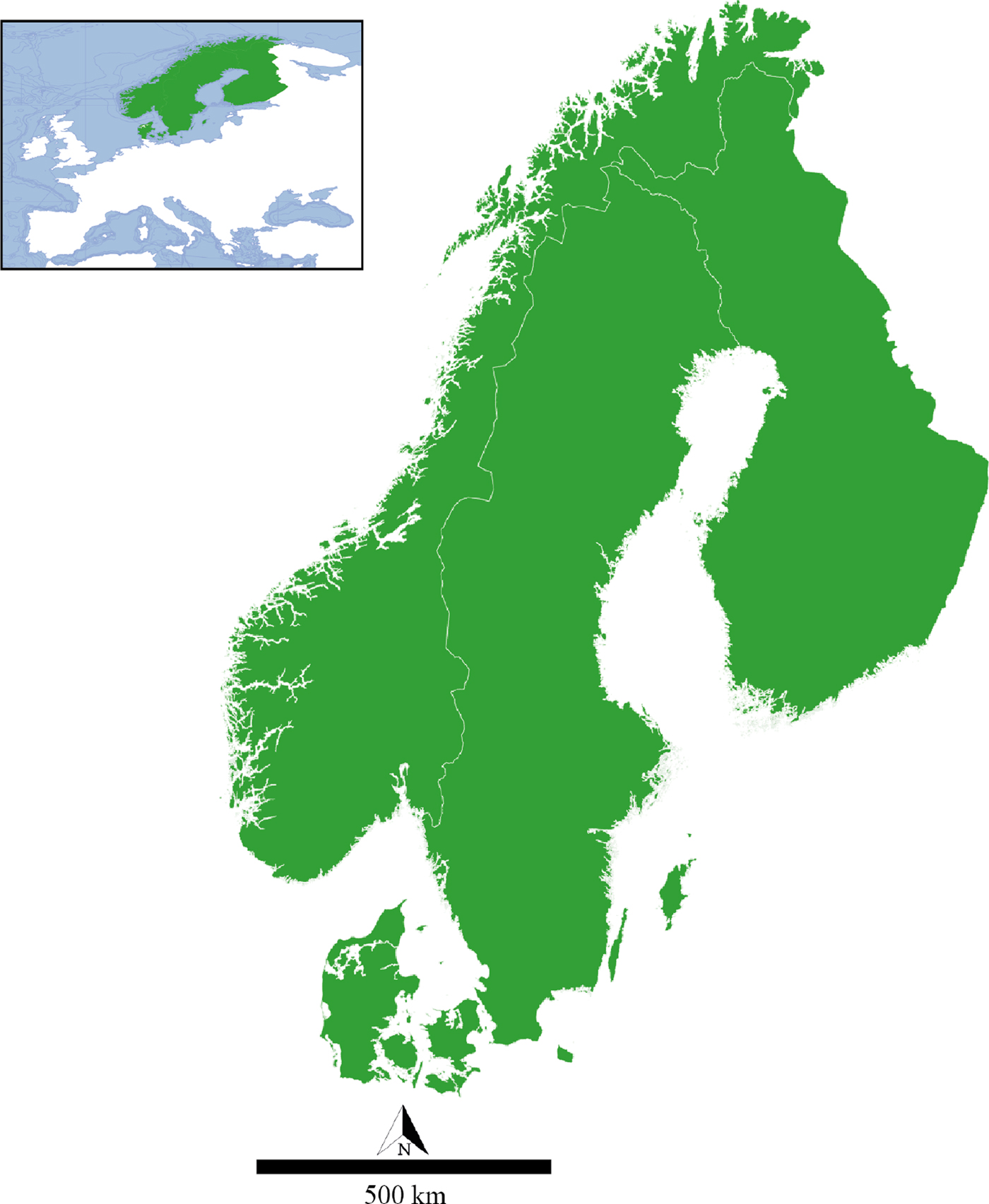
The geographical focus is continental Scandinavia sensu lato, corresponding to the current countries of Denmark, Finland, Norway, and Sweden, with a particular focus on the southern part of the study area (Figure 1). The temporal framework is two-fold. First, the Middle and early Upper Pleistocene constitutes the archaeological timeframe, i.e. the chronological window for the proposed hominin dispersal into Scandinavia. Second, the research historical framework is the period 1900 to 2016, when the topic of Pleistocene occupation of Europe, and by extension Scandinavia, was established and extensively debated in the international scientific community.
Study area including present-day Denmark, Sweden, Norway, and Finland. Peripheral Scandinavian islands (e.g. Iceland, Faroe Islands) are not included in the study.

The Historiography of Neanderthal Research in Scandinavia
The eolith phase
In Scandinavia, as in most other parts of continental Europe, the study of deep prehistory has its roots in the Antiquity of Man debate of the late 1800s (Lyell, Reference Lyell1863). From this debate grew the acceptance that flint and other mineral raw materials had been modified by humans and functioned as tools in the Pleistocene. This further facilitated the search for such artefacts, which at the onset was focused geographically in England and France and typologically on the easily recognizable and iconic handaxe (Gamble & Kruszynski, Reference Gamble and Kruszynski2009). The acceptance of the handaxe as an anthropogenic object gradually gave way to the recognition of other tool types. On some occasions this accelerated into overly enthusiastic interpretations of a wide range of artefact-like natural stones resembling artefacts (geofacts; see McNabb, Reference McNabb2012; Ellen, Reference Ellen2013). At the time of their discovery, these geofacts were sometimes classified as particularly ancient (even pre-Pliocene) so-called eoliths because of their presumed primitiveness (de Mortillet, Reference de Mortillet1883; MacCurdy, Reference MacCurdy1909). The acceptance of eoliths as a typological class thereby allowed the scientific inclusion of natural rocks as genuine artefacts. This increased the accepted and hence expected variation in human tool production. Consequently, eoliths started to appear in other regions of Europe. This development distorted, but in some ways also decentralized, prevalent views on the hominin range across Europe, with the result that quite suddenly many different regions were equal contenders for an early hominin presence. It also coincided with rising national competition across Europe, which further, albeit indirectly, fuelled the desire to uncover the most ancient ancestors on particular nations' territories (see Otte & Keeley, Reference Otte and Keeley1990; see also Kristiansen, Reference Kristiansen1993, and Kjærgaard, Reference Kjærgaard2014).
After 1950, when the Piltdown hoax was uncovered, and with the hominin fossil record becoming more robust, the non-anthropogenic status of these eoliths became evident. Previously sensational finds of especially pre-Pleistocene stone tools were hence increasingly dismissed. This reinforced the uneven representations of finds across Europe and formed the now dominant view of a centre and a periphery in the hominin range in the south-west and north-east respectively.
Before the dismissal of eoliths, their acceptance inspired naturalists in Scandinavia to participate in the search for similar primitive tools. The first eoliths from Scandinavia were discovered in 1909 in an Eemian bog deposit at Høllund-Søgaard in Denmark (Hartz, Reference Hartz1909: 193–204). Belgian eolith expert Dr A. Rutot confirmed the eolith status of only ten of the hundred pieces collected by Hartz. The anthropogenic nature of the implements was, however, already questioned in 1936 (Nordmann, Reference Nordmann1936: 38). Other early claims, which are now regarded as genuine artefacts, but of a post-Weichselian age, came from the Alta region of northern Norway (Nummedal, Reference Nummedal1926; Ekholm, Reference Ekholm1929; Bøe & Nummedal, Reference Bøe and Nummedal1936) and Romsdalen on the west coast of Norway (Bjørn, Reference Bjørn1928).
The noble northern Neanderthal ancestry
While a focus on material culture was starting to develop in the late nineteenth and early twentieth century, the dominant approach to population history was still anthropometrics, then commonly laden with overt racial notions and terminology. Cranial measurements and description of physical traits (cranial shape, height, eye- and hair colour, etc.) were particularly widely employed by early anthropologists and used to classify human populations into ‘races’ or the like. Based on the work of Swedish anatomist Anders Retzius, the cranial shapes of the world's populations were categorized into either dolichocephalic (long-headed) or brachycephalic (short-headed). The former was considered superior because it was assumed ancestral to the ‘civilized’ centre of western Europe and measurements confirmed the inclusion of the Swedish population in this group (Retzius, Reference Retzius and Retzius1864). This and other traits, i.e. tall, blond, and blue-eyed, became part of the racial description of the Nordic people as defined by Ripley (Reference Ripley1899).
In Sweden, the discovery of several leaf-shaped flint implements (resembling the French Solutrean leaf points), and the assumed western origin of the shared long-headed cranial shape, led to the hypothesis that the contemporary Swedes descended directly from the first Cro-Magnon people of western Europe (Montelius, Reference Montelius1919, Reference Montelius1921). Montelius concluded: ‘Our pedigree is a very fine one!’ (Montelius, Reference Montelius1921: 101). In this way, the integration of anthropometric and archaeological evidence became an important instrument for affirming national deep history and claims of land rights, not only in Sweden.
In Denmark, anthropometric studies were carried out by a professor of ethnology and geography, Hans Peder Steensby. Steensby (Reference Steensby1908, Reference Steensby1911) strongly advocated the fundamentally mixed character of all contemporary populations. He argued that all living people (including him) were racially mixed, and that particular traits had been hybridized to various degrees depending on historical migrations and level of isolation (Steensby, Reference Steensby1911: 93–120). Prominent racial features were therefore indicative of a population's relative isolation, whereas the combination of racial features indicated movement and mixing of different groups.
Within this framework, he argued that contemporary urban Danes were highly bastardized and that any original racial traits had effectively been erased, or at least obscured, in recent times. For his cranial- and physical assessments of the Danish population, he therefore targeted rural and island populations (including his own hometown), where he believed original aspects of racial ancestry could still be detected. This, he expected, would confirm ancestral connections to Ripley's Nordic type, as in the neighbouring Scandinavian countries. Instead, he found something very different.
In the population of the Danish island of Anholt, he detected a, to him, peculiar mix of racial traits which he later also identified in other isolated populations of Denmark. For example, a long but very robust body, a crooked nose, no chin, large hands, and a short-headed cranium with receding forehead and a globular occipital region (Steensby, Reference Steensby1911: 132). These features did not conform to Ripley's Nordic type. By means of comparison, Steensby concluded that these combinations of features were similar to those observed on fossil specimens of Neanderthals, a species that was again attracting special attention following the discovery of the La Chapelle-aux-Saints 1 skeleton in central France in 1908. Since this conclusion differed significantly from his initial expectations, Steensby had to explain this anomaly while still defending the relative superiority of the Danish people. He did this by challenging the notion of the savage and primitive Neanderthal. Instead he argued that the brutish ape-like Neanderthal reconstructions of the time were flawed, and that Neanderthals clearly walked upright, a feature which in itself affirmed their human status. He further argued that their hunting culture was not inferior to that of early Homo sapiens, emphasizing their equal intelligence. That Neanderthals had survived the challenging climate of the Pleistocene for countless generations also confirmed their physical superiority as well as attested to their strong determination, Steensby argued. He finally leapt to the conclusion that the Neanderthals were ‘the most beautiful as well as the most spiritual human beings that had ever been present in Europe’ (Steensby, Reference Steensby1911: 146).
This unconventional view on the original ancestor of the short-headed cranial type provided an acceptable platform for Steensby's observations and he concluded that the physical characteristics he observed in Denmark were the result of Neanderthal ancestry, thus indicating an even deeper ancestral connection to the country than the other Scandinavian countries had been able to establish.
This argument was later embraced by the Nobel Prize-winning Danish author Johannes V. Jensen, who drew heavily on historical tropes in his writings. He noticed that the explicit facial features described by Steensby could be seen in their purest form in the prominent Danish poet Hans Christian Andersen, confirming that the link to a Neanderthal ancestry was associated with highly developed cultural abilities and sophistication (Duedahl, Reference Duedahl2005). Except for this, however, Steensby's interpretative leap from anatomical observation to Neanderthal ancestry failed to make any significant impact in his day. Following these early attempts, the search for deep historical ancestry in Scandinavia subsided somewhat, only to return with a renewed focus on material culture.
More recent archaeological claims from Scandinavia
Between 1950 and 2000, the search for Pleistocene archaeology in Scandinavia was modest compared to the simultaneous development in central and north-western Europe. Yet, announcements of archaeological finds of proposed pre-Weichselian age did occur. These included: fallow deer (Dama dama) bones proposed to have been split open for marrow extraction from an Eemian deposit at Hollerup (Møhl-Hansen, Reference Møhl-Hansen1955); a flint blade found in a gravel quarry in Seest (Westerby, Reference Westerby1956); several handaxe-like flint artefacts found on the surface at Villestrup, Fænø (Becker, Reference Becker1971), Skellerup, Karskov Klint (Grote & Jacobsen, Reference Grote and Jacobsen1982), and Alrø; and a number of crude-looking flint flake assemblages from Vejstrup Skov (Jensen, Reference Jensen1980; Holm, Reference Holm, Tuffreau and Sommé1986), Ejby Klint (Madsen, Reference Madsen1968), and Vejstrup Ådal (Holm, Reference Holm1987, Reference Holm2000), all in Denmark.
In addition to these sites and assemblages—although none securely dated or in stratigraphic association—a large number of entirely unconvincing and undiagnostic flake assemblages were collected along the numerous Danish gravel beaches. Some were even claimed to reflect a high density of Middle Pleistocene hominins in the region (e.g. Baudet & Jepsen, Reference Baudet and Jepsen1968; Jepsen, Reference Jepsen1973). Symptomatic of the cultural nomenclature practices of the time, these beach assemblages were classified by some authors as true primitive or archaic cultures; for example, the Calaisien baltique (Baudet, Reference Baudet and Gripp1970), the Esbjerg Culture, and the Baltische Gruppe (Pielenz, Reference Pielenz1959, Reference Pielenz1966). These groups were interpreted as regional variants of the Clactonian and Acheulean technocomplexes respectively, and were likened to other (now questionable) regional artefact groups (e.g. Baudet, Reference Baudet1967, Reference Baudet and Gripp1970).
Simultaneously, in Germany, the feted autodidact archaeologist Alfred Rust started developing a controversial theory regarding hominin (Homo heidelbergensis) production of simple quartz tools (Rust, Reference Rust1956: pl. 5, Reference Rust, Kersten and Baume1958; Rust & Steffens, Reference Rust and Steffens1962). Rust's pebble industry was criticized at the time (Prufer, Reference Prufer1957), and is widely rejected today (see Hachmann, Reference Hachmann1974). Rust's theory prompted discoveries of similar implements on the island of Zealand, Denmark (Madsen, Reference Madsen1959; Rust, Reference Rust1959), but these were never widely acknowledged.
More recently, between 2000 and 2015, claims include a proposed early Weichselian hearth and modified wooden stick from Laduholmen in central Sweden (Heimdahl, Reference Heimdahl2006), and Eemian stone tools in the Susiluola Cave in western Finland (Schulz et al., Reference Schulz, Eriksson, Hirvas, Huhta, Jungner and Purhonen2002, Reference Schulz, Hirvas, Huhta, Moisanen and Rostedt2010).
As an extension to these historical claims, the debate about the Pleistocene settlement of Scandinavia resurfaced intermittently, but never developed beyond a regional or local scale. The lack of international recognition and/or awareness can be attested by the absence of any reference to the Hollerup locality in the Eemian dense forest/cold steppe debate between 1980 and 1990 (Gamble, Reference Gamble1986; Roebroeks et al., Reference Roebroeks, Conard and van Kolfschoten1992). Notably, Hollerup was then still widely acknowledged in Denmark as a genuine Eemian site of Neanderthal marrow extraction (e.g. Becker, Reference Becker and Nielsen1985; the site was only re-evaluated and rejected by Egeland et al. in Reference Egeland, Nielsen, Byø, Kjærgaard, Larsen and Riede2014). It would therefore have been significant in the debate about the suitability of dense forests for human occupation during the Eemian. Yet, it did not feature in the debate at all, despite some contributions mentioning Hollerup in international conference proceedings (Holm, Reference Holm, Tuffreau and Sommé1986; Holm & Larsson, Reference Holm, Larsson, Roebroeks and van Kolfschoten1995).
Why these publications did not receive greater attention is unclear. Overall, however, the nationally delimited audience and engagement of the various Scandinavian cases mentioned above left the sites, the finds, and the published arguments under-scrutinized in the wider European arena.
Science by press release
The observations made above stress an important lack of international scientific integration. This is aggravated further by a shift to the newspaper media as the primary dissemination platform for the Neanderthal debate in Scandinavia between 1950 and 1980. As other rhetorical and intellectual rules apply to this type of media (e.g. avoiding specialist terms and focusing more on popularized and sensational statements), these debates became personal and less based on empirical and hypothesis-driven arguments.
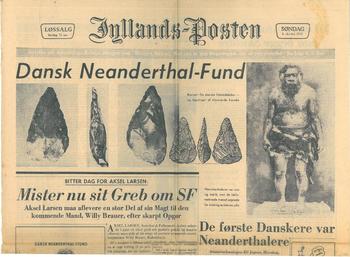
The controversy surrounding the Villestrup handaxe serves as a good illustration of this. Although discovered in 1931 in a potato field in northern Jutland, the Villestrup handaxe first became publicly known on 6 October 1963, when it was presented as a sensational Neanderthal tool on the cover of the national newspapers (Figure 2). The instigator was Eli Jepsen, a private collector and autodidact archaeologist from Herning in Denmark. Before the public announcement, he had obtained verbal authentication that the Villestrup artefact was a genuine handaxe from a curator at the Musée de l'Homme in Paris, Guy de Beauchêne, who Jepsen called a leading expert on the French Palaeolithic.
Cover of the Danish newspaper Jyllands-Posten, 6 October 1963. Translated title: ‘Danish Neanderthal Find’. Illustrations show the Villestrup handaxe (left three photographs) next to a smaller drawing of a French handaxe (middle drawing) and a photograph of a reconstructed Neanderthal man (right photograph) made by the sculptor Frederick Blaschke in the 1920s, exhibited at the time in The Field Museum of Natural History in Chicago.

As documented in private letters between Jepsen and the Musée de l'Homme, Jepsen also attempted, albeit without success, to have Professor André Leroi-Gourhan verify the find. Argument from authority (argumentum ad verecundiam) is indeed a recurrent feature in the Scandinavian debate. The authentication of the Villestrup find was based solely on its similarity with handaxes from the French collections.
The Danish Professor of archaeology P.V. Glob responded to this announcement with little optimism, arguing instead that the implement was an unfinished Neolithic preform intended to become a sickle (Glob, Reference Glob1963). Another point of contention was the use of a foreign expert for artefact authentication. Glob argued that de Beauchêne was not properly informed about the regional geoarchaeological conditions, the occurrence of preforms and geofacts, as well as the level of surface modification expected on a Pleistocene artefact—the Villestrup handaxe is fresh and shows no extensive surface modification.
Unfortunately, this difference of opinion concerning the formal interpretation of the Villestrup artefact turned into a newspaper-based dispute characterized by personal attacks (argumentum ad hominem), which led to an increased polarization between autodidact and professional archaeologists. Jepsen accused Glob of keeping to his ivory tower and mistrusting amateur archaeologists, and Glob accused Jepsen of a dilettantish approach to science and of instigating an unnecessarily acrimonious debate (list of 1963 newspaper headlines in online Supplementary Information (SI 1)).
This dispute continued for more than a decade (e.g. Glob, Reference Glob1972; Jepsen, Reference Jepsen1973) and is, regrettably, not an isolated incident. Similar debate patterns followed the discoveries of, for example, Vejstrup Skov in Denmark (Nielsen, Reference Nielsen2016) and Susiluola Cave in Finland (Pettitt & Niskanen, Reference Pettitt and Niskanen2005; Schulz & Rostedt, Reference Schulz and Rostedt2008). The medium of publication thereby not only influences the dialogue, but, more importantly, defines the scale of impact (local, regional, or international audiences) as well as the longevity of claims of an early human presence.
Citation Network Analysis
The review undertaken here frames the role of research history in shaping current notions of northern Neanderthal dispersal. The next step in our analysis is to assess the structural components of the participants' interaction and the configuration of the debate by means of social network analysis drawing on citation data.
Method
Network analysis is a graph tool useful for visualizing complex interactions. Visualizing complex systems as a network creates a readily appreciable understanding of inherent structures in the system (such as clusters) and also facilitates the quantitative evaluation of the network. The application of network analysis has shown great potential for analysing the interplay between scholars, citations, and academic disciplines, providing a useful platform for visualizing epistemological dynamics and academic practice (Fanelli & Glänzel, Reference Fanelli and Glänzel2013; Chappin & Ligtvoet, Reference Chappin and Ligtvoet2014). Furthermore, the approach is increasingly being applied to archaeological research questions, e.g. to map structures within cultural developments and interaction in space and time (Brughmans, Reference Brughmans2010; Knappett, Reference Knappett2013; Collar et al., Reference Collar, Coward, Brughmans and Mills2015; Mills, Reference Mills2017). Here, the network is built on citations. All network graphs contain a set of nodes joined by lines called edges. The nodes represent publications and edges citations, and the graph is ‘directed’ since citations are unidirectional in nature. The graph visualization tool used here is Gephi (version 0.8.2; Bastian et al., Reference Bastian, Heymann and Jacomy2009). Gephi is an open source resource (http://gephi.github.io/).
Data collection
The dataset is a comprehensive collection of the publications dealing with the topic of a possible pre-Homo sapiens occupation in the case study area, i.e. Denmark, Norway, Sweden, and Finland. These texts form the primary set of publications, and the texts cited therein form the secondary set of publications. The primary publications have been coupled with a set of attributes. These are:
(1) time of publication (1901–1950, 1951–2000, 2001–2015)
(2) position in the debate (critical, pro-argument, review)
(3) regional focus (Norway, Sweden, Denmark, Finland), and
(4) educational status of the main author (professional, autodidact, unknown).
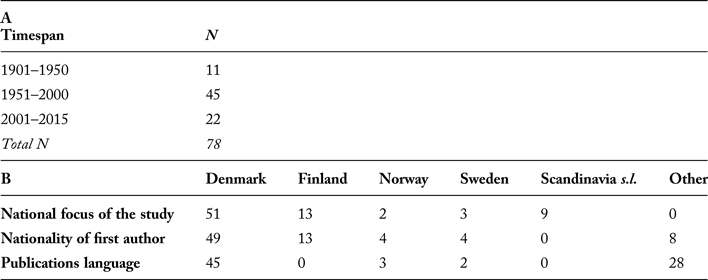
These attributes provide added analytical value to the network and are visualized through colour coding in the network graphs. The data comprises texts published between 1900 and 2015 and include scientific studies, museum reports, popular science publications, and newspaper articles. Authors range from autodidact to professional archaeologists, geologists, and natural scientists. The publications are collected equally from Denmark, Norway, Sweden, and Finland, yet it cannot be ruled out that the authors' familiarity with the Danish material has introduced a bias towards this material (see sample breakdown in Table 1). In contrast to most bibliometric analyses using similar visualisation and analysis tools, our study does not draw on material that is ready digitized. Instead, substantial archival research preceded the analysis presented below. In parallel with this analysis, a physical and digital archive of newspaper clippings, academic and popular writings, and letters has been assembled, and is currently curated at the Department of Archaeology and Heritage Studies at Aarhus University.
Breakdown of the seventy-eight primary publications used in the network analysis according to A) publication time and B) the national focus in the study, national relationship of the first author (employment at the time of publication), and the publication language. Scandinavia s.l. (sensu lato) = Denmark, Finland, Norway, and Sweden combined. Other = Germany, France, the Netherlands, the UK, and the USA. The majority of the data is oriented towards Denmark, and we cannot fully rule out that this is a result of a priori knowledge of this research field. However, care was taken in the data collection to avoid this bias and it is therefore likely that the dataset expresses an actual differentiation of publication activities.

Our collection strategy resulted in seventy-eight primary publications and 1250 secondary publications, making a total of 1328 nodes with unique identifiers (data in SI 2). To the authors' knowledge, this represents the first, and so far the only, collection of an entire corpus of literature dealing with this specific research topic in a pan-Scandinavian setting.
Results and Discussion
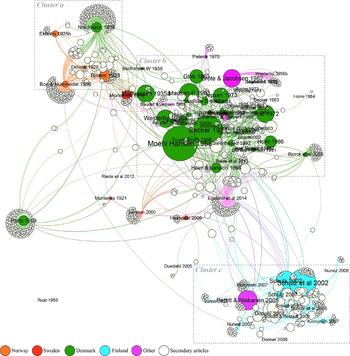
The network graph can be viewed in its entirety in Figure 3. (For a further network evaluation, see SI 3a–c.)
Graph of the citation network including primary (coloured nodes) and secondary articles (white nodes). Layout algorithm: Force Atlas, node size ranking: In-degree. The colour denotes the national relationship of the first author which, for research papers, is defined by the country of the research institute/university where the research has taken place (in most cases this corresponds to the national identity of the author, but not always, e.g. Riede et al., Reference Riede, Egeland and Nielsen2012, Reference Riede, Egeland, Nielsen, Larsen, Odgaard and Kjærgaard2013). Three main author clusters are identified (a, b, c) and highlighted in dotted boxes (see SI 3b). Interestingly, these clusters link to the national relationship of the first author, where cluster a represents mainly Norway (orange), cluster b mainly Denmark (green), and cluster c mainly Finland (turquoise). Only four articles were published in Sweden and they do not adhere to any particular cluster. Other nationalities (pink) include Germany, France, the Netherlands, the UK, and the USA (see SI 2). These all have a co-author whose national relationship overlaps with the overall nationality of the clusters highlighted (e.g. in cluster c, Pettitt & Niskanen, Reference Pettitt and Niskanen2005, the first author was then at the University of Sheffield, UK, whereas Niskanen is from the University of Oulu, Finland).

Attribute analysis
In the following, the network is filtered so that only primary publications are shown. This allows for graphic simplicity regarding the internal dynamics between primary publications and the attributes in the graphs. Percentages and other numerical measures given in the following therefore only reflect proportions among the primary publications.
Attribute I: time of publication
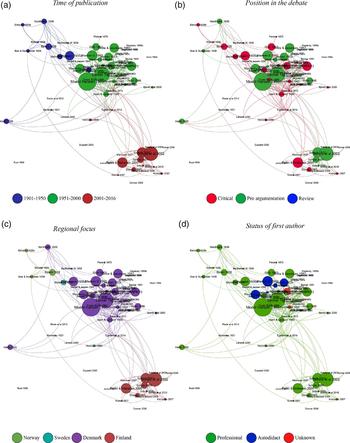
The first attribute (Figure 4a) indicates the time of publication within three timeframes: 1901–1950, 1951–2000, and 2001–2015. Their duration is unequal as the last only encompasses the most recent fifteen years, but we contend that this temporal distinction nonetheless serves as a useful heuristic illustrating the broader patterns regarding historical phases of science communication.
Attribute graphs filtered so only the primary publications are displayed. (a): time of publication shown in timeslots of up to fifty years from 1901 to 2016. (b): position of the publication in the debate in categories, i.e. critical and predominantly negative, or pro-argument (regarding either the presence or prospect of Neanderthal evidence in Scandinavia), or review. (c): Scandinavian region discussed in the publication (Norway, Sweden, Denmark, or Finland). (d): professional status of the first author within the topic discussed in the publication, categorized as either professional (educated training in the field), autodidact (no education or education in another field of expertise), or of unknown status.

By comparing Figure 4a with author nationality (Figure 3) and drawing on the historiographical account, the results show that between 1901 and 1950 the debate included few, but geographically spread, participants from Norway, Sweden, and Denmark discussing various primitive-looking surface assemblages. A clear regional trend is visible between 1950 and 2000, when the debate was centred on Denmark, in the aftermath of the Hollerup discovery of 1955. A similar shift can be observed from 2001 to today, when the debate has almost entirely moved to Finland in connection with the Susiluola Cave, discovered between 1996 and 2000 but first published in English in 2002 (Schulz et al., Reference Schulz, Eriksson, Hirvas, Huhta, Jungner and Purhonen2002). This temporal pattern shows that the timing of the debate is closely linked to the announcements of sites or finds and that the general discussion in Denmark, Sweden, and Norway has been almost inactive over the last fifteen years.
If we take a closer look at the language of the primary articles published between 1951 and 2000, the majority are written in Danish (n=34), whereas only six are written in English, three in French, and two in German (SI 2). Among the English publications, another interesting pattern emerges. Considering the timing of the publications, there is a conspicuous lack of reciprocal referencing between these six articles, despite the fact that they form the only body of literature in this scientific lingua franca. Although separated by only one year, Johansen and Stapert (Reference Johansen and Stapert1996) do not, for example, refer to Holm and Larsson (Reference Holm, Larsson, Roebroeks and van Kolfschoten1995)—perhaps due to delays in publication of these two near-simultaneous contributions. Larsson (Reference Larsson, Roebroeks, Mussi, Svoboda and Fennenma2000) does not reference Johansen and Stapert (Reference Johansen and Stapert1996), despite the latter article having been published four years earlier and being an absolutely central review and innovative analysis of the historically proposed Danish Palaeoliths. The article by Björck et al. (Reference Björck, Noe-Nygaard, Wolin, Houmark-Nielsen, Hansen and Snowball2000) is a stratigraphic study of the Hollerup locality, but, although it mentions the potential of this being a Neanderthal butchering site, it does not cite any of the other English publications on the wider debate.
Even considering limitations owed to the timeline, it is clear that reciprocal referencing is surprisingly limited—particularly considering the overlap in the topics discussed and the small number of publications. Whether this is representative of intentional behaviour, or a lack of familiarity with the older publications, is uncertain. The outcome is effectively a non-cumulative scientific process and a lack of in-print debate within the academic literature.
The debate has instead shifted to the popular media (e.g. newspapers), which engage another target group in essentially short-lived debates with little or no feedback into the scientific community. This displacement between 1951 and 2000 is clear in the data collection where fourteen newspaper articles, thirteen popular science articles, seven museum dissemination pieces or yearbook articles, and one self-published book by an autodidact archaeologist make up the primary publications. In contrast, there are only twelve scientific (peer-reviewed) papers discussing various aspects of this topic in this ~fifty year period (SI 2).
Attribute II: position in the debate
The second attribute (Figure 4b) indicates the qualitative position of the article in the debate as either critical, in favour of, or a review of pre-Weichselian human occupation. The result shows that the written debate is dominated by articles categorized as critical (55 per cent) and pro-argument (41 per cent). Although pro-argument contributions have a lower proportion, overall they have more citations (Average degree = 1.697) relative to the critical publications (Average degree = 1.500), and both are higher than the average for the entire network (Average degree = 1.400; see SI 3a). Although citation does not necessarily indicate agreement with the cited article, it does suggest that these publications and their arguments are acknowledged and reproduced.
Attribute III: regional focus
The third attribute (Figure 4c) indicates the regional focus of the sites and/or topic discussed in the publication. The result shows that the empirical focus is divided in the four countries: Norway, Sweden, Denmark, and Finland. This parameter differs from the geographic attribute shown in Figure 3 in that it reflects the archaeological material discussed in the publication and not the nationality of the author. Yet, it correlates to the national author cluster previously identified and clearly stresses that the national connectedness of the author corresponds to their empirical focus. Further, the regional manifestation of the debate relates to the pattern identified in Figure 4a concerning the timing of publication. Together, these data underline how the debate has moved both geographically as well as temporally through the Scandinavian counties.
This highly regionalized pattern is significant and compounds the predominantly national and single-site scope of these investigations. National frame-setting of Palaeolithic studies is common in Europe (Otte & Keeley, Reference Otte and Keeley1990), and it has in our case led to a problematic detachment from larger-scale intellectual perspectives and continental comparisons. Studies that are framed nationally and in such isolation ‘tend to focus on local phenomena or events and reinforce ideas of local continuity and evolution’ (Otte & Keeley, Reference Otte and Keeley1990: 577). This is in part further cemented by the language of the dominant part of the articles (i.e. Scandinavian languages), the chosen publication outlets (e.g. newspapers), as well as the lack of internal reference within regional or national studies as shown previously.
Attribute IV: status of first author
The fourth attribute (Figure 4d) indicates to what degree the first author of the publication is considered a professional or an amateur/autodidact on the topic addressed in the publication, or if his or her status is unknown. The result shows that the debate is dominated by professionals in their fields (78 per cent), followed by publications by autodidacts (12 per cent). Yet, two of the publications by autodidacts are part of the top ten cited articles (Madsen, Reference Madsen1962 and Westerby, Reference Westerby1956; see SI 3c). Further, all the autodidact publications are found within the regional author cluster of Denmark; this suggests that, according to the current dataset, amateur archaeologists have only been actively publishing and cited here.
Implications
The outcome of our historiographical account coupled with a network analysis provides an evidence-based framework for better understanding contemporary notions of whether Neanderthals and other pre-modern humans may have been present in Scandinavia, and also for setting the stage for future contributions to this debate. First, our results confirm that the Scandinavian debate on Pleistocene hominin occupation has distinct characteristics, which we argue have had a significant influence on how this research field has developed. A number of central components are identified:
• regionalism
• nationalism
• ephemeral nature of the debate
• non-cumulative work
• publication in Nordic languages
• science by press release/sensationalism
• few participants
• arguments ad hominem
It is clear that, within a wider European scientific perspective, colleagues are unaware of the regional debates which have taken place in Scandinavia. This anonymity fundamentally hinders knowledge-sharing across national borders and sub-disciplines. In a local perspective, the national discourse is made up of consecutive rather than cumulative discussions, revolving mostly around site-, find-, or indeed person-specific disagreements. This lack of knowledge accumulation has prevented both the formation of a clear consensus and the unfolding of productive debate.
Importantly, the most recent research into the topic (Riede et al., Reference Riede, Egeland and Nielsen2012, Reference Riede, Egeland, Nielsen, Larsen, Odgaard and Kjærgaard2013; Egeland et al., Reference Egeland, Nielsen, Byø, Kjærgaard, Larsen and Riede2014; Benito et al., Reference Benito, Svenning, Nielsen, Riede, Gil-Romera and Mailund2017; Nielsen et al., Reference Nielsen, Benito, Svenning, Sandel, McKerracher and Riede2017) highlights the potential for hominin occupation in at least the southernmost parts Scandinavia (southern part of the Jutland Peninsula, Denmark). Yet, in Denmark the National Strategy for Stone Age Investigations drafted by the responsible heritage agency does not include periods prior to the Last Glacial Maximum (see Slots- og Kulturstyrelsen, n.d.). The lack of investigations between 2001 and 2015 in Denmark, but also in Norway and Sweden, is, we argue, in part causally related to a lack of governmental and hence legislative support brought on by events in research history.
The only exception to this trend is Finland and the case of Susiluola Cave. As previously mentioned, controversy features large in the interpretation of this site, and in particular its stone assemblage, which is argued to be intentionally produced by the last interglacial Neanderthals (Schulz, Reference Schulz2002, Reference Schulz2007; Schulz & Rostedt, Reference Schulz and Rostedt2008; Schulz et al., Reference Schulz, Eriksson, Hirvas, Huhta, Jungner and Purhonen2002, Reference Schulz, Hirvas, Huhta, Moisanen and Rostedt2010), or a natural accumulation of geofacts (Pettitt & Niskanen, Reference Pettitt and Niskanen2005; Donner, Reference Donner2007, Reference Donner2008; Kinnunen, Reference Kinnunen2007; Núñez, Reference Núñez2007, Reference Núñez2008). No consensus regarding the status of the assemblage has been reached, but it is noticeable that the only supporters of the Neanderthal hypothesis are the original investigators. Although a portion of the debate has been carried out in Finnish, the main points of contention have, in exemplary fashion, also been published in English, predominantly in the regional open-access journal Fennoscandia archaeologica (a good summary is provided by Pettitt & Niskanen, Reference Pettitt and Niskanen2005).
Today, the Susiluola controversy is strongly rooted in concerns regarding scientific integrity and the international reputation of Finnish archaeological practices (Núñez, Reference Núñez2007, Reference Núñez2008; Immonen & Taavitsainen, Reference Immonen, Taavitsainen and Lozny2011). This is explained by Núñez (Reference Núñez2007), who initially chose not to comment on the Susiluola artefacts despite being encouraged by Schulz at an early stage. This changed after the publication of a children's book on the prehistory of Finland featuring an illustration of Neanderthals sitting around the fire at Susiluola. Núñez expresses serious professional concern over the fact that such a controversial interpretation is disseminated uncritically to children and fears that such mythmaking will over time become embedded in the collective mindset of future archaeologists (Núñez, Reference Núñez2007: 87).
The similarly controversial site of Hollerup in Denmark—where Møhl-Hansen's (Reference Møhl-Hansen1955) original reading of marrow extraction by Neanderthals has since been rejected by Riede et al. (Reference Riede, Egeland, Nielsen, Larsen, Odgaard and Kjærgaard2013) and Egeland et al. (Reference Egeland, Nielsen, Byø, Kjærgaard, Larsen and Riede2014)—has equally entered a textbook version of national prehistory (e.g. Jensen, Reference Jensen2006) and contemporary Scandinavian origin myths (e.g. Reich, Reference Reich2005), with varying degrees of critical appreciation.
Prospects
Through a close analysis of the research history relating to the potential hominin occupation of Scandinavia, we have shown how this research history—patchy and not entirely unproblematic—has structured the present state of the art. In contrast to the UK, where the topic has seen a great deal of research (e.g. White & Pettitt, Reference White and Pettitt2011; Ashton & Scott, Reference Ashton and Scott2016) and highly productive collaborations between researchers, government agencies, and public and industrial stakeholders (e.g. Buteux et al., Reference Buteux, Chambers and Silva2009; see also CITiZAN, n.d.), no such systematic efforts are underway in southern Scandinavia. Based on novel zooarchaeological (Riede et al., Reference Riede, Egeland, Nielsen, Larsen, Odgaard and Kjærgaard2013; Egeland et al., Reference Egeland, Nielsen, Byø, Kjærgaard, Larsen and Riede2014), geospatial, and quantitative ecological methods (Benito et al., Reference Benito, Svenning, Nielsen, Riede, Gil-Romera and Mailund2017; Nielsen et al., Reference Nielsen, Benito, Svenning, Sandel, McKerracher and Riede2017), recent research has, however, demonstrated the potential for clarifying some of the remaining questions. More importantly, these new studies are framed not as attempts to prove either the presence or absence of pre-modern hominins in the region through solely discovery-driven initiatives, but as model-based hypotheses, in which both positive and negative results provide important scientific contributions to the wider debate on hominin adaptability and expansion capabilities.
Our historiographical analysis also powerfully demonstrates how unfortunate divisions between professional and autodidact practitioners have led to largely parallel rather than interacting research endeavours. How can this stalemate be overcome? While archaeologists—especially in Denmark (Lyngbak, Reference Lyngbak, Hvass and Storgaard1993)—have a long-standing and largely positive relationship with amateur collectors and the interested public, new concepts from citizen science may allow an important re-thinking of this relationship vis-à-vis this specific topic (see e.g. Gura, Reference Gura2013). Through a balanced application of outreach, education, and increasingly digital crowdsourcing, important new artefacts, assemblages, and insights may be generated. By the same token, a set of standards shared between all stakeholders for conducting, publishing, and validating this research needs to be identified. These reflections may be particularly pertinent to parts of Europe marginal to the Middle Pleistocene hominin world, such as southern Scandinavia. Yet, as the case studies from elsewhere in Europe listed at the beginning of this article show, similar situations exist in Germany, Poland, Lithuania, and Scotland. It is a pan-European problem at the very least.
The paucity of evidence and remoteness in time of Middle or even Early Pleistocene archaeology is almost inversely related to the interest and fascination it generates among professionals and the public alike. This traction should be embraced rather than repressed. Moreover, absence or sparseness of evidence can be a very effective platform for deriving both scientific interpretation and telling evocative stories about these early hominins. Of course, the location and excavation of genuine, stratified, and datable sites must remain a priority, but staging this research as entirely discovery-driven can lead to the kinds of pitfalls we have addressed here. It is our hope that interest and research into the pre-modern hominin occupation of Scandinavia will be allowed to enter a new, more cumulative and internationally oriented phase.
Acknowledgements
The work presented in this study was funded by a PhD scholarship awarded to Trine Kellberg Nielsen by the Faculty of Arts and a post-doc at the Centre for Biocultural History, Aarhus University, funded through the Aarhus University Research Foundation's AU IDEAS scheme.
Supplementary Material
To view supplementary material for this article, please visit https://doi.org/10.1017/eaa.2018.12.
Online Supplementary Information
1. The Villestrup controversy
Table I. Timeline and list of newspaper articles debating the Villestrup controversy in 1963.
2. Data collection
Table II. Alphabetically ordered list of primary publications.
3. Network characteristics
3a. Evaluation
Table III. Descriptions and results of the Gephi statistics used to evaluate the network.
3b. Clusters
3c. Citation ranking
Table IV. List of the ten most cited publications in the network.