Introduction
This paper analyses the experiences of gigging entertainers working in alcohol-licensed venues and the challenges they face when performing to intoxicated audiences. This builds upon two previous projects by the research team which looked at the roles of music within pubs (Forsyth and Cloonan Reference Forsyth and Cloonan2008) and alcohol-licensed nightclubs (Forsyth Reference Forsyth2009) in Glasgow, Scotland. These prior studies were designed to identify environmental factors that mediate levels of alcohol-related problems (e.g. violence) within venues, via a combination of field observations and interviews conducted with bar staff and patrons. Although music was omnipresent in both studies (e.g. DJs, karaoke, live acts), and was observably a key factor influencing alcohol-related behaviours (e.g. intoxication levels, aggression, sexual activity), those providing the entertainment were not consulted. The present project fills this lacuna by conducting interviews with a sample of entertainers who perform in Glasgow's pub/club scene.
We begin by locating our work within wider debates about music in everyday life, artist–audience interactions, live music and musical labour. We locate popular music practice within the broader leisure economy, before we go on to explain our methodology. We then reveal our research findings which examine entertainers' responses to disorderly audiences in general, specific problems with hecklers or stage invaders, and subsequent lessons learned in crowd control. Finally we discuss these findings in terms of entertainers' continuing professional development (CPD), before making some tentative conclusions and suggestions for further research.
The research context
One aspect of the link between live music and alcohol consumption is the wide range of disciplines with which it finds interest, including (but not limited to) popular music studies (PMS), musicology, economics, health, psychology, social sciences and law. We seek here to locate our research within PMS and to limit our considerations to four broad areas: the use of music in everyday life, artist–audience interactions, live music and musical labour.
Alcohol consumption and music are both part of daily life, and their place there is well documented by the Music in Daily Life Project (Crafts et al. Reference Crafts, Caviicchi and Keil1993) and De Nora's (Reference De Nora2000) seminal text, Music in Everyday Life. However, the focus in such works has been on the audience and on recorded music in public places and in identity formation. Similar work in psychology (e.g. Krause et al. Reference Krause, North and Heritage2014; North et al. Reference North, Sheridan and Areni2015) has also concentrated on recorded music. Our research builds on this interest in the use of music but offers new insights through a focus on performers rather than audiences, and on live rather than recorded music.
We do not wish to draw strict demarcations here, as the consideration of live music obviously means the consideration of audiences. Indeed, the relationship between audiences and musical entertainers has always been fraught. Research by Becker in the 1940s illustrated that many live jazz musicians saw their audiences as constraints on their art (Becker Reference Becker1951), and a clear disconnect between artist and audience is evident in perhaps the most famous popular music performance of all time – Bob Dylan at the Newport Festival (Marshall Reference Marshall and Inglis2006). Cohen's pioneering work on music making in 1980s Liverpool also revealed the relationships between bands and their audiences, including those with their potential hecklers (Cohen Reference Cohen1991, pp. 77, 91), as involving complex power relations (Cohen Reference Cohen1991, p. 95). More recent research, involving one of our team, found that audiences themselves had reservations about how their fellow audience members would behave at events where music was the main focus. They disapproved of such things as excessive dancing or making too much noise (Behr et al. Reference Behr, Brennan and Cloonan2014, p. 9). These problems can be seen as being exacerbated under circumstances where music is part of a broader milieu of entertainment in the night-time economy, but they also serve to reveal the complexity of both audience–artist interaction and intra-audience interaction.
More broadly, research into live music has blossomed since it became economically dominant within music industries from 2008 onwards (Page Reference Page2009). The pioneering work in this ‘turn to live music’ has involved a concentration on the industry, rather than on performers per se, and in particular on concert promoters (see Cloonan Reference Cloonan2012; Frith et al. Reference Frith, Brennan, Cloonan and Webster2013). Importantly, related work has shown how intimately intertwined the regulation of live music is with the licensing of alcohol sales, as was exemplified by the Licensing Act of 2003 in England and Wales. The Act made changes to alcohol licensing that came to have a disproportionate effect on the provision of live music (Cloonan Reference Cloonan2007, pp. 53–8). Scotland too has witnessed the role of recorded music in framing drinking behaviour in pubs (Forsyth and Cloonan Reference Forsyth and Cloonan2008). However, this is the first time that live musicians' experiences of regulating behaviour associated with heavy drinking have been examined.
Our work comes at a time where the relationship between live music and alcohol is becoming increasingly questioned. While the volume at gigs has long been of concern (Cloonan Reference Cloonan1996, p. 184, Johnson and Cloonan Reference Johnson and Cloonan2009, p. 191), alcohol consumption can be viewed as something of a given. As bigger live music events such as arena tours, stadium gigs and festivals have grown, so has sponsorship of them. Key among such sponsors has been the alcohol companies. For example, Scotland's biggest festival, T in the Park, gets the ‘T’ in its title from the Tennent's beer brand. The association here is clearly one in which the consumption of alcohol is associated with ‘cool’ events. Concerns about the impact of alcohol on health (see www.alcoholpolicy.net/scotland/) are likely to be ongoing and the experiences of entertainment workers provide as yet under-utilised evidence from which to build policy.
Finally, there has been a growth of interest in issues of musical labour. Examples of this have included the Canadian journal Musicultures (41/1, 2014) and another project in which one of us is involved (www.muhistory.com). While musicians' representative organisations have long been concerned about their members' working conditions, they have rarely considered the implications for musicians of ‘binge drinking’. However, the UK's Musicians' Union has recently reported that musicians in elite entertainment venues (private members' clubs) face hostility from drunken patrons (Simpson Reference Simpson2015). Looking at musicians as workers in such situations can provide further insight into the lived reality of working in music. In sum, we bring together a number of overlapping issues and throw new light on what it is to be a popular music practitioner.
Live popular music and ‘drinkertainment’
The provision of live music and the consumption of alcohol have long gone hand in hand. Music is a feature of on-trade alcohol outlets (i.e. pubs and clubs) and alcohol is commonly available at designated live entertainment venues such as concert halls, theatres, festivals and other arenas hosting gigs. Taken together, as part of the night-time economy, their coexistence has been termed ‘drinkertainment’ (Bell Reference Bell2007). The music policies adopted by individual alcohol-licensed premises are thought to result in sonic demarcation of the night-time economy, with patrons choosing which venues to enter, depending on the entertainments on offer (Purcell and Graham Reference Purcell and Graham2005; Measham and Hadfield Reference Measham and Hadfield2009; Hunt et al. Reference Hunt, Maloney and Evans2010). Thus anticipated levels of alcohol-related problems experienced within any venue are likely to be a function of the types of clientele that its music policy attracts.
As well as attracting patrons to alcohol-licensed premises, once inside, entertainment provision can be used to structure their night. For example, changes to the music within a venue can signal when it's time to converse, time to dance (and how to dance) or time to take a break from the dancefloor (i.e. to visit the bar to purchase alcohol), and ultimately drinking-up/closing time (Caldwell and Hibbert Reference Caldwell, Hibbert, Dubois, Lowrey, Shrum and Vanhuele1999; Hadfield et al. Reference Hadfield, Collins, Doyle, Mackie and Kolvin2004).
In experimental (bar-lab) settings, music has been found to influence alcohol consumption. The findings from such studies have concluded that: the presence of music increases alcohol consumption, especially when played in the company of other drinkers (Drews et al. Reference Drews, Vaughn and Anfiteatro1992); louder music, which can stymie conversation, encourages consumption (Guéguen et al. Reference Guéguen, Jacob, Le Guellec, Morineau and Lourel2008); a faster tempo can result in faster drinking (McElrea and Standing Reference McElrea and Standing1992); and music can distract from the taste of alcohol, leading consumers to underestimate the strength of beverages (Stafford et al. Reference Stafford, Fernandes and Agobiani2012). Lyrical content may also affect consumption, either obviously by priming drinkers with alcohol-related lyrics, including ‘drinking songs’ (Jacob Reference Jacob2006), or subtly via mood alteration (Bach and Schaefer Reference Bach and Schaefer1979). Interestingly, in these studies the experimental condition (i.e. music) was always reported to increase consumption, perhaps suggesting a Hawthorne effect (i.e. where the presence of the experimenter influences the desired direction of the outcome), whereas in real world settings there would appear to be scope for music to also be used as a mechanism to decrease drinking rates within venues (e.g. through reversing these effects).
Two previous observational research studies conducted by this research team (Forsyth et al. Reference Forsyth, Cloonan and Barr2005; Forsyth Reference Forsyth2006) carried out in pubs and alcohol-licensed nightclubs in Glasgow, Scotland, noted these effects on drinking behaviours in real-world venues. On the one hand, music was observed being used to create a (binge) drinking, party atmosphere, but on the other, to create a more chilled vibe, fostering more moderate (but more exclusively priced) drinking. Additionally the entertainers providing the music were observed engaging in alcohol promotion, ranging from overtly advertising over the microphone to subtly acting as pied pipers, leading the consumers by example (see also Home Office/KPMG LLP 2008; Turney Reference Turney2008; Briggs Reference Briggs2013). Thus musical entertainment (including DJs, karaoke and live acts) was observably a key factor influencing not only drinking rates, but also the resultant behaviour, including aggression. However, our previous research also observed these same entertainers actively attempting to maintain good order within venues, ranging from the obvious, such as alerting security staff to violent incidents over the microphone, to more unobtrusively, i.e. using music to rein in rowdy patrons, diffusing tense situations or recovering a positive atmosphere following violent incidents (Forsyth and Cloonan Reference Forsyth and Cloonan2008; Forsyth Reference Forsyth2009).
Thus, rather than venue mangers booking acts solely on the basis of their musical talents, the purpose of pubs/clubs providing live entertainment may extend to forms of selective consumer attraction and violence reduction, via techniques which Hadfield (Reference Hadfield2006) describes as ‘sonic-governance’ and ‘soft-policing’. Such practice entails attracting the right crowd, controlling their consumption patterns once on the premises and preventing drunken disorder by keeping the entertained customers satisfied. As Homel and Tomsen (Reference Homel, Tomsen, Strang and Gerull1993, p. 687) noted, ‘[e]ntertained crowds are less hostile’ and ‘bands and music are perhaps of the greatest importance’ in this respect. What remains unknown is the extent to which entertainers are themselves aware of these roles, as suggested in the following quotation from Hadfield (Reference Hadfield and Hadfield2009, pp. 98–9).
Music policy is a clever form of manipulation that most people do not recognise, even people in the industry. … managers, DJs and security staff … It is much more important to control the crowd with music than it is to control the crowd with security staff because if you have to constantly control the crowd with security staff you've lost the plot, basically. You should be creating an environment which keeps people out of the mood where conflict can occur. (Jim, Manager, high street bar)
The above quote by a venue manager implies that although those providing musical entertainment play an important role in crowd control they may not be aware of it. Perhaps this view is simply because to date no research has asked pub/club scene entertainers for their views and experiences. This is not because the entertainers are not interested in such issues. On the contrary, the dissemination of our previous research attracted critical attention from those working in the entertainment industry (we received e-mails from two artists (a Swedish house music DJ and Australian hip-hop promoter) who had read our work and we got feedback following presentation at the Club Health 2008 conference in Ibiza). This drew our attention to the conspicuous absence of data obtained from those providing the music. It was suggested that: (i) our research into music and aggression in alcohol-licensed venues was incomplete without giving a voice to those providing the entertainment; and (ii) the impact that alcohol-related hassle from the audience has on entertainers themselves, and on their ability to perform, has been overlooked. The present project filled this lacuna by conducting interviews with a sample of gigging entertainers who perform in Glasgow's pub/club scene. Specifically we asked:
• Are those who provide the musical entertainment in pubs and clubs aware of their roles as crowd controllers and to what extent do they think preventing alcohol-related aggression within audiences is, or should be, part of their job remit?
• How do they deal with hassles from intoxicated audience members directed at them?
• Have they had any formal training in dealing with alcohol-related problems? If not, then how did they learn the people skills necessary to successfully deal with drunken audiences, and do they think musical entertainers would benefit from such training?
Method
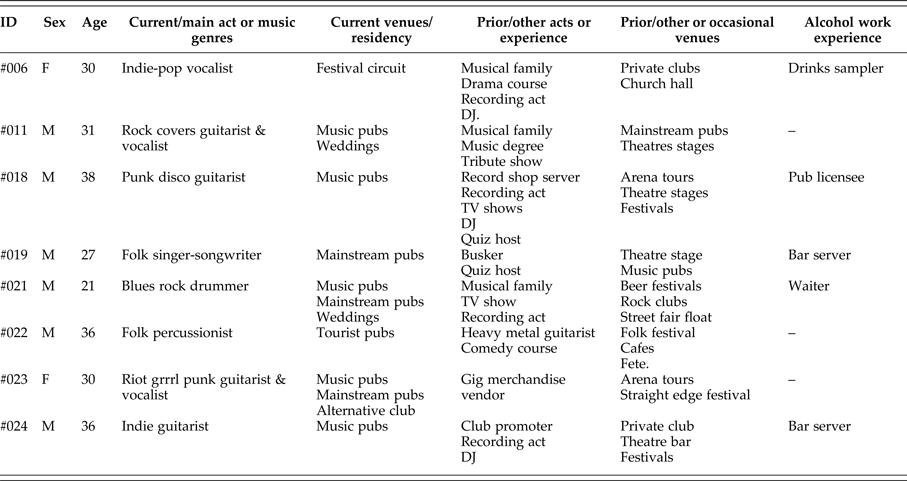
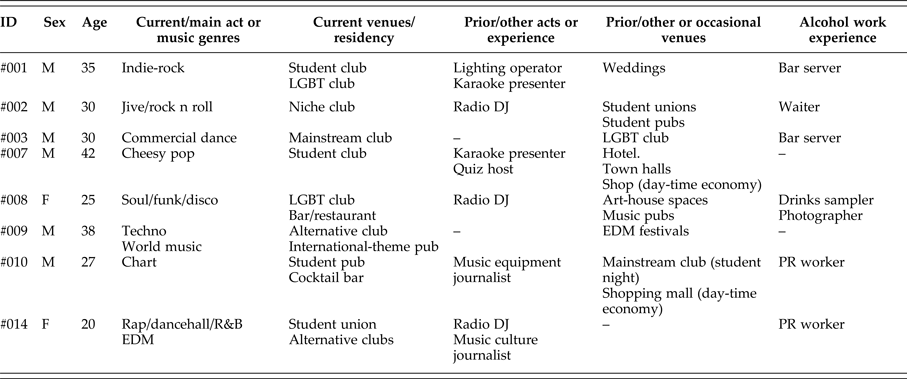
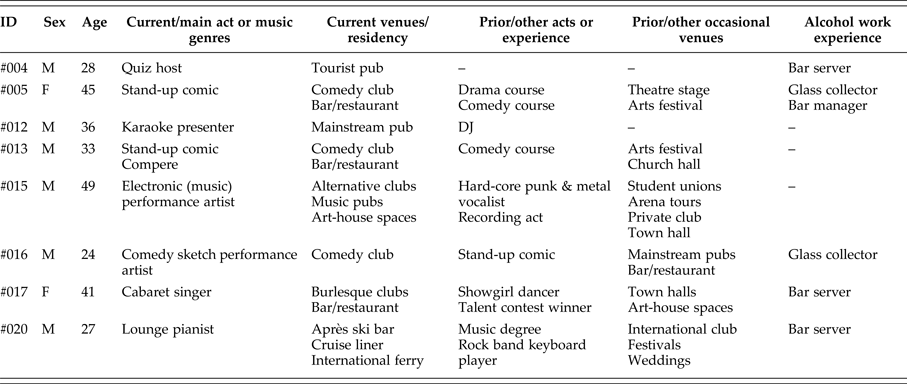
To meet our research aims it was decided to conduct 24 qualitative interviews with entertainers currently working in Glasgow's pubs and clubs (although some participants had toured extensively). A sampling frame was drawn up to produce a diverse range of participants. Three broad categories of entertainer were recruited: band members (n = 8), DJs (n = 8), and variety acts (n = 8). The variety acts category differed from the others in that half its participants were non-musical acts. These four participants (comprising two stand-up comedians, a comedy sketch artist and a quiz host) are excluded from further analysis in this paper. Nevertheless, it should be stressed that their experiences of working in alcohol environments were broadly similar to that reported by the 20 musical acts. The exception was that the stand-up comics had engaged in formal courses in dealing with disruptive audiences (one band member had similarly been trained in stand-up). Although being a pub/club entertainer appeared to be a male-dominated profession in Glasgow, we recruited two female participants in each category and, reflecting the locality, 20/24 participants were white-Scottish, three were Irish and one was of another ethnicity (not further described for anonymity). A breakdown of the full sample's characteristics is shown in Tables 1–3, which include information on any previous employment in either the music/entertainment or alcohol/hospitality industries.
Band members.

DJs.
Variety acts.
As can be seen from Tables 1–3, although band members tended to perform mainly in pubs and DJs in clubs, most participants had a breadth of experience working across the night-time economy. Several participants were able to speak as members of more than one of our three categories; for example, three band members had worked as DJs, two DJs had been karaoke presenters, and our karaoke presenter had been a DJ. Several participants in each category had worked in alcohol hospitality jobs, ranging from bar servers to a licensee. In some cases, alcohol-related employment predated or was even their route into entertainment work; in others, ‘bar work’ was a means of financing their musical careers. Thus some participants were able speak from experience gained on both sides of the bar about the issues they faced when dealing with the intoxicated public.
Each participant was interviewed in late 2014 using a semi-structured interview schedule, enquiring about the venues they played, the clientele, and their experiences with alcohol-related issues (also including topics such as their own drinking and alcohol marketing). In practice, the participants were very talkative, but in case any points of interested were missed the schedule included the following prompts regarding dealing with alcohol-related misbehaviour.
• Has there ever been any trouble that has arisen in venues when you've been playing? For example, what happened, what do you think caused it, what did you do (trouble in general, trouble directed at you, e.g. heckling, arguments, fights)?
• How do you deal with hassles (e.g. hecklers, bad behaviour, drunk people, bad requests, etc.)? Have you ever had to stop what you were doing as a result of crowd problems/trouble? What interventions did you make (e.g. call security, lights up, get involved yourself)?
• Have you ever had any training on how to deal with patrons in terms of crowd control or dealing with intoxicated people?
Interviews were recorded and later transcribed, before being analysed. Thematic analysis was used because of its ability to provide for ‘identifying, analysing, and reporting patterns (themes) within data’ (Braun and Clarke Reference Braun and Clarke2006, p. 79). To ensure full familiarisation with the data, interview transcripts were read multiple times, searching for patterns and ideas, making notes, before moving on to a more formal analysis (Bryman Reference Bryman2012). Data were entered into the qualitative data management software NVivo 10. Initially, coding was broad and inclusive in order to avoid moving pieces of data from their context and to leave room for multiple interpretations of ambiguous sections. The dataset was worked through systematically, breaking it into broad codes linked to the research question. These were sorted into potential overarching themes, considering how codes may combine together (Braun and Clarke Reference Braun and Clarke2006). Once a set of themes had been devised, these were refined, working back and forth between the entire dataset, notes, research questions and coded extracts.
Results
All participants had experience of alcohol-related problems while performing as gigging entertainers. Broadly speaking, these hassles took two forms: either group disorders within the audience unrelated to their act, or the unwanted attentions of individual drunken patrons directed at them/their performance. An overarching theme influencing both types of hassle was the drinking context. This varied first by performing space, that is venue-type, as is illustrated in the following quote made by participant #008, a DJ:
In terms of alcohol and environment I think it really does depend on the type of bar or club that you're playing in. … if it's the kind of place that's £4 [US$6.30] a pint they are less likely to get so drunk, they're less likely to give you hassle and they're more likely to be there to see you or the night, whereas, if you're playing to a sort of £1 [US$1.53] mixer they're just there to get drunk. There is a different reason for them being there than to see music or appreciate music. (#008, DJ)
Secondly, hassles relating to the drinking context could vary by performance time; for example, at late night gigs audiences were likely to have been on the premises longer and consequently to have consumed more alcohol, as is explained below by participant #006, a band member.
The people had just been drinking for far too long and it would have been far better for us to go on at like 12 o'clock rather than like 2, 3 in the morning because it just got to the point where it was just, you know, nobody was listening or people were being rowdy or, so there's definitely a time, there's a peak level, there's this window where it's like a wee bit drunk but not like being pains. (#006 band member)
Should I play or should I go: reacting to disorderly audiences
There was little that participants could do to influence the contextual risk of different venues other than, for example, try to avoid bookings where ‘maybe the reputation of clubs are not as good if these are the kind of people that are going in’ (#003) or just accepting ‘It's my own fault for booking gigs that are late at night’ (#011). However, it was also suggested that alcohol-related trouble is inevitable in alcohol-licensed venues, for example, that ‘there's always fights in nightclubs’ (#003) or that it's ‘just part of club-culture and nightlife’ (#010). Perhaps such negative expectancies were in part shaped by entertainers' central position in the evening's entertainment, often the focal point of events, making them the most aware person in the venue when trouble was brewing. Indeed their often literally elevated position (on stages) offered them a panoptical (and sober) view of audience (mis)behaviours.
… point of view, like in the club like you'll always see, and it's interesting because they don't realise that you're listening, like sometimes you can pick up on conversations and because you're sober when you're working you get to see the whole night. You get to see what's going on, when you're drunk you don't see as much. (#003, DJ)
People misbehaving, hitting light fixtures and stuff like that. Yeah, you see everything. In certain venues you can see the whole room. You have a vantage point. (#002, DJ)
Thus, owing to their unique ‘vantage point’, entertainers often doubled as the all-seeing-eyes and ears of a venue's security arrangements, alerting stewards to trouble spots by various means, including hand signals, radio messages or shouting out on the microphone.
… there's always going to be fights. So our job really at that part is just to mediate it and be like ‘fight, that guy in the T-shirt started it, that guy there got punched for no reason’ and we just say it all down the mic and security will deal with it any way they see fit, and that's the kind of agreement. (#020, variety act)
We had code-words so we would get on the microphone, so if you saw a fight that was kind of minor, so when I say minor punches being thrown that kind of thing you would shout ‘blue-2’ and then you would shout the area of where the fight was. … But if the fight was more severe as in maybe like a stabbing or something then I would shout ‘red-1’ and then the area. (#003, DJ)
The above two quotes identify a common dilemma faced by entertainers when trouble occurs within an audience; that is, should the band play on? In the first quote, lounge pianist #020 stops playing and makes it clear to all present exactly what is going on, whereas in the second, DJ #003 uses prearranged code-words so only the security staff need to know. The sample was split between participants who felt cutting the music, to draw attention to an incident, would get it dealt with more quickly and those who felt this risked more patrons becoming involved.
I would turn the music off. I would do the exact opposite of that [use code-words] … I would turn the music down so everybody would turn round and go ‘what's going on’. If stewards don't realise there's something going on when I have called them out and the music is off. ‘Can I get a steward over here please’ and there is no music playing then something is happening, surely something is happening. That would maybe get it done quicker. (#007, DJ)
I don't like to cut the music but some managers and stuff tell you to turn the music off which I think is ridiculous because it focuses all the attention on it, whereas there might only have been twenty or thirty people at that certain area that are aware of it but then you're bringing the whole pub aware of it. Everybody then wants to get involved … I'm not a big fan but I'll go by what the manager says because then it's on his head. It's nothing to do with me. (#012, variety act)
Participants were divided according to the extent to which they felt preventing negative audience behaviours was part of an entertainer's job remit and, even if it was, at what point this became ‘nothing to do with’ them and better left to designated security staff.
You don't want to get involved yourself because you don't know what implications that's going to have … simply just go and get a management figure or one of the bouncers. That's their job at the end of the day. It's not mine. I'm there to play music not break up fights. (#010, DJ)
I'm the first one to jump over the bar as well and try and break it up. I shouldn't get involved but I have done. ‘Cause I feel responsible.’ Cause I genuinely believe that if I'm working in a nightclub I need to look after the welfare of the people that are there. I'm not just there to make them dance. (#009, DJ)
Although the above two quotes might seem to contradict each other, they reflect the different perceptions of the two DJs as to what the boundaries of entertainers' interventions might be (indeed whether they viewed their reactions as interventions), rather than the differences in their sense of their duty of care towards their audiences. For example, #010 went on to describe how, rather than ignoring what was going on, he might change the music to distract the audience from an incident and ‘make them dance’ again.
I mean [after fights] you may want to like choose a different sort of vibe, a different sort of song or something to sort of kick things back into gear, but nine times out of ten like you'll have an atmosphere for like a wee while, a minute or two after that's happened and then people just sort of forget about it and get back on. At the time it does almost clear the dancefloor. (#010, DJ)
Thus only being ‘there to play music’ could extend to soft-policing, even if unknowingly so. Entertainers' level of involvement in crowd management appeared to be dependent on their assessment of the situation and on their (lack of) training or authority for dealing with it, together with the level of responsibility they felt towards the audience and the power that their focal position afforded them. The following examples illustrate how one size did not fit all situations, and how entertainers tailored their actions accordingly.
When you feel a bad atmosphere then that's the DJ's job I think to rein it back and keep people cool a wee bit. You can do that. In clubs and stuff like that you can see people going a hundred mile an hour and it's good to play a song that just reins it back a wee bit, … then you just go ‘right ok, do you know what, something could happen here, somebody could be jumping about too much and bump into somebody and cause a fight’, so just rein it back. (#012, variety act)
I've come out from behind the turn-tables and, you know, like put my hand on people's shoulders and, not when they've been mid fisticuffs! If that was the case I'm not the man to deal with that! But yeah, whatever the situation needs. (#002, DJ)
I would go out of my way to get involved … I'd go out of my way which isn't professional, it isn't what to do. Generally speaking there are staff there for that but yes a 100 per cent I would go out of my way to have a comment in. There's a great sense of power in having a microphone in front of you so if you shout across at somebody ‘wrap it’ or ‘stop doing that’ or ‘what have you?’ they listen a bit more. (#019, band member)
Combat pub-rock: responding to hecklers, inappropriate requests and stage invaders
In the final quote above, #019 comments on the power of ‘having a microphone’. This was an effective tool in dealing with the other form of drunken behaviour they commonly faced, specifically abuse directed at them by audience members.
Sometimes when you are getting heckled you're kind of indestructible, you've got this microphone in front of you and you're amplified over the top of people so sometimes you do have an advantage and they do back down and stuff. (#022, band member)
You need to have quite a big personality and again that's magnified by having more people. If you've got four people with mics they beat 20 lads like because we're louder and we've got control of the majority of the room. (#020, variety act)
As #020 says, gigging entertainers also need to have a certain personality or temperament behind that microphone to deal with drunken troublemakers. Indeed, being able to handle tough audiences, for example by ‘reading the crowd’ (#010), was seen as crucial a natural talent or learned skill for a successful career as creative artistry or technical proficiency.
I don't think you should get into this industry if you haven't got a good personality or a good read of people. (#012, variety act)
It doesn't really matter whether you are good or not if you can seem like you're good and seem like you're confident and be loud enough to sort of carry the room a wee bit. It's not that important what you play. (#019, band member)
However, levels of abuse directed at entertainers were felt to differ according to the levels of respect that types of acts could command from an audience. Another factor was the type of event – those events (e.g. weddings) where entertainers were viewed by intoxicated patrons as ‘a human jukebox’ (#10) or ‘a CD player that's wearing clothes' (#020) or ‘the hired entertainment’ (#021). This was especially the case when drunken patrons believed everybody could do the entertainer's job, or that they had more expertise regarding music choices.
I think drunk people … especially because ‘everybody is in a band these days', so when people go into a venue and they see a band they don't go ‘Oh cool, there's a band playing’. It's just another person that just happens to be working at the venue who's got a guitar with him that night. (#011, band member)
You can't argue with drunk people! [laughs] Like it just goes round and round and round and round. I kind of figured that out … it's not a war of wills and it's not you know ‘you've come to my club to be educated by my amazing music’. (#001, DJ)
DJs felt an extra level of vulnerability in comparison to band members, partly because they tended to occupy static, more accessible spaces (this was also experienced by lounge pianist #020). They were often working alone, in the same venue every night (rather having ‘the road’ as an escape) with a residency job to defend. They were more prone to intoxicated patrons hanging around making very persistent inappropriate requests (e.g. for a genre incompatible with the venue's music policy, or for songs with football/sectarian connotations).Footnote 1 Unlike band members, who may genuinely not know or be unable to comply with a request (e.g. ‘ask[ing] for something like “Bohemian Rhapsody”, which for a three piece is impossible’ (#011)), DJs faced the additional problem of being expected to have every piece of music quite literally at their fingertips (i.e. via the internet), a situation exacerbated in recent times by patrons downloading requests for DJs to play from their smartphones, etc. The following two accounts, both by participants who had experience gigging as DJs and as band members, illustrate this.
It's harder as a DJ because you've got a more collective public duty … when you are a DJ as technically you should have everything in the world if you are attached to wi-fi. So I still DJ from vinyl and CDs … just so I can say ‘I genuinely don't have that’ and then you'll get someone handing you a phone or an i-pad saying ‘play that!’. So being in a band is different. (#018, band member)
I think there's just something about, with DJing which people just feel like ‘oh, well I'd be a better DJ’ so come up and a lot of kind of shouting in your ear and things like that. Whereas, I suppose with the band there is to a certain degree … I wouldn't say to the same degree as kind of with DJing which can sometimes verge on even being a bit aggressive. (#006, band member)
The persistent attention of drunken patrons could impact on the quality of the show to a greater extent should they start interfering with expensive equipment, such as speakers or mixing desks, and attempt to play instruments or take control of the microphone.
The piano is like literally just in the middle of the room, on a circle like a very small stage and there is seats all round you and a bar all round you so people can just walk over, talk to you mid-song, try and press the piano, that was the hardest gig to deal with. (#020, variety act)
[At weddings] You're there to be, almost like at their disposal as such and I think they think, sometimes people can think they can take advantage or come up on stage … come up and are like ‘give me a shot of your drums big man’. (#021 band member)
Stage incursions also presented a risk to others; for example, as #021 added, uninvited volunteer drummers risked ‘tripping over wires and all that stuff, spilling drinks, electricity’. The invasion of performance spaces was the audience misbehaviour that participants were most fearful of, as it presented them with difficult choices over what constituted appropriately severe counter-action to safeguard themselves or their equipment, both in the heat of the moment and in the longer term planning of shows.
The worst thing we get is drunk people trying to get on stage and sing. They grab the microphone and things like that but I've got zero-tolerance policy for that these days. Even weddings … but the amount of gear I have had broken over the years with people coming up on the stage … somebody will get up and swirl their beer about and then they'll smash a cymbal with their pint glass and that cymbal is smashed. One cymbal is 300 quid [US$462] because we all use professional gear and, if we didn't use professional gear, it's a Catch-22, we could go in with cheap gear that doesn't sound as good and we wouldn't sound as good as a band but we wouldn't have to worry about it being broken, or we could go and do a professional job and risk it getting broken. (#011, band member)
I remember playing [named concert venue] and there was no barrier at the front of the stage and the place was really full and there was just a guy … loads of drinks in front of them on the edge of the stage and it was right where my drum machines were plugged in and I could see him just like footering [interfering] with the leads and that just kind of swaying about … he had a pint in front of him and this is me having no alcohol in my system but I was just fed-up with his footering and I kicked his pint in his face, it was a plastic cup! (#018, band member)
Despite experiencing a wide variety of unwanted attention, participants felt their job did afford them some additional security compared to others in a venue. As well as obvious protection from security staff, some also felt safe from a sense of togetherness among fellow entertainers and with others working in the night-time economy.
I think like working in the entertainment industry, this sort of night-time industry there's a sense of sort of camaraderie almost … and there's not many people with occupations that have to deal with people that have been drinking so there is a sort of sense of looking out for one another and that sort of thing. You know, definitely there's a feeling of support amongst you. (#010, DJ)
I suppose the good thing about the band is you're not just up there yourself, it's almost like you've got a little team behind you … the DJ thing as it's more of a kind of singular thing but you would always probably just have somebody within the venue. (#006, band member)
This help from ‘somebody within the venue’ which #006 mentions extended to ‘the back-up of the crowd’ (#006), because should disruptive patrons start spoiling the show for the rest of the audience, a bystander intervention was likely to take place. To this end entertainers could rely on their fans and venue regulars, or even purposively cultivate a following during a show to third-party police on their behalf, as illustrated in the following examples.
If you punch a DJ, the DJ is a very visible figure in the room and other people are having a good time so it's not going to go down well. (#002, DJ)
It was just off his own back [audience member who defended participant from heckler]. I think there's ownership about a pub, regulars go to a pub and it's their pub, it's their watering-hole and if you play there long enough you become part of that, that's our band, that's our guy that comes in. (#019, band member)
They [drunken stag-nights/bachelor parties] have to come through my bar to smoke and I'm playing ‘Fly Me to the Moon’ and obviously quite an easy target because they're pissed [drunk] and it's new to them and they go ‘Ah piano dickhead’. So I quite often had to create a situation where … I quite often had groups of like older women, women of like say 40+ who would take a shining to me or I would play songs for them or whatever, who would like chase out groups of lads because I would create this sense of like ‘we're all in this together and they are spoiling it for us' and they would just go full firm and be like ‘get out! Stop being a nuisance!’ which is great. (#020, variety act)
In sum, the responses here show that the live music arena can provide key insights into the use of music in everyday life and into the working practices of professional musicians, in particular the problematic relationship artists can have with audiences, especially if such audiences are not there primarily to see their act. The accounts here are far removed from media accounts of musicians' glamourous lifestyles, suggesting that the live music arena is not only a place where musicians make a living, but also where they place themselves in danger from audiences whose desire for an intoxicated night out can clash with the musical aspirations of performers.
Non-complete control: learning to deal with alcohol-related hassles
When asked how they had learned their techniques for dealing with alcohol-related hassles, participants often explained that this had only been through length of work experience as a performer, making comments such as ‘talking to the other DJs I guess' (#001) or ‘learn as you go’ (#002), ‘just through experience’ (#003), ‘it becomes an instinct’ (#012), ‘you learn on the job’ (#020) and ‘just watch other people and just learn very slowly’ (#009). Often painful lessons had been learned from repeated mistakes made earlier in their careers – for example, in the following accounts where participants describe how they had only ‘very slowly’ learned how to verbally engage with intoxicated patrons.
I was playing at a really dodgy pub … and I think I just got a bit mouthy with this guy's girlfriend … she was drunk and tried to get up on to the stage and, I dunno, I was a bit rude to her I think. I'd gave her a couple of opportunities to be civil about it but we just starting mouthing off and this guy came up and punched me in the face. I learned my lesson from there. It took a few of these situations to learn how to deal with people … so I learned to be not as cocky. (#011, band member)
#001, DJ: I've had a few drinks thrown at me over the years. [laughs]
Interviewer: And how do you deal with situations like that?
#001, DJ: Oh dear, well eh well I got better at getting out of the way [laughs] and then I kind of started realising ‘Well ok well why are people throwing drinks over me?’ And then I realised well it's just because I was being, I was being a little bit cheeky with people.
Thus participants gradually adopted more passive conflict diffusion techniques over their careers, learning, for example, to ‘take it on the chin and gracefully accept their criticism’ (#010) or ‘take that with the pinch of salt it deserves' (#020) or ‘sort of apologise and show that you're listening’ (#006). The best strategy seemed to be to remain composed, use non-threatening body language, be polite but firm, neither giving any ground to, nor ignoring troublemakers no matter how unreasonable they were.
I would always get scared of it at first and instinctively, like that big chap [patron who threatened participant if he did not play same song again] your thought is ‘should I hit him or should I run away’ or sort of ‘take it on the chin’ or ‘what should I do’? I'm not saying I know the correct answer but it seems to be if you are firm enough they know you're not going to do that, i.e. what they're asking for. That seems to save any hassle. (#019, band member)
Just try to employ a disarming politeness. Apologise … just saying sorry and, you know a lot of body language which comes into it as well. Appear apologetic with your body. Open your arms up and tilt your head and stuff. (#002)
What is interesting is that these de-escalation techniques are very similar to strategies taught to alcohol-serving staff in Scotland (e.g. Alcohol Focus Scotland 2001; Scottish Qualifications Authority Reference Authority2014), yet none of our music acts had received any formal training (as musicians) in how to deal with such issues.
DJs are totally out on their own, I have never been trained in anything at all, which is probably why I was telling people to ‘fuck off’ and it's taken me time to learn. But I've never been given any training at all. I've always been expected to know. (#009, DJ)
No training whatsoever. I wish I had. … it can be quite difficult to rationalise with someone who is that drunk … I think it would be really beneficial in some sense to get some kind of help. But then, I guess it comes really down to the venue. Like the venue should be seeing us as part of their staff … there's never been any sort of ‘in the event that someone comes over this is what you should do’, which I think I would appreciate. (#008, DJ)
Some participants had learned aggression management techniques through other employment or training, providing transferable skills which they were able to apply while gigging, including people skills acquired in customer service or voluntary work and even in other capacities within the night-time economy.
I've never had any formal stewardship or any kind of particular training around violence reduction. But I am [day job in health care] to trade and I probably learned quite a lot on-the-hoof in terms of de-escalation. (#015, variety act)
I did want to do stand-up at one time, so it's quite good having a little repartee of heckles or something or ways of engaging people and you keep them engaged till the bouncer finds out where they are and chucks them out. (#022, band member)
Only as a licence holder, not as an entertainer for sure, although admittedly having licensee training really, it's totally helped me in how to deal with anyone that's being aggressive or complaining, not even as an entertainer, just in any walk of life. As I was saying, my instincts when I was younger was just to fight fire with fire, you know, and just be like ‘what the fuck are you saying?’ and just, you know, not necessarily getting into endless fights but just simply not backing down and now I just, I really love to talk someone out of their anger, being very calm. (#018, band member)
One participant went further in suggesting that musicians might benefit from formal education about nightlife employment more generally (a topic beyond the remit of our research question), to include dealing with drunken misbehaviour but extending to the complicated payment arrangements that employment as a gigging entertainer within alcohol-licensed premises often entailed.
I did a music degree, and I know that out of everyone that did the degree not everyone is going to be a gigging musician, but a lot of them are, and so for example the cultural relevance of music in the 80s is all well and good, but really, how to do your own accounts, how to deal with drunk people are two lectures I would have turned up for every time … there are lots and lots of things that I was taught in university that are totally useless, as there are in schools and I'm sure all courses and stuff, but not even a nod to the fact that you will very, very soon, as soon as you leave university be much, much more likely than say a lawyer of doctor or anyone else, even people that do more menial jobs, to be one; self-employed and do your own tax from day one and complicated tax … and number two, some sort of crowd management, group psychology, something like that which I've had to develop over the years would have been wildly helpful when I first started. (#020, band member)
Our findings have confirmed that gigging entertainers working in alcohol-licensed venues are aware of their role in crowd control, although views differed on the extent to which this should be considered part of their job. They were also on the receiving end of alcohol-related audience misbehaviour and this did negatively impact on their ability to perform. In the absence of opportunities to access any relevant training courses, musicians performing in the pub/club scene had often begun their careers unprepared for dealing with drunken audience misbehaviours. The final section will discuss how these issues might be addressed.
Conclusion
The participants in this research felt it was normal to expect some level of drunken misbehaviour while working as gigging entertainers. This is probably not something everyone who chooses a career in music considers prior to finding work in this industry. During interviews there was usually an awkward moment when the participant acknowledged that patrons often came to venues to get drunk rather than hear them perform. This may of course reflect Scottish drinking culture and elsewhere different circumstances may pertain (a point not lost on our participants who had toured internationally). Alcohol-related trouble varied and was felt to be worse at certain types of venue (e.g. selling cheap alcohol) or types of events (e.g. weddings).
This differentiation, between types of gigs, chimes with recent research by Aresi and Pedersen (Reference Aresi and Pedersen2015) who conducted interviews with Italian drinkers to create a three-part typology of event-appropriate intoxication; first ‘social drinking’, where alcohol is a ‘side-dish’, secondly ‘dance settings’ where moderate alcohol consumption is necessary for disinhibition, and thirdly ‘celebration events’ (e.g. weddings) where extreme intoxication is the goal. For our entertainers trouble seemed to be more likely where music was the ‘side-dish’ (e.g. a marketing tool) for alcohol, or at celebration events where audiences had less respect for their music or job as entertainers (rather than, say, gigs where extreme intoxication was present but where music remained the focal point). That said, less trouble might be anticipated at gigs held earlier in the evening, for example in #006's ‘window’ of intoxication, or where there was an (even nominal) entrance fee (or membership), because patrons investing in such gigs would be more likely to have come, as #008 put it, to ‘appreciate music’ (i.e. where alcohol is the ‘side-dish’). Another possibility might be the provision of more alcohol-free performance spaces, but ‘dry’ venues might reduce the enjoyment of the show (less disinhibition), lowering attendances (our participants equated these venues with underage events, often struggling to think of ever having played to an entirely sober adult audience).
Acknowledging that alcohol-related problems (drunken criticism, persistent inappropriate requests, heckles, threats, even assaults) are part of a gigging entertainer's job was one thing, but ascertaining whether it was part of their job to combat these problems (e.g. trying to prevent or intervening in fights within the audience) was quite another. Is their job just to entertain? While online guidance for musicians is clear that they should stop playing (Severe Tire Damage n.d.) our participants’ views on this varied by the individual performer's circumstances, and overall there appeared to be a lack of consistency in what interventions entertainers felt they could make. Some felt that the show must go on, whereas others would stop playing. Often this varied according to inconsistent house rules that participants might follow regardless of whether they felt these were appropriate. Other participants, especially DJs, felt on their own to make judgements as to how best to deal with situations.
Those who felt unprepared for dealing with alcohol-related issues were positive towards musicians being offered some form of early career training in people skills because many had only learned conflict de-escalation techniques from their past mistakes. Interestingly, the techniques they had devised were similar to those in mandatory training taught to bar-serving staff in Scotland (or in stand-up comedy courses). The question remains as to who would be willing to provide or pay for the delivery of such training to musicians.
One body which might take this on in the UK is the Musicians’ Union, many of whose members work in the sorts of environments portrayed here. Few of our participants worked for the venues they performed in; most were self-employed and the Union is one of the very few bodies providing the sort of CPD services within which such training might take place. Informal consultation with the Union suggested that thus far their intervention has been limited to alerting members to the dangers of their own excessive consumption of alcohol, rather than advising members as to how to deal with intoxicated audiences. Some participants felt the onus should be on the venues (i.e. the licensed trade industry) to provide training. However, we feel that there may be resistance to this from the security industry (who will see it as their job) and from venue management (who might see this as an admission of problems, jeopardising their licence). Also there may be a danger of overkill, in that too much security or mandated training may undermine the point/ethos of gigging entertainment, providing artistic freedom for new talent and accessible venues for local or niche audiences.
We feel one option might be, as participant #020 put it, for at least ‘a nod’ to be given to the practicalities of performing in the real world of ‘drinkertainment’. This might be incorporated into formal music courses (e.g. in schools, tertiary education or private tuition), such as a lecture covering the issues raised in this paper, as well as other aspects of the night-time economy which students might one day face (e.g. self-financing). Finally, there may be some scope for informal mentoring between gigging entertainers, perhaps via online forums (our participants already used the internet as a self-marketing tool). This would allow gigging entertainers to more rapidly exchange their experiences with future musicians.
This paper has addressed a knowledge gap in the relationship between alcohol and music – specifically entertainers’ experiences of drunken misbehaviour by audiences. In doing so it has shed further light on the use of music in everyday life but broadening the approach into the live music arena. While that area has been subject to detailed analysis in recent years, the lived-in experiences of the participants here adds a new angle, while also furthering accounts of musical labour and artist–audience interaction. Although our data were rich in depth, our sample was relatively small, limited to one city (and drinking culture), and it was not possible to include all types of performers or genres. Future research could be cross-cultural, allowing more of these voices to be heard and compared, or undertaken with a view to evaluating any future schemes that are introduced to reduce the alcohol-related hassles that musicians face. As workers, musicians should be as entitled as any other worker to go to their place of employment without fearing the sorts of incidents which our research uncovered. Breaking up fights should not lead to broken musicians.
Acknowledgments
This study was funded by Alcohol Research UK, grant number SG 14/15 206, grant holder Alasdair Forsyth at the Institute for Society & Social Justice Research, Glasgow Caledonian University. We wish to thank the 24 anonymous entertainers who took part in this research.