Costa Rica has long enjoyed a reputation as the success story of Latin America. Following a civil war in 1948, Costa Rica famously abolished its military, declaring that it would invest instead in an army of teachers. Investments in healthcare matched those in education, and after seven decades of uninterrupted democratic rule, Costa Rica has made a name for itself as the exception of the region.Footnote 1 Costa Rican exceptionalism has stood in sharp contrast to the experiences of the other Central American countries, with their histories of violent conflict, poverty, inequality, and dictatorship.
Due to its exceptionalism, Costa Rica attracts millions of visitors. Most of these visitors come to enjoy the natural beauty that enables tourism to earn 12.5 percent of the Costa Rican GDP each year. Others come to Costa Rica seeking sanctuary and better economic prospects. According to the most recent census, 2011, 6.3 percent of the Costa Rican population is foreign born, a number that can rise to 8 percent when accounting for seasonal or temporary migrants.
Of these immigrants, approximately 75 percent are Nicaraguan. Nicaraguan migrants have a long history in Costa Rica, historically providing much-needed labor in agriculture and construction. By the mid-1990s, the numbers of Nicaraguan migrants had increased substantially, and continued to rise in the early 2000s. More recently, Costa Rica has also become a prime destination for refugees, with record numbers, especially from El Salvador, arriving over the past four years (Kahn Reference Kahn2016).Footnote 2
Increases in immigration and refugee requests have occurred against a backdrop of broader change in Costa Rica. Over the past two decades, Costa Rica has implemented major economic reforms that have liberalized markets but also increased economic uncertainties. Income inequality and unemployment rose substantially between 1990 and 2012, and many Costa Ricans began to feel that the hallmarks of middle-class living were out of their grasp, despite their country’s reputation as a “middle-class country” (Sandoval-García Reference Sandoval-García2004b, 435).Footnote 3 Crime also increased sharply, more than doubling between 1990 and 2014.Footnote 4
Unfortunately, immigrants are often convenient scapegoats for the fears and worries generated by these broader socioeconomic trends. Nicaraguan immigrants are the most frequent targets, as the diminutive term for Nicaraguans, Nica, is twisted for use in derogatory expressions, such as No seas Nica (don’t be like a Nica). Indeed, anti-Nicaraguan sentiment has a long tradition in Costa Rica, and contemporary media extend this tradition by typecasting Nicaraguans as prototypical villains, responsible for increases in crime and social disorder (Campos Zamora and Jiménez Reference Campos Zamora and Jiménez2009; Sandoval-García Reference Sandoval-García2004a).Footnote 5
Some public officials have decried the large numbers of migrants, arguing that they overburden social service provision, take jobs from Costa Ricans, and threaten the Costa Rican way of life (Fouratt Reference Fouratt2014; Sandoval-García Reference Sandoval-García2004b).Footnote 6 Xenophobia is on display throughout the Costa Rican media, public discourse, and social media outlets.
This discourse has concrete ramifications, perhaps best exemplified by the controversial 2006 General Law of Migration and Alien Affairs, which framed migration as a matter of state security and expanded police powers to include measures such as indefinite detention (Fouratt Reference Fouratt2014, 161). In 2009, the legislature softened some of the law’s more controversial provisions, but migration proceedings remained difficult and expensive, impeding migrants’ abilities to regularize their status and access social services (Sandoval-García Reference Sandoval-García2015).
The large Nicaraguan community in Costa Rica and the xenophobia often associated with this community raise an important question: how do attitudes about immigrants shape policy preferences? In industrialized countries, extant literature examines the linkage between perceptions of marginalized socioeconomic groups and public policy preferences, particularly crime and social welfare policy (see, e.g., Hurwitz and Peffley Reference Hurwitz and Peffley2005; Gilens Reference Gilens1999; Harell et al. Reference Harell, Soroka and Ladner2014). The linkage between perceptions of immigrants specifically and public policy preferences has received comparatively less attention, however (although see Burgoon Reference Burgoon2014 for a notable exception). Until recently, both these lines of research have been understudied in the global South. Some recent work has begun to address the economic and social impacts of South-South migration (Gindling Reference Gindling2009; Noy and Voorend Reference Noy and Voorend2016). Immigration law and the securitization of immigration have also received greater scrutiny (see, e.g., Fouratt Reference Fouratt2014; Sandoval-García Reference Sandoval-García2013). To date, however, the impact of immigration on public attitudes has not been thoroughly examined in the global South.
This study contributes to the literature by examining the linkage between perceptions of immigrants and public policy preferences in Costa Rica. Costa Rica is a fascinating case, as it is a stable democracy, a middle-income country, and one of the oldest social welfare states in the hemisphere. Nicaraguan migration to Costa Rica is also one of the most prominent examples of South-South migration.
Using recent survey data from Costa Rica, this study examines the linkage between perceptions of immigrants and public policy preferences in two key issue areas: crime and social welfare. Literature from the global North illustrates that attitudes about marginalized groups are closely tied to policy positions in these two issue areas. In contemporary Costa Rica, much of the public discourse on Nicaraguan immigrants highlights the purported impact of migrants on the quality of education and health services, as well as the alleged association of migrants with violence and criminal activity. As these two issue areas are frequently linked to discourses on immigration in Costa Rica, they provide an excellent starting point for examining how perceptions of immigrants shape public policy preferences.
This study relies on the Latin American Public Opinion Project’s 2014 national survey of Costa Rica. For more than three decades, LAPOP has been the leading organization collecting public opinion data in Latin America, and its 2014 survey of Costa Rica includes a series of questions on perceptions of immigrants, crime control policies, and support for government provision of social services.Footnote 7 This survey is uniquely suited to examining the linkage between public attitudes toward immigrants and public policy preferences in the context of South-South migration.
This article proceeds in four parts. First it provides a historical overview of immigration in Costa Rica, to contextualize current debates on immigration. Second, it examines contemporary immigration trends and the broader socioeconomic context in which these trends unfold. After reviewing the literature on perceptions of immigrants and other marginalized groups, this study relies on ordinal logistic regression to link these perceptions to views on crime control policy and public service provision. The concluding section discusses the implications of these results for migrant communities in the global South.
Immigration in Costa Rica
Like those in most countries, Costa Rican historical narratives idealize the nation’s founding and development.Footnote 8 Frequently, immigration coexists uneasily with these narratives. According to idealized versions of Costa Rican history, Costa Rican exceptionalism is tied to its early colonial roots. When the Spanish conquered the land in the late sixteenth century, they found few natural resources and little indigenous labor to exploit. The lack of resources and the geographical isolation relegated Costa Rica to a colonial backwater, and the subsequent population had more racial and cultural homogeneity than its Central American neighbors; this facilitated the emergence of a more egalitarian political culture, as residents tended to see less social distance between themselves and their fellow citizens.
Most of the population concentrated in the Central Valley and engaged in agriculture on small, family-owned farms. While there were socioeconomic inequalities, these inequities were on a much smaller scale than in other parts of the region. Likewise, Costa Rica was no stranger to military rule in the nineteenth century, but repression was never on the same level as in other parts of the Isthmus. Costa Rica’s status as a former colonial backwater also insulated it from foreign military intervention, particularly the U.S. occupation that was common in other parts of the region.Footnote 9
According to romanticized historical narratives, this egalitarian foundation paved the way for an early transition to democratic governance, investments in social welfare, and the eventual abolition of the military. In a nation of small yeoman farmers, lower levels of social differentiation facilitated the establishment of universal health and education programs. The economy did not depend on the repression of labor, making it easier to abolish the military. By the end of the twentieth century, Costa Rica’s long history of stable democratic governance and investments in social welfare had clearly paid off, as it boasted educational and health outcomes on a par with advanced industrial democracies, with only about a quarter of the GDP per capita of these countries.Footnote 10
As is typical of these narratives, this idealized version of history contains some grains of truth alongside many flaws.Footnote 11 For the purpose of this study, the most salient flaw is the emphasis on a homogeneous and egalitarian culture, as it is difficult to reconcile this narrative with Costa Rica’s history of immigration. Historically, chronic domestic labor shortages mandated that Costa Rica search abroad for workers to supplement its labor force.Footnote 12 Before Costa Rica abolished slavery in 1824, agricultural production relied on enslaved black laborers.Footnote 13 After the abolition of slavery, Costa Rican elites depended on immigrants to remedy labor shortages, particularly in the agricultural and construction industries. Elites prioritized admitting immigrants compatible with Costa Rica’s creation myth—white Europeans, preferably Catholic and Spanish-speaking. By encouraging migration from Europe, elites aimed to “whiten” and “Europeanize” the Costa Rican population (Orcés Reference Orcés, Bearfield and Dubnick2015). This migration policy often failed to address labor shortages, however, as many white European immigrants did not want to work on banana plantations or build railroads, and preferred to settle in urban areas in the Central Valley.
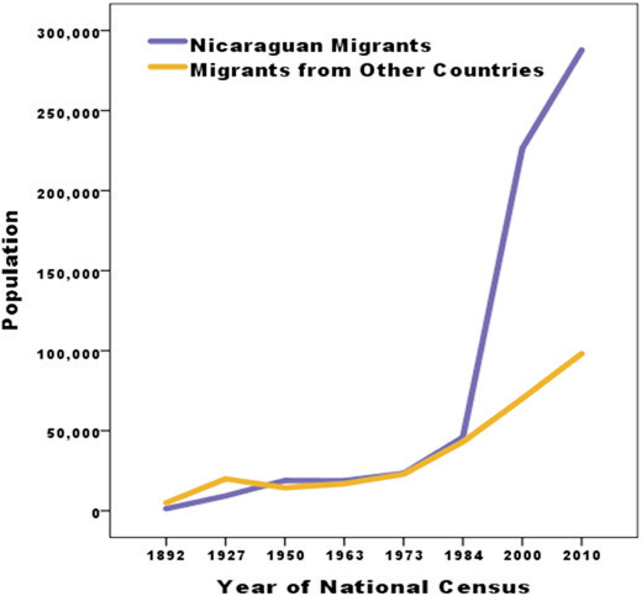
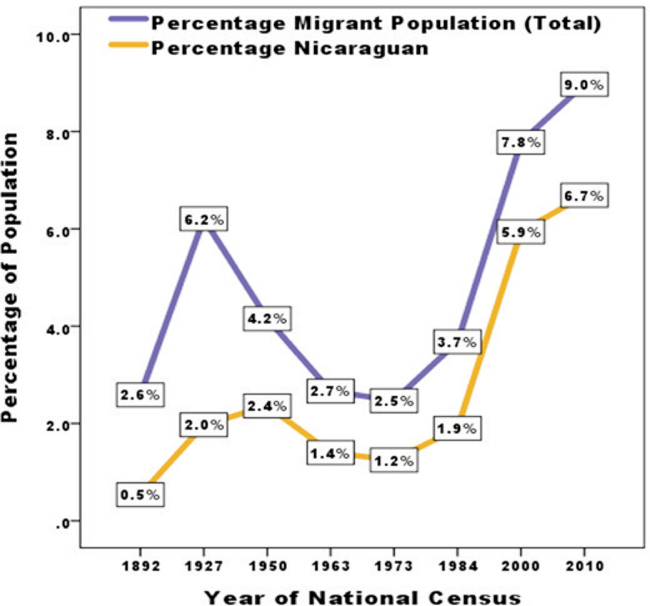
Labor necessities obliged Costa Rican elites to look elsewhere for workers, and both banana plantations and construction industries depended heavily on Nicaraguan laborers and immigrants from the Caribbean, particularly Jamaica.Footnote 14 Multinational corporations recruited Chinese immigrants to construct railroads. Relying on national census data, figure 1 documents the steady increase in immigration. In the mid-1890s, approximately 2.5 percent of the population was foreign born; by the 1927 census, immigrants represented 6.2 percent of the total population, with Nicaraguans and Afro-Caribbeans the primary groups (Castro Reference Castro2011).
Immigrant Population in Costa Rica, 1892–2011

Costa Rican elites fretted about the impact of Caribbean and Nicaraguan immigration on the homogeneity and whiteness of the Costa Rican population. To insulate the Central Valley (where most of the population lived) from the diversity of immigration, legislators enacted a series of laws to control the movements of “less desirable” immigrants throughout the nineteenth century (Alvarenga Reference Alvarenga2011). By the early twentieth century, Nicaraguans constituted a larger percentage of the immigrant population and faced frequent discrimination.Footnote 15 For example, Bourgois (Reference Bourgois1989) documents how segregated plantation systems frequently assigned Nicaraguans the most dangerous and undesirable tasks (e.g., clearing new land for cultivation), and how white and black workers frequently disparaged Nicaraguans as violent, murderous alcoholics.
As Nicaraguan immigration increased throughout the first half of the twentieth century, Nicaraguans were typically portrayed as violent criminals; indeed, in 1948, Francisco Ibarra wrote a scathing critique of the treatment and stereotypes of Nicaraguan workers in the northwest region of Guanacaste in The Tragedy of the Nicaraguan in Costa Rica.Footnote 16 Despite discrimination, Nicaraguan immigration continued to rise. As figure 2 demonstrates, in 1927, one-third of the migrant population was Nicaraguan; in 1950, this percentage had increased to roughly one-half.
Percentage Migrant Population, 1892–2011

Costa Rica’s historical patterns of immigration challenge narratives of a homogenous and egalitarian culture. It is true that until 1949 the Central Valley comprised a relatively homogenous citizenry, but this is at least partly due to the regulation of the movements of nonwhites. The 1949 Constitution challenged this status quo. The casualties and destruction of the 1948 civil war alarmed elites, who feared that Costa Rica would fall into the same cycles of violence and revolt that had long plagued other countries in the region. As part of the resolution of the civil war, a new constitution abolished standing military forces and set the foundation for democratic governance.
The new constitution also eliminated race-based citizenship and addressed immigration. The first section declares that Costa Rica is a democratic and independent republic, while the second section defines Costa Rican citizenship and stipulates mechanisms for naturalization.Footnote 17 These definitions of citizenship eliminated race-based citizenship laws and provided mechanisms for legally incorporating immigrant populations into the citizenry. The third section of the constitution is devoted entirely to foreigners, and stipulates that any foreigner in Costa Rica is entitled to the same individual and social rights as citizens have.
In 1949, white and nonwhite Costa Ricans were on a level legal playing field, and immigrants had a pathway to citizenship. Policy innovations buttressed these new laws by investing in human capital and demonstrated that there was genuine interest in creating a more egalitarian society. While the Central Valley still benefited disproportionately from state investments, public spending did increase in the other geographic regions of the country, home to racial and ethnic minorities who had long been marginalized (Palmer and Molina Reference Palmer and Molina2004, 230). In the years following the new constitution, the numbers of immigrants continued to increase, but at a much slower pace than overall population growth. In the 1950 census, 4.2 percent of the population was foreign born; this number dropped to 2.7 percent in 1963 and remained low until 1984, when the Contra War led to a spike in refugees fleeing Nicaragua (Lundquist and Massey Reference Lundquist and Massey2005).
After the Contra War ended, once again economic factors returned to the fore-front of Nicaraguans’ immigration calculus. In 1998, Costa Rica declared an amnesty to legalize undocumented migrants from Central American countries. Since this agreement, large numbers of Nicaraguans have migrated for seasonal and long-term employment opportunities; in 2011, six times more Nicaraguan migrants were registered in Costa Rica than in 1984. Castro (Reference Castro2011) argues that Costa Rica’s adoption of neoliberal economic reforms in the 1980s and 1990s created incentives for more Nicaraguans to migrate, as these reforms ushered in new economic activities that “required a work force that was only partially available in Costa Rica” (2011, 39). Educated Costa Ricans pursued higher-paying, specialized jobs, leaving many lower-paid, unskilled jobs unfilled. Among the applicants for these specialized jobs were greater numbers of Costa Rican women, and as more women entered the workforce, demand for affordable childcare and other domestic services increased.Footnote 18 Nicaraguan immigrants have filled these gaps in the labor force, and they currently feature prominently in childcare, domestic work, and private security provision (Sandoval-García Reference Sandoval-García2015).
Given these job concentrations, Nicaraguan migrants are overwhelmingly urban: 70 percent live in cities, particularly in and around the capital, San José. According to the most recent census, 2011, Nicaraguans constitute 6 percent of the Costa Rican population, and this proportion has steadily risen over the past three decades (INEC 2011). Gatica (Reference Gatica2011) estimates that there are roughly 130,000 undocumented migrants, which, when added to the numbers documented in the 2011 census, would bring the percentage of Nicaraguans living in Costa Rica to 10 percent of the total population.
Immigration in a Troubled Paradise
As more migrants traveled south throughout the 1990s and early 2000s, they arrived in Costa Rica amid economic, social, and political transformation. The 1982 debt crisis instigated most of these changes, as Costa Rica implemented a series of structural adjustment policies to respond to the regionwide debt default.Footnote 19
As neoliberal reforms restructured the economy and liberalized markets, unemployment and inequality continued to rise. Between 1990 and 2001, the Gini Coefficient increased from 45.3 to 51.1, before decreasing in 2012 to 48.6. The unemployment rate rose from 5.6 percent in 1991 to 7.8 percent in 2012.Footnote 20 Despite efforts to maintain social services, the quality of healthcare declined. Mesa-Lago (Reference Mesa-Lago2004) notes that in the 1990s, key healthcare indicators deteriorated and the budgets of antipoverty programs faced sharp cuts. Since 2011, the Caja Costarricense de Seguro Social (Costa Rican Social Security Fund) has confronted major financial troubles, and maintaining the most important social programs remains challenging.
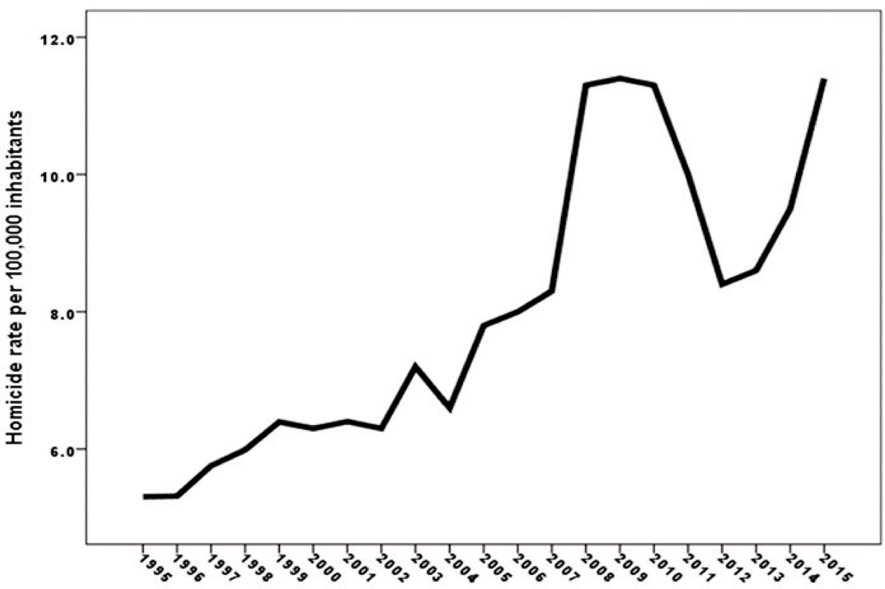
During this same period, crime rates also began to rise. Costa Ricans had long prided themselves on low rates of violence, particularly in contrast to the violence that historically consumed their neighbors to the north. By the end of the twentieth century, patterns of crime and violence began to change. Homicide rates, which had always been low in Costa Rica, doubled from 4.6 per 100,000 in 1990 to 9.6 in 2014. As figure 3 illustrates, murder rates reached historic highs in 2009, climbing to 11.4 per 100,000 (UNODC 2014). During this period, Costa Rica became an increasingly important country in the global illegal drug trade, as both a transit country and a growing domestic market (Parkinson Reference Parkinson2013). Costa Rican homicide rates were still far lower than those of Panama or the Northern Triangle countries; however, citizens reacted with alarm to such an abrupt change in the status quo.Footnote 21
Trends in Costa Rican Homicide Rates, 1995–2015

Political changes accompanied these economic and social transformations. Analyses of survey data from 1978 to 2012 document steady declines in the legitimacy of political institutions in the eyes of the Costa Rican public (Alfaro-Redondo and Seligson Reference Alfaro-Redondo and Seligson2012; Seligson Reference Seligson2002). Lower levels of political legitimacy coincided with lower levels of voter turnout, particularly for the two major political parties. In the early 2000s, voters gravitated toward minor parties as the two-party system became increasingly fragmented, a trend that culminated with the new Citizens’ Action Party presidential victory in 2014.
Against this backdrop of broader socioeconomic and political change, immigration has become a highly charged topic. Nicaraguans are widely depicted as responsible for increases in crime and the deterioration of public services. Sandoval-García (Reference Sandoval-García2004a) documents the negative depictions of Nicaraguan immigrants in the Costa Rican media, noting the propensity to portray Nicaraguans as violent criminals taking advantage of Costa Rica’s generous social services. In a survey of students at the University of Costa Rica from 1998 to 2006, Ramírez (Reference Ramírez2011) catalogues a series of common jokes associating Nicaraguans with stupidity, slovenliness, and prostitution. Masis and Paniagua (Reference Masis and Paniagua2011) find that the racialization of Nicaraguans in these jokes intensified between the 1990s and 2000s.Footnote 22 Sandoval-García (Reference Sandoval-García2004b, Reference Sandoval-García2015) also notes that even among public intellectuals in Costa Rica, who have long been associated with social democracy and leftist politics, xenophobia increasingly peppers public discourse.Footnote 23
Nicaraguans regularly face derogatory comments and discrimination yet are vital to the Costa Rican economy. Perhaps most paradoxically, Nicaraguans frequently work in private security positions despite stereotypes of their lawlessness and violence. Nicaraguan women frequently find employment as housekeepers and caregivers at wages far below what most Costa Ricans would accept.Footnote 24 Despite these economic roles, much discourse labels Nicaraguan migrants as a drain on resources (Sandoval-García Reference Sandoval-García2015).
In 2006, growing opposition to Nicaraguan immigrants culminated in the punitive General Law of Migration and Alien Affairs, which increased deportations and border security and made legal residency requirements stricter (Orcés Reference Orcés, Bearfield and Dubnick2015, 9). The legislature revised this law in 2009, but critics argued that it still curtailed health and education benefits and imposed financial charges for participation in the public social security system (Sandoval-García Reference Sandoval-García2015).
In sum, Nicaraguan immigration to Costa Rica increased substantially at the same time that the country underwent major economic, social, and political changes. Nicaraguans are often scapegoats for the fallout associated with these changes, blamed particularly for the deterioration of public services and increases in crime. These trends raise several questions. Do attitudes toward these immigrants have an impact on public policy preferences? If people hold negative attitudes toward this immigrant community, are they less supportive of universal social welfare programs? If people have negative attitudes toward immigrants, are they more likely to support more punitive crime control policies? This article now turns to public perceptions of immigrants and the impact of these perceptions on public policy in two key areas: social welfare spending and crime control policy.
Perceptions of Immigrants and Public Policy Preferences
Most of the research on immigration attitudes is from the global North. In a comprehensive review essay, Hainmueller and Hopkins (Reference Hainmueller and Hopkins2014) identify more than one hundred studies examining public attitudes toward immigrants. They find that this literature concentrates on the United States, Canada, and Europe and focuses heavily on the connection between public perceptions of immigrants and immigration policy.
Overwhelmingly, scholars aim to link attitudes toward immigrants to attitudes about immigration policies, isolating their analyses to this one public policy domain. In a notable exception, Burgoon (Reference Burgoon2014) links the percentage of foreign-born citizens in European countries to public support for redistributive policies and social protection. However, to my knowledge, this literature does not tie attitudes toward immigrants to broader public policy preferences, such as attitudes regarding public spending, service provision, or crime control in the global South.
A separate literature does examine the relationship between socially marginalized groups more broadly and attitudes toward public policy. Much of this work focuses on the United States and assesses the impact of attitudes toward minority groups on public policy preferences. For example, in a seminal work, Gilens (Reference Gilens1999) empirically demonstrated that white opposition to social welfare programs was tied to negative perceptions of black people, who were stereotyped as the “undeserving poor.” Hurwitz and Peffley (Reference Hurwitz and Peffley2005) found that racial cues increased public support for punitive crime control measures; when white respondents thought of criminals as black, they registered higher levels of support for spending money on prisons at the expense of antipoverty programs. In work conducted outside the United States, scholars have reported similar findings: perceptions about a country’s marginalized group(s) shape attitudes toward various types of public policy. In Canada, for example, respondents were less supportive of redistributive policies when the beneficiaries were described as Aboriginal (Harell et al. Reference Harell, Soroka and Ladner2014).
In analyzing attitudes toward immigrants and marginalized groups, both lines of research distinguish between symbolic and tangible threats. Tangible threats refer to competition for resources, or the concrete threat that one group (e.g., immigrant community) might pose for another (longtime residents). Tangible threats include job competition, competition for resources like housing and schools, and risks to personal safety. In contrast, symbolic threats are more abstract and based on stereotypes, resentments, and perceptions of threat that newcomers pose to lifestyle or culture.
Overall, the literature finds that in advanced industrialized countries, symbolic threat is more important than tangible threat in shaping public attitudes. For example, in their groundbreaking work, Kinder and Sears (Reference Kinder and Sears1981) found that symbolic threat was a more potent predictor of voting behavior in local elections in Los Angeles than tangible threat. While a sizable amount of research has tested Kinder and Sears’s theory and replicated their findings, some scholars have cautioned against delineating too strictly symbolic and tangible threats. For example, Verkuyten (Reference Verkuyten2014, 145) contends that depending on the larger context, tangible threats might be more salient, or even intertwined with symbolic threats.
To build on this research, this study examines the impact of different types of perceived threats on policy preferences. The 2014 LAPOP survey contains three questions to gauge attitudes toward immigrants. Two of these questions refer to clear tangible threats, in the form of increased economic competition and criminal threats to personal safety. As Kinder and Sears (Reference Kinder and Sears1981) note in their seminal work, perceptions of threats to economic well-being and personal safety can lead members of a majority to conclude that other societal groups constitute a tangible threat to the quality of their private lives. In this study, tangible threat perceptions could lead some Costa Ricans to view Nicaraguan immigration as detrimental to the quality of their daily lives, as they perceive such immigration as threatening their economic livelihood and their personal safety (or the safety of their families).
To measure perceptions of the tangible threats posed by economic competition and crime, two LAPOP questions were used:
“In general, would you say that the people from other countries who come here to live take jobs that Costa Ricans don’t want, or take jobs away from Costa Ricans?” Responses were recoded as (1) do jobs that Costa Ricans don’t want; (2) both; (3) take work from Costa Ricans.Footnote 25
“How much do you agree or disagree that crime has increased in Costa Rica because of the people who come here to live from other countries? (1) strongly agree – (5) strongly disagree.” Responses were recoded so that higher values indicated more agreement that immigrants were responsible for crime increases.
These questions do not explicitly refer to Nicaraguan immigrants, but in the context of contemporary Costa Rica, Nicaraguans are most likely to be the primary group that comes to mind.
LAPOP also included a question to measure symbolic threat: “How much do you agree or disagree that Costa Rican culture is threatened by people who come to live here from other countries?”Footnote 26 Like symbolic threat measures, this item is abstract, and asks respondents to indicate whether immigrants threaten Costa Rican culture, an assessment typically based on stereotypes of the marginalized group in question. Once again, the question mentions only immigrants, not Nicaraguans specifically, but Nicaraguans are the group that comes to mind first in the context of contemporary Costa Rica.
Descriptive statistics indicate that a clear majority of respondents did not view immigrants as economic threats: 61 percent replied that immigrants do jobs that Costa Ricans do not want, while only 21 percent stated that immigrants unilaterally took jobs away from Costa Ricans (and 18 percent replied “both”). When asked about crime, respondents registered more negative attitudes toward immigrants: 51 percent of the sample strongly or somewhat agreed that immigrants cause crime rates to rise. A sizable minority agreed that immigrants posed a threat to Costa Rican culture: 42 percent either agreed or strongly agreed with this statement.Footnote 27
Perceptions of Immigrants and Crime
In its 2014 national survey of Costa Rica, LAPOP included a question on crime control policy preferences: “In your opinion, what should be done to reduce crime in a country like ours: implement preventive measures or increase punishment of criminals?” Responses were recoded as (1) implement preventive measures, (2) both, (3) increase punishment of criminals.Footnote 28 This question has been at the fore-front of politics in Costa Rica as discussions of crime have dominated the national agenda and politicians have clashed on how best to respond to rising crime. Preventive security policies aim to address the root causes of crime and include measures to reduce poverty, provide job training and employment for young people, and identify at-risk youth. Preventive policies can range from after-school programs to improving lighting in parks and alleys. In contrast, more punitive measures include policies like longer jail sentences for convicted criminals, lowering the age at which teenagers can be tried as adults, and new laws criminalizing a broader range of behaviors.
Former president Laura Chinchilla (2010–14), who was a public security expert before assuming the Costa Rican presidency, tended to support a balance of these two approaches, advocating some increased sanctions for criminals combined with more investments in social security (Rico and Chinchilla Reference Rico and Chinchilla2002).Footnote 29 Critics of this approach have argued that Costa Rica must act decisively against suspected criminals and impose harsher sanctions for criminal offenses.Footnote 30 Punitive laws have been a hallmark of the mano dura (iron fist) crime-fighting strategies implemented in several Central American countries and have resulted in human rights violations but have not successfully deterred crime (Wolf Reference Wolf2017). This analysis aims to determine whether perceptions of immigrants shape people’s willingness to endorse harsher punishments for suspected criminals, as opposed to measures aimed at preventing crime or a mixture of the two approaches.
Before examining the linkage between perceptions of immigrants and crime control policies, we must first control for other factors linked to support for harsher crime control strategies. In the literature, scholars have empirically linked support for harsher punishments to being a victim of crime, fear of crime, satisfaction with law enforcement forces, media exposure, and socioeconomic characteristics (Pérez Reference Pérez2015). This analysis controls for these factors.Footnote 31 Using ordinal logistic regression, it determines whether negative perceptions of immigrants lead people to register support for more punitive crime control policies.
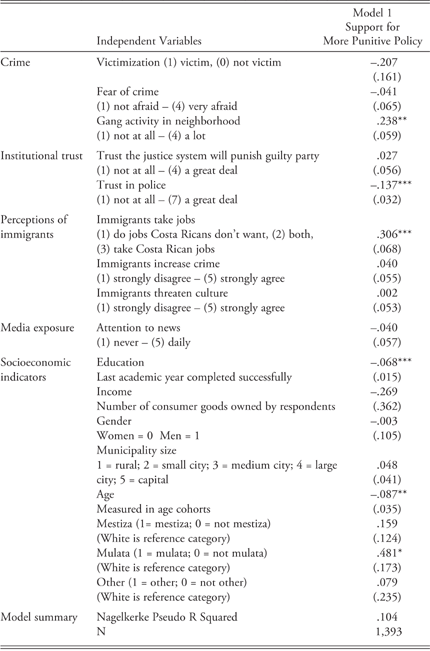
As model 1 in table 1 reports, respondents who considered immigrants more of an economic threat were significantly more likely to support punitive crime control policies. In contrast, the other items measuring perceptions of immigrants were not significant. Respondents who considered immigrants a threat to their culture or who thought immigrants were responsible for increases in crime did not register more support for punitive practices. To ensure that these insignificant results were not attributable to multicollinearity, each of the immigrant perception items was entered into the regression model separately; even when entered alone in the regression model, perceptions that immigrants threaten culture and increase crime were not significantly related to crime control policy preferences.
Support for Punitive Crime Control Policy

* p <.05
** p <.01
*** p <.001
Notes: Coefficient estimates with standard errors in parentheses. Mulata and mestiza defined in AmericasBarometer 2014.
It is particularly interesting that respondents who associated immigrants with increased levels of crime did not necessarily endorse more punitive crime control measures. Respondents who linked immigrants to increases in crime did not automatically think that punitive measures were the best way to reduce this criminality. They might view crime as a problem and attribute crime increases to immigration trends but still entertain the possibility that preventive measures can be better tactics for fighting crime, as they purportedly tackle the root causes of crime. This suggests that even if people associate immigrants with crime, they can still be willing to support preventive policies to reduce crime.
To probe these findings further, I examined the characteristics of respondents who regarded immigrants as economic threats, compared to those who linked immigrants to crime and cultural threats.Footnote 32 In socioeconomic terms, respondents who regarded immigrants as economic threats were less affluent than those who perceived immigrants as cultural and criminal threats. The economic threat group also consisted of a greater percentage of 18-to-25-year-olds.Footnote 33 Furthermore, respondents who thought immigrants took Costa Rican jobs were significantly less likely to report that their salaries covered their household expenditures, that their quality of life was better than that of their parents, and that people were trustworthy.Footnote 34 Perceptions that immigrants took Costa Rican jobs also correlated with perceptions of other marginalized groups: people who viewed immigrants as economic threats were significantly less tolerant of gay individuals, for example.Footnote 35
In contrast, perceptions that immigrants represented criminal and cultural threats were not significantly correlated with evaluations of household income, quality of life, and interpersonal trust. Respondents who associated immigrants with crime did not report significantly less tolerance of gay individuals. People who perceived immigrants as cultural threats did register significantly less tolerant attitudes toward gay people, but the magnitude of this correlation was much lower than that of economic threat.Footnote 36 In sum, those who thought immigrants took Costa Rican jobs had more personal economic anxiety, less interpersonal trust, and less tolerance of other marginalized groups.Footnote 37 These characteristics could explain why the perception that immigrants were economic threats was significant in model 1 but other perceptions of immigrants were not significant.
As model 1 reports, personal experience with crime, as well as fear of future victimization, did not significantly shape people’s attitudes toward crime control policy. While this might seem counterintuitive, other studies corroborate these findings. Often, victims of crime and people who fear crime do advocate punitive policies to control crime, but this is not always the case. For example, previous research (Malone Reference Malone2014) found that the quality of the justice system and the actual levels of violent crime in a country can mediate the relationship between experiences and perceptions of crime and support for specific policies. Most important for the purpose of this study, crime control policy preferences were not linked to personal experiences or perceptions of crime, yet they were significantly linked to perceptions of immigrants. The only time crime itself had an impact on policy preferences was in the case of gang activity. When respondents perceived gangs as active in their neighborhoods, they were more likely to support punitive policies. This finding also is corroborated by the literature, as the public tends to favor punitive measures when perpetrators are perceived as gang members (Wolf Reference Wolf2017).
Trust in police was also a significant predictor in model 1. People with higher levels of trust in the police were less likely to support punitive measures over preventive ones. When respondents trusted police to protect them from crime, they did not see the need to rely more on punishment. The other institutional trust variable, trust in the justice system to punish the guilty party, was not significant.
Among the socioeconomic variables, age and education were significant, as older respondents were less likely to support punitive measures and more educated respondents were less likely to favor punitive policies. Furthermore, people who identified as mulatto were more likely to support punitive measures. The remaining socioeconomic and demographic variables were not significant, nor was media exposure.Footnote 38
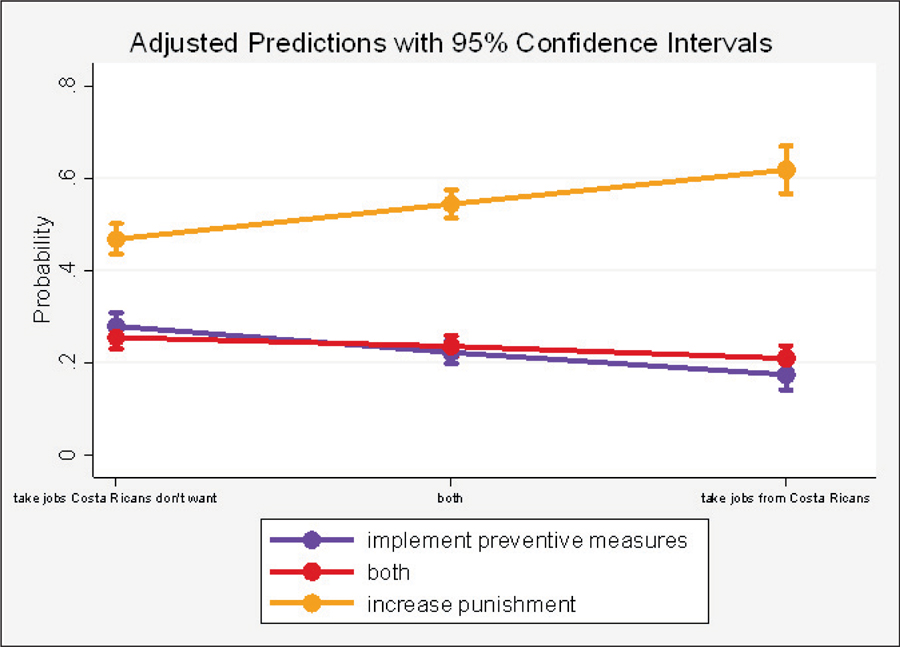
Based on the results of model 1, predicted probabilities were estimated to illustrate the substantive impact that economic threat has on support for punitive crime control policies (see figure 4). Holding all other variables at their means, the probability of supporting punitive policies (outcome 3) is 15.1 percentage points higher for people who thought immigrants took jobs away from Costa Ricans, compared to those who replied that immigrants took jobs Costa Ricans did not want.Footnote 39
Support for Punitive Crime Control Policy

Perceptions of Immigrants and Social Welfare Policy
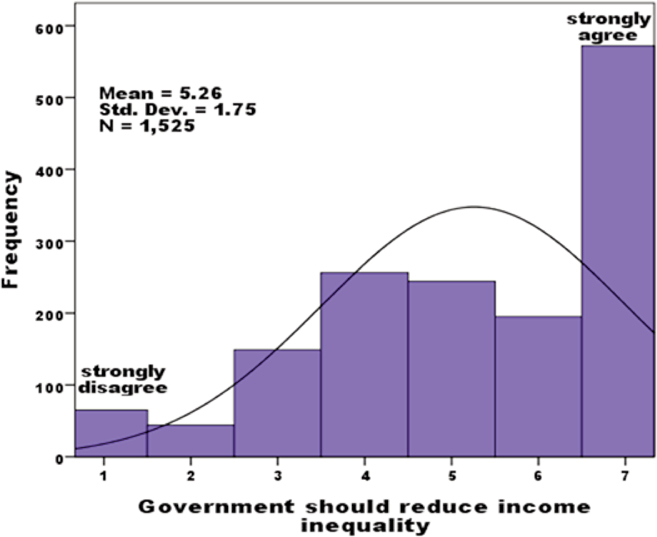
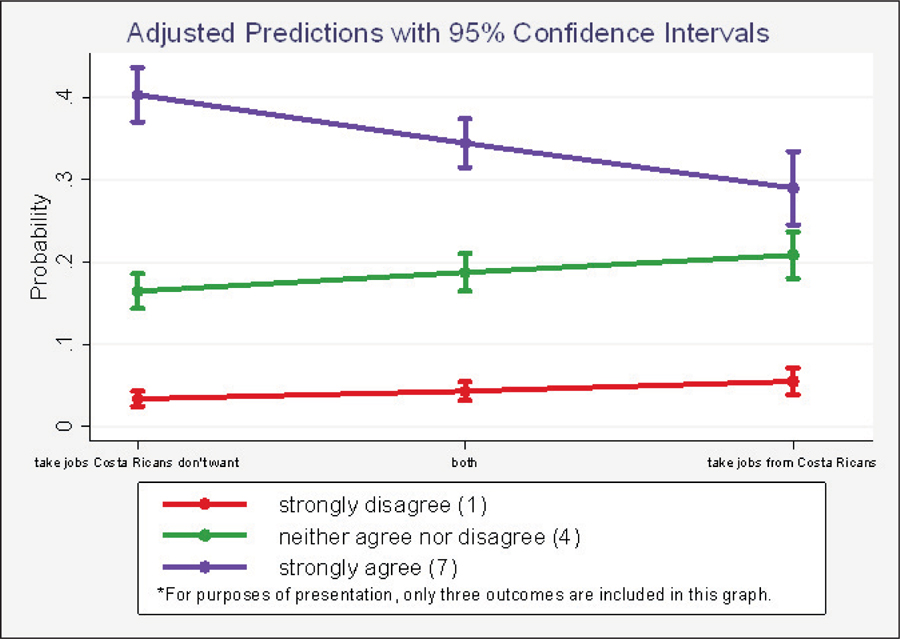
To measure levels of support for a social safety net and income equality, this study turns to the following LAPOP question: “The Costa Rican government should implement strong policies to reduce income inequality between the rich and the poor. To what extent do you agree or disagree with this statement? (1) strongly disagree – (7) strongly agree.” As figure 5 illustrates, overall support for a government role in reducing income inequality was quite high: 37.5 percent of the sample responded with the highest value. Only 7 percent of respondents gave values at the low point of the scale (values 1 or 2).
Support for Government Reduction of Income Inequality

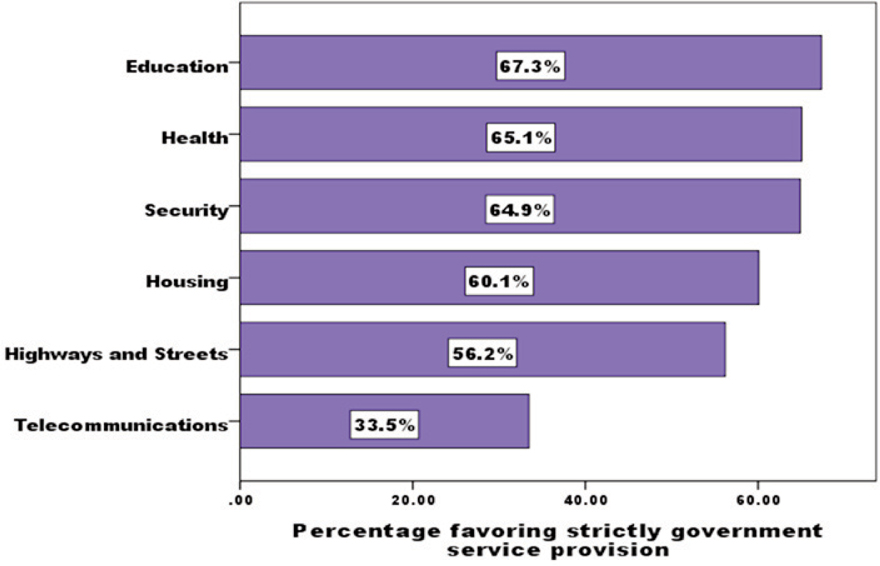
When asked about a government role in social service provision, respondents were even more supportive. LAPOP included a battery of items to measure support for various dimensions of social welfare policy: “Do you think that the following goods and services should be provided by (1) the government, (2) private businesses, or (3) both?” The list of services included education, health services, security, housing, highways and streets, and telecommunications. Figure 6 highlights the very high levels of support for government intervention for most services in Costa Rica. Security, health services, and education were areas of considerable consensus, with at least 65 percent of the sample reporting support for only government provision of these services. Government provision of housing and streets and highways garnered strong support, with more than half of the sample indicating only government should provide these services. The only area where support for government provision was lower was in the telecommunications sector (comprising telephone and internet). This reflects a contentious debate about the telecommunications industry in Costa Rica, which had been nationally owned throughout the 1990s.Footnote 40
Support for Government Role in Service Provision

For this analysis, I first recoded these six survey items so that higher values corresponded to higher levels of support for government provision of these services (e.g., [1] private, [2] both, [3] government). I then combined these measures into an additive index, with a Cronbach’s alpha of .739.Footnote 41
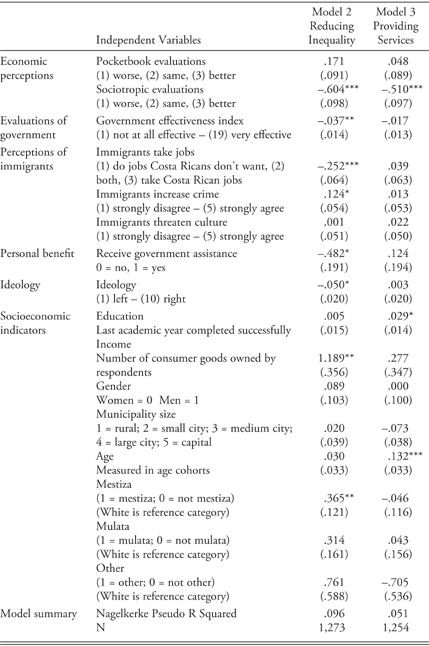
Of course, in order to examine the relationship between perceptions of immigrants and support for social welfare provision and income redistribution, we must also include other variables that scholars have linked to public support for social welfare policies. Scholars frequently point to the importance of economic perceptions, evaluations of government effectiveness, personal benefits from social welfare programs, ideology, and socioeconomic characteristics.Footnote 42 Table 2 reports the results of this analysis.
Support for a Government Role in Reducing Inequality and Providing Services

* p <.05
** p <.01
*** p <.001
Coefficient estimates with standard errors in parentheses.
Model 2 in table 2 confirms the trend detected earlier: respondents who agreed that immigrants take Costa Rican jobs were significantly less likely to support government policies to reduce income inequality. However, model 2 reports a finding that might seem counterintuitive: respondents who attributed increases in crime to immigrants were significantly more likely to support government policies to reduce income inequality.
This result is surprising, but earlier results from table 1 help to put it into a broader context. In table 1, perceptions that immigrants caused crime to rise did not lead to support for more punitive policies. This could be because people might think immigrants are responsible for crime but attribute this criminality to their economic circumstances, for example. Linking immigrants with rising levels of crime did not necessarily lead respondents to conclude that punitive policies were the best way to redress this problem. Instead, investments in preventive crime control measures were also perceived as a viable strategy. In a similar vein, respondents who think that immigrants are responsible for crime increases might attribute this linkage to lower levels of economic prosperity or the concentration of immigrants in disadvantaged communities. Consequently, they may view government policies designed to reduce income inequality as a way to improve the socioeconomic status of immigrant groups and thus reduce criminality. Like prior models on crime control, perceptions that immigrants threaten culture did not have a significant impact on support for government reduction of income inequality.
Other variables traditionally associated with support for government policies to reduce income inequality were significant in this model, too. Respondents who placed themselves to the right of the ideological spectrum were significantly less supportive of government intervention.Footnote 43 People who thought that the national economy was doing worse were significantly more likely to advocate for government policies targeting income inequality. In contrast, people’s evaluations of their own personal economic situation did not have a significant impact.
One initially surprising result was the relationship between receiving government assistance and support for reducing income inequality. In model 2, recipients of government assistance were significantly less likely to support government policies to promote income equality. Personally benefiting from government programs did not lead respondents to support government policies to reduce inequality; the relationship ran in the opposite direction. This finding should be interpreted with caution, however, as only 118 respondents (7.7 percent of sample) reported receiving government assistance. Still, to probe this finding further, I examined the correlations between receiving government assistance and additional variables. People who received some form of government assistance reported significantly lower incomes and levels of education, and they were significantly more likely to state that immigrants took Costa Rican jobs. Thus, it is possible that this sense of economic threat shaped the perceptions of recipients of government assistance.Footnote 44
Another variable with counterintuitive results is the government effectiveness index. This variable aimed to gauge perceptions of government effectiveness in three distinct policy areas (fighting corruption, maintaining security, managing the economy), hypothesizing that people who thought government was more effective would be more supportive of other government policies, such as those to reduce income inequality.Footnote 45 The analysis found a significant relationship in the opposite direction. Positive evaluations of government performance in these areas did not translate into more support for state policies in the domain of inequality reduction. Even when respondents viewed government favorably, it did not mean that they thought the government should take on the role of reducing income inequality. Conversely, these models suggest that cynicism regarding government performance is not the reason why people oppose government intervention to reduce inequality.
Based on the results in model 2, I estimated the predicted probabilities to gauge the substantive impact that economic threat has on support for a government role in inequality reduction (see figure 7). Holding all other variables at their means, the probability of registering the highest level of support for government intervention to reduce inequality (outcome 7) is 11.3 percentage points lower for people who thought immigrants took jobs away from Costa Ricans, compared to those who replied that immigrants took jobs Costa Ricans did not want.
Support for Government Role in Reducing Income Inequality

Model 3 of table 2 reports the results of the analysis of support for government provision of services. Here, we find that none of the survey items measuring attitudes toward immigrants significantly predicts support for government provision of services. The primary reason for this is probably that support for government action in these areas is quite high throughout Costa Rica. As figure 6 demonstrates, there is little disagreement that government should be actively involved in the provision of education, healthcare, security, and housing. There is more variation in attitudes toward government provision of highways and streets and telecommunications, but a sizable percentage still registers strong support.
This strong support is probably tied to the historical legacy of Costa Rica’s social welfare system. The universal provision of education and healthcare has long been a source of national pride, and we see that this support does not waiver depending on trends of immigration. Indeed, given this strong support for government provision of services, most of the variables in the model have little explanatory power. Sociotropic economic evaluations are significantly and negatively correlated with support for a social welfare system, whereas education and age maintain positive and significant relationships. The remaining variables are insignificant, however, indicating that support for a social welfare system is firmly entrenched in Costa Rican political culture.
Conclusions
This analysis finds that attitudes toward immigrants can shape attitudes toward public policy. In two key policy areas, perceptions of immigrants had a significant impact on public support. When respondents perceived immigrants as an economic threat, they were significantly more supportive of punitive crime control policies. This finding is particularly striking, as many of the variables related to crime were not significant. Crime victims, and people who were more fearful of falling victim, did not register more support for punitive crime control policies. Instead, respondents’ economic fears of immigrants mattered more than personal experiences with and perceptions of crime.
When people perceived immigrants to be economic threats, they were also less supportive of government attempts to reduce income inequality. However, economic threat did not have an impact on public support for government services. Even when respondents perceived immigrants as competing for Costa Rican jobs, they did not register less support for government service provision. This is most probably due to the historical tradition of a strong social welfare state in Costa Rica, which has long been a source of national pride.
Interestingly enough, people who associated immigrants with crime were not more supportive of punitive crime control measures, but they were more supportive of government policies to reduce income inequality. Such respondents might attribute criminality to lower levels of economic prosperity or to the concentration of immigrants in disadvantaged communities. Thus, even when people associated immigrants with crime, they did not automatically endorse punitive crime policies, and still thought it viable to invest in policies to reduce income inequality.
From a theoretical standpoint, it is interesting that economic threat mattered far more than symbolic threat (“immigrants threaten culture”) in shaping public policy preferences. In contrast to studies conducted in the global North, in Costa Rica symbolic threat did not have a significant effect on crime control or social welfare policy preferences. This could be because respondents who viewed immigrants as an economic threat also harbored underlying economic anxieties, lower levels of interpersonal trust, and less tolerance for other societal groups. The study of these underlying economic anxieties and attitudes and how they translate into tangible and symbolic threats merits closer examination in future research, particularly given the large immigrant populations in other parts of the global South, such as Argentina and Chile.
This analysis has implications for designing public policy. If policymakers respond to a public clamor for more punitive crime control measures, for example, they must be careful to consider what factors are linked to public support for such policies. From a policy standpoint, it is undesirable for crime control strategies to be driven by politicized discourse and stereotypes rather than sound policy analysis (Garland Reference Garland1996, 461). Likewise, when deciding the appropriate economic role for government, politicians should weigh public preferences carefully, as those grounded in xenophobia rather than economic interest are likely to be counterproductive.
Recent events underscore the need for this caution. Since Nicaraguan president Daniel Ortega’s violent crackdown on political opponents in April 2018, record numbers of Nicaraguans have fled to Costa Rica and requested asylum. Journalists report that approximately 24,000 Nicaraguans have formally explored asylum options in Costa Rica this year, a dramatic increase compared to the 6,300 total asylum applications in 2017 (Semple Reference Semple2018). The influx in Nicaraguans seeking asylum has heightened preexisting tensions and accompanying xenophobia, making it all the more imperative to insulate policymaking decisions from kneejerk xenophobic attitudes toward immigrants.
Supporting Information
Additional supporting materials may be found with the online version of this article at the publisher’s website: Online appendix.