


Introduction
Paranoia is an interpersonal experience that can extend to the belief that other people intend or are currently causing severe physical, psychological or social harm (Freeman and Garety, Reference Freeman and Garety2000). Although paranoia is likely to impact on an individual's ability to engage in cognitive behavioural therapy for psychosis (CBTp), particularly if they become paranoid about their therapist (e.g. Chadwick, Birchwood and Trower, Reference Chadwick, Birchwood and Trower1996; Chadwick; Reference Chadwick2006; Hutton and Morrison, Reference Hutton and Morrison2012), there is also evidence that the successful resolution of difficulties in the therapeutic relationship may actually improve therapy outcome (e.g. Safran, Muran and Eubanks-Carter, Reference Safran, Muran, Eubanks-Carter and Norcross2011). Understanding the processes involved in the development and resolution of difficulties in the therapeutic relationship thus represents an important area of investigation (Castonguay, Constantino and Grosse-Holtforth, Reference Castonguay, Constantino and Grosse-Holtforth2006).
Research suggests that good therapeutic relationships can be developed and maintained with clients with psychosis, and are associated with improved therapy outcomes (e.g. Bentall et al., Reference Bentall, Lewis, Tarrier, Haddock, Drake and Day2003; Evans-Jones, Peters and Barker, Reference Evans-Jones, Peters and Barker2009; Svensson and Hansson, Reference Svensson and Hansson1999). The CBTp literature also provides general guidance to therapists about preventing and responding to clients becoming paranoid about them (e.g. Fowler, Garety and Kuipers, Reference Fowler, Garety and Kuipers1995; Kingdon and Turkington, Reference Kingdon, Turkington and Persons2008; Chadwick et al., Reference Chadwick, Birchwood and Trower1996). This includes anticipating paranoia, seeking regular feedback and, where paranoia is present, reassuring clients, problem-solving the issue, and either working more informally or at a schematic level. Within the person-based cognitive therapy approach to distressing psychosis (Chadwick, Reference Chadwick2006), it is proposed that developing a “radically collaborative” therapeutic relationship, in which the client is positioned at the heart of the therapeutic process, can minimize the impact of clients incorporating therapists within paranoid belief systems. Radical collaboration promotes openness and acceptance of client paranoia about the therapist, rather than fear of being incorporated into paranoid belief systems (Chadwick, Reference Chadwick2006). However, important gaps remain in our understanding of the experience and impact of clients’ paranoia about their therapist and how it can be helpfully addressed (e.g. Dilks, Tasker and Wren, Reference Dilks, Tasker and Wren2012; Hutton and Morrison, Reference Hutton and Morrison2012; Wittorf et al., Reference Wittorf, Jakobi, Bannert, Bechdolf, Müller and Sartory2010).
Qualitative research has begun to investigate client and therapist experiences of CBTp and what is associated with clients finding therapy helpful (Berry and Hayward, Reference Berry and Hayward2011). Fewer studies have explored difficulties in therapy and, although paranoia about the therapist has been linked with non-progression in therapy (McGowan, Lavender and Garety, Reference McGowan, Lavender and Garety2005), there remain no detailed accounts of it from either client or therapist perspective. The aim of the present study was therefore to understand the experience of paranoia and how it can be addressed in the therapeutic relationship, amongst a group of 10 therapists and 8 clients currently engaged in CBTp. Qualitative thematic analysis was used to address the following research questions: (1) What are clients’ experiences of becoming paranoid about their therapist during therapy; (2) What issues arise for therapists when clients become paranoid about them; (3) What have therapists found helpful when working with clients who have become paranoid about them; and (4) What is the impact on clients of exploring and addressing paranoia about their therapist?
Method
Participants
Ten therapists and eight clients took part in the study. Purposive, systematic sampling was employed (Mays and Pope, Reference Mays and Pope1995) in order to ensure participants met the selection criteria for the study. Therapists were selected on the basis that they were qualified clinical psychologists with at least 2 years experience of using CBTp. Five therapists were male and five were female; average length of time qualified was 11.6 years (range: 2–38 years) and average length of time working with clients with psychosis was 10.05 years (range 2–24 years). All therapists worked in NHS services in the UK and identified themselves as White British. Eight clients were identified by four therapists from their personal caseload on the basis that they had a diagnosis of schizophrenia, were experiencing current persecutory delusions, and were currently engaged in CBTp. They were also required to be able to engage in the interview and communicate well in English without the use of an interpreter. All clients were white British males (MAGE = 35.9 years, range 31–41) with a primary diagnosis of paranoid schizophrenia (DSM-IV, APA 1994). All clients were outpatients currently engaged in CBTp, and all but one were taking antipsychotic medication; two were employed and the remainder were unemployed.
Qualitative interview
Two semi-structured interviews were developed, in which parallel questions were developed for therapists and clients, with the aim of eliciting reflections in the following areas: (1) client experiences of paranoia in the therapeutic relationship (e.g. “Has there ever been a time when you felt mistrustful of your therapist?”); (2) How therapists respond to client paranoia (e.g. “How have you responded when a client incorporates you into a paranoid belief system?”); and (3) the impact of client paranoia (e.g. “When you felt mistrustful of your therapist in sessions, how did this affect the way you behaved?”). Therapists were asked to discuss their experiences both generally and in relation to specific clients. Consistent with guidelines for conducting semi-structured interviews, probes were used flexibly to “combine structure with flexibility” (Legard, Keegan and Ward, Reference Legard, Keegan, Ward, Ritchie and Lewis2003). Therefore, whilst sequence of questions was standard, the interviewer had the freedom to pursue unexpected areas of interest and probe for more detail.
Procedure
NHS ethics approval was gained prior to the commencement of the study, and all participants gave written, informed consent. Therapists were approached first by one of the authors (LE) and invited to take part. They were also asked to identify current clients on their caseload who met the selection criteria. Therapist and client interviews were conducted by two of the authors (CL and KH). All interviews were audio-recorded and client participants were given the opportunity to explore the digital recording equipment prior to the start of the interview, as recommended by Boyd and Gumley (Reference Boyd and Gumley2007). Interviews were then transcribed verbatim ready for qualitative analysis.
Qualitative analysis
The data were analyzed using thematic analysis, a method for systematically identifying and describing themes in a qualitative data set (Joffe and Yardley, Reference Joffe, Yardley, Marks and Yardley2004). This method was chosen because it permits a flexible, detailed and inductive analysis of complex information, and is suitable for collecting data from more than one sample. Thematic analysis is a recursive process, in which the researcher “moves between” different phases of analysis. The coding process comprised six phases, consistent with good practice guidelines (Braun and Clarke, Reference Braun and Clarke2006). Each interview was analyzed separately and emergent themes were summarized. Inductive coding was used (Boyatzis, Reference Boyatzis1998); that is, themes were drawn from the raw information rather than preexisting ideas or a preexisting “coding frame” (although themes are inevitably influenced by the central research question). In this way, coding was “data driven”. In addition, information was coded exclusively; that is, each coding unit could be coded into only one category, a method that makes clear distinctions between aspects of the content (Joffe and Yardley, Reference Joffe, Yardley, Marks and Yardley2004). Following Braun and Clarke (Reference Braun and Clarke2006), in order for a theme to be extracted from the data it needed to be present in at least three transcripts. This criterion was used to establish thematic saturation. Themes were initially developed for therapist (5 themes) and client (8 themes) data separately, which were subsequently collapsed into a final set of 3 master themes by two of the authors (CL and LE) combining all of the data.
Providing credibility and reliability checks
Three additional checks were used. First, as an initial reliability check, the two people involved in coding conducted a consensus review and appraisal of themes for the first transcript. Second, to assess interrater reliability, 30 sample quotations from transcripts were independently allocated to the list of themes by someone independent to the study. This revealed a Kappa value of 0.75, indicative of a good level of agreement. Third, the credibility of final themes was checked using “respondent validation” in which the themes were presented to participants for feedback. All recognized and endorsed the themes, and no participant suggested any significant omission.
Results
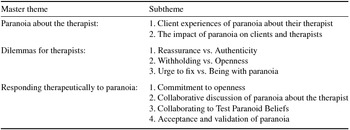
Three main themes emerged from the data: Paranoia about the therapist, Dilemmas for the therapist, and Responding therapeutically to paranoia (see Table 1).
Master themes and subthemes

Theme 1: Paranoia about the therapist
Client experiences of paranoia about their therapist. The content of paranoid beliefs about the therapist reflected both a generalized sense of others as untrustworthy and malevolent, which included the therapist:
I became frightened of everyone, thinking anybody who was around me was part of some sort of great scheme about me. At first, this included [my therapist]. (Client 3)
When I first started (therapy) I thought I couldn't (trust my therapist). . . but I was like that with everybody. (Client 6)
as well as reports of clients actively incorporating their therapist into a delusional belief system:
There was one little doubt that [my therapist] was out to get me, to kind of trap me, catch me out. (Client 7)
Between sessions, I was hearing voices of people that persecute me and (my therapist). . . I thought that some of (them) were offering him money to do things to me. . . in the next session, I felt I couldn't trust him. (Client 4)
The impact of paranoia on clients and therapists
Paranoia about the therapist resulted in a number of consequences for both clients and therapists. For clients, this focused on monitoring themselves and their therapists’ reactions during therapy sessions:
I was being very guarded about what I said, how I acted and did things. . . I just said what had to be said but I didn't open up. (Client 7)
I had to suss (him) out to see if he was trustworthy. . . checking out. . . how well (he) dealt with the stuff that I brought up initially. (Client 2)
For some therapists, clients’ paranoia about them resulted in vigilance or a preoccupation with clients’ experiences in the room:
(I have) become mistrustful about whether a client poses a threat and. . . vigilant about what might trigger hostility responses. (Therapist 3)
A lot of my clients will be hearing voices that will be saying “Hurt them, Harm your therapist” et cetera, and so I guess I'm always vigilant whether that might be going on. (Therapist 8)
Some therapists also reported that clients becoming paranoid about them evoked feelings of self-doubt or led to them questioning whether they should have done things differently:
I realised you can get dragged into someone's delusional system and I just felt a bit helpless. (Therapist 4)
I did question whether I'd done something wrong or whether there were some qualities about me as a therapist that I didn't portray. . . you question your competence. (Therapist 2)
Theme 2: Dilemmas for the therapists
The perception or realisation that clients were paranoid about them appeared to result in dilemmas for therapists and required them to balance or choose between a focus on being open and accepting or trying to reassure clients and “fix” paranoia. These were categorized into three broad areas: reassurance vs. authenticity; withholding vs. openness; and urge to fix vs. being with paranoia.
Reassurance vs. authenticity
Several therapists reported occasions where their behaviour during therapy sessions was interpreted in a way that led clients to feel paranoid about them. This created a dilemma in terms of the extent to which the therapist should monitor and change their behaviour to reassure clients of their intentions and minimize future paranoia versus remaining authentic in the room. Some therapists emphasized taking responsibility for client paranoia and changing their behaviour:
I think you often feel that you're on tenterhooks or walking on eggshells a little bit. You're being careful that you don't upset the trust. (Therapist 10)
It's about being profusely apologetic. . .and making sure you don't do it again. . .– it's my fault, I've misunderstood. (Therapist 7)
However, therapists also discussed the importance of being accepting of misinterpretations and addressing clients’ paranoia about their behaviour by remaining authentic and sharing their position with the client:
We kind of made a joke about it – unless I was set in concrete there was no way I could avoid him interpreting my gestures . . . Where we're starting to feel tied in knots – I can't say this because the person might think I mean that – it's going to stultify therapy. I'm aware of any of those tendencies and letting them go. (Therapist 1)
(One client) thought I might be in league with a particular agency (and I responded by) just trying to talk about it, talking about what had led him to think that, what that meant about coming, the pros and cons about coming. As far as I was concerned I wasn't, but clearly he thought I was so what could we do to try and make that feel better for him, how could we work together with that happening? (Therapist 10)
Withholding vs. openness
Some therapists also reported having difficult experiences of feeling that clients were not being open about their particular concerns or experiences, which was sometimes linked to perceiving inconsistencies in what was shared in therapy. This resulted in a dilemma about whether to openly and sensitively discuss this with the client, or withhold this observation. Some therapists decided, at least initially, not to share their concerns about clients not being open with them:
(When) you feel that the client is withholding something from you, or is lying about something . . . it's really uncomfortable (and) you find yourself stewing on (it) and ruminating. (Therapist 6)
Little incongruities just made me think maybe some of the stuff he's telling me is not entirely true. (Therapist 4).
Other therapists emphasized the importance of being open about their concerns, but doing this in a way that facilitates an open discussion about clients’ experiences:
Experiencing that somebody's not being truthful is really challenging and I need to kind of raise it and get it on the table because (otherwise) we're not working together, but obviously it's a really difficult sensitive issue to raise. (Therapist 1)
There will be times when the person really struggles to let you know what is going on for them and you sense that. . . what I do then is raise it as a possibility to see if the person wants to discuss it. . . and open the door to having a conversation about it when that person's ready to, and then it's entirely their choice. (Therapist 9)
Urge to fix vs. being with paranoia
A third dilemma identified by therapists was in relation to whether and the extent to which they should try to “fix” or actively solve clients’ paranoia about them or accept it:
I'd have that immediate knee-jerk response of how can I make this better and really go overboard - pull out all the stops to get this person to trust me once again. (Therapist 4)
It can feel quite difficult when you're trying to wrack your head what else you can do to facilitate that trust. (Therapist 8)
In contrast to these accounts, some therapists were much more accepting of paranoia, viewing it as an issue for them to attend to and then collaboratively address with the client:
I think maybe my role is to recognize that it's happening and name it and get us both working on it together rather than me trying to solve it. (Therapist 1)
(Previously) I'd (think) I've got to have perfect therapeutic relationships and do my utmost to get (clients’) trust – now I expect it (paranoia about the therapist), and actually I think it's very helpful because then you've got material to work with in the room. (Therapist 9)
Theme 3: Responding therapeutically to paranoia
Therapists identified helpful ways of responding when clients became paranoid about them during therapy. Their accounts emphasized three key characteristics: (1) commitment to openness; (2) collaboratively making sense of and testing out paranoid beliefs about the therapist; and (3) the importance of acceptance and validation of the client's concerns.
Commitment to openness
Most therapists reported that it was useful to be open with clients about their intentions towards them and possible difficulties in the therapeutic relationship:
You would always want to elicit it -is there something I've said or done that's upset you (or) made you think that my intentions towards you have changed . . .check it out and be open. (Therapist 7)
There will be times when the person really struggles to let you know what is going on for them. . . It may be that I've done something that means the person doesn't trust me. You sense it's going on . . . and then what I do then is raise it as a possibility (so that) we can talk about it if and when the person is ready to. (Therapist 9)
Therapists also discussed explicitly stating their commitment to continue working with the client, thereby clarifying their intentions:
I decided to write him a letter to try to reassure him that I was committed to working with him, what my intentions were, what I was hoping to offer. (Therapist 3)
I might say to someone I can imagine it might be quite difficult to believe (but) I'm not behind the mistreatment. . . not checking out have you believed me or trying to persuade them. (Therapist 1)
Collaborative discussion of paranoia about the therapist
All therapists discussed the importance of working with the individual to discuss and make sense of their paranoia about the therapist:
I work with the person to recognize when those worries seem to be involving me, and often people's voices might talk about me. . . and work with them to try to have a conversation with me about it if and when it does happen. (Therapist 9)
We looked at what the difficulties were and were able to formulate how I became part of that. She still had the thought maybe I was, which we had to go on as one possibility - (either) I was part of this delusional system (or) totally separate from it. (Therapist 6)
This sometimes involved therapists sharing their experiences with clients:
He thought I was with the people who were conspiring against him. . . I got emotional. I said I feel very upset about that, and he smiled, and it was amazing. . . I think it actually worked . . . he suddenly seemed able to tell me all this stuff. (Therapist 5)
I (shared) my concerns about my safety. . . so how are we going to work this out so that you're going to feel safe and I'm going to feel safe. . .how do we work together? (Therapist 6)
Clients discussed the positive impact of openly discussing paranoia about their therapist within sessions and this appeared to support them to feel more positively about their therapists’ intentions:
(I was) really opening up about it and saying I didn't think I could trust her. . . we had a whole session about it and. . . at the end of it I felt really good. I felt I had found someone who understood me. (Client 7)
If I said something to (my therapist). . . I'd get paranoid about what would happen to
the information. . .I spoke to him about it and (it) helped me with my trust. (Client 2)
Clients also reflected on the impact of developing trust in their therapist on their paranoid beliefs about others. There were some accounts of trust beginning to generalize for some clients:
It has helped me start getting a bit of trust in people again because I sort of lost my trust in everybody. (Client 3)
It restored my faith in human beings. . . I'm a little less guarded around people now. . . if you can trust one person maybe you can extend that trust to other people. (Client 7)
Collaborating to test paranoid beliefs
Therapists discussed collaborating with clients in order to find a helpful way of addressing clients’ paranoia about them:
(He) was suspicious that. . .after each session I might go down to talk to the receptionists and tell them all about what he had said and laugh (so) we would go down together and I would leave and he would hang around . . . I just said don't take my word for it, check it out for yourself. (Therapist 7)
One of the things that she wanted to do to check I wasn't the devil was to bring in some holy water and put it on me . . . I put my hands in the holy water which helped her believe that maybe I wasn't. (Therapist 8)
Acceptance and validation of paranoia
Therapists emphasized the importance of validation and acceptance of clients’ paranoia about them as therapists:
It was about acknowledging that it's very difficult for her to sit in the room with me with all these worries that I might potentially harm her in some way, or pass information that would then end up harming her, and really validating how difficult it is to have all those distressing thoughts and feelings and not know whether to trust somebody. (Therapist 9)
(He believed) I was part of the delusional system and (sessions) involved constant checking in on his impression of a whole series of things which as far as he was concerned I'd been doing. That was just about being open to his views . . .and not insisting that (he has) to think differently for things to continue. (Therapist 10)
I thanked her for telling me, I said. . . I was really glad that she'd come to see me and talked about it. So again trying to be accepting. (Therapist 1)
Discussion
The aim of the present study was to understand clients’ and therapists’ experiences of paranoia in the therapeutic relationship in CBTp. Three key themes were identified that highlighted client experiences of paranoia about the therapist, dilemmas that can arise for therapists, and helpful ways of working with clients when they become paranoid about the therapist.
Clients reported experiencing paranoia about their therapist, both within and between therapy sessions. The content of paranoid beliefs about the therapist reflected both a generalized sense of others as untrustworthy and malevolent as well as clients actively incorporating their therapist into a delusional belief system. These accounts are consistent with Chadwick's (Reference Chadwick2006) distinction between schematic and symptomatic paranoia and the findings extend existing research in illustrating their potential impact on clients and therapists within a therapeutic context. Interestingly, all clients remained in therapy at the time of the interview despite experiencing paranoia about their therapist. Future research might usefully examine the development and impact of schematic and symptomatic paranoia over the course of therapy and the extent to which clients drop out of therapy due to paranoia about their therapist.
Therapists’ accounts highlighted a number of dilemmas that can arise in responding to clients’ paranoia about them. This was particularly in relation to trying to balance efforts to be open, accepting and genuine with attempts to reassure and “fix” or prevent paranoia. Some therapists reported feelings of self-doubt or incompetence when clients became paranoid about them and anxiety or vigilance about eliciting paranoia or negative responses in clients during sessions. The results provide support for Chadwick's (Reference Chadwick2006) proposal that therapists commonly hold beliefs, or enter into “anti-collaborative modes”, that can threaten relationship building, for example, equating their competence with clients remaining in therapy or changing or believing that they need to be very skilful to avoid eliciting paranoia. Although the current study is not able to report on the longitudinal impact of such beliefs, there is some evidence that difficulties in the therapeutic relationship are more successfully resolved through a collaborative effort to understand the rupture rather than emphasis on bringing about change (e.g. Stevens, Muran and Safran, Reference Stevens, Muran, Safran and Leahy2003). Supervision and reflective practice are likely to be helpful for therapists to monitor their own reactions and their impact on the therapeutic relationship and to remain collaborative (e.g. Castonguay, Boswell, Constantino, Goldfried and Hill, Reference Castonguay, Boswell, Constantino, Goldfried and Hill2010; Chadwick, Reference Chadwick2006). Future research is needed to determine the extent to which anti-collaborative modes occur in therapy, when they become activated, and their potential impact on therapeutic outcomes.
The findings highlight helpful ways of working with clients when they become paranoid about their therapist. Both client and therapist accounts suggested that discussing, making sense of and collaboratively addressing clients’ paranoia led clients to feel more understood and less paranoid about their therapist and, in some cases, less paranoid about the intentions of other people more broadly. The results are consistent with Chadwick's person-based approach to psychosis and the usefulness of a commitment to openness, collaboration and acceptance in response to paranoia (Chadwick, Reference Chadwick2006). Participants’ accounts are also consistent with preliminary evidence from the non-psychosis literature that difficulties in the therapeutic relationship are more likely to be resolved where they have been openly discussed, validated and made sense of in terms of the contribution of the client and/or therapist (Hill and Knox, Reference Hill and Knox2009). It has been suggested that this approach to difficulties in the therapeutic relationship may support clients to reflect on how they construe events and provide new relational experiences that may disconfirm existing beliefs (Chadwick, Reference Chadwick2006; Safran and Muran, Reference Safran and Muran1996). Future quantitative research is needed to determine the impact of acceptance and radical collaboration on therapeutic outcomes and to explore other factors that may facilitate or impede the resolution of difficulties in CBTp.
As with all qualitative methodology, the findings reflect the experience of the 18 participants, which clearly limits generalization. Clients were initially identified to take part in the study by their therapists, which could have introduced a source of sampling bias, and no data were collected on the number of therapy sessions each client had completed at the time of the interview. Additional themes could perhaps have emerged had we interviewed more clients, particularly perhaps those who had dropped out of therapy. Participants also retrospectively recalled therapeutic interactions; therefore future research might usefully examine in-session interactions, to allow consideration of the impact of paranoia about the therapist over the course of therapy. Finally, although participants reported subjective benefits of having open discussions of their paranoia about the therapist, the present study is silent about any potential effects on therapeutic outcomes.
The current findings suggest that paranoia about the therapist can occur both within and between therapy sessions, and includes symptomatic and schematic paranoid beliefs. The findings highlight the ways in which both client and therapist beliefs can threaten relationship building. The results emphasize the importance of developing a therapeutic relationship that is radically collaborative, supporting a person-based approach to distressing psychotic experiences.



Comments
No Comments have been published for this article.