INTRODUCTION
The northern Maya lowlands are comprised of the Yucatan Peninsula, including the three modern Mexican states of Campeche, Yucatan, and Quintana Roo. Within this larger region, distinguished from the central and southern lowlands by architecture, ceramics, inscriptions, and settlement patterns, lie such important sites like Calakmul (Campeche), Chichen Itza (Yucatan), Coba (Quintana Roo), Ek’ Balam (Yucatan), and Uxmal (Yucatan), among many others. The reason for assigning Calakmul to the northern Maya lowlands is that the kanul, “snake,” dynasty associated with Calakmul in the Late Classic (a.d. 600–800) likely originates at the site of Dzibanche (Quintana Roo) farther north (Grube Reference Grube and Nalda2004; Martin Reference Martin2005; Martin and Velásquez García Reference Martin and Velásquez García2016). While some sites like Calakmul, which is assigned here to the northern lowlands, include inscribed histories and features that link it more closely with other regions, those sites farther north have no or few easily readable hieroglyphic texts. The latter are scarcer, shorter, and, in many instances, still not very well understood due to varying calligraphy, syntax, and a different form of calendrical expression. This has made it difficult to know more about the northern sites, for example with regard to their kings and political organization in the Classic Period (a.d. 300 to 1000; Dunning and Kowalski Reference Dunning and Kowalski1994; Grube Reference Grube and Kerr1990, Reference Grube and Hansen2000).
One particularity in the northern lowlands, the scarcity of identifiable emblem glyphs that distinguish sites politically (Berlin Reference Berlin1958; Marcus Reference Marcus1976; Mathews Reference Mathews and Culbert1991), has been under review, especially over the last 10 years (Graña-Behrens Reference Graña-Behrens2006). In emblem glyphs, a compound of invariable signs is structured around one or more variable signs (see Mathews Reference Mathews and Culbert1991:19 for an illustration of the elements of an emblem glyph). The invariable signs render the expression k'uhul, “divine,” along with one or several others for ajaw, “ruler, lord” (Houston and Stuart Reference Houston and Stuart1996:295; Jackson and Stuart Reference Jackson and Stuart2001:217, 225; Prager Reference Prager2013:27–28; Ringle Reference Ringle1988:11; Stuart Reference Stuart1995:233–240). The group of variable signs, often called the “main sign,” refers to the “emblem” and is the feature identifying a polity or kingdom, as has been long known for the central and southern lowlands (Barthel Reference Barthel1968:120; Berlin Reference Berlin1958:111; Kelley Reference Kelley1976:213–219; Mathews Reference Mathews and Culbert1991:23–25). The combined expressions k'uhul and ajaw, plus a “main sign,” constitute what has been termed the full form of an emblem glyph. The complete emblem glyph thus translates as “divine ruler/lord from x,” with the lord or ruler, not the place, being referenced as “holy” (Mathews Reference Mathews and Culbert1991:25; Stuart Reference Stuart, Sabloff and Henderson1993:326; Stuart and Houston Reference Stuart and Houston1994:7). In the northern lowlands, however, there are fewer sites with an emblem glyph either in the full variant or with an abbreviated form. Instead, we find some individuals that are referred to by a variable sign plus the term ajaw. Because of the absence of the k'uhul element, these phrases have often been interpreted not as an emblem glyph, but as a “name tag.” Colas (Reference Colas2004:149) identifies in Maya hieroglyphic inscriptions personal names or anthroponymy that include titles such as ajaw (lord), sajal (a kind of secondary man), itz'aat (wise man) and others which he interprets as epiclesis. He separates such personal names/titles from the emblem glyph whether in the full variant or not (Colas Reference Colas2004:XXV). Thus, the question arises of why there are apparently less emblem glyphs in the north and these are less often present in the inscriptions compared to the central and southern lowlands. The frequent lack of the k'uhul, “sacred,” adjective in many northern emblems has led to the following model about the political organization in regions using such abbreviated forms in general:
“The lack of full emblem glyphs at important sites such as Oxpemul and Uxul can only be explained as an expression of hierarchy between the powerful regional centres and places with only limited and localised power. (…) Toponymic titles may point to a lesser level in the hierarchy of sites in the Maya lowlands. It is likely that these sites with what Houston called ‘problematic emblem glyphs’ originated as dependencies or even colonies of more potent centres, which used full emblems” (Grube Reference Grube2005:100–101).
Although this distinction cannot be dismissed, the problem in the northern lowlands is that even large sites like Uxmal, Oxkintok, or Chichen Itza lack a full variant emblem glyph, not only those considered to be of minor political importance like Oxpemul or Uxul, which lay within the political sphere of Calakmul. Thus, it must be asked whether the existence or absence of the k'uhul adjective in the inscriptions of the northern lowlands is a legitimate criterion for not assuming the same political or hierarchical structures between kingdoms or polities as indicated in the central and southern lowlands. It remains unclear if the inscriptions of the northern lowlands reflect a different political organization or, rather, different political rhetoric.
From these observations arise at least two possibilities for reconstructing the political organization in northern Yucatan. One could be the existence of a completely different political and hierarchical organization compared to the center and south. This position has been proposed, especially for northern sites where stelae, the most common of all monumental inscriptions in the central and southern lowlands that display the local king, are scarce; or, as in the case of Chichen Itza, where no paramount king or ruler had been identified (Boot Reference Boot2005; Grube Reference Grube and Prem1994, Reference Grube and Prem2003; Schele and Freidel Reference Schele and Freidel1990, among others). This view, however, has often been combined with the assumption that in some areas of the northern lowlands where there are sites with emblem glyphs, a political organization existed that was similar to that known from sites father south.
The second possibility is to assume that a similar, albeit not identical, political system existed in both the north and south, which is the position elaborated in this paper. This possibility still generates many questions including: what were the specific similarities and differences across the lowlands; what did these differences mean for the structure and function of political systems; and how is political organization manifest in both the epigraphic and archaeological record?
One similarity has been already pointed out is that we do find emblem glyphs in the northern lowlands, albeit not with the same compelling pattern as in the central and southern lowlands. We also already knew about many differences such as the absence of stelae in some parts of the north. A second difference concerns the display of individuals on public monuments like stelae or altars. Whereas in the central and southern lowlands these individuals represent in many instances the local king during his life time while performing some important ritual (end of period, bloodletting, enthronement, or dance), many of the northern inscriptions allegedly portray the local king after his death and after he had undergone a corresponding ceremony to be considered an important ancestor (Graña-Behrens Reference Graña-Behrens and Stanton2014, Reference Graña-Behrens2017). Most commonly a twisted rope or band beneath the individual or surrounding the scene on the monument visualizes that the scene refers to an ancestor like on Stela 1 of Huntichmul (cf. Figure 8a), Stela 4 of Sayil (both Yucatan), or Stela 12 from Itzimte-Bolonchen (Campeche). While there are many monuments more from Oxkintok and elsewhere that point out this difference, there are only a few from the central and southern lowlands that show this kind of practice, including Altar 1 from Sakpeten (cf. Stuart Reference Stuart, Rice and Rice2009:319, Figure 13.2), an altar of unknown provenance attributed to the Bonampak area (Chiapas) and now housed in the Art Institute of Chicago (cf. Mayer Reference Mayer1995:Plate 91); and the mural paintings of the famous Río Azul Tomb 1 (cf. Adams Reference Adams1999:81–82). A third difference is the infiltration of words of Yucatec origin in the hieroglyphic writing, which has a common Ch'olan linguistic foundation beginning around a.d. 700 (Lacadena García-Gallo Reference Lacadena García-Gallo, Colas, Delvendahl, Kuhnert and Schubart2000; Wichmann Reference Wichmann2006:295, Figure 1). Finally, the calendar system, albeit essentially the same, is peculiar in the northern lowlands, especially emphasizing the tun and k'atun count, cycles of roughly 20 and 260 years, respectively, as well as some other particularities like the Yucatec Method or so-called Puuc style dates (Graña-Behrens Reference Graña-Behrens2009, Reference Graña-Behrens2017; Thompson Reference Thompson1937). Cumulatively, these differences may reflect subtle variations in traditions of self-reference, discourse, and manner of expressing political power, rather than being indicators of totally different political structures. The same can be said for dynastic sequences, which are less apparent in the northern inscriptions but are undoubtedly of equal importance. In the last decade, several dynasties have now be elaborated for places like Coba (Con Uribe and Esparza Olguín Reference Con Uribe and Quetzalcoatl Esparza Olguín2016; Graña-Behrens Reference Graña-Behrens2012; Gronemeyer Reference Gronemeyer2004; Guenter Reference Guenter and Stanton2014; Stuart Reference Stuart2010), Etzna (Pallan Gayol Reference Pallan Gayol2009), Ek’ Balam (Lacadena García-Gallo Reference Lacadena García-Gallo2003), Itzimte-Bolonchen (Graña-Behrens Reference Graña-Behrens and Merk2016), as well for sites close to Calakmul, including Oxpemul or Uxul (Grube Reference Grube2005, Reference Grube and Sprajc2008).
More generally, several other difficulties arise in trying to better understand the ancient political organization of the northern lowlands. First, is the question of how to integrate archaeological, epigraphic, iconographic, and ethnohistoric data. As ethnohistorical sources from the peninsula of Yucatan are retrospective from Colonial times, their importance for understanding the Classic Period has significantly diminished in more recent scholarship compared to archaeological and epigraphic approaches (cf. Braswell Reference Braswell and Braswell2015; Rubenstein Reference Rubenstein2017; Stanton Reference Stanton2014). Secondly, there is the question of how to evaluate the political affairs in the northern lowlands during the Classic period compared to the much better understood political affairs in the southern and central lowlands. This point is not just a matter of research focus (i.e., a comparative scarcity of epigraphic work on northern inscriptions), but also of a history of research that emphasized models that downplayed the time depth of northern Maya culture and its connection with southern traditions. For example, for a long time it was supposed that the northern lowlands were populated relatively late by people migrating from the south in the Late Classic (ca. a.d. 600), and later from Tula in Central Mexico, a thesis strongly promoted especially by Charnay in the late nineteenth century and furthered by Morley in the early twentieth century. This idea led, in turn, to other later theories like Thompson's “Putun invasion” (Graña-Behrens Reference Graña-Behrens and Frühsorge2015; Kremer Reference Kremer and Prem1994; Morley Reference Morley1915a, Reference Morley1915b, Reference Morley1946; Thompson Reference Thompson1970). Archaeology has proven, however, that not only were the northern lowlands inhabited already during the Preclassic (well before a.d. 300), but that there are even sites like Dzbilchaltun, Ek’ Balam, or Santa Rosa Xtampak that show a continuous settlement history across many historical periods (cf. Braswell Reference Braswell and Braswell2015:6–16; Graña-Behrens Reference Graña-Behrens2009:vol. I, p. 279). Even in the Puuc region, which was long thought to have been essentially vacant until the Late Classic, Preclassic settlement is now known to have been sizeable. Comparable to the southern lowlands, many early sites and the people who founded them were closely identified with water sources (c.f. Tokovinine Reference Tokovinine2013). One example is the Puuc site of Xcoch, where a large Middle and Late Preclassic community developed above a sacred cave (Dunning et al. Reference Dunning, Weaver, Smyth, Ortegon Zapata and Stanton2014; Smyth et al. Reference Smyth, Dunning, Weaver, van Beynen and Ortegón Zapata2017). Thus, except for some sites like Chichen Itza, which appears to have been founded quite late in the Classic, most northern sites exhibit considerably greater time depth, having been founded sometime in the Classic or, in many cases, in the Preclassic.
Besides theories from Charnay, Morley, Thompson, and others that had a deep impact on understanding the political organization and history of the northern lowlands, others proposed an inverse movement, e.g., that particular groups of people migrated from the north into parts of the central lowlands in the latter Late and/or Terminal Classic (a.d. 800–900). One of these theories is the so-called “Itza'” migration supposedly from Chichen Itza to the Peten region (Boot Reference Boot2005; Schele et al. Reference Schele, Grube and Boot1997). Another proposes that the style of a newly discovered stela at the site of Kajtuun in the Río Bec region (which is still part of the northern lowlands, as defined here) may be the result of influences from unknown people who migrated from farther north and who brought not only a new style with them, but also provoked a “political, social, and linguistic transformation,” which is arguably reflected in a different settlement pattern that highlights the importance of kings as compared to sites farther south (Nondedeo and Lacadena Garcia-Gallo Reference Philipp and Lacadena García-Gallo2004:197). Alternatively, the stela may simply reflect long-term connections between the cultural traditions of the north and south. In short, the real picture of what happened in the northern lowlands during the Classic period, especially in the Late Classic (a.d. 700/800–1000), in terms of political organization and hierarchy, still remains poorly understood.
This paper contributes to expanding this picture through an analysis of the inscriptions of the Late and Terminal Classic (a.d. 700/800–1000). Proceeding from the assumption that northern political organization was subtly and not radically different from that in the south, I first identify further examples of both full-form and abbreviated emblem glyphs by analyzing how emblem glyphs appear syntactically in the inscriptions. Next, I explore the meaning and political implication of emblem glyphs that include a numeral, something that has not been noticed and discussed previously. I then analyze inscriptions on certain vessels from the northwest to see whether a hierarchy can be deduced from the titles of different individuals who are said to be the owner or the user of the object. Among such titles are king or nobleman (ajaw), “first of the earth” (bakab), and a kind of administrator (sajal) that can be compared to what is known about the political organization in the north from the Late Postclassic and early Colonial period (a.d. 1400–1600). Last, I propose for the first time a sequence of kings and noblemen of the Chan or Kan site (most probably Jaina). Thus, in general, this paper suggests that the political organization and hierarchy in the northern lowlands differ from the central and southern lowlands less as a whole and more by subtle forms of presenting individuals and titles.
EMBLEM GLYPHS IN THE NORTHERN LOWLANDS
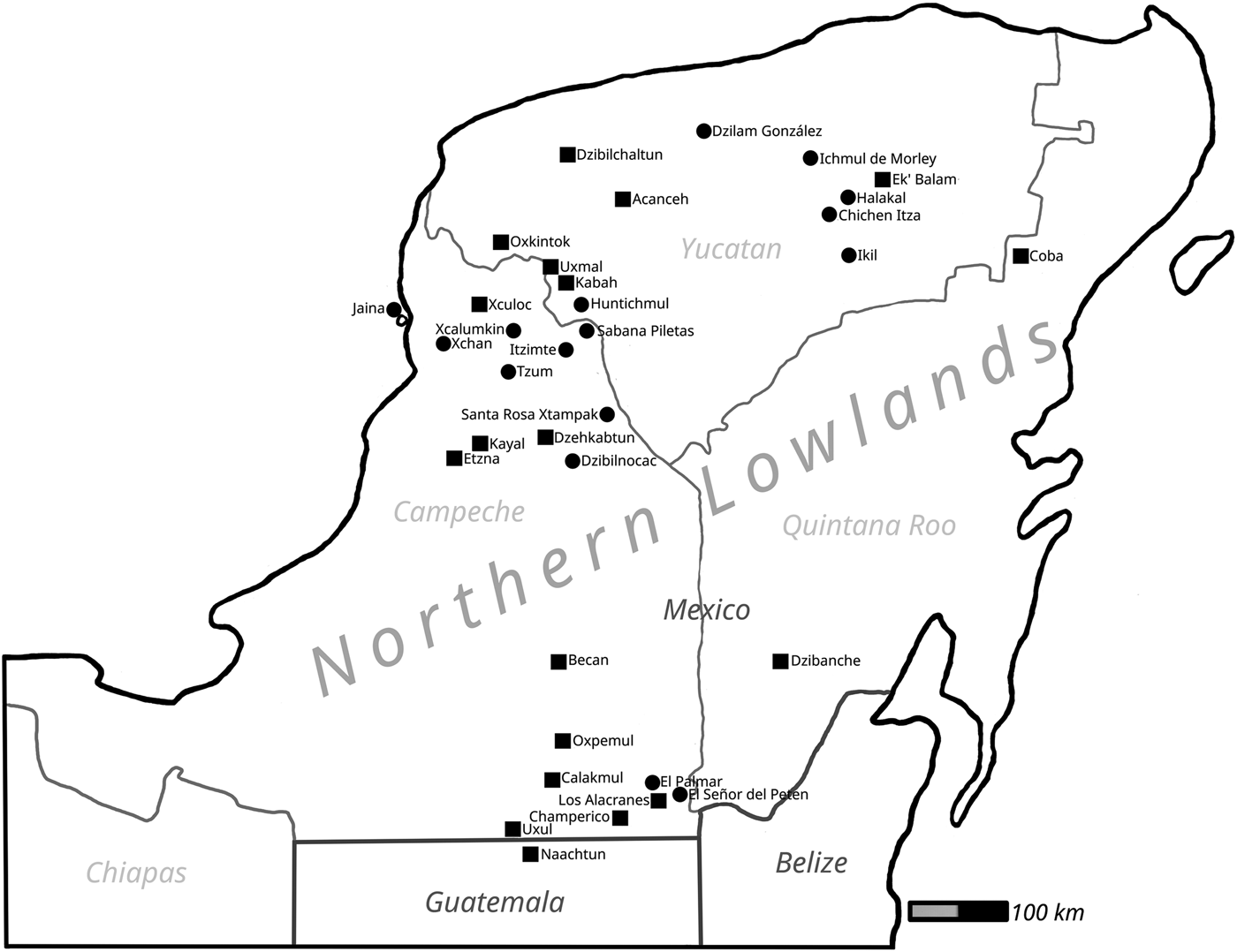
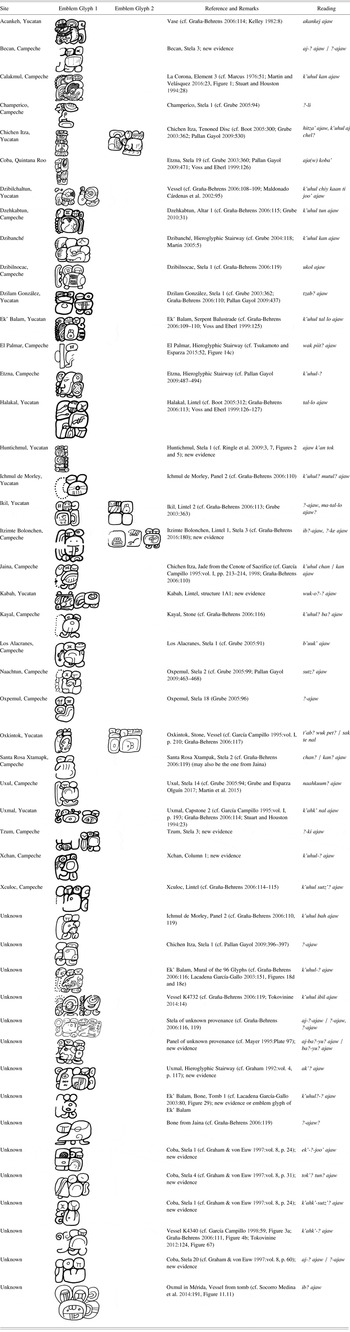
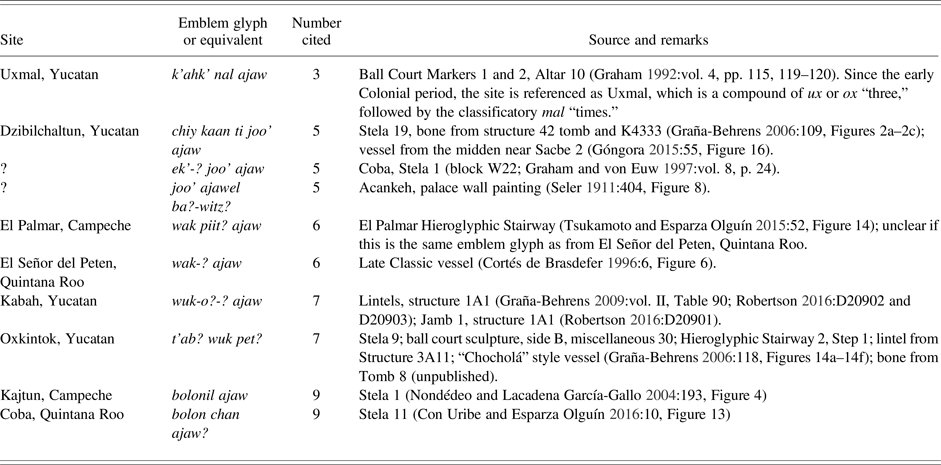
In Maya inscriptions, an emblem glyph is regularly part of the nominal phrase of an individual and references a polity or dynasty. In the central and southern lowlands, emblems most commonly follow the personal name of the individual or king and can be complemented by references like bakab or kalomte, two not very well understood titles worn usually by kings (see below). An emblem glyph joins or clusters usually three parts: an “emblem” referring either to a toponym, a mythical name, or something else; the ajaw (“ruler, king,” by extension also “nobleman”) expression; and the k'uhul prefix. The latter is occasionally missing for still unknown or poorly understood reasons. Due to their standardized syntax, full and partial emblem glyphs are relatively easy to distinguish in the inscriptions of the central and southern lowlands. In the case of the northern lowlands, however, this is often difficult. First, there are fewer well-preserved inscriptions that allow isolating nominal phrases of individuals. Second, those inscriptions are more difficult to understand because of calligraphy and syntax. And third, there are fewer full emblem glyphs. Instead, some individuals carry a title of the type partial form. Hence, compared to the central and southern lowlands, with up to 80 emblem glyphs, only approximately 20 had been detected and analyzed in the north as recently as 10 years ago (Graña-Behrens Reference Graña-Behrens2006). Despite these limitations, additional northern emblem glyphs can be recognized by taking into account those that appear on inscriptions of unknown provenance that can be related calligraphically and/or stylistically to the northern lowlands. From these findings, a more complex picture arises for the northern lowlands (Figure 1 and Table 1).
The northern lowlands, with major archaeological sites with presumed emblem glyphs. Map by the author.

Emblem glyphs in the northern Maya lowlands.

Sites with a firmly recognized emblem glyph are marked on Figure 1 with a triangle, while those with a tentatively identified emblem glyph are indicated by a dot. The emblem glyph of Calakmul, Etzna, or Ek’ Balam are essentially indisputable, while others, such as those of Itzimte-Bolonchen, Ichmul de Morley, and Jaina, are less secure. For the almost 50 emblem glyphs identified here that presumably refer to a northern lowland site, roughly half do not record or do not show in the existing examples a k'uhul prefix and are thus of the partial form type. Among them are such important sites like Uxmal, Oxkintok, or Kabah. This is important because full emblem glyphs (according to the conventions of the southern and central lowlands) would be expected for these sites. It should be noted, however, that roughly half of the more than 100 Late Classic emblem glyphs in the central and southern Maya lowlands are not attested in their full form. What does this say about political organization and hierarchy between both hemispheres? Why does the k'uhul prefix seem less significant at important sites in the northern lowlands?
Besides these observations, special attention is warranted for the Chan or Kan emblem glyph, assigned to the site of the island of Jaina. Additionally, I analyze a presumed partial emblem glyph with T709 as its main sign that appears in several contexts within the northern, central, and southern lowlands. Finally, in the northern lowlands several emblem glyphs make reference to a number, presented here for the first time, which may have implications for understanding the organization of these sites or historical conceptions that perdured over time.
The Chan or Kan Emblem Glyph
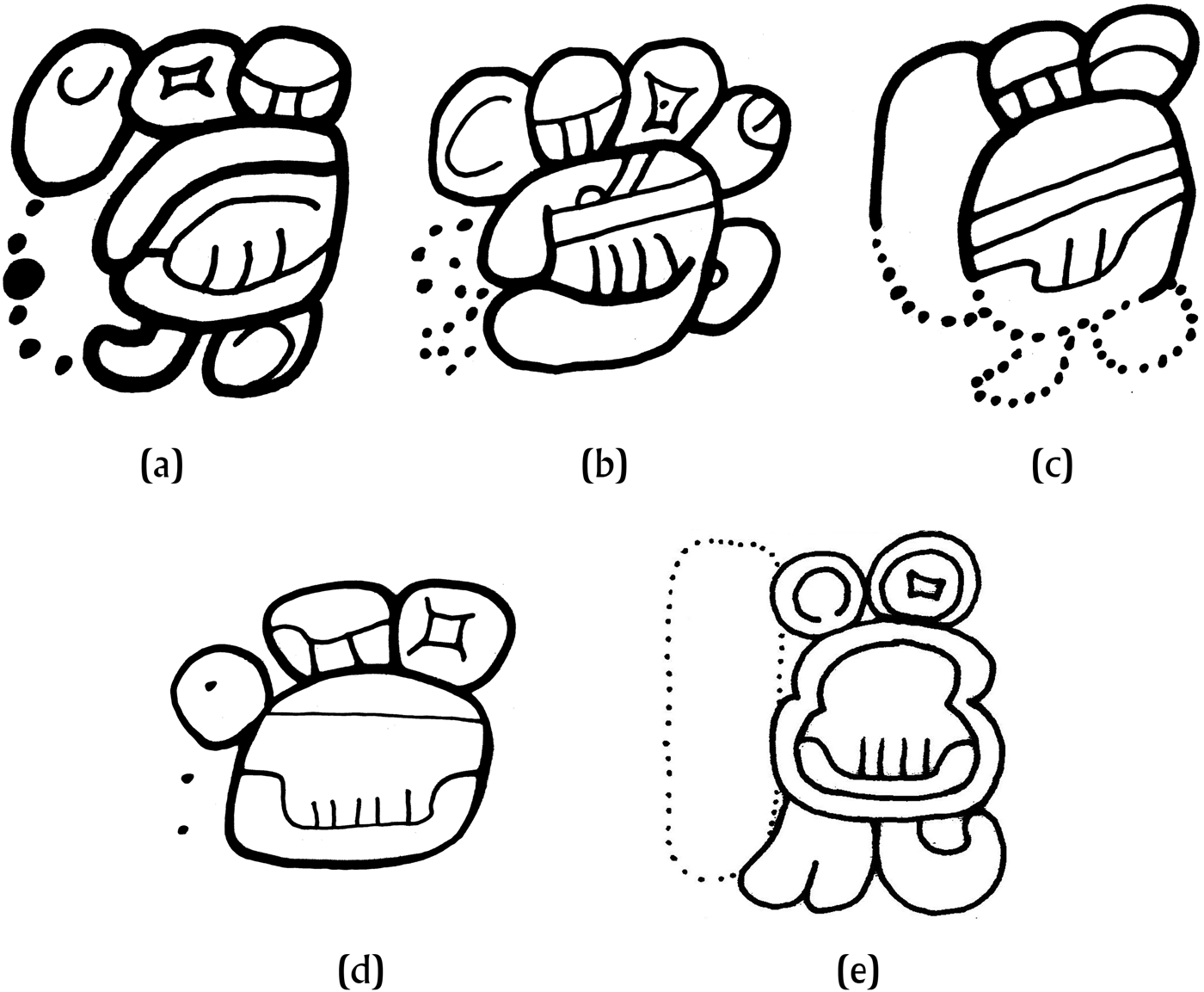
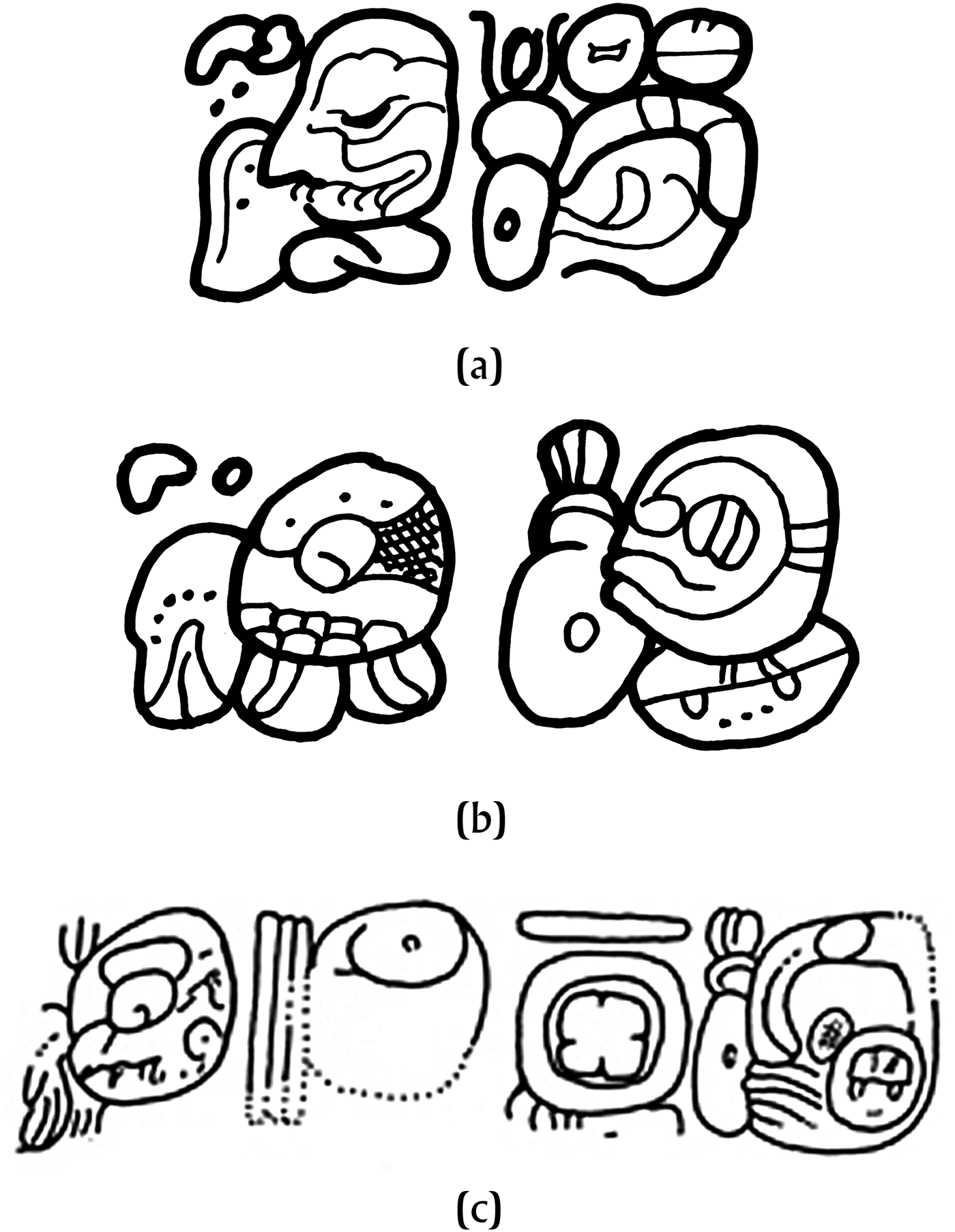
The emblem glyph with chan or kan as its main sign has long been recognized and associated with the archaeological site on the island of Jaina in the Gulf of Mexico (Figures 2a–2e; García Campillo Reference García Campillo1995:vol. I, pp. 213–214, Reference García Campillo1998). As remarked elsewhere, however, the appearance of this emblem glyph at sites like Santa Rosa Xtampak, Xcalumkin, and Sabana Piletas (Campeche), as well as on monuments of unknown provenance and on several jades recovered from the Cenote of Sacrifice of Chichen Itza, make the suggested affiliation with Jaina problematic (Graña-Behrens Reference Graña-Behrens2006:110; Grube and Pallan Reference Grube, Pallan and Merk2011). Only recently has the Chan or Kan emblem glyph been recognized on a stone fragment directly from Jaina (based on an unpublished drawing from Nikolai Grube). Taking these observations together, it remains hazardous to associate this emblem glyph firmly with any of the aforementioned sites, though the new fragment further underscores the likely affiliation with Jaina. There is a strikingly similar case from the central lowlands, where the Pa’ Chan emblem glyph, although usually associated with Yaxchilan (Chiapas), appears during the Classic period in inscriptions at Uaxactun, El Zotz’, and Naranjo (all Peten) without a direct political relationship attested either in the form of a visit of a Yaxchilan king to one of these sites, the capture of a king, or a war between these sites (Helmke Reference Helmke2012:100–107). Hence, only further evidence may help to clarify the significance of appearance of the same Chan or Kan emblem glyph at sites on the mainland not far away from Jaina (see also Reconstructing the Chan or Kan Dynasty, below). Last but not least, it should be mentioned that, in the southern lowlands, the emblem glyph of Chincultic (Chiapas) also expresses chan, although at the moment it seems unlikely that this supposes the existence of a political network between the aforementioned sites.
(a) Chichen Itza, jade from the Cenote of Sacrifice. Drawing by the author after Proskouriakoff Reference Proskouriakoff1974:118, Figures 49b, 12, 15–16. (b) Jade pendant, probably from Uaymil. Drawing by the author after Proskouriakoff Reference Proskouriakoff1974:207, Figure 13. (c) Chichen Itza, jade from the Cenote of Sacrifice. Drawing by the author after Proskouriakoff Reference Proskouriakoff1974:206, Figure 14. (d) Jadeite amulet, probably from Jaina. Drawing by the author after Spinden Reference Spinden1975:144, Figure 196. (e) Pillar or wall panel of unknown provenance hosted in the Museum of Hecelchakan, Campeche. Drawing by the author.

The T709 Title or Emblem Glyph
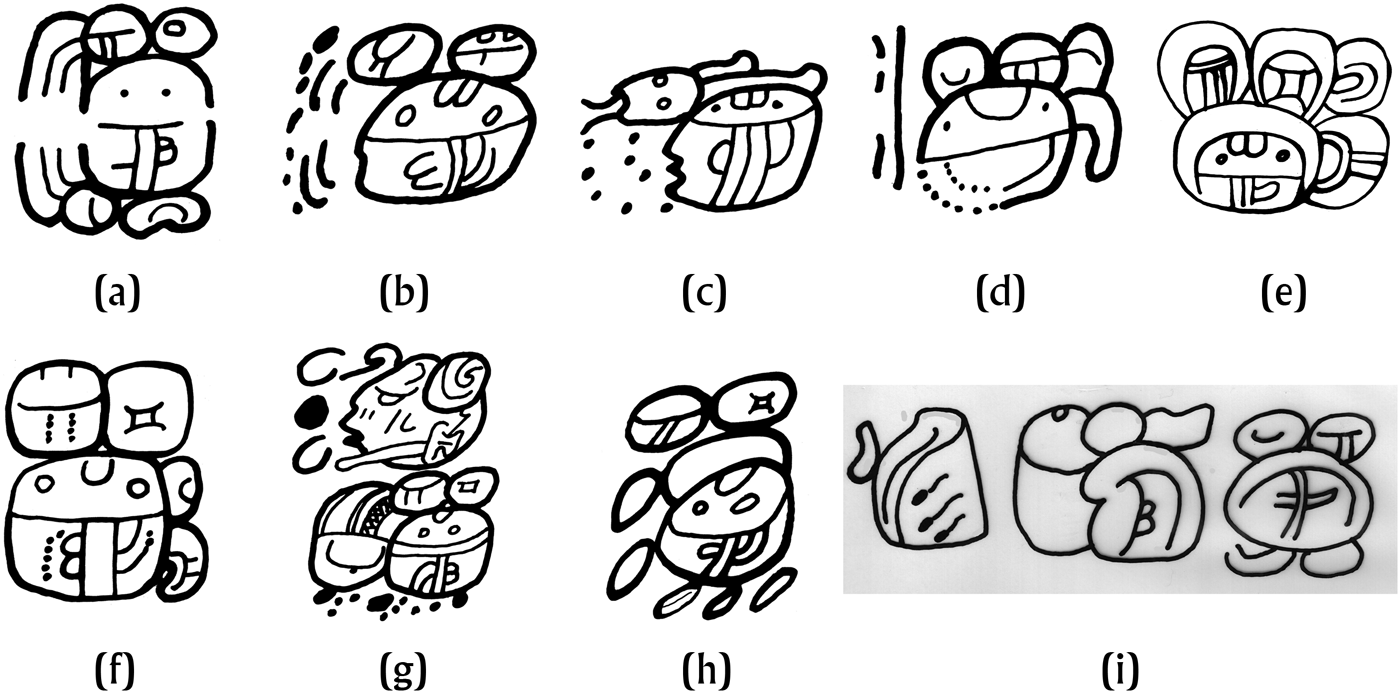
There are several inscriptions from the northern lowlands that may refer to a partial emblem glyph. The main sign is T709, a possible logogram whose decipherment is still debated, joined by T168 /ajaw/. The k'uhul prefix is lacking in all instances except one. Occasionally T679 /i/ is prefixed to this title. Because of this, the reading ib (“bean”) has been tentatively suggested for T709 (Tokovinine Reference Tokovinine2014). One example with i-prefix follows the name phrase of an individual that is presumed to be a ruler of Itzimte-Bolonchen, as a text documented on a stone lintel from that site reports (Graña-Behrens Reference Graña-Behrens and Merk2016:177–178; Figure 3a). Another examples with an i-prefix appears after the expression juun ixiim, the name of the Maize God, on a plate from Calakmul (Figure 3b). Furthermore, a similar title, but with the nal (“place”) attribute instead of ajaw, is written on an earflare found in the tomb of Yuknoom Yich'aak K'ahk’, ruler of Calakmul (Figure 3c; Tokovinine Reference Tokovinine2014:11, 14). Without the i-prefix, the compound T168:709 can be found on one of the jades recovered from the Cenote of Sacrifice at Chichen Itza (Proskouriakoff Reference Proskouriakoff1974:108, number d, 206, Figure 12, number 17). It is associated with an individual known from other inscriptions whose name suggests that he is the same person carrying the Chan or Kan emblem glyph (Figure 3d). Finally, a vessel from a location now named as Oxmuul, within the greater Mérida (Yucatan) metropolitan area and excavated from a funeral context containing several individuals under a house platform, refers to a nobleman who is most probably not a king, but carries the T709 ajaw title, as well (Figure 3e; Socorro et al. Reference Socorro Medina, José Gómez Cobá, Pantoja Díaz and Stanton2014:191, Figure 11.11).
(a) T709-title on Lintel 1 from Itzimte Bolonchen (Graña-Behrens Reference Graña-Behrens and Merk2016:177, Figure 123). (b) T709-title on a vessel from Calakmul. Drawing by the author after Tokovinine Reference Tokovinine2014:11, Figure 3. (c) T709-title on an earflare from the tomb of the ruler Yuknoom Yich'aak K'ahk’ of Calakmul. Drawing by the author after Tokovinine Reference Tokovinine2014:14, Figure 7a. (d) T709-title on a jade recovered from the Cenote of Sacrifice of Chichen Itza. Drawing by the author, taken from Proskouriakoff Reference Proskouriakoff1974:108, number d, 206, Figure 12, number 17. (e) T709-title on a vessel from a tomb located within the city of Merida. Drawing by the author after a photo from Socorro Medina et al. Reference Socorro Medina, José Gómez Cobá, Pantoja Díaz and Stanton2014:191, Figure 11.11. (f) Sculpture title on Yaxchilan Stela 1. Drawing by the author after Tokovinine Reference Tokovinine2014:Figure 8a. (g) T709-title on a vessel of unknown provenance (K791). Drawing by the author, taken from Tokovinine Reference Tokovinine2014:11, Figure 4a. (h) T709-title from a wall painting from Bonampak in Chiapas. Drawing by the author in Graña-Behrens Reference Graña-Behrens and Merk2016:181, Figure 129. (i) T709-title from a wall painting from Jolja cave in Chiapas. Drawing by the author.

In the southern lowlands, the title appears without the i-prefix as part of a nominal phrase on Yaxchilan Stela 1 (Figure 3f). Complemented by the prefix k'uhul, the same title is part of a creature, the so-called way (spirit companion), on a vessel of unknown provenance (Figure 3g; K791, Kerr Reference Kerr2017.). A very similar title, modified by an additional prefix instead of i, can be found on one of the murals from Bonampak (Chiapas) referring to one of the painted individuals (Figure 3h). At Jolja cave (Chiapas), there is a painted variant with the word lakam (“banner”) preceding T709 and followed by the nal (“place”) expression and ajaw (Figure 3i).
Several questions emerge from these observations but cannot yet be answered. If the title represents an emblem glyph, why does it appear at different sites in the northern, central, and southern lowlands, and why with people of different rank or function, such as an artist, nobleman, and a ruler? Since the title with the i-prefix follows the name of a local ruler, shall we consider it the local emblem glyph from Itzimte-Bolonchen? What would this mean in terms of political relationships to other sites where this i-type emblem glyph also appears (e.g., Chichen Itza)? Further, suppose the i-prefix represents just the initial sound (e.g., appears only facultative and not obligatory), what would this mean politically, since the T709:168 title without i-prefix also appears on the newly excavated vessel from the Mérida urban zone, as well as at Yaxchilan or even Bonampak in the southern lowlands? Moreover, why do supernaturals (way) or deities (jun ixiim) carry this title but not comparable emblem glyphs? If the title is not an emblem glyph, why was it structured as such by clustering the signs in this form, and why does it appear precisely in a syntactical position where an emblem glyph can be expected?
Numbered Emblem Glyphs
There are several emblem glyphs, or emblem glyph equivalent references, in the inscriptions of the northern lowlands that include a numeral expressed most commonly by the bar and dot system or sometimes by the corresponding word, which are completely compiled here for the first time (Table 2, cf. Table 1 for drawings). In comparison, there are fewer instances from the central or southern lowlands that show this particularity. These are the emblem glyphs from Ixtutz with the numeral five, as well as the so-called aberrant forms from Caracol and Río Azul with the numeral three. Besides such emblem glyphs, there are toponyms that refer to a number, such as Wak Kab Nal to six or Joo’ Noh Witz to five (cf. Tokovinine Reference Tokovinine2014:45, 60, Figures 26g and 35h). Thus, the question is not only why there are more examples from the northern lowlands, but also if the numeral reference may have a further political or hierarchical meaning in terms of internal or external organization of a polity in the north. For instance, the well-known emblem glyph of Dzibilchaltun consists of several parts: Chiy Chan Ti Joo’ (“raised in the sky [at] five [place]”; Figures 4a–4b; Maldonado et al. Reference Cárdenas, Rubén, Góngora Sales, Tiesler, Cobos and Robertson2002:10). Of interest here is the second part, Ti Joo’ or Ti Ho’: Tihó is reported by indigenous Maya in the early sixteenth century as the ancient name of the place where Mérida was founded by the Spaniards. In an inscription recorded on a vessel excavated from a midden near the northern access to Sacbe 2 at Dzibilchaltun, the first part ajaw chiy kaan is separated from Ti Joo’ (blocks F, G, and J) by a distance number and a k'in day-count period (blocks H and I; Figure 4c; Góngora Reference Góngora2015:55, Figure 16). This raises the question why presumably constitutive parts of an emblem glyph were separated — Ti Joo’ could possibly have been a larger political-administrative unity to which Chiy Kaan (i.e., the site of Dzibilchaltun proper) pertained politically or through dynastic relations. This would help explain why in early Colonial times the indigenous Maya referred to an archaeological site now underlying central Mérida as Tihó instead of to Dzibilchaltun, a site some 20 kilometers away that continued to be inhabited and where the Spaniards erected an open chapel to indoctrinate the local people.
(a–b) Emblem glyph of Dzibilchaltun. Drawing by the author after Maldonado Cárdenas et al. Reference Cárdenas, Rubén, Góngora Sales, Tiesler, Cobos and Robertson2002:10. (c) Emblem glyph of Dzibilchaltun on a new vessel, from Góngora Reference Góngora2015:55, Figure 16.

Emblem glyphs in the northern Maya lowlands with reference to a numeral.

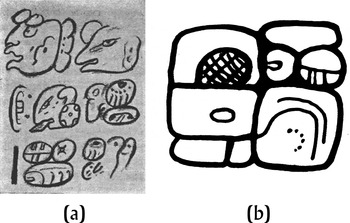
A related case is Akankej, an archaeological site in a modern community southeast of Merida, that preserves its original name as indicated in its Classic period inscriptions (Grube Reference Grube and Prem2003:359; Kelley Reference Kelley1982:8). A wall painting first documented by Seler (Reference Seler1911:404, Figure 8) not only references the toponym Akankej, but mentions in sequence someone who carries the title joo’ ajawal (“five rulership”), an observation that already led to the suggestion that Akankej may have been part of the larger political-administrative unit called Ti Joo' (Figure 5a; Góngora Reference Góngora2015:90). Another emblem glyph referencing the number five appears on Coba Stela 1 referencing an individual other than the protagonist (a ruler of Coba) and can be read as Ek’-? Joo’ (“black ? five;” block W22; Figure 5b). Here, again, and analogous to what has been outlined for Dzibilchaltun and Akankej, the question is if Ek’ is another unknown site within the larger unit Ti’ Joo’.
(a) Wall painting from Acanceh (from Seler Reference Seler1911:404, Abbildung 8). (b) Coba Stela 1, block W22. Drawing by the author after own photographs and Graham Reference Graham and von Euw1997:vol. 8, p. 24.

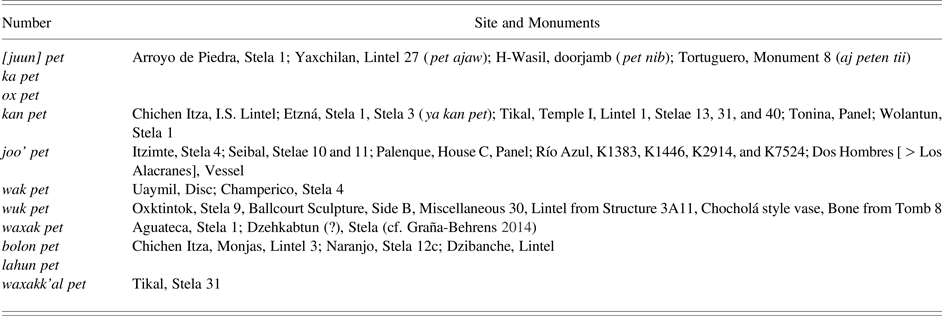
There are two sites, Kabah and Oxkintok, which reference the number seven. In both cases, however, the compound following the number is different (Figures 6a and 6b). In Oxkintok, there is no full-form emblem glyph, as the ajaw title is always missing. Instead, the compound consists of the number seven attached either to a human head or a sign resembling T511, with a suggested reading of wuk pet (“seven circle/[province?]”; García Campillo Reference García Campillo1995:vol. I, p. 210). In some instances, an unusual smaller sign plus T501 /ba/ is prefixed and suggests a reading of ?-ba wuk pet. The unusual sign shows some resemblance to an equally small sign on Lintel 1 from Ikil (Yucatan), where it is attached to T501 /ba/. In the last case, the compound works as a verb with a suggested reading as t'ab (“to ascend”; Gronemeyer Reference Gronemeyer2016; Stuart Reference Stuart and Houston1998:409–417). Thus, in the case of Oxkintok, the compound functioning syntactically as an emblem glyph might be deciphered and read as T'ab(?) Wuk Pet(?) (perhaps something akin to “ascending? seven [circles/province?]”). Neither the expression t'ab nor pet can be satisfactorily translated so far. T'ab means “to ascend” in Ch'olan languages (Kaufman and Norman Reference Kaufman, Norman, Justeson and Campbell1984:133) and “bald” in Yucatec Maya (Barrera Vásquez Reference Barrera Vásquez1991:830), among others. Pet in Yucatec Maya is “circle,” but as a classifier for fields and gardens (Barrera Vásquez Reference Barrera Vásquez1991:647–648). More recently, it has also been proposed as “province” (Tokovinine Reference Tokovinine2008:266). It is also noteworthy that the supposed pet sign occurs in additional titles from all over the Maya lowlands that combine this word with a number, although not with seven (Table 3). As can be seen in Table 3, the widely used pet-title is associated with noblemen and kings and sometimes combined with ajaw, kab (“earth”), winik (“man”), or chab (of unknown significance) and is often joined with one of the numbers from one to 10 (juun to lahun). The title possibly refers to “province” or “partition” (Tokovinine Reference Tokovinine2008:37, 119, 251, 266, Reference Tokovinine2013:18). The number seven seems to be reserved for Oxkintok. Pet is never combined with the numbers two, three, and 10. In the case of Oxkintok, it is notable that the tab(?) wuk pet(?) title is sometimes paired with a second unique reference that most probably functions as a place name: Sak Te Nal (“white tree place;” cf. Figure 6; García Campillo Reference García Campillo1995:vol. I, pp. 198–199). Taking into account the former observations concerning Dzibilchaltun and Akankej, this now suggests that Tab(?) Wuk Pet(?) may refer as well to a larger political-administrative unit, while Sak Te Nal specifically references the site of Oxkintok. In the case of Kabah, the signs following the number seven cannot be read yet. Again, however, the whole expression may reference a wider political sphere to which the site of Kabah belonged and whose particular pre-Hispanic name is still unrecognized from the inscriptions. The site name Kabah, which appears in native documents as early as during the Colonial period, may itself be a combination of the Maya word ka for two and ba or bah, with an unknown grammatical and lexical meaning.
(a) Possible emblem glyph of Kabah from lintels of structure 1A1 (“Manos Rojas”). (b) Emblem glyph of Oxkintok, t'ab? wuk pet?, and toponym sak te nal. Drawings by the author.

Evidences of the pet-title throughout the Maya lowlands.

I.S. = Initial Series
The idea that northern lowland sites with a numbered emblem glyph refer to larger political units could help explain why Uxmal, a site that referred to itself by an emblem glyph with a main sign read k'ahk’ nal (“fire place”) in the Late and Terminal Classic periods (a.d. 600–1000), was instead called Uxmal in early sixteenth century indigenous Maya documents. It suggests that, in pre-Hispanic times, Uxmal may have formed part of or have had leadership in a larger political unit called Ux Mal (“three times” or “thrice built”), while the particular reference for the site itself was K'ahk’ Nal. Moreover, Uxmal was joined to two other large sites, Nohpat and Kabah, by sacbeoo'b (stone roadways), though other smaller sites occur along the roads as well (Dunning Reference Dunning1992).
A stela from the site of Kajtun near Río Bec (Campeche) includes an emblem glyph with the numeral nine (Nondedeo and Lacadena García-Gallo Reference Philipp and Lacadena García-Gallo2009:193). Although the full reading is still debated, there is no doubt that this is an emblem glyph, albeit without the k'uhul prefix. Another title with the numeral nine, most probably also an emblem glyph, appears on a newly discovered fragment from Stela 11 of Coba. Here, a kneeling prisoner at the feet of the local ruler wears the title bolon chan ajaw (“nine sky lord,” blocks I3 and I4; Con Uribe and Esparza Olguín Reference Con Uribe and Quetzalcoatl Esparza Olguín2016:10, Figure 13). Although the authors who analyzed the fragment are not convinced that block I4 represents the head variant of T1000 /ajaw/ because of its net-like headdress, it can be shown that T1000 may indeed be just one of many different writing forms of the word ajaw in the northern lowlands.
Finally, it should be mentioned that even the sites of Calakmul and Oxpemul in the southernmost part of the northern lowlands share a number-based expression (cf. Table 1). The expression ox te tun or uxte' tun (“three stones”) is sometimes found on the monuments of both sites and may refer, although still speculatively, to the surrounding or larger geographical area (Martin and Velásquez García Reference Martin and Velásquez García2016:25; Tokovinine Reference Tokovinine2013:60).
It has been proposed for the northern lowlands that there are titles like an emblem glyph that refer to a number and which most probably conceptualize a form of political organization beyond what is usually understood as a kingdom. The number may represent either an internal or external counting system or might simply conceptually highlight a form of a larger political entity. At the same time, these numbered emblem glyphs sometimes appear combined with expressions that allude to the proper site or kingdom, e.g., what usually is expressed elsewhere by an emblem glyph in its narrow sense. Thus, as can be deduced from chiy chan ti joo' ajaw, the expression Ti Joo’, “five” may embark an area between today Mérida and Dzibilchaltun, while the aforementioned archaeological site may have been properly called Chiy Chan in pre-Hispanic times. Analogously, the larger area of Oxkintok and Kabah was marked by the number seven and combined, albeit differently, with some other signs. Sak Te Nal was the reference for the kingdom of Oxkintok, while the one for Kabah is still elusive. In the case of Uxmal, these findings make it possible to deduce that the proper emblem glyph K’ahk’ Nal Ajaw refers only to the kingdom or site today known as Uxmal, while the current appellation of Uxmal, “three times” could be interpreted as a relict that still highlights a formerly larger political conception. At the same time, these observations make it clear that there is no consistent pattern for emblem glyphs with or without numbers in the northern lowlands. In the case of Dzibilchaltun, the phrase ti joo ajaw is structured like an emblem glyph (though without the k'uhul prefix). It is now suggested that this is, instead, a title for a somehow larger political designation. The name of the site of Dzibilchaltun itself, Chiy Chan, however, never adds the title ajaw and thus does not have the standard structure of an emblem glyph. In the case of Uxmal, the opposite seems to be the case. While the proper name of the site, K'ahk’ Nal Ajaw, indeed is patterned as an emblem glyph, albeit without k'uhul, the supposed Colonial name for the larger area, Uxmal, is not. In the case of Oxkintok, there is even a third form, suggesting that neither the larger area nor the name of the site or polity resembles an emblem glyph, as in no case is the word ajaw expressed.
Nonetheless, it remains unclear how emblem glyphs in the most northern lowlands may have operated and how many larger or smaller sites may have been involved in each case. Only one thing seems to be clear from the viewpoint of the known inscriptions from the north: none of the aforementioned sites seems to have adopted one of the other titles with numbers. This, at least, seems to signal that the number system may be more of archaic origin then the result of political influences or changes. Thus, it is still hard to decide whether the number system of emblem glyphs has a wider implication for the political organization or not. This makes it even harder to explore further the concept of heterarchy in complex societies (cf. Crumley Reference Crumley1995) in the northern lowlands, at least during the Late and Terminal Classic periods.
If we interpret the combined expressions with a number, not as a fossilized or archaic title, we can postulate broader political or lineage-based entities in operation during the Late or Terminal Classic, instead of competing single centers (Dzibilchaltun, Oxkintok, and Uxmal). No single site may have been dominating others within a political entity like Ti Joo’, Wuk Pet, or Uxmal. More speculatively, they could have been loosely knit or shifting seats of power. Whereas the latter seems less likely, as no direct evidences can be gleaned from the inscriptions of the north, the former possibility could explain why, in the western part of the northern lowlands, the Chan or Kan emblem glyph appears simultaneous at different sites like Jaina, Santa Rosa Xtampak, or Xcalumkin, among others and why emblem glyphs in general are of less importance in the monumental records of the north compared to the central and southern lowlands. This matches other archaeological and iconographic evidence like the interaction network that even smaller sites like Santa Barbara in northern Yucatan maintained with other regions (western Yucatan, northern Campeche; Stanton et al. Reference Stanton, Carrillo Sánchez, Ceballos Gallareta, Eberl, Jiménez Alvarez and Ramos Pacheco2003:31).
PERSONAL NAMES AND TITLES
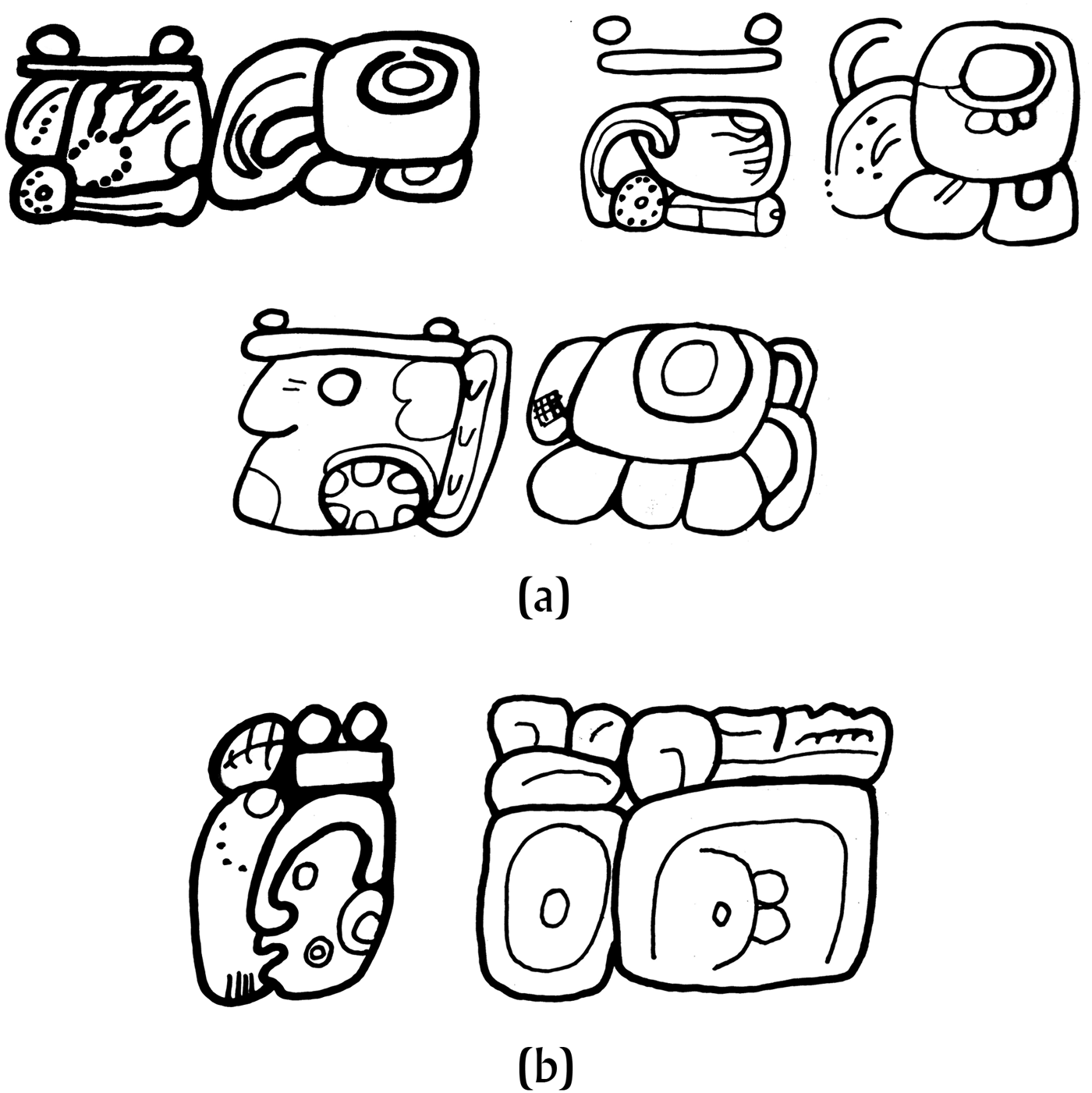
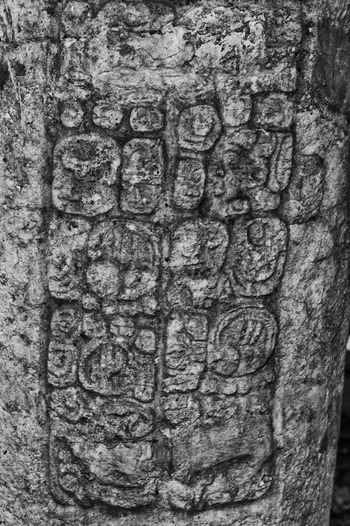
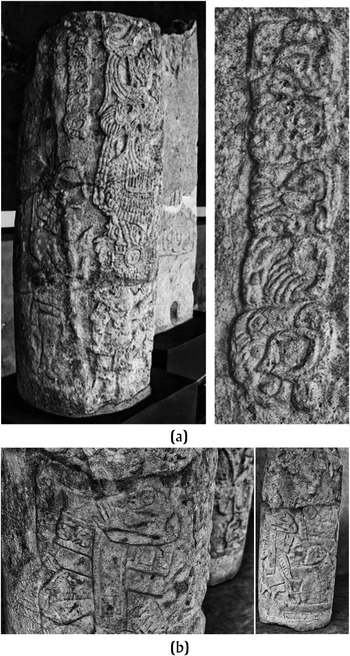
The inscriptions of the northern lowlands occasionally exhibit a different syntax concerning the position of titles and proper names. In the central and southern lowlands, titles like an emblem glyph, bakab (most commonly translated as “first of earth”), kalomte (still of debated meaning) in the case of kings, aj k'ujuun (“book keeper?”), sajal (a secondary king or administrator), or aj tz'ib (“scribe”) in the case of nobleman or lesser noteworthy person, among other priesthood titles, always follow personal names. In contrast, in northern inscriptions some titles are placed before the name of an individual. Among these titles are kalomte, aj k'ujuun, and sajal, a practice which is in accordance with similarly alternated position of other titles like ajaw in Colonial indigenous Maya manuscripts (Lacadena García-Gallo Reference Lacadena García-Gallo, Colas, Delvendahl, Kuhnert and Schubart2000). Moreover, the same practice of placing the ajaw title before the personal name can now be documented for the Classic period, too. For example, a column from Cansacbe (Campeche) records a short text that names an individual or ruler who is depicted on the monument and who might be the same person associated elsewhere with the Chan or Kan emblem glyph (Figure 7a, blocks A1–A4). Instead of naming the individual first after the usual statement u bah (“the image of”), however, the columnar inscription begins with the title ajaw (“ruler, nobleman”) followed by what appears to be his proper name (Figure 7a, blocks A1 and A2). Similarly, the loincloth of an individual depicted on a monument from Oxkintok records first ajaw instead of his name, while a second inscription in front of the individual's face reports the title kalomte directly after the u bah statement (Figure 7b). A third case is the aforementioned vessel from Dzibilchaltun that shows the split emblem glyph Chiy Kan and Ti Joo’ (cf. Figure 5a). Although part of the inscription is lost, there is no doubt that the personal name of the ruler precedes the title ajaw, while the main part of the emblem glyph follows it. Thus, in this case, the ajaw title is not preceding the name of the ruler, but the main part of the emblem glyph when usually it should follow. A similar and final example comes from Etzna, where a prisoner is shown on Stela 18 and accompanied by the phrase aja(w) koba’, whereas others suggest a reading aj koba’, “he of Coba” (Grube Reference Grube and Prem2003:360; Pallan Gayol Reference Pallan Gayol2009:88). In the light of what had been said earlier, however, it is not unlikely that the individual was more than a nobleman of Coba, a site comparable to Etzna roughly at the opposite side of the peninsula, and instead a local king, as attested to by the emblem glyph (cf. Table 1, see Coba). As Stela 18 of Etzna was dedicated at a.d. 672 or 9.12.0.0.0 in the Maya Long Count, it is not unlikely that the observed throne change registered on Coba Stela 1 some 10 years later might have to do with the Etzna event (cf. Stuart Reference Stuart2010:2).
(a) Cansacbe, Column 1 and (b) Oxkintok Miscellaneous 30. Photographs by the author.

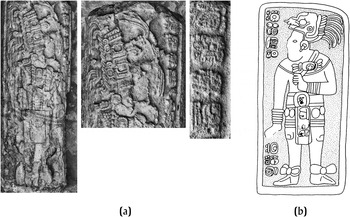
In the case of the northern lowlands, the different sequence, ajaw first and next the main element of the emblem glyph and not vice versa, has an important implication: we can also look for emblem glyphs in phrases initiated by the title ajaw. A case in point is Stela 1 from Huntichmul, Yucatan (Figure 8a; Ringle et al. Reference Ringle, Bay, Gallareta and Kelly2009). The inscription begins with the statement u bah (“his image”) followed by the personal name and u k'aba’ (“the name of”), a reference usually marking the end of the personal name (blocks A2–A4). The inscription continues, however, with ajaw k'an tok (blocks A5 and A6) and a partially destroyed sequence of further hieroglyphs, most probably additional titles (blocks A7–A9). As the name phrase ends with u k'aba', the following glyphs, ajaw k'an tok, may, thus, represent the emblem glyph of Huntichmul. On Jamb 2 from structure 1A1 of Kabah (Yucatan), however, the inscription also starts with u bah (“the image of”) followed by the personal name Ajaw K'awiil, and closes with u k'aba (“the name of,” blocks A1–A4; Figure 8b). In this case, however, no emblem glyph, but the titles kalomte and ajaw follow (blocks A5 and A6). This variation suggests that no strict rule exists for what follows after the personal name in northern inscriptions. Furthermore, the Kabah example clearly shows how the initial ajaw statement is part of the individual's personal name, whereas the Cansacbe inscription indicates that it functions more like a proper title.
(a) Huntichmul, Stela 1, from Ringle et al. Reference Ringle, Bay, Gallareta and Kelly2009:3, 7, Figure 2; drawing by William Ringle. (b) Kabah, Jamb 2, Structure 1A1 (“Manos Rojas”). Drawing by the author.

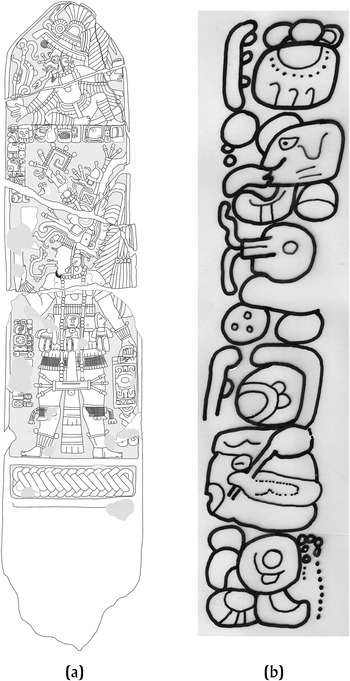
Despite the potential for confusion, such findings are nonetheless helpful for a reconsideration of well-known inscriptions from the northern lowlands like Altar 10 from Uxmal (Figure 9; Graham Reference Graham1992:vol. 4, p. 115). On the upper band after the u bah (“the image of”) introduction, is a reference to an individual named as E?-Witz Ajaw Ch'ok Wi?-tzi? Wak Eb Chaak (blocks C–I), and then a parental statement including his mother (blocks J–L) and most probably his father (blocks M–P). The double vertical column inscription on the same monument has a shorter reference. After the u bah (“the image of”) introductory phrase follows first the name of the local ruler of Uxmal, K'ahk’ Sip? Chan Chaak, and a poorly understood ajaw title, before it is said that he is yitah (“in the company”) of E?-Witz Ajaw and a second person whose name cannot be fully deciphered (Figure 9, blocks A1–B5). Of interest here is that the second e?-witz ajaw statement has been considered until now as a kind of shortened version of the individual's anthroponymy (cf. Colas Reference Colas2004, Microsoft Access database). In light of the above analysis, however, the first part of the vertical inscription can be seen as structured or clustered as an emblem glyph. The same seems to be true for the second person. Thus, it seems more likely that the two individuals mentioned on the double vertical column of Altar 10 of Uxmal are mentioned in association with their particular emblem glyph, rather than by their proper name. By extension, many ajaw titles that are similarly structured as emblem glyphs in inscriptions from Chichen Itza (e.g., the tenoned disc) and elsewhere should be re-analyzed and either confirmed as personal names or tentatively identified as emblem glyphs.
Uxmal, Altar 10. Photograph by the author.

Title Hierarchy
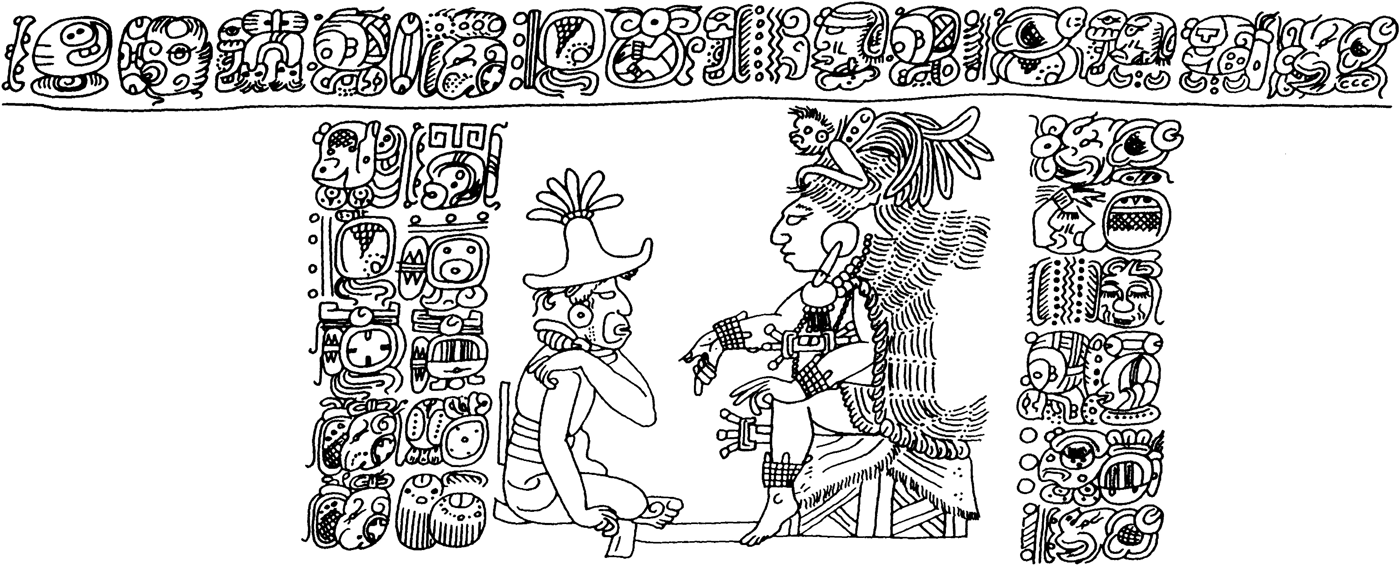
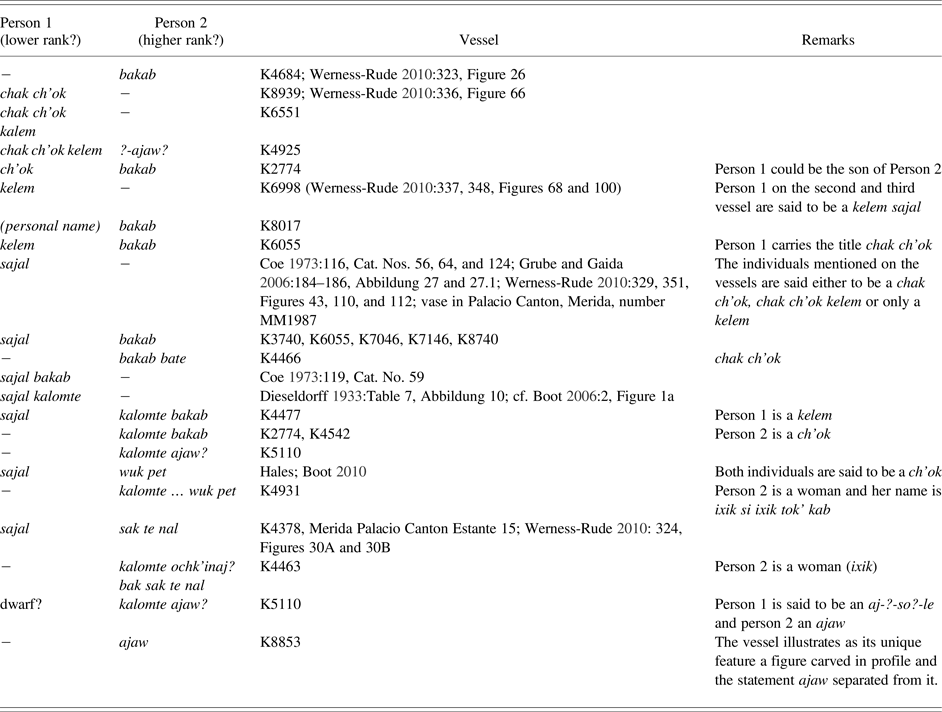
When looking at inscriptions on some vessels that appear to have their origin in the northern lowlands, most of them of the so-called Chocholá style, a possible hierarchical structure of titles can be deduced (Table 4). A few vessels illustrate a scene with more than one person. One of these vessels (K8017, Kerr Reference Kerr2017) may come from the Xcalumkin area (Figure 10). It shows a typical “palace-like” scene with one presumably higher-ranking person seated on a wooden stool, while the second individual is seated on the floor. The longer inscription refers to one or more owners of the vessel, to the artist, and to the illustrated persons. The seated individual, most probably the higher-ranking one, is called a bakab (after the initial statement u bah, “his image”), a still elusive title, while the second one to the left is called “they from booj” in plural, presumably a name for the region (left column, blocks B4 and B5; cf. Grube Reference Grube and Prem1994:x, Reference Grube and Prem2003:365). Thus, a certain kind of hierarchy is detectable from this vessel scene, in which the bakab is ranked higher than those individuals whose titles or names are not given, and in which the higher-ranking person is sitting from the viewer's perspective on the right and the lower ranking individual on the floor on the left side. The same pattern can be found on a vessel excavated in front of the Palace of the Governor in Uxmal, labeled Miscellaneous 78 (Graham and Von Euw Reference Graham and von Euw1992:vol. 4, p. 147) or K5110 in the Kerr Maya Vase Database (cf. Kerr Reference Kerr2017). Here, again, the same pattern can be detected. The presumably higher-ranking person is again sitting on a wooden stool, while the apparent lower-ranking one sits on the floor to the viewer's left. In this case, however, only one person is clearly marked by the initial reference u bah, “his image” (block D1). There seems to be no title following, only his personal name, which is not completely decipherable (blocks D2–F1). Therefore, it must remain open if the second individual is named in the remaining text on the left side of the scene (blocks A1–C2). In this case, it is more difficult to establish a hierarchy by means of a given title. From this observation we may conclude, again, similar to my discussions of emblem glyphs and title sequences above, that no clear pattern exists. Other Chocholá style and related vessels lack comparable court or palace scenes. Instead, we usually find an inscription on the rim of the vessel, the so-called Primary Standard Sequence (PSS), which refers to the kind of artistic elaboration of the text on the vessel (e.g., painted or incised), to the beverage it contained (e.g., maize brew), and to the owner of the vessel (cf. Grube Reference Grube and Kerr1990). While many of these inscriptions only refer to a single person, the owner of the vessel, by addressing him by common titles (e.g., sajal, ch'ok, see below), there are other vessels which may allude to two individuals in the PSS and thus allow us to deduce some hierarchical order. An example is vase K4378 (Kerr Reference Kerr2017; cf. Table 4). Its hieroglyphic text says that it was used for drinking maize brew (ul or “atole”) in relation to an individual who carries the title cholom sajal (Grube Reference Grube and Kerr1990:326). Individuals that carry the title sajal, a secondary title for administrator with an unclear meaning, are subordinate to individuals with the title bakab, kalomte bakab, or ajaw, as indicated by their position in palace scenes or the associated hieroglyphic texts. Moreover, sajal titles never include the adjective k'uhul in their title, except for Dzehkabtun Lintel 1 (blocks D and E; Grube Reference Grube2010:37, Figure 5). On vessel K4378, the inscription continues to indicate that it was the polish (yul) of a person from Sak Te Nal, a title that likely refers to the Oxkintok kingdom. Thus, I argue that the vessel mentions not one individual with two titles but two individuals: a lower-ranking sajal, who may be the user of the cup, and a second individual, who may have been the king or ajaw of Oxkintok and ultimately to whom the vessel was most likely dedicated.
Vessel of unknown provenance, allegedly from the Xcalumkin area. Drawing by the author.

Possible hierarchical structure of titles on vessels from the northern Maya lowlands.

These observations suggest that a political hierarchy with at least three tiers existed in the northern lowlands (or the area from which the vessels in Table 4 originate) during the Late and Terminal Classic: administrators (sajal), higher ranking noblemen (kalomte, kalomte bakab), and a king (ajaw) at the peak. The vases also suggest that higher-ranking individuals like bakab or ajaw are not more often mentioned than individuals of supposedly lower rank like a sajal. These findings go along with other recent analysis of Chocholá style ceramics that suggest that the titles are connected to political organization. Thus, for instance, a count of all Chocholá style vessels indicates that 54 percent mention secondary people like a sajal, while only a few vases give the title ajaw and the bakab title (Werness-Rude Reference Werness-Rude and Rubenstein2017:127–132). Additionally, it is interesting to note that, in some instances, the titles chak ch'ok or kelem, both related to youth, appear associated with an individual of supposedly lower rank. In these cases, however, as has been shown more specifically for the southern and central lowlands, youth may indicate less a specific rank as an important status in being or becoming an elite young male (Houston Reference Houston2009). From the vessels of northern provenance, nonetheless, a certain kind of submission can be gleaned. Thus, vessel K2774 (fifth row in Table 4) clearly indicates how son and father are distinguished and ranked by their respective title (e.g., ch'ok versus bakab), much as a sajal and an ajaw are by their title. In this sense, the youth titles compares to others like bakab or ajaw. They signal not only an age-status but also a hierarchy. This hierarchy may be necessary to differentiate people precisely within the nobility and the same family or lineage.
Archaeological research in the northern lowlands mirrors the epigraphic evidence. As has been shown by different scholars, settlement pattern and architectonical features like building types, internal paved causeways (sacbeo'ob), or monumental artworks clearly indicate a ranking system among sites (Dunning and Kowalski Reference Dunning and Kowalski1994; Michelet and Becquelin Reference Michelet, Becquelin, Ciudad Ruiz, Josefa Iglesias and Martínez2001). An example could be Hunto Chac, a large Puuc site with twin political centers joined by a sacbe and possible lineage barrios centered on smaller monumental clusters (Prem and Dunning Reference Prem and Dunning2004). At the same time, it has been suggested that sites were politically related to each other due to the presence of external causeways, as documented in the cases of Uxmal, Kabah, Nohpat or Coba, and Yaxuna, among others. Among these networks in the Terminal Classic (a.d. 800–1000), sites like Uxmal gained political or military sovereignty (Carmean et al. Reference Carmean, Dunning, Karl Kowalski, Demarest, Rice and Rice2004:443–445). The same can be said based on political statements or commercial activities for other sites, as well: examples include Dzilam Gonzalez and Ichmul de Morley farther north (cf. Covarrubias et al. Reference Covarrubias, Burgos Villanueva and Palomo Carrillo2013); as well as Jaina and Xcalumkin or Santa Rosa Xtampak on the western edge of the northern lowlands.
Questions still remain. Why are secondary people more often recorded on vessels from the northern lowlands than kings? Why are kings often referenced only by a title like ajaw or by the local emblem glyph and fewer mentioned by their personal name (e.g., Oxkintok)? Why do northern kings (ajaw) portray less often the bakab title compared to what is known from the south, while presumably other individuals do carry the title, as suggested here? What might be the relation between a possible lower ranking bakab compared to a king? Why do some secondary or administrative persons with the title sajal also use the title bakab? Are they responsible for offices that have been combined? How does such a three-tired hierarchy relate to kingdoms like Oxkintok or Uxmal, which where situated within the sphere of Chocholá style vases? Last but not least: do these findings somewhat resembles early Colonial period accounts where an administrator (ah cuch cab) of a town (cah) that is grouped together (cuchteel) was designated by a higher ranking official (batab), who himself was dependent from the highest ranking person (halach uinik) within a certain kind of non-bounded province dominated or disputed by one or more lineages (cuchcabalob; Okoshi Harada Reference Okoshi Harada1992, Reference Okoshi Harada2012)? How does this at least three-tired hierarchy differ from what is known from the hierarchy between a king (ajaw) and a secondary administrator (sajal), as amply reported from Yaxchilan or Piedras Negras? How far shall we expect to find similar offices reported from the royal courts on inscriptions and vases from the central and southern lowlands, as is the case for priests and other cargo holders in the northern lowlands (Saturno et al. Reference Saturno, Rossi, Stuart and Hurst2017; Zender Reference Zender2004)?
RECONSTRUCTING THE CHAN OR KAN DYNASTY
The dynastic sequence of rulers in the northern lowlands is still frustratingly poorly known. There have been only a few attempts to elaborate such genealogies or lists of kings. Among these are those for Coba (Con Uribe and Esparza Olguín Reference Con Uribe and Quetzalcoatl Esparza Olguín2016; Graña-Behrens Reference Graña-Behrens2012; Gronemeyer Reference Gronemeyer2004; Guenter Reference Guenter and Stanton2014; Stuart Reference Stuart2010), Etzna (Pallan Gayol Reference Pallan Gayol2009), Chichen Itza (Boot Reference Boot2005), Ek’ Balam (Lacadena García-Gallo Reference Lacadena García-Gallo2003), Itzimte-Bolonchen (Graña-Behrens Reference Graña-Behrens and Merk2016), Oxpemul, and Uxul (Grube Reference Grube2005, Reference Grube and Sprajc2008). Here, I attempt to reconstruct the rulers from the Chan or Kan site, moving beyond earlier attempts and trying to put them in a chronological order (García Campillo Reference García Campillo1995:vol. I, pp. 156–163, Reference García Campillo1998:Table 5).
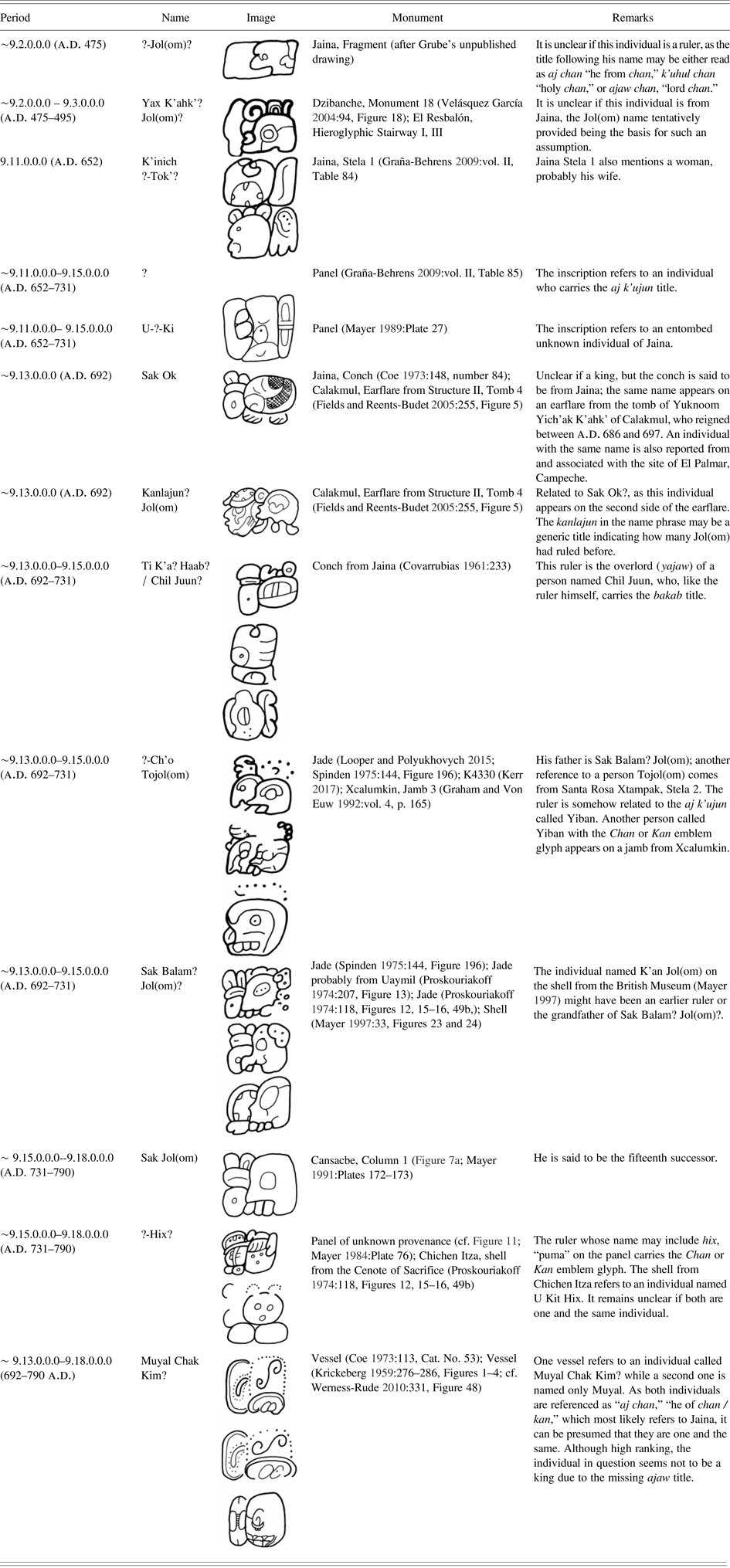
The earliest attested ruler from the Chan or Kan site can be found on a monument fragment that comes from Jaina (see Table 5). The local ruler's name shows a T1040 head form similar to the one that is read as Jol(om), and carries a shortened version of the Chan or Kan emblem glyph, but without the qualifiers k'uhul and ajaw. Tentatively, the ruler might have reigned around 9.2.0.0.0 (a.d. 475). Around the same time, a nobleman called Yax Kahk'? Jol(om)? was captured between a.d. 450 and 550 by the king of Dzibanche and mentioned on the hieroglyphic stairway on El Resbalon (both in Quintana Roo; Velásquez García Reference Velásquez García and Nalda2004:94). The jol(om) part of his name suggests that he may have come from the Chan or Kan kingdom. There is no direct evidence for another Chan or Kan ruler until 9.11.0.0.0 (a.d. 652) on Jaina Stela 1, which mentions a person called K'inich Jol(om) Tok’. There are also two panels said to be from Jaina that refer to high-ranking individuals around this time period, in one case to a aj k'uhuun (“bookkeeper”), and in the second case to an entombed person, most probably a ruler from Jaina. An earflare from Jaina refers to a person with the probable name of Sak Ok. Another individual with the same name is mentioned on another earflare which was found in the tomb of Yuknoom Yich'aak K'ahk’, ruler of Calakmul who, according to new evidence, reigned between a.d. 686 and 697 (Martin and Grube Reference Martin and Grube2000:110; Stuart et al. Reference Stuart, Canuto, Barrientos Q., Ponce and Baron2015:2–5). There is another person called Sak Ok reported from a hieroglyphic stairway and associated with the emblem glyph of El Palmar (Campeche; Tsukamoto and Esparza Olguín Reference Tsukamoto, Esparza Olguín, Golden, Houston and Skidmore2015). Although the name is the same, the date from this monument is slightly later, around 9.14.15.0.0 (a.d. 726). Thus, as the Calakmul ruler Yuknoom Yich'aak K'ahk’ died not later than a.d. 697, it is less likely that both Sak Ok are the same person. By matching both earflares, thus, it can be assumed that a relationship may have existed between Jaina and Calakmul at the time of Yuknoom Yich'aak K'ahk’. Additionally, the earflare from Tomb 4 in Structure II of Calakmul mentions another person whose name is Kanlahun Jol(om), the “fourteenth” Jol(om). Although the relationship between Sak Ok and the Kanlahun Jol(om) on the earflare is unclear, it may be that the latter was a predecessor, most likely former's grandfather or an earlier king. “Fourteenth” may indicate how many predecessors of the name Jol(om) already existed. Assuming a length of 20 years as average for each reign or ruler on the throne, the origin of the Jol(om) dynasty then may go back at least 280 years, reaching the third or fourth century a.d., although even earlier inscriptions with calendrical information have been recovered from Jaina (Benavides and Grube Reference Benavides and Grube2002).
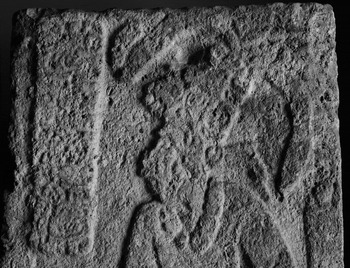
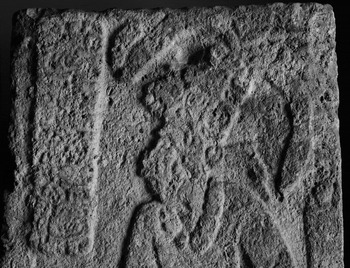
Hecelchakan, panel. Photograph by the author.
Presumed rulers from the Chan or Kan site.

A conch shell said to be from Jaina may refer to one of the next rulers. Although his name phrase, Ti K'a Haab, is tentative, he is said to be the yajaw, or overlord of another individual probably named Chil Juun. Intriguingly, both individuals carry the bakab title, but only the local ruler additionally is assigned the Chan or Kan emblem glyph. A jade reported by Spinden (Reference Spinden1975:144, Figure 196) and a vessel (K4330, Kerr Reference Kerr2017), both tentatively placed by style around 9.13.0.0.0 and 9.15.0.0.0 (a.d. 692–731), mention ?-Ch'o Tojol(om)? as the next possible Chan or Kan ruler. It is possible that another Tojol(om) reported on Santa Rosa Xtampak Stela 2 might be the same person. The Spinden jade, however, directly mentions him as father of Sak Balam? Jol(om)? and the vessel associated the ruler ?-ch'o Tojol(om) with the aj k'uhun or “bookkeeper” named Yiban (cf. Tokovinine Reference Tokovinine2013). On Jamb 3 (blocks Ap1–Ap4) of Xcalumkin appears also a person called Yiban ?-Chan, who additionally carries the Chan or Kan emblem glyph (cf. Garcia Campillo Reference García Campillo1998:50–51).
Another Sak Jol(om) ruler appears on Cansacbe Column 1 (cf. Figure 7a). As he is said to be the fifteenth successor, one might speculate that he is from the Chan or Kan site, as well. This would mean, however, that, between the “fourteenth” Jol(om) and the fifteenth successor, more than 80 years passed by and included at least three more reported rulers from the Chan or Kan site that had not been included in the title of numbers of succession. Another Chan or Kan ruler appears on a panel of unknown provenance, now housed in the Museum of Hecelchakan, Campeche (Mayer Reference Mayer1984:Plate 76; Figure 11). The heavily eroded name phrase only allows recognition of a possible Hix, or “puma” glyph. A jade from the cenote of Chichen Itza also refers to a person called U Kit Hix, who may be the same individual, in association with the Chan or Kan ruler Sak Balam? Jol(om). Finally, two vessels of unknown provenance refer to an individual named Muyal Chak Kim(?). On one vessel the aforementioned nominal reference is followed by aj chan (“he from Chan or Kan”), whereas the second vessel only refers to him as muyal and as aj chan or kan. Since both inscriptions only refer to their named individual by his title of origin and not by using the title ajaw or an emblem glyph, it is most probable that the individual is not a ruler on both vessels, but merely a high-ranking person.
The present sequence of supposed Chan or Kan rulers reveals that at least the western part of the northern lowlands had dynasties going back in time before the Late Classic. This is comparable with what is known from sites like Uxul or even Calakmul (cf. Grube and Delvendahl Reference Grube and Delvendahl2015). The Chan or Kan dynasties seem to have had relationships with Calakmul, which was the dominant political sphere in the most southern part of the northern lowlands as defined here (cf. Grube et al. Reference Grube, Delvendahl and Seefeld2012). The Chan or Kan dynasty may have dominated a larger area since their emblem glyph is attested from several sites on the western edge of the northern lowlands (Cansacbe, Sabana Piletas, Santa Rosa Xtampak, Uaymil, and Xcalumkin, among others based on monuments of unknown provenance).
POLITICS AND PARTICULARITIES
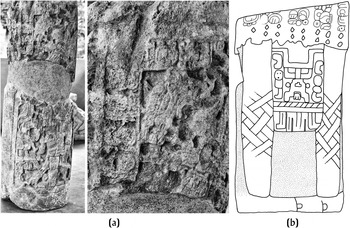
Although it is often presumed that stelae are the quintessential indicators of kingly political power and messages throughout the Maya lowlands, there are areas in the northern lowlands where stelae are scare or absent. Among these is a zone in today's western Campeche, including Xcalumkin, Xcombec, Xcochkax, Xcocha, Xculoc, and other sites prominently known for their architectural inscriptions (columns, jambs, lintels, and capitals), that commonly mention individuals with the title sajal (cf. Grube Reference Grube and Prem1994). This regional characteristic led some scholars, as already outlined, to speculate that the political organization among these sites might differ from the rest of the northern lowlands. There are some indications, however, that columns on buildings replaced the erection of stelae at these sites for still unknown reasons. Some of these columns indeed refer to kings and not only to secondary administrative persons such as sajal. One example is Column 1 from Cansacbe, which, as proposed in this paper, refers to a ruler from the Chan or Kan site, most probably Jaina (cf. Figure 7a). Another monument that displays and mentions a king is a column from Xchan, a site near Xcalumkin (Figure 12a). Although the name phrase and associated emblem glyph cannot be easily recognized, it is clear that the individual carries a full form emblem glyph with the k'uhul (“sacred”) adjective or prefix, while the interior of the main element, which would give the name of the kingdom, has been lost. Another column from the same site shows a ball court scene and the belt of the ball player displays the names of the individuals involved in the ritual game (Figure 12b). Another column from the nearby site of Chico documents a complex scene and, despite some destroyed parts, the hieroglyphic text mentions the ending of the k'atun 2 Ajaw (9.16.0.0.0, a.d. 751; Figure 13a). Another western site that employed numerous columns that portray individuals in dancing pose is Santa Bárbara, Yucatan, roughly 50 kilometers southwest of Mérida (Stanton et al. Reference Stanton, Carrillo Sánchez, Ceballos Gallareta, Eberl, Jiménez Alvarez and Ramos Pacheco2003). The large western site of Oxkintok also participated in this “column tradition,” but additionally erected numerous stelae. For example, one sculptured column at Oxkintok displays a local nobleman or ruler with even his jaguar skirt displaying a large portion of text (Figure 13b).
(a) Xchan, column. (b) Xchan, column ballplayer. Photographs by the author.

(a) Chico, column. (b) Oxkintok column. Photograph and drawing by the author.

The absence of stelae and the abundance of sculptured columns with iconography and hieroglyphs in one region is, however, only one peculiarity among others in the northern lowlands. For example, several sites southeast of Chichen Itza, including Popola and X'telhu, display their noblemen or kings on panels instead of on columns or stelae (Magnoni et al. Reference Magoni, Johnson, Stanton and Stanton2014). Another area where stelae are rare but architectural inscriptions are prominent includes Chichen Itza and the nearby sites of Yula and Halakal. Here, lintels were the favored monument type for recording individuals and their histories.
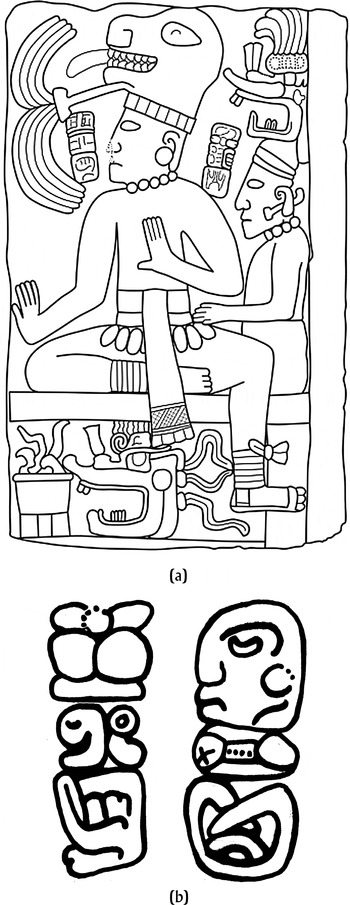
Among these areas with unique monumental or iconographic traditions, political relationships are also documented. For example, Panel 5 from Popola shows two individuals, one of them seated on a throne, the other standing to his right, suggesting that one is subordinate to the other (Figure 14). Two small inscriptions name these individuals. Although partially eroded and not easy to decipher, the inscription to the left refers to the individual on the throne and clarifies that he is an ajaw (“ruler”) of the site that tentatively may be read as sotz’ (“bat,” blocks A2 and A3). In contrast, the standing individual to the right seems to be a ch'ok or young noblemen (block B1). A very similar emblem glyph with a sotz’ sign appears on one of the lintels from Xculoc, the western region with few stelae (Graña-Behrens Reference Graña-Behrens2006:114–115, Figure 9). Thus, one wonders, if the lintel of Xculoc may refer to a ruler of Popola or vice versa. Another sotz’ ajaw reference appears on a doorjamb from Kabah structure 2C6, but within an unclear context (Graña-Behrens Reference Graña-Behrens2009:vol. II, Table 88). Since the scene shows the capture of a prisoner by two Kabah noblemen, among them probably the local ruler himself, one wonders if Kabah had attacked Popola or Xculoc or had captured one of its rulers in the Late or Terminal Classic. To this can be added the probable relationship between Jaina and Calakmul, based on the earflare from the tomb of Yuknoom Yich'aak K'ahk’ in Calakmul. These new data can be added to earlier findings concerning interpolity interactions throughout the Maya lowlands among those between Ikil and Altun Ha in the central lowlands (Graña-Behrens Reference Graña-Behrens2006:113), as well as between Ek’ Balam and Chichen Itza or Xcalumkin and Uxmal, among others (Grube Reference Grube and Prem2003:359–366).
Popola, Panel 5. Drawing by Scott Johnson, from Magnoni et al. Reference Magoni, Johnson, Stanton and Stanton2014:304, Figure 17.12. Drawing of the smaller glyphs by the author, after a photograph from Magnoni et al. Reference Magoni, Johnson, Stanton and Stanton2014:307, Figure 17.20.

CONCLUSIONS
Cumulatively, the findings presented in this the paper suggest that the political organization and hierarchy in the northern lowlands was less radically different from that of the central and southern lowlands than has been formerly supposed. Rather, an intermediate position recognizing more subtle differences has been proposed above. This is also more consistent with the impression that the southern, central, and northern lowlands seem to have shared a common cultural background (same writing and calendar systems, rituals, and gods), albeit expressed with regional differences. The analysis underscores that the understanding of political organization and hierarchy in the northern lowlands still needs to be investigated, not only archaeologically (cf. Braswell Reference Braswell and Braswell2015:25–26; Ek Reference Ek and Braswell2015:151), but epigraphically and iconographically, as well. Conversely, the proposed political organization and hierarchy suggested by the epigraphic analysis must be tested against archaeological data (e.g., settlement patterns, functionality of buildings and plazas, commodity networks, and ceramic distribution, among others).
The new evidence presented here concerning the schema and meaning of emblem glyphs and other titles assumed by high-ranking individuals, the relationship between those individuals, and the emergence of partial dynastic sequences suggests that there is a rich political history to be gleaned from northern inscriptions. In the northern lowlands, a similar political schema known from the central and southern lowlands was paired with different political rhetoric and tradition in communication preferences. At the moment, this makes it difficult to form a conclusive picture of the ancient political system in the north and more questions are raised than answered. Why did the north not simply use the same political rhetoric as the south? Does this mirror already known differences, such as using a variant calendrical system (k'atun count in the form of the so-called Yucatec Method, Puuc-style dates); elaborating hieroglyphic text infiltrated by the Yucatec language, which replaced the Maya lingua franca (probably a form of Ch'ol or Ch'orti language); or more often displaying kings as ancestors on public monuments (stelae, altars) instead of as a living person performing rituals?
The advances presented concerning the structure and meaning of emblem glyphs suggest that this title can be found at more sites than formerly recognized. Nonetheless, lesser preservation and fewer inscriptions to facilitate comparison of preserved information hampers the detection of emblem glyphs in the northern region. Despite this limitation, more than 30 emblem glyphs have now been recognized, not counting those still to be investigated on monuments from different places like Chichen Itza, although some of these are only tentatively authenticated. Some emblems show the attribute of an associated numeral that could be interpreted as referencing a kind of political-administrative organization distinct from, or rarely documented in, the central and southern lowlands. The existence of emblem glyph-like title sequences that include a reference to a numeral, such as Dzibilchaltun (Chiy Kaan + Ti Joo’) and Oxkintok (T'ab? Wuk Pet? + Sak Te Nal) may represent a difference in how political unity was conceived. Because the expression itself never changes over time and no other title sequence appears to be associated with the same numbered part, however, it may also stand for some kind of static or fossilized title that originated earlier but continued to be used during the Late and Terminal Classic periods. Thus, in the case of Dzibilchaltun, Ti Joo' may have been the ancient name for the larger administrative or political unit encompassing Dzibilchaltun and the former site of Tiho (today Mérida), while Chiy Kaan only referred to the current archaeological site of Dzibilchaltun during the Late and Terminal Classic periods. The same could be true for Uxmal and explain why the emblem glyph of Uxmal known from inscriptions (which reads K'ahk’ Nal) differs from the later appellation Uxmal, which may have been the fossilized reference for a larger political unit. The same pattern can even be found farther south, where Calakmul and other sites allude to the numbered expression ox te’ tun. Thus, it is suggested that these numerical expressions represent a subtle regional form of political discourse, albeit one that we still do not understand well. At present, we can only speculate that the sequence of titles with a numeral could stand for multi-site political entities.
By comparing inscriptions on certain kinds of vessels that allude to individuals as the owner or the user, a second conclusion can be drawn concerning the political and hierarchical organization in the northern region. Especially since some of these vessels refer not to one but to two individuals, a certain kind of hierarchy can be deduced. Whether this hierarchy is particular to the north, or simply not recorded on central and southern inscriptions, must remain an open question. From these vessels, a hierarchy with at least three tiers can be deduced. Although not a new finding, it supports the idea that individuals in the rank of a sajal are somehow inferior to those carrying the title bakab. Contrary to what has been observed for the central and southern lowlands, however, the bakab himself is sometimes not represented by the king (ajaw), but by a different person, and in rare instances, even by a sajal. Thus, a three-tiered hierarchy may have been of some importance during the Late and Terminal Classic periods and may mirror somewhat the hierarchy that is known from Late Postclassic and Early Colonial reports for northern Yucatan (cf. ah cuch cab, batab, and halach winik).
A third conclusion is based on the preliminary sequence of rulers and noblemen from the Chan or Kan site (probably Jaina) associated with the name Jolom, “head.” This suggests that the dynasty of the site of Chan or Kan had considerable time depth in western Campeche, perhaps as early as a.d. 500. Moreover, it suggests the existence of varying relations to sites like Calakmul, Xcalumkin, Cansacbe, and Uaymil, among others. Therefore, we must abandon old notions that dynasties in the northern lowlands are not attested to earlier than the beginning of the Late Classic (around a.d. 700).
A final conclusion is that sub-regional differences can be found that express forms of political organization. Besides sites with stelae that point to the existence of a dynasty or rulership, based on what is known from the central and southern lowlands, other, subtler forms of expressions also existed. Examples include doorway columns, such as in western Campeche, or stone panels, such as around Xtelhu or Popola in eastern Yucatan. Whereas the Xcalumkin region favored columns, the Popola region preferred stone panels, and Chichen Itza, Yula, and other sites primarily utilized lintels. With the exception of Coba in the east and Etzna in the west, dynastic stelae were primarily erected in the central part of the northern lowlands, extending from the Rio Bec region through the northern plains (e.g., Dzibilchaltun and Dzilam González).
In sum, a new and more complex political and hierarchical picture is emerging from the inscriptions from the northern lowlands, but one that still needs to be elucidated in more detail. These findings may also help shed light on the political system of the Maya lowlands in general.
RESUMEN
Este artículo presenta nuevas evidencias sobre la jerarquía y el poder de los mayas del clásico (300--1000 d.C.) en las tierras bajas del norte. El trabajo amplía la lista de glifos de emblemas identificables y analiza la práctica o sintaxis de estructurar nombres personales y títulos para poder identificar mejor glifos emblemas. En particular se presentan algunos glifos emblemas con número y se cuestiona su función en relación con la organización política. Además el trabajo analiza individuos en base a su título en algunas vasijas del norte para entender mejor la estructura de la jerarquía socio-política. Finalmente se propone para el reino Chan o Kan (más probablemente Jaina) por primera vez una secuencia de gobernantes en orden cronológico.
ACKNOWLEDGMENTS
I thank Nicholas Dunning (Cincinnatti) and Markus Eberl (Vanderbilt) for critical remarks and clarifying arguments and for turning it into what I believed to be English. Dedicated to Erik Boot.