The Sydney Morning Herald in 1961 published an item that highlighted the formation of a co-operative among real estate agents or realtors in Sydney, Australia, noting that co-operatives were an unusual business model for an industry with a “reputation for sharp competition.”Footnote 1 While co-operatives are traditionally associated with workers, consumers, and farmers, the co-operative business model, with its emphasis on democracy and community, has also been adopted by groups of small business owners, the self-employed, and professionals. These business co-operatives are distinct phenomenon, because they primarily consist of independent organizational entities that are not co-operatives and are generally in direct competition with one another. They are unique in that they bring together separate organizations that seek to combat market threats while adopting a philosophy based on co-operative principles. While this article focuses on Australia, business co-operatives are an international phenomenon, with small businesses in the United States belonging to purchasing co-operatives for joint buying and shared services. The concept of business co-operatives is also being promoted by organizations such as Co-operatives UK and the International Labour Organisation to promote the co-operative business model and stimulate the economy.Footnote 2
The main objectives of this article are to define business co-operatives and highlight their significance in introducing the values of participatory democracy and working for the common good into unanticipated markets and their role in reinforcing the co-operative movement. To achieve these objectives, the article provides an overview of the Australian co-operative landscape from the mid-nineteenth century until the present. This will help place the development of Australian business co-operatives in their national context. The business co-operative is then defined as a distinct category of co-operative with unique features. The article then draws upon the Visual Atlas of Australian Co-operatives History Project, which includes a large historical database of Australian co-operatives over time and space, to examine the development of business co-operatives in Australia, which were largely a post–World War II phenomenon, in their historical and geographic contexts. The article looks at where business co-operatives formed in the economy, the motivation underlying their formation, their average life spans, and their relationships with the broader co-operative movement. Supported by comprehensive historical data, the article offers novel insights into a history of business co-operatives and demonstrates their significance. In doing so, it also sets the foundations for future research into other types of networked business models, such as contemporary business ecosystems, that could benefit from the rich history of business co-operatives.
The Australian Co-operative Landscape
The Australian co-operative landscape has been dominated by three major types—consumer, agricultural, and financial. The consumer co-operative allows members to have control over consumption through common ownership and democratic principles, originating in Rochdale in England in 1844, to guide the price, quality, and supply of goods such as bread, groceries, and meat. Farmers have protected their interests through forming agricultural co-operatives. Agricultural co-operatives can provide crucial supplies for farmers such as seeds and fertilizers through bulk purchases that reduce costs. These agricultural co-operatives may overlap with consumer co-operatives by providing their members with groceries and a variety of consumer goods. They may also allow farmers to vertically integrate by marketing and distributing their goods. Agricultural co-operatives also allow farmers to pool risk in what can be a volatile industry in terms of market demand, weather, and pests and to capture profits from others involved in the food supply chain. Individuals formed financial co-operatives to obtain access to credit where credit was not provided by existing financial institutions or to avoid moneylenders, who may charge high fees and interest rates. Financial co-operatives include credit unions and building societies.Footnote 3
The notion of co-operation in Australia dates from the 1820s with ideas of land settlement promoted by Peter Cunningham, naval surgeon and author, influenced by the great UK co-operator Robert Owen. The ideas of the Rochdale movement began to attract interest in Australia in the 1850s. George Holyoake’s Self-Help by the People, the influential history of the Rochdale pioneers, was reviewed in the Empire newspaper in Sydney in August 1858.Footnote 4 The earliest known Australian Rochdale consumer co-operative was formed in Brisbane barely fifteen years after the establishment of the Rochdale movement in England. It was registered in Brisbane in August 1859 under the NSW Friendly Societies Act, before the separation of Queensland from New South Wales. Rochdale co-operative societies have played an integral role in the lives of many Australians in coal-mining areas, but also in rural regions and metropolitan centers. Australian farmers also adopted the idea of co-operatives to help pool resources for the storage, production, and market of their produce and to cut out the intermediaries who took their produce to market. Dairying led the way in the 1880s, influenced by the success of Danish dairy co-operatives.Footnote 5
There had been waves of co-operative formation in Australia, with major peaks during the 1890s, the early 1920s, 1945–1951, the early 1970s, and the early 1980s. The peaks relate to times of political and social unrest arising from economic downturns, the disruption of war, and questioning of prevailing values that emphasized individualism. During the postwar period state governments also promoted co-operatives through an active Co-operative Registrar in New South Wales and specific co-operative legislation in Queensland in 1947 and Victoria in 1953.Footnote 6 Consumer co-operatives had major peaks in the early 1920s and 1950s, reflecting concerns relating to the prices and availability of goods in the period following the world wars. The traditional Rochdale consumer co-operatives generally went into decline in the postwar period, but there has been a resurgence of interest in food co-operatives, which often emphasize healthy and sustainable food,Footnote 7 and specialist co-operatives that provide specific services such as a household water supply in rural areas.
Agricultural co-operatives, including fishing co-operatives, were a second major wave of co-operation from the 1880s with a peak in the early 1950s. Their subsequent decline reflects a falling rural population, amalgamation, and demutualization, which are “changes in the ownership structure of user owned and controlled organizations from a mutual to a for-profit, proprietary organization,”Footnote 8 whereby members can lose control of the business to outside interests.Footnote 9 While building societies operated in Australia from the 1840s,Footnote 10 there was a third major wave of co-operatives in the form of credit unions from the 1940s, and by 1975 there were 748 credit unions Australia-wide, with 910,000 members. There was state encouragement with specific co-operative legislation for credit unions. The amalgamation of credit unions was a feature of the subsequent general decline of financial co-operatives, as they aimed to take advantage of economies of scale and survive in an increasingly competitive financial system. Credit unions have become an important part of the Australian financial system and have developed into a movement that sees itself as distinct from the general Australian co-operative movement, with its own national and international peak bodies.Footnote 11
While consumer, agricultural, and financial co-operatives have been features of Australian co-operative development, other types of co-operatives have also shaped the Australian co-operative sector. Worker co-operatives surged in the 1890s and 1980s, fueled by periods of economic downturn and business failures. They had a limited impact in Australia, as workers focused on trade unions and political activity through the Labor Party.Footnote 12 Community co-operatives, particularly in New South Wales and Victoria, which include registered clubs and Victorian school fundraising co-operatives,Footnote 13 grew dramatically from the early 1950s until the 1990s. Indigenous co-operatives, whose services include housing, health, cultural preservation, and creating employment grew rapidly during the 1970s and early 1980s. They provided legal entities to manage the federal funding that arose following the 1967 constitutional referendum that transferred powers over indigenous matters from the states to the federal government.Footnote 14
Overshadowing these developments, from the mid-1980s, co-operatives faced a more difficult political and economic environment. The political climate since the 1980s favored privatization and deregulation to make the Australian economy more globally competitive. There was a period of federal Labor government from 1983 to 1996, the longest in Australian political history. The Hawke-Keating Labor governments were willing to dump Keynesianism and social democratic policies, which were viewed as discredited by the collapse of the postwar boom, needing to establish their economic credentials as a responsible party of change and modernization following the apparent economic mismanagement of the Whitlam federal Labor government, which held power from 1972 to 1975. They embraced pre-Keynesian “neoclassical” economics as part of their drive to modernize Australia. The consequences of this thinking were the dismantling of state regulation, state enterprise, and public investment.Footnote 15
The floating of the Australian dollar in December 1983 gave the financial markets increased power over government economic policy. Other contextual changes included the abolition of exchange controls; the deregulation of the financial sector, which increased competition for financial co-operatives such as credit unions and building societies; and major tariff reductions in 1988 and 1991. There was also a strong advocacy by the Labor government of free trade agendas in international forums such as General Agreement on Tariffs and Trade. The shift toward the market led to abandonment by the Labor Party of its traditional view of public ownership and its desirability as early as 1986. It opposed the call for privatization by the Liberals in 1985 but supported privatization on a case-by-case basis by 1988. Major state enterprises such as Qantas and the Commonwealth Bank were privatized, while the monopoly of the state-owned Telecom was broken up. A significant legacy is the National Competition Policy Act, which required both federal and state governments to implement comprehensive pro-market programs under the supervision of the unelected and unaccountable National Competition Council. Successive Liberal National Party and Labor governments, at both the state and federal levels, built their economic policies on these foundations.Footnote 16
The shift toward neoliberalism, as in other countries, challenged the business strategies of both investor-owned businesses (IOBs) and co-operatives, with some co-operatives amalgamating and demutualizing.Footnote 17 Corporations, rather than co-operatives, were generally viewed as more efficient entities, and an Australian Senate inquiry into the co-operative and mutual sector found in 2016 that there were “restrictive practices” in government grants and funding mechanisms that disadvantaged co-operatives “against other types of business structures.”Footnote 18 There was a reduction of direct state assistance to co-operative development, and co-operatives sought the advice of consultants to help them deal with a changing business environment. Consultants had limited familiarity or sympathy with the principles of the co-operative business models, given the lack of co-operative education in tertiary institutions that taught law, accounting, and business. There were also “success fees” for consultants if they successfully demutualized co-operatives. As co-operative historian Gary Lewis argues, their advice “was incestuous or narrow in its world view and reflected a corporate paradigm” with an emphasis on “recommendations for profit maximisation, enhancing share value, external investments and competitive advantage.”Footnote 19
One major problem for Australian co-operatives in facing challenges such as the rise of neoliberalism has been the lack of a national or even state organizations. Co-operative legislation was a state responsibility, with co-operatives focusing on state rather than national concerns. Two long-standing examples of state peak bodies include the Co-operative Federation of Western Australia (CFWA), which was formed in October 1919 at the instigation of the Westralian Farmers’ Co-operative Ltd. and was dominated by farmers’ co-operatives, and the Co-operative Federation of Queensland, founded in 1945. At the national level, after at least three previous Australian Co-operative Congresses, a Commonwealth Consumers Co-operative Conference with representatives of co-operatives from six states held at the Albert Hall in Canberra in December 1943 led to the establishment of a permanent secretariat in Canberra known as the Co-operative Federation of Australia (CFA). The CFA, however, remained weak and fluctuated in its level of activity, becoming moribund in 1986. The Co-operative Federation of NSW (CFNSW), which represented a wide variety of co-operatives and was established in 1964, subsequently formed its own Australian Association of Co-operatives. This body collapsed in 1993, and NSW co-operatives reformed the CFNSW. After further unsuccessful attempts to form a national organization, and in the wake of the UN International Year of Co-operatives 2012, co-operatives and mutuals launched a new national organization called the Business Council of Co-operatives and Mutuals (BCCM) in July 2013 to represent the whole sector. A crucial player in the successful establishment of the BCCM was the Capricorn Society, a business co-operative.Footnote 20
Business Co-operatives
When business co-operatives are discussed in the literature, they have also been referred to as entrepreneur co-operatives, business services co-operatives, enterprise co-operatives, shared service co-operatives, and retailer co-operatives such as Foodstuffs in New Zealand and Ace Hardware in the United States.Footnote 21 They are not formed by consumers, farmers, and workers, and unlike financial co-operatives are not specifically concerned with obtaining credit. Their business members are not co-operatives but independent businesses, which can be sole traders, partnerships, and registered companies, that all retain their separate legal identities and financial control. They include, for example, small shopkeepers, newsagents, butchers, and professionals, who form co-operatives to advance their business interests rather than an association or an IOB. Business co-operatives can also be formed by other business types such as friendly societies and incorporated associations but not co-operatives. Instead, co-operatives have formed consumer wholesale co-operatives, agricultural wholesale co-operatives, agricultural supply co-operatives, and co-operative businesses, such as brick and tile works, to ensure vertical integration. Overall, business co-operatives can be defined as federated organizations composed of independent, nonagricultural entities that are generally for-profit and are technically in market competition with one another but choose to share resources to promote the overall success of their ventures according to co-operative principles.
There are a variety of reasons for the creation of business co-operatives. They can be a revolt against the present economic and political system, especially during periods of economic uncertainty and social unrest. There are market failures or contract failures, wherein suppliers and marketers cannot be controlled through traditional contracts. There is a desire to cut out the “middleman” and gain direct control over supply and marketing. The governance costs of co-operatives are also lower if members are homogenous with similar objectives.Footnote 22 Businesses desire to reduce costs by purchasing goods and services in bulk, such as hairdressing supplies and even office space. They wish to ensure stability in the supply chain by engaging in vertical integration through setting up their own abattoirs or manufacturing facilities. They also gain marketing advantages by having a common brand and a platform to engage in political lobbying. There is also a principle of mutuality that brings tax benefits to co-operatives in many countries but has limitations, such as a requirement in Australia that co-operatives are not deemed co-operatives if less than 90 percent of ordinary business is with members. However, this principle of mutuality does not appear to be a motivation for forming business co-operatives.Footnote 23 Overall, the business co-operatives increase small businesses’ markets and political voice based on a governance model that has the principle of one-member, one-vote irrespective of the size of a member’s business.
While the general co-operative literature has traditionally overlooked the possible engagement of retailers, professionals, and the self- employed with the co-operative business model,Footnote 24 there is recognition that co-operatives are important for providing wholesaling for retailers in the food trade and pharmacists in Europe. Johnston Birchall has noted that independent retailers organize their own wholesaling co-operatives when they see the advantage of vertical integration for competitors, such as co-operatives and chain stores. These co-operatives have a variety of ownership structures and tend to operate through franchising, which ensures the discipline of the group. If the members control the franchise, rather the franchiser, this ensures that the retailers have great say in their own business operations and minimizes disputes with the franchiser over issues such as the transparency of sales data and the quality of goods. Overall Birchall classifies retailer-owned supermarkets, hardware stores, and pharmacies as producer co-operatives as opposed to employee- and consumer-owned co-operatives.Footnote 25
Birchall also recognizes that co-operatives can provide shared services for the self-employed, small businesses, and professionals such as dentists, artisans, taxi drivers, and market traders. As with the retail-owned wholesaler, he classifies them as producer co-operatives. There are advantages to these groups forming co-operatives due to the economies of scale gained from joint marketing and purchasing, as well as shared services such as office accommodation. Like agricultural and consumer co-operatives, they do away with the middleman and allow members to retain the maximum return for their work. Birchall argues that during economic recessions, these shared-service co-operatives tend to grow as businesses group together to increase sales and reduce costs. He recognizes that the term shared-service co-operatives is hazy and suggests alternatives such as co-operative consortia or business co-operatives. Footnote 26
This article uses the term business co-operatives to cover both types of Birchall’s producers’ co-operative—the retailer-wholesaler and shared services. This term is preferred, as producer co-operative has been used to describe a wide range of co-operatives. In the United Kingdom, the term producer co-operative is used to describe a form of worker co-operatives particularly prevalent during the nineteenth century. John Wilson, Anthony Webster, and Rachael Vorberg-Rugh define a producer co-operative as “a producer/industrial organization owned at least partly by the workforce, which shared the profits of the organization after meeting essential commitments like interest on loans, wages and other costs.”Footnote 27 These producer co-operatives were also found in Australia, particularly in the nineteenth century. The term is also used to describe agricultural co-operatives, which are “composed of individual farmers who produce a particular commodity or commodities but who may purchase needed supplies and inputs and process and market their produce collectively.”Footnote 28 While Birchall highlights that there can be hybrid forms of business co-operatives, such as jointly owned retailer-wholesaler businesses and minority ownership in shared-service IOBs, business co-operatives in this article are fully owned by retailers and the users of the business services.Footnote 29 Health professionals such as doctors and pharmacists are not included in the business co-operative category but fall under the category of health co-operatives, which provide health services ranging from general practice to hospitals, sometimes in partnership with their local communities.Footnote 30
Business co-operatives must face two issues: (1) the tension between individual needs and collective mobilization and (2) embracing the ideals of the co-operative movement. The retailers’ co-operatives, for example, are an “interesting mix” of individual ownership and self-imposed group discipline. There is a challenge of overcoming a focus on short-term immediate survival and developing over time a culture that could align member interests and minimize opportunistic behavior. For collective survival, members may have to accept limitations upon their individual freedom to make decisions relating to their specific businesses. The Leclerc chain in France, for example, allows individual members to own their own stores, but has the right to control when the stores are sold, and the price received. There has to be a high degree of trust and reciprocity for the long-term survival of the co-operative and a willingness to accept collective decision making that may not be in the individual firm’s best interest. There are suggestions in the literature that these business co-operatives may be fragile, with many performing badly and high failure rates, but the studies referred to relate not to business co-operatives but to other forms of business associations, such as joint ventures across national borders.Footnote 31
Business co-operatives must manage individual versus collectivist tensions while also addressing their role in the broader co-operative movement. Co-operatives are a business, but they are also a movement with regional, national, and international organizations such as the International Co-operative Alliance (ICA), which co-operatives founded in 1896. There is an ideology built around collective self-help, economic democracy, and community obligation enshrined in co-operative principles that historically are based on the original principles of the Rochdale consumer co-operative movement in the United Kingdom in the mid-nineteenth century. There are important cultural artifacts associated with the co-operative movement, such as International Co-operative Day, co-operative halls of fame, and museums. The ICA promotes the co-operative movement worldwide and provides a forum for international co-operative collaboration. While small businesses may form co-operatives to overcome specific business problems, how far do they embrace the collectivist ideals of the co-operative movement by participation in the broader co-operative movement? To answer this question and gain a better understanding of business co-operatives over time and space (geographic regions), this study draws insights from the Visual Atlas of Australian Co-operatives History Project, briefly described in the following section.Footnote 32
The Visual Atlas of Australian Co-operatives History Project
The Visual Atlas of Australian Co-operatives History Project (VAACHP) was funded by the Australian Research Council from 2017 to 2020, with data collection starting as early as 2015. Its key component, the Visual Atlas of Australian Co-operatives, is currently maintained by the Co-operative Research Group at the University of Sydney Business School, with the support of colleagues at Macquarie University and the University of Technology Sydney. The project focuses on historical data collection and visual data exploration of all forms of co-operatives in Australia, including retail co-operatives, agricultural co-operatives, and financial co-operatives, such as credit unions and co-operative building societies. The Visual Atlas of Australian Co-operatives is a constantly growing interactive visual database of co-operatives that also includes co-operative federations and auxiliary organizations such as co-operative women’s guilds. It does not include insurance mutuals, such as health funds, which can restrict membership participation to a small group of “governing members,” or industry superannuation funds, whose members do not directly elect the board of directors.
The project draws upon and integrates historical data from a range of reputable sources collected by historians specializing in co-operative history, using historical research methods. It is the first to harvest data from the Australian National Library Trove newspaper database to develop a long-term picture of the development of a business model in the Australian historical context, particularly for the nineteenth century. The general data relating to the development of Australia co-operatives are obtained from a variety of sources, including the limited surviving historical records of various state and national bodies relating to the movement. This material is supplemented by public sources such as newspapers, particularly at the community level, published co-operative histories, detailed case studies, parliamentary papers and debates, and material sent to the various registrars of co-operative societies. There is also a major credit union archive in Sydney with the records of a significant number of financial co-operatives. While the VAACHP primarily draws from Australian sources, it also examines the relevant records of the English Co-operative Wholesale Society in Manchester, which had a close relationship with the early Australian consumer co-operatives. This in turn enabled the researchers to obtain further information on nineteenth-century Australian co-operatives.Footnote 33
In June 2020, the Visual Atlas contained the historical data of 3,743 co-operatives at 1,724 locations. As such, it is the most comprehensive source of historical data on Australian co-operatives to date. Major types of co-operatives include 936 agricultural co-operatives; 899 community co-operatives, such as registered clubs; 646 consumer co-operatives; and 576 financial co-operatives. All data have been collected, authenticated, cross-referenced, and quality checked on an ongoing basis by expert co-operative historians from Macquarie University and the University of Sydney, who are also coleaders of the project, using systematic data collection grounded in historical research methods.
In addition to the large database of historical records, the Visual Atlas includes an interactive visual data exploration environment developed using the state-of-the-art data visualization software Tableau. The visual environment is designed to enable an interactive, self-guided, visual exploration of the collected historical records by co-operative historians, who are nontechnical domain experts. The main types of data collected and recorded in the database include location, date of operation, type of co-operative, membership, employment, finances, and end status. The financial data include assets, turnover, liabilities, and surpluses/losses. Locations include, for example, branch stores and produce-handling facilities. The end status of the registered co-ops, where known, includes ongoing, amalgamation, liquidation, cancellation of registration, and demutualization.
The data stored in the Visual Atlas come from a variety of data sources, both structured and unstructured. For example, data harvested from sources such as Trove are already structured in data sets that are ready-made and could be easily imported, stored, and integrated in the Visual Atlas database. However, other valuable data come from unstructured data sources, such as historical records in various forms, including textual documents, pictures, registration files, and co-operative records that examine co-operatives over long periods, rather than short-term data that may cover only one or two years. Such data need to be examined in historical context, interpreted, cross-checked, and verified using different historical records to confirm, for example, that the co-operatives are indeed co-operatives, given the lack of legal definition in the Australian environment for a long period. Finally, the resulting data are recorded in spreadsheets by a team of historians.Footnote 34
Once collected and prepared using this method, the spreadsheets are then given to a team of visual analytics researchers at the University of Technology Sydney to be uploaded, integrated, modeled in a way that could be used by the data visualization software, and ultimately stored in previously designed data structures (called multidimensional data models). These models, combined with an easy-to-use visual interface, enable domain experts (co-operative historians) to explore historical records to draw new insights, in this case about business co-operatives, and interpret them in the appropriate historical context. This ongoing iterative multidisciplinary research method, which was codesigned by the multidisciplinary research team, was gradually refined over the past four years. It has resulted in a robust, yet simple to use visual environment with high quality and the most authoritative data on the Australian co-operatives to date.
The collected data highlight trends and allow patterns of growth, decline, and revival to emerge and become visible to the historians, even with only an unknown proportion of the population of co-operatives, partly because of the addition of newly formed co-operatives each year and the further detailed research being undertaken to find the full details of co-operatives missing in the registrar’s records. From the variety of sources available, it is estimated that the June 2020 version of the Atlas, which is the nineteenth version, contains approximately 50 percent of all known Australian co-operatives, past and present, from all jurisdictions. As more data are input in the Visual Atlas, these patterns have become even clearer, with the overall fluctuations in the number of co-operatives over time in recent versions remaining relatively constant.Footnote 35
There are issues relating to the historical tracking of co-operatives in the Visual Atlas, due to historical changes in legislations or legislative boundaries. Because the states have had legislative responsibility for co-operatives in Australia, the legislative and political context for co-operatives varied. Australian co-operatives could register at varying times under Friendly Societies Acts, Industrial and Provident Societies Acts and Company Acts, as well as specific co-operative legislation. Changes in other legislation could radically influence the number of co-operatives, with registered clubs in New South Wales in 1969 required by the amendments to the Liquor Act to incorporate as a company or a co-operative, with many choosing the latter.Footnote 36 There are variations in the type of data available. The surviving information about co-operatives is good for understanding the life span and type of co-operative, which is important for understanding overall fluctuations of interest in co-operatives, but limited in regard to financial, membership, and employment data. There are no consistent series of data, for example, on the membership of specific co-operatives, but where possible, missing membership data are extracted from other historical sources, such as annual reports and newspapers.
Despite these limitations, the data set developed through the Visual Atlas is uniquely placed to examine the development of business co-operatives in Australia. There is no alternative comprehensive database available that charts the development of Australian co-operatives. It was specifically developed by the authors to explore the development of traditional types of co-operatives, such as consumer co-operatives, but also to identify new types, such as business co-operatives, that do not fit into existing typologies. The Visual Atlas data also identify whether business co-operatives clustered in particular locations and provide information on resilience through data on formation and demise. Further, the documentary material collected as part of the development of the Visual Atlas allows greater insights into specific co-operatives by providing information on membership data, activities, and co-operative ideology when such information is not available from registry archives. The following sections outline the key findings regarding business co-operatives gained from the VAACHP.
Business Co-operatives in Australia
Key Trends from the VAACHP
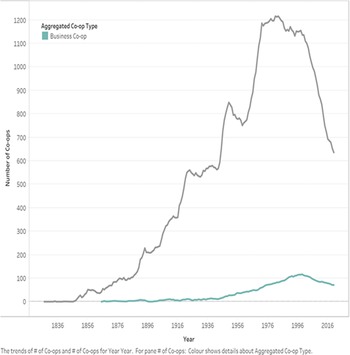
The Visual Atlas as of June 2020 recorded 217 business co-operatives. As Figure 1 indicates, they have operated in Australia from the 1860s until today, with the exception of a short period (1878–1879). There were minor peaks of co-operative formation in 1891, 1910–1911, 1922–1923, and 1938, with the first peak coinciding with the 1890s depression in Australia and the last peak coinciding with the recovery from the 1930s Great Depression. From 1947 to 1992, there was a growth in business co-operatives, with the peak in 1992 coinciding with a major recession in the Australian economy. There was a further growth of business co-operatives from 1996 to 1999, which by contrast was a period of economic growth in Australia. Figure 1 also highlights that compared to the trends for all Australian co-operatives, the growth of business co-operatives was a post–World War II phenomenon in response to market failure and the challenge for small retailers of the rise of large supermarket chains in Australia. Business co-operatives have maintained their postwar growth beyond the peak for all Australian co-operatives in the early 1980s, highlighting a resilience despite the impact of neoliberalism on co-operatives generally.
The trends of number of co-ops and number of co-ops per year. For number of co-ops, color shows details about aggregated co-op type.

While Birchall’s argument that shared-services business co-operatives can be expected to grow during periods of economic recession may be an explanation for some growth in Australia,Footnote 37 there was a dramatic growth of Australian business co-operatives during the post–World War II economic boom as small businesses found it necessary to share services to remain competitive in rapidly expanding markets and state governments promoted the co-operative business model. With end of the war taxi drivers, many of whom were returned military personnel, found that co-operatives provided a way to reduce costs by providing shared radio dispatch, marketing, and vehicle maintenance services. Wesdan Ltd. in Perth was formed in 1937 as supplier to butchery and meat processing but mutualized in 1948 to form the Master Butchers Co-operative in 1949 after reaching an agreement with the Western Australian Meat and Allied Trades Federation that allowed it to raise further capital for expansion.Footnote 38 There was also an expansion of professional employment in Australia growing from 181,000 in 1947 to 568,000 in 1971 and to 909,00 in 1981, despite the economic turbulence of the 1970s, as the economy grew and tertiary-sector employment expanded.Footnote 39 There was a growth of professional co-operatives primarily for barristers in Sydney from the 1950s providing library facilities, clerical services, and accommodation.Footnote 40
Despite an environment favoring demutualization since the 1980s, some small businesses and professionals combined into co-operatives as a way of dealing with deregulated business environments and increased competition. Eleven Victorian automobile parts retailers in 1985 formed the Aspar, later Autobarn, Co-operative Society to group-buy supplies at a reduced rate to compete with bigger retailers. In Western Australia, hardware store owners made two unsuccessful attempts to set up hardware retail co-operatives in 1987 and 2008 for group buying and joint marketing.Footnote 41
Key Types
Table 1 indicates there are four groups that have organized business co-operatives in Australia. The largest group is small businesses that include grocers, real estate agents, travel agents, and newsagents. The second group is transport owner-drivers, which are mainly taxi drivers, but also include truck drivers and, in rare cases, boat owners. The third group is self-employed trades such as bakers, builders, butchers, and plumbers. The smallest groups are professionals such as lawyers and accountants.
Businesses organizing co -operatives, 1867–2020

Source: VAACHP v. 19.0 (June 2020).
The first type of business co-operatives are those organized by small businesses. There are examples of small businesses forming co-operatives before World War II to promote their interests. Adelaide retailers established the Adelaide Bottle Co-operative in 1909 to reduce the costs of glass bottles. Sydney grocers, concerned with the rise of chain stores, formed United Grocers Co-operative Stores in 1938, with fifteen stores opening in late July 1938 trading under the name of Melray Stores, a Victorian retail franchise. Despite their high hopes, the co-operative went quickly into liquidation in December 1938 and was deregistered in 1946.Footnote 42
The growth of small business co-operatives was largely a postwar phenomenon. A major motivation for small businesses to form co-operatives is the growth of large companies, which gain advantages of economy of scale over small businesses. When Sydney real estate agents established their co-operative in 1960, they were concerned at the growth of large real estate chains such as L.J. Hooker in the booming postwar housing market and believed that a co-operative was a way of protecting the “small man” against “takeover.”Footnote 43
Retailers faced competition from two dominant supermarket chains, Coles and Woolworths, which have their origins in the variety store format but eventually split into supermarkets and discount department stores. Coles and Woolworths controlled 80 percent of the Australian grocery market share by 2013, leading to claims that Australia had the least competitive retail supermarket sector in the world. Coles, which itself was taken over by Wesfarmers in 2007, and Woolworths also expanded through the acquisition of specialist retail chains in areas such as fashion, hardware, and stationery.Footnote 44 An example of small businesses forming a co-operative in response to the threat of the two supermarket chains is Liquor Barons. Independent alcohol retailers in Western Australia formed this co-operative in 1998 to coordinate buying and marketing as they faced increasing competition from Coles and Woolworths, which were expanding into liquor sales through the purchases of independent chains such as the Australian Liquor Group.Footnote 45
Some small business co-operatives, like ANCOL and the Capricorn Society, can become large enterprises. Newsagents formed a network of co-operatives in four states under the trading name of ANCOL, of which one survives in South Australia. The NSW Associated Newsagents Co-operative (NSWANC), which newsagents established in 1947, had 700 members by 1950. It grew by January 1988 to have 1450 members and 240 employees with a turnover for the 1986–1987 financial year of A$13.6 million. As a wholesaler, it used the collective buying power of its members to purchase stationery, confectionary, toys, and other items. NSWANC, with the three major newspaper publishers, had an arrangement through a Newsagency Council that ensured that its members had the exclusive right to deliver newspapers to homes within a specific geographic territory.Footnote 46
The Capricorn Society began in 1970 as small buying group without legal status, known as Group 11, for a group of WA Golden Fleece Service Station owners seeking to challenge the price control exercised by the Western Australian Spare Parts Association, which disadvantaged the service station proprietors compared with other sections of the automobile industry. The service station owners who supported the co-operative business model argued that spare parts suppliers would find this approach more acceptable, because bad debts would be minimized, as the co-operative rather than individual members carried all risk and guaranteed the payments of its accounts. There was also the appeal of the democratic governance of a co-operative. The society gained registration as a co-operative in 1975 with parts suppliers providing discounts as the society’s membership grew. It expanded into New South Wales in 1988 and was operating in all Australian states by 1991. It also became international, with operations in New Zealand since 1997 and in South Africa for a period from 2000. By 2019 it was the second-largest nonfinancial Australian co-operative after Co-operative Bulk Handling, the WA wheat farmers co-operative, with a turnover of $A1.8 billion. Capricorn grew from approximately three thousand members in 2006 to more than twenty-two thousand members by 2020. While Capricorn registered under the Corporations Act in 2006 to allow greater flexibility in its interstate and international operations, it continued to operate under the co-operative business model and remained active within the WA co-operative movement.Footnote 47
The second type of business co-operatives are those of owner-drivers. Members of this category have a long-standing interest in the formation of co-operatives to increase their collective voice and provide shared services. Early examples of owner-drivers forming co-operatives are carters, carriers, and teamsters in regional New South Wales. Carriers formed the Nyngan Carriers Union Co-operative Forwarding Agency Society in 1888 to challenge the “monopoly” of carrier firms and their agents in distributing work. There were at least two more of these regional carriers’ co-operatives organized, but all had ceased to operate by 1895 in the midst of the 1890s depression.Footnote 48
Owner-driver taxicab operators formed taxi co-operatives from the 1920s. One of the earliest was De Luxe Cabs in Sydney, which commenced operations in October 1928 and registered under the NSW Co-operatives legislation in March 1929. During the postwar period, there was a major expansion in New South Wales, with thirty-eight registered taxi co-operatives by 1988, twenty-one of which were in regional centers. The largest was Legion Cabs in Sydney, formed by returned military personnel seeking self-employment after World War II, which had 684 members and 80 employees by 1988. It also owned petrol stations for servicing its members’ taxis. By February 2020, the number of taxi co-operatives had fallen in New South Wales to twenty-seven, with nineteen being in regional centers.Footnote 49
Truck drivers as owner-drivers also have a history of forming co-operatives, with the earliest known example being the Western Co-operative Motor Transport Society. This society formed in the regional NSW center of Dubbo in 1928 but failed to survive the onset of the Great Depression. A group of truck drivers in the Sydney suburb of Balmain in 1945 established Lodehaul, which is the longest surviving example of an owner-driver truck co-operative, with the drivers determined to get rid of the middleman in negotiating contracts with clients.Footnote 50
While the owner-drivers saw themselves as entrepreneurs, if their fortunes changed, they were willing to take collective action against their contractors. Members of the Owner Motor Lorry Drivers Association of Australia Co-operative (OMLDACC), which was formed in 1943 with the support of the National Union of Railwaymen, a union ostracized by the NSW Labour movement as it was formed by loyalists during the NSW 1917 General Strike, stopped work on several occasions in February 1944 during a dispute over contract rates for the cartage of sand in Sydney. When OMLDACC members found that they could not resolve the dispute without registration under NSW industrial legislation, they joined the Transport Workers Union. The issue of whether owner-drivers had the same industrial rights as employees, however, remained a contentious one for Australian industrial relations jurisdictions.Footnote 51
The third type of business co-operatives are those organized by self-employed trades. This category has the oldest known business co-operative in Australia, the Lambton Co-operative Butchering Society, which operated near Newcastle in the Hunter Valley briefly from 1865 to 1866. This co-operative set the pattern for the formation of butchers’ co-operatives for vertical integration by cutting out the middleman, with butchers directly controlling the slaughtering of stock through the co-operative.Footnote 52 The longest-surviving of these butchers’ co-operatives is the Masters’ Butchers Co-operative, established as the Master Butchers Association in Adelaide, SA, in 1905. Its early pioneers were influenced by the Rochdale co-operative model with its emphasis on the democratic principle of one member being entitled to only vote. One of its first actions was to protect its members from customers who were bad credit risks by issuing lists to members of credit risks. It provided butchers with a collective voice in dealings with suppliers and government agencies such as the Metropolitan Abattoirs Board. One focus of the co-operative was processing and marketing the waste products of butchers. It established a Hide and Skin Department in 1906 to combat low prices offered to butchers for skins and hides. The co-operative also saw opportunities for further earnings for its members by collecting material waste for processing at a soap and tallow factory that the co-operative established in 1941. By 2012 half the revenue of the co-operative was derived from the waste products of its members that were converted into animal feed, soap, cosmetics, and biodiesel fuel.Footnote 53 The Master Butchers Co-operative for the 2017–2018 financial year had a turnover of approximately A$72 million and assets of A$49 million.Footnote 54
There was also interest in co-operatives among the self-employed building trades. For example, self-employed plumbers in New South Wales faced shortages of plumbers’ supplies following World War II and were reliant on an Associated Hardware Manufacturers and Distributors’ Association (AHMDA) which fixed prices and increased costs for plumbers. Their interest in co-operatives was fueled by the NSW Registry of Co-operatives, which highlighted the suitability of the co-operative business model for co-operative buying. After an initial attempt to form a co-operative trading society failed in 1951 due to a refusal by a majority of suppliers to supply goods on a wholesale basis, the NSW plumbers successfully established the Plumbers Supplies Co-operative (PSC) in 1955 after they were able to join a Suburban Shopkeepers Co-operative and sideline the AHMDA. The PSC was able to bulk buy on behalf of its members and provide returns to members based on their patronage, with material shortages easing by 1960, and the PSC finally becoming a member of the AHMDA in 1969. It established branches to serve its membership that spread beyond Sydney and eventually into the neighboring states of Queensland and Victoria. The PSC membership grew from 1100 by 1988 to 5230 in 2019 with a total revenue from sales of A$126 million and various financial returns to members of A$3.6 million in the 2018–2019 financial year.Footnote 55 Other self-employed trades that formed co-operatives included bakers and hairdressers.Footnote 56
The fourth type of business co-operatives covers professionals. Professionals formed the smallest number of business co-operatives. Unlike the other business co-operatives, they had a particular geographic cluster among the legal profession in Sydney, Australia’s largest city. The first was registered in 1955 to provide library services, and then in 1965 barristers registered a Barristers’ Chambers Co-operative, later renamed the Wardell Chambers (15 Floor) Co-operative, to provide a broader range of services such as chamber accommodation and secretarial services to reduce costs. By 1989 the number of these co-operatives had grown to nine but were relatively small compared with other types of business co-operatives. The Barristers’ Services Co-operative, established in 1972, had sixty members and four employees by 1988, while the 14th Floor Wardell Chambers Co-operative, registered in 1975, had twenty-three members and three employees. The Sydney legal co-operatives went into decline from 2001, with three still currently operating in 2020. There were at least three accountants’ co-operatives in New South Wales and Victoria during the 1990s providing services such as computer facilities, debt recovery, and financial planning for their members. While these business co-operatives have focused on shared services for professionals, the Achiteam Co-operative, established in Victoria in 1991, has promoted the services of small, medium, and emerging architect practices through education and lobbying.Footnote 57
Business Co-operatives—Life Span and the Co-operative Movement
While there are concerns in the literature about the stability of business co-operatives,Footnote 58 the Visual Atlas indicates an average life span of 28.71 years for Australian business co-operatives. This compares favorably to an average life span of Australian co-operatives in general of 23.77 years and exceeds the average life span of worker/producer co-operatives (9.04 years), consumer co-operatives (22.8 years), and financial co-operatives (23.21 years). Only agricultural co-operatives exceed the average life span of business co-operatives with 32.9 years. Twenty-four of the 63 currently operating business co-operatives in the Atlas have been in operation for more than 50 years, with the most notable being the Master Butchers in South Australia (114 years), the Queensland Chamber of Fruit and Vegetable Industries Co-operative (81 years), the Hairdressers Co-operative of Society in South Australia (renamed the Hair Beauty Co-op Ltd, 77 years), LOD Co-operative Haulage and Transport in NSW (76 years), and the Ex-Servicemen’s Cabs Co-operative in NSW (75 years). These business co-operatives have successfully adjusted to changing market conditions, and their members have continued to have homogenous objectives and avoided the formation of significant self-interest groups, such as “dry” or nontrading shareholders, with goals relating to organizational gain rather than co-operative ideals.Footnote 59
While there are examples of business co-operative that have survived for long periods, they can fail like other businesses because of poor management or be demutualized. One spectacular failure occurred when ANCOL in New South Wales went into receivership in 1987 after a disastrous attempt to install an online computer system cost it A$10 million and wiped out all available capital. There are only three known cases in the Atlas of demutualization of business co-operatives before the 1980s demutualization surge in Australia. Since 1980, business co-operatives constituted 16 percent of demutalizations in Australia compared with 59 percent for agricultural co-operatives. There were two demutualizations of business co-operatives in the Visual Atlas during the period 1980–1989, four for 1990–1999, seven for 2000–2009, and two since in 2010. With the exception of the professionals, there were demutualizations by all types of business co-operatives. Autobarn, which grew rapidly, moved away from the co-operative model in 1991, adopting a franchising approach and eventually demutualizing in 1995. The Master Butchers Co-operative in Western Australia demutualized in 2004 as the traditional membership base of retailer butchers declined and there was a need for capital to expand into new markets. There were also at least ten taxi co-operatives that demutualized since 1980.Footnote 60
There are business co-operatives that have promoted the co-operative business model and its principles. The Capricorn Society had been a strong promoter of co-operative principles, with Frank Connor, the general manager, making a “pilgrimage” to Rochdale in 1994 to participate in the 150th anniversary celebrations of the Rochdale co-operative model, and emphasizing the adoption by Capricorn of the International Principles of Co-operation, such as participatory democracy through one vote for each member and an equitable distribution of any surplus. The society strongly promoted the principle of co-operative education with their monthly newsletter in the mid-1990s being a “co-operative propaganda voice.”Footnote 61 The thirtieth anniversary history of Capricorn featured a picture of the Rochdale Pioneers Museum and praised the co-operative business model as “a tried and true system.”Footnote 62 Capricorn, through its CEO Trent Bartlett, also promoted and provided significant funding for the celebration of the UN International Year of Co-operatives in Australia in 2012. Greg Wall, Bartlett’s successor as CEO at Capricorn and chair of the Australian International Year of Co-operatives Secretariat,Footnote 63 noted that the “co-operative model” allowed “groups of people” to “cope more effectively with the economic and social challenges that affected businesses at the time.”Footnote 64 Other business co-operatives that supported the promotion of the International Year of Co-operatives included the South Australian Master Butchers Co-operative, the LOD Co-operative and the PSC, whose General Manager Sales Tony Rogic emphasized the value of economic democracy with an “equal vote” of members.Footnote 65 Co-operative Supermarkets Australia, which is one of Australia’s newest business co-operatives, launched in 2019, drew its inspiration from the successful co-operative supermarket chains Leclerc in France and Foodstuffs in New Zealand, and registered under co-operative legislation. It brings together more than 250 Independent Grocers of Australia franchised stores in southeastern Australia to provide a greater variety of products than the existing supplier Metcash, reduce business costs through group buying, and share knowledge about supermarket practices.Footnote 66
Business co-operatives have played key roles in state, national, and international co-operative organizations and been welcomed into the movement by other co-operatives. Of the forty-eight co-operatives affiliated to the CFWA in 2004, nine were business co-operatives, including the Capricorn Society, the Associated Newsagents, and the Perth-based Swan Taxis. In March 2012, thirteen of the seventy-nine affiliated co-operatives affiliated to CFNSW were business co-operatives, including the PSC, the Estate Agents Co-operative, the Independent Liquor Group, and six taxi co-operatives.Footnote 67
Key people involved in these business co-operatives also play a significant role in the wider movement. Frank O’Connor, the Capricorn Society general manager, served on the CFWA Council from 1986 to 2001, being the chair from 1998 to 2000. The PSC in New South Wales provided the first office accommodation and clerical assistance for the reformed CFNSW from 1993 to 1998. Tony Rogic from the PSC served on the CFNSW board of directors from 2008, being the chair from 2010 to 2012. The Capricorn Society played a crucial role in establishing the BCCM, with Greg Wall serving as its first chair and providing continuing financial support. The Capricorn Society also represented Australian co-operatives at the ICA, affiliating in 2006, with CEO Greg Wall being the first Australian elected to the ICA board of directors in 2013. Overall, business co-operatives have played a key role in resuscitating the national organization of co-operatives in Australia and promoting the co-operative business model.Footnote 68
Conclusion and Future Work
Business co-operatives, where small businesses, the self-employed, and professionals form a co-operative for joint buying, joint marketing, and shared services, have been generally neglected by co-operative historians. Business co-operative founders were motivated by a desire to cut out the middleman and reduce costs, but also a need to share scarce resources in periods of economic downturn and protect their autonomy in the face of growing market concentration and increased competition from larger enterprises.
The Visual Atlas database highlights that business co-operatives appeared as early as the 1860s and experienced major growth since World War II, with small businesses and owner-drivers being the main instigators of business co-operatives. Auto part retailers and self-employed plumbers formed co-operatives to challenge price control exercised by wholesalers. Lawyers and taxi drivers found co-operatives effective in providing shared services such as accommodation and radio dispatch services. While some professional business co-operatives may have a small number of members, larger business co-operatives such as Capricorn Society have more than twenty-two thousand members. The major peaks in the 1990s were against a shift toward neoliberalism and greater uncertainty among small businesses with greater domestic and international competition. Small retailers saw the consolidation of two supermarket chains, Coles and Woolworths, which extended their interests into areas such as hardware, stationery, and liquor sales.
Business co-operatives proved resilient and went beyond their specific interests to promote the co-operative business model. Despite suggestions of instability due to competition among small businesses, such businesses have provided “fertile soil” for sustaining the co-operative business model, with the life span of business co-operatives being above the average life span for Australian co-operatives and exceeded only by agricultural co-operatives. Business co-operatives have promoted co-operative principles among their members and within the broader community, playing an active role in the formation and survival of Australian peak body co-operative organizations. Australian business co-operatives such as Capricorn and PSC have grown into large organizations operating across several states and even internationally delivering financial returns to their members who have a voice in the co-operative’s management.
As we continue to learn about business co-operatives in their historical context, our future multidisciplinary work includes further analysis of these organizations using innovative methods, such as value networks analysis. This is expected to lead to new insights about the mechanisms of business value creation/co-creation, used by different types of business co-operatives (successful and unsuccessful) across industry sectors. Looking beyond the world of co-operatives, such mechanisms could also inform the currently growing trend of business ecosystems, in terms of new opportunities for value creation.
Acknowledgement
The research for this article was funded by the Australian Research Council Discovery Scheme grant DP170100573. We would like to thank the Business Council of Co-operatives and Mutuals, particularly Melina Morrison; Co-operatives WA; the Co-op Federation; and the various registrars of co-operatives in each state. We would also like to thank Garry Cronan, Caitlin Gardner, Yasmin Rittau, and Jiang Zhu for their research assistance.