INTRODUCTION
Who are the Han majority and who are the non-Han minorities on the margins of China? Or, how could Chinese society extend and overlap across different cultural political systems on the frontier? This case study aims to review the history of Chinese lineage construction as a social mechanism in the reformation of the China–Burma frontier, which was able to link the two sides of Yunnan and Burma by forming networks of business, kinship and identity in competition with other non-Han ethnic polities and identities. On the Yunnan–Burma frontier, the term “Yunnanese” often referred to the people who defined themselves as Han Chinese. But for local people, to be Han meant having a different lifestyle, as well as an identity distinct from neighboring groups. The most significant feature among the groups was the lineage organization practiced by Han immigrants and the military power that was based on these lineages, led by Han gentry, in their interaction with other groups in a dynamic of border demarcation after the 1870s.
During and after the Ming dynasty (1368–1644), more and more migrants moved from China's central provinces to Yunnan and, step by step, they penetrated into the southern mountain areas beyond the Ailao Mountains and the Western Mekong River. In this process, some Han immigrants adopted non-Han identities, like the Luohei (Lahu) or the Wa 佤, while other, indigenous residents also changed to identify themselves as Han.Footnote 1 For the immigrants, to become Han, or Lahu and Wa, meant adopting different political organizations along this dynamic extended frontier, from Yunnan toward Burma, during the period from the fourteenth to nineteenth centuries. Over the long-term mutual construction of diverse political systems and identities, the changes also highlighted a multi-layer network for frontier peoples, through identity mobilizations, religious movements, and responses to social change in Burma.Footnote 2 However, pushed by the Qing government, the official administration, based on counties and prefectures, had gradually but steadily extended toward the Dai chieftain (Dai/Baiyi tusi 傣/擺夷土司) area to the south. Meanwhile, more immigrants resettled along the same course. The administrative reforms, called gaitu guiliu 改土歸流, or abolishing hereditary native chieftains and replacing them with circulating officials (liuguan 流官), were implemented by the dynastic state.Footnote 3 In connection with the history of the Yunnan–Burma frontier, Patterson Giersch describes this area as being a middle ground and a borderland in which social boundaries and cultural practices were in flux. Different people worked as social actors who shaped this region into a place of fluid cultural and economic exchange under local conditions.Footnote 4 Moreover, the long-distance circulation of goods also helped to shape local transformation.Footnote 5 This fluidity provided the early historical background for the modern networks between Yunnan and Southeast Asian counties. Additionally, Ann Maxwell Hill points out that the Yunnanese were regional traders, but they were regarded as strangers by the native peoples in Burma and Thailand. They played mediating roles and were treated by the Thai state as another “hill tribe,” a contemporary redefinition of the term by which the Yunnanese have long been known in Thailand, haw.Footnote 6 Even though scholars argue that the Yunnanese traders defined themselves as Chinese on the so-called middle ground, necessary research on the social mechanisms related to their Han Chinese identity, and on how they networked with Yunnan, Burma and Thailand, is still insufficient.
In the current study the author focuses on issues of social organization and the historical progress of Han Chinese society on the frontier, a society which has been regarded as Yunnanese in Burma and Thailand. How did the Han turn themselves into a localized political and economic power? The author argues that the Han Chinese should not simply be regarded as a fixed entity, but rather as more of a situational construct in the context of frontier formation. The case of the Han Chinese in Mianning on the Yunnan–Burma frontier shows that a Han identity depended on lineage organization, and that the lineage which worked as a corporation in the basins along transportation routes developed rapidly over several decades. These competitive political and economic corporations also highlighted characteristics of their Han ethnicity, responding to other ethnic groups participating in the frontier reconstruction. Thus, Han identity appeared in competition with the identities of other native groups like the Dai, the Lahu and the Wa in the historical context of frontier formation. In this process, the construction of lineages was an important means of providing the Han settlers with a chance to extend their networks to facilitate alliances and long-distance trade between cities in Burma and in Yunnan. However, in Chinese history, because lineage organization was linked with Confucian ideology through elements such as the rituals of ancestral worship and Confucian education and civil service examinations, it was permitted and promoted by the Ming and the Qing states. Moreover, the rise of lineage power also shows that some local groups could develop closer relationships with state power. But for non-Han ethnic minorities, their cultural connections with the state would be weaker, such as ethnic groups like the Dai, the Luohei and the Wa, on this frontier. The case of lineage construction in the current research shows that it is also bound to social and cultural mobilization and identity imagination in long-term frontier reconstruction, albeit these conditions of lineage construction were very different from the cases of Canton, Fujian or Taiwan during the decline of the Qing dynasty, as well as the decline of official Confucian ideology and the rise of modernity on the frontier.
According to James Watson, even if lineages, clans and surname groups are rooted differently in the Chinese social system and allow people to play different roles in society, there are significant characteristics specific to lineages. As a patrilineal descent system, lineages were based on certain corporate foundations, especially landowning corporations, and they also monopolized markets and transportation facilities. Besides, the benefits of belonging to a lineage are measured in terms of protection and patronage. Due to the variations in lineage organization, such as ethnicity, kinship is “a matter of degree”, depending upon the criteria used as the basis of comparison.Footnote 7 Many scholars emphasize particular elements like collective property shared by lineage members in the form of ancestral estates or funds under the name of central ancestors, ancestral worship activities practiced by lineage members, the compilation of genealogies to highlight degrees of kinship and membership, and the power the lineage organization wielded, controlled by its leaders, known as the gentry. During the Ming and Qing dynasties the lineage provided education to its children and met the costs accrued by participants who undertook the civil service examinations to become officials, but they needed to return to their home villages to pay back and work for the collective interest as lineage gentry.Footnote 8
However, we should not just consider the lineage in cultural terms. Steven Sangren points out that, like native-place chambers of commerce and deity-cult corporations, once a corporation is established, there is little difference in its members, whether they can demonstrate patrilineal descent from a common ancestor or not. But what is more important is the owning of stock in a partnership.Footnote 9 James Wilkerson's research points out that a similar corporation could also be based on temple shares. The households and temple corporation could sometimes have a certain interlocking ownership; the households functioned as part of the temple corporation, and the temple acted as a mediator in the ownership of all property within the households in a community.Footnote 10 On one hand, scholars consider lineages as corporations in a flexible way; on the other, but identify as well that a lineage could appear as a certain social construction in a local context. David Faure and Liu Zhiwei point out that the lineage in South China could also have been a cultural invention in the Ming and Qing.Footnote 11 For example, lineage organizations in the Pearl River delta in Canton could have been developed as a means to organize the reclamation of sand fields, a cultural strategy to obtain political recognition and authority within the imperial paradigm, a method to stabilize the land tenure system in the sand fields, and to create unique local configurations of power after the mid-Ming under particular social and economic circumstances.Footnote 12 Some studies emphasize that, in the late Qing period and the early Republic era, the Manchus and some Mongol groups had shifted to the cultural, economic and ideological periphery, toward more crystallized “ethnic” identification, or else back toward the cultural center.Footnote 13 Meanwhile, some groups considered themselves to be Han, along with those who shared varying proportions of cultural identification with them. Others distinguished themselves outright from the Han. It all happened within a context of official policies, from empires with varying capacities and concerns, which often conditioned the range of options.Footnote 14 In summary, the lineage could be an important social organization and economic corporation in many conditions, but, during the period of transformation from the late Qing to the Early Republic era, the change of identities between the Han majority and non-Han minorities should be reviewed case by case. However, the Han identity should not necessarily be linked with lineage or other social organizations, and the style of Han and non-Han relationships varied under the differing conditions of space and time.
In this article, the historical process of lineage construction in Mianning and nearby areas on the Yunnan and Burma frontier provides us with a different perspective to recheck the frontier conditions and mechanisms of ethnic competition at the margins of Chinese society. Additionally, it enables us to explore the relationship of the so-called Han and non-Han interdependency through the methods of recollection of original native towns, cross-provincial migration and commercial networks, and cross-border trade. All these factors could link with frontier and inland Chinese societies, as well as with, in a very different social-historical environment, upper Burma. Besides, the lineage corporations displayed significant characteristics of merchants' networks along the transportation routes between Yunnan and Burma. Meanwhile, the fact of ethnic conflicts between new immigrants and groups of native minorities should be reviewed in the light of changes in state policies toward frontier peoples, through the extension of the boundary between chieftains and counties, and the ethnic conflicts, which were also extending further toward the Burmese side, and which occurred between the 1720s and the 1750s. After the advent of British colonialist rule in northern Burma in 1886, external conditions influencing social conflicts was seriously changed. The style of long-distance trade between Lashio and Burmese cities, by Mianning merchants, strongly stimulated the tendency of lineage construction to orientate toward commercial interests, but their superiority over peoples living in the mountains remained. The competition between the immigrants and the Dai, the Luohei (Lahu) and the Wa therefore increased to include not only political power and territorial control, but also control over the transportation routes between Lashio and Mianning. Therefore, the rise of Han identity was based on the movement of lineage organization, beyond land rights competition and ethnic conflicts, as a way of networking in the different markets between Burma and Yunnan. In general, the mutual construction of Han and non-Han identities happened within the dynamic context of frontier reformation from the Qing state to the Republic state, and between China and the British colony Burma. In this way, the Han lineage became one of the important social and cultural institutions participating in the dynamic formation of the frontier, and it functioned with other identity-polity systems like the Dai, the Lahu and the Wa, to link Burma and Yunnan societies into a network.
EXTENSION OF STATE POWER AND THE FORMATION OF THE SHUNNING–YUN–MIANNING TRIANGLE
The western and eastern areas either side of the Mekong River in Southwest Yunnan came under the jurisdiction of two prefectures during the Qing dynasty: Pu'er 普洱 and Shunning 順寧. Shunning was established in 1598 during the Ming dynasty much earlier than Pu'er,Footnote 15 which was established as late as 1724. Because Shunning was close to the administrative centers of Dali 大理 and Yongchang 永昌 cities, the line from Shunning to Jingdong 景東 which spanned the Mekong River served as the border between Ming-controlled counties and the areas administered by the Dai Chieftains. It was said that the Pu people were the original residents of the area to the west of this line, and the Dai chieftains occupied the basin of Mengmian to the east in the early Ming dynasty.
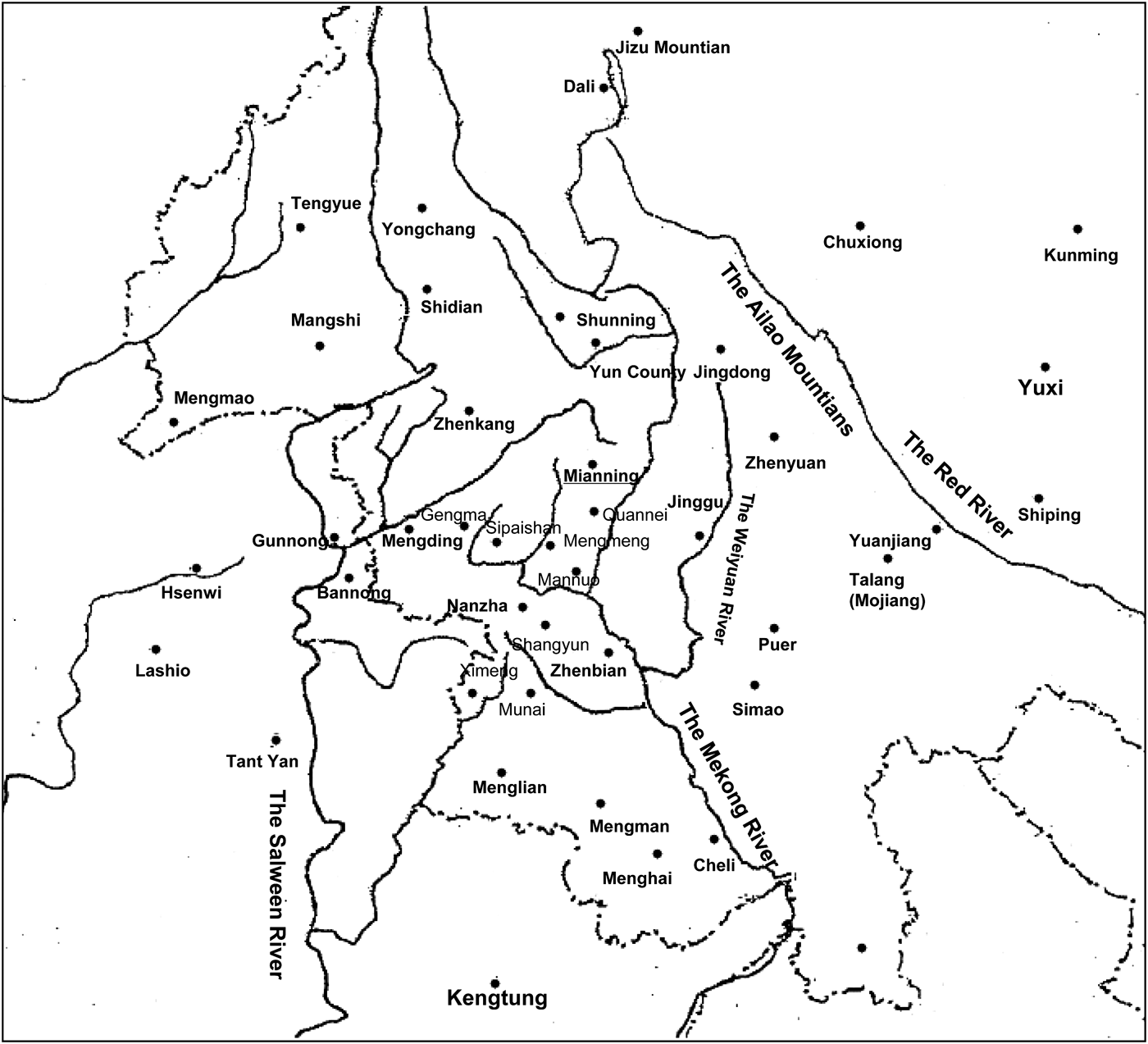
Yunnan–Burma border region (map by the author).

Before the arrival of Han immigrants in the Shunning basin in the Ming dynasty, it had been occupied by the indigenous Pu people. In the early Ming dynasty, Shunning prefecture was set up and controlled by a family of hereditary chieftains, whose surname was Meng 猛, who were the Pu (or the Puman 蒲蠻, the “Pu barbarians”). The Meng chieftain family at Shunning was famous for its wealth, due to the accumulation of family treasures for eighteen generations, and this story attracted the attention of high officials in Yunnan province. As a consequence, in 1596, the general Wu Xianzhong 吳顯忠 framed the Meng family, claiming that they were plotting rebellion. General Wu cooperated with the Yunnan governor in obtaining permission from Beijing to abolish the Meng chieftainship. He integrated Shunning into an official county by implementing the guitu guiliu policy and put pressure on the rebels who followed the native Pu people. After this change, the frontier between the official counties and the non-Han “barbarians” extended to Yun 雲 and Mengmian 勐緬 and remained static until the reforms of the 1750s. According to one gazetteer:
Yun County is the gate to the barbarians' area. From here, the road goes west to Shunning and then Yongchang, and east to Jingdong and Weiyuan 威遠. South of this area, Mengmeng 勐勐, Menglian 孟連, Gengma 耿馬 all are areas belonging to the native Dai chieftains.Footnote 16
The three Dai chieftains to the south of this line, the Mengmeng, the Mengmian and the Mengsha 勐撒, had competed with each other throughout the Ming dynasty. The Mengsha were later taken over by Gengma, which was an extended part of the Mubang 木邦 chieftain area (at Hsenwi) in the Ming and early Qing dynasties.Footnote 17
The surname of the chieftain family at Mengmian was Feng 俸氏. The Feng family had inherited the native chieftainship for seventeen generations before it was abolished in 1746, after which this family was resettled in Jiangxi province. After it became an official county the Qing officials measured the farmland, set the ratio of tax and corvée, which in total was 1,211 dan of rice (about 726 tons), and established a military camp with 1,200 soldiers.Footnote 18 Following administrative reforms in 1746, which integrated the Dai chieftains at Mengmian into official counties, the place name of Mengmian was changed to Mianning (literally ‘peaceful place of the Mian’) because “Mian” is what the Dai called the ancient residents there, who were regarded as the ancestors of the Lahu. After that, the area between Shunning, Yun and Mianning formed a conjoined triangle to the west of the Mekong River in mid-west Yunnan. Subsequently, the border between the counties and the chieftains extended to the south of the Mianning basin. The Han residential bases also extended to the southern margin of the Mianning basin at the Douge villages, facing the Luohei Mountains and the Mengmeng Dai chieftain in the northern basins of Mianning. In brief, in the period spanning the 1590s to the 1750s, a Han Chinese society was gradually established. To the east of the Mekong River, due to the huge, mountainous terrain, even though large numbers of immigrants came from other provinces like Jiangxi, Hunan or other places in Yunnan and settled down, or moved toward the Luohei Mountains through this area, Pu'er prefecture did not become a significant and sizeable Han residential base, in contrast to the situation in the Shunning–Yun–Mianning triangle. But the Han immigrants who came to this area mainly identified themselves as Lahu in the Qing dynasty, which indicates a localization of identity among Han immigrants.Footnote 19 According to local Dai documents, the original residents in their Mengmian area were the Yellow Luohei, and their chieftainship was held by a family whose surname was Bu 布. The founder of this Bu chieftain family was Bu Daomu 布倒募, who led a Luohei group from the eastern part of Mekong River in the Ailao Mountains 哀牢山 to resettle here before the Dai occupied the basin. Following the Bu family, the Feng family who were ethnically Dai became chieftains. After the administrative reforms of 1746, more and more Han immigrants moved in, which pushed other natives to move toward the south from this basin and the nearby mountains. It is clear that the political reforms created fundamental changes to the population.
By the fall of the Qing dynasty in 1911, the Han accounted for about 80 per cent of the local population, the Dai about 8 per cent and the Luohei 7 per cent, while the remaining 5 per cent were made up of the Menghua 蒙化, the Pu, the Hui and the Limi 俐米.Footnote 20 According to Peng Gui'e, a famous local scholar who wrote many reports about local society in the 1930s and 1940s, the Han residents numbered about 80,000 in the early Republican era; they controlled the political, economic, cultural and military power of this frontier base in Mianning. They originated from Jiangxi, Sichuan, Guizhou, and Hunan, but most of them did not directly migrate from their home province. Their common style of migration was to settle at a midway point, such as Jingdong or Shiping 石屏, before resettling at Mianning. There were several kinds of migrants: they were businessmen, descendants of officials, soldiers or exiles. These Han people often concentrated around the three basins of Mianning, Shunning and Yun. They built eight Native Place Lodges (huiguan 會館), based on their province of origin, in the period from the 1870s to the 1910s, including the lodges for Jiangxi, Sichuan, Guizhou, Hunan and Hubei origins, or from other counties in Yunnan, like Shiping, Dali, Chuxiong 楚雄 and Kunming. Associations all had individual festivals for their own annual collective meeting related to various religious activities. Among these associations, the two most powerful organizations were the Jiangxi Lodge and the Shiping Lodge. Aside from the immigrant organizations based on origin, lineages were the basic organizations among more than sixty surnames, the most powerful and famous of whom were the Li 李, Yang 楊, Peng 彭, Qiu 邱, Tang 唐, Zhao 趙, He 何, Zhou 周, and Luo 羅. According to Peng Gui'e's records, in the process of cultural and political change after the 1750s, many of the native Dai people altered their customs, such as their spoken language, clothes and building style, and gradually shifted toward identifying themselves as Han, but by this time most of the Luohei had already moved toward the southern mountains.Footnote 21
LINEAGE CONSTRUCTION MOVEMENT AND CULTURAL CHANGES IN MIANNING SOCIETY
The Qiu lineage was one of the most famous and powerful in Mianning society. According to the Qiu genealogy,Footnote 22 the founding ancestor of the Qiu first migrated from Fuzhou prefecture in Jiangxi in the Zhengtong reign period (1436–1449) in the Ming dynasty, and settled at Shiping County in south Yunnan. In year 11 of the Yongzheng emperor's reign (1727) in the Qing dynasty, one man from the Qiu family left home to make money in the Pu'er area, to the east of Mekong River. He used to be a student and was familiar with Confucian texts before he became a merchant. According to the story, this poor man arrived at Talang 他郎 (today's Mojiang County 墨江县) and prayed at a Guandi Temple 關帝廟, the place to worship the god of war Guan Yu, asking for blessings from him. That night he dreamed of Guan Yu, and received a revelation in the dream: you will find your happiness at an area that has three places each with the word mian in its name, that is “Mian, Mian, Mian 緬、緬、緬”. The next day he met a merchant who came from Jiangxi province. The Jiangxi businessman told the young man that an easy business would be to buy betel nuts in Yuanjiang 元江 then sell them in Mengmian. This young man joined the Jiangxi merchant and they eventually arrived at Mengmian 勐緬 to sell their betel nuts to the Dai natives there. They stayed at a Dai temple in Mianweng 緬翁 village. In Yunnan Han dialect, Theravada temples are called Mian temples 緬寺. The young man suddenly recalled the revelation about the “three-Mian” place names: it was a Mian temple at Mianweng village in Mengmian! It must be the right place! Because the Dai people there were betel nut addicts they made a great deal of easy money. He decided to settle in Mengmian and, because he used be a student, the local Dai chieftain invited him to teach their children Confucian texts. After he had made a great deal of money from teaching, he invested some of it with some Jiangxi merchants in the betel nut business, and they all gradually became rich. Every winter, he went home to Shiping to serve his parents, but returned to Mengmian in the spring. After more than ten years of seasonal migration between Shiping and Mengmian, and after his parents had passed away, he finally moved his family to Mengmian. Later, he built a Taoist temple dedicated to worshiping the god of literature (Wenchang Gong 文昌宫), and ran this temple as a public school where he taught more than a hundred students. He had four sons and seventeen grandsons, all of whom married local Dai women. Some of their relatives from Jiangxi followed them to plant tea and set up porcelain workshops in Mengmian. They were the Jiangxi migrant pioneers of Mengmian, before the reforms integrated the Dai chieftain into an official county in 1746. The Qiu family then developed into a lineage famous for their highly prestigious scholars,Footnote 23 and became one of the leading cultural representatives of the elevated Han power along the Southwest Yunnan and Burma frontier.
Another elite lineage at Mianning was the Leng 冷, who could be regarded as the representative of political and economic power among the rising lineages in Mianning. According to the genealogy,Footnote 24 the founding ancestor of the Leng also came from Jiangxi, but had settled in Sichuan for a short time before resettling, which means that one of the migration routes for the Jiangxi people was along the Yangtze River. The founder of Leng lineage settled at Jingdong in 1621, in the late Ming dynasty. As mentioned above, Jingdong used to be a place controlled by Dai chieftains but was integrated into an official county in late Ming. It then became a locality on the border between the chieftains and the counties before the Mengmian system was reformed.Footnote 25 The Leng settled down at Jingdong and claimed their Jiangxi origin. After that, more and more relatives resettled from their hometown in Wuling County, Nanchang prefecture, Jiangxi. They joined them and developed their settlement into a single lineage village in the Ailao Mountains. In 1641, the leader of the Leng lineage was entitled as a Juren 舉人 in the examinations. He passed the provincial-level civil examination and was appointed as an official. Subsequently, as the Leng lineage became rich and powerful, their ancestral hall was built. After this Juren ancestor passed away, a serious conflict occurred between the Leng and a neighboring lineage. The Leng was finally overcome, the whole village was destroyed, and all the people escaped to the southern mountains along the Mekong River. In 1714, a son of the Leng family, known as Leng Ang 冷昂, moved to Mengmian, where the reforms had not yet been carried out. Leng Ang married a daughter of the Dai chieftain, while one of his brothers became an owner of a famous silver mine in the Puer region. Again, due to their efforts, the Leng lineage gradually reorganized and set up their base at Mianning after the political reforms in 1746. The Lengs rebuilt an ancestral hall, recompiled their genealogy, and re-established many items of collective property under the name of ancestral hall funds. In 1887, one descendant of the Leng lineage, Leng Qihua 冷起華, was appointed as the head of a military camp at the border between Mianning and Luohei Mountain 倮黑山. The rebellious Luohei (Lahu) attacked the official army at the border. Under Leng Qihua's command, his army successfully defeated the Luohei. Through cooperation with Peng Kun, the general commander of the local garrison (tuanlian 團練) at Mianning, their soldiers occupied the northern area of Luohei Mountain and killed the Luohei leaders Zhang Binquan 張炳權 and Zhang Chaowen 張朝文. In 1903, Leng Qihua was promoted to regional general for the Qing army in the Shunning–Yun–Mianning area. Even after the 1911 revolution, when the Qing dynasty fell, Leng Qihua remained the commander of the local official military officers, until his retirement at the age of seventy-one. Under his powerful leadership, the Leng lineage ran three caravan companies doing business between Lashio and Mianning, had more than 500 mu (1 mu = 666 square meters) of farmland and several hundred cattle. Many lineage members of the Lengs were sent to be heads of townships and villages in Mianning and nearby mountain villages, and controlled large areas of farmland. One of Leng Qihua's daughters married a general in the Yunnan warlords' army after the 1911 revolution.
Leng Qihua's family also partly controlled religious power. He sent one of his daughters to a Taoist temple as a nun. The temple used to be an official Hinayana temple belonging to the Dai chieftain before the reforms in 1746, but even before the political reforms at Mengmian the mother of the last Dai chieftain had already converted to Taoism, and he rebuilt the official Theravada temple as a Taoist temple. After the reforms, the temple became the most influential temple in this region. Leng Qihua's daughter was the thirteenth-generation successor of the Longmen teachings (Longmen pai 龍門派), one of the branches of Taoism in west Yunnan. With her powerful family's help, this temple owned large areas of farmland, got more than 100 dan (1 dan = 50 kilograms) tenure per year, and supported more than eighty nuns doing local religious services.
The case of the Leng lineage is crucial. It shows how a lineage was reconstructed after political reforms changed the Dai chieftain to a county, and how the Han immigrants “borrowed” their hometown cultural mechanisms to extend their organizational power in many places, even if they sometimes failed when competing with other lineages. Of course, the Leng lineage was built based on the supporting state ideology, but it also could have failed. After it was reconstructed in Mianning, the lineage organization effectively worked in a multi-functional role: as a business network, military power, farmland controller as well as religious services provider. It was developed gradually, especially in the generation of Leng Qihua, from the 1870s to the 1930s. One of the external driving factors in the reconstruction was the war with the Luohei (Lahu) in the southern mountains area, which also stimulated the rise of other lineages, like Peng Kun's.
It was a historically significant time for lineage construction along the transportation routes between cities in Burma and Yunnan after the 1870s. Meanwhile, the wars with the Luohei Mountains provided another opportunity for the rising Han people, who after 1746 had taken the place of the Dai chieftains in fighting for control of power on the frontier. During the period from the 1740s to the 1930s, various historical factors had pushed the three basins, Shunning, Yun, and Mianning, toward a closer political orientation with the rising of gentry power based on lineage construction. First, there was a war between the Qing and the Burmese kings, followed by the rapid development of the mines in the southern mountains. Meanwhile, an active religious movement among the Luohei (Lahu) reshaped the political structure of the relationships between mountain people, with the political and economic centers in the basins. Besides this, the most serious change to occur since 1886 was the rapid development of commercial exchanges between Burma and Yunnan, after north Burma had fallen to the British and become a colony. All these elements show that the frontier conditions of lineage construction are different from the lineage theories developed in other places in China. In general, the two aspects of modernity and ethnic conflicts on the frontier were crucial factors of lineage development in the terrain between the Mekong River and the Salween River after the 1870s.
Aside from lineage organization for territorial control, there was also the rise of gentry power. Above the layer of the lineages, or the ancestral halls, was an alliance of lineages based on the Native Place Lodges. They were meeting places for lineage leaders, and the bases or the offices of local political affairs, but the lodges looked like religious centers. For example, the Jiangxi Lodge was set in the temple dedicated to the worship of the god Xiao (Xiaogong Ci 蕭公祠), the lodge for Hunan and Hubei origins was the temple of god Yu (Yuwang Gong 禹王宮), and the lodge for Sichuan origins was the temple of the King of Sichuan (Chuanzhu Gong 川主宮). In general,
The Han immigrants have become more concentrated than the locals, while many indigenous people have moved to the outskirts, beyond the borders, and the remainder had gradually become the Han. Since the mid-Qing, local custom had seriously changed and the remaining natives had adopted Han surnames and joined their lineages. The consequence was that there were large numbers of lineages in the prefecture, some villages had become single surname villages, and others became villages shared by different lineages. However, in the cities different lineages had to be co-opted together, a situation different from that in the villages.Footnote 26
The case of the Luo lineage shows the historical process by which different Han groups combined to construct lineages. The founding ancestor of the Luo lineage is said to have come from Ji'an prefecture in Jiangxi, like others, because the Ming court sent many Jiangxi soldiers to Yunnan in early Ming, to establish a military station system in Yunnan. The Luo family resettled at Jingdong military station first. In the wars between the Qing government and the Luohei, in the period from the 1790s to the 1810s, the official strategy was to drive the Luohei away from the Ailao Mountains areas to the west of Mekong River. During the wars, two brothers of the Luo family moved to Mianning, where they were promoted to high military official positions in 1799. One of the brothers married into a local Zhao family, and they bought lands from the Dai chieftain Feng family, to build their houses. After that, the brothers cooperated with other families who claimed the same surname, Luo, but not the same ancestors, to build a new Luo lineage. Eight generations down from the Luo brothers, according to the newly compiled genealogy, the Luo lineage developed into a large village of more than 200 households.Footnote 27
The Panthay Muslim rebellion of 1856 to 1873 was rooted in the shrunken mining industry in the mountainous area. Mianning used be one of the bases of the Panthay army because Yun County was the hometown of the important Panthay general, Cai Fachun 蔡發春, who was second-in-command of the rebel army.Footnote 28 During this period, the whole Shunning–Yun–Mianning triangle was controlled by the Panthay Muslim army, and most Han gentry were targets of that army. For instance, the powerful Yang lineage in Yun County was destroyed. The leaders of the Yang escaped to Jingdong for eighteen years. After this episode of serious social chaos, the Yang lineage recovered quickly. One of the sons in the Yang lineage became a general in the Yunnan warlords' army after 1911. Another son organized their private military force at the home village. In the 1920s, the village was rebuilt into a very stable fortress, and the lineage warriors were equipped with weapons bought from Burma. The Yang lineage therefore became militarized caravan businessmen, running between Lashio and Mianning.Footnote 29
On the militarized frontier after the 1850s, the construction of lineages accelerated. It was also a period of the rising of Han identity, which linked with the development of gentry power and was rooted in the lineages. With the construction of localized lineages and Han identity, the three basins, Shunning, Yun, and Mianning, became a whole political system controlled by the gentry when the Qing state weakened. It was a period of rapid commercialization between Lashio and Mianning as well, because after the colonization of Burma, trans-border trade became much more convenient. Along with the business line, the lineage networks also quickly extended toward the Burmese side through Mengmeng, Gengma, and Kokang 果敢, to Lashio, Mandalay and Tant Yan 當陽. It can be verified that the rapid development of Han lineages along the transportation routes was not because of the development of strong state power or state-promoted Confucian ideology, or because of the newly exploited farmlands and the demands for settlement rights from new comers. After the coming of British colonial power on the Burmese side, trade styles quickly changed from the previous relationship of tributary and trade between Burma kingdom and the Qing China, to become trade between the local gentry-controlled market in Yunnan and the market controlled by British merchants in Burma. However, when we consider Chinese lineages, the circumstance of lineage construction at the Yunnan and Burma frontier should be regarded as the social and cultural base for those so-called Yunnanese caravan traders in Southeast Asian counties. Additionally, the development of lineages in Mianning could also be seen as a process of rising Han asserting their identity, and confronting other indigenous ethnic groups such as the Dai, the Wa and the Luohei (Lahu), who clung to different political systems and maintained identities distinct from the Han.
What is significant here is that when the lineage organization becomes a social institution for local mobilization, networking for cross-border trade and military power in the basins opposite the mountains systems on the frontier, the Han then becomes a type of native identity. What they claimed about their Jiangxi or Sichuan origins could be regarded as a necessary cultural source to create an ancestral myth, or the way to link people together based on certain alternative methods. The Han lineage replaced the Dai system, but the network of trade, the control over farmlands, and the influence of religious belief had also extended toward the southern outer regions, toward Lashio, following this tendency. The case of the Peng family will show how gentry power worked as a vector in the formation of the Yunnan–Burma frontier after the 1870s, using the core issue of lineage construction.
THE CASE OF PENG KUN, AS THE PIONEER AND CONTROLLER OF THE FRONTIERFootnote 30
The official military commander, Leng Qihua, married his daughter to a son of the Peng lineage. The Peng lineage had been constructed after the political reform of the Dai chieftains, like other lineages in Mianning. Peng Kun 彭錕 (1855–1928) was the leading gentry member of his Peng lineage and performed a key role among gentry leaders for more than fifty years in the Han society of Mianning. Gentry (shishen 士紳) often referred to local political leaders who were official title holders, but it also indicated powerful people who were local leaders representing their lineage or village interests and not necessarily holders of any title.Footnote 31 Under Peng Kun's leadership, the political power of Han gentry, based on Mianning society, quickly extended toward the outer Dai chieftain areas and penetrated into the north Luohei Mountains, then gradually integrated these areas into the system of Mianning. Therefore, Peng was an important state agent at a time when the Chinese state was weak, and he strongly reshaped the social landscape for the current Yunnan and Burma frontier. According to the Peng lineage genealogy, the founder of the Peng came from Anfu County 安福縣 in Ji'an prefecture 吉安府, Jiangxi province.Footnote 32 It was a considerable lineage in the home county, based in a single lineage village, and the whole lineage had separated into three sub-lineages in early Qing. The first generation of the Peng had settled at Jingdong as merchants as early as the Hongzhi reign (1488–1505) in the Ming. After the Yongzheng reign (1678–1735) and before the reforms, some of the Peng set up a branch in Mengmian. However, the Peng in Jingdong and Mengmian still maintained their network with the Jiangxi home village and there were endless new Peng migrants who came to join them in Mianning. In 1795, acting as a local representative for the first time, a Peng man participated in the provincial civil examination after an official school was established at Mianning, and gained the title of Juren. Four years later, this Juren joined the Qing army in wars against the Luohei, but he died in the war. Following him, another Peng member came to Mianning from Jiangxi, in Jiaqing's reign (1796–1820), and became a teacher at the official school. Then one of his nephews, Peng Kun's grandfather, came to join his family. Peng Kun's grandfather was a merchant but he failed to make money due to the chaos at the time of the Panthay rebellion. It was not until 1899, when Peng Kun became the leader of the Mianning gentry, that the Peng's ancestral hall was built.
In the local context at Mianning, people called Peng Kun the head of the local gentry (shenshou 紳首), because he was one of the leading representatives of all lineage leaders, and these lineage leaders were regarded as members of the gentry. In the Peng lineage genealogy, Peng Kun was described as the leader of Peng lineage:
He received the order to conquer the Luohei Mountains from the court, and finally became the pioneer and controller of the frontier. Beside this, he created an education system at the temple of Three Saints (Sanshen Gong 三聖宮) to enlighten the local people. He also established tea plantations and enlarged the tea trade with merchants at Menghua County.Footnote 33
In the mountainous area between Mianning basin in the north and Sipsongpanna in the south, from the Mekong River in the east to the Wa Mountains in the west, the region was called the Luohei Mountains (Luohei Shan 倮黑山). In this large area, several monks who followed the teachings of Big Vehicle Religion (Dacheng Jiao, 大乘教) established a political system known as the Five Buddha Districts (wu fo wu jing 五佛五經). It was a three-layer and centralized religious and military system controlled by the Zhang family from the 1790s to the 1910s.Footnote 34 The most serious military conflicts between the Qing government and the Five Buddha Districts in the Luohei Mountains were in the period between 1796 and 1812. Because the Qing government had set the Mekong River and the margin of Mianning basin as borders after the Luohei were driven away into this frontier area, the Qing government tried to manage Mianning as the new cultural and political base before the war with the kingdom of Burma, and to keep the transportation routes open to the side of Mubang and then Lashio. After 1885, the Qing government realized that British colonial power was a direct threat to the frontier. The Yunnan-Guizhou governor, Cen Yuying 岑毓英, sent official and private troops to cross the Mekong River from the east wing and from Mianning in the north, charging them with the task of building a new county in the Luohei Mountains. Peng Kun was the commander of the local garrison from Mianning, and his troops finally destroyed the central temple of the Five Buddha Districts system at Nanzha, in 1889. After that, the gentry power of Mianning was the main military force used to fight Luohei warriors on the north wing, until the final destruction of the power of the Luohei in the 1920s.
In 1873, the Qing government suppressed the Panthay rebellion, but found that the lengthy wars had already seriously weakened the financial base of the provincial government. What followed was another wave of political power shifting from government officials to local militarization run by members of the local gentry in Mianning. During the Jiaqing reign (1796–1820), the Qing government set the military boundary with the Luohei Mountain at the margin of the Mianning basin. There were two military bases at Quannei and Potou, about 50 kilometers away from Mianning city, for defense against the Luohei. But in 1908, the government dissolved the Green Standard Army (Lüying 綠營) and handed overall military authority to the local gentry, allowing them to establish local garrisons, the Tuanlian 團練, the gentry's force in point of fact.Footnote 35 In Mianning, in each regiment, there were 60 militia members, divided into three groups of 20 soldiers: the group for battle, the group for preparation, and the group for police officers. A head soldier was appointed for every 10 soldiers, and in each group every 5 soldiers were organized into a fighting team. All of them were militia, under the general commander of the garrison, so the Native Place Lodges had to pay each soldier a salary of 2.4 liang (1 liang = 50 g) of silver every month. Only county seats, like Mianning, Shunning and Yun County, had a garrison. Two members of the gentry were selected as the general commanders of the local garrison, and they were paid ten liang silver per month. The income of the local garrison came in part from the government in the form of the salt tax, but this was just a small share of the total cost after the 1870s. The major financial support for local garrison came from donations made by powerful local lineages and merchants, which therefore meant that the gentry army was based on local autonomy. In other words, because the government could not completely support the army, political power shifted to the powerful local lineages. The leaders of these local lineages took on the responsibility of training an army for themselves and members of the local gentry assumed responsibility for local affairs after the 1870s. The gentry became a group that was adept at running their military force. However, they also needed to finance this militia force, and there was no easy way to do this. The resources of the Mianning gentry group now came from the new economic interests along the transportation routes to Lashio, while new opportunities and resources which they could obtain from the Luohei Mountains and the Dai chieftains were also substantial sources of income to support their military power.
After the colonization of upper Burma, the area along the roads from Lashio to Mianning rapidly became a busy commercial zone. Some merchant associations based on cross-border trade were controlled by large lineages or, in other words, controlled by a number of members of the leading gentry.Footnote 36 In brief, after the 1870s, Mianning and the nearby basins had developed into new and rapidly expanding commercial centers through commercial exchange with Burma. As a result, some lineage leaders, like Peng Kun, became representatives of local gentry power who not only controlled a military force and economic opportunities, but also political connections with the higher provincial government. Besides this, members of the gentry controlled local affairs through networks of lineage relationships between villages and cities, and through intermarriage relationships between lineages, such as in the cases of the Leng and the Qiu lineages. So, Peng Kun was the commander of the local garrison in Mianning, supported by local Han lineages fighting with other ethnic groups, and he extended the range of Han gentry power toward the Burmese side.
Becoming a Representative of the Gentry Power of Han Society in Mianning
Peng Kun grew up during the period of the Panthay rebellion in Mianning city, when the Panthay army were in control of the area for more than a decade. During this period, the Qing official and civil examinations were abolished. Peng Kun's father passed away when he was ten, which forced him to become an apprentice to a tailor's family at a young age. He shifted to a cloth-dying workshop when he reached fifteen, while he continued to study at a private school. When Mianning recovered from the Panthay rebellion, Peng Kun found a civilian job at a government military office when he was nineteen, and was promoted due to his talent. He was trusted by his superior, General Ding Huai 丁槐, who later became the governor of Guangxi and Yunnan provinces. Based on this work experience, he built up a special connection with some high-ranking officials. When Peng Kun was twenty, General Ding Huai appointed him as commander to attack the Wa tribes in Mengjiao and Mengdong. He then successfully gained an official title of the ninth rank (jiupin guan 九品官). After that, he opened a salt store at a ferry crossing on the Mekong River, through which he controlled the transportation route for salt business between Mianning and the salt production wells at Jinggu 景谷 to the east of the Mekong River. Gradually, Peng Kun not only controlled various salt sources, but also transportation gates between Mianning and Jinggu, and became rich. His influence over local affairs was quickly accepted by other lineage leaders, so he was selected as an organizer for people of Jiangxi origin to build the Jiangxi Native Place Lodge. All costs were covered by the rich lineages. The Jiangxi Lodge was regarded as an office and alliance of the most powerful lineages, and was also managed as a Taoist temple. As a young member of the gentry, Peng Kun established a Dongjing Assembly 洞經會 at the Jiangxi Lodge, and all local scholars and gentries joined this Tao Assembly, setting up regular meetings to practice Tao rituals there.Footnote 37
The Dongjing Assembly was a Taoism–Buddhism–Confucian combined teaching practice based on a Taoist-style music ritual. The members of the gentry who participated were organized into a musical performance band at the temple – the Jiangxi Lodge at Mianning. Through this musical performance, the Taoist texts were sung as a way of accumulating merit. This Dongjing Assembly tradition had originally developed in west Yunnan in Dali, as a localized method of teaching practice in Yunnan, since the late Ming dynasty. But, as late as the mid- and late Qing, Dongjing Assembly groups were well developed in cities in south Yunnan. Some retired officials, powerful lineage leaders and Taoist specialists came together regularly as a performance band, to practice musical rituals according to the annual schedule, especially at festivals and at the gods' birthday celebrations. In the Jiaqing reign (1796–1820), the Dongjing Assembly was first established at Yun County, then in the early Republic during the 1910s to the 1920s, an ever greater number of Dongjing bands were organized in various townships outside the Yun County seat.Footnote 38 But in Mianning, the Dongjing Assembly was established as late as in 1892, by Peng Kun. The gentry in the city would study a set of musician performances as Taoist rituals, and they also organized a parade of deity statues for all temples during the Lunar New Year festival, which attracted several thousand participants.Footnote 39 This change at Mianning shows that, about 150 years after the administrative reforms, Mianning society had changed from a Dai chieftainship into a Han Chinese society in this frontier extension, just like other interior cities along the transportation routes in Yunnan. The organization of the Dongjing Assembly also reveals that a lineage-based society was controlled by a sizeable gentry group after the Panthay rebellion. Localized immigrants and the natives who converted their identities and culture to the Han style had been well integrated into a new system. It is clear that the Dongjing Assembly was the cultural and religious symbol of a gentry-controlled Han society in most cities in Yunnan.Footnote 40
In the same process, the war with the Luohei can be seen as another aspect in the development of a local gentry group, through which more political power and more local resources became under firm control, Peng Kun being the leader of this group. In 1887, when the Yunnan-Guizhou governor, Cen Yuying, ordered General Lu Chun 陸春 to send an army to attack the Luohei Mountains from the north, Peng Kun was selected as general commander of the local garrison at the age of only thirty-two. After this war, Peng Kun became an important social actor in the construction of the Yunnan–Burma frontier, and also served as an agent of the state in the establishment of the border. In brief, after he worked with officials and built up special connections, Peng Kun engaged in the salt trade to become rich. The trade helped him accumulate plenty of money and human resources. He then worked as the leader of the Jiangxi Lodge, through the building of a lodge and the establishment of the Dongjing Assembly. Finally, due to his talent as a military strategist against the Luohei and the Wa, he became general commander of all Mianning's garrisons. In 1903, the Luohei and the Wa rebelled again. They attacked the Dai chieftain at Mengmeng and official army stations at the Mianning border. At this time, the Mianning officials appointed Peng Kun as sole commander, to lead the well-trained garrison and small numbers of official soldiers to fight against the Luohei and the Wa allied army. They occupied Nanzha 南栅 again, destroying the center of the religious and political system in the Luohei Mountains.
Extending Garrison Power into the Luohei Mountains
After the 1790s, the Five Buddha Districts system gradually became established in the mountainous areas. The Five Buddha Districts system was based on a mechanism of secret societies at the frontier, but the teaching of the leading monks of the Big Vehicle Religion followed a secret society tradition in the Luohei Mountains, and this system was controlled by the Zhang family for many generations. As a student of the master founder of this teaching, the monk Tong Jing (銅金和尚) resumed his Han name, Zhang Fuguo 張輔國, in 1799, and became a Luohei style “Buddha King”, but he himself was also a Han immigrant to the Luohei Mountains. Through this religious movement, the Lahu identity and relatively religious culture was well mobilized and confirmed for more than a century. The Zhang family was not a lineage, but, generation after generation, from Zhang Fuguo to his sons and grandsons, they had all been regarded as the reincarnation of the E Sha Buddha 厄沙佛祖, until Zhang Chaowen 張朝文, who escaped to Burma after failing to repel the attacks of Peng Kun and his colleagues in 1903.Footnote 41
Under the leadership of the central temple at Nanzha, controlled by the Zhangs who appeared each generation as a reborn Buddha, the Five Buddha Districts system in the Luohei Mountains divided the whole area into five or six districts. In each district, a district chief jo53 mo53 or lord (Taiye 太爺) was appointed by the Nanzha temple (Nanzha fang 南栅佛房). Six or more sub-lords (zhangye 掌爺), under the district chief, were selected by the central temple of the districts. Each of the sub-lords controlled several villages, and in each village a village head was selected by the villagers at the village temple. The villagers had to pay tax and labor service to the village head, based on households. Young male villagers were organized into warrior bands, based on three-man groups made up of a crossbowman, a spearman, and a stick-fork fighter; each of them would carry one hundred arrows into the fight. There was a warrior head under the village head in each village. After the 1870s, firearms were also used in the Luohei Mountains.Footnote 42 During the period of the Panthay rebellion, the Luohei leaders were appointed as officers and given official seals by the Panthay leader, Du Wenxiu.Footnote 43 Until 1887, the Luohei military force extended to the margin of the Mianning basin. Once the Qing government had determined to take action and attack the Luohei from Mianning and Jinggu, before the British extension into this area from Burma, the Mianning garrison quickly occupied the area north of Luohei Mountain. After the war in 1887, the Qing government established a new military county in the Luohei Mountain, known as Zhenbian County (Zhenbian ting 鎮邊廳). In their trial, after Zhang Zhengfa 張登發 and Zhang Shibao 張石保 were arrested, they did not speak Han Chinese, claiming that they were Luohei generals, and Luohei/Lahu language speakers.Footnote 44 Since the time of Zhang Fuguo, the Zhang family had defiantly converted their Han identity to the Lahu, who mobilized to fight with the Han invaders and wanted to return to their ancient hometown in Mianning.Footnote 45
The Luohei Mountains was an area shared between Dai chieftains, Han residents, as well as Wa tribes. In order to demarcate the border with Burma, Qing officials decided that the newly established county should be controlled by the Qing; otherwise, the land might be forcibly incorporated into Burma by British colonialists. After the occupation of the Luohei Mountains, Qing officers appointed nine powerful Han original families as the new native chieftains, and allowed them to control the previous Buddha districts after carrying out household registrations and possible taxation measures.Footnote 46 Through this new frontier formation, the previous Luohei Mountains became the new borderland controlled by the Qing government, forming a barrier for Mianning and Jinggu counties, which extended the line of the frontier from Mianning and Jinggu toward the Wa Mountains. This area became the object of negotiation by both sides during the investigations for the delineation of the border.Footnote 47 In the wars against the Luohei forces, Peng Kun led his garrison, and they occupied and controlled the northern area of the mountains, and shared political power with the nine new chieftains and the official army in the north. Owing to his great efforts in fighting the Luohei, Peng Kun was appointed officer of the northern Luohei Mountains. In 1894, Peng Kun drew several maps of this frontier for the Qing government, which provided essential data for the subsequent investigation for the undetermined border with Burma. His feat of frontier extension toward the Wa Mountains demonstrated his unusual loyalty to the Qing state and to the interests of the Han power based at Mianning.
However, again, the remaining rebellious Luohei and Wa people rose up to defend themselves against the Han invaders in 1903. Another son of Zhang Chaowen cooperated with the Wa leader, Bao Aimeng 鮑岩勐, and mobilized their people to resist the Han army, because Han merchants and immigrants tried to take over their lands and other economic resources, especially the opium trade channels. The Lahu–Wa alliance army pushed the Qing forces back to Mianning and burned Mengmeng Dai city to the ground in March 1903.Footnote 48 After that, they fought with the Mianning garrison for another three months. Led by Peng Kun, the garrison recovered the area, and finally drove the rebellious leaders into Burma. Again, the holy place of Nanzha and nearby Wa villages in Ai Shuai were taken over by Peng Kun's soldiers.Footnote 49 After this war, the Yunnan-Guizhou governor appointed Peng Kun as the only officer of local affairs in the area north of the Luohei Mountains, and gave him the power to practice political reforms to integrate the Dai chieftaincy at Mengmeng into an official county. Having set up his stable military base at Nanzha, the next step for Peng Kun was to establish a new county government in the northern Luohei Mountains and the Mengmeng Dai chieftain area. He did this by appropriating land rights and the control of the justice system, which had previously belonged to the E Sha Buddha and the Dai chieftain, to form Mianning County.
Administrative Reforms That Transformed the Tai Chieftainship into a County in 1922
In the vast terrain on the Southwestern frontier between Yunnan and Burma, especially in the Menglian, Gengma and Mengmeng area, the Dai chieftains had set up a taxation system that differentiated between mountain land, known as Quan 圈, and basin land, known as Meng 勐. Therefore, “Quan” and “Meng” extracted two taxes in different ways. For instance, there were “Three Meng and Five Quan Districts” in Jinggu, “Nine Meng and Thirteen Quan in Gengma”.Footnote 50 The structure of Quan in the mountains and Meng in the basins meant that household taxation was owed to the chieftain, but the villagers in the mountain areas only paid a specific amount of tax, known as “silver for mountains and rivers (Shanshui Yin 山水銀).” Because many of the Wa tribes practiced head hunting, the Dai chieftains were prevented from collecting tax from these mountains, but that was only the case prior to the Luohei resettlement in the mountains areas. After the Five Buddha Districts system was established by the monks of the Big Vehicle Religion teaching, the previous Quan district systems in the mountains, under the jurisdiction of the Menglian Dai chieftain in the south and the Mengmeng Dai chieftain in the north, were taken over by Luohei monks and reshaped into the Five Buddha Districts. After this change, the Luohei leaders refused to pay any silver tax for “mountains and rivers” to the Dai chieftain. Many Chinese and Dai official documents show that the Dai chieftains had struggled with the Luohei rulers for a long time and appealed to provincial governors and the emperor many times. Before the coming of the Luohei, the Mengmeng Dai chieftain collected 330 liang of silver as tax for the land (the silver for mountains and rivers), plus an additional 240 liang silver as household tax from the mountain Quans. Under this system, there were different levels of officials, such as: Lang Meng 郎猛, Zhangmeng 掌猛, Langjia 郎家, Guanshi 管事, Baizhao 百找, and Huotou 火頭, who, as heads of the three layers of the administrative Meng and Quan system, were in charge of affairs relating to village militia training and tax collection. The chieftain officials held judicial power. At village level, the system set aside a piece of common farmland to support the selective village heads (Huotou, literally means ‘head of fires’). Besides the land for the village heads, there was a village committee on which sat men of considerable prestige, with the power to redistribute certain areas of collective farmland (zhaigongtian 寨公田). Under the system of chieftaincy, the village authority had a sufficient amount of power to control collective lands.Footnote 51
Even if the Quan system could have been easily converted into the Five Buddha system, the framework would still have remained after Peng became the ruler of the area north of the Luohei Mountains. He reformed the previous Quan and Five Buddha Districts order into a new system controlled by Han gentry power originally from Mianning. From 1903 to the 1920s, as the local ruler, Peng Kun abolished the Dai chieftaincy at Mengmeng in the basin, then he changed the previous system of Quan and Buddha districts as follows: (a) collective farmlands in mountain villages in the north Luohei area of the Mountains were changed into land property for village schools, and the land rents paid were used to support a small village school; (b) the jurisdiction of the Dai chieftains was abolished and the authority of the judiciary was passed to the Mianning government; (c) the layers of administrative officials were reformed into a county system, heads of districts were set up, and two levels of village heads were combined into a single head of a village; (d) household registration was carried out for tax collection purposes, and a village-level militia was set up following principles similar to those of the gentry army, as in Mianning. Based on this political reform, he handed over all financial income to the Mianning government except that required for local affairs such as fees for the local army.Footnote 52 Due to his long-term management, in 1926 the Yunnan provincial government approved the establishment of a new county, Shuangjiang County 雙江縣, in the area of the Mengmeng chieftaincy and the north Luohei Mountains. By the time of Peng Kun's death in 1928, an official system based on county government, districts, townships and villages had been firmly established.Footnote 53
Another important social change carried out by Peng Kun was the development of local markets after the safety of the transportation route between Lashio and Mianning through Shuangjiang was guaranteed. The large amount of “horse” (actually mule) caravan trade between the two sides had multiplied within a short time after Peng Kun's rule was established. Business interests were guaranteed; the exchange goods included imported Indian cotton and machine-spun cloth, European soaps, kerosene, and weapons, while the exported goods were mainly tea and minerals or opium. Gradually, eleven regular markets opened, providing an income from taxation of around 0.2 million silver yuan, and since the 1910s the production of local tea had reached about 600 tons per year.Footnote 54 In brief, the social landscape of the north Luohei Mountains changed significantly after the Mianning gentry power had been in control of this mountain area for about twenty years. Peng Kun played the key role in these changes, but he should still be regarded as the representative of the interests of Mianning Han society.
Displaying Wa Skulls to the Wa and Work in the Border Negotiations
During the occupation by Han gentry power, the Mianning garrison encountered the Wa tribes on the western margin, where both the British colonialist authority in Burma and the Chinese Qing and Republican governments wanted to draw a border over the mountain ranges. Peng Kun set up several military camps in the Si Paishan Mountains 四排山, where they could protect the trade routes from the threat of the Wa tribes. This was the route that linked Shuangjiang with Lashio by passing through the Gengma customs gate. Before the occupation by Peng Kun's army, the Wa tribes had scattered to the west of this route and, as they liked to engage in the practice of head hunting there, for a long time the Wa had actual control over the route.Footnote 55 In order to avoid the Wa tribes' attacks, the Dai villages were forced to submit tribute in silver and oxen every year as a payment for protection. Peng Kun, therefore, set up a “Tree of Heads” in each village to display the skulls of Wa on the trees as a deterrent to Wa warriors. This strategy, which in effect borrowed the custom of posting skulls from the Wa themselves,Footnote 56 served as an effective way to stop head hunting by the Wa in the area.
In the first border investigation of the Wa Mountains between China and British Burma, from 1899 to 1900, as the local administrator, Peng Kun worked as a border issue committee member, helping the Qing official, Chen Can, and British colonial officer, James G. Scott. A doctor and a translator in the British team were killed by the Wa tribe at Yonghe 永和, in January 1900, when the Wa tribes in Yonghe and Mengdong organized about 3,000 warriors to resist outsiders going into their territory, and repulsed both the British and the Han officials' border-drawing investigation. Following this incident, both sides appointed Peng Kun as negotiator and liaison officer, to deal with both military action and the geographic investigation.Footnote 57 Even though the border was not finally determined in this area until 1961, Peng was an important actor in the border negotiations and, based on his hand-drawn maps, the Chinese government had a key local consultant who was familiar with local affairs and provided fundamental data to both sides.
As a representative of Mianning lineages and gentry power, Peng Kun's family were important social actors in the China–Burma frontier for many generations. One of his sons, Peng Zhaoji 彭肇紀, was sent to Japan as an overseas Chinese student in 1905. He joined the Tongmenghui 同盟會 organized by Sun Yat-sen and became one of the core leaders of the Chinese Nationalists' revolution to overthrow the Qing government in Yunnan. Another of Peng Kun's sons, Peng Zhaomo 彭肇模, was also powerful on the borderland. He was not only a political actor but also a successful trader who could speak several languages and maintained a friendship with the Wa chiefs. His caravans could easily cross the Wa Mountains, due to his special connection with the Wa, and as a result make a substantial amount of money by which to support the local garrison in the 1940s.Footnote 58 He escaped to Burma in 1949 when the Communist army arrived at Shuangjiang. After Peng Zhaomo moved to Burma, he joined the KMT army and was appointed as column commander of Lancang and Mianning in Burma and Thailand, until 1962. He was an influential figure among the KMT in Burma and Thailand, until he passed away at Maesai in 1972.Footnote 59
CONCLUSION: CONSTRUCTION OF HAN IDENTITY AND INTERACTION WITH THE OTHERS ON THE FRONTIER
The Ming government set up the Shunning Prefecture in Southwest Yunnan after the 1590s, at a time of administrative reform and frontier reconstruction involving the integration of native Dai chieftains into an official county system run by circulating officials. In the period from the 1720s to the 1740s, Mianning County was established by Qing officials, with the cooperation of the Han settlers. Frontier formation was closely linked with the construction of immigrant communities around cities and commercial centers. However, the continual expansion of state power toward the mountain areas and Burma dramatically changed due to the collapse of the mining industry and ethnic conflicts during the Panthay rebellion, both of which happened between the 1830s and 1870s. After that, the construction of lineages among the Han settlers in the Shunning, Yun and Mianning basins and their networks became significant, because British colonialists now took the place of the Burmese kings, and opened up new opportunities for the Han Chinese merchants from Burma. However, the threat of British colonial power also pushed the Qing government to consider how to demarcate a clear borderline on a huge terrain where ethnic groups with ambiguous identities resided between Yunnan and Burma. The political systems in the mountains included the Five Buddha districts system, the Wa communities, the Dai Chieftains, as well as Han Chinese residents between Mianning, the Mekong River and the Salween River.
In the process of state border demarcation, gentry power based in Mianning society performed the crucially important role of state agency in border making. The Han residents had demonstrated their loyalty to Qing officials in the wars against the Luohei, the Dai, and the Wa polities, even if the political leaders of these non-Han groups were also, occasionally, originally from the Han side. Therefore, we should look once again at the long-term identity construction among different political systems in this mountainous terrain between Yunnan and Burma. There were the Quan and the Meng systems controlled by the Dai chieftains, after which came the newly established political system of the Luohei (Lahu), known as the system of Five Buddha Districts. This system was rooted in a religious movement among different settlers and natives, but mobilized different groups into a seriously politicalized and militarized system, bound with Lahu identity in more than one century.Footnote 60 Meanwhile, the majority of the Wa communities had practiced a different political system in the mountain area between the Lahu, the Dai, the Burmese and the Han. Put briefly, it was a system of territorial control through social mechanisms such as head hunting.Footnote 61 Additionally, led by the gentry elite, Han settlers set up their own political system based on an alliance of lineages in the basins of Mianning, Shunning and Yun, opposing the Luohei, the Wa and the Dai, as their response to these non-Han ethnicities.
By taking the case of Peng Kun and the gentry power developed at Mianning after the 1870s, we gain a better understanding of the mutual construction of identities in the frontier terrain between the Mekong River and the Salween River at that time. The Han settlers also needed to create their own political system supported by lineage corporations, through compiling family genealogies, building ancestral halls, setting up collective properties and farmlands, and cooperating with local governments. However, the Han residents were not simply the representatives of the Qing or the Republic governments. They did not care very much about which states they should support. What they really desired was territorial control, and the chance to advance their economic interests that involved exploiting the Dai, the Luohei, and the Wa, and searching for new commercial opportunities. The Han garrison could appropriate land from the Lahu and the Dai, but the Han merchants could also share their business interests with foreign traders in Burma and exchange goods with people in the mountains. Therefore, control over the transportation routes became the key issue and Han lineages developed along the routes from Lashio to Mianning. Thus, the ethnic identity of the Han Chinese on the frontier is not as self-evident as the identities of other non-Han peoples.
The gentry rose up to become leaders of the localized lineages, and they were to become the actual rulers on this frontier when the Qing state began to collapse, and in the chaotic periods from the Qing dynasty to the early Republican era. In brief, the gentry represented their groups' interests based on a system of lineage corporations, and this political system was constructed during the time when official Confucian ideology was about to collapse on the frontier. Meanwhile, due to this social condition of frontier transformation and state reformation, the exploitation of modern commercialization on the frontier between Yunnan and Burma flourished. The trade network overlapped with the network of lineage corporations and was protected by their leading gentry power. Social actors like Peng Kun, as the general commander of this militarized gentry power, supported by the Mianning lineages, guided the local garrison to occupy the Luohei and the Wa Mountains, to operate new markets, and to cooperate with higher-level provincial officials. All of these not only extended and protected their own groups' interests, but also worked in the role of state agency, even when the Chinese states were weakened. As a social consequence, their activities also guaranteed deep penetration of state institutions and state ideology among the Luohei and Wa villagers, and furthermore their activities set down new conditions for the later transformations effected by the communist state after 1949.
Here, we could conclude that there was a dual process of administrative and identity change and competition on the frontier. On one hand, there was the construction of gentry power on the frontier, which represented the construction of a Han identity opposing the Others; on the other hand, there was a process of frontier construction pushed by state and local officials, but both sides had to cooperate and respond to the social changes in Burma. Additionally, there was a process through which the political systems and identities of the Lahu were mobilized, while those of the Dai shrunk, and those of the Wa were reconfirmed. However, the Han system was mainly developed along the transportation route between Lashio and Mianning. In brief, after the 1870s, there was a very strong tendency toward self-construction among the new immigrants. In this process, they settled down and extended their networks and power toward mountain areas and upper Burma. What they chose to do was to become Han by copying a social institution from their hometowns in a different context, at this newly exploited frontier. Without the construction of lineages, the creation of Han identity was impossible. Some cases show that many immigrants may have changed their original identities to be the Lahu, the Wa or the Dai, but certain natives, like the Dai in Mianning, also shifted their identity to become Han once they adopted the ways of lineage construction and claimed Han identity. When state institutions like the county system, schooling, legal jurisdiction, household registration and taxation had penetrated the newly exploited frontier under the conditions of the colonization of Upper Burma, the construction of Han identity also became a part of frontier extension from China. Thus, both the identities of ethnic minorities and the Han majority experienced the same process of frontier re-transformation, but with the difference that it was a new and effective way to create Han Chinese lineages on this frontier, while in other parts of China lineage organization was about to collapse with the fall of the Qing dynasty. When a new frontier linked with modernity was formed, the correlated lineage organizations became a kind of frontier institution between China and Burma.