INTRODUCTION
Teladorsagia circumcincta is a parasitic nematode that inhabits the abomasum of small domestic ruminants. It is an important parasite in temperate areas of the world, both in terms of animal welfare and economic loss. Animals suffer from diarrhoea, reduced growth, emaciation and high morbidity; the estimated cost to the British farming industry through gastrointestinal parasites alone is £84 million annually (Nieuhof and Bishop, Reference Nieuhof and Bishop2005; Scott et al. Reference Scott, Sargison and Wilson2007). Current control methods rely on pasture management and the use of anthelmintic drugs; however, the emergence of widespread resistance to anthelmintic treatment is driving the search for alternative methods of control (Sargison, Reference Sargison2011).
Sheep can acquire immunity to T. circumcincta following exposure, leading to investigation of vaccination as one such alternative method of control (Smith et al. Reference Smith, Jackson, Jackson and Williams1983, Reference Smith, Jackson, Jackson, Graham, Williams, Willadsen and Fehilly1986; Miller, Reference Miller1996; Balic et al. Reference Balic, Bowles, Liu and Meeusen2003; Macaldowie et al. Reference Macaldowie, Jackson, Huntley, Mackellar and Jackson2003; Halliday et al. Reference Halliday, Morrison and Smith2009, Reference Halliday, McAllister and Smith2010). Manifestations of immunity include a reduction in total worm burden and egg output, a reduction in developing worm length and a reduction in larval establishment in the abomasa of immune sheep, through either exclusion or expulsion, within 48 h of ingestion (Stear et al. Reference Stear, Bishop, Doligalska, Duncan, Holmes, Irvine, McCririe, McKellar, Sinski and Murray1995, Reference Stear, Strain and Bishop1999a, Reference Stear, Strain and Bishopb; Jackson et al. Reference Jackson, Greer, Huntley, McAnulty, Bartley, Stanley, Stenhouse, Stankiewicz and Sykes2004; Halliday et al. Reference Halliday, Routledge, Smith, Matthews and Smith2007, Reference Halliday, Morrison and Smith2009). This implies that there are critical events occurring very early in the host-parasite interaction that determine whether the parasite can establish in the abomasum of its ovine host.
The high capacity and relatively long read length of 454 sequencing technology (Margulies et al. Reference Margulies, Egholm, Altman, Attiya, Bader, Bemben, Berka, Braverman, Chen, Chen, Dewell, Du, Fierro, Gomes, Godwin, He, Helgesen, Ho, Irzyk, Jando, Alenquer, Jarvie, Jirage, Kim, Knight, Lanza, Leamon, Lefkowitz, Lei, Li, Lohman, Lu, Makhijani, McDade, McKenna, Myers, Nickerson, Nobile, Plant, Puc, Ronan, Roth, Sarkis, Simons, Simpson, Srinivasan, Tartaro, Tomasz, Vogt, Volkmer, Wang, Wang, Weiner, Yu, Begley and Rothberg2005; Roche, 2011) has made it suitable for transcriptomic studies and several parasite species have been investigated in this way including T. circumcincta, Haemonchus contortus, Trichostrongylus colubriformus and Fasciola hepatica (Young et al. Reference Young, Hall, Jex, Cantacessi and Gasser2003; Cantacessi et al. Reference Cantacessi, Campbell, Young, Jex, Hall, Presidente, Zawadzki, Zhong, Aleman, Loukas, Sternberg and Gasser2010a, Reference Cantacessi, Mitreva, Campbell, Hall, Young, Jex, Ranganathan and Gasserb; Dicker et al. Reference Dicker, Nath, Yaga, Nisbet, Lainson, Alex, John and Skuce2011). Here, we used 454 sequencing to examine gene expression in the infective 3rd larval stage of T. circumcincta immediately following exposure to either an immune or a naïve ovine host abomasal environment. By comparing gene expression in these environments we have identified a subset of the genes that may be important in larval infectivity and response to host immunity.
MATERIALS AND METHODS
Animals, post-mortem and generation of naïve and immune abomasal environments
All sheep used were Scotch Mules (Blackface ewe X Blue-faced Leicester tup) that were 8 months old at the start of the immunizing infection, and 10 months old at post-mortem. The sheep were born and raised in controlled parasite-free conditions to ensure that they remained parasite free until the time of trickle infection for the immunized group, and until the end of the experiment for the naïve group. Immunity to T. circumcincta was generated in 1 group of 6 sheep as detailed previously (Halliday et al. Reference Halliday, Routledge, Smith, Matthews and Smith2007). Briefly, a trickle infection of 2000 infective 3rd-stage larvae (L3) T. circumcincta was given 3 times per week for 8 weeks. This group of animals (immune) were then given Fenbendazole according to the manufacturer's instructions to remove the resident worms, followed 7 days later, by a single bolus challenge of 50 000 L3. Another group of 6 uninfected sheep (naïve) were maintained in parallel. Twenty-four hours after the bolus dose of larvae to the immune group, all the sheep were stunned with a captive bolt, exsanguinated, and the abomasum removed and opened along its lesser curvature. The abomasum was washed 3 times in warm saline, then two 2 cm2 folds per sheep were removed, rinsed briefly with warm water to remove food debris and then incubated in 2 ml of warm Earle's Buffered Saline Solution (18 mM CaCl2·2H2O, 54 mM KCl, 8 mM MgSO4·7H2O, 1·16 M NaCl, 10 mM NaH2PO4, 56 mM glucose; EBSS) for 3 h at 37°C, in 6-well cell culture plates. The abomasal fold sample was then removed and discarded, and the buffer retained as either a naive or immune abomasal environment sample.
Ex-sheathing larvae and exposure to abomasal environment
Approximately 200 000 T. circumcincta L3 were washed in phosphate-buffered saline (PBS)/penicillin (250 IU/ml)/streptomycin (250 mg/ml)/gentamicin (312·5 μg/ml)/amphotericin B (5 μg/ml) (PBS wash solution), then centrifuged for 2 min at 200 g and the supernatant fraction discarded. This was repeated twice, then the larval pellet was resuspended in 50 ml of warm EBSS/penicillin (100 IU/ml)/streptomycin (100 mg/ml)/gentamicin (125 μg/ml/amphotericin b (5 μg/ml) (EBSS ex-sheathing buffer). CO2 gas was bubbled gently through the larval suspension for 15 min, before incubating the suspension at 37°C with shaking (100 rpm) for 4 h. Then 100 μl was removed every hour to monitor larval exsheathing. After 4 h of incubation, the larval suspension was split into 2 equal volumes and centrifuged for 2 min at 200 g. The supernatant fraction was removed and the larval pellets were resuspended in 1·5 ml of naïve or immune abomasal environment sample, prepared as described above, then incubated in 6-well plates at 37°C with shaking (100 rpm) for a further 4 h. A 100 μl sample was removed after 2 h and 4 h to monitor larval viability. After 4 h the larvae were centrifuged for 2 min at 200 g. The supernatant fraction was removed, and 1 larval pellet for each treatment snap frozen in liquid nitrogen.
Preparation of cDNA and 454 sequencing
Total RNA from the 2 larval samples, i.e. 1 from naïve- and 1 from immune-abomasal environment exposed larvae was prepared using TRIzol reagent (GibcoBRL, Life Technologies) following the manufacturer's instructions. The extracted RNA was treated with DNase (Ambion) as per the manufacturer's instructions, and cleaned up using a Qiagen RNeasy Minelute kit, as per manufacturer's instructions. RNA integrity and yield was examined by agarose gel electrophoresis and using a NanoDrop ND-1000 UV spectrophotometer v.3.2.1 (NanoDrop Technologies, Wilmington, DE, USA). First strand cDNA was constructed using the SMARTer™ PCR cDNA synthesis kit (Clontech/Takara Bio, CA) following the manufacturer's instructions. An optimized PCR cycling protocol of 14 cycles was used to amplify full-length cDNAs using 5′ PCR Primer II A with Advantage 2 PCR buffer and polymerase mix (Clontech/Takara), and the amplified cDNA cleaned up using Qiagen PCR purification kit as per manufacturer's instructions. A total of 5 μg cDNA for each sample was delivered to TheGenePool, Edinburgh University, for next generation sequencing using Roche-454 Titanium technology (Margulies et al. Reference Margulies, Egholm, Altman, Attiya, Bader, Bemben, Berka, Braverman, Chen, Chen, Dewell, Du, Fierro, Gomes, Godwin, He, Helgesen, Ho, Irzyk, Jando, Alenquer, Jarvie, Jirage, Kim, Knight, Lanza, Leamon, Lefkowitz, Lei, Li, Lohman, Lu, Makhijani, McDade, McKenna, Myers, Nickerson, Nobile, Plant, Puc, Ronan, Roth, Sarkis, Simons, Simpson, Srinivasan, Tartaro, Tomasz, Vogt, Volkmer, Wang, Wang, Weiner, Yu, Begley and Rothberg2005; Roche, 2011).
Bioinformatic analysis of sequencing data
Sequence data were assembled using Newbler (v2.55) Assembler software (Roche, 2010). The read data from each population were assembled separately, as joint assembly of the 2 sets of sequencing data resulted in unrealistically long contigs that were unlikely to represent biological entities. Following assembly, the Isotig sequences representing putative transcripts were submitted to the Blast2GO server (Conesa et al. Reference Conesa, Gotz, Garcia-Gomez, Terol, Talon and Robles2005; Conesa and Gotz, Reference Conesa and Gotz2008; Gotz et al. Reference Gotz, Garcia-Gomez, Terol, Williams, Nagaraj, Nueda, Robles, Talon, Dopazo and Conesa2008). This carried out Blastx searches using the NCBI non-redundant database (Blast ExpectValue 1.0E-03), InterProScan searches for functional annotation (Hunter et al. Reference Hunter, Apweiler, Attwood, Bairoch, Bateman, Binns, Bork, Das, Daugherty, Duquenne, Finn, Gough, Haft, Hulo, Kahn, Kelly, Laugraud, Letunic, Lonsdale, Lopez, Madera, Maslen, McAnulla, McDowall, Mistry, Mitchell, Mulder, Natale, Orengo, Quinn, Selengut, Sigrist, Thimma, Thomas, Valentin, Wilson, Wu and Yeats2009) and Gene Ontology based annotation (Ashburner et al. Reference Ashburner, Ball, Blake, Botstein, Butler, Cherry, Davis, Dolinski, Dwight, Eppig, Harris, Hill, Issel-Tarver, Kasarskis, Lewis, Matese, Richardson, Ringwald, Rubin and Sherlock2000). Sequences were annotated to KEGG biological pathways within Blast2GO with the parameters E-Value-Hit-Filter 1.0E-06, Annotation CutOff 55, GO weight 5 (Kanehisa and Goto, Reference Kanehisa and Goto2000; Ogata et al. Reference Ogata, Goto, Sato, Fujibuchi, Bono and Kanehisa1999). Clustering of the combined Isotig datasets was carried out using UCLUST (v3.0.617) (Edgar, Reference Edgar2010) optimized at 65% identity, searching against forward and reverse strand, with optimal global alignment selected. The reads contained within each cluster were enumerated using a Perl script that calculated the total number of unique reads originating from each sample and thus the abundance of transcripts from each sample.
Statistical analyses
A 2×2 Fisher's Exact test was conducted to test for differences between the mean proportion of Isotigs representing naïve and immune groups for each functional classification as identified by KEGG and GO analysis. The estimated P-values for all functional groups under KEGG and GO classification systems were then adjusted using the False Discovery Rate (FDR) approach (Benjamini and Hochberg, Reference Benjamini and Hochberg1995) to take into account multiple comparisons of treatments.
For the 454 next-generation sequencing data, the strategy used to identify clusters indicated that there was likely to be excess clustering or overdispersion in the data. However, with a single replicate for each combination of cluster and treatment, it was not possible to quantify this effect. Therefore an approach was adopted which combined information from 2 statistical models that together spanned the range of results that would arise from a more appropriate model. The first model is a conservative model with dispersion parameter set at a maximum possible value (3·65), estimated from a separate model which confounded any cluster or cluster by treatment effects with this dispersion parameter. The second model is a liberal model which assumes that there is no overdispersion in the data, and hence sets the value of dispersion parameter as 1. Details of this statistical approach were previously described by Dicker et al. (Reference Dicker, Nath, Yaga, Nisbet, Lainson, Alex, John and Skuce2011).
The FDR adjusted p-value (Benjamini and Yekutieli, Reference Benjamini and Yekutieli2005) for a cluster is the minimum FDR for which the observed difference between the mean expression level of naïve and immune groups would be accepted as statistically significant. The FDR-adjusted P values (P F) from the two statistical models were then used to categorize each cluster into 1 of 3 classes: clusters with P F values of less than or equal to 5% under the conservative model were of prime scientific interest; clusters with P F values greater than 5% under the liberal model were unlikely to be of interest; other clusters were of indeterminate status, but could be prioritized for further work with respect to either set of P F values. FDR-adjusted p-values are hereafter denoted by P F.
All statistical analyses were carried out using the R software version 2.11.1 (R Development Core Team, 2010).
Proteomic analysis of abomasal environments
SDS-PAGE of naive and immune abomasal environment samples was carried out using NuPAGE 4–12% Bis-Tris mini gels (Invitrogen, Life Technologies, Carlsbad, CA, USA) under reducing conditions, as per manufacturer's instructions. After protein separation, gels were stained with colloidal Coomassie Blue (SimplyBlue™ SafeStain, Invitrogen) then destained in distilled water. Mass spectrometry analysis was carried out at the Moredun Research Institute's Proteomics Facility as described previously (Moredun, 2011; Smith et al. Reference Smith, Nisbet, Meikle, Inglis, Sales, Beynon and Matthews2009). Mascot generic (mgf) files were generated from the resultant data and submitted to a local database server using the MASCOT search engine for protein database searching against NCBI non-redundant database (http://www.ncbi.nlm.nih.gov) with mammals as a taxonomical search parameter. The fixed and variable modifications used in the searches were carbamidomethyl (C) and oxidation (M) respectively. Mass tolerance values for MS and MS/MS were set at 1·5 Da and 0·5 Da, respectively. Matches achieving a significant molecular weight search (MOWSE) score were considered significant only if 2 or more peptides were matched for each protein, and each was observed to contain an unbroken ‘b’ or ‘y’ ion series of a minimum of 4 amino acid residues.
RESULTS
Ex-sheathing larvae
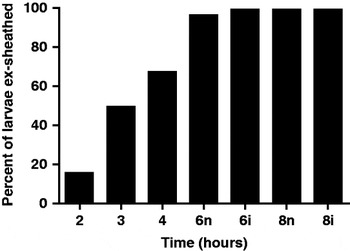
The percentage of ex-sheathed larvae at each time-point sampled during the ex-sheathing process and during the exposure to the abomasal environment samples are shown in Fig. 1. After incubation for 2 h in EBSS ex-sheathing buffer, 15% of the larvae had ex-sheathed. After 3 h, 49% had ex-sheathed and after 4 h 67% had ex-sheathed. At each of these time-points no larvae had died (data not shown). After incubation for 4 h in ex-sheathing buffer the larvae were transferred to incubation in either the immune or naive abomasal environment samples. The numbers of larvae that had ex-sheathed after 2 h and 4 h in this environment are represented by the 6-n and 8-n bars (incubated in naive environment sample) and the 6-i and 8-i bars (incubated in immune environment sample) in Fig. 1. After incubation for 8 h, more than 99% of the larvae were ex-sheathed and alive.
Progress of larval exsheathing. 6-n and 8-n, larvae incubated in naïve abomasal environment sample. 6-i and 8-i, larvae incubated in immune abomasal environment sample.

Bioinformatic analysis
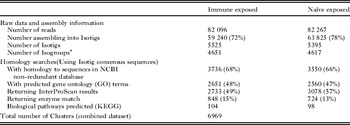
An overview of the sequencing data, assembly and initial bioinformatic analysis is shown in Table 1. The number of Isotigs in each dataset with Gene Ontology annotations, InterProScan results and enzyme matches, and the total number of Clusters obtained after combining the 2 sets of Isotigs, are also shown.
Overview of bioinformatic analysis

Gene ontology
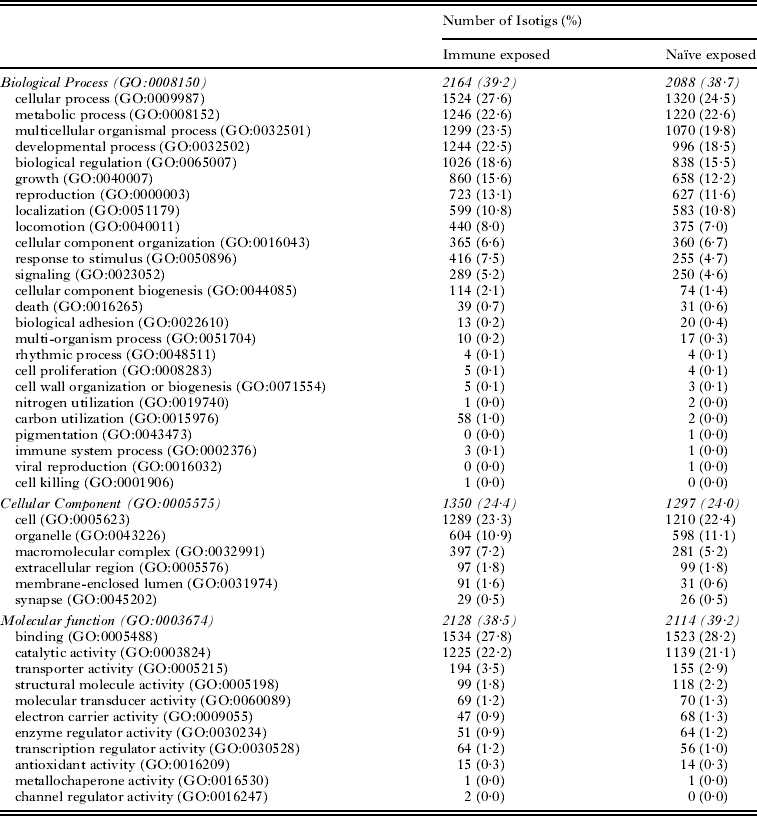
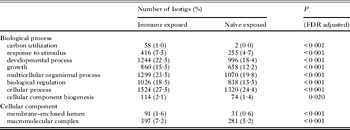
The level 2 Gene Ontology terms associated with the Isotigs from each sample are shown in Table 2. Table 3 shows the ‘biological process’ and ‘cellular component’ GO terms that had a significantly higher mean proportion of Isotigs in the immune exposed group than the naïve exposed group. For biological processes these included ‘carbon utilization’, ‘response to stimulus’ and ‘developmental process’ as exemplified by CRE-ALDO-2 protein (fructose-bisphosphate aldolase 2, 44 Isotigs), heat shock protein 16–2 (68 Isotigs) and heat shock protein 16–2 (68 Isotigs)/CRE-GEI-7 protein (isocitrate lyase-like protein, 65 Isotigs) respectively (all P F<0·001). Within ‘cellular component’, mean proportion of Isotig for ‘membrane-enclosed lumen’ and ‘macromolecular complex’ were statistically significantly higher in the immune-exposed group compared to the naïve-exposed group (P F⩽0·001). There was no evidence that the number of any level 2 ‘molecular function’ annotations were statistically different between the exposed and naïve group.
Parental (level 2) gene ontology (GO) terms associated with the assembled Isotigs from each sample

GO terms with significantly more abundant representation within the immune exposed larval

KEGG biological pathways
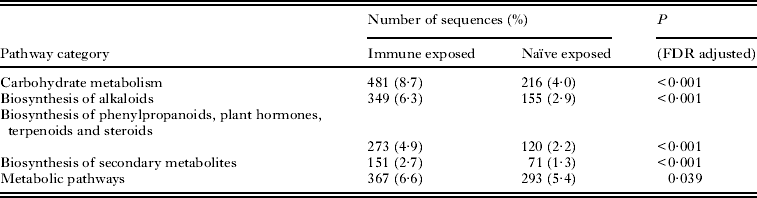
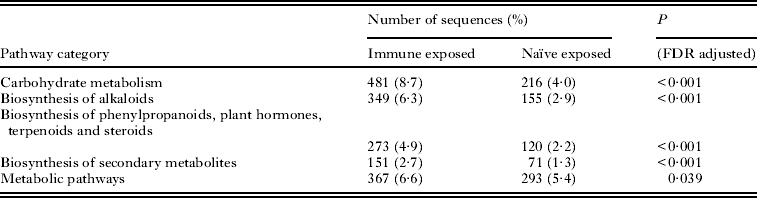
KEGG biological pathway annotation of the 2 sets of Isotigs was carried out within the Blast2GO software suite and pathways showing statistically significant differences in the mean proportion of Isotigs between the two groups are shown in Table 4. Pathways showing statistically significantly higher mean proportion of Isotigs in the larvae exposed to the immune environment (P F⩽0·001) were ‘carbohydrate metabolism’, ‘biosynthesis of alkaloids’, ‘biosynthesis of phenylpropanoids, plant hormones, terpenoids and steroids’, ‘biosynthesis of secondary metabolites’ and ‘metabolic pathways’. Immune exposed larvae also showed a statistically significantly higher number of Isotigs for metabolic pathways (P F=0·039).
KEGG annotations showing significant differences in abundance between the immune and naïve exposed larvae
Most abundant transcripts
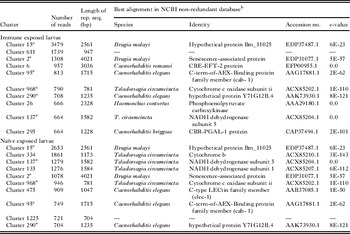
Clustering of combined sets of 5525 Isotigs from the immune exposed larval sample and the 5395 Isotigs from the naïve-exposed sample using UCLUST software resulted in 6969 Clusters. The 10 most abundant sequences for each sample, determined by the number of unique reads contributing to the Cluster, are shown in Table 5. In the sample that had been prepared from larvae exposed to the immune abomasal environment, the most abundant sequences were a homologue of a hypothetical protein homologue from Brugia malayi, an unidentified protein that had no hits in the NCBI non-redundant database, and a senescence-associated protein also from B. malayi. The most abundant sequences in the naïve-exposed larval sample were the same hypothetical protein homologue from B. malayi identified in the immune-exposed larvae, Cytochrome b and NADH dehydrogenase subunit 5.
Top 10 most abundant sequences in each dataset, by number of reads from sample present in cluster

Differences in sequence abundance between the larval samples
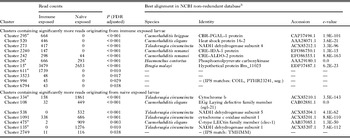
Individual sequencing reads contributing to each Cluster were identified, and parsed to output the number of unique reads per cluster originating from each sample. Analysis of these Cluster read counts resulted in 18 Clusters showing statistical significance at levels consistent with a false discovery rate of less than 5% (P F<0·05) for differences in mean proportions of reads between the naïve and immune groups under the conservative model, while a further 77 Clusters were of indeterminate status, being statistically significant with P F<0·05 under the liberal model only. The 18 Clusters with P F⩽0·05 under the conservative model and the identity of the representative sequence of each (determined by Blastx homology searching to proteins in the NCBI non-redundant database) are shown in Table 6. A total of 11 Clusters had statistically significantly higher mean proportion of reads in the immune-exposed larvae than naïve larvae (P F⩽0·001). These included Cluster 295 (CBR-PGAL-1 protein – a peptidylglycine alpha-amidating mono-oxygenase homologue), Cluster 520 (heat shock protein 16-2), Cluster 273 (NADH dehydrogenase subunit 4) and Cluster 2240 (CRE-IDA-1 protein, a tyrosine phosphatase-like receptor protein). A total of 7 Clusters had a statistically significantly greater mean proportion of reads in the naïve larval sample (P F⩽0·001) which included Cluster 334 (cytochrome b), Cluster 108 (EGg Laying defective family member (EGL-21) and Cluster 538 (NADH dehydrogenase subunit 5). Four of the 11 Clusters with P F⩽0·05 and a higher mean proportion of reads originating from the immune exposed larvae, and 3 of the 7 Clusters with P F⩽0·05 and a higher mean proportion of reads originating from the naïve-exposed larvae, were also amongst the 10 Clusters with the highest read counts for their respective originating samples. Furthermore, 8 of the 11 Clusters with P F⩽0·05 for the immune-exposed larvae appeared to be unique to that dataset, with no representative reads from the naïve-exposed larval group.
Identities of Clusters with statistically significant differences in mean read count abundance between immune-exposed and naïve-exposed groups under the conservative model

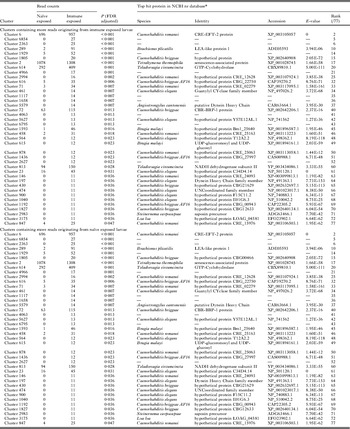
In the set of indeterminate Clusters with P F⩽0·05 only under the liberal model (Table 7), the immune-exposed group had a statistically significantly higher mean proportion of reads for sequences (with top Blastx hits) of CRE-EFT-2 (translation elongation factor 2), Brachionus plicatilis LEA-like protein 1 (late embryo abundant), the B. malayi senescence-associated protein and T. circumcincta GTP-Cyclohydrolase. The indeterminate clusters that showed a statistically significantly higher mean proportion of read counts in naïve-exposed larvae relative to immune-exposed larvae returned sequences (top Blastx hits) of Caenorhabditis briggsae UNC-54 protein (myosin heavy chain), C. briggsae putative acyltransferase, Oesophagostomum dentatum FMRFamide-like propeptide (flp-14), Caenorhabditis elegans UBC-18 homologue (ubiquitin-conjugating enzyme) and Caenorhabditis remanei EPN-1 protein (nucleoside transporter protein).
Identities of indeterminate Clusters with statistically significant differences in mean read count abundance between immune-exposed and naïve-exposed groups under the liberal model

* Representative sequence from cluster used as query for Blastx search of NCBI non-redundant database.
— no hits in NCBI nr database.
Proteomics results
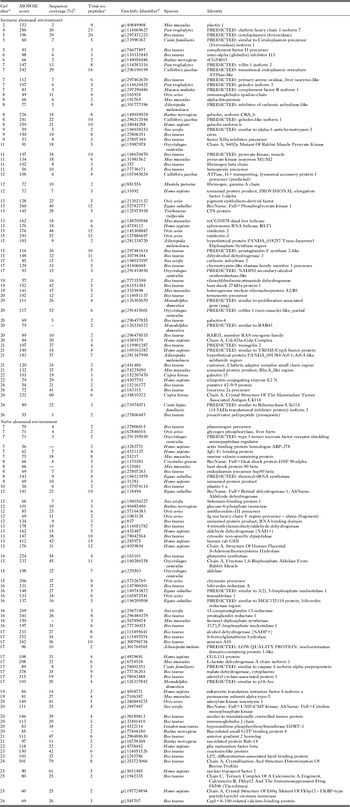
Analysis of the proteins present in the naïve and immune abomasal environment samples returned 702 and 695 matches respectively in the NCBInr database. After in silico subtraction and manual curation to remove matches with the same identity, this was reduced to 67 protein matches uniquely detected in the naive abomasal environment, and 67 protein matches uniquely detected in the immune abomasal environment sample (Table 8). Proteins identified uniquely in the immune sample included clathrin, intelectin-2, galectin-15, IgE and gelsolin-b.
Proteins exclusively present in either immune or naïve abomasal environment samples, identified by LC-MS/MS

DISCUSSION
In this study, we have presented data comparing the transcriptome of exsheathed infective Teladorsagia circumcincta 3rd larval stage parasites upon exposure to either a naïve or immune host environment, and also carried out qualitative proteomic analysis on the host environment samples. These data showed changes in transcript levels between the 2 larval populations, particularly for several genes with possible roles in sensory capabilities and response to the differing environments, in this case possibly reflecting early responses to the host immune response. The proteome profiles of the naïve and immune abomasal environments confirmed that the larvae exposed to the immune environment encountered relevant immune effectors.
A conservative statistical model was used, due to the lack of experimental repeats, to determine statistically significant differences in transcript abundance between the transcriptomes of the 2 larval samples. Eighteen transcripts were identified although, as a conservative statistical model was employed, the true number of transcripts with significantly differing abundance may be higher than this. O'Meara et al. (Reference O'Meara, Barber, Mello, Sangaralingam, Viney and Paterson2010) also observed that changes in expression occurred in only a relatively small proportion of Strongyloides ratti transcripts in response to host immune status.
Analysis of the GOs associated with the entire transcriptome from each sample (i.e. not restricted to only those transcripts with higher mean abundance in the immune-exposed larvae) showed that in the immune-environment exposed larval sample the most statistically significantly increased annotations were ‘carbon utilization’, ‘response to stimulus’ and ‘developmental process’. The increased number of transcripts with these annotations is likely to reflect the response of larvae encountering a different environment from those exposed to a naïve host environment.
One of the transcripts with the greatest increase in abundance in larvae exposed to the immune host environment was a C. briggsae peptidyl-glycine alpha-amidating monooxygenase protein homologue (CBR-PGAL-1 protein). The peptidyl-glycine alpha-amidating monooxygenase gene encodes 1 polypeptide with 2 enzymatic domains, responsible for the copper-dependent alpha-amidation of glycine-extended biopeptides often necessary for full activity of the peptides (Eipper et al. Reference Eipper, Milgram, Husten, Yun and Mains1993; Prigge et al. Reference Prigge, Mains, Eipper and Amzel2000). Neuropeptides are commonly modified at the N- or C-terminus to protect them from degradation and/or to achieve full biological activity. Amidated peptides have widespread functions in the nervous system, and in development and regulation: in C. elegans over 18 genes encode more than 53 Phe-Met-Arg-Phe-NH2 (FMRFamide) related peptides, yet disruption of a single precursor gene, and the resultant varying levels of the peptide, leads to a profound variation in behaviour (Nelson et al. Reference Nelson, Rosoff and Li1998). In Schistosoma mansoni the release of immunosuppressive neuropeptides has been associated with deactivation of previously activated host lymphocytes, an example of helminth immunodulation via molecular mimicry, a phenomenon whereby parasites mimic endogenous host proteins in order to interfere with the host response (Duvaux-Miret et al. Reference Duvaux-Miret, Stefano, Smith, Dissous and Capron1992). The greater abundance of the CBR-PGAL-1 homologue transcript in larvae exposed to the immune host environment as opposed to those exposed to the naïve environment raises the possibility that this transcript is involved in neuropeptide processing in response to the host immune factors present, and may play a role in either evasion and/or modulation of the host immune response, or may be involved in changes in developmental regulation related to environmental cues.
The second most abundant transcript in the larvae exposed to the immune abomasal environment (named ‘Cluster 611’) was exclusive to that dataset and database searches (Wormbase, 2011) indicated significant homology to C. elegans mitochondrial DNA.
Another transcript present in higher abundance in the immune-exposed larvae, which may be indicative of a response to encountering the immune host environment, was an IDA-1 homologue (in C. remanei), which is a tyrosine phosphatase-like receptor protein. The C. elegans homologue of CRE-IDA-1 is a membrane-spanning protein associated with the granules of neural- and endocrine-specific cells, involved in the release of neuropeptides from dense core vesicles, with parallels to insulin signalling in mammals (Zahn et al. Reference Zahn, Macmorris, Dong, Day and Hutton2001; Cai et al. Reference Cai, Fukushige, Notkins and Krause2004). An insulin-like pathway is known to regulate dauer formation in C. elegans following environmental cues (Thomas et al. Reference Thomas, Birnby and Vowels1993; Gottlieb and Ruvkun, Reference Gottlieb and Ruvkun1994; Riddle and Albert, Reference Riddle and Albert1997; Hu, Reference Hu2007). The T. circumcincta larvae described herein are entering an environment known to cause immune-mediated inhibition of larval development (McKellar, Reference McKellar1993; Halliday et al. Reference Halliday, Routledge, Smith, Matthews and Smith2007; Smith, Reference Smith2007) therefore the possibility also exists of the IDA-1 homologue protein being involved in a signalling pathway involved in arrested development in response to environmental cues.
Other transcripts with a statistically significantly higher mean abundance in the immune-exposed larvae included the stress-induced heat shock protein 16-2 (HSP 16-2; (Ding and Candido, Reference Ding and Candido2000)). The host immune system will be producing oxidative free radicals to kill pathogens, and HSP 16-2 has been found to protect cells from death due to such oxidative stress (Bellyei et al. Reference Bellyei, Szigeti, Boronkai, Pozsgai, Gomori, Melegh, Janaky, Bognar, Hocsak, Sumegi and Gallyas2007; Hartwig et al. Reference Hartwig, Heidler, Moch, Daniel and Wenzel2009). A C. remanei ALDO-2 (fructose bisphosphase aldolase) homologue and an H. contortus phosphoenolpyruvate carboxykinase homologue also displayed greater abundance in the immune-exposed larvae, indicating increased carbon utilization.
Amongst the list of indeterminate Clusters with P F⩽0 05 only under the liberal model, sequences showing higher abundance of reads in immune-exposed larvae included a Late Embryo Abundant protein homologue (LEA-1) and T. circumcincta GTP-Cyclohydrolase. The lea-1 gene encodes a protein that is involved in the stress-response mechanism in C. elegans, particularly dessication, osmotic and heat stress (Gal et al. Reference Gal, Glazer and Koltai2004). GTP-cyclohydrolase (GTP-CH) has been identified as one of the most abundant transcripts in the exsheathed L3 T. circumcincta transcriptome when compared to the 4th larval stage (Nisbet et al. Reference Nisbet, Redmond, Matthews, Watkins, Yaga, Jones, Nath and Knox2008), and the C. elegans cat-4 gene which encodes GTP-cyclohydrolase shows increased transcription in C. elegans dauer larvae (Jeong et al. Reference Jeong, Kwon, Joo and Paik2009). GTP-cyclohydrolase has a proposed role in environmental protection in T. circumcincta larval stages with transcript levels observed to fall in T. circumcincta upon transition to the parasitic lifestyle (Baker et al. Reference Baker, Buschbaum, Matthews, McKendrick, Schnieder, Strube and Nisbet2011), thus raising the possibility that maintenance of higher levels of transcription in larvae exposed to the immune environment in these experiments may reflect a requirement for ongoing environmental protection.
Within the sequences which had a statistically significantly higher mean proportion of reads in the larvae exposed to the naïve host environment were transcripts for proteins involved in the respiratory electron transport chain; a C. elegans EGg Laying defective family member (egl-21) homologue (a carboxypeptidase which facilitates acetylcholine release at neuromuscular junctions (Jacob and Kaplan, Reference Jacob and Kaplan2003)); and a C. elegans C-type LECtin family member (clec-1) homologue with associated biological process Gene Ontologies of body morphogenesis, growth, hermaphrodite genitalia development, locomotion, morphogenesis of an epithelium, nematode larval development and positive regulation of multicellular organism growth. These transcripts which are more abundant in the larvae exposed to the naïve host environment, are consistent with parasites growing and developing as would be predicted given current knowledge of the T. circumcincta life cycle.
The most abundant transcript in each larval dataset was a B. malayi hypothetical protein homologue with similarity to a checkpoint-like protein from Helicoverpa armigera (cotton bollworm) which shows increased expression during larval molting (Dong et al. Reference Dong, He, Chai, Jiang, Wang and Zhao2007). Here, the larvae in both treatments were exsheathing during the incubation period and the presence of high levels of this transcript may reflect this process.
Transcriptomic analysis of the parasitic nematode Strongyloides ratti (O'Meara et al. Reference O'Meara, Barber, Mello, Sangaralingam, Viney and Paterson2010; Thompson et al. Reference Thompson, Barker, Hughes and Viney2008) showed an increase in expression of an IDA family member (ida-1) and a small heat shock protein family member (C. elegans HSP 17) in response to host immunity and high immune pressure respectively, results comparable to those presented here. Interestingly, in S. ratti unc-54 and a C-type lectin family member (clec-200) were also upregulated in response to host immunity, whereas these transcripts were more abundant in T. circumcincta larvae exposed to a naïve host environment. The S. ratti transcriptomic study was carried out 12 days after infection as opposed to after 4 h exposure to a naïve or immune environment, which may explain the differences observed.
KEGG biological pathways with a statistically significantly increased mean proportion of Isotigs in the immune-exposed larval sample included carbohydrate and energy metabolism, and biosynthesis of alkaloids and secondary metabolites. An increase in energy metabolism could represent an increased requirement for energy to mount responses to the host environment. The biosynthesis of alkaloids, phenylpropanoids and other secondary metabolites is known to be involved in response to environmental stress in plants (Iriti and Faoro, Reference Iriti and Faoro2009), and herein could be representative of a stress response in the immune environment-exposed larvae accompanied by contemporaneous adjustment in metabolic pathways.
The method employed here to create the abomasal environments in vitro will not result in an exact replica of the physiological situation that the larvae encounter in vivo. Analysis of the protein profiles of these abomasal samples showed differences between the environments created using the abomasa of naïve and immune sheep, these being comparable to the results obtained from in-depth quantitative analysis of the equivalent abomasal tissue (Athanasiadou et al. Reference Athanasiadou, Pemberton, Jackson, Inglis, Miller, Thevenod, Mackellar and Huntley2008; Alan Pemberton, personal communication). One of the proteins with the highest number of non-redundant peptides identified from immune sheep was clathrin, a prominent protein component of cellular protein transport vesicles with the formation of a clathrin coat being fundamental to the mechanism of vesicle budding as well as receptor sorting and transport specificity (McDowall, Reference McDowall2007). Proteins which are known to be upregulated in the abomasa of immune sheep and which are thought to play a role in vivo in local immunity, such as intelectin-2, galectin-15, IgE and gelsolin-b, were all detected exclusively in the immune abomasal environment sample. Sheep intelectin-2 (Itln-2) expression is upregulated in the abomasa of immune sheep following challenge compared to naïve sheep undergoing a primary infection and immunolocalizes to abomasal mucus neck cells and gastric mucus surrounding developing larvae (French et al. Reference French, Knight, Smith, Brown, Craig, Pate, Miller and Pemberton2008). Itln-2 co-purifies with the mucin Muc5a from gastric mucosa to alter the rheological properties of the mucus, which could potentially reduce larval penetration to the underlying mucus layer (Pemberton et al. Reference Pemberton, Verdon, Inglis and Pearson2011). Galectin-15 (ovgal11) shows greatly increased expression in the abomasal tissue of sheep infected with H. contortus compared to uninfected tissue, and the mRNA appears more rapidly in previously sensitized sheep compared to naïve sheep (Dunphy et al. Reference Dunphy, Balic, Barcham, Horvath, Nash and Meeusen2000). Galectin-15 protein is also secreted into the lumen and detected in mucus where it may interact with carbohydrate motifs such as mucins. Increased levels of locally produced IgE have been observed in previously infected sheep undergoing challenge infection when compared to naïve sheep undergoing a primary infection (Huntley et al. Reference Huntley, Schallig, Kooyman, Mackellar, Jackson and Smith1998), and gelsolin levels in ovine gastric lymph have been demonstrated to decrease in vivo in naïve sheep undergoing a primary infection but not during challenge of immune sheep (Goldfinch et al. Reference Goldfinch, Smith, Imrie, McLean, Inglis and Pemberton2008). Gelsolin can function as an actin scavenger, possibly binding free actin released from damaged cells to prevent actin-polymerization and subsequent detrimental effects on mucus viscosity (Sun et al. Reference Sun, Yamamoto, Mejillano and Yin1999; Goldfinch et al. Reference Goldfinch, Smith, Imrie, McLean, Inglis and Pemberton2008). It is also known to be down-regulated as cells become less differentiated, for example during replacement of acid-producing parietal cells with non-differentiated non-acid secreting cells as is seen in the abomasum during T. circumcincta infection, and may also have a role in the regulation of mucus secretion from goblet cells (Vandekerckhove et al. Reference Vandekerckhove, Bauw, Vancompernolle, Honore and Celis1990; Ehre et al. Reference Ehre, Rossi, Abdullah, De, Hill, Olsen and Davis2005). Detection of these proteins exclusively in the immune abomasal environment sample suggests that the abomasal environment fluids used for larval culture here were at least partly representative of the soluble abomasal proteome.
An astacin-like metalloprotease was identified by Smith et al. (Reference Smith, Nisbet, Meikle, Inglis, Sales, Beynon and Matthews2009) in the excretory/secretory (ES) products of T. circumcincta larvae recovered 1 day post-infection of naïve sheep; however, transcript for this protein was not detected in either of the larval datasets generated here. It is possible that production of this protein had not yet commenced within the 4 h of exposure to the abomasal environment as compared to the 24+ h exposure described by Smith et al. (Reference Smith, Nisbet, Meikle, Inglis, Sales, Beynon and Matthews2009).
In conclusion, this paper defines the major transcriptional changes in T. circumcincta upon encountering either a naïve or an immune ovine host environment. Statistically significant differences in mean transcript levels between the 2 larval populations were detected for several genes with possible roles in sensory capabilities and response to the differing environments. The larvae exposed to the immune environment are encountering conditions known to lead to larval inhibition, therefore the possibility exists that the transcriptional changes observed may relate to larvae entering a state of arrest. Further work could focus on localization and functional analysis of these proteins to further determine the response of the parasites to varying host environments and concomitant effects on parasitic behaviour and development.
DATA
454 sequencing data are available in the Sequencing Read Archive (SRA), Accession number ERP000810, http://www.ebi.ac.uk/ena/data/view/ERP000810.
Assembled transcript data are available via the PartiGene database http://genepool.bio.ed.ac.uk/GP_Partigene/2010038_AileenHalliday_AH15AH16/ (Parkinson et al. Reference Parkinson, Anthony, Wasmuth, Schmid, Hedley and Blaxter2004).
ACKNOWLEDGEMENTS
The authors would like to thank Frank Jackson's laboratory and Moredun Bioservices for supplying parasite material and for assistance with the animal experiments, and Anna Montazan and Denis Cleven at the GenePool sequencing facility for 454 library preparation and sequencing. The authors also wish to acknowledge Iain J. McKendrick of BioSS for his help in formulating the statistical analysis applied to these data.
FINANCIAL SUPPORT
This work was supported by the UK Biotechnology and Biological Sciences Research Council (BBSRC grant no: BB/E01867X/1) under the Combating Endemic Diseases of Farm Animals for Sustainability (CEDFAS) initiative. D.P.K. and M.N. were also partly supported by a Programme Grant from the Scottish Government (RERAD).