Introduction
The two-spotted spider mite (TSSM), Tetranychus urticae Koch, and greenhouse whitefly (GHWF), Trialeurodes vaporariorum Westwood are notorious and major destructive pests in greenhouse crops worldwide (Mortazavi et al., Reference Mortazavi, Fathipour and Talebi2017, Reference Mortazavi, Fathipour and Talebi2019). These two pests can also indirectly affect the plant by producing webs and honeydew, making them more difficult to control (Nomikou et al., Reference Nomikou, Janssen and Sabelis2003; Lemos et al., Reference Lemos, Sarmento, Pallini, Dias, Sabelis and Janssen2010). Because of the pests' high reproductive capacity and developed resistance to different pesticides, farmers increasingly intend to use biological control programs against these two pests (Ragusa and Tsolakis, Reference Ragusa and Tsolakis2000). Therefore, finding the most efficient predators or the methods to promote the predators' performance is vital.
The generalist predatory mite Typhlodromus bagdasarjani Wainstein and Arutunjan (Acari: Phytoseiidae) is an indigenous species in Iran and other Middle East countries (Ganjisaffar et al., Reference Ganjisaffar, Fathipour and Kamali2011; Riahi et al., Reference Riahi, Fathipour, Talebi and Mehrabadi2016). This predator is considered as a type III phytoseiid (McMurtry et al., Reference McMurtry, De Moraes and Sourassou2013) and can be an effective control agent of spider mites and whiteflies in a wide range of crops (Farazmand et al., Reference Farazmand, Fathipour and Kamali2012; Riahi et al., Reference Riahi, Fathipour, Talebi and Mehrabadi2016). The poor establishment of a predator on crops forces farmers to release it regularly, which is costly (Cock et al., Reference Cock, van Lenteren, Brodeur, Barratt, Bigler, Bolckmans, Cônsoli, Haas, Mason and Parra2010; Messelink et al., Reference Messelink, Bennison, Alomar, Ingegno, Tavella, Shipp, Palevsky and Wäckers2014). When food is scarce, a phytoseiid predator either dies or migrates (Van Rijn and Tanigoshi, Reference Van Rijn and Tanigoshi1999; Nomikou et al., Reference Nomikou, Sabelis and Janssen2010). Therefore, some scientists have suggested methods that can increase the population of predators and protect them before the pest invasion. One of these methods is to provide supplemental foods or alternative diets for natural enemies (Van Rijn and Tanigoshi, Reference Van Rijn and Tanigoshi1999; Nomikou et al., Reference Nomikou, Sabelis and Janssen2010; Messelink et al., Reference Messelink, Bennison, Alomar, Ingegno, Tavella, Shipp, Palevsky and Wäckers2014; Leman and Messelink, Reference Leman and Messelink2015; Samaras et al., Reference Samaras, Pappas, Fytas and Broufas2019). These foods can help predators overcome the period of lack or absence of the prey and have been shown to enhance biological control efficacy (Nomikou et al., Reference Nomikou, Janssen and Sabelis2003, Reference Nomikou, Sabelis and Janssen2010). Many scientists have recommended the use of pollen as a food source to support predatory mites during early establishment and prey scarcity (Khanamani et al., Reference Khanamani, Fathipour, Talebi and Mehrabadi2017; Yazdanpanah et al., Reference Yazdanpanah, Fathipour, Riahi and Zalucki2021; Eini et al., Reference Eini, Jafari, Fathipour and Zalucki2022; Gravandian et al., Reference Gravandian, Fathipour, Hajiqanbar, Riahi and Riddick2022).
Diet mixing or self-selection has many advantages for generalist predatory mites related to their ability to feed on prey comprising various amounts of nutrients and therefore actively redress specific nutritional imbalances in their food (Mayntz et al., Reference Mayntz, Raubenheimer, Salomon, Toft and Simpson2005). They can search among different diets, select the food with high nutritional value, and feed more on it or they may specifically extract nutrients from a single food (Jones and Flynn, Reference Jones and Flynn2005; Behmer, Reference Behmer2009). A positive effect of diet mixing on phytoseiids' performance has been documented (Messelink et al., Reference Messelink, van Maanen, van Steenpaal and Janssen2008; Samaras et al., Reference Samaras, Pappas, Fytas and Broufas2019). Two groups of mixed diets have been studied in the previous investigations (Messelink et al., Reference Messelink, van Maanen, van Steenpaal and Janssen2008; Pappas et al., Reference Pappas, Xanthis, Samaras, Koveos and Broufas2013; Samaras et al., Reference Samaras, Pappas, Fytas and Broufas2019). In the first group, a mixture of two or more prey species has been considered as a mixed diet, while a mixture of prey and non-prey food has been examined in the second group.
The previous study has documented that maize pollen is a suitable alternative food for T. bagdasarjani (Riahi et al., Reference Riahi, Fathipour, Talebi and Mehrabadi2016). We hypothesized that a mixed diet of pollen and prey or a mixed diet of two prey species could enhance the efficacy of this predatory mite. In the current study, we examined the performance of this predator when maize pollen was added to two prey species, including TSSM and GHWF, compared to each food alone. In addition, we assessed the impact of mixing two prey species on the survival, development, and predation rate of T. bagdasarjani.
Material and methods
Prey and predator cultures
The population of TSSM and GHWF was initially collected from the naturally infested bean (Phaseolos vulgaris), and strawberry (Camarosa variety) plants, respectively, on the campus of the Faculty of Agriculture, Tarbiat Modares University. The colonies were reared and kept on the strawberry in a greenhouse (25 ± 3°C, 16L:8D h, 65 ± 5% RH).
The individuals needed for a stock colony of T. bagdasarjani were collected from blackberry trees on the Faculty of Agriculture campus, Tarbiat Modares University, Tehran, Iran. They were reared in plastic arenas (23 × 14 × 0.3 cm) by closed edges with a moist tissue. Twice a week, maize pollen, TSSM, and GHWF nymphs were added to the arenas as a food source for T. bagdasarjani. The colonies were kept in a controlled environment at 25 ± 1°C, 65 ± 5% RH, and a 16:8 h L:D photoperiod.
Pollen collection
Maize pollen (Zea mays L.) was collected from flowering plants at Tarbiat Modares University farm. Pollen was dried in an oven at 37°C for 2 days, sieved (200 mm mesh), and stored at −20°C.
Experimental design
Strawberry plants (Camarosa variety) were grown in plastic pots in a greenhouse for using in the experiments. The plants were watered every 3 days. Leaf discs (5 cm in diameter) were punched out of 4–5 weeks old plants and placed individually on wet cotton in Petri dishes (8 cm diameter, 1 cm height). These leaf discs were used for each experiment.
Diets
Five monotypic diets were used in the present study, including TSSM eggs/without webs, TSSM eggs/with webs, GHWF eggs, maize pollen, and honeydew. About 20 TSSM adults were placed on a strawberry leaf disc and allowed to lay eggs and produce webs. After 2 days, the adults were removed, and 50 TSSM eggs were left on each leaf disc. The webs were removed from some leaf discs by a needle (named as SN), and some remained full of webs (named as SW). Twenty GHWF adults were placed on each strawberry leaf disc and allowed to lay eggs for 2 days. Extra eggs and adults were removed, and only 50 eggs were left on each leaf disc (treatment G). Another treatment (M) involved 0.005 g maize pollen. The pre-infested leaves by GHWF were selected, and only the exuviae and honeydew were left on the leaf disc (named as H). We also carried out three treatments involving the following combinations as mixed diets: 50 TSSM eggs + about 0.005 g of maize pollen, 50 GHWF eggs + about 0.005 g of maize pollen, and 25 TSSM eggs + 25 GHWF eggs (named as SN + M, G + M, and SN + G, respectively). An experimental unit without a food source was considered as a control treatment. Based on the previous study, these numbers of prey in treatments were sufficient to avoid the predator starvation and ensure maximum prey consumption (Mortazavi et al., Reference Mortazavi, Fathipour and Talebi2019).
Population growth and predation rate of T. bagdasarjani on different diets
For each diet, young adult females (3–4 days old) were collected from the stock colony and were transferred individually to strawberry leaf discs. The leaf discs were placed upside down on water-soaked cotton, and the edges were covered by moist tissue paper to keep the leaves fresh and prevent the mites from escaping. Eggs from females of the same age were individually transferred to new leaf discs and were allowed to develop to adulthood. One egg on each leaf disc was considered one replicate, and up to 90 replicates were used per treatment. Each leaf disc was checked daily using a stereomicroscope, and the development, growth stage, and survivorship of each immature were recorded. After the adult emergence, every female was coupled with a male obtained from the same experiment. The dead or escaped male was replaced by a new one from the stock colony. These couples were kept together until the death of the adults. Those mentioned diets were provided every day for the predators and the survival rate, oviposition rate, pre-oviposition, oviposition, and post oviposition periods were calculated daily.
Simultaneously, the predation rate of T. bagdasarjani in the monotypic diets comprised one prey species (i.e., SN, SW, and G), and all three mixed diets (i.e., SN + M, G + M, and SN + G) was evaluated daily through the life table experiments until the death of all individuals. The predation rate of ten females and males were evaluated under the same condition separately to assess the ratio of predation capacity of females and males. The number of prey killed by both females and males was recorded daily using a stereomicroscope. The feeding rate of females to males was determined and used to calculate the proportion of prey consumed by each adult in each unit. All the experimental units were kept in a growth chamber (25 ± 1°C, 65 ± 5% RH, and a photoperiod of 16L:8D h).
Statistical analysis
The life history data of all individuals were analyzed according to the age-stage, two-sex life table theory (Chi and Liu, Reference Chi and Liu1985; Chi, Reference Chi1988, Reference Chi2016a). The age-stage-specific fecundity (fxj), the age-stage-specific survival rate (sxj) (x is the age and j is the stage), the age-specific survival rate (lx), the age-specific fecundity (mx), and the population growth parameters (r, GRR, R 0, λ, and T) were estimated for each treatment using TWOSEX-MS Chart program. The variances and standard errors of the population parameters were calculated using the bootstrap test with 40,000 samples. The paired bootstrap test was used for mean comparisons of population growth parameters among different treatments. Other parameters were compared by the Tukey test (P < 0.05).
The daily consumption of all individuals was analyzed using the computer program CONSUME-MS Chart (Chi, Reference Chi2016b). The daily consumption of each individual was used to calculate the age-stage predation rate (cxj). Moreover, the net predation rate (C 0); the mean number of prey consumed by an individual predator during its life span, the transformation rate from prey population to predator progeny (Q p); the number of prey needed for the production of an offspring from a predator, the stable predation rate (ψ); the total predation capacity of a stable population, and the finite predation rate (ω); the predation potential of predator population by combining its growth rate (λ), age-stage predation rate (cxj), a stable age-stage structure (axj) were calculated according to Chi and Yang (Reference Chi and Yang2003). Moreover, the predation rates of different stages were compared by the Tukey test (P < 0.05). The variances and standard errors of all predation parameters were estimated using the TWO-SEX-MS Chart program (40,000 samples). A paired bootstrap test was used for mean comparisons.
Results
The duration of different life stages, total pre-adult, adult longevity, adult pre-oviposition period (APOP), total pre-oviposition period (TPOP), oviposition period, total fecundity, and total life span of T. bagdasarjani is shown in table 1. Although all individuals of the control treatment died before maturation due to the lack of food, the predator could survive to the adult stage and reproduce on the other food sources (table 1). The pre-adult duration was significantly different among the eight treatments (table 1). The populations fed on the mixed diets had a considerably shorter developmental time than those raised on the monotypic diets except maize pollen. The most prolonged pre-adult duration (9.49 ± 0.15 days) was observed when TSSM was offered as a food source in the presence of their web. In other words, adding pollen to each prey resulted in a remarkable decrease in the time needed for T. bagdasarjani juveniles to complete their development. Adult longevity was also significantly affected by diets (table 1). The longest and shortest female longevity were observed in TSSM + GHWF (37.66 ± 1.19 days) and TSSM in the presence of the webs (10.15 ± 0.41 days), respectively. In general, males developed faster than females in all treatments. As apparent from table 1, feeding on monotypic diets caused a considerable reduction in both female and male longevities. Moreover, both females and males' longest total life span was observed on the mixed diet of TSSM and GHWF eggs.
Mean developmental time, adult longevity, total life span (day ± SE), and fecundity (eggs/female) of Typhlodromus bagdasarjani when fed on different monotypic and mixed diets

Means followed by different letters in the rows are significantly different (P < 0.05, Tukey).
a APOP, adult pre-oviposition period (the duration from adult emergence to the first oviposition).
b TPOP, total pre-ovipositional period (the duration from egg to the first oviposition. SN (T. urticae in the absence of webs), SW (T. urticae in the presence of webs), G (T. vaporariorum), M (maize pollen), H (honeydew), SN + M (mixed of T. urticae and maize pollen), G + M (mixed of T. vaporariorum and maize pollen), SN + G (mixed of T. urticae and T. vaporariorum).
The APOP and TPOP of T. bagdasarjani were longest on the diet of TSSM in the presence of their webs. By contrast, the APOP was shortest when the mixture of spider mites and pollen was offered as food. The APOP and TPOP were accelerated in predators fed on the diets comprised of one prey and pollen or the mixture of two prey compared to those fed TSSM or GHWF or maize pollen alone. In addition, the presence of a web prolonged the pre-oviposition periods. Our results showed that the diet type had remarkable effects on the oviposition period and fecundity of T. bagdasarjani (table 1). The fecundity was highest, and the oviposition period was longest when the predators consumed the mixture of TSSM and GHWF eggs. Feeding on TSSM with webs and honeydew alone resulted in the lowest fecundity. In general, females laid significantly more eggs when they consumed mixed diets (pollen + prey or a combination of two pests) than when they consumed only TSSM, GHWF, or pollen. In addition, mixed diets led to a more extended oviposition days than monotypic diets. Furthermore, the presence of the webs substantially reduced the fecundity and oviposition days of T. bagdasarjani (table 1). However, in the mixture of GHWF and TSSM eggs, the number of eggs produced reached about 1.5 and 3 times higher than that when solely fed on TSSM and GHWF eggs, respectively.
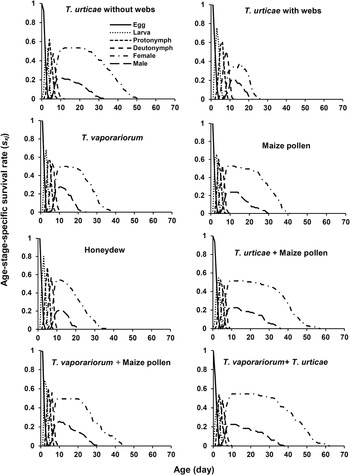
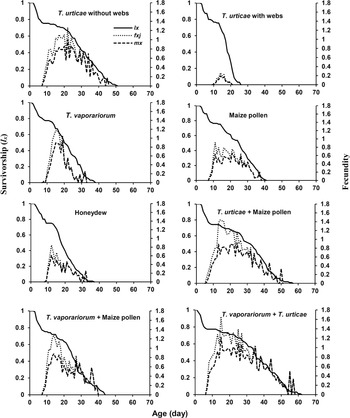
Figure 1 illustrates the age-stage-specific survival rate (sxj) of T. bagdasarjani differed among different diets. Significant overlaps displayed that the development duration changes among T. bagdasarjani individuals. Overall, female and male adults emerged simultaneously except when the diet was the GHWF, TSSM + GHWF, honeydew, and the mixture of spider mites and pollen (fig. 1). Moreover, the age-stage fecundity (mx) of T. bagdasarjani on different diets is illustrated (fig. 2). The results showed that the lowest fecundity rate was on TSSM-infested leaves covered with webs. The highest value of age-specific fecundity (fx) was 1.26, 0.26, 1.23, 0.92, 0.85, 1.28, 1.28, and 1.66 at the age of 22, 14, 15, 11, 12, 13, 14, and 15 days when the predators reared on TSSM eggs without webs, TSSM eggs with webs, GHWF eggs, maize pollen, honeydew, TSSM + maize pollen, GHWF + maize pollen, and GHWF + TSSM, respectively. However, most data points of the curves fx and mx on the mixed diet of two prey were higher than those in the other seven treatments. Figure 2 also proves that providing pollen in the presence of the main prey can enhance the fecundity of the predator.
Age-stage-specific survival rate (sxj) of Typhlodromus bagdasarjani when fed on different monotypic and mixed diets.

Age-specific survivorship (lx), age-stage fecundity of female (fxj), and age-specific fecundity (mx) of Typhlodromus bagdasarjani when fed on different monotypic and mixed diet.

Table 2 shows that all age-stage, two-sex life table parameters of T. bagdasarjani were significantly affected by the consumed diet. The highest values of net reproductive rate (R 0) and gross reproductive rate (GRR) were seen when the females consumed the mixture of both prey species followed by the mixture of TSSM and pollen as well as TSSM alone in the absence of webs (table 2). In addition, the highest values of the intrinsic rate of increase (r) and finite rate of increase (λ) were obtained on TSSM + GHWF eggs followed by TSSM + maize pollen. When TSSM was a food source, a significant effect of the web presence on all population parameters was found. The mentioned parameters were decreased significantly in the presence of spider mites web. When we offered a mixture of eggs of both prey, T. bagdasarjani had a faster growth rate than when prepared only the eggs of a single prey. Furthermore, this predatory mite had higher r and λ values when eggs of either TSSM or GHWF were offered together with maize pollen than when they were offered alone, showing that adding pollen to a monotypic diet could enhance the performance of this predator.
Population growth parameters (mean ± SE) of Typhlodromus bagdasarjani when fed on different monotypic and mixed diets

Means followed by different letters in the same row are significantly different between diets using the paired bootstrap test at 5% significance level.
SN (T. urticae in the absence of webs), SW (T. urticae in the presence of webs), G (T. vaporariorum), M (maize pollen), H (honeydew), SN + M (mixed of T. urticae and maize pollen), G + M (mixed of T. vaporariorum and maize pollen), SN + G (mixed of T. urticae and T. vaporariorum).
Predation rate of T. bagdasarjani
The predation rate of active-feeding life stages of T. bagdasarjani on TSSM and GHWF in the presence or absence of webs, pollen, and other prey is shown in table 3. The highest predation rate of the pre-adult stages (protonymph and deutonymph) for both females and males was observed on TSSM eggs offered on web-free leaves, which diminished sharply on the same diet in the presence of the webs (about 35% reduction). The highest predation rate of T. bagdasarjani females during their total life span was observed on TSSM eggs (379.43 ± 18.14 prey). It was significantly decreased in the presence of maize pollen (270.61 ± 11.25 prey) or webs (60.17 ± 3.72 prey). Moreover, the results showed that T. bagdasarjani consumed fewer TSSM eggs in the mixed diet of TSSM and GHWF than when only TSSM eggs were available (379.43 ± 18.14 prey). Pollen also had a negative effect on the consumption rate of this predator on GHWF because the female predation rate on GHWF eggs when supplemented with maize pollen dropped by about 12% (table 3).
Daily consumption rate (±SE) of different life stages of Typhlodromus bagdasarjani when fed on different monotypic and mixed diets

Means with different letters in each row are significantly different (P < 0.05, Tukey).
SN (T. urticae in the absence of webs), SW (T. urticae in the presence of webs), G (T. vaporariorum), SN + M (mixed of T. urticae and maize pollen), G + M (mixed of T. vaporariorum and maize pollen), SN + G (mixed of T. urticae and T. vaporariorum).
Furthermore, the net predation rate (C 0), transformation rate (Q p), stable predation rate (ψ), and finite predation rate (ω) of T. bagdasarjani on eight diets are presented in table 4. We found the highest and lowest values of C 0 when the TSSM egg was offered to T. bagdasarjani on the web-free and web-covered leaves, respectively (table 4). Furthermore, the web presence negatively affected C 0, ψ, and ω. When a single prey was the food source, the net, stable, and finite predation rates were higher than the mixture diets. In addition, on all three mixture diets, T. bagdasarjani needed less prey to produce an offspring than monotypic diets (table 4).
Mean predation rates (±SE) of Typhlodromus bagdasarjani when fed on different monotypic and mixed diets

Means with different letters in each row are significantly different (paired bootstrap test, 40,000 resampling).
SN (T. urticae in the absence of webs), SW (T. urticae in the presence of webs), G (T. vaporariorum), SN + M (mixed of T. urticae and maize pollen), G + M (mixed of T. vaporariorum and maize pollen), SN + G (mixed of T. urticae and T. vaporariorum).
The age-stage-specific predation rate (Cxj) and the mean number of TSSM consumed by an individual T. bagdasarjani at age x and stage j on different diets are shown in fig. 3. According to the results, the consumption rate in all treatments increased with age. The highest curve peak of Cxj was 16.09, 5.84, 10.34, 9.88, 8.20, and 8.49 occurred at the age of 15, 7, 14, 15, 15, and 18, on TSSM eggs without webs, TSSM eggs with webs, GHWF eggs, TSSM + maize pollen, GHWF + maize pollen, and GHWF + TSSM, respectively. This peak varied depending on the age as well as the presence of pollen and GHWF eggs. In addition, the lowest daily consumption rate was determined when TSSM was offered on the web-covered leaves.
Age-stage-specific predation rate (Cxj) of Typhlodromus bagdasarjani when fed on different monotypic and mixed diets.

The age-specific predation rate (kx) and age-specific net predation rate (qx) of T. bagdasarjani on different diets are shown in fig. 4. This figure indicates that the values of these parameters became identical until the age at which the first mortality occurred.
Age-specific predation rates (kx), and age-specific net predation rates (qx) of Typhlodromus bagdasarjani when fed on different monotypic and mixed diets.

Discussion
Spider mites can spin a dense web to serve various purposes, such as protecting themselves against different biotic and abiotic stresses such as predators, rain, and wind (Lemos et al., Reference Lemos, Sarmento, Pallini, Dias, Sabelis and Janssen2010). Based on our results, a shorter developmental time, APOP, and TPOP were obtained when TSSM was transferred on the experimental unit without webs compared with an infested leaf covered with webs. In addition, in the former, the oviposition days, adult longevity, and total life span took longer, and the population growth rate and fecundity were higher than the latter. These differences are probably because of TSSM webs. Our study suggested that the webs made it difficult for T. bagdasarjani to move in and out and find and consume TSSM individuals. Therefore, predators can consume only a small number of prey, which leads to starvation and ultimately reduce the predator's performance, oviposition rate, and life expectancy (Lemos et al., Reference Lemos, Sarmento, Pallini, Dias, Sabelis and Janssen2010; Yano, Reference Yano2012). In other words, the lower rate of predation in the web presence than its absence suggests that this predator became entrapped within the webs of TSSM. This inability to move among dense web fibers proves the importance and role of the predator presence and early establishment as a standing army before the pest outbreak (Vangansbeke et al., Reference Vangansbeke, Nguyen, Audenaert, Verhoeven, Gobin, Tirry and De Clercq2016; Samaras et al., Reference Samaras, Pappas, Fytas and Broufas2019). This study supports previous reports suggesting that generalist predatory mites have less power than specialized predatory mites such as Phytoseiulus persimilis Athias-Henriot to overcome the dense web (Ragusa and Tsolakis, Reference Ragusa and Tsolakis2000; Lemos et al., Reference Lemos, Sarmento, Pallini, Dias, Sabelis and Janssen2010; Yano, Reference Yano2012; McMurtry et al., Reference McMurtry, De Moraes and Sourassou2013). Similarly, the web of spider mites appeared to impede the foraging of the predatory mite Iphiseius degenerans (Berlese), resulted in a longer developmental time and higher escape rates (Vantornhout et al., Reference Vantornhout, Minnaert, Tirry and De Clercq2004). In addition, Yano (Reference Yano2012) revealed that a few spider mite eggs were preyed by Euseius sojaensis (Ehara) when the web-building period before the invasion was prolonged. In addition, the effectiveness of established spider mite webs against other generalist predators has been reported previously (McMurtry et al., Reference McMurtry, Huffaker and Van de Vrie1970; Ozawa and Yano, Reference Ozawa and Yano2009).
Comparisons among five monotypic diets revealed that the diet of TSSM in the absence of webs was the most favorable diet resulted in the highest fecundity, population growth rate, shortest developmental time, and pre-oviposition period. By contrast, the same food in the presence of webs was the worst diet due to the lowest population growth and oviposition rate. Furthermore, our data determined that TSSM has more nutritional benefits than GHWF for T. bagdasarjani as the possible lack of nutrients affected the development and reproduction of the predator. Our study showed that although feeding on maize pollen reduced the fecundity compared to TSSM eggs, it was even superior to GHWF eggs. The same result was obtained by Riahi et al. (Reference Riahi, Fathipour, Talebi and Mehrabadi2016), who recommended maize pollen as an ample suitable food source for reproduction of T. bagdasarjani. Therefore, maize pollen can still be relied on as an alternative food source in the absence of pests which can help predators expand their population and increase their survival in the lack of prey (Van Rijn and Tanigoshi, Reference Van Rijn and Tanigoshi1999; Nomikou et al., Reference Nomikou, Sabelis and Janssen2010). This ability can keep predator populations on plants in the absence of the prey till the end of the cropping season without the need to re-introduction a new population of the natural enemy (Nomikou et al., Reference Nomikou, Janssen and Sabelis2003; Samaras et al., Reference Samaras, Pappas, Fytas and Broufas2019). Based on our results, although this predator could reproduce on honeydew, the significant positive effects on its growth rate were significantly lower than maize pollen and GHWF. A review of available literature suggested that honeydew was inferior to other food sources; however, the honeydew producer and its host plant can significantly influence the honeydew quality (Wäckers et al., Reference Wäckers, van Rijn and Heimpel2008; Mortazavi et al., Reference Mortazavi, Fathipour and Talebi2019).
Reproduction needs food sources with high protein, and when two or more prey and non-prey foods are mixed, incredible reproduction will be supported than the individual elements alone (Lundgren, Reference Lundgren2009). The effects of the mixture of TSSM and GHWF on T. bagdasarjani performance derived from the higher population increase in the mixed diet compared with the diet including only one of each prey. This is in agreement with the previous study that revealed that the combination of two stored-product mites enhanced the performance of Amblyseius swirskii Athias-Henriot than when every single prey was provided individually (Asgari et al., Reference Asgari, Sarraf Moayeri, Kavousi, Enkegaard and Chi2020). In addition, we observed the positive effects of pollen addition to prey on the immature and adult life-history traits of the predatory mite. Although T. bagdasarjani could feed and reproduce on GHWF eggs, adding pollen improved its fecundity rate, intrinsic rate of increase, finite rate of population increase, and net reproductive rate significantly. When reared on the combination of TSSM eggs and maize pollen, the predator's fecundity and population growth rate were substantially higher than those solely raised on TSSM or pollen. When pollen was added to the high-quality prey (TSSM), the predator population increased at higher rates than when the maize pollen was added to the low-quality prey (GHWF). Our findings agree with previous studies where phytoseiids showed that reproductive performance and survival of generalist predators on the mixed diet of pollen and prey increased more than the single-diet treatments (Nomikou et al., Reference Nomikou, Janssen and Sabelis2003, Reference Nomikou, Sabelis and Janssen2010; Samaras et al., Reference Samaras, Pappas, Fytas and Broufas2019; Pirayeshfar et al., Reference Pirayeshfar, Safavi, Sarraf Moayeri and Messelink2020).
One of the essential side-effects of mixing two or more food resources is declining prey consumption which negatively affects the predation efficiency of generalist phytoseiid mites (Leman and Messelink, Reference Leman and Messelink2015; Vangansbeke et al., Reference Vangansbeke, Nguyen, Audenaert, Verhoeven, Gobin, Tirry and De Clercq2016). Because feeding on pollen is more accessible and there is no need to forage and energy consumption than prey, predators probably shift toward pollen grains when a mixed diet of pollen and prey is given to the predator (Samaras et al., Reference Samaras, Pappas, Fytas and Broufas2019). Another possible explanation for the predator shifting may be related to the fact that the predator has active foraging toward a more nutritious food than lower-quality prey. Although the higher nutritional quality can explain only the predator's choice for pollen than low-quality prey, predator shift to predominantly pollen may also apply to high-quality prey (Samaras et al., Reference Samaras, Pappas, Fytas and Broufas2019). Predator consumption from different amounts of prey and pollen, either selectively or randomly, causes predator satiation and lower prey predation than when the predator has access to prey only. In the present study, the number of TSSM eggs killed by T. bagdasarjani reduced by 28% when pollen was supplemented, compared to when it was just fed on TSSM eggs. Furthermore, pollen provisioning to T. bagdasarjani in a mixed diet with GHWF eggs led to reduced consumption of GHWF. Other researchers reported similar findings for different phytoseiid mites. More spider mites were consumed when Amblydromalus limonicus (Garman and McGregor) and A. swirskii females had access to spider mites only than when they were also provided with pollen (Riahi et al., Reference Riahi, Fathipour, Talebi and Mehrabadi2017; Samaras et al., Reference Samaras, Pappas, Fytas and Broufas2019). The thrips consumption by A. swirskii or Neoseiulus cucumeris (Oudemans) was reduced by 50% when pollen was added to the diet (Delisle et al., Reference Delisle, Brodeur and Shipp2015; Leman and Messelink, Reference Leman and Messelink2015). Although this reduction in pest predation would lead to adverse effects in the short term, a substantial increase in the numerical response, possibly due to the nutritional benefits of the mixed diet, can offset the predator's efficiency (Messelink et al., Reference Messelink, van Maanen, van Steenpaal and Janssen2008; Nomikou et al., Reference Nomikou, Sabelis and Janssen2010).
In conclusion, the mixture of eggs from GHWF and TSSM was the best diet for the development and reproduction of T. bagdasarjani, followed by the combination of TSSM eggs and maize pollen. TSSM eggs alone in the presence of webs and honeydew were the worst diets. Therefore, this predatory mite can effectively control both pests simultaneously. Furthermore, T. bagdasarjani performs better on mixed diets than monotypic diets. The potential of maize pollen as a supplemental food source for managing TSSM and GHWF using T. bagdasarjani was proven. In this regard, the importance of using banker plants or spraying pollen to enhance the predatory mite conservation in greenhouse crops before pest's outbreak or improving their performance becomes more apparent (Messelink et al., Reference Messelink, Bennison, Alomar, Ingegno, Tavella, Shipp, Palevsky and Wäckers2014). In addition, our study showed that TSSM webs impeded the movement and attack rate of T. bagdasarjani. The current study stimulates further research to test the effects of the provision of maize pollen and the combination of two or more prey species on the density and population increase of T. bagdasarjani in the greenhouses.
Acknowledgements
The financial and technical support of this research by the Department of Entomology, Tarbiat Modares University is greatly appreciated.
Conflict of interest
None.