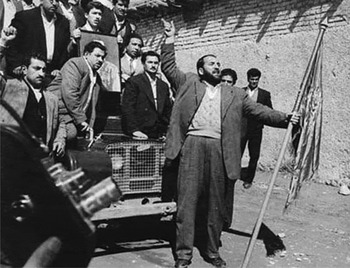
When I lived in Iran in the late 1960s, I was often tasked with showing visiting European guests, both men and women, the city of Tehran. In those days few historic sites in the capital were open to the public, and one of the few culturally specific places I could take our guests was the traditional gymnasium of Iran, known as the zūrkhānah (house of strength), where men exercise in a pit (gawd) to the rhythm of a murshid, a man who recites poetry while accompanying himself on a goblet drum.Footnote 1 In those days Tehran had about thirty of them, but the one that staged regular daily performances for visitors was the club of Shaʿban Jaʿfari (popularly known as Shaʿban Bimukh, Shaʿban the Brainless), a “tough guy” who had been one of the ringleaders of the royalist crowds in the early 1950s showdown between the shah and Prime Minister Muhammad MusaddiqFootnote 2 (Figure 1).
Shaʿban Jaʿfari leading a mob in the early 1950s.

For his services he was rewarded by the monarch with a modern club that, while respecting the spatial structures of a traditional zūrkhānah, was much better appointed than the old and often somewhat shabby and dingy buildings that housed zūrkhānahs in Tehran's déclassé southern neighborhoods. My explanations of the exercises and rituals to our guests uncritically reiterated the oft-repeated refrain that the house of strength was an institution dedicated not only to physical education but, equally importantly, to chivalry and virtuous living. The word pahlavān, so I explained, meant a champion athlete (especially a wrestler) but also a man dedicated to selflessly helping the poor and vulnerable, one who practiced fairness, hospitality, forgiveness, humility, and generosity, and who eschewed haughtiness, rancor, greed, and subservience to the powerful; in other words, one who embodied the ethos of Persian chivalry (javānmardī).Footnote 3
In subsequent years, it sometimes happened that when I told Iranians about my visits to the zūrkhānah, my interlocutors would smirk and exchange knowing glances with each other. It was only in the late 1980s that I found out why: after a lecture on the zūrkhānah by Sadr al-Din Ilahi, a senior Iranian journalist with a doctorate in sport sciences, a member of the audience asked him a pointed question about the reason why so many Iranians hold the institution in contempt. He chuckled and admitted that in the past zūrkhānahs had the reputation of being dens of sodomy and pedophilia.Footnote 4 This rekindled the memory of a lanky blond and very pale youth wearing clothes that were tight even by the standards of the late 1960s surreptitiously entering the practice room behind the public space of the Jaʿfari club during one of my visits, a sight that I had found vaguely incongruous but that I had been too innocent to find intriguing.
In this article, I propose to unravel how gender relations in Iran's native athletic tradition have changed as a result of developments in Iranian society as a whole. This involves a discussion of its homoerotic dimension,Footnote 5 which will be done by adducing evidence from classical literature and more recent accounts of real-life zūrkhānahs. I will then examine the dilemmas faced by athletes and Iran's sports authorities, both before and after the 1979 revolution, as they faced the pressures of heteronormalization in a social institution that traditionally mandated sexual segregation.Footnote 6 This will be followed by a discussion of contemporary women's quests for participation in what is now called “ancient sports.” I will end with a brief look at contemporary artistic expressions of the unresolved dilemmas faced by an ancient institution as it faces a changing world.
THE EVIDENCE FROM CLASSICAL LITERATURE
Physical exercises were not considered a particularly noble pursuit in premodern society, for which reason they and their practitioners are rarely mentioned in classical Persian literature. The various works of Iran's epic tradition, most importantly the Shahnamah (Book of Kings), mention numerous games of polo and wrestling bouts between warriors, some of them women, but the stories in which these occur take place in a mythical past and are almost always rendered in a formulaic way.Footnote 7 To the best of my knowledge, the first depiction of an individualized pahlavān can be found in the Gulistan of Saʿdi (1210–92), a 13th-century work on ethical topics in mixed prose and verse that ranks perhaps as the most influential work of Persian literature. In it we find the story of a wrestling master who teaches one of his pupils 359 of the 360 holds and moves that he knows. When the young pahlavān boasts to the king that he has become the equal of his teacher, the king arranges for them to wrestle. The old man uses his last move to defeat his disrespectful pupil. When asked by the king to explain how he did it, he reveals that he had saved the last hold for just such an occasion, the morale of the story being that one should not give a friend enough strength that, if he becomes a foe, he would be stronger than oneself. In contemporary Iran, the lesson drawn is that one should never reveal all one's secrets to anyone, even one's closest friends, as they might take advantage of what they know if one day they are no longer a friend. What is overlooked in most references to this well-known story, is that the wrestling master had also taken a shine to this particular student: “In a corner of his mind he was attracted to the beauty of one of his pupils,”Footnote 8 a detail that adds to the poignancy of the betrayal. The Gulistan contains many other stories involving same-sex love,Footnote 9 a common feature of premodern Persian literature.Footnote 10 Almost all the love relationships of which these stories speak are chaste, however, and can be interpreted metaphorically as expressions of love of God, to whose beauty the lovely mien of a youth is a testimony.Footnote 11 Moreover, none occurs in the modest world of athletes. In other works by Saʿdi, however, we find stories about sexual encounters involving athletes that are rendered in too explicit a language to admit of a spiritual interpretation. These texts have often been excised from his “Complete Works” by prudish 20th-century editors.Footnote 12
In Saʿdi's Hazliyyāt (Pleasantries), there is a story about a man falling in love with a beautiful young wrestler. He desires the athlete, but the latter will only accept his embrace, “lip on lip and mouth to mouth, like two nuts in one shell.” The man, however, cannot contain his sexual desire, and eventually manages to sodomize the wrestler, and “he who had never had his shoulders pinned to the ground, ended up with his forehead on the ground.”Footnote 13 In another poem, we read:
A hundred years later, the satirist ʿUbayd Zakani (1300–71) used similar similes of pinning and penetration. In a short text called Sad Pand (Hundred Admonitions) in which he reverses all the usual moral precepts (rather like Jonathan Swift's Devil's Dictionary or Oscar Wilde's Phrases and Philosophies for the Use of the Young), two of the admonitions contain references to wrestling: “As a child, do not withhold your arse from friend and foe, relative and stranger, near and far, so that in old age you can become a venerable old man, a preacher, a champion wrestler, or a famous man.” And: “Don't call a champion him who can pin his opponent's back to the ground, instead deem him a true champion who will put his face on the ground and out of devotion take a penis in his arse.”Footnote 15
In the pantheon of Iran's traditional athletic culture, the most prominent figure is Pahlavan Mahmud Khvarazmi, known in Iran as Puriya Vali.Footnote 16 He started as an athlete and later became a Sufi master; his tomb in Khiva (in what is now Uzbekistan) is still visited today. In an oft-quoted story, he lets himself be beaten by an ambitious younger contender after seeing that man's mother pray for her son because the poor family needed the prize money. One version of this story has Puriya Vali fall in love with this young man.Footnote 17 In another story, related in the chapter devoted to Puriya Vali in an early 16th-century work from Herat that contains “75 short biographies of celebrated figures, mystics, poets … and rulers narrating their lives with a view to explaining that one cannot reach true spiritual love without having endured and understood the pangs of earthly longing,”Footnote 18 we read that a youth of outstanding beauty arrived from Hamadan with the intention of being among the beloveds of Puriya. At the height of passion, when the pahlavān was insanely drunk from the wine of oblivion, and upon beholding that youth's countenance, he fell in love with him. He decided to teach him wrestling, and trained him until he had adorned the palm tree of his body with the branches and twigs of wrestling holds. And after that it so happened that he never recovered. The love of that youth had such a disorienting effect on the pahlavān that he fell ill.Footnote 19
A few years later, Zayn al-Din Mahmud Vasifi (1485–1551 or 1566) wrote a long book about famous figures of his time in which he dedicates a whole chapter to the pahlavāns of the Timurid court of Sultan Husayn Bayqara at Herat.Footnote 20 One story tells of a match between a studious youth, Darvish Muhammad, and an established wrestler from outside the city of Herat, Pahlavan ʿAli Rustaʾi. The boy is a nephew of a famous local wrestler now retired, and his uncle takes him away from his studies and trains him for three years. The homoerotic dimensions of the rest of the story are readily apparent. The king orders a water basin to be emptied and to be transformed into an arena.Footnote 21
When Darvish Muhammad disrobed, it was as if he was a corporeal spirit [rūḥ-i mujassam]. The king said that no pleasure equaled beholding Darvish Muhammad, and gave him the title of tupchāq-e kushtīgīrān.Footnote 22 Compared to him, Pahlavan ʿAli Rustaʾi was the epitome of ugliness and lack of proportion [nāhamvārī].
Darvish Muhammad easily defeats his opponent but gives him all the prize money, saying that the honor he acquired is enough for him.Footnote 23 He went on to have a distinguished career as a musician, poet, and courtier. When he grew older, he spent considerable time training a wrestler, Pahlavan Piri, “with the view that in his old age, he would be the beloved child and delight of Pahlavan…. But he was unfaithful, and separated from Pahlavan. Pahlavan was a man of great honor and virtue, and though his heart was aflame and his body wounded by grief, he did not reveal it to anyone.” He went on compose a masnavī in on the subject of his aging, and the infidelity of Pahlavan Piri.Footnote 24
Another poet active in Herat, Sayfi Bukharaʾi, wrote a ghazal about a young strongman performing in public:
Timurid rule in Herat ended in 1506, and soon the city was incorporated into the Safavid empire. Safavid shahs patronized wrestling, and Iran was dotted with many zūrkhānahs. The 17th-century French traveler John Chardin relates that
Wrestling is the Exercise of People in a Lower Condition; and generally Speaking, only of People who are indigent. They call the Place where they Show themselves to Wrestle, Zour Kone, that is to say, the House of Force. They have of'em in all the Houses of the great Lords, and especially those of Governours of Provinces, to Exercise their People. Every Town has besides Companies of those Wrestlers for Show.Footnote 26
Around 1700, Mir ʿAbd al-ʿAdil, a minor poet known as Nijat-i Isfahani, wrote a masnavī on wrestling that was to acquire lasting fame: the Gul-i Kushti (Rose [or Gage] of Wrestling).Footnote 27 This poem of 268 diptychs skillfully weaves wrestling terminology into the narrative, which again praises the beauty and charm of young athletes—so much so that a British scholar of Persian literature thought that “in spite of its ostensible theme the poem contains very little on wrestling and is mainly of erotic content.”Footnote 28 Mention should also be made of a number of short poems in the shahr āshūb genre that also praise young athletes and their beauty.Footnote 29 However, one should be careful in drawing conclusions from these because shahr āshubs exist for most professions, from tailors and fruit-sellers to iron smiths and butchers.
THE WORLD OF THE PREMODERN ZŪRKHĀNAH
Having shown that a certain homoerotic sensibility can be detected in the few classical texts that deal with athletes, let us now look at actual practice. Was the eroticism of a discursive nature or is there evidence of actual carnal relations? One might dismiss a masnavī such as Mir Nijat's Gul-i Kushti as yet another example of an old poetic trope, except that the author, very probably an athlete himself, had particular persons in mind:
There is a treatise by Mir Nijat, who wrote these verses on the life and times [aḥvāl] of a young and beautiful youth who was a zūrkhānah goer, and anybody familiar with zūrkhānah terminology knows how much his verses on the zūrkhānah and pahlavānhood are amusing, for this type of poetry is original and unprecedented.Footnote 30
Mir Nijat's work inspired four different commentaries, known as Sharh-i Gul-i Kushti, penned in India, and the one to which I have access actually names the two young pahlavāns with whom the author was in love: “Haji [sic] and Rustam were both beloveds of Mir Nijat, and Gul-i Kushti is about them.”Footnote 31 The fact that Gul-i Kushti was annotated by four different authors in India may not be unrelated to the fact that the connection between male eroticism and athletics was not unknown there. In a text written in Persian in the 1740s, we learn about akharas, the Indian analogs to the zūrkhānah, that “handsome boys frequent them and the licentious and libertines enjoy their beauty.”Footnote 32
But back to Iran: inside the zūrkhānah, members did not hesitate to show their affection for each other openly. In the 1930s an English lady traveler, Mary Weston, managed to visit a house of strength, entrance to which was then forbidden to women. It is not astonishing that the very un-British physical intimacy reigning in the pit struck her:
At last the wrestling began. The opponents took hands and, giving a quaint sudden pull, touched each other, right shoulder to right shoulder, before the bout began. None lasted long and when they finished the men touched each other on the right brow, the right cheek, pretended to kiss or did kiss each other, full upon the lips. In the intervals some of the men stood close together, their hands clasped or their arms about each other.Footnote 33
We also know of two brothers, ʿAbbas and Husayn, sons of a pahlavān, who were both athletes and “unsurpassed in their knowledge of the holds of wrestling.” “Their love for each other surpassed that between brothers, and they could not stand being separated for an instant.” When ʿAbbas suddenly died, his brother put his head on the deceased's tomb and died on the spot. Husayn was buried next to ʿAbbas, and their tomb became a shrine for the sports lovers of Sanandaj, the capital of the Iranian province of Kurdistan.Footnote 34
Finally, there is the curious story of a murderer whose life was spared because of his good looks. A pupil of Mustafa Tusi, a much-respected wrestling champion in the 1940s and 1950s, killed another man in a fight over a trifle. When a court condemned the pupil to be hanged, Tusi set out to save him. First, he obtained the consent of the victim's family to save his life, but that did not sway the court. So he went to the shah himself, told him of the youngster's virtues, and then showed him his half-naked photos: “Look how beautiful his face and body are. Wouldn't it be a shame if such a proportionate body were to be hanged because of a blunder?,” he asked. The shah commuted his sentence, and he was released after a few years on the occasion of an amnesty.Footnote 35
Of course physical displays of affection, the admiration of beauty, and a fortiori brotherly love do not automatically connote physical homoerotic relationships. But if we consider the physical and social setting of an Iranian house of strength, the potential for such relationships was certainly present. Like many institutions in traditional Islamic societies, the zūrkhānah, too, constituted a homosocial milieu. Not only were women not allowed to be present, but men covered only their intimate parts, ʿawrah, which according to the shariʿa is the area between the navel and the knees.Footnote 36 “Exercising with clothes on was forbidden in the zūrkānah,”Footnote 37 as the following two verses show:
and
Moreover, it seems that athletes often did not marry and avoided having intercourse with women.Footnote 40 The medieval historian Juvayni tells the story of a champion wrestler, Filah Hamadani, who had been called to the court of Genghis Khan's son and successor Ögedei Khan (r. 1229–41). The Mongol ruler rewarded Filah after a decisive victory with a beautiful and charming young woman, but practicing abstinence, he did not touch her. When she complained that her husband did not pay any attention to her, Ögedei asked the pahlavān why this was so, and was told that he sought to conserve his strength. The ruler told him the point was to have children, and absolved him from wrestling ever again.Footnote 41 This abstinence is congruent with practices elsewhere, and we find this belief in the strength of semen both in Greek antiquityFootnote 42 and in South Asia. In India, “wrestlers, on the whole, avoid the company of women assiduously. Women, when encountered, are to be treated as mothers or sisters.”Footnote 43 In Pakistan, traditional wrestlers are celibate and “keep their loin cloth firmly tied” while they are active, and “open their loincloth” when they get married in their mid-thirties.Footnote 44 According to a physical education teacher quoted to me by the aforementioned Sadr al-Dan Ilahi, the great pahlavāns of the past used to collect their nightly semen emissions and drink them in the morning, so as not to lose strength. As late as the late 1950s, an American living in Iran was told by zūrkhānah athletes that while sleeping with women sapped their strength, sleeping with men did not.Footnote 45
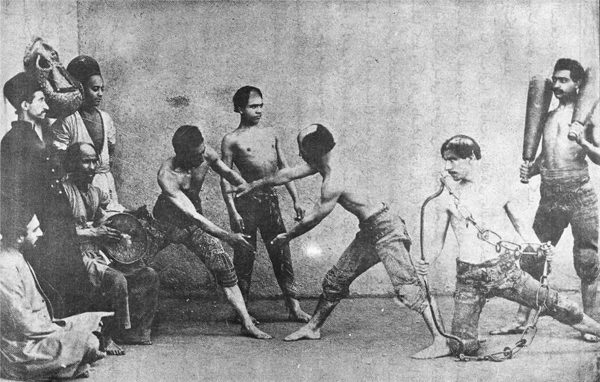
Given the Iranian tradition of shāhid-bāzī (enjoying gazing at beautiful young males), beholding the beauty of God on the face of a half-naked youth in the pit of a house of strength was too much of a temptation, and so one of the standard “rules” for zūrkhānahs stated that in addition to women and non-Muslims, beardless (prepubescent) boys were not allowed to enter. Facial hair was (and is) of course “a visible and bodily symbol of a double opposition: to women and to children,”Footnote 46 and in the Iranian zūrkhānah in theory if a young man's beard was thick enough for a comb to stick to it, he could enter—if not, he had to wait. The story is told of a youngster who was so eager to enter the gymnasium that he stuck a comb into the flesh of his cheek, an act that was considered manly enough for acceptance.Footnote 47 There are, however, old photos of athletes showing prepubescent boys, including one which seems to show a complicitous eye lock between one and an adult athlete (Figure 2). The prohibition of youth may therefore be an invented tradition of the 20th century. In fact, an early 16th-century text on the customs of pahlavāns and wrestlers does not mention such a rule.Footnote 48
A fin-de-siècle (A.H.S.) zūrkhānah scene in Tehran.

By the early 20th century, it was known that male–male sexual activity went on in some houses of strength. Older athletes sometimes abused the novices, and some went so far as to brand their boys so that they could never again show off (ʿarẓ-i andām kunand).Footnote 49 The boys were called arbāb, ādam (person), or simply nawchah, the latter being actually the legitimate term for novices.Footnote 50 These practices have left traces in the Persian language. The expression kundah bālā kashidan, for instance, denotes a wrestling move but can be colloquially used in the sense of “screwing someone.” (A similar polysemy existed in ancient Greece.)Footnote 51
MODERN TIMES
In the 19th century, many habitués of the zūrkhānahs were lūṭīs, a marginal group of men who flaunted some rules of propriety: they drank, organized and bet on cock and ram fights and pigeon races, gambled, fought with knives, and had a reputation for sexual deviance; in fact, the word lūṭī derives from the same trilateral Arabic root as the word liwāṭ, meaning sodomy.Footnote 52 Some were entertainers—musicians, jugglers, acrobats, strongmen, snake-charmers—others neighborhood toughs who extracted protection money from the rich, occasionally helped the poor, defended the “honor” of their neighborhood by brawling with rival lūṭīs from other neighborhoods, ran prostitution rings and opium dens, rioted in the pay of a local notable or religious leader, or maintained law and order in the pay of the state and its local representatives. However, the term lūṭī also connoted a man who is truthful, honors his promises, helps the poor and weak, disregards status distinctions when dealing with his social inferiors, and puts the welfare of others above his own, in short, one who lives by the ideals of javānmardī.
Under the Qajars, both the court and provincial grandees patronized pahlavāns, who entertained courtiers and governors with their wrestling matches. The Constitutional Revolution of 1906 put an end to that, as the modernists who came to power were highly critical of the zūrkhānah, mainly because of the louche reputation of many of its lūṭī devotees. They favored modern European sports, especially team sports that, so they thought, would teach young Iranians to cooperate with one another in contrast to the individual exercises of Iran.Footnote 53 Zūrkhānah sports fell on hard times, kept alive by a few dedicated amateurs. A modest state patronage resumed only in 1934, when the millennium of Iran's national epic, the Shahnamah of Firdawsi (940–1020), was celebrated all over Iran and traditional athletes performed their exercises as part of these celebrations.Footnote 54 What had been called simply varzish (sport) was now called varzish-i bāstānī (ancient” sport), as the unqualified word came to connote modern, i.e., European, sports and physical exercises. To ennoble activities that had had, as we have seen, an ambiguous reputation in society, they had to be discursively connected with Iran's ever-so-glorious ancient (read: pre-Islamic) past. Whatever negative traits they may have had, were now ascribed to the general “decadence” of Iranian society under the Qajar dynasty, whose rule ended in 1925. The imputation of moral “decadence” to the Qajars was a common trope in Iran after their fall, and the idea has to be taken with a grain of salt.Footnote 55 True, Nasir al-Din Shah's (r. 1848–96) Austrian court physician noted in a book published in 1865 that “since a lot of dissolute and merry types frequent [the houses of strength], young men of good families do not go there.”Footnote 56 But this was nothing new: during the reign of the last ruling Safavid king, Shah Sultan Husayn (r. 1694–1722), “pahlavāns and wrestlers … wherever they saw a women, a beautiful girl, or a beautiful boy would abduct them by a variety of tricks, [abuse them] until they were satisfied, and then return them.”Footnote 57
The pahlavān therefore had to be reinvented as a chivalrous and patriotic figure. In the ideal heteronormalized Iranian society that came to be propagated in the 1920s and 1930s, there was no place for love and sex among males,Footnote 58 but now that the zūrkhānah was a patriotic institution embodying the most noble values of a “renascent” Iran, overt criticism of it was rare and focused on the hygienic conditions prevailing in the insufficiently ventilated gymnasiums and the inadequacy of some exercises for the development of a harmonious body.Footnote 59 Such was the taboo that attached to same-sex dalliances that their prevalence in the zūrkhānah was criticized only in works of fiction.Footnote 60
Already in 1908 Muhammad Baqir Mirza Khusruvi had hinted at the normative obsolescence of same-sex sentiments in the Iran of his time. In his novel Shams va-Tughra (Shams and Tughra), whose story unfolds in the 13th century and which is considered the first Persian historical novel, one of the male characters embraces and kisses one Pahlavan Muhammad and they speak of love and enjoyments (ʿishq va ṣafā). But the author felt compelled to clarify that these “were common in that time.”Footnote 61 Jaʿfar Shahri, a chronicler of urban life in early 20th-century Tehran,Footnote 62 went further in his autobiographical novel Shikar-i Talkh (Bitter Sugar). Deploring the spread of pederasty and even sexual relations among people of the same age around the turn of the 20th century (the first being apparently less heinous than the latter!), he writes that a merchant who employed a beautiful youth in his shop would attract more business. He adds that this bad habit had spread to the zūrkhānahs, for here such youth gathered in great numbers and “their crystalline bodies were available to the gaze of their admirers without any obstacles.” In the past, he avers, a pahlavān would readily lose to spare his opponent embarrassment, but today a pahlavān rapes his novices, if need be by inebriating them, so that once they have grown up they will be of such ill repute that they would never dare pin the pahlavān to the ground. He even claims that the great Pahlavan Khurasani had young men branded in their private parts after abusing them.Footnote 63
Nor did modernization necessarily quell the anxiety felt among athletes. One aspect of modernization in the realm of sports was that in the 1930s international freestyle wrestling replaced the style practiced in the zūrkhānah, which was later constituted as a separate discipline known as “pahlavāni wrestling.” In the beginning, the singlets used in modern international wrestling were deemed indecent because they left a man's thigh, part of his ʿawrah, uncovered. This is how some youths’ first efforts on the mat are described in an autobiographical novel whose action takes place among traditional lower-class Iranians of Tehran's South End in the late 1950s:
In the beginning he and Murtiza were ashamed to step onto the mat in singlets. Well, they were right to be afraid, such fair and handsome things [chīz-i bih ūn tar u tamīzī], and that on a wrestling mat to boot. The upshot was to be careful not to get caught in a scissors hold [sagak] by Mr. Davudi [the coach].Footnote 64
Later in the novel, as a group of young men discuss their sports heroes, one mentions soccer players and another lists wrestlers and practitioners of “ancient” sports, but he is interrupted by a third person who says: “and among the pederasts [bachchahbāz] we have Mr. Davudi, Sayyid Husayn Maddah, and Shaykh Ghulam Dakalbaz.”Footnote 65 However, sexual activity was fluid and embraced both sexes, for in the same novel we read that people respected men sporting cauliflower ears, who received a particularly warm welcome in Tehran's Red Light District.Footnote 66 Obviously, as the Shahnamah has it in an oft-quoted line, bih kushtī padid āyad az mard mard, translatable as “wrestling makes a man out of a man.”
These anecdotes pertain to the more traditional sectors of society. Under the Pahlavis, the state promoted not only heteronormativity but also sexual desegregation, and this brought about new types of gender anxieties involving women. The logical consequence of this state of affairs for what was now considered “traditional” sports was that by the 1950s the prohibition for women entering the zūrkhānahs was occasionally breached.
WOMEN AND THE ZŪRKHĀNAH
Whereas the old nonstate zūrkhānahs by and large maintained the prohibition on women's presence, the newer ones did not. Foreign visitors, including women, were often invited by their Iranian hosts to attend athletic performances: officials were taken to the well-appointed House of Strength of the Bank Melli in central Tehran; celebrities from the realms of sport and entertainment were often hosted by Shaʿban Jaʿfari in his club.
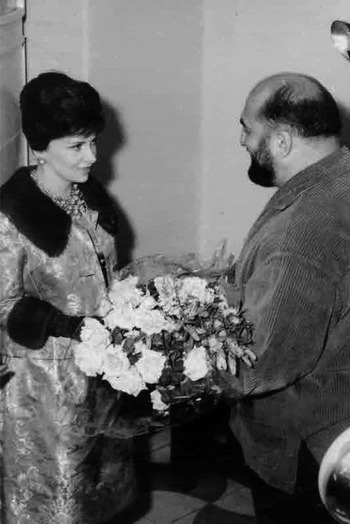
Traditional circles did not take to this breach of propriety kindly. When the Italian actress Gina Lollobrigida was received with full honors by Jaʿfari, he was criticized for hosting “a woman of ill repute.” A rival zūrkhānah owner sent a photo of the star with Jaʿfari to the religious authorities, asking them for a condemnation. Jaʿfari had to use all his contacts within the shah's secret police, Savak, to avoid a humiliation (Figure 3).Footnote 67
Gina Lollobrigida at the Jaʿfari Club in the spring of 1963. Provided by Homa Sarshar.

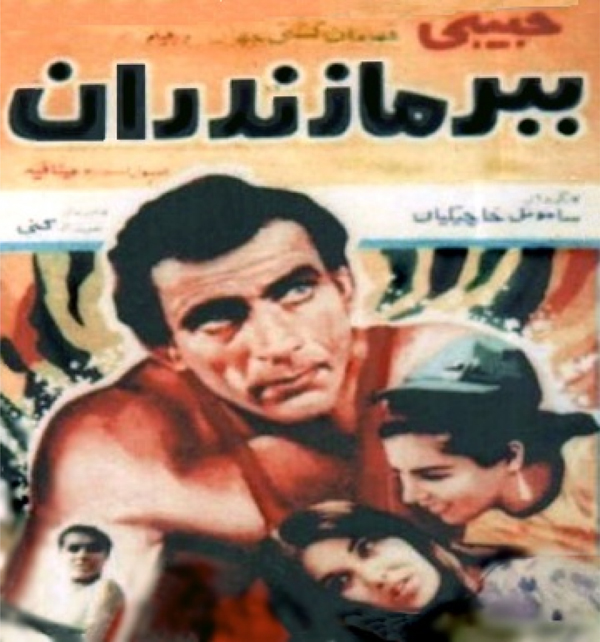
When the old story of Puriya Vali was updated for a film, women were introduced into the narrative. The film Babr-i Mazandaran (Tiger of Mazandaran), which was released in 1968, retells the story of the Sufi saint, shorn of all religious elements, in a contemporary context. Habib (played by Imam-ʿAli Habibi, a multiple world freestyle wrestling champion who also served as a member of parliament under the shah) is a lumberjack and village strongman in Mazandaran, a Caspian province known for the prowess of its wrestlers. He has a sidekick who is a dwarf, and he is at odds with the local land owner's steward, the evil Bashir Khan. (The film was made only a few years after the shah's land reform.) Habib wins a local tournament and is sent to Mashhad to compete in a national championship. At a shrine there, he surreptitiously observes the mother of Kayvan, the man who will be his opponent in the finals, as she prays for her son's victory so that he will not lose face with his fiancée's family. Habib allows himself to be pinned. The mother sees through Habib's sacrifice, and sends him a gift of money to thank him. When this is discovered, Habib stands accused of having been bribed to lose intentionally. Worse, back in the village he is accused by Bashir Khan of having attempted to rape a blind girl, Lalah. When the mother hears about the problem she created, she resolves to prove Habib's innocence and heads for the village in the company of her son and his fiancée to set the record straight. For some reason Bashir Khan is present when everybody meets, and when the blind Lalah hears his voice, she identifies him as the man who had attempted to rape her. Threatened with arrest, Bashir and his henchmen abduct Kayvan's fiancée and drive away, and together Habib and Kayvan set off to rescue her. After many car chases and fights that allow both of them to display their physique and their grappling techniques, they rescue the young woman and capture Bashir. Kayvan considers it dishonorable to have won thanks to his opponent having allowed himself to be thrown, and demands a rematch right there and then. This time Habib wins fair and square, and everybody celebrates. In the last scene, the dwarf proposes marriage to the blind girl, telling her that “if we wrestle [!], our children will have your height and my eyesight” (Figure 4).Footnote 68
The poster for Babr-i Mazandaran.

By the 1970s, the Iranian press routinely published photos of female singers or actors in the company of male athletes, usually football players, because football fever was spreading. The following cover of Iṭṭilaʿat Haftagi, a mass-circulation weekly, had everything to offend traditional notions of propriety (Figure 5).
A singer and an athlete starring in a comedy film.

As the shah's popularity plummeted among traditional Iranians, the close ties between Jaʿfari, who headed the country's “Ancient Sport” establishment, and the regime soiled the reputation of traditional athletics, which was already ambiguous for all the reasons we saw earlier. When the revolution broke out in 1978, Jaʿfari tried to mount pro-shah demonstrations, but unlike in the 1950s, found no one to go along.Footnote 69 After the revolution he fled abroad and died in Los Angeles, where he is buried at the Pierce Brothers Westwood Village Memorial Park & Mortuary, a few meters from the grave of Marilyn Monroe.
Initially the new power holders in Iran regarded Western sports with a certain contempt. Tennis was outlawed for being elitist,Footnote 70 and football was suspect because it distracted the young from more worthy pursuits such as religion.Footnote 71 The quest for cultural authenticity being one of the leitmotive of the revolutionaries, zūrkhānah sports would have seemed to be an obvious choice for official support—except that they were soiled by association with the old regime. For “ancient sport” to survive, therefore, it had to be cleansed of all associations with the Pahlavi state. To legitimize it in the new postrevolutionary order, its Islamic, more particularly Shiʿi, dimensions were stressed again, and these included strict sexual segregation. In his memoirs, the first postrevolutionary head of Iran's national physical education organization recalls that “in principle the attire of traditional athletes is a lung [a broad cloth wrapped around a man's hips], and even if they wear shorts underneath this, their torso is naked, and it is contrary to Islamic and Iranian etiquette for a woman to enter a zūrkhānah.”Footnote 72 Women were no longer allowed to visit the gymnasia, in line with the state's general sports policies, which did not allow women to attend men's sports events, most notoriously football matches.Footnote 73 Conversely, men could no longer attend women's sports events. This created problems for the state-run television service, which faced the difficult task of broadcasting sports events without showing too much skin.Footnote 74 Women's sports, which had been encouraged under the Pahlavis,Footnote 75 were marginalized, as facilities were used mostly by men and there was little money to build new ones given the expense of the war with Iraq. Beginning in the 1990s, after the end of the war and the social liberalization under Presidents ʿAli-Akbar Rafsanjani and Muhammad Khatami, the demands of women activists for equal treatment in the realm of sport were twofold: access to male sports events as spectators,Footnote 76 and equal facilities for practicing sports. Most of the demands concerned modern Western sports, and though women are still not allowed to attend soccer matches in Iran, considerable progress has been made in the provision of facilities and the organization of competitions for women.Footnote 77 By the 2000s a few women showed interest in “ancient” sport as well, as we shall see shortly.
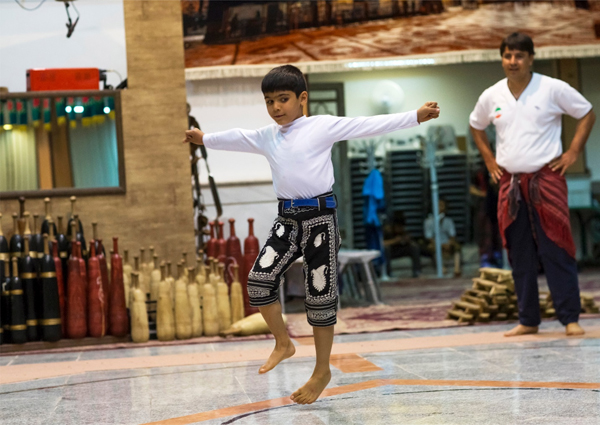
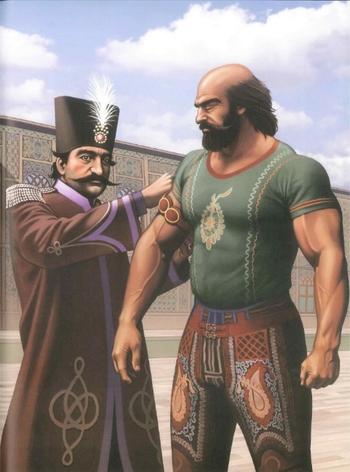
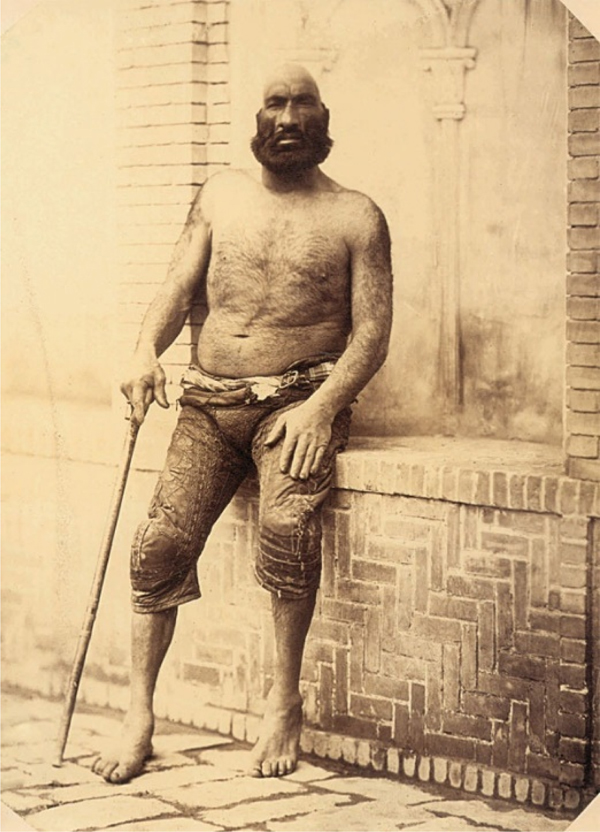
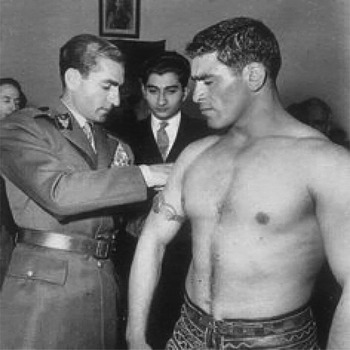
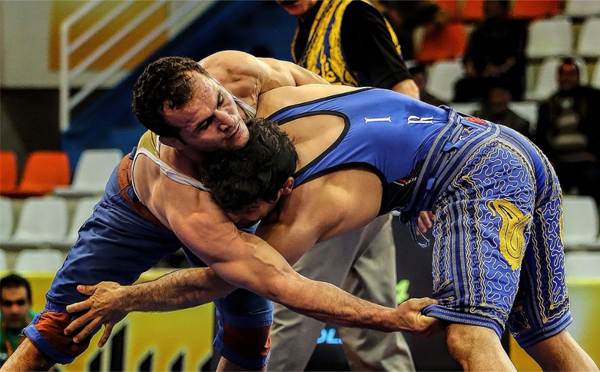
In light of the newly enforced sexual segregation in zūrkhānahs, it is intriguing that the authorities also decided to innovate by requiring zūrkhānah athletes to wear T-shirts in the gawd—a dress code for which there was no precedent. In another break with (invented?) tradition, boys and adolescents were allowed into the pit, a necessity for ensuring the future of an institution most young Iranians deem hopelessly old fashioned and uncool (Figure 6). In view of the prescribed absence of women, the imposition of T-shirts can reasonably be ascribed to anxiety about homosociality veering into homoerotic or pedophile desire. The new dress codes also made it possible to showcase zūrkhānah sports on television. It was even retroactively applied to historical figures: in an illustration for a children's book on traditional Iranian sports, we find a painting by Muhammad Haqqani of Nasir al-Din Shah fastening the champion's torque onto the bicep of Pahlavan Yazdi, one of the legendary athletes of late 19th-century Iran (Figure 7).Footnote 78 Fortunately, we have a photo of the historical Pahlavan Yazdi (Figure 8). Two features of the painting are worth noting. First, the exaggerated musculature of the athlete, which betrays the influence of Western notions of male athletic beauty as propagated by body builders.Footnote 79 Second, the addition of a T-shirt, which becomes obvious when we compare it to a photo from the early 1950s which must have been its model, at least as far as the posture of the athlete is concerned (Figure 9). By the same token, Zuran, a documentary made in 2001 for the Kermanshah affiliate of Islamic Republic of Iran Broadcasting (the state radio and television corporation) was not granted permission to be screened on the network or be shown at festivals because the filmmaker insisted on showing athletes in their traditional attire (Figure 10).Footnote 80 Pahlavānī wrestlers were exempted from wearing T-shirts for a while. When I attended the national pahlavānī wrestling championship in Isfahan in the summer of 2003, contestants wore only the traditional breeches (tunbān) while they battled in front of an all-male public some of whose members made obscene cat-calls.Footnote 81 But when a TV crew arrived to film one bout for the evening news, the wrestlers donned T-shirts, presumably out of respect for female viewers. More recently, pahlavānī wrestlers have been made to wear standard singlets underneath their breeches, which are maintained to enable holds that are specific to that style of wrestling and that would be impossible if the contestants wore only singlets (Figure 11).Footnote 82
Two generations at a contemporary zūrkhānah in Kashan. © Eric Lafforgue / age fotostock.

Painting of Nasir al-Din Shah and Pahlavan Yazdi by Muhammad Haqqani, 2016.

Pahlavan Yazdi.

Mohammad Reza Shah decorating Pahlavan Aḥmad Vafadar, 1950.

Zuran, a documentary “not fit for broadcasting,” by Muhammad Riza Haji Ghulami.

International pahlavānī wrestling.

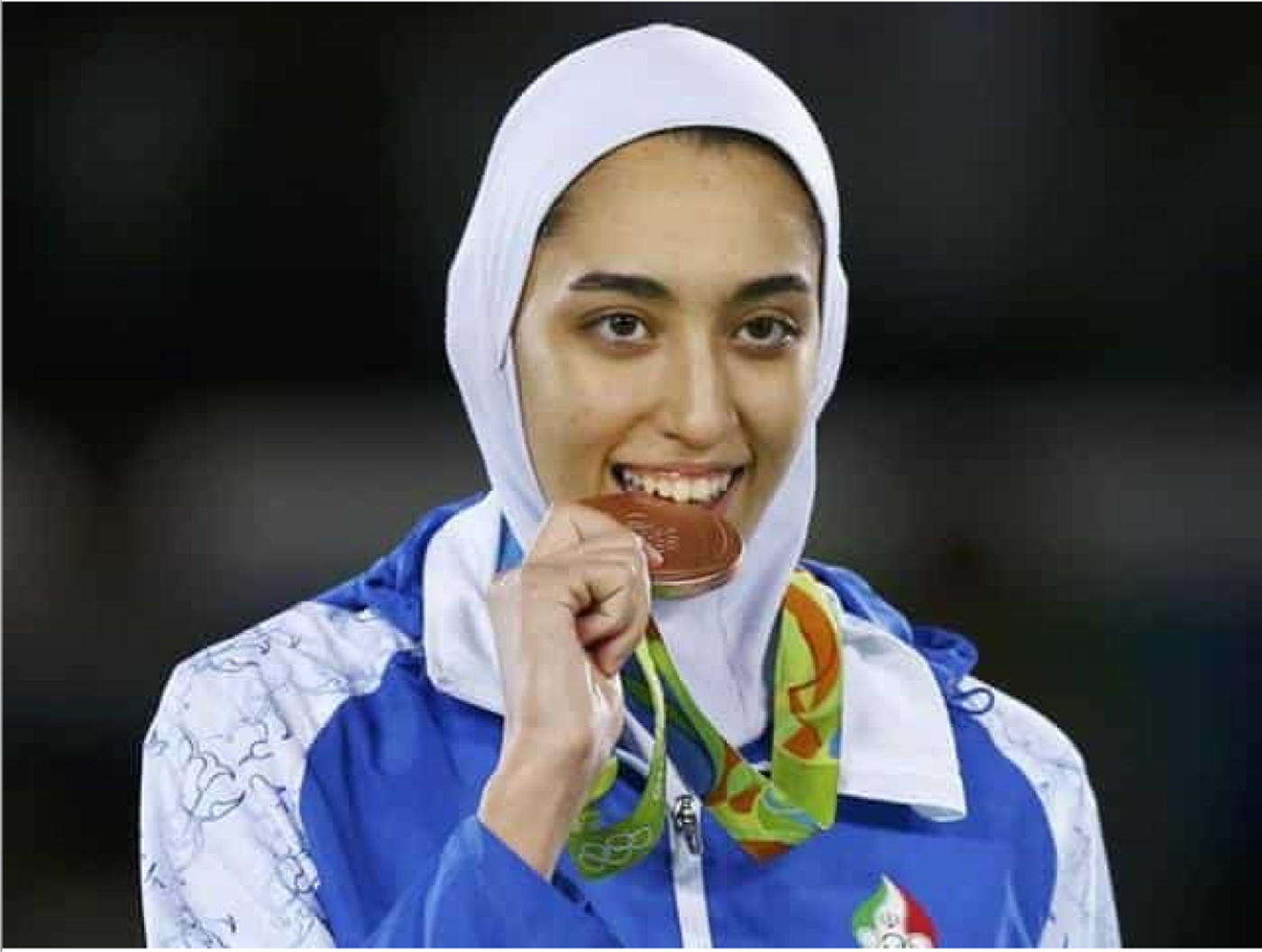
The imposition of T-shirts has been criticized for its inauthenticity, and its juxtaposition with the traditional breeches has struck many as an “aesthetic dysfunctionality.”Footnote 83 True, but one must keep in mind that, given the official puritanism in Iran, it was only by making compromises that practitioners of “ancient” sports could open a space for their activities and receive state support, without which their activities would not be viable.Footnote 84 For the fact is that young Iranians are overwhelmingly attracted to modern sports, and to the extent that they engage in combat sports, their preferences go to East Asian disciplines such as Wushu and Taekwondo. It is precisely in the latter that the first Iranian woman gained an Olympic medal when Kimiya ʿAlizadah Zunuzi won a bronze medal in Rio de Janeiro in 2016 (Figure 12). The presence of women athletes wearing hijab in the Iranian martial arts scene has opened up the question of their participation in zūrkhānah exercises, which are often presented as a form of martial arts in view of the popularity of that concept around the world.Footnote 85
Olympic medalist Kimiya ʿAlizadah Zunuzi, 2016. https://www.hindustantimes.com/olympics/rio-2016-iran-hail-their-first-ever-woman-medallist-kimia-alizadeh/story-Ttgl6xLzWigVDQQIHgav4J.html.

Discussions on the place of women in zūrkhānah sports were triggered by the sustained efforts to internationalize them.Footnote 86 These efforts were motivated by the need to render them more attractive in the eyes of the young by offering possibilities for international competition. As the head of the International Zurkhaneh Sports Federation confirmed in a recent interview, the ultimate goal is to make zūrkhānah sports an Olympic discipline. But for that to happen, numerous conditions had to be met, including equality between men and women.Footnote 87 Movement towards that goal is already evident: as Iranian instructors fanned out to coach people around the world in the techniques of zūrkhānah exercises, they found themselves having to teach women. By 2008 women participated in zūrkhānah sports in India, Sri Lanka, Nepal, the Philippines, South Korea, Tajikistan, and Afghanistan.Footnote 88
Whereas Iranian sports functionaries grew concerned with women's participation because of the attempts at internationalization, Iranian women athletes did not wait for their involvement to become an issue because of outside pressures. In Kermanshah, a woman by the name of Simin Muʾayyidi opened a zūrkhānah for women, but it was soon closed down by the authorities. Supporters of women's participation in “ancient” sports opine that the prohibition stems from tradition, not the shariʿa. Indeed, conservative elders argue that inside the sacred space of a gawd a man must be in a state of ritual purity, i.e., have done his ablutions (vuẓū/wuḍū), which, according to them, is problematic for women (probably a reference to women's menstruation). But this argument has been refuted by a cleric who retorted that women are allowed in mosques, and zūrkhānahs are certainly not more hallowed spaces than mosques. However, for the then vice president of the International Federation, Mitra Ruhi, this was of minor importance. Although she found the argument insulting, she did not advocate women's presence in the zūrkhānah, preferring that women exercise in modern sports halls: “What's the difference with aerobics, other than that the music is our own?”Footnote 89
In the meantime, a number of marjaʿs (the highest religious authorities in Twelver Shiʿa Islam) have been asked for a fatwa concerning women's participation in zūrkhānah sports, and many, including Iran's Supreme Leader ʿAli Khaminihʾi, have found no reason to prohibit it as long as there is no intermingling of the sexes. While the national federation in Tehran (which has been at odds with the International Federation) dithers in Tehran, athletes in the provinces have taken matters into their own hands. In Shiraz, a Mr. Jaʿfari who heads a zūrkhānah, reported that his wife learned the exercises when he exercised at home, and now occasionally joins him in the gawd of his club when no other men are around.Footnote 90
A woman artist, Maryam Akhondy, who trained in classical Persian music but left Iran after the revolution when it became illegal for women to sing as soloists in public, recorded a video clip titled “Maryam Akhondy's Zurkhane” in which she recites poetry while accompanying herself on the goblet drum, having mastered every detail of a traditional murshid’s art—except that the poetry she performs is feminist:Footnote 91
While sports functionaries argue for and against women's participation in “ancient” sports, be it as spectators or as practitioners, artists have given their own interpretation of the gender dimension of the zūrkhānah.
ZŪRKHĀNAH AND GENDER IN THE VISUAL ARTS
The travails of Iran's sports authorities are paralleled by artists who have cast an ironic eye on the zūrkhānah’s gender dimensions. In 2013 Anahita Razmi, an Iranian based in Germany, exhibited a video installation in Dubai consisting of a videoloop that shows her going through the exercises associated with the zūrkhānah, and an octagonal colored floor sticker. Her website explains that
the sport is only executed by men in Iran, - women are not allowed in the clubs. Initially disturbing this patriarchal base of the sport, the work House of Strength replaces the body of the male athlete with the body of the female artist. The ever repeating exercises are meanwhile reminding of a mechanical process without any output. The octagonal floor installation is referring to the shape of a typical zurkhaheh ring, - located somewhere between an abstract geometrical floor painting and a ring, which can be entered by the audience to follow the video.Footnote 92 (Figure 13)
Anahita Razmi and Carbon12 Gallery, Dubai, 2013. © Anahita Razmi © Mehraneh Atashi.

Occasionally, some women find ways to visit a zūrkhānah in Iran, and in recent years some historic zūrkhānahs have allowed foreign women tourists to attend performances. In 2004 the photographer Mehraneh Atashi snuck into a house of strength and took a number of photos of bare-chested athletes while she herself was dutifully covered. Using mirrors, the photographer managed to be present in all the photos she took. In theory, there is nothing objectionable to these images, because both the artist and her subjects observe the rules of the shariʿa for covering one's ʿawrah. In practice, however, they are an ironic inversion of the more common (at least in the West) scene of a fully dressed man ogling scantily clad women and can be interpreted as a reductio ad absurdum of the Islamic Republic's dress codes (Figure 14).Footnote 93
Mehraneh Atashi photographing a zūrkhānah athlete in 2004.

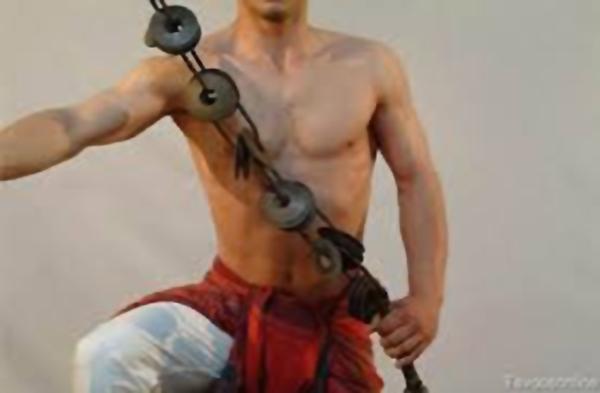
More daring still are the works of male artists that have cast a homoerotic gaze on the zūrkhānah and its practitioners, which brings our discussion full circle. Because many of these artists are active in Iran, I will here name only the late Sadegh Tirafkan. In a series of photographs of bare-chested men (2003–4) posing with the exercise instruments used in a traditional house of strength, he tried to show, as he put it, that “the same environment and looks are kept, but not the same spirit and attitude.”Footnote 94 He did not elaborate on what the new “spirit and attitude” were, but one has a hunch that they had much in common with the premodern world of Iranian athletics, before the heteronormalization decreed by the modernizers erased consciousness of what is there for everyone to see (Figure 15).
Photo by Sadegh Tirafkan. http://www.payvand.com/news/11/jul/1055.html.

CONCLUSION
What remains is to put the above analysis in context. By focusing on one aspect of a topic, one can easily create a fallacy of pars pro toto in the mind of the reader. The homoerotic dimension of what is now called “ancient sports” is something of which most people who are intimately familiar with the tradition are aware, and yet societal taboos have so far prevented its systematic discussion. The fact that this aspect of the tradition has been the subject of this study should not be taken to mean that Iranian zūrkhānahs are, or have ever been, primarily dens of quotidian pedophilia or homoeroticism. Historically, zūrkhānahs and their habitués have reflected the diversity of the population at large: thugs who misuse their physical power to terrorize peaceful citizens or lend their strong-arm services to political figures have coexisted with God-fearing athletes who have tried to lead the good life to the best of their abilities;Footnote 95 pedophiles have coexisted with upright family men; and presumably men whose primary attraction was to other men (or chose them faute de mieux) have exercised in the company of men who preferred women.
Second, the presence of homoeroticism at athletic venues is not unique to Iran.Footnote 96 In India the 18th-century Urdu poet Sauda gives a detailed account of one Mirza Muft Birji of Delhi, “who maintained an akhara to attract handsome boys with whom he satisfied his carnal desires.”Footnote 97 Similar encounters are reported from Pakistan in the 1990s.Footnote 98 Nor is this complicity between athletes and their gay admirers limited to the Indo-Persian world: in late Wilhelmine Berlin, some athletes maintained close contact with gay subculture. In one gymnasium, which was located adjacent to a restaurant and presided over by a dressmaker in drag, unmarried working-class men exercised for the edification of “gentlemen whose distinguished miens and elegant suits contrasted strangely with those of the strongmen.” The guests “paid for the weights and wrestling mats, and provided sustenance for the athletes, which consisted of seltzer, lemonade, and cigarettes before and while they worked [sic], and of beer and supper after they had wrestled and lifted weights.”Footnote 99 There have also been speculations about John E. du Pont's motivations for hosting male athletes on his estate in Delaware, an episode that ended in tragedy.Footnote 100
In this study I have attempted to do four things. First, to broaden our awareness of same-sex practices in the premodern world. In the all-male world of the premodern zūrkhānah, there is none of the ambiguity that attaches to amorous discourse in ghazals, lyric poetry that leaves the identity of the beloved open because the Persian language has only one ungendered third-person pronoun. There is both textual and historical evidence that the attraction between males was not merely of the spiritual kind that is associated (or said to be associated) with Sufism.Footnote 101 Second, I have tried to document how the evidence for these practices has been excised from more recent published materials. Third, I have tried to lay bare the anxieties caused by this heritage for the practitioners and officials of Iran's native athletics, as modernization put an end to the fluidity that characterized affective ties. This anxiety was heightened after the Islamic Revolution of 1979, after which the state mandated—with varying degrees of diligence and success—sexual segregation in public spaces. And finally, I have tried to document how enterprising women, both athletes and artists, have tried to subvert official policies that discriminate against them.