

Emerging adulthood is marked by the transition to more serious romantic relationships that are longer, more intimate, and central to wellbeing (Furman & Winkles, Reference Furman, Winkles, Laursen and Collins2012). Within developed Western societies, emerging adulthood refers to 18- to 25-year-olds who have left the dependency of childhood and adolescence but who have not yet assumed the responsibilities typical of adulthood (Arnett, Reference Arnett2004). Commitment and marriage are not characteristic of this period, but experiences with intimacy during this time are important for the health of future long-term relationships (Collibee & Furman, Reference Collibee and Furman2015). A challenging task during emerging adulthood is to constructively manage romantic conflicts that arise from unmet needs (Connolly & McIsaac, Reference Connolly and McIsaac2009; Gray, Hawrilenko, & Cordova, Reference Gray, Hawrilenko and Cordova2015; Tuval-Mashiach & Shulman, Reference Tuval-Mashiach and Shulman2006). Such conflicts have the potential to provoke difficulties but can also strengthen connections and improve relationships (Simon, Kobielski, & Martin, Reference Simon, Kobielski and Martin2008).
Negative emotions help explain how conflicts enhance or harm romantic relationships (Bloch, Hasse, & Levenson, Reference Bloch, Haase and Levenson2014; Sanford & Grace, Reference Sanford and Grace2011). In particular, anger and sadness are important for understanding the types of conflict strategies associated with problem resolution and relationship health (Sanford, Reference Sanford2007a; Seidman, Reference Seidman2011). Although major theorists highlight narrative recollections as a means to understand emotion and its regulation, studies using ratings and observations are more common than narrative methods in romantic relationship and emotion research (Habermas, Meier, & Mukhtar, Reference Habermas, Meier and Mukhtar2009; Rimé, Reference Rimé2009). Since adaptation to the reconstructed past is central to understanding negative emotion and its management (Campos, Walle, Dahl, & Main, Reference Campos, Walle, Dahl and Main2011), the first major goal of this study was to address this gap in the literature by studying negative emotion in narratives about romantic conflict events. The second major goal of this study was to understand negative emotion during romantic conflict narratives as a function of gender. Differences in gender socialisation histories suggest that women and men may, to some extent, interpret conflict events differently in terms of their emotional significance, motivational goals, and behaviour (Chaplin & Aldao, Reference Chaplin and Aldao2012; Keener, Strough, & DiDonato, Reference Keener, Strough and DiDonato2012; White, Reference White2009). Yet, we know very little about how negative emotions vary by gender in romantic conflict narratives and gender-moderated links to conflict strategies.
Negative Emotion and Narratives
Following the relational approach to emotion, we considered emotion as the process of registering the meaning of romantic conflict events as construed by a couple member (Campos et al., Reference Campos, Walle, Dahl and Main2011). Conflict events can evoke a variety of emotions, and it is the personal meaning of events that determines the emotion. By linking conflict events to personal meaning, emotions are believed to be constitutive. Registering the personal meaning or significance of an event constitutes the type of emotion and the degree of significance the magnitude of the emotion. For example, Partner A's decision to spend an evening with friends rather than Partner B may be interpreted by Partner B as a waning interest in the relationship (sadness), intentionally ignoring previous plans to be together (anger), both, or neither. If Partner A has repeatedly decided to spend the evening with friends despite Partner B's concerns, such behaviour might increase the magnitude of Partner B's sadness or anger. In the relational approach, emotion regulation is viewed as the process of negotiating or coordinating one's own goals and strivings with those of the romantic partner's (Campos et al., Reference Campos, Walle, Dahl and Main2011). For example, negotiating the mutual goals of care and commitment can involve feelings of love and jealousy. Such negotiation takes place during face-to-face interactions but can also operate when considering and interpreting past conflict episodes.
In this study, we focused on narratives about recollections of specific romantic conflict events and how emotions were used to make meaning of and respond to these events. Three different features of negative emotion were of interest: the use of angry and sad emotion words to interpret the personal meaning of the narrated conflict events, self-rated anger and sadness, and the level of negative emotional arousal as indicated by vocal pitch. The use of emotion words like ‘angry’ and ‘sad’ in a conflict narrative can encode many aspects of the experience that reflect the social construction of the events (Oatley, Reference Oatley, Lewis and Haviland1993). Emotion words can convey information about internal states, motivations, social contexts, and elicitors (Shiota & Keltner, Reference Shiota and Keltner2005). In this study, we focused on emotion words as indicators of how the narrator made meaning of conflict events as involving angry and sad feelings. The process of choosing emotion words to explain the meaning of events is considered regulatory (Campos, Frankel, & Camras, Reference Campos, Frankel and Camras2004). The second feature of emotion we examined was ratings of the degree of anger and sadness felt immediately after narrating the conflict events. Negative emotion ratings capture perceptions of the magnitude of emotional experiences. They are widely used in couples’ conflict research and are related to observer ratings of couple members’ emotional expression and conflict behaviour (e.g., Crane & Testa, Reference Crane and Testa2014; Sanford Reference Sanford2007a, Reference Sanford2007b).
The third feature of emotion in this study, vocal pitch, did not tap anger or sadness but provided a general indicator of negative emotional reactivity while narrating romantic conflict events. Vocally encoded emotional arousal, the fundamental frequency (F0) of the human voice, is a physical property of the speech sound wave and is the acoustic counterpart of perceived pitch (Busso, Lee, & Narayanan, Reference Busso, Lee and Narayanan2009). Higher levels of emotional arousal lead to higher levels of F0 perceived as higher vocal pitch (Juslin & Scherer, Reference Juslin, Scherer, Harrington, Rosenthal and Scherer2005). Higher pitch during couples’ conflict discussions is associated with physiological reactivity such as increased cortisol levels and accelerated heart rate (Weusthoff, Hahlweg, & Baucom, Reference Weusthoff, Hahlweg and Baucom2013). We are not aware of research that examines individual differences in pitch during romantic conflict narratives or associations with reports of conflict strategies. While recognising that words, ratings, and pitch each tap into a different aspect of emotion processing (Campos et al., Reference Campos, Walle, Dahl and Main2011), for ease of presentation we refer to all three features of negative emotion using the summary term, negative emotional responses (NER).
Negative Emotion and Gender
Gender provides a salient lens for examining recollections of romantic relationship experiences (Thorne, McLean, & Lawrence, Reference Thorne, McLean and Lawrence2004). Early socialisation practices emphasise dyadic and relationship-oriented behaviour and the centrality of such relationships for wellbeing in girls more than boys (Fischer & Evers, Reference Fischer and Evers2011). Boys are more focused on the larger peer group and care more about competition and dominance (Rose & Rudolph, Reference Rose and Rudolph2006). In children and adults, female compared to male autobiographical narratives include more relationship and emotional references, suggesting that their construction of identity is more relationship focused and grounded in emotions (Fivush & Buckner, Reference Fivush, Buckner, Fivush and Haden2003; McAdams et al., Reference McAdams, Bauer, Sakaeda, Anyidoho, Machado, Magrino Failla and Pals2006). Because women more so than men are socialised to highly value, maintain, and repair interpersonal relationships, especially romantic ones, they are more likely to react with negative emotions and behaviour when the stability of relationships are threatened in conflict situations (Brody, Muderrisoglu, & Nakash-Eiskovits, Reference Brody, Muderrisoglu, Nakash-Eiskovits, Bornstein and Masling2002; Ogolsky & Bowers, Reference Ogolsky and Bowers2012). In contrast to women, men strive to minimise displays of negative emotions and emotion-related conflict behaviours in an effort to adhere to gender roles, which for men emphasise maintaining self-control and avoiding being ‘overly emotional’ (Hess, Shlomo, & Shlomo, Reference Hess, Shlomo and Shlomo2016). Socialisation theory suggests that men try to reduce expressions of negative emotions and conflict behaviours that may potentially signal diminished power and dependency on the romantic partner (Fischer & Evers, Reference Fischer and Evers2011).
In romantic conflict research, both anger and sadness are considered negative emotions that may motivate couples’ behaviour (e.g., Sanford & Rowatt, Reference Sanford and Rowatt2004; Waldinger, Schulz, Hauser, Allen, & Crowell, Reference Waldinger, Schulz, Hauser, Allen and Crowell2004). However, the subjective experience and expression of these emotions are thought to differentially guide conflict behaviour (Sanford & Grace, Reference Sanford and Grace2011). Anger increases the likelihood of reacting aggressively towards romantic partners in conflict situations (Crane & Testa, Reference Crane and Testa2014; Nichols, Graber, Brooks-Gunn, & Botvin, Reference Nichols, Graber, Brooks-Gunn and Botvin2006). In romantic relationship contexts, self-reported anger is more frequent in women than men (Fehr et al., Reference Fehr, Baldwin, Collins, Patterson and Benditt1999; Shute & Charlton, Reference Shute and Charlton2006; Simon & Furman, Reference Simon and Furman2010; Sprecher & Sedikides, Reference Sprecher and Sedikides1993).
Sadness is viewed as an indication of vulnerability with a focus on relationship goals and closeness that motivates seeking support, relationship repair, and conflict resolution (Sanford, Reference Sanford2007b). When compared to anger, sadness is related to more constructive types of communication during conflict. Alternatively, sadness is also associated with a stronger belief that problems will be more difficult to resolve, as well as concerns that the partner is not sufficiently engaged in the relationship (Sanford & Grace, Reference Sanford and Grace2011). Gender socialisation theory suggests that because women's emotional goals are more relationally oriented than men's, women are more likely to express sadness in response to conflict situations. Research consistently supports this idea, with women expressing more sadness than men when interacting or reporting on relationships with friends (Timmers, Fischer, & Manstead, Reference Timmers, Fischer and Manstead1998) and romantic partners (Fehr et al., Reference Fehr, Baldwin, Collins, Patterson and Benditt1999; Sanford, Reference Sanford2007a; Sprecher & Sedikides, Reference Sprecher and Sedikides1993).
In addition to anger and sadness, pitch during narrations about conflict events was of interest in this study because it is an indicator of emotional arousal largely out of awareness. Individuals may try to monitor their word choices during conflict narratives or ratings of how they felt about the conflict events. In contrast, they do not systematically attend to their pitch, making it a measure that is less susceptible to gender stereotypes and self-presentation bias. Higher pitch is associated with the use of negative communication and demand/withdrawal strategies (Baucom et al., Reference Baucom, Atkins, Eldridge, McFarland, Sevier and Christensen2011; Weusthoff et al., Reference Weusthoff, Hahlweg and Baucom2013) and poorer treatment outcomes for women in couple's therapy (Bloch et al., Reference Bloch, Haase and Levenson2014).
Although there is limited work on gender moderation in the context of negative emotions and romantic conflict behaviours, some studies have found negative emotion and behaviour more strongly associated in women. In a prospective daily diary study of couples, increases in anger were related to more subsequent aggression in women with aggression histories compared to men with or without such histories (Crane & Testa, Reference Crane and Testa2014). In a study of romantic relationship satisfaction and depressive symptoms (which include sad emotions), the negative association between relationship quality and depressive symptoms was stronger for women than men at all levels of relationship interdependence and commitment (Whitton & Kurluk, Reference Whitton and Kurluk2012). Furthermore, associations between greater negative emotional reactivity (i.e., degree of being upset when in an argument) and more conflict were significant for adolescent girls but not boys across the relationship contexts of parents, friends, and romantic partners (Cook, Buehler, & Blair, Reference Cook, Buehler and Blair2013).
The Current Study
Narrating relationship conflicts offers the opportunity to consider the emotional meaning of these events for oneself and the relationship (Fiese & Spagnola, Reference Fiese and Spagnola2005). We hoped to learn how NER in the context of specific conflict recollections were related to conflict strategies. Recollections of conflicts and corresponding NER are potentially modifiable; and helping emerging adults frame conflict related negative emotions in more constructive ways could enhance their capacities for handling romantic relationship conflict. Although we expected the three features of NER to capture unique information on emotional experience (Jones & Furman, Reference Jones and Furman2011), we anticipated similar patterns of gender differences and moderation as these features all tap into negative emotion constructs in the context of romantic conflict. Women are socialised more than men to focus on relationship maintenance and are more likely to react negatively to conflict events that might threaten the stability of close relationships (Brody et al., Reference Brody, Muderrisoglu, Nakash-Eiskovits, Bornstein and Masling2002; Rose & Rudolph, Reference Rose and Rudolph2006). Accordingly, we expected women to be higher than men in NER in the context of romantic conflict.
Anger is consistently associated with greater perpetration of relationship aggression, and this association may be stronger for women than men (Crane & Testa, Reference Crane and Testa2014). Anger is also associated with fewer problem-solving types of communication (Sanford, Reference Sanford2007a). Women more than men view conflict as potentially threatening to relationships and tend to be more negatively reactive in their interpretations and emotional response to violations of relationship expectations (MacEvoy & Asher, Reference MacEvoy and Asher2012; Mathieson et al., Reference Mathieson, Murray-Close, Crick, Woods, Zimmer-Gembeck, Geiger and Morales2011; Whitton & Kurluk, Reference Whitton and Kurluk2012). Accordingly, we predicted that more anger would be associated with more aggression and less problem solving and that this relation would be stronger for women than men. Although work on sadness and romantic conflict is limited, research indicates that sadness is related to positive approaches to discussing problems (Sanford & Grace, Reference Sanford and Grace2011). Sadness is stereotypically a female emotion (Fischer, Rodriguez-Mosquera, van Vianen, & Manstead, Reference Fischer, Rodriguez-Mosquera, van Vianen and Manstead2004; Fivush & Buckner, Reference Fivush, Buckner, Fivush and Haden2003), and given women's greater emphasis on the importance of maintaining close relationships for their self-concepts (Keener et al., Reference Keener, Strough and DiDonato2012; Smith & Rose, Reference Smith and Rose2011), sadness might be more likely to motivate more problem solving and less aggression. We therefore expected that more sadness would be related to more positive problem solving and less aggression, with women showing stronger associations than men. Alternatively, sadness is related to concerns that the partner is not sufficiently engaged in the relationship (Sanford & Grace, Reference Sanford and Grace2011), which might motivate self-protection in terms of more withdrawal. Men are more likely to use withdrawal as a strategy to keep their negative emotions from escalating (Verhofstadt, Buysse, De Clercq, & Goodwin, Reference Verhofstadt, Buysse, De Clercq and Goodwin2005). Knobloch-Fedders et al. (Reference Knobloch-Fedders, Critchfield, Boisson, Woods, Bitman and Durbin2014) found that ‘women demand/men withdraw’ behaviour during couple conflict was positively associated with men's depressive symptoms. This suggests that there would be a stronger relation between sadness and withdrawal for men compared to women.
Research suggests that women are more emotionally reactive to interpersonal conflict than men (Brody, Reference Brody1997; Cook et al., Reference Cook, Buehler and Blair2013), and studies of couple interaction indicate that higher pitch is related to more negative conflict approaches such as the use of negative verbal communication (Baucom et al., Reference Baucom, Atkins, Eldridge, McFarland, Sevier and Christensen2011; Weusthoff et al., Reference Weusthoff, Hahlweg and Baucom2013). We therefore expected that for women more than men, higher pitch would be related to more aggression and less problem solving. The escape-conditioning model indicates that emotional arousal is related to demand and withdrawal behaviours, with more arousal associated with more withdrawal in men (Gottman & Levenson, Reference Gottman, Levenson, Noller and Fitzpatrick1988). Support for this gendered link is mixed (e.g., Baucom et al., Reference Baucom, Atkins, Eldridge, McFarland, Sevier and Christensen2011; Denton, Burleson, Hobbs, Von Stein, & Rodriguez, Reference Denton, Burleson, Hobbs, Von Stein and Rodriguez2001). Nevertheless, since men are socialised to minimise displays of negative emotions, greater arousal might motivate them more than women to rely on withdrawal as a strategy to avoid escalation of negative emotions and loss of control (Fischer & Evers, Reference Fischer and Evers2011; Shields, Reference Shields2002). For men more than women, we predicted that higher pitch would be related to more withdrawal.
Method
Participants
Participants included 145 undergraduate students (53.8% women) who were between 18 and 23 years old (M = 19.57, SD = 1.20). To qualify for participation, interested students had to be currently involved in a relationship of at least 3 months duration and not be married, engaged to, or living with a romantic partner. Romantic relationships ranged from 3 to 60 months (M = 16.84, SD = 13.79). The majority of participants were in a relationship with a partner of the other sex (94%). The ethnic composition of the sample was similar to that of the college student population at the sponsoring institution: 66.2 % of participants were White, 4.8% African American, 11% Latino or Hispanic American, 8.3% Asian American, 9.7% Other.
Procedure
All procedures for this study were approved by the institutional review board. Following informed consent, the participants were audio recorded as they responded to interview questions about met and unmet needs in their current romantic relationship. Following this interview, participants were asked to complete a survey packet that included measures of conflict strategies. Upon completion of the survey, the participants were debriefed, given a handout with community resources on relationship issues, and received educational credits.
Measures of NER
Angry and sad emotion words
A semistructured, audio-recorded interview was used to obtain relationship narratives from which angry and sad emotion words were coded. Participants were asked to describe two unmet needs using the following questions: (1) Describe a specific time when your partner did not meet your needs? (2) Can you walk me through what happened? (3) How did you feel when your partner did not meet your need? (4) Were there any other reactions? and (5) How did your partner feel? The interviewers were undergraduate women and men who were trained by the first author, for a minimum of 25 hours, to conduct the interviews. All the women were interviewed by women whereas men were interviewed by both men (30%) and women (70%). For male participants, the sex of the interviewer was not related to the length of the interview or the emotion variables.
Recorded interviews were transcribed verbatim and all identifying information replaced with non-identifying markers. The length of the interviews averaged 41 minutes (SD = 14.58). Coders were trained by the second author using a coding manual initially developed on 15 narratives from a sample of narratives other than the ones reported on in this article. Each narrative was coded for the frequency of angry and sad words used during the two unmet needs portion of the narrative. We were guided by past work on words that convey anger and sadness (Birditt & Fingerman, Reference Birditt and Fingerman2003; Lazarus, Reference Lazarus1991). Angry emotion words included feelings of anger and other negative emotions associated with asserting power and control (e.g., pissed off, irritated, heated, mad) and sad emotion words included feelings of sadness, hurt, and other negative emotions associated with vulnerability (e.g., disappointed, depressed, down). Angry and sad words referring to participants’ own feelings (not their partners’) were summed separately for each of these emotion types, with higher scores indicating the greater use of such words. Interrater reliability between two coders on 15 narratives was acceptable (anger r = .91, percent agreement = 91; sadness r = .93, percent agreement = 88).
Angry and sad ratings
Immediately following the narration of their two unmet needs, participants completed the Couples Emotion Rating Form (CERF; Sanford, Reference Sanford2007b) to assess the magnitude of their feelings of anger and sadness. They were asked to rate how they felt during the times their partner did not meet their needs while keeping the just-narrated conflict events in mind. Participants rated the extent to which they experienced angry (angry, annoyed, irritated, aggravated) and sad (hurt, sad, concerned, and disappointed) emotions on a 6-point scale ranging from disagree strongly (1) to agree strongly (6). The four items were averaged and higher scores indicated higher levels of anger (α =.88) and sadness (α =.82).
Pitch
In the initial phase of speech production, air is released from the lungs and passes over the vocal folds as it leaves the throat. The lowest harmonic frequency of the vibrations in the passing air caused by the tension of the vocal folds is labelled fundamental frequency (F0). Variation in F0 is a function of muscle tension in the vocal folds that encodes emotional arousal (Weusthoff et al., Reference Weusthoff, Hahlweg and Baucom2013). Higher frequency vibrations correspond to higher F0, which is perceived as higher pitch of the human voice (Frick, Reference Frick1985). Pitch was obtained from participants’ speech during their narratives about two unmet needs by measuring the F0 of their vocal sound waves in cycles per second (cps, Hertz). To obtain audio files that included only participants’ speech about unmet needs, we used the Audacity software (Audacity Team, 2013) to delete interviewer speech or any extraneous sounds (e.g., microphone feedback). Next we used the Praat software (Boersma & Weenink, Reference Boersma and Weenink2010), to extract the mean F0 over each participant's speech sample. The F0 of adult speech changes rapidly and summary measures are used to characterise pitch during a sample of speech (Weusthoff et al., Reference Weusthoff, Hahlweg and Baucom2013). Following Baucom et al. (Reference Baucom, Atkins, Eldridge, McFarland, Sevier and Christensen2011), we calculated sex-centred mean pitch to control for differences in pitch due to biological differences in men and women's vocal chords and larynx. Longer vocal chords cause men to have a naturally lower mean F0 and therefore lower mean pitch than women (Weusthoff et al., Reference Weusthoff, Hahlweg and Baucom2013).
Conflict Strategies
The Conflict Resolution Styles Inventory (CRSI; Kurdek, Reference Kurdek1994) was used to assess participants’ positive problem solving (e.g., compromise and negotiation) and withdrawal (e.g., remaining silent and tuning the partner out) during conflicts with their current romantic partners. Each scale has four items rated on a 5-point frequency scale from 1 = never to 5 = always. Higher scores indicated the strategy was reported as used more often (positive problem solving, α = .59; withdrawal, α = .80). The use of aggression during conflict was measured by the Conflict in Relationships Questionnaire (CIRQ; Wolfe et al., Reference Wolfe, Scott, Reitzel-Jaffe, Wekerle, Grasley and Straatman2001). Participants completed items on dating aggression in reference to the frequency of their own behaviour using a 4-point scale —never (0), seldom (1), sometimes (2) and often (3) in regard to physical (four items), verbal (ten items) and relational (5 items) aggression and the use of threatening behaviour (four items). Items for each type of aggression were summed, with higher scores indicating more frequent perpetration of aggression. To reduce the probability of Type I error, a summary perpetration score was created by adding the scores for each type of dating aggression. The higher the summary scores the more perpetration (α = .93).
Results
Descriptive Statistics
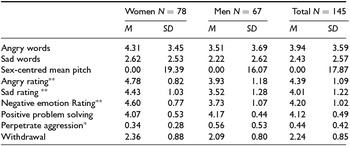
Table 1 shows the means and standard deviations for study variables by gender and for the total sample. Following the narration of unmet needs, women compared to men rated themselves as having felt more anger, t(143) = 5.06, p = .0001, and sadness, t(143) = 4.79, p = .0001. However, contrary to our hypothesis, there were no gender differences in the use of angry and sad words or pitch. Although aggression was rare, men reported higher levels than did women, t(143) = 3.09, p = .002; there were no gender differences for problem solving and withdrawal.
Descriptive Statistics for the Negative Emotion Words, Ratings and Pitch and Conflict Strategies by Gender and for the Total Sample

Note: Gender differences *p < .01; **p < .0001.
Negative Emotions and Romantic Functioning With Gender as a Moderator
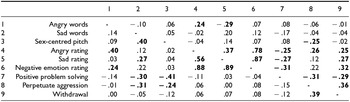
Mplus was used to examine the gender moderation for the associations between NER and conflict strategies (Muthén & Muthén, Reference Muthén and Muthén1998–Reference Muthén and Muthén2010). Although we originally intended to estimate a model with separate variables for angry and sad ratings, the association of these ratings with each other and the word use variables resulted in a saturated model (see Table 2 for correlations between study variables by gender). We therefore decided to combine the ratings into an average (see Tables 1 and 2 for descriptive information on this summary negative emotion rating). We then examined a model that estimated the relations between each of four emotion features (angry words, sad words, pitch, and negative emotion rating) with the three conflict strategies (positive problem solving, aggression, and withdrawal). In addition, relations between sad words with pitch and the negative emotion rating, as well as between withdrawal and positive problem solving and aggression were added to control for their bivariate associations.
Correlations between the Study Variables by Gender (Women Above the Diagonal Men Below)

Note: Bold type = significant correlations (p < .05). Negative emotion rating = negative emotion rating — the average of angry plus sad rating scales.
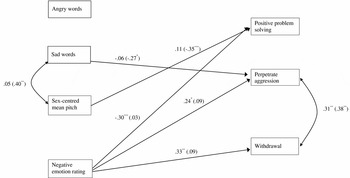
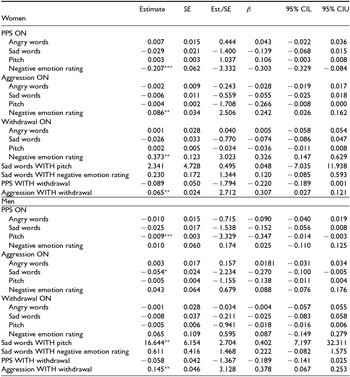
To assess for gendered effects in the model, we evaluated whether allowing path coefficients to vary across gender (unconstrained model) produced a significantly better fit than restricting all path coefficients to be equal across gender (constrained model). The constrained model was a poor fit to the data, χ2 = 51.49, p = .01, CFI = 0.64, RMSEA = 0.10. The unconstrained model showed acceptable fit to the data, χ2 = 6.04, p = .42 CFI = .99; RMSEA = 0.01. The unconstrained model produced a significantly better fit to the data than the constrained model (Δχ2 = 45.45, Δdf = 25, p = .007), indicating gender moderation. Figure 1 illustrates the findings, including the significant coefficients (β standardised) for the relations to each endogenous variable for women and men. Table 3 shows the results for the unconstrained model, including all coefficients for the relations to each endogenous variable for women and men, regardless of significance.
Unconstrained multigroup structural equation model of paths from negative emotion variables to conflict strategies. The figure shows significant pathways with standardised path coefficients for women presented first followed by those for men in parentheses.

Structural Equation Model Results for Associations Between Negative Emotion Variables and Conflict Strategies by Gender

Note: * p < 0.05; ** p < 0.01, p < 0.001***. PPS = positive problem solving; negative emotion rating = average of sad and angry rating
To identify gender-moderated paths between NER and conflict strategies, we compared separate models that constrained a single path (e.g., sad words to perpetration of aggression) with the unconstrained model for paths showing a significant association for women or men (there were no significant paths across gender). Constraining the paths between the negative emotion rating and positive problem solving (p = .01) and withdrawal (p = .05) but not aggression (p = .54) worsened model fit, indicating that the negative rating was associated with less problem solving and more withdrawal for women but not men. Constraining the path between pitch and problem solving worsened model fit (p = .005), indicating higher pitch was related to less problem solving for men but not women. Constraining the paths between sad words and aggression marginally worsened model fit (p = .09) such that more sad words was related to less aggression for men but not women.
We also explored individual ratings in a model that considered words, pitch, and either the angry or sad rating related to the three conflict strategies. The model with the angry rating remained saturated. The unconstrained model with the sad rating showed an acceptable fit to the data (χ2 = 9.40, p = .15, CFI = 0.94, RMSEA = 0.09) and was a significantly better fit than the constrained model (Δχ2 = 42.01, Δdf = 25, p = .012), indicating gender moderation. For women but not men, there were significant estimates for higher sad ratings and less problem solving (-.26 women/.10 men), and more withdrawal (.32/.08). Constraining the paths between the sad rating and positive problem solving (p = .02) and withdrawal (p = .09) worsened model fit. As in the model using the summary negative emotion rating, the model using sad ratings showed that for men but not women pitch was related to less problem solving, and sad words to less aggression.
Discussion
In the context of narratives about romantic conflict events, we examined the extent to which NER differed by gender and whether associations between NER and conflict strategies were moderated by gender. As anticipated, there were gender differences in NER but only for ratings, not words or pitch. As expected, gender moderated the associations between NER and conflict strategies. However, our specific predictions suggesting that women would show stronger links than men were not supported. Instead, we found that for men but not women, sad words and pitch were related to conflict strategies. In contrast, for women but not men, self-rated negative emotions were related to strategies. Given the unexpected nature of the gender-moderated associations, our interpretation of the findings should be considered with circumspection.
Although we anticipated similar patterns for all NER, women showed greater anger and sadness than men only in the ratings of these emotions. For ratings, the findings are consistent with research showing that in the context of focusing on romantic relationship problems, women display more NER than men (Brody et al., Reference Brody, Muderrisoglu, Nakash-Eiskovits, Bornstein and Masling2002) and that men may seek to portray themselves as exercising greater emotional restraint (Hess et al., Reference Hess, Shlomo and Shlomo2016). Women's endorsement of greater anger and sadness related to romantic conflict could reflect a tendency to rely on general holistic emotional processing when recalling events. Such processing entails generic prototypical aspects of specific kinds of events, such as ‘I always get sad when my partner spends too much time with his friends’. Consistent with this idea, the strength of women's negative emotion ratings was related to their reports of conflict strategies, which was not the case for men. In contrast to women, the men in our sample may have sought to down-regulate or manage the impression of their emotional restraint while completing the ratings. For men, it was sad words and pitch that were related to their reports of conflict strategies; these negative emotion features were more likely out of awareness and possibly less susceptible to attempts to manage impressions of emotional restraint.
Since men are socialised to constrain expression of negative emotions, we anticipated greater arousal, as indexed by pitch, might motivate men more than women to use withdrawal as a conflict strategy. Our results did not fit the escape-conditioning model that links more arousal with withdrawal, especially for men (Gottman & Levenson, Reference Gottman, Levenson, Noller and Fitzpatrick1988). Instead, we found that higher pitch was related to less problem solving for men but not women. We also found that higher pitch was associated with using more sad words and sad words were related to less aggression for men but not women. Considered together, these results suggest that the expression of sadness during narratives about unmet needs may be more arousing for men than women because it is a violation of male-normative standards of power as opposed to vulnerability (Fischer et al., Reference Fischer, Rodriguez-Mosquera, van Vianen and Manstead2004; Hess et al., Reference Hess, Senécal, Kirouac, Herrera, Philippot and Kleck2000). These narrative features of negative emotion may motivate passive immobility, which entails the desire to address the conflict but the expectation that the partner will intuit the problem and fix it (Nichols, Backer-Fulghum, Boska, & Sanford, Reference Nichols, Backer-Fulghum, Boska and Sanford2015). Passive immobility is associated with greater arousal, more sadness, and anxiety about the partner's investment in the relationship.
In general, we expected more and stronger associations between women's negative emotions and their conflict behaviour because women are more likely than men to view relationships as central to their sense of self and conflict as potentially threatening. Word use and pitch did not support this predicted pattern. However, women's higher negative emotion ratings were related to less problem solving and more withdrawal, but they were not related to aggression. Our capacity to examine particular predictions concerning gender moderation for associations between angry and sad emotions and conflict strategies was compromised by the need to use a summary negative emotion rating rather than individual angry and sad ratings in our model. When we ran exploratory models with words, pitch, and either angry or sad ratings, we found that higher sad ratings for women but not men were associated with less problem solving and more withdrawal, the same pattern we found for the summary negative emotion rating. Taken together, these results suggest that following the narration of unmet needs, women's ratings of sadness reflect a sense that the conflict is difficult to resolve (Sanford & Grace, Reference Sanford and Grace2011) and a tendency to disengage rather than initiate reparative action. In summary, for both women and men in our sample, sadness appeared to operate in a negative fashion, denoting a tendency to disengage in regard to handling conflict constructively. Although for men it was words and for women it was ratings, sadness in the context of recalling specific romantic relationship conflict suggested feeling discouraged about resolving a particular problem or perhaps the partner's perceived unwillingness to redress it.
Limitations
Several limitations should be kept in mind when interpreting the findings from this study. The gender-moderated associations of NER with conflict strategy use need replication with larger samples that are more diverse by age and ethnicity. Measurement of conflict strategies relied on self-report measures. Future work would benefit from understanding how NER from event-specific narrations about past conflicts from both partners are related to observations of couples’ emotional expression and functioning during conflict and problem-solving situations. The use of multiple methods and broadening the types of relationship outcomes measured would improve our understanding of how NER in conflict narratives operate in positive as well as negative ways to predict conflict resolution skills and more satisfying relationships as a function of gender (Bloch et al., Reference Bloch, Haase and Levenson2014). The cross-sectional data precluded examining whether NER in narrations about past conflict would be related to subsequent relationship functioning and how such narrative-based NER might change with more relationship experiences and commitment.
Practical Implications
Handling conflicts constructively is essential for relational need fulfillment, satisfaction, and maintenance (Appel & Shulman, Reference Appel and Shulman2015; Fischer et al., Reference Fischer, Rodriguez-Mosquera, van Vianen and Manstead2004). Our findings suggest that reflecting back on past conflicts related to unmet needs is a task that involves the regulation of negative emotions and that such emotions are related to conflict approaches. The preponderance of relationship research focuses on anger and conflict in part due to the potentially harmful physical consequences. Our findings indicate that sadness deserves more attention for its likely role in disrupting activities that enhance relationship maintenance (Vujeva & Furman, Reference Vujeva and Furman2011). Sadness expressed in narrative word use and ratings reveal how NER assessed in regard to event-specific conflicts motivate disengagement from dealing with conflict rather than attempts to understand and resolve unmet needs. Surprisingly, we could find no comprehensive evidence-based prevention programs to promote healthy emotion regulation and conflict approaches for emerging adults in romantic relationships (Kelly, Edwards, Dardis, & Gidycz, Reference Kelly, Edwards, Dardis and Gidycz2015). Our findings suggest that the development of such programs might include the narrative assessment of event-specific conflict events and exercises grounded in the narrated events to enhance skills that promote understanding of emotional responses and healthy regulation. Past work on individuals in romantic relationships, as compared to that on couples, use samples that typically over-represent women and do not consider or have the power to examine conceptually grounded gender moderation. Our findings indicate the need for future research on individuals in romantic relationships to include more gender-balanced samples. Gender moderation in links between sad emotions with conflict tactics suggests potential advantages for developing some intervention components that are gender specific. For example, men might benefit from interventions that help them feel more comfortable recognising and expressing sad emotions that are linked to specific unmet needs. Such interventions might seek to foster the authentic communication and management of emotional experience (Englar-Carlson & Shepard, Reference Englar-Carlson and Shepard2005; Pascual-Leone & Greenberg, Reference Pascual-Leone and Greenberg2007). For men and women, rather than suppressing or ruminating on sadness, constructively confronting the causes of disagreement and their emotional meaning could help motivate learning skills to negotiate relationship problems.
Author Note
Izabela Milaniak and Lesley Clisura were students at the College of New Jersey when the research was conducted.
Acknowledgments
The authors wish to acknowledge the contributions of the undergraduate students in the Romantic Relationships Research Lab for making this research possible, particularly Trista Chiu Gretchen Conway, Elizabeth Finke, and Christine Petit.
Financial Support
This research received no specific grant from any funding agency, commercial or not-for-profit sectors.
Conflict of Interest
None.
Ethical Standards
The authors assert that all procedures contributing to this work comply with the ethical standards of the relevant national and institutional committees on human experimentation and with the Helsinki Declaration of 1975, as revised in 2008.