





Impact statement
The important contributions of this paper are as follows. First, we are using and explaining a little-known fabrication method for mycelium-based composites (MBC) invented by architect Chris Maurer and the MycoHAB team that produces a new type of MBC, one we call high-compression mycofabrication (HCM). Second, we use spent mushroom substrate from a local mushroom farm in order to promote the circular bioeconomy. Third, using HCM, we have discovered that oyster composites outperform reishi ones in compressive stress, reversing what is commonly known about these species when tested as MBC biofoams or PMMs. Fourth, our compressive stress values for oyster HCM coupons fabricated at 20 tons of force and 30 tons of force are the highest yet published anywhere to our knowledge, with median values 34.95 and 46.10 MPa respectively and at ∼70% deformation, comparable to values accepted for medium- and high-strength concrete at much lower deformation levels and with densities that are 1/3 of those typical of concrete. We notice that bulk densities alone may not predict compressive structural performance. Lastly, we observe that higher force during fabrication for oyster HCM coupons leads to higher compressive stress results during testing, even possibly strain-hardening behavior.
Introduction
Biodesign is both old and new. For millennia, humans have used biological materials for architecture and design. From wood for framing houses to textiles for interiors woven from plant fibers, we have creatively grown and harvested materials from the biological world to construct shelter and products to keep us safe and warm. In the last twenty years, however, we have earnestly begun working with microorganisms and less familiar species, including those from the fungal kingdom, to develop sustainable new materials for art, architecture and design. Owing to the ecological damage we have inflicted through fossil-fuel-derived processes and materials that release carbon into the atmosphere, and given the corresponding climate change and extreme heat the world is facing, these new biobased materials have the potential to return us to a more sustainable path. One approach prioritizes circularity, finding ways to take agricultural “waste” (actually valuable resources) to produce new nontoxic and functional yet ultimately biodegradable materials. This paper positions itself in this context, as we take spent mushroom substrate from mushroom farming and pursue its transformation into bricks with the necessary properties for structural building, as well as other possible design applications.
Mycelium-based materials currently exist in a few common forms. Although some are grown predominantly in liquid cultures, others take the form of composites of mycelium grown with solid substrates, referred to as mycelium-based composites (MBC). These can be used to grow flexible pure mycelium materials (PMM) or engineered living materials (ELM), or they can be air-dried or heat-pressed into semi-rigid or rigid “biofoams” (as many people call them). Under these familiar overarching categories, other variations in MBCs derive from differences in fungal species, substrate, growth conditions and post-processing methods. Because of these variables, publications offer a wide variety of data on compressive stress values of different MBC materials. To establish current baselines on this data, we surveyed the results of many recently published studies on ELMs, PMMs and MBCs as follows.
Engineered living materials (ELMs) and pure mycelium materials (PMMs) generally are more flexible than more rigid mycelium-based composites (MBCs), with tests of tensile and flexural strength and Young’s modulus indicating their significant material properties. For example, Gantenbein et al. (Reference Gantenbein, Colucci, Käch, Trachsel, Coultier, Rühs, Masania and Studart2022) produced mycelium-infused hydrogels with Ganoderma lucidum that grew into ELMs with pure mycelium that exhibited compression stress around 20 kPa and robust mechanical stiffness close to 87 kPa. Soh et al. (Reference Soh, Teoh, Leong, Xing and Le Ferrand2023) 3D-printed Pleurotus ostreatus mycelium ink into small cubes that grew into PMMs over 28 days that demonstrated a 60 kPa compression modulus, higher than mycelium hydrogels’ values between 20 and 30 kPa. Finally, Elsacker et al. (Reference Elsacker, Zhang and Dade-Robertson2023) created Ganoderma lucidum mycelium ELMs that they perforated to allow self-healing to occur; they found that both versions before and after healing for 3, 5 & 10 days could withstand tensile stress at the same levels (around 1.11, 1.00 and .92 MPa respectively). Samples from days 3 and 5 after healing had Young’s modulus/stiffness noticeably higher than undamaged ones (around 16.04 and 22.56 MPa, rather than 11.85 or 15.87 MPa). To our knowledge, the highest tensile strength thus far (though it is not a PMM but a textile composite) is that of MycoWorks’ Reishi TM leather, tanned using Rei-Tan technology, testing at 18 MPa (Harrell Reference Harrell2025).
When solid substrates are bound together by mycelium networks into MBCs that are dried or baked but not compressed during fabrication, the resulting biofoam has more rigidity than PMMs, lending itself to non-structural uses as insulation panels, door cores or foams used in furniture. Compression tests of MBC biofoams made with Ganoderma lucidum binding various substrates exhibit a wide range of strength values: from .13 MPa (oat husk), .28 MPa (rapeseed cake), .76 MPa (beech sawdust), 1.41 MPa (wood sawdust) and 6.4 MPa (rice or wheat straw) up to 14 MPa (40% wood + 60% PLA) (Cai et al. Reference Cai, Han, Ge, Lin, Pan and Ren2023; Huang et al. Reference Huang, Wei and Hadigheh2024; Sharma and Ferrand Reference Sharma and Le Ferrand2025; Tacer-Caba et al. Reference Tacer-Caba, Varis, Lankinen and Mikkonen2020; Vašatko et al. Reference Vašatko, Gosch, Jauk and Stavric2022). Only the last two fall within the low end of compressive strength of approved structural building materials. Tensile tests on reishi sawdust composites showed 1.55 MPa, whereas flexural tests came in between 1.25 and 2.5 MPa (Huang et al. Reference Huang, Wei and Hadigheh2024).
Comparatively, compression tests on Pleurotus ostreatus composite biofoams with varying substrates that are dried or baked but not compressed during fabrication also produced varied results, ranging from .013–.078 MPa (bagasse, rice husk), .015–.08 MPa (coconut powder + wheat bran), .11–.16 MPa (Hemp + peanut shell), .02–.188 MPa (sawdust + supplement), .265 MPa (mahogany sawdust + rice husk), .03–.28 MPa (oat husk, rapeseed cake), .41 MPa (wood sawdust), .27–46 MPa (corn straw, sawdust), 1.35 MPa (rice husk + rice bran), .35–2.65 MPa (beech sawdust, soy silk fibers, cardboard, cotton fibers), 1.65–2.92 MPa (coffee grounds + pineapple fibers), up to 12.1 MPa (flax + geopolymer/aluminosilicates sandwich) (Brudny et al. Reference Brudny, Łach, Kozub and Korniejenko2024; Camilleri et al. Reference Camilleri, Narayan, Lingam and Blundell2025; Ghazvinian and Gürsoy Reference Ghazvinian and Gürsoy2022; Ghazvinian et al. Reference Ghazvinian, Farrokhsiar, Vieira, Pecchia and Gursoy2019; Huang et al. Reference Huang, Wei and Hadigheh2024; Kohphaisansombat et al. Reference Kohphaisansombat, Jongpipitaporn, Laoratanakui, Tantipaibulvut, Euanorasetr, Rungjindamai, Chuaseeharonnachai, Kwantong, Somrithipol and Boonyuen2024; Lingam et al. Reference Lingam, Narayan, Mamun and Charan2023; Mbabali et al. Reference Mbabali, Lubwama, Yiga, Were and Kasedde2024; Nashruddin et al. Reference Nashiruddin, Chua, Fadziyana, Rahman, Lai, Azelee and Enshasy2022; Peng et al. Reference Peng, Yi, Yang, Xie and Chen2023; Picco et al. Reference Picco, Suarez and Regenhardt2024; Tacer-Caba et al. Reference Tacer-Caba, Varis, Lankinen and Mikkonen2020; Lopes Teixeira et al. Reference Lopes Teixeira, Paca Matos, Lima Nascimento, Griza, Rodrigues Holanda and Marino2018; Vašatko et al. Reference Vašatko, Gosch, Jauk and Stavric2022). Flexural tests on oyster-based composites produced a range from 0.01 to 0.54 MPa whereas tensile strength was between .01–.19 MPa (Appels et al. Reference Appels, Camere, Montalti, Karana, Jansen, Dijksterhuis, Krijgsheld and Wösten2019; Huang et al. Reference Huang, Wei and Hadigheh2024; Majib et al. Reference Majib, Yaacob, Ting, Rohaizad and Azizul Rashidi2025; Peng et al. Reference Peng, Yi, Yang, Xie and Chen2023; Vašatko et al. Reference Vašatko, Gosch, Jauk and Stavric2022).
Heat-pressing MBCs using a heat press as a post-processing method after drying tends to increase strength values, owing to compression reducing porosity and releasing liquids from within cells and heat causing for its evaporation. For Ganoderma lucidum composites, Shao et al. (Reference Shao, Zhang, Xu, Jin, Wu, Yang and Xu2025) achieved 2.51 MPa compression strength (sawdust, fruit peel, bagasse, eggshells and diaper waste) after heat-pressing at 10 MPa at 160 Celsius for 20 minutes. Javadian et al. (Reference Javadian, Le Ferrand, Hebel and Saeidi2020) reported reishi-composite heat-pressed boards at 6.4 MPa in compressive strength. But these pale in comparison to the 26 MPa value that Chris Maurer achieved using his high-compression method (not using a heat press) on reishi MBCs (described in more detail in Methods section below) (Brandić Lipińska et al. Reference Brandić Lipińska, Maurer, Cadogan, Head, Dade-Robertson, Paulino-Lima, Liu, Morrow, Senesky, Theodoridou, Rheinstädter, Zhang and Rothschild2022; Maurer Reference Maurer2024). For flexural strength, Chan et al. (Reference Chan, Saeidi, Javadian, Hebel and Gupta2021) achieved 2.68 MPa for reishi-palm fruit fiber with sawdust, while Liu et al. (Reference Liu, Long, Sheng, Xu, Qiu, Li, Wang and Wu2019) pressed a reishi-cotton stalk composite at 3.5–4 MPa at 200 Celsius for 6 minutes, then 2 MPa for 1 minute, to achieve 4.6 MPa value.
The values for heat-pressed MBCs made on a heat press with Pleurotus ostreatus published thus far fall lower than those of heat-pressed Ganoderma lucidum above, for example heat-pressed oyster boards at 1.02 MPa compressive strength (Javadian et al. Reference Javadian, Le Ferrand, Hebel and Saeidi2020) and high-compression oyster mycoblocks (not made on a heat press) at 6–7 MPa (Acacia melliflora substrate) (Maurer Reference Maurer2024). Appels et al. (Reference Appels, Camere, Montalti, Karana, Jansen, Dijksterhuis, Krijgsheld and Wösten2019) found heat-pressed oyster MBC (rapeseed straw, beech sawdust and cotton fiber substrate) tensile strength to be between .01–.24 MPa and flexural strength between .05–.87 MPa. Kohphaisansombat et al. (Reference Kohphaisansombat, Jongpipitaporn, Laoratanakui, Tantipaibulvut, Euanorasetr, Rungjindamai, Chuaseeharonnachai, Kwantong, Somrithipol and Boonyuen2024)’s findings on flexural strength (with substrate coffee grounds + pineapple fibers) are narrower, from .2–.48 MPa, values they found similar to that of Aiduang et al. (Reference Aiduang, Kumla, Srinuanpan, Thamjaree, Lumyong and Suwannarach2022) and Womer et al. (Reference Womer, Huynh and John2023).
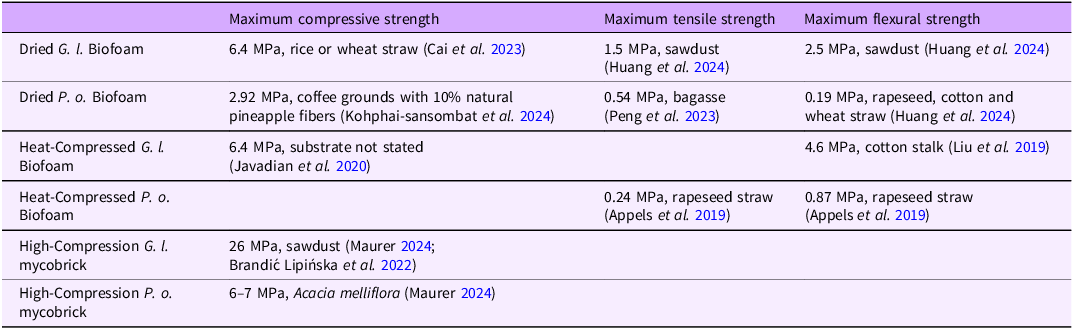
Overall, as shown in Table 1, for MBCs of either Ganoderma lucidum or Pleurotus ostreatus, in the forms of dried biofoams, heat-pressed biofoams (made on a heat press) or high-compression mycofabrication (HCMs) not made on a heat press, most of the current published data supports common knowledge thus far that Ganoderma-based MBCs outperform Pleurotus-based ones in strength.
Recently published maximum values for compressive stress, tensile strength and flexural strength of dried MBC biofoams, heat-pressed MBC biofoams and high-compression mycofabrication (HCM) MBCs of both Ganoderma lucidum (G. l.) and Pleurotus ostreatus (P. o.)

Table 1. Long description
Recently published maximum values for compressive stress, tensile strength and flexural strength of dried MBC biofoams, heat-pressed MBC biofoams, and high-compression mycofabrication (HCM) MBCs of both Ganoderma lucidum (G. l.) and Pleurotus ostreatus (P. o.).
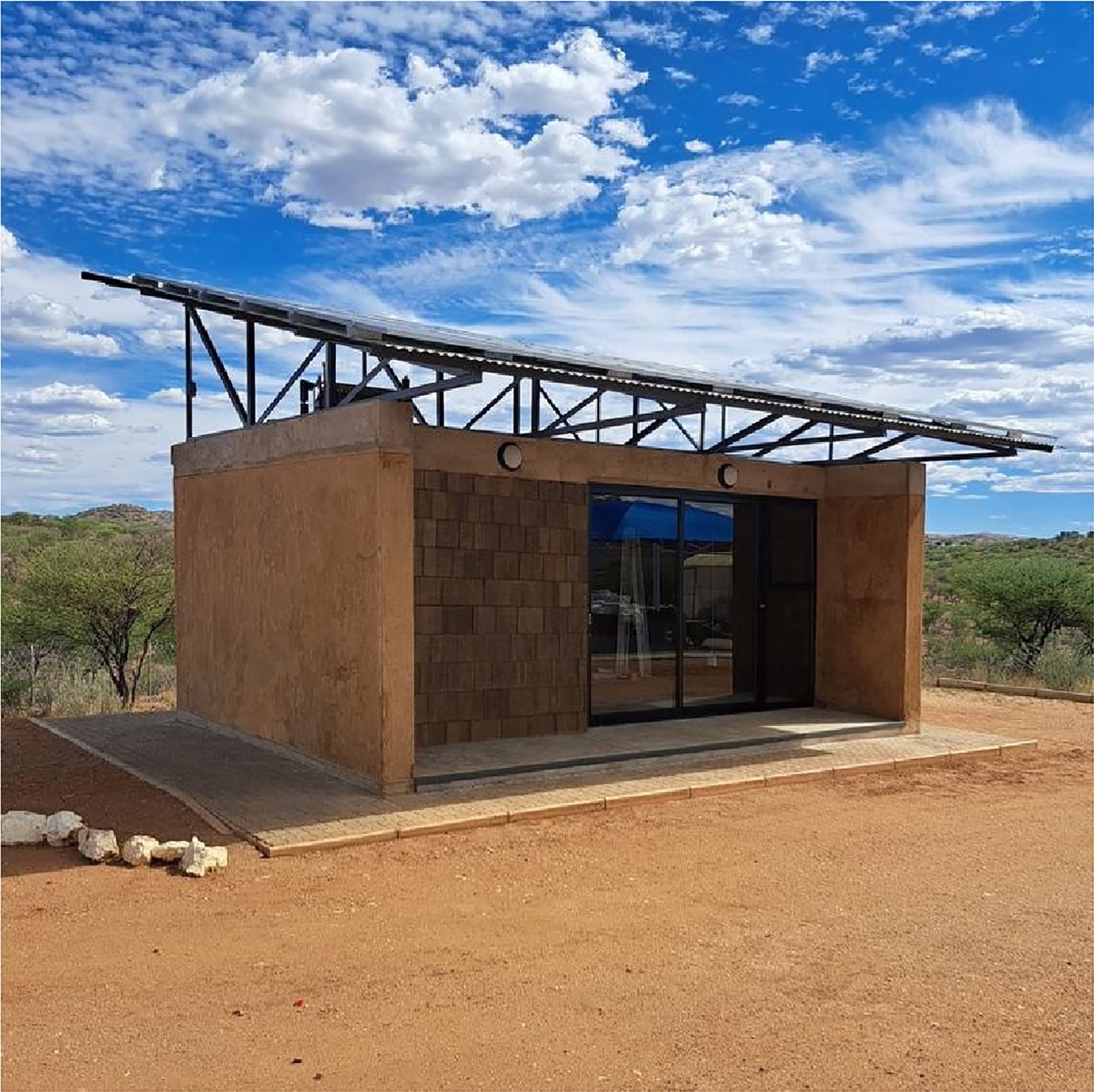
Note that the maximum observed compressive strength for both Ganoderma lucidum (26 MPa) and Pleurotus ostreatus (oyster) MBCs (6–7 MPa) were set by Chris Maurer et al. (Brandić Lipińska et al. Reference Brandić Lipińska, Maurer, Cadogan, Head, Dade-Robertson, Paulino-Lima, Liu, Morrow, Senesky, Theodoridou, Rheinstädter, Zhang and Rothschild2022; Maurer Reference Brandić Lipińska, Maurer, Cadogan, Head, Dade-Robertson, Paulino-Lima, Liu, Morrow, Senesky, Theodoridou, Rheinstädter, Zhang and Rothschild2024). Both of these records resulted from an innovative, patented, high-compression fabrication method invented by architect Maurer with MIT Center for Bits and Atoms and Standard Bank Johannesburg for construction of MycoHAB near Windhoek, Namibia in 2024 (Figure 1), the only structural mycoblock building in the world. Because of these results and many others derived from stress testing oyster and reishi biofoams and PMMs over the years, researchers have generally come to accept that monomitic or dimitic oyster MBCs grow faster than trimitic reishi MBCs, but that the latter are stronger in both compressive and tensile strength. Prior research by our team also found that reishi-based MBC biofoams supplemented with textile waste outperformed oyster-based ones in compressive strength (Ruiz et al. Reference Ruiz, Cogdell, Mak, Rowe, Wan and La Saponara2024). As Majib et al. (Reference Majib, Yaacob, Ting, Rohaizad and Azizul Rashidi2025) state, “It is generally accepted that more complex hyphal systems, like trimitic systems, are superior…. Instead of generative hyphae (monomitic hyphal systems), which are hollow and contain cytoplasm, binding hyphae (dimitic and trimitic hyphal systems) are thought to be in charge of material strength.” Additionally, they and others have obtained higher compressive results from substrates that include hardwood sawdust than from those filled with straw or other fibrous substrates.
MycoHAB, Namibia, 2024, the first structural mycoblock building. Photo courtesy of Christopher Maurer, redhouse studio, Cleveland, Ohio.

Figure 1. Long description
MycoHAB, Namibia, 2024, the first structural mycoblock building. Photo courtesy of Christopher Maurer, redhouse studio, Cleveland, Ohio.
The results outlined in this paper upend this common understanding. Consistently, we find oyster-based MBCs outperform reishi-based ones in compressive stress tests when we create our samples using Maurer’s innovative fabrication method, which we call high-compression mycofabrication (HCM) that does not involve using a heat press. An important clarification is necessary here at the outset, though, to acknowledge a very interesting aspect of our results (discussed below) in comparison with Maurer’s and others’ data on compressive strength tests. Compressive strength is defined by the point of “failure” of the material during the test. We consider ultimate strength since it is the basis of most structural designs worldwide and was applied to concrete-based structures since the 1950s. On a graph showing deformation – the testing machine cross-head displacement/initial height of the sample – in relation to the applied force divided by the initial area (compressive stress), as the test proceeds, we consider failure to occur when the stress has reached its ultimate maximum value and regresses to a lower level. As we discuss below, although a number of our early tests reached failure, once we changed our method of fabrication to include crumbling and mixing, our subsequent tests regardless of whether we use 20 tons or 30 tons of force and regardless of species, have typically all failed to reach ultimate failure. To put this another way, as we approach very high levels of deformation of our coupons and the top and bottom plates on the machine come close to touching each other, we have to stop our tests at around 70–80% maximum deformation in order to protect the machine, not because we actually reached failure or the maximum force level applied to the area of our material. These deformation values are significantly higher than the typical 30% deformation applied to concrete samples. Thus, we cannot technically describe our results as a measure of ultimate compressive “strength” because we do not reach such failure, so we instead describe our results as measures of compressive stress at the given deformation level. Hence our title claims that our high-compression mycofabrication (HCM) method shows that Pleurotus ostreatus MBCs outperform Ganoderma lucidum ones in compressive stress.
One possible interpretation of our data, however, that we are in the process of further investigating, is whether this lack of failure indicates possible strain-hardening properties in our HCM composite materials. Some architects and engineers with whom we have discussed our results suggest that our materials are too “compliant,” in essence behaving like a “sponge,” and are not reaching failure for this reason. In fact, our materials are strong enough that they have four times bent a 17 mm diameter stainless steel post on our machine during our compression tests, which to us seems quite “non-compliant” and non-“sponge”-like. We had our machine checked and recalibrated and afterwards, we continue to get the same range of values on our tests.
For HCM, we use strong steel molds into which we place crumbled spent mushroom substrate and then apply very high levels of force using a hydraulic press – 20 tons to 30 tons – to the material. We maintain this pressure through our mold design throughout hours of baking, effectively curing the mycobrick under pressure. This is how Maurer’s team created the mycoblocks for MycoHAB (see US Patents No. 11,997,956 and No. 2023/0342794), which we took as our starting point for the method we use in this paper, explained below with our results. They cut down and shredded a local invasive species of hardwood encroacher bush, Acacia melliflora, into substrate that they pasteurized and then seeded with oyster fungus. After harvesting oyster mushrooms that were sold for food, they then compressed the spent mushroom substrate into steel molds (25 cm × 25 cm × 25 cm, totaling 1250 cm3) using a 150-ton hydraulic press. After baking under pressure (based on mold design) at 180 degrees Celsius for 12 hours, they cooled and then removed the blocks from the molds. With this substrate, species and method, they attained a compressive strength of 6–7 MPa, which rivaled the strength of local concrete block in Namibia (Maurer Reference Maurer2024).
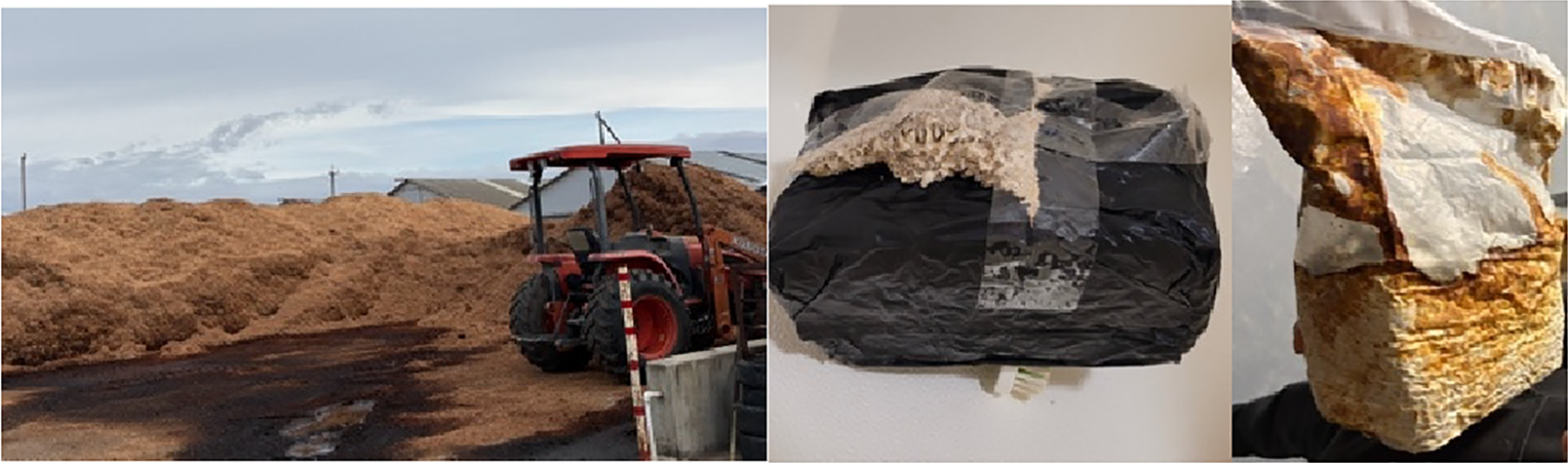
In order to standardize our mycobrick source material and output, we have chosen to work with post-harvest agricultural waste, spent mushroom substrate, from a local mushroom farm, Far West Fungi, located just south of the San Francisco Bay Area. By reusing their waste to create high-compression MBCs, our mycobrick’s life cycle models a circular approach to the bioeconomy, turning local agricultural waste into potential future building materials for architecture (Figure 2).
Waste used as source materials for high-compression mycobrick fabrication. Left: Waste sawdust from a local door manufacturing company that is used as substrate by Far West Fungi (FWF). Center: Pleurotus ostreatus spent mushroom substrate from FWF. Right: Ganoderma lucidum spent mushroom substrate from FWF. Photos by author.

Figure 2. Long description
Waste used as source materials for high-compression mycobrick fabrication. Left: Waste sawdust from a local door manufacturing company that is used as substrate by Far West Fungi (FWF). Center: Pleurotus ostreatus spent mushroom substrate from FWF. Right: Ganoderma lucidum spent mushroom substrate from FWF. Photos by author.
Materials and methods
Substrate and preparation
Spent mushroom substrate was sourced from Far West Fungi (Moss Landing and San Martin, California, USA). This is a mixture of hardwood sawdust of six different species, rice bran, soy hulls, lime and water shaped into a rectangular block. The substrate is fully colonized by either Pleurotus ostreatus or Ganoderma lucidum fungus inside filter patch bags. After the first oyster flush and harvest at about three to four weeks of growth, we brought the spent mushroom substrate to our university where we refrigerated it until processing time. Alternately, the reishi bags had grown for about eleven weeks and were beginning to form fungal antlers but had not yet been harvested when we retrieved them and stored them in a refrigerator.
According to the Spawn Director for Far West Fungi, Ethan Levesque, for both reishi and oyster inoculation they top-seed the substrate without shaking in the spawn. This allows the mycelium to grow downward into the bags over time. For this reason and others, mycelium networks throughout a single block-shaped bag are not evenly distributed. Initially, we pressed spent mushroom substrate blocks into our molds without crumbling or mixing them, but we achieved high coefficients of variation (COV, computed as the ratio of mean and standard deviation, multiplied by 100) in our early compression tests of coupons cut from a single brick.
With Levesque’s insight and advice, we began to crumble every spent mushroom substrate block by hand until individual fragments are approximately 3–5 mm in diameter. We thoroughly mix this crumbled substrate by hand to ensure an even distribution of clump size and composition throughout our bricks. Using this method, our COV has dropped significantly, revealing far more even distribution of mycelium and substrate throughout our bricks. Only data for mycobrick coupons made through crumbling and mixing are used in this paper.
Pressing
Once our substrate is crumbled and mixed, we gently compact it by hand into a steel mold greased with biodegradable coconut oil for easy removal after pressing and baking. Our steel molds were custom-designed and manufactured to (1) have gaps for liquid to escape during compression and (2) hold the compressed composite under pressure during baking. Using the available hydraulic press (Dake 50-ton), we applied either 20 tons or 30 tons of force onto a strong steel top plate in the mold, which compresses the composite’s volume by approximately 75% into the form of a brick.
Baking
Following compression in the hydraulic press, the molds were placed into a pre-heated mechanical convection oven (Yamato DKN-600) at 163 degrees Celsius. Typically two molds were baked at the same time for a nominal three hours. The time and temperature accounts for convection oven efficiency (compared to baking in a conventional oven at 180 degrees Celsius for four hours). When baking is finished, we leave the molds to cool inside the oven, usually overnight. We found that early removal from the mold while still warm resulted in easily broken bricks during the demolding process, so we inferred that the transformed material inside the mold needed more time to solidify into its new molecular structure.
Although we do not yet know what transformations are happening during pressing and baking, Shao et al. (Reference Shao, Zhang, Xu, Jin, Wu, Yang and Xu2025) describe the chemical and physical changes that happen during heat-pressing with a heat press. Temperature increase causes water to evaporate while “at the same time, some components in the mycelium (such as proteins, polysaccharides, etc.) may undergo denaturation, softening or flow at high temperatures. Under the action of pressure, the material is more easily compacted to form a tight structure, thus affecting the plasticization and compaction of the material.” They also state: “When the temperature rises to a certain extent, protein components in the mycelium will denature and become more compact from the original loose state, which helps in material molding.” Alternately, mycologist Sue van Hook (Cogdell Reference Cogdell2026) has suggested that rather than proteins denaturing, that β-glucans in the mycelial cell walls may be the more transformative factor.
Cutting coupons and selection of geometry
We cut our bricks into coupons using a Delta Contractor 10-inch table saw with Freud 50-tooth combination blade. The samples were then stored in the laboratory at room temperature and average interior moisture conditions prior to testing over a one- to four-month period. Tests were conducted between September 2025 and February 2026 at our university.
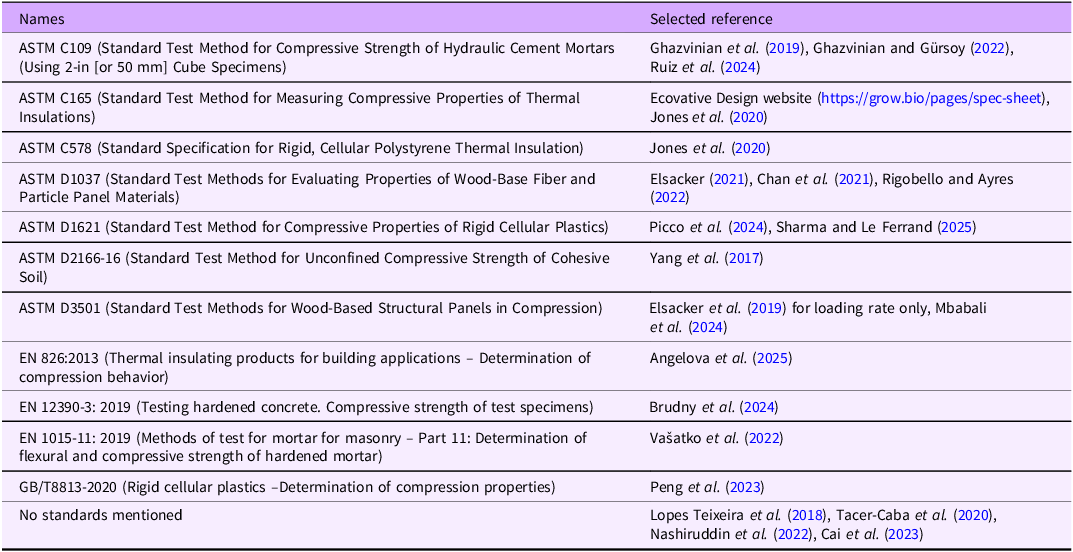
Regarding the geometry, no approved standards exist yet specifically for MBCs, much less for our MBCs created using HCM, that show the ability to take high stress levels during compression testing above those experienced by foams and mortar, even at the point of bending steel, as discussed below. Authors of published literature either use existing standards or do not report any standard, as shown in Table 2.
Compressive properties standards mentioned in the published literature

Table 2. Long description
Compressive properties standards mentioned in the published literature.
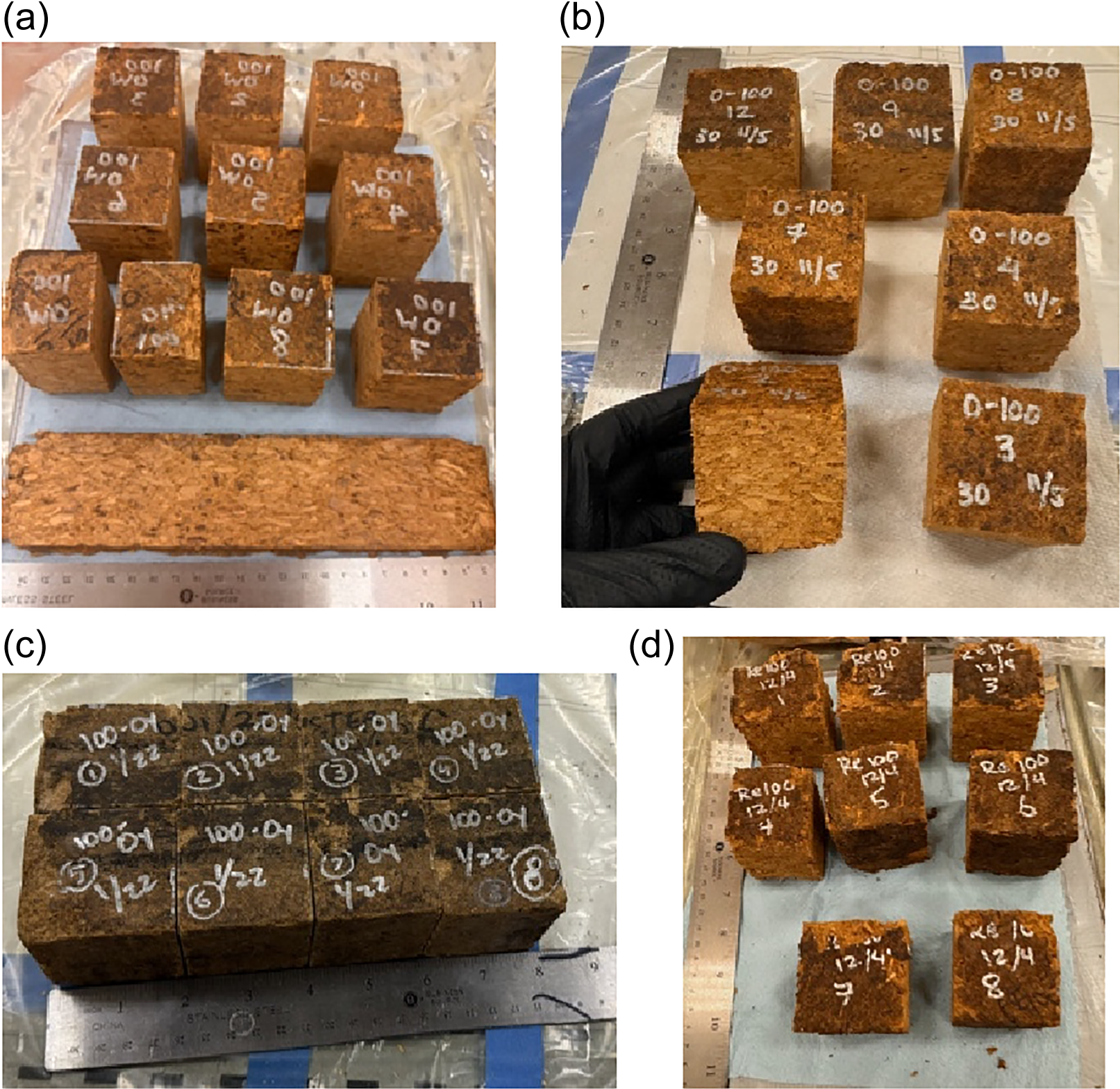
We selected the geometry of a 50 mm cube to conform to a modified version of ASTM C109 standard, which is the Standard Test Method for Compressive Strength of Hydraulic Cement Mortars (Using 2-in or [50 mm] Cube Specimens), as discussed below and based on previous work (Cogdell et al., Reference Cogdell, Licudine, Kulkarni, Shankar, Magaña Cuevas, Patel and La Saponara2026; Ghazvinian and Gürsoy, Reference Ghazvinian and Gürsoy2022; Ghazvinian et al., Reference Ghazvinian, Farrokhsiar, Vieira, Pecchia and Gursoy2019; Ruiz et al., Reference Ruiz, Cogdell, Mak, Rowe, Wan and La Saponara2024). For this study, we tested mechanically a total of 41 cuboid samples cut with the following dimensions: height equal to (51.83 ± 5.108) mm, cross-sectional area equal to (2531 ± 142.0) mm2, with a COV of respectively 9.855% and 5.610%, which we consider very reasonable for these MCB materials. We measured 5 times in every dimension, and median dimensions were used for calculations of compressive stress and deformation (note that ASTM C109 requires only 3 samples per condition; we used a minimum of 5 which is the bare minimum for boxplots). We labeled O100 the samples with 100% oyster substrate, while R100 represents the samples with 100% reishi substrate. Figure 3 shows representative samples of each group. All the O100 coupons (Figure 3a–3c) are compacted, dense and regularly shaped. By comparison, the R100 coupons appear brittle and with voids (Figure 3d). We will discuss density and mechanical performance later in this paper.
Representative samples from the mechanically tested sets: (a) O100, 20-tons, (b) O100, 30 tons, set 1, (c) O100, 30 tons, set2, (d) R100, 20-tons. The samples have approximately the same dimensions. Photos by authors.

Figure 3. Long description
Representative samples from the mechanically tested sets: a) O100, 20 tons, b) O100, 30 tons, set 1, c) O100, 30 tons, set2, d) R100, 20 tons. The samples have approximately the same dimensions. Photos by authors.
Compression tests
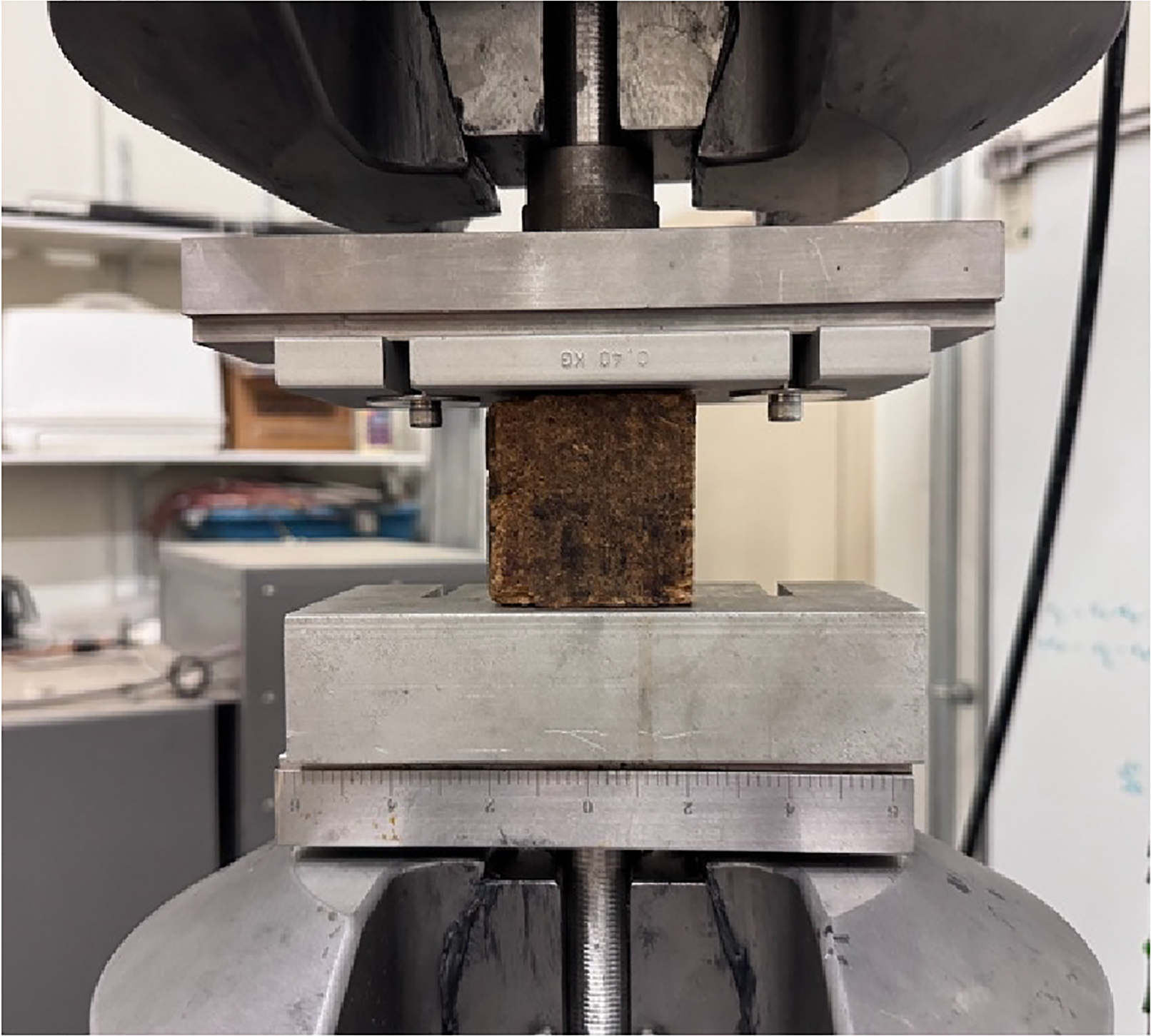
The samples were tested in static compression on a calibrated uniaxial hydraulic machine (MTS 810) with a 330 kN (55 kips) static load capacity (Figure 4) and at a 0.5 s acquisition rate.
Setup for compression tests, with O100 (30 tons, set 2) MBC sample (∼50 mm cube) about to be tested. Photo by author.

Figure 4. Long description
Setup for compression tests, with O100 (30 tons, set 2) MBC sample (~50 mm cube) about to be tested. Photo by author.
Each sample was placed in a modified steel bending fixture with top and bottom plates larger than the samples’ dimensions and with no interference with the samples before and during testing. We used the procedure of earlier work (Cogdell et al. Reference Cogdell, Licudine, Kulkarni, Shankar, Magaña Cuevas, Patel and La Saponara2026; Ghazvinian and Gürsoy Reference Ghazvinian and Gürsoy2022, Ruiz et al. Reference Ruiz, Cogdell, Mak, Rowe, Wan and La Saponara2024), which is a modified version of ASTM C109 (nominal dimensions as in ASTM C109) but follows a displacement control procedure at 2 mm/min, as per ASTM C165 (with a compatible geometry to ASTM C109). Displacement control is typical of the majority of the papers reported in Table 2, including Ghazvinian and Gürsoy (Reference Ghazvinian and Gürsoy2022) and Ruiz et al. (Reference Ruiz, Cogdell, Mak, Rowe, Wan and La Saponara2024).
The displacement d was initialized to zero when the top part of the sample had a small gap (approximately 1 mm) with respect to the top plate. In previous work, we observed the ability of the MCB samples to withstand high deformation levels (∼70%) and we continued to compress the samples to these levels. The deformation is estimated as displacement d divided by the original height (median measurements among 5 in each sample) and varies from 0 (sample not engaged) to negative numbers, as the direction of compression is deemed to be negative. Leveling fixtures’ surfaces before and after every test strived for uniformity of applied load on each coupon (we note that the tops of some samples were not flat).
We computed the compressive stress as P/Ao, with P being the machine axial load and Ao being the initial cross-sectional area of the sample based on median measurements for that sample. The number of tested samples is as follows: 14 for O100 at 20 tons (samples selected randomly from 3 different bricks), 10 samples for R100 at 20 tons (from 3 bricks), 9 for O100 at 30 tons (one brick, “set 1”) and 8 for O100 at 30 tons (one brick, “set 2”). For the data and statistical analysis, we used MS Excel spreadsheets to store data and mathematical software (MATLAB R2023b, MathWorks; Prism 10, Graph Pad) for the plots.
Results and discussion
Density results
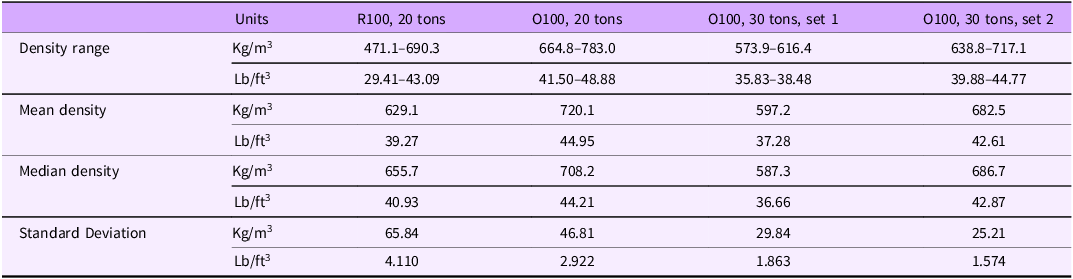
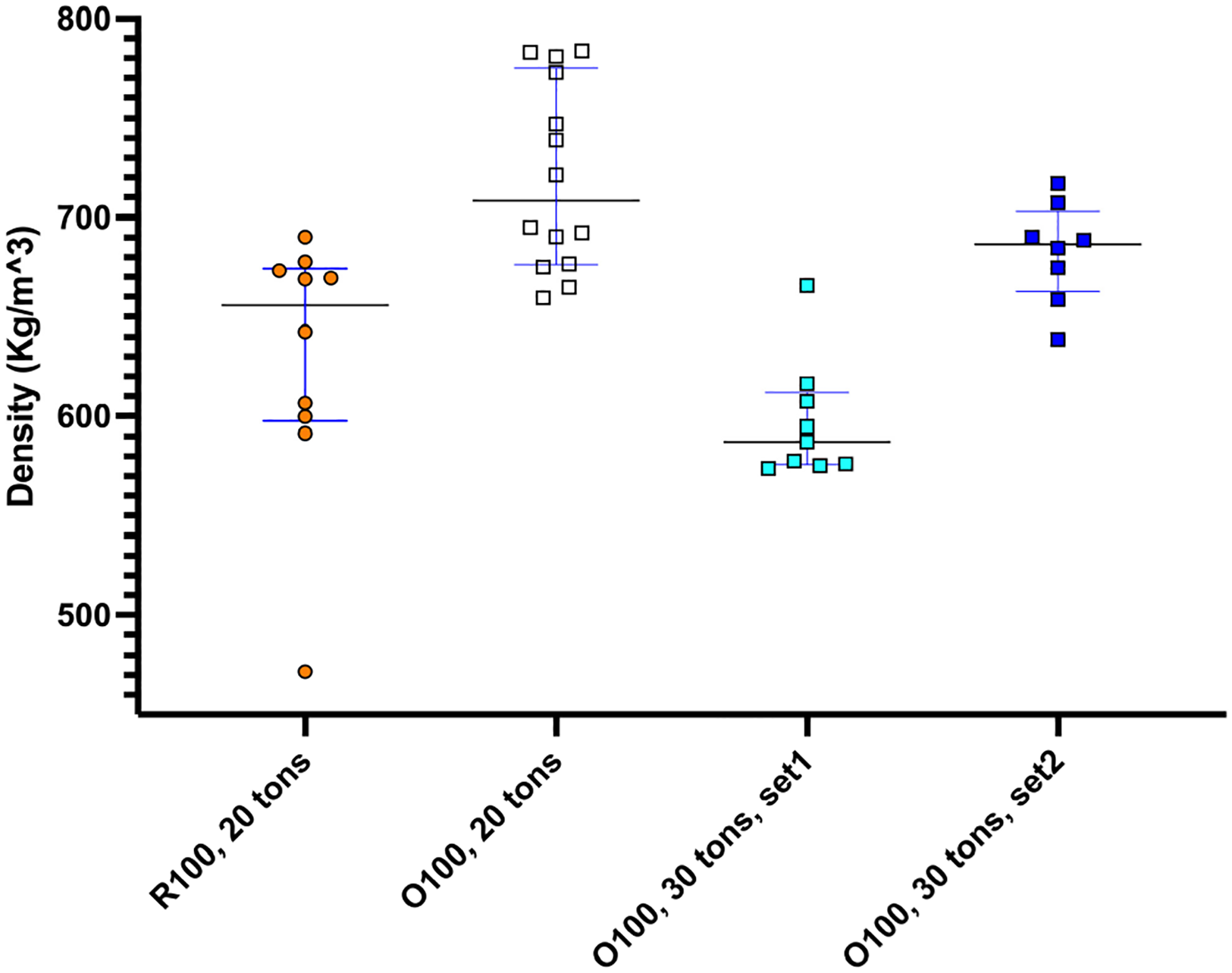
Table 3 reports the bulk density data (weight/volume measured on the as-manufactured samples, which include existing voids in the material) for the samples pressed at 20 tons and at 30 tons. Data in this table has been provided in imperial units for comparative purposes. This is accompanied by Figure 5, where medians and interquartile ranges are shown. We expected the 30-tons O100 samples to be more compacted and thus exhibit higher bulk densities than the 20-tons O100 samples, but this did not happen to be the case for our bricks (Figure 5). We also did not expect the two 30-tons bricks to have statistically different bulk densities: set 1’s and set 2’s densities are respectively statistically equivalent to 20-tons R100 and 20-tons O100 (Figure 5). This may depend on the age of the spent mushroom substrate bag of set 2 (approximately 2 months older than that of set 1), but the process was the same.
Density information for the HCM samples of this study

Table 3. Long description
Density information for the HCM samples of this study.
Medians (black lines) and interquartile ranges (blue lines) of the densities of MCB of this study. Outliers are located outside the interquartile range.

Figure 5. Long description
Medians (black lines) and interquartile ranges (blue lines) of the densities of MCB of this study. Outliers are located outside the interquartile range.
By comparison, concrete has a density of 2242 kg/m3 (140 lb./ft3) (Concrete Masonry Association of California and Nevada, https://cmacn.org/), over 3 times higher than our measured bulk densities. We hypothesized that bulk densities of the mycobricks correlate with their compressive performance, as in many natural (bone, wood) and artificial materials (concrete, foam) that becomes densified upon loading. We will discuss this hypothesis in the next section.
Compression testing results
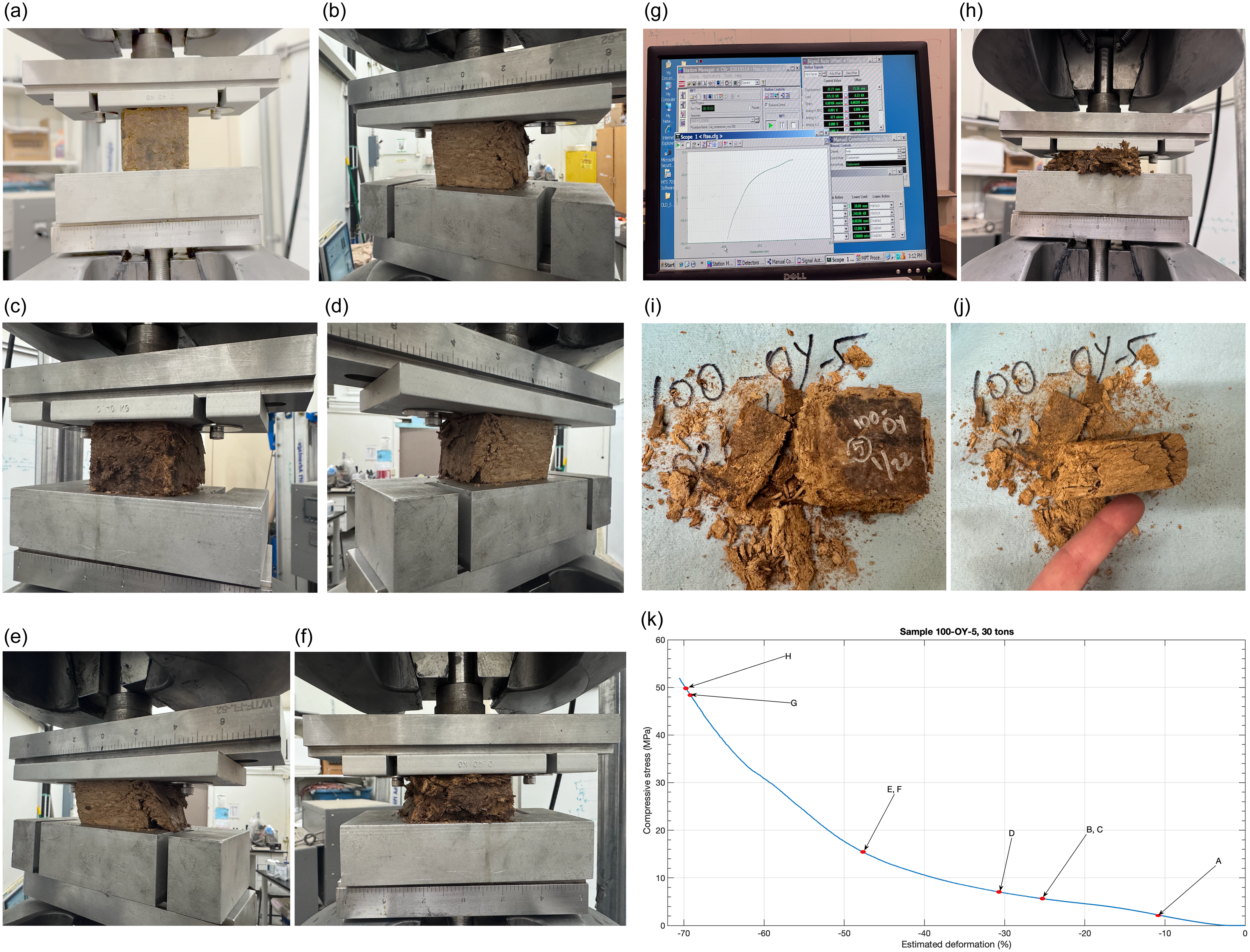
Figure 6a–6h show a typical estimated deformation/stress process and curve of O100 samples, which partially sheared and crushed under compression while retaining some structural integrity to the end even with ∼70% deformation (see Figure 6i–6j). By comparison, the R100 samples sheared and crumbled completely.
(Left to right, top three rows, previous page) 30-tons O100 sample being compressed. (Above left) Curve of this sample during compression. (Above top right) Final view of sample after test prior to removal. (Above bottom right and left) This sample after the end of the test, rotated by hand for two views. Photos by author.

Figure 6. Long description
(Left to right, top three rows, previous page) 30-tons O100 sample being compressed. (Above top left) Curve of this sample during compression. (Above top right) Final view of sample after test prior to removal. (Above bottom right and left) This sample after the end of the test, rotated by hand for two views. Photos by author.
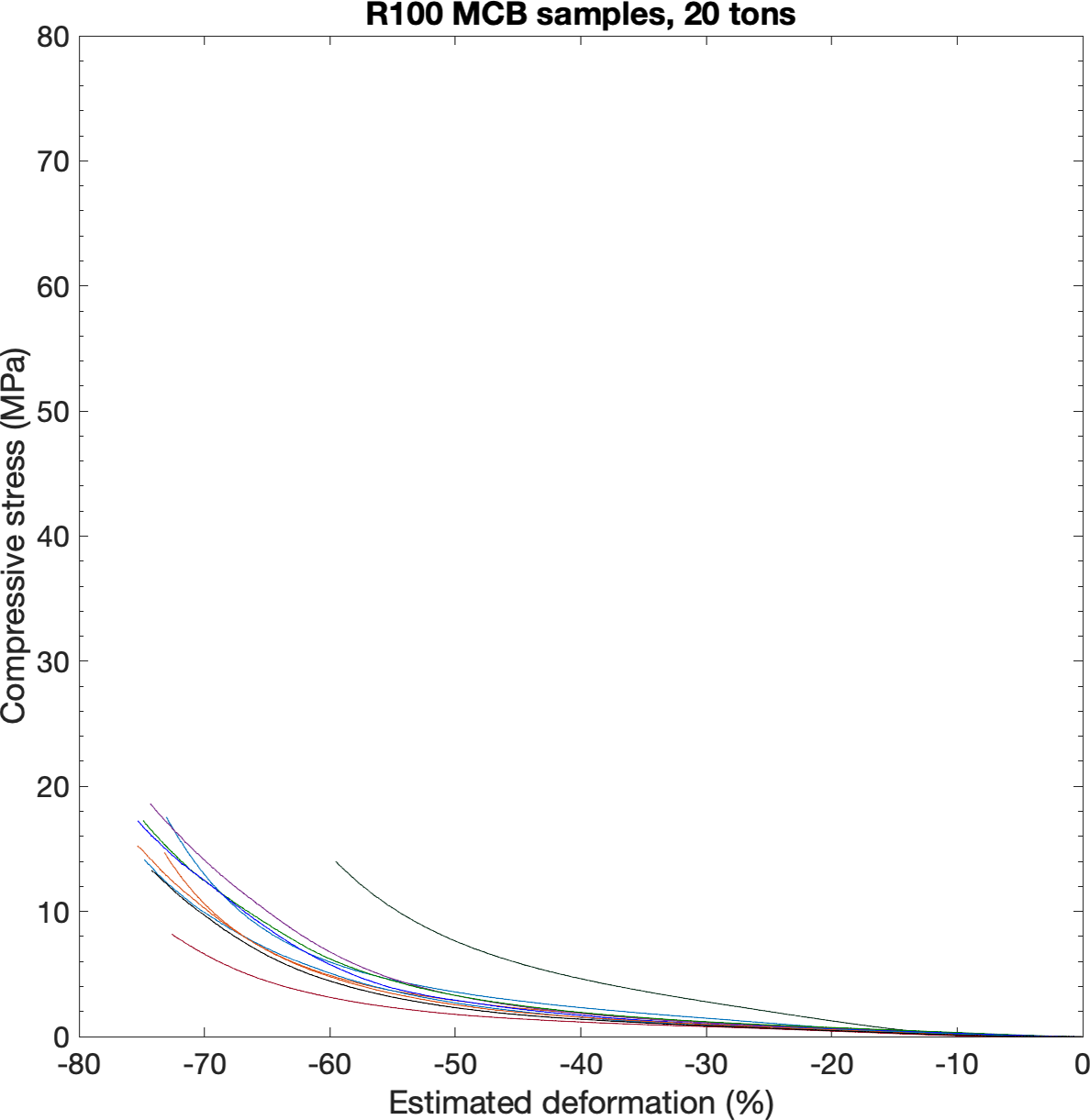
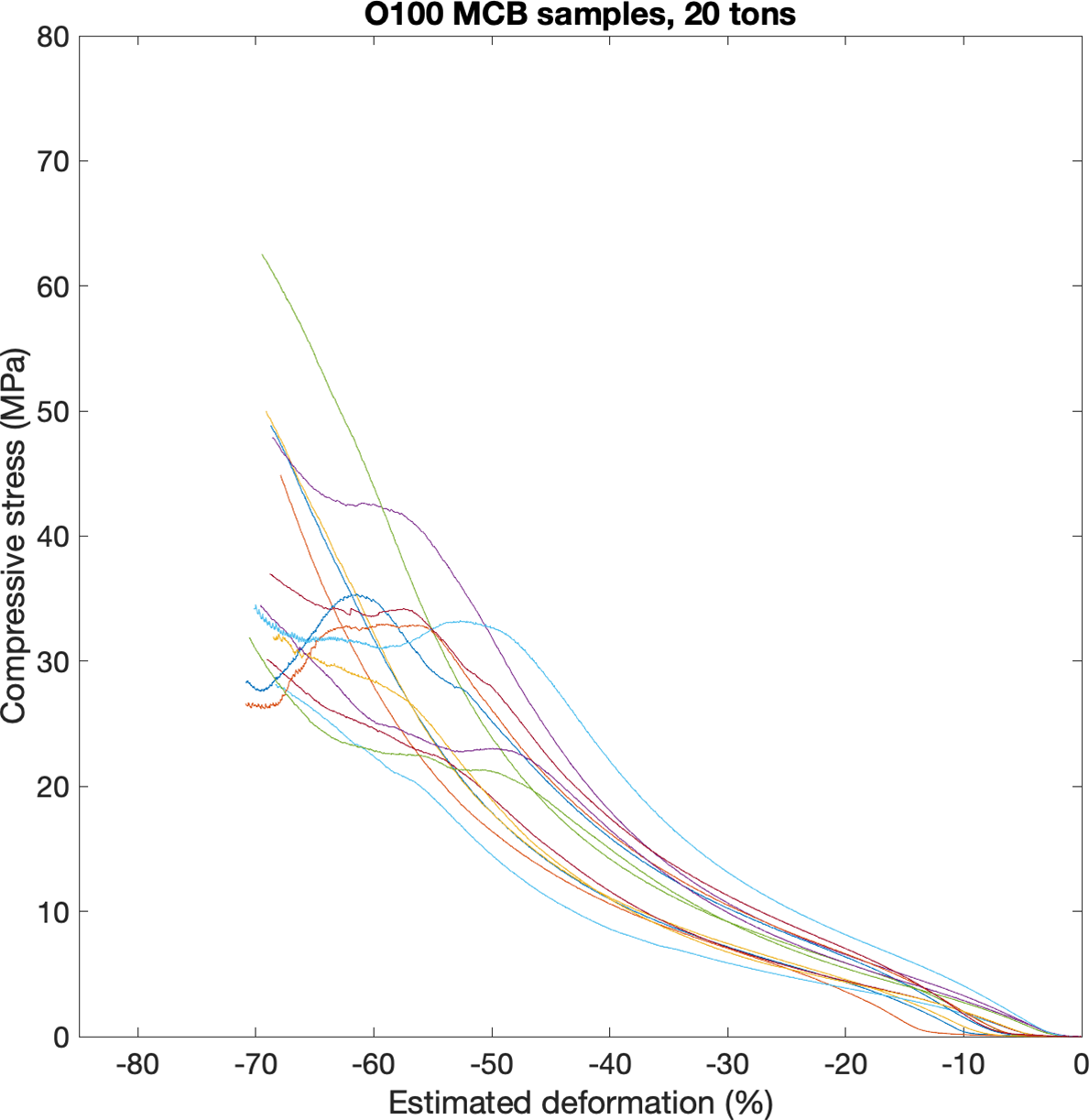
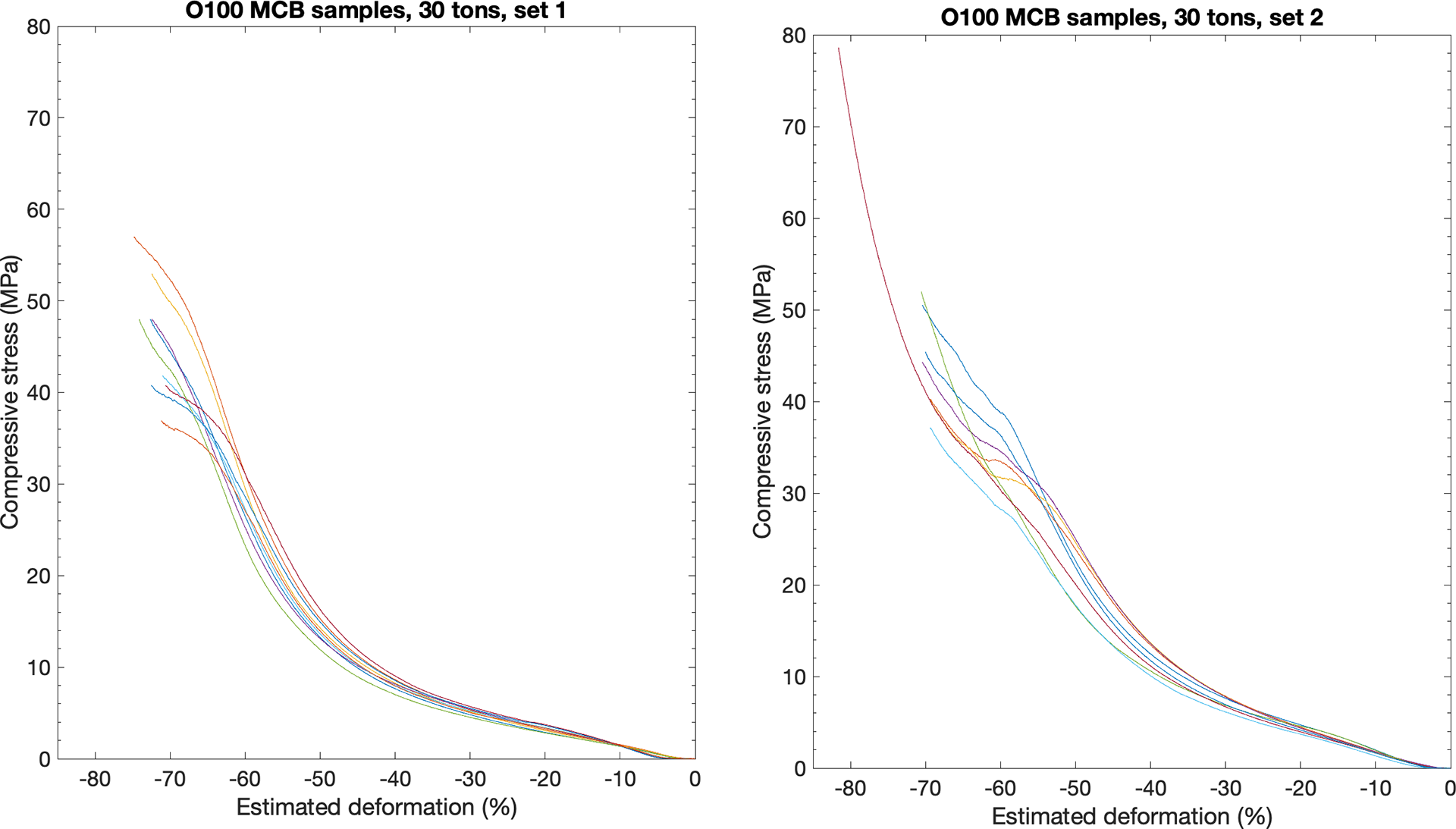
From Figures 7–9, both species of HCM MBC materials typically appear to have higher load capacity as they become more compressed up to ∼70% deformation, exhibiting possible strain-hardening behavior: out of 41 samples, only 3 samples from 20-tons O100 had ultimate strengths in the tested deformation range (i.e. about 7% of the samples). Strain hardening has been observed in materials such as (biological) collagen, nacre, (artificial) heat-treated metallic alloys, metallic or polymeric foams that become densified; however, these HCM MBC samples do not fall in any of these categories.
Plots of estimated deformation versus compressive stress for tested reishi-based MCB samples at 20-tons.

Figure 7. Long description
Plots of estimated deformation versus compressive stress for tested reishi-based MCB samples at 20 tons.
Plots of estimated deformation versus compressive stress for tested oyster-based MCB samples at 20-tons.

Figure 8. Long description
Plots of estimated deformation versus compressive stress for tested oyster-based MCB samples at 20 tons.
Plots of estimated deformation versus compressive stress for tested oyster-based MCB samples at 30 tons.

Figure 9. Long description
Plots of estimated deformation versus compressive stress for tested oyster-based MCB samples at 30 tons.
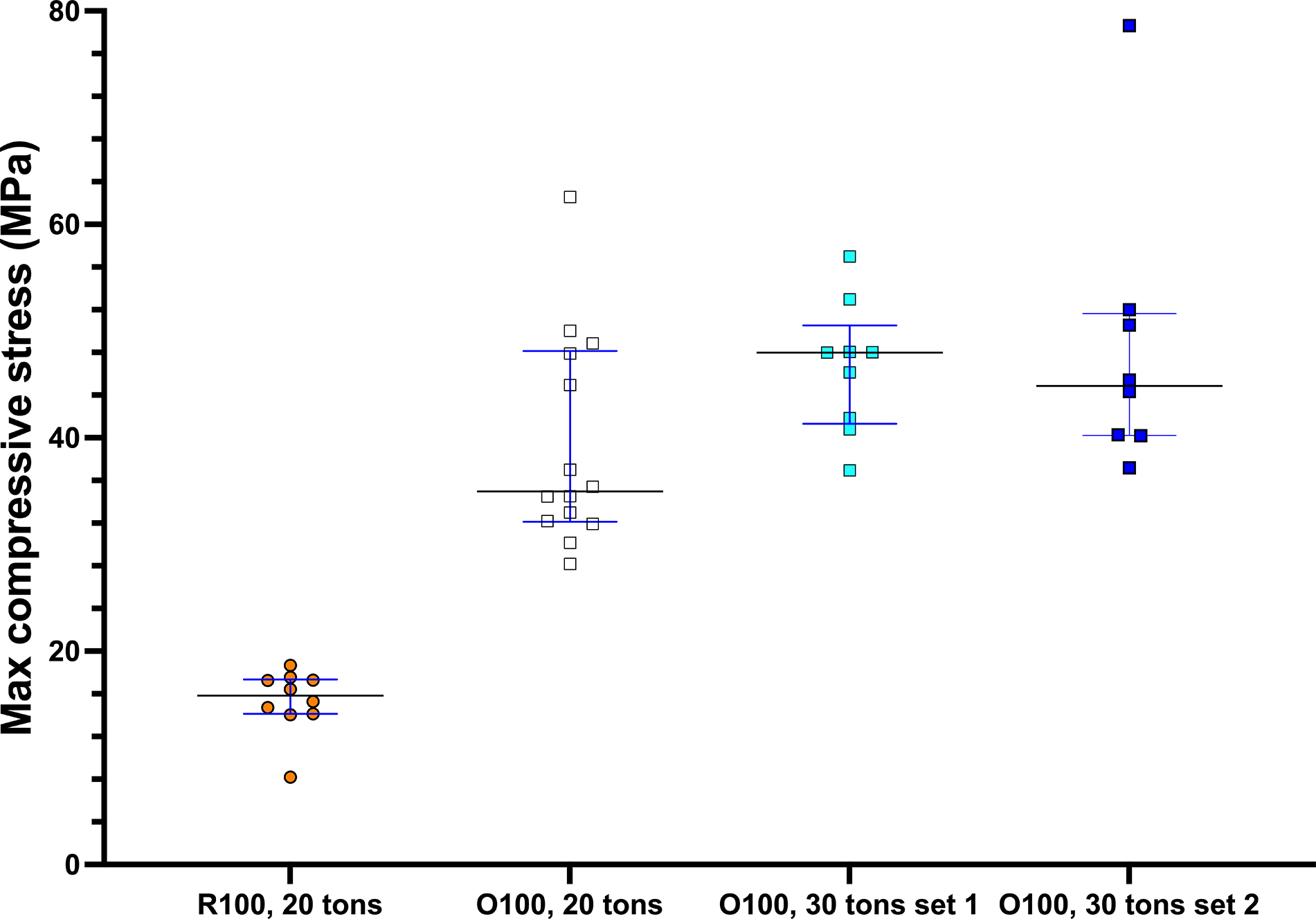
These results were obtained under displacement control at 2 mm/min, at ∼70% deformations and with the given loading fixture. The maximum measured compressive stress for the 20-tons and 30-tons samples were respectively 62.56 and 78.64 MPa from one sample from each configuration (outliers in the scatter plots). However, medians for 20 tons and 30 tons are lower, respectively 34.95 and 46.1 MPa (median of the two 30-tons sets). The 20-tons R100 set had a lackluster performance: their median is 1/2 to 1/3 of those from the O100 configurations. See Table 4 for details. With respect to the 20 tons, the 30-tons sets show statistically similar results in terms of spread (interquartile range, between the blue lines), Figure 10.
Summary of compressive test results for R100 (Reishi 100%) and O100 (Oyster 100%) coupons at different forces during compression at 70% deformation

Table 4. Long description
Summary of compressive test results for R 100 (Reishi 100%) and O 100 (Oyster 100%) coupons at different forces during compression at 70% deformation.
Medians (black lines) and interquartile ranges (blue lines) for maximum compressive stresses of the tested MCB samples. Outliers are located outside the interquartile range.

Figure 10. Long description
Medians (black lines) and interquartile ranges (blue lines) for maximum compressive stresses of the tested MCB samples. Outliers are located outside the interquartile range.
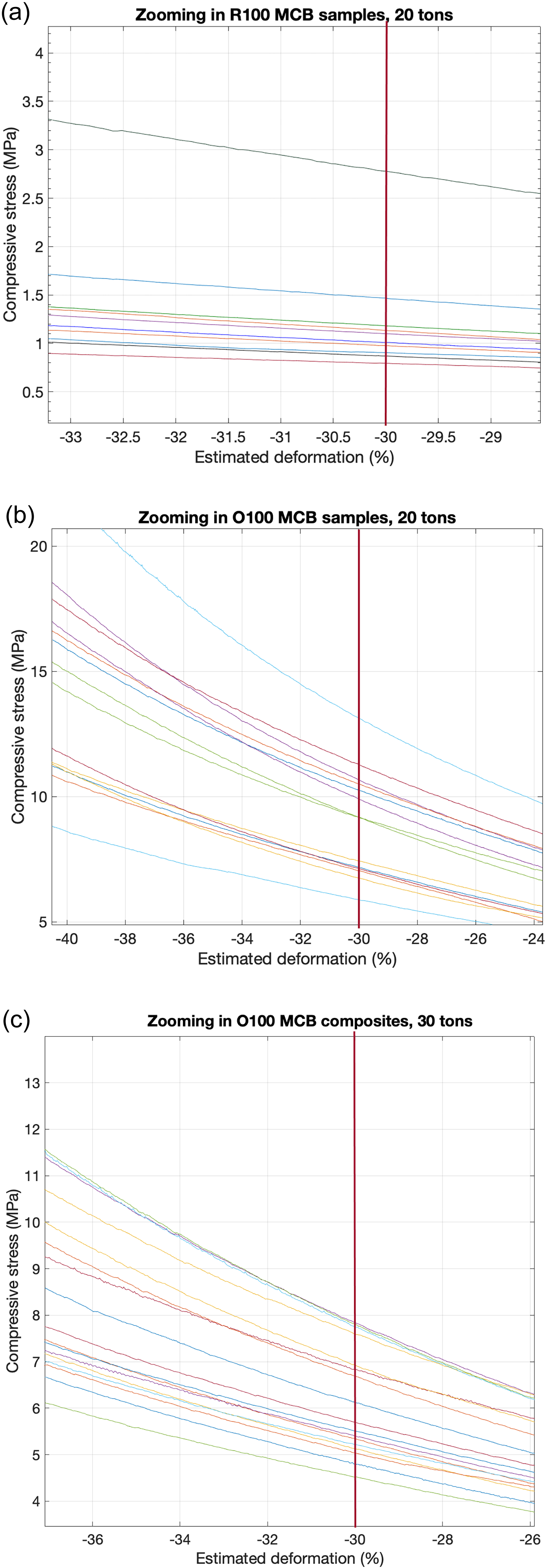
Figure 11 shows curves at 30% deformation to provide an assessment of these MBCs at deformation values typical of concrete. At this deformation, the ranges of compressive stresses for R100, 20-tons O100 and 30-tons O100 were respectively [0.7939–2.776] MPa, [5.878–13.12] MPa and [4.521–7.859] MPa. We observe that 20-tons O100 MBCs were typically stiffer than the 30-tons O100 MBCs in this first part of the tests, but eventually the latter achieved higher stress capacity as shown in Figures 7–10 and Table 4. Our results are comparable to those in Table 1, but our MBCs clearly outperform all MBCs in the published literature at ∼70% deformation.
Close-ups of estimated deformation/stress curves for the three groups of MBC tested (11a, 20-tons reishi; 11b, 20-tons oyster; 11c, 30-tons oyster) to compare values at 30% deformation.

Figure 11a–11c. Long description
Close-ups of estimated deformation/stress curves for the three groups of MBC tested (20-tons reishi in 11a, 20-tons oyster in 11b, 30-tons oyster in 11c) to compare values at 30% deformation. Outliers are located outside the interquartile range.
With respect to the discussion on bulk densities values versus compressive performance, i.e. denser materials being typically stronger in compression, we can see that this hypothesis does not appear to hold for the samples of this study and the given testing conditions, as 30-tons O100 set 1 and 20-tons R100 are comparable in densities, but their mechanical performance is drastically different. On the other hand, the two 30-tons sets have very different densities, but their compressive behavior is statistically the same (Figure 10). We hypothesize a role of the fungal chemistry of these species with respect to the spent mushroom substrate used (different types of hardwoods and aging prior to use) and will investigate this aspect in future work.
Since our data is obtained adapting existing testing standards based on other materials (because none exists for these MCB and HCM materials), we are hesitant to use the expression “compressive strength,” which is a standardized property. The median compressive stresses we measured (in displacement control and at ∼70% deformation) for the 20-tons and 30-tons O100 are in the range of published median and high-strength concrete at typically 30% deformation. American Concrete Institute ACI 211.4R-08 considers high-strength concrete one that has a strength over 42 MPa, and this is still accepted in the engineering practice. However, ACI 363R from American Concrete Institute labels high-strength concrete one with strength superior to 55 MPa. Properties for concrete are generally measured in load control, not displacement control, but the majority of the authors in the MBC literature use displacement control testing (Table 2). We will change the load control process for our future tests to better compare with concrete data.
We will also continue to investigate the strain-hardening behavior, for example following different strain rates, since strain-hardening materials are strain rate-dependent.
In general, the 30-tons O100 configuration appears to be a better choice for structural performance under compression and at high deformation (∼70%), if we can remove the physical strength of a human from the manufacturing process. Additionally, we continue to experiment with different methods of pre-treating our spent mushroom substrate prior to pressing into molds in order to arrive at methods that will consistently bring “ultimate failure” in our materials. It is only with that baseline that we can declare ultimate strength, which in turn is necessary to design and engineer structural buildings with this material. We are also investigating how to optimize not just strength but also fire resistance, as well as studying the seismic resilience of these materials through flexure and shear tests of bricks and soon, of a mycobrick wallette.
Summary and conclusions
In this work, we introduced research on mycelium-based composites (MBC) using a fabrication method invented by architect Chris Maurer and the MycoHAB team, leading to a new type of MBC. We call this method high-compression mycofabrication (HCM). We use spent mushroom substrate from a local mushroom farm in order to promote the circular bioeconomy. For this work, we tested under displacement control a total of 41 samples with a nominal 50 mm cuboid shape: 14 oyster samples from bricks compressed by a 20-tons force, 17 oyster samples from bricks compressed by a 30-tons force, 10 reishi samples from bricks compressed by a 20-tons force. We prove that oyster HCM composites significantly outperform reishi ones in compressive stress. The compressive stress values for oyster HCM coupons fabricated at 20 tons of force and 30 tons of force are the highest yet published anywhere to our knowledge, with median values 34.95 and 46.10 MPa respectively, comparable to values used in the engineering practice for medium- and high-strength concrete, from fungi-based materials that have 1/3 of concrete densities. Moreover, the coupons appear to strain-harden under compression and withstand very high levels of deformation (∼70%), which we will further investigate. Lastly, we observe that higher force during fabrication for oyster HCM coupons leads to higher median compressive stress results during testing.
Data availability statement
All data is given in the main document and in the Appendix section.
Acknowledgements
The authors wish to acknowledge our affiliation with the UC Davis Maria Manetti Shrem Institute for Sustainable Design, Fashion and Textiles. Additionally, some of the data used in this paper was produced by the authors of another paper our team has under peer review (June 2026), “Optimizing Material Properties of Compressed Mycelium-Based Composite Bricks Using Species Combinations of Post-Harvest Spent Mushroom Waste,” by Christina Cogdell, Dharyl Ong Licudine, Vaishnavi Kulkarni, Kavya Shankar, Angel Magaña Cuevas, Swayam Patel and Valeria La Saponara. Dr. Marc Facciotti Andrew Yao and Valentina Rueda facilitated our use of the UC Davis BioInnovation Lab spaces where we conducted some this research, apart from Dr. La Saponara’s ACRES Laboratory. Far West Fungi provided the SMS used in this study and we appreciate the material, insights and access shared by Ethan Levesque, Kyle Garrone, Ian Garrone, Kiera Garrone and Erin Raser. Architect Chris Maurer of redhouse studio architecture offered significant insights, as did Dr. Michele Barbato (Civil and Environmental Engineering, UC Davis). Marshall Flagg at Old West Iron, Vacaville, CA fabricated our steel molds. Dr. Brad Hanson cut our coupons from our bricks. Steven Lucero, Director of UC Davis Tech Foundry and TEAM Lab, fabricated steel parts for our testing machine. Kathy Hoppel Martin offered behind the scenes support. The authors also thank: members of the ACRES Laboratory for their assistance with the manufacturing of the 30-tons bricks (Brandon Yee, Seth Ochoa Sarmiento, Maya Rohrer, Joshua Perkins, Hardik Arora and Mariam Diab); the personnel of UC Davis Dyane Bryant Engineering Student Design Center (particularly Jose Mojica and R&D engineers David Kehlet and Michael Fish) for training and support on the hydraulic press.
Author contributions
Conceptualization: C.C; V.L.S. Data curation: V.L.S; V.K; C.M.V. Formal analysis: V.L.S. Investigation: V.L.S; V.K; C.M.V. Methodology: C.C; V.L.S. Project Administration: C.C; V.L.S. Resources: C.C; V.L.S. Software: V.L.S. Supervision: C.C; V.L.S. Validation: V.L.S. Visualization: C.C; V.L.S. Writing – original draft: C.C; V.L.S. Writing – reviewing and editing: C.C; V.L.S; V.K; C.M.V. All authors approved the final submitted draft.
Financial support
No funding supported this research.
Competing interests
The authors declare no conflicts of interests.
Ethical standards
The research in this paper meets all ethical guidelines, including adherence to the legal requirements of the study country.


 Open access

