INTRODUCTION
Individuals with psychiatric disorders are among the most highly stigmatized groups in society (Westbrook et al. Reference Westbrook, Legge and Pennay1993; Mechanic et al. Reference Mechanic, McAlpine, Rosenfield and Davis1994; Link et al. Reference Link, Phelan, Bresnahan, Stueve and Pescosolido1999). Evidence has been accumulating that illness attributions (beliefs about illness causation) strongly impact quality of life and psychological adjustment in medical illness in general (Watts, Reference Watts, Antaki and Brewin1982; Turnquist et al. Reference Turnquist, Harvey and Andersen1988; Sensky, Reference Sensky1997), and psychiatric disorders in particular (Kuyken et al. Reference Kuyken, Brewin, Power and Furnham1992; Mechanic et al. Reference Mechanic, McAlpine, Rosenfield and Davis1994). While it appears particularly salient to assess the impact of illness attributions on the perceived stigma of psychiatric disorders, very few empirical data are currently available on this issue. In particular, whether attributing psychiatric disorders to genetic factors impacts perceived stigma and psychological distress, and whether it affects reproductive options among those affected by psychiatric disorders, remains largely unexplored (Nuffield Council on Bioethics, 1998). The potential impact of endorsing a genetic model is of special importance to those with a strong family history of bipolar disorder, given its high demonstrated heritability, which is estimated at 70–85% (McGuffin et al. Reference McGuffin, Rijsdijk, Andrew, Sham, Katz and Cardno2003; Smoller & Finn, Reference Smoller and Finn2003).
A summary of the debate on the relationship between genetic cause and perceived stigma
There has been ongoing debate on the potential impact of a genetic attribution on the stigma associated with mental illness (Phelan, Reference Phelan2002, Reference Phelan2005; Austin & Honer, Reference Austin and Honer2005; Meiser et al. Reference Meiser, Mitchell, McGirr, Van Herten and Schofield2005). Attribution theory predicts that a genetic explanation would decrease stigma as it shifts causal responsibility away from the individual and towards the role of an uncontrollable biological cause (heredity), which in turn may alleviate self-blame and guilt, and increase sympathy and help (Sensky, Reference Sensky1997; Phelan, Reference Phelan2002, Reference Phelan2005). In accordance with ‘genetic essentialism’ (the belief that genes form the basis of our human identity) (Nelkin & Lindee, Reference Nelkin and Lindee1995), however, a genetic explanation could increase stigma by increasing perceptions of differentness and seriousness, which in turn could increase ‘social distance’ (i.e. social rejection) and ‘reproductive restrictiveness’ (the belief that those affected with an inherited disorder should not reproduce) (Phelan, Reference Phelan2002, Reference Phelan2005). Adopting an intermediate position, Phelan (Reference Phelan2005) argues that these theories may not be mutually exclusive but operate simultaneously. Indeed, empirical findings suggest that the effects of attributing mental illness to genetic factors may be particularly complex, ameliorating stigma in some ways, while exacerbating it in others (Phelan et al. Reference Phelan, Rosangely Cruz and Reiff2002; Phelan, Reference Phelan2005). For example, Phelan et al. (Reference Phelan, Rosangely Cruz and Reiff2002) found that people who attributed an individual's schizophrenia to genetic factors were less likely to think the person was responsible for the disorder. By contrast, a vignette experiment in a general population sample demonstrated support for genetic essentialism, in that genetic attributions increased the perceived seriousness and persistence of the mental illness (Phelan, Reference Phelan2005). Clearly these findings are of interest but require replication in a clinical sample.
Impact of genetic risk information on childbearing decisions
Very few data are currently available on attitudes to childbearing of individuals affected with or at risk for bipolar disorder. In the USA, Trippitelli et al. (Reference Trippitelli, Jamison, Folstein, Bartko and DePaulo1998) assessed 45 individuals with bipolar disorder (only 16 of whom had a strong family history of bipolar disorder) and their spouses as to whether knowing that they or their spouse had a gene variation that increases the likelihood of developing bipolar disorder would have deterred them from having children. Twenty-seven per cent of patients and 18% of spouses reported that such knowledge would probably or definitely have deterred them from having children, with 18% and 25% of patients and spouses respectively reporting being uncertain (Trippitelli et al. Reference Trippitelli, Jamison, Folstein, Bartko and DePaulo1998). In Germany, Illes et al. (Reference Illes, Rietz, Fuchs, Ohiraun, Prell, Rudinger, Maier and Rietschel2003) assessed attitudes to childbearing among 316 patients (unselected for family history) with schizophrenia and/or an affective disorder. These authors found that 23% and 56% of patients reported that they would not have children in case of an increased genetic risk of depression and/or schizophrenia respectively. As most participants in these previous studies were unselected for the presence of family history, it is important to assess whether decision making about childbearing among individuals with a strong family history of bipolar disorder is similar.
Given the lack of empirical data on the impact of attributing the cause of mood disorders to genetic factors, we recently undertook a preliminary interview-based study of 21 individuals from families with multiple cases of bipolar disorder (Meiser et al. Reference Meiser, Mitchell, McGirr, Van Herten and Schofield2005), which informed the hypotheses tested in the present study. In this previous study, most participants felt that having a genetic explanation was very helpful to families with members with bipolar disorder because it offered relief from self-blame for those affected with bipolar disorder. A genetic explanation was also thought to be helpful to parents who might otherwise attribute bipolar disorder in their children to poor parenting. However, many participants felt that a genetic explanation was unlikely to decrease the stigma attributed to bipolar disorder in the community. A diversity of views was identified, in that a smaller number of participants felt that a genetic explanation had the potential of decreasing stigma, as it made it more likely that bipolar disorder would be viewed as a medical condition, while others were of the view that it may have the opposite effect. Approximately half of those interviewed said that coming from a family with multiple cases of bipolar disorder had affected their decision to have children or would have affected their decision had they known about their increased risk prior to having children (Meiser et al. Reference Meiser, Mitchell, McGirr, Van Herten and Schofield2005).
Given the dearth of empirical data in this area, the present study hoped to fill an important gap in the existing literature. The study aimed to assess, in a sample of families with multiple cases of bipolar disorder: attributions about bipolar disorder, in particular the degree to which a genetic model of causation is endorsed and its impact on causal attributions on perceptions of the stigma associated with bipolar disorder and psychological distress; predictors of psychological distress; and attitudes towards childbearing. The study tested the following hypotheses: that endorsement of a genetic model of causation for bipolar disorder will be associated with (i) lower perceived stigma of bipolar disorder, (ii) lower psychological distress, and (iii) less willingness to have children.
METHOD
Participants were ascertained through the Molecular Genetics Study of Bipolar Disorder, a genetic linkage study established 15 years ago that aims to clarify the molecular genetics of bipolar disorder (Adams et al. Reference Adams, Mitchell, Fielder, Rosso, Donald and Schofield1998; Badenhop et al. Reference Badenhop, Moses, Scimone, Mitchell, Ewen, Rosso, Donald, Adams and Schofield2001). Medium- to large-sized multigenerational families that contain a minimum of three affected individuals, at least two of whom have been diagnosed with bipolar disorder I, are eligible for participation in this study.
Only those aged 18 years or over and those who can read English proficiently were eligible to participate, as data were collected using self-administered questionnaires. Up to four affected and unaffected individuals each were selected randomly per family and were sent an invitation letter by the Principal Clinical Investigator of the Molecular Genetics of Bipolar Study. Affected status was defined as those fulfilling Research Diagnostic Criteria for either bipolar disorder, schizo-affective disorder (manic type), or recurrent major depression. Individuals were asked to return an enclosed preference card to indicate their interest in participation. Individuals who did not decline participation were then contacted by telephone to confirm their eligibility and sent a study package including a questionnaire, consent form, and reply-paid envelope. Affected individuals who were in an active phase of illness were given the option to be re-contacted to participate at a later time. Reminder calls were made and replacement questionnaires were sent as necessary.
Measures
Data were collected using the measures listed below.
Demographic characteristics
Sex, age, highest level of education obtained, current marital status, and number of biological children were assessed using specifically designed multiple choice items.
Clinical and family history data
Data on family history and illness characteristics were collected as part of the Molecular Genetics Study of Bipolar Disorder using the Family Interview for Genetic Studies (NIMH, 1992) at the time of recruitment and the Diagnostic Interview for Genetic Studies, which was subsequently used to establish the diagnosis according to the Research Diagnostic Criteria (Nurnberger et al. Reference Nurnberger, Blehar, Kaufmann, York-Cooler, Simpson, Harkavy-Friedman, Severe, Malaspina and Reich1994).
Causal attributions for bipolar disorder
Based on the results of our previous qualitative study (Meiser, Reference Meiser2005), items were purposively designed to assess the perceived importance of different factors in causing bipolar disorder in relation to participants' family and other families with multiple cases of bipolar disorder. Participants responded to all items using a five-point Likert-type scale ranging from 1 ‘Not at all important’ to 5 ‘Extremely important’.
Zarit Burden Interview (ZBI)
This 12-item measure of family burden was only administered to unaffected individuals. It has excellent psychometric properties (Bedard et al. Reference Bedard, Molloy, Squire, Dubois, Lever and O'Donnell2001) and was designed to measure the extent to which caregivers perceive their care-giving as having a detrimental effect on their health, personal and social life, psychological well-being, and finances. Each item is rated on a five-point scale [ranging from ‘Never’ (0) to ‘Nearly always’ (4)] present], and total scores range from 0 to 48, with higher scores indicating higher levels of perceived burden (Bedard et al. Reference Bedard, Molloy, Squire, Dubois, Lever and O'Donnell2001). Internal consistency in this sample was very high, with Cronbach's α=0·90.
Internal State Scale (ISS)
The ISS was administered to affected participants only. It assesses the severity of current manic and depressive symptoms and comprises 16 items rated on a 0–100 Likert scale. Studies have shown that the ISS has good reliability and validity in patients with bipolar disorder (Bauer et al. Reference Bauer, Crits-Christoph, Ball, Dewees, McAllister, Alahi, Cacciola and Whybrow1991). Items can be divided into four subscales [Activation (ACT), Depression (DEP), Perceived Conflict (PC) and Well-Being (WB)], which can be used to classify participants as euthymic (WB⩾125, ACT<155), depressed (WB<125, ACT<155), manic/hypomanic (WB⩾125, ACT⩾155) and/or having mixed symptoms (WB<125, ACT⩾155) (Glick et al. Reference Glick, McBride and Bauer2003). For the WB subscale, lower scores indicate greater pathology, and for all other subscales higher scores suggest greater symptomatology. The internal consistency values in this sample were very high, with Cronbach's α=0·88 (ACT), 0·74 (DEP), 0·86 (PC) and 0·88 (WB).
Outcome variables
Perceived Devaluation–Discrimination
This 12-item measure of mental illness stigma was used as both a predictor and an outcome variable. It assesses respondents' perceptions of what ‘most other people’ believe, which is a key feature of modified labelling theory, according to which perceived devaluation–discrimination should have no impact on social or psychological functioning in people who have never been officially labelled with mental illness (Link, Reference Link1987; Link et al. Reference Link, Yang, Phelan and Collins2004). The measure was selected on the basis of its sound theoretical basis and because it has been used mainly among people being treated for mental illness. Items explored beliefs, such as whether a person with bipolar disorder is just as trustworthy as the average citizen, and whether one would willingly accept a person with bipolar disorder as a friend (Link, Reference Link1987). Five-point Likert-type response scales were used, ranging from 1 ‘Strongly disagree’ to 5 ‘Strongly agree’, and items were summed and divided by the total number of items answered (Link, Reference Link1987), with higher values indicating greater perceived stigma. This measure demonstrated excellent internal consistency in the present sample, with Cronbach's α=0·87.
Attitudes towards childbearing
One item assessed the extent to which having a strong family history of bipolar disorder has affected participants' attitude towards having children. Participants chose from the following response options: ‘Not at all willing to have children’, ‘Less willing to have children’, ‘No change in attitude towards having children’ and ‘More willing to have children’.
General Health Questionnaire 12 (GHQ12)
This 12-item scale is a measure of minor psychiatric disorder and was used to assess psychological distress (Goldberg & Williams, Reference Goldberg and Williams1988). Questions focus on two main classes of phenomena: inability to carry out one's normal healthy functions, and the emergence of new illness-related phenomena that are distressing (Goldberg & Hillier, Reference Goldberg and Hillier1979; Goldberg & Williams, Reference Goldberg and Williams1988).
Statistical analyses
Data were explored initially with descriptive statistics and graphs. Bivariate associations between possible predictors and the non-normally distributed outcome variables were first examined using Spearman's rank correlation (r s) for ordered or continuous predictor variables and Mann–Whitney U tests for binary predictor variables. All variables with a bivariate association with p<0·1 were entered into the regression model and progressively eliminated until the only remaining variables were those with p<0·05, or those that confounded the association of interest. In all regression models, correlations among responses of individuals in the same family were allowed for using generalized estimating equations (GEE) methodology (Zeger & Liang, Reference Zeger and Liang1986). The following variables were assessed as possible predictor variables or potential confounders in all analyses: age, sex, marital status, educational level, disease status, number of affected first- and second-degree relatives, perceived stigma, and causal attributions for bipolar disorder.
For the logistic regression modelling of psychological distress, GHQ12 scores were recoded into a new variable, using the bimodal scoring method (Burvill & Knuiman, Reference Burvill and Knuiman1983), where those with a score of 2 or higher are categorized as having distress levels consistent with a need for clinical intervention (‘cases’). The probability of being a case was modelled separately for unaffected and affected participants. For the logistic regression model on attitude to childbearing, the outcome variable was defined as ‘Not at all willing to have children’ and ‘Less willing to have children’ versus ‘No change in attitude towards having children’.
RESULTS
In total, 347 people were approached from 64 families; of these, 10 individuals were found to be ineligible to participate, resulting in a total number of 337 eligible participants (59% female and 41% male). Of these, 82 were lost to contact as a result of incorrect address (n=9), incorrect telephone number (n=22), or three or more failed contact attempts (n=51). Of the 255 individuals who were successfully contacted, 200 completed the study questionnaire, and the remainder either declined participation (n=33) or did not return the questionnaire (n=22), resulting in a return rate of 78%, among those who were successfully contacted, and an overall participation rate of 59% among eligible individuals. There were no statistically significant differences between eligible individuals who completed questionnaires (n=200) and those who did not (n=137) in terms of age and clinical diagnosis. However, women who were invited to the study were more likely to participate (64%) than men (52%) (χ2=4·73, df=1, p=0·03).
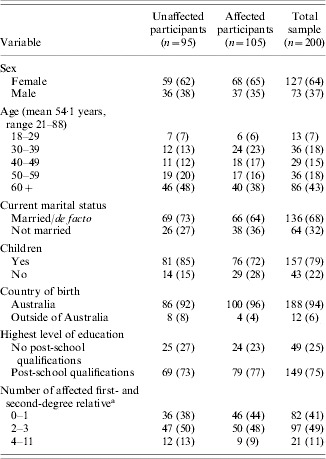
A total of 95 unaffected and 105 affected family members were included in the final sample. Sociodemographic characteristics of the sample are shown in Table 1 separately for unaffected and affected participants. The mean number of participants per family was 3·3 (range 1–7). One hundred and twenty-seven female and 73 male participants were included, with a mean age of 54·1 years (range 21–88 years). Affected participants were significantly less likely to have children (χ2=4·90, df=1, p=0·03) and were younger than those unaffected (z=2·02, p=0·04). The mean ages of affected and unaffected participants were 52·0 (s.d.=16·1) and 56·5 (s.d.=16·1) years respectively.
Summary characteristics of participants (n=200)

Values are given as n (%).
a Refers to total number of first- and second-degree relatives with either bipolar disorder, schizo-affective disorder (manic type), or recurrent major depression who were alive at the time of the diagnostic interview undertaken as part of the molecular genetics parent study. Participants with no affected first- and second-degree relatives had affected relatives who were third-degree or higher.
Factor structure of Causal Attributions for Bipolar Disorder scale
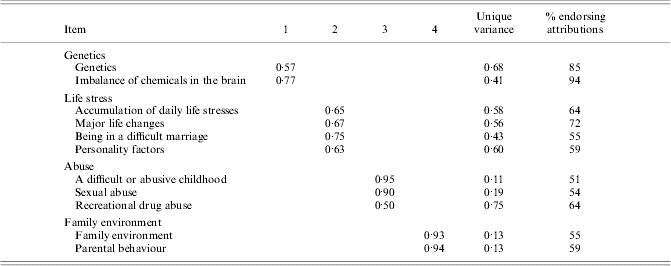
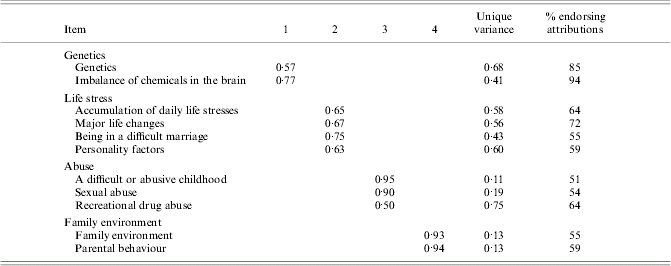
Exploratory factor analysis yielded a four-factor solution (shown in Table 2), with item groupings representing (i) genetics, (ii) life stress, (iii) abuse and (iv) family environment. Two items (‘Childbirth leading to postnatal depression’ and ‘Seasonal effects’) did not load satisfactorily onto any of the four factors, and one item (‘Excessive alcohol consumption’) was identified as a Heywood case or improper solution (McDonald, Reference McDonald2004). Hence, a decision was made to omit these three items from further analysis. Additionally, one item (‘Brain damage or trauma during childbirth’) was omitted from further analysis on conceptual grounds because its loading with items indicative of abuse within relationships with others could not be substantiated theoretically. The factor loadings for the confirmatory analysis were consistent with the exploratory pattern. The confirmatory factor analysis gave a χ2 of 83·11 on 38 df, with a root mean square error of approximation (RMSEA) of 0·08 (i.e. satisfactory), a goodness-of-fit index (GFI) of 0·99, and no large discrepancies, indicating that the fitted model provided a good approximation to the data. Values of Cronbach's α for the items comprising the four different factors were: 0·59 (Genetics), 0·77 (Life stress), 0·82 (Abuse) and 0·93 (Family environment).
Factor loadings (1–4) and unique variances from the confirmatory factor analysis and percentages of participants endorsing individual causal attributions as ‘quite important’ or ‘extremely important’
Association between endorsement of a genetic model and perceived stigma
A Mann–Whitney U test showed weak evidence of a difference between affected and unaffected participants in terms of endorsement of a genetic model (z=1·76, p=0·079). To test hypothesis (i), Spearman's rank correlation was used to test for an association between endorsement of a genetic model of bipolar disorder and perceived stigma. While this correlation was not significant for the combined sample (r s=0·10, p=0·18) and affected participants alone (r s=–0·03, p=0·42), further examination showed a positive association for unaffected participants (r s=0·30, p=0·004), thus partially supporting hypothesis (i). Associations between perceived stigma and the other Causal Attributions for Bipolar Disorder subscales were not significant in the combined sample (data not shown). A linear regression model using GEE to account for familial clustering confirmed a significant interaction between endorsement of a genetic model and disease status (p=0·014), indicating that endorsement of a genetic model was associated with perceived stigma for unaffected, but not affected, participants.
Descriptive data on psychological measures
Twenty-four per cent and 48% of unaffected and affected participants respectively (37% in the combined sample) were found to have levels of distress consistent with a need for clinical intervention, as measured by the GHQ12. The Perceived Devaluation–Discrimination scale had a mean of 2·8 (s.d.=0·64) in the combined sample, and 2·8 (s.d.=0·7) and 2·9 (s.d.=0·6) among unaffected and affected participants respectively. The Family Burden measure had a mean of 13·5 (s.d.=9·1). Using the ISS, 48% of affected participants were classified as currently euthymic, 15% as depressed, 24% as manic and 13% as having a mixed state.
Factors associated with psychological distress
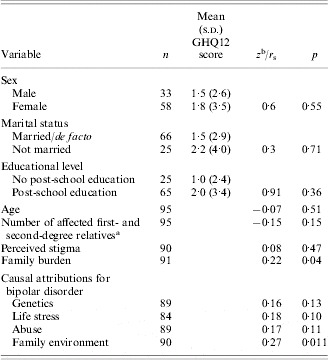
Table 3 shows results from bivariate analyses of the factors associated with psychological distress (GHQ12 scores) among unaffected participants. Family burden (r s=0·22, p=0·04) and the Family Environment subscale (r s=0·27, p=0·011) of the Causal Attributions for Bipolar Disorder scale were significantly associated with psychological distress. A logistic regression model using GEE to account for familial clustering showed that only the Family Environment subscale (OR 1·58, p=0·043) of the Causal Attributions for Bipolar Disorder scale remained significantly associated with psychological distress.
Factors explored for association with psychological distress among unaffected participants (n=95)

a Refers to total number of first- and second-degree relatives with either bipolar disorder, schizo-affective disorder (manic type) or recurrent major depression who were alive at the time of the diagnostic interview undertaken as part of the molecular genetics parent study.
b z values are from Mann–Whitney U tests.
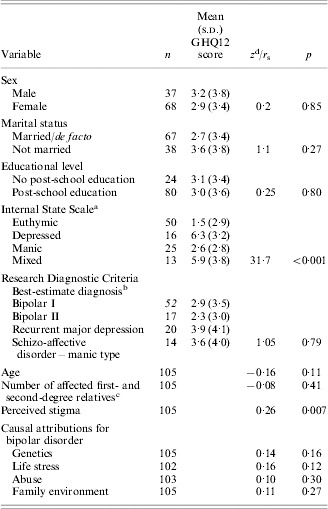
Table 4 shows results from bivariate analyses of the factors associated with psychological distress (GHQ12 scores) among affected participants. Severity of symptoms (as measured by the ISS) (χ2=31·7, df=3, p<0·001) and perceived stigma (r s=0·26, p=0·007) were significantly associated with psychological distress. When entered into a logistic regression model using GEE to account for familial clustering, perceived stigma (OR 2·44, p=0·02) remained significantly associated with GHQ12 caseness, controlling for severity of symptoms (p<0·001).
Factors explored for association with psychological distress among affected participants (n=105)

a Assesses current severity of manic and depressive symptoms.
b Based on Diagnostic Interview for Genetic Studies (Nurnberger et al. Reference Nurnberger, Blehar, Kaufmann, York-Cooler, Simpson, Harkavy-Friedman, Severe, Malaspina and Reich1994).
c Refers to total number of first- and second-degree relatives with either bipolar disorder, schizo-affective disorder (manic type) or recurrent major depression who were alive at the time of the diagnostic interview undertaken as part of the molecular genetics parent study.
d z values are from Mann–Whitney U tests.
Hypothesis (ii), which postulated an association between endorsement of a genetic model and psychological distress, was not confirmed in unaffected (r=0·01, p=0·94) or affected participants (r=0·13, p=0·19).
Attitudes towards childbearing
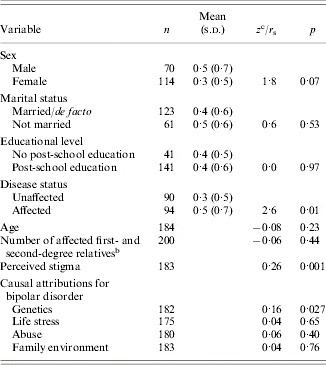
Participants reported on whether having a strong family history of bipolar disorder had affected their attitudes towards having children. Ten participants (5%) reported being ‘not at all willing to have children’, 55 (30%) reported being ‘less willing to have children’, and 119 (65%) reported ‘no change in attitude towards having children’. None reported being ‘more willing to have children’. Table 5 shows results from bivariate analyses on attitudes to childbearing. Significant associations were found between less willingness to have children and perceived stigma of bipolar disorder (r s=0·26, p=0·001), endorsement of a genetic model for bipolar disorder (as measured by the Genetics subscale of the Causal Attributions for Bipolar Disorder scale) (r s=0·16, p=0·027), and being affected (z=2·6, p=0·01). Thirty-one per cent (31%) of unaffected and 50% of affected participants reporting being not at all or less willing to have children. When entered into a logistic regression model using GEE to account for familial clustering, perceived stigma (OR 2·42, p=0·002) and being affected (OR 2·16, p=0·01) remained in the model; furthermore, hypothesis (iii) was supported in that endorsement of a genetic model (OR 1·76, p=0·046) was also significantly associated with being not at all or less willing to have children.
Factors explored for association with attitudes towards childbearingFootnote a

a ‘Attitudes towards childbearing’ variable: range ‘Not at all willing to have children’ (2), ‘Less willing’ (1), ‘No change in attitude towards having children’ (0).
b Refers to total number of first- and second-degree relatives with either bipolar disorder, schizo-affective disorder (manic type) or recurrent major depression who were alive at the time of the diagnostic interview undertaken as part of the molecular genetics parent study.
c z values are from Mann–Whitney U tests.
DISCUSSION
Causal attributions
Contrary to hypothesis (i), which predicted that endorsement of a genetic model of causation for bipolar disorder would be associated with lower perceived stigma, we found a significant positive association between endorsement of a genetic model and perceived stigma among unaffected participants, while no such association was found for affected participants. These findings provide support for the notion of ‘stigma by association’ of unaffected relatives because of their association with an individual already stigmatized because they are affected with bipolar disorder (Phelan et al. Reference Phelan, Bromet and Link1998; Ostman & Kjellin, Reference Ostman and Kjellin2002; Austin & Honer, Reference Austin and Honer2005; Phelan, Reference Phelan2005). Our findings also support the results of the vignette study by Phelan (Reference Phelan2005), who found that endorsement of a genetic model of bipolar disorder did not affect reproductive restrictiveness or social distance from the ill person, but did increase social distance for the person's sibling, particularly regarding intimate forms of contact involving dating, marriage and having children. Taken together, these findings are cause for concern, because they suggest that a genetic explanation may exacerbate perceived associative stigma among unaffected relatives, who may suffer rejection as potential marriage partners or parents, as well as discrimination in employment and some forms of insurance (Phelan, Reference Phelan2002, Reference Phelan2005). These findings also indicate that genetic counselling for mental illness may be particularly challenging as the provision of risk information has the potential to label unaffected relatives as being ‘at risk’ and may lead to internalized stigma (Austin & Honer, Reference Austin and Honer2005).
Family burden
Studies of schizophrenia have shown that family burden (i.e. the emotional, social and financial stresses that the illness imposes on the family) is widely reported by family members and is associated with less optimal psychosocial outcomes (e.g. Potasnik & Nelson, Reference Potasnik and Nelson1984; Baronet, Reference Baronet1999; Hinricksen & Lieberman, Reference Hinricksen and Lieberman1999). However, few data are available on family members of people with bipolar disorder and unipolar depression (Targum et al. Reference Targum, Dibble, Davenport and Gershon1981; Coyne et al. Reference Coyne, Kessler, Tal, Turnbull, Wortman and Greden1987; Fadden et al. Reference Fadden, Bebbington and Kuipers1987; Perlick et al. Reference Perlick, Clarkin, Sirey, Raue, Greenfield, Struening and Rosenheck1999), and the data reported here are, to our knowledge, the first among families with multiple cases of bipolar disorder. The Family Burden measure, which was only administered to unaffected participants, had a mean of 13·5 [95% confidence interval (CI) 11·7–15·3, s.d.=9·1], which is similar to the level of perceived burden among 297 carers of people with Alzheimer's disease (mean=11·2, 95% CI 8·5–13·9, s.d.=23·3) (Bedard et al. Reference Bedard, Molloy, Squire, Dubois, Lever and O'Donnell2001). The high levels of family burden suggest that unaffected family members may require specific interventions to be developed, to support them in their caregiving role, which in turn may lead to better coping for affected family members.
Predictors of psychological distress among unaffected and affected family members
Hypothesis (ii), that is a positive association between endorsement of a genetic model and psychological distress, was not supported among either unaffected or affected participants, thus supporting neither attribution theory nor genetic essentialism. These findings are reassuring as they show that neither a genetic attribution nor stigma is associated with increased levels of distress among unaffected participants. By contrast, we found that psychological distress was associated with perceiving the family environment as an important factor in causing bipolar disorder among unaffected family members. Attribution theory can be used to interpret this finding. According to attribution theory, individuals make attributions about the cause and controllability of a person's illness that lead to inferences about responsibility (Weiner, Reference Weiner1995). If the illness is attributed to genetic factors, the affected individual is less likely to be judged responsible (Weiner et al. Reference Weiner, Graham and Chandler1982; Corrigan et al. Reference Corrigan, Markowitz, Watson, Rowan and Kubiak2003). However, it is possible that attributing personal responsibility for bipolar disorder to the family environment (including parental behaviour) may lead to anger and/or guilt because of the belief that bipolar disorder could have been avoided had the family environment been more amenable. These data imply that unaffected family members may benefit psychologically if their illness attributions are elicited. Any beliefs in the causative role of the family environment may be redressed by pointing out the lack of scientific evidence for a major role of the family environment in the development of bipolar disorder.
Among affected family members, we found that psychological distress was associated with perceived stigma, after controlling for severity of symptoms. These findings confirm results from previous studies, which show that perceived stigma is associated with poorer social adjustment among patients with bipolar disorder (Perlick et al. Reference Perlick, Rosenheck, Clarkin, Sirey, Salahi, Struening and Link2001), as well as higher rates of depression (Ritsher & Phelan, Reference Ritsher and Phelan2004) and lower self-esteem among individuals with a serious mental illness (Link et al. Reference Link, Struening, Neese-Todd, Asmussen and Phelan2001). Taken together, these findings underscore a need for the development of public health education campaigns designed to increase ‘mental health literacy’ to counter the effects of stigma (Jorm, Reference Jorm2000). They also point to a need to develop interventions that assist patients and their families in coping with perceived stigma; such interventions may need to foster positive self-identity and to help in developing stronger social networks.
Attitudes towards childbearing
Previous studies of people with bipolar disorder (where the majority were unselected for the presence of family history) (Trippitelli et al. Reference Trippitelli, Jamison, Folstein, Bartko and DePaulo1998; Illes et al. Reference Illes, Rietz, Fuchs, Ohiraun, Prell, Rudinger, Maier and Rietschel2003) and psychosis (Austin et al. Reference Austin, Smith and Honer2006), found that approximately one-fifth reported less willingness to have children in case of increased risk results. In the current study, we found that as many as 35% of participants (31% of unaffected and 50% of affected participants) reported being not at all or less willing to have children as a result of having a strong family history of bipolar disorder. These findings suggest that individuals with a strong family history of bipolar disorder may be less willing to have children than those without such a family history. Our additional analyses showed that less willingness to have children was associated with greater endorsement of a genetic model of bipolar disorder (thus supporting hypothesis iii), perceived stigma, and being affected with bipolar disorder. These data suggest that the greater reluctance among those with a strong family history of bipolar disorder may be related to a heightened awareness of the role of hereditary factors and/or increased perceptions of stigma associated with bipolar disorder. Indeed, it is plausible that perceived stigma may be greater among individuals from high-risk families, given the increased likelihood that such individuals may have experienced the effects of stigma both directly and vicariously through other family members, compared to those without such a family history.
Limitations of the study
The limitations of this study should be noted. First, as part of this cross-sectional study we assessed associations, which are not necessarily causative. For example, among affected participants, symptoms of bipolar disorder such as paranoid delusions may give rise to perceptions of stigma, rather than perceived stigma causing psychological distress. Attitudes to childbearing were assessed with a single item, whose psychometric properties are unknown. Clearly, future studies that build upon this and other studies (Phelan, Reference Phelan2005) are needed to establish the causal nature of the associations, using validated measures with multiple items to assess attitudes to childbearing. Second, given that participants were ascertained by using an existing molecular genetics study, the possibility of ascertainment bias cannot be ruled out. The above-average educational levels of participants and the lack of participants from non-English-speaking backgrounds suggest that participants may not be representative of the larger population of families with multiple cases of bipolar disorder. It is also possible that participation in the molecular genetics study may have altered individuals' causal attributions for bipolar disorder. We also observed participation bias, in that women were more likely to participate than men.
ACKNOWLEDGEMENTS
We are most grateful for the valuable contribution of all the families who participated in this study. The Molecular Genetics Study of Bipolar Disorder is funded by the National Health and Medical Research Council of Australia (NHMRC) Program Grant No. 222708. Bettina Meiser is supported by an NHMRC Career Development Award (ID 350989), and Peter Schofield by an NHMRC Senior Principal Research Fellowship (ID 157209).
DECLARATION OF INTEREST
None.