Introduction
‘Good for you!’ The interpretation of this sentence depends on the situation and our feelings for the individual it is addressed toFootnote 1. Indeed, a recent study by Rodríguez-Gómez et al. (Reference Rodríguez-Gómez, Martín-Loeches, Colmenares, Romero Ferreiro and Moreno2020) has shown that social and moral emotions (e.g., empathy, compassion, envy, Schadenfreude Footnote 2), as well as our preference for prosocial over antisocial individuals, impact sentence comprehension. These results support that, in a first language (L1), semantic and pragmatic information (e.g., world knowledge, speaker's identity) is rapidly integrated to interpret sentence meaning (Hagoort, Hald, Bastiaansen & Petersson, Reference Hagoort, Hald, Bastiaansen and Petersson2004; Van Berkum, Brink, Tesink, Kos & Hagoort, Reference Van Berkum, Brink, Tesink, Kos and Hagoort2008). In a second language (L2), however, integration seems to be modulated by the type of information to be processed, and emotion-laden pragmatic information (e.g., concerning moral values) is particularly costly (Foucart, Moreno, Martin & Costa, Reference Foucart, Moreno, Martin and Costa2015a). In this study, we investigated whether comprehension would be similarly more impacted by social factors in L2 compared to L1. To do so, we extended Rodríguez-Gómez et al.'s, (Reference Rodríguez-Gómez, Martín-Loeches, Colmenares, Romero Ferreiro and Moreno2020) study by testing L2 Spanish users. In the original study, the authors presented scenarios in SpanishFootnote 3 describing prosocial (1a) or antisocial protagonists (1b) followed by either fortunate or unfortunate outcomes (1c):
-
1a - Julio is an excellent employee. He does his best at work and his co-workers appreciate him very much.
-
1b - Julio is a disastrous worker. He arrives late, avoids his duties and screams at his co-workers.
-
1c - His boss notifies him that he has been promoted/fired.
Event-related brain potentials (ERPs) were time-locked on the critical ending, and analyses examined three components: 1) P200, indexing attentional resources (Leuthold, Kunkel, Mackenzie & Filik, Reference Leuthold, Kunkel, Mackenzie and Filik2015; Van Berkum, Holleman, Nieuwland, Otten & Murre, Reference Van Berkum, Holleman, Nieuwland, Otten and Murre2009), 2) N400, indexing semantic fit (Kutas & Federmeier, Reference Kutas and Federmeier2011), and 3) Late Positive Potential (LPP), indexing reanalysis/re-evaluation processes (Bayer, Sommer & Schacht, Reference Bayer, Sommer and Schacht2010; Holt, Lynn & Kuperberg, Reference Holt, Lynn and Kuperberg2009; Kissler, Herbert, Winkler & Junghofer, Reference Kissler, Herbert, Winkler and Junghofer2009; Schindler, Schettino & Pourtois, Reference Schindler, Schettino and Pourtois2018; Van Berkum et al., Reference Van Berkum, Holleman, Nieuwland, Otten and Murre2009).The results revealed a larger P200 for prosocial versus antisocial protagonists, reflecting our preference for socially accepted individuals. The N400 effect indicated that semantic processing was facilitated (smaller amplitude) when an antisocial protagonist encountered an unfortunate outcome (i.e., Schadenfreude). Finally, analyses showed a larger LPP for unfortunate than fortunate outcomes, implying an increased reevaluation for unfortunate endings (Rodríguez-Gómez et al., Reference Rodríguez-Gómez, Martín-Loeches, Colmenares, Romero Ferreiro and Moreno2020). Authors concluded that social factors influence language comprehension.
The interpretation of the outcome in such scenarios involves integrating the linguistic, literal information (e.g., lexico-semantic/syntactic), and the discourse-pragmatic information generated by the previous context, which seems costlier in L2 than L1 (Foucart, Romero-Rivas, Gort & Costa, Reference Foucart, Romero-Rivas, Gort and Costa2016; Hyunwoo & Grüter, Reference Hyunwoo and Grüter2020). For instance, Foucart et al. (Reference Foucart, Romero-Rivas, Gort and Costa2016) presented L1 and L2 users with scenarios in which the final sentence (e.g., ‘She had sunburn on Monday’) had various levels of causal relation with the context, high (e.g., ‘She forgot to put sunscreen on’), intermediate (e.g., ‘She usually remembered to wear sunscreen’) or unrelated (e.g., ‘She always put on sunscreen’). L1 users’ ERP data revealed an N400 effect (400–500ms), showing that they rapidly integrated information from the preceding context to interpret the casual relation across sentences. L2 users’ data displayed a similar effect but delayed (620–750 ms), as commonly observed in L2 (e.g., Moreno & Kutas, Reference Moreno and Kutas2005; Newman, Tremblay, Nichols, Neville & Ullman, Reference Newman, Tremblay, Nichols, Neville and Ullman2012). Note that an extra cost reflected by a long-lasting negativity was also observed when L2 users had to simultaneously integrate semantic and world knowledge information. Word knowledge violations (e.g., ‘The color of taxis in New York is green’’) compared with correct pragmatic information (e.g., ‘The color of taxis in New York is yellow’) triggered a late negativity of greater magnitude and duration in L2 than in L1 speakers (Romero-Rivas, Corey, Garcia, Thierry, Martin & Costa, Reference Romero-Rivas, Corey, Garcia, Thierry, Martin and Costa2016). Nevertheless, although the time-course slightly differs, the presence of the N400 both in L1 and L2 suggests no qualitative differences in terms of processing.
It has been shown that emotional reactions are less intense in L2 compared to L1 (Pavlenko, Reference Pavlenko2005). For instance, there is a reduced arousal to emotional and swear words as revealed by physiological (Caldwell-Harris, Tong, Lung & Poo, Reference Caldwell-Harris, Tong, Lung and Poo2011) and behavioural measures (Dewaele, Reference Dewaele2004) which is relevant in the case of social scenarios. Likewise, the reduced emotional reaction in L2 has been suggested to provoke more utilitarian (i.e., less emotionally driven) moral decisions in L2 than in L1 (Costa, Foucart, Arnon, Aparici & Apesteguia, Reference Costa, Foucart, Arnon, Aparici and Apesteguia2014). When processing sentences, we tend to rapidly classify speakers based on their voice or identity, which activates associated social stereotypes and may modulate our affect (Dragojevic & Giles, Reference Dragojevic and Giles2016; Foucart & Hartsuiker, Reference Foucart and Hartsuiker2021; Jiang, Gossack-Keenan & Pell, Reference Jiang, Gossack-Keenan and Pell2020). The mere presentation of a photograph can affect sentence comprehension (Hernández-Gutiérrez, Muñoz, Sánchez-García, Sommer, Abdel Rahman, Casado, Jiménez-Ortega, Espuny, Fondevila & Martín-Loeches, Reference Hernández-Gutiérrez, Muñoz, Sánchez-García, Sommer, Abdel Rahman, Casado, Jiménez-Ortega, Espuny, Fondevila and Martín-Loeches2021). Social aspects are not restricted to the speaker-related features. Indeed, as shown in Rodríguez-Gómez et al. (Reference Rodríguez-Gómez, Martín-Loeches, Colmenares, Romero Ferreiro and Moreno2020), protagonists involved in a scenario also generate feelings in us that affect semantic processing. Therefore, the construction of meaning involves simultaneous integration of linguistic and social/moral emotion. Concerning L2, while L2 users seem to integrate the speaker's identity as L1 users (Foucart, Garcia, Ayguasanosa, Thierry, Martin & Costa, Reference Foucart, Garcia, Ayguasanosa, Thierry, Martin and Costa2015b), their processing of moral values differs. Foucart et al. (Reference Foucart, Moreno, Martin and Costa2015a) studied L2 online valuation of statements in relation to one's moral values. Spanish native speakers and French–Spanish late L2 users evaluated sentences that (mis-)matched their moral values (e.g., ‘Paedophilia should be prohibited/tolerated’). ERP data showed a larger N400 and LPP for immoral than moral statements in L1. Interestingly, in the L2 group, only the LPP was observed. They concluded that, during L2 sentence comprehension, valuation is integrated online (presence of LPP) but it does not interfere with semantic processing (absence of N400). It is therefore possible that, when processing the outcome of scenarios involving pro/antisocial individuals, L2 semantic processing is not impacted by social/moral emotion as it is in L1, which would be reflected in an absent or delayed N400 component in L2.
Finally, the difficulty in L2 to interpret the outcome of a scenario based on social/moral emotion may not only come from the cost of integrating multiple sources of information. Indeed, to integrate this pragmatic information, it must first be generated by the preceding context. However, it has been shown that processing an L2 reduces emotional reactions (Dewaele, Reference Dewaele2004; Pavlenko, Reference Pavlenko2012) – hence, the feelings provoked by the description of pro/antisocial behaviours may not be as intense when reading a scenario in L2 than in L1. If true, social/moral emotion may not impact semantic processing, and the processing of (un)fortunate outcomes. Moreover, the level of attention given to a pro/antisocial individual may be equal and, thus, the P200 components related to these individuals may not vary.
To sum up, given that integrating multiple types of information, especially emotion-laden information, requires extra processing in L2, and that emotional processing is reduced, we expect to observe different neural patterns for the interpretation of the outcomes of scenarios in L2 than in L1.
Methods
Participants
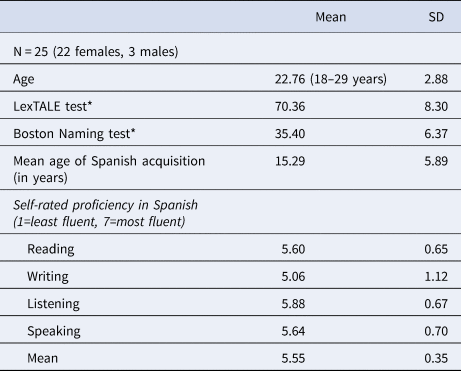
Twenty-four participants was the minimum sample size needed for an estimated size effect of 0.25 (ŋ2) in a minimum set of 4 electrodes (Faul, Erdfelder, Lang & Buchner, Reference Faul, Erdfelder, Lang and Buchner2007). Twenty-nine late learners of Spanish took part in the study (participants’ details are reported in Table 1). Participants first language was English (N = 3), French (N = 5), Italian (N = 9), Portuguese (N = 8) or German (N = 4). Spanish proficiency was assessed using the LexTALE (Izura, Cuetos & Brysbaert, Reference Izura, Cuetos and Brysbaert2014) and Boston Naming tests (Kaplan, Goodglass, Weintraub & Segal, Reference Kaplan, Goodglass, Weintraub and Segal1983). To keep the level of proficiency homogeneous (equivalent to B2-C1 level on the European Common Framework of Reference for Languages), we calculated the average of both tests (M = 52.88, SD = 5.66) and excluded participants who obtained a general score that was more than 2.5 SDs away resulting in the exclusion of 3 participants. Another participant was also excluded because the ERP data exceeded the threshold of artifact rejections (over 40%). The final sample included 25 participants with normal/corrected-to-normal vision and no neurological/psychiatric disorders. The protocol was approved by the Research Ethics Committee of Nebrija University (UNNE-2021–005). After receiving instructions, participants signed a consent form. They received a pro-rata of 10€/hour.
Participants’ proficiency scores in Spanish

*LexTALE test total score: 90
*Boston Naming Test total score: 60
Stimuli
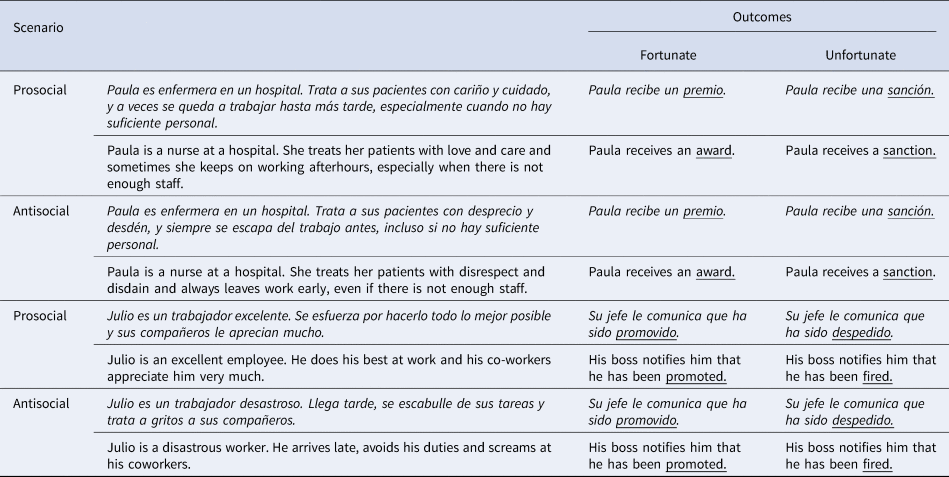
We used the same materials as in Rodríguez-Gómez et al. (Reference Rodríguez-Gómez, Martín-Loeches, Colmenares, Romero Ferreiro and Moreno2020, see note 3 and original artícle for a full description), consisting of 320 scenarios describing the compliance or violation of basic social norms (see Table 2). Materials available at (https://osf.io/ebk9r/). Each trial contained two parts: first, a context scenario that categorised characters as prosocial (altruistic, considerate, cooperative, etc.) or antisocial (self-seeking, inconsiderate, selfish, etc.); second, a target sentence with the critical ending word that indicated a fortunate or unfortunate outcome for the character. Four experimental conditions were distinguished: prosocial characters with a fortunate outcome (prosocial-fortunate), prosocial characters with an unfortunate outcome (prosocial-unfortunate), antisocial characters with a fortunate outcome (antisocial-fortunate), and antisocial characters with an unfortunate outcome (antisocial-unfortunate). Four experimental lists were created to ensure one participant never saw both the prosocial and corresponding antisocial scenario. Each list contained 160 scenarios (40 prosocial-fortunate; 40 prosocial-unfortunate; 40 antisocial-fortunate, and 40 antisocial unfortunate). Participants were randomly assigned to one of the lists.
Examples of experimental scenarios and outcomes in Spanish with the English translation

Procedure
Procedure was the same as in Rodríguez-Gómez et al. (Reference Rodríguez-Gómez, Martín-Loeches, Colmenares, Romero Ferreiro and Moreno2020, see Table 2). Participants silently read the scenarios and answered “yes/no” comprehension questions (e.g., “Is Paula a nurse?”) after 30% of the trials to ensure they were paying attention (M = 82.62%, SD = 6.88). During each trial, participants were first presented with the context and, by pressing the space bar, they initiated the target sentence which appeared word by word. Each word was presented for 300 ms (500 ms for the last word) with 30 ms of inter-words interval. Trials were presented in 4 blocks of 40 trials, separated by a short break. The task was programmed using MatLab (The MathWorks, Natick, MA). After the reading task, participants completed the demographic questionnaire and language proficiency tests. The whole session lasted two hours.
EEG recording and data analysis
EEG activity was recorded continuously from 32 Ag/AgCl electrodes mounted in an electrode cap (Electro-Cap International) distributed according to the international 10–20 system (Jasper, Reference Jasper1958). Electrode impedances were kept below 5 kΩ. Electrodes were referenced online to the left mastoid, amplified with Brain Amps amplifiers (Brain Products, Munich, Germany) at a sampling rate of 250 Hz with an online bandpass of 0.1–1000 Hz, and re-referenced off-line to the mastoid average. The signal was filtered through a 0.1–20 Hz offline band-pass filter. The electrooculographic activity was recorded using vertical and horizontal bipolar electrodes placed at a suprainfraorbital level of the right eye and on the outer canthus of both eyes.
Data was processed using Brain Vision Analyzer (Brain Products, Munich). Ocular correction was realized with Gratton, Coles, and Donchin (Reference Gratton, Coles and Donchin1983) method. For artifact rejection, the following thresholds were set: maximal allowed voltage step, 50 μV; minimal and maximal allowed amplitude, ± 100 μV; lowest allowed activity (max-min), 5 μV for a 1500 ms interval length, resulting in an average of 97% trails remaining per condition. A Butterworth zero phase filter was applied. Epochs ranged from -100 to 900 ms after the onset of the target word. Baseline correction was performed in reference to pre-stimulus activity (-100; 0ms). Individual average trials were then computed for each condition separately.
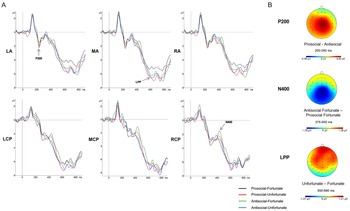
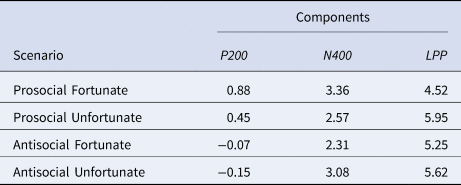
Repeated-measures analysis of variance (ANOVAs) were performed on mean amplitudes (values provided in Table 3) involving: Sociality (prosocial/antisocial), Outcome (fortunate/unfortunate for the P2, N400 and LPP components, and congruent/incongruent for the N400 component), and Regions of Interest (ROIs). A Huynh-Feldt correction was applied for effects with more than one degree of freedom, and Bonferroni correction for multiple comparisons. ROIs were selected to overlap those used in Rodríguez-Gómez et al. (Reference Rodríguez-Gómez, Martín-Loeches, Colmenares, Romero Ferreiro and Moreno2020) in 6 predefined levels: Left Anterior (LA: FP1, F3, FC3), Midline Anterior (MA: FPz, Fz, FCz), Right Anterior (RA: FP2, F4, FC4), Left Centro-Parietal (LCP: C3, CP3, P3), Midline Centro-Parietal (MCP: Cz, CPz, Pz), Right Centro-Parietal (RCP: C4, CP4, P4). Time-windows were determined based on Rodríguez-Gómez et al. (Reference Rodríguez-Gómez, Martín-Loeches, Colmenares, Romero Ferreiro and Moreno2020) and previous literature as follows: 200–250 ms for the P2 component (Leuthold et al., Reference Leuthold, Kunkel, Mackenzie and Filik2015; Van Berkum et al., Reference Van Berkum, Holleman, Nieuwland, Otten and Murre2009), 375–500 ms for the N400 (Kutas & Federmeier, Reference Kutas and Federmeier2011) and 550–680 ms for the LPP (Van Berkum et al., Reference Van Berkum, Holleman, Nieuwland, Otten and Murre2009). Grand means are presented in Figure 1.
A. Brainwaves elicited in response to the final outcome (fortunate or unfortunate) to prosocial and antisocial protagonists in regions Left Anterior (LA: FP1, F3, FC3), Midline Anterior (MA: FPz, Fz, FCz), Right Anterior (RA: FP2, F4, FC4), Left Centro-Parietal (LCP: C3, CP3, P3), Midline Centro-Parietal (MCP: Cz, CPz, Pz), Right Centro-Parietal (RCP: C4, CP4, P4). Negative voltage (in microvolts) is plotted up. Time 0 (in milliseconds) in the X-axis, indicated the onset of the critical final word of the sentence. B. Voltage maps show the distribution of each of these effects across the scalp (difference brainwaves).

Amplitude values in μV for components P200, N400 and LPP for each condition

Results
P2 (200–250 ms)
The omnibus ANOVA revealed a significant main effect of ROIs (F(5, 120) = 7.19, p = .002; ŋ2p = .231). The factors Sociality (F(1, 24) = 3.31, p = .081; ŋ2p = .121) and Outcome (F (1, 24) = 0.19, p = .667; ŋ2p = .008) did not reach significance. Analyses in individual ROIs showed a significant main effect of Sociality at centro-parietal regions (LCP: F(1, 24) = 5.07, p = .034; ŋ2p = .175: MCP: F(1, 24) = 6.45, p = .018; ŋ2p = .212; RCP: F(1, 24) = 5.31, p = .030; ŋ2p = .181), with larger amplitudes for the prosocial condition than the antisocial condition.
N400 (375–500 ms)
Due to the possible influence of the P200 on the N400 component, and following the suggestion of an anonymous reviewer, waveforms were renormalized with respect to the P200 latency window following procedure by Hagoort (Reference Hagoort2003). The omnibus ANOVA on the renormalized amplitude values in the 375–500 ms latency range resulted in a significant effect of ROIs (F(5, 120) = 12.88, p = .000; ŋ2p = .349). The interaction Sociality x Outcome was significant at centro-parietal sites (LCP: F(1, 24) = 4.15, p = .053, ŋ2p = .147; MCP: F(1, 24) = 4.32, p = .048; ŋ2p = .153). Post-hoc analyses showed larger amplitude for unfortunate outcomes to prosocial protagonists than antisocial protagonists (p = .049). The difference for fortunate outcome for prosocial vs. antisocial protagonists did not reach significance (p = .846).
LPP (550–680 ms)
The analysis yielded a significant main effect of ROIs (F(5, 120) = 7.65, p = .001; ŋ2p = .242). Sociality (F(1, 24) = 0.61, p = .807; ŋ2p = .003) and Outcome (F(1, 24) = 2.51, p = .126; ŋ2p = .095) were not significant. The interaction ROIs x Sociality x Outcome was also significant (F(5, 120) = 4.915, p =.010; ŋ2p = .170). Individual analyses of ROIs revealed a significant effect of Outcome at anterior regions (LA: F(1, 24) = 4.59, p = .042, ŋ2p = .161; MA: F(1, 24) = 4.35, p = .048; ŋ2p = .154), with a larger LPP for the unfortunate outcomes than the fortunate outcomes, independently of the type of sociality.
Discussion
The study examined whether social factors impact sentence processing in L2, using the social scenarios presented in Rodríguez-Gómez et al. (Reference Rodríguez-Gómez, Martín-Loeches, Colmenares, Romero Ferreiro and Moreno2020), which relate (un)fortunate outcomes to pro/antisocial individuals. The original study showed that language processing cannot be dissociated from social/moral emotions and our perception of pro/antisocial individuals. We hypothesized that the interpretation of such outcomes would reveal different neural patterns in L2 than in L1, because L2 users usually have more difficulties integrating multiple types of information, especially emotion-laden information (Foucart et al., Reference Foucart, Moreno, Martin and Costa2015a), and the often reduced emotional responses in L2 (Pavlenko, Reference Pavlenko2012) would provoke fewer social/moral emotions towards the individuals. In contrast to our expectations, the results for L2 users resembled those reported for L1 users.
At early stages, we observed a larger positive effect for prosocial than antisocial characters, regardless of their outcome, as in Rodríguez-Gómez et al. (Reference Rodríguez-Gómez, Martín-Loeches, Colmenares, Romero Ferreiro and Moreno2020). A larger P2 reflects greater attention to the speaker (Van Berkum et al., Reference Van Berkum, Holleman, Nieuwland, Otten and Murre2009; Foucart & Brouwer, Reference Foucart and Brouwer2021) or, in this case, the protagonist involved in the scenario. We hypothesized that the feelings provoked by the description of a pro/antisocial behaviour may not be as intense when reading a scenario in L2 than in L1 due to a reduced emotional response in L2 (Pavlenko, Reference Pavlenko2012). The results disconfirm this hypothesis and suggest that social/moral emotions are processed online during L2 sentence comprehension, at early stages, for higher-intermediate L2 users.
The main component of interest, the N400, was larger for unfortunate outcomes to prosocial protagonists than antisocial protagonists, reflecting that an unfair outcome provokes effortful processing, at least when it happens to a prosocial character. This effect suggests that L2 users applied the feelings towards the character they had built from the context (as revealed by the P2 effect) to interpret the outcome of the scenario. Hence, L2 users simultaneously integrated semantic and prior discourse-pragmatic information to process the sentence online, like L1 users in Rodríguez-Gómez et al. (Reference Rodríguez-Gómez, Martín-Loeches, Colmenares, Romero Ferreiro and Moreno2020). Note that, in the original study, the pattern was slightly different since the N400 effect was driven by a reduced amplitude for unfortunate outcomes to antisocial characters and not by a larger amplitude for unfortunate outcomes to prosocial characters, like here. To confirm whether the patterns in L1 and L2 were indeed different, we conducted an analysisFootnote 4 in the N400 time-window directly comparing the original L1 data to the L2 data, which revealed no interaction by group. This result indicates that the effects are not significantly driven by one condition or the other, and thus, the apparently distinct patterns cannot be attributed to differences in terms of discourse processing between L1 and L2. Our findings contrast with Foucart et al.'s (Reference Foucart, Moreno, Martin and Costa2015a) that revealed an absence of N400 (but presence of LPP) in the L2 group when they evaluated statements in relation to one's moral values. The authors concluded that, during L2 sentence comprehension, valuation is integrated online (presence of LPP) but it does not interfere with semantic processing (absence of N400). Here we show that social/moral emotions triggered by a pro/antisocial protagonist interfere with semantic processing. The contrast between these results could be accounted for by many factors (e.g., language proficiency, stimuli, type of emotion) that we cannot verify with the present data and that should be addressed in future studies.
Post N400, we observed a larger LPP component for unfortunate than fortunate outcomes. The direction of the effect was similar as in Rodríguez-Gómez et al. (Reference Rodríguez-Gómez, Martín-Loeches, Colmenares, Romero Ferreiro and Moreno2020), which indicates that L2 users processed emotional concepts as L1 users, and particularly that negative stimuli (i.e., unfortunate outcome) required more reanalysis/reevaluation than positive ones. Note, however, that the effect was delayed by 50 ms compared to the original study. This result is in line with previous studies that have shown that with enough proficiency L2 users can process emotional content as L1 users (Conrad, Recio & Jacobs, Reference Conrad, Recio and Jacobs2011; Sutton, Altarriba, Gianico & Basnight-Brown, Reference Sutton, Altarriba, Gianico and Basnight-Brown2007), that negative and positive stimuli are not processed in the same manner (Jończyk, Korolczuk, Balatsou & Thierry, Reference Jończyk, Korolczuk, Balatsou and Thierry2019; Wu & Thierry, Reference Wu and Thierry2012;), and that valuation is integrated online but requires extra processing in L2 (Foucart et al., Reference Foucart, Moreno, Martin and Costa2015a).
To conclude, this study explored the integration of social/moral emotions and semantic processing to interpret meaning during L2 discourse comprehension. Our findings revealed similar neural patterns in L2 as in the L1 study we extended (Rodríguez-Gómez et al., Reference Rodríguez-Gómez, Martín-Loeches, Colmenares, Romero Ferreiro and Moreno2020), suggesting that L2 users simultaneously integrate semantic and discourse-pragmatic information.
Acknowledgments
The study was supported by the Spanish Government (FEDER/Ministerio de Ciencia, Innovación y Universidades, FFI2017-83166-C2-2-R, PID2020-115175RB-I00) and the Community of Madrid and the European Social Fund (H2019/HUM5772). Andrea González-García was supported by a grant from the Spanish Government (FPU20/06880)
Data availability
The data that support the findings will be available in Open Science Framework upon publication. Materials available at (https://osf.io/ebk9r/).