Introduction
Granulomas may be idiopathic in nature or may result from voice abuse, laryngopharyngeal reflux (LPR) or intubation. In some patients, the cause is probably multifactorial and requires combined therapy in order to effectively resolve the matter. Granulomas are associated clinically with odynophonia, frequent throat-clearing, globus and otalgia. Treatment algorithms have been based on multi-modality therapy, including voice therapy, anti-reflux medications, surgical excision, systemic and inhaled steroids, and antibiotic regimens.Reference Havas, Priestley and Lowinger1 Despite targeted therapy, such as voice therapy for vocal abusers and anti-reflux therapy for patients with LPR, granuloma recurrence rates are 15 to 20 per cent, with an even higher recurrence rate of 60 per cent in patients with idiopathic granulomas.Reference de Lima Pontes, De Biase and Gadelha2 The repetitive traumatic contact of the vocal processes during speaking, swallowing and coughing – analogous to a hammer striking an anvil (as originally purported by Jackson and Jackson)Reference Jackson and Jackson3 – may prevent this area from healing, thus accounting for the refractory nature of granulomas.
In 1994, Berke and colleagues introduced a novel therapy in the treatment of laryngeal granulomas.Reference Nasri, Sercarz, McAlpin and Berke4 Botulinum toxin type A (Botox, Allergan, Irvine, California, USA) was injected into one or both vocal folds to induce temporary vocal fold paresis, allowing resolution of granulomas in six patients. The success of this therapy was confirmed by Orloff and Goldman, who noted resolution of granulomas in eight patients treated with botulinum toxin.Reference Orloff and Goldman5 Although voice therapy and anti-reflux therapy probably play significant roles in the overall treatment of laryngeal granulomas, the recovery period enabled by the paresis may be essential in order to prevent rapid recurrence.
Encouraged by the success of these previous studies, the current study investigated the utility of botulinum toxin in managing refractory granulomas in seven patients, all of whom had undergone some form of medical, surgical and/or speech therapy.
Materials and methods
This study was approved by the Institutional Review Board of the Stanford University Medical Center.
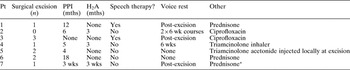
Two patients with bilateral and five patients with unilateral vocal process granulomas were treated with botulinum toxin. All patients had been treated previously with surgical excision, speech therapy and/or medical therapy (consisting of proton pump inhibitors, antibiotics, and oral or inhaled steroids) (Table I). Five patients had undergone prior surgical excision and three had undergone speech therapy. Six patients described a history of an upper respiratory tract infection with prolonged coughing prior to the onset of their laryngeal symptoms. Two patients noted a strong personal history of voice overuse. One patient had a history of intermittent reflux symptomatology. All patients who had been referred to our institution for therapy were symptomatic. Laryngeal symptoms consisted of a foreign body sensation, sore throat and odynophonia. Most patients had more than one of the aforementioned symptoms.
Prior treatments and duration

*Stopped early due to side effects (headache, nausea and diarrhoea). Pt = patient; PPI = proton pump inhibitor; H2A = H2 antagonist; mths = months; wk = weeks
Pre- and post-treatment examinations were performed using the Olympus ENF-P4 fibre-optic rhinolaryngoscope (Olympus America, Melville, New York, USA) or the Kay Elemetrics 90° rigid endoscope (Kay Elemetrics, Lincoln Park, New Jersey, USA). These were attached to a Storz Tricam SL camera head, processor and light source (Karl Storz, Culver City, California, USA) and the image recorded to videotape. In order to document the granuloma and the response to therapy, a videoprint was made using a UP 21 MD colour video printer (Karl Storz).
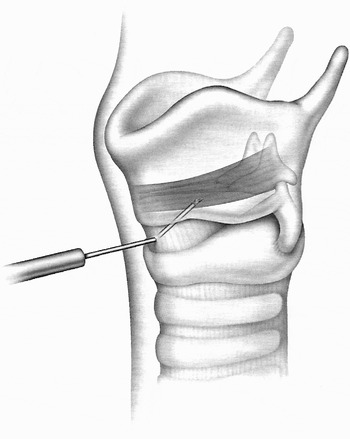
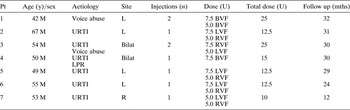
All patients received percutaneous injection of botulinum toxin into both vocal folds, using the point-touch technique as originally described by Green et al. Reference Green, Berke, Ward and Gerratt6 (Table II). The patient was seated upright in the examination chair and their anterior neck landmarks examined, including the cricoid cartilage, the superior notch of the thyroid cartilage, the hyoid bone and the cricothyroid membrane. Botulinum toxin was diluted to a concentration of 25 U/ml with sterile, preservative-free saline. This was then drawn into a 1 ml syringe and attached to a 27 gauge, 31.7 mm needle. The inferior border of the thyroid ala was identified and the needle inserted inferior to this, through the cricothyroid membrane and into the muscular portion of the ipsilateral vocal fold (Figure 1). The procedure was then repeated identically on the contralateral side. No topical or local anaesthesia was needed. Because the external laryngeal landmarks precisely localised the vocal fold, fibre-optic visualisation was not needed to perform the injections.
Injection of botulinum toxin percutaneously via the cricothyroid membrane into the vocal fold, using a 27 gauge needle. Reprinted with permission.7

Results
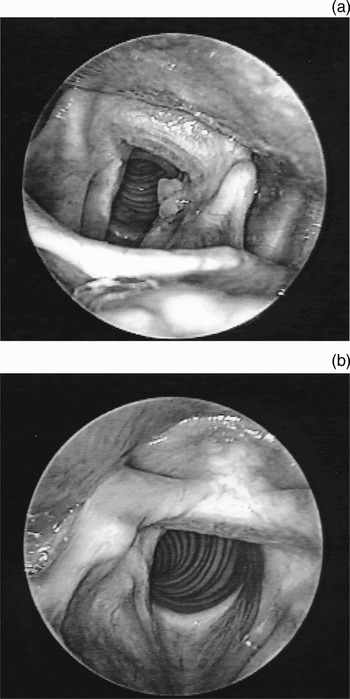
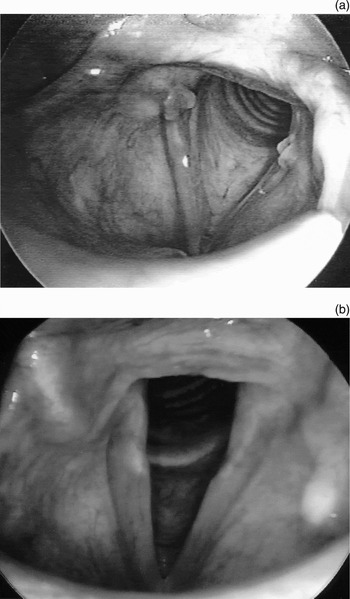
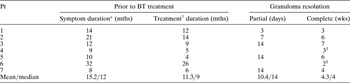
Patient follow up varied, from a minimum of 12 months to a maximum of 32 months (median 30 months, mean 27 months). All patients experienced resolution of their granulomas (Table III). Figure 2 shows the pre- and post-injection states of patient two, with a unilateral granuloma. Figure 3 shows the pre- and post-injection states of patient four, with bilateral granulomas. Improvement was seen in as little as three days (mean 10.4 days), with a complete response occurring between two and seven weeks after injection (mean 4.3 weeks).
Laryngoscopic views of patient 2. (a) Left unilateral vocal process granuloma; (b) six weeks after botulinum toxin treatment.

Laryngoscopic views of patient 4. (a) Bilateral vocal process granulomas; (b) three weeks after botulinum toxin treatment.

Characteristics of patients treated with botulinum toxin

Pt = patient; y = years; mths = months; M = male; L = left; BVF = bilateral vocal folds; URTI = upper respiratory tract infection; LVF = left vocal fold; RVF = right vocal fold; bilat = bilateral; LPR = laryngopharyngeal reflux
Patient one was noted to have persistent contact of the vocal processes three days following injection, although the voice itself had become hoarse and the granuloma was seen to be 50 per cent of its initial size. This patient underwent an additional injection of 5 U to each side to further weaken the contact between the vocal processes.
Duration of symptoms and therapy prior to botulinum toxin treatment, compared with resolution of granuloma post-treatment

*From onset of symptoms (as noted initially by patient) to first botulinum toxin (BT) injection. †Treatment other than BT, including surgery, medication and voice therapy. ‡Complete resolution seen at first post-treatment visit.
Patient three had bilateral granulomas. Two weeks following his initial injection, one granuloma had resolved and the other had reduced to the appearance of a small fullness at the vocal process. However, by the fifth week after injection, the patient noted a sense of irritation on the left, and a repeat evaluation showed persistence of the left vocal process fullness. The voice was also notably stronger than it had been at the prior examination. Therefore, a repeat injection to both folds was given. The patient subsequently developed resolution of the remaining granuloma, as observed in the seventh week of treatment.
All patients subjectively noted significant dysphonia following their injections. Four of seven patients noted dysphagia, primarily for liquids, for four to six weeks following the injections, but all of these patients were able to manage this by tilting the chin down and swallowing more slowly. No patients required dietary modification or a feeding tube, or developed aspiration pneumonia. Six of the seven patients were working and one was retired. All of the employed patients continued to work full-time. There were no complications from the injection itself (e.g. local haematoma or infection).
Discussion
Although the exact pathophysiology of the laryngeal granuloma is a matter of debate, it appears that some form of initial traumatic or irritative phenomenon causes a disruption in the mucosa over the vocal process. When speaking, coughing and swallowing, the vocal processes are brought into repetitive, traumatic contact, resulting in the development or persistence of a granuloma. In the setting of constant motion, irritation or pressure, the granuloma may prove chronic and difficult to resolve. By weakening the adductory force of the vocal folds with botulinum toxin, it may be that enough pressure is relieved at the level of the vocal processes to allow the mucosa to heal and the granuloma to resolve.
In the current series, six of the seven patients developed an upper respiratory tract infection with significant coughing prior to the onset of their symptoms. This is somewhat different from other published series, wherein the predominant aetiology of the granulomas was strongly linked to LPR or voice abuse. While it may be suggested that these patients were mistaking the symptoms of reflux for those of an upper respiratory tract infection, this seems unlikely, given the reported accompanying features such as fever and mucopurulent cough. These patients possibly had underlying factors that would have predisposed them to the formation of granulomas, such as LPR or voice abuse, and the ensuing infection simply tipped the balance toward granuloma formation. Since elucidation of the exact aetiology of a granuloma may be difficult, directed therapy may prove even more so. What is compelling about the current study group is that all the patients' granulomas resolved with botulinum toxin, as has been reported in prior studies. Therefore, whatever the aetiology of the granuloma, botulinum toxin therapy merits consideration, especially when other methods have failed.
Much criticism of the role of botulinum toxin in treating laryngeal granulomas has focused on the hoarseness which ensues following injection. In this series, every patient who was working full-time continued to do so without any significant disruption in their productivity. For those patients who rely on optimal vocal function to earn a living, botulinum toxin may or may not be the best initial treatment option. The time needed to recover from the injection must be weighed against the time invested in speech therapy and anti-reflux treatments, or against the potential long-term complications of surgery. Obviously, the needs and expectations of the individual patient need to be weighed against the expected risks and benefits of any form of therapy.
In the two patients who were examined within two weeks of injection, marked resolution of the granulomas could already be seen. It appears that once the vocal folds are weakened, corresponding to the onset of hoarseness, the granulomas begin to resolve. Given this observation, it seems reasonable to assert that it is the effect of the botulinum toxin itself rather than the delayed effects of the previous interventions (e.g. voice therapy) which is responsible for the improvement.
Two of our patients received an extra injection of botulinum toxin. Patient one was noted to have persistent contact of the vocal processes after the initial injection, and patient three was noted to have residual disease on the left vocal process after five weeks. In the resolution of a granuloma, we feel that it is important for the vocal folds to remain in a weakened state long enough for the vocal processes to heal. Therefore, in patients one and three, extra doses were given to weaken the vocal folds further and thus to gain more time for healing. Monitoring patients in the weeks following injection may be important in order to assess their response to the botulinum toxin; if it is judged that more time is needed to allow for healing, a second injection should be contemplated.
In the current series, as in prior series, most patients received between 10 and 30 U of botulinum toxin, which is usually enough to induce significant hoarseness. If the voice does not change, one must question whether sufficient botulinum toxin is present to effect resolution of the granuloma. It is interesting that Orloff and Goldman noted granuloma resolution in a patient treated with only 1.25 U of botulinum toxin to both vocal folds.Reference Orloff and Goldman5 This raises the question as to the minimal effective dose capable of achieving granuloma resolution. Currently, this remains to be determined, but lower doses could mean less prolonged hoarseness for the patient.
Overall, botulinum toxin therapy may represent a cost-effective alternative to other treatment modalities. Six of the seven patients presented in this series had previously had one or more direct laryngoscopies under general anaesthesia in order to remove their granuloma. Three of the seven patients had undergone speech therapy. Five of the seven patients had been treated with antacid therapy, most commonly proton pump inhibitors. All patients had undergone courses of antibiotics or steroids prior to definitive treatment.
• This study evaluated the role of botulinum toxin type A in the treatment of refractory laryngeal granulomas
• Seven patients with vocal process granulomas underwent percutaneous injection of botulinum toxin into both vocal folds, performed in the office setting
• All patients experienced resolution of their granulomas over two to seven weeks. All patients experienced hoarseness secondary to the injections, but voice quality returned to baseline in all patients as the toxin was degraded
• Botulinum toxin is a safe and effective therapy in resolving vocal process granulomas in patients refractory to traditional therapy
At our institution, the average cost of a 100 U bottle of botulinum toxin was US$540, and the botulinum toxin was injected in a clinic setting using the point-touch technique, avoiding operative and anaesthesia costs. This is not an inconsequential consideration when compared with the costs of current medical treatment, which may include proton pump inhibitors and other drugs, surgery and voice therapy. When factoring in clinic visit costs as well as inconvenience to the patient, a therapy which may offer an enhanced cure rate must be considered within our armamentarium of treatment options.
A significant weakness of this study was that all patients had received a variety of therapies prior to presentation to our institution. It is possible that the initial treatment outcomes would have been better had all patients undergone more carefully controlled therapy under the care of one provider. For example, perhaps the three patients who had undergone formal speech therapy would have had a more favourable result if their speech therapist had had more experience in treating granuloma patients. Perhaps twice-daily dosing with proton pump inhibitors plus a nightly H2 antagonist would have been more effective than the once- or twice-daily dosing of proton pump inhibitors alone received by most patients. The variability in therapies currently being employed to treat vocal process granulomas, as outlined in Table I, serves to emphasise the refractory nature of this condition. Until the pathophysiology of this problem is understood completely, botulinum toxin therapy should be considered as a viable option for our patients, particularly when other modalities fail.